

The biomass distribution on Earth
Open accessThe DOI matches its Crossref record; 263 of the 263 references it cites were found in a registry or an index; 11 of the 41 sources its claims cite were checked for support.
Abstract
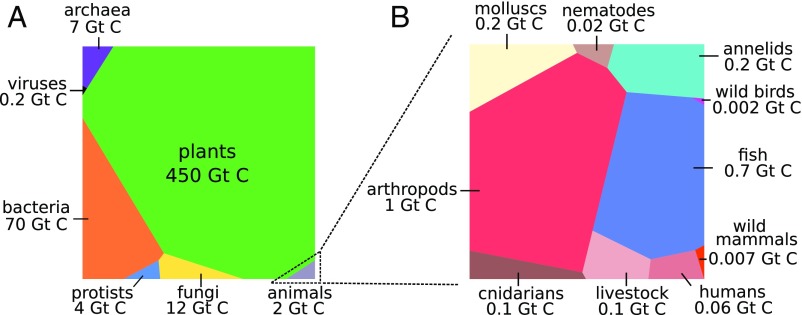
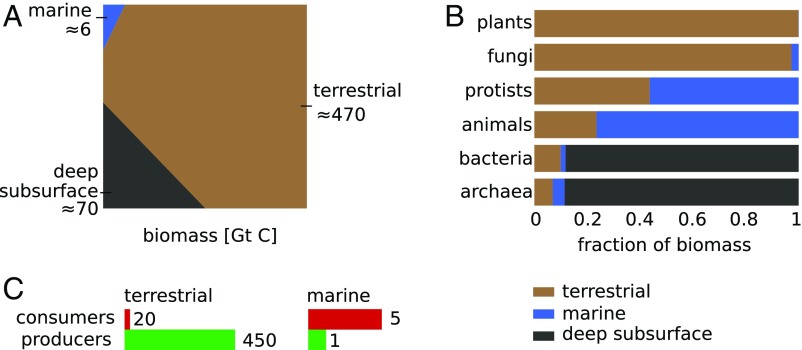
A census of the biomass on Earth is key for understanding the structure and dynamics of the biosphere. However, a global, quantitative view of how the biomass of different taxa compare with one another is still lacking. Here, we assemble the overall biomass composition of the biosphere, establishing a census of the ≈550 gigatons of carbon (Gt C) of biomass distributed among all of the kingdoms of life. We find that the kingdoms of life concentrate at different locations on the planet; plants (≈450 Gt C, the dominant kingdom) are primarily terrestrial, whereas animals (≈2 Gt C) are mainly marine, and bacteria (≈70 Gt C) and archaea (≈7 Gt C) are predominantly located in deep subsurface environments. We show that terrestrial biomass is about two orders of magnitude higher than marine biomass and estimate a total of ≈6 Gt C of marine biota, doubling the previous estimated quantity. Our analysis reveals that the global marine biomass pyramid contains more consumers than producers, thus increasing the scope of previous observations on inverse food pyramids. Finally, we highlight that the mass of humans is an order of magnitude higher than that of all wild mammals combined and report the historical impact of humanity on the global biomass of prominent taxa, including mammals, fish, and plants.
Overview
CoChat Summary
TL;DR
The paper assembles a global census of biomass across all kingdoms of life, estimating Earth’s total biomass at ≈550 Gt C, dominated by plants. It also compares biomass across environments and trophic modes, highlighting large uncertainties and human impacts on the biosphere.
Key findings
- Total global biomass is ≈550 Gt C, with plants ≈450 Gt C (≈80%), bacteria ≈70 Gt C (≈15%), fungi ≈12 Gt C, archaea ≈7 Gt C, protists ≈4 Gt C, animals ≈2 Gt C, and viruses ≈0.2 Gt C.
- Land biomass (≈470 Gt C) is about two orders of magnitude higher than marine biomass (≈6 Gt C); the deep subsurface holds ≈15% of total biomass, chiefly bacteria and archaea.
- In the ocean, ≈1 Gt C of primary producers supports ≈5 Gt C of consumer biomass, an inverted standing biomass distribution; marine biomass is ≈70% microbes, mainly bacteria and protists.
- Human-associated biomass is large relative to wild vertebrates: humans ≈0.06 Gt C, livestock ≈0.1 Gt C, wild mammals ≈0.007 Gt C, domesticated poultry ≈0.005 Gt C versus wild birds ≈0.002 Gt C; total plant biomass has declined approximately twofold relative to pre-human civilization.
Methods
- The authors synthesize hundreds of studies and generate estimates for major taxonomic groups, reporting biomass as gigatons of carbon (Gt C) and using a kingdom-level framework plus viruses.
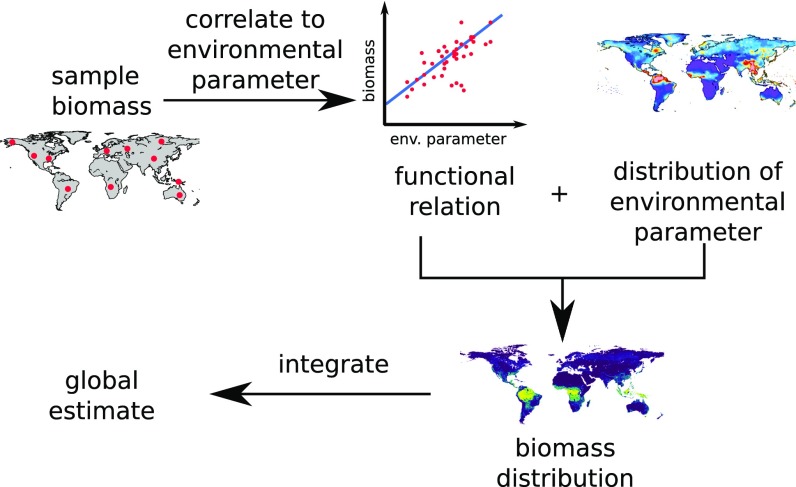
- For many taxa, local biomass samples are extrapolated globally by correlating biomass density with environmental parameters known at global scale; best estimates often use a geometric mean of independent estimates.
- Uncertainty is reported as multiplicative fold-change projections akin to 95% confidence intervals, incorporating intrastudy, interstudy, and intermethod variation; data and code are open-sourced.
Limitations
- The paper states that most datasets rely on fragmentary sampling, causing large uncertainties; sampling is scarce in the deep ocean (usually deeper than 200 m) and deep soil (usually deeper than 1 m), and some estimates may be biased by sampling toward high-abundance areas.
- The paper states that deep subsurface environments have particularly high uncertainty and unknown systematic biases, including unresolved distribution of biomass between aquifer fluids and rocks and among microbial taxa.
- The paper states that current and prehuman vertebrate biomass estimates are only a crude first step, amphibians remain poorly characterized, and parasite biomass is not resolved from hosts; evident from the text, kingdom-level grouping was chosen because much data lack finer taxonomic detail, and some uncertainty projections rely on analogous taxa or expert consultation.
Model-written summary. Check it against the paper before relying on it.
Integrity signals
Registry
Cites
Statistics
Figures
Verification
Claims the paper makes
9 Valid · 7 Not valid · 16 Not checked · 53 Own results and interpretations
Every source the paper cites for this claim was checked and supports it.
In the paper
“The biomass of amphibians, which are experiencing a dramatic population decline (42), remains poorly characterized.”
§ The biomass distribution on Earth > Discussion
What the sources say
- Supportedcites [42] Wake DB Vredenburg VT 2008 Colloquium paper: Are we in the midst of the sixth mass extinction? A view from the world of amphibians Proc Natl Acad Sci USA 105 11466 11473 18695221 PMC2556420 source
The citation is attached to the clause about amphibian population decline, not the separate statement that their biomass is poorly characterized. The passage reporting the Global Amphibian Assessment (labeled Abstract in our copy) says that 43% of amphibian species have declining populations. (LLM, conf=0.92)
plain- Asserted: passes — The authors put it forward as true.
- Checkable: passes — It can be checked against evidence.
- Load-bearing: unclear — It is unclear whether the paper’s conclusions depend on it.
- Based: passes — The paper gives a reason why it holds.
- Supported
Every source the paper cites for this claim was checked and supports it.
In the paper
“In the case of prokaryotes, some major improvements were recently realized, with global estimates of marine deep subsurface prokaryote biomass reduced by about two orders of magnitude due to an increased diversity of sampling locations (7).”
§ The biomass distribution on Earth > Discussion
What the sources say
- Supportedcites [7] Kallmeyer J Pockalny R Adhikari RR Smith DC D’Hondt S 2012 Global distribution of microbial abundance and biomass in subseafloor sediment Proc Natl Acad Sci USA 109 16213 16216 22927371 PMC3479597 source
The Discussion reports a revised subseafloor microbial biomass estimate of 4.1 Pg C versus a previous estimate of 303 Pg C—about a 74-fold reduction. It also identifies a more geographically diverse sampling database, including low-abundance ocean gyres, as a reason the new estimate is lower. The paper identifies other contributing factors as well. (LLM, conf=0.88)
plainstates a cause- Asserted: passes — The authors put it forward as true.
- Checkable: passes — It can be checked against evidence.
- Load-bearing: unclear — It is unclear whether the paper’s conclusions depend on it.
- Based: passes — The paper gives a reason why it holds.
- Supported
The sources with a verdict support this claim; the rest weren’t checked yet, have no full text we could read, or their verdicts aren’t rated yet.
In the paper
“Such inverted biomass distributions can occur when primary producers have a rapid turnover of biomass [on the order of days (34)], while consumer biomass turns over much more slowly [a few years in the case of mesopelagic fish (35)].”
§ The biomass distribution on Earth > Results > The Distribution of Biomass Across Environments and Trophic Modes.
What the sources say
- Supportedcites [34] Zubkov MV 2014 Faster growth of the major prokaryotic versus eukaryotic CO2 fixers in the oligotrophic ocean Nat Commun 5 3776 24777140 PMC4015317 source
The Results (Comparison of the growth rates of the CO2 fixers; page unavailable) report growth rates of 0.1–0.6 per day for the studied oceanic primary producers, consistent with biomass turnover on the order of days. The few-years estimate for mesopelagic fish is assigned to a different citation, not this source. (LLM, conf=0.91)
- Not checked — no full text of the sourcecites [35] Catul V Gauns M Karuppasamy PK 2011 A review on mesopelagic fishes belonging to family Myctophidae Rev Fish Biol Fish 21 339 354 source
plainstates a possible cause- Asserted: passes — The authors put it forward as true.
- Checkable: passes — It can be checked against evidence.
- Load-bearing: passes — The paper’s conclusions depend on it.
- Based: passes — The paper gives a reason why it holds.
- Supported
The cited sources support only part of this claim — read each source’s verdict below.
In the paper
“Combining data from independent sources such as these enables a robust assessment of the total plant biomass (17).”
§ The biomass distribution on Earth > Results > The Uncertainty Associated with Global Biomass Estimates.
What the sources say
- Partly supportedcites [17] Erb K-H 2017 Unexpectedly large impact of forest management and grazing on global vegetation biomass Nature 553 73 76 29258288 PMC5756473 sourceExperimental — accuracy not yet measured
The Methods describe combining multiple datasets and types of evidence to estimate global vegetation biomass stocks. But the paper also says global stocks remain uncertain, reports uncertainty ranges around 35% of the median estimate, and describes more robust estimates as a future prospect. It therefore supports the use of independent sources for an assessment, but not the unqualified characterization of that assessment as robust. (LLM, conf=0.84)
plainstates a cause- Asserted: passes — The authors put it forward as true.
- Checkable: passes — It can be checked against evidence.
- Load-bearing: passes — The paper’s conclusions depend on it.
- Based: passes — The paper gives a reason why it holds.
- Partly supported
A result the paper states — it cites no source for it, so there is none to check. The quote shows it is in the paper.
In the paper
“Plant biomass includes ≈70% stems and tree trunks, which are mostly woody, and thus relatively metabolically inert.”
§ The biomass distribution on Earth > Results > The Biomass Distribution of the Biosphere by Kingdom.
plain- Asserted: passes — The authors put it forward as true.
- Checkable: passes — It can be checked against evidence.
- Load-bearing: unclear — It is unclear whether the paper’s conclusions depend on it.
- Based: passes — The paper gives a reason why it holds.
27 more claims
Create a free account to see all 85 claims and to verify the 2 references still open.
- It may state two separate claims as one. 32
- Probably not a substantial claim. 28
Claims other papers make about this one
Each is checked against this paper’s own text: does it say what the citing paper says it does?
The cited source doesn’t support the claim as written.
In the citing paper
“and less than 10% that of the world ' s current human population ( 52 ).”
From Pervasive human-driven decline of life on Earth points to the need for transformative change (2019) · cites this paper as [52]
Checked by a reasoning model — may be wrong.
Experimental — accuracy not yet measuredThe cited source says what the claim attributes to it.
In the citing paper
“Approximately 450 Gt of C is bound up in terrestrial biota, primarily in plants (86), while only ~6 Gt of C is found in ocean biota (87).”
From Earth beyond six of nine planetary boundaries (2023) · cites this paper as [87]
The cited source says what the claim attributes to it.
In the citing paper
“The amount of metabolic energy available to a biosphere powered by O 2 is vast, such that the O 2 -rich ocean-atmosphere system of the modern Earth supports staggering levels of standing biomass (Bar-On et al. 2018), energy flow (Falkowski et al. 2008), and ecological complexity (Steele 1974).”
From The History of Ocean Oxygenation (2022) · cites this paper as Bar-On et al. 2018
In the citing paper
“Global populations of domestic ruminants (cattle, sheep, and goats) (Ripple et al. 2013) poultry, and pigs (Bennett et al. 2018) used to feed the growing human population now exceed 100 million tons of carbon (Bar-On et al. 2018), and livestock populations are growing rapidly.”
From Scientists’ warning to humanity on the freshwater biodiversity crisis (2021) · cites this paper as Bar-On et al. 2018
Citations
Cites
The worldwide leaf economics spectrum
Wright, I. J., Reich, P. B., Westoby, M., Ackerly, D. D., Baruch, Z., Bongers, F., Cavender-Bares, J., Chapin, T., Cornelissen, J. H. C., Diemer, M., et al. (2004) · Nature · doi:10.1038/nature02403 · Cited by 9,021 · cited 1×
“We then convert the total area of leaves to an estimate of the total dry mass of leaves by using the Glopnet database (24), which measured leaf mass per area (LMA) for ≈2500 plant species.”
MethodA large and persistent carbon sink in the world’s forests
Pan, Y., Birdsey, R. A., Fang, J., Houghton, R., Kauppi, P. E., Kurz, W. A., Phillips, O. L., Shvidenko, A., Lewis, S. L., Canadell, J. G., et al. (2011) · Science · doi:10.1126/science.1201609 · Cited by 8,458
Soil Sampling and Methods of Analysis
(2007) · CRC Press eBooks · doi:10.1201/9781420005271 · Cited by 6,469
Primary production of the biosphere: Integrating terrestrial and oceanic components
Field, C. B., Behrenfeld, M. J., Randerson, J. T., & Falkowski, P. (1998) · Science · doi:10.1126/science.281.5374.237 · Cited by 6,371
Prokaryotes: The unseen majority
Whitman, W. B., Coleman, D. C., & Wiebe, W. J. (1998) · Proceedings of the National Academy of Sciences · doi:10.1073/pnas.95.12.6578 · Cited by 4,871
Global effects of land use on local terrestrial biodiversity
Newbold, T., Hudson, L. N., Hill, S. L. L., Contu, S., Lysenko, I., Senior, R. A., Börger, L., Bennett, D. J., Choimes, A., Collen, B., et al. (2015) · Nature · doi:10.1038/nature14324 · Cited by 4,352
Belowground biodiversity and ecosystem functioning
Bardgett, R. D., & van der Putten, W. H. (2014) · Nature · doi:10.1038/nature13855 · Cited by 3,990 · cited 4×
“This was recommended by experts in the field for estimation of arbuscular mycorrhizal fungi abundance (117).”
BackgroundInfluentialMangroves among the most carbon-rich forests in the tropics
Donato, D. C., Kauffman, J. B., Murdiyarso, D., Kurnianto, S., Stidham, M., & Kanninen, M. (2011) · Nature Geoscience · doi:10.1038/ngeo1123 · Cited by 3,374
Poorter, H., Niklas, K. J., Reich, P. B., Oleksyn, J., Poot, P., & Mommer, L. (2012) · New Phytologist · doi:10.1111/j.1469-8137.2011.03952.x · Cited by 3,163 · cited 1×
“The first relies on a meta-analysis of the biomass allocation to different plant compartments across biomes (19).”
BackgroundA global analysis of root distributions for terrestrial biomes
Jackson, R. B., Canadell, J., Ehleringer, J. R., Mooney, H. A., Sala, O. E., & Schulze, E. D. (1996) · Oecologia · doi:10.1007/bf00333714 · Cited by 3,071 · cited 4×
“assumed the distribution of microbial biomass with depth follows the biomass density versus depth profile of root biomass (21).”
BackgroundMethodInfluential
Research works printed but not linked: 1
- Chapman AD 2009 Numbers of Living Species in Australia and the World Australian Biological Resources Study Canberra, Australia
Cited by
Items 401–500 of 3,743
Life as Aftermath: Social Theory for an Age of Anthropogenic Biology
Landecker, H. L. (2024) · Science Technology & Human Values · doi:10.1177/01622439241233946 · Cited by 70
“For example, the concept of the anthropogenic biome was introduced in 2008 to describe “terrestrial biomes based on global patterns of sustained, direct human interaction with ecosystems,” covering more than 75 percent of Earth’s ice-free land (Ellis and Ramankutty 2008, 439).”
Diaz, B. P., Knowles, B., Johns, C. T., Laber, C. P., Bondoc, K. G. V., Haramaty, L., Natale, F., Harvey, E. L., Kramer, S. J., Bolaños, L. M., et al. (2021) · Nature Communications · doi:10.1038/s41467-021-26836-1 · Cited by 65
Alternating lysis and lysogeny is a winning strategy in bacteriophages due to Parrondo's paradox
Cheong, K. H., Wen, T., Benler, S., Koh, J. M., & Koonin, E. V. (2022) · Proceedings of the National Academy of Sciences · doi:10.1073/pnas.2115145119 · Cited by 55
“Bacteriophages outnumber all other reproducing biological entities in the biosphere combined, reaching an estimated instantaneous total of about 10(31) virus across all biomes (1, 2).”
BackgroundChen, Z., Chen, Z., Liu, J., Zhuang, P., Evrendilek, F., Huang, S., Chen, T., Xie, W., He, Y., & Sun, S. (2022) · The Science of The Total Environment · doi:10.1016/j.scitotenv.2022.159585 · Cited by 58
Zhang, Y., Si, C., Fan, T., Zhu, Y., Li, H., Ren, S., & Lin, P. (2023) · Construction and Building Materials · doi:10.1016/j.conbuildmat.2023.131796 · Cited by 59
Exploring the Deep Marine Biosphere: Challenges, Innovations, and Opportunities
Cario, A., Oliver, G. C., & Rogers, K. L. (2019) · Frontiers in Earth Science · doi:10.3389/feart.2019.00225 · Cited by 63
Biswas, B., Kumar, A., Krishna, B. B., & Bhaskar, T. (2021) · Renewable Energy · doi:10.1016/j.renene.2021.04.039 · Cited by 57
Purkamo, L., Kietäväinen, R., Nuppunen-Puputti, M., Bomberg, M., & Cousins, C. (2020) · Life · doi:10.3390/life10010002 · Cited by 55
“However, the deep biosphere biomass consists of approximately 15% of the total biomass of the Earth [74] and therefore could play a significant role in dynamics of elemental cycling on all inhabited planetary objects.”
BackgroundPfannerstill, E. Y., Reijrink, N. G., Edtbauer, A., Ringsdorf, A., Zannoni, N., de Araújo, A. C., Ditas, F., Holanda, B. A., Sá, M., Tsokankunku, A., et al. (2021) · Atmospheric chemistry and physics · doi:10.5194/acp-21-6231-2021 · Cited by 67
Rewilding Lite: Using Traditional Domestic Livestock to Achieve Rewilding Outcomes
Gordon, I. J., Pérez-Barbería, F. J., & Manning, A. D. (2021) · Sustainability · doi:10.3390/su13063347 · Cited by 70
“It is worth noting that, as compared to livestock (including pets) that make up 66% of the total biomass of land mammals today, wildlife including large herbivores make up less than 3% (and humans the remaining 31%) [32].”
BackgroundMcelhinney, J., Catacutan, M. K., Mawart, A., Hasan, A., & Dias, J. M. M. (2022) · Frontiers in Microbiology · doi:10.3389/fmicb.2022.851450 · Cited by 66
“Anthropogenic perturbations give rise to spatiotemporal patterns in microbial communities by influencing the following: abundances, interactions between, and dispersal of community members (Blaser et al., 2016; Liao et al., 2018).”
BackgroundCrop management shapes the diversity and activity of DNA and RNA viruses in the rhizosphere
Muscatt, G., Hilton, S. L., Raguideau, S., Teakle, G. R., Lidbury, I. D. E. A., Wellington, E. M. H., Quince, C., Millard, A. D., Bending, G. D., & Jameson, E. (2022) · Microbiome · doi:10.1186/s40168-022-01371-3 · Cited by 66
“Given that there is an estimated 70 times more terrestrial biomass than marine biomass [11], and that viral infection rates are speculated to be greater in soils than oceans [12], there is a significant interest in unearthing the importance of viruses in terrestrial ecosystems [13, 14].”
BackgroundAre humans really blind to plants?
Knapp, S. (2019) · Plants People Planet · doi:10.1002/ppp3.36 · Cited by 69
Yang, H., Ciais, P., Santoro, M., Huang, Y., Li, W., Wang, Y., Bastos, A., Goll, D. S., Arneth, A., Anthoni, P. M., et al. (2020) · Global Change Biology · doi:10.1111/gcb.15117 · Cited by 64
Toxicity of UV filters on marine bacteria: Combined effects with damaging solar radiation
Lozano, C., Matallana-Surget, S., Givens, J., Nouet, S., Arbuckle, L., Lambert, Z., & Lebaron, P. (2020) · Science of The Total Environment · doi:10.1016/j.scitotenv.2020.137803 · Cited by 54
“Marine bacteria are dominant organisms on Earth and play a vital role in marine ecosystems (Bar-On et al., 2018; Whitman et al., 1998).”
BackgroundLang‐Yona, N., Flores, J. M., Haviv, R., Alberti, A., Poulain, J., Belser, C., Trainic, M., Gat, D., Ruscheweyh, H., Wincker, P., et al. (2022) · Communications Earth & Environment · doi:10.1038/s43247-022-00441-6 · Cited by 71
“Within the ocean, they account for approximately 70% of the total marine biomass 1 , crucial role in biogeochemical cycles (such as the carbon, nitrogen, and sulfur cycles) 2 .”
Harm to Nonhuman Animals from AI: a Systematic Account and Framework
Coghlan, S., & Parker, C. (2023) · Philosophy & Technology · doi:10.1007/s13347-023-00627-6 · Cited by 77
“The biomass of ‘livestock’ today is up to 15 times the combined weight of all wild mammal species (Bar-On et al., 2018).”
BackgroundGreen land: Multiple perspectives on green algal evolution and the earliest land plants
McCourt, R. M., Lewis, L. A., Strother, P. K., Delwiche, C. F., Wickett, N. J., de Vries, J., & Bowman, J. L. (2023) · American Journal of Botany · doi:10.1002/ajb2.16175 · Cited by 66
Li, J., Yu, Y., Craig, N. J., He, W., & Su, L. (2023) · Journal of Hazardous Materials · doi:10.1016/j.jhazmat.2023.132783 · Cited by 70
Global trends and biases in biodiversity conservation research
Caldwell, I. R., Hobbs, J., Bowen, B. W., Cowman, P. F., DiBattista, J. D., Whitney, J. L., Ahti, P. A., Belderok, R., Canfield, S. J., Coleman, R. R., et al. (2024) · Cell Reports Sustainability · doi:10.1016/j.crsus.2024.100082 · Cited by 95
Lignocellulosic Biomass Gasification: Perspectives, Challenges, and Methods for Tar Elimination
Santana, H. E. P., Jesus, M. S., Santos, J., Rodrigues, A. C., Pires, P., Ruzene, D. S., da Silva, I. P., & Silva, D. P. (2025) · Sustainability · doi:10.3390/su17051888 · Cited by 69
Effect of northern boreal forest fires on PAH fluctuations across the arctic
Luo, J., Han, Y., Zhao, Y., Huang, Y., Liu, X., Tao, S., Liu, J., Huang, T., Wang, L., Chen, K., et al. (2020) · Environmental Pollution · doi:10.1016/j.envpol.2020.114186 · Cited by 60
Chi, Z., Yu, G., Kappler, A. A., Liu, C., & Gadd, G. M. (2021) · Environmental Science & Technology · doi:10.1021/acs.est.1c06596 · Cited by 57
Metagenomic insight into the microbial degradation of organic compounds in fermented plant leaves
Tao, J., Chen, Q., Chen, S., Lu, P., Chen, Y., Jin, J., Li, J., Xu, Y., He, W., Long, T., et al. (2022) · Environmental Research · doi:10.1016/j.envres.2022.113902 · Cited by 60
Biomass‐Derived Catalytically Active Carbon Materials for the Air Electrode of Zn‐Air Batteries
Zhou, T., Wu, X., Liu, S., Wang, A., Liu, Y., Zhou, W., Sun, K., Li, S., Zhou, J., Li, B., et al. (2024) · ChemSusChem · doi:10.1002/cssc.202301779 · Cited by 57
Desing, H., Widmer, R., Beloin‐Saint‐Pierre, D., Hischier, R., & Wäger, P. A. (2019) · Energies · doi:10.3390/en12244723 · Cited by 53
Baloch, H. A., Siddiqui, M. T. H., Nizamuddin, S., Riaz, S., Haris, M. N., Mubarak, N. M., Griffin, G. J., & Srinivasan, M. P. (2021) · Process Safety and Environmental Protection · doi:10.1016/j.psep.2021.02.015 · Cited by 54
Bianchi, T. S., Aller, R. C., Atwood, T. B., Brown, C. J., Buatois, L. A., Levin, L. A., Levinton, J. S., Middelburg, J. J., Morrison, E. S., Regnier, P. A. G., et al. (2021) · Elementa Science of the Anthropocene · doi:10.1525/elementa.2020.00180 · Cited by 69
“…the coarseness of estimates for size group contributions to total benthic biomass, we estimate that macrobenthic biomass amounts to about 1 Gt (Bar-On et al., 2018), recognizing the uncertainty and the incomplete inclusion of major groups such as echinoderms that dominate macrobenthic biomass…”
BackgroundThroup, J., Martínez, J. B. G., Bals, B. D., Cates, J., Pearce, J. M., & Denkenberger, D. (2021) · Food and Bioproducts Processing · doi:10.1016/j.fbp.2021.10.012 · Cited by 65
Controls of Methylmercury Bioaccumulation in Forest Floor Food Webs
Tsui, M. T., Liu, S., Brasso, R. L., Blum, J. D., Kwon, S. Y., Ulus, Y., Nollet, Y. H., Balogh, S. J., Eggert, S. L., & Finlay, J. C. (2019) · Environmental Science & Technology · doi:10.1021/acs.est.8b06053 · Cited by 57
Bottom‐up when it is not top‐down: Predators and plants control biomass of grassland arthropods
Welti, E. A. R., Prather, R. M., Sanders, N. J., de Beurs, K. M., & Kaspari, M. E. (2020) · Journal of Animal Ecology · doi:10.1111/1365-2656.13191 · Cited by 58
Aweya, J. J., Zheng, Z., Zheng, X., Yao, D., & Zhang, Y. (2021) · Reviews in Aquaculture · doi:10.1111/raq.12551 · Cited by 53
Nicolas, W. J., Fäßler, F., Dutka, P., Schur, F. K. M., Jensen, G. J., & Meyerowitz, E. M. (2022) · Current Biology · doi:10.1016/j.cub.2022.04.024 · Cited by 52
Rural livelihoods, community-based conservation, and human–wildlife conflict: Scope for synergies?
Meyer, M., & Börner, J. (2022) · Biological Conservation · doi:10.1016/j.biocon.2022.109666 · Cited by 65
“Wild mammals are especially affected by global environmental change (Bradshaw et al., 2021; Bar-On et al., 2018).”
BackgroundTowards a toolkit for global insect biodiversity monitoring
van Klink, R., Sheard, J. K., Høye, T. T., Roslin, T. V., Nascimento, L. A. D., & Bauer, S. (2024) · Philosophical Transactions of the Royal Society B Biological Sciences · doi:10.1098/rstb.2023.0101 · Cited by 49
“Insects are the most species-rich group of animals on Earth, and, together with other arthropods, make up most of the terrestrial animal biomass [1].”
BackgroundThe future extent of the Anthropocene epoch: A synthesis
Summerhayes, C., Zalasiewicz, J., Head, M., Syvitski, J., Barnosky, A., Cearreta, A., Fiałkiewicz-Kozieł, B., Grinevald, J., Leinfelder, R., McCarthy, F., et al. (2024) · Apollo (University of Cambridge) · doi:10.17863/cam.112342 · Cited by 44
de Groot, G. A., Geisen, S., Wubs, E. R. J., Meulenbroek, L., Laros, I., Snoek, B. L., Lammertsma, D. R., Hansen, L. H., & Slim, P. A. (2021) · Environment International · doi:10.1016/j.envint.2021.106551 · Cited by 58
Adaptive multi-paddock grazing improves water infiltration in Canadian grassland soils
Döbert, T. F., Bork, E. W., Apfelbaum, S. I., Carlyle, C. N., Chang, S. X., Khatri‐Chhetri, U., Sobrinho, L. S., Thompson, R., & Boyce, M. S. (2021) · Geoderma · doi:10.1016/j.geoderma.2021.115314 · Cited by 65
“, 2013), with livestock accounting for 60% of land-based vertebrate biomass (Bar-On et al., 2018).”
BackgroundLaying it on thick: a study in secondary growth
Turley, E. K., & Etchells, J. P. (2021) · Journal of Experimental Botany · doi:10.1093/jxb/erab455 · Cited by 54
“Collectively, plants contribute a huge proportion (~80%) of the world’s biomass, with stems and tree trunks alone thought to contribute 70% of this (Bar-On et al., 2018).”
BackgroundGrand Transitions: How the Modern World Was Made
Smil, V. (2021) · doi:10.1093/oso/9780190060664.001.0001 · Cited by 87
The consumption of viruses returns energy to food chains
DeLong, J. P., Etten, J. L. V., Al-Ameeli, Z. T., Agarkova, I. V., & Dunigan, D. D. (2022) · Proceedings of the National Academy of Sciences · doi:10.1073/pnas.2215000120 · Cited by 54
“Protists represent a large fraction of living biomass (11), and their grazing plays a major role in aquatic food webs (12), but current models of aquatic food webs and ecosystems do not include the trophic link between viruses and their consumers.”
One-step conversion of biomass to reduced graphene oxide at room temperature
Wang, D., Lv, J., Zhong, S., Wu, Y., Liu, Y., Lei, S., Yu, H., Qu, L., Stoddart, J. F., & Guo, Q. (2024) · Nature Sustainability · doi:10.1038/s41893-024-01480-x · Cited by 54
Visualizing the invisible: class excursions to ignite children’s enthusiasm for microbes
McGenity, T. J., Gessesse, A., Hallsworth, J. E., García‐Cela, E., Verheecke‐Vaessen, C., Wang, F., Chavarría, M., Häggblom, M. M., Molin, S., Danchin, A., et al. (2020) · Microbial Biotechnology · doi:10.1111/1751-7915.13576 · Cited by 67
“, 2009), such as watching television (e.g. images of the sea: remembering microbes make up 65% of marine biomass; Bar-On et al., 2018), going for a walk (e.”
BackgroundMartínez‐Abad, A., Jiménez‐Quero, A., Wohlert, J., & Vilaplana, F. (2020) · Green Chemistry · doi:10.1039/d0gc01207f · Cited by 58
Seager, S., Petkowski, J. J., Gao, P., Bains, W., Bryan, N. C., Ranjan, S., & Greaves, J. S. (2020) · DSpace@MIT (Massachusetts Institute of Technology) · Cited by 48
Geisen, S., Lara, E., Mitchell, E. A. D., Völcker, E., & Krashevska, V. (2020) · Soil Organisms · doi:10.25674/so92iss3pp189 · Cited by 69
“Indeed, soil organisms are the major component of life on Earth, with respect to abundance, biomass and diversity (Bar-On et al. 2018, Geisen et al. 2019, Decaëns 2010).”
BackgroundHoeffner, K., Santonja, M., Monard, C., Barbe, L., MOING, M. L., & Cluzeau, D. (2021) · Pedosphere · doi:10.1016/s1002-0160(20)60020-0 · Cited by 49
Worden, J. R., Saatchi, S. S., Keller, M., Bloom, A. A., Liu, J., Parazoo, N. C., Fisher, J. B., Bowman, K. W., Reager, J. T., Fahy, K. A., et al. (2021) · Reviews of Geophysics · doi:10.1029/2020rg000711 · Cited by 53
“Estimates of above-ground carbon stored in live tropical forests vary between 180 and 300 Pg C (Baccini et al., 2012; Bar-On et al., 2018; Malhi et al., 2010; S. S. Saatchi et al., 2011), depending on the period of the”
BackgroundA planetary health perspective on synthetic methionine
Neubauer, C., & Landecker, H. L. (2021) · The Lancet Planetary Health · doi:10.1016/s2542-5196(21)00138-8 · Cited by 57
A bolder One Health: expanding the moral circle to optimize health for all
Coghlan, S., Coghlan, B., Capon, A. G., & Singer, P. (2021) · One Health Outlook · doi:10.1186/s42522-021-00053-8 · Cited by 58
“Incredibly, the global biomass of livestock now far exceeds that of all wild mammals [17].”
BackgroundZhang, M., Shi, Y., Liu, Z., Zhang, Y., Yin, X.-R., Liang, Z., Huang, Y., Grierson, D. S., & Chen, K. (2021) · Journal of Experimental Botany · doi:10.1093/jxb/erab511 · Cited by 51
Wood cellulose microfibrils have a 24-chain core–shell nanostructure in seed plants
Tai, H., Chang, C., Cai, W., Lin, J.-H., Huang, S., Lin, Q., Yuan, E. C., Li, S.-L., Lin, Y. J., Chan, J. C. C., et al. (2023) · Nature Plants · doi:10.1038/s41477-023-01430-z · Cited by 55
“By combining SAXS, ssNMR and XRD analyses, we arrived at a new structural model of wood CMF with these features: (1) new wood contains mostly segregated CMFs; (2) most CMFs show N = 24; and (3) similar CMF sizes in angiosperms and gymnosperms.”
Late‐Quaternary megafauna extinctions have strongly reduced mammalian vegetation consumption
Pedersen, R. Ø., Faurby, S., & Svenning, J. (2023) · Global Ecology and Biogeography · doi:10.1111/geb.13723 · Cited by 59
Pawar, S. S., Huxley, P. J., Smallwood, T. R. C., Nesbit, M. L., Chan, A. H. H., Shocket, M. S., Johnson, L. R., Kontopoulos, D. ‐. G., & Cator, L. J. (2024) · Nature Ecology & Evolution · doi:10.1038/s41559-023-02301-8 · Cited by 68
“Arthropods are highly diverse and constitute almost half of the biomass of all animals on earth, fulfilling critical roles as prey, predators, decomposers, pollinators, pests and disease vectors in virtually every ecosystem 1 .”
Ruff, S. E., de Angelis, I. H., Mullis, M. M., Payet, J. P., Magnabosco, C., Lloyd, K. G., Sheik, C. S., Steen, A. D., Shipunova, A., Morozov, A., et al. (2024) · Science Advances · doi:10.1126/sciadv.adq0645 · Cited by 67
On the Statistical Mechanics of Life: Schrödinger Revisited
Jeffery, K., Pollack, R., & Rovelli, C. (2019) · Entropy · doi:10.3390/e21121211 · Cited by 48
“In a few millennia, for instance, we have altered the Earth’s mammalian biomass to the point that today 90% of the mammalian biomass is either ourselves or species we raise ourselves to kill and eat ([46]).”
BackgroundNitrogenase Inhibition Limited Oxygenation of Earth’s Proterozoic Atmosphere
Allen, J. F., Thake, B., & Martin, W. F. (2019) · Trends in Plant Science · doi:10.1016/j.tplants.2019.07.007 · Cited by 55
The Earth BioGenome project: opportunities and challenges for plant genomics and conservation
Expósito‐Alonso, M., Drost, H., Burbano, H. A., & Weigel, D. (2020) · The Plant Journal · doi:10.1111/tpj.14631 · Cited by 50
Situation analysis on the roles and risks of wildlife in the emergence of human infectious diseases
Kock, R. A., & Cáceres-Escobar, H. (2022) · doi:10.2305/iucn.ch.2022.01.en · Cited by 68
The fossil record of igneous rock
Ivarsson, M., Drake, H., Neubeck, A., Sallstedt, T., Bengtson, S., Roberts, N. M. W., & Rasmussen, B. (2020) · Earth-Science Reviews · doi:10.1016/j.earscirev.2020.103342 · Cited by 54
“The deep biosphere represents one-tenth to one-third of all live biomass today while the rest is predominantly land plants (McMahon and Parnell, 2018; Magnabosco et al., 2018; Bar-On et al., 2018).”
Engineered yeast tolerance enables efficient production from toxified lignocellulosic feedstocks
Lam, F. H., Turanlı-Yıldız, B., Liu, D., Resch, M. G., Fink, G. R., & Stephanopoulos, G. N. (2021) · Science Advances · doi:10.1126/sciadv.abf7613 · Cited by 46
“Lignocellulosic biomass, the largest renewable terrestrial resource, provides a realistic intermediate-term route to sustainable fuel and nonfuel commodities at enormous scale when paired with suitable fermentation infrastructure (3).”
BackgroundBains, W., Petkowski, J. J., Rimmer, P. B., & Seager, S. (2021) · Proceedings of the National Academy of Sciences · doi:10.1073/pnas.2110889118 · Cited by 56
One tool in the box: the role of hunters in mitigating the damages associated to abundant wildlife
Gortázar, C., & Fernández-de-Simón, J. (2022) · European Journal of Wildlife Research · doi:10.1007/s10344-022-01578-7 · Cited by 54
Global diversity of enterococci and description of 18 previously unknown species
Schwartzman, J. A., Lebreton, F., Salamzade, R., Shea, T., Martin, M. J., Schaufler, K., Urhan, A., Abeel, T., Camargo, I. L. B. D. C., Sgardioli, B. F., et al. (2024) · Proceedings of the National Academy of Sciences · doi:10.1073/pnas.2310852121 · Cited by 64
“We used our isolation data, and published estimates of global animal biomass and animal species diversity (29–31), to understand the depth to which we had sampled the diversity of different animal taxa, and to extrap olate an upper bound for enterococcal species diversity (Fig.”
Ameh, V. I., Ayeleru, O. O., Nomngongo, P. N., & Ramatsa, I. M. (2024) · Waste Management Bulletin · doi:10.1016/j.wmb.2024.03.002 · Cited by 65
Gallardo-Navarro, Ó. A., Aguilar-Salinas, B., Rocha, J., & Olmedo‐Álvarez, G. (2024) · Heliyon · doi:10.1016/j.heliyon.2024.e33896 · Cited by 57
“In present days, microbial total biomass is the second largest in abundance after plants [7].”
BackgroundSoil microbial functions are affected by organic matter removal in temperate deciduous forest
Maillard, F., Leduc, V., Bach, C., Reichard, A., Fauchery, L., Saint‐André, L., Zeller, B., & Buée, M. (2019) · Soil Biology and Biochemistry · doi:10.1016/j.soilbio.2019.02.015 · Cited by 52
“Forests are major components of the carbon (C) cycle on Earth, sequestering large quantities of C ( 41 Lal, 2005; Pan et al., 2011; Bar-On et al., 2018).”
BackgroundPang, K., Guo, S., Chen, I.-A., Burgaud, G., Luo, Z.-H., Dahms, H. U., Hwang, J., Lin, Y., Huang, J.-S., Ho, T. W., et al. (2019) · PLoS ONE · doi:10.1371/journal.pone.0226616 · Cited by 50
“The deep-sea (loosely defined as habitats below the epipelagic zone) represents the largest biome on Earth, representing more than 65% of the Earth’s surface and more than 95% of the global biosphere [8].”
BackgroundBotanical boom: A new opportunity to promote the public appreciation of botany
Burke, R., Sherwood, O. L., Clune, S., Carroll, R. I., McCabe, P. F., Kane, A., & Kacprzyk, J. (2022) · Plants People Planet · doi:10.1002/ppp3.10257 · Cited by 69
Crowe, J. D., Hao, P., Pattathil, S., Pan, H. S., Ding, S., Hodge, D. B., & Jensen, J. K. (2021) · Frontiers in Plant Science · doi:10.3389/fpls.2021.737690 · Cited by 51
“The majority of this is secondary cell wall (SCW) material from land plants, such as trees (Bar-On et al., 2018; Zhong et al., 2019).”
BackgroundImpact of Dietary Meat and Animal Products on GHG Footprints: The UK and the US
Barthelmie, R. J. (2022) · Climate · doi:10.3390/cli10030043 · Cited by 56
“Global numbers of livestock have tripled over the last 50 years to 2019 [12] (Table 1 and Figure 1) and now represent ~60% of total mammalian biomass [13].”
BackgroundCommunity supported agriculture: Setting the research agenda through a bibliometric analysis
Fomina, Y. A., Glinska-Newes, A. J., & Ignasiak-Szulc, A. (2022) · Journal of Rural Studies · doi:10.1016/j.jrurstud.2022.04.007 · Cited by 56
Williams, M., Leinfelder, R., Barnosky, A. D., Head, M. J., McCarthy, F. M. G., Cearreta, A., Himson, S. J., Holmes, R., Waters, C. N., Zalasiewicz, J., et al. (2022) · Palaeontology · doi:10.1111/pala.12618 · Cited by 53
“According to Bar-On et al. (2018), 96% of the carbon biomass of all present-day land mammals is represented by humans (36”
BackgroundNath, S., Enerijiofi, K. E., Astapati, A. D., & Guha, A. (2024) · Journal of Environmental Quality · doi:10.1002/jeq2.20625 · Cited by 57
Artificial Microbial Arenas: Materials for Observing and Manipulating Microbial Consortia
Wondraczek, L., Pohnert, G., Schacher, F. H., Köhler, A., Gottschaldt, M., Schubert, U. S., Küsel, K., & Brakhage, A. A. (2019) · Advanced Materials · doi:10.1002/adma.201900284 · Cited by 51
Recent progress in pyrolyzed carbon materials as electrocatalysts for the oxygen reduction reaction
Ouyang, C., & Wang, X. (2019) · Inorganic Chemistry Frontiers · doi:10.1039/c9qi00962k · Cited by 50
Bridging compassion and justice in conservation ethics
Santiago‐Ávila, F. J., & Lynn, W. S. (2020) · Biological Conservation · doi:10.1016/j.biocon.2020.108648 · Cited by 49
Parasitoids indicate major climate‐induced shifts in arctic communities
Kankaanpää, T., Vesterinen, E. J., Hardwick, B., Schmidt, N. M., Andersson, T., Aspholm, P. E., Barrio, I. C., Beckers, N., Bêty, J., Birkemoe, T., et al. (2020) · Global Change Biology · doi:10.1111/gcb.15297 · Cited by 49
Boat noise impacts Lusitanian toadfish breeding males and reproductive outcome
Amorim, M. C. P., Vieira, M., Meireles, G., et al. (2022) · The Science of The Total Environment · doi:10.1016/j.scitotenv.2022.154735 · Cited by 47
Fish Gut Microbiome: A Primer to an Emerging Discipline in the Fisheries Sciences
Gallo, B. D., Farrell, J. M., & Leydet, B. F. (2020) · Fisheries · doi:10.1002/fsh.10379 · Cited by 49
The fluid city, urbanism as process
Leadbetter, M. P. (2021) · World Archaeology · doi:10.1080/00438243.2021.2001367 · Cited by 49
“These transformations require huge amounts of energy for continued movementfor instance, 96% of Earth’s total biomass of mammals is now human food-animals, mostly feeding urban areas (Bar-On et al. 2018).”
BackgroundHost ecology regulates interspecies recombination in bacteria of the genus Campylobacter
Mourkas, E., Yahara, K., Bayliss, S., Calland, J., Johansson, H., Mageiros, L., Muñoz-Ramírez, Z. Y., Futcher, G., Méric, G., Hitchings, M. D., et al. (2022) · eLife · doi:10.7554/elife.73552 · Cited by 50
Proteomic and metabolic disturbances in lignin-modified Brachypodium distachyon
Barros, J., Shrestha, H. K., Serrani-Yarce, J. C., Engle, N. L., Abraham, P. E., Tschaplinski, T. J., Hettich, R. L., & Dixon, R. A. (2022) · The Plant Cell · doi:10.1093/plcell/koac171 · Cited by 59
The design of synthetic gene circuits in plants: new components, old challenges
Vázquez‐Vilar, M., Selma, S., & Orzáez, D. (2023) · Journal of Experimental Botany · doi:10.1093/jxb/erad167 · Cited by 56
“A recent study showed that 83% of the biomass generated on the planet is of plant origin (Bar-On et al., 2018), indicating that the biosynthetic capacity of plants is unmatched by any other evolutionary group.”
BackgroundMicrobes, the ‘silent third partners’ of bee–angiosperm mutualisms
Steffan, S. A., Dharampal, P. S., Kueneman, J. G., Keller, A., Argueta-Guzmán, M. P., McFrederick, Q. S., Buchmann, S. L., Vannette, R. L., Edlund, A. F., Mezera, C. C., et al. (2023) · Trends in Ecology & Evolution · doi:10.1016/j.tree.2023.09.001 · Cited by 57
Lobato, M. P., Yue, H., Brun, N., Ellis, G., Naffakh, M., & Shuttleworth, P. S. (2024) · Polymers · doi:10.3390/polym16182633 · Cited by 58
Deng, W., Wang, Y., Fu, M., Wang, Z., Di, X., Wang, J., & Liu, W. (2025) · Environmental Science & Technology · doi:10.1021/acs.est.5c06662 · Cited by 52
Mayer, M., Ullmann, W., Heinrich, R., Fischer, C., Blaum, N., & Sunde, P. (2019) · Landscape Ecology · doi:10.1007/s10980-019-00878-9 · Cited by 48
Potassium physiology from Archean to Holocene: A higher-plant perspective
Britto, D. T., Coskun, D., & Kronzucker, H. J. (2021) · Journal of Plant Physiology · doi:10.1016/j.jplph.2021.153432 · Cited by 49
“The global biomass of livestock was recently estimated to be nearly twice that of global human biomass (Bar-On et al., 2018), suggesting”
BackgroundAlsante, A. N., Thornton, D. C. O., & Brooks, S. D. (2021) · Frontiers in Microbiology · doi:10.3389/fmicb.2021.764178 · Cited by 62
“Despite early scientific interest in aerobiology, recent estimates of the abundance and biomass of organisms on Earth have ignored the atmosphere (Whitman et al., 1998; Bar-On et al., 2018) or considered the atmosphere to be a minor component (Flemming and Wuertz, 2019).”
BackgroundPlanetary Health: Safeguarding Human Health and the Environment in the Anthropocene
Haines, A., & Frumkin, H. (2021) · Cambridge University Press eBooks · doi:10.1017/9781108698054 · Cited by 65
Novel Virus Identification through Metagenomics: A Systematic Review
Bassi, C., Guerriero, P., Pierantoni, M., Callegari, E., & Sabbioni, S. (2022) · Life · doi:10.3390/life12122048 · Cited by 57
Fish Skin Mucus Extracts: An Underexplored Source of Antimicrobial Agents
Díaz‐Puertas, R., Adamek, M., Mallavia, R. M., & Falcó, A. (2023) · Marine Drugs · doi:10.3390/md21060350 · Cited by 60
A slow-fast trait continuum at the whole community level in relation to land-use intensification
Neyret, M., Provost, G. L., Boesing, A. L., Schneider, F. D., Baulechner, D., Bergmann, J., de Vries, F. T., Fiore‐Donno, A. M., Geisen, S., Goldmann, K., et al. (2024) · Nature Communications · doi:10.1038/s41467-024-45113-5 · Cited by 54
Soybean Interaction with Engineered Nanomaterials: A Literature Review of Recent Data
Coman, V., Oprea, I., LEOPOLD, L. F., Vodnar, D. C., & Coman, C. (2019) · Nanomaterials · doi:10.3390/nano9091248 · Cited by 47
“Plant biomass accounts for approximately 80% of the total biomass on Earth [11].”
BackgroundBecker, B., Feng, X., Yin, Y., & Holzinger, A. (2020) · Journal of Experimental Botany · doi:10.1093/jxb/eraa105 · Cited by 44
“Strikingly, the colonization of land by plants was so successful that land plants today represent 80% of the total biomass on earth (Fig. 1A; Bar-On et al., 2018), even though land plants contribute only ~50% to the global primary production.”
Transmissible cancers in mammals and bivalves: How many examples are there?
Dujon, A. M., Bramwell, G., Roche, B., Thomas, F., & Újvári, B. (2020) · BioEssays · doi:10.1002/bies.202000222 · Cited by 46
“In addition, whilewe have yet to find the evidence for an extraterrestrial civilisation, we already know of multiple transmissible cancers occurring in mammalian and bivalve populations, thus allowing the benchmarking of our estimation of the number of species in which transmissible cancers emerged on Earth.”
BackgroundInfluentialPangenomics reveals alternative environmental lifestyles among chlamydiae
Köstlbacher, S., Collingro, A., Halter, T., Schulz, F., Jungbluth, S. P., & Horn, M. (2021) · Nature Communications · doi:10.1038/s41467-021-24294-3 · Cited by 47
Towards an understanding of the avian virome
François, S., & Pybus, O. G. (2020) · Journal of General Virology · doi:10.1099/jgv.0.001447 · Cited by 44
How Microbial Biofilms Control the Environmental Fate of Engineered Nanoparticles?
Desmau, M., Carboni, A., Bars, M. L., Dœlsch, E., Benedetti, M. F., Auffan, M., Levard, C., & Gélabert, A. (2020) · Frontiers in Environmental Science · doi:10.3389/fenvs.2020.00082 · Cited by 48
“, 2006), and a total biomass estimated at 77 Gt C on Earth (Bar-On et al., 2018).”
Background
Metadata
- Authors
- Bar-On, Y. M., Phillips, R., & Milo, R.
- Affiliations
- Department of Plant and Environmental Sciences, Weizmann Institute of Science, 76100 Rehovot, Israel;
- California Institute of Technology (US)
- Weizmann Institute of Science (IL)
- Corresponding author
- Milo, Ron
- Venue
- Proceedings of the National Academy of Sciences
- Publisher
- National Academy of Sciences
- Published
- 2018-05-21
- Volume
- 115
- Issue
- 25
- Pages
- 6506-6511
- ISSN
- 0027-8424 (ISSN-L)
- 1091-6490
- PMC
- PMC6016768
- OpenAlex
- W2804910112
- Cited by
- 3,723
- References
- 263
- Citations by year
- 2026: 349 · 2025: 450 · 2024: 589 · 2023: 617 · 2022: 498 · 2021: 498 · 2020: 419 · 2019: 246 · 2018: 49
- FWCI
- 239.98
- Type
- journal article
- Language
- en
- Open access
- hybrid
- doi.org
- Licence
- Locations
- Proceedings of the National Academy of Sciences (publishedVersion, cc-by-nc-nd)
- Europe PMC (PubMed Central) (publishedVersion, cc-by-nc-nd)
- PubMed Central (publishedVersion, cc-by-nc-nd)
- PubMed (publishedVersion)
- CaltechAUTHORS (California Institute of Technology) (submittedVersion, cc-by-nc-nd)
- Funders
- National Institutes of Health (5r35gm118043-07)
- National Institute of General Medical Sciences (R35 GM118043)
- Topics
- Physical Sciences › Environmental Science › Nature and Landscape Conservation › Ecology and Vegetation Dynamics Studies
- Physical Sciences › Environmental Science › Global and Planetary Change › Earth Systems and Cosmic Evolution
- Life Sciences › Agricultural and Biological Sciences › Soil Science › Soil Carbon and Nitrogen Dynamics
- Keywords
- biomass allocation, biomass carbon, terrestrial biomass, marine biomass, bacteria, archaea, food pyramid, wild mammals, fish biomass, plant biomass
- MeSH terms
- Animals, Archaea, Bacteria, Carbon, Humans, Plants, Ecosystem, Biomass, Earth, Planet, Biota
About these checks
Registry, retraction, Cites and statistics results are computed, not judged, with one exception: a printed reference that no index lists is read once by a model before it counts as a citation error. Claims are extracted by a model and kept only when their quote appears verbatim in the text; each cited source is then checked, with a model’s help, for whether it says what the claim relies on. Those verdicts can be wrong — read the claim’s quote and the cited source before relying on one.
The claim verdicts this report counts are experimental: their accuracy is not yet measured.
A language model drew the claims from the paper on 2026-10-10, under version 3 of the claim definition (model deepseek-v4.1-flash, prompt extract-v3).
A second model labelled each claim on 2026-10-10 (model jev-1.13-20260917, definition revision gold-guideline-v0.2).
Cited sources are checked with a language model’s help (gpt-6-sol).
Statistics and arithmetic are recomputed, not judged.
Confidence bands are shown only for fields calibrated on our annotated test set. None is calibrated yet, so no band is shown.
What counts as a claim ›How we measure confidence ›How we check this ›
Are you an author, or do you see a problem with this page? Request a review
Data sources
Bibliographic data: Semantic Scholar, OpenAlex, Crossref.
Contains information from the Semantic Scholar Academic Graph Datasets, made available under the ODC Attribution License (ODC-BY 1.0).
Semantic Scholar’s data is described in: Kinney, R., et al. (2023). The Semantic Scholar Open Data Platform. arXiv:2301.10140.
