

The biomass distribution on Earth
Open accessThe DOI matches its Crossref record; 263 of the 263 references it cites were found in a registry or an index; 11 of the 41 sources its claims cite were checked for support.
Abstract
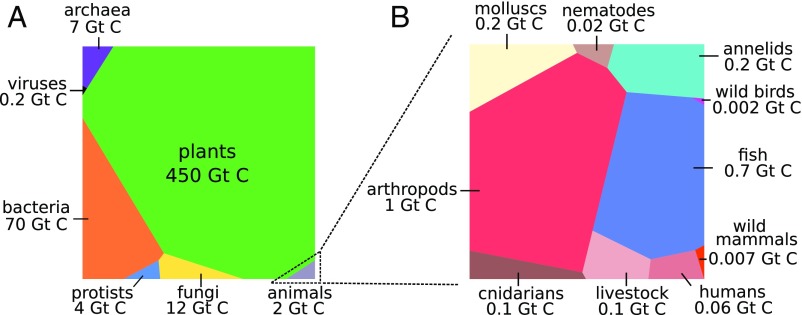
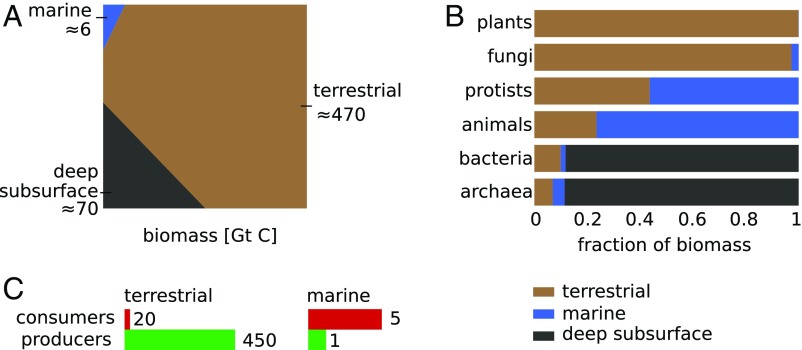
A census of the biomass on Earth is key for understanding the structure and dynamics of the biosphere. However, a global, quantitative view of how the biomass of different taxa compare with one another is still lacking. Here, we assemble the overall biomass composition of the biosphere, establishing a census of the ≈550 gigatons of carbon (Gt C) of biomass distributed among all of the kingdoms of life. We find that the kingdoms of life concentrate at different locations on the planet; plants (≈450 Gt C, the dominant kingdom) are primarily terrestrial, whereas animals (≈2 Gt C) are mainly marine, and bacteria (≈70 Gt C) and archaea (≈7 Gt C) are predominantly located in deep subsurface environments. We show that terrestrial biomass is about two orders of magnitude higher than marine biomass and estimate a total of ≈6 Gt C of marine biota, doubling the previous estimated quantity. Our analysis reveals that the global marine biomass pyramid contains more consumers than producers, thus increasing the scope of previous observations on inverse food pyramids. Finally, we highlight that the mass of humans is an order of magnitude higher than that of all wild mammals combined and report the historical impact of humanity on the global biomass of prominent taxa, including mammals, fish, and plants.
Overview
CoChat Summary
TL;DR
The paper assembles a global census of biomass across all kingdoms of life, estimating Earth’s total biomass at ≈550 Gt C, dominated by plants. It also compares biomass across environments and trophic modes, highlighting large uncertainties and human impacts on the biosphere.
Key findings
- Total global biomass is ≈550 Gt C, with plants ≈450 Gt C (≈80%), bacteria ≈70 Gt C (≈15%), fungi ≈12 Gt C, archaea ≈7 Gt C, protists ≈4 Gt C, animals ≈2 Gt C, and viruses ≈0.2 Gt C.
- Land biomass (≈470 Gt C) is about two orders of magnitude higher than marine biomass (≈6 Gt C); the deep subsurface holds ≈15% of total biomass, chiefly bacteria and archaea.
- In the ocean, ≈1 Gt C of primary producers supports ≈5 Gt C of consumer biomass, an inverted standing biomass distribution; marine biomass is ≈70% microbes, mainly bacteria and protists.
- Human-associated biomass is large relative to wild vertebrates: humans ≈0.06 Gt C, livestock ≈0.1 Gt C, wild mammals ≈0.007 Gt C, domesticated poultry ≈0.005 Gt C versus wild birds ≈0.002 Gt C; total plant biomass has declined approximately twofold relative to pre-human civilization.
Methods
- The authors synthesize hundreds of studies and generate estimates for major taxonomic groups, reporting biomass as gigatons of carbon (Gt C) and using a kingdom-level framework plus viruses.
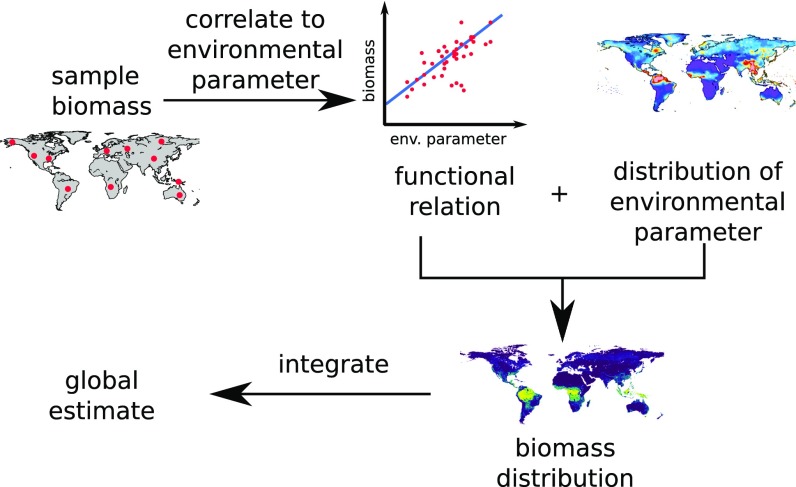
- For many taxa, local biomass samples are extrapolated globally by correlating biomass density with environmental parameters known at global scale; best estimates often use a geometric mean of independent estimates.
- Uncertainty is reported as multiplicative fold-change projections akin to 95% confidence intervals, incorporating intrastudy, interstudy, and intermethod variation; data and code are open-sourced.
Limitations
- The paper states that most datasets rely on fragmentary sampling, causing large uncertainties; sampling is scarce in the deep ocean (usually deeper than 200 m) and deep soil (usually deeper than 1 m), and some estimates may be biased by sampling toward high-abundance areas.
- The paper states that deep subsurface environments have particularly high uncertainty and unknown systematic biases, including unresolved distribution of biomass between aquifer fluids and rocks and among microbial taxa.
- The paper states that current and prehuman vertebrate biomass estimates are only a crude first step, amphibians remain poorly characterized, and parasite biomass is not resolved from hosts; evident from the text, kingdom-level grouping was chosen because much data lack finer taxonomic detail, and some uncertainty projections rely on analogous taxa or expert consultation.
Model-written summary. Check it against the paper before relying on it.
Integrity signals
Registry
Cites
Statistics
Figures
Verification
Claims the paper makes
9 Valid · 7 Not valid · 16 Not checked · 53 Own results and interpretations
Every source the paper cites for this claim was checked and supports it.
In the paper
“The biomass of amphibians, which are experiencing a dramatic population decline (42), remains poorly characterized.”
§ The biomass distribution on Earth > Discussion
What the sources say
- Supportedcites [42] Wake DB Vredenburg VT 2008 Colloquium paper: Are we in the midst of the sixth mass extinction? A view from the world of amphibians Proc Natl Acad Sci USA 105 11466 11473 18695221 PMC2556420 source
The citation is attached to the clause about amphibian population decline, not the separate statement that their biomass is poorly characterized. The passage reporting the Global Amphibian Assessment (labeled Abstract in our copy) says that 43% of amphibian species have declining populations. (LLM, conf=0.92)
plain- Asserted: passes — The authors put it forward as true.
- Checkable: passes — It can be checked against evidence.
- Load-bearing: unclear — It is unclear whether the paper’s conclusions depend on it.
- Based: passes — The paper gives a reason why it holds.
- Supported
Every source the paper cites for this claim was checked and supports it.
In the paper
“In the case of prokaryotes, some major improvements were recently realized, with global estimates of marine deep subsurface prokaryote biomass reduced by about two orders of magnitude due to an increased diversity of sampling locations (7).”
§ The biomass distribution on Earth > Discussion
What the sources say
- Supportedcites [7] Kallmeyer J Pockalny R Adhikari RR Smith DC D’Hondt S 2012 Global distribution of microbial abundance and biomass in subseafloor sediment Proc Natl Acad Sci USA 109 16213 16216 22927371 PMC3479597 source
The Discussion reports a revised subseafloor microbial biomass estimate of 4.1 Pg C versus a previous estimate of 303 Pg C—about a 74-fold reduction. It also identifies a more geographically diverse sampling database, including low-abundance ocean gyres, as a reason the new estimate is lower. The paper identifies other contributing factors as well. (LLM, conf=0.88)
plainstates a cause- Asserted: passes — The authors put it forward as true.
- Checkable: passes — It can be checked against evidence.
- Load-bearing: unclear — It is unclear whether the paper’s conclusions depend on it.
- Based: passes — The paper gives a reason why it holds.
- Supported
The sources with a verdict support this claim; the rest weren’t checked yet, have no full text we could read, or their verdicts aren’t rated yet.
In the paper
“Such inverted biomass distributions can occur when primary producers have a rapid turnover of biomass [on the order of days (34)], while consumer biomass turns over much more slowly [a few years in the case of mesopelagic fish (35)].”
§ The biomass distribution on Earth > Results > The Distribution of Biomass Across Environments and Trophic Modes.
What the sources say
- Supportedcites [34] Zubkov MV 2014 Faster growth of the major prokaryotic versus eukaryotic CO2 fixers in the oligotrophic ocean Nat Commun 5 3776 24777140 PMC4015317 source
The Results (Comparison of the growth rates of the CO2 fixers; page unavailable) report growth rates of 0.1–0.6 per day for the studied oceanic primary producers, consistent with biomass turnover on the order of days. The few-years estimate for mesopelagic fish is assigned to a different citation, not this source. (LLM, conf=0.91)
- Not checked — no full text of the sourcecites [35] Catul V Gauns M Karuppasamy PK 2011 A review on mesopelagic fishes belonging to family Myctophidae Rev Fish Biol Fish 21 339 354 source
plainstates a possible cause- Asserted: passes — The authors put it forward as true.
- Checkable: passes — It can be checked against evidence.
- Load-bearing: passes — The paper’s conclusions depend on it.
- Based: passes — The paper gives a reason why it holds.
- Supported
The cited sources support only part of this claim — read each source’s verdict below.
In the paper
“Combining data from independent sources such as these enables a robust assessment of the total plant biomass (17).”
§ The biomass distribution on Earth > Results > The Uncertainty Associated with Global Biomass Estimates.
What the sources say
- Partly supportedcites [17] Erb K-H 2017 Unexpectedly large impact of forest management and grazing on global vegetation biomass Nature 553 73 76 29258288 PMC5756473 sourceExperimental — accuracy not yet measured
The Methods describe combining multiple datasets and types of evidence to estimate global vegetation biomass stocks. But the paper also says global stocks remain uncertain, reports uncertainty ranges around 35% of the median estimate, and describes more robust estimates as a future prospect. It therefore supports the use of independent sources for an assessment, but not the unqualified characterization of that assessment as robust. (LLM, conf=0.84)
plainstates a cause- Asserted: passes — The authors put it forward as true.
- Checkable: passes — It can be checked against evidence.
- Load-bearing: passes — The paper’s conclusions depend on it.
- Based: passes — The paper gives a reason why it holds.
- Partly supported
A result the paper states — it cites no source for it, so there is none to check. The quote shows it is in the paper.
In the paper
“Plant biomass includes ≈70% stems and tree trunks, which are mostly woody, and thus relatively metabolically inert.”
§ The biomass distribution on Earth > Results > The Biomass Distribution of the Biosphere by Kingdom.
plain- Asserted: passes — The authors put it forward as true.
- Checkable: passes — It can be checked against evidence.
- Load-bearing: unclear — It is unclear whether the paper’s conclusions depend on it.
- Based: passes — The paper gives a reason why it holds.
27 more claims
Create a free account to see all 85 claims and to verify the 2 references still open.
- It may state two separate claims as one. 32
- Probably not a substantial claim. 28
Claims other papers make about this one
Each is checked against this paper’s own text: does it say what the citing paper says it does?
The cited source doesn’t support the claim as written.
In the citing paper
“and less than 10% that of the world ' s current human population ( 52 ).”
From Pervasive human-driven decline of life on Earth points to the need for transformative change (2019) · cites this paper as [52]
Checked by a reasoning model — may be wrong.
Experimental — accuracy not yet measuredThe cited source says what the claim attributes to it.
In the citing paper
“Approximately 450 Gt of C is bound up in terrestrial biota, primarily in plants (86), while only ~6 Gt of C is found in ocean biota (87).”
From Earth beyond six of nine planetary boundaries (2023) · cites this paper as [87]
The cited source says what the claim attributes to it.
In the citing paper
“The amount of metabolic energy available to a biosphere powered by O 2 is vast, such that the O 2 -rich ocean-atmosphere system of the modern Earth supports staggering levels of standing biomass (Bar-On et al. 2018), energy flow (Falkowski et al. 2008), and ecological complexity (Steele 1974).”
From The History of Ocean Oxygenation (2022) · cites this paper as Bar-On et al. 2018
In the citing paper
“Global populations of domestic ruminants (cattle, sheep, and goats) (Ripple et al. 2013) poultry, and pigs (Bennett et al. 2018) used to feed the growing human population now exceed 100 million tons of carbon (Bar-On et al. 2018), and livestock populations are growing rapidly.”
From Scientists’ warning to humanity on the freshwater biodiversity crisis (2021) · cites this paper as Bar-On et al. 2018
Citations
Cites
The worldwide leaf economics spectrum
Wright, I. J., Reich, P. B., Westoby, M., Ackerly, D. D., Baruch, Z., Bongers, F., Cavender-Bares, J., Chapin, T., Cornelissen, J. H. C., Diemer, M., et al. (2004) · Nature · doi:10.1038/nature02403 · Cited by 9,021 · cited 1×
“We then convert the total area of leaves to an estimate of the total dry mass of leaves by using the Glopnet database (24), which measured leaf mass per area (LMA) for ≈2500 plant species.”
MethodA large and persistent carbon sink in the world’s forests
Pan, Y., Birdsey, R. A., Fang, J., Houghton, R., Kauppi, P. E., Kurz, W. A., Phillips, O. L., Shvidenko, A., Lewis, S. L., Canadell, J. G., et al. (2011) · Science · doi:10.1126/science.1201609 · Cited by 8,458
Soil Sampling and Methods of Analysis
(2007) · CRC Press eBooks · doi:10.1201/9781420005271 · Cited by 6,469
Primary production of the biosphere: Integrating terrestrial and oceanic components
Field, C. B., Behrenfeld, M. J., Randerson, J. T., & Falkowski, P. (1998) · Science · doi:10.1126/science.281.5374.237 · Cited by 6,371
Prokaryotes: The unseen majority
Whitman, W. B., Coleman, D. C., & Wiebe, W. J. (1998) · Proceedings of the National Academy of Sciences · doi:10.1073/pnas.95.12.6578 · Cited by 4,871
Global effects of land use on local terrestrial biodiversity
Newbold, T., Hudson, L. N., Hill, S. L. L., Contu, S., Lysenko, I., Senior, R. A., Börger, L., Bennett, D. J., Choimes, A., Collen, B., et al. (2015) · Nature · doi:10.1038/nature14324 · Cited by 4,352
Belowground biodiversity and ecosystem functioning
Bardgett, R. D., & van der Putten, W. H. (2014) · Nature · doi:10.1038/nature13855 · Cited by 3,990 · cited 4×
“This was recommended by experts in the field for estimation of arbuscular mycorrhizal fungi abundance (117).”
BackgroundInfluentialMangroves among the most carbon-rich forests in the tropics
Donato, D. C., Kauffman, J. B., Murdiyarso, D., Kurnianto, S., Stidham, M., & Kanninen, M. (2011) · Nature Geoscience · doi:10.1038/ngeo1123 · Cited by 3,374
Poorter, H., Niklas, K. J., Reich, P. B., Oleksyn, J., Poot, P., & Mommer, L. (2012) · New Phytologist · doi:10.1111/j.1469-8137.2011.03952.x · Cited by 3,163 · cited 1×
“The first relies on a meta-analysis of the biomass allocation to different plant compartments across biomes (19).”
BackgroundA global analysis of root distributions for terrestrial biomes
Jackson, R. B., Canadell, J., Ehleringer, J. R., Mooney, H. A., Sala, O. E., & Schulze, E. D. (1996) · Oecologia · doi:10.1007/bf00333714 · Cited by 3,071 · cited 4×
“assumed the distribution of microbial biomass with depth follows the biomass density versus depth profile of root biomass (21).”
BackgroundMethodInfluential
Research works printed but not linked: 1
- Chapman AD 2009 Numbers of Living Species in Australia and the World Australian Biological Resources Study Canberra, Australia
Cited by
Items 201–300 of 3,743
Serpentinization: connecting geochemistry, ancient metabolism and industrial hydrogenation
Preiner, M., Xavier, J. C., Sousa, F. L., Zimorski, V., Neubeck, A., Lang, S. Q., Greenwell, H. C., Kleinermanns, K., Tüysüz, H., McCollom, T. M., et al. (2018) · Life · doi:10.3390/life8040041 · Cited by 97
“The deep biosphere contains very large amounts of biomass [140,141] consisting of microorganisms that are generally starved for reducible carbon substrate, Heberling et al.”
BackgroundA global overview of the trophic structure within microbiomes across ecosystems
Xiong, W., Jousset, A., Li, R., Delgado‐Baquerizo, M., Bahram, M., Logares, R., Wilden, B., de Groot, G. A., Amacker, N., Kowalchuk, G. A., et al. (2021) · Environment International · doi:10.1016/j.envint.2021.106438 · Cited by 105
Offshore Freshened Groundwater in Continental Margins
Micallef, A., Person, M. A., Berndt, C., Bertoni, C., Cohen, D., Dugan, B., Evans, R. L., Haroon, A., Hensen, C., Jegen, M., et al. (2021) · Reviews of Geophysics · doi:10.1029/2020rg000706 · Cited by 112
Electro-fermentation: Sustainable bioproductions steered by electricity
Virdis, B., Hoelzle, R. D., Marchetti, A., Boto, S. T., Rosenbaum, M. A., Blasco-Gómez, R., Puig, S., Freguia, S., & Villano, M. (2022) · Biotechnology Advances · doi:10.1016/j.biotechadv.2022.107950 · Cited by 114
“earth, primarily in the forms of cellulose and hemicellulose (Abdel-Hamid et al., 2013; Bar-On et al., 2018; Boerjan et al., 2003).”
BackgroundSingle-cell transcriptomics unveils xylem cell development and evolution
Tung, C.-C., Kuo, S., Yang, C.-L., Yu, J., Huang, C.-E., Liou, P., Sun, Y., Shuai, P., Su, J., Ku, C., et al. (2023) · Genome biology · doi:10.1186/s13059-022-02845-1 · Cited by 111
“Together these xylem cells make up the vast majority of mass in woods and are the most abundant tissue on Earth [37].”
BackgroundFood Webs and Ecosystems: Linking Species Interactions to the Carbon Cycle
Schmitz, O. J., & Leroux, S. (2020) · Annual Review of Ecology Evolution and Systematics · doi:10.1146/annurev-ecolsys-011720-104730 · Cited by 118
Hagen, O., Flück, B., Fopp, F., Cabral, J. S., Hartig, F., Pontarp, M., Rangel, T. F., & Pellissier, L. (2021) · PLoS Biology · doi:10.1371/journal.pbio.3001340 · Cited by 121
“Species abundance, frequency, and range Assemblages are generally composed of a few very abundant species and many rare species [97,98].”
Large Soil Carbon Storage in Terrestrial Ecosystems of Canada
Söthe, C., Gonsamo, A., Arabian, J., Kurz, W. A., Finkelstein, S. A., & Snider, J. (2022) · Global Biogeochemical Cycles · doi:10.1029/2021gb007213 · Cited by 120
“Plants store about 80% of the live biomass on Earth, with an estimated pool of 450 Pg C (Bar-On et al., 2018).”
BackgroundGlobal variation in diversification rate and species richness are unlinked in plants
Tietje, M., Antonelli, A., Baker, W. J., Govaerts, R., Smith, S. A., & Eiserhardt, W. L. (2022) · Proceedings of the National Academy of Sciences · doi:10.1073/pnas.2120662119 · Cited by 113
Siegert, M. J., Bentley, M. J., Atkinson, A., Bracegirdle, T. J., Convey, P., Davies, B. J., Downie, R., Hogg, A. E., Holmes, C., Hughes, K. A., et al. (2023) · Frontiers in Environmental Science · doi:10.3389/fenvs.2023.1229283 · Cited by 104
“About one million blue and fin whales were removed between 1904 and 1980—part of a massive, global scale depredation of marine mammals to roughly one-fifth of their original biomass (Bar-on et al., 2018).”
BackgroundChallenges and Solutions for Sustainable Food Systems: The Potential of Home Hydroponics
de Sousa, R., Bragança, L., da Silva, & Oliveira, R. S. (2024) · Sustainability · doi:10.3390/su16020817 · Cited by 155
Sariola, S., & Gilbert, S. F. (2020) · Microorganisms · doi:10.3390/microorganisms8050746 · Cited by 112
“Biomes are shrinking to be replaced by cities and managed farms [9].”
BackgroundHuman footprint and protected areas shape elephant range across Africa
Wall, J., Wittemyer, G., Klinkenberg, B., LeMay, V., Blake, S., Strindberg, S., Henley, M. D., Vollrath, F. W., Maisels, F. G., Ferwerda, J. G., et al. (2021) · Current Biology · doi:10.1016/j.cub.2021.03.042 · Cited by 127
“org/wpp/Publications/), with between 50%–70% of the planet already experiencing anthropogenic disturbance.(10,54) Fragmentation of wildlife habitats by humans has resulted in only 7% of wildlife habitat patches being larger than 100 km.”
BackgroundEarthworms as catalysts in the formation and stabilization of soil microbial necromass
Angst, G., Frouz, J., van Groenigen, J. W., Scheu, S., Kögel‐Knabner, I., & Eisenhauer, N. (2022) · Global Change Biology · doi:10.1111/gcb.16208 · Cited by 108
Svenning, J., Lemoine, R. T., Bergman, J., Buitenwerf, R., le Roux, E., Lundgren, E. J., Mungi, N. A., & Pedersen, R. Ø. (2024) · Cambridge Prisms Extinction · doi:10.1017/ext.2024.4 · Cited by 171
“Global declines of wild megafauna have been followed by large increases in domestic livestock densities (Bar-On et al., 2018).”
BackgroundAn inherited complex organic molecule reservoir in a warm planet-hosting disk
Booth, A. S., Walsh, C. M., van Scheltinga, J. T., van Dishoeck, E. F., Ilee, J. D., Hogerheijde, M. R., Kama, M., & Nomura, H. (2021) · Nature Astronomy · doi:10.1038/s41550-021-01352-w · Cited by 103
Unboxing the black box—one step forward to understand the soil microbiome: A systematic review
Mishra, A., Singh, L., & Singh, D. (2022) · Microbial Ecology · doi:10.1007/s00248-022-01962-5 · Cited by 116
“The scientific world and the common man are more concerned about the macroscopic environment, and much lesser is known about the microscopic biota that is hidden in the heterogeneous soil, although these organisms along with plants, rule the Earth’s living biomass [9, 46].”
BackgroundThe infectious disease trap of animal agriculture
Hayek, M. (2022) · Science Advances · doi:10.1126/sciadv.add6681 · Cited by 122
“Now, there are more than 33 billion chickens on Earth, representing more than 70% of global avian biomass (75).”
BackgroundZhao, H., Liu, J., Zhong, N., Larter, S., Li, Y., Kibria, M. G., Su, B., Chen, Z., & Hu, J. (2023) · Advanced Energy Materials · doi:10.1002/aenm.202300257 · Cited by 101
Vascular Plants Are Globally Significant Contributors to Marine Carbon Fluxes and Sinks
Cragg, S. M., Friess, D. A., Gillis, L. G., Trevathan‐Tackett, S. M., Terrett, O. M., Watts, J. E. M., Distel, D. L., & Dupree, P. (2019) · Annual Review of Marine Science · doi:10.1146/annurev-marine-010318-095333 · Cited by 112
“Vascular plants constitute more than two-thirds of global biomass (Bar-On et al. 2018), predominantly on land but also in highly productive blue carbon ecosystems—salt marshes, mangrove forests, and seagrass meadows.”
BackgroundA Review of Estimation Methods for Aboveground Biomass in Grasslands Using UAV
Bazzo, C. O. G., Kamali, B., Hütt, C., Bareth, G., & Gaiser, T. (2023) · Remote Sensing · doi:10.3390/rs15030639 · Cited by 114
The significance of biofilms to human, animal, plant and ecosystem health
Sentenac, H., Loyau, A., Leflaive, J., & Schmeller, D. S. (2021) · Functional Ecology · doi:10.1111/1365-2435.13947 · Cited by 112
Pocha, C. K. R., Chia, W. Y., Silvanir, Kurniawan, T. A., Khoo, K. S., & Chew, K. W. (2023) · Fuel · doi:10.1016/j.fuel.2023.127472 · Cited by 99
Burcham, Z. M., Belk, A. D., McGivern, B. B., Bouslimani, A., Ghadermazi, P., Martino, C., Shenhav, L., Zhang, A. R., Shi, P., Emmons, A. L., et al. (2024) · Nature Microbiology · doi:10.1038/s41564-023-01580-y · Cited by 107
“Yet understanding and predicting this assembly is important for our understanding of ecosystems and metric tons of high-nutrient animal biomass 8 contribute substantially to ecosystem productivity, soil fertility, and a host of other ecosystem functions and attributes 9,10 .”
BackgroundBreman, E., Ballesteros, D., Castillo-Lorenzo, E., Cockel, C., Dickie, J., Faruk, A., O'Donnell, K., Offord, C., Pironon, S., Sharrock, S., et al. (2021) · Plants · doi:10.3390/plants10112371 · Cited by 86
“levels [5], and to ~40% of plant species being threatened with extinction [6].”
BackgroundSoil under stress: The importance of soil life and how it is influenced by (micro)plastic pollution
Joos, L., & Tender, C. A. D. (2022) · Computational and Structural Biotechnology Journal · doi:10.1016/j.csbj.2022.03.041 · Cited by 116
“Microorganisms belong to the most abundant and diverse groups of soil organisms, representing an estimated total biomass of 3–4% on earth (up to 20 Gt carbon (C)) [3].”
BackgroundThe History of Ocean Oxygenation
Reinhard, C. T., & Planavsky, N. J. (2022) · Annual Review of Marine Science · doi:10.1146/annurev-marine-031721-104005 · Cited by 91
Defying the Footprint Oracle: Implications of Country Resource Trends
Wackernagel, M., Lin, D. H., Evans, M., Hanscom, L., & Raven, P. H. (2019) · Sustainability · doi:10.3390/su11072164 · Cited by 117
“Biological regeneration essentially boils down to the process of photosynthesis that uses solar power, nutrients, and water to produce plant matter, which, in turn, feeds all other life [25].”
BackgroundWhat is a tree in the Mediterranean Basin hotspot? A critical analysis
Mèdail, F., Monnet, A., Pavón, D., Nikolić, T., Dimopoulos, P., Bacchetta, G., Arroyo, J., Barina, Z., Albassatneh, M. C., Domina, G., et al. (2019) · Forest Ecosystems · doi:10.1186/s40663-019-0170-6 · Cited by 92
“A recent census of the biomass distribution on Earth indicates that plants, mostly terrestrial species, represent about 80% (i.e. ≈ 450 Gt C) of the sum of the biomass across all taxa worldwide, and that plant biomass includes about 70% stems and tree trunks (Bar-On et al. 2018).”
BackgroundYeo, D. C. J., Srivathsan, A., & Meier, R. (2020) · Systematic Biology · doi:10.1093/sysbio/syaa014 · Cited by 102
Community-wide changes reflecting bacterial interspecific interactions in multispecies biofilms
Sadiq, F. A., Burmølle, M., Heyndrickx, M., Flint, S., Lu, W., Chen, W., Zhao, J., & Zhang, H. (2021) · Critical Reviews in Microbiology · doi:10.1080/1040841x.2021.1887079 · Cited by 108
“A bacterial biofilm represents a markedly distinct form of bacterial life compared with planktonic cells, as biofilms-associated cells are physiologically and genetically distinct from their counterpart planktonic cells, and whereby specific metabolic activities are juxtaposed (Bar-On et al. 2018).”
BackgroundBeneficial Soil Microbiomes and Their Potential Role in Plant Growth and Soil Fertility
Vincze, É., Becze, A., Laslo, É., & Mara, G. (2024) · Agriculture · doi:10.3390/agriculture14010152 · Cited by 116
Uncovering the hidden diversity of litter-decomposition mechanisms in mushroom-forming fungi
Floudas, D., Bentzer, J., Ahrén, D., Johansson, T., Persson, P., & Tunlid, A. (2020) · The ISME Journal · doi:10.1038/s41396-020-0667-6 · Cited by 94
“Soils and plant biomass store an enormous amount of carbon in terrestrial ecosystems [1, 2].”
BackgroundWang, S., Xiong, W., Wang, Y., Nie, Y., Wu, Q. J., Xu, Y., & Geisen, S. (2020) · mSystems · doi:10.1128/msystems.00555-20 · Cited by 92
“Microorganisms are the most abundant biota and compose the second-largest biomass source on the planet (1).”
BackgroundRecent developments towards performance-enhancing lignin-based polymers
Bass, G. F., & Epps, T. H. I. (2021) · Polymer Chemistry · doi:10.1039/d1py00694k · Cited by 105
Zvereva, E. L., & Kozlov, M. V. (2021) · Ecology Letters · doi:10.1111/ele.13851 · Cited by 93
Population abundance estimates in conservation and biodiversity research
Callaghan, C. T., Santini, L., Spake, R., & Bowler, D. E. (2024) · Trends in Ecology & Evolution · doi:10.1016/j.tree.2024.01.012 · Cited by 112
Hamedi, M. M., Sandberg, M., Olsson, R. T., Pedersen, J., Benselfelt, T., & Wohlert, J. (2025) · Advanced Materials · doi:10.1002/adma.202415787 · Cited by 118
Feeding the Walls: How Does Nutrient Availability Regulate Cell Wall Composition?
Ogden, M., Hoefgen, R., Roessner, U., Persson, S., & Khan, G. A. (2018) · International Journal of Molecular Sciences · doi:10.3390/ijms19092691 · Cited by 95
“Plants are the primary producers on earth, accounting for 80% of all living biomass, and provide us with food, feed, and shelter [1].”
BackgroundOxygenic photosynthesis: history, status and perspective
Junge, W. (2019) · Quarterly Reviews of Biophysics · doi:10.1017/s0033583518000112 · Cited by 94
“In a recent meta-study Ron Milo and his colleagues reviewed the distribution over taxa of the biomass on earth (Bar-On et al., 2018).”
BackgroundEchinococcosis transmission on the Tibetan Plateau
Craig, P. S., Giraudoux, P., Wang, Z. H., & Wang, Q. (2019) · Advances in Parasitology/Advances in parasitology · doi:10.1016/bs.apar.2019.03.001 · Cited by 94
Aspects of Forest Biomass in the Earth System: Its Role and Major Unknowns
Reichstein, M., & Carvalhais, N. (2019) · Surveys in Geophysics · doi:10.1007/s10712-019-09551-x · Cited by 124
Całusińska, M., Marynowska, M., Bertucci, M., Untereiner, B., Klimek, D., Goux, X., Sillam‐Dussès, D., Gawron, P., Halder, R., Wilmes, P., et al. (2020) · Communications Biology · doi:10.1038/s42003-020-1004-3 · Cited by 99
Revising the global biogeography of annual and perennial plants
Poppenwimer, T. L., Mayrose, I., & DeMalach, N. (2023) · Nature · doi:10.1038/s41586-023-06644-x · Cited by 129
“Nonethe-less, similar results were obtained when we analysed the proportion of annuals among all species (Supplementary Note 2, Supplementary Tables 7–12 and Extended Data Fig.”
BackgroundInfluentialStoried Seas and Living Metaphors in the Blue Humanities
Oppermann, S. (2019) · Configurations · doi:10.1353/con.2019.0030 · Cited by 91
Ecological economics for humanity’s plague phase
Rees, W. E. (2019) · Ecological Economics · doi:10.1016/j.ecolecon.2019.106519 · Cited by 125
Crossroads in the evolution of plant specialized metabolism
Rieseberg, T. P., Dadras, A., Fürst‐Jansen, J. M. R., Ashok, A. D., Darienko, T., de Vries, S., Irisarri, I., & de Vries, J. (2022) · Seminars in Cell and Developmental Biology · doi:10.1016/j.semcdb.2022.03.004 · Cited by 95
Epochs, events and episodes: Marking the geological impact of humans
Waters, C. N., Williams, M., Zalasiewicz, J., Turner, S. D., Barnosky, A. D., Head, M. J., Wing, S. L., Wagreich, M., Steffen, W., Summerhayes, C. P., et al. (2022) · Earth-Science Reviews · doi:10.1016/j.earscirev.2022.104171 · Cited by 101
“The Late Quaternary Extinction (LQE) represents the first substantial human-caused transformation of the Earth’s biota, which was followed by progressive replacement of wild-animal biomass by human and domestic animal biomass (Barnosky, 2008; Smil, 2011; Bar-On et al., 2018).”
BackgroundMicrobial dormancy in the marine subsurface: Global endospore abundance and response to burial
Wörmer, L., Hoshino, T., Bowles, M. W., Viehweger, B., Adhikari, R. R., Xiao, N., Uramoto, G., Könneke, M., Lazar, C. S., Morono, Y., et al. (2019) · Science Advances · doi:10.1126/sciadv.aav1024 · Cited by 90
“6 to 35 Pg C) to the recent census of biomass on Earth (~550 Pg C) (42), the total biomass adds up to be between 555 and 585 Pg C, with endospores in the marine subsurface contributing between 0.”
BackgroundExploring a natural baseline for large‐herbivore biomass in ecological restoration
Fløjgaard, C., Pedersen, P. B. M., Sandom, C. J., Svenning, J., & Ejrnæs, R. (2021) · Journal of Applied Ecology · doi:10.1111/1365-2664.14047 · Cited by 111
Status, Change, and Futures of Zooplankton in the Southern Ocean
Johnston, N. M., Murphy, E. J., Atkinson, A., Constable, A. J., Cotté, C., Cox, M. J., Daly, K. L., Driscoll, R., Flores, H., Halfter, S., et al. (2022) · Frontiers in Ecology and Evolution · doi:10.3389/fevo.2021.624692 · Cited by 108
“They are ubiquitous and abundant in the world’s oceans (Bar-On et al., 2018; Chiba et al., 2018), playing a critical role in the structure and function (Odum, 1964, 1969) of marine ecosystems, including ‘ecosystem services’ that benefit humans (Millennium Ecosystem Assessment, 2005; Simcock, 2017; Bebianno et al.”
BackgroundSrivathsan, A., Feng, V., Suárez, D., Emerson, B. C., & Meier, R. (2023) · Cladistics · doi:10.1111/cla.12566 · Cited by 109
“In fact, the biomass of all arthropods combined surpasses that of all terrestrial vertebrates in the wild (Bar-On et al., 2018).”
BackgroundEvolution of the structure and impact of Earth’s biosphere
Planavsky, N. J., Crowe, S. A., Fakhraee, M., Beaty, B., Reinhard, C. T., Mills, B. J. W., Holstege, C., & Konhauser, K. O. (2021) · Nature Reviews Earth & Environment · doi:10.1038/s43017-020-00116-w · Cited by 111
Kang, K., Klinghoffer, N. B., ElGhamrawy, I., & Berruti, F. (2021) · Renewable and Sustainable Energy Reviews · doi:10.1016/j.rser.2021.111372 · Cited by 97
The development of terrestrial ecosystems emerging after glacier retreat
Ficetola, G. F., Marta, S., Guerrieri, A., Cantera, I., Bonin, A., Cauvy‐Fraunié, S., Ambrosini, R., Caccianiga, M. S., Anthelme, F., Azzoni, R. S., et al. (2024) · Nature · doi:10.1038/s41586-024-07778-2 · Cited by 111
“In the soil, vertebrates usually show very low biomass compared with other organisms (for example, protists, fungi, annelids and arthropods) 91–93 .”
The Microbial Conveyor Belt: Connecting the Globe through Dispersion and Dormancy
Mestre, M., & Höfer, J. (2020) · Trends in Microbiology · doi:10.1016/j.tim.2020.10.007 · Cited by 85
A review of megatrends in the global dairy sector: what are the socioecological implications?
Bojovic, M., & McGregor, A. (2022) · Agriculture and Human Values · doi:10.1007/s10460-022-10338-x · Cited by 125
The Anthropocene condition: evolving through social–ecological transformations
Ellis, E. C. (2023) · Philosophical Transactions of the Royal Society B Biological Sciences · doi:10.1098/rstb.2022.0255 · Cited by 115
“There is simply no precedent for a growing population of more than 8 billion people on Earth, which, together with domestic livestock, already compose more than 90% of all mammal biomass (160 Mt; [16,17]); a biomass similar to all social insects combined (approx.”
BackgroundGericke, M., Amaral, A. J. R., Budtova, T., Wever, P. D., Groth, T., Heinze, T. J., Höfte, H., Huber, A., Ikkala, O. T., Kapuśniak, J., et al. (2023) · Carbohydrate Polymers · doi:10.1016/j.carbpol.2023.121633 · Cited by 96
Cai, Y., Xu, X., Zhu, P., Nie, S., Wang, C., Xiong, Y., & Liu, X. (2024) · ISPRS Journal of Photogrammetry and Remote Sensing · doi:10.1016/j.isprsjprs.2024.08.001 · Cited by 107
Fungal-mediated soil aggregation as a mechanism for carbon stabilization
de Goede, S., Hannula, S. E., Jansen, B., & Morriën, E. (2025) · The ISME Journal · doi:10.1093/ismejo/wraf074 · Cited by 131
“This requires a thorough understanding of the underlying biotic mechanisms and their interactions with the abiotic environment that drive SOC storage in a wide variety of circumstances [7].”
Molybdenum-catalyzed oxidative depolymerization of alkali lignin: Selective production of Vanillin
Rawat, S., Gupta, P., Singh, B., Bhaskar, T., Natte, K., & Narani, A. (2020) · Applied Catalysis A General · doi:10.1016/j.apcata.2020.117567 · Cited by 82
Hagendorff, T., Bossert, L. N., Tse, Y. F., & Singer, P. (2023) · AI and Ethics · doi:10.1007/s43681-022-00199-9 · Cited by 84
“For instance, of all living birds, only one-third exist in the wild, whereas two-thirds are farmed birds [94].”
BackgroundGarcía, F. C., Clegg, T., O’Neill, D. B., Warfield, R., Pawar, S. S., & Yvon‐Durocher, G. (2023) · Nature Microbiology · doi:10.1038/s41564-022-01283-w · Cited by 104
“We use the definition of the average interaction experienced by a focal species, aijCi≠j = 1 N ∑i≠j aijCj to write the interspecies interactions term in equation (6) as:”
BackgroundMethodInfluentialMapping potential conflicts between global agriculture and terrestrial conservation
Hoang, N. T., Taherzadeh, O., Ohashi, H., Yonekura, Y., Nishijima, S., Yamabe, M., Matsui, T., Matsuda, H., Moran, D. D., & Kanemoto, K. (2023) · Proceedings of the National Academy of Sciences · doi:10.1073/pnas.2208376120 · Cited by 106
Bergman, J., Pedersen, R. Ø., Lundgren, E. J., Lemoine, R. T., Monsarrat, S., Pearce, E. A., Schierup, M. H., & Svenning, J. (2023) · Nature Communications · doi:10.1038/s41467-023-43426-5 · Cited by 101
“Strikingly however, the current total biomass of the entire current wild terrestrial mammal community, estimated by Bar-On et al. 60 to be ~0.003 Gt C, is 10% of our estimate for the total megafauna biomass during the period between 100 – 742kya (~0.03Gt C), implying that mammals — both only…”
InfluentialGenome-Wide Signatures of Adaptation to Extreme Environments in Red Algae
Cho, C. H., Park, S. I., Huang, T.-Y., Lee, Y., Ciniglia, C., Yadavalli, H. C., Yang, S. W., Bhattacharya, D., & Yoon, H. S. (2023) · Nature Communications · doi:10.1038/s41467-022-35566-x · Cited by 83
“Red microalgae [1] Porphyridiophyceae [1]”
BackgroundFeng, Y., Tao, L., Zheng, Z., Huang, H., & Lin, F. (2020) · Energy storage materials · doi:10.1016/j.ensm.2020.06.017 · Cited by 88
The Molecular Basis for Life in Extreme Environments
Ando, N., Barquera, B., Bartlett, D. H., Boyd, E., Burnim, A. A., Byer, A. S., Colman, D., Gillilan, R. E., Gruebele, M., Makhatadze, G., et al. (2021) · Annual Review of Biophysics · doi:10.1146/annurev-biophys-100120-072804 · Cited by 82
Crustal Groundwater Volumes Greater Than Previously Thought
Ferguson, G., McIntosh, J. C., Warr, O., Lollar, B. S., Ballentine, C. J., Famiglietti, J. S., Kim, J., Michalski, J. R., Mustard, J. F., Tarnas, J., et al. (2021) · Geophysical Research Letters · doi:10.1029/2021gl093549 · Cited by 94
“, 2014) and the distribution of life in the subsurface (Bar-On et al., 2018; Lollar et al., 2019; Magnabosco et al., 2018).”
BackgroundDynamic cybergenetic control of bacterial co-culture composition via optogenetic feedback
Gutiérrez, J., Kumar, S., & Khammash, M. (2022) · Nature Communications · doi:10.1038/s41467-022-32392-z · Cited by 101
“(1)–(3), comprising our host-aware modeling framework, are based on the assumption that the growth rate equation, derived by Scott et al.”
BackgroundMethodHealthy soil for healthy humans and a healthy planet
Kopittke, P. M., Minasny, B., Pendall, E. G., Rumpel, C., & McKenna, B. A. (2023) · Critical Reviews in Environmental Science and Technology · doi:10.1080/10643389.2023.2228651 · Cited by 100
“The first critical function of soil is the provision of biomass, with soil supporting the 470 Pg C of terrestrial biomass (Bar-On et al., 2018).”
BackgroundThe Impact of Textile Dyes on the Environment
Akter, T., Protity, A. T., Shaha, M., Mamun, M. A., & Hashem, A. (2023) · Smart nanomaterials technology · doi:10.1007/978-981-99-3901-5_17 · Cited by 122
Schachat, S. R., & Labandeira, C. C. (2020) · Annals of the Entomological Society of America · doi:10.1093/aesa/saaa042 · Cited by 96
Visualizing active viral infection reveals diverse cell fates in synchronized algal bloom demise
Vincent, F., Sheyn, U., Porat, Z., Schatz, D., & Vardi, A. (2021) · Proceedings of the National Academy of Sciences · doi:10.1073/pnas.2021586118 · Cited by 79
Dietzel, A., Bode, M., Connolly, S. R., & Hughes, T. P. (2021) · Nature Ecology & Evolution · doi:10.1038/s41559-021-01393-4 · Cited by 103
Major Revisions in Pancrustacean Phylogeny and Evidence of Sensitivity to Taxon Sampling
Bernot, J. P., Owen, C. L., Wolfe, J. M., Meland, K., Olesen, J., & Crandall, K. A. (2023) · Molecular Biology and Evolution · doi:10.1093/molbev/msad175 · Cited by 118
The human impact in geomorphology – 50 years of change
Goudie, A. S. (2018) · Geomorphology · doi:10.1016/j.geomorph.2018.12.002 · Cited by 100
Ruminating on soil carbon: applying current understanding to inform grazing management
Stanley, P. L., Wilson, C., Patterson, E., Machmuller, M. B., & Cotrufo, M. F. (2024) · Global Change Biology · doi:10.1111/gcb.17223 · Cited by 82
“Currently, the biomass of domesticated cattle on Earth far surpasses that of other native grazers (Bar-On et al., 2018).”
Bačnik, K., Kutnjak, D., Pecman, A., Mehle, N., Žnidarič, M. T., Gutiérrez‐Aguirre, I., & Ravnikar, M. (2020) · Water Research · doi:10.1016/j.watres.2020.115628 · Cited by 99
de Gea, A. B., Hautier, Y., & Geisen, S. (2022) · Global Change Biology · doi:10.1111/gcb.16471 · Cited by 89
“In fact, soil biodiversity accounts for an estimated 25% of all species, and an even higher share of carbon bound in life on Earth (Bar-On et al., 2018; Guerra et al., 2020 ).”
A reconstruction of parasite burden reveals one century of climate-associated parasite decline
Wood, C. L., Welicky, R. L., Preisser, W. C., Leslie, K. L., Mastick, N. C., Greene, C. M., Maslenikov, K. P., Tornabene, L. M., Kinsella, J. M., & Essington, T. E. (2023) · Proceedings of the National Academy of Sciences · doi:10.1073/pnas.2211903120 · Cited by 103
“…of organisms, ecologists rely on long-term data to infer current population status and trends and to project future threats: for example, some insects (9), amphibians (10), mammals (11), and birds (12) are on the decline, whereas invasive species (13) and synanthropic species (14) are on the rise.”
BackgroundRainforest transformation reallocates energy from green to brown food webs
Potapov, A., Drescher, J., Darras, K., Wenzel, A., Janotta, N., Nazarreta, R., Kasmiatun, K., Laurent, V., Mawan, A., Utari, E. H., et al. (2024) · Nature · doi:10.1038/s41586-024-07083-y · Cited by 109
“Our group selection represents most animal biomass in these systems (arthropods and earthworms) 18,19 , including ecosystem engineers (earthworms and ants) and animals at different trophic levels—from detritivores, microbivores and herbivores (various arthropod groups) to top predators (for…”
BackgroundThe ocean genome and future prospects for conservation and equity
Blasiak, R., Wynberg, R., Grorud‐Colvert, K., Thambisetty, S., Bandarra, N. M., Canário, A. V. M., da Silva, J. M., Duarte, C. M., Jaspars, M., Rogers, A. D., et al. (2020) · Nature Sustainability · doi:10.1038/s41893-020-0522-9 · Cited by 97
Qin, X., Zhang, K., Fan, Y., Fang, H., Nie, Y., & Wu, X. (2022) · Microbiology Spectrum · doi:10.1128/spectrum.02311-22 · Cited by 92
“Bacteria comprise approximately 15% of the entire biomass on Earth and can be found even in the most extreme environments where higher plants and animals fail to thrive (1).”
BackgroundThe geologic history of primary productivity
Crockford, P. W., On, Y. M. B., Ward, L. M., Milo, R., & Halevy, I. (2023) · Current Biology · doi:10.1016/j.cub.2023.09.040 · Cited by 93
Self-citationClifford, E. L., Varela, M. M., Corte, D. D., Bode, A., Ortiz, V., Herndl, G. J., & Sintes, E. (2019) · Microbial Ecology · doi:10.1007/s00248-019-01320-y · Cited by 81
Microplastic pollution in wild populations of decapod crustaceans: A review
Yin, J., Li, J., Craig, N. J., & Su, L. (2021) · Chemosphere · doi:10.1016/j.chemosphere.2021.132985 · Cited by 90
Emerging trends in biomass-derived porous carbon materials for hydrogen storage
Elyasi, S., Saha, S., Hameed, N., Mahon, P. J., Juodkazis, S., & Salim, N. V. (2024) · International Journal of Hydrogen Energy · doi:10.1016/j.ijhydene.2024.02.337 · Cited by 85
Jo, J., Oh, J., & Park, C. (2020) · The Journal of Microbiology · doi:10.1007/s12275-020-9525-5 · Cited by 92
Environmental gradients reveal stress hubs pre-dating plant terrestrialization
Dadras, A., Fürst‐Jansen, J. M. R., Darienko, T., Krone, D., Scholz, P., Sun, S., Herrfurth, C., Rieseberg, T. P., Irisarri, I., Steinkamp, R., et al. (2023) · Nature Plants · doi:10.1038/s41477-023-01491-0 · Cited by 90
“Among the hubs in pink are homologues for (1) diverse receptor kinases known from Arabidopsis to sense alterations in cell wall integrity(56) and (2) EXORDIUM-like (EXL; Mesotaenium has 12 EXL homologues), which integrates growth with environmental signalling(57) (Fig.”
BackgroundMethodInfluentialMourkas, E., Taylor, A. J., Méric, G., Bayliss, S., Pascoe, B., Mageiros, L., Calland, J., Hitchings, M. D., Ridley, A., Vidal, A., et al. (2020) · Proceedings of the National Academy of Sciences · doi:10.1073/pnas.1917168117 · Cited by 82
“5 billion cattle on Earth, each of which produces around 30 kg of manure daily (1).”
InfluentialSoil macrofauna: Study problems and perspectives
Gongalsky, K. B. (2021) · Soil Biology and Biochemistry · doi:10.1016/j.soilbio.2021.108281 · Cited by 117
Wieczynski, D. J., Singla, P., Doan, A., Singleton, A. L., Han, Z., Votzke, S., Yammine, A., & Gibert, J. P. (2021) · Proceedings of the National Academy of Sciences · doi:10.1073/pnas.2104863118 · Cited by 76
“For example, bacteria and fungi store 41 times more carbon than the entire animal kingdom (40), while soil prokaryotic respiration alone releases 98 Pg C yr 1 (41), representing one of the largest sources of atmospheric carbon emissions (42), which is expected to rise with global warming (43).”
BackgroundNatural Biomaterials from Biodiversity for Healthcare Applications
Insuasti‐Cruz, E., Suárez‐Jaramillo, V., Urresta, K. A. M., Pila‐Varela, K. O., Fiallos‐Ayala, X., Dahoumane, S. A., & Alexis, F. (2021) · Advanced Healthcare Materials · doi:10.1002/adhm.202101389 · Cited by 79
Li, M., Kwon, S. Y., Poulin, B. A., Tsui, M. T., Motta, L. C., & Cho, M. (2022) · Environmental Science & Technology · doi:10.1021/acs.est.1c08631 · Cited by 82
Whales in the carbon cycle: can recovery remove carbon dioxide?
Pearson, H. C., Savoca, M. S., da Costa, D. P., Lomas, M. W., Molina, R., Pershing, A. J., Smith, C. R., Villaseñor‐Derbez, J. C., Wing, S. R., & Roman, J. (2022) · Trends in Ecology & Evolution · doi:10.1016/j.tree.2022.10.012 · Cited by 102
“Still, the currently known carbon contributions from the great whales are small compared with carbon stored in all marine animals (~1.4 Gt C [67]) or exported via the BCP [2,30,31].”
BackgroundInfluentialRevisiting social natures: People-elephant conflict and coexistence in Sri Lanka
de Silva, S., & Srinivasan, K. (2019) · Geoforum · doi:10.1016/j.geoforum.2019.04.004 · Cited by 92
Genome mining- and synthetic biology-enabled production of hypermodified peptides
Bhushan, A., Egli, P. J., Peters, E. E., Freeman, M. F., & Piel, J. (2019) · Nature Chemistry · doi:10.1038/s41557-019-0323-9 · Cited by 79
Plasma-assisted agriculture: history, presence, and prospects—a review
Šimek, M., & Homola, T. (2021) · The European Physical Journal D · doi:10.1140/epjd/s10053-021-00206-4 · Cited by 87
Metadata
- Authors
- Bar-On, Y. M., Phillips, R., & Milo, R.
- Affiliations
- Department of Plant and Environmental Sciences, Weizmann Institute of Science, 76100 Rehovot, Israel;
- California Institute of Technology (US)
- Weizmann Institute of Science (IL)
- Corresponding author
- Milo, Ron
- Venue
- Proceedings of the National Academy of Sciences
- Publisher
- National Academy of Sciences
- Published
- 2018-05-21
- Volume
- 115
- Issue
- 25
- Pages
- 6506-6511
- ISSN
- 0027-8424 (ISSN-L)
- 1091-6490
- PMC
- PMC6016768
- OpenAlex
- W2804910112
- Cited by
- 3,723
- References
- 263
- Citations by year
- 2026: 349 · 2025: 450 · 2024: 589 · 2023: 617 · 2022: 498 · 2021: 498 · 2020: 419 · 2019: 246 · 2018: 49
- FWCI
- 239.98
- Type
- journal article
- Language
- en
- Open access
- hybrid
- doi.org
- Licence
- Locations
- Proceedings of the National Academy of Sciences (publishedVersion, cc-by-nc-nd)
- Europe PMC (PubMed Central) (publishedVersion, cc-by-nc-nd)
- PubMed Central (publishedVersion, cc-by-nc-nd)
- PubMed (publishedVersion)
- CaltechAUTHORS (California Institute of Technology) (submittedVersion, cc-by-nc-nd)
- Funders
- National Institutes of Health (5r35gm118043-07)
- National Institute of General Medical Sciences (R35 GM118043)
- Topics
- Physical Sciences › Environmental Science › Nature and Landscape Conservation › Ecology and Vegetation Dynamics Studies
- Physical Sciences › Environmental Science › Global and Planetary Change › Earth Systems and Cosmic Evolution
- Life Sciences › Agricultural and Biological Sciences › Soil Science › Soil Carbon and Nitrogen Dynamics
- Keywords
- biomass allocation, biomass carbon, terrestrial biomass, marine biomass, bacteria, archaea, food pyramid, wild mammals, fish biomass, plant biomass
- MeSH terms
- Animals, Archaea, Bacteria, Carbon, Humans, Plants, Ecosystem, Biomass, Earth, Planet, Biota
About these checks
Registry, retraction, Cites and statistics results are computed, not judged, with one exception: a printed reference that no index lists is read once by a model before it counts as a citation error. Claims are extracted by a model and kept only when their quote appears verbatim in the text; each cited source is then checked, with a model’s help, for whether it says what the claim relies on. Those verdicts can be wrong — read the claim’s quote and the cited source before relying on one.
The claim verdicts this report counts are experimental: their accuracy is not yet measured.
A language model drew the claims from the paper on 2026-10-10, under version 3 of the claim definition (model deepseek-v4.1-flash, prompt extract-v3).
A second model labelled each claim on 2026-10-10 (model jev-1.13-20260917, definition revision gold-guideline-v0.2).
Cited sources are checked with a language model’s help (gpt-6-sol).
Statistics and arithmetic are recomputed, not judged.
Confidence bands are shown only for fields calibrated on our annotated test set. None is calibrated yet, so no band is shown.
What counts as a claim ›How we measure confidence ›How we check this ›
Are you an author, or do you see a problem with this page? Request a review
Data sources
Bibliographic data: Semantic Scholar, OpenAlex, Crossref.
Contains information from the Semantic Scholar Academic Graph Datasets, made available under the ODC Attribution License (ODC-BY 1.0).
Semantic Scholar’s data is described in: Kinney, R., et al. (2023). The Semantic Scholar Open Data Platform. arXiv:2301.10140.
