

The biomass distribution on Earth
Open accessThe DOI matches its Crossref record; 263 of the 263 references it cites were found in a registry or an index; 11 of the 41 sources its claims cite were checked for support.
Abstract
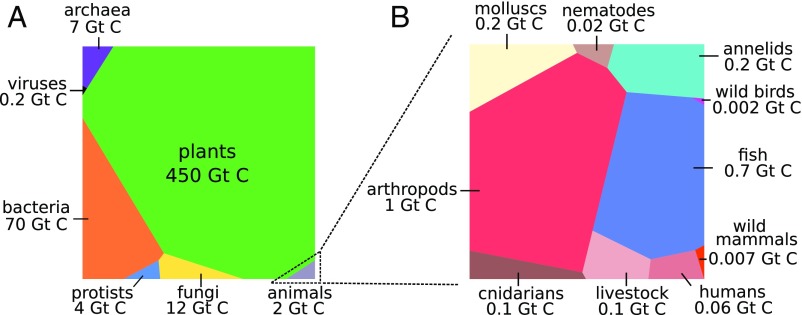
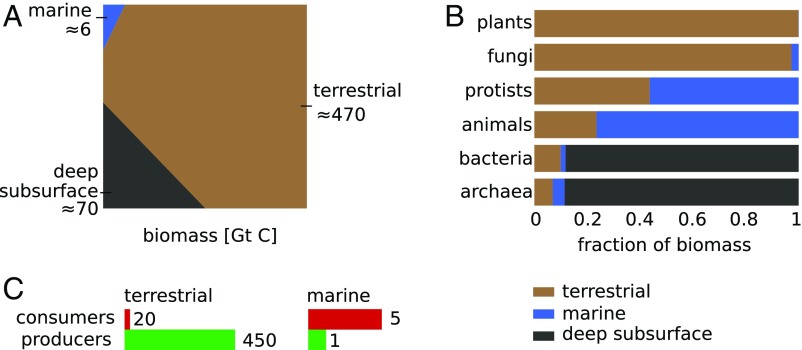
A census of the biomass on Earth is key for understanding the structure and dynamics of the biosphere. However, a global, quantitative view of how the biomass of different taxa compare with one another is still lacking. Here, we assemble the overall biomass composition of the biosphere, establishing a census of the ≈550 gigatons of carbon (Gt C) of biomass distributed among all of the kingdoms of life. We find that the kingdoms of life concentrate at different locations on the planet; plants (≈450 Gt C, the dominant kingdom) are primarily terrestrial, whereas animals (≈2 Gt C) are mainly marine, and bacteria (≈70 Gt C) and archaea (≈7 Gt C) are predominantly located in deep subsurface environments. We show that terrestrial biomass is about two orders of magnitude higher than marine biomass and estimate a total of ≈6 Gt C of marine biota, doubling the previous estimated quantity. Our analysis reveals that the global marine biomass pyramid contains more consumers than producers, thus increasing the scope of previous observations on inverse food pyramids. Finally, we highlight that the mass of humans is an order of magnitude higher than that of all wild mammals combined and report the historical impact of humanity on the global biomass of prominent taxa, including mammals, fish, and plants.
Overview
CoChat Summary
TL;DR
The paper assembles a global census of biomass across all kingdoms of life, estimating Earth’s total biomass at ≈550 Gt C, dominated by plants. It also compares biomass across environments and trophic modes, highlighting large uncertainties and human impacts on the biosphere.
Key findings
- Total global biomass is ≈550 Gt C, with plants ≈450 Gt C (≈80%), bacteria ≈70 Gt C (≈15%), fungi ≈12 Gt C, archaea ≈7 Gt C, protists ≈4 Gt C, animals ≈2 Gt C, and viruses ≈0.2 Gt C.
- Land biomass (≈470 Gt C) is about two orders of magnitude higher than marine biomass (≈6 Gt C); the deep subsurface holds ≈15% of total biomass, chiefly bacteria and archaea.
- In the ocean, ≈1 Gt C of primary producers supports ≈5 Gt C of consumer biomass, an inverted standing biomass distribution; marine biomass is ≈70% microbes, mainly bacteria and protists.
- Human-associated biomass is large relative to wild vertebrates: humans ≈0.06 Gt C, livestock ≈0.1 Gt C, wild mammals ≈0.007 Gt C, domesticated poultry ≈0.005 Gt C versus wild birds ≈0.002 Gt C; total plant biomass has declined approximately twofold relative to pre-human civilization.
Methods
- The authors synthesize hundreds of studies and generate estimates for major taxonomic groups, reporting biomass as gigatons of carbon (Gt C) and using a kingdom-level framework plus viruses.
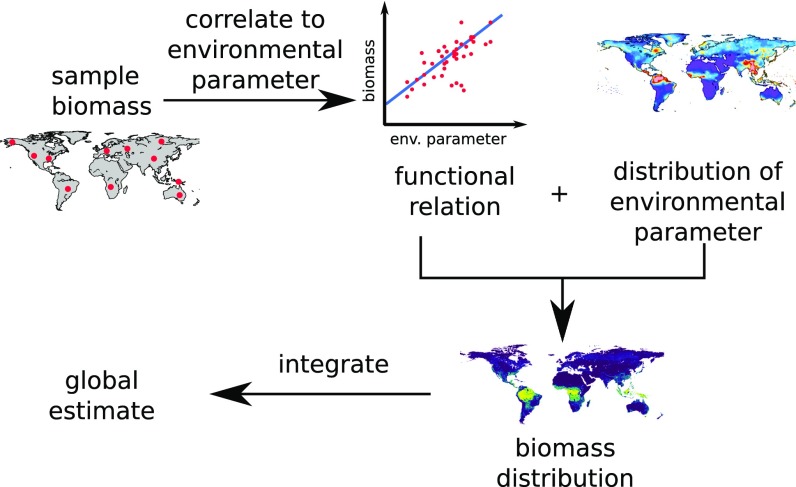
- For many taxa, local biomass samples are extrapolated globally by correlating biomass density with environmental parameters known at global scale; best estimates often use a geometric mean of independent estimates.
- Uncertainty is reported as multiplicative fold-change projections akin to 95% confidence intervals, incorporating intrastudy, interstudy, and intermethod variation; data and code are open-sourced.
Limitations
- The paper states that most datasets rely on fragmentary sampling, causing large uncertainties; sampling is scarce in the deep ocean (usually deeper than 200 m) and deep soil (usually deeper than 1 m), and some estimates may be biased by sampling toward high-abundance areas.
- The paper states that deep subsurface environments have particularly high uncertainty and unknown systematic biases, including unresolved distribution of biomass between aquifer fluids and rocks and among microbial taxa.
- The paper states that current and prehuman vertebrate biomass estimates are only a crude first step, amphibians remain poorly characterized, and parasite biomass is not resolved from hosts; evident from the text, kingdom-level grouping was chosen because much data lack finer taxonomic detail, and some uncertainty projections rely on analogous taxa or expert consultation.
Model-written summary. Check it against the paper before relying on it.
Integrity signals
Registry
Cites
Statistics
Figures
Verification
Claims the paper makes
9 Valid · 7 Not valid · 16 Not checked · 53 Own results and interpretations
Every source the paper cites for this claim was checked and supports it.
In the paper
“The biomass of amphibians, which are experiencing a dramatic population decline (42), remains poorly characterized.”
§ The biomass distribution on Earth > Discussion
What the sources say
- Supportedcites [42] Wake DB Vredenburg VT 2008 Colloquium paper: Are we in the midst of the sixth mass extinction? A view from the world of amphibians Proc Natl Acad Sci USA 105 11466 11473 18695221 PMC2556420 source
The citation is attached to the clause about amphibian population decline, not the separate statement that their biomass is poorly characterized. The passage reporting the Global Amphibian Assessment (labeled Abstract in our copy) says that 43% of amphibian species have declining populations. (LLM, conf=0.92)
plain- Asserted: passes — The authors put it forward as true.
- Checkable: passes — It can be checked against evidence.
- Load-bearing: unclear — It is unclear whether the paper’s conclusions depend on it.
- Based: passes — The paper gives a reason why it holds.
- Supported
Every source the paper cites for this claim was checked and supports it.
In the paper
“In the case of prokaryotes, some major improvements were recently realized, with global estimates of marine deep subsurface prokaryote biomass reduced by about two orders of magnitude due to an increased diversity of sampling locations (7).”
§ The biomass distribution on Earth > Discussion
What the sources say
- Supportedcites [7] Kallmeyer J Pockalny R Adhikari RR Smith DC D’Hondt S 2012 Global distribution of microbial abundance and biomass in subseafloor sediment Proc Natl Acad Sci USA 109 16213 16216 22927371 PMC3479597 source
The Discussion reports a revised subseafloor microbial biomass estimate of 4.1 Pg C versus a previous estimate of 303 Pg C—about a 74-fold reduction. It also identifies a more geographically diverse sampling database, including low-abundance ocean gyres, as a reason the new estimate is lower. The paper identifies other contributing factors as well. (LLM, conf=0.88)
plainstates a cause- Asserted: passes — The authors put it forward as true.
- Checkable: passes — It can be checked against evidence.
- Load-bearing: unclear — It is unclear whether the paper’s conclusions depend on it.
- Based: passes — The paper gives a reason why it holds.
- Supported
The sources with a verdict support this claim; the rest weren’t checked yet, have no full text we could read, or their verdicts aren’t rated yet.
In the paper
“Such inverted biomass distributions can occur when primary producers have a rapid turnover of biomass [on the order of days (34)], while consumer biomass turns over much more slowly [a few years in the case of mesopelagic fish (35)].”
§ The biomass distribution on Earth > Results > The Distribution of Biomass Across Environments and Trophic Modes.
What the sources say
- Supportedcites [34] Zubkov MV 2014 Faster growth of the major prokaryotic versus eukaryotic CO2 fixers in the oligotrophic ocean Nat Commun 5 3776 24777140 PMC4015317 source
The Results (Comparison of the growth rates of the CO2 fixers; page unavailable) report growth rates of 0.1–0.6 per day for the studied oceanic primary producers, consistent with biomass turnover on the order of days. The few-years estimate for mesopelagic fish is assigned to a different citation, not this source. (LLM, conf=0.91)
- Not checked — no full text of the sourcecites [35] Catul V Gauns M Karuppasamy PK 2011 A review on mesopelagic fishes belonging to family Myctophidae Rev Fish Biol Fish 21 339 354 source
plainstates a possible cause- Asserted: passes — The authors put it forward as true.
- Checkable: passes — It can be checked against evidence.
- Load-bearing: passes — The paper’s conclusions depend on it.
- Based: passes — The paper gives a reason why it holds.
- Supported
The cited sources support only part of this claim — read each source’s verdict below.
In the paper
“Combining data from independent sources such as these enables a robust assessment of the total plant biomass (17).”
§ The biomass distribution on Earth > Results > The Uncertainty Associated with Global Biomass Estimates.
What the sources say
- Partly supportedcites [17] Erb K-H 2017 Unexpectedly large impact of forest management and grazing on global vegetation biomass Nature 553 73 76 29258288 PMC5756473 sourceExperimental — accuracy not yet measured
The Methods describe combining multiple datasets and types of evidence to estimate global vegetation biomass stocks. But the paper also says global stocks remain uncertain, reports uncertainty ranges around 35% of the median estimate, and describes more robust estimates as a future prospect. It therefore supports the use of independent sources for an assessment, but not the unqualified characterization of that assessment as robust. (LLM, conf=0.84)
plainstates a cause- Asserted: passes — The authors put it forward as true.
- Checkable: passes — It can be checked against evidence.
- Load-bearing: passes — The paper’s conclusions depend on it.
- Based: passes — The paper gives a reason why it holds.
- Partly supported
A result the paper states — it cites no source for it, so there is none to check. The quote shows it is in the paper.
In the paper
“Plant biomass includes ≈70% stems and tree trunks, which are mostly woody, and thus relatively metabolically inert.”
§ The biomass distribution on Earth > Results > The Biomass Distribution of the Biosphere by Kingdom.
plain- Asserted: passes — The authors put it forward as true.
- Checkable: passes — It can be checked against evidence.
- Load-bearing: unclear — It is unclear whether the paper’s conclusions depend on it.
- Based: passes — The paper gives a reason why it holds.
27 more claims
Create a free account to see all 85 claims and to verify the 2 references still open.
- It may state two separate claims as one. 32
- Probably not a substantial claim. 28
Claims other papers make about this one
Each is checked against this paper’s own text: does it say what the citing paper says it does?
The cited source doesn’t support the claim as written.
In the citing paper
“and less than 10% that of the world ' s current human population ( 52 ).”
From Pervasive human-driven decline of life on Earth points to the need for transformative change (2019) · cites this paper as [52]
Checked by a reasoning model — may be wrong.
Experimental — accuracy not yet measuredThe cited source says what the claim attributes to it.
In the citing paper
“Approximately 450 Gt of C is bound up in terrestrial biota, primarily in plants (86), while only ~6 Gt of C is found in ocean biota (87).”
From Earth beyond six of nine planetary boundaries (2023) · cites this paper as [87]
The cited source says what the claim attributes to it.
In the citing paper
“The amount of metabolic energy available to a biosphere powered by O 2 is vast, such that the O 2 -rich ocean-atmosphere system of the modern Earth supports staggering levels of standing biomass (Bar-On et al. 2018), energy flow (Falkowski et al. 2008), and ecological complexity (Steele 1974).”
From The History of Ocean Oxygenation (2022) · cites this paper as Bar-On et al. 2018
In the citing paper
“Global populations of domestic ruminants (cattle, sheep, and goats) (Ripple et al. 2013) poultry, and pigs (Bennett et al. 2018) used to feed the growing human population now exceed 100 million tons of carbon (Bar-On et al. 2018), and livestock populations are growing rapidly.”
From Scientists’ warning to humanity on the freshwater biodiversity crisis (2021) · cites this paper as Bar-On et al. 2018
Citations
Cites
The worldwide leaf economics spectrum
Wright, I. J., Reich, P. B., Westoby, M., Ackerly, D. D., Baruch, Z., Bongers, F., Cavender-Bares, J., Chapin, T., Cornelissen, J. H. C., Diemer, M., et al. (2004) · Nature · doi:10.1038/nature02403 · Cited by 9,021 · cited 1×
“We then convert the total area of leaves to an estimate of the total dry mass of leaves by using the Glopnet database (24), which measured leaf mass per area (LMA) for ≈2500 plant species.”
MethodA large and persistent carbon sink in the world’s forests
Pan, Y., Birdsey, R. A., Fang, J., Houghton, R., Kauppi, P. E., Kurz, W. A., Phillips, O. L., Shvidenko, A., Lewis, S. L., Canadell, J. G., et al. (2011) · Science · doi:10.1126/science.1201609 · Cited by 8,458
Soil Sampling and Methods of Analysis
(2007) · CRC Press eBooks · doi:10.1201/9781420005271 · Cited by 6,469
Primary production of the biosphere: Integrating terrestrial and oceanic components
Field, C. B., Behrenfeld, M. J., Randerson, J. T., & Falkowski, P. (1998) · Science · doi:10.1126/science.281.5374.237 · Cited by 6,371
Prokaryotes: The unseen majority
Whitman, W. B., Coleman, D. C., & Wiebe, W. J. (1998) · Proceedings of the National Academy of Sciences · doi:10.1073/pnas.95.12.6578 · Cited by 4,871
Global effects of land use on local terrestrial biodiversity
Newbold, T., Hudson, L. N., Hill, S. L. L., Contu, S., Lysenko, I., Senior, R. A., Börger, L., Bennett, D. J., Choimes, A., Collen, B., et al. (2015) · Nature · doi:10.1038/nature14324 · Cited by 4,352
Belowground biodiversity and ecosystem functioning
Bardgett, R. D., & van der Putten, W. H. (2014) · Nature · doi:10.1038/nature13855 · Cited by 3,990 · cited 4×
“This was recommended by experts in the field for estimation of arbuscular mycorrhizal fungi abundance (117).”
BackgroundInfluentialMangroves among the most carbon-rich forests in the tropics
Donato, D. C., Kauffman, J. B., Murdiyarso, D., Kurnianto, S., Stidham, M., & Kanninen, M. (2011) · Nature Geoscience · doi:10.1038/ngeo1123 · Cited by 3,374
Poorter, H., Niklas, K. J., Reich, P. B., Oleksyn, J., Poot, P., & Mommer, L. (2012) · New Phytologist · doi:10.1111/j.1469-8137.2011.03952.x · Cited by 3,163 · cited 1×
“The first relies on a meta-analysis of the biomass allocation to different plant compartments across biomes (19).”
BackgroundA global analysis of root distributions for terrestrial biomes
Jackson, R. B., Canadell, J., Ehleringer, J. R., Mooney, H. A., Sala, O. E., & Schulze, E. D. (1996) · Oecologia · doi:10.1007/bf00333714 · Cited by 3,071 · cited 4×
“assumed the distribution of microbial biomass with depth follows the biomass density versus depth profile of root biomass (21).”
BackgroundMethodInfluential
Research works printed but not linked: 1
- Chapman AD 2009 Numbers of Living Species in Australia and the World Australian Biological Resources Study Canberra, Australia
Cited by
Items 701–800 of 3,743
Zheng, Y., Li, Y., Yang, Y., Zhang, Y., Wang, D., Wang, P., Wong, A. C. Y., Hsieh, Y. S. Y., & Wang, D. (2022) · Journal of Agricultural and Food Chemistry · doi:10.1021/acs.jafc.1c07267 · Cited by 36
Groundwater biodiversity and constraints to biological distribution
Marmonier, P., Galassi, D. M. P., Korbel, K. L., Close, M. E., Datry, T., & Karwautz, C. (2023) · Elsevier eBooks · doi:10.1016/b978-0-12-819119-4.00003-2 · Cited by 39
Groundwater ecology and evolution: an introduction
Malard, F., Griebler, C., & Rétaux, S. (2023) · Elsevier eBooks · doi:10.1016/b978-0-12-819119-4.00026-3 · Cited by 34
The evolutionary neuroscience of domestication
Hecht, E. E., Barton, S. A., Flattery, C. N. R., & Meza, A. M. (2023) · Trends in Cognitive Sciences · doi:10.1016/j.tics.2023.03.008 · Cited by 34
Emergence of life in an inflationary universe
Totani, T. (2020) · Scientific Reports · doi:10.1038/s41598-020-58060-0 · Cited by 29
“C. An upper limit may be estimated by the number of nucleotides in the present life on Earth, N m = 7 × 1037 (3.7×10¹⁶ g in mass), which is estimated by the total biomass of 550 Gt-C (3.7×10¹² wet·t) [46] assuming that nucleic acids constitute 1% of the wet biomass. A rough amount of nucleobases delivered from space b…”
BackgroundInfluentialThe Anthropocene, hyperobjects and the archaeology of the future past
Campbell, P. B. (2021) · Antiquity · doi:10.15184/aqy.2021.116 · Cited by 32
“Human biomass, together with our domesticated species, currently outweighs twenty-fold the combined biomass of all mammals in nature (Bar-On et al. 2018).”
BackgroundMöhrke, A. C. F., Haegerbaeumer, A., Traunspurger, W., & Höss, S. (2022) · Frontiers in Environmental Science · doi:10.3389/fenvs.2022.975904 · Cited by 35
“Soil organisms are key drivers for ecosystem functions and processes, such as nutrient cycling and water transfer (Bar-On et al., 2018; Bardgett & van der Putten, 2014; Bowker et al., 2010; Lavelle & Spain, 2001; Porazinska et al., 2003; Roger-Estrade et al., 2010; van den Hoogen et al., 2019).”
BackgroundViral infections likely mediate microbial controls on ecosystem responses to global warming
Wieczynski, D. J., Yoshimura, K. M., Denison, E. R., Geisen, S., DeBruyn, J. M., Shaw, A. J., Weston, D. J., Pelletier, D. A., Wilhelm, S. W., & Gibert, J. P. (2023) · FEMS Microbiology Ecology · doi:10.1093/femsec/fiad016 · Cited by 35
Capper, J. L. (2022) · One Health Outlook · doi:10.1186/s42522-023-00089-y · Cited by 34
“Consequently, cattle account for 54.8% of global livestock mass, compared to 18.4% for swine and 3.4% for chickens (Author’s calculation derived from supplementary data from [57]).”
BackgroundInfluentialSimba, L. D., Beest, M. T., Hawkins, H., Larson, K., Palmer, A. R., Sandström, C., Smart, K. G., Kerley, G. I. H., & Cromsigt, J. P. G. M. (2024) · AMBIO · doi:10.1007/s13280-023-01976-4 · Cited by 41
“While livestock and wildlife coexist in the same land, global mammalian biomass is now excessively composed of livestock, comprising about 62% compared to just 2% representing wild land mammals (Bar-On et al. 2018).”
BackgroundWidespread ecological novelty across the terrestrial biosphere
Kerr, M. R., Ordóñez, A., Riede, F., Atkinson, J., Pearce, E. A., Sykut, M. T., Trepel, J., & Svenning, J. (2025) · Nature Ecology & Evolution · doi:10.1038/s41559-025-02662-2 · Cited by 47
“…incorporates two aspects of human impacts on plant assemblages, given their importance in terrestrial ecosystems functioning and structure 46 : the proportion of alien species, which we calculated by downscaling country-level alien species checklists using data from the global…”
Bordeleau, X., Hatcher, B. G., Denny, S., Fast, M. D., Whoriskey, F. G., Patterson, D. A., & Crossin, G. T. (2018) · Biological Conservation · doi:10.1016/j.biocon.2018.06.033 · Cited by 30
Takoudjou, S. M., Ploton, P., Martin‐Ducup, O., Lehnebach, R., Fortunel, C., Sagang, L. B., Boyemba, F., Couteron, P., Fayolle, A., Libalah, M. B., et al. (2020) · Scientific Reports · doi:10.1038/s41598-020-58733-w · Cited by 36
Sabido, E. M., Tenebro, C. P., Suarez, A. F. L., Ong, S. D. C., Trono, D. J. V. L., Amago, D. S., Evangelista, J. E., Reynoso, A. M. Q., Villalobos, I. G. M., Alit, L. D. D., et al. (2020) · Journal of Marine Science and Engineering · doi:10.3390/jmse8100734 · Cited by 37
Duan, C.-S., Zuo, S., Wu, Z., Qiu, Y., Wang, J., Lei, Y., Liao, H., & Ren, Y. (2020) · Environmental Research Letters · doi:10.1088/1748-9326/abcee9 · Cited by 32
Swanson, H. A., Svenning, J., Saxena, A., Muscarella, R., Franklin, J., Garbelotto, M. M., Mathews, A. S., Saitô, O., Schnitzler, A., Serra-Diaz, J. M., et al. (2021) · One Earth · doi:10.1016/j.oneear.2021.01.006 · Cited by 36
Orchid Root Associated Bacteria: Linchpins or Accessories?
Kaur, J., & Sharma, J. (2021) · Frontiers in Plant Science · doi:10.3389/fpls.2021.661966 · Cited by 35
Romillac, N., & Santorufo, L. (2021) · Soil Biology and Biochemistry · doi:10.1016/j.soilbio.2021.108415 · Cited by 36
Botanical priming helps overcome plant blindness on a memory task
Zani, G., & Low, J. (2022) · Journal of Environmental Psychology · doi:10.1016/j.jenvp.2022.101808 · Cited by 39
Plant Proxy Evidence for High Rainfall and Productivity in the Eocene of Australia
Reichgelt, T., Greenwood, D. R., Steinig, S., Conran, J. G., Hutchinson, D. K., Lunt, D. J., Scriven, L. J., & Zhu, J. (2022) · Paleoceanography and Paleoclimatology · doi:10.1029/2022pa004418 · Cited by 29
“, 2010; Whittaker, 1962) and by far exceed any other type of organism in sheer biomass (Bar-On et al., 2018).”
BackgroundThe human eco-predicament: Overshoot and the population conundrum
Rees, W. E. (2022) · Vienna Yearbook of Population Research · doi:10.1553/p-eznb-ekgc · Cited by 39
“Wild populations of many species are in freefall, and domestic poultry now represent 70% of Earth’s remaining avian biomass (Bar-On et al., 2018; see also Smil, 2011; OP, 2022).”
BackgroundZhang, Y., Kepiro, I. E., Ryadnov, M. G., & Pagliara, S. (2023) · Microbiology Spectrum · doi:10.1128/spectrum.03667-22 · Cited by 32
“Bacteria are single-cell organisms that have inhabited our planet for billions of years and make up 13% of the Earth’s biomass (1).”
BackgroundThe protist cultural renaissance
del Campo, J., Carlos‐Oliveira, M., Čepička, I., Hehenberger, E., Horák, A., Karnkowska, A., Kolísko, M., Lara, E., Lukeš, J., Pánek, T., et al. (2023) · Trends in Microbiology · doi:10.1016/j.tim.2023.11.010 · Cited by 38
“These abundant and omnipresent organisms represent the bulk of extant eukaryotic genetic and functional diversity [1] and account for an estimated biomass of 4 gigatons of carbon, doubling the animal biomass [2].”
Lee, H. B., Jeong, D. H., Cho, B. C., & Park, J. S. (2023) · Frontiers in Marine Science · doi:10.3389/fmars.2023.1199116 · Cited by 32
Kilner, C. L., Carrell, A. A., Wieczynski, D. J., Votzke, S., DeWitt, K., Yammine, A., Shaw, A. J., Pelletier, D. A., Weston, D. J., & Gibert, J. P. (2024) · Global Change Biology · doi:10.1111/gcb.17203 · Cited by 40
“Unicellular Eukaryotes, collectively known as protists, store two times more C globally than all animals combined (Bar-On et al., 2018; Bond-Lamberty & Thomson, 2010), contributing to C cycling through mixotrophic metabolism (Jassey et al., 2015; Wieczynski, Moeller, & Gibert, 2023), and also serve…”
BackgroundA practical guide to the discovery of biomolecules with biostimulant activity
Li, J., Lardon, R., Mangelinckx, S., & Geelen, D. (2024) · Journal of Experimental Botany · doi:10.1093/jxb/erae156 · Cited by 34
Drivers and impacts of global seed disperser decline
Fricke, E. C., Bello, C., Chaplin‐Kramer, R., Dent, D. H., Feeley, K. J., Galetti, M., González‐Varo, J. P., Heleno, R., & Reid, J. L. (2025) · Nature Reviews Biodiversity · doi:10.1038/s44358-025-00053-w · Cited by 57
“Plants adapted to dispersal by wild animals now exist in an increasingly defaunated world, with wild animals making up less than 5% of the land vertebrate biomass 9 .”
A New Frontier for Palaeobiology: Earth's Vast Deep Biosphere
McMahon, S., & Ivarsson, M. (2019) · BioEssays · doi:10.1002/bies.201900052 · Cited by 33
Thermal unfolding and refolding of a lytic polysaccharide monooxygenase from Thermoascus aurantiacus
Singh, R. K., Blossom, B. M., Russo, D. A., van Oort, B., Croce, R., Jensen, P. E., Felby, C., & Bjerrum, M. J. (2019) · RSC Advances · doi:10.1039/c9ra05920b · Cited by 33
Thinking avant la lettre: A Review of 4E Cognition.
Carney, J. (2020) · Evolutionary Studies in Imaginative Culture · doi:10.26613/esic/4.1.172 · Cited by 28
Thermophilic microbial deconstruction and conversion of natural and transgenic lignocellulose
Bing, R. G., Sulis, D. B., Wang, J. P., Adams, M. W. W., & Kelly, R. M. (2021) · Environmental Microbiology Reports · doi:10.1111/1758-2229.12943 · Cited by 33
Predatory cues drive colony size reduction in marine diatoms
Rigby, K., & Selander, E. (2021) · Ecology and Evolution · doi:10.1002/ece3.7890 · Cited by 26
“The total biomass of diatoms totals to around 0.1% of that of terrestrial plants (Bar-On et al., 2018; Leblanc et al., 2012).”
InfluentialCausal Relations of Upscaled Urban Aquaponics and the Food-Water-Energy Nexus—A Berlin Case Study
Baganz, G. F. M., Schrenk, M., Körner, O., Baganz, D., Keesman, K. J., Goddek, S., Siscan, Z., Baganz, E., Doernberg, A., Monsees, H., et al. (2021) · Water · doi:10.3390/w13152029 · Cited by 34
“The food system also impacts biodiversity loss [86]—related to the biosphere integrity planetary boundary—and while domestic livestock currently has an estimated biomass of 100 Mt C, all wild mammals globally account for only about 7 Mt C [87].”
BackgroundAdvanced materials design based on waste wood and bark
Wenig, C., Dunlop, J., Hehemeyer-Cürten, J., Reppe, F., Horbelt, N., Krauthausen, K., Fratzl, P., & Eder, M. (2021) · Philosophical Transactions of the Royal Society A Mathematical Physical and Engineering Sciences · doi:10.1098/rsta.2020.0345 · Cited by 34
“%) of biomass on Earth [8].”
South Africa’s private wildlife ranches protect globally significant populations of wild ungulates
Taylor, W. A., Child, M. F., Lindsey, P. A., Nicholson, S. K., Relton, C., & Davies‐Mostert, H. T. (2021) · Biodiversity and Conservation · doi:10.1007/s10531-021-02294-5 · Cited by 37
Early evolution of beetles regulated by the end-Permian deforestation
Zhao, X., Yu, Y., Clapham, M. E., Yan, E., Chen, J., Jarzembowski, E. A., Zhao, X., & Wang, B. (2021) · eLife · doi:10.7554/elife.72692 · Cited by 44
A Theory of City Biogeography and the Origin of Urban Species
Dunn, R. R., Burger, J. R., Carlen, E. J., Koltz, A. M., Light, J. E., Martin, R. A., Munshi‐South, J., Nichols, L. M., Vargo, E. L., Yitbarek, S., et al. (2022) · Frontiers in Conservation Science · doi:10.3389/fcosc.2022.761449 · Cited by 33
“This is vastly different frommost terrestrial ecosystems where, on average, animal biomass tends to be just one two hundredth that of plant biomass (Bar-On et al., 2018).”
BackgroundInsect herbivory within modern forests is greater than fossil localities
Azevedo‐Schmidt, L., Meineke, E. K., & Currano, E. D. (2022) · Proceedings of the National Academy of Sciences · doi:10.1073/pnas.2202852119 · Cited by 30
Discovering marine biodiversity in the 21st century
Rogers, A. D., Appeltans, W., Assis, J. F., Ballance, L. T., Cury, P. M., Duarte, C. M., Favoretto, F., Hynes, L. A., Kumagai, J. A., Lovelock, C. E., et al. (2022) · Advances in marine biology · doi:10.1016/bs.amb.2022.09.002 · Cited by 36
Nguyen, T. H., Wang, S., & Nguyen, V. B. (2022) · Agronomy · doi:10.3390/agronomy12123099 · Cited by 28
Shayka, B. F., Hesselbarth, M. H. K., Schill, S. R., Currie, W. S., & Allgeier, J. E. (2023) · Biology Letters · doi:10.1098/rsbl.2023.0075 · Cited by 29
“7 Pg C) [41], 13 times larger than the amount of C in all livestock biomass on Earth (≈0.”
BackgroundBroekhuis, F., Madsen, E. K., & Klaassen, B. (2019) · Animal Conservation · doi:10.1111/acv.12483 · Cited by 30
Ecology of Subseafloor Crustal Biofilms
Ramírez, G. A., Garber, A. I., Lecoeuvre, A., D’Angelo, T., Wheat, C. G., & Orcutt, B. N. (2019) · Frontiers in Microbiology · doi:10.3389/fmicb.2019.01983 · Cited by 28
“As estimates of global biomass in ocean crust are beginning to emerge (Heberling et al., 2010; Bar-On et al., 2018), we emphasize that biomass partitioning into plankton and biofilm in this habitat, each community type existing at a different cellular density, is necessary for overall estimate robustness and proper ec…”
BackgroundChase, W. R., Zhaxybayeva, O., Rocha, J., Cosgrove, D. J., & Shapiro, L. R. (2020) · New Phytologist · doi:10.1111/nph.16428 · Cited by 35
“…diverse set of microbial species – including many which have not yet been described as interacting with plants or algae – suggests that the immense amount of global cellulose biomass (Bar-On et al., 2018) is an under-recognized selective pressure driving microbial evolution (Smillie et al., 2011).”
BackgroundSelf-Regulating Plant Robots: Bioinspired Heliotropism and Nyctinasty
Cezan, S. D., Baytekin, H. T., & Baytekin, B. (2020) · Soft Robotics · doi:10.1089/soro.2019.0036 · Cited by 28
“28,29 Since the plants constitute the largest living mass on earth, 30 one might think about transpiration as the most widely used water transport mechanism on earth.”
Industrial solid waste as oxygen carrier in chemical looping gasification technology: A review
Peng, L., Dong, S., Yang, J., et al. (2024) · Journal of the Energy Institute · doi:10.1016/j.joei.2024.101694 · Cited by 27
Hartop, E., Lee, L., Srivathsan, A., Jones, M. M., Peña‐Aguilera, P., Ovaskainen, O., Roslin, T. V., & Meier, R. (2024) · BMC Biology · doi:10.1186/s12915-024-02010-z · Cited by 31
“Such charismatic taxa are then used as proxies for all taxa in a region [7, 8, 33, 56, 57, 61, 70, 79] instead of basing our understanding of global biodiversity on a broad and unbiased representation of biodiversity covering a wide range of traits and responses to environmental change [2, 21, 37].”
Yoshimi, Y., Yu, L., Cresswell, R., Guo, X., Echevarría‐Poza, A., Łyczakowski, J. J., Dupree, R., Kotake, T., & Dupree, P. (2025) · Nature Communications · doi:10.1038/s41467-025-56626-y · Cited by 28
“1 The versatile utility of plant cell wall polysaccharides has gained great attention to achieve a recycling-oriented society with a low carbon footprint, yet a basal understanding of the polymers is still limited.”
Algal–bacterial symbiosis and its application in wastewater treatment
Johnson, I., Girijan, S., Tripathy, B. K., Ali, M. A. S., & Kumar, M. (2020) · Elsevier eBooks · doi:10.1016/b978-0-12-819860-5.00015-8 · Cited by 40
Reflections on the Dasgupta Review on the Economics of Biodiversity
Groom, B., & Turk, Z. (2021) · Environmental and Resource Economics · doi:10.1007/s10640-021-00560-2 · Cited by 38
Corlett, R. T. (2021) · Springer eBooks · doi:10.1007/978-3-030-66877-8_7 · Cited by 38
Wells, H. B. M., Crego, R. D., Ekadeli, J., Namoni, M., Kimuyu, D. M., Odadi, W. O., Porensky, L. M., Dougill, A. J., Stringer, L. C., & Young, T. P. (2022) · Frontiers in Ecology and Evolution · doi:10.3389/fevo.2022.825689 · Cited by 32
Schreiber, M., Rensing, S. A., & Gould, S. B. (2022) · Trends in Plant Science · doi:10.1016/j.tplants.2022.05.005 · Cited by 28
Understanding anthropogenic impacts on zoogeochemistry is essential for ecological restoration
Abraham, A. J., Duvall, E. S., Ferraro, K. M., Webster, A. B., Doughty, C. E., le Roux, E., & Ellis‐Soto, D. (2022) · Restoration Ecology · doi:10.1111/rec.13778 · Cited by 29
Alarm communication predates eusociality in termites
Sillam‐Dussès, D., Jandák, V., Stiblík, P., Delattre, O., Chouvenc, T., Balvín, O., Cvačka, J., Soulet, D., Synek, J., Brothánek, M., et al. (2023) · Communications Biology · doi:10.1038/s42003-023-04438-5 · Cited by 31
Huang, S., Jiang, R., Craig, N. J., Deng, H., He, W., Li, J., & Su, L. (2023) · Marine Environmental Research · doi:10.1016/j.marenvres.2023.105951 · Cited by 37
Understanding and Monitoring Chemical and Biological Soil Degradation
Saljnikov, E., Lavrishchev, A. V., Römbke, J., Rinklebe, J., Scherber, C., Wilke, B., Tóth, T., Blum, W. E. H., Behrendt, U., Eulenstein, F., et al. (2021) · Innovations in landscape research · doi:10.1007/978-3-030-85682-3_3 · Cited by 34
Toward a common set of functional traits for soil protists
Giachello, S., Cantera, I., Carteron, A., Marta, S., Cipriano, C., Guerrieri, A., Bonin, A., Thuiller, W., & Ficetola, G. F. (2023) · Soil Biology and Biochemistry · doi:10.1016/j.soilbio.2023.109207 · Cited by 28
Polyploidy – A tool in adapting trees to future climate changes? A review of polyploidy in trees
Ræbild, A., Anamthawat‐Jónsson, K., Egertsdotter, U., Immanen, J., Jensen, A. M., Koutouleas, A., Martens, H. J., Nieminen, K. M., Olofsson, J. K., Röper, A.-C., et al. (2024) · Forest Ecology and Management · doi:10.1016/j.foreco.2024.121767 · Cited by 30
Sustainable land systems in the Anthropocene: Navigating the global land squeeze
Erb, K., Matej, S., Haberl, H., & Gingrich, S. (2024) · One Earth · doi:10.1016/j.oneear.2024.06.011 · Cited by 36
Food processing of chitin and chitosan: From waste to opportunities
Knorr, D. (2025) · Journal of Food Engineering · doi:10.1016/j.jfoodeng.2025.112634 · Cited by 35
Citizen-Science for the Future: Advisory Case Studies From Around the Globe
Simoniello, C., Jencks, J., Lauro, F. M., et al. (2019) · Frontiers in Marine Science · doi:10.3389/fmars.2019.00225 · Cited by 26
Althoff, F., & Zachgo, S. (2020) · International Journal of Molecular Sciences · doi:10.3390/ijms21155410 · Cited by 26
“This foundational event enabled the evolution of three-dimensional land plants with adaptations to new environments such that land plants represent today 80% of the total biomass on earth [1,2].”
BackgroundNanozyme-mediated elemental biogeochemical cycling and environmental effects
Chi, Z., & Yu, G. (2021) · Science China Earth Sciences · doi:10.1007/s11430-020-9756-5 · Cited by 26
Reissig, G. N., Oliveira, T. F. D. C., de Oliveira, R. P., Posso, D. A., Parise, A. G., Nava, D. E., & Souza, G. M. (2021) · Frontiers in Sustainable Food Systems · doi:10.3389/fsufs.2021.657401 · Cited by 27
Illuminating the Virosphere Through Global Metagenomics
Call, L., Nayfach, S., & Kyrpides, N. C. (2021) · Annual Review of Biomedical Data Science · doi:10.1146/annurev-biodatasci-012221-095114 · Cited by 25
Cariglino, B., Moisan, P., & Lara, M. B. (2021) · Journal of South American Earth Sciences · doi:10.1016/j.jsames.2021.103512 · Cited by 34
Global Rangeland Primary Production and Its Consumption by Livestock in 2000–2010
Wolf, J. E., Chen, M., & Asrar, G. (2021) · Remote Sensing · doi:10.3390/rs13173430 · Cited by 29
“Currently, the global biomass of mammalian livestock is 67% larger than that of humans, 1329% larger than that of all wild mammals, and 318% larger than total mammalian biomass that was supported on Earth 100,000 years ago [1].”
BackgroundCatalytic conversion of sucrose to 5-hydroxymethylfurfural in green aqueous and organic medium
Mulk, S., Sajid, M., Wang, L., Liu, F., & Pan, G. (2021) · Journal of environmental chemical engineering · doi:10.1016/j.jece.2021.106613 · Cited by 27
Warm and arid regions of the world are hotspots of superorganism complexity
Richelière, F. L., Muñoz, G., Guénard, B., Dunn, R. R., Economo, E. P., Powell, S., Sanders, N. J., Weiser, M. D., Abouheif, E., & Lessard, J. (2022) · Proceedings of the Royal Society B Biological Sciences · doi:10.1098/rspb.2021.1899 · Cited by 33
Epilithic Microbial Community Functionality in Deep Oligotrophic Continental Bedrock
Nuppunen-Puputti, M., Kietäväinen, R., Raulio, M., Soro, A., Purkamo, L., Kukkonen, I., & Bomberg, M. (2022) · Frontiers in Microbiology · doi:10.3389/fmicb.2022.826048 · Cited by 29
“Deep continental microbial biomass has been estimated to constitute up to 19% of the Earth’s biomass (McMahon and Parnell, 2014; Bar-On et al., 2018; Magnabosco et al., 2018).”
BackgroundLee, H.-I., Seo, Y.-O., Kim, H., Ali, A., Lee, C., & Chung, Y. (2022) · Forest Ecology and Management · doi:10.1016/j.foreco.2022.120179 · Cited by 27
Context‐dependent effects of shifting large herbivore assemblages on plant structure and diversity
Orr, D. A., Bui, A. Q. T., Klope, M., McCullough, I. M., Lee, M. J., Motta, C. I., Mayorga, I., Konicek, K., & Young, H. S. (2022) · Journal of Ecology · doi:10.1111/1365-2745.13871 · Cited by 28
Protist Predation Influences the Temperature Response of Bacterial Communities
Rocca, J. D., Yammine, A., Simonin, M., & Gibert, J. P. (2022) · Frontiers in Microbiology · doi:10.3389/fmicb.2022.847964 · Cited by 28
Australia as a global sink for the genetic diversity of avian influenza A virus
Wille, M., Grillo, V., Pedroso, S. B. D. G., Burgess, G. W., Crawley, A., Dickason, C., Hansbro, P. M., Hoque, M. A., Horwood, P. F., Kirkland, P. D., et al. (2022) · PLoS Pathogens · doi:10.1371/journal.ppat.1010150 · Cited by 31
Day, T. C., Márquez-Zacarías, P., Bravo, P., Pokhrel, A. R., MacGillivray, K. A., Ratcliff, W. C., & Yunker, P. J. (2022) · Biophysics Reviews · doi:10.1063/5.0080845 · Cited by 24
Quantifying research interests in 7,521 mammalian species with h -index: a case study
Tam, J., Lagisz, M., Cornwell, W. K., & Nakagawa, S. (2022) · GigaScience · doi:10.1093/gigascience/giac074 · Cited by 26
“Among all mammals on earth, wild mammals make up only 4% of the total mammalian biomass, while humans and live-stock combine to form the other 96% [50], and this corresponds with their widespread occurrence due to the globalization of a small number of animal husbandry systems [51].”
Antibiotics from Insect-Associated Actinobacteria
Baranova, A. A., Zakalyukina, Y. V., Ovcharenko, A. A., Korshun, V. A., & Tyurin, A. P. (2022) · Biology · doi:10.3390/biology11111676 · Cited by 28
Land and deep-sea mining: the challenges of comparing biodiversity impacts
Katona, S. K., Paulikas, D., Ali, S. H., Clarke, M., Ilves, E., Lovejoy, T. Ε., Madin, L. P., & Stone, G. S. (2023) · Biodiversity and Conservation · doi:10.1007/s10531-023-02558-2 · Cited by 32
“Kingdom Plantae comprises 80% of Earth’s biomass (Bar-On et al. 2018) and includes about 391,000 known species of vascular plants, of which 21% are in danger of extinction (RBG Kew 2016) from conversion of forests and other land to agriculture, development, or mineral extraction, among others.”
BackgroundHarrellson, S. G., DeLay, M., Chen, X., Cavusoglu, A.-H., Dworkin, J. E., Stone, H. A., & Şahin, Ö. (2023) · Nature · doi:10.1038/s41586-023-06144-y · Cited by 38
“According to equation (1), the resulting plot should be that of an exponential decay, with the decay length corresponding to λ.”
BackgroundMethodInfluentialWang, X., Chen, X., Xu, J., Ji, Y., Du, X.-X., & Gao, J. (2023) · Plants · doi:10.3390/plants12152843 · Cited by 26
“In the arid regions of northwest China, plants’ conservative resource acquisition strategies often accompany higher BGB or R/S, while the aboveground and belowground biomass allocation patterns in areas with abundant water and heat are opposite [1].”
BackgroundBiomass carbon mining to develop nature-inspired materials for a circular economy
Bachs-Herrera, A., York, D., Stephens-Jones, T., Mabbett, I. W., Yeo, J., & Martín‐Martínez, F. J. (2023) · iScience · doi:10.1016/j.isci.2023.106549 · Cited by 30
Pang, Y. X., Sharmin, N., Wu, T., & Pang, C. H. (2023) · Applied Energy · doi:10.1016/j.apenergy.2023.121055 · Cited by 26
Resource Patchiness as a Resolution to the Food Paradox in the Sea
Benoit‐Bird, K. J. (2023) · The American Naturalist · doi:10.1086/727473 · Cited by 25
“A recent global census of life on Earth revealed that the average volumetric concentration of biomass in the ocean is four orders of magnitude lower than that in terrestrial ecosystems (Costanza 1999; Bar-On et al. 2018).”
BackgroundGuerreiro, M. F., Borges, F. O., Santos, C. P., Xavier, J. C., Hoving, H., & Rosa, R. (2023) · Marine Biology · doi:10.1007/s00227-023-04261-w · Cited by 30
“Cephalopods fulfill an important role in numerous marine foodwebs and make up to a fourth of the global mollusk bio‐ mass (Rodhouse et al. 1996; Bar‐On et al. 2018; de la Ches‐ nais et al. 2019).”
BackgroundBuilding microbial kinetic models for environmental application: A theoretical perspective
Jin, Q. (2023) · Applied Geochemistry · doi:10.1016/j.apgeochem.2023.105782 · Cited by 30
Kobziar, L. N., Lampman, P., Tohidi, A., Kochanski, A. K., Cervantes, A., Hudak, A. T., Mccarley, R., Gullett, B. K., Aurell, J. M., Moore, R. A., et al. (2024) · Environmental Science & Technology · doi:10.1021/acs.est.3c05142 · Cited by 29
SEA-PHAGES and SEA-GENES: Advancing Virology and Science Education
Heller, D. M., Sivanathan, V., Asai, D. J., & Hatfull, G. F. (2024) · Annual Review of Virology · doi:10.1146/annurev-virology-113023-110757 · Cited by 39
Whale recovery and the emerging human-wildlife conflict over Antarctic krill
Savoca, M. S., Kumar, M., Sylvester, Z. T., Czapanskiy, M. F., Meyer, B., Goldbogen, J. A., & Brooks, C. M. (2024) · Nature Communications · doi:10.1038/s41467-024-51954-x · Cited by 34
“Thecumulativebiomassofthewhales killed was estimated to be equivalent to one-third of all people 34 , and twice that of all wild mammals, on Earth at the turn of the 21st-century 35 .”
BackgroundWang, J., Peñuelas, J., Shi, X., Liu, Y., Delgado‐Baquerizo, M., Mao, J., Zhang, G., Liu, C., & Pan, G. (2024) · Communications Earth & Environment · doi:10.1038/s43247-024-01767-z · Cited by 31
Carbon-centric dynamics of Earth’s marine phytoplankton
Stoer, A. C., & Fennel, K. (2024) · Proceedings of the National Academy of Sciences · doi:10.1073/pnas.2405354121 · Cited by 28
“Based on our estimate, oceanic phytoplankton account for only ~ 0.06% of the biomass of the biosphere ( 44 )—a miniscule fraction despite their tremendous role in sustaining marine ecosystems and mediating Earth’s carbon cycling.”
InfluentialA deep learning pipeline for time-lapse camera monitoring of insects and their floral environments
Bjerge, K., Karstoft, H., Mann, H. M. R., & Høye, T. T. (2024) · Ecological Informatics · doi:10.1016/j.ecoinf.2024.102861 · Cited by 42
Strigolactones optimise plant water usage by modulating vessel formation
Zhao, J., Shi, D., Kaeufer, K., Song, C., Both, D., Thier, A. L., Cao, H., Lassen, L., Xu, X., Hamamura, Y., et al. (2025) · Nature Communications · doi:10.1038/s41467-025-59072-y · Cited by 29
“On the median level, our analysis detected 1224 transcribed genes and 1854 UMIs for each nucleus (Supplementary Data 1).”
The Anthropocene fossil record of terrestrial mammals
Plotnick, R. E., & Koy, K. A. (2019) · Anthropocene · doi:10.1016/j.ancene.2019.100233 · Cited by 27
Transitioning towards human–large carnivore coexistence in extensive grazing systems
Boronyak, L., Jacobs, B. C., & Wallach, A. D. (2020) · AMBIO · doi:10.1007/s13280-020-01340-w · Cited by 28
“The central aim of environmental governance is to maintain or improve ‘‘the ability of environmental systems to function and to produce ecosystem services through the persistence of species, habitats or biodiversity’’ (Bennett and Satterfield 2018, p. 7).”
BackgroundSvensson, J. S., Neumann, W., Bjärstig, T., Zachrisson, A., & Thellbro, C. (2020) · Sustainability · doi:10.3390/su12125113 · Cited by 38
The vital role of rangers in conservation
Singh, R., Galliers, C., Appleton, M., et al. (2021) · Parks Stewardship Forum · doi:10.5070/p537151745 · Cited by 25
Flores-Jerónimo, G., Silva-Mendoza, J., Claudio, P. D. C. M. S., Toxqui-Terán, A., Aguilar-Martínez, J. A., & Guerrero, L. C. (2021) · Waste and Biomass Valorization · doi:10.1007/s12649-021-01377-2 · Cited by 25
Novel Microbial Groups Drive Productivity in an Archean Iron Formation
Sheik, C. S., Badalamenti, J. P., Telling, J. P., Hsu, D. S. Y., Alexander, S. C., Bond, D. R., Gralnick, J. A., Lollar, B. S., & Toner, B. M. (2021) · Frontiers in Microbiology · doi:10.3389/fmicb.2021.627595 · Cited by 26
Two conifer GUX clades are responsible for distinct glucuronic acid patterns on xylan
Łyczakowski, J. J., Yu, L., Terrett, O. M., Fleischmann, C. M., Temple, H., Thorlby, G. J., Sorieul, M., & Dupree, P. (2021) · New Phytologist · doi:10.1111/nph.17531 · Cited by 28
“The majority of terrestrial carbon is stored in forests as wood (Pan et al., 2011; Ramage et al., 2017; Bar-On et al., 2018).”
Background
Metadata
- Authors
- Bar-On, Y. M., Phillips, R., & Milo, R.
- Affiliations
- Department of Plant and Environmental Sciences, Weizmann Institute of Science, 76100 Rehovot, Israel;
- California Institute of Technology (US)
- Weizmann Institute of Science (IL)
- Corresponding author
- Milo, Ron
- Venue
- Proceedings of the National Academy of Sciences
- Publisher
- National Academy of Sciences
- Published
- 2018-05-21
- Volume
- 115
- Issue
- 25
- Pages
- 6506-6511
- ISSN
- 0027-8424 (ISSN-L)
- 1091-6490
- PMC
- PMC6016768
- OpenAlex
- W2804910112
- Cited by
- 3,723
- References
- 263
- Citations by year
- 2026: 349 · 2025: 450 · 2024: 589 · 2023: 617 · 2022: 498 · 2021: 498 · 2020: 419 · 2019: 246 · 2018: 49
- FWCI
- 239.98
- Type
- journal article
- Language
- en
- Open access
- hybrid
- doi.org
- Licence
- Locations
- Proceedings of the National Academy of Sciences (publishedVersion, cc-by-nc-nd)
- Europe PMC (PubMed Central) (publishedVersion, cc-by-nc-nd)
- PubMed Central (publishedVersion, cc-by-nc-nd)
- PubMed (publishedVersion)
- CaltechAUTHORS (California Institute of Technology) (submittedVersion, cc-by-nc-nd)
- Funders
- National Institutes of Health (5r35gm118043-07)
- National Institute of General Medical Sciences (R35 GM118043)
- Topics
- Physical Sciences › Environmental Science › Nature and Landscape Conservation › Ecology and Vegetation Dynamics Studies
- Physical Sciences › Environmental Science › Global and Planetary Change › Earth Systems and Cosmic Evolution
- Life Sciences › Agricultural and Biological Sciences › Soil Science › Soil Carbon and Nitrogen Dynamics
- Keywords
- biomass allocation, biomass carbon, terrestrial biomass, marine biomass, bacteria, archaea, food pyramid, wild mammals, fish biomass, plant biomass
- MeSH terms
- Animals, Archaea, Bacteria, Carbon, Humans, Plants, Ecosystem, Biomass, Earth, Planet, Biota
About these checks
Registry, retraction, Cites and statistics results are computed, not judged, with one exception: a printed reference that no index lists is read once by a model before it counts as a citation error. Claims are extracted by a model and kept only when their quote appears verbatim in the text; each cited source is then checked, with a model’s help, for whether it says what the claim relies on. Those verdicts can be wrong — read the claim’s quote and the cited source before relying on one.
The claim verdicts this report counts are experimental: their accuracy is not yet measured.
A language model drew the claims from the paper on 2026-10-10, under version 3 of the claim definition (model deepseek-v4.1-flash, prompt extract-v3).
A second model labelled each claim on 2026-10-10 (model jev-1.13-20260917, definition revision gold-guideline-v0.2).
Cited sources are checked with a language model’s help (gpt-6-sol).
Statistics and arithmetic are recomputed, not judged.
Confidence bands are shown only for fields calibrated on our annotated test set. None is calibrated yet, so no band is shown.
What counts as a claim ›How we measure confidence ›How we check this ›
Are you an author, or do you see a problem with this page? Request a review
Data sources
Bibliographic data: Semantic Scholar, OpenAlex, Crossref.
Contains information from the Semantic Scholar Academic Graph Datasets, made available under the ODC Attribution License (ODC-BY 1.0).
Semantic Scholar’s data is described in: Kinney, R., et al. (2023). The Semantic Scholar Open Data Platform. arXiv:2301.10140.
