

The biomass distribution on Earth
Open accessThe DOI matches its Crossref record; 263 of the 263 references it cites were found in a registry or an index; 11 of the 41 sources its claims cite were checked for support.
Abstract
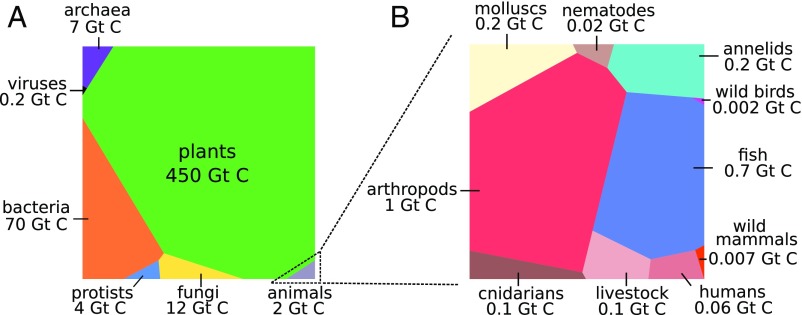
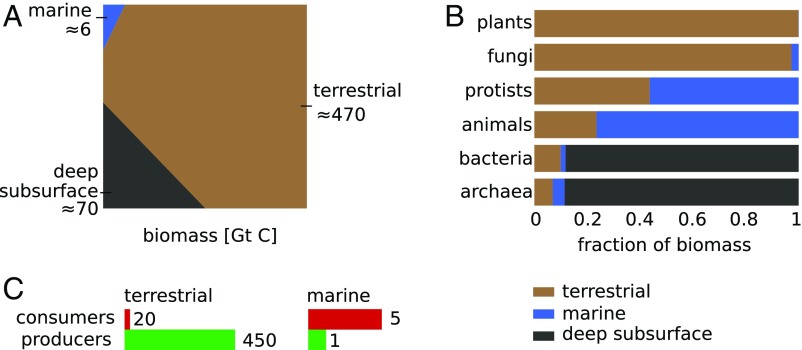
A census of the biomass on Earth is key for understanding the structure and dynamics of the biosphere. However, a global, quantitative view of how the biomass of different taxa compare with one another is still lacking. Here, we assemble the overall biomass composition of the biosphere, establishing a census of the ≈550 gigatons of carbon (Gt C) of biomass distributed among all of the kingdoms of life. We find that the kingdoms of life concentrate at different locations on the planet; plants (≈450 Gt C, the dominant kingdom) are primarily terrestrial, whereas animals (≈2 Gt C) are mainly marine, and bacteria (≈70 Gt C) and archaea (≈7 Gt C) are predominantly located in deep subsurface environments. We show that terrestrial biomass is about two orders of magnitude higher than marine biomass and estimate a total of ≈6 Gt C of marine biota, doubling the previous estimated quantity. Our analysis reveals that the global marine biomass pyramid contains more consumers than producers, thus increasing the scope of previous observations on inverse food pyramids. Finally, we highlight that the mass of humans is an order of magnitude higher than that of all wild mammals combined and report the historical impact of humanity on the global biomass of prominent taxa, including mammals, fish, and plants.
Overview
CoChat Summary
TL;DR
The paper assembles a global census of biomass across all kingdoms of life, estimating Earth’s total biomass at ≈550 Gt C, dominated by plants. It also compares biomass across environments and trophic modes, highlighting large uncertainties and human impacts on the biosphere.
Key findings
- Total global biomass is ≈550 Gt C, with plants ≈450 Gt C (≈80%), bacteria ≈70 Gt C (≈15%), fungi ≈12 Gt C, archaea ≈7 Gt C, protists ≈4 Gt C, animals ≈2 Gt C, and viruses ≈0.2 Gt C.
- Land biomass (≈470 Gt C) is about two orders of magnitude higher than marine biomass (≈6 Gt C); the deep subsurface holds ≈15% of total biomass, chiefly bacteria and archaea.
- In the ocean, ≈1 Gt C of primary producers supports ≈5 Gt C of consumer biomass, an inverted standing biomass distribution; marine biomass is ≈70% microbes, mainly bacteria and protists.
- Human-associated biomass is large relative to wild vertebrates: humans ≈0.06 Gt C, livestock ≈0.1 Gt C, wild mammals ≈0.007 Gt C, domesticated poultry ≈0.005 Gt C versus wild birds ≈0.002 Gt C; total plant biomass has declined approximately twofold relative to pre-human civilization.
Methods
- The authors synthesize hundreds of studies and generate estimates for major taxonomic groups, reporting biomass as gigatons of carbon (Gt C) and using a kingdom-level framework plus viruses.
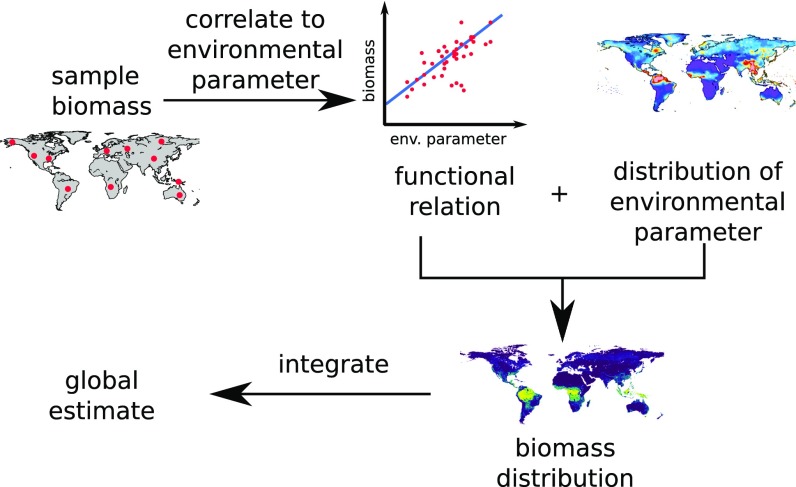
- For many taxa, local biomass samples are extrapolated globally by correlating biomass density with environmental parameters known at global scale; best estimates often use a geometric mean of independent estimates.
- Uncertainty is reported as multiplicative fold-change projections akin to 95% confidence intervals, incorporating intrastudy, interstudy, and intermethod variation; data and code are open-sourced.
Limitations
- The paper states that most datasets rely on fragmentary sampling, causing large uncertainties; sampling is scarce in the deep ocean (usually deeper than 200 m) and deep soil (usually deeper than 1 m), and some estimates may be biased by sampling toward high-abundance areas.
- The paper states that deep subsurface environments have particularly high uncertainty and unknown systematic biases, including unresolved distribution of biomass between aquifer fluids and rocks and among microbial taxa.
- The paper states that current and prehuman vertebrate biomass estimates are only a crude first step, amphibians remain poorly characterized, and parasite biomass is not resolved from hosts; evident from the text, kingdom-level grouping was chosen because much data lack finer taxonomic detail, and some uncertainty projections rely on analogous taxa or expert consultation.
Model-written summary. Check it against the paper before relying on it.
Integrity signals
Registry
Cites
Statistics
Figures
Verification
Claims the paper makes
9 Valid · 7 Not valid · 16 Not checked · 53 Own results and interpretations
Every source the paper cites for this claim was checked and supports it.
In the paper
“The biomass of amphibians, which are experiencing a dramatic population decline (42), remains poorly characterized.”
§ The biomass distribution on Earth > Discussion
What the sources say
- Supportedcites [42] Wake DB Vredenburg VT 2008 Colloquium paper: Are we in the midst of the sixth mass extinction? A view from the world of amphibians Proc Natl Acad Sci USA 105 11466 11473 18695221 PMC2556420 source
The citation is attached to the clause about amphibian population decline, not the separate statement that their biomass is poorly characterized. The passage reporting the Global Amphibian Assessment (labeled Abstract in our copy) says that 43% of amphibian species have declining populations. (LLM, conf=0.92)
plain- Asserted: passes — The authors put it forward as true.
- Checkable: passes — It can be checked against evidence.
- Load-bearing: unclear — It is unclear whether the paper’s conclusions depend on it.
- Based: passes — The paper gives a reason why it holds.
- Supported
Every source the paper cites for this claim was checked and supports it.
In the paper
“In the case of prokaryotes, some major improvements were recently realized, with global estimates of marine deep subsurface prokaryote biomass reduced by about two orders of magnitude due to an increased diversity of sampling locations (7).”
§ The biomass distribution on Earth > Discussion
What the sources say
- Supportedcites [7] Kallmeyer J Pockalny R Adhikari RR Smith DC D’Hondt S 2012 Global distribution of microbial abundance and biomass in subseafloor sediment Proc Natl Acad Sci USA 109 16213 16216 22927371 PMC3479597 source
The Discussion reports a revised subseafloor microbial biomass estimate of 4.1 Pg C versus a previous estimate of 303 Pg C—about a 74-fold reduction. It also identifies a more geographically diverse sampling database, including low-abundance ocean gyres, as a reason the new estimate is lower. The paper identifies other contributing factors as well. (LLM, conf=0.88)
plainstates a cause- Asserted: passes — The authors put it forward as true.
- Checkable: passes — It can be checked against evidence.
- Load-bearing: unclear — It is unclear whether the paper’s conclusions depend on it.
- Based: passes — The paper gives a reason why it holds.
- Supported
The sources with a verdict support this claim; the rest weren’t checked yet, have no full text we could read, or their verdicts aren’t rated yet.
In the paper
“Such inverted biomass distributions can occur when primary producers have a rapid turnover of biomass [on the order of days (34)], while consumer biomass turns over much more slowly [a few years in the case of mesopelagic fish (35)].”
§ The biomass distribution on Earth > Results > The Distribution of Biomass Across Environments and Trophic Modes.
What the sources say
- Supportedcites [34] Zubkov MV 2014 Faster growth of the major prokaryotic versus eukaryotic CO2 fixers in the oligotrophic ocean Nat Commun 5 3776 24777140 PMC4015317 source
The Results (Comparison of the growth rates of the CO2 fixers; page unavailable) report growth rates of 0.1–0.6 per day for the studied oceanic primary producers, consistent with biomass turnover on the order of days. The few-years estimate for mesopelagic fish is assigned to a different citation, not this source. (LLM, conf=0.91)
- Not checked — no full text of the sourcecites [35] Catul V Gauns M Karuppasamy PK 2011 A review on mesopelagic fishes belonging to family Myctophidae Rev Fish Biol Fish 21 339 354 source
plainstates a possible cause- Asserted: passes — The authors put it forward as true.
- Checkable: passes — It can be checked against evidence.
- Load-bearing: passes — The paper’s conclusions depend on it.
- Based: passes — The paper gives a reason why it holds.
- Supported
The cited sources support only part of this claim — read each source’s verdict below.
In the paper
“Combining data from independent sources such as these enables a robust assessment of the total plant biomass (17).”
§ The biomass distribution on Earth > Results > The Uncertainty Associated with Global Biomass Estimates.
What the sources say
- Partly supportedcites [17] Erb K-H 2017 Unexpectedly large impact of forest management and grazing on global vegetation biomass Nature 553 73 76 29258288 PMC5756473 sourceExperimental — accuracy not yet measured
The Methods describe combining multiple datasets and types of evidence to estimate global vegetation biomass stocks. But the paper also says global stocks remain uncertain, reports uncertainty ranges around 35% of the median estimate, and describes more robust estimates as a future prospect. It therefore supports the use of independent sources for an assessment, but not the unqualified characterization of that assessment as robust. (LLM, conf=0.84)
plainstates a cause- Asserted: passes — The authors put it forward as true.
- Checkable: passes — It can be checked against evidence.
- Load-bearing: passes — The paper’s conclusions depend on it.
- Based: passes — The paper gives a reason why it holds.
- Partly supported
A result the paper states — it cites no source for it, so there is none to check. The quote shows it is in the paper.
In the paper
“Plant biomass includes ≈70% stems and tree trunks, which are mostly woody, and thus relatively metabolically inert.”
§ The biomass distribution on Earth > Results > The Biomass Distribution of the Biosphere by Kingdom.
plain- Asserted: passes — The authors put it forward as true.
- Checkable: passes — It can be checked against evidence.
- Load-bearing: unclear — It is unclear whether the paper’s conclusions depend on it.
- Based: passes — The paper gives a reason why it holds.
27 more claims
Create a free account to see all 85 claims and to verify the 2 references still open.
- It may state two separate claims as one. 32
- Probably not a substantial claim. 28
Claims other papers make about this one
Each is checked against this paper’s own text: does it say what the citing paper says it does?
The cited source doesn’t support the claim as written.
In the citing paper
“and less than 10% that of the world ' s current human population ( 52 ).”
From Pervasive human-driven decline of life on Earth points to the need for transformative change (2019) · cites this paper as [52]
Checked by a reasoning model — may be wrong.
Experimental — accuracy not yet measuredThe cited source says what the claim attributes to it.
In the citing paper
“Approximately 450 Gt of C is bound up in terrestrial biota, primarily in plants (86), while only ~6 Gt of C is found in ocean biota (87).”
From Earth beyond six of nine planetary boundaries (2023) · cites this paper as [87]
The cited source says what the claim attributes to it.
In the citing paper
“The amount of metabolic energy available to a biosphere powered by O 2 is vast, such that the O 2 -rich ocean-atmosphere system of the modern Earth supports staggering levels of standing biomass (Bar-On et al. 2018), energy flow (Falkowski et al. 2008), and ecological complexity (Steele 1974).”
From The History of Ocean Oxygenation (2022) · cites this paper as Bar-On et al. 2018
In the citing paper
“Global populations of domestic ruminants (cattle, sheep, and goats) (Ripple et al. 2013) poultry, and pigs (Bennett et al. 2018) used to feed the growing human population now exceed 100 million tons of carbon (Bar-On et al. 2018), and livestock populations are growing rapidly.”
From Scientists’ warning to humanity on the freshwater biodiversity crisis (2021) · cites this paper as Bar-On et al. 2018
Citations
Cites
The worldwide leaf economics spectrum
Wright, I. J., Reich, P. B., Westoby, M., Ackerly, D. D., Baruch, Z., Bongers, F., Cavender-Bares, J., Chapin, T., Cornelissen, J. H. C., Diemer, M., et al. (2004) · Nature · doi:10.1038/nature02403 · Cited by 9,021 · cited 1×
“We then convert the total area of leaves to an estimate of the total dry mass of leaves by using the Glopnet database (24), which measured leaf mass per area (LMA) for ≈2500 plant species.”
MethodA large and persistent carbon sink in the world’s forests
Pan, Y., Birdsey, R. A., Fang, J., Houghton, R., Kauppi, P. E., Kurz, W. A., Phillips, O. L., Shvidenko, A., Lewis, S. L., Canadell, J. G., et al. (2011) · Science · doi:10.1126/science.1201609 · Cited by 8,458
Soil Sampling and Methods of Analysis
(2007) · CRC Press eBooks · doi:10.1201/9781420005271 · Cited by 6,469
Primary production of the biosphere: Integrating terrestrial and oceanic components
Field, C. B., Behrenfeld, M. J., Randerson, J. T., & Falkowski, P. (1998) · Science · doi:10.1126/science.281.5374.237 · Cited by 6,371
Prokaryotes: The unseen majority
Whitman, W. B., Coleman, D. C., & Wiebe, W. J. (1998) · Proceedings of the National Academy of Sciences · doi:10.1073/pnas.95.12.6578 · Cited by 4,871
Global effects of land use on local terrestrial biodiversity
Newbold, T., Hudson, L. N., Hill, S. L. L., Contu, S., Lysenko, I., Senior, R. A., Börger, L., Bennett, D. J., Choimes, A., Collen, B., et al. (2015) · Nature · doi:10.1038/nature14324 · Cited by 4,352
Belowground biodiversity and ecosystem functioning
Bardgett, R. D., & van der Putten, W. H. (2014) · Nature · doi:10.1038/nature13855 · Cited by 3,990 · cited 4×
“This was recommended by experts in the field for estimation of arbuscular mycorrhizal fungi abundance (117).”
BackgroundInfluentialMangroves among the most carbon-rich forests in the tropics
Donato, D. C., Kauffman, J. B., Murdiyarso, D., Kurnianto, S., Stidham, M., & Kanninen, M. (2011) · Nature Geoscience · doi:10.1038/ngeo1123 · Cited by 3,374
Poorter, H., Niklas, K. J., Reich, P. B., Oleksyn, J., Poot, P., & Mommer, L. (2012) · New Phytologist · doi:10.1111/j.1469-8137.2011.03952.x · Cited by 3,163 · cited 1×
“The first relies on a meta-analysis of the biomass allocation to different plant compartments across biomes (19).”
BackgroundA global analysis of root distributions for terrestrial biomes
Jackson, R. B., Canadell, J., Ehleringer, J. R., Mooney, H. A., Sala, O. E., & Schulze, E. D. (1996) · Oecologia · doi:10.1007/bf00333714 · Cited by 3,071 · cited 4×
“assumed the distribution of microbial biomass with depth follows the biomass density versus depth profile of root biomass (21).”
BackgroundMethodInfluential
Research works printed but not linked: 1
- Chapman AD 2009 Numbers of Living Species in Australia and the World Australian Biological Resources Study Canberra, Australia
Cited by
Items 801–900 of 3,743
Flattening the curve: approaching complete sampling for diverse beetle communities
Burner, R. C., Birkemoe, T., Åström, J., et al. (2021) · Insect Conservation and Diversity · doi:10.1111/icad.12540 · Cited by 25
“Their diversity, numbers, and sheer biomass make them a fascinating and important topic of study (Bar-On et al., 2018), but this same diversity also presents challenges as we try to understand the ecology of various taxonomic and functional groups and the roles they play in different environmental…”
BackgroundSrivastava, N., Singh, R. K., Srivastava, M., Syed, A., Pal, D. B., Bahkali, A. H., Mishra, P. K., & Gupta, V. K. (2021) · Bioresource Technology · doi:10.1016/j.biortech.2021.126560 · Cited by 26
Value addition of lignin to zingerone using recyclable AlPO4 and Ni/LRC catalysts
Rawat, S., Singh, B., Kumar, R., Pendem, C., Bhandari, S., Natte, K., & Narani, A. (2021) · Chemical Engineering Journal · doi:10.1016/j.cej.2021.134130 · Cited by 25
Mohan, I., Panda, A. K., Volli, V., & Kumar, S. (2022) · Biomass Conversion and Biorefinery · doi:10.1007/s13399-022-02833-2 · Cited by 28
“Surprisingly, the humans contribute only about 0.06 Gt C of the total biomass on the planet which is less than that of the livestock biomass, approximately 0.1 Gt C [1].”
InfluentialFuture Eco‐Perfect : Temporal Fixes of Liberal Environmentalism
Collard, R., & Dempsey, J. (2022) · Antipode · doi:10.1111/anti.12849 · Cited by 34
European Mammal Exposure to Lead from Ammunition and Fishing Weights Sources
Chiverton, L., Cromie, R., & Kock, R. A. (2022) · Heliyon · doi:10.1016/j.heliyon.2022.e10014 · Cited by 26
“58% of global animal biomass constitutes arthropods, molluscs, and annelids (Bar-On et al., 2018).”
BackgroundXue, J., Wang, J., Huang, P., Liu, L., Huang, T., Zhang, L., Wang, X., Shen, B., Wang, D., Liu, J., et al. (2022) · Earth-Science Reviews · doi:10.1016/j.earscirev.2022.104290 · Cited by 25
Sartor, F., Xu, X., Popp, T., Dodd, A. N., Kovács, Á. T., & Merrow, M. W. (2023) · Science Advances · doi:10.1126/sciadv.adh1308 · Cited by 30
Dube, T., Dube, T., & Marambanyika, T. (2023) · Physics and Chemistry of the Earth Parts A/B/C · doi:10.1016/j.pce.2023.103473 · Cited by 32
On the importance of studying asteroids: A comprehensive review
Azadmanesh, M., Roshanian, J., & Hassanalian, M. (2023) · Progress in Aerospace Sciences · doi:10.1016/j.paerosci.2023.100957 · Cited by 30
Multiple horizontal gene transfer events have shaped plant glycosyl hydrolase diversity and function
Kfoury, B., Rodrigues, W. F. C., Kim, S., Brandizzí, F., & Del‐Bem, L. (2024) · New Phytologist · doi:10.1111/nph.19595 · Cited by 32
Pan, D., Morono, Y., Inagaki, F., & Takai, K. (2019) · Frontiers in Microbiology · doi:10.3389/fmicb.2019.00878 · Cited by 25
“Implications There is estimated to be on the order of 1031 viruses on Earth, the overwhelming majority of which inhabit soil and sediments, with estimates ranging from 79% (Bar-On et al., 2018) to 97% (Cobián Güemes et al.”
BackgroundGlobal climate impacts of agriculture: A meta-regression analysis of food production
Gaugler, T., Stöckl, S., & Rathgeber, A. (2020) · Journal of Cleaner Production · doi:10.1016/j.jclepro.2020.122575 · Cited by 28
Sánchez, P., Coutinho, F. H., Sebastián, M., Pernice, M. C., Rodríguez‐Martínez, R., Salazar, G., Cornejo‐Castillo, F. M., Pesant, S., Lopez, X., López-García, E. M., et al. (2024) · Scientific Data · doi:10.1038/s41597-024-02974-1 · Cited by 33
Palaeontological signatures of the Anthropocene are distinct from those of previous epochs
Williams, M., Zalasiewicz, J., Barnosky, A. D., Leinfelder, R., Head, M. J., Waters, C. N., McCarthy, F. M. G., Cearreta, A., Aldridge, D. C., McGann, M. L., et al. (2024) · Earth-Science Reviews · doi:10.1016/j.earscirev.2024.104844 · Cited by 30
Atolls are globally important sites for tropical seabirds
Steibl, S., Steiger, S., Wegmann, A. S., Holmes, N. D., Young, H. S., Carr, P., & Russell, J. C. (2024) · Nature Ecology & Evolution · doi:10.1038/s41559-024-02496-4 · Cited by 37
“25, which approximates carbon content assuming 70% water content of bird biomass and 50% carbon content of bird dry weight.”
BackgroundReconstructing Early Microbial Life
Kaçar, B. (2024) · Annual Review of Microbiology · doi:10.1146/annurev-micro-041522-103400 · Cited by 24
“Despite the current eukaryote-skewed distribution of terrestrial biomass (8), the history of life on Earth is overwhelmingly one of bacteria and archaea, extending back almost 4 billion years (128, 162).”
A meta-analysis reveals earthworms as mutualists rather than predators of soil microorganisms
Blouin, M., Robin, A., Amans, L., Reverchon, F., Barois, I., & Lavelle, P. (2025) · Geoderma · doi:10.1016/j.geoderma.2025.117238 · Cited by 28
Fossil amber reveals springtails’ longstanding dispersal by social insects
Robin, N., D’Haese, C. A., & Barden, P. (2019) · BMC Evolutionary Biology · doi:10.1186/s12862-019-1529-6 · Cited by 24
“The biomass of termites is estimated to be approximately equal to that of humans [61] and in tropical localities, termites and ants together may outweigh all vertebrates and all other insects combined [62].”
BackgroundMetabolic networks classification and knowledge discovery by information granulation
Martino, A., Giuliani, A., Todde, V., Bizzarri, M., & Rizzi, A. (2019) · Computational Biology and Chemistry · doi:10.1016/j.compbiolchem.2019.107187 · Cited by 25
Imperfect detection alters the outcome of management strategies for protected areas
Hammill, E., & Clements, C. F. (2020) · Ecology Letters · doi:10.1111/ele.13475 · Cited by 23
Microbial Residents of the Atlantis Massif’s Shallow Serpentinite Subsurface
Motamedi, S., Orcutt, B. N., Früh‐Green, G. L., Twing, K. I., Pendleton, H. L., & Brazelton, W. J. (2020) · Applied and Environmental Microbiology · doi:10.1128/aem.00356-20 · Cited by 28
“Subsurface environments may host the majority of microbial life on Earth (1, 2), but current estimates of subsurface biomass lack certainty due to a paucity of observations.”
Harnessing hypoxia as an evolutionary driver of complex multicellularity
Hammarlund, E. U. (2020) · Interface Focus · doi:10.1098/rsfs.2019.0101 · Cited by 29
Infectious Diseases, Livestock, and Climate: A Vicious Cycle?
Ezenwa, V. O., Civitello, D. J., Barton, B. T., Becker, D. J., Brenn‐White, M., Classen, A. T., Deem, S. L., Johnson, Z. E., Kutz, S. J., Malishev, M., et al. (2020) · Trends in Ecology & Evolution · doi:10.1016/j.tree.2020.08.012 · Cited by 25
“Sixty percent of all mammal biomass on Earth is livestock (e.g., cattle, pigs, sheep; [3]) and ruminant livestock account for nearly half of all biogenic methane emissions (Figure 2A).”
Kenyon, C. R. (2020) · Epidemics · doi:10.1016/j.epidem.2020.100410 · Cited by 26
Economic assessment of rewilding versus agri-environmental nature management
Schou, J. S., Bladt, J., Ejrnæs, R., Thomsen, M. N., Vedel, S. E., & Fløjgaard, C. (2020) · AMBIO · doi:10.1007/s13280-020-01423-8 · Cited by 25
Constrained proteome allocation affects coexistence in models of competitive microbial communities
Pacciani-Mori, L., Suweis, S. S., Maritan, A., & Giometto, A. (2021) · The ISME Journal · doi:10.1038/s41396-020-00863-0 · Cited by 28
Freshwaters: Global Distribution, Biodiversity, Ecosystem Services, and Human Pressures
Tockner, K. (2021) · Springer eBooks · doi:10.1007/978-3-030-60147-8_16 · Cited by 47
Introducing palaeolithobiology
Ivarsson, M., Drake, H., Neubeck, A., Snoeyenbos-West, O., Belivanova, V., & Bengtson, S. (2021) · GFF · doi:10.1080/11035897.2021.1895302 · Cited by 26
“It represents one-tenth to one-third of all live biomass including both prokaryotes and eukaryotes, which makes it the second largest reservoir of live biomass today (Orcutt et al. 2011; Heim 2011; Sohlberg et al. 2015; Borgonie et al. 2015; McMahon & Parnell 2018; Magnabosco et al. 2018; Bar-On et al. 2018; Ivarsson…”
BackgroundEnvironmental impact assessment of dam-break floods considering multiple influencing factors
Zhang, Y., Li, Z., Wang, J., Ge, W., & Chen, X. (2022) · The Science of The Total Environment · doi:10.1016/j.scitotenv.2022.155853 · Cited by 29
Lessons From Insect Fungiculture: From Microbial Ecology to Plastics Degradation
Barcoto, M. O., & Rodrigues, A. L. (2022) · Frontiers in Microbiology · doi:10.3389/fmicb.2022.812143 · Cited by 28
“Anthropogenic activities have transformed about 30–50% of the biosphere composition (Bar-On et al., 2018; Chure et al., 2021), ultimately reorganizing life on Earth (Lewis and Maslin, 2015; Keys et al.”
BackgroundRamos, D., Hartke, T. R., Buchori, D., Dupérré, N., Hidayat, P., Lia, M., Harms, D., Scheu, S., & Drescher, J. (2022) · PeerJ · doi:10.7717/peerj.13898 · Cited by 32
Land Use Change and Prediction for Valuating Carbon Sequestration in Viti Levu Island, Fiji
Avtar, R., Rinamalo, A. V., Umarhadi, D. A., Gupta, A. K., Khedher, K. M., Yunus, A. P., Singh, B. P., Kumar, P., Sahu, N., & Sakti, A. D. (2022) · Land · doi:10.3390/land11081274 · Cited by 27
“The total carbon quantities of biomass on Earth is ~550 Gt C across all kingdoms of life, dominated by plants (~80%; ~450 Gt C) [4].”
BackgroundDurfort, A., Mariani, G., Tulloch, V., Savoca, M. S., Troussellier, M., & Mouillot, D. (2022) · Proceedings of the Royal Society B Biological Sciences · doi:10.1098/rspb.2022.0375 · Cited by 30
Extending conservation to include Earth's microbiome
Redford, K. H. (2023) · Conservation Biology · doi:10.1111/cobi.14088 · Cited by 29
“2 gigatons of carbon, representing 10% of the biomass of all animals (Bar-On et al., 2018).”
BackgroundInfluentialExploring scenarios for the food system–zoonotic risk interface
Shepon, A., Wu, T., Kremen, C., Dayan, T., Perfecto, I., Fanzo, J., Eshel, G., & Golden, C. D. W. (2023) · The Lancet Planetary Health · doi:10.1016/s2542-5196(23)00007-4 · Cited by 43
SituSeq : an offline protocol for rapid and remote Nanopore 16S rRNA amplicon sequence analysis
Zorz, J., Li, C., Chakraborty, A., Gittins, D. A., Surcon, T., Morrison, N., Bennett, R., MacDonald, A., & Hubert, C. R. J. (2023) · ISME Communications · doi:10.1038/s43705-023-00239-3 · Cited by 38
“Nanopore sequencing is quickly approaching parity with other sequencing platforms in this regard [19 – 21].”
The Use and Prospects of Nonlethal Methods in Entomology
Löveï, G. L., & Ferrante, M. (2023) · Annual Review of Entomology · doi:10.1146/annurev-ento-120220-024402 · Cited by 34
Herbivore corridors sustain genetic footprint in plant populations: a case for Spanish drove roads
García‐Fernández, A., Manzano, P., Seoane, J., Azcárate, F. M., Iriondo, J. M., & Peco, B. (2019) · PeerJ · doi:10.7717/peerj.7311 · Cited by 28
Biomass and production of freshwater meiofauna: a review and a new allometric model
Schmid-Araya, J. M., Schmid, P. E., Majdi, N., et al. (2020) · Hydrobiologia · doi:10.1007/s10750-020-04261-7 · Cited by 24
“Recently, the distribution of biomass as a proxy of biosequestered carbon on Earth has provided an integrated global picture of the abundances of all kingdoms of life (Bar-On et al., 2018).”
BackgroundThe Neurobiology of Ocean Change – insights from decapod crustaceans
Stein, W., & Harzsch, S. (2020) · Zoology · doi:10.1016/j.zool.2020.125887 · Cited by 26
Mitigating the threat of emerging infectious diseases; a coevolutionary perspective
van Oosterhout, C. (2021) · Virulence · doi:10.1080/21505594.2021.1920741 · Cited by 24
“(c) The biomass of livestock is over an order of magnitude higher than that of all wildlife combined[11], yet”
BackgroundInfluentialMetabolic Engineering of Filamentous Fungi
Meyer, V. (2021) · Wiley eBooks · doi:10.1002/9783527823468.ch20 · Cited by 35
Holden, J. F., & Sistu, H. (2023) · Frontiers in Microbiology · doi:10.3389/fmicb.2023.1093018 · Cited by 23
“It was estimated that 40% of bacterial and archaeal global biomass is found in the rocky portion of the ocean crust below ocean sediments (Bar-On et al., 2018; Fleming and Wuertz, 2019).”
BackgroundTurning the tide on sex and the microbiota in aquatic animals
Bates, K. A., Higgins, C., Neiman, M., & King, K. C. (2022) · Hydrobiologia · doi:10.1007/s10750-022-04862-4 · Cited by 23
Coluccia, M., & Besaury, L. (2023) · Molecular Genetics and Genomics · doi:10.1007/s00438-023-02045-x · Cited by 29
Li, P., Li, T., & Wu, S. (2024) · International Journal of Biological Macromolecules · doi:10.1016/j.ijbiomac.2024.136053 · Cited by 27
Predicting microbial community structure and temporal dynamics by using graph neural network models
Andersen, K. S., Zhao, K., Agerskov, A. D. L., Sørensen, C. B., Holmager, T. J., Nierychlo, M., Peces, M., Guo, C., & Nielsen, P. H. (2025) · Nature Communications · doi:10.1038/s41467-025-64175-7 · Cited by 30
“They were able to predict the dynamics 10 time points into the future (2-4 months) with high accuracy for most of the abundant bacteria, especially process-critical bacteria, and some even 20 time points ahead (up to 8 months).”
Trends and gaps in forecasting plant virus disease risk
McLeish, M., Fraile, A., & García‐Arenal, F. (2019) · Annals of Applied Biology · doi:10.1111/aab.12553 · Cited by 24
Death and serious injury from dark matter
Sidhu, J. S., Scherrer, R. J., & Starkman, G. D. (2020) · Physics Letters B · doi:10.1016/j.physletb.2020.135300 · Cited by 21
“[28], but the deaths of domestic animals are considerably less well-monitored.”
BackgroundMarine biology on a violated planet: from science to conscience
Bearzi, G. (2020) · Ethics in Science and Environmental Politics · doi:10.3354/esep00189 · Cited by 23
Everard, M. (2020) · Current Opinion in Environmental Sustainability · doi:10.1016/j.cosust.2020.03.004 · Cited by 28
Abiotic and biotic processes that drive carboxylation and decarboxylation reactions
Sheik, C. S., Cleaves, H. J., Johnson-Finn, K. N., Giovannelli, D., Kieft, T. L., Papineau, D., Schrenk, M. O., & Tumiati, S. (2020) · American Mineralogist · doi:10.2138/am-2020-7166ccbyncnd · Cited by 24
Harrison, S., Baker, M. G., Benschop, J., et al. (2020) · One Health Outlook · doi:10.1186/s42522-020-0011-0 · Cited by 23
Abd-Elrahman, A. H., Guan, Z., Dalid, C. O., et al. (2020) · Remote Sensing · doi:10.3390/rs12213632 · Cited by 23
“The dry biomass [46] weight was then measured.”
MethodDai, X., Wang, Y., Li, L., Pfiffner, S. M., Li, G., Dong, Z., Xu, Z., Dong, H., & Huang, L. (2021) · Geobiology · doi:10.1111/gbi.12430 · Cited by 27
West, C. K., Reichgelt, T., & Basinger, J. F. (2021) · Palaeogeography Palaeoclimatology Palaeoecology · doi:10.1016/j.palaeo.2021.110488 · Cited by 28
Roberts, N. J., Zhang, Y., Convery, I., Liang, X. T., Smith, D., & Jiang, G. (2021) · Frontiers in Ecology and Evolution · doi:10.3389/fevo.2021.680367 · Cited by 25
The wild ancestors of domestic animals as a neglected and threatened component of biodiversity
Smith, W. J. B., Quilodrán, C. S., Jezierski, M. T., Sendell‐Price, A. T., & Clegg, S. M. (2021) · Conservation Biology · doi:10.1111/cobi.13867 · Cited by 26
Ortí, M. A., Casanelles‐Abella, J., Chiron, F., Deguines, N., Hallikma, T., Jaksi, P., Kwiatkowska, P. K., Moretti, M., Muyshondt, B., Niinemets, Ü., et al. (2022) · Urban forestry & urban greening · doi:10.1016/j.ufug.2022.127650 · Cited by 24
Potential long-term habitable conditions on planets with primordial H–He atmospheres
Lous, M. M., Helled, R., & Mordasini, C. (2022) · Nature Astronomy · doi:10.1038/s41550-022-01699-8 · Cited by 31
“The implication of equation (4) is that the luminosity does not vary through the gaseous envelope.”
BackgroundPata, P. R., Galbraith, M. D., Young, K. V., Margolin, A. R., Perry, R. I., & Hunt, B. P. V. (2022) · Progress In Oceanography · doi:10.1016/j.pocean.2022.102849 · Cited by 25
Santos, A. A., Xiao, L., Labandeira, C. C., Néraudeau, D., Dépré, É., Moreau, J., Perrichot, V., & Wappler, T. (2022) · Botany Letters · doi:10.1080/23818107.2022.2092772 · Cited by 24
Land use and soil characteristics affect soil organisms differently from above-ground assemblages
Burton, V. J., Contu, S., Palma, A. D., Hill, S. L. L., Albrecht, H., Bone, J. S., Carpenter, D., Corstanje, R., SMEDT, P. D., Farrell, M., et al. (2022) · BMC Ecology and Evolution · doi:10.1186/s12862-022-02089-4 · Cited by 30
Oberemok, V. V., Useinov, R. Z., Skorokhod, O. A., Gal’chinsky, N. V., Novikov, I. A., Makalish, T. P., Яцкова, Е. В., Sharmagiy, A. K., Golovkin, I. O., Gninenko, Y. I., et al. (2022) · International Journal of Molecular Sciences · doi:10.3390/ijms232415681 · Cited by 21
Microbial ecology of vertebrate decomposition in terrestrial ecosystems
Mason, A. R., Taylor, L. S., & DeBruyn, J. M. (2023) · FEMS Microbiology Ecology · doi:10.1093/femsec/fiad006 · Cited by 32
Commercial krill fishing within a foraging supergroup of fin whales in the Southern Ocean
Ryan, C., Santangelo, M., Stephenson, B. M., Branch, T. A., Wilson, E. A., & Savoca, M. S. (2023) · Ecology · doi:10.1002/ecy.4002 · Cited by 26
Seasonality of biogeochemically relevant microbial genes in a coastal ocean microbiome
Auladell, A., Ferrera, I., Montiel, L., Júnior, C. D. S., Sebastián, M., Logares, R., & Gasol, J. M. (2023) · Environmental Microbiology · doi:10.1111/1462-2920.16367 · Cited by 27
Towards a More Realistic In Vitro Meat: The Cross Talk between Adipose and Muscle Cells
Pallaoro, M., Modina, S., Fiorati, A., Altomare, L., Mirra, G., Scocco, P., & Giancamillo, A. D. (2023) · International Journal of Molecular Sciences · doi:10.3390/ijms24076630 · Cited by 24
The metabolic rate of the biosphere and its components
Hoehler, T. M., Mankel, D., Girguis, P. R., McCollom, T. M., Kiang, N. Y.-L., & Jørgensen, B. B. (2023) · Proceedings of the National Academy of Sciences · doi:10.1073/pnas.2303764120 · Cited by 47
“When considering only the metabolically active fraction of plant biomass, which Bar-On et al. (14) estimate to be roughly one-third of total mass, global MSP then approximates the all-species mean at ~ 0.01 W (g C) −1 .”
InfluentialBerger, J., Wangchuk, T. R., Briceño, C., Vila, A., & Lambert, J. E. (2020) · Frontiers in Ecology and Evolution · doi:10.3389/fevo.2020.00128 · Cited by 30
“, 2014), and together with humans, domestics may account for > 97% of global mammalian biomass (Bar-On et al., 2018).”
BackgroundZafeiropoulos, H., Paragkamian, S., Ninidakis, S., Pavlopoulos, G. A., Jensen, L. J., & Pafilis, E. (2022) · Microorganisms · doi:10.3390/microorganisms10020293 · Cited by 22
“Microbes are omnipresent and impact global ecosystem functions [1] through their abundance [2], versatility [3], and interactions [4].”
BackgroundMarine DNA Viral Macro-and Micro-Diversity From Pole to PolePreprint
Gregory, A., Zayed, A. A., Conceição-Neto, N., et al. (2019) · SSRN Electronic Journal · doi:10.2139/ssrn.3319797 · Cited by 23
ODFM, an omics data resource from microorganisms associated with fermented foods
Whon, T. W., Ahn, S. W., Yang, S., Kim, J. Y., Kim, Y. B., Kim, Y., Hong, J.-M., Jung, H., Choi, Y.-E., Lee, S. H., et al. (2021) · Scientific Data · doi:10.1038/s41597-021-00895-x · Cited by 25
Vandvik, V., Althuizen, I., Jaroszynska, F., et al. (2022) · Scientific Data · doi:10.1038/s41597-022-01559-0 · Cited by 23
Djemiel, C., Dequiedt, S. S., Horrigue, W., Bailly, A., Lelièvre, M., Tripied, J., Guilland, C., Perrin, S., Comment, G., Saby, N., et al. (2024) · SOIL · doi:10.5194/soil-10-251-2024 · Cited by 31
Chele, K. H., Piater, L. A., van der Hooft, J. J. J., & Tugizimana, F. (2025) · Metabolites · doi:10.3390/metabo15060362 · Cited by 36
Richter, B., & de Sousa, L. O. (2019) · International Journal of Sustainable Development & World Ecology · doi:10.1080/13504509.2019.1672220 · Cited by 22
“This situation poses a serious threat to the quality of life for humans and the rest of the biosphere (Bar-On et al. 2018; Butgess and Gainess 2018).”
BackgroundA River of Bones: Wildebeest Skeletons Leave a Legacy of Mass Mortality in the Mara River, Kenya
Subalusky, A. L., Dutton, C. L., Rosi, E. J., Puth, L. M., & Post, D. M. (2020) · Frontiers in Ecology and Evolution · doi:10.3389/fevo.2020.00031 · Cited by 25
“The biomass of domestic livestock and poultry now far exceeds that of wild mammals and birds (Bar-On et al., 2018).”
BackgroundLimits to food production from the sea
van der Meer, J. (2020) · Nature Food · doi:10.1038/s43016-020-00202-8 · Cited by 30
de Araújo, E. A., Dias, A. H. S., Kadowaki, M. A. S., Piyadov, V., Pellegrini, V. O. A., Urio, M. B., Ramos, L. P., Skaf, M. S., & Polikarpov, I. (2021) · Carbohydrate Polymers · doi:10.1016/j.carbpol.2021.118059 · Cited by 22
Kanbargi, N. S., Goswami, M., Collins, L. F., Kearney, L. T., Bowland, C. C., Kim, K., Rajan, K., Labbé, N., & Naskar, A. K. (2021) · ACS Applied Polymer Materials · doi:10.1021/acsapm.0c01387 · Cited by 22
Quantifying bacterial evolution in the wild: A birthday problem for Campylobacter lineages
Calland, J., Pascoe, B., Bayliss, S., Mourkas, E., Berthenet, E., Thorpe, H. A., Hitchings, M. D., Feil, E. J., Corander, J., Blaser, M. J., et al. (2021) · PLoS Genetics · doi:10.1371/journal.pgen.1009829 · Cited by 28
Singh, S., Hundal, J. S., Patra, A. K., Sethi, R. S., & Sharma, A. (2021) · Environmental Science and Pollution Research · doi:10.1007/s11356-021-17674-1 · Cited by 26
“However, global livestock biomass is double the human biomass (Bar-On et al. 2018), and utilises 58% of human-food biomass globally (Krausmann et al.”
BackgroundResilience rankings and trajectories of world's countries
Bolson, N., Yutkin, M. P., Rees, W. E., & Patzek, T. W. (2022) · Ecological Economics · doi:10.1016/j.ecolecon.2022.107383 · Cited by 23
Nabeh, N., Brokaw, C., & Picard, A. (2022) · Frontiers in Microbiology · doi:10.3389/fmicb.2022.662219 · Cited by 29
Large-herbivore nemabiomes: patterns of parasite diversity and sharing
Titcomb, G., Pansu, J., Hutchinson, M. C., Tombak, K. J., Hansen, C., Baker, C. C. M., Kartzinel, T. R., Young, H. S., & Pringle, R. M. (2022) · Proceedings of the Royal Society B Biological Sciences · doi:10.1098/rspb.2021.2702 · Cited by 27
“Particularly important, in terms of both ecological dynamics and human livelihoods, is to understand drivers of cross-species parasite transmission in a world where wildlife are increasingly overlapping with people and their livestock [11].”
BackgroundForchielli, E., Sher, D., & Segrè, D. (2022) · mSystems · doi:10.1128/msystems.00070-22 · Cited by 23
“microbial (versus 96% plant on land) (2); accordingly, their submicroscale processes have”
BackgroundImachi, H., Nobu, M. K., Miyazaki, M., Tasumi, E., Saito, Y., Sakai, S., Ogawara, M., Ohashi, A., & Takai, K. (2022) · Nature Protocols · doi:10.1038/s41596-022-00735-1 · Cited by 24
Climate Change and the Sea: A Major Disruption in Steady State and the Master Variables
Simmer, R. A., Jansen, E. J., Patterson, K. J., & Schnoor, J. L. (2023) · ACS Environmental Au · doi:10.1021/acsenvironau.2c00061 · Cited by 30
Consequences of Microplastics on Global Ecosystem Structure and Function
Wang, Y., Bai, J., Liu, Z., Zhang, L., Zhang, G., Chen, G., Xia, J., Cui, B., & Rillig, M. C. (2023) · Reviews of Environmental Contamination and Toxicology · doi:10.1007/s44169-023-00047-9 · Cited by 28
“It was reported that in 1994, global plastic C stock was only 2 Pg, which was the same as the global animal biomass, while the global plastic C pool increased up to 6.9 Pg in 2015, which is equivalent to global archaeal biomass (Bar‑”
BackgroundInfluentialNon-Flat Earth Recalibrated for Terrain and Topsoil
Blakemore, R. J. (2018) · Soil Systems · doi:10.3390/soilsystems2040064 · Cited by 23
“Mycorrhizal VAM-fungal hyphae and biocrusts add 15 and 5 Gt (974 + 20 = 994), plus 2–4 Gt earthworms [82] and 7 Gt for other organisms [81] = ~1000 Gt total.”
BackgroundInfluentialSustainable Materials from Fish Industry Waste for Electrochemical Energy Systems
Lionetto, F., Bagheri, S., & Mele, C. (2021) · Energies · doi:10.3390/en14237928 · Cited by 25
Biological Weathering in the Terrestrial System
Zaharescu, D. G., Burghelea, C. I., Dontsova, K. M., Reinhard, C. T., Chorover, J., & Lybrand, R. A. (2020) · Geophysical monograph · doi:10.1002/9781119413332.ch1 · Cited by 37
Metabolic Engineering for Large‐Scale Environmental Bioremediation
Nikel, P. I., & de Lorenzo, V. (2021) · Metabolic Engineering · doi:10.1002/9783527823468.ch22 · Cited by 22
Cultivating relations with plant stories
Grimwood, B. S. R., & Höckert, E. (2023) · Annals of Tourism Research · doi:10.1016/j.annals.2023.103661 · Cited by 22
Bärnthaler, R., Novy, A., Arzberger, L., Krisch, A., & Volmary, H. (2024) · Humanities and Social Sciences Communications · doi:10.1057/s41599-024-03065-7 · Cited by 35
“Since then, increased production in animal feed has led to a surge in livestock, elevating its share in terrestrial mammalian biomass to around 60% (Bar-On et al., 2018).”
An anthropocene-framed transdisciplinary dialog at the chemistry-energy nexus
Prévot, M. S., Finelli, V., Carrier, X., Deplano, G., Cavallo, M., Quadrelli, E. A., Michel, J., Pietraru, M., Camp, C., Forghieri, G., et al. (2024) · Chemical Science · doi:10.1039/d4sc00099d · Cited by 28
Towards global insect biomonitoring with frugal methods
Brydegaard, M. S., Pedales, R., Feng, V., Yamoa, A. S.-D., Kouakou, B. K., Månefjord, H., Wührl, L., Pylatiuk, C., Amorim, D. D. S., & Meier, R. (2024) · Philosophical Transactions of the Royal Society B Biological Sciences · doi:10.1098/rstb.2023.0103 · Cited by 23
“…fast decline in biodiversity [2,3], but the information is biased because many biomonitoring programmes still prioritize the charismatic megafauna [4], while the biomass and diversity of arthropods are 100 times greater than that of all wild birds, mammals, amphibians and reptiles combined [5].”
BackgroundThe atmosphere: a transport medium or an active microbial ecosystem?
Lappan, R. J., Thakar, J., Moncayo, L. M., Besser, A. C., Bradley, J. A., Goordial, J., Trembath‐Reichert, E., & Greening, C. (2024) · The ISME Journal · doi:10.1093/ismejo/wrae092 · Cited by 29
“A recent estimate of the biomass distribution on Earth omits atmospheric biomass [8], reflective of frequent lack of consideration of the atmosphere as part of the biosphere.”
Background
Metadata
- Authors
- Bar-On, Y. M., Phillips, R., & Milo, R.
- Affiliations
- Department of Plant and Environmental Sciences, Weizmann Institute of Science, 76100 Rehovot, Israel;
- California Institute of Technology (US)
- Weizmann Institute of Science (IL)
- Corresponding author
- Milo, Ron
- Venue
- Proceedings of the National Academy of Sciences
- Publisher
- National Academy of Sciences
- Published
- 2018-05-21
- Volume
- 115
- Issue
- 25
- Pages
- 6506-6511
- ISSN
- 0027-8424 (ISSN-L)
- 1091-6490
- PMC
- PMC6016768
- OpenAlex
- W2804910112
- Cited by
- 3,723
- References
- 263
- Citations by year
- 2026: 349 · 2025: 450 · 2024: 589 · 2023: 617 · 2022: 498 · 2021: 498 · 2020: 419 · 2019: 246 · 2018: 49
- FWCI
- 239.98
- Type
- journal article
- Language
- en
- Open access
- hybrid
- doi.org
- Licence
- Locations
- Proceedings of the National Academy of Sciences (publishedVersion, cc-by-nc-nd)
- Europe PMC (PubMed Central) (publishedVersion, cc-by-nc-nd)
- PubMed Central (publishedVersion, cc-by-nc-nd)
- PubMed (publishedVersion)
- CaltechAUTHORS (California Institute of Technology) (submittedVersion, cc-by-nc-nd)
- Funders
- National Institutes of Health (5r35gm118043-07)
- National Institute of General Medical Sciences (R35 GM118043)
- Topics
- Physical Sciences › Environmental Science › Nature and Landscape Conservation › Ecology and Vegetation Dynamics Studies
- Physical Sciences › Environmental Science › Global and Planetary Change › Earth Systems and Cosmic Evolution
- Life Sciences › Agricultural and Biological Sciences › Soil Science › Soil Carbon and Nitrogen Dynamics
- Keywords
- biomass allocation, biomass carbon, terrestrial biomass, marine biomass, bacteria, archaea, food pyramid, wild mammals, fish biomass, plant biomass
- MeSH terms
- Animals, Archaea, Bacteria, Carbon, Humans, Plants, Ecosystem, Biomass, Earth, Planet, Biota
About these checks
Registry, retraction, Cites and statistics results are computed, not judged, with one exception: a printed reference that no index lists is read once by a model before it counts as a citation error. Claims are extracted by a model and kept only when their quote appears verbatim in the text; each cited source is then checked, with a model’s help, for whether it says what the claim relies on. Those verdicts can be wrong — read the claim’s quote and the cited source before relying on one.
The claim verdicts this report counts are experimental: their accuracy is not yet measured.
A language model drew the claims from the paper on 2026-10-10, under version 3 of the claim definition (model deepseek-v4.1-flash, prompt extract-v3).
A second model labelled each claim on 2026-10-10 (model jev-1.13-20260917, definition revision gold-guideline-v0.2).
Cited sources are checked with a language model’s help (gpt-6-sol).
Statistics and arithmetic are recomputed, not judged.
Confidence bands are shown only for fields calibrated on our annotated test set. None is calibrated yet, so no band is shown.
What counts as a claim ›How we measure confidence ›How we check this ›
Are you an author, or do you see a problem with this page? Request a review
Data sources
Bibliographic data: Semantic Scholar, OpenAlex, Crossref.
Contains information from the Semantic Scholar Academic Graph Datasets, made available under the ODC Attribution License (ODC-BY 1.0).
Semantic Scholar’s data is described in: Kinney, R., et al. (2023). The Semantic Scholar Open Data Platform. arXiv:2301.10140.
