

The biomass distribution on Earth
Open accessThe DOI matches its Crossref record; 263 of the 263 references it cites were found in a registry or an index; 11 of the 41 sources its claims cite were checked for support.
Abstract
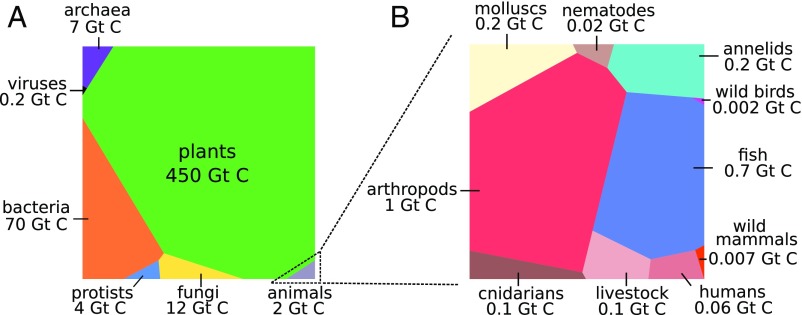
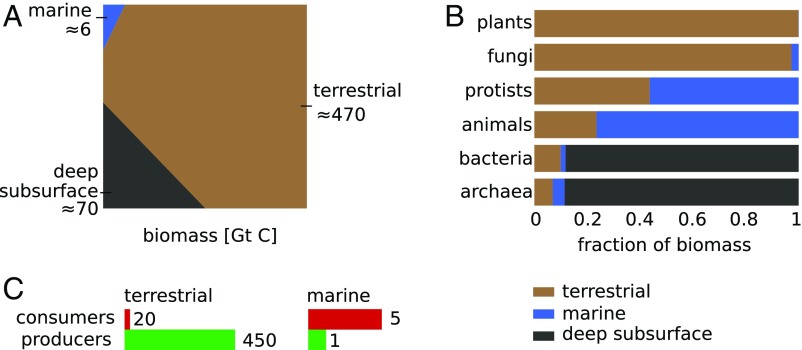
A census of the biomass on Earth is key for understanding the structure and dynamics of the biosphere. However, a global, quantitative view of how the biomass of different taxa compare with one another is still lacking. Here, we assemble the overall biomass composition of the biosphere, establishing a census of the ≈550 gigatons of carbon (Gt C) of biomass distributed among all of the kingdoms of life. We find that the kingdoms of life concentrate at different locations on the planet; plants (≈450 Gt C, the dominant kingdom) are primarily terrestrial, whereas animals (≈2 Gt C) are mainly marine, and bacteria (≈70 Gt C) and archaea (≈7 Gt C) are predominantly located in deep subsurface environments. We show that terrestrial biomass is about two orders of magnitude higher than marine biomass and estimate a total of ≈6 Gt C of marine biota, doubling the previous estimated quantity. Our analysis reveals that the global marine biomass pyramid contains more consumers than producers, thus increasing the scope of previous observations on inverse food pyramids. Finally, we highlight that the mass of humans is an order of magnitude higher than that of all wild mammals combined and report the historical impact of humanity on the global biomass of prominent taxa, including mammals, fish, and plants.
Overview
CoChat Summary
TL;DR
The paper assembles a global census of biomass across all kingdoms of life, estimating Earth’s total biomass at ≈550 Gt C, dominated by plants. It also compares biomass across environments and trophic modes, highlighting large uncertainties and human impacts on the biosphere.
Key findings
- Total global biomass is ≈550 Gt C, with plants ≈450 Gt C (≈80%), bacteria ≈70 Gt C (≈15%), fungi ≈12 Gt C, archaea ≈7 Gt C, protists ≈4 Gt C, animals ≈2 Gt C, and viruses ≈0.2 Gt C.
- Land biomass (≈470 Gt C) is about two orders of magnitude higher than marine biomass (≈6 Gt C); the deep subsurface holds ≈15% of total biomass, chiefly bacteria and archaea.
- In the ocean, ≈1 Gt C of primary producers supports ≈5 Gt C of consumer biomass, an inverted standing biomass distribution; marine biomass is ≈70% microbes, mainly bacteria and protists.
- Human-associated biomass is large relative to wild vertebrates: humans ≈0.06 Gt C, livestock ≈0.1 Gt C, wild mammals ≈0.007 Gt C, domesticated poultry ≈0.005 Gt C versus wild birds ≈0.002 Gt C; total plant biomass has declined approximately twofold relative to pre-human civilization.
Methods
- The authors synthesize hundreds of studies and generate estimates for major taxonomic groups, reporting biomass as gigatons of carbon (Gt C) and using a kingdom-level framework plus viruses.
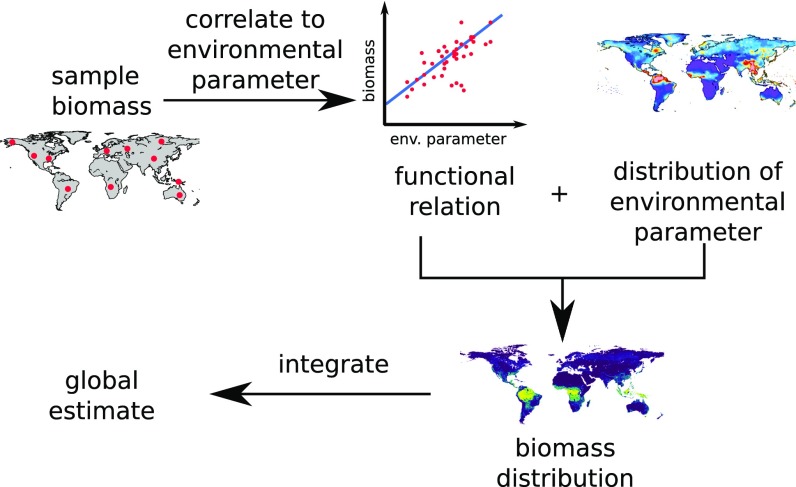
- For many taxa, local biomass samples are extrapolated globally by correlating biomass density with environmental parameters known at global scale; best estimates often use a geometric mean of independent estimates.
- Uncertainty is reported as multiplicative fold-change projections akin to 95% confidence intervals, incorporating intrastudy, interstudy, and intermethod variation; data and code are open-sourced.
Limitations
- The paper states that most datasets rely on fragmentary sampling, causing large uncertainties; sampling is scarce in the deep ocean (usually deeper than 200 m) and deep soil (usually deeper than 1 m), and some estimates may be biased by sampling toward high-abundance areas.
- The paper states that deep subsurface environments have particularly high uncertainty and unknown systematic biases, including unresolved distribution of biomass between aquifer fluids and rocks and among microbial taxa.
- The paper states that current and prehuman vertebrate biomass estimates are only a crude first step, amphibians remain poorly characterized, and parasite biomass is not resolved from hosts; evident from the text, kingdom-level grouping was chosen because much data lack finer taxonomic detail, and some uncertainty projections rely on analogous taxa or expert consultation.
Model-written summary. Check it against the paper before relying on it.
Integrity signals
Registry
Cites
Statistics
Figures
Verification
Claims the paper makes
9 Valid · 7 Not valid · 16 Not checked · 53 Own results and interpretations
Every source the paper cites for this claim was checked and supports it.
In the paper
“The biomass of amphibians, which are experiencing a dramatic population decline (42), remains poorly characterized.”
§ The biomass distribution on Earth > Discussion
What the sources say
- Supportedcites [42] Wake DB Vredenburg VT 2008 Colloquium paper: Are we in the midst of the sixth mass extinction? A view from the world of amphibians Proc Natl Acad Sci USA 105 11466 11473 18695221 PMC2556420 source
The citation is attached to the clause about amphibian population decline, not the separate statement that their biomass is poorly characterized. The passage reporting the Global Amphibian Assessment (labeled Abstract in our copy) says that 43% of amphibian species have declining populations. (LLM, conf=0.92)
plain- Asserted: passes — The authors put it forward as true.
- Checkable: passes — It can be checked against evidence.
- Load-bearing: unclear — It is unclear whether the paper’s conclusions depend on it.
- Based: passes — The paper gives a reason why it holds.
- Supported
Every source the paper cites for this claim was checked and supports it.
In the paper
“In the case of prokaryotes, some major improvements were recently realized, with global estimates of marine deep subsurface prokaryote biomass reduced by about two orders of magnitude due to an increased diversity of sampling locations (7).”
§ The biomass distribution on Earth > Discussion
What the sources say
- Supportedcites [7] Kallmeyer J Pockalny R Adhikari RR Smith DC D’Hondt S 2012 Global distribution of microbial abundance and biomass in subseafloor sediment Proc Natl Acad Sci USA 109 16213 16216 22927371 PMC3479597 source
The Discussion reports a revised subseafloor microbial biomass estimate of 4.1 Pg C versus a previous estimate of 303 Pg C—about a 74-fold reduction. It also identifies a more geographically diverse sampling database, including low-abundance ocean gyres, as a reason the new estimate is lower. The paper identifies other contributing factors as well. (LLM, conf=0.88)
plainstates a cause- Asserted: passes — The authors put it forward as true.
- Checkable: passes — It can be checked against evidence.
- Load-bearing: unclear — It is unclear whether the paper’s conclusions depend on it.
- Based: passes — The paper gives a reason why it holds.
- Supported
The sources with a verdict support this claim; the rest weren’t checked yet, have no full text we could read, or their verdicts aren’t rated yet.
In the paper
“Such inverted biomass distributions can occur when primary producers have a rapid turnover of biomass [on the order of days (34)], while consumer biomass turns over much more slowly [a few years in the case of mesopelagic fish (35)].”
§ The biomass distribution on Earth > Results > The Distribution of Biomass Across Environments and Trophic Modes.
What the sources say
- Supportedcites [34] Zubkov MV 2014 Faster growth of the major prokaryotic versus eukaryotic CO2 fixers in the oligotrophic ocean Nat Commun 5 3776 24777140 PMC4015317 source
The Results (Comparison of the growth rates of the CO2 fixers; page unavailable) report growth rates of 0.1–0.6 per day for the studied oceanic primary producers, consistent with biomass turnover on the order of days. The few-years estimate for mesopelagic fish is assigned to a different citation, not this source. (LLM, conf=0.91)
- Not checked — no full text of the sourcecites [35] Catul V Gauns M Karuppasamy PK 2011 A review on mesopelagic fishes belonging to family Myctophidae Rev Fish Biol Fish 21 339 354 source
plainstates a possible cause- Asserted: passes — The authors put it forward as true.
- Checkable: passes — It can be checked against evidence.
- Load-bearing: passes — The paper’s conclusions depend on it.
- Based: passes — The paper gives a reason why it holds.
- Supported
The cited sources support only part of this claim — read each source’s verdict below.
In the paper
“Combining data from independent sources such as these enables a robust assessment of the total plant biomass (17).”
§ The biomass distribution on Earth > Results > The Uncertainty Associated with Global Biomass Estimates.
What the sources say
- Partly supportedcites [17] Erb K-H 2017 Unexpectedly large impact of forest management and grazing on global vegetation biomass Nature 553 73 76 29258288 PMC5756473 sourceExperimental — accuracy not yet measured
The Methods describe combining multiple datasets and types of evidence to estimate global vegetation biomass stocks. But the paper also says global stocks remain uncertain, reports uncertainty ranges around 35% of the median estimate, and describes more robust estimates as a future prospect. It therefore supports the use of independent sources for an assessment, but not the unqualified characterization of that assessment as robust. (LLM, conf=0.84)
plainstates a cause- Asserted: passes — The authors put it forward as true.
- Checkable: passes — It can be checked against evidence.
- Load-bearing: passes — The paper’s conclusions depend on it.
- Based: passes — The paper gives a reason why it holds.
- Partly supported
A result the paper states — it cites no source for it, so there is none to check. The quote shows it is in the paper.
In the paper
“Plant biomass includes ≈70% stems and tree trunks, which are mostly woody, and thus relatively metabolically inert.”
§ The biomass distribution on Earth > Results > The Biomass Distribution of the Biosphere by Kingdom.
plain- Asserted: passes — The authors put it forward as true.
- Checkable: passes — It can be checked against evidence.
- Load-bearing: unclear — It is unclear whether the paper’s conclusions depend on it.
- Based: passes — The paper gives a reason why it holds.
27 more claims
Create a free account to see all 85 claims and to verify the 2 references still open.
- It may state two separate claims as one. 32
- Probably not a substantial claim. 28
Claims other papers make about this one
Each is checked against this paper’s own text: does it say what the citing paper says it does?
The cited source doesn’t support the claim as written.
In the citing paper
“and less than 10% that of the world ' s current human population ( 52 ).”
From Pervasive human-driven decline of life on Earth points to the need for transformative change (2019) · cites this paper as [52]
Checked by a reasoning model — may be wrong.
Experimental — accuracy not yet measuredThe cited source says what the claim attributes to it.
In the citing paper
“Approximately 450 Gt of C is bound up in terrestrial biota, primarily in plants (86), while only ~6 Gt of C is found in ocean biota (87).”
From Earth beyond six of nine planetary boundaries (2023) · cites this paper as [87]
The cited source says what the claim attributes to it.
In the citing paper
“The amount of metabolic energy available to a biosphere powered by O 2 is vast, such that the O 2 -rich ocean-atmosphere system of the modern Earth supports staggering levels of standing biomass (Bar-On et al. 2018), energy flow (Falkowski et al. 2008), and ecological complexity (Steele 1974).”
From The History of Ocean Oxygenation (2022) · cites this paper as Bar-On et al. 2018
In the citing paper
“Global populations of domestic ruminants (cattle, sheep, and goats) (Ripple et al. 2013) poultry, and pigs (Bennett et al. 2018) used to feed the growing human population now exceed 100 million tons of carbon (Bar-On et al. 2018), and livestock populations are growing rapidly.”
From Scientists’ warning to humanity on the freshwater biodiversity crisis (2021) · cites this paper as Bar-On et al. 2018
Citations
Cites
The worldwide leaf economics spectrum
Wright, I. J., Reich, P. B., Westoby, M., Ackerly, D. D., Baruch, Z., Bongers, F., Cavender-Bares, J., Chapin, T., Cornelissen, J. H. C., Diemer, M., et al. (2004) · Nature · doi:10.1038/nature02403 · Cited by 9,021 · cited 1×
“We then convert the total area of leaves to an estimate of the total dry mass of leaves by using the Glopnet database (24), which measured leaf mass per area (LMA) for ≈2500 plant species.”
MethodA large and persistent carbon sink in the world’s forests
Pan, Y., Birdsey, R. A., Fang, J., Houghton, R., Kauppi, P. E., Kurz, W. A., Phillips, O. L., Shvidenko, A., Lewis, S. L., Canadell, J. G., et al. (2011) · Science · doi:10.1126/science.1201609 · Cited by 8,458
Soil Sampling and Methods of Analysis
(2007) · CRC Press eBooks · doi:10.1201/9781420005271 · Cited by 6,469
Primary production of the biosphere: Integrating terrestrial and oceanic components
Field, C. B., Behrenfeld, M. J., Randerson, J. T., & Falkowski, P. (1998) · Science · doi:10.1126/science.281.5374.237 · Cited by 6,371
Prokaryotes: The unseen majority
Whitman, W. B., Coleman, D. C., & Wiebe, W. J. (1998) · Proceedings of the National Academy of Sciences · doi:10.1073/pnas.95.12.6578 · Cited by 4,871
Global effects of land use on local terrestrial biodiversity
Newbold, T., Hudson, L. N., Hill, S. L. L., Contu, S., Lysenko, I., Senior, R. A., Börger, L., Bennett, D. J., Choimes, A., Collen, B., et al. (2015) · Nature · doi:10.1038/nature14324 · Cited by 4,352
Belowground biodiversity and ecosystem functioning
Bardgett, R. D., & van der Putten, W. H. (2014) · Nature · doi:10.1038/nature13855 · Cited by 3,990 · cited 4×
“This was recommended by experts in the field for estimation of arbuscular mycorrhizal fungi abundance (117).”
BackgroundInfluentialMangroves among the most carbon-rich forests in the tropics
Donato, D. C., Kauffman, J. B., Murdiyarso, D., Kurnianto, S., Stidham, M., & Kanninen, M. (2011) · Nature Geoscience · doi:10.1038/ngeo1123 · Cited by 3,374
Poorter, H., Niklas, K. J., Reich, P. B., Oleksyn, J., Poot, P., & Mommer, L. (2012) · New Phytologist · doi:10.1111/j.1469-8137.2011.03952.x · Cited by 3,163 · cited 1×
“The first relies on a meta-analysis of the biomass allocation to different plant compartments across biomes (19).”
BackgroundA global analysis of root distributions for terrestrial biomes
Jackson, R. B., Canadell, J., Ehleringer, J. R., Mooney, H. A., Sala, O. E., & Schulze, E. D. (1996) · Oecologia · doi:10.1007/bf00333714 · Cited by 3,071 · cited 4×
“assumed the distribution of microbial biomass with depth follows the biomass density versus depth profile of root biomass (21).”
BackgroundMethodInfluential
Research works printed but not linked: 1
- Chapman AD 2009 Numbers of Living Species in Australia and the World Australian Biological Resources Study Canberra, Australia
Cited by
Items 501–600 of 3,743
Luo, E., Leu, A. O., Eppley, J. M., Karl, D. M., & DeLong, E. F. (2022) · The ISME Journal · doi:10.1038/s41396-022-01202-1 · Cited by 48
“These sinking particles and their associated microbes play a critical role in the global carbon cycle by sequestering approximately 4 gigatons of our planet’s atmospheric carbon annually [3], roughly equivalent to the total standing carbon stock in marine biomass [4].”
BackgroundThe Promise of Blue Carbon Climate Solutions: Where the Science Supports Ocean-Climate Policy
Christianson, A. B., Cabré, A., Bernal, B., Baez, S. K., Leung, S. W., Pérez-Porro, A. R., & Poloczanska, E. S. (2022) · Frontiers in Marine Science · doi:10.3389/fmars.2022.851448 · Cited by 60
“organic carbon (700 Gt C, mostly dissolved organic carbon, excluding living marine biota and sediment floor), marine biota (6 Gt C) (Bar-On et al., 2018), and the sediment floor (2,322 Gt C in the top first meter) (Bar-On et al.”
BackgroundInfluentialα-cyanobacteria possessing form IA RuBisCO globally dominate aquatic habitats
Cabello‐Yeves, P. J., Scanlan, D. J., Callieri, C., Picazo, A., Schallenberg, L., Huber, P., Roda‐Garcia, J. J., Bartosiewicz, M., Belykh, O. I., Тихонова, И. В., et al. (2022) · The ISME Journal · doi:10.1038/s41396-022-01282-z · Cited by 50
“Whilst global cyanobacterial biomass is tiny compared to plant systems [9, 10], in marine systems cyanobacteria contribute around 25% of global marine primary production with oceanic productivity on a par with terrestrial ecosystems [11, 12].”
BackgroundGeological diversity and microbiological potential of lakes on Mars
Michalski, J. R., Goudge, T. A., Crowe, S. A., Cuadros, J., Mustard, J. F., & Johnson, S. S. (2022) · Nature Astronomy · doi:10.1038/s41550-022-01743-7 · Cited by 51
Li, W., Wang, C., Liu, H., Wang, W., Sun, R., Li, M., Shi, Y., Zhu, D., Du, W., Ma, L., et al. (2023) · Frontiers in Ecology and Evolution · doi:10.3389/fevo.2023.1132248 · Cited by 44
“It is estimated that the global fine root C storage exceeds atmospheric C storage by 5% (Bar-On et al., 2018).”
BackgroundSynthesis of prebiotic organics from CO2 by catalysis with meteoritic and volcanic particles
Peters, S., Semenov, D. A., Hochleitner, R., & Trapp, O. (2023) · Scientific Reports · doi:10.1038/s41598-023-33741-8 · Cited by 44
Spatiotemporal-based automated inundation mapping of Ramsar wetlands using Google Earth Engine
Goyal, M. K., Rakkasagi, S., Shaga, S., Zhang, T. C., Surampalli, R. Y., & Dubey, S. (2023) · Scientific Reports · doi:10.1038/s41598-023-43910-4 · Cited by 46
“Moreover, wetlands are responsible for the production of over 20% of the earth’s organic carbon 2 , making them an essential source of nutrients and energy for many aquatic and terrestrial ecosystems 3 .”
BackgroundMomper, L., Aronson, H. S., & Amend, J. P. (2018) · Frontiers in Microbiology · doi:10.3389/fmicb.2018.01993 · Cited by 49
Modeling strawberry biomass and leaf area using object-based analysis of high-resolution images
Guan, Z., Abd-Elrahman, A. H., Fan, Z., Whitaker, V. M., & Wilkinson, B. (2020) · ISPRS Journal of Photogrammetry and Remote Sensing · doi:10.1016/j.isprsjprs.2020.02.021 · Cited by 49
Bossert, L. N., & Hagendorff, T. (2021) · Technology in Society · doi:10.1016/j.techsoc.2021.101678 · Cited by 57
Sorghum as a novel biomass for the sustainable production of cellulose nanofibers
Pennells, J., Cruickshank, A., Chaléat, C. M., Godwin, I. D., & Martin, D. J. (2021) · Industrial Crops and Products · doi:10.1016/j.indcrop.2021.113917 · Cited by 47
Host manipulation by parasites as a cryptic driver of energy flow through food webs
Sato, T., Iritani, R., & Sakura, M. (2019) · Current Opinion in Insect Science · doi:10.1016/j.cois.2019.02.010 · Cited by 44
Ryan, E., Bateman, P. W., Fernandes, K., van der Heyde, M., & Nevill, P. (2022) · Environmental DNA · doi:10.1002/edn3.306 · Cited by 52
Composition of continental crust altered by the emergence of land plants
Spencer, C. J., Davies, N. S., Gernon, T., Wang, X., McMahon, W. J., Morrell, T. R. I., Hincks, T. K., Pufahl, P. K., Brasier, M., Seraine, M., et al. (2022) · Nature Geoscience · doi:10.1038/s41561-022-00995-2 · Cited by 48
A global perspective on bacterial diversity in the terrestrial deep subsurface
Soares, A., Edwards, A., An, D., Bagnoud, A., Bradley, J. A., Barnhart, E. P., Bomberg, M., Budwill, K., Caffrey, S. M., Fields, M. W., et al. (2023) · Microbiology · doi:10.1099/mic.0.001172 · Cited by 53
“Efforts by multiple teams of investigators to sequence subsurface ecosystems over the last decade were hereby consolidated to characterize the 12–20 % of global biomass this biome represents [5].”
BackgroundRakkasagi, S., Goyal, M. K., & Jha, S. (2024) · Journal of Hydrology · doi:10.1016/j.jhydrol.2024.130869 · Cited by 44
Jin, J., Zhao, D., Wang, J., Wang, Y., Zhu, H., Wu, Y., Fang, L., & Bing, H. (2024) · Journal of Hazardous Materials · doi:10.1016/j.jhazmat.2024.135438 · Cited by 47
Estimating the Importance of Viral Contributions to Soil Carbon Dynamics
Zimmerman, A., Graham, E. B., McDermott, J., & Hofmockel, K. (2024) · Global Change Biology · doi:10.1111/gcb.17524 · Cited by 52
“Our estimate for the carbon in terrestrial bacteriophages is within (Bar-On, Phillips, and Milo 2018) estimate that all bacteriophages, regardless of ecosystem, globally represent 0.6 Pg carbon when applying the same carbon- per-virus conversion factor.”
InfluentialA diverse and distinct microbiome inside living trees
Arnold, W., Gewirtzman, J., Raymond, P. A., Duguid, M. C., Brodersen, C. R., Brown, C., Norbraten, N., Wood, Q. T. V., Bradford, M. A., & Peccia, J. (2025) · Nature · doi:10.1038/s41586-025-09316-0 · Cited by 65
“These findings establish a framework for further investigation into the roles of wood-associated microbiomes in tree physiology, microbial ecology and biogeochemistry.”
Morais, S., Cario, A., Liu, N., Bernard, D., Lecoutre, C., Garrabos, Y., Ranchou‐Peyruse, A., Dupraz, S., Azaroual, M., Hartman, R. L., et al. (2020) · Reaction Chemistry & Engineering · doi:10.1039/d0re00023j · Cited by 49
Hylling, O., Carstens, A. B., Kot, W., Hansen, M. A., Neve, H., Franz, C. M. A. P., Johansen, A., Ellegaard‐Jensen, L., & Hansen, L. H. (2020) · Scientific Reports · doi:10.1038/s41598-020-68389-1 · Cited by 43
Community, Distribution, and Ecological Roles of Estuarine Archaea
Zou, D., Liu, H., & Li, M. (2020) · Frontiers in Microbiology · doi:10.3389/fmicb.2020.02060 · Cited by 52
Mobile forms of carbon in trees: metabolism and transport
Domínguez, P. G., & Niittylä, T. (2021) · Tree Physiology · doi:10.1093/treephys/tpab123 · Cited by 50
“Most of the biomass in trees resides in above and below ground woody tissues and roots, which account for ∼70% of the terrestrial plant biomass (Bar-on et al. 2018).”
BackgroundEriksson, O. (2022) · Frontiers in Sustainable Food Systems · doi:10.3389/fsufs.2022.801327 · Cited by 58
“The total biomass of livestock on Earth by far exceeds the biomass of all other mammals taken together (Bar-On et al., 2018).”
BackgroundHome-produced eggs: An important human exposure pathway of perfluoroalkylated substances (PFAS)
Lasters, R., Groffen, T., Eens, M., Coertjens, D., Gebbink, W. A., Hofman, J., & Bervoets, L. (2022) · Chemosphere · doi:10.1016/j.chemosphere.2022.136283 · Cited by 53
“In this regard, free-ranging chickens offer unique opportunities for monitoring human exposure, as they are the most prevalent birds on earth in terms of biomass and usually live in close contact with humans (Bar-On et al., 2018; Scaramozzino et al., 2019).”
BackgroundGios, E., Mosley, O. E., Weaver, L., Close, M. E., Daughney, C., & Handley, K. M. (2023) · ISME Communications · doi:10.1038/s43705-023-00223-x · Cited by 47
“Microbial life in the subsurface is estimated to constitute 15% of the Earth’s total biomass [2], but remains mostly uncultivated and largely unexplored.”
BackgroundYuan, S., Wang, J.-J., Dong, B., & Dai, X. (2023) · Environmental Science & Technology · doi:10.1021/acs.est.3c04203 · Cited by 43
Giga-ton and tera-watt scale challenges at the energy - climate crossroads: A global perspective
Gür, T. M. (2023) · Energy · doi:10.1016/j.energy.2023.129971 · Cited by 44
Wijas, B. J., Allison, S., Austin, A. T., Cornwell, W. K., Cornelissen, J. H. C., Eggleton, P., Fraver, S., Ooi, M. K. J., Powell, J. R., Woodall, C. W., et al. (2024) · Annual Review of Ecology Evolution and Systematics · doi:10.1146/annurev-ecolsys-110421-102327 · Cited by 61
“Plants constitute ~80% of all living biomass (Bar-On et al. 2018) and assimilate one fifth of atmospheric carbon each year (Keenan & Williams 2018).”
BackgroundA coupled microscopy approach to assess the nano-landscape of weathering
Lybrand, R. A., Austin, J. C., Fedenko, J., Gallery, R. E., Rooney, E. C., Schroeder, P. A., Zaharescu, D. G., & Qafoku, O. S. (2019) · Scientific Reports · doi:10.1038/s41598-019-41357-0 · Cited by 44
Towards Integrating Evolution, Metabolism, and Climate Change Studies of Marine Ecosystems
Baltar, F., Bayer, B., Bednaršek, N., Deppeler, S., Escribano, R., González, C. E., Hansman, R. L., Mishra, R. K., Moran, M. A., Repeta, D. J., et al. (2019) · Trends in Ecology & Evolution · doi:10.1016/j.tree.2019.07.003 · Cited by 51
“In contrast to terrestrial systems where most (≈96%) of the living biomass are plants, most of the biomass of the ocean (≈70%) is microbial [15].”
BackgroundA History of Pigs in China: From Curious Omnivores to Industrial Pork
Lander, B., Schneider, M. L., & Brunson, K. (2020) · The Journal of Asian Studies · doi:10.1017/s0021911820000054 · Cited by 49
“The total biomass of all wild mammals has been reduced to a mere 0.007 Gt C (Bar-On, Phillips, and Milo 2018; Smil 2013).”
BackgroundInfluentialRevealing hidden plant diversity in arid environments
Carrasco‐Puga, G., Díaz, F. P., Soto, D. C., Hernández‐Castro, C., Contreras‐López, O., Maldonado, A., Latorre, C., & Gutiérrez, R. A. (2020) · Ecography · doi:10.1111/ecog.05100 · Cited by 47
Why and how do termite kings and queens live so long?
Tasaki, E., Takata, M., & Matsuura, K. (2021) · Philosophical Transactions of the Royal Society B Biological Sciences · doi:10.1098/rstb.2019.0740 · Cited by 45
“Termites are one of the most abundant terrestrial animals on earth [1,2].”
BackgroundPfeffer, S. E., & Wolf, H. (2020) · Animal Cognition · doi:10.1007/s10071-020-01446-4 · Cited by 43
Natural folding of airborne fungal spores: a mechanism for dispersal and long-term survival?
Segers, F. J. J., Dijksterhuis, J., Giesbers, M., & Debets, A. J. M. (2022) · Fungal Biology Reviews · doi:10.1016/j.fbr.2022.10.005 · Cited by 52
Patterns and determinants of the global herbivorous mycobiome
Meili, C. H., Jones, A., Arreola, A. X., Habel, J., Pratt, C. J., Hanafy, R. A., Wang, Y., Yassin, A. S., TagElDein, M. A., Moon, C. D., et al. (2023) · Nature Communications · doi:10.1038/s41467-023-39508-z · Cited by 47
“Plant biomass represents the most abundant [1], yet least readily digestible [2] nutritional source 57”
Capturing wild animal welfare: a physiological perspective
Beaulieu, M. (2023) · Biological reviews/Biological reviews of the Cambridge Philosophical Society · doi:10.1111/brv.13009 · Cited by 59
“0.35% of the animal biomass on Earth (Mora et al ., 2011; Burgin et al ., 2018; Bar-On et al ., 2018)].”
BackgroundInfluentialTowards establishing a fungal economics spectrum in soil saprobic fungi
Camenzind, T., Aguilar‐Trigueros, C. A., Hempel, S., Lehmann, A., Bielčik, M., Andrade‐Linares, D. R., Bergmann, J., Cruz, J. D., Gawronski, J., Golubeva, P., et al. (2024) · Nature Communications · doi:10.1038/s41467-024-47705-7 · Cited by 50
“Saprobic fungi in soil represent a highly diverse microbial guild that drives C and nutrient turnover, contributes large portions of soil microbial biomass 34,35 and activity 36 and plays a major role in soil C sequestration 37,38 .”
Lazić, D., Geßner, C., Liepe, K. J., Lesur, I., Mäder, M., Blanc-Jolivet, C., Gömöry, D., Liesebach, M., González‐Martínez, S. C., Fladung, M., et al. (2024) · Nature Communications · doi:10.1038/s41467-024-52933-y · Cited by 62
“Large genetic biodiversity monitoring projects are already performing high-resolution sampling of different plant and animal species 48,49 .””
Enhancing soil microbiome resilience: the mitigating role of silicon against environmental stresses
Etesami, H. (2024) · Frontiers in Agronomy · doi:10.3389/fagro.2024.1465165 · Cited by 53
Microbial metal physiology: ions to ecosystems
Helmann, J. D. (2025) · Nature Reviews Microbiology · doi:10.1038/s41579-025-01213-7 · Cited by 58
“They are the numerically dominant form of life in the oceans and second only to plants in their contribution to the biomass of terrestrial ecosystems 13 .”
Direct Cell Mass Measurements Expand the Role of Small Microorganisms in Nature
Khachikyan, A., Milucka, J., Littmann, S., Ahmerkamp, S., Meador, T. B., Könneke, M., Burg, T. P., & Kuypers, M. M. M. (2019) · Applied and Environmental Microbiology · doi:10.1128/aem.00493-19 · Cited by 41
“1 Pg of C [44]) and 33% higher than the most recent assessment (10 Pg of C [1]).”
BackgroundThermal degradation of crab shell biomass, a nitrogen-containing carbon precursor
Sebestyén, Z., Jakab, E., Domán, A., Bokrossy, P., Bertóti, I., Madarász, J., & László, K. (2020) · Journal of Thermal Analysis and Calorimetry · doi:10.1007/s10973-020-09438-9 · Cited by 45
“The estimated carbon content in the overall biomass composition of the biosphere is ≈ 550 gigatons and is distributed among all of the segments of life [3].”
BackgroundMutation, Randomness, and Evolution
Stoltzfus, A. (2021) · doi:10.1093/oso/9780198844457.001.0001 · Cited by 54
Cumpstey, A. F., Clark, A. D., Santolini, J., Jackson, A. A., & Feelisch, M. (2021) · Antioxidants and Redox Signaling · doi:10.1089/ars.2021.0017 · Cited by 42
“A recent census of the Earth’s biosphere composition revealed that the mass of humans is already an order of magnitude higher than that of all wild mammals combined (22); by comparison, the total mass of SARS-CoV-2 virions on Earth is estimated to be < 1 kg (377).”
Contribution of microbial photosynthesis to peatland carbon uptake along a latitudinal gradient
Hamard, S., Céréghino, R., Barret, M., Sytiuk, A., Lara, E., Dorrepaal, E., Kardol, P., Küttim, M., Lamentowicz, M., Leflaive, J., et al. (2021) · Journal of Ecology · doi:10.1111/1365-2745.13732 · Cited by 50
Nova, N. (2021) · Frontiers in Public Health · doi:10.3389/fpubh.2021.717941 · Cited by 54
Cummins, M. L., Reid, C. J., & Djordjevic, S. P. (2022) · mSystems · doi:10.1128/msystems.01212-21 · Cited by 52
“Worldwide, there are approximately 26 billion chickens (56), and colibacillosis caused by APEC that overwhelmingly carry ColV plasmids is the most common bacterial poultry disease (57).”
BackgroundFundamental Science and Engineering Questions in Planetary Cave Exploration
Wynne, J. J., Titus, T. N., Agha–mohammadi, A., Azúa-Bustos, A., Boston, P. J., de León, P., Demirel‐Floyd, C., Waele, J. D., Jones, H., Malaska, M. J., et al. (2022) · Journal of Geophysical Research Planets · doi:10.1029/2022je007194 · Cited by 50
“In terrestrial subsurfaces, at least an order of magnitude more cells are physically attached to a substrate than free-living cells in the aqueous phase (Bar-On et al., 2018).”
BackgroundSizing Up the Uncultured Microbial Majority
Hug, L. A. (2018) · mSystems · doi:10.1128/msystems.00185-18 · Cited by 44
The Future of (Soil) Microbiome Studies: Current Limitations, Integration, and Perspectives
Geisen, S. (2021) · mSystems · doi:10.1128/msystems.00613-21 · Cited by 46
“highest diversity, abundance, and biomass of microbes (4, 5).”
BackgroundA mechanistic explanation of the transition to simple multicellularity in fungi
Heaton, L. L. M., Jones, N. S., & Fricker, M. D. (2020) · Nature Communications · doi:10.1038/s41467-020-16072-4 · Cited by 51
Accessible versatility underpins the deep evolution of plant specialized metabolism
Dadras, A., Rieseberg, T. P., Zegers, J. M. S., Fürst‐Jansen, J. M. R., Irisarri, I., de Vries, J., & de Vries, S. (2023) · Phytochemistry Reviews · doi:10.1007/s11101-023-09863-2 · Cited by 49
“To put this in numbers, the phenylpropanoid-derived wood molecule lignin (which consists of carbon, oxygen, and hydrogen) alone likely accounts for more than 15% of the biomass on land (cf. Robinson 1990; Bar-On et al. 2018).”
Ahmad, M. M., Yousaf, M., Han, J., Rahman, S. U., Sharif, H. M. A., Wang, L., Tang, Z., Zhou, Y., & Huang, Y. (2023) · Chemical Engineering Journal · doi:10.1016/j.cej.2023.147517 · Cited by 43
Time-resolved oxidative signal convergence across the algae–embryophyte divide
Rieseberg, T. P., Dadras, A., Darienko, T., Post, S., Herrfurth, C., Fürst‐Jansen, J. M. R., Hohnhorst, N., Petroll, R., Rensing, S. A., Pröschold, T., et al. (2025) · Nature Communications · doi:10.1038/s41467-025-56939-y · Cited by 49
Substrate specificity, regiospecificity, and processivity in glycoside hydrolase family 74
Arnal, G., Stogios, P. J., Asohan, J., Attia, M. A., Skarina, T., Viborg, A. H., Henrissat, B., Savchenko, A. V., & Brumer, H. (2019) · Journal of Biological Chemistry · doi:10.1074/jbc.ra119.009861 · Cited by 40
“XyGs have a -1,4 –linked glucosyl backbone (“G” unit), some of which are decorated with an -(1,6)-D-xylosyl residue (together comprising an “X” unit; nomenclature according to Ref.”
BackgroundSub‐seafloor biogeochemical processes and microbial life in the Baltic Sea
Jørgensen, B. B., Andrén, T., & Marshall, I. P. G. (2020) · Environmental Microbiology · doi:10.1111/1462-2920.14920 · Cited by 41
Cell biomechanics and mechanobiology in bacteria: Challenges and opportunities
Harper, C. E., & Hernandez, C. J. (2020) · APL Bioengineering · doi:10.1063/1.5135585 · Cited by 45
Eugenio‐Gozalbo, M., Núñez, L. A., & Ortega-Cubero, I. (2020) · Frontiers in Psychology · doi:10.3389/fpsyg.2020.02226 · Cited by 50
Bideault, A., Galiana, N., Zelnik, Y. R., Gravel, D., Loreau, M., Barbier, M., & Sentis, A. (2020) · Global Change Biology · doi:10.1111/gcb.15395 · Cited by 44
“Large-scale predictions for terrestrial and marine herbivory In a recent meta-analysis, Bar-On et al. (2018) estimated biomasses in carbon mass for the major taxonomic groups on Earth.”
BackgroundMethodInfluentialBhunia, S., Bhowmik, A., Mallick, R., Debsarcar, A., & Mukherjee, J. (2021) · Scientia Horticulturae · doi:10.1016/j.scienta.2021.109927 · Cited by 46
Martyn, J. E., Gómez-Valero, L., & Buchrieser, C. (2022) · FEMS Microbiology Reviews · doi:10.1093/femsre/fuac012 · Cited by 41
“However, in Legionella spp. and environmental Chlamydiae population size is potentially less constrained as amoebae are omnipresent and more abundant than animal hosts (Bar-On et al., 2018).”
BackgroundSantoro, M., Cartus, O., Wegmüller, U., Besnard, S., Carvalhais, N., Araza, A. B., Herold, M., Liang, J., Čavlović, J., & Engdahl, M. E. (2022) · Remote Sensing of Environment · doi:10.1016/j.rse.2022.113114 · Cited by 46
Ramírez-Estrada, A., Mena-Cervantes, V. Y., Mederos-Nieto, F. S., Pineda-Flores, G., & Hernández‐Altamirano, R. (2021) · International Journal of Environmental Science and Technology · doi:10.1007/s13762-021-03309-y · Cited by 44
“A considerable proportion of biomass is lignocellulose (Bar-On et al. 2018), which is mainly compounded by cellulose (40–50%), hemicellulose (25%) and lignin (25%) (Anwar et al.”
Putman, L. I., Sabuda, M. C., Brazelton, W. J., Kubo, M. D. Y., Hoehler, T. M., McCollom, T. M., Cardace, D., & Schrenk, M. O. (2021) · mSystems · doi:10.1128/msystems.00300-21 · Cited by 41
“…hard-rock aquifer R ecent estimates of the distribution of biomass on Earth indicate that bacteria are the second largest reservoir of biomass ( ; 70 gigatons of carbon) and that the majority of bacterial and archaeal biomass is hosted within subsurface environments ( ; 64 gigatons of carbon) (1).”
Opposing seasonal temperature dependencies of CO2 and CH4 emissions from wetlands
Li, J., Pei, J., Fang, C., Li, B., & Nie, M. (2022) · Global Change Biology · doi:10.1111/gcb.16528 · Cited by 46
Networking the forest infrastructure towards near real-time monitoring – A white paper
Zweifel, R., Pappas, C., Peters, R. L., Babst, F., Balanzategui, D., Basler, D., Bastos, A., Beloiu, M., Buchmann, N., Bose, A. K., et al. (2023) · The Science of The Total Environment · doi:10.1016/j.scitotenv.2023.162167 · Cited by 45
The Human Ecology of Overshoot: Why a Major ‘Population Correction’ Is Inevitable
Rees, W. E. (2023) · World · doi:10.3390/world4030032 · Cited by 53
“Similarly, domestic poultry now comprises 70% of the earth’s remaining bird biomass [13,14] and commercial fishing depletes the oceans at the expense of rapidly declining fish-dependent marine mammals and birds.”
Electroreforming injects a new life into solid waste
Ma, Y., Zhang, Y., Yuan, W., Du, M., Kang, S., & Qiu, B. (2023) · EES Catalysis · doi:10.1039/d3ey00147d · Cited by 42
Trained immunity: Perspectives for disease control strategy in marine mollusc aquaculture
Montagnani, C., Morga, B., Novoa, B., Gourbal, B., Saco, A., Rey-Campos, M., Bourhis, M., Riera, F., Vignal, E., Corporeau, C., et al. (2024) · Reviews in Aquaculture · doi:10.1111/raq.12906 · Cited by 39
Global wildlife trade and trafficking contribute to the world’s nonhuman primate conservation crisis
Garber, P. A., Estrada, A., Shanee, S., Svensson, M. S., Arregoitia, L. D. V., Nijman, V., Shanee, N., Gouveia, S. F., Nekaris, K. A. I., Chaudhary, A., et al. (2024) · Frontiers in Conservation Science · doi:10.3389/fcosc.2024.1400613 · Cited by 59
Sun, D. A., & Patel, N. H. (2019) · Wiley Interdisciplinary Reviews Developmental Biology · doi:10.1002/wdev.355 · Cited by 47
Martinez, N. D. (2020) · Frontiers in Ecology and Evolution · doi:10.3389/fevo.2020.00092 · Cited by 40
“Given this perspective, humans have already achieved much ecological understanding as indicated by the incredible success of humans in becoming the most abundant and widely distributed animal species on the planet (Bar-On et al., 2018).”
BackgroundMasese, F. O., Kiplagat, M. J., González‐Quijano, C. R., Subalusky, A. L., Dutton, C. L., Post, D. M., & Singer, G. A. (2020) · Proceedings of the Royal Society B Biological Sciences · doi:10.1098/rspb.2019.3000 · Cited by 37
The Mycobiota of the Deep Sea: What Omics Can Offer
Vargas‐Gastélum, L., & Riquelme, M. (2020) · Life · doi:10.3390/life10110292 · Cited by 42
Roeder, K. A., Bujan, J., de Beurs, K. M., Weiser, M. D., & Kaspari, M. E. (2021) · Ecosphere · doi:10.1002/ecs2.3645 · Cited by 42
“Arthropods are (mostly) ectotherms that comprise ~ 46% of Earth ’ s animal biomass (Bar-On et al. 2018) and may represent up to 5 – 10 million of Earth ’ s species (Ødegaard 2000).”
BackgroundSalvatori, M., Tenan, S., Oberosler, V., Augugliaro, C., Christe, P., Groff, C., Krofel, M., Zimmermann, F., & Rovero, F. (2021) · Biological Conservation · doi:10.1016/j.biocon.2021.109294 · Cited by 45
Controllable preparation of green biochar based high-performance supercapacitors
Lin, Y., Li, F., Zhang, Q. J., Liu, G., & Xue, C. (2022) · Ionics · doi:10.1007/s11581-022-04557-9 · Cited by 40
“5 × 10¹¹ tons (dry carbon basis) until 2018 [27].”
Geological processes mediate a microbial dispersal loop in the deep biosphere
Gittins, D. A., Desiage, P., Morrison, N., Rattray, J. E., Bhatnagar, S., Chakraborty, A., Zorz, J., Li, C., Horanszky, O., Cramm, M. A., et al. (2022) · Science Advances · doi:10.1126/sciadv.abn3485 · Cited by 46
Tactile Sensing for Soft Robotic Manipulators in 50 MPa Hydrostatic Pressure Environments
Liu, S., Zhang, D., Fu, X. H., Mo, L., Miao, Q., Huang, R., Huang, X., Guo, W., Li, Y., Zheng, Q., et al. (2023) · Advanced Intelligent Systems · doi:10.1002/aisy.202300296 · Cited by 43
Zheng, F. Y., Gao, J., Tang, M., Zhou, T., Zhu, D., Yang, X., & Chen, B. (2024) · Chemosphere · doi:10.1016/j.chemosphere.2024.143177 · Cited by 47
Biogeochemical consequences of marine fisheries and aquaculture
Ray, N. E., Bonaglia, S., Cavan, E. L., Sampaio, F. G., Gephart, J. A., Hillman, J. R., Hornborg, S., Paradis, S., Petrik, C. M., Tiano, J., et al. (2025) · Nature Reviews Earth & Environment · doi:10.1038/s43017-024-00633-y · Cited by 46
“Assuming values of 0.7 Pg carbon, 26 Tg nitrogen and 6 Tg phosphorus in global marine fish biomass 7,21,45 (see Supplementary Table 1), then capture fisheries extract approximately 2% of carbon, 13% of nitrogen and 13% of phosphorus held in animal biomass from the ocean each year.”
InfluentialHerrmann, M., Geesink, P., Yan, L., Lehmann, R. G., Totsche, K. U., & Küsel, K. (2019) · Water Research · doi:10.1016/j.watres.2019.115306 · Cited by 42
Santoro, M., Cartus, O., & Fransson, J. E. S. (2020) · Remote Sensing of Environment · doi:10.1016/j.rse.2020.112235 · Cited by 42
Silva, S. V., Andermann, T., Zizka, A., Kozlowski, G., & Silvestro, D. (2022) · Frontiers in Plant Science · doi:10.3389/fpls.2022.839792 · Cited by 47
“, 2017) represent the bulk of biomass and are essential as ecosystem engineers housing and feeding millions of species (Olson et al., 2001; Crowther et al., 2015; Bar-On et al., 2018).”
BackgroundPhotodegradation in terrestrial ecosystems
Austin, A. T., & Ballaré, C. L. (2024) · New Phytologist · doi:10.1111/nph.20105 · Cited by 37
“The importance of plants as modulators of the C cycle is indisputable and reflected in their sheer mass at the global scale (Bar-On et al ., 2018).”
Quantifying the role of protected areas for safeguarding the uses of biodiversity
Velazco, S. J. E., Bedrij, N. A., Rojas, L., Keller, H. A., Ribeiro, B. R., & Júnior, P. D. M. (2022) · Biological Conservation · doi:10.1016/j.biocon.2022.109525 · Cited by 40
Escamez, S., Terryn, C., Gandla, M. L., Yassin, Z., Scheepers, G., Näsholm, T., Sundman, O., Jönsson, L. J., Felten, J., Tuominen, H., et al. (2021) · ACS Sustainable Chemistry & Engineering · doi:10.1021/acssuschemeng.1c06780 · Cited by 45
Larsen, S., Albanese, D., Stegen, J., Franceschi, P., Coller, E., Zanzotti, R., Ioriatti, C., Stefani, E., Pindo, M., Cestaro, A., et al. (2022) · Microbial Ecology · doi:10.1007/s00248-022-02065-x · Cited by 39
“Recent estimates indicate that microbes represent ~ 90% of below-ground biomass globally [2], providing essential ecosystem functions and services, including carbon sequestration [3, 4] and nutrient cycling as well as directly and indirectly influencing plant and animal health, including humans [5].”
BackgroundMore is Different: Metabolic Modeling of Diverse Microbial Communities
Diener, C., & Gibbons, S. M. (2023) · mSystems · doi:10.1128/msystems.01270-22 · Cited by 40
Lombard, A. T., Dorrington, R. A., Reed, J. R., Ortega‐Cisneros, K., Penry, G. S., Pichegru, L., Smit, K. P., Vermeulen-Miltz, E., Witteveen, M., Sink, K. J., et al. (2019) · Frontiers in Marine Science · doi:10.3389/fmars.2019.00146 · Cited by 49
Rossi, S., Isla, E., Bosch‐Belmar, M., Galli, G., Gori, A., Gristina, M., Ingrosso, G., Milisenda, G., Piraino, S., Rizzo, L., et al. (2019) · ICES Journal of Marine Science · doi:10.1093/icesjms/fsz147 · Cited by 45
Is Endothermy an Evolutionary By-Product?
Seebacher, F. (2020) · Trends in Ecology & Evolution · doi:10.1016/j.tree.2020.02.006 · Cited by 36
Directly Valuing Animal Welfare in (Environmental) Economics
Carlier, A., & Treich, N. (2020) · International Review of Environmental and Resource Economics · doi:10.1561/101.00000115 · Cited by 37
Liquid-phase electron microscopy imaging of cellular and biomolecular systems
Smith, J. W., & Chen, Q. (2020) · Journal of Materials Chemistry B · doi:10.1039/d0tb01300e · Cited by 42
Global contribution of pelagic fungi to protein degradation in the ocean
Breyer, E., Zhao, Z., Herndl, G. J., & Baltar, F. (2022) · Microbiome · doi:10.1186/s40168-022-01329-5 · Cited by 43
“Background Microbes make up around 70% of the total marine biomass [1] and are involved in complex functional and phylogenetic networks with all three organismal domains of life and viruses [2].”
BackgroundReal‐time genomics for One Health
Urban, L., Perlas, A., Francino, O., Martí‐Carreras, J., Muga, B., Mwangi, J., Boykin, L. M., Stanton, J. L., Black, A., Waipara, N. W., et al. (2023) · Molecular Systems Biology · doi:10.15252/msb.202311686 · Cited by 43
“The extremely high biomass and population densities of our livestock and crops (Bar-On et al, 2018) in combination with their relatively low levels of genetic diversity (Zhang et al, 2018) make them susceptible to emerging infectious diseases (van Oosterhout, 2021).”
BackgroundGeological activity shapes the microbiome in deep-subsurface aquifers by advection
Zhang, Y., Horne, R. N., Hawkins, A. J., Primo, J. C., Gorbatenko, O. V., & Dekas, A. (2022) · Proceedings of the National Academy of Sciences · doi:10.1073/pnas.2113985119 · Cited by 45
“Adapted to the relatively stable subsurface environmental conditions with continuous darkness and limited nutrients (3, 4), subsurface prokaryotes have slow metabolic activity and associated turnover times from months to thousands of years (1) and tend to be resilient to natural disturbance such as recharge from heavy…”
Backgroundde Lorenzo, V. (2022) · Philosophical Transactions of the Royal Society B Biological Sciences · doi:10.1098/rstb.2021.0395 · Cited by 43
“A recent calculation of the different contributors to the whole Earth’s biomass [31] indicates that out of a whole of ca 545 GTons of live matter, more than 80% consists of plants while the bulk of the rest (approx.”
Background
Metadata
- Authors
- Bar-On, Y. M., Phillips, R., & Milo, R.
- Affiliations
- Department of Plant and Environmental Sciences, Weizmann Institute of Science, 76100 Rehovot, Israel;
- California Institute of Technology (US)
- Weizmann Institute of Science (IL)
- Corresponding author
- Milo, Ron
- Venue
- Proceedings of the National Academy of Sciences
- Publisher
- National Academy of Sciences
- Published
- 2018-05-21
- Volume
- 115
- Issue
- 25
- Pages
- 6506-6511
- ISSN
- 0027-8424 (ISSN-L)
- 1091-6490
- PMC
- PMC6016768
- OpenAlex
- W2804910112
- Cited by
- 3,723
- References
- 263
- Citations by year
- 2026: 349 · 2025: 450 · 2024: 589 · 2023: 617 · 2022: 498 · 2021: 498 · 2020: 419 · 2019: 246 · 2018: 49
- FWCI
- 239.98
- Type
- journal article
- Language
- en
- Open access
- hybrid
- doi.org
- Licence
- Locations
- Proceedings of the National Academy of Sciences (publishedVersion, cc-by-nc-nd)
- Europe PMC (PubMed Central) (publishedVersion, cc-by-nc-nd)
- PubMed Central (publishedVersion, cc-by-nc-nd)
- PubMed (publishedVersion)
- CaltechAUTHORS (California Institute of Technology) (submittedVersion, cc-by-nc-nd)
- Funders
- National Institutes of Health (5r35gm118043-07)
- National Institute of General Medical Sciences (R35 GM118043)
- Topics
- Physical Sciences › Environmental Science › Nature and Landscape Conservation › Ecology and Vegetation Dynamics Studies
- Physical Sciences › Environmental Science › Global and Planetary Change › Earth Systems and Cosmic Evolution
- Life Sciences › Agricultural and Biological Sciences › Soil Science › Soil Carbon and Nitrogen Dynamics
- Keywords
- biomass allocation, biomass carbon, terrestrial biomass, marine biomass, bacteria, archaea, food pyramid, wild mammals, fish biomass, plant biomass
- MeSH terms
- Animals, Archaea, Bacteria, Carbon, Humans, Plants, Ecosystem, Biomass, Earth, Planet, Biota
About these checks
Registry, retraction, Cites and statistics results are computed, not judged, with one exception: a printed reference that no index lists is read once by a model before it counts as a citation error. Claims are extracted by a model and kept only when their quote appears verbatim in the text; each cited source is then checked, with a model’s help, for whether it says what the claim relies on. Those verdicts can be wrong — read the claim’s quote and the cited source before relying on one.
The claim verdicts this report counts are experimental: their accuracy is not yet measured.
A language model drew the claims from the paper on 2026-10-10, under version 3 of the claim definition (model deepseek-v4.1-flash, prompt extract-v3).
A second model labelled each claim on 2026-10-10 (model jev-1.13-20260917, definition revision gold-guideline-v0.2).
Cited sources are checked with a language model’s help (gpt-6-sol).
Statistics and arithmetic are recomputed, not judged.
Confidence bands are shown only for fields calibrated on our annotated test set. None is calibrated yet, so no band is shown.
What counts as a claim ›How we measure confidence ›How we check this ›
Are you an author, or do you see a problem with this page? Request a review
Data sources
Bibliographic data: Semantic Scholar, OpenAlex, Crossref.
Contains information from the Semantic Scholar Academic Graph Datasets, made available under the ODC Attribution License (ODC-BY 1.0).
Semantic Scholar’s data is described in: Kinney, R., et al. (2023). The Semantic Scholar Open Data Platform. arXiv:2301.10140.
