

The biomass distribution on Earth
Open accessThe DOI matches its Crossref record; 263 of the 263 references it cites were found in a registry or an index; 11 of the 41 sources its claims cite were checked for support.
Abstract
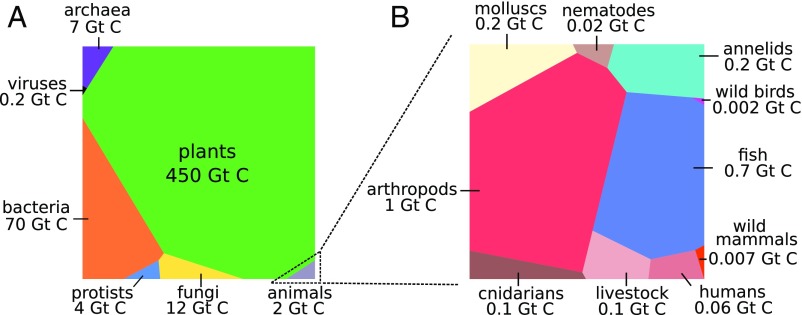
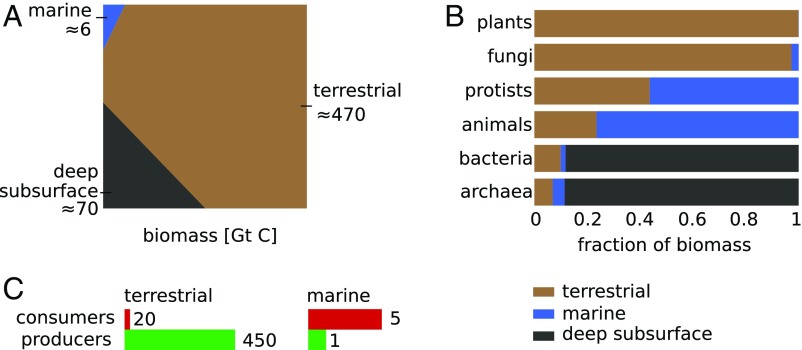
A census of the biomass on Earth is key for understanding the structure and dynamics of the biosphere. However, a global, quantitative view of how the biomass of different taxa compare with one another is still lacking. Here, we assemble the overall biomass composition of the biosphere, establishing a census of the ≈550 gigatons of carbon (Gt C) of biomass distributed among all of the kingdoms of life. We find that the kingdoms of life concentrate at different locations on the planet; plants (≈450 Gt C, the dominant kingdom) are primarily terrestrial, whereas animals (≈2 Gt C) are mainly marine, and bacteria (≈70 Gt C) and archaea (≈7 Gt C) are predominantly located in deep subsurface environments. We show that terrestrial biomass is about two orders of magnitude higher than marine biomass and estimate a total of ≈6 Gt C of marine biota, doubling the previous estimated quantity. Our analysis reveals that the global marine biomass pyramid contains more consumers than producers, thus increasing the scope of previous observations on inverse food pyramids. Finally, we highlight that the mass of humans is an order of magnitude higher than that of all wild mammals combined and report the historical impact of humanity on the global biomass of prominent taxa, including mammals, fish, and plants.
Overview
CoChat Summary
TL;DR
The paper assembles a global census of biomass across all kingdoms of life, estimating Earth’s total biomass at ≈550 Gt C, dominated by plants. It also compares biomass across environments and trophic modes, highlighting large uncertainties and human impacts on the biosphere.
Key findings
- Total global biomass is ≈550 Gt C, with plants ≈450 Gt C (≈80%), bacteria ≈70 Gt C (≈15%), fungi ≈12 Gt C, archaea ≈7 Gt C, protists ≈4 Gt C, animals ≈2 Gt C, and viruses ≈0.2 Gt C.
- Land biomass (≈470 Gt C) is about two orders of magnitude higher than marine biomass (≈6 Gt C); the deep subsurface holds ≈15% of total biomass, chiefly bacteria and archaea.
- In the ocean, ≈1 Gt C of primary producers supports ≈5 Gt C of consumer biomass, an inverted standing biomass distribution; marine biomass is ≈70% microbes, mainly bacteria and protists.
- Human-associated biomass is large relative to wild vertebrates: humans ≈0.06 Gt C, livestock ≈0.1 Gt C, wild mammals ≈0.007 Gt C, domesticated poultry ≈0.005 Gt C versus wild birds ≈0.002 Gt C; total plant biomass has declined approximately twofold relative to pre-human civilization.
Methods
- The authors synthesize hundreds of studies and generate estimates for major taxonomic groups, reporting biomass as gigatons of carbon (Gt C) and using a kingdom-level framework plus viruses.
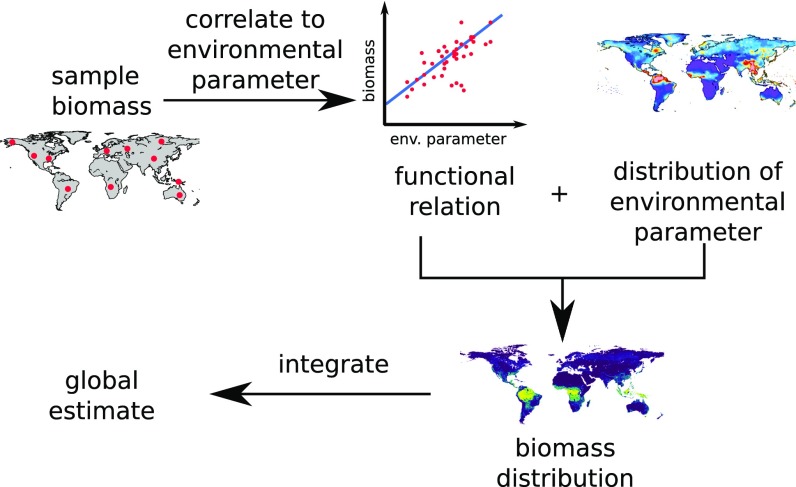
- For many taxa, local biomass samples are extrapolated globally by correlating biomass density with environmental parameters known at global scale; best estimates often use a geometric mean of independent estimates.
- Uncertainty is reported as multiplicative fold-change projections akin to 95% confidence intervals, incorporating intrastudy, interstudy, and intermethod variation; data and code are open-sourced.
Limitations
- The paper states that most datasets rely on fragmentary sampling, causing large uncertainties; sampling is scarce in the deep ocean (usually deeper than 200 m) and deep soil (usually deeper than 1 m), and some estimates may be biased by sampling toward high-abundance areas.
- The paper states that deep subsurface environments have particularly high uncertainty and unknown systematic biases, including unresolved distribution of biomass between aquifer fluids and rocks and among microbial taxa.
- The paper states that current and prehuman vertebrate biomass estimates are only a crude first step, amphibians remain poorly characterized, and parasite biomass is not resolved from hosts; evident from the text, kingdom-level grouping was chosen because much data lack finer taxonomic detail, and some uncertainty projections rely on analogous taxa or expert consultation.
Model-written summary. Check it against the paper before relying on it.
Integrity signals
Registry
Cites
Statistics
Figures
Verification
Claims the paper makes
9 Valid · 7 Not valid · 16 Not checked · 53 Own results and interpretations
Every source the paper cites for this claim was checked and supports it.
In the paper
“The biomass of amphibians, which are experiencing a dramatic population decline (42), remains poorly characterized.”
§ The biomass distribution on Earth > Discussion
What the sources say
- Supportedcites [42] Wake DB Vredenburg VT 2008 Colloquium paper: Are we in the midst of the sixth mass extinction? A view from the world of amphibians Proc Natl Acad Sci USA 105 11466 11473 18695221 PMC2556420 source
The citation is attached to the clause about amphibian population decline, not the separate statement that their biomass is poorly characterized. The passage reporting the Global Amphibian Assessment (labeled Abstract in our copy) says that 43% of amphibian species have declining populations. (LLM, conf=0.92)
plain- Asserted: passes — The authors put it forward as true.
- Checkable: passes — It can be checked against evidence.
- Load-bearing: unclear — It is unclear whether the paper’s conclusions depend on it.
- Based: passes — The paper gives a reason why it holds.
- Supported
Every source the paper cites for this claim was checked and supports it.
In the paper
“In the case of prokaryotes, some major improvements were recently realized, with global estimates of marine deep subsurface prokaryote biomass reduced by about two orders of magnitude due to an increased diversity of sampling locations (7).”
§ The biomass distribution on Earth > Discussion
What the sources say
- Supportedcites [7] Kallmeyer J Pockalny R Adhikari RR Smith DC D’Hondt S 2012 Global distribution of microbial abundance and biomass in subseafloor sediment Proc Natl Acad Sci USA 109 16213 16216 22927371 PMC3479597 source
The Discussion reports a revised subseafloor microbial biomass estimate of 4.1 Pg C versus a previous estimate of 303 Pg C—about a 74-fold reduction. It also identifies a more geographically diverse sampling database, including low-abundance ocean gyres, as a reason the new estimate is lower. The paper identifies other contributing factors as well. (LLM, conf=0.88)
plainstates a cause- Asserted: passes — The authors put it forward as true.
- Checkable: passes — It can be checked against evidence.
- Load-bearing: unclear — It is unclear whether the paper’s conclusions depend on it.
- Based: passes — The paper gives a reason why it holds.
- Supported
The sources with a verdict support this claim; the rest weren’t checked yet, have no full text we could read, or their verdicts aren’t rated yet.
In the paper
“Such inverted biomass distributions can occur when primary producers have a rapid turnover of biomass [on the order of days (34)], while consumer biomass turns over much more slowly [a few years in the case of mesopelagic fish (35)].”
§ The biomass distribution on Earth > Results > The Distribution of Biomass Across Environments and Trophic Modes.
What the sources say
- Supportedcites [34] Zubkov MV 2014 Faster growth of the major prokaryotic versus eukaryotic CO2 fixers in the oligotrophic ocean Nat Commun 5 3776 24777140 PMC4015317 source
The Results (Comparison of the growth rates of the CO2 fixers; page unavailable) report growth rates of 0.1–0.6 per day for the studied oceanic primary producers, consistent with biomass turnover on the order of days. The few-years estimate for mesopelagic fish is assigned to a different citation, not this source. (LLM, conf=0.91)
- Not checked — no full text of the sourcecites [35] Catul V Gauns M Karuppasamy PK 2011 A review on mesopelagic fishes belonging to family Myctophidae Rev Fish Biol Fish 21 339 354 source
plainstates a possible cause- Asserted: passes — The authors put it forward as true.
- Checkable: passes — It can be checked against evidence.
- Load-bearing: passes — The paper’s conclusions depend on it.
- Based: passes — The paper gives a reason why it holds.
- Supported
The cited sources support only part of this claim — read each source’s verdict below.
In the paper
“Combining data from independent sources such as these enables a robust assessment of the total plant biomass (17).”
§ The biomass distribution on Earth > Results > The Uncertainty Associated with Global Biomass Estimates.
What the sources say
- Partly supportedcites [17] Erb K-H 2017 Unexpectedly large impact of forest management and grazing on global vegetation biomass Nature 553 73 76 29258288 PMC5756473 sourceExperimental — accuracy not yet measured
The Methods describe combining multiple datasets and types of evidence to estimate global vegetation biomass stocks. But the paper also says global stocks remain uncertain, reports uncertainty ranges around 35% of the median estimate, and describes more robust estimates as a future prospect. It therefore supports the use of independent sources for an assessment, but not the unqualified characterization of that assessment as robust. (LLM, conf=0.84)
plainstates a cause- Asserted: passes — The authors put it forward as true.
- Checkable: passes — It can be checked against evidence.
- Load-bearing: passes — The paper’s conclusions depend on it.
- Based: passes — The paper gives a reason why it holds.
- Partly supported
A result the paper states — it cites no source for it, so there is none to check. The quote shows it is in the paper.
In the paper
“Plant biomass includes ≈70% stems and tree trunks, which are mostly woody, and thus relatively metabolically inert.”
§ The biomass distribution on Earth > Results > The Biomass Distribution of the Biosphere by Kingdom.
plain- Asserted: passes — The authors put it forward as true.
- Checkable: passes — It can be checked against evidence.
- Load-bearing: unclear — It is unclear whether the paper’s conclusions depend on it.
- Based: passes — The paper gives a reason why it holds.
27 more claims
Create a free account to see all 85 claims and to verify the 2 references still open.
- It may state two separate claims as one. 32
- Probably not a substantial claim. 28
Claims other papers make about this one
Each is checked against this paper’s own text: does it say what the citing paper says it does?
The cited source doesn’t support the claim as written.
In the citing paper
“and less than 10% that of the world ' s current human population ( 52 ).”
From Pervasive human-driven decline of life on Earth points to the need for transformative change (2019) · cites this paper as [52]
Checked by a reasoning model — may be wrong.
Experimental — accuracy not yet measuredThe cited source says what the claim attributes to it.
In the citing paper
“Approximately 450 Gt of C is bound up in terrestrial biota, primarily in plants (86), while only ~6 Gt of C is found in ocean biota (87).”
From Earth beyond six of nine planetary boundaries (2023) · cites this paper as [87]
The cited source says what the claim attributes to it.
In the citing paper
“The amount of metabolic energy available to a biosphere powered by O 2 is vast, such that the O 2 -rich ocean-atmosphere system of the modern Earth supports staggering levels of standing biomass (Bar-On et al. 2018), energy flow (Falkowski et al. 2008), and ecological complexity (Steele 1974).”
From The History of Ocean Oxygenation (2022) · cites this paper as Bar-On et al. 2018
In the citing paper
“Global populations of domestic ruminants (cattle, sheep, and goats) (Ripple et al. 2013) poultry, and pigs (Bennett et al. 2018) used to feed the growing human population now exceed 100 million tons of carbon (Bar-On et al. 2018), and livestock populations are growing rapidly.”
From Scientists’ warning to humanity on the freshwater biodiversity crisis (2021) · cites this paper as Bar-On et al. 2018
Citations
Cites
The worldwide leaf economics spectrum
Wright, I. J., Reich, P. B., Westoby, M., Ackerly, D. D., Baruch, Z., Bongers, F., Cavender-Bares, J., Chapin, T., Cornelissen, J. H. C., Diemer, M., et al. (2004) · Nature · doi:10.1038/nature02403 · Cited by 9,021 · cited 1×
“We then convert the total area of leaves to an estimate of the total dry mass of leaves by using the Glopnet database (24), which measured leaf mass per area (LMA) for ≈2500 plant species.”
MethodA large and persistent carbon sink in the world’s forests
Pan, Y., Birdsey, R. A., Fang, J., Houghton, R., Kauppi, P. E., Kurz, W. A., Phillips, O. L., Shvidenko, A., Lewis, S. L., Canadell, J. G., et al. (2011) · Science · doi:10.1126/science.1201609 · Cited by 8,458
Soil Sampling and Methods of Analysis
(2007) · CRC Press eBooks · doi:10.1201/9781420005271 · Cited by 6,469
Primary production of the biosphere: Integrating terrestrial and oceanic components
Field, C. B., Behrenfeld, M. J., Randerson, J. T., & Falkowski, P. (1998) · Science · doi:10.1126/science.281.5374.237 · Cited by 6,371
Prokaryotes: The unseen majority
Whitman, W. B., Coleman, D. C., & Wiebe, W. J. (1998) · Proceedings of the National Academy of Sciences · doi:10.1073/pnas.95.12.6578 · Cited by 4,871
Global effects of land use on local terrestrial biodiversity
Newbold, T., Hudson, L. N., Hill, S. L. L., Contu, S., Lysenko, I., Senior, R. A., Börger, L., Bennett, D. J., Choimes, A., Collen, B., et al. (2015) · Nature · doi:10.1038/nature14324 · Cited by 4,352
Belowground biodiversity and ecosystem functioning
Bardgett, R. D., & van der Putten, W. H. (2014) · Nature · doi:10.1038/nature13855 · Cited by 3,990 · cited 4×
“This was recommended by experts in the field for estimation of arbuscular mycorrhizal fungi abundance (117).”
BackgroundInfluentialMangroves among the most carbon-rich forests in the tropics
Donato, D. C., Kauffman, J. B., Murdiyarso, D., Kurnianto, S., Stidham, M., & Kanninen, M. (2011) · Nature Geoscience · doi:10.1038/ngeo1123 · Cited by 3,374
Poorter, H., Niklas, K. J., Reich, P. B., Oleksyn, J., Poot, P., & Mommer, L. (2012) · New Phytologist · doi:10.1111/j.1469-8137.2011.03952.x · Cited by 3,163 · cited 1×
“The first relies on a meta-analysis of the biomass allocation to different plant compartments across biomes (19).”
BackgroundA global analysis of root distributions for terrestrial biomes
Jackson, R. B., Canadell, J., Ehleringer, J. R., Mooney, H. A., Sala, O. E., & Schulze, E. D. (1996) · Oecologia · doi:10.1007/bf00333714 · Cited by 3,071 · cited 4×
“assumed the distribution of microbial biomass with depth follows the biomass density versus depth profile of root biomass (21).”
BackgroundMethodInfluential
Research works printed but not linked: 1
- Chapman AD 2009 Numbers of Living Species in Australia and the World Australian Biological Resources Study Canberra, Australia
Cited by
Items 301–400 of 3,743
Lignin Modifications, Applications, and Possible Market Prices
Nadányi, R., Ház, A., Lisý, A., Jablonský, M., Šurina, I., Majová, V., & Baco, A. (2022) · Energies · doi:10.3390/en15186520 · Cited by 90
Priya, D. S., Kennedy, L. J., & Anand, G. T. (2023) · Materials Today Sustainability · doi:10.1016/j.mtsust.2023.100320 · Cited by 75
Alpha diversity of vascular plants in European forests
Večeřa, M., Divíšek, J., Lenoir, J., Jiménez‐Alfaro, B., Biurrun, I., Knollová, I., Agrillo, E., Campos, J. A., Čarni, A., Jiménez, G. C., et al. (2019) · Journal of Biogeography · doi:10.1111/jbi.13624 · Cited by 77
Prather, R. M., Castillioni, K., Welti, E. A. R., Kaspari, M. E., & Souza, L. (2020) · Ecology · doi:10.1002/ecy.3033 · Cited by 87
“Here we show evidence for the importance of moisture and temperature in regulating community abundance and diversity among arthropods, an abundant taxon (Bar-On et al. 2018) in one of Earth’s dominant ecosystems (White et al. 2000).”
BackgroundAjmal, Z., Ali, H., Ullah, S., Kumar, A., Abboud, M., Gul, H., Al‐Hadeethi, Y., Alshammari, A. S., Almuqati, N. S., Ashraf, G. A., et al. (2024) · Fuel · doi:10.1016/j.fuel.2024.131295 · Cited by 76
Plant defense resistance in natural enemies of a specialist insect herbivore
Zhang, X., van Doan, C., Arce, C. C. M., Hu, L., Grünig, S., Parisod, C., Hibbard, B. E., Hervé, M. R., Nielson, C., Robert, C. A. M., et al. (2019) · Proceedings of the National Academy of Sciences · doi:10.1073/pnas.1912599116 · Cited by 76
“D the high abundance and diversity of arthropod herbivores, plants dominate terrestrial (agro)ecosystems (1).”
Murray, G. G. R., Hossain, A., Miller, E. L., Bruchmann, S., Balmer, A. J., Matuszewska, M., Herbert, J., Hadjirin, N. F., Mugabi, R., Li, G., et al. (2023) · Proceedings of the National Academy of Sciences · doi:10.1073/pnas.2307773120 · Cited by 81
“3 Introduction Global livestock populations have grown rapidly over the past few centuries, with the global biomass of livestock now exceeding that of humans and wild mammals combined (1, 2).”
BackgroundA map of the rubisco biochemical landscape
Prywes, N., Phillips, N. R., Oltrogge, L. M., Lindner, S., Taylor‐Kearney, L. J., Tsai, Y.-C. C., de Pins, B., Cowan, A. E., Chang, H. A., Wang, R. Z., et al. (2025) · Nature · doi:10.1038/s41586-024-08455-0 · Cited by 80
Self-citationSynthesis of Functional Chemicals from Lignin‐derived Monomers by Selective Organic Transformations
Natte, K., Narani, A., Goyal, V., Sarki, N., & Jagadeesh, R. V. (2020) · Advanced Synthesis & Catalysis · doi:10.1002/adsc.202000634 · Cited by 73
Plant blindness and sustainability
Thomas, H., Ougham, H., & Sanders, D. L. (2021) · International Journal of Sustainability in Higher Education · doi:10.1108/ijshe-09-2020-0335 · Cited by 73
Modeling the public attitude towards organic foods: a big data and text mining approach
Singh, A., & Glinska-Newes, A. J. (2022) · Journal Of Big Data · doi:10.1186/s40537-021-00551-6 · Cited by 112
“Agriculture accounts for over a quarter of global greenhouse gas emissions; half of the total habitable land is used for agriculture; it uses 70% of global freshwater withdrawals and causes 78% of waterways’ pollution; 94% of mammal biomass (excluding humans) is livestock [13, 14].”
BackgroundThe Science, Engineering, and Validation of Marine Carbon Dioxide Removal and Storage
Doney, S. C., Wolfe, W. H., McKee, D. C., & Fuhrman, J. (2024) · Annual Review of Marine Science · doi:10.1146/annurev-marine-040523-014702 · Cited by 112
Serpentinite and the search for life beyond Earth
Vance, S. D., & Daswani, M. M. (2020) · Philosophical Transactions of the Royal Society A Mathematical Physical and Engineering Sciences · doi:10.1098/rsta.2018.0421 · Cited by 81
“Life thrives in Earth’s deep subsurface [3–6]; the biomass of this buried biome is estimated at approximately 15% that of the total biosphere [7].”
BackgroundMicrobes trading electricity in consortia of environmental and biotechnological significance
Rotaru, A., Yee, M. O., & Musat, F. (2021) · Current Opinion in Biotechnology · doi:10.1016/j.copbio.2021.01.014 · Cited by 84
“com environments, prokaryotes dominate the subterrestrial (90%) and oceanic realms (70%) [1].”
BackgroundGenomic insights into diverse bacterial taxa that degrade extracellular DNA in marine sediments
Wasmund, K., Pelikan, C., Schintlmeister, A., Wagner, M., Watzka, M., Richter, A. A., Bhatnagar, S., Noel, A., Hubert, C. R. J., Rattei, T., et al. (2021) · Nature Microbiology · doi:10.1038/s41564-021-00917-9 · Cited by 82
Evaluating the carbon inventory, carbon fluxes and carbon cycles for a long-term sustainable world
Tomkins, P., & Müller, T. E. (2019) · Green Chemistry · doi:10.1039/c9gc00528e · Cited by 77
Heterotrophic Thaumarchaea with Small Genomes Are Widespread in the Dark Ocean
Aylward, F. O., & Santoro, A. E. (2020) · mSystems · doi:10.1128/msystems.00415-20 · Cited by 75
“Archaea represent a major fraction of the microbial biomass on Earth and play key roles in global biogeochemical cycles (1, 2).”
BackgroundThe elements of life: A biocentric tour of the periodic table
(2023) · Advances in Microbial Physiology · doi:10.1016/bs.ampbs.2022.11.001 · Cited by 71
Methods to Investigate the Global Atmospheric Microbiome
Dommergue, A., Amato, P., Tignat‐Perrier, R., Magand, O., Thollot, A., Joly, M., Bouvier, L., Sellegri, K., Vogel, T. M., Sonke, J. E., et al. (2019) · Frontiers in Microbiology · doi:10.3389/fmicb.2019.00243 · Cited by 80
“The constant flux of bacteria from the atmosphere to the Earth’s surface due to precipitation and dry deposition can also affect global biodiversity, but they are rarely taken into account when conducting ecological surveys (Hughes and Convey, 2010; Bar-On et al., 2018; Leyronas et al., 2018; Reche et al., 2018).”
BackgroundPope, D. H., Karlsson, J. O., Baker, P., & McCoy, D. (2021) · International Journal of Environmental Research and Public Health · doi:10.3390/ijerph182312678 · Cited by 84
“The global ruminant livestock population is enormous, numbering approximately four billion, with a total biomass that is more than ten times the total biomass of all wild mammals [78].”
BackgroundParihar, A., Choudhary, N. K., Sharma, P., & Khan, R. (2023) · Materials Today Chemistry · doi:10.1016/j.mtchem.2023.101499 · Cited by 72
Microbial ecology of the deep terrestrial subsurface
Beaver, R. C., & Neufeld, J. D. (2024) · The ISME Journal · doi:10.1093/ismejo/wrae091 · Cited by 94
Capdevila, P., Beger, M., Blomberg, S. P., Hereu, B., Linares, C., & Salguero‐Gómez, R. (2020) · Functional Ecology · doi:10.1111/1365-2435.13604 · Cited by 73
Precursors of fatty alcohols in the ISM: Discovery of n -propanol
Jiménez-Serra, I., Rodríguez-Almeida, L. F., Martín-Pintado, J., Rivilla, V. M., Melosso, M., Zeng, S., Colzi, L., Kawashima, Y., Hirota, E., Puzzarini, C., et al. (2022) · Astronomy and Astrophysics · doi:10.1051/0004-6361/202142699 · Cited by 79
Semenov, V. M., Паутова, Н. Б., Lebedeva, T. N., Хромычкина, Д. П., Semenova, N. A., & de Gerenyu, V. О. L. (2019) · Eurasian Soil Science · doi:10.1134/s1064229319100119 · Cited by 74
Exploring the landscape of livestock ‘Facts’
Salmon, G., MacLeod, M. J., Claxton, J. R., Pica‐Ciamarra, U., Robinson, T. P., Duncan, A. J., & Peters, A. R. (2019) · Global Food Security · doi:10.1016/j.gfs.2019.100329 · Cited by 90
“Livestock production makes a significant contribution to human existence; recent estimates suggest that the global biomass of livestock is twice that of human populations (Bar-On et al., 2018).”
BackgroundMetabarcoding data allow for reliable biomass estimates in the most abundant animals on earth
Schenk, J., Geisen, S., Kleinbölting, N., & Traunspurger, W. (2019) · Metabarcoding and Metagenomics · doi:10.3897/mbmg.3.46704 · Cited by 77
“Soil and sediments host a huge part of biodiversity and organism biomass on earth (Bar-On et al. 2018).”
BackgroundInfluentialMangroves are an overlooked hotspot of insect diversity despite low plant diversity
Yeo, D. C. J., Srivathsan, A., Puniamoorthy, J., Foo, M., Grootaert, P., Chan, L., Guénard, B., Damken, C., Wahab, R. A., Ang, Y., et al. (2021) · BMC Biology · doi:10.1186/s12915-021-01088-z · Cited by 81
Biomass as activated carbon precursor and potential in supercapacitor applications
Rashidi, N. A., Chai, Y. H., Ismail, I. S., Othman, M. F. H., & Yusup, S. B. (2022) · Biomass Conversion and Biorefinery · doi:10.1007/s13399-022-02351-1 · Cited by 84
“%) of carbon, respectively [28, 29].”
The role of food chain in antimicrobial resistance spread and One Health approach to reduce risks
Sagar, P., Aseem, A., Banjara, S. K., & Veleri, S. (2023) · International Journal of Food Microbiology · doi:10.1016/j.ijfoodmicro.2023.110148 · Cited by 97
D’Angelo, T., Goordial, J., Lindsay, M. R., McGonigle, J. M., Booker, A. E., Moser, D. P., Stepanauskas, R., & Orcutt, B. N. (2023) · The ISME Journal · doi:10.1038/s41396-023-01397-x · Cited by 74
“INTRODUCTION Approximately 13% of Earth’s biomass—and 80% of all bacterial and archaeal biomass—is estimated to be located within the subsurface [1, 2].”
BackgroundBelow‐ground responses to insect herbivory in ecosystems with woody plant canopies: A meta‐analysis
Kristensen, J. A., Rousk, J., & Metcalfe, D. B. (2019) · Journal of Ecology · doi:10.1111/1365-2745.13319 · Cited by 75
community, J. W., Kortetmäki, T., Puurtinen, M., Salo, M., Aro, R., Baumeister, S., Duflot, R., Elo, M., Halme, P., Husu, H., et al. (2021) · Humanities and Social Sciences Communications · doi:10.1057/s41599-021-00899-3 · Cited by 130
“The biomass of wild mammals has fallen by 82% since prehistory (Bar-On et al., 2018), and it is projected that by 2050 humans will have eliminated 38–46% of all biodiversity (measured as mean species abundance) from the planet (van der Esch et al., 2017; IPBES, 2018).”
BackgroundThe neuroecology of the water-to-land transition and the evolution of the vertebrate brain
MacIver, M. A., & Finlay, B. L. (2021) · Philosophical Transactions of the Royal Society B Biological Sciences · doi:10.1098/rstb.2020.0523 · Cited by 86
“Easy passage of light benefits plants as well, increasing food availability on land 100-fold— 95% owing to plants [1].”
BackgroundInfluentialThinking avant la lettre: A Review of 4E Cognition
Carney, J. (2020) · Evolutionary Studies in Imaginative Culture · doi:10.26613/esic.4.1.172 · Cited by 120
“Most organic cognition that we know of is carried out by fish and arthropods, which together make up eighty-five percent of Earth’s non-vegetable biomass (Bar-On, Phillips, and Milo 2018).”
BackgroundToward a forest biomass reference measurement system for remote sensing applications
Labrière, N., Davies, S. J., Disney, M. I., Duncanson, L. I., Herold, M., Lewis, S. L., Phillips, O. L., Quegan, S., Saatchi, S. S., Schepaschenko, D. G., et al. (2022) · Global Change Biology · doi:10.1111/gcb.16497 · Cited by 79
“Plants store about 80% of the Earth's biomass carbon (Bar-On et al., 2018), with forests constituting by far the largest plant carbon pool (ca. 80%; Pan et al., 2013).”
Economic factors underlying biodiversity loss
Dasgupta, P. S., & Levin, S. A. (2023) · Philosophical Transactions of the Royal Society B Biological Sciences · doi:10.1098/rstb.2022.0197 · Cited by 95
Climate change impacts on Antarctic krill behaviour and population dynamics
Kawaguchi, S., Atkinson, A., Bahlburg, D., Bernard, K. S., Cavan, E. L., Cox, M. J., Hill, S. L., Meyer, B., & Veytia, D. (2023) · Nature Reviews Earth & Environment · doi:10.1038/s43017-023-00504-y · Cited by 83
“Indeed, the total biomass of krill could be higher than that of any other free-living wild animal species 2 .”
Diatoms Are Selective Segregators in Global Ocean Planktonic Communities
Vincent, F., & Bowler, C. (2020) · mSystems · doi:10.1128/msystems.00444-19 · Cited by 76
Deep learning approaches for natural product discovery from plant endophytic microbiomes
Aghdam, S. A., & Brown, A. M. V. (2021) · Environmental Microbiome · doi:10.1186/s40793-021-00375-0 · Cited by 75
Why do microbes make minerals?
Cosmidis, J., & Benzerara, K. (2022) · Comptes Rendus Géoscience · doi:10.5802/crgeos.107 · Cited by 79
Global decline of pelagic fauna in a warmer ocean
Ariza, A., Lengaigne, M., Menkès, C., Lebourges‐Dhaussy, A., Receveur, A., Gorguès, T., Habasque, J., Gutiérrez, M., Olivier, M., & Bertrand, A. (2022) · Nature Climate Change · doi:10.1038/s41558-022-01479-2 · Cited by 79
Bioethanol to jet fuel: Current status, challenges, and perspectives
Xie, S., Li, Z., Luo, S., & Zhang, W. (2023) · Renewable and Sustainable Energy Reviews · doi:10.1016/j.rser.2023.114240 · Cited by 81
Puente‐Sánchez, F., Pascual‐García, A., Bastolla, U., Pedrós‐Alió, C., & Tamames, J. (2024) · Communications Biology · doi:10.1038/s42003-024-06616-5 · Cited by 86
“(1) Missing, if the pathway is absent from all members but present in the random assemblages, suggesting that it is not needed in the habitat in which the community lives.”
Toward harnessing biodiversity–ecosystem function relationships in fungi
Runnel, K., Tedersoo, L., Krah, F., Piepenbring, M., Scheepens, J. F., Hollert, H., Johann, S., Meyer, N., & Bässler, C. (2024) · Trends in Ecology & Evolution · doi:10.1016/j.tree.2024.10.004 · Cited by 89
Flux modeling for monolignol biosynthesis
Wang, J. P., Matthews, M. L., Naik, P. P., Williams, C., Ducoste, J. J., Sederoff, R. R., & Chiang, V. L. (2018) · Current Opinion in Biotechnology · doi:10.1016/j.copbio.2018.12.003 · Cited by 69
Energy metabolism in anaerobic eukaryotes and Earth's late oxygenation
Zimorski, V., Mentel, M., Tielens, A. G. M., & Martin, W. F. (2019) · Free Radical Biology and Medicine · doi:10.1016/j.freeradbiomed.2019.03.030 · Cited by 77
Distinct spread of DNA and RNA viruses among mammals amid prominent role of domestic species
Wells, K., Morand, S., Wardeh, M., & Baylis, M. (2020) · Global Ecology and Biogeography · doi:10.1111/geb.13045 · Cited by 65
“populations sizes and high densities, that often excels those of wildlife populations [18], 394 could further contribute to host shifting and pathogen spread.”
BackgroundThrough the Eye of a Needle: An Eco-Heterodox Perspective on the Renewable Energy Transition
Seibert, M. K., & Rees, W. E. (2021) · Energies · doi:10.3390/en14154508 · Cited by 80
“Today, H. sapien s constitute 36%, and our domestic livestock another 60%, of a much-expanded mammalian biomass, compared with only 4% for all wild species combined [9–11].”
BackgroundBioenergy production in Pakistan: Potential, progress, and prospect
Khan, S., Nisar, A., Wu, B., Zhu, Q., Wang, Y., Hu, G., & He, M. (2022) · The Science of The Total Environment · doi:10.1016/j.scitotenv.2021.152872 · Cited by 76
Hejnowicz, A. P., Thorn, J., Giraudo, M. E., Sallach, J. B., Hartley, S. E., Grugel, J. B., Pueppke, S. G., & Emberson, L. D. (2022) · Earth s Future · doi:10.1029/2021ef002622 · Cited by 80
Ekardt, F., Günther, P., Hagemann, K., Garske, B., Heyl, K., & Weyland, R. (2023) · Environmental Sciences Europe · doi:10.1186/s12302-023-00786-5 · Cited by 99
“Currently, the biomass of humans and their domesticated animals is significantly higher than the biomass of all other wild mammals, which must compete with them for space and resources [55, 85].”
BackgroundComplex Relationships at the Intersection of Insect Gut Microbiomes and Plant Defenses
Mason, C. J. (2020) · Journal of Chemical Ecology · doi:10.1007/s10886-020-01187-1 · Cited by 64
Reconciling livestock production and wild herbivore conservation: challenges and opportunities
Pozo, R. A., Cusack, J. J., Acebes, P., Malo, J. E., Traba, J., Iranzo, E. C., Morris-Trainor, Z., Minderman, J., Bunnefeld, N., Radic‐Schilling, S., et al. (2021) · Trends in Ecology & Evolution · doi:10.1016/j.tree.2021.05.002 · Cited by 81
Qiu, T., Andrus, R. A., Acuña, M. A., Ascoli, D., Bergeron, Y., Berretti, R., Berveiller, D., Bogdziewicz, M., Boivin, T., Bonal, R., et al. (2022) · Nature Communications · doi:10.1038/s41467-022-30037-9 · Cited by 81
Charting the landscape of the environmental exposome
Wei, X. L., Huang, Z., Jiang, L., Li, Y., Zhang, X., Leng, Y., & Jiang, C. (2022) · iMeta · doi:10.1002/imt2.50 · Cited by 66
“About ~80% of the total marine biomass is mainly composed of animals (e.g., fish and crustaceans), protists (mainly eukaryotic microalgae and unicellular eukaryotes), and bacteria (e.g., photo-synthetic cyanobacteria and heterotrophic bacteria) [126].”
BackgroundPlant size, latitude, and phylogeny explain within-population variability in herbivory
The Herbivory Variability Network* †, Robinson, M. L., Hahn, P. G., Inouye, B. D., Underwood, N. C., Whitehead, S. R., Abbott, K. C., Bruna, E. M., Cacho, N. I., Dyer, L. A., et al. (2023) · Science · doi:10.1126/science.adh8830 · Cited by 69
Zhou, X., Schnepf, A., Vanderborght, J., Leitner, D., Lacointe, A., Vereecken, H., & Lobet, G. (2020) · in silico Plants · doi:10.1093/insilicoplants/diaa001 · Cited by 64
Prokaryotic Life in the Deep Ocean's Water Column
Herndl, G. J., Bayer, B., Baltar, F., & Reinthaler, T. (2022) · Annual Review of Marine Science · doi:10.1146/annurev-marine-032122-115655 · Cited by 82
Factors in the Distribution of Mycorrhizal and Soil Fungi
Janowski, D., & Leski, T. (2022) · Diversity · doi:10.3390/d14121122 · Cited by 69
The Co-Evolution Aspects of the Biogeochemical Role of Phytoplankton in Aquatic Ecosystems: A Review
Lobus, N. V., & Kulikovskiy, M. S. (2023) · Biology · doi:10.3390/biology12010092 · Cited by 82
“The stock of phytogenic carbon in aquatic ecosystems includes a vast number of various components of OM of different molecular weights, ranging from small molecules, such as amino acids, organic acids, sugars, and nucleotides, to high molecular weight polymers [63,67,68].”
BackgroundOcean carbon from space: Current status and priorities for the next decade
Brewin, R. J. W., Sathyendranath, S., Kulk, G., Rio, M., Concha, J. A., Bell, T. G., Bracher, A. U., Fichot, C. G., Frölicher, T. L., Galí, M., et al. (2023) · Earth-Science Reviews · doi:10.1016/j.earscirev.2023.104386 · Cited by 72
Yuan, Z., Wang, J., Qu, Q., Zhu, Z., Xu, M., Zhao, M., Sun, C., Peng, H., Huang, X., Dong, Y., et al. (2023) · Advanced Science · doi:10.1002/advs.202302459 · Cited by 76
Paying the price for the meat we eat
Allen, A. M., & Hof, A. R. (2019) · Environmental Science & Policy · doi:10.1016/j.envsci.2019.04.010 · Cited by 75
“Livestock and humans consist of 59% and 36% respectively of the total biomass of mammals and birds, whilst their wild counterparts make up the remaining 5% (Bar-On et al., 2018).”
BackgroundScale-free vertical tracking microscopy
Krishnamurthy, D., Li, H., du Rey, F. B., Cambournac, P., Larson, A. G., Li, E., & Prakash, M. (2020) · Nature Methods · doi:10.1038/s41592-020-0924-7 · Cited by 66
The economics of organellar gene loss and endosymbiotic gene transfer
Kelly, S. (2021) · Genome Biology · doi:10.1186/s13059-021-02567-w · Cited by 62
“eukaryotic cell [4, 8–14], and together they have given rise to the multicellular organisms that constitute the largest fraction of the biomass of the biosphere [15].”
BackgroundMacdonald, D. W. (2019) · Annual Review of Environment and Resources · doi:10.1146/annurev-environ-101718-033039 · Cited by 69
Maintaining biodiversity will define our long-term success
Raven, P. H., & Wackernagel, M. (2020) · Acta Botanica Yunnanica · doi:10.1016/j.pld.2020.06.002 · Cited by 81
Making the invisibles visible: Including animals in sustainability (and) accounting
Vinnari, E. M., & Vinnari, M. (2021) · Critical Perspectives on Accounting · doi:10.1016/j.cpa.2021.102324 · Cited by 79
Pontzer, H., & Wood, B. M. (2021) · Annual Review of Nutrition · doi:10.1146/annurev-nutr-111120-105520 · Cited by 72
Agency, teleonomy and signal transduction in plant systems
Gilroy, S., & Trewavas, T. (2022) · Biological Journal of the Linnean Society · doi:10.1093/biolinnean/blac021 · Cited by 69
Xiong, W. H., Peng, Y., Ma, W., Xu, X., Zhao, Y., Wu, J., & Tang, R. (2023) · National Science Review · doi:10.1093/nsr/nwad200 · Cited by 70
Rasheed, H. A., Rehman, A., Karim, A., Al‐Asmari, F., Cui, H., & Lin, L. (2024) · Food Bioscience · doi:10.1016/j.fbio.2024.104035 · Cited by 74
Harnessing ecological theory to enhance ecosystem restoration
Silliman, B. R., Hensel, M. J. S., Gibert, J. P., Daleo, P., Smith, C. S., Wieczynski, D. J., Angelini, C., Paxton, A. B., Adler, A. M., Zhang, Y. S., et al. (2024) · Current Biology · doi:10.1016/j.cub.2024.03.043 · Cited by 80
A travelling-wave strategy for plant–fungal trade
Gálvez, L. O., Bisot, C., Bourrianne, P., Cargill, R. I. M., Klein, M., van Son, M., van Krugten, J., Caldas, V. E. A., Clerc, T., Lin, K.-K., et al. (2025) · Nature · doi:10.1038/s41586-025-08614-x · Cited by 84
The economics of organellar gene loss and endosymbiotic gene transfer
Kelly, S. (2020) · doi:10.1101/2020.10.01.322487 · Cited by 62
Wang, J., Li, X., Cheng, Q., Lv, F., Chang, C., & Zhang, L. (2019) · Carbohydrate Polymers · doi:10.1016/j.carbpol.2019.115470 · Cited by 62
Global risk of heat stress to cattle from climate change
North, M. A., Franke, J., Ouweneel, B., & Trisos, C. H. (2023) · Environmental Research Letters · doi:10.1088/1748-9326/aceb79 · Cited by 81
Wood of trees: Cellular structure, molecular formation, and genetic engineering
Zhu, Y., & Li, L. (2024) · Journal of Integrative Plant Biology · doi:10.1111/jipb.13589 · Cited by 64
Expanding Our Horizons: AIE Materials in Bacterial Research
Lee, M. M. S., Yu, E. Y., Chau, J. H. C., Lam, J. W. Y., Kwok, R. T. K., & Tang, B. Z. (2024) · Advanced Materials · doi:10.1002/adma.202407707 · Cited by 89
Evolutionary synchrony of Earth’s biosphere and sedimentary-stratigraphic record
Davies, N. S., Shillito, A. P., Slater, B. J., Liu, A., & McMahon, W. J. (2019) · Earth-Science Reviews · doi:10.1016/j.earscirev.2019.102979 · Cited by 66
Symbioses between fungi and bacteria: from mechanisms to impacts on biodiversity
Pawlowska, T. E. (2024) · Current Opinion in Microbiology · doi:10.1016/j.mib.2024.102496 · Cited by 65
Bioaccumulation and Toxicological Effects of UV-Filters on Marine Species
Lozano, C., Givens, J., Stien, D., Matallana-Surget, S., & Lebaron, P. (2020) · The Handbook of Environmental Chemistry · doi:10.1007/698_2019_442 · Cited by 60
Marine wild-capture fisheries after nuclear war
Scherrer, K. J. N., Harrison, C. S., Heneghan, R. F., Galbraith, E., Bardeen, C. G., Coupe, J., Jägermeyr, J., Lovenduski, N. S., Luna, A., Robock, A., et al. (2020) · Proceedings of the National Academy of Sciences · doi:10.1073/pnas.2008256117 · Cited by 59
“The total biomass of all fish species is highly uncertain (69), meaning that this potential is poorly known, but the biomass of unexploited mesopelagic fishes is believed to be larger than the total global biomass of currently exploited wild finfish (70).”
Uncoupling Meat From Animal Slaughter and Its Impacts on Human-Animal Relationships
Heidemann, M. S., Molento, C. F. M., Reis, G. G., & Phillips, C. J. C. (2020) · Frontiers in Psychology · doi:10.3389/fpsyg.2020.01824 · Cited by 67
Population density estimates for terrestrial mammal species
Santini, L., Benítez‐López, A., Dormann, C. F., & Huijbregts, M. A. J. (2022) · Global Ecology and Biogeography · doi:10.1111/geb.13476 · Cited by 69
A Response to Scientific and Societal Needs for Marine Biological Observations
Bax, N. J., Miloslavich, P., Muller-Karger, F. E., Allain, V., Appeltans, W., Batten, S. D., Benedetti‐Cecchi, L., Buttigieg, P. L., Chiba, S., Costa, D. P., et al. (2019) · Frontiers in Marine Science · doi:10.3389/fmars.2019.00395 · Cited by 77
“Microbial life constitutes a notable proportion of Earth’s total biomass, particularly in the form of bacterial biomass in the subsurface (including subseafloor sediments and the oceanic crust) (Kallmeyer et al., 2012; Bar-On et al., 2018).”
BackgroundWeathering in a world without terrestrial life recorded in the Mesoproterozoic Velkerri Formation
Rafiei, M., & Kennedy, M. J. (2019) · Nature Communications · doi:10.1038/s41467-019-11421-4 · Cited by 62
Standing in the shadows of plants
Sanders, D. L. (2019) · Plants People Planet · doi:10.1002/ppp3.10059 · Cited by 73
Evolution in the Anthropocene: Informing Governance and Policy
Jørgensen, P. S., Folke, C., & Carroll, S. P. (2019) · Annual Review of Ecology Evolution and Systematics · doi:10.1146/annurev-ecolsys-110218-024621 · Cited by 71
“Ongoing coevolutionary processes underlie the stability of ecological communities (Lankau 2011) and hence the resilience of ecosystems and the Earth’s biosphere.”
BackgroundInfluentialChlorine cycling and the fate of Cl in terrestrial environments
Svensson, T., Kylin, H., Montelius, M., Sandén, P., & Bastviken, D. (2021) · Environmental Science and Pollution Research · doi:10.1007/s11356-020-12144-6 · Cited by 72
“(dry matter), which the plant does not show deficiency symptoms (Marschner 2012) and a global plant biomass of 900 Gt (Bar-On et al. 2018), the plant biomass reservoir of Cl (0.”
BackgroundInfluentialMicrobiome: A forgotten target of environmental micro(nano)plastics?
Santos, A. L., Rodrigues, C. C., Oliveira, M., & Rocha, T. L. (2022) · The Science of The Total Environment · doi:10.1016/j.scitotenv.2022.153628 · Cited by 65
A resilience approach to corporate biodiversity impact measurement
Kennedy, S., Fuchs, M., van Ingen, W., & Schoenmaker, D. (2022) · Business Strategy and the Environment · doi:10.1002/bse.3140 · Cited by 67
Endosymbiotic selective pressure at the origin of eukaryotic cell biology
Raval, P. K., Garg, S. G., & Gould, S. B. (2022) · eLife · doi:10.7554/elife.81033 · Cited by 65
Recent gains in global terrestrial carbon stocks are mostly stored in nonliving pools
Bar‐On, Y. M., Li, X., O’Sullivan, M., Wigneron, J., Sitch, S. A., Ciais, P., Frankenberg, C., & Fischer, W. W. (2025) · Science · doi:10.1126/science.adk1637 · Cited by 80
Self-citationFixing our global agricultural system to prevent the next COVID-19
Baudron, F., & Liégeois, F. (2020) · Outlook on Agriculture · doi:10.1177/0030727020931122 · Cited by 71
“Indeed, humans are one of the most abundant vertebrates worldwide, representing 36% of the global biomass of mammals (Bar-On et al., 2018), and we interact with almost every ecosystem around the world (Ellis and Ramankutty, 2008).”
BackgroundHerbivore Impacts on Carbon Cycling in Boreal Forests
Leroux, S., Wiersma, Y. F., & Wal, E. V. (2020) · Trends in Ecology & Evolution · doi:10.1016/j.tree.2020.07.009 · Cited by 73
Tree phylogenetic diversity structures multitrophic communities
Staab, M., Liu, X., Aßmann, T., Bruelheide, H., Buscot, F., Durka, W., Erfmeier, A., Klein, A., Ma, K., Michalski, S. G., et al. (2020) · Functional Ecology · doi:10.1111/1365-2435.13722 · Cited by 59
“Green plants constitute by far the largest amount of biomass to terrestrial ecosystems (Bar-On et al., 2018) and are the backbone of species communities and trophic interactions, as they supply matter and energy to all other trophic levels (Hairston et al., 1960).”
BackgroundMehrshad, M., López-Fernández, M., Sundh, J., Bell, E., Simone, D., Buck, M., Bernier‐Latmani, R., Bertilsson, S., & Dopson, M. (2021) · Nature Communications · doi:10.1038/s41467-021-24549-z · Cited by 59
Ojeda, D., Nirmal, P., Rocheleau, D., & Emel, J. (2022) · Annual Review of Environment and Resources · doi:10.1146/annurev-environ-112320-092246 · Cited by 122
Metadata
- Authors
- Bar-On, Y. M., Phillips, R., & Milo, R.
- Affiliations
- Department of Plant and Environmental Sciences, Weizmann Institute of Science, 76100 Rehovot, Israel;
- California Institute of Technology (US)
- Weizmann Institute of Science (IL)
- Corresponding author
- Milo, Ron
- Venue
- Proceedings of the National Academy of Sciences
- Publisher
- National Academy of Sciences
- Published
- 2018-05-21
- Volume
- 115
- Issue
- 25
- Pages
- 6506-6511
- ISSN
- 0027-8424 (ISSN-L)
- 1091-6490
- PMC
- PMC6016768
- OpenAlex
- W2804910112
- Cited by
- 3,723
- References
- 263
- Citations by year
- 2026: 349 · 2025: 450 · 2024: 589 · 2023: 617 · 2022: 498 · 2021: 498 · 2020: 419 · 2019: 246 · 2018: 49
- FWCI
- 239.98
- Type
- journal article
- Language
- en
- Open access
- hybrid
- doi.org
- Licence
- Locations
- Proceedings of the National Academy of Sciences (publishedVersion, cc-by-nc-nd)
- Europe PMC (PubMed Central) (publishedVersion, cc-by-nc-nd)
- PubMed Central (publishedVersion, cc-by-nc-nd)
- PubMed (publishedVersion)
- CaltechAUTHORS (California Institute of Technology) (submittedVersion, cc-by-nc-nd)
- Funders
- National Institutes of Health (5r35gm118043-07)
- National Institute of General Medical Sciences (R35 GM118043)
- Topics
- Physical Sciences › Environmental Science › Nature and Landscape Conservation › Ecology and Vegetation Dynamics Studies
- Physical Sciences › Environmental Science › Global and Planetary Change › Earth Systems and Cosmic Evolution
- Life Sciences › Agricultural and Biological Sciences › Soil Science › Soil Carbon and Nitrogen Dynamics
- Keywords
- biomass allocation, biomass carbon, terrestrial biomass, marine biomass, bacteria, archaea, food pyramid, wild mammals, fish biomass, plant biomass
- MeSH terms
- Animals, Archaea, Bacteria, Carbon, Humans, Plants, Ecosystem, Biomass, Earth, Planet, Biota
About these checks
Registry, retraction, Cites and statistics results are computed, not judged, with one exception: a printed reference that no index lists is read once by a model before it counts as a citation error. Claims are extracted by a model and kept only when their quote appears verbatim in the text; each cited source is then checked, with a model’s help, for whether it says what the claim relies on. Those verdicts can be wrong — read the claim’s quote and the cited source before relying on one.
The claim verdicts this report counts are experimental: their accuracy is not yet measured.
A language model drew the claims from the paper on 2026-10-10, under version 3 of the claim definition (model deepseek-v4.1-flash, prompt extract-v3).
A second model labelled each claim on 2026-10-10 (model jev-1.13-20260917, definition revision gold-guideline-v0.2).
Cited sources are checked with a language model’s help (gpt-6-sol).
Statistics and arithmetic are recomputed, not judged.
Confidence bands are shown only for fields calibrated on our annotated test set. None is calibrated yet, so no band is shown.
What counts as a claim ›How we measure confidence ›How we check this ›
Are you an author, or do you see a problem with this page? Request a review
Data sources
Bibliographic data: Semantic Scholar, OpenAlex, Crossref.
Contains information from the Semantic Scholar Academic Graph Datasets, made available under the ODC Attribution License (ODC-BY 1.0).
Semantic Scholar’s data is described in: Kinney, R., et al. (2023). The Semantic Scholar Open Data Platform. arXiv:2301.10140.
