

The biomass distribution on Earth
Open accessThe DOI matches its Crossref record; 263 of the 263 references it cites were found in a registry or an index; 11 of the 41 sources its claims cite were checked for support.
Abstract
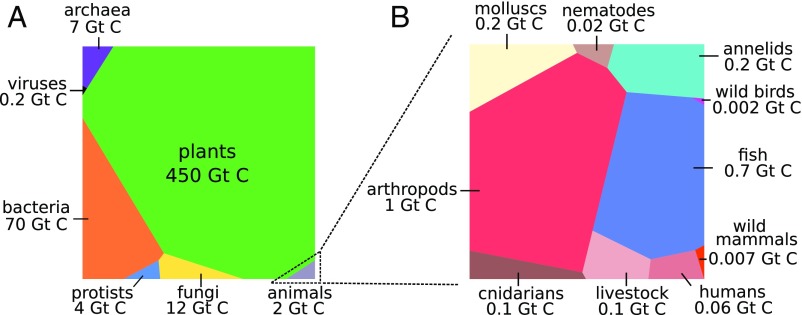
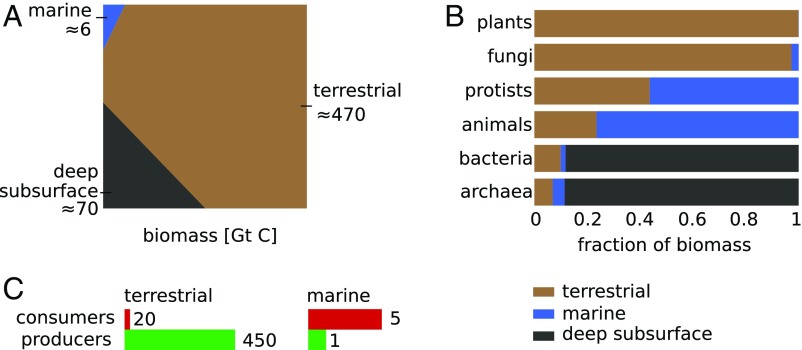
A census of the biomass on Earth is key for understanding the structure and dynamics of the biosphere. However, a global, quantitative view of how the biomass of different taxa compare with one another is still lacking. Here, we assemble the overall biomass composition of the biosphere, establishing a census of the ≈550 gigatons of carbon (Gt C) of biomass distributed among all of the kingdoms of life. We find that the kingdoms of life concentrate at different locations on the planet; plants (≈450 Gt C, the dominant kingdom) are primarily terrestrial, whereas animals (≈2 Gt C) are mainly marine, and bacteria (≈70 Gt C) and archaea (≈7 Gt C) are predominantly located in deep subsurface environments. We show that terrestrial biomass is about two orders of magnitude higher than marine biomass and estimate a total of ≈6 Gt C of marine biota, doubling the previous estimated quantity. Our analysis reveals that the global marine biomass pyramid contains more consumers than producers, thus increasing the scope of previous observations on inverse food pyramids. Finally, we highlight that the mass of humans is an order of magnitude higher than that of all wild mammals combined and report the historical impact of humanity on the global biomass of prominent taxa, including mammals, fish, and plants.
Overview
CoChat Summary
TL;DR
The paper assembles a global census of biomass across all kingdoms of life, estimating Earth’s total biomass at ≈550 Gt C, dominated by plants. It also compares biomass across environments and trophic modes, highlighting large uncertainties and human impacts on the biosphere.
Key findings
- Total global biomass is ≈550 Gt C, with plants ≈450 Gt C (≈80%), bacteria ≈70 Gt C (≈15%), fungi ≈12 Gt C, archaea ≈7 Gt C, protists ≈4 Gt C, animals ≈2 Gt C, and viruses ≈0.2 Gt C.
- Land biomass (≈470 Gt C) is about two orders of magnitude higher than marine biomass (≈6 Gt C); the deep subsurface holds ≈15% of total biomass, chiefly bacteria and archaea.
- In the ocean, ≈1 Gt C of primary producers supports ≈5 Gt C of consumer biomass, an inverted standing biomass distribution; marine biomass is ≈70% microbes, mainly bacteria and protists.
- Human-associated biomass is large relative to wild vertebrates: humans ≈0.06 Gt C, livestock ≈0.1 Gt C, wild mammals ≈0.007 Gt C, domesticated poultry ≈0.005 Gt C versus wild birds ≈0.002 Gt C; total plant biomass has declined approximately twofold relative to pre-human civilization.
Methods
- The authors synthesize hundreds of studies and generate estimates for major taxonomic groups, reporting biomass as gigatons of carbon (Gt C) and using a kingdom-level framework plus viruses.
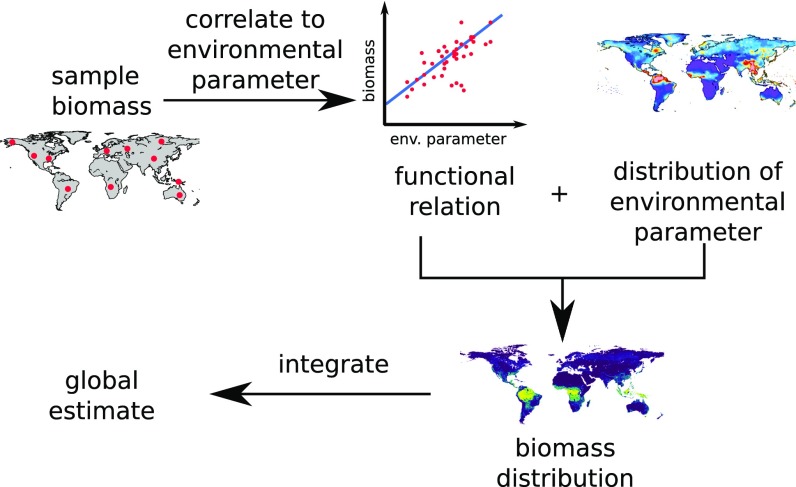
- For many taxa, local biomass samples are extrapolated globally by correlating biomass density with environmental parameters known at global scale; best estimates often use a geometric mean of independent estimates.
- Uncertainty is reported as multiplicative fold-change projections akin to 95% confidence intervals, incorporating intrastudy, interstudy, and intermethod variation; data and code are open-sourced.
Limitations
- The paper states that most datasets rely on fragmentary sampling, causing large uncertainties; sampling is scarce in the deep ocean (usually deeper than 200 m) and deep soil (usually deeper than 1 m), and some estimates may be biased by sampling toward high-abundance areas.
- The paper states that deep subsurface environments have particularly high uncertainty and unknown systematic biases, including unresolved distribution of biomass between aquifer fluids and rocks and among microbial taxa.
- The paper states that current and prehuman vertebrate biomass estimates are only a crude first step, amphibians remain poorly characterized, and parasite biomass is not resolved from hosts; evident from the text, kingdom-level grouping was chosen because much data lack finer taxonomic detail, and some uncertainty projections rely on analogous taxa or expert consultation.
Model-written summary. Check it against the paper before relying on it.
Integrity signals
Registry
Cites
Statistics
Figures
Verification
Claims the paper makes
9 Valid · 7 Not valid · 16 Not checked · 53 Own results and interpretations
Every source the paper cites for this claim was checked and supports it.
In the paper
“The biomass of amphibians, which are experiencing a dramatic population decline (42), remains poorly characterized.”
§ The biomass distribution on Earth > Discussion
What the sources say
- Supportedcites [42] Wake DB Vredenburg VT 2008 Colloquium paper: Are we in the midst of the sixth mass extinction? A view from the world of amphibians Proc Natl Acad Sci USA 105 11466 11473 18695221 PMC2556420 source
The citation is attached to the clause about amphibian population decline, not the separate statement that their biomass is poorly characterized. The passage reporting the Global Amphibian Assessment (labeled Abstract in our copy) says that 43% of amphibian species have declining populations. (LLM, conf=0.92)
plain- Asserted: passes — The authors put it forward as true.
- Checkable: passes — It can be checked against evidence.
- Load-bearing: unclear — It is unclear whether the paper’s conclusions depend on it.
- Based: passes — The paper gives a reason why it holds.
- Supported
Every source the paper cites for this claim was checked and supports it.
In the paper
“In the case of prokaryotes, some major improvements were recently realized, with global estimates of marine deep subsurface prokaryote biomass reduced by about two orders of magnitude due to an increased diversity of sampling locations (7).”
§ The biomass distribution on Earth > Discussion
What the sources say
- Supportedcites [7] Kallmeyer J Pockalny R Adhikari RR Smith DC D’Hondt S 2012 Global distribution of microbial abundance and biomass in subseafloor sediment Proc Natl Acad Sci USA 109 16213 16216 22927371 PMC3479597 source
The Discussion reports a revised subseafloor microbial biomass estimate of 4.1 Pg C versus a previous estimate of 303 Pg C—about a 74-fold reduction. It also identifies a more geographically diverse sampling database, including low-abundance ocean gyres, as a reason the new estimate is lower. The paper identifies other contributing factors as well. (LLM, conf=0.88)
plainstates a cause- Asserted: passes — The authors put it forward as true.
- Checkable: passes — It can be checked against evidence.
- Load-bearing: unclear — It is unclear whether the paper’s conclusions depend on it.
- Based: passes — The paper gives a reason why it holds.
- Supported
The sources with a verdict support this claim; the rest weren’t checked yet, have no full text we could read, or their verdicts aren’t rated yet.
In the paper
“Such inverted biomass distributions can occur when primary producers have a rapid turnover of biomass [on the order of days (34)], while consumer biomass turns over much more slowly [a few years in the case of mesopelagic fish (35)].”
§ The biomass distribution on Earth > Results > The Distribution of Biomass Across Environments and Trophic Modes.
What the sources say
- Supportedcites [34] Zubkov MV 2014 Faster growth of the major prokaryotic versus eukaryotic CO2 fixers in the oligotrophic ocean Nat Commun 5 3776 24777140 PMC4015317 source
The Results (Comparison of the growth rates of the CO2 fixers; page unavailable) report growth rates of 0.1–0.6 per day for the studied oceanic primary producers, consistent with biomass turnover on the order of days. The few-years estimate for mesopelagic fish is assigned to a different citation, not this source. (LLM, conf=0.91)
- Not checked — no full text of the sourcecites [35] Catul V Gauns M Karuppasamy PK 2011 A review on mesopelagic fishes belonging to family Myctophidae Rev Fish Biol Fish 21 339 354 source
plainstates a possible cause- Asserted: passes — The authors put it forward as true.
- Checkable: passes — It can be checked against evidence.
- Load-bearing: passes — The paper’s conclusions depend on it.
- Based: passes — The paper gives a reason why it holds.
- Supported
The cited sources support only part of this claim — read each source’s verdict below.
In the paper
“Combining data from independent sources such as these enables a robust assessment of the total plant biomass (17).”
§ The biomass distribution on Earth > Results > The Uncertainty Associated with Global Biomass Estimates.
What the sources say
- Partly supportedcites [17] Erb K-H 2017 Unexpectedly large impact of forest management and grazing on global vegetation biomass Nature 553 73 76 29258288 PMC5756473 sourceExperimental — accuracy not yet measured
The Methods describe combining multiple datasets and types of evidence to estimate global vegetation biomass stocks. But the paper also says global stocks remain uncertain, reports uncertainty ranges around 35% of the median estimate, and describes more robust estimates as a future prospect. It therefore supports the use of independent sources for an assessment, but not the unqualified characterization of that assessment as robust. (LLM, conf=0.84)
plainstates a cause- Asserted: passes — The authors put it forward as true.
- Checkable: passes — It can be checked against evidence.
- Load-bearing: passes — The paper’s conclusions depend on it.
- Based: passes — The paper gives a reason why it holds.
- Partly supported
A result the paper states — it cites no source for it, so there is none to check. The quote shows it is in the paper.
In the paper
“Plant biomass includes ≈70% stems and tree trunks, which are mostly woody, and thus relatively metabolically inert.”
§ The biomass distribution on Earth > Results > The Biomass Distribution of the Biosphere by Kingdom.
plain- Asserted: passes — The authors put it forward as true.
- Checkable: passes — It can be checked against evidence.
- Load-bearing: unclear — It is unclear whether the paper’s conclusions depend on it.
- Based: passes — The paper gives a reason why it holds.
27 more claims
Create a free account to see all 85 claims and to verify the 2 references still open.
- It may state two separate claims as one. 32
- Probably not a substantial claim. 28
Claims other papers make about this one
Each is checked against this paper’s own text: does it say what the citing paper says it does?
The cited source doesn’t support the claim as written.
In the citing paper
“and less than 10% that of the world ' s current human population ( 52 ).”
From Pervasive human-driven decline of life on Earth points to the need for transformative change (2019) · cites this paper as [52]
Checked by a reasoning model — may be wrong.
Experimental — accuracy not yet measuredThe cited source says what the claim attributes to it.
In the citing paper
“Approximately 450 Gt of C is bound up in terrestrial biota, primarily in plants (86), while only ~6 Gt of C is found in ocean biota (87).”
From Earth beyond six of nine planetary boundaries (2023) · cites this paper as [87]
The cited source says what the claim attributes to it.
In the citing paper
“The amount of metabolic energy available to a biosphere powered by O 2 is vast, such that the O 2 -rich ocean-atmosphere system of the modern Earth supports staggering levels of standing biomass (Bar-On et al. 2018), energy flow (Falkowski et al. 2008), and ecological complexity (Steele 1974).”
From The History of Ocean Oxygenation (2022) · cites this paper as Bar-On et al. 2018
In the citing paper
“Global populations of domestic ruminants (cattle, sheep, and goats) (Ripple et al. 2013) poultry, and pigs (Bennett et al. 2018) used to feed the growing human population now exceed 100 million tons of carbon (Bar-On et al. 2018), and livestock populations are growing rapidly.”
From Scientists’ warning to humanity on the freshwater biodiversity crisis (2021) · cites this paper as Bar-On et al. 2018
Citations
Cites
The worldwide leaf economics spectrum
Wright, I. J., Reich, P. B., Westoby, M., Ackerly, D. D., Baruch, Z., Bongers, F., Cavender-Bares, J., Chapin, T., Cornelissen, J. H. C., Diemer, M., et al. (2004) · Nature · doi:10.1038/nature02403 · Cited by 9,021 · cited 1×
“We then convert the total area of leaves to an estimate of the total dry mass of leaves by using the Glopnet database (24), which measured leaf mass per area (LMA) for ≈2500 plant species.”
MethodA large and persistent carbon sink in the world’s forests
Pan, Y., Birdsey, R. A., Fang, J., Houghton, R., Kauppi, P. E., Kurz, W. A., Phillips, O. L., Shvidenko, A., Lewis, S. L., Canadell, J. G., et al. (2011) · Science · doi:10.1126/science.1201609 · Cited by 8,458
Soil Sampling and Methods of Analysis
(2007) · CRC Press eBooks · doi:10.1201/9781420005271 · Cited by 6,469
Primary production of the biosphere: Integrating terrestrial and oceanic components
Field, C. B., Behrenfeld, M. J., Randerson, J. T., & Falkowski, P. (1998) · Science · doi:10.1126/science.281.5374.237 · Cited by 6,371
Prokaryotes: The unseen majority
Whitman, W. B., Coleman, D. C., & Wiebe, W. J. (1998) · Proceedings of the National Academy of Sciences · doi:10.1073/pnas.95.12.6578 · Cited by 4,871
Global effects of land use on local terrestrial biodiversity
Newbold, T., Hudson, L. N., Hill, S. L. L., Contu, S., Lysenko, I., Senior, R. A., Börger, L., Bennett, D. J., Choimes, A., Collen, B., et al. (2015) · Nature · doi:10.1038/nature14324 · Cited by 4,352
Belowground biodiversity and ecosystem functioning
Bardgett, R. D., & van der Putten, W. H. (2014) · Nature · doi:10.1038/nature13855 · Cited by 3,990 · cited 4×
“This was recommended by experts in the field for estimation of arbuscular mycorrhizal fungi abundance (117).”
BackgroundInfluentialMangroves among the most carbon-rich forests in the tropics
Donato, D. C., Kauffman, J. B., Murdiyarso, D., Kurnianto, S., Stidham, M., & Kanninen, M. (2011) · Nature Geoscience · doi:10.1038/ngeo1123 · Cited by 3,374
Poorter, H., Niklas, K. J., Reich, P. B., Oleksyn, J., Poot, P., & Mommer, L. (2012) · New Phytologist · doi:10.1111/j.1469-8137.2011.03952.x · Cited by 3,163 · cited 1×
“The first relies on a meta-analysis of the biomass allocation to different plant compartments across biomes (19).”
BackgroundA global analysis of root distributions for terrestrial biomes
Jackson, R. B., Canadell, J., Ehleringer, J. R., Mooney, H. A., Sala, O. E., & Schulze, E. D. (1996) · Oecologia · doi:10.1007/bf00333714 · Cited by 3,071 · cited 4×
“assumed the distribution of microbial biomass with depth follows the biomass density versus depth profile of root biomass (21).”
BackgroundMethodInfluential
Research works printed but not linked: 1
- Chapman AD 2009 Numbers of Living Species in Australia and the World Australian Biological Resources Study Canberra, Australia
Cited by
Items 601–700 of 3,743
Stewart, L. C., Algar, C. K., Fortunato, C. S., Larson, B. I., Vallino, J. J., Huber, J. A., Butterfield, D. A., & Holden, J. F. (2019) · The ISME Journal · doi:10.1038/s41396-019-0382-3 · Cited by 39
Feuerbacher, A., Lippert, C., Kuenzang, J., & Subedi, K. (2021) · Biological Conservation · doi:10.1016/j.biocon.2020.108919 · Cited by 46
Choi, Y., Lim, C.-H., Chung, H. I., Kim, Y., Cho, H. J., Hwang, J., Kraxner, F., Biging, G. S., Lee, W., Chon, J., et al. (2021) · Journal of Environmental Management · doi:10.1016/j.jenvman.2021.112400 · Cited by 40
Bulut, S. (2022) · Ecological Informatics · doi:10.1016/j.ecoinf.2022.101951 · Cited by 51
Chlorophyll a de-excitation pathways in the LHCII antenna
Ruban, A. V., & Saccon, F. (2022) · The Journal of Chemical Physics · doi:10.1063/5.0073825 · Cited by 38
Direct use of large-footprint lidar waveforms to estimate aboveground biomass
Ni‐Meister, W., Rojas, A., & Lee, S. (2022) · Remote Sensing of Environment · doi:10.1016/j.rse.2022.113147 · Cited by 40
Understanding the Role of Weather Data for Earth Surface Forecasting using a ConvLSTM-based Model
Diaconu, C., Saha, S., Günnemann, S., & Zhu, X. X. (2022) · IEEE/CVF Conference on Computer Vision and Pattern Recognition Workshops (CVPRW) · doi:10.1109/cvprw56347.2022.00142 · Cited by 54
“This poses a serious threat to our existence since it has a pronounced and complex impact on our terrestrial surface that hosts the majority of our living world [2].”
BackgroundA machine learning approach for cross-domain plant identification using herbarium specimens
Chulif, S., Lee, S. H., Chang, Y. L., & Chai, K. C. (2022) · Neural Computing and Applications · doi:10.1007/s00521-022-07951-6 · Cited by 36
“Plants make up the majority of the earth’s life-form, taking up 80% of the global biomass [1].”
BackgroundLittle, J. C., Kaaronen, R. O., Hukkinen, J., Xiao, S., Sharpee, T. O., Farid, A. M., Nilchiani, R., & Barton, C. M. (2023) · Environmental Science & Technology · doi:10.1021/acs.est.2c06203 · Cited by 56
An Overview of Using Unmanned Aerial System Mounted Sensors to Measure Plant Above-Ground Biomass
Bazrafkan, A., Delavarpour, N., Oduor, P. G., Bandillo, N. B., & Flores, P. (2023) · Remote Sensing · doi:10.3390/rs15143543 · Cited by 39
Coenye, T., Ahonen, M. H., Anderson, S., Cámara, M., Chundi, P., Fields, M. W., Foidl, I., Gnimpiéba, E. Z., Griffin, K., Hinks, J., et al. (2024) · Biofilm · doi:10.1016/j.bioflm.2024.100210 · Cited by 41
“For example, microorganisms represent > 20 % (93.2 Gt carbon) of the total global biomass on Earth [14] of which approx.”
InfluentialThe deep history of Earth's biomass
McMahon, S., & Parnell, J. (2018) · Journal of the Geological Society · doi:10.1144/jgs2018-061 · Cited by 38
“…plants, the total subsurface biomass (carbon) would be nearly half of the total global biomass (Whitman et al. 1998); other estimates vary between less than 1% and a third of the total biomass (Fry et al. 2008; Schrenk et al. 2010; Kallmeyer et al. 2012; McMahon & Parnell 2014; Bar-On et al. 2018).”
BackgroundInfluentialKock, R. A., Haider, N., Mboera, L. E. G., et al. (2019) · The Lancet Planetary Health · doi:10.1016/s2542-5196(19)30111-1 · Cited by 35
The Woody Planet: From Past Triumph to Manmade Decline
Fazan, L., Song, Y., & Kozlowski, G. (2020) · Plants · doi:10.3390/plants9111593 · Cited by 41
“Even more impressive, however, are the estimations of the biomass of woody species [26].”
BackgroundInfluentialSmall freshwater ecosystems with dissimilar microbial communities exhibit similar temporal patterns
David, G. M., López‐García, P., Moreira, D., Alric, B., Deschamps, P., Bertolino, P., Restoux, G., Rochelle‐Newall, E., Thébault, É., Simon, M., et al. (2021) · Molecular Ecology · doi:10.1111/mec.15864 · Cited by 32
Design processes and multi-regulation of biomimetic building skins: A comparative analysis
Cruz, E., Hubert, T., Chancoco, G., Naim, O., Chayaamor-Heil, N., Cornette, R., Ménézo, C., Badarnah, L., Raskin, K., & Aujard, F. (2021) · Energy and Buildings · doi:10.1016/j.enbuild.2021.111034 · Cited by 42
“from [112](B) Distribution in percentage of the biological models which inspired the 19 Bio-BS.”
BackgroundPillay, R., Watson, J. E. M., Hansen, A. J., Jantz, P. A., Aragon-Osejo, J. L., Armenteras, D., Atkinson, S., Burns, P., Ervin, J., Goetz, S. J., et al. (2022) · Nature Ecology & Evolution · doi:10.1038/s41559-022-01915-8 · Cited by 39
Roy, S., Naidu, D. G. T., & Bagchi, S. (2023) · Global Change Biology · doi:10.1111/gcb.16600 · Cited by 43
Jagadesh, S., Zhao, C., Mulchandani, R., & Boeckel, T. P. V. (2023) · Emerging infectious diseases · doi:10.3201/eid2904.221022 · Cited by 38
Plant anthraquinones: Classification, distribution, biosynthesis, and regulation
Wang, P., Wei, J., Hua, X., Dong, G., Dziedzic, K., Wahab, A., Efferth, T., Sun, W. Y., & Ma, P. (2023) · Journal of Cellular Physiology · doi:10.1002/jcp.31063 · Cited by 51
Swaine, M., Bergna, A., Oyserman, B. O., Vasileiadis, S., Karas, P. A., Screpanti, C., & Karpouzas, D. G. (2025) · FEMS Microbiology Ecology · doi:10.1093/femsec/fiaf052 · Cited by 58
“Made up of bacteria, fungi, archaea, protists, and viruses, the soil microbiota accounts for an estimated 3%–4% of the total biomass on earth (Bar-On et al. 2018 , Anthony et al. 2023 ) regulating 80%–90% of soil processes (Nan-nipieri et al. 2003 ).”
Dependence of Biological Activity on the Surface Water Fraction of Planets
Lingam, M., & Loeb, A. (2019) · The Astronomical Journal · doi:10.3847/1538-3881/aaf420 · Cited by 35
“…is comparable to the Earth to determine the total biomass of producers in the oceans (Mw), thereby obtaining Mw ∼ 1012 kg ( fw f⊕ )2 [( 1− fw 1− f⊕ ) + 3.3× 10⁻³ ]( R R⊕ )0.3 , (14) and the normalization constant signifies the biomass of primary producers in Earth’s oceans (Bar-On et al. 2018).”
BackgroundInfluentialThe missing dead: The lost role of animal remains in nutrient cycling in North American Rivers
Wenger, S. J., Subalusky, A. L., & Freeman, M. C. (2018) · Food Webs · doi:10.1016/j.fooweb.2018.e00106 · Cited by 41
Elevated CO 2 , increased leaf-level productivity, and water-use efficiency during the early Miocene
Reichgelt, T., D'Andrea, W. J., Valdivia-McCarthy, A. D. C., Fox, B., Bannister, J. M., Conran, J. G., Lee, W. G., & Lee, D. E. (2020) · Climate of the past · doi:10.5194/cp-16-1509-2020 · Cited by 37
Laundon, D., Chrismas, N. A. M., Wheeler, G. L., & Cunliffe, M. (2020) · Proceedings of the Royal Society B Biological Sciences · doi:10.1098/rspb.2020.0433 · Cited by 38
Accumulation of dead cells from contact killing facilitates coexistence in bacterial biofilms
Steinbach, G., Crisan, C. V., Ng, S. L., Hammer, B. K., & Yunker, P. J. (2020) · Journal of The Royal Society Interface · doi:10.1098/rsif.2020.0486 · Cited by 37
“While bacteria often inhabit confined geometries in natural settings [66], it is unclear if confinement itself impacts population dynamics.”
BackgroundATP binding cassette importers in eukaryotic organisms
Choi, C. C., & Ford, R. C. (2021) · Biological reviews/Biological reviews of the Cambridge Philosophical Society · doi:10.1111/brv.12702 · Cited by 38
Timmusk, S., Päll, T., Raz, S., Fetsiukh, A., & Nevo, E. (2023) · Frontiers in Microbiology · doi:10.3389/fmicb.2023.1141862 · Cited by 40
“Microbial life determines the physical, chemical, and biological characteristics of soil ecosystems (Bar-On et al., 2018; Averill et al., 2022).”
BackgroundInfluentialScientific Attention to Sustainability and SDGs: Meta-Analysis of Academic Papers
Asatani, K., Takeda, H., Yamano, H., & Sakata, I. (2020) · Energies · doi:10.3390/en13040975 · Cited by 44
“For instance, various kinds of studies such as material/bioscience [5,6], industrial engineering [7], operation research [8], and economics [9,10] play important roles in improving”
BackgroundFlowering Plants in the Anthropocene: A Political Agenda
Negrutiu, I., Frohlich, M. W., & Hamant, O. (2020) · Trends in Plant Science · doi:10.1016/j.tplants.2019.12.008 · Cited by 38
Li, H., & Greening, C. (2022) · FEMS Microbiology Reviews · doi:10.1093/femsre/fuac034 · Cited by 29
The macroevolutionary history of bony fishes: a paleontological view
Friedman, M. (2022) · Annual Review of Ecology, Evolution, and Systematics · doi:10.1146/annurev-ecolsys-111720-010447 · Cited by 27
Maitner, B., Gallagher, R. V., Svenning, J., Tietje, M., Wenk, E. H., & Eiserhardt, W. L. (2023) · New Phytologist · doi:10.1111/nph.18999 · Cited by 42
Antarctic krill sequester similar amounts of carbon to key coastal blue carbon habitats
Cavan, E. L., Mackay, N. S., Hill, S. L., Atkinson, A., Belcher, A., & Visser, A. W. (2024) · Nature Communications · doi:10.1038/s41467-024-52135-6 · Cited by 40
Bruno, A., Arnoldi, I., Barzaghi, B., Boffi, M., Casiraghi, M., Colombo, B., Gennaro, P. D., Epis, S., Facciotti, F., Ferrari, N., et al. (2024) · iScience · doi:10.1016/j.isci.2024.110959 · Cited by 44
Anyasi, T. A., Acharya, P., & Udenigwe, C. C. (2025) · Future Foods · doi:10.1016/j.fufo.2025.100699 · Cited by 64
A physical framework for the earth system, Anthropocene equation and the great acceleration
Bertolami, O., & Francisco, F. (2018) · Global and Planetary Change · doi:10.1016/j.gloplacha.2018.07.006 · Cited by 40
Harkes, P., van Steenbrugge, J. J. M., van den Elsen, S. J. J., Suleiman, A. K. A., de Haan, J. J., Holterman, M., & Helder, J. (2020) · Frontiers in Plant Science · doi:10.3389/fpls.2019.01697 · Cited by 33
Factoring Origin of Life Hypotheses into the Search for Life in the Solar System and Beyond
Longo, A., & Damer, B. (2020) · Life · doi:10.3390/life10050052 · Cited by 45
Warrier, R., Noon, B. R., & Bailey, L. L. (2020) · Ecosphere · doi:10.1002/ecs2.3080 · Cited by 38
“Most of the biosphere is impacted by human modification (Kennedy et al. 2019), and collectively humans and livestock constitute about 96% of the global mammalian biomass (Bar-On et al. 2018).”
BackgroundHigh-pressure small-angle X-ray scattering cell for biological solutions and soft materials
Rai, D. K., Gillilan, R. E., Huang, Q., Miller, R. C., Ting, E., Lazarev, A. V., Täte, M. W., & Gruner, S. M. (2020) · Journal of Applied Crystallography · doi:10.1107/s1600576720014752 · Cited by 35
“There is a growing realization that a significant part of the planetary biomass lives under high pressure in the depths of the oceans and in the Earth’s crust (Bar-On et al., 2018; Mentré & Hoa, 2001; Daniel et al., 2006).”
BackgroundTesta, M. L., & Tummino, M. L. (2021) · Catalysts · doi:10.3390/catal11010125 · Cited by 36
“LCB is a biopolymer, mainly composed of cellulose, hemicellulose and lignin (see details in Section 2) and represents one of the most abundant materials on the earth, since it is a fundamental component of plants (see Figure 1) [18,19].”
BackgroundThe Fennoscandian Shield deep terrestrial virosphere suggests slow motion ‘boom and burst’ cycles
Holmfeldt, K., Nilsson, E., Simone, D., López-Fernández, M., Wu, X., de Bruijn, I., Lundin, D., Andersson, A. F., Bertilsson, S., & Dopson, M. (2021) · Communications Biology · doi:10.1038/s42003-021-01810-1 · Cited by 32
Tree-aggregated predictive modeling of microbiome data
Bien, J., Yan, X., Simpson, L., & Müller, C. L. (2021) · Scientific Reports · doi:10.1038/s41598-021-93645-3 · Cited by 41
“(2) would provide an ideal means to handle binary responses while simultaneously enabling the use of efficient path algorithms (see35 and references therein).”
BackgroundMethodInfluentialKuile, A. M., Apigo, A., Bui, A. Q. T., DiFiore, B. P., Forbes, E. S., Lee, M. J., Orr, D. A., Preston, D. L., Behm, R., Bogar, T. A., et al. (2022) · Ecology · doi:10.1002/ecy.3634 · Cited by 36
“…interaction data for small-bodied invertebrate taxa is not inconsequential; these taxa represent over 50% of the earth’s animal biomass (including terrestrial and marine systems) and most animal species diversity (Bar-On et al., 2018; Costello et al., 2013; Mora et al., 2011; Stork, 2018).”
BackgroundMetabarcoding reveals massive species diversity of Diptera in a subtropical ecosystem
Huang, J., Miao, X., Wang, Q., Menzel, F., Tang, P., Yang, D., Wu, H. Y., & Vogler, A. P. (2022) · Ecology and Evolution · doi:10.1002/ece3.8535 · Cited by 34
Structural insights into the assembly and the function of the plant oxidative phosphorylation system
Meyer, E. H., Letts, J. A., & Maldonado, M. (2022) · New Phytologist · doi:10.1111/nph.18259 · Cited by 36
Demand changes meat as changing meat reshapes demand: The great meat revolution
Bellio, J. C. B., de Oliveira, G. B., Marques, M. C. P., & Molento, C. F. M. (2022) · Meat Science · doi:10.1016/j.meatsci.2022.109040 · Cited by 43
Disconnection between plant–microbial nutrient limitation across forest biomes
Liu, J., Fang, L., Qiu, T., Bing, H., Cui, Y., Sardans, J., Du, E., Chen, J., Tan, W., Delgado‐Baquerizo, M., et al. (2023) · Functional Ecology · doi:10.1111/1365-2435.14361 · Cited by 35
Towards a quantitative view of the global ubiquity of biofilms
Bar‐On, Y. M., & Milo, R. (2019) · Nature Reviews Microbiology · doi:10.1038/s41579-019-0162-0 · Cited by 40
Self-citationThe Genomic Natural History of the Aurochs
Rossi, C., Sinding, M.-H. S., Mullin, V. E., Scheu, A., Erven, J. A. M., Verdugo, M. P., Daly, K. G., Ciucani, M. M., Mattiangeli, V., Teasdale, M. D., et al. (2024) · Nature · doi:10.1038/s41586-024-08112-6 · Cited by 32
Transfer of Rocks Between Planetary Systems: Panspermia Revisited
Adams, F. C., & Napier, K. J. (2022) · Astrobiology · doi:10.1089/ast.2021.0187 · Cited by 35
“The mass of our biosphere is approximately 10 - 10 M 4 ( e.g., Bar-On et al. , 2018).”
A remarkably diverse and well-organized virus community in a filter-feeding oyster
Jiang, J., Fang, Y.-F., Wei, H., Zhu, P., Liu, M., Yuan, W.-G., Yang, L., Guo, Y.-X., Jin, T., Shī, M., et al. (2023) · Microbiome · doi:10.1186/s40168-022-01431-8 · Cited by 35
“Virome studies are highly reliant on amplification because the viral biomass in natural samples is very low [4, 71].”
BackgroundFood web structure for high carbon retention in marine plankton communities
Kang, H. C., Jeong, H. J., Ok, J. H., Lim, A. S., Lee, K., You, J. H., Park, S. A., Eom, S. H., Lee, S. Y., Lee, K. H., et al. (2023) · Science Advances · doi:10.1126/sciadv.adk0842 · Cited by 32
“Total annual net primary production in marine ecosystems (~49 GtC) is similar to that in terrestrial ecosystems (~56 GtC), but the total carbon biomass of all life (i.e., standing stocks) in marine eco-systems is approximately 1% of that in terrestrial ecosystems ( 8 , 9 ).”
Recent Advances in Biomass-derived Porous Carbon Materials: Synthesis, Composition and Applications
Zhai, Z., Lu, Y., Liu, G., Ding, W., Cao, B., & He, H. (2024) · Chemical Research in Chinese Universities · doi:10.1007/s40242-024-3259-6 · Cited by 35
Wang, M., Huang, Z., Wu, C., Yan, S., Fang, H.-T., Pan, W., Tan, Q., Pan, K., Ji, R., Yang, L., et al. (2024) · Environmental Science & Technology · doi:10.1021/acs.est.3c07486 · Cited by 34
Coated Bacteria: Advanced Living Materials for Microbial Therapy
Cao, Z., & Liu, J. (2024) · Accounts of Materials Research · doi:10.1021/accountsmr.4c00116 · Cited by 35
The Natural Products Magnetic Resonance Database (NP-MRD) for 2025
Wishart, D. S., Sajed, T., Pin, M., Poynton, E. F., Goel, B., Lee, B. L., Guo, A. C., Saha, S., Sayeeda, Z., Han, S., et al. (2024) · Nucleic Acids Research · doi:10.1093/nar/gkae1067 · Cited by 46
Total OH Reactivity Changes Over the Amazon Rainforest During an El Niño Event
Pfannerstill, E. Y., Nölscher, A. C., Yáñez‐Serrano, A. M., Bourtsoukidis, E., Keßel, S., Janssen, R. H. H., Tsokankunku, A., Wolff, S. A., Sörgel, M., Sá, M., et al. (2018) · Frontiers in Forests and Global Change · doi:10.3389/ffgc.2018.00012 · Cited by 43
“Amazonia contains more than half of the world’s tropical forests (Morley, 2000), 25% of the Earth’s biodiversity (Dirzo and Raven, 2003), and nearly 15% of terrestrial biomass (Houghton et al., 2001; Bar-On et al., 2018).”
BackgroundPhotosynthesis on habitable planets around low-mass stars
Lingam, M., & Loeb, A. (2019) · Monthly Notices of the Royal Astronomical Society · doi:10.1093/mnras/stz847 · Cited by 31
“It is no exaggeration to claim that life on Earth is dominated by photosynthesis as far as its biomass is concerned (Bar-On et al. 2018).”
BackgroundBiochar mines: Panacea to climate change and energy crisis?
Thengane, S. K., & Bandyopadhyay, S. K. (2019) · Clean Technologies and Environmental Policy · doi:10.1007/s10098-019-01790-1 · Cited by 37
Aguilar-Marcelino, L., de Gives, P. M., Al‐Ani, L. K. T., López‐Arellano, M. E., Gómez‐Rodríguez, O., Villar-Luna, E., & Reyes-Guerrero, D. E. (2020) · Elsevier eBooks · doi:10.1016/b978-0-12-818469-1.00027-4 · Cited by 64
The Astrobiology of Alien Worlds: Known and Unknown Forms of Life
Irwin, L. N., & Schulze‐Makuch, D. (2020) · Universe · doi:10.3390/universe6090130 · Cited by 41
“Biomass and biodiversity are greatest in the subterranean and aquatic environments (both fresh and saltwater), while plant biomass dominates the surface of the land [34] which was occupied later in the natural history of our planet as co-evolution of protection against UV irradiation and dehydration made it habitable.”
BackgroundBenvenuti, L., & Santis, A. D. (2020) · Frontiers in Nutrition · doi:10.3389/fnut.2020.562833 · Cited by 39
“This means livestock outweigh wild mammals by a factor of 15-to-1 (43).”
BackgroundWildlife Trade and COVID-19: Towards a Criminology of Anthropogenic Pathogen Spillover
Beirne, P. (2020) · The British Journal of Criminology · doi:10.1093/bjc/azaa084 · Cited by 32
“Moreover, 40 per cent of amphibians, almost a third of reef-building corals, more than a third of marine mammals and 10 per cent of all insects face looming extinction (Bar-On et al. 2018; Brisman and South 2019; World Wildlife Fund 2020).”
BackgroundCorsi, G. I., Tichkule, S., Sannella, A. R., Vatta, P., Asnicar, F., Segata, N., Jex, A. R., van Oosterhout, C., & Cacciò, S. M. (2022) · Molecular Ecology · doi:10.1111/mec.16556 · Cited by 40
“The huge biomass of our livestock (Bar- On et al., 2018) and close human- animal contacts have also increased the opportunity for genetic exchanges between previously isolated parasite lineages (van Oosterhout, 2021).”
BackgroundAfter the mammoths: The ecological legacy of late Pleistocene megafauna extinctions
Smith, F. A., Smith, E. A. E., Hedberg, C. P., Lyons, S. K., Pardi, M. I., & Tomé, C. P. (2023) · Cambridge Prisms Extinction · doi:10.1017/ext.2023.6 · Cited by 38
“Indeed, as the overall biomass of mammals on the planet has grown fourfold over the past few hundred years, the biomass of wild mammals has decreased by a factor of 6 (Bar-On et al., 2018).”
Global patterns and predictors of avian population density
Santini, L., Tobias, J. A., Callaghan, C. T., Gallego‐Zamorano, J., & Benítez‐López, A. (2023) · Global Ecology and Biogeography · doi:10.1111/geb.13688 · Cited by 40
“…to non-volant mammals suggests that birds compose a minor part of endotherm biomass in ecosystems (birds: ~ 0.002 gigatons of carbon, mammals: ~ 0.007 gigatons of carbon, Bar-On et al., 2018 ) even if they are able to maintain a high number of species in local communities (Silva et al., 1997).”
BackgroundInfluentialThe Ocean as a Solution to Climate Change: Five Opportunities for Action
Hoegh‐Guldberg, O., Caldeira, K., Chopin, T., Gaines, S. D., Haugan, P. M., Hemer, M., Howard, J., Konar, M., Krause‐Jensen, D., Lovelock, C. E., et al. (2023) · Springer eBooks · doi:10.1007/978-3-031-16277-0_17 · Cited by 43
Biodiversity Conservation Requires Management of Feral Domestic Animals
Bonacic, C., Almuna, R., & Ibarra, J. T. (2019) · Trends in Ecology & Evolution · doi:10.1016/j.tree.2019.05.002 · Cited by 32
“Domestic animals are present and play a major role in human-dominated landscapes, to the extent that some 90% of all mammals on earth are now humans or our livestock [4].”
BackgroundEvolution of vascular plants through redeployment of ancient developmental regulators
Lu, K., Hofland, N. V. ‘. W., Mor, E., Mutte, S. K., Abrahams, P., Kato, H., Vandepoele, K., Weijers, D., & Rybel, B. D. (2019) · Proceedings of the National Academy of Sciences · doi:10.1073/pnas.1912470117 · Cited by 36
“R estimates suggest that plants contribute about 80% of all the biomass on earth (1).”
BackgroundEpidemiology of disease through the interactions between humans, domestic animals, and wildlife
Marrana, M. (2022) · Elsevier eBooks · doi:10.1016/b978-0-12-822794-7.00001-0 · Cited by 44
Future farming: protein production for livestock feed in the EU
Rauw, W. M., Izquierdo, E. G., Torres, O., Gil, M. G., Beascoechea, E. D. M., Beñayas, J. M. R., & Gomez‐Raya, L. (2023) · Sustainable Earth Reviews · doi:10.1186/s42055-023-00052-9 · Cited by 47
“[35], in the hypothetical absence of land use, potential vegetation would store more than double the amount of carbon (currently estimated at ≈ 450 Gt [36]), also highlighting the massive effect of land use on biomass stocks.”
BackgroundCamtrap DP: an open standard for the FAIR exchange and archiving of camera trap data
Bubnicki, J. W., Norton, B., Baskauf, S., Bruce, T., Cagnacci, F., Casaer, J., Churski, M., Cromsigt, J. P. G. M., Farra, S. D., Fiderer, C., et al. (2023) · Remote Sensing in Ecology and Conservation · doi:10.1002/rse2.374 · Cited by 92
“On the one hand, many species are rapidly declining due to anthropogenic stressors acting at different spatio-temporal scales (Bar-On et al., 2018; Dirzo et al., 2014; Ripple et al., 2017; Venter et al., 2016).”
BackgroundDynamic and optimal ash-to-gas responses of oxy-fuel and air combustions of soil remediation biomass
Chen, Z., Li, W., Dai, W., Zhuang, P., Shi, Y., Evrendilek, F., Huang, S., Huang, W., Liu, J., & Liu, J. (2024) · Renewable Energy · doi:10.1016/j.renene.2024.120299 · Cited by 31
Microbes in porous environments: from active interactions to emergent feedback
Jin, C., & Sengupta, A. (2024) · Biophysical Reviews · doi:10.1007/s12551-024-01185-7 · Cited by 47
“…(bacteria and archaea) on Earth estimated to be about 1.2 × 10 30 cells (Flemming and Wuertz (2019)), they account for nearly 15 % of the net biomass on Earth, despite being orders of magnitude smaller size than those of the eukaryotic cells (Bar-On et al. (2018); Philippot et al. (2023)).”
BackgroundInfluentialMarine microbial biofilms on diverse abiotic surfaces
Yu, S., Lu, X., & Lu, H. (2025) · Frontiers in Marine Science · doi:10.3389/fmars.2025.1482946 · Cited by 41
Dornelas, M., Madin, E. M. P., Bunce, M., DiBattista, J. D., Johnson, M. P., Madin, J. S., Magurran, A. E., McGill, B. J., Pettorelli, N., Pizarro, O. R., et al. (2019) · Global Ecology and Biogeography · doi:10.1111/geb.13025 · Cited by 34
The place of nature in conservation conflicts
Chapron, G., & López‐Bao, J. V. (2020) · Conservation Biology · doi:10.1111/cobi.13485 · Cited by 42
“Pervasive human-driven decline of life on Earth points to the need for transformative change.”
BackgroundInfluentialCounting sea lions and elephants from aerial photography using deep learning with density maps
Padubidri, C., Kamilaris, A., Karatsiolis, S., & Kamminga, J. W. (2021) · Animal Biotelemetry · doi:10.1186/s40317-021-00247-x · Cited by 33
“Of all living mammals on Earth, 60% are livestock, 36% humans, and just 4% are wild animals [1].”
BackgroundPrieto, A., de Eugenio, L. I., Méndez-Líter, J. A., et al. (2021) · International Microbiology · doi:10.1007/s10123-021-00202-z · Cited by 31
Large-Scale Quantification and Correlates of Ungulate Carrion Production in the Anthropocene
Morant, J., Arrondo, E., Cortés‐Avizanda, A., Moleón, M., Donázar, J. A., Sánchez‐Zapata, J. A., López‐López, P., Ruiz‐Villar, H., Zuberogoitia, Í., Morales‐Reyes, Z., et al. (2022) · Ecosystems · doi:10.1007/s10021-022-00763-8 · Cited by 35
A Synthesis of Viral Contribution to Marine Nitrogen Cycling
Wang, S., Yu, Y. Y., & Jing, J. (2022) · Frontiers in Microbiology · doi:10.3389/fmicb.2022.834581 · Cited by 38
“Marine microbes constitute more than 90% of the living biomass in the ocean and are responsible for half of the global primary productivity (Field et al., 1998; Caron, 2005; Sogin et al., 2006; Bar-On et al., 2018).”
BackgroundPeripheral membrane proteins modulate stress tolerance by safeguarding cellulose synthases
Kesten, C., García-Moreno, Á., Amorim‐Silva, V., Menna, A., Castillo, A. G., Percio, F., Armengot, L., Ruiz‐López, N., Jaillais, Y., Sánchez‐Rodríguez, C., et al. (2022) · Science Advances · doi:10.1126/sciadv.abq6971 · Cited by 34
Singh, V., Singh, J., Singh, N., Nand, S., Verma, M. K., Verma, M., Singh, V., Chivate, M. S., Bilal, M., & Mishra, V. (2022) · BioMetals · doi:10.1007/s10534-022-00476-4 · Cited by 33
“Additionally, they are widely and easily available across the globe (Bar-On et al. 2018).”
BackgroundDisentangling temporal associations in marine microbial networks
Deutschmann, I. M., Krabberød, A. K., Benites, L., Latorre, F., Delage, E., Marrasé, C., Balagué, V., Gasol, J. M., Massana, R., Eveillard, D., et al. (2023) · Microbiome · doi:10.1186/s40168-023-01523-z · Cited by 44
“In particular, microorganisms dominate the largest biome, the ocean, which harbors ≈ 1029 microbial cells [6] accounting for ~ 70% of the total marine biomass [7, 8].”
BackgroundThe Impact of Zooplankton Calcifiers on the Marine Carbon Cycle
Knecht, N., Benedetti, F., Elizondo, U. H., Bednaršek, N., Chaabane, S., de Weerd, C., Peijnenburg, K. T. C. A., Schiebel, R., & Vogt, M. (2023) · Global Biogeochemical Cycles · doi:10.1029/2022gb007685 · Cited by 43
“Estimates of standing stocks are highly uncertain, though less so than in marine systems than terrestrial ones (Bar-On et al., 2018; de Garidel-Thoron et al., 2022).”
The largely neglected ecological role of oceanic pelagic fungi
Breyer, E., & Baltar, F. (2023) · Trends in Ecology & Evolution · doi:10.1016/j.tree.2023.05.002 · Cited by 37
Sholes, S., Krissansen‐Totton, J., & Catling, D. C. (2019) · Astrobiology · doi:10.1089/ast.2018.1835 · Cited by 42
Feldt, T., Karg, H., Kadaouré, I., Bessert, L., & Schlecht, E. (2020) · Land Use Policy · doi:10.1016/j.landusepol.2020.104579 · Cited by 30
Climate change, industrial animal agriculture, and the role of physicians – Time to act
Higuita, N. I. A., LaRocque, R. C., & McGushin, A. (2023) · The Journal of Climate Change and Health · doi:10.1016/j.joclim.2023.100260 · Cited by 44
Rogers, A. D., Appiah-Madson, H. J., Ardron, J., Bax, N. J., Bhadury, P., Brandt, A., Buttigieg, P. L., Clerck, O. D., Delgado, C., Distel, D. L., et al. (2023) · Frontiers in Marine Science · doi:10.3389/fmars.2023.1224471 · Cited by 34
Fungi in soil: a rich community with diverse functions
Taylor, D. L., & Bhatnagar, J. M. (2024) · Elsevier eBooks · doi:10.1016/b978-0-12-822941-5.00004-1 · Cited by 44
A multiple baseline approach for marine heatwaves
Giménez, L., Boersma, M., & Wiltshire, K. H. (2024) · Limnology and Oceanography · doi:10.1002/lno.12521 · Cited by 34
“70% of the total marine biomass (Bar-On et al. 2018) and that those organisms have short generation times (days to weeks).”
BackgroundZhong, R., Cui, D., Richardson, E. A., et al. (2019) · Plant and Cell Physiology · doi:10.1093/pcp/pcz178 · Cited by 30
Biochemical fingerprints of marine fungi: implications for trophic and biogeochemical studies
Gutiérrez, M., Vera, J. C., Srain, B. M., Quiñones, R. A., Wörmer, L., Hinrichs, K., & Pantoja, S. (2020) · Aquatic Microbial Ecology · doi:10.3354/ame01927 · Cited by 34
“Improvement of quantitative methods of de - tection and expansion of sampling coverage should reduce the current large uncertainty (e.g. Bar-On et al. 2018) in estimates of marine fungal biomass.”
MethodGómez, I., & Lizundia, E. (2021) · Advanced Sustainable Systems · doi:10.1002/adsu.202100236 · Cited by 32
Phytoplankton biodiversity and the inverted paradox
Behrenfeld, M. J., O’Malley, R. T., Boss, E., Karp‐Boss, L., & Mundt, C. C. (2021) · ISME Communications · doi:10.1038/s43705-021-00056-6 · Cited by 37
“Trophic exclusion One of the stark differences between terrestrial and aquatic ecosystems is that turnover of photosynthetic biomass is generally on the order of months to centuries for the former and only days for the latter [19, 20].”
BackgroundThermochronologic perspectives on the deep-time evolution of the deep biosphere
Drake, H., & Reiners, P. W. (2021) · Proceedings of the National Academy of Sciences · doi:10.1073/pnas.2109609118 · Cited by 32
World scientists’ warnings into action, local to global
Barnard, P., Moomaw, W. R., Fioramonti, L., Laurance, W. F., Mahmoud, M. I., O’Sullivan, J., Rapley, C. G., Rees, W. E., Rhodes, C. J., Ripple, W. J., et al. (2021) · Science Progress · doi:10.1177/00368504211056290 · Cited by 48
“41,42 (Figure 1) Nature is all-encompassing in its bene fi ts – not just a set of commodities Protecting oceans, natural landscapes, and remaining primary forests 43 are critical for successfully accumulating carbon out of the atmosphere.”
Background
Metadata
- Authors
- Bar-On, Y. M., Phillips, R., & Milo, R.
- Affiliations
- Department of Plant and Environmental Sciences, Weizmann Institute of Science, 76100 Rehovot, Israel;
- California Institute of Technology (US)
- Weizmann Institute of Science (IL)
- Corresponding author
- Milo, Ron
- Venue
- Proceedings of the National Academy of Sciences
- Publisher
- National Academy of Sciences
- Published
- 2018-05-21
- Volume
- 115
- Issue
- 25
- Pages
- 6506-6511
- ISSN
- 0027-8424 (ISSN-L)
- 1091-6490
- PMC
- PMC6016768
- OpenAlex
- W2804910112
- Cited by
- 3,723
- References
- 263
- Citations by year
- 2026: 349 · 2025: 450 · 2024: 589 · 2023: 617 · 2022: 498 · 2021: 498 · 2020: 419 · 2019: 246 · 2018: 49
- FWCI
- 239.98
- Type
- journal article
- Language
- en
- Open access
- hybrid
- doi.org
- Licence
- Locations
- Proceedings of the National Academy of Sciences (publishedVersion, cc-by-nc-nd)
- Europe PMC (PubMed Central) (publishedVersion, cc-by-nc-nd)
- PubMed Central (publishedVersion, cc-by-nc-nd)
- PubMed (publishedVersion)
- CaltechAUTHORS (California Institute of Technology) (submittedVersion, cc-by-nc-nd)
- Funders
- National Institutes of Health (5r35gm118043-07)
- National Institute of General Medical Sciences (R35 GM118043)
- Topics
- Physical Sciences › Environmental Science › Nature and Landscape Conservation › Ecology and Vegetation Dynamics Studies
- Physical Sciences › Environmental Science › Global and Planetary Change › Earth Systems and Cosmic Evolution
- Life Sciences › Agricultural and Biological Sciences › Soil Science › Soil Carbon and Nitrogen Dynamics
- Keywords
- biomass allocation, biomass carbon, terrestrial biomass, marine biomass, bacteria, archaea, food pyramid, wild mammals, fish biomass, plant biomass
- MeSH terms
- Animals, Archaea, Bacteria, Carbon, Humans, Plants, Ecosystem, Biomass, Earth, Planet, Biota
About these checks
Registry, retraction, Cites and statistics results are computed, not judged, with one exception: a printed reference that no index lists is read once by a model before it counts as a citation error. Claims are extracted by a model and kept only when their quote appears verbatim in the text; each cited source is then checked, with a model’s help, for whether it says what the claim relies on. Those verdicts can be wrong — read the claim’s quote and the cited source before relying on one.
The claim verdicts this report counts are experimental: their accuracy is not yet measured.
A language model drew the claims from the paper on 2026-10-10, under version 3 of the claim definition (model deepseek-v4.1-flash, prompt extract-v3).
A second model labelled each claim on 2026-10-10 (model jev-1.13-20260917, definition revision gold-guideline-v0.2).
Cited sources are checked with a language model’s help (gpt-6-sol).
Statistics and arithmetic are recomputed, not judged.
Confidence bands are shown only for fields calibrated on our annotated test set. None is calibrated yet, so no band is shown.
What counts as a claim ›How we measure confidence ›How we check this ›
Are you an author, or do you see a problem with this page? Request a review
Data sources
Bibliographic data: Semantic Scholar, OpenAlex, Crossref.
Contains information from the Semantic Scholar Academic Graph Datasets, made available under the ODC Attribution License (ODC-BY 1.0).
Semantic Scholar’s data is described in: Kinney, R., et al. (2023). The Semantic Scholar Open Data Platform. arXiv:2301.10140.
