

The biomass distribution on Earth
Open accessThe DOI matches its Crossref record; 263 of the 263 references it cites were found in a registry or an index; 11 of the 41 sources its claims cite were checked for support.
Abstract
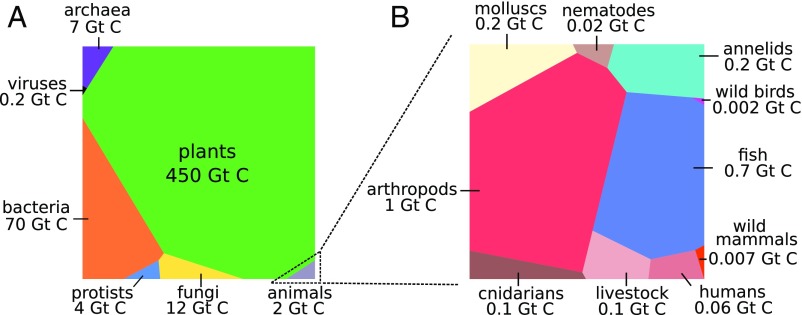
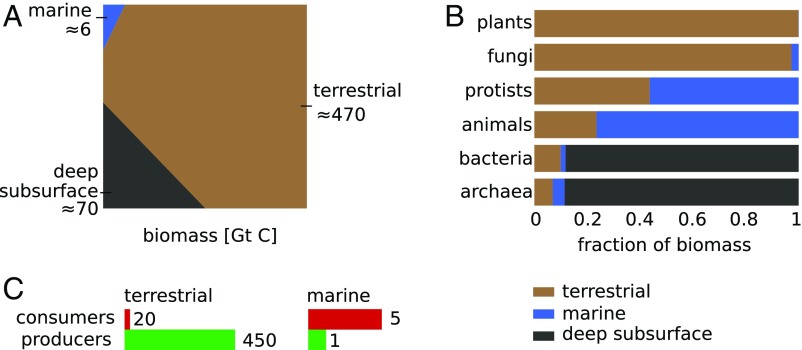
A census of the biomass on Earth is key for understanding the structure and dynamics of the biosphere. However, a global, quantitative view of how the biomass of different taxa compare with one another is still lacking. Here, we assemble the overall biomass composition of the biosphere, establishing a census of the ≈550 gigatons of carbon (Gt C) of biomass distributed among all of the kingdoms of life. We find that the kingdoms of life concentrate at different locations on the planet; plants (≈450 Gt C, the dominant kingdom) are primarily terrestrial, whereas animals (≈2 Gt C) are mainly marine, and bacteria (≈70 Gt C) and archaea (≈7 Gt C) are predominantly located in deep subsurface environments. We show that terrestrial biomass is about two orders of magnitude higher than marine biomass and estimate a total of ≈6 Gt C of marine biota, doubling the previous estimated quantity. Our analysis reveals that the global marine biomass pyramid contains more consumers than producers, thus increasing the scope of previous observations on inverse food pyramids. Finally, we highlight that the mass of humans is an order of magnitude higher than that of all wild mammals combined and report the historical impact of humanity on the global biomass of prominent taxa, including mammals, fish, and plants.
Overview
CoChat Summary
TL;DR
The paper assembles a global census of biomass across all kingdoms of life, estimating Earth’s total biomass at ≈550 Gt C, dominated by plants. It also compares biomass across environments and trophic modes, highlighting large uncertainties and human impacts on the biosphere.
Key findings
- Total global biomass is ≈550 Gt C, with plants ≈450 Gt C (≈80%), bacteria ≈70 Gt C (≈15%), fungi ≈12 Gt C, archaea ≈7 Gt C, protists ≈4 Gt C, animals ≈2 Gt C, and viruses ≈0.2 Gt C.
- Land biomass (≈470 Gt C) is about two orders of magnitude higher than marine biomass (≈6 Gt C); the deep subsurface holds ≈15% of total biomass, chiefly bacteria and archaea.
- In the ocean, ≈1 Gt C of primary producers supports ≈5 Gt C of consumer biomass, an inverted standing biomass distribution; marine biomass is ≈70% microbes, mainly bacteria and protists.
- Human-associated biomass is large relative to wild vertebrates: humans ≈0.06 Gt C, livestock ≈0.1 Gt C, wild mammals ≈0.007 Gt C, domesticated poultry ≈0.005 Gt C versus wild birds ≈0.002 Gt C; total plant biomass has declined approximately twofold relative to pre-human civilization.
Methods
- The authors synthesize hundreds of studies and generate estimates for major taxonomic groups, reporting biomass as gigatons of carbon (Gt C) and using a kingdom-level framework plus viruses.
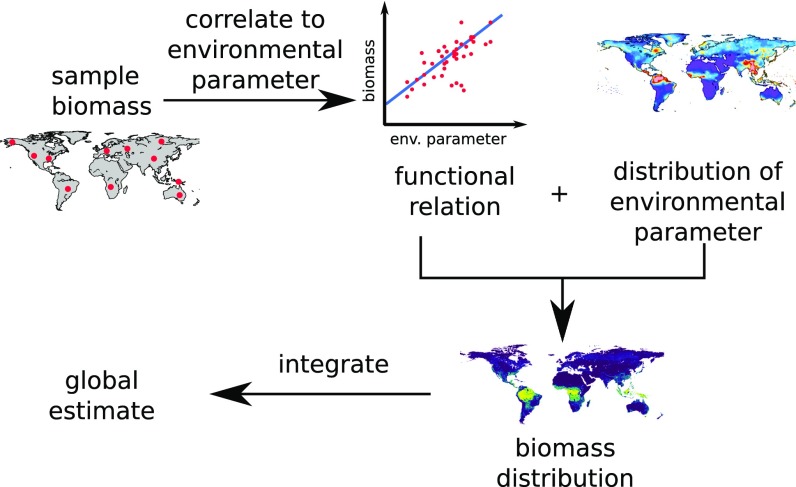
- For many taxa, local biomass samples are extrapolated globally by correlating biomass density with environmental parameters known at global scale; best estimates often use a geometric mean of independent estimates.
- Uncertainty is reported as multiplicative fold-change projections akin to 95% confidence intervals, incorporating intrastudy, interstudy, and intermethod variation; data and code are open-sourced.
Limitations
- The paper states that most datasets rely on fragmentary sampling, causing large uncertainties; sampling is scarce in the deep ocean (usually deeper than 200 m) and deep soil (usually deeper than 1 m), and some estimates may be biased by sampling toward high-abundance areas.
- The paper states that deep subsurface environments have particularly high uncertainty and unknown systematic biases, including unresolved distribution of biomass between aquifer fluids and rocks and among microbial taxa.
- The paper states that current and prehuman vertebrate biomass estimates are only a crude first step, amphibians remain poorly characterized, and parasite biomass is not resolved from hosts; evident from the text, kingdom-level grouping was chosen because much data lack finer taxonomic detail, and some uncertainty projections rely on analogous taxa or expert consultation.
Model-written summary. Check it against the paper before relying on it.
Integrity signals
Registry
Cites
Statistics
Figures
Verification
Claims the paper makes
9 Valid · 7 Not valid · 16 Not checked · 53 Own results and interpretations
Every source the paper cites for this claim was checked and supports it.
In the paper
“The biomass of amphibians, which are experiencing a dramatic population decline (42), remains poorly characterized.”
§ The biomass distribution on Earth > Discussion
What the sources say
- Supportedcites [42] Wake DB Vredenburg VT 2008 Colloquium paper: Are we in the midst of the sixth mass extinction? A view from the world of amphibians Proc Natl Acad Sci USA 105 11466 11473 18695221 PMC2556420 source
The citation is attached to the clause about amphibian population decline, not the separate statement that their biomass is poorly characterized. The passage reporting the Global Amphibian Assessment (labeled Abstract in our copy) says that 43% of amphibian species have declining populations. (LLM, conf=0.92)
plain- Asserted: passes — The authors put it forward as true.
- Checkable: passes — It can be checked against evidence.
- Load-bearing: unclear — It is unclear whether the paper’s conclusions depend on it.
- Based: passes — The paper gives a reason why it holds.
- Supported
Every source the paper cites for this claim was checked and supports it.
In the paper
“In the case of prokaryotes, some major improvements were recently realized, with global estimates of marine deep subsurface prokaryote biomass reduced by about two orders of magnitude due to an increased diversity of sampling locations (7).”
§ The biomass distribution on Earth > Discussion
What the sources say
- Supportedcites [7] Kallmeyer J Pockalny R Adhikari RR Smith DC D’Hondt S 2012 Global distribution of microbial abundance and biomass in subseafloor sediment Proc Natl Acad Sci USA 109 16213 16216 22927371 PMC3479597 source
The Discussion reports a revised subseafloor microbial biomass estimate of 4.1 Pg C versus a previous estimate of 303 Pg C—about a 74-fold reduction. It also identifies a more geographically diverse sampling database, including low-abundance ocean gyres, as a reason the new estimate is lower. The paper identifies other contributing factors as well. (LLM, conf=0.88)
plainstates a cause- Asserted: passes — The authors put it forward as true.
- Checkable: passes — It can be checked against evidence.
- Load-bearing: unclear — It is unclear whether the paper’s conclusions depend on it.
- Based: passes — The paper gives a reason why it holds.
- Supported
The sources with a verdict support this claim; the rest weren’t checked yet, have no full text we could read, or their verdicts aren’t rated yet.
In the paper
“Such inverted biomass distributions can occur when primary producers have a rapid turnover of biomass [on the order of days (34)], while consumer biomass turns over much more slowly [a few years in the case of mesopelagic fish (35)].”
§ The biomass distribution on Earth > Results > The Distribution of Biomass Across Environments and Trophic Modes.
What the sources say
- Supportedcites [34] Zubkov MV 2014 Faster growth of the major prokaryotic versus eukaryotic CO2 fixers in the oligotrophic ocean Nat Commun 5 3776 24777140 PMC4015317 source
The Results (Comparison of the growth rates of the CO2 fixers; page unavailable) report growth rates of 0.1–0.6 per day for the studied oceanic primary producers, consistent with biomass turnover on the order of days. The few-years estimate for mesopelagic fish is assigned to a different citation, not this source. (LLM, conf=0.91)
- Not checked — no full text of the sourcecites [35] Catul V Gauns M Karuppasamy PK 2011 A review on mesopelagic fishes belonging to family Myctophidae Rev Fish Biol Fish 21 339 354 source
plainstates a possible cause- Asserted: passes — The authors put it forward as true.
- Checkable: passes — It can be checked against evidence.
- Load-bearing: passes — The paper’s conclusions depend on it.
- Based: passes — The paper gives a reason why it holds.
- Supported
The cited sources support only part of this claim — read each source’s verdict below.
In the paper
“Combining data from independent sources such as these enables a robust assessment of the total plant biomass (17).”
§ The biomass distribution on Earth > Results > The Uncertainty Associated with Global Biomass Estimates.
What the sources say
- Partly supportedcites [17] Erb K-H 2017 Unexpectedly large impact of forest management and grazing on global vegetation biomass Nature 553 73 76 29258288 PMC5756473 sourceExperimental — accuracy not yet measured
The Methods describe combining multiple datasets and types of evidence to estimate global vegetation biomass stocks. But the paper also says global stocks remain uncertain, reports uncertainty ranges around 35% of the median estimate, and describes more robust estimates as a future prospect. It therefore supports the use of independent sources for an assessment, but not the unqualified characterization of that assessment as robust. (LLM, conf=0.84)
plainstates a cause- Asserted: passes — The authors put it forward as true.
- Checkable: passes — It can be checked against evidence.
- Load-bearing: passes — The paper’s conclusions depend on it.
- Based: passes — The paper gives a reason why it holds.
- Partly supported
A result the paper states — it cites no source for it, so there is none to check. The quote shows it is in the paper.
In the paper
“Plant biomass includes ≈70% stems and tree trunks, which are mostly woody, and thus relatively metabolically inert.”
§ The biomass distribution on Earth > Results > The Biomass Distribution of the Biosphere by Kingdom.
plain- Asserted: passes — The authors put it forward as true.
- Checkable: passes — It can be checked against evidence.
- Load-bearing: unclear — It is unclear whether the paper’s conclusions depend on it.
- Based: passes — The paper gives a reason why it holds.
27 more claims
Create a free account to see all 85 claims and to verify the 2 references still open.
- It may state two separate claims as one. 32
- Probably not a substantial claim. 28
Claims other papers make about this one
Each is checked against this paper’s own text: does it say what the citing paper says it does?
The cited source doesn’t support the claim as written.
In the citing paper
“and less than 10% that of the world ' s current human population ( 52 ).”
From Pervasive human-driven decline of life on Earth points to the need for transformative change (2019) · cites this paper as [52]
Checked by a reasoning model — may be wrong.
Experimental — accuracy not yet measuredThe cited source says what the claim attributes to it.
In the citing paper
“Approximately 450 Gt of C is bound up in terrestrial biota, primarily in plants (86), while only ~6 Gt of C is found in ocean biota (87).”
From Earth beyond six of nine planetary boundaries (2023) · cites this paper as [87]
The cited source says what the claim attributes to it.
In the citing paper
“The amount of metabolic energy available to a biosphere powered by O 2 is vast, such that the O 2 -rich ocean-atmosphere system of the modern Earth supports staggering levels of standing biomass (Bar-On et al. 2018), energy flow (Falkowski et al. 2008), and ecological complexity (Steele 1974).”
From The History of Ocean Oxygenation (2022) · cites this paper as Bar-On et al. 2018
In the citing paper
“Global populations of domestic ruminants (cattle, sheep, and goats) (Ripple et al. 2013) poultry, and pigs (Bennett et al. 2018) used to feed the growing human population now exceed 100 million tons of carbon (Bar-On et al. 2018), and livestock populations are growing rapidly.”
From Scientists’ warning to humanity on the freshwater biodiversity crisis (2021) · cites this paper as Bar-On et al. 2018
Citations
Cites
The worldwide leaf economics spectrum
Wright, I. J., Reich, P. B., Westoby, M., Ackerly, D. D., Baruch, Z., Bongers, F., Cavender-Bares, J., Chapin, T., Cornelissen, J. H. C., Diemer, M., et al. (2004) · Nature · doi:10.1038/nature02403 · Cited by 9,021 · cited 1×
“We then convert the total area of leaves to an estimate of the total dry mass of leaves by using the Glopnet database (24), which measured leaf mass per area (LMA) for ≈2500 plant species.”
MethodA large and persistent carbon sink in the world’s forests
Pan, Y., Birdsey, R. A., Fang, J., Houghton, R., Kauppi, P. E., Kurz, W. A., Phillips, O. L., Shvidenko, A., Lewis, S. L., Canadell, J. G., et al. (2011) · Science · doi:10.1126/science.1201609 · Cited by 8,458
Soil Sampling and Methods of Analysis
(2007) · CRC Press eBooks · doi:10.1201/9781420005271 · Cited by 6,469
Primary production of the biosphere: Integrating terrestrial and oceanic components
Field, C. B., Behrenfeld, M. J., Randerson, J. T., & Falkowski, P. (1998) · Science · doi:10.1126/science.281.5374.237 · Cited by 6,371
Prokaryotes: The unseen majority
Whitman, W. B., Coleman, D. C., & Wiebe, W. J. (1998) · Proceedings of the National Academy of Sciences · doi:10.1073/pnas.95.12.6578 · Cited by 4,871
Global effects of land use on local terrestrial biodiversity
Newbold, T., Hudson, L. N., Hill, S. L. L., Contu, S., Lysenko, I., Senior, R. A., Börger, L., Bennett, D. J., Choimes, A., Collen, B., et al. (2015) · Nature · doi:10.1038/nature14324 · Cited by 4,352
Belowground biodiversity and ecosystem functioning
Bardgett, R. D., & van der Putten, W. H. (2014) · Nature · doi:10.1038/nature13855 · Cited by 3,990 · cited 4×
“This was recommended by experts in the field for estimation of arbuscular mycorrhizal fungi abundance (117).”
BackgroundInfluentialMangroves among the most carbon-rich forests in the tropics
Donato, D. C., Kauffman, J. B., Murdiyarso, D., Kurnianto, S., Stidham, M., & Kanninen, M. (2011) · Nature Geoscience · doi:10.1038/ngeo1123 · Cited by 3,374
Poorter, H., Niklas, K. J., Reich, P. B., Oleksyn, J., Poot, P., & Mommer, L. (2012) · New Phytologist · doi:10.1111/j.1469-8137.2011.03952.x · Cited by 3,163 · cited 1×
“The first relies on a meta-analysis of the biomass allocation to different plant compartments across biomes (19).”
BackgroundA global analysis of root distributions for terrestrial biomes
Jackson, R. B., Canadell, J., Ehleringer, J. R., Mooney, H. A., Sala, O. E., & Schulze, E. D. (1996) · Oecologia · doi:10.1007/bf00333714 · Cited by 3,071 · cited 4×
“assumed the distribution of microbial biomass with depth follows the biomass density versus depth profile of root biomass (21).”
BackgroundMethodInfluential
Research works printed but not linked: 1
- Chapman AD 2009 Numbers of Living Species in Australia and the World Australian Biological Resources Study Canberra, Australia
Cited by
Items 901–1,000 of 3,743
Microbial, holobiont, and Tree of Life eDNA/eRNA for enhanced ecological assessment
Cook, L. S. J., Briscoe, A. G., Fonseca, V. G., Boenigk, J., Woodward, G., & Bass, D. (2024) · Trends in Microbiology · doi:10.1016/j.tim.2024.07.003 · Cited by 25
Zhang, Y., Li, Z., Xu, H., Ge, W., Qian, H., Li, J., Sun, H., Zhang, H., & Jiao, Y. (2024) · The Science of The Total Environment · doi:10.1016/j.scitotenv.2024.175683 · Cited by 30
A genomic analysis reveals the diversity of cellulosome displaying bacteria
Minor, C., Takayesu, A., Ha, S. M., Salwiński, Ł., Sawaya, M. R., Pellegrini, M. A., & Clubb, R. (2024) · Frontiers in Microbiology · doi:10.3389/fmicb.2024.1473396 · Cited by 22
Computational capacity of life in relation to the universe
Kurian, P. (2025) · Science Advances · doi:10.1126/sciadv.adt4623 · Cited by 31
“The most recent census of Earth’s biomass concludes that there is ∼ 550 gigatons of carbon (Gt C = 10 15 g C) distributed among all king-doms of life on our planet ( 20 ).”
Recent advancements of biomass materials in aqueous zinc- ion batteries
Tang, R., Feng, Y., Liu, Y., Wu, Y., Liu, Q., Hu, G., & Liu, X. (2025) · Chemical Engineering Journal · doi:10.1016/j.cej.2025.168559 · Cited by 24
Climate change shapes the future evolution of plant metabolism
Xu, S. Y., & Weng, J. (2020) · Advanced Genetics · doi:10.1002/ggn2.10022 · Cited by 26
Plants make our existence possible
Raven, P. H. (2020) · Plants People Planet · doi:10.1002/ppp3.10173 · Cited by 25
“Plants amount to more than four fifths of the total living biomass on Earth, playing a huge role in absorbing carbon and, thus, slowing global warming (Bar-On et al., 2018).”
BackgroundLizzi, D., Mattiello, A., Piani, B., et al. (2020) · Nanomaterials · doi:10.3390/nano10122534 · Cited by 21
“Since plant Kingdom represent about 82% of living organisms mass on Earth [6], and their ecological role is of paramount importance to understand the relationships between plants and ENMs.”
BackgroundAdamczyk, B. (2021) · Plants · doi:10.3390/plants10040731 · Cited by 23
“Considering the intensive competition between microorganisms and plants for N, the presence of effective mechanisms increasing the competitive abilities of plants to access organic N would explain the prevalence of plant over microbial biomass; globally, the plant biomass C exceeds these of microorganisms more than fi…”
BackgroundBergsten, P., Vannier, P., Klonowski, A. M., Knobloch, S., Guðmundsson, M. T., Jackson, M. D., & Marteinsson, V. (2021) · Frontiers in Microbiology · doi:10.3389/fmicb.2021.728977 · Cited by 25
Zalma, S. A., & El-Sharoud, W. M. (2021) · Science Progress · doi:10.1177/00368504211055277 · Cited by 21
Carbon cycle in tropical upland ecosystems: a global review
Figueroa, D. C. (2021) · Web Ecology · doi:10.5194/we-21-109-2021 · Cited by 24
“It has been estimated that biotic carbon allocated into terrestrial plants counts for about 80 % of all taxa on Earth (450 Gt C), from which 320 Gt C is bound to aboveground biomass, mainly in stems and tree trunks, and 130 Gt C is accumulated in plant roots (Bar-On et al., 2018).”
BackgroundBuffering Climate Change with Nature
Hessen, D. O., & Vandvik, V. (2022) · Weather Climate and Society · doi:10.1175/wcas-d-21-0059.1 · Cited by 31
“under the radar}the striking loss and degradation of wilderness and natural ecosystems such as forests and wetlands, resulting in dramatic and accelerating declines in the biodiversity as well as in the bulk biomass of wild plants and animals (Bar-On et al. 2018; Brondizio et al. 2019).”
BackgroundInfluentialHetherington, E. D., Choy, C. A., Thuesen, E. V., & Haddock, S. H. D. (2022) · Frontiers in Marine Science · doi:10.3389/fmars.2022.864004 · Cited by 27
“The pelagic ocean contains the highest carbon biomass of animals on earth (Bar-On et al., 2018).”
BackgroundChallenging Pronatalism Is Key to Advancing Reproductive Rights and a Sustainable Population
Bajaj, N., & Stade, K. (2023) · The Journal of Population and Sustainability · doi:10.3197/jps.63799953906861 · Cited by 33
“Of the total biomass of terrestrial vertebrates, 59 per cent is represented by livestock, 36 per cent by human beings, and about five per cent by wild mammals, birds, reptiles and amphibians (Bar-On et al., 2018; Bradshaw et al., 2021).”
Underrated past herbivore densities could lead to misoriented sustainability policies
Manzano, P., Pardo, G. O., Itani, M., & del Prado, A. (2023) · npj Biodiversity · doi:10.1038/s44185-022-00005-z · Cited by 30
“ESTIMATES OF NATURAL HERBIVORE ABUNDANCE Recently, Bar-On et al.(5) published an estimate of the total biomass on Earth, widely cited by other academic publications.”
BackgroundInfluentialRapid eco‐phenotypic feedback and the temperature response of biomass dynamics
Gibert, J. P., Wieczynski, D. J., Han, Z., & Yammine, A. (2023) · Ecology and Evolution · doi:10.1002/ece3.9685 · Cited by 18
López‐García, A., & Aguirre, J. I. (2023) · Ornithological Applications · doi:10.1093/ornithapp/duad009 · Cited by 29
“Humans have deeply modified the size and distribution of species populations around the world (Boivin et al. 2016, Bar-On et al. 2018).”
BackgroundSivan, P., Heinonen, E., Gandla, M. L., Jiménez‐Quero, A., Özeren, H. D., Jönsson, L. J., Mellerowicz, E. J., & Vilaplana, F. (2023) · Green Chemistry · doi:10.1039/d3gc01020a · Cited by 24
Donhauser, J., Briones, M. J. I., Mikola, J., Jones, D. L., Eder, R., Filser, J., Frossard, A., Krogh, P. H., Sousa, J. P., Cortet, J., et al. (2023) · Soil Biology and Biochemistry · doi:10.1016/j.soilbio.2023.109154 · Cited by 26
Aschemann‐Witzel, J., Mulders, M. D. G. H., Janßen, M., & Pérez-Cueto, F. J. A. (2023) · Cleaner and Responsible Consumption · doi:10.1016/j.clrc.2023.100154 · Cited by 25
Principles of cognitive biology and the concept of biocivilisations
Slijepčević, P. (2023) · Biosystems · doi:10.1016/j.biosystems.2023.105109 · Cited by 40
Bhurtel, A., Salifu, E., & Siddiqua, S. (2024) · The Science of The Total Environment · doi:10.1016/j.scitotenv.2023.169808 · Cited by 28
The Hidden Hydrogeosphere: The Contribution of Deep Groundwater to the Planetary Water Cycle
Lollar, B. S., Warr, O., & Higgins, P. M. (2024) · Annual Review of Earth and Planetary Sciences · doi:10.1146/annurev-earth-040722-102252 · Cited by 27
Heterotrophy in marine animal forests in an era of climate change
Denis, V., Ferrier‐Pagès, C., Schubert, N., et al. (2024) · Biological reviews/Biological reviews of the Cambridge Philosophical Society · doi:10.1111/brv.13053 · Cited by 21
Organic Input to Titan's Subsurface Ocean Through Impact Cratering
Neish, C. D., Malaska, M. J., Sotin, C., Lopes, R. M. C., Nixon, C. A., Affholder, A., Chatain, A., Cockell, C. S., Farnsworth, K., Higgins, P. M., et al. (2024) · Astrobiology · doi:10.1089/ast.2023.0055 · Cited by 27
Hotter is not (always) better: Embracing unimodal scaling of biological rates with temperature
Michaletz, S. T., & Garen, J. C. (2024) · Ecology Letters · doi:10.1111/ele.14381 · Cited by 25
A Marine Group A isolate relies on other growing bacteria for cell wall formation
Katayama, T., Nobu, M. K., Imachi, H., Hosogi, N., Meng, X., Morinaga, K., Yoshioka, H., Takahashi, H. A., Kamagata, Y., & Tamaki, H. (2024) · Nature Microbiology · doi:10.1038/s41564-024-01717-7 · Cited by 19
Unravelling the secrets of soil microbiome and climate change for sustainable agroecosystems
Kaur, R., Gupta, S. K., Tripathi, V., & Bharadwaj, A. (2024) · Folia Microbiologica · doi:10.1007/s12223-024-01194-9 · Cited by 27
“Another difficulty for climate modeling is the size at which bacteria work (Bar-On et al. 2018).”
Will organic thermoelectrics get hot?
Campoy‐Quiles, M. (2019) · Philosophical Transactions of the Royal Society A Mathematical Physical and Engineering Sciences · doi:10.1098/rsta.2018.0352 · Cited by 29
“If we consider that there are about two farming mammals per human [4], the heat potential of cattle, pigs and humans together would be lower than 0.”
BackgroundWildlife Management, Species Injustice and Ecocide in the Anthropocene
Sollund, R. A. (2019) · Critical Criminology · doi:10.1007/s10612-019-09469-1 · Cited by 27
Yang, T., Shi, Y., Zhu, J., Zhao, C., Wang, J., Liu, Z., Fu, X. Y., Liu, X., Yan, J., Yuan, M., et al. (2021) · Science China Life Sciences · doi:10.1007/s11427-020-1843-6 · Cited by 23
Brown Dwarf Atmospheres as the Potentially Most Detectable and Abundant Sites for Life
Lingam, M., & Loeb, A. (2019) · The Astrophysical Journal · doi:10.3847/1538-4357/ab3f35 · Cited by 28
“It is therefore not surprising that photosynthesis is responsible for the majority of carbon fixation and biomass on Earth (Bar-On et al. 2018).”
BackgroundViruses in Subsurface Environments
Wirth, J., & Young, M. (2022) · Annual Review of Virology · doi:10.1146/annurev-virology-093020-015957 · Cited by 24
Ten simple rules for using large language models in science, version 1.0
Smith, G. R., Bello, C., Bialic-Murphy, L., Clark, E., Delavaux, C. S., Fournier de Lauriere, C., van den Hoogen, J., Lauber, T., Ma, H., Maynard, D. S., et al. (2024) · PLOS Computational Biology · doi:10.1371/journal.pcbi.1011767 · Cited by 25
“The estimate of 450 Gt C can instead be traced to Bar-On and colleagues (2018) [24].”
BackgroundEffect of diet on the evolution of gut commensal bacteria
Đapa, T., & Xavier, K. B. (2024) · Gut Microbes · doi:10.1080/19490976.2024.2369337 · Cited by 24
“120 According to theoretical models in natural products, the potential wide range of isomers for all glycan structures is > 10 12 (hexasaccharides), 121 despite that, the human body only has 17 different carbohydrate-active enzymes (CAZymes) with which it can break down glycans.”
BackgroundXiao, J., Zhang, J., Yuan, H., Xie, X., Gao, Y., Lu, Y., Liao, Y., & Nie, J. (2024) · European Journal of Soil Biology · doi:10.1016/j.ejsobi.2024.103652 · Cited by 21
Novel onion flower-derived biochar for high-performance sustainable supercapacitor applications
Kwarteng, F. A., Abdel-Aty, A. A. R., Mohamed, S. R. E., Hassan, M. A., Ohashi, H., López‐Salas, N., Semida, W. M., & Khalil, A. S. G. (2024) · Diamond and Related Materials · doi:10.1016/j.diamond.2024.111703 · Cited by 20
Ma, K.-J., Ye, Y.-L., Li, Y.-K., Fu, G., Wu, Y., Sun, C., & Xu, X. (2025) · Frontiers in Marine Science · doi:10.3389/fmars.2025.1551618 · Cited by 23
The multi-dimensional environmental impact of global crop commodities
Jwaideh, M. A. A., & Dalin, C. (2025) · Nature Sustainability · doi:10.1038/s41893-025-01528-6 · Cited by 37
“Agriculture, encompassing crop and livestock production, threatens 86% of species with risk of extinction and reduces species variability 1,2 .”
Biomass Native Structure Into Functional Carbon‐Based Catalysts for Fenton‐Like Reactions
Tian, W., Lin, J., Tian, Z., et al. (2025) · Advanced Functional Materials · doi:10.1002/adfm.202508759 · Cited by 20
Where the Wild Things were is Where Humans are Now: an Overview
Abegão, J. L. R. (2019) · Human Ecology · doi:10.1007/s10745-019-00099-3 · Cited by 22
“…requirements has already led to the decline or extinction of many animal and plant populations, precipitated ecosystem disruption, and promoted biohomogeneity (Burkle et al. 2013; Machovina et al. 2015; Ceballos et al. 2017; Crist et al. 2017; Bar-On et al. 2018; Watson et al. 2018; WWF 2018).”
BackgroundAnthropogenic factors affecting wildlife species status outcomes: why the fixation on pesticides?
Brain, R. A., & Anderson, J. C. (2020) · Environmental Science and Pollution Research · doi:10.1007/s11356-020-08980-1 · Cited by 28
“Bar-On et al. (2018) estimated the distribution of biomass on earth and determined that animals comprise approximately 2 of 550 Gigatonnes of carbon, of which wild mammals amount to less than 0.5% of total animal biomass.”
BackgroundInfluentialCohen, I. R., & Marron, A. (2020) · F1000Research · doi:10.12688/f1000research.24447.3 · Cited by 28
“…the “natural” environment, our domestication of a small number of species has markedly affected the biosphere: the biomass of chickens by now far outweighs the combined biomass of all wild birds and the biomass of cattle outweighs by many fold the biomass of all other mammals combined 141 .”
Animal Welfare for Corporate Sustainability: The Business Benchmark on Farm Animal Welfare
Mateo, J. F., & Barrera, A. (2020) · Journal of Sustainability Research · doi:10.20900/jsr20200030 · Cited by 28
“Today, farm birds represent 70% of all birds on the planet, and 60% of all mammals on Earth are livestock, mostly cattle and pigs [54].”
BackgroundGeoengineering super low carbon cows: food and the corporate carbon economy in a low carbon world
Ormond, J. (2020) · Climatic Change · doi:10.1007/s10584-020-02766-7 · Cited by 23
“This includes spraying sulphur particles into the atmosphere (Keith et al. 2018), sending giant mirrors into space to deflect sunlight away from the Earth (Angel 2006) or increasing the radius of the Earth’s orbit around the sun (Jain 1993), thereby countering climate change and at the same time, adding 5.5 days to ea…”
BackgroundInfluentialFood web complexity weakens size-based constraints on the pyramids of life
Woodson, C. B., Schramski, J. R., & Joye, S. B. (2020) · Proceedings of the Royal Society B Biological Sciences · doi:10.1098/rspb.2020.1500 · Cited by 20
“Our estimate of global ocean biomass is 3–7 × higher than recent global estimates that blended size spectra theory, mass-balanced ecosystem modelling, and mesopelagic fish biomass estimates [26,45,46].”
BackgroundMethodInfluentialTrophic flexibility of marine diplonemids - switching from osmotrophy to bacterivory
Prokopchuk, G., Korytář, T., Juricová, V., Majstorović, J., Horák, A., Šimek, K., & Lukeš, J. (2022) · The ISME Journal · doi:10.1038/s41396-022-01192-0 · Cited by 19
“Together with prokaryotes, they account for about 70% of the total biomass in the marine environment [2] and, through a multitude of interactions with other microeukaryotes, bacteria and viruses, form highly complex microbial food webs [3].”
BackgroundDeclines in scavenging by endangered vultures in the Horn of Africa
Buechley, E. R., Murgatroyd, M., RUFFO, A. D., Bishop, R. C., Christensen, T., Marra, P. P., Sillett, T. S., & Şekercioğlu, Ç. H. (2022) · Journal of Wildlife Management · doi:10.1002/jwmg.22194 · Cited by 23
Strategies for managing marine disease
Glidden, C. K., Field, L. C., Bachhuber, S. M., Hennessey, S. M., Cates, R., Cohen, L., Crockett, E., Degnin, M., Feezell, M. K., Fulton‐Bennett, H. K., et al. (2022) · Ecological Applications · doi:10.1002/eap.2643 · Cited by 26
“Yet, invertebrates make up most animal taxa in the ocean (Mather, 2013) and, at least partly due to considerable differences in the biomass of marine invertebrates versus terrestrial taxa (Bar-On et al., 2018), are more affected by disease than terrestrial invertebrates.”
BackgroundMartins, R. T., de Brito, J. G., Dias‐Silva, K., Leal, C. G., Leitão, R. P., de Oliveira, V. C., de Oliveira, J. M. B., de Paula, F. R., Roque, F. D. O., Hamada, N., et al. (2022) · Hydrobiologia · doi:10.1007/s10750-022-04867-z · Cited by 23
“Most of Earth’s large mammal and bird biomasses are either humans or our food animals (Bar-On et al., 2018), and over 40% of Earth’s terrestrial surface area is agricultural or urban (Foley et al.”
BackgroundChi, Z., Yu, G., Teng, H. H., Liu, H.-G., Wang, J., Liu, C., Shen, Q., & Gadd, G. M. (2022) · Environmental Science & Technology · doi:10.1021/acs.est.2c01388 · Cited by 20
Abiotic and biotic constituents of oil sands process-affected waters
Hussain, N. A. S., & Stafford, J. L. (2022) · Journal of Environmental Sciences · doi:10.1016/j.jes.2022.06.012 · Cited by 24
Fu, W., Li, Z., Han, J., Zhang, Z., & Wang, F. (2022) · Carbon · doi:10.1016/j.carbon.2022.12.067 · Cited by 20
The future role of MFCs in biomass energy
Ieropoulos, I. A., & Greenman, J. (2023) · Frontiers in Energy Research · doi:10.3389/fenrg.2023.1108389 · Cited by 27
“With regard to microorganisms, these are predominantly located in deep subsurface environments with bacteria (at ≈70 Gt C) outnumbering the archaea (≈7 Gt C) (Bar et al., 2018), and fungi thought to be around 12 Gt C.”
BackgroundBickel, S., & Or, D. (2023) · Communications Biology · doi:10.1038/s42003-023-04703-7 · Cited by 22
Mixotrophic microbes create carbon tipping points under warming
Wieczynski, D. J., Moeller, H. V., & Gibert, J. P. (2023) · Functional Ecology · doi:10.1111/1365-2435.14350 · Cited by 27
“…al., 2019; Mieczan, 2009; Sanders, 1991; Selosse et al., 2017; Stoecker, 1998; Stoecker et al., 2017; Worden et al., 2015) and massively abundant (Bar-On et al., 2018) mixotrop-hic microbes exhibit a rich array of dynamical responses to joint changes in temperature and nutrient levels, leading…”
BackgroundProcessed foods: From their emergence to resilient technologies
Knorr, D., & Sevenich, R. (2023) · Comprehensive Reviews in Food Science and Food Safety · doi:10.1111/1541-4337.13205 · Cited by 25
Fridolfsson, E., Bunse, C., Lindehoff, E., Farnelid, H., Pontiller, B., Bergström, K., Pinhassi, J., Legrand, C., & Hylander, S. (2023) · Scientific Reports · doi:10.1038/s41598-023-38816-0 · Cited by 24
Zhang, X., Chen, J., Wang, W., & Zhu, L. (2024) · Environmental Pollution · doi:10.1016/j.envpol.2024.123436 · Cited by 24
Caruso, V., Hartop, E., Chimeno, C., Noori, S., Srivathsan, A., Haas, M., Lee, L., Meier, R., & Whitmore, D. (2024) · Insect Conservation and Diversity · doi:10.1111/icad.12762 · Cited by 23
“With insects contributing to much of the animal biomass and key ecosystem functions (Bar-On et al., 2018; Dufour, 1987; Grimaldi & Engel, 2005; Kremen et al., 1993; Stork et al., 2015), many biologists agree that there is a pressing need for investigating insect biodiversity and accelerating…”
Marino, S., Brugiapaglia, E., Miraglia, N., Persichilli, C., Angelis, M. D., Pilla, F., & Brita, A. D. (2024) · Ecological Informatics · doi:10.1016/j.ecoinf.2024.102740 · Cited by 22
An ancient role for CYP73 monooxygenases in phenylpropanoid biosynthesis and embryophyte development
Knosp, S., Kriegshauser, L., Tatsumi, K., Malherbe, L., Erhardt, M., Wiedemann, G., Bakan, B., Kohchi, T., Reski, R., & Renault, H. (2024) · The EMBO Journal · doi:10.1038/s44318-024-00181-7 · Cited by 24
“Most of this biomass is found on land (Bar-On et al, 2018), re fl ecting the cornerstone functions performed by plants in terrestrial ecosystems, primarily as an entry point for solar energy.”
Quantitative principles of microbial metabolism shared across scales
Sher, D., Segrè, D., & Follows, M. J. (2024) · Nature Microbiology · doi:10.1038/s41564-024-01764-0 · Cited by 25
“Biological systems span and encompass many scales, from molecules to organisms, communities, ecosystems and the whole Earth biosphere 1–3 .”
Landmarks and frontiers in biological fluid dynamics
Dabiri, J. O. (2019) · Physical Review Fluids · doi:10.1103/physrevfluids.4.110501 · Cited by 24
Benoist, N. M. A., Bett, B. J., Morris, K. J., & Ruhl, H. A. (2019) · Progress In Oceanography · doi:10.1016/j.pocean.2019.102188 · Cited by 25
“A census of biomass on Earth is important to understanding both the structure and the functioning of the biosphere (Bar-On et al., 2018).”
BackgroundBiotechnological Strategies for the Lignin-Based Biorefinery Valorization
de Albuquerque, T. L., Silva, J. D. S., de Macedo, A. C., Gonçalves, L. R. B., & Rocha, M. V. P. (2019) · Elsevier eBooks · doi:10.1016/b978-0-12-409547-2.14570-6 · Cited by 22
Bacterial biomechanics—From individual behaviors to biofilm and the gut flora
Ishikawa, T., Omori, T., & Kikuchi, K. (2020) · APL Bioengineering · doi:10.1063/5.0026953 · Cited by 28
“They inhabit a wide variety of locations and account for about 13% of the global biomass (Bar-On et al., 2018).”
BackgroundLabrador, M. D. M., Doña, J., Serrano, D., & Jovani, R. (2020) · Microbial Ecology · doi:10.1007/s00248-020-01634-2 · Cited by 23
“Similarly, knowing the biomass of each group of organisms on Earth is necessary to understand the functioning of the biosphere [20].”
BackgroundResultKumar, V., Momin, S. A., Kumar, V. V., Ahmed, J., Al-Musallam, L., Shajan, A. B., Al-Aqeel, H., Al-Mansour, H., & Al-Zakri, W. M. (2021) · PLoS ONE · doi:10.1371/journal.pone.0250645 · Cited by 24
“Billions of marine microbes are present in a liter of seawater; about 70% of the oceanic biomass is derived from marine microorganisms [1].”
BackgroundA “Wicked Problem” Reconciling Human-Shark Conflict, Shark Bite Mitigation, and Threatened Species
Niella, Y. V., Peddemors, V. M., Green, M., Smoothey, A. F., & Harcourt, R. G. (2021) · Frontiers in Conservation Science · doi:10.3389/fcosc.2021.720741 · Cited by 25
“Balancing human risk with increasingly disturbed environments and ever diminishing populations of wildlife (Bar-On et al., 2018) requires robust approaches.”
BackgroundZoo elephant research: contributions to conservation of captive and free‐ranging species
Bechert, U. S., Brown, J. L., Dierenfeld, E. S., Ling, P. D., Molter, C. M., & Schulte, B. A. (2019) · International Zoo Yearbook · doi:10.1111/izy.12211 · Cited by 22
Cheng, S., Yuan, L., Li‐Gao, R., Chen, S., Li, H., & Du, M. (2024) · Journal of Agricultural and Food Chemistry · doi:10.1021/acs.jafc.3c08850 · Cited by 24
Determining the Young’s Modulus of the Bacterial Cell Envelope
Lee, J., Jha, K., Harper, C. E., et al. (2024) · ACS Biomaterials Science & Engineering · doi:10.1021/acsbiomaterials.4c00105 · Cited by 19
Exploring the secrets of marine microorganisms: Unveiling secondary metabolites through metagenomics
Wang, S., Li, X., Yang, W., & Huang, R. (2024) · Microbial Biotechnology · doi:10.1111/1751-7915.14533 · Cited by 18
“These organisms account for approximately 87% of the total carbon mass on the planet, highlighting their crucial role in the global carbon cycle and their substantial contribution to the Earth's overall biomass (Bar-On et al., 2018; Wang, 2016).”
BackgroundProduction, Transport, Fate and Effects of Lipids in the Marine Environment
Parrish, C. C. (2025) · Marine Drugs · doi:10.3390/md23020052 · Cited by 26
Rethinking Darwin’s coral reef paradox and the ubiquity of “marine oases”
Morais, R. A., Patricio-Valerio, L., Narvaez, P., Parravicini, V., & Brandl, S. J. (2025) · Current Biology · doi:10.1016/j.cub.2025.05.033 · Cited by 26
Li, K., Wang, J., Zhou, Z., Wu, J., Bo, X., Shen, M., & Zou, J. (2025) · Global Change Biology · doi:10.1111/gcb.70514 · Cited by 23
“Globally, fungi and bacteria dominate soil communities and together contribute approximately 19 Gt of carbon—nearly eight times the combined biomass of soil animals and archaea (Bar-On et al. 2018; Crowther et al. 2019).”
Restoration of transborder connectivity for Fennoscandian brown bears (Ursus arctos)
Kopatz, A., Kleven, O., Kojola, I., et al. (2021) · Biological Conservation · doi:10.1016/j.biocon.2020.108936 · Cited by 19
“Moreover, climate change may further challenge the persistence and survival of large carnivore populations (Hoffmann et al., 2011; Ripple et al., 2014; Haddad et al., 2015; Bar-On et al., 2018).”
BackgroundAOP Report: Inhibition of Chitin Synthase 1 Leading to Increased Mortality in Arthropods
Schmid, S., Song, Y., & Tollefsen, K. E. (2021) · Environmental Toxicology and Chemistry · doi:10.1002/etc.5058 · Cited by 22
“It expands the small but increasing number of invertebrate AOPs that have relevance to arthropods, the largest phylum within the animal kingdom (Bar‐On et al. 2018).”
BackgroundWang, Z., Gong, H., Huang, M., Gu, F., Wei, J., Guo, Q., & Song, W. (2021) · Methods in Ecology and Evolution · doi:10.1111/2041-210x.13729 · Cited by 20
Zoonotic Politics: The Impossible Bordering of the Leaky Boundaries of Species
Cudworth, E., & Hobden, S. (2022) · Millennium Journal of International Studies · doi:10.1177/03058298221110921 · Cited by 23
From Food to Gods to Food to Waste
Knorr, D., & Augustin, M. A. (2022) · Critical Reviews in Food Science and Nutrition · doi:10.1080/10408398.2022.2153795 · Cited by 27
“A census of the biomass distribution on Earth (Bar-On, Phillips, and Milo 2018) reveals how biomass of different taxa contribute to the biosphere.”
BackgroundCrustaceans of the Northwest Pacific Ocean: Species richness and distribution patterns
Knauber, H., Kohlenbach, K., Brandt, A., & Saeedi, H. (2022) · Journal of Sea Research · doi:10.1016/j.seares.2022.102332 · Cited by 19
Suarez, C., Hackl, T., Wilén, B., Persson, F., Hagelia, P., Jetten, M. S. M., & Martins, P. D. (2023) · FEMS Microbiology Letters · doi:10.1093/femsle/fnad049 · Cited by 20
Benhamdoun, A., Achtak, H., Vinti, G., & Dahbi, A. (2023) · Environmental Monitoring and Assessment · doi:10.1007/s10661-023-11467-4 · Cited by 20
Qiu, D., Lange, E., Haas, T., Prucker, I., Masuda, S., Wang, Y. L., Felix, G., Schaaf, G., & Jessen, H. J. (2023) · Journal of the American Chemical Society · doi:10.1021/jacs.3c04445 · Cited by 27
Forecasting the dynamics of a complex microbial community using integrated meta-omics
Delogu, F., Kunath, B. J., Queirós, P., Halder, R., Lebrun, L., Pope, P. B., May, P., Widder, S., Muller, E. E. L., & Wilmes, P. (2023) · Nature Ecology & Evolution · doi:10.1038/s41559-023-02241-3 · Cited by 25
“Microorganisms are ubiquitous on planet Earth 1 and constitute up to 17% of its carbon biomass 2 .”
Knorr, D., & Augustin, M. A. (2024) · Sustainable Food Technology · doi:10.1039/d3fb00199g · Cited by 34
Guerra, S., Betti, S., Sartori, L., Zani, G., & Castiello, U. (2024) · Journal of Environmental Psychology · doi:10.1016/j.jenvp.2024.102246 · Cited by 28
Quiroga, S., Suárez, C., Hernanz, V., Aguiño, J. E., & Fernández-Manjarrés, J. F. (2024) · Forest Policy and Economics · doi:10.1016/j.forpol.2024.103198 · Cited by 27
Parrondo's paradox reveals counterintuitive wins in biology and decision making in society
Wen, T., & Cheong, K. H. (2024) · Physics of Life Reviews · doi:10.1016/j.plrev.2024.08.002 · Cited by 23
Sivan, P., Urbancsok, J., Donev, E. N., Derba‐Maceluch, M., Barbut, F. R., Yassin, Z., Gandla, M. L., Mitra, M., Heinonen, E., Šimura, J., et al. (2024) · Plant Biotechnology Journal · doi:10.1111/pbi.14487 · Cited by 22
Protein adaptation to high hydrostatic pressure: Computational analysis of the structural proteome
Avagyan, S., Vasilchuk, D., & Makhatadze, G. I. (2019) · Proteins Structure Function and Bioinformatics · doi:10.1002/prot.25839 · Cited by 21
Izenberg, N. R., Gentry, D. M., Smith, D. J., Gilmore, M. S., Grinspoon, D. H., Bullock, M. A., Boston, P. J., & Słowik, G. P. (2021) · Astrobiology · doi:10.1089/ast.2020.2326 · Cited by 27
“In the modern era, bacteria and archaea on Earth are the second largest global biomass components ( * 77 Gt C), the vast majority of which reside in subsurface environments (Bar-On et al. , 2018).”
Quantitative High-Resolution Imaging of Live Microbial Cells at High Hydrostatic Pressure
Bourgès, A. C., Lazarev, A. V., Declerck, N., et al. (2020) · Biophysical Journal · doi:10.1016/j.bpj.2020.04.017 · Cited by 19
Precipitation extremes in recent decades impact cattle populations at the global and national scales
Tortarolo, G. N. M., & Jaramillo, V. J. (2020) · The Science of The Total Environment · doi:10.1016/j.scitotenv.2020.139557 · Cited by 20
Phytomass Valorization by Deep Eutectic Solvents—Achievements, Perspectives, and Limitations
Jablonský, M., & Šíma, J. (2020) · Crystals · doi:10.3390/cryst10090800 · Cited by 21
“The sum of the biomass across all taxa on Earth is approximately 550 gigatons of carbon, of which about 450 Gt C are plants, followed by bacteria (70 Gt C), fungi, archaea, protists, animals, and viruses, which together account for the remaining <10% [4].”
BackgroundAre domesticated freshwater fish an underappreciated culprit of ecosystem change?
Cucherousset, J., & Olden, J. D. (2020) · Fish and Fisheries · doi:10.1111/faf.12499 · Cited by 21
Arthropods: Why It Is So Crucial to Know Their Biodiversity?
Santos, J. C., de Almeida, W. R., & Fernandes, G. W. (2020) · Springer eBooks · doi:10.1007/978-3-030-53226-0_1 · Cited by 27
Metadata
- Authors
- Bar-On, Y. M., Phillips, R., & Milo, R.
- Affiliations
- Department of Plant and Environmental Sciences, Weizmann Institute of Science, 76100 Rehovot, Israel;
- California Institute of Technology (US)
- Weizmann Institute of Science (IL)
- Corresponding author
- Milo, Ron
- Venue
- Proceedings of the National Academy of Sciences
- Publisher
- National Academy of Sciences
- Published
- 2018-05-21
- Volume
- 115
- Issue
- 25
- Pages
- 6506-6511
- ISSN
- 0027-8424 (ISSN-L)
- 1091-6490
- PMC
- PMC6016768
- OpenAlex
- W2804910112
- Cited by
- 3,723
- References
- 263
- Citations by year
- 2026: 349 · 2025: 450 · 2024: 589 · 2023: 617 · 2022: 498 · 2021: 498 · 2020: 419 · 2019: 246 · 2018: 49
- FWCI
- 239.98
- Type
- journal article
- Language
- en
- Open access
- hybrid
- doi.org
- Licence
- Locations
- Proceedings of the National Academy of Sciences (publishedVersion, cc-by-nc-nd)
- Europe PMC (PubMed Central) (publishedVersion, cc-by-nc-nd)
- PubMed Central (publishedVersion, cc-by-nc-nd)
- PubMed (publishedVersion)
- CaltechAUTHORS (California Institute of Technology) (submittedVersion, cc-by-nc-nd)
- Funders
- National Institutes of Health (5r35gm118043-07)
- National Institute of General Medical Sciences (R35 GM118043)
- Topics
- Physical Sciences › Environmental Science › Nature and Landscape Conservation › Ecology and Vegetation Dynamics Studies
- Physical Sciences › Environmental Science › Global and Planetary Change › Earth Systems and Cosmic Evolution
- Life Sciences › Agricultural and Biological Sciences › Soil Science › Soil Carbon and Nitrogen Dynamics
- Keywords
- biomass allocation, biomass carbon, terrestrial biomass, marine biomass, bacteria, archaea, food pyramid, wild mammals, fish biomass, plant biomass
- MeSH terms
- Animals, Archaea, Bacteria, Carbon, Humans, Plants, Ecosystem, Biomass, Earth, Planet, Biota
About these checks
Registry, retraction, Cites and statistics results are computed, not judged, with one exception: a printed reference that no index lists is read once by a model before it counts as a citation error. Claims are extracted by a model and kept only when their quote appears verbatim in the text; each cited source is then checked, with a model’s help, for whether it says what the claim relies on. Those verdicts can be wrong — read the claim’s quote and the cited source before relying on one.
The claim verdicts this report counts are experimental: their accuracy is not yet measured.
A language model drew the claims from the paper on 2026-10-10, under version 3 of the claim definition (model deepseek-v4.1-flash, prompt extract-v3).
A second model labelled each claim on 2026-10-10 (model jev-1.13-20260917, definition revision gold-guideline-v0.2).
Cited sources are checked with a language model’s help (gpt-6-sol).
Statistics and arithmetic are recomputed, not judged.
Confidence bands are shown only for fields calibrated on our annotated test set. None is calibrated yet, so no band is shown.
What counts as a claim ›How we measure confidence ›How we check this ›
Are you an author, or do you see a problem with this page? Request a review
Data sources
Bibliographic data: Semantic Scholar, OpenAlex, Crossref.
Contains information from the Semantic Scholar Academic Graph Datasets, made available under the ODC Attribution License (ODC-BY 1.0).
Semantic Scholar’s data is described in: Kinney, R., et al. (2023). The Semantic Scholar Open Data Platform. arXiv:2301.10140.
