

Mental health during the COVID-19 pandemic: exploring the role of psychological flexibility and stress-related variables.
Open accessThe DOI matches its Crossref record; 77 of the 77 references it cites were found in a registry or an index; 9 of the 31 sources its claims cite were checked for support.
Abstract
Understanding the impact of the COVID-19 pandemic on mental health and the psychological factors associated can help inform subsequent interventions to protect psychological health. In particular, psychological flexibility has been shown to be an important target for intervention. The current study aimed to investigate associations between protective factors (state mindfulness, values and self-compassion) and risk factors (COVID-19 stress, worry and rumination) for mental health during the early stages of the COVID-19 pandemic. 439 participants completed three online surveys during the 1st wave of the pandemic in the UK: Time 1 (April 1–5th 2020), Time 2 (April 15–19th April), Time 3 (May 13–17th 2020). Measures of wellbeing, burnout and life satisfaction. Psychological health outcome measures were found to be lower (worse) than normative comparison data during the early stages of the UK lockdown, while COVID-19 stress and worry reduced over time. Multilevel models found that higher levels of trait and state measures of psychological flexibility and self-compassion were associated with better psychological health across time points. Higher levels of COVID-19 stress, worry and rumination were also associated with poorer psychological health. The results showed that mindfulness, values and self-compassion are potential targets for intervention.
Overview
CoChat Summary
TL;DR
In a three-wave UK longitudinal study during the first COVID-19 lockdown, lower wellbeing/life satisfaction and higher COVID-19 stress/rumination were linked to poorer mental health, while trait and state mindfulness, values, and self-compassion were linked to better psychological health. Trait psychological flexibility also predicted higher state flexibility, but trait variables did not moderate the state-outcome relationships.
Key findings
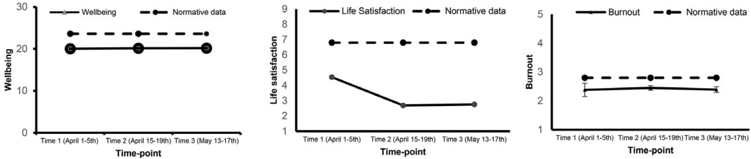
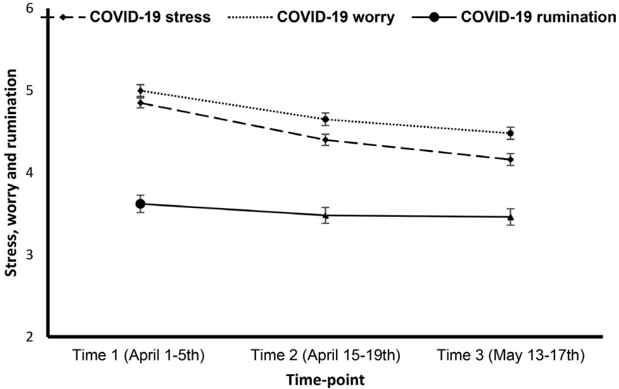
- At T1, wellbeing fell in the bottom 20% of UK norms, and life satisfaction was 4.54/10 versus UK 2019 norms of 6.8/10; life satisfaction declined to 2.69 at T2 and 2.76 at T3 (p < .001 for T1 to T2/T3). Wellbeing and burnout did not change significantly, while COVID-19 stress (4.85 to 4.16) and worry (5.00 to 4.48) decreased significantly (p < .001); rumination did not change significantly (p = .10).
- Higher trait mindfulness (β = 0.125), trait values (β = 0.422), and trait self-compassion (β = 0.218) were associated with better wellbeing (p < .001); higher state mindfulness (β = 0.491), state values (β = 0.335), and state self-compassion (β = 1.639) were also associated with better wellbeing (p < .001). State self-compassion and state values were associated with higher life satisfaction, and state mindfulness, values, and self-compassion were associated with lower burnout.
- COVID-19 stress (β = -0.524) and rumination (β = -0.190) were associated with lower wellbeing; stress (β = -0.199) was associated with lower life satisfaction; stress (β = 2.069) and rumination (β = 0.996) were associated with higher burnout. COVID-19 worry was not associated with wellbeing, life satisfaction, or burnout.
- Trait mindfulness, values, and self-compassion were positively associated with state mindfulness, values, and self-compassion; trait variables did not moderate any state-outcome relationships.
Methods
- Longitudinal questionnaire study with three timepoints during the first UK lockdown: T1 (April 1–5, 2020), T2 (April 15–19, 2020), and T3 (May 13–17, 2020). The analytic sample was 439 UK residents who completed all three timepoints (from 557 who agreed), aged 18–75 (M = 35.05, SD = 13.65), 78.8% female, and 91.3% White British.
- Measures included the Warwick-Edinburgh Mental Wellbeing Scale for wellbeing, a single-item life satisfaction measure, the Burnout Measure Short version, the 15-item Five Facet Mindfulness Questionnaire for trait mindfulness, adapted Chronic Pain Values Inventory for trait/state values, the 12-item Self-Compassion Scale for trait/state self-compassion, and single-item COVID-19 stress, worry, and rumination measures.
- Analyses used multilevel modelling in HLM version 7, with level 1 within-person state measures group-mean centred and level 2 trait measures grand-mean centred; repeated measures ANOVAs with Greenhouse-Geisser correction examined change over time. Missing data were tested with Little’s MCAR test and replaced by variable mean substitution; burnout analyses included only participants currently at work (375 of 439).
Limitations
- The paper states there was no pre-lockdown baseline, so findings cannot be attributed specifically to lockdown; the follow-up was short-term; and more detailed outcome assessments would have been useful but were balanced against participant burden.
- The paper notes preregistration occurred after data collection but before the research team viewed the data or analyses commenced.
- Evident from the text: the sample was predominantly White British (91.3%) and female (78.8%), recruited via Prolific, social media, and a university participant pool, limiting generalisability; all measures were self-report, including single-item measures for life satisfaction and COVID-19 stress/worry/rumination, and the design cannot establish causality.
Model-written summary. Check it against the paper before relying on it.
Integrity signals
Registry
Cites
Statistics
Figures

Verification
Claims the paper makes
8 Valid · 0 Not valid · 13 Not checked · 78 Own results and interpretations
The cited sources support only part of this claim — read each source’s verdict below.
In the paper
“Second, this study also confirmed that COVID-19 stress and rumination are important vulnerability factors for psychological health.”
- Also stated in: § Discussion · boosted
“Another important finding from the current study was that it confirmed that COVID-19 stress and rumination are important vulnerability factors for psychological health during the pandemic (e.g. Baiano et al., 2020; Satici et al., 2020; Zysberg & Zisberg, 2020).”
What the sources say
- Partly supportedcites Baiano et al., 2020 matched to “Tendency to worry and fear of mental health during Italy's COVID-19 lockdown” (2020) sourceExperimental — accuracy not yet measured
The Discussion says trait worry may put individuals at risk of dysfunctional psychological responses to pandemic exposure, and the Conclusions report increased anxiety sensitivity among high trait worriers during lockdown. The paper does not establish rumination or COVID-19 stress as separate vulnerability factors; its findings also come from a small sample of university students. The indexed passages provide section labels but no page numbers. (LLM, conf=0.86)
- Not matchedcites Satici et al., 2020
An author–year citation the paper’s reference list doesn’t settle. We don’t search these by name.
- Not checked — no full text of the sourcecites Zysberg & Zisberg, 2020 matched to “Days of worry: Emotional intelligence and social support mediate worry in the COVID-19 pandemic” (2022) source
boostedstates an association- Asserted: passes — The authors put it forward as true.
- Checkable: passes — It can be checked against evidence.
- Load-bearing: passes — The paper’s conclusions depend on it.
- Based: passes — The paper gives a reason why it holds.
- Also stated in: § Discussion · boosted
Every source the paper cites for this claim was checked and supports it.
In the paper
“when compared with normative comparison data, wellbeing levels, in particular, remained lower than the published norms”
- Also stated in: § Discussion · plain
“the reported levels of wellbeing across the three time points were poor by comparison with the UK general population norms (Fat et al., 2017).”
What the sources say
- Supportedcites Fat et al., 2017 matched to “Evaluating and establishing national norms for mental wellbeing using the short warwick–edinburgh mental well-being scale (SWEMWBS): Findings from the health survey for england” (2017) source
The Methods (Establishing Norms) state that the paper calculated national SWEMWBS norms from the 2010–2013 Health Survey for England, and the Norms section reports those scores. The citation supports the identification of the published comparison norms; the observation that lockdown wellbeing was lower is the citing authors’ comparison, not a finding of this 2017 paper. (LLM, conf=0.88)
plain- Asserted: passes — The authors put it forward as true.
- Checkable: passes — It can be checked against evidence.
- Load-bearing: unclear — It is unclear whether the paper’s conclusions depend on it.
- Based: passes — The paper gives a reason why it holds.
- Also stated in: § Discussion · plain
A result the paper reports from its own data — it cites no other source for it, so there is none to check. The quote shows it is in the paper.
In the paper
“Overall, at the start of the pandemic, the level of positive wellbeing reported by participants at T1 fell in the bottom 20% of responses meaning that wellbeing levels at T1 were low by comparison with comparable UK normative data (M = 23.60; SD = .05) available for the Warwick-Edinburgh Mental Wellbeing scale (pre-pandemic).”
plain- Asserted: passes — The authors put it forward as true.
- Checkable: passes — It can be checked against evidence.
- Load-bearing: unclear — It is unclear whether the paper’s conclusions depend on it.
- Based: passes — The paper gives a reason why it holds.
- Rests on an assumption not shown here.
A result the paper reports from its own data — it cites no other source for it, so there is none to check. The quote shows it is in the paper.
In the paper
“Trait mindfulness (β = 0.032, p < .001), trait values (β = 0.440, p < .001) and trait self-compassion (β = 0.063, p < .001) had a significant positive association with state values.”
plainstates an association- Asserted: passes — The authors put it forward as true.
- Checkable: passes — It can be checked against evidence.
- Load-bearing: passes — The paper’s conclusions depend on it.
- Based: passes — The paper gives a reason why it holds.
A result the paper reports from its own data — it cites no other source for it, so there is none to check. The quote shows it is in the paper.
In the paper
“trait mindfulness (β = 3.401, p < .001) and trait self-compassion (β = 0.043, p < .001) had a significant positive association with state mindfulness.”
plainstates an association- Asserted: passes — The authors put it forward as true.
- Checkable: passes — It can be checked against evidence.
- Load-bearing: unclear — It is unclear whether the paper’s conclusions depend on it.
- Based: passes — The paper gives a reason why it holds.
63 more claims
Create a free account to see all 99 claims and to verify the 2 references still open.
- Probably not a substantial claim. 23
- It may state two separate claims as one. 13
- The quote only partly states this claim. 3
Self-check
Percentages, sums and reported differences re-computed from the paper’s own numbers.
Each contradiction between two passages listed here was confirmed by an independent check.
Rated major: it would touch a result — a value a result rests on, reported and recomputed p-values on opposite sides of the significance level, two passages that conflict with no sign which is right, or a cited work retracted before this paper was published.
In the paper
§ Conclusion
“Higher levels of COVID-19 stress, worry and rumination were also associated with poorer psychological health.”
§ Hypothesis 3
“COVID-19 worry was not associated with wellbeing (β = 0.023, p = .799), life satisfaction (β = -0.086, p = 0.072) or burnout (β = 0.484, p = 0.132).”
Rated minor: it would not touch a result — a value no result rests on, a p-value that stays on the same side of the significance level, or a conflict that is clerical, resolved elsewhere in the paper, or outside its own findings.
In the paper
§ Discussion
“Results from our study show a large decline in life satisfaction in the UK from 4.54/10 to 2.56/10 six weeks after the start of the pandemic.”
§ Descriptive statistics
“T3 (M = 2.76; SD = 2.09).”
Rated minor: it would not touch a result — a value no result rests on, a p-value that stays on the same side of the significance level, or a conflict that is clerical, resolved elsewhere in the paper, or outside its own findings.
In the paper
§ Descriptive statistics
“higher at T1 than when these were measured at T2, for the former (M = 4.16; SD = 1.53) and the latter (M = 4.48; SD = 1.38)”
§ Descriptive statistics
“| COVID-19 worry | 5.00 | 1.28 | 4.65 | 1.39 | 4.48 | 1.38 | 76.133** ( p < .001) | .15 | | COVID-19 rumination | 3.62 | 1.71 | 3.48 | 1.67 | 3.46 | 1.68 | 2.349 ( p = .10) | .01 | | COVID-19 stress | 4.85 | 1.28 | 4.40 | 1.45 | 4.16 | 1.53 | 58.145** ( p < .001) | .12 |”
Rated minor: it would not touch a result — a value no result rests on, a p-value that stays on the same side of the significance level, or a conflict that is clerical, resolved elsewhere in the paper, or outside its own findings.
In the paper
§ Hypothesis 4
“trait mindfulness (β = 3.401, p < .001) and trait self-compassion (β = 0.043, p < .001) had a significant positive association with state mindfulness.”
§ Hypothesis 3
“| | | 3.401** | 0.039 | 0.043** | | | | | Coefficient | | 0.032* | | | |”
Citations
Cites
The psychological impact of quarantine and how to reduce it: Rapid review of the evidence
Brooks, S. K., Webster, R. K., Smith, L. E., Woodland, L., Wessely, S., Greenberg, N., & Rubin, G. J. (2020) · The Lancet · doi:10.1016/s0140-6736(20)30460-8 · Cited by 16,378 · cited 1×
“These studies confirmed data from previous infectious diseases (e.g. Brooks et al., 2020), showing that public health measures such as isolation, quarantine and community containment are effective in slowing down the spread of the disease (Wilder-Smith & Freedman, 2020).”
ResultThe benefits of being present: Mindfulness and its role in psychological well-being
Brown, K. W., & Ryan, R. M. (2003) · Journal of Personality and Social Psychology · doi:10.1037/0022-3514.84.4.822 · Cited by 13,448 · cited 2×
“Participants rated state mindfulness by completing an adapted version of the Mindful Attention Awareness Scale (MAAS; Brown & Ryan, 2003).”
BackgroundMethodInfluentialUsing Self-Report Assessment Methods to Explore Facets of Mindfulness
Baer, R. A., Smith, G. T., Hopkins, J., Krietemeyer, J., & Toney, L. (2006) · Assessment · doi:10.1177/1073191105283504 · Cited by 7,511 · cited 1×
“The factor structure of this scale is consistent with the longer version (FFMQ-39) and has good internal consistency across a range of samples (.72–.92, Gu et al., 2016; Baer et al., 2006, 2008).”
ResultAcceptance and commitment therapy: model, processes and outcomes
Hayes, S. C., Luoma, J. B., Bond, F. W., Masuda, A., & Lillis, J. (2006) · Behaviour Research and Therapy · doi:10.1016/j.brat.2005.06.006 · Cited by 6,587 · cited 1×
“For example, promoting ACT-based training more widely in the NHS and in communities could help lessen the negative effects of the pandemic on people’s wellbeing and on healthcare staffs’ mental health (Hayes et al., 2006; Prudenzi et al., 2021b).”
BackgroundHolmes, E. A., O'Connor, R. C., Perry, V. H., Tracey, I., Wessely, S., Arseneault, L., Ballard, C., Christensen, H., Cohen Silver, R., Everall, I., et al. (2020) · The Lancet Psychiatry · doi:10.1016/s2215-0366(20)30168-1 · Cited by 5,715 · cited 3×
“The early stages of the pandemic represented a novel context—that included sudden and unknown risks to health, local and international lockdowns, mass movement to home-working, bereavements and social isolation (e.g. Holmes et al., 2020; O’Connor et al., 2020).”
BackgroundImpact of COVID-19 pandemic on mental health in the general population: a systematic review
Xiong, J., Lipsitz, O., Nasri, F., Lui, L. M. W., Gill, H., Phan, L., Chen-Li, D., Iacobucci, M., Ho, R., Majeed, A., et al. (2020) · Journal of Affective Disorders · doi:10.1016/j.jad.2020.08.001 · Cited by 5,204 · cited 4×
“Indeed, whilst a large amount of the emerging evidence has focussed on understanding the negative effects of the pandemic on psychological health, less has investigated which psychological factors may protect or confer resilience (Xiong et al., 2020, for a review).”
BackgroundResultInfluentialThe Warwick-Edinburgh Mental Well-being Scale (WEMWBS): development and UK validation
Tennant, R., Hiller, L., Fishwick, R., Platt, S., Joseph, S., Weich, S., Parkinson, J., Secker, J., & Stewart-Brown, S. (2007) · Health and Quality of Life Outcomes · doi:10.1186/1477-7525-5-63 · Cited by 5,031 · cited 2×
“A brief seven-item self-report inventory scale, The Warwick-Edinburgh Mental Wellbeing scale (Tennant et al., 2007), was used to assess wellbeing in the general population (e.g. ‘Over the past two weeks have you been feeling optimistic about the future?’).”
MethodInfluentialMental health and the COVID-19 pandemic
Pfefferbaum, B., & North, C. S. (2020) · New England Journal of Medicine · doi:10.1056/nejmp2008017 · Cited by 4,378 · cited 1×
“Moreover, recent reports in the UK suggest that one in three NHS staff suffered mental health issues related to the pandemic (Al-Ghunaim et al., 2021; Cullen et al., 2020; Pfefferbaum et al., 2020).”
BackgroundPsychological flexibility as a fundamental aspect of health
Kashdan, T. B., & Rottenberg, J. (2010) · Clinical Psychology Review · doi:10.1016/j.cpr.2010.03.001 · Cited by 3,054 · cited 2×
“Given the robustness of psychological flexibility as a construct and promoter of psychological health (Kashdan & Rottenberg, 2010 for a review), in this study, we hypothesised that dispositional psychological flexibility may help individuals face the challenging environments driven by the pandemic…”
BackgroundIntroducing Multilevel Modeling
Kreft, I., & de Leeuw, J. (1998) · doi:10.4135/9781849209366 · Cited by 2,997
Construction and factorial validation of a short form of the Self-Compassion Scale
Raes, F., Pommier, E., Neff, K. D., & Van Gucht, D. (2011) · Clinical Psychology & Psychotherapy · doi:10.1002/cpp.702 · Cited by 2,997 · cited 3×
“The scale demonstrates high internal consistency (α ≥ 0.86, Hayes et al., 2016; Raes et al., 2011).”
BackgroundMethodInfluentialBaer, R. A., Smith, G. T., Lykins, E., Button, D., Krietemeyer, J., Sauer, S., Walsh, E., Duggan, D., & Williams, J. M. G. (2008) · Assessment · doi:10.1177/1073191107313003 · Cited by 2,930 · cited 1×
“The factor structure of this scale is consistent with the longer version (FFMQ-39) and has good internal consistency across a range of samples (.72–.92, Gu et al., 2016; Baer et al., 2006, 2008).”
ResultWilder-Smith, A., & Freedman, D. O. (2020) · Journal of Travel Medicine · doi:10.1093/jtm/taaa020 · Cited by 2,727 · cited 1×
“These studies confirmed data from previous infectious diseases (e.g. Brooks et al., 2020), showing that public health measures such as isolation, quarantine and community containment are effective in slowing down the spread of the disease (Wilder-Smith & Freedman, 2020).”
ResultWang, C., Pan, R., Wan, X., Tan, Y., Xu, L., McIntyre, R. S., Choo, F. N., Tran, B., Ho, R., Sharma, V. K., et al. (2020) · Brain, Behavior, and Immunity · doi:10.1016/j.bbi.2020.04.028 · Cited by 2,571 · cited 3×
“…to poorer mental health (e.g. Cheng & Tang, 2004; García-Fernández et al., 2020; Holmes et al., 2020; O’Connor et al., 2020a; O’Connor et al., 2020b; Wang et al., 2020; Xiong et al., 2020; Yu et al., 2005) especially in healthcare professionals (e.g. Al-Ghunaim et al., 2021; Cartwright &…”
BackgroundCiotti, M., Ciccozzi, M., Terrinoni, A., Jiang, W.-C., Wang, C.-B., & Bernardini, S. (2020) · Critical Reviews in Clinical Laboratory Sciences · doi:10.1080/10408363.2020.1783198 · Cited by 1,514 · cited 1×
“The novel coronavirus was named severe acute respiratory syndrome coronavirus 2 (SARS-CoV-2), while the disease associated with it was named COVID-19 (Ciotti et al., 2020).”
BackgroundMental health in the COVID-19 pandemic
Cullen, W., Gulati, G., & Kelly, B. D. (2020) · QJM: An International Journal of Medicine · doi:10.1093/qjmed/hcaa110 · Cited by 1,275 · cited 2×
“Moreover, recent reports in the UK suggest that one in three NHS staff suffered mental health issues related to the pandemic (Al-Ghunaim et al., 2021; Cullen et al., 2020; Pfefferbaum et al., 2020).”
BackgroundStewart-Brown, S., Tennant, A., Tennant, R., Platt, S., Parkinson, J., & Weich, S. (2009) · Health and Quality of Life Outcomes · doi:10.1186/1477-7525-7-15 · Cited by 1,251
Progression of Mental Health Services during the COVID-19 Outbreak in China
Li, W., Yang, Y., Liu, Z.-H., Zhao, Y.-J., Zhang, Q., Zhang, L., Cheung, T., & Xiang, Y.-T. (2020) · International Journal of Biological Sciences · doi:10.7150/ijbs.45120 · Cited by 1,213 · cited 1×
“The emerging psychological evidence on COVID-19 has mainly focussed on understanding the negative effects of the pandemic on psychological health (e.g. Fullana et al., 2020; Li et al., 2020; Wang et al., 2020).”
BackgroundInternational Journal of Mental Health and Addiction
(2013) · International Journal of Mental Health and Addiction · doi:10.1007/11469.1557-1882 · Cited by 1,058
Mishra, P. P., & Dash, S. (2019) · The Palgrave Encyclopedia of Global Security Studies · doi:10.1007/978-3-319-74336-3_371-1 · Cited by 1,049
O'Connor, R. C., Wetherall, K., Cleare, S., McClelland, H., Melson, A. J., Niedzwiedz, C. L., O'Carroll, R. E., O'Connor, D. B., Platt, S., Scowcroft, E., et al. (2021) · The British Journal of Psychiatry · doi:10.1192/bjp.2020.212 · Cited by 1,042 · cited 6×
“…likely to give rise to poorer mental health (e.g. Cheng & Tang, 2004; García-Fernández et al., 2020; Holmes et al., 2020; O’Connor et al., 2020a; O’Connor et al., 2020b; Wang et al., 2020; Xiong et al., 2020; Yu et al., 2005) especially in healthcare professionals (e.g. Al-Ghunaim et al.,…”
BackgroundInfluentialSelf-citationStress and Health: A Review of Psychobiological Processes
O'Connor, D. B., Thayer, J. F., & Vedhara, K. (2021) · Annual Review of Psychology · doi:10.1146/annurev-psych-062520-122331 · Cited by 948
Self-citationDifede, J. (1997) · JAMA: The Journal of the American Medical Association · doi:10.1001/jama.1997.03540450090047 · Cited by 649
Salazar de Pablo, G., Vaquerizo-Serrano, J., Catalan, A., Arango, C., Moreno, C., Ferre, F., Shin, J. I., Sullivan, S., Brondino, N., Solmi, M., et al. (2020) · Journal of Affective Disorders · doi:10.1016/j.jad.2020.06.022 · Cited by 631 · cited 1×
“…et al., 2020b; Wang et al., 2020; Xiong et al., 2020; Yu et al., 2005) especially in healthcare professionals (e.g. Al-Ghunaim et al., 2021; Cartwright & Thompson, 2020; Kadhum et al., 2020; Kannampallil et al., 2020; Khalafallah et al., 2020; Salazar de Pablo et al., 2020; Wu et al., 2020).”
BackgroundThe Burnout Measure, Short Version.
Malach-Pines, A. (2005) · International Journal of Stress Management · doi:10.1037/1072-5245.12.1.78 · Cited by 610 · cited 7×
“Overall burnout levels were low and were not markedly different by comparison to relevant normative data (Malach-Pines, 2005).”
BackgroundMethodResultInfluentialSatici, B., Saricali, M., Satici, S. A., & Griffiths, M. D. (2022) · International Journal of Mental Health and Addiction · doi:10.1007/s11469-020-00305-0 · Cited by 580 · cited 2×
“Our results for life satisfaction are in line with emerging (Satici et al., 2020) and previous studies (e.g. Yu et al., 2005; Cheng & Tang, 2004) showing that the pandemic may be a significant threat for different aspects of wellbeing.”
BackgroundResultNg Fat, L., Scholes, S., Boniface, S., Mindell, J., & Stewart-Brown, S. (2017) · Quality of Life Research · doi:10.1007/s11136-016-1454-8 · Cited by 548 · cited 1×
“Although it is not possible to make direct comparisons with the levels of wellbeing pre-pandemic, the reported levels of wellbeing across the three time points were poor by comparison with the UK general population norms (Fat et al., 2017).”
ResultClarke, A., Friede, T., Putz, R., Ashdown, J., Martin, S., Blake, A., Adi, Y., Parkinson, J., Flynn, P., Platt, S., et al. (2011) · BMC Public Health · doi:10.1186/1471-2458-11-487 · Cited by 493 · cited 1×
“This scale showed good content validity with a Cronbach’s alpha score of 0.89 (student sample) and 0.91 (population sample) (Clarke et al., 2011; Stewart-Brown et al., 2009; Tennant et al., 2007).”
MethodInfluentialThe British Journal of Psychiatry
(1978) · British Journal of Psychiatry · doi:10.1192/s0007125000095386 · Cited by 470
McCracken, L. M., & Morley, S. (2014) · The Journal of Pain · doi:10.1016/j.jpain.2013.10.014 · Cited by 464 · cited 1×
“Psychological flexibility can be defined as ‘the capacity to persist or to change behaviour in a way that includes conscious and open contact with thoughts and feelings, appreciates what the situation affords, and is guided by one’s goals and values’ (McCracken & Morley, 2014, p. 8).”
BackgroundAssessing coping flexibility in real-life and laboratory settings: A multimethod approach
Cheng, C. (2001) · Journal of Personality and Social Psychology · doi:10.1037/0022-3514.80.5.814 · Cited by 463 · cited 3×
“Cheng et al. (2001, 2003) found, on multiple occasions, that psychological flexibility (one’s intentions to display situation-appropriate behaviours, Cheng, 2001, p. 814) was a robust predictor of both problem-focused and emotion-focused coping strategies during stressful events (one’s behaviours…”
BackgroundResultFacilitating Posttraumatic Growth
(1999) · doi:10.4324/9781410602268 · Cited by 446
Dawson, D. L., & Golijani-Moghaddam, N. (2020) · Journal of Contextual Behavioral Science · doi:10.1016/j.jcbs.2020.07.010 · Cited by 445 · cited 2×
“In a study of UK residents (Dawson & Golijani-Moghaddam, 2020), overall psychological flexibility was positively related to wellbeing and negatively associated with depression, anxiety, COVID-19 stress and worry.”
BackgroundResultGu, J., Strauss, C., Crane, C., Barnhofer, T., Karl, A., Cavanagh, K., & Kuyken, W. (2016) · Psychological Assessment · doi:10.1037/pas0000263 · Cited by 431 · cited 2×
“The factor structure of this scale is consistent with the longer version (FFMQ-39) and has good internal consistency across a range of samples (.72–.92, Gu et al., 2016; Baer et al., 2006, 2008).”
MethodResultExposure to COVID-19 patients increases physician trainee stress and burnout
Kannampallil, T. G., Goss, C. W., Evanoff, B. A., Strickland, J. R., McAlister, R. P., & Duncan, J. (2020) · PLOS ONE · doi:10.1371/journal.pone.0237301 · Cited by 389 · cited 1×
“…et al., 2020b; Wang et al., 2020; Xiong et al., 2020; Yu et al., 2005) especially in healthcare professionals (e.g. Al-Ghunaim et al., 2021; Cartwright & Thompson, 2020; Kadhum et al., 2020; Kannampallil et al., 2020; Khalafallah et al., 2020; Salazar de Pablo et al., 2020; Wu et al., 2020).”
BackgroundFullana, M. A., Hidalgo-Mazzei, D., Vieta, E., & Radua, J. (2020) · Journal of Affective Disorders · doi:10.1016/j.jad.2020.06.027 · Cited by 382 · cited 1×
“The emerging psychological evidence on COVID-19 has mainly focussed on understanding the negative effects of the pandemic on psychological health (e.g. Fullana et al., 2020; Li et al., 2020; Wang et al., 2020).”
BackgroundThe Role of Fear-Related Behaviors in the 2013–2016 West Africa Ebola Virus Disease Outbreak
Shultz, J. M., Cooper, J. L., Baingana, F., Oquendo, M. A., Espinel, Z., Althouse, B. M., Marcelin, L. H., Towers, S., Espinola, M., McCoy, C. B., et al. (2016) · Current Psychiatry Reports · doi:10.1007/s11920-016-0741-y · Cited by 328 · cited 1×
“…outcomes are also concerning given that behaviours driven by stress and fear (e.g. stockpiling goods or not wearing a face covering) may accelerate the spread of the disease or exacerbate its impact (Shultz et al., 2016) and can influence health behaviours including sleep (Clancy et al., 2020c).”
BackgroundThe Development and Validation of the State Self-Compassion Scale (Long- and Short Form)
Neff, K. D., Tóth-Király, I., Knox, M. C., Kuchar, A., & Davidson, O. (2021) · Mindfulness · doi:10.1007/s12671-020-01505-4 · Cited by 309 · cited 3×
“State self-compassion was assessed with the 12-item Self-Compassion Scale (Raes et al., 2011).”
BackgroundMethodInfluentialPsychological stress of medical staffs during outbreak of COVID‐19 and adjustment strategy
Wu, W., Zhang, Y., Wang, P., Zhang, L., Wang, G., Lei, G., Xiao, Q., Cao, X., Bian, Y., Xie, S., et al. (2020) · Journal of Medical Virology · doi:10.1002/jmv.25914 · Cited by 261 · cited 1×
“…et al., 2020b; Wang et al., 2020; Xiong et al., 2020; Yu et al., 2005) especially in healthcare professionals (e.g. Al-Ghunaim et al., 2021; Cartwright & Thompson, 2020; Kadhum et al., 2020; Kannampallil et al., 2020; Khalafallah et al., 2020; Salazar de Pablo et al., 2020; Wu et al., 2020).”
BackgroundThe role of values in a contextual cognitive-behavioral approach to chronic pain
McCracken, L. M., & Yang, S.-Y. (2006) · Pain · doi:10.1016/j.pain.2006.02.021 · Cited by 260 · cited 4×
“Trait values were assessed with an adapted version of the Chronic Pain Values Inventory (CPVI; McCracken & Yang, 2006) published in Hegarty et al. (2019).”
BackgroundMethodInfluentialTol, W. A., Leku, M. R., Lakin, D. P., Carswell, K., Augustinavicius, J., Adaku, A., Au, T. M., Brown, F. L., Bryant, R. A., Garcia-Moreno, C., et al. (2020) · The Lancet Global Health · doi:10.1016/s2214-109x(19)30504-2 · Cited by 249 · cited 1×
“Recent studies have shown that at times of great difficulty, such as wars (Tol et al., 2020), school shootings, devastating storms, or violent crime (e.g. Brockman et al., 2016; Gold & Marx 2007; Kumpula et al., 2011), higher psychological flexibility can help people function effectively even when…”
BackgroundLyubomirsky, S., Layous, K., Chancellor, J., & Nelson, S. K. (2015) · Annual Review of Clinical Psychology · doi:10.1146/annurev-clinpsy-032814-112733 · Cited by 222 · cited 1×
“The latter findings are unsurprising given that the effects of stress and rumination on mental health, as well as on physical health outcomes, are well established (e.g. Clancy et al., 2016, 2020b; Lyubomirsky et al., 2015; McCarrick et al., 2021; O’Connor et al., 2021).”
BackgroundResearch priorities for the COVID‐19 pandemic and beyond: A call to action for psychological science
O'Connor, D. B., Aggleton, J. P., Chakrabarti, B., Cooper, C. L., Creswell, C., Dunsmuir, S., Fiske, S. T., Gathercole, S., Gough, B., Ireland, J. L., et al. (2020) · British Journal of Psychology · doi:10.1111/bjop.12468 · Cited by 210 · cited 3×
“…measures are also likely to give rise to poorer mental health (e.g. Cheng & Tang, 2004; García-Fernández et al., 2020; Holmes et al., 2020; O’Connor et al., 2020a; O’Connor et al., 2020b; Wang et al., 2020; Xiong et al., 2020; Yu et al., 2005) especially in healthcare professionals (e.g.…”
BackgroundSelf-citationPakenham, K. I., Landi, G., Boccolini, G., Furlani, A., Grandi, S., & Tossani, E. (2020) · Journal of Contextual Behavioral Science · doi:10.1016/j.jcbs.2020.07.003 · Cited by 210 · cited 2×
“…these results are consistent with a number of previous studies (Brockman et al., 2016; Gold & Marx 2007; Kumpula et al., 2011) and build upon and improve the cross-sectional evidence that is emerging from pandemic (Dawson & Golijani-Moghaddam, 2020; Landi et al., 2020; Pakenham et al., 2020).”
BackgroundResultCognitive and motivational processes underlying coping flexibility: A dual-process model
Cheng, C. (2003) · Journal of Personality and Social Psychology · doi:10.1037/0022-3514.84.2.425 · Cited by 208 · cited 2×
“Cheng et al. (2001, 2003) found, on multiple occasions, that psychological flexibility (one’s intentions to display situation-appropriate behaviours, Cheng, 2001, p. 814) was a robust predictor of both problem-focused and emotion-focused coping strategies during stressful events (one’s behaviours…”
BackgroundResultMental Health in Elderly Spanish People in Times of COVID-19 Outbreak
Fernandez, L. G., Romero‐Ferreiro, V., López‐Roldán, P. D., Padilla, S., & Rodríguez–Jiménez, R. (2020) · American Journal of Geriatric Psychiatry · doi:10.1016/j.jagp.2020.06.027 · Cited by 168 · cited 1×
“However, restrictive measures are also likely to give rise to poorer mental health (e.g. Cheng & Tang, 2004; García-Fernández et al., 2020; Holmes et al., 2020; O’Connor et al., 2020a; O’Connor et al., 2020b; Wang et al., 2020; Xiong et al., 2020; Yu et al., 2005) especially in healthcare…”
BackgroundClancy, F., Prestwich, A., Caperon, L., Tsipa, A., & O’Connor, D. B. (2020) · Health Psychology Review · doi:10.1080/17437199.2019.1700819 · Cited by 165 · cited 4×
“Single item measures of stress, rumination and worry have been used successfully in previous research and have been shown to be reliable and valid (Clancy et al., 2020a; O’Connor & Ferguson, 2016; Zoccola et al., 2011).”
BackgroundMethodInfluentialKumpula, M. J., Orcutt, H. K., Bardeen, J. R., & Varkovitzky, R. L. (2011) · Journal of Abnormal Psychology · doi:10.1037/a0023927 · Cited by 162 · cited 2×
“…difficulty, such as wars (Tol et al., 2020), school shootings, devastating storms, or violent crime (e.g. Brockman et al., 2016; Gold & Marx 2007; Kumpula et al., 2011), higher psychological flexibility can help people function effectively even when experiencing strong emotions such as fear and…”
BackgroundResultCrouse Quinn, S. (2008) · Health Promotion Practice · doi:10.1177/1524839908324022 · Cited by 152 · cited 2×
“The factor structure of this scale is consistent with the longer version (FFMQ-39) and has good internal consistency across a range of samples (.72–.92, Gu et al., 2016; Baer et al., 2006, 2008).”
BackgroundResultLandi, G., Pakenham, K. I., Boccolini, G., Grandi, S., & Tossani, E. (2020) · Frontiers in Psychology · doi:10.3389/fpsyg.2020.02195 · Cited by 146 · cited 2×
“…these results are consistent with a number of previous studies (Brockman et al., 2016; Gold & Marx 2007; Kumpula et al., 2011) and build upon and improve the cross-sectional evidence that is emerging from pandemic (Dawson & Golijani-Moghaddam, 2020; Landi et al., 2020; Pakenham et al., 2020).”
BackgroundResultThe Dynamics of Fear at the Time of Covid-19: A Contextual Behavioral Science Perspective.
(2020) · PubMed Central · doi:10.36131/cn20200206 · Cited by 115
Perseverative Cognition and Health Behaviors: A Systematic Review and Meta-Analysis
Clancy, F., Prestwich, A., Caperon, L., & O'Connor, D. B. (2016) · Frontiers in Human Neuroscience · doi:10.3389/fnhum.2016.00534 · Cited by 110 · cited 2×
“The latter findings are unsurprising given that the effects of stress and rumination on mental health, as well as on physical health outcomes, are well established (e.g. Clancy et al., 2016, 2020b; Lyubomirsky et al., 2015; McCarrick et al., 2021; O’Connor et al., 2021).”
BackgroundMethodSelf-citationConstruct validity of the Self-Compassion Scale-Short Form among psychotherapy clients
Hayes, J. A., Lockard, A. J., Janis, R. A., & Locke, B. D. (2016) · Counselling Psychology Quarterly · doi:10.1080/09515070.2016.1138397 · Cited by 107 · cited 1×
“The scale demonstrates high internal consistency (α ≥ 0.86, Hayes et al., 2016; Raes et al., 2011).”
BackgroundInfluentialAssessment in Health Psychology
(2015) · Hogrefe Publishing eBooks · doi:10.1027/00452-000 · Cited by 107
Gold, S. D., Marx, B. P., & Lexington, J. M. (2007) · Behaviour Research and Therapy · doi:10.1016/j.brat.2006.05.006 · Cited by 104 · cited 2×
“…at times of great difficulty, such as wars (Tol et al., 2020), school shootings, devastating storms, or violent crime (e.g. Brockman et al., 2016; Gold & Marx 2007; Kumpula et al., 2011), higher psychological flexibility can help people function effectively even when experiencing strong emotions…”
BackgroundResultBrockman, C., Snyder, J., Gewirtz, A., Gird, S. R., Quattlebaum, J., Schmidt, N., Pauldine, M. R., Elish, K., Schrepferman, L., Hayes, C., et al. (2016) · Journal of Family Psychology · doi:10.1037/fam0000152 · Cited by 103 · cited 2×
“…studies have shown that at times of great difficulty, such as wars (Tol et al., 2020), school shootings, devastating storms, or violent crime (e.g. Brockman et al., 2016; Gold & Marx 2007; Kumpula et al., 2011), higher psychological flexibility can help people function effectively even when…”
BackgroundResultDays of worry: Emotional intelligence and social support mediate worry in the COVID-19 pandemic
Zysberg, L., & Zisberg, A. (2022) · Journal of Health Psychology · doi:10.1177/1359105320949935 · Cited by 101
Tendency to worry and fear of mental health during Italy's COVID-19 lockdown
Baiano, C., Zappullo, I., the LabNPEE Group, & Conson, M. (2020) · International Journal of Environmental Research and Public Health · doi:10.3390/ijerph17165928 · Cited by 87 · cited 1×
“Another important finding from the current study was that it confirmed that COVID-19 stress and rumination are important vulnerability factors for psychological health during the pandemic (e.g. Baiano et al., 2020; Satici et al., 2020; Zysberg & Zisberg, 2020).”
BackgroundBasavanthappa, B. (2015) · Jaypee Brothers Medical Publishers (P) Ltd. eBooks · doi:10.5005/jp/books/12612_20 · Cited by 85
Burnout and career satisfaction among attending neurosurgeons during the COVID-19 pandemic
Khalafallah, A. M., Lam, S., Gami, A., Dornbos, D. L., Sivakumar, W., Johnson, J. N., & Mukherjee, D. (2020) · Clinical Neurology and Neurosurgery · doi:10.1016/j.clineuro.2020.106193 · Cited by 77 · cited 1×
“…et al., 2020b; Wang et al., 2020; Xiong et al., 2020; Yu et al., 2005) especially in healthcare professionals (e.g. Al-Ghunaim et al., 2021; Cartwright & Thompson, 2020; Kadhum et al., 2020; Kannampallil et al., 2020; Khalafallah et al., 2020; Salazar de Pablo et al., 2020; Wu et al., 2020).”
BackgroundThe psychological burden experienced by Hong Kong midlife women during the SARS epidemic
Yu, H. Y. R., Ho, S. C., So, K. F. E., & Lo, Y. L. (2005) · Stress and Health · doi:10.1002/smi.1051 · Cited by 76 · cited 3×
“…Tang, 2004; García-Fernández et al., 2020; Holmes et al., 2020; O’Connor et al., 2020a; O’Connor et al., 2020b; Wang et al., 2020; Xiong et al., 2020; Yu et al., 2005) especially in healthcare professionals (e.g. Al-Ghunaim et al., 2021; Cartwright & Thompson, 2020; Kadhum et al., 2020;…”
BackgroundResultTrait and state perseverative cognition and the cortisol awakening response
Zoccola, P. M., Dickerson, S. S., & Yim, I. S. (2010) · Psychoneuroendocrinology · doi:10.1016/j.psyneuen.2010.10.004 · Cited by 65 · cited 1×
“Single item measures of stress, rumination and worry have been used successfully in previous research and have been shown to be reliable and valid (Clancy et al., 2020a; O’Connor & Ferguson, 2016; Zoccola et al., 2011).”
MethodCheng, C., & Tang, C. S. (2004) · Asian Journal of Social Psychology · doi:10.1111/j.1467-839x.2004.00130.x · Cited by 64 · cited 2×
“Our results for life satisfaction are in line with emerging (Satici et al., 2020) and previous studies (e.g. Yu et al., 2005; Cheng & Tang, 2004) showing that the pandemic may be a significant threat for different aspects of wellbeing.”
BackgroundResultPrudenzi, A., Graham, C. D., Clancy, F., Hill, D., O'Driscoll, R., Day, F., & O'Connor, D. B. (2021) · Journal of Affective Disorders · doi:10.1016/j.jad.2021.07.084 · Cited by 64 · cited 2×
“…suggests that the hypothesised psychological factors (i.e. state mindfulness, values and self-compassion) might be protective of wellbeing and help individuals adjust to changes when faced with an uncertain, challenging and stressful environment (Calhoun & Tedeschi, 1999; Prudenzi et al., 2021b).”
BackgroundSelf-citationPrudenzi, A., D. Graham, C., Flaxman, P. E., & O’Connor, D. B. (2022) · Psychology, Health & Medicine · doi:10.1080/13548506.2021.1898651 · Cited by 58 · cited 2×
“…suggests that the hypothesised psychological factors (i.e. state mindfulness, values and self-compassion) might be protective of wellbeing and help individuals adjust to changes when faced with an uncertain, challenging and stressful environment (Calhoun & Tedeschi, 1999; Prudenzi et al., 2021b).”
BackgroundSelf-citationMcAllister, T. W., & Trzepacz, P. T. (1989) · Journal of Neuropsychiatry · doi:10.1176/jnp.1.2.198 · Cited by 52
Health Effects of Psychological Interventions for Worry and Rumination: A Meta-analysis
McCarrick, D., Prestwich, A., Prudenzi, A., & O'Connor, D. B. (2021) · Health Psychology · doi:10.1037/hea0000985 · Cited by 51
Al-Ghunaim, T. A., Johnson, J., Biyani, C. S., & O’Connor, D. (2021) · BMJ Open · doi:10.1136/bmjopen-2020-045699 · Cited by 45 · cited 2×
“…O’Connor et al., 2020a; O’Connor et al., 2020b; Wang et al., 2020; Xiong et al., 2020; Yu et al., 2005) especially in healthcare professionals (e.g. Al-Ghunaim et al., 2021; Cartwright & Thompson, 2020; Kadhum et al., 2020; Kannampallil et al., 2020; Khalafallah et al., 2020; Salazar de Pablo et…”
BackgroundSelf-citationMental wellbeing and burnout in surgical trainees: implications for the post-COVID-19 era
Kadhum, M., Farrell, S., Hussain, R., & Molodynski, A. (2020) · British journal of surgery · doi:10.1002/bjs.11726 · Cited by 38 · cited 1×
“…et al., 2020b; Wang et al., 2020; Xiong et al., 2020; Yu et al., 2005) especially in healthcare professionals (e.g. Al-Ghunaim et al., 2021; Cartwright & Thompson, 2020; Kadhum et al., 2020; Kannampallil et al., 2020; Khalafallah et al., 2020; Salazar de Pablo et al., 2020; Wu et al., 2020).”
BackgroundDo Worry and Brooding Predict Health Behaviors? A Daily Diary Investigation
Clancy, F., O'Connor, D. B., & Prestwich, A. (2020) · International Journal of Behavioral Medicine · doi:10.1007/s12529-020-09898-1 · Cited by 21 · cited 4×
“Single item measures of stress, rumination and worry have been used successfully in previous research and have been shown to be reliable and valid (Clancy et al., 2020a; O’Connor & Ferguson, 2016; Zoccola et al., 2011).”
BackgroundMethodInfluentialSelf-citationTemplate for Rapid Iterative Consensus of Experts (TRICE)
Chater, A., Shorter, G. W., Swanson, V., Kamal, A., Epton, T., Arden, M. A., Hart, J., Byrne-Davis, L. M. T., Drury, J., Whittaker, E., et al. (2021) · International Journal of Environmental Research and Public Health · doi:10.3390/ijerph181910255 · Cited by 16 · cited 1×
“During the COVID-19 pandemic, behavioural scientists and psychologists have played an important role in advising governments on how to implement lockdown and social distancing measures (Chater et al., 2021; O’Connor et al., 2020a).”
BackgroundSelf-citationClancy, F., Prestwich, A., Ferguson, E., & O'Connor, D. B. (2021) · Psychology and Health · doi:10.1080/08870446.2020.1867727 · Cited by 16
Self-citationHansen, S. R., Wetherell, M. A., & Smith, M. (2021) · Psychology and Health · doi:10.1080/08870446.2021.1936521 · Cited by 13
Hegarty, R. S. M., Treharne, G. J., Stebbings, S., Graham, K., & Conner, T. S. (2019) · Psychology & Health · doi:10.1080/08870446.2018.1520232 · Cited by 8 · cited 4×
“Trait values were assessed with an adapted version of the Chronic Pain Values Inventory (CPVI; McCracken & Yang, 2006) published in Hegarty et al. (2019).”
BackgroundMethodInfluentialTol, W. A., Leku, M. R., Lakin, D. P., Carswell, K., Augustinavicius, J., Adaku, A., Brown, F. L., Bryant, R. A., Moreno, C. G., Musci, R. J., et al. (2019) · SSRN Electronic Journal · doi:10.2139/ssrn.3396026 · Cited by 7
Clancy, F., Prestwich, A., & O'Connor, D. B. (2019) · doi:10.31234/osf.io/w952r · Cited by 5
Self-citationBarbero (2014) · doi:10.1016/j · Cited by 1
Research works printed but not linked: 1
- Raudenbush, S. W., Bryk, A. S., & Congdon, R. (2011). HLM 7 for Windows . Scientific Software International.
Cited by
O'Connor, D. B., Wilding, S., Ferguson, E., Cleare, S., Wetherall, K., McClelland, H., Melson, A. J., Niedzwiedz, C. L., O’Carroll, R. E., Platt, S., et al. (2022) · Journal of Mental Health · doi:10.1080/09638237.2022.2069716 · Cited by 101
“Interventions that promote psychological flexibility (i.e., mindfulness, self-compassion) are also likely to yield benefits (Prudenzi et al., 2022).”
BackgroundSelf-citationChong, Y. Y., Frey, E., Chien, W. T., Cheng, H. Y., & Gloster, A. T. (2023) · Journal of Nursing Scholarship · doi:10.1111/jnu.12874 · Cited by 42
Sales trends of psychotropic drugs in the COVID-19 pandemic: A national database study in Brazil
Fiol, F. D. S. D., Bergamaschi, C. D. C., Lopes, L. C., Silva, M. T., & Barberato-Filho, S. (2023) · Frontiers in Pharmacology · doi:10.3389/fphar.2023.1131357 · Cited by 27
“Some studies have shown that the impact on the mental health of populations was important, with exacerbated conditions of depression, anxiety, panic, including suicidal ideation, especially among young people and health professionals (Gloster et al., 2020; de Vroege and van den Broek, 2021; Varga et al., 2021; Acharya…”
BackgroundWilding, S., O'Connor, D. B., Ferguson, E., Wetherall, K., Cleare, S., O’Carroll, R. E., Robb, K. A., & O’Connor, R. C. (2022) · Psychiatry Research · doi:10.1016/j.psychres.2022.114876 · Cited by 17
Self-citationThe effects of psychological flexibility and night shifts on mental health and well-being in nurses
Li, X., Han, J., & Lin, H. (2024) · PLoS ONE · doi:10.1371/journal.pone.0313634 · Cited by 14
“For example, Prudenzi et al., (2023) reported an association between higher levels psychological flexibility with better mental health in British adults during the first wave of the COVID-19 pandemic [53].”
Metadata
- Authors
- Prudenzi, A., Graham, C. D., Rogerson, O., & O’Connor, D. B.
- Affiliations
- University of Leeds (GB)
- Queen's University Belfast (GB)
- School of Psychology, University of Leeds
- Corresponding author
- Prudenzi, Arianna
- Venue
- Psychology & Health
- Publisher
- Informa UK Limited
- Published
- 2022-01-24
- Volume
- 38
- Issue
- 10
- Pages
- 1378-1401
- ISSN
- 0887-0446 (ISSN-L)
- 1476-8321
- OpenAlex
- W4210682154
- Semantic Scholar
- 060acc59fdd34984799a37194014e575160d2a0e
- Cited by
- 27
- References
- 68
- Citations by year
- 2026: 1 · 2025: 7 · 2024: 7 · 2023: 9 · 2022: 3
- FWCI
- 5.93
- Type
- journal article
- Language
- en
- Open access
- hybrid
- doi.org
- Licence
- Locations
- Psychology and Health (publishedVersion, cc-by-nc-nd)
- PubMed (publishedVersion)
- Research Portal (Queen's University Belfast) (publishedVersion, cc-by-nc-nd)
- White Rose Research Online (University of Leeds, The University of Sheffield, University of York) (acceptedVersion)
- Strathprints: The University of Strathclyde institutional repository (University of Strathclyde) (submittedVersion)
- University of Birmingham Research Portal (University of Birmingham) (submittedVersion, cc-by-nc-nd)
- Funders
- National Institute for Health and Care Research
- University of Leeds
- Patient Safety Translational Research Centre
- Topics
- Social Sciences › Psychology › Clinical Psychology › COVID-19 and Mental Health
- Social Sciences › Psychology › Clinical Psychology › Mindfulness and Compassion Interventions
- Health Sciences › Medicine › Public Health, Environmental and Occupational Health › Maternal Mental Health During Pregnancy and Postpartum
- Keywords
- COVID-19 pandemic, mental health, psychological flexibility, state mindfulness, self-compassion, values, COVID-19 stress, worry, rumination, burnout, life satisfaction, well-being, lockdown, protective factors, risk factors
About these checks
Registry, retraction, Cites and statistics results are computed, not judged, with one exception: a printed reference that no index lists is read once by a model before it counts as a citation error. Claims are extracted by a model and kept only when their quote appears verbatim in the text; each cited source is then checked, with a model’s help, for whether it says what the claim relies on. Those verdicts can be wrong — read the claim’s quote and the cited source before relying on one.
The claim verdicts this report counts are experimental: their accuracy is not yet measured.
A language model drew the claims from the paper on 2026-10-11, under version 3 of the claim definition (model deepseek-v4.1-flash, prompt extract-v3).
A second model labelled each claim on 2026-10-11 (model jev-1.13-20260917, definition revision gold-guideline-v0.2).
Cited sources are checked with a language model’s help (gpt-6-sol).
Statistics and arithmetic are recomputed, not judged.
Confidence bands are shown only for fields calibrated on our annotated test set. None is calibrated yet, so no band is shown.
What counts as a claim ›How we measure confidence ›How we check this ›
Are you an author, or do you see a problem with this page? Request a review
Data sources
Bibliographic data: Semantic Scholar, OpenAlex, Crossref.
Contains information from the Semantic Scholar Academic Graph Datasets, made available under the ODC Attribution License (ODC-BY 1.0).
Semantic Scholar’s data is described in: Kinney, R., et al. (2023). The Semantic Scholar Open Data Platform. arXiv:2301.10140.
