

Primary cell cultures versus immortalized cell lines: critical comparative insights into biological fidelity and translational applications
Open accessThe DOI matches its Crossref record; 307 of the 308 references it cites were found in a registry or an index; 165 of the 205 sources its claims cite were checked for support.
Abstract
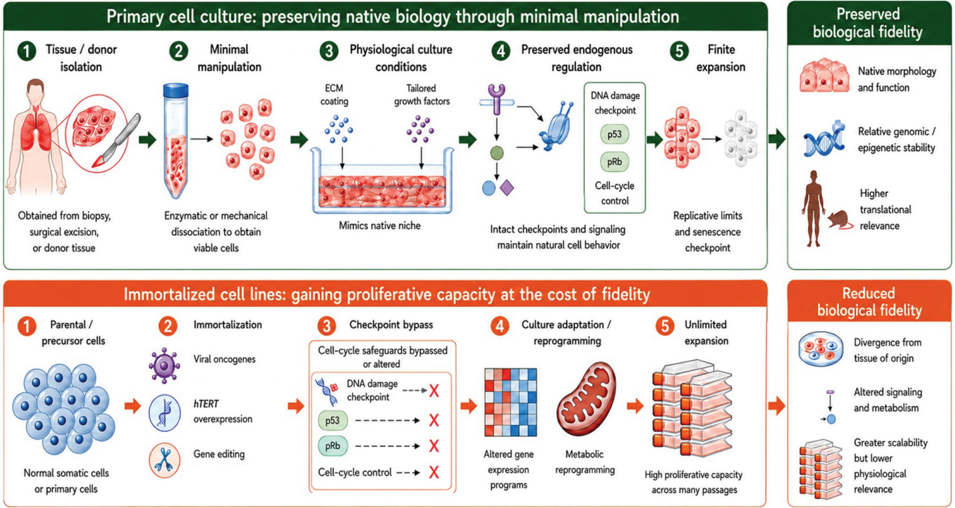
In vitro cell culture models are fundamental to biomedical research, yet the choice between primary cell cultures and immortalized cell lines profoundly influences experimental outcomes. Immortalized lines offer convenience and unlimited proliferative capacity but frequently acquire genetic, epigenetic, and phenotypic alterations that compromise tissue-specific functions and overall biological fidelity. In contrast, primary cell cultures preserve native morphology, signaling pathways, and functional characteristics of their tissue of origin, providing a more physiologically relevant model. While previous reviews have outlined the general advantages of primary cells, few critically synthesize comparative data across cell types or evaluate strategies to mitigate inherent limitations such as finite lifespan and donor variability. This review critically examines the comparison between primary and immortalized cells across different cell types in terms of preserved tissue-specific characteristics, genomic and epigenetic fidelity, predictive value in drug testing and disease modeling, and emerging roles in personalized medicine. We further discuss innovative approaches, including conditional reprogramming, optimized donor selection, pooled-donor strategies, and standardized culture protocols, that enhance reproducibility and functional stability. By integrating comparative evidence with methodological advances, this review provides a critical framework for selecting appropriate in vitro models, highlighting the translational significance of primary cells in drug discovery, precision medicine, and biomedical research.
Overview
CoChat Summary
TL;DR
This review argues that primary cell cultures generally provide higher biological fidelity, tissue-specific function, genomic/epigenetic stability, and translational predictivity than immortalized cell lines, but they face finite lifespan, donor variability, and technical complexity. It synthesizes comparative evidence and emerging strategies—conditional reprogramming, pooled donors, optimized donor selection, and standardized protocols—to improve reproducibility and translational utility.
Key findings
- Primary cells preserve native morphology, signaling, and function across many cell types, whereas immortalized lines often show dedifferentiation, transcriptional drift, and epigenetic erosion. For example, primary hepatocytes retained P450 activity, albumin synthesis, and hepatic architecture, while immortalized hepatocyte lines lost hepatic-specific functions after >50 passages; immortalized renal lines failed to replicate proximal tubule properties.
- Primary human hepatocytes (PHHs) show superior drug-metabolism and toxicity predictivity. Table 2 reports baseline CYP activity much higher in PHHs than HepaRG/HepG2 (CYP3A4: 464.29 vs 27.33 vs 4.75; CYP2B6: 34.87 vs 4.34 vs 0.56; CYP1A2: 2.74 vs 0.49 vs 0.20). HepG2 hepatotoxin detection sensitivity was ~6%, compared with 31–44% in PHHs, and a PHH CYP3A4 mRNA induction model predicted 71 internal compounds with 64% accuracy and minimal false positives.
- Immortalized cancer lines remain useful for scalable, pathway-specific anticancer screening—e.g., A549, HCT116, MCF-7, and A431 for targeted agents—but the review characterizes these advantages as mainly practical rather than predictive.
- Emerging strategies can mitigate primary-cell limitations: conditional reprogramming with ROCK inhibitor Y-27632 plus irradiated J2-3T3 feeder cells extends primary epithelial proliferation while preserving differentiation; pooled human bone marrow MSCs maintained >90% positive and <1% negative MSC markers with trilineage differentiation; donor age/sex affected MSC colony-forming efficiency; harmonized protocols reduced inter-laboratory variability but did not eliminate donor/tissue variability.
Methods
- Design: narrative/critical review, not a systematic review or meta-analysis; it synthesizes comparative literature on primary cell cultures versus immortalized cell lines.
- Data/sample: covers primary hepatocytes, epithelial, endothelial, fibroblasts, immune cells, keratinocytes/melanocytes, smooth muscle cells, cardiomyocytes, neural cells, renal proximal tubule cells, and fetal/adult stem cells, alongside immortalized models including HepG2, Huh7, HeLa, SH-SY5Y, H9c2, AC16, Calu-3, 16HBE, RPTEC/TERT, HEK293, 3T3, A549, HCT116, MCF-7, and A431.
- Main analysis: qualitative comparative synthesis of tissue-specific fidelity, genomic/transcriptomic/epigenetic stability, drug-testing and disease-modeling predictivity, personalized medicine, and strategies to overcome primary-cell limitations; includes Table 1 feature comparison and Table 2 CYP activity comparison.
Limitations
- Stated in the paper: primary cell cultures have finite proliferative capacity, donor-to-donor variability, and technical complexity; conditional reprogramming evidence remains limited regarding full biochemical, epigenetic, and metabolic fidelity after withdrawal; pooled-donor strategies may mask rare or extreme donor-specific phenotypes and can be skewed by dominant donors; standardized protocols cannot fully eliminate donor- and tissue-specific variability.
- Evident from the text: as a review, it generates no new experimental data and does not report a systematic search strategy, inclusion criteria, or formal quality appraisal, so conclusions depend on the selected cited studies and may be subject to selection or interpretation bias.
Model-written summary. Check it against the paper before relying on it.
Integrity signals
Registry
Cites
Statistics
Figures


Verification
Claims the paper makes
110 Valid · 6 Not valid · 26 Not checked · 93 Own results and interpretations
At least one cited source doesn’t support this claim or points to a different paper, and none confirmed it — see the verdicts below.
In the paper
“Consistently, other studies have shown that immortalized cell lines frequently undergo epigenetic erosion, including loss of imprinting (Okamura et al. 2011), promoter hypomethylation (Edgar et al. 2022), and global histone acetylation imbalance (Moro-López et al. 2024), all of which undermine transcriptional regulation and cellular identity (Futscher 2013;Desaulniers et al. 2021).”
§ Primary cell cultures versus immortalized cell lines: critical comparative insights into biological fidelity and translational applications > Genomic, transcriptomic, and epigenetic stability
What the sources say
- Not matchedcites Okamura et al. 2011
An author–year citation the paper’s reference list doesn’t settle. We don’t search these by name.
- Disputedcites Edgar et al. 2022 matched to “Culture-Associated DNA Methylation Changes Impact on Cellular Function of Human Intestinal Organoids” (2022) sourceExperimental — accuracy not yet measured
The Edgar et al. citation is attached specifically to promoter hypomethylation in immortalized cell lines. In the Results section, the paper studies intestinal organoids and reports that CpGs losing DNA methylation with passage were depleted in promoters; it does not report promoter hypomethylation in immortalized lines. (LLM, conf=0.88)
Checked by a reasoning model — may be wrong.
- Not checked — no full text of the sourcecites Moro-López et al. 2024 matched to “Trusting the forces of our cell lines” (2024) source
plainstates an association- Asserted: passes — The authors put it forward as true.
- Checkable: passes — It can be checked against evidence.
- Load-bearing: passes — The paper’s conclusions depend on it.
- Based: passes — The paper gives a reason why it holds.
- Not matched
Some cited sources support this claim and some don’t — read each source’s verdict below.
In the paper
“Because pooling averages biological variation across donors, it may reduce the detection of rare, extreme, or clinically relevant donor-specific phenotypes, including differences in proliferation, differentiation potential, marker expression, senescence responses, metabolic activity, or immunomodulatory capacity (Chan et al. 2018;Kukaj et al. 2025;Mebarki et al. 2025;Ya and Bayraktutan 2025).”
§ Primary cell cultures versus immortalized cell lines: critical comparative insights into biological fidelity and translational applications > Pooled-donor strategies
What the sources say
- Partly supportedcites Chan et al. 2018 matched to “Enabling multiplexed testing of pooled donor cells through whole-genome sequencing” (2018) sourceExperimental — accuracy not yet measured
The Background describes measuring donor-specific phenotypes in pooled cells, including protein expression, and the Discussion describes selecting cells under different growth conditions. Neither section says pooling averages away biological variation or reduces detection of rare or clinically relevant donor-specific phenotypes; most of the listed capacities are not addressed. Page numbers are unavailable in our copy. (LLM, conf=0.78)
- Disputedcites Kukaj et al. 2025 matched to “No simple way to averaging out: Pooled mesenchymal stromal cells do not reflect average donor characteristics” (2025) sourceExperimental — accuracy not yet measured
Split into 2 atoms — 0 confirmed, 1 partially supported, 1 disputed, 0 misattributed, 0 unverifiable. Expand the claim to see per-atom verdicts.
Checked by a reasoning model — may be wrong.
- Partly supportedcites Mebarki et al. 2025 matched to “Pooling umbilical cord-mesenchymal stromal cells derived from selected multiple donors reduces donor-dependent variability and improves their immunomodulatory properties” (2025) sourceExperimental — accuracy not yet measured
Split into 2 atoms — 1 confirmed, 1 partially supported, 0 disputed, 0 misattributed, 0 unverifiable. Expand the claim to see per-atom verdicts.
hedgedstates a possible cause- Asserted: passes — The authors put it forward as true.
- Checkable: passes — It can be checked against evidence.
- Load-bearing: passes — The paper’s conclusions depend on it.
- Based: passes — The paper gives a reason why it holds.
- Partly supported
The cited sources support only part of this claim — read each source’s verdict below.
In the paper
“Immortalized lines offer convenience and unlimited proliferative capacity but frequently acquire genetic, epigenetic, and phenotypic alterations that compromise tissue-specific functions and overall biological fidelity.”
- Also stated in: § Introduction · plain
“However, these cell lines frequently acquire genetic drift, epigenetic alterations, and phenotypic changes over successive passages, leading to compromised tissue-specific functions and reduced biological fidelity”
§ Primary cell cultures versus immortalized cell lines: critical comparative insights into biological fidelity and translational applications > Abstract
What the sources say
- Partly supportedcites Tommasi et al. 2013 matched to “Mammalian cells acquire epigenetic hallmarks of human cancer during immortalization” (2013) sourceExperimental — accuracy not yet measured
The Discussion (page unavailable) reports aberrant DNA methylation and altered gene expression in immortalized mouse embryonic fibroblast lines compared with low-passage primary cells; the Introduction also discusses genetic changes associated with immortalization. The paper does not establish that immortalized lines generally lose tissue-specific functions or biological fidelity, nor does it show that such losses accumulate over successive passages. (LLM, conf=0.85)
- Partly supportedcites Ben-David et al. 2018 matched to “Genetic and transcriptional evolution alters cancer cell line drug response” (2018) sourceExperimental — accuracy not yet measured
The Extended Data table reports that prolonged passaging increases variation, and the Abstract and Discussion describe genetic, gene-expression, and phenotypic differences among cancer cell-line strains. The paper links those differences to changes in drug response, but the cited passages do not establish epigenetic alterations or compromised tissue-specific functions. Its evidence also concerns cancer cell lines, rather than immortalized lines generally. (LLM, conf=0.87)
- Partly supportedcites Taciak et al. 2018 matched to “Evaluation of phenotypic and functional stability of RAW 264.7 cell line through serial passages” (2018) sourceExperimental — accuracy not yet measured
The Introduction (page unavailable) says immortalized lines provide an unlimited source of cells and that additional passages increase the probability of genotypic and phenotypic change. The Results and discussion (page unavailable) also reports passage-related changes in RAW 264.7 cells and cautions that use after passage 30 may affect data reliability. The paper does not address epigenetic alterations or establish that tissue-specific functions are generally compromised across immortalized lines. (LLM, conf=0.88)
plainstates a cause- Asserted: passes — The authors put it forward as true.
- Checkable: passes — It can be checked against evidence.
- Load-bearing: passes — The paper’s conclusions depend on it.
- Based: passes — The paper gives a reason why it holds.
- Also stated in: § Introduction · plain
The cited sources support only part of this claim — read each source’s verdict below.
In the paper
“Complementary growth factor supplementation sustains homeostatic signaling pathways and functional competence without deliberately overriding endogenous control mechanisms”
§ Primary cell cultures versus immortalized cell lines: critical comparative insights into biological fidelity and translational applications > Cell establishment as a determinant of biological fidelity: foundational divergence between primary cell cultures and immortalized cell lines
What the sources say
- Partly supportedcites Ibtisham et al. 2023 matched to “Effects of Growth Factors on In Vitro Culture of Neonatal Piglet Testicular Tissue Fragments” (2023) sourceExperimental — accuracy not yet measured
The Results (§3.1 and §3.3; page unavailable) show that GDNF- and bFGF-supplemented cultures better maintained seminiferous-tubule integrity and gonocyte numbers in neonatal piglet testicular tissue. The paper does not establish that supplementation sustains homeostatic signaling pathways or preserves functional competence without overriding endogenous control mechanisms; those mechanistic assurances go beyond the reported findings. (LLM, conf=0.87)
- Partly supportedcites Ghebosu et al. 2025 matched to “Increasing the biomolecular relevance of cell culture practice” (2025) sourceExperimental — accuracy not yet measured
The Background says that growth factors in fetal bovine serum support cell maintenance and proliferation, and that defined media contain growth factors required for cell growth. It does not establish that complementary growth factor supplementation sustains homeostatic signaling or functional competence without overriding endogenous control mechanisms; those are additional claims. (LLM, conf=0.82)
plainstates a cause- Asserted: passes — The authors put it forward as true.
- Checkable: passes — It can be checked against evidence.
- Load-bearing: passes — The paper’s conclusions depend on it.
- Based: passes — The paper gives a reason why it holds.
- Partly supported
The cited sources support only part of this claim — read each source’s verdict below.
In the paper
“Unlike true replicative senescence, stressinduced premature senescence may reflect cultureimposed damage or adaptation and may reduce fidelity by altering cell morphology, gene expression, metabolism, inflammatory signaling, and functional responsiveness”
§ Primary cell cultures versus immortalized cell lines: critical comparative insights into biological fidelity and translational applications > Cell establishment as a determinant of biological fidelity: foundational divergence between primary cell cultures and immortalized cell lines
What the sources say
- Not matchedcites Li et al. 2025
This doesn’t read as a citation we can look up.
- Partly supportedcites McCarty and Kearney 2025 matched to “Human dermal fibroblast senescence in response to single and recurring oxidative stress” (2025) sourceExperimental — accuracy not yet measured
Results §3.1 reports morphological changes after oxidative stress, and Results §3.7 reports changes in inflammatory signaling; the Discussion also reports altered gene expression and cellular activity. The paper does not establish a change in metabolism or compare this model’s fidelity with replicative senescence, so those parts of the citing sentence are unsupported. (LLM, conf=0.86)
hedgedstates a possible cause- Asserted: passes — The authors put it forward as true.
- Checkable: passes — It can be checked against evidence.
- Load-bearing: passes — The paper’s conclusions depend on it.
- Based: passes — The paper gives a reason why it holds.
- Not matched
149 more claims · 64 with their cited sources checked
Create a free account to see all 235 claims and to verify the 2 references still open.
- It may state two separate claims as one. 77
- The quote only partly states this claim. 1
- Probably not a substantial claim. 4
Self-check
Percentages, sums and reported differences re-computed from the paper’s own numbers.
Each contradiction between two passages listed here was confirmed by an independent check.
Rated minor: it would not touch a result — a value no result rests on, a p-value that stays on the same side of the significance level, or a conflict that is clerical, resolved elsewhere in the paper, or outside its own findings.
In the paper
§ Primary cell cultures versus immortalized cell lines: critical comparative insights into biological fidelity and translational applications > Superior predictive value for drug testing and disease modeling
“In contrast, immortalized airway cell lines (Calu-3 and 16HBE) exhibited limited replication of mucociliary function and reduced responsiveness to xenobiotics (Lee et al. 2021).”
§ Primary cell cultures versus immortalized cell lines: critical comparative insights into biological fidelity and translational applications > References
“Lee DF, Lethem MI, Lansley AB. 2021. A comparison of three mucus-secreting airway cell lines (calu-3, SPOC1 and UNCN3T) for use as biopharmaceutical models of the nose and lung.”
Citations
Cites
Understanding the Warburg Effect: The Metabolic Requirements of Cell Proliferation
Vander Heiden, M. G., Cantley, L. C., & Thompson, C. B. (2009) · Science · doi:10.1126/science.1160809 · Cited by 16,197 · cited 3×
“As a result, the metabolic phenotype of immortalized cell lines may diverge from the native metabolic profile of their tissue of origin (Vander Heiden et al. 2009; Liberti and Locasale 2016).”
The Warburg Effect: How Does it Benefit Cancer Cells?
Liberti, M. V., & Locasale, J. W. (2016) · Trends in Biochemical Sciences · doi:10.1016/j.tibs.2015.12.001 · Cited by 5,150 · cited 2×
“As a result, the metabolic phenotype of immortalized cell lines may diverge from the native metabolic profile of their tissue of origin (Vander Heiden et al. 2009; Liberti and Locasale 2016).”
Wnt/β-Catenin Signaling, Disease, and Emerging Therapeutic Modalities
Nusse, R., & Clevers, H. (2017) · Cell · doi:10.1016/j.cell.2017.05.016 · Cited by 4,342
Bhatia, S. N., & Ingber, D. E. (2014) · Nature Biotechnology · doi:10.1038/nbt.2989 · Cited by 3,305 · cited 1×
“…including vascular perfusion, oxygen and nutrient gradients, three-dimensional extracellular matrix architecture, mechanical forces, tissue–tissue interfaces, and multicellular crosstalk, are therefore incompletely represented (Bhatia and Ingber 2014; Edmondson et al. 2014; Jensen and Teng 2020).”
A DNA damage checkpoint response in telomere-initiated senescence
Fagagna, F. D. D., Reaper, P. M., Clay-Farrace, L., Fiegler, H., Carr, P., von Zglinicki, T., Saretzki, G., Carter, N. P., & Jackson, S. P. (2003) · Nature · doi:10.1038/nature02118 · Cited by 2,917 · cited 1×
“…senescence is driven largely by progressive telomere attrition together with intact p53/p21-and pRb-mediated cell-cycle checkpoint pathways, which function as endogenous safeguards against genomic instability and uncontrolled proliferation (Beauséjour et al. 2003; d’Adda di Fagagna et al. 2003).”
Edmondson, R., Broglie, J. J., Adcock, A. F., & Yang, L. (2014) · ASSAY and Drug Development Technologies · doi:10.1089/adt.2014.573 · Cited by 2,515 · cited 2×
“…including vascular perfusion, oxygen and nutrient gradients, three-dimensional extracellular matrix architecture, mechanical forces, tissue–tissue interfaces, and multicellular crosstalk, are therefore incompletely represented (Bhatia and Ingber 2014; Edmondson et al. 2014; Jensen and Teng 2020).”
Endothelial Progenitor Cells: Characterization and Role in Vascular Biology
Urbich, C., & Dimmeler, S. (2004) · Circulation Research · doi:10.1161/01.res.0000137877.89448.78 · Cited by 2,369 · cited 1×
“They are particularly relevant for tissue-specific repair and regeneration across multiple systems, including vascular (Urbich and Dimmeler 2004; Li et al. 2017), epithelial and gastrointestinal (Andersson-Rolf et al. 2017; Miyashita et al. 2017; Zhang et al. 2018), hematopoietic (Bourgine et al.…”
Control of adaptive immunity by the innate immune system
Iwasaki, A., & Medzhitov, R. (2015) · Nature Immunology · doi:10.1038/ni.3123 · Cited by 2,160 · cited 1×
“…lymphocytes) populations, execute specialized functions in antigen detection, cytokine signaling, cytotoxicity, and immune coordination (Warrington et al. 2011; Iwasaki and Medzhitov 2015; Liu 2016; Zimmerman et al. 2020; Xia et al. 2021; Chi et al. 2024; Wang et al. 2024; Brancewicz et al. 2025).”
The PI3K–AKT network at the interface of oncogenic signalling and cancer metabolism
Hoxhaj, G., & Manning, B. D. (2020) · Nature Reviews Cancer · doi:10.1038/s41568-019-0216-7 · Cited by 2,137 · cited 1×
“…concerns, CR may also influence the underlying metabolic state of primary cells, as sustained proliferation is generally associated with changes in growth-and survival-related signaling, biosynthetic demand, oxidative state, and energy use (Vander Heiden et al. 2009; Hoxhaj and Manning 2020).”
A ROCK inhibitor permits survival of dissociated human embryonic stem cells
Watanabe, K., Ueno, M., Kamiya, D., Nishiyama, A., Matsumura, M., Wataya, T., Takahashi, J. B., Nishikawa, S., Nishikawa, S.-I., Muguruma, K., et al. (2007) · Nature Biotechnology · doi:10.1038/nbt1310 · Cited by 2,055 · cited 1×
“By reducing actomyosin contractility and cytoskeletal tension, ROCK inhibition decreases mechanical stress after cell dissociation, suppresses dissociation-induced apoptosis or anoikis, and improves primary cell survival (Watanabe et al. 2007; Zhang et al. 2011; Liu et al. 2012).”
Mechanisms of DNA damage, repair, and mutagenesis
Chatterjee, N., & Walker, G. C. (2017) · Environmental and Molecular Mutagenesis · doi:10.1002/em.22087 · Cited by 2,039 · cited 1×
“This intact repair machinery efficiently corrects replication errors and DNA damage prior to cell division, ensuring accurate chromosomal segregation and preserving overall genomic integrity (Chatterjee and Walker 2017).”
Kaech, S., & Banker, G. (2006) · Nature Protocols · doi:10.1038/nprot.2006.356 · Cited by 1,659 · cited 1×
“In neuronal cultures, Kaech and Banker (2006) demonstrated that primary hippocampal neurons preserved native tissue characteristics by developing polarized structures, along with extensive axonal and dendritic arbors, as well as functional synapses.”
Is it time to start transitioning from 2D to 3D cell culture?
Jensen, C., & Teng, Y. (2020) · Frontiers in Molecular Biosciences · doi:10.3389/fmolb.2020.00033 · Cited by 1,640 · cited 2×
“…including vascular perfusion, oxygen and nutrient gradients, three-dimensional extracellular matrix architecture, mechanical forces, tissue–tissue interfaces, and multicellular crosstalk, are therefore incompletely represented (Bhatia and Ingber 2014; Edmondson et al. 2014; Jensen and Teng 2020).”
Reversal of human cellular senescence: roles of the p53 and p16 pathways
Beauséjour, C. M., Krtolica, A., Galimi, F., Narita, M., Lowe, S. W., Yaswen, P., & Campisi, J. (2003) · The EMBO Journal · doi:10.1093/emboj/cdg417 · Cited by 1,457 · cited 1×
“…senescence is driven largely by progressive telomere attrition together with intact p53/p21-and pRb-mediated cell-cycle checkpoint pathways, which function as endogenous safeguards against genomic instability and uncontrolled proliferation (Beauséjour et al. 2003; d’Adda di Fagagna et al. 2003).”
Coexistence of Quiescent and Active Adult Stem Cells in Mammals
Li, L., & Clevers, H. (2010) · Science · doi:10.1126/science.1180794 · Cited by 1,247 · cited 3×
“However, their therapeutic use may be limited by lower proliferative capacity, restricted differentiation potential, and age-related functional decline (Li and Clevers 2010; Ito and Suda 2014).”
ERK signalling: A master regulator of cell behaviour, life and fate
Lavoie, H., Gagnon, J., & Therrien, M. (2020) · Nature Reviews Molecular Cell Biology · doi:10.1038/s41580-020-0255-7 · Cited by 1,185 · cited 1×
“…under CR conditions, including AKT, ERK, TGF-β/SMAD, Notch, and β-catenin signaling, are closely linked to transcriptional regulation, lineage specification, cell-state maintenance, and epigenetic control (Ligaba et al. 2015; Bray 2016; Hill 2016; Nusse and Clevers 2017; Lavoie et al. 2020).”
The SH-SY5Y cell line in Parkinson’s disease research: a systematic review
Xicoy, H., Wieringa, B., & Martens, G. J. M. (2017) · Molecular Neurodegeneration · doi:10.1186/s13024-017-0149-0 · Cited by 1,036 · cited 1×
“…and 3T3 exemplify this paradox: despite their convenience and historical utility, their biological behavior increasingly reflects adaptation to artificial culture conditions rather than native physiology (Leibiger et al. 2013; Visagie et al. 2016; Xicoy et al. 2017; Arzumanian et al. 2021).”
Metabolic requirements for the maintenance of self-renewing stem cells
Ito, K., & Suda, T. (2014) · Nature Reviews Molecular Cell Biology · doi:10.1038/nrm3772 · Cited by 1,014 · cited 3×
“However, their therapeutic use may be limited by lower proliferative capacity, restricted differentiation potential, and age-related functional decline (Li and Clevers 2010; Ito and Suda 2014).”
Bray, S. J. (2016) · Nature Reviews Molecular Cell Biology · doi:10.1038/nrm.2016.94 · Cited by 1,012 · cited 1×
“…under CR conditions, including AKT, ERK, TGF-β/SMAD, Notch, and β-catenin signaling, are closely linked to transcriptional regulation, lineage specification, cell-state maintenance, and epigenetic control (Ligaba et al. 2015; Bray 2016; Hill 2016; Nusse and Clevers 2017; Lavoie et al. 2020).”
Considerations for the use of SH-SY5Y neuroblastoma cells in neurobiology
Kovalevich, J., & Langford, D. (2013) · Methods in molecular biology · doi:10.1007/978-1-62703-640-5_2 · Cited by 1,005 · cited 1×
“In contrast, Kovalevich and Langford (2013) reported that differentiated SH-SY5Y neuroblastoma cells failed to replicate mature neuronal morphology, dendritic and axonal complexity, or electrophysiological and synaptic protein expression.”
Rho‐kinase/ROCK: A key regulator of the cytoskeleton and cell polarity
Amano, M., Nakayama, M., & Kaibuchi, K. (2010) · Cytoskeleton · doi:10.1002/cm.20472 · Cited by 994 · cited 1×
“Mechanistically, Y-27632 inhibits ROCK, a downstream effector of the RhoA-ROCK pathway that normally promotes actomyosin contractility (Amano et al. 2010; Liu et al. 2012; Julian and Olson 2014).”
Genetic and transcriptional evolution alters cancer cell line drug response
Ben-David, U., Siranosian, B., Ha, G., Tang, H., Oren, Y., Hinohara, K., Strathdee, C. A., Dempster, J., Lyons, N. J., Burns, R., et al. (2018) · Nature · doi:10.1038/s41586-018-0409-3 · Cited by 931 · cited 2×
“…genetic drift, epigenetic alterations, and phenotypic changes over successive passages, leading to compromised tissue-specific functions and reduced biological fidelity (Tommasi et al. 2013; Mouriaux et al. 2016; Ben-David et al. 2018; Taciak et al. 2018; Volleth et al. 2020; Zaaijer et al. 2021).”
Wilkening, S., Stahl, F., & Bader, A. (2003) · Drug Metabolism and Disposition · doi:10.1124/dmd.31.8.1035 · Cited by 794 · cited 1×
“In contrast, Wilkening et al. (2003) found that the HepG2 cell line was unable to replicate the metabolic and functional characteristics of native liver tissue, thereby highlighting the limitations of immortalized cells in regenerative applications.”
Bell, C. C., Hendriks, D. F. G., Moro, S. M. L., Ellis, E., Walsh, J., Renblom, A., Fredriksson Puigvert, L., Dankers, A. C. A., Jacobs, F., Snoeys, J., et al. (2016) · Scientific Reports · doi:10.1038/srep25187 · Cited by 739 · cited 1×
“Furthermore, primary cells maintain essential tissue-level interactions, structural organization, and functional stability, which are critical for modeling drug penetration, systemic toxicity, and tissue-specific response (Bell et al. 2016).”
ROCK Inhibitor and Feeder Cells Induce the Conditional Reprogramming of Epithelial Cells
Liu, X., Ory, V., Chapman, S., Yuan, H., Albanese, C., Kallakury, B., Timofeeva, O. A., Nealon, C., Dakic, A., Simic, V., et al. (2012) · The American Journal of Pathology · doi:10.1016/j.ajpath.2011.10.036 · Cited by 726
Gerets, H. H. J., Tilmant, K., Gerin, B., Chanteux, H., Depelchin, B. O., Dhalluin, S., & Atienzar, F. A. (2012) · Cell Biology and Toxicology · doi:10.1007/s10565-011-9208-4 · Cited by 698 · cited 1×
“Similarly, Gerets et al. (2012) observed that the HepG2 cell line responded weakly to classical CYP450 inducers (e.g. β-naphthoflavone, phenobarbital, and rifampicin) and generally exhibited CYP450 activities lower than primary human hepatocytes (Table 2).”
Fibroblast and myofibroblast activation in normal tissue repair and fibrosis
Younesi, F. S., Miller, A. E., Barker, T. H., Rossi, F. M. V., & Hinz, B. (2024) · Nature Reviews Molecular Cell Biology · doi:10.1038/s41580-024-00716-0 · Cited by 681 · cited 1×
“Their phenotypic plasticity, particularly the ability to transition into activated myofibroblasts in response to biomechanical and inflammatory cues (Younesi et al. 2024), positions them as central mediators of tissue homeostasis and fibrosis (Tschumperlin and Lagares 2020).”
An introduction to immunology and immunopathology
Warrington, R., Watson, W., Kim, H. L., & Antonetti, F. R. (2011) · Allergy, Asthma & Clinical Immunology · doi:10.1186/1710-1492-7-s1-s1 · Cited by 596
Rho-associated coiled-coil containing kinases (ROCK): Structure, regulation, and functions
Julian, L., & Olson, M. F. (2014) · Small GTPases · doi:10.4161/sgtp.29846 · Cited by 550 · cited 1×
“Mechanistically, Y-27632 inhibits ROCK, a downstream effector of the RhoA-ROCK pathway that normally promotes actomyosin contractility (Amano et al. 2010; Liu et al. 2012; Julian and Olson 2014).”
Geginat, J., Sallusto, F., & Lanzavecchia, A. (2001) · The Journal of Experimental Medicine · doi:10.1084/jem.194.12.1711 · Cited by 533 · cited 1×
“In vitro , these cells are instrumental for dissecting immune mechanisms, host–pathogen interactions, and cytokine signaling pathways (Geginat et al. 2001; Kuo et al. 2003; Barron et al. 2021; Salz et al. 2024; Sarna et al. 2024; Walch and Broz 2024).”
Cells in focus: endothelial cell
Sumpio, B. E., Timothy Riley, J., & Dardik, A. (2002) · The International Journal of Biochemistry & Cell Biology · doi:10.1016/s1357-2725(02)00075-4 · Cited by 531 · cited 1×
“…non-thrombogenic surface to prevent clot formation (Neubauer and Zieger 2022), regulating barrier permeability to control fluid and solute exchange (Sumpio et al. 2002), and modulating vascular tone through the production of vasoactive mediators such as nitric oxide and endothelin-1 (Gallo et al.…”
Cell lines: Valuable tools or useless artifacts
Kaur, G., & Dufour, J. M. (2012) · Spermatogenesis · doi:10.4161/spmg.19885 · Cited by 510
The Immune Functions of Keratinocytes in Skin Wound Healing
Piipponen, M., Li, D., & Landén, N. X. (2020) · International Journal of Molecular Sciences · doi:10.3390/ijms21228790 · Cited by 503 · cited 1×
“Keratinocytes form the epidermal barrier (Jiang et al. 2020) and coordinate immune surveillance (Jiang et al. 2020; Piipponen et al. 2020; Gupta et al. 2024) and wound repair through signaling with fibroblasts and immune cells (Ye and Lai 2025).”
Siegel, G., Kluba, T., Hermanutz-Klein, U., Bieback, K., Northoff, H., & Schäfer, R. (2013) · BMC Medicine · doi:10.1186/1741-7015-11-146 · Cited by 493 · cited 1×
“Siegel et al. (2013) showed that phenotype, donor age, and sex significantly affect the function of human bone marrow-derived MSCs.”
Dichter, M. A. (1978) · Brain Research · doi:10.1016/0006-8993(78)90476-6 · Cited by 480 · cited 1×
“Similarly, Dichter (1978) reported that rat cortical neurons in dissociated cultures exhibited morphologies and electrophysiological properties similar to mature in vivo neurons.”
Ousterout, D. G., Kabadi, A. M., Thakore, P. I., Majoros, W. H., Reddy, T. E., & Gersbach, C. A. (2015) · Nature Communications · doi:10.1038/ncomms7244 · Cited by 470 · cited 1×
“In studies of genetic disorders such as muscular dystrophy, Ousterout et al. (2015) demonstrated that primary cells isolated from patients allow for precise evaluation and optimization of CRISPR/Cas9 gene-editing approaches.”
Functional and Molecular Defects of Pancreatic Islets in Human Type 2 Diabetes
Del Guerra, S., Lupi, R., Marselli, L., Masini, M., Bugliani, M., Sbrana, S., Torri, S., Pollera, M., Boggi, U., Mosca, F., et al. (2005) · Diabetes · doi:10.2337/diabetes.54.3.727 · Cited by 466 · cited 1×
“For example, studies by Del Guerra et al. (2005) and Hu et al. (2025) on diabetes demonstrated that primary cell cultures derived from pancreatic islets provide a more authentic and clinically relevant representation of disease pathology.”
Induced pluripotent stem cells (iPSCs): molecular mechanisms of induction and applications
Cerneckis, J., Cai, H., & Shi, Y. (2024) · Signal Transduction and Targeted Therapy · doi:10.1038/s41392-024-01809-0 · Cited by 452 · cited 3×
“…types, including cells that are otherwise difficult to access, such as neurons, cardiomyocytes, and pancreatic β-like cells (Volpato and Webber 2020; Cerneckis et al. 2024; Joshi et al. 2024). iPSC platforms also enable genome editing and the generation of isogenic controls, allowing…”
Endothelial Dysfunction in Hypertension: Current Concepts and Clinical Implications
Gallo, G., Volpe, M., & Savoia, C. (2022) · Frontiers in Medicine · doi:10.3389/fmed.2021.798958 · Cited by 446 · cited 1×
“…to prevent clot formation (Neubauer and Zieger 2022), regulating barrier permeability to control fluid and solute exchange (Sumpio et al. 2002), and modulating vascular tone through the production of vasoactive mediators such as nitric oxide and endothelin-1 (Gallo et al. 2021; Kostov 2021).”
How vascular smooth muscle cell phenotype switching contributes to vascular disease
Cao, G., Xuan, X., Hu, J., Zhang, R., Jin, H., & Dong, H. (2022) · Cell Communication and Signaling · doi:10.1186/s12964-022-00993-2 · Cited by 431 · cited 2×
“Their phenotypic plasticity allows them to switch between contractile and synthetic states (Cao et al. 2022).”
The Curious Case of the HepG2 Cell Line: 40 Years of Expertise
Arzumanian, V. A., Kiseleva, O. I., & Poverennaya, E. V. (2021) · International Journal of Molecular Sciences · doi:10.3390/ijms222313135 · Cited by 387 · cited 1×
“…and 3T3 exemplify this paradox: despite their convenience and historical utility, their biological behavior increasingly reflects adaptation to artificial culture conditions rather than native physiology (Leibiger et al. 2013; Visagie et al. 2016; Xicoy et al. 2017; Arzumanian et al. 2021).”
Cardiomyocyte Transplantation Improves Heart Function
Li, R.-K., Jia, Z.-Q., Weisel, R. D., Mickle, D. A. G., Zhang, J., Mohabeer, M. K., Rao, V., & Ivanov, J. (1996) · The Annals of Thoracic Surgery · doi:10.1016/s0003-4975(96)00389-x · Cited by 382 · cited 1×
“This potential was demonstrated in preclinical studies by Li et al. (1996), who showed that transplanted primary cardiomyocytes were capable of regenerating myocardial tissue and restoring contractile function after injury, thereby highlighting the promise of patient-derived cells in cardiac tissue…”
Volpato, V., & Webber, C. (2020) · Disease Models & Mechanisms · doi:10.1242/dmm.042317 · Cited by 379 · cited 2×
“Reprogramming and differentiation can introduce line-to-line variability, clonal differences, and heterogeneity in differentiation efficiency, which may affect reproducibility and functional interpretation (Volpato and Webber 2020; Nath et al. 2023).”
Evaluation of phenotypic and functional stability of RAW 264.7 cell line through serial passages
Taciak, B., Białasek, M., Braniewska, A., Sas, Z., Sawicka, P., Kiraga, Ł., Rygiel, T., & Król, M. (2018) · PLOS ONE · doi:10.1371/journal.pone.0198943 · Cited by 377 · cited 1×
“…genetic drift, epigenetic alterations, and phenotypic changes over successive passages, leading to compromised tissue-specific functions and reduced biological fidelity (Tommasi et al. 2013; Mouriaux et al. 2016; Ben-David et al. 2018; Taciak et al. 2018; Volleth et al. 2020; Zaaijer et al. 2021).”
Transcriptional Control by the SMADs
Hill, C. S. (2016) · Cold Spring Harbor Perspectives in Biology · doi:10.1101/cshperspect.a022079 · Cited by 351 · cited 1×
“…under CR conditions, including AKT, ERK, TGF-β/SMAD, Notch, and β-catenin signaling, are closely linked to transcriptional regulation, lineage specification, cell-state maintenance, and epigenetic control (Ligaba et al. 2015; Bray 2016; Hill 2016; Nusse and Clevers 2017; Lavoie et al. 2020).”
Endothelial cells and coagulation
Neubauer, K., & Zieger, B. (2022) · Cell and Tissue Research · doi:10.1007/s00441-021-03471-2 · Cited by 351
Cytokinocytes: the diverse contribution of keratinocytes to immune responses in skin
Jiang, Y., Tsoi, L. C., Billi, A. C., Ward, N. L., Harms, P. W., Zeng, C., Maverakis, E., Kahlenberg, J. M., & Gudjonsson, J. E. (2020) · JCI Insight · doi:10.1172/jci.insight.142067 · Cited by 348 · cited 1×
“Keratinocytes form the epidermal barrier (Jiang et al. 2020) and coordinate immune surveillance (Jiang et al. 2020; Piipponen et al. 2020; Gupta et al. 2024) and wound repair through signaling with fibroblasts and immune cells (Ye and Lai 2025).”
Pollman, M. J., Yamada, T., Horiuchi, M., & Gibbons, G. H. (1996) · Circulation Research · doi:10.1161/01.res.79.4.748 · Cited by 341 · cited 1×
“In vitro , primary SMCs are used to investigate contractility (Ahmetaj-Shala et al. 2021), phenotypic switching (Zhang et al. 2022), ECM regulation (Song et al. 2021), and responses to vasoactive stimuli (Pollman et al. 1996).”
Performance assessment and economic analysis of a human Liver-Chip for predictive toxicology
Ewart, L., Apostolou, A., Briggs, S. A., Carman, C. V., Chaff, J. T., Heng, A. R., Jadalannagari, S., Janardhanan, J., Jang, K.-J., Joshipura, S. R., et al. (2022) · Communications Medicine · doi:10.1038/s43856-022-00209-1 · Cited by 337 · cited 1×
“…primary human hepatocytes have demonstrated translational utility in complementary contexts: Docci et al. (2022) showed the maintenance of metabolically relevant functions for drug metabolism, while Ewart et al. (2022) demonstrated physiologically relevant assessment of drug-induced liver injury.”
Principles and therapeutic applications of adaptive immunity
Chi, H., Pepper, M., & Thomas, P. G. (2024) · Cell · doi:10.1016/j.cell.2024.03.037 · Cited by 330 · cited 1×
“…lymphocytes) populations, execute specialized functions in antigen detection, cytokine signaling, cytotoxicity, and immune coordination (Warrington et al. 2011; Iwasaki and Medzhitov 2015; Liu 2016; Zimmerman et al. 2020; Xia et al. 2021; Chi et al. 2024; Wang et al. 2024; Brancewicz et al. 2025).”
The interaction of innate immune and adaptive immune system
Wang, R., Lan, C., Benlagha, K., Camara, N. O. S., Miller, H., Kubo, M., Heegaard, S., Lee, P., Yang, L., Forsman, H., et al. (2024) · MedComm · doi:10.1002/mco2.714 · Cited by 305 · cited 1×
“…lymphocytes) populations, execute specialized functions in antigen detection, cytokine signaling, cytotoxicity, and immune coordination (Warrington et al. 2011; Iwasaki and Medzhitov 2015; Liu 2016; Zimmerman et al. 2020; Xia et al. 2021; Chi et al. 2024; Wang et al. 2024; Brancewicz et al. 2025).”
Estrada, J. C., Albo, C., Benguría, A., Dopazo, A., López-Romero, P., Carrera-Quintanar, L., Roche, E., Clemente, E. P., Enríquez, J. A., Bernad, A., et al. (2012) · Cell Death & Differentiation · doi:10.1038/cdd.2011.172 · Cited by 297 · cited 1×
“Primary cells can also undergo stress-induced premature senescence in response to artificial or suboptimal culture conditions, including oxidative stress (Facchin et al. 2018), supraphysiological oxygen tension (Estrada et al. 2012), and non-physiological substrate stiffness (Blokland et al. 2022).”
Conditionally reprogrammed cells represent a stem-like state of adult epithelial cells
Suprynowicz, F. A., Upadhyay, G., Krawczyk, E., Kramer, S. C., Hebert, J. D., Liu, X., Yuan, H., Cheluvaraju, C., Clapp, P. W., Boucher, R. C., et al. (2012) · Proceedings of the National Academy of Sciences · doi:10.1073/pnas.1213241109 · Cited by 291 · cited 1×
“Specifically, Suprynowicz et al. (2012) demonstrated that several CR-associated epithelial stem-like features, including increased integrin α6, ΔNp63α, CD44, hTERT, and nuclear β-catenin, together with reduced Notch signaling, reverted toward the non-reprogrammed state after withdrawal from CR…”
Mesenchymal stem cells: Amazing remedies for bone and cartilage defects
Kangari, P., Talaei-Khozani, T., Razeghian-Jahromi, I., & Razmkhah, M. (2020) · Stem Cell Research & Therapy · doi:10.1186/s13287-020-02001-1 · Cited by 286 · cited 1×
“…(Andersson-Rolf et al. 2017; Miyashita et al. 2017; Zhang et al. 2018), hematopoietic (Bourgine et al. 2018; Lee and Hong 2020), musculoskeletal (Kangari et al. 2020), and hepatic systems (So et al. 2020; Li et al. 2021), as well as for immunomodulatory applications (Chen et al. 2011; Liu et…”
Zhang, Y., He, Y., Bharadwaj, S., Hammam, N., Carnagey, K., Myers, R., Atala, A., & Van Dyke, M. (2009) · Biomaterials · doi:10.1016/j.biomaterials.2009.04.005 · Cited by 276 · cited 1×
“Matrix components such as collagen I, laminin, and fibronectin support appropriate adhesion, polarity, and cytoskeletal organization, thereby reinforcing tissue-specific architecture rather than imposing artificial growth states (Zhang et al. 2009; Chua and Lim 2023).”
SARS-CoV-2 infection of primary human lung epithelium for COVID-19 modeling and drug discovery
Mulay, A., Konda, B., Garcia, G., Yao, C., Beil, S., Villalba, J. M., Koziol, C., Sen, C., Purkayastha, A., Kolls, J. K., et al. (2021) · Cell Reports · doi:10.1016/j.celrep.2021.109055 · Cited by 258 · cited 1×
“In vitro , primary epithelial cells are widely used to investigate barrier integrity, transepithelial transport, host–pathogen interactions, and mechanisms underlying epithelial diseases (Wu et al. 2016; Rayner et al. 2020; Heinen et al. 2021; Mulay et al. 2021).”
Three-Dimensional Cell Cultures: The Bridge between In Vitro and In Vivo Models
Urzì, O., Gasparro, R., Costanzo, E., De Luca, A., Giavaresi, G., Fontana, S., & Alessandro, R. (2023) · International Journal of Molecular Sciences · doi:10.3390/ijms241512046 · Cited by 224 · cited 1×
“This limitation is particularly relevant when primary cells are maintained for extended periods or cultured under simplified two-dimensional conditions that do not adequately reproduce cell–cell and cell– matrix interactions present in vivo (Urzì et al. 2023).”
Genomic evolution of cancer models: perils and opportunities
Ben-David, U., Beroukhim, R., & Golub, T. R. (2019) · Nature Reviews Cancer · doi:10.1038/s41568-018-0095-3 · Cited by 222 · cited 2×
“…genetic drift, epigenetic alterations, and phenotypic changes over successive passages, leading to compromised tissue-specific functions and reduced biological fidelity (Tommasi et al. 2013; Mouriaux et al. 2016; Ben-David et al. 2018; Taciak et al. 2018; Volleth et al. 2020; Zaaijer et al. 2021).”
Gastrointestinal motility disorders in neurologic disease
Camilleri, M. (2021) · Journal of Clinical Investigation · doi:10.1172/jci143771 · Cited by 211 · cited 1×
“Smooth muscle cells (SMCs) regulate contractility (Shi et al. 2025) and organ motility (Camilleri 2021).”
Hydrogel scaffolds as in vitro models to study fibroblast activation in wound healing and disease
Smithmyer, M. E., Sawicki, L. A., & Kloxin, A. M. (2014) · Biomater. Sci. · doi:10.1039/c3bm60319a · Cited by 207 · cited 1×
“In vitro , primary fibroblasts are leveraged to model tissue remodeling, fibrosis, wound healing, ECM dynamics, and tumor– stroma interactions (Smithmyer et al. 2014; Majety et al. 2015).”
Han, Y., & Kim, S. Y. (2023) · Experimental & Molecular Medicine · doi:10.1038/s12276-022-00906-w · Cited by 201 · cited 1×
“This occurs due to telomere shortening (Liu et al. 2019), activation of cell-cycle checkpoints (e.g. p53/p21 WAF1 and p16 Ink4A /RB pathways) (Han and Kim 2023), and accumulation of oxidative or genotoxic stress (Yu et al. 2018).”
Genetic and Epigenetic Changes in Human Epithelial Cells Immortalized by Telomerase
Farwell, D. G., Shera, K. A., Koop, J. I., Bonnet, G. A., Matthews, C. P., Reuther, G. W., Coltrera, M. D., McDougall, J. K., & Klingelhutz, A. J. (2000) · The American Journal of Pathology · doi:10.1016/s0002-9440(10)65025-0 · Cited by 196 · cited 1×
“The resulting cells often exhibit altered cell-cycle dynamics, increased stress tolerance, metabolic reprogramming, transcriptional plasticity, and reduced dependence on physiological niche signals, thereby diverging from their tissue of origin (Farwell et al. 2000; de Bardet et al. 2023).”
Primary Patient-Derived Cancer Cells and Their Potential for Personalized Cancer Patient Care
Kodack, D. P., Farago, A. F., Dastur, A., Held, M. A., Dardaei, L., Friboulet, L., von Flotow, F., Damon, L. J., Lee, D., Parks, M., et al. (2017) · Cell Reports · doi:10.1016/j.celrep.2017.11.051 · Cited by 193 · cited 1×
“Their predictable response to pharmacological agents and controlled injury models makes them highly relevant for drug testing, toxicology studies, and wound-healing assays (Feng et al. 2015; Kodack et al. 2017; Liarte et al. 2018).”
Immunomodulatory properties of human adult and fetal multipotent mesenchymal stem cells
Chen, P.-M., Yen, M.-L., Liu, K.-J., Sytwu, H.-K., & Yen, B.-L. (2011) · Journal of Biomedical Science · doi:10.1186/1423-0127-18-49 · Cited by 180 · cited 2×
“…(Carlessi et al. 2013; Vagaska et al. 2020), hematopoietic and hepatic regeneration (Nyamath et al. 2007; Chen et al. 2013; Bhardwaj et al. 2021), vascular repair and angiogenesis (Eggermann et al. 2003; Kwon et al. 2023), and immunomodulatory applications (Chen et al. 2011; Liu et al. 2023).”
Fibroblasts: The arbiters of extracellular matrix remodeling
DeLeon-Pennell, K. Y., Barker, T. H., & Lindsey, M. L. (2020) · Matrix Biology · doi:10.1016/j.matbio.2020.05.006 · Cited by 180 · cited 2×
“They also secrete cytokines and growth factors that drive wound repair, angiogenesis, and epithelial-stromal crosstalk (DeLeon-Pennell et al. 2020).”
O'Donoghue, K., & Fisk, N. M. (2004) · Best Practice & Research Clinical Obstetrics & Gynaecology · doi:10.1016/j.bpobgyn.2004.06.010 · Cited by 179 · cited 3×
“FSCs are often investigated because of their developmental immaturity, high proliferative capacity, broad differentiation potential, relatively low immunogenicity, and robust paracrine activity (Fischbach and Fischbach 2004; O’Donoghue and Fisk 2004; Sagar et al. 2018).”
Elmarasi, M., Elmakaty, I., Elsayed, B., Elsayed, A., Zein, J. A., Boudaka, A., & Eid, A. H. (2024) · Journal of Cellular Physiology · doi:10.1002/jcp.31200 · Cited by 179 · cited 1×
“They also contribute to tissue elasticity (Cai and Chen 2024) and participate in ECM remodeling and cytokine production (Cao et al. 2022; Khalfaoui and Pabelick 2023; Elmarasi et al. 2024; Xin et al. 2024; Zhao et al. 2024).”
From Donor to the Lab: A Fascinating Journey of Primary Cell Lines
Richter, M., Piwocka, O., Musielak, M., Piotrowski, I., Suchorska, W. M., & Trzeciak, T. (2021) · Frontiers in Cell and Developmental Biology · doi:10.3389/fcell.2021.711381 · Cited by 174 · cited 1×
“Among in vitro models, immortalized cell lines and primary cell cultures are the most widely adopted, each with distinct origins, characteristics, and applications (Richter et al. 2021).”
Kostov, K. G. (2021) · Life · doi:10.3390/life11090986 · Cited by 169 · cited 1×
“…to prevent clot formation (Neubauer and Zieger 2022), regulating barrier permeability to control fluid and solute exchange (Sumpio et al. 2002), and modulating vascular tone through the production of vasoactive mediators such as nitric oxide and endothelin-1 (Gallo et al. 2021; Kostov 2021).”
Hematopoietic Stem Cells and Their Roles in Tissue Regeneration
Lee, J. Y., & Hong, S.-H. (2020) · International Journal of Stem Cells · doi:10.15283/ijsc19127 · Cited by 165 · cited 1×
“…2017), epithelial and gastrointestinal (Andersson-Rolf et al. 2017; Miyashita et al. 2017; Zhang et al. 2018), hematopoietic (Bourgine et al. 2018; Lee and Hong 2020), musculoskeletal (Kangari et al. 2020), and hepatic systems (So et al. 2020; Li et al. 2021), as well as for immunomodulatory…”
Roles of telomere biology in cell senescence, replicative and chronological ageing
Liu, J., Wang, L., Wang, Z., & Liu, J.-P. (2019) · Cells · doi:10.3390/cells8010054 · Cited by 164 · cited 1×
“This occurs due to telomere shortening (Liu et al. 2019), activation of cell-cycle checkpoints (e.g. p53/p21 WAF1 and p16 Ink4A /RB pathways) (Han and Kim 2023), and accumulation of oxidative or genotoxic stress (Yu et al. 2018).”
Animal tissue culture principles and applications
Verma, A., Verma, M., & Singh, A. (2020) · Animal Biotechnology · doi:10.1016/b978-0-12-811710-1.00012-4 · Cited by 161
Epithelial cells: liaisons of immunity
Larsen, S. B., Cowley, C. J., & Fuchs, E. V. (2019) · Current Opinion in Immunology · doi:10.1016/j.coi.2019.11.004 · Cited by 159 · cited 1×
“Epithelial cells form continuous sheets lining the body’s external and internal surfaces, providing a protective barrier against mechanical stress, chemical insults, and microbial invasion (Larsen et al. 2020; Guenin-Macé et al. 2023).”
In vitro biomimetic engineering of a human hematopoietic niche with functional properties
Bourgine, P. E., Klein, T., Paczulla, A. M., Shimizu, T., Kunz, L., Kokkaliaris, K. D., Coutu, D. L., Lengerke, C., Skoda, R., Schroeder, T., et al. (2018) · Proceedings of the National Academy of Sciences · doi:10.1073/pnas.1805440115 · Cited by 158 · cited 1×
“…2004; Li et al. 2017), epithelial and gastrointestinal (Andersson-Rolf et al. 2017; Miyashita et al. 2017; Zhang et al. 2018), hematopoietic (Bourgine et al. 2018; Lee and Hong 2020), musculoskeletal (Kangari et al. 2020), and hepatic systems (So et al. 2020; Li et al. 2021), as well as for…”
Eggermann, J. (2003) · Cardiovascular Research · doi:10.1016/s0008-6363(03)00252-9 · Cited by 150 · cited 1×
“…(Carlessi et al. 2013; Vagaska et al. 2020), hematopoietic and hepatic regeneration (Nyamath et al. 2007; Chen et al. 2013; Bhardwaj et al. 2021), vascular repair and angiogenesis (Eggermann et al. 2003; Kwon et al. 2023), and immunomodulatory applications (Chen et al. 2011; Liu et al. 2023).”
Waugh, K. A., Araya, P., Pandey, A., Jordan, K. R., Smith, K. P., Granrath, R. E., Khanal, S., Butcher, E. T., Estrada, B. E., Rachubinski, A. L., et al. (2019) · Cell Reports · doi:10.1016/j.celrep.2019.10.038 · Cited by 150 · cited 1×
“They also serve as critical models for evaluating immunotherapies, vaccine responses, and disease-associated immune dysregulation (Sen et al. 2018; Waugh et al. 2019; David et al. 2020; Chew et al. 2022; Roser et al. 2023).”
Poetsch, M. S., Strano, A., & Guan, K. (2022) · Stem Cells · doi:10.1093/stmcls/sxac020 · Cited by 144 · cited 1×
“Reprogramming may also partially erase or leave residual aspects of donor-specific epigenetic memory (Scesa et al. 2021; Li and Darabi 2022; Poetsch et al. 2022).”
Stem cells: science, policy, and ethics
Fischbach, G. D., & Fischbach, R. L. (2004) · Journal of Clinical Investigation · doi:10.1172/jci23549 · Cited by 141
Mechano-therapeutics: Targeting Mechanical Signaling in Fibrosis and Tumor Stroma
Tschumperlin, D. J., & Lagares, D. (2020) · Pharmacology & Therapeutics · doi:10.1016/j.pharmthera.2020.107575 · Cited by 141 · cited 1×
“Their phenotypic plasticity, particularly the ability to transition into activated myofibroblasts in response to biomechanical and inflammatory cues (Younesi et al. 2024), positions them as central mediators of tissue homeostasis and fibrosis (Tschumperlin and Lagares 2020).”
Wu, N., Yang, W. L., Beineke, A., Dijkman, R., Matrosovich, M. N., Baumgärtner, W., Thiel, V., Valentin‐Weigand, P., Meng, F., & Herrler, G. (2016) · Scientific Reports · doi:10.1038/srep39668 · Cited by 130 · cited 1×
“In vitro , primary epithelial cells are widely used to investigate barrier integrity, transepithelial transport, host–pathogen interactions, and mechanisms underlying epithelial diseases (Wu et al. 2016; Rayner et al. 2020; Heinen et al. 2021; Mulay et al. 2021).”
Perspectives on Systems Modeling of Human Peripheral Blood Mononuclear Cells
Sen, P., Kemppainen, E., & Orešič, M. (2018) · Frontiers in Molecular Biosciences · doi:10.3389/fmolb.2017.00096 · Cited by 125 · cited 1×
“They also serve as critical models for evaluating immunotherapies, vaccine responses, and disease-associated immune dysregulation (Sen et al. 2018; Waugh et al. 2019; David et al. 2020; Chew et al. 2022; Roser et al. 2023).”
Immortalizing Cells for Human Consumption
Soice, E., & Johnston, J. (2021) · International Journal of Molecular Sciences · doi:10.3390/ijms222111660 · Cited by 119 · cited 1×
“Immortalization is achieved through spontaneous transformation, viral oncogene transduction, or targeted genetic manipulation, including hTERT overexpression and disruption of the p53/pRb signaling axes (Soice and Johnston 2021; Shitova et al. 2024).”
Onódi, Z., Visnovitz, T., Kiss, B., Hambalkó, S., Koncz, A., Ágg, B., Váradi, B., Tóth, V. É., Nagy, R. N., Gergely, T. G., et al. (2021) · Journal of Molecular and Cellular Cardiology · doi:10.1016/j.yjmcc.2021.12.007 · Cited by 119 · cited 1×
“By contrast, Onódi et al. (2022) showed that commonly used cardiac cell lines (H9c2 and AC16) exhibited reduced expression of cardiac-specific genes and lower similarity to mature adult cardiac phenotype.”
3D and organoid culture in research: physiology, hereditary genetic diseases and cancer
Suarez-Martinez, E., Suazo-Sanchez, I., Celis-Romero, M., & Carnero, A. (2022) · Cell & Bioscience · doi:10.1186/s13578-022-00775-w · Cited by 118 · cited 1×
“…scaffolds, organoid systems, or dynamic co-culture platforms has been shown to enhance the preservation of tissue-specific architecture and functional responses, creating hybrid models that more faithfully recapitulate in vivo physiology (Suarez-Martinez et al. 2022; Silva-Pedrosa et al. 2023).”
Differentiation potential of adult stem cells
Clarke, D. L., & Frisén, J. (2001) · Current Opinion in Genetics & Development · doi:10.1016/s0959-437x(00)00235-5 · Cited by 115 · cited 1×
“Fetal stem cells (FSCs) and adult stem cells (ASCs) are multipotent stem cell populations with distinct developmental origins, differentiation capacities, and metabolic profiles (Clarke and Frisén 2021; Rosner et al. 2023; Gençer et al. 2024).”
The Multifaceted Role of Macrophages in Biology and Diseases
Brancewicz, J., Wójcik, N., Sarnowska, Z., Robak, J., & Król, M. (2025) · International Journal of Molecular Sciences · doi:10.3390/ijms26052107 · Cited by 115 · cited 1×
“…lymphocytes) populations, execute specialized functions in antigen detection, cytokine signaling, cytotoxicity, and immune coordination (Warrington et al. 2011; Iwasaki and Medzhitov 2015; Liu 2016; Zimmerman et al. 2020; Xia et al. 2021; Chi et al. 2024; Wang et al. 2024; Brancewicz et al. 2025).”
Bento-Lopes, L., Cabaço, L. C., Charneca, J., Neto, M. V., Seabra, M. C., & Barral, D. C. (2023) · International Journal of Molecular Sciences · doi:10.3390/ijms241411289 · Cited by 114 · cited 1×
“In contrast, melanocytes synthesize and transfer melanin (Bento-Lopes et al. 2023), contributing to photoprotection, pigment regulation, and cutaneous immune signaling (Coutant et al. 2024).”
Zhang, H., Xu, J., Long, Y., Maimaitijiang, A., Su, Z., Li, W., & Li, J. (2024) · International Journal of Molecular Sciences · doi:10.3390/ijms252312928 · Cited by 112 · cited 1×
“…reduces the accumulation of chromosomal instability, aneuploidy, and copy number variations, which are commonly observed in continuously proliferating immortalized cell lines (Frias et al. 2012; Hänzelmann et al. 2015; Vodicka et al. 2021; Turkalo et al. 2023; Zhou et al. 2023; Zhang et al. 2024).”
Van der Hauwaert, C., Savary, G., Gnemmi, V., Glowacki, F., Pottier, N., Bouillez, A., Maboudou, P., Zini, L., Leroy, X., Cauffiez, C., et al. (2013) · PLoS ONE · doi:10.1371/journal.pone.0066750 · Cited by 111 · cited 1×
“In epithelial cells, Qi et al. (2007) and Van der Hauwaert et al. (2013) demonstrated that primary cells retained essential morphological features, including a polarized structure, tight junctions, and apical microvilli.”
Liver progenitor cell-driven liver regeneration
So, J., Kim, A., Lee, S.-H., & Shin, D. (2020) · Experimental & Molecular Medicine · doi:10.1038/s12276-020-0483-0 · Cited by 111 · cited 1×
“…2017; Miyashita et al. 2017; Zhang et al. 2018), hematopoietic (Bourgine et al. 2018; Lee and Hong 2020), musculoskeletal (Kangari et al. 2020), and hepatic systems (So et al. 2020; Li et al. 2021), as well as for immunomodulatory applications (Chen et al. 2011; Liu et al. 2023; Wang et al. 2025).”
Fibroblasts Influence Survival and Therapeutic Response in a 3D Co-Culture Model
Majety, M., Pradel, L. P., Gies, M., & Ries, C. H. (2015) · PLOS ONE · doi:10.1371/journal.pone.0127948 · Cited by 110 · cited 1×
“In vitro , primary fibroblasts are leveraged to model tissue remodeling, fibrosis, wound healing, ECM dynamics, and tumor– stroma interactions (Smithmyer et al. 2014; Majety et al. 2015).”
iPSC Preparation and Epigenetic Memory: Does the Tissue Origin Matter?
Scesa, G., Adami, R., & Bottai, D. (2021) · Cells · doi:10.3390/cells10061470 · Cited by 110 · cited 1×
“Reprogramming may also partially erase or leave residual aspects of donor-specific epigenetic memory (Scesa et al. 2021; Li and Darabi 2022; Poetsch et al. 2022).”
Optimal Differentiation of In Vitro Keratinocytes Requires Multifactorial External Control
Borowiec, A.-S., Delcourt, P., Dewailly, E., & Bidaux, G. (2013) · PLoS ONE · doi:10.1371/journal.pone.0077507 · Cited by 108 · cited 1×
“Primary keratinocytes and melanocytes are widely used in skin biology studies (Borowiec et al. 2013; Johansen 2017; Branquinho et al. 2020; Smits et al. 2020; Jeayeng et al. 2024), wound-healing assays (Tao et al. 2007; Garcia et al. 2018; Iyer et al. 2018; Wiegand et al. 2021), pigmentation…”
Polymeric and biological membranes for organ-on-a-chip devices
Corral-Nájera, K., Chauhan, G., Serna-Saldivar, S. O., Martinez-Chapa, S. O., & Aeinehvand, M. M. (2023) · Microsystems & Nanoengineering · doi:10.1038/s41378-023-00579-z · Cited by 106 · cited 1×
“…cells are cultured within engineered microenvironments designed to recapitulate physiological cues, including continuous perfusion, shear stress, oxygen/nutrient gradients, mechanical stimulation, tissue–tissue interfaces, and multicellular crosstalk (Corral-Nájera et al. 2023; Nam et al. 2024).”
Stem Cells in Repair of Gastrointestinal Epithelia
Andersson-Rolf, A., Zilbauer, M., Koo, B., & Clevers, H. C. (2017) · Physiology · doi:10.1152/physiol.00005.2017 · Cited by 102 · cited 1×
“…repair and regeneration across multiple systems, including vascular (Urbich and Dimmeler 2004; Li et al. 2017), epithelial and gastrointestinal (Andersson-Rolf et al. 2017; Miyashita et al. 2017; Zhang et al. 2018), hematopoietic (Bourgine et al. 2018; Lee and Hong 2020), musculoskeletal…”
VEGF promotes endothelial progenitor cell differentiation and vascular repair through connexin 43
Li, L., Liu, H., Xu, C., Deng, M., Song, M., Yu, X., Xu, S., & Zhao, X. (2017) · Stem Cell Research & Therapy · doi:10.1186/s13287-017-0684-1 · Cited by 101 · cited 1×
“They are particularly relevant for tissue-specific repair and regeneration across multiple systems, including vascular (Urbich and Dimmeler 2004; Li et al. 2017), epithelial and gastrointestinal (Andersson-Rolf et al. 2017; Miyashita et al. 2017; Zhang et al. 2018), hematopoietic (Bourgine et al.…”
A morphological study of differentiated hepatocytes in vitro
Arterburn, L. M., Zurlo, J., Yager, J. D., Overton, R. M., & Heifetz, A. H. (1995) · Hepatology · doi:10.1002/hep.1840220128 · Cited by 98 · cited 1×
“In hepatocytes, Arterburn et al. (1995) reported that primary cells cultured in vitro retained native functional and morphological traits, including preserved P450 activity and albumin synthesis, a cuboidal shape, abundant microvilli, and cord-like arrangements resembling hepatic trabeculae.”
Kuo, Y., Weng, S. C., Chou, C. J., Chang, T., & Tsai, W.-J. (2003) · British Journal of Pharmacology · doi:10.1038/sj.bjp.0705500 · Cited by 98 · cited 1×
“In vitro , these cells are instrumental for dissecting immune mechanisms, host–pathogen interactions, and cytokine signaling pathways (Geginat et al. 2001; Kuo et al. 2003; Barron et al. 2021; Salz et al. 2024; Sarna et al. 2024; Walch and Broz 2024).”
Darekar, S., Georgiou, K., Yurchenko, M., Yenamandra, S. P., Chachami, G., Simos, G., Klein, G., & Kashuba, E. (2012) · PLoS ONE · doi:10.1371/journal.pone.0042072 · Cited by 96 · cited 1×
“One major manifestation of this adaptation is a Warburg-like phenotype, in which cells preferentially rely on aerobic glycolysis over oxidative phosphorylation, even under oxygen-replete conditions (Kondoh 2009; Darekar et al. 2012; Suchorolski et al. 2013).”
Manesia, J. K., Xu, Z., Broekaert, D., Boon, R., van Vliet, A., Eelen, G., Vanwelden, T., Stegen, S., Van Gastel, N., Pascual-Montano, A., et al. (2015) · Stem Cell Research · doi:10.1016/j.scr.2015.11.001 · Cited by 96 · cited 1×
“These states involve increased biosynthetic demand and flexible use of glycolysis, oxidative phosphorylation, and mitochondrial activity to support tissue expansion and lineage specification (Manesia et al. 2015; Ravera et al. 2018; Shapira and Christofk 2020).”
Martinovich, K. M., Iosifidis, T., Buckley, A. G., Looi, K., Ling, K.-M., Sutanto, E. N., Kicic-Starcevich, E., Garratt, L. W., Shaw, N. C., Montgomery, S., et al. (2017) · Scientific Reports · doi:10.1038/s41598-017-17952-4 · Cited by 96 · cited 2×
“…and preserves physiological fidelity, it fundamentally limits the use of conventional primary cell cultures in high-throughput screening, where large numbers of phenotypically consistent cells are required for assay scalability, reproducibility, and repeated testing (Martinovich et al. 2017).”
Zhang, L., Valdez, J. M., Zhang, B., Wei, L., Chang, J., & Xin, L. (2011) · PLoS ONE · doi:10.1371/journal.pone.0018271 · Cited by 95 · cited 1×
“By reducing actomyosin contractility and cytoskeletal tension, ROCK inhibition decreases mechanical stress after cell dissociation, suppresses dissociation-induced apoptosis or anoikis, and improves primary cell survival (Watanabe et al. 2007; Zhang et al. 2011; Liu et al. 2012).”
Leibiger, C., Kosyakova, N., Mkrtchyan, H., Glei, M., Trifonov, V., & Liehr, T. (2013) · Journal of Histochemistry & Cytochemistry · doi:10.1369/0022155413476868 · Cited by 92 · cited 1×
“…and 3T3 exemplify this paradox: despite their convenience and historical utility, their biological behavior increasingly reflects adaptation to artificial culture conditions rather than native physiology (Leibiger et al. 2013; Visagie et al. 2016; Xicoy et al. 2017; Arzumanian et al. 2021).”
Ghasemi, M., Liang, S., Luu, Q. M., & Kempson, I. (2023) · Methods in Molecular Biology · doi:10.1007/978-1-0716-3052-5_2 · Cited by 91 · cited 1×
“Many commonly used in vitro viability assays, including tetrazolium-and resazurin-based assays, rely on cellular metabolic or redox activity as indirect indicators of viability instead of directly quantifying viable cell number or cell death (Ghasemi et al. 2023; Vieira-da-Silva and Castanho 2023).”
Little, A. C., Kovalenko, I., Goo, L. E., Hong, H. S., Kerk, S. A., Yates, J. A., Purohit, V., Lombard, D. B., Merajver, S. D., & Lyssiotis, C. A. (2020) · Communications Biology · doi:10.1038/s42003-020-0988-z · Cited by 88 · cited 1×
“…redox activity in immortalized cell lines may confound the interpretation of tetrazolium-or resazurin-based assay readouts, as the resulting signals do not necessarily reflect actual changes in cell viability, proliferation, or cytotoxicity (Little et al. 2020; Hoogstraten et al. 2022).”
Immune-Epithelial Cross Talk in Regeneration and Repair
Guenin‐Macé, L., Konieczny, P., & Naik, S. (2023) · Annual Review of Immunology · doi:10.1146/annurev-immunol-101721-062818 · Cited by 88 · cited 2×
“They also interact with resident stem cells to coordinate tissue regeneration (Guenin-Macé et al. 2023).”
Jedrzejczak-Silicka, M. (2017) · New Insights into Cell Culture Technology · doi:10.5772/66905 · Cited by 87 · cited 1×
“…cells to more closely recapitulate in vivo conditions and support studies of cell physiology, cellular metabolism, disease mechanisms, drug responses, tissue-specific toxicity, vaccine development, gene therapy, and translational research (Jedrzejczak-Silicka 2017; Harper 2024; Pipiya et al. 2024).”
Zhang, C., Lee, H. J., Shrivastava, A., Wang, R., McQuiston, T. J., Challberg, S. S., Pollok, B. A., & Wang, T. (2018) · Cell Reports · doi:10.1016/j.celrep.2018.09.072 · Cited by 87 · cited 1×
“…including vascular (Urbich and Dimmeler 2004; Li et al. 2017), epithelial and gastrointestinal (Andersson-Rolf et al. 2017; Miyashita et al. 2017; Zhang et al. 2018), hematopoietic (Bourgine et al. 2018; Lee and Hong 2020), musculoskeletal (Kangari et al. 2020), and hepatic systems (So et al.…”
Continuous mucociliary transport by primary human airway epithelial cells in vitro
Sears, P. R., Yin, W.-N., & Ostrowski, L. E. (2015) · American Journal of Physiology-Lung Cellular and Molecular Physiology · doi:10.1152/ajplung.00024.2015 · Cited by 85 · cited 1×
“Sears et al. (2015) showed that primary airway epithelial cells differentiated into mucociliary epithelium while preserving native tissue characteristics, effectively replicating mucociliary clearance (MCC) mechanisms.”
Liguori, M. J., Blomme, E. A. G., & Waring, J. F. (2008) · Drug Metabolism and Disposition · doi:10.1124/dmd.107.017608 · Cited by 84 · cited 1×
“Liguori et al. (2008) and Bulutoglu et al. (2020) reported that HepG2 and Huh7 cell lines exhibit diminished cytochrome P450 activity, altered basal gene expression, and reduced capacity to generate physiologically relevant metabolites.”
Revolutionizing Disease Modeling: The Emergence of Organoids in Cellular Systems
Silva-Pedrosa, R., Salgado, A. J., & Ferreira, P. E. (2023) · Cells · doi:10.3390/cells12060930 · Cited by 84 · cited 1×
“…scaffolds, organoid systems, or dynamic co-culture platforms has been shown to enhance the preservation of tissue-specific architecture and functional responses, creating hybrid models that more faithfully recapitulate in vivo physiology (Suarez-Martinez et al. 2022; Silva-Pedrosa et al. 2023).”
Two distinct cellular pathways leading to endothelial cell cytotoxicity by silica nanoparticle size
Lee, K., Lee, J., Kwak, M., Cho, Y., Hwang, B., Cho, M. J., Lee, N. G., Park, J., Lee, S., Park, J., et al. (2019) · Journal of Nanobiotechnology · doi:10.1186/s12951-019-0456-4 · Cited by 83 · cited 1×
“In particular, human umbilical vein endothelial cells (HUVECs) and microvascular endothelial cells are commonly applied in drug cytotoxicity assays (Freese et al. 2014; Yan et al. 2016; Lee et al. 2019; Javaheri-Ghezeldizaj et al. 2023) and vascular modeling (Kaya-Tilki et al. 2024).”
Metabolic regulation of tissue stem cells
Shapira, S. N., & Christofk, H. R. (2020) · Trends in Cell Biology · doi:10.1016/j.tcb.2020.04.004 · Cited by 82
Liu, X., Wei, Q., Lu, L., Cui, S., Ma, K., Zhang, W., Ma, F., Li, H., Fu, X., & Zhang, C. (2023) · Frontiers in Immunology · doi:10.3389/fimmu.2023.1094685 · Cited by 81 · cited 2×
“…(Carlessi et al. 2013; Vagaska et al. 2020), hematopoietic and hepatic regeneration (Nyamath et al. 2007; Chen et al. 2013; Bhardwaj et al. 2021), vascular repair and angiogenesis (Eggermann et al. 2003; Kwon et al. 2023), and immunomodulatory applications (Chen et al. 2011; Liu et al. 2023).”
Blázquez-Prunera, A., Díez, J. M., Gajardo, R., & Grancha, S. (2017) · Stem Cell Research & Therapy · doi:10.1186/s13287-017-0552-z · Cited by 79 · cited 1×
“In primary human MSCs, Blázquez-Prunera et al. (2017) demonstrated that primary human MSCs preserved their native characteristics in culture by maintaining typical morphology and functional properties, including their ability to differentiate into adipogenic, osteogenic, and chondrogenic lineages.”
Hänzelmann, S., Beier, F., Gusmao, E. G., Koch, C. M., Hummel, S., Charapitsa, I., Joussen, S., Benes, V., Brümmendorf, T. H., Reid, G., et al. (2015) · Clinical Epigenetics · doi:10.1186/s13148-015-0057-5 · Cited by 78 · cited 1×
“…reduces the accumulation of chromosomal instability, aneuploidy, and copy number variations, which are commonly observed in continuously proliferating immortalized cell lines (Frias et al. 2012; Hänzelmann et al. 2015; Vodicka et al. 2021; Turkalo et al. 2023; Zhou et al. 2023; Zhang et al. 2024).”
Practical Use of Immortalized Cells in Medicine: Current Advances and Future Perspectives
Voloshin, N., Tyurin-Kuzmin, P., Karagyaur, M., Akopyan, Z., & Kulebyakin, K. (2023) · International Journal of Molecular Sciences · doi:10.3390/ijms241612716 · Cited by 77 · cited 2×
“They offer practical advantages, including indefinite proliferation, ease of maintenance, cost efficiency, and reproducibility (Voloshin et al. 2023; Chalak et al. 2024).”
Vieira-da-Silva, B., & Castanho, M. A. R. B. (2023) · Molecules · doi:10.3390/molecules28052283 · Cited by 76 · cited 1×
“Many commonly used in vitro viability assays, including tetrazolium-and resazurin-based assays, rely on cellular metabolic or redox activity as indirect indicators of viability instead of directly quantifying viable cell number or cell death (Ghasemi et al. 2023; Vieira-da-Silva and Castanho 2023).”
Nguyen, N., Nguyen, W., Nguyenton, B., Ratchada, P., Page, G., Miller, P. E., Ghetti, A., & Abi-Gerges, N. (2017) · Frontiers in Physiology · doi:10.3389/fphys.2017.01073 · Cited by 75 · cited 1×
“Consistently, Nguyen et al. (2017) demonstrated that hPCMs reliably distinguished torsadogenic from non-torsadogenic drugs with high assay sensitivity and specificity, highlighting their value in predicting inotropic and pro-arrhythmic risks.”
Yan, M., Zhang, Y., Qin, H., Liu, K., Guo, M., Ge, Y., Xu, M., Sun, Y., & Zheng, X. (2016) · International Journal of Nanomedicine · doi:10.2147/ijn.s93591 · Cited by 74 · cited 1×
“In particular, human umbilical vein endothelial cells (HUVECs) and microvascular endothelial cells are commonly applied in drug cytotoxicity assays (Freese et al. 2014; Yan et al. 2016; Lee et al. 2019; Javaheri-Ghezeldizaj et al. 2023) and vascular modeling (Kaya-Tilki et al. 2024).”
Metabolic reprogramming and interventions in angiogenesis
Liu, Y., Wu, Z., Li, Y., Chen, Y., Zhao, X., Wu, M., & Xia, Y. (2024) · Journal of Advanced Research · doi:10.1016/j.jare.2024.05.001 · Cited by 74 · cited 1×
“They also mediate angiogenesis and vascular remodeling (Zhou et al. 2021; Liu et al. 2025).”
Role of chemokines, innate and adaptive immunity
Zimmerman, K. A., Hopp, K., & Mrug, M. M. (2020) · Cellular Signalling · doi:10.1016/j.cellsig.2020.109647 · Cited by 72 · cited 1×
“…lymphocytes) populations, execute specialized functions in antigen detection, cytokine signaling, cytotoxicity, and immune coordination (Warrington et al. 2011; Iwasaki and Medzhitov 2015; Liu 2016; Zimmerman et al. 2020; Xia et al. 2021; Chi et al. 2024; Wang et al. 2024; Brancewicz et al. 2025).”
Garnier, D., Li, R., Delbos, F., Fourrier, A., Collet, C., Guguen-Guillouzo, C., Chesné, C., & Nguyen, T. H. (2018) · Scientific Reports · doi:10.1038/s41598-018-26584-1 · Cited by 71 · cited 1×
“This benefit is exemplified in liver regeneration research, where Garnier et al. (2018) demonstrated that primary hepatocytes isolated from a patient could be expanded in vitro to produce functional liver tissue suitable for transplantation.”
Air-Liquid interface cultures to model drug delivery through the mucociliary epithelial barrier
Lee, R. E., Reidel, B., Nelson, M. R., Macdonald, J. K., Kesimer, M., & Randell, S. H. (2023) · Advanced Drug Delivery Reviews · doi:10.1016/j.addr.2023.114866 · Cited by 71 · cited 1×
“Lee et al. (2023) further demonstrated that these cells maintained secretion of gel-forming mucins and host-defense molecules, supporting studies of airway disease pathogenesis and therapeutic interventions.”
Metabolic switches during development and regeneration
Mahmoud, A. I. (2023) · Development · doi:10.1242/dev.202008 · Cited by 71 · cited 1×
“…turnover or injury, ASCs can undergo metabolic reprogramming involving context-dependent shifts in fatty acid oxidation, glycolysis, oxidative phosphorylation, and anabolic metabolism to support proliferation and repair (Li and Clevers 2010; Ito and Suda 2014; Ravera et al. 2018; Mahmoud 2023).”
Freese, C., Schreiner, D., Anspach, L., Bantz, C., Maskos, M., Unger, R. E., & Kirkpatrick, C. J. (2014) · Particle and Fibre Toxicology · doi:10.1186/s12989-014-0068-y · Cited by 68 · cited 1×
“In particular, human umbilical vein endothelial cells (HUVECs) and microvascular endothelial cells are commonly applied in drug cytotoxicity assays (Freese et al. 2014; Yan et al. 2016; Lee et al. 2019; Javaheri-Ghezeldizaj et al. 2023) and vascular modeling (Kaya-Tilki et al. 2024).”
Genome Editing in iPSC-Based Neural Systems: From Disease Models to Future Therapeutic Strategies
McTague, A., Rossignoli, G., Ferrini, A., Barral, S., & Kurian, M. A. (2021) · Frontiers in Genome Editing · doi:10.3389/fgeed.2021.630600 · Cited by 67 · cited 1×
“It also makes iPSC-derived models particularly valuable for studying inherited disorders, modeling diseases involving inaccessible tissues, screening therapeutic candidates, and developing patient-matched regenerative strategies (McTague et al. 2021; Cerneckis et al. 2024; Singh et al. 2024).”
Cell culture: in vitro model system and a promising path to in vivo applications
Zhao, C. (2023) · Journal of Histotechnology · doi:10.1080/01478885.2023.2170772 · Cited by 67
Primary Human Hepatocyte Spheroid Model as a 3D In Vitro Platform for Metabolism Studies
Kanebratt, K. P., Janefeldt, A., Vilén, L., Vildhede, A., Samuelsson, K., Milton, L., Björkbom, A., Persson, M., Leandersson, C., Andersson, T. B., et al. (2021) · Journal of Pharmaceutical Sciences · doi:10.1016/j.xphs.2020.10.043 · Cited by 66 · cited 1×
“Kanebratt et al. (2021) and Guan et al. (2022) further confirmed that PHHs maintain complex metabolic functions over extended culture periods.”
Docci, L., Milani, N., Ramp, T., Romeo, A. A., Godoy, P., Franyuti, D. O., Krähenbühl, S., Gertz, M., Galetin, A., Parrott, N., et al. (2022) · Lab on a Chip · doi:10.1039/d1lc01161h · Cited by 66 · cited 1×
“Similarly, liver-on-a-chip studies using primary human hepatocytes have demonstrated translational utility in complementary contexts: Docci et al. (2022) showed the maintenance of metabolically relevant functions for drug metabolism, while Ewart et al. (2022) demonstrated physiologically relevant…”
Chalak, M., Hesaraki, M., Mirbahari, S. N., Yeganeh, M., Abdi, S., Rajabi, S., & Hemmatzadeh, F. (2024) · Life · doi:10.3390/life14030417 · Cited by 66 · cited 1×
“They offer practical advantages, including indefinite proliferation, ease of maintenance, cost efficiency, and reproducibility (Voloshin et al. 2023; Chalak et al. 2024).”
Timofeeva, O. A., Palechor-Ceron, N., Li, G., Yuan, H., Krawczyk, E., Zhong, X., Liu, G., Upadhyay, G., Dakic, A., Yu, S., et al. (2017) · Oncotarget · doi:10.18632/oncotarget.13937 · Cited by 65 · cited 1×
“Timofeeva et al. (2017) further demonstrated that CR enabled the long-term expansion of matched normal and tumor prostate epithelial cells while preserving stable karyotypes and DNA fingerprint profiles.”
Expanding Roles of the E2F-RB-p53 Pathway in Tumor Suppression
Zhou, Y., Nakajima, R., Shirasawa, M., Fikriyanti, M., Zhao, L., Iwanaga, R., Bradford, A. P., Kurayoshi, K., Araki, K., & Ohtani, K. (2023) · Biology · doi:10.3390/biology12121511 · Cited by 65 · cited 1×
“…reduces the accumulation of chromosomal instability, aneuploidy, and copy number variations, which are commonly observed in continuously proliferating immortalized cell lines (Frias et al. 2012; Hänzelmann et al. 2015; Vodicka et al. 2021; Turkalo et al. 2023; Zhou et al. 2023; Zhang et al. 2024).”
Primary Hepatocyte Isolation and Cultures: Technical Aspects, Challenges and Advancements
Kaur, I., Vasudevan, A., Rawal, P., Tripathi, D. M., Ramakrishna, S., Kaur, S., & Sarin, S. K. (2023) · Bioengineering · doi:10.3390/bioengineering10020131 · Cited by 64 · cited 1×
“This is due to their ability to preserve the structural, metabolic, and physiological characteristics of native tissues, allowing them to replicate human in vivo responses and produce more accurate data (Kaur et al. 2023).”
Keratinocytes: new perspectives in inflammatory skin diseases
Ye, J., & Lai, Y. (2025) · Trends in Molecular Medicine · doi:10.1016/j.molmed.2025.03.012 · Cited by 64 · cited 1×
“Keratinocytes form the epidermal barrier (Jiang et al. 2020) and coordinate immune surveillance (Jiang et al. 2020; Piipponen et al. 2020; Gupta et al. 2024) and wound repair through signaling with fibroblasts and immune cells (Ye and Lai 2025).”
A Brief History of Cell Culture: From Harrison to Organs-on-a-Chip
Moro, L. G., Guarnier, L. P., Azevedo, M. F., Fracasso, J. A. R., Lucio, M. A. A., de Castro, M. V., Dias, M. L., Lívero, F. A. D. R., & Ribeiro‐Paes, J. T. (2024) · Cells · doi:10.3390/cells13242068 · Cited by 63 · cited 1×
“In vitro cell culture systems are foundational tools in biomedical research, enabling controlled studies of cellular physiology, disease mechanisms, and therapeutic interventions (Busk et al. 2023; Moro et al. 2024).”
Telomere dysfunction and genome instability
Frias, C. (2012) · Frontiers in Bioscience · doi:10.2741/4044 · Cited by 61 · cited 1×
“…reduces the accumulation of chromosomal instability, aneuploidy, and copy number variations, which are commonly observed in continuously proliferating immortalized cell lines (Frias et al. 2012; Hänzelmann et al. 2015; Vodicka et al. 2021; Turkalo et al. 2023; Zhou et al. 2023; Zhang et al. 2024).”
Mouriaux, F., Zaniolo, K., Bergeron, M., Weidmann, C., de la Fouchardière, A., Fournier, F., Droit, A., Morcos, M., Landreville, S., & Guérin, S. L. (2016) · Investigative Ophthalmology & Visual Science · doi:10.1167/iovs.16-19317 · Cited by 61 · cited 1×
“…genetic drift, epigenetic alterations, and phenotypic changes over successive passages, leading to compromised tissue-specific functions and reduced biological fidelity (Tommasi et al. 2013; Mouriaux et al. 2016; Ben-David et al. 2018; Taciak et al. 2018; Volleth et al. 2020; Zaaijer et al. 2021).”
Conditional reprogramming: next generation cell culture
Wu, X., Wang, S., Li, M., Li, J., Shen, J., Zhao, Y., Pang, J., Wen, Q., Chen, M., Wei, B., et al. (2020) · Acta Pharmaceutica Sinica B · doi:10.1016/j.apsb.2020.01.011 · Cited by 61 · cited 2×
“Recent methodological innovations, including conditional reprogramming (Wu et al. 2020), optimized donor selection (Carp and Liang 2022; Maged et al. 2024), pooled-donor approaches (Kannan et al. 2024), and standardized culture protocols (Nagai et al. 2023), have improved the reproducibility,…”
Desaulniers, D. M., Vasseur, P., Jacobs, A. C., Aguila, M. C., Ertych, N., & Jacobs, M. N. (2021) · International Journal of Molecular Sciences · doi:10.3390/ijms222010969 · Cited by 60 · cited 1×
“…epigenetic erosion, including loss of imprinting (Okamura et al. 2011), promoter hypomethylation (Edgar et al. 2022), and global histone acetylation imbalance (Moro-López et al. 2024), all of which undermine transcriptional regulation and cellular identity (Futscher 2013; Desaulniers et al. 2021).”
Yu, J., Shi, J., Zhang, Y., Zhang, Y., Huang, Y., Chen, Z., & Yang, J. (2018) · International Journal of Medical Sciences · doi:10.7150/ijms.24635 · Cited by 59 · cited 1×
“This occurs due to telomere shortening (Liu et al. 2019), activation of cell-cycle checkpoints (e.g. p53/p21 WAF1 and p16 Ink4A /RB pathways) (Han and Kim 2023), and accumulation of oxidative or genotoxic stress (Yu et al. 2018).”
Mancini, Ö. K., Acevedo, M., Fazez, N., Cuillerier, A., Ruiz, A. F., Huynh, D. N., Burelle, Y., Ferbeyre, G., Baron, M. G., & Servant, M. J. (2021) · Rheumatology · doi:10.1093/rheumatology/keab477 · Cited by 59
Kammerer, S. (2021) · International Journal of Molecular Sciences · doi:10.3390/ijms221910214 · Cited by 59 · cited 1×
“Furthermore, Kammerer (2021) emphasized the critical role of PHHs in preserving native hepatic functions for predicting drug-induced liver injury (DILI).”
Tohkayomatee, R., Reabroi, S., Tungmunnithum, D., Parichatikanond, W., & Pinthong, D. (2022) · Molecules · doi:10.3390/molecules27113544 · Cited by 57
Calcat-i-Cervera, S., Rendra, E., Scaccia, E., Amadeo, F., Hanson, V., Wilm, B., Murray, P., O’Brien, T., Taylor, A., & Bieback, K. (2023) · Stem Cell Research & Therapy · doi:10.1186/s13287-023-03352-1 · Cited by 56 · cited 1×
“Calcat-I-Cervera et al. (2023) demonstrated that harmonized culture procedures across three independent laboratories substantially reduced inter-laboratory variability in MSC research.”
Chen, Q., Khoury, M., Limmon, G., Choolani, M., Chan, J. K. Y., & Chen, J. (2013) · Stem Cells · doi:10.1002/stem.1359 · Cited by 55 · cited 1×
“…and central nervous system injury modeling (Carlessi et al. 2013; Vagaska et al. 2020), hematopoietic and hepatic regeneration (Nyamath et al. 2007; Chen et al. 2013; Bhardwaj et al. 2021), vascular repair and angiogenesis (Eggermann et al. 2003; Kwon et al. 2023), and immunomodulatory…”
DNA methylation is stable during replication and cell cycle arrest
Vandiver, A. R., Idrizi, A., Rizzardi, L., Feinberg, A. P., & Hansen, K. D. (2015) · Scientific Reports · doi:10.1038/srep17911 · Cited by 55 · cited 1×
“Additionally, primary cells preserve native gene-regulatory and epigenetic profiles under optimized culture conditions, which enhances the consistency of drug responses in predictive models (Vandiver et al. 2015).”
Garcia, M., Alout, H., Diop, F., Damour, A., Bengue, M., Weill, M., Missé, D., Lévêque, N., & Bodet, C. (2018) · Frontiers in Cellular and Infection Microbiology · doi:10.3389/fcimb.2018.00387 · Cited by 54 · cited 1×
“…(Borowiec et al. 2013; Johansen 2017; Branquinho et al. 2020; Smits et al. 2020; Jeayeng et al. 2024), wound-healing assays (Tao et al. 2007; Garcia et al. 2018; Iyer et al. 2018; Wiegand et al. 2021), pigmentation research (Kumar et al. 2012; Tang et al. 2014; Branquinho et al. 2020;…”
Generation and Culturing of Primary Human Keratinocytes from Adult Skin
Johansen, C. (2017) · Journal of Visualized Experiments · doi:10.3791/56863 · Cited by 53 · cited 1×
“Primary keratinocytes and melanocytes are widely used in skin biology studies (Borowiec et al. 2013; Johansen 2017; Branquinho et al. 2020; Smits et al. 2020; Jeayeng et al. 2024), wound-healing assays (Tao et al. 2007; Garcia et al. 2018; Iyer et al. 2018; Wiegand et al. 2021), pigmentation…”
Fetal Mesenchymal Stromal Cells: an Opportunity for Prenatal Cellular Therapy
Sagar, R. L., Walther–Jallow, L., David, A. L., Gotherstrom, C. O. T., & Westgren, M. (2018) · Current Stem Cell Reports · doi:10.1007/s40778-018-0118-8 · Cited by 53 · cited 2×
“FSCs are often investigated because of their developmental immaturity, high proliferative capacity, broad differentiation potential, relatively low immunogenicity, and robust paracrine activity (Fischbach and Fischbach 2004; O’Donoghue and Fisk 2004; Sagar et al. 2018).”
QI, W., JOHNSON, D. W., VESEY, D. A., POLLOCK, C. A., & CHEN, X. (2007) · Nephrology · doi:10.1111/j.1440-1797.2007.00779.x · Cited by 52 · cited 1×
“In epithelial cells, Qi et al. (2007) and Van der Hauwaert et al. (2013) demonstrated that primary cells retained essential morphological features, including a polarized structure, tight junctions, and apical microvilli.”
KLF4-PFKFB3-driven glycolysis is essential for phenotypic switching of vascular smooth muscle cells
Zhang, X., Zheng, B., Zhao, L., Shen, J., Yang, Z., Zhang, Y., Fan, R., Zhang, M., Ma, D., Zheng, L., et al. (2022) · Communications Biology · doi:10.1038/s42003-022-04302-y · Cited by 52 · cited 1×
“In vitro , primary SMCs are used to investigate contractility (Ahmetaj-Shala et al. 2021), phenotypic switching (Zhang et al. 2022), ECM regulation (Song et al. 2021), and responses to vasoactive stimuli (Pollman et al. 1996).”
Oh, H.-Y., Jin, X., Kim, J.-G., Oh, M.-J., Pian, X., Kim, J.-M., Yoon, M.-S., Son, C.-I., Lee, Y. S., Hong, K.-C., et al. (2007) · BMC Cell Biology · doi:10.1186/1471-2121-8-20 · Cited by 51 · cited 1×
“Specifically, Oh et al. (2007) reported that primary pig fibroblasts maintained chromosomal integrity and functional p53 regulation in vitro .”
Progress and challenges in developing allogeneic cell therapies
Deuse, T., & Schrepfer, S. (2025) · Cell Stem Cell · doi:10.1016/j.stem.2025.03.004 · Cited by 51 · cited 1×
“This approach offers significant advantages over the use of allogeneic or immortalized cell lines, particularly by minimizing the risk of immune rejection and enhancing graft compatibility (Deuse and Schrepfer 2025).”
Gutbier, S., May, P., Berthelot, S., Krishna, A., Trefzer, T., Behbehani, M., Efremova, L., Delp, J., Gstraunthaler, G., Waldmann, T., et al. (2018) · Archives of Toxicology · doi:10.1007/s00204-018-2326-5 · Cited by 49 · cited 1×
“Specifically, Gutbier et al. (2018) reported that Lund human mesencephalic cells (LUHMES) exhibited altered susceptibility to toxicants, accompanied by changes in dopaminergic marker expression due to accumulated minor genetic variations.”
In Vitro Models for Studying Respiratory Host–Pathogen Interactions
Barron, S. L., Sáez, J., & Owens, R. M. (2021) · Advanced Biology · doi:10.1002/adbi.202000624 · Cited by 48 · cited 1×
“In vitro , these cells are instrumental for dissecting immune mechanisms, host–pathogen interactions, and cytokine signaling pathways (Geginat et al. 2001; Kuo et al. 2003; Barron et al. 2021; Salz et al. 2024; Sarna et al. 2024; Walch and Broz 2024).”
Epigenetic Regulation of NK Cell-Mediated Antitumor Immunity
Xia, M., Wang, B., Wang, Z., Zhang, X., & Wang, X. (2021) · Frontiers in Immunology · doi:10.3389/fimmu.2021.672328 · Cited by 47 · cited 1×
“…lymphocytes) populations, execute specialized functions in antigen detection, cytokine signaling, cytotoxicity, and immune coordination (Warrington et al. 2011; Iwasaki and Medzhitov 2015; Liu 2016; Zimmerman et al. 2020; Xia et al. 2021; Chi et al. 2024; Wang et al. 2024; Brancewicz et al. 2025).”
In Vitro Lung Models and Their Application to Study SARS-CoV-2 Pathogenesis and Disease
Heinen, N., Klöhn, M., Steinmann, E., & Pfaender, S. (2021) · Viruses · doi:10.3390/v13050792 · Cited by 47 · cited 1×
“In vitro , primary epithelial cells are widely used to investigate barrier integrity, transepithelial transport, host–pathogen interactions, and mechanisms underlying epithelial diseases (Wu et al. 2016; Rayner et al. 2020; Heinen et al. 2021; Mulay et al. 2021).”
Facchin, F., Bianconi, E., Romano, M., Impellizzeri, A., Alviano, F., Maioli, M., Canaider, S., & Ventura, C. (2018) · International Journal of Medical Sciences · doi:10.7150/ijms.27181 · Cited by 46 · cited 1×
“Primary cells can also undergo stress-induced premature senescence in response to artificial or suboptimal culture conditions, including oxidative stress (Facchin et al. 2018), supraphysiological oxygen tension (Estrada et al. 2012), and non-physiological substrate stiffness (Blokland et al. 2022).”
Liu, K. (2016) · Encyclopedia of Cell Biology · doi:10.1016/b978-0-12-394447-4.30111-0 · Cited by 46
Functional isolation, culture and cryopreservation of adult human primary cardiomyocytes
Zhou, B., Shi, X., Tang, X., Zhao, Q., Wang, L., Yao, F., Hou, Y., Wang, X., Feng, W., Wang, L., et al. (2022) · Signal Transduction and Targeted Therapy · doi:10.1038/s41392-022-01044-5 · Cited by 46 · cited 1×
“Zhou et al. (2022) reported that adult human primary cardiomyocytes (hPCMs) maintained high viability, preserved electrophysiological and neurohormonal function, and exhibited strong sensitivity to cardiotoxic compounds.”
Airway smooth muscle in contractility and remodeling of asthma: potential drug target mechanisms
Khalfaoui, L., & Pabelick, C. M. (2023) · Expert Opinion on Therapeutic Targets · doi:10.1080/14728222.2023.2177533 · Cited by 46 · cited 1×
“They also contribute to tissue elasticity (Cai and Chen 2024) and participate in ECM remodeling and cytokine production (Cao et al. 2022; Khalfaoui and Pabelick 2023; Elmarasi et al. 2024; Xin et al. 2024; Zhao et al. 2024).”
Nawroth, J. C., Roth, D., van Schadewijk, A., Ravi, A., Maulana, T. I., Senger, C. N., van Riet, S., Ninaber, D. K., de Waal, A. M., Kraft, D., et al. (2023) · Materials Today Bio · doi:10.1016/j.mtbio.2023.100713 · Cited by 46 · cited 1×
“More recently, Nawroth et al. (2023) reported that human primary airway epithelial cells cultured in an organ-on -a-chip device displayed accelerated maturation and polarization of mucociliary clearance compared with traditional static culture, supporting the utility of chip-based systems for…”
Navigating challenges: optimising methods for primary cell culture isolation
Piwocka, O., Musielak, M., Ampuła, K., Piotrowski, I., Adamczyk, B., Fundowicz, M., Suchorska, W. M., & Malicki, J. (2024) · Cancer Cell International · doi:10.1186/s12935-023-03190-4 · Cited by 46
Mammalian cells acquire epigenetic hallmarks of human cancer during immortalization
Tommasi, S., Zheng, A., Weninger, A., Bates, S. E., Li, X. A., Wu, X., Hollstein, M., & Besaratinia, A. (2013) · Nucleic Acids Research · doi:10.1093/nar/gks1051 · Cited by 45 · cited 1×
“…genetic drift, epigenetic alterations, and phenotypic changes over successive passages, leading to compromised tissue-specific functions and reduced biological fidelity (Tommasi et al. 2013; Mouriaux et al. 2016; Ben-David et al. 2018; Taciak et al. 2018; Volleth et al. 2020; Zaaijer et al. 2021).”
Blokland, K. E. C., Nizamoglu, M., Habibie, H., Borghuis, T., Schuliga, M., Melgert, B. N., Knight, D. A., Brandsma, C.-A., Pouwels, S. D., & Burgess, J. K. (2022) · Frontiers in Pharmacology · doi:10.3389/fphar.2022.989169 · Cited by 45 · cited 1×
“Primary cells can also undergo stress-induced premature senescence in response to artificial or suboptimal culture conditions, including oxidative stress (Facchin et al. 2018), supraphysiological oxygen tension (Estrada et al. 2012), and non-physiological substrate stiffness (Blokland et al. 2022).”
Gordon, K., Clouaire, T., Bao, X. X., Kemp, S. E., Xenophontos, M., de Las Heras, J. I., & Stancheva, I. (2014) · Nucleic Acids Research · doi:10.1093/nar/gkt1351 · Cited by 44 · cited 1×
“In contrast, Gordon et al. (2014) reported that immortalized human fibroblasts accumulated de novo DNA methylation at numerous gene promoters, accompanied by widespread changes in gene expression during extended culture.”
Callegaro, G., Kunnen, S. J., Trairatphisan, P., Grosdidier, S., Niemeijer, M., den Hollander, W., Guney, E., Piñero Gonzalez, J., Furlong, L., Webster, Y. W., et al. (2021) · Archives of Toxicology · doi:10.1007/s00204-021-03141-w · Cited by 43 · cited 1×
“They also retain functional stress–response and homeostatic signaling networks under toxic challenges, supporting their use in mechanism-based toxicity testing and improving the reliability of drug safety predictions (Callegaro et al. 2021).”
Dedifferentiation of conditionally immortalized hepatocytes with long-term in vitro passage
Kim, B.-H., Sung, S.-R., Choi, E.-H., Kim, Y.-I., Kim, K.-J., Dong, S.-H., Kim, H.-J., Chang, Y.-W., Lee, J.-I., & Chang, R. (2000) · Experimental & Molecular Medicine · doi:10.1038/emm.2000.6 · Cited by 42 · cited 1×
“By contrast, Kim et al. (2000) demonstrated that immortalized hepatocyte cell lines lost these critical characteristics after more than 50 passages.”
More than fishing for a cure: The promises and pitfalls of high throughput cancer cell line screens
Ling, A. L., Gruener, R. F., Fessler, J. L., & Huang, R. S. (2018) · Pharmacology & Therapeutics · doi:10.1016/j.pharmthera.2018.06.014 · Cited by 42
The potency of mesenchymal stem/stromal cells: does donor sex matter?
Maged, G., Abdelsamed, M. A., Wang, H., & Lotfy, A. (2024) · Stem Cell Research & Therapy · doi:10.1186/s13287-024-03722-3 · Cited by 42 · cited 2×
“Recent methodological innovations, including conditional reprogramming (Wu et al. 2020), optimized donor selection (Carp and Liang 2022; Maged et al. 2024), pooled-donor approaches (Kannan et al. 2024), and standardized culture protocols (Nagai et al. 2023), have improved the reproducibility,…”
Human Normal Bronchial Epithelial Cells: A Novel In Vitro Cell Model for Toxicity Evaluation
Feng, W., Guo, J., Huang, H., Xia, B., Liu, H., Li, J., Lin, S., Li, T., Liu, J., & Li, H. (2015) · PLoS ONE · doi:10.1371/journal.pone.0123520 · Cited by 41 · cited 1×
“Their predictable response to pharmacological agents and controlled injury models makes them highly relevant for drug testing, toxicology studies, and wound-healing assays (Feng et al. 2015; Kodack et al. 2017; Liarte et al. 2018).”
A comparison of hepato-cellular in vitro platforms to study CYP3A4 induction
Bulutoglu, B., Rey-Bedón, C., Mert, S., Tian, L., Jang, Y.-Y., Yarmush, M. L., & Usta, O. B. (2020) · PLOS ONE · doi:10.1371/journal.pone.0229106 · Cited by 41 · cited 1×
“Liguori et al. (2008) and Bulutoglu et al. (2020) reported that HepG2 and Huh7 cell lines exhibit diminished cytochrome P450 activity, altered basal gene expression, and reduced capacity to generate physiologically relevant metabolites.”
Wiegand, C., Hipler, U., Elsner, P. U., & Tittelbach, J. (2021) · Biomedicines · doi:10.3390/biomedicines9121802 · Cited by 41 · cited 1×
“…2017; Branquinho et al. 2020; Smits et al. 2020; Jeayeng et al. 2024), wound-healing assays (Tao et al. 2007; Garcia et al. 2018; Iyer et al. 2018; Wiegand et al. 2021), pigmentation research (Kumar et al. 2012; Tang et al. 2014; Branquinho et al. 2020; Jeayeng et al. 2024), and dermatological…”
Garnique, A. M. B., Parducci, N. S., de Miranda, L. B. L., de Almeida, B. O., Sanches, L., & Machado‐Neto, J. A. (2024) · Drugs and Drug Candidates · doi:10.3390/ddc3020024 · Cited by 41
Warburg and Crabtree Effects in Premalignant Barrett's Esophagus Cell Lines with Active Mitochondria
Suchorolski, M. T., Paulson, T. G., Sanchez, C. A., Hockenbery, D., & Reid, B. J. (2013) · PLoS ONE · doi:10.1371/journal.pone.0056884 · Cited by 40 · cited 1×
“One major manifestation of this adaptation is a Warburg-like phenotype, in which cells preferentially rely on aerobic glycolysis over oxidative phosphorylation, even under oxygen-replete conditions (Kondoh 2009; Darekar et al. 2012; Suchorolski et al. 2013).”
Iyer, K., Chen, Z., Ganapa, T., Wu, B. M., Tawil, B., & Linsley, C. S. (2018) · Tissue Engineering and Regenerative Medicine · doi:10.1007/s13770-018-0145-7 · Cited by 40 · cited 1×
“…al. 2013; Johansen 2017; Branquinho et al. 2020; Smits et al. 2020; Jeayeng et al. 2024), wound-healing assays (Tao et al. 2007; Garcia et al. 2018; Iyer et al. 2018; Wiegand et al. 2021), pigmentation research (Kumar et al. 2012; Tang et al. 2014; Branquinho et al. 2020; Jeayeng et al. 2024), and…”
Culture-Associated DNA Methylation Changes Impact on Cellular Function of Human Intestinal Organoids
Edgar, R. D., Perrone, F., Foster, A. R., Payne, F., Lewis, S., Nayak, K. M., Kraiczy, J., Cenier, A., Torrente, F., Salvestrini, C., et al. (2022) · Cellular and Molecular Gastroenterology and Hepatology · doi:10.1016/j.jcmgh.2022.08.008 · Cited by 40 · cited 1×
“…that immortalized cell lines frequently undergo epigenetic erosion, including loss of imprinting (Okamura et al. 2011), promoter hypomethylation (Edgar et al. 2022), and global histone acetylation imbalance (Moro-López et al. 2024), all of which undermine transcriptional regulation and cellular…”
Xin, Y., Zhang, Z., Lv, S., Xu, S., Liu, A., Li, H., Li, P., Han, H., & Liu, Y. (2024) · Frontiers in Cardiovascular Medicine · doi:10.3389/fcvm.2024.1400780 · Cited by 40 · cited 1×
“They also contribute to tissue elasticity (Cai and Chen 2024) and participate in ECM remodeling and cytokine production (Cao et al. 2022; Khalfaoui and Pabelick 2023; Elmarasi et al. 2024; Xin et al. 2024; Zhao et al. 2024).”
Vodicka, P., Andera, L., Opattova, A., & Vodickova, L. (2021) · Cancers · doi:10.3390/cancers13030479 · Cited by 39 · cited 1×
“…reduces the accumulation of chromosomal instability, aneuploidy, and copy number variations, which are commonly observed in continuously proliferating immortalized cell lines (Frias et al. 2012; Hänzelmann et al. 2015; Vodicka et al. 2021; Turkalo et al. 2023; Zhou et al. 2023; Zhang et al. 2024).”
Microphysiological Systems as Organ-Specific In Vitro Vascular Models for Disease Modeling
Nam, U., Lee, S., Ahmad, A., Yi, H., & Jeon, J. S. (2024) · BioChip Journal · doi:10.1007/s13206-024-00152-4 · Cited by 39 · cited 1×
“…cells are cultured within engineered microenvironments designed to recapitulate physiological cues, including continuous perfusion, shear stress, oxygen/nutrient gradients, mechanical stimulation, tissue–tissue interfaces, and multicellular crosstalk (Corral-Nájera et al. 2023; Nam et al. 2024).”
Kannan, S., Gokul Krishna, S., Gupta, P. K., & Kolkundkar, U. K. (2024) · Scientific Reports · doi:10.1038/s41598-024-62544-8 · Cited by 39 · cited 3×
“This is evident from recent studies showing that pooled human bone marrow-derived MSCs maintained expected marker expression (>90% positive for MSC markers, <1% negative) and retained trilineage differentiation capacity while reducing donor-to-donor variability (Kannan et al. 2024).”
Thi, M. M., Urban-Maldonado, M., Spray, D. C., & Suadicani, S. O. (2010) · American Journal of Physiology-Cell Physiology · doi:10.1152/ajpcell.00544.2009 · Cited by 38
Multipotent fetal stem cells in reproductive biology research
Rosner, M., Horer, S., Feichtinger, M., & Hengstschläger, M. (2023) · Stem Cell Research & Therapy · doi:10.1186/s13287-023-03379-4 · Cited by 38 · cited 1×
“Fetal stem cells (FSCs) and adult stem cells (ASCs) are multipotent stem cell populations with distinct developmental origins, differentiation capacities, and metabolic profiles (Clarke and Frisén 2021; Rosner et al. 2023; Gençer et al. 2024).”
In Vitro Human Keratinocyte Migration Rates Are Associated with SNPs in the KRT1 Interval
Tao, H., Berno, A. J., Cox, D. R., et al. (2007) · PLoS ONE · doi:10.1371/journal.pone.0000697 · Cited by 37 · cited 1×
“…in skin biology studies (Borowiec et al. 2013; Johansen 2017; Branquinho et al. 2020; Smits et al. 2020; Jeayeng et al. 2024), wound-healing assays (Tao et al. 2007; Garcia et al. 2018; Iyer et al. 2018; Wiegand et al. 2021), pigmentation research (Kumar et al. 2012; Tang et al. 2014; Branquinho…”
Ravera, S., Podestà, M., Sabatini, F., Fresia, C., Columbaro, M., Bruno, S., Fulcheri, E., Ramenghi, L. A., & Frassoni, F. (2017) · Cellular and Molecular Life Sciences · doi:10.1007/s00018-017-2665-z · Cited by 37 · cited 2×
“These states involve increased biosynthetic demand and flexible use of glycolysis, oxidative phosphorylation, and mitochondrial activity to support tissue expansion and lineage specification (Manesia et al. 2015; Ravera et al. 2018; Shapira and Christofk 2020).”
Gerckens, M., Schorpp, K., Pelizza, F., Wögrath, M., Reichau, K., Ma, H., Dworsky, A.-M., Sengupta, A., Stoleriu, M. G., Heinzelmann, K., et al. (2021) · Science Advances · doi:10.1126/sciadv.abb3673 · Cited by 37 · cited 1×
“Fibroblasts provide mechanistic insights and platforms for antifibrotic drug testing and therapeutic development (Gerckens et al. 2021; Marwick et al. 2021; Kizilay et al. 2022; Rogers and Richardson 2022; Aminzadehanboohi et al. 2025; Zeng et al. 2025).”
Puy, C., Moellmer, S. A., Pang, J., Vu, H. H., Melrose, A. R., Lorentz, C. U., Tucker, E. I., Shatzel, J. J., Keshari, R. S., Lupu, F., et al. (2024) · Blood · doi:10.1182/blood.2023022257 · Cited by 37 · cited 1×
“In vitro , these cells facilitate the study of angiogenic processes (Groten et al. 2025), vascular remodeling (Sebastián-Jaraba I et al. 2024), and barrier function (Puy et al. 2024).”
Sanchez, M. E. A., Salgado, M. A. A., Galván, V. M. U., Salguero, V. Y., Estrella, M. B. Y., López, E. F. M., García, N. A. R., Zárate, M. O. C., Hurtado, J. D. S., Pineda, D. A. D., et al. (2025) · Pathophysiology · doi:10.3390/pathophysiology32030033 · Cited by 37 · cited 1×
“They regulate selective absorption and secretion of ions, nutrients, and metabolites, contributing to organ homeostasis in the gastrointestinal tract and kidneys (Kayama and Takeda 2024; Alamilla-Sanchez et al. 2025).”
The Use of Immortalized Cell Lines in GPCR Screening: The Good, Bad and Ugly.
Eglen, R., Gilchrist, A., & Reisine, T. (2008) · Combinatorial Chemistry & High Throughput Screening · doi:10.2174/138620708785204144 · Cited by 36 · cited 1×
“…immortalized cell lines can still offer practical experimental advantages over primary cells in selected studies of specific drug classes and target pathways, particularly when reproducible, scalable, and high-throughput-compatible models are required (Eglen et al. 2008; Voloshin et al. 2023).”
D’Aloia, A., Pastori, V., Blasa, S., Campioni, G., Peri, F., Sacco, E., Ceriani, M., Lecchi, M., & Costa, B. (2024) · Cell Death Discovery · doi:10.1038/s41420-023-01790-7 · Cited by 36 · cited 1×
“In contrast, D’Aloia et al. (2024) found that the SH-SY5Y cell line failed to consistently replicate these properties by exhibiting limited electrophysiological functionality and weak or absent synaptic activity.”
Cell Immortalization: In Vivo Molecular Bases and In Vitro Techniques for Obtention
de Bardet, J. C., Cardentey, C. R., González, B. L., Patrone, D., Mulet, I. L., Siniscalco, D., & Robinson-Agramonte, M. D. L. A. (2023) · BioTech · doi:10.3390/biotech12010014 · Cited by 35 · cited 1×
“The resulting cells often exhibit altered cell-cycle dynamics, increased stress tolerance, metabolic reprogramming, transcriptional plasticity, and reduced dependence on physiological niche signals, thereby diverging from their tissue of origin (Farwell et al. 2000; de Bardet et al. 2023).”
Overcoming the Variability of iPSCs in the Manufacturing of Cell-Based Therapies
Nath, S. C., Menendez, L., & Friedrich Ben-Nun, I. (2023) · International Journal of Molecular Sciences · doi:10.3390/ijms242316929 · Cited by 35 · cited 1×
“Reprogramming and differentiation can introduce line-to-line variability, clonal differences, and heterogeneity in differentiation efficiency, which may affect reproducibility and functional interpretation (Volpato and Webber 2020; Nath et al. 2023).”
Kermanizadeh, A., Brown, D. M., Moritz, W., & Stone, V. (2019) · Scientific Reports · doi:10.1038/s41598-019-43870-8 · Cited by 33
Joshi, J., Albers, C., Smole, N., Guo, S., & Smith, S. A. (2024) · Frontiers in Physiology · doi:10.3389/fphys.2024.1475152 · Cited by 33 · cited 1×
“…that are otherwise difficult to access, such as neurons, cardiomyocytes, and pancreatic β-like cells (Volpato and Webber 2020; Cerneckis et al. 2024; Joshi et al. 2024). iPSC platforms also enable genome editing and the generation of isogenic controls, allowing disease-causing variants to be…”
Metzger, K., Tuchscherer, A., Palin, M.-F., Ponsuksili, S., & Kalbe, C. (2020) · In Vitro Cellular & Developmental Biology - Animal · doi:10.1007/s11626-019-00428-2 · Cited by 32 · cited 1×
“This strategy has been shown to significantly reduce variability in proliferation, differentiation, metabolic activity, and other cellular responses, thereby improving experimental reproducibility (Stoddart et al. 2012; Metzger et al. 2020; Kannan et al. 2024).”
Turkalo, T. K., Maffia, A., Schabort, J. J., Regalado, S. G., Bhakta, M. S., Blanchette, M., Spierings, D. C. J., Lansdorp, P. M., & Hockemeyer, D. F. (2023) · Nature Communications · doi:10.1038/s41467-023-36294-6 · Cited by 32 · cited 1×
“…reduces the accumulation of chromosomal instability, aneuploidy, and copy number variations, which are commonly observed in continuously proliferating immortalized cell lines (Frias et al. 2012; Hänzelmann et al. 2015; Vodicka et al. 2021; Turkalo et al. 2023; Zhou et al. 2023; Zhang et al. 2024).”
The Pathophysiological Role of Vascular Smooth Muscle Cells in Abdominal Aortic Aneurysm
Shi, D., Zhang, M., Zhang, Y., Shi, Y., Liu, X., Wu, X., & Yang, Z. (2025) · Cells · doi:10.3390/cells14131009 · Cited by 32 · cited 1×
“Smooth muscle cells (SMCs) regulate contractility (Shi et al. 2025) and organ motility (Camilleri 2021).”
Epigenetic Changes During Cell Transformation
Futscher, B. W. (2012) · Advances in experimental medicine and biology · doi:10.1007/978-1-4419-9967-2_9 · Cited by 30 · cited 1×
“…epigenetic erosion, including loss of imprinting (Okamura et al. 2011), promoter hypomethylation (Edgar et al. 2022), and global histone acetylation imbalance (Moro-López et al. 2024), all of which undermine transcriptional regulation and cellular identity (Futscher 2013; Desaulniers et al. 2021).”
Lee, D. F., Lethem, M. I., & Lansley, A. B. (2021) · European Journal of Pharmaceutics and Biopharmaceutics · doi:10.1016/j.ejpb.2021.07.016 · Cited by 30 · cited 1×
“In contrast, immortalized airway cell lines (Calu-3 and 16HBE) exhibited limited replication of mucociliary function and reduced responsiveness to xenobiotics (Lee et al. 2021).”
Research works printed but not linked: 1
- Barreto-Durán E, Mejía-Cruz CC, Leal-García E, Pérez- Núñez R, Rodríguez-Pardo VM. 2018. Impact of donor characteristics on the quality of bone marrow as a source of mesenchymal stromal cells. Am J STEM Cells. 7 (5):114-120.
Cited by
Xing, F., Gao, J., Guo, Z., Kong, Y., & Zhang, G. (2026) · International Journal of Molecular Sciences · doi:10.3390/ijms27198617
Metadata
- Authors
- Suali, L., Chia, Y., Rustin, C., Lem, F. F., Ching, X. J., Mansur, M. A. B., Henry, Z. A., Chan, M. K. S., Wong, M. B. F., & Pan, S. Y.
- Affiliations
- Baden Research and Testing (Asia Pac) Sdn. Bhd, Lot 29, Lorong 1C KKIP Industrial Zone, 2, Jalan Sepanggar, Menggatal, 88450 Kota Kinabalu, Sabah
- Universiti of Malaysia Sabah (MY)
- Corresponding author
- Pan, Shing Yi
- ORCID
- Venue
- Biotechnic & Histochemistry
- Publisher
- Informa UK Limited
- Published
- 2026-08-18
- Volume
- 101
- Issue
- 7
- Pages
- 429-455
- ISSN
- 1052-0295 (ISSN-L)
- 1473-7760
- OpenAlex
- W7203693944
- Semantic Scholar
- 1876f4a85bee39efdf09e877605969ece4217e80
- Cited by
- 2
- References
- 304
- Citations by year
- 2026: 2
- FWCI
- 1.09
- Type
- journal article
- Language
- en
- Open access
- hybrid
- doi.org
- Licence
- cc-by
- creativecommons.org/licenses/by/4.0/ (vor)
- doi.org/10.1080/policies-text-data-mining (tdm)
- Locations
- Biotechnic & Histochemistry (publishedVersion, cc-by)
- PubMed (publishedVersion)
- Topics
- Life Sciences › Biochemistry, Genetics and Molecular Biology › Molecular Biology › Viral Infectious Diseases and Gene Expression in Insects
- Health Sciences › Veterinary › Small Animals › Animal testing and alternatives
- Health Sciences › Medicine › Oncology › Cancer Cells and Metastasis
- Keywords
- primary cell culture, immortalized cell lines, in vitro model, drug testing, disease modeling, personalized medicine, conditional reprogramming, donor selection, translational research
- MeSH terms
- Animals, Cell Line, Humans, Cell Culture Techniques, Primary Cell Culture
About these checks
Registry, retraction, Cites and statistics results are computed, not judged, with one exception: a printed reference that no index lists is read once by a model before it counts as a citation error. Claims are extracted by a model and kept only when their quote appears verbatim in the text; each cited source is then checked, with a model’s help, for whether it says what the claim relies on. Those verdicts can be wrong — read the claim’s quote and the cited source before relying on one.
The claim verdicts this report counts are experimental: their accuracy is not yet measured.
A language model drew the claims from the paper on 2026-10-07, under version 3 of the claim definition (model deepseek-v4.1-flash, prompt extract-v3).
A second model labelled each claim on 2026-10-07 (model jev-1.13-20260917, definition revision gold-guideline-v0.2).
Cited sources are checked with a language model’s help (gpt-6-sol).
Statistics and arithmetic are recomputed, not judged.
Confidence bands are shown only for fields calibrated on our annotated test set. None is calibrated yet, so no band is shown.
What counts as a claim ›How we measure confidence ›How we check this ›
Are you an author, or do you see a problem with this page? Request a review
Data sources
Bibliographic data: Semantic Scholar, OpenAlex, Crossref.
Contains information from the Semantic Scholar Academic Graph Datasets, made available under the ODC Attribution License (ODC-BY 1.0).
Semantic Scholar’s data is described in: Kinney, R., et al. (2023). The Semantic Scholar Open Data Platform. arXiv:2301.10140.
