

Legalizing control: the rise of restrictive internet regulation in sub-Saharan Africa
Open accessThe DOI matches its Crossref record; 73 of the 73 references it cites were found in a registry or an index; 3 of the 34 sources its claims cite were checked for support.
Abstract
Today, internet freedom is increasingly contingent upon government discretion. Previous research has uncovered how governments use digital strategies to establish control over online communication. However, beyond digital strategies for internet control, conventional tactics also expand the digital repressive toolkit. Governments are gradually creating legal capacities, often under the guise of preventing cybercrime or protecting user privacy, which enable them to punish online expressions of anti-government sentiments or to legalize state surveillance. But when do governments enshrine infringements of digital political and civil rights into law? Using original data on internet legislation across sub-Saharan African countries, I test whether governments’ reactive or preemptive decision-making, influenced by domestic and regional factors, drives restrictive internet regulation. The results indicate that governments restrict digital rights through national laws as a preventive measure, outside the spotlight of political events. Specifically, illiberal governments in regional environments where legal internet controls are widespread are more likely to enact restrictive internet regulation. Anecdotal evidence from cybersecurity laws enacted in Eastern Africa further highlights that governments learn from each other about acceptable levels of rights restrictions and the legal provisions needed to implement these restrictions.
Overview
CoChat Summary
TL;DR
Using original data on internet legislation across sub-Saharan Africa, the paper argues that restrictive internet regulation is a form of legal repressive capacity-building, enacted pre-emptively rather than in response to immediate domestic or regional unrest. The strongest finding is that governments are more likely to enact restrictive internet regulations when neighbouring countries in their region have recently done so, suggesting regional learning.
Key findings
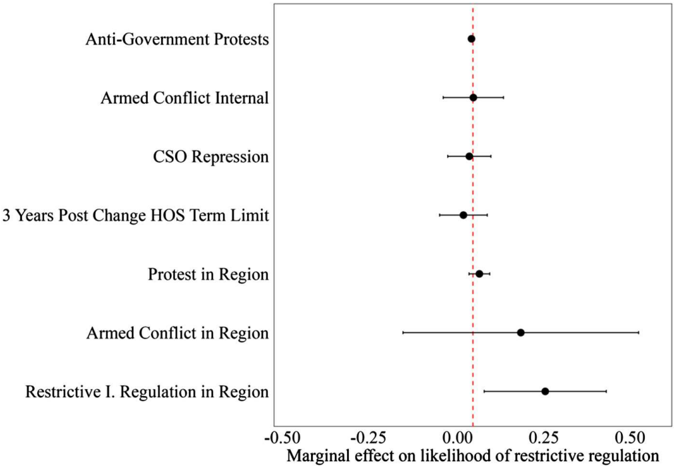
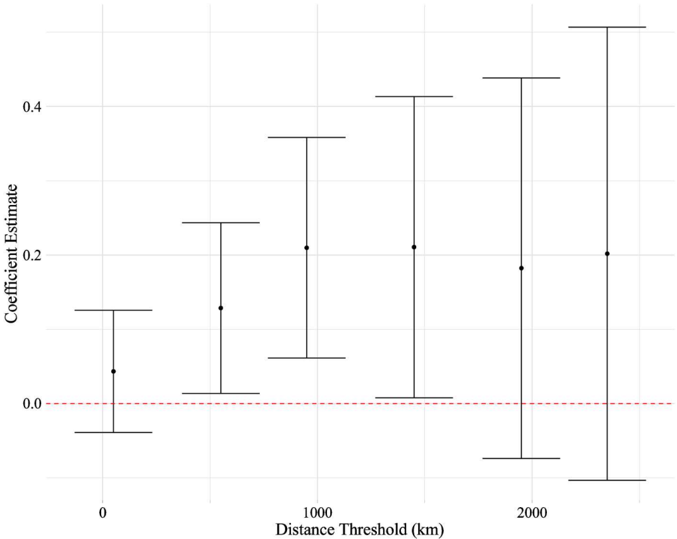
- Regional restrictive internet regulation is the only consistently significant driver: a higher number of restrictive regulations in the region increases the likelihood of a government enacting restrictive internet regulations, statistically significant at the 0.05 level; this holds when all independent variables are tested together and across robustness checks.
- Other proposed drivers are not supported: anti-government protests have a negative but insignificant effect, violent conflict has a positive but insignificant effect, and both CSO repression and changes to head-of-state term limits have negative but statistically insignificant effects.
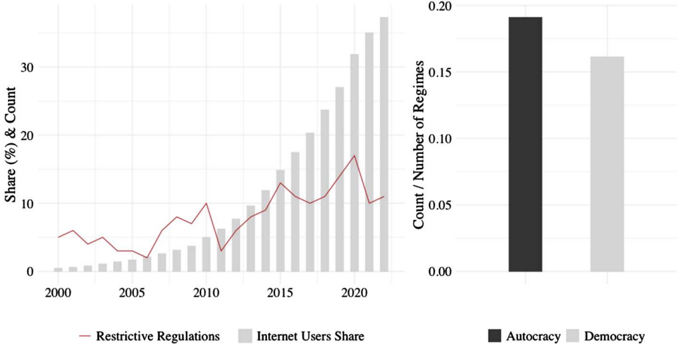
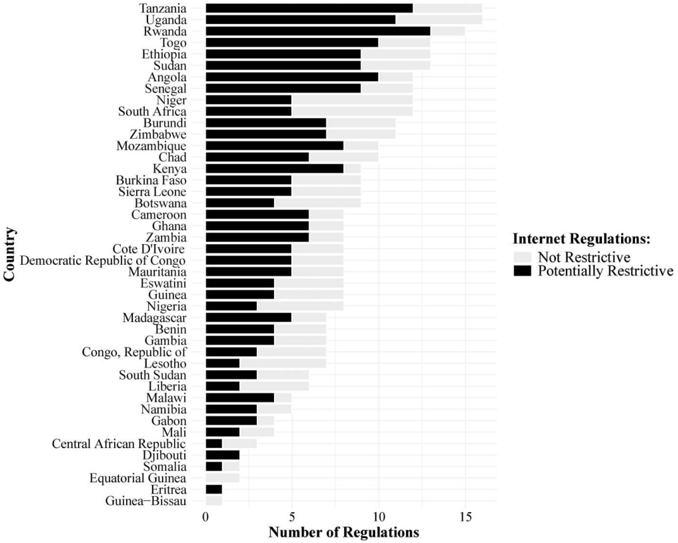
- The original dataset covers 44 sub-Saharan African states from 2000 to 2022 and contains 360 laws/regulations, of which 227 can potentially restrict digital rights. In the country-year analysis for 2001–2020, there are 870 country-years, with restrictive internet regulations enacted in 156 of them.
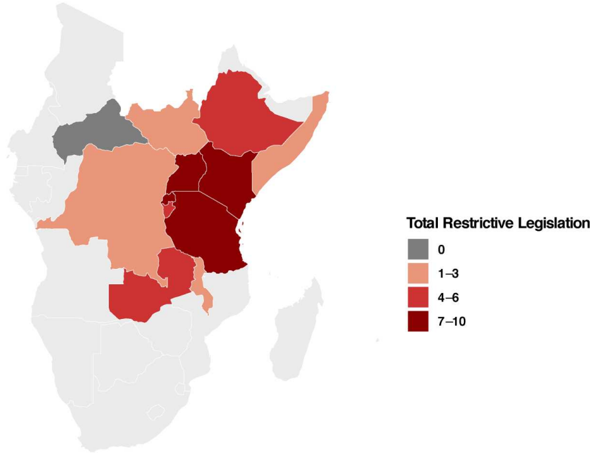
- In Eastern and Central Africa, 87 internet-related laws were enacted between 2010 and 2022; 37 could potentially infringe on freedom of expression, and all 10 cybersecurity laws enacted or amended in the region in that period included potential restrictions. Across the 87 laws, 33 included potential restrictions on privacy rights.
Methods
- The paper collects original data on internet laws and regulations across 44 sub-Saharan African states from 2000 to 2022, including both laws explicitly mentioning digital technologies and laws applied to digital infrastructure, networks, or applications. A regulation is coded as restrictive if at least two secondary source reports document either publicly condemned charges or convictions under it, or concerns about vague or excessive provisions that could be abused.
- For the quantitative test, data are aggregated to the country-year level with a binary dependent variable indicating whether a potentially restrictive regulation was enacted in a given year. The observation period is 2001–2020 due to independent-variable data availability, yielding 870 country-years. The main analysis uses OLS with unit and time fixed effects, with independent variables lagged by one year, tested in separate models and then together.
- A qualitative section examines the timing and content of cybersecurity laws in Eastern and Central Africa, focusing on restrictive provisions and similarities across neighbouring countries.
Limitations
- The paper states that classifying internet regulations as restrictive takes a broad approach based on CSO reports, which may be particularly cautious of new government interventions in cyberspace.
- The paper states that aggregation at the country-year level masks variation in new internet regulations and does not fully capture differences between laws and degrees of restrictiveness; future research should examine how regulations are applied by courts and executive agencies.
- The paper also notes that the regional restrictive-regulation variable is not detailed enough to identify the mechanisms behind the learning effect, and that the dataset cannot guarantee a complete list of all legislation pertaining to the internet in sub-Saharan Africa.
Model-written summary. Check it against the paper before relying on it.
Integrity signals
Registry
Cites
Statistics
Figures


Verification
Claims the paper makes
0 Valid · 16 Not valid · 27 Not checked · 73 Own results and interpretations
The cited sources that could be checked couldn’t confirm or dispute this claim.
In the paper
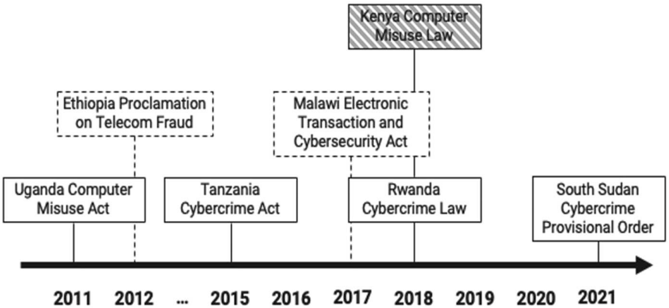
“In subsequent years, Malawi, Rwanda, and South Sudan also enacted cybercrime or cybersecurity laws penalizing the dissemination of “offensive” or “false” information.108”
§ Legalizing control: the rise of restrictive internet regulation in sub-Saharan Africa > Focusing on the regional learning effect
What the sources say
- Could not verifycites [108] 108. Davies, Shawn, Therése Pettersson, and Magnus Öberg. "Organized Violence 1989-2022, and the Return of Conflict between States." Journal of Peace Research 60, no. 4 (2023): 691-708. sourceExperimental — accuracy not yet measured
The paper’s State-based armed conflict section discusses conflict trends, while its Replication data lists armed conflicts involving the named countries (page numbers unavailable). Searches for cybercrime, cybersecurity laws, and penalties for disseminating offensive or false information found no passage addressing the claim. (LLM, conf=0.77)
plain- Asserted: passes — The authors put it forward as true.
- Checkable: passes — It can be checked against evidence.
- Load-bearing: passes — The paper’s conclusions depend on it.
- Based: passes — The paper gives a reason why it holds.
- Could not verify
A result the paper reports from its own data — it cites no other source for it, so there is none to check. The quote shows it is in the paper.
In the paper
“Specifically, illiberal governments in regional environments where legal internet controls are widespread are more likely to enact restrictive internet regulation.”
- Also stated in: § Introduction · hedged
“The results primarily support one of the four arguments I advance: illiberal governments are most likely to enact restrictive internet regulations when neighbouring countries in their region have done so.”
§ Legalizing control: the rise of restrictive internet regulation in sub-Saharan Africa > Abstract
hedgedstates an association- Asserted: passes — The authors put it forward as true.
- Checkable: passes — It can be checked against evidence.
- Load-bearing: passes — The paper’s conclusions depend on it.
- Based: passes — The paper gives a reason why it holds.
- Also stated in: § Introduction · hedged
A result the paper reports from its own data — it cites no other source for it, so there is none to check. The quote shows it is in the paper.
In the paper
“Notably, countries that enact many laws do not necessarily adopt a high number of restrictive ones.”
§ Legalizing control: the rise of restrictive internet regulation in sub-Saharan Africa > Internet legislation in sub-Saharan Africa: cross-national data
plain- Asserted: passes — The authors put it forward as true.
- Checkable: passes — It can be checked against evidence.
- Load-bearing: unclear — It is unclear whether the paper’s conclusions depend on it.
- Based: passes — The paper gives a reason why it holds.
The paper states this without a source or data behind it here, so there is nothing to check it against. The quote shows it is in the paper.
In the paper
“Roughly half of all laws and regulation in this dataset explicitly mention the internet, online communication, or other buzzwords related to digitization.”
§ Legalizing control: the rise of restrictive internet regulation in sub-Saharan Africa > Internet legislation in sub-Saharan Africa: cross-national data
plain- Asserted: passes — The authors put it forward as true.
- Checkable: passes — It can be checked against evidence.
- Load-bearing: unclear — It is unclear whether the paper’s conclusions depend on it.
- Based: unclear — It is unclear why the paper says it holds.
A result the paper reports from its own data — it cites no other source for it, so there is none to check. The quote shows it is in the paper.
In the paper
“The results indicate that governments restrict digital rights through national laws as a preventive measure, outside the spotlight of political events.”
- Also stated in: § Introduction · hedged
“The findings suggest that restrictive internet regulations are a long-term measure enacted by governments to preempt future digitally fuelled contention, rather than a reaction to spikes in domestic or regional unrest.”
§ Legalizing control: the rise of restrictive internet regulation in sub-Saharan Africa > Abstract
hedgedstates a cause- Asserted: passes — The authors put it forward as true.
- Checkable: passes — It can be checked against evidence.
- Load-bearing: passes — The paper’s conclusions depend on it.
- Based: passes — The paper gives a reason why it holds.
- Also stated in: § Introduction · hedged
47 more claims
Create a free account to see all 116 claims and to verify the 3 references still open.
- It may state two separate claims as one. 44
- Probably not a substantial claim. 29
- Borderline: one of the tests for a substantial claim is unclear. 1
Self-check
Percentages, sums and reported differences re-computed from the paper’s own numbers.
Each contradiction between two passages listed here was confirmed by an independent check.
Rated minor: it would not touch a result — a value no result rests on, a p-value that stays on the same side of the significance level, or a conflict that is clerical, resolved elsewhere in the paper, or outside its own findings.
In the paper
§ Legalizing control: the rise of restrictive internet regulation in sub-Saharan Africa > Research design
“The period of observation is limited to 2001-2020 due to data availability for the independent variables, resulting in a dataset of 870 country-years.”
§ Legalizing control: the rise of restrictive internet regulation in sub-Saharan Africa > Notes
“Figure 4. Effects on the likelihood of restrictive internet regulation being enacted in Sub-Saharan African countries 2001-2019.”
Citations
Cites
Armed Conflict 1946-2001: A New Dataset
GLEDITSCH, N. P., WALLENSTEEN, P., ERIKSSON, M., SOLLENBERG, M., & STRAND, H. (2002) · Journal of Peace Research · doi:10.1177/0022343302039005007 · Cited by 3,846
State Repression and Political Order
Davenport, C. (2007) · Annual Review of Political Science · doi:10.1146/annurev.polisci.10.101405.143216 · Cited by 1,564
KING, G., PAN, J., & ROBERTS, M. E. (2017) · American Political Science Review · doi:10.1017/s0003055417000144 · Cited by 1,028
Democracy’s Fourth Wave?: Digital Media and the Arab Spring
Howard, P. N., & Hussain, M. M. (2013) · Oxford University Press eBooks · doi:10.1093/acprof:oso/9780199936953.001.0001 · Cited by 640
Diamond, L. (2010) · Journal of Democracy · doi:10.1353/jod.0.0190 · Cited by 639
Censored: Distraction and Diversion Inside China's Great Firewall
(2018) · Project Muse (Johns Hopkins University) · doi:10.23943/9781400890057/html · Cited by 508
Political Repression: Iron Fists, Velvet Gloves, and Diffuse Control
Earl, J. (2011) · Annual Review of Sociology · doi:10.1146/annurev.soc.012809.102609 · Cited by 445
Liberation Technology: China's "Networked Authoritarianism"
MacKinnon, R. (2011) · Journal of Democracy · doi:10.1353/jod.2011.0033 · Cited by 415
Social Conflict in Africa: A New Database
Salehyan, I., Hendrix, C. S., Hamner, J., Case, C., Linebarger, C., Stull, E., & Williams, J. (2012) · International Interactions · doi:10.1080/03050629.2012.697426 · Cited by 414
What authoritarianism is … and is not:∗ a practice perspective
Glasius, M. (2018) · International Affairs · doi:10.1093/ia/iiy060 · Cited by 375
Broadcasters and hidden influentials in online protest diffusion
González-Bailón, S., Borge-Holthoefer, J., & Moreno, Y. (2013) · American Behavioral Scientist · doi:10.1177/0002764213479371 · Cited by 327
To Repress or to Co‐opt? Authoritarian Control in the Age of Digital Surveillance
Xu, X. (2021) · American Journal of Political Science · doi:10.1111/ajps.12514 · Cited by 316
The Oxford Handbook of Legislative Studies
(2014) · Oxford University Press eBooks · doi:10.1093/oxfordhb/9780199653010.001.0001 · Cited by 296
The Geography of the International System: The CShapes Dataset
Weidmann, N. B., Kuse, D., & Gleditsch, K. S. (2010) · International Interactions · doi:10.1080/03050620903554614 · Cited by 290
Organized violence 1989–2022, and the return of conflict between states
Davies, S., Pettersson, T., & Öberg, M. (2023) · Journal of Peace Research · doi:10.1177/00223433231185169 · Cited by 266
Social media and protest mobilization: evidence from the Tunisian revolution
Breuer, A., Landman, T., & Farquhar, D. (2015) · Democratization · doi:10.1080/13510347.2014.885505 · Cited by 263
Earl, J. (2022) · Science Advances · doi:10.1126/sciadv.abl8198 · Cited by 250
Constructing a Framework of Authoritarian Diffusion: Concepts, Dynamics, and Future Research
Ambrosio, T. (2010) · International Studies Perspectives · doi:10.1111/j.1528-3585.2010.00411.x · Cited by 224
The Use of Repression as a Response to Domestic Dissent
Carey, S. C. (2010) · Political Studies · doi:10.1111/j.1467-9248.2008.00771.x · Cited by 212
Repression Technology: Internet Accessibility and State Violence
Gohdes, A. R. (2020) · American Journal of Political Science · doi:10.1111/ajps.12509 · Cited by 203
How Saudi Crackdowns Fail to Silence Online Dissent
PAN, J., & SIEGEL, A. A. (2020) · American Political Science Review · doi:10.1017/s0003055419000650 · Cited by 167
Roberts, M. E. (2018) · Princeton University Press · doi:10.23943/9781400890057 · Cited by 159
From the web to the streets: internet and protests under authoritarian regimes
Ruijgrok, K. (2016) · Democratization · doi:10.1080/13510347.2016.1223630 · Cited by 155
The Assault on Civil Society: Explaining State Crackdown on NGOs
Chaudhry, S. (2022) · International Organization · doi:10.1017/s0020818321000473 · Cited by 148
Illiberal Norm Diffusion: How Do Governments Learn to Restrict Nongovernmental Organizations?
Glasius, M., Schalk, J., & De Lange, M. (2020) · International Studies Quarterly · doi:10.1093/isq/sqaa019 · Cited by 137
How Dictators Control the Internet: A Review Essay
Keremoğlu, E., & Weidmann, N. B. (2020) · Comparative Political Studies · doi:10.1177/0010414020912278 · Cited by 131
Digital discrimination: Political bias in Internet service provision across ethnic groups
Weidmann, N. B., Benitez-Baleato, S., Hunziker, P., Glatz, E., & Dimitropoulos, X. (2016) · Science · doi:10.1126/science.aaf5062 · Cited by 100
Youth bulge and civil war: Why a country’s share of young adults explains only non-ethnic wars
Yair, O., & Miodownik, D. (2014) · Conflict Management and Peace Science · doi:10.1177/0738894214544613 · Cited by 98
Why Botter: How Pro-Government Bots Fight Opposition in Russia
STUKAL, D., SANOVICH, S., BONNEAU, R., & TUCKER, J. A. (2022) · American Political Science Review · doi:10.1017/s0003055421001507 · Cited by 94
Access Controlled: The Shaping of Power, Rights, and Rule in Cyberspace
Deibert, R., Palfrey, J., Rohozinski, R., & Zittrain, J. L. (2010) · CrimRxiv · doi:10.21428/cb6ab371.3d7364a1 · Cited by 91
Elites Tweet to Get Feet Off the Streets: Measuring Regime Social Media Strategies During Protest
Munger, K., Bonneau, R., Nagler, J., & Tucker, J. A. (2019) · Political Science Research and Methods · doi:10.1017/psrm.2018.3 · Cited by 84
Legislative response to international terrorism
Epifanio, M. (2011) · Journal of Peace Research · doi:10.1177/0022343311399130 · Cited by 78
The Dictator's Digital Toolkit: Explaining Variation in Internet Filtering in Authoritarian Regimes
Hellmeier, S. (2016) · Politics & Policy · doi:10.1111/polp.12189 · Cited by 69
Broadcasters and Hidden Influentials in Online Protest DiffusionPreprint
González‐Bailón, S., Borge‐Holthoefer, J., & Moreno, Y. (2012) · SSRN Electronic Journal · doi:10.2139/ssrn.2017808 · Cited by 67
17 WEAVING THE AUTHORITARIAN WEB The Control of Internet Use in Nondemocratic Regimes
Boas, T. C. (2006) · How Revolutionary Was the Digital Revolution? · doi:10.1515/9781503625730-021 · Cited by 62
Lee, F. L. F., & Chan, C.-K. (2022) · Media Culture & Society · doi:10.1177/01634437221140525 · Cited by 62
Access Contested: Security, Identity, and Resistance in Asian Cyberspace
Deibert, R., Palfrey, J., Rohozinski, R., & Zittrain, J. L. (2011) · CrimRxiv · doi:10.21428/cb6ab371.4d5188e5 · Cited by 61
Authoritarian legal harmonization in the post-Soviet space
Lemon, E., & Antonov, O. (2020) · Democratization · doi:10.1080/13510347.2020.1778671 · Cited by 60
Repression in the Digital Age: Surveillance, Censorship, and the Dynamics of State Violence
Gohdes, A. R. (2024) · Oxford University Press · doi:10.1093/oso/9780197743577.001.0001 · Cited by 59
How African countries respond to fake news and hate speech
Garbe, L., Selvik, L.-M., & Lemaire, P. (2023) · Information, Communication & Society · doi:10.1080/1369118x.2021.1994623 · Cited by 57
Protest Diffusion and Cultural Resonance in the 2011 Protest Wave
Gerbaudo, P. (2013) · The International Spectator · doi:10.1080/03932729.2013.847689 · Cited by 55
Do they know something we don’t? Diffusion of repression in authoritarian regimes
Olar, R.-G. (2019) · Journal of Peace Research · doi:10.1177/0022343318822718 · Cited by 50
At Home and Abroad: The Use of Denial-of-service Attacks during Elections in Nondemocratic Regimes
Lutscher, P. M., Weidmann, N. B., Roberts, M. E., Jonker, M., King, A., & Dainotti, A. (2020) · Journal of Conflict Resolution · doi:10.1177/0022002719861676 · Cited by 50
Neo, R. (2022) · Journalism · doi:10.1177/1464884920984060 · Cited by 45
Analysis of Country-Wide Internet Outages Caused by Censorship
Dainotti, A., Squarcella, C., Aben, E., Claffy, K. C., Chiesa, M., Russo, M., & Pescape, A. (2014) · IEEE/ACM Transactions on Networking · doi:10.1109/tnet.2013.2291244 · Cited by 42
Undue Process: Persecution and Punishment in Autocratic Courts
Shen-Bayh, F. F. (2022) · doi:10.1017/9781009197151 · Cited by 42
Punishing Bodies, Securing the Nation: How Rule of Law Can Legitimate the Urbane Authoritarian State
Rajah, J. (2011) · Law & Social Inquiry · doi:10.1111/j.1747-4469.2011.01257.x · Cited by 39
Protest, Internet Activism, and Sociopolitical Change in Sub-Saharan Africa
Martín, Ó. M., & Erro, C. B. (2020) · American Behavioral Scientist · doi:10.1177/0002764220975060 · Cited by 35
And the Heat Goes On: Police Repression and the Modalities of Power
Liu, H., & Sullivan, C. M. (2021) · Journal of Conflict Resolution · doi:10.1177/00220027211013099 · Cited by 33
The securitisation of fake news in Singapore
Neo, R. (2019) · International Politics · doi:10.1057/s41311-019-00198-4 · Cited by 31
The role of digital media in the 2011 Egyptian revolution
Hamanaka, S. (2020) · Democratization · doi:10.1080/13510347.2020.1737676 · Cited by 25
Fernandez, J. M. (2019) · Pacific Journalism Review – Te Koakoa · doi:10.24135/pjr.v25i1.474 · Cited by 22
Attack or Block? Repertoires of Digital Censorship in Autocracies
Kawerau, L., Weidmann, N. B., & Dainotti, A. (2022) · Journal of Information Technology & Politics · doi:10.1080/19331681.2022.2037118 · Cited by 22
Killing the golden goose? A framework for regulating disruptive technologies
Bennett, W. L. (2023) · Information, Communication & Society · doi:10.1080/1369118x.2021.1994625 · Cited by 21
Toward a Coherent Framework: A Typology and Conceptualization of CSO Regulatory Regimes
DeMattee, A. J. (2019) · Nonprofit Policy Forum · doi:10.1515/npf-2018-0011 · Cited by 20
Disguised Repression: Targeting Opponents with Nonpolitical Crimes to Undermine Dissent
Pan, J., Xu, X., & Xu, Y. (2024) · The Journal of Politics · doi:10.1086/734267 · Cited by 16
Convergence of Counterterrorism Policies: A Case Study of Kyrgyzstan and Central Asia
Omelicheva, M. Y. (2009) · Studies in Conflict & Terrorism · doi:10.1080/10576100903182518 · Cited by 14
Illiberal responses to “fake news” in Southeast Asia
Cho, C. S. M. (2025) · Democratization · doi:10.1080/13510347.2024.2442395 · Cited by 14
Implications of Uganda’s New Social Media TaxPreprint
Kakungulu-Mayambala, R., & Rukundo, S. (2018) · SSRN Electronic Journal · doi:10.2139/ssrn.3383377 · Cited by 12
Internet restrictions in Uganda: examining their impact on journalism
Selnes, F. N. (2021) · Information, Communication & Society · doi:10.1080/1369118x.2020.1859580 · Cited by 12
Kingdom of Trolls? Influence Operations in the Saudi Twittersphere
Barrie, C., & Siegel, A. (2021) · Journal of Quantitative Description: Digital Media · doi:10.51685/jqd.2021.012 · Cited by 12
Pulling through elections by pulling the plug: Internet disruptions and electoral violence in Uganda
Garbe, L. (2024) · Journal of Peace Research · doi:10.1177/00223433231168190 · Cited by 11
Reluctant Democrats and Their Legislatures
Martin, S., Saalfeld, T., Strøm, K. W., et al. (2014) · Oxford University Press eBooks · doi:10.1093/oxfordhb/9780199653010.013.0024 · Cited by 8
Sombatpoonsiri, J., Williams, S. T., & Ruijgrok, K. (2026) · Democratization · doi:10.1080/13510347.2025.2461478 · Cited by 8
Gloppen, S., Gerzso, T., & van de Walle, N. (2022) · doi:10.1093/oso/9780192867322.003.0003 · Cited by 8
Disguised Repression: Targeting Opponents with Non-Political Crimes to Undermine DissentPreprint
Pan, J., Xu, X., & Xu, Y. (2023) · SSRN Electronic Journal · doi:10.2139/ssrn.4488481 · Cited by 7
Fragmentation of International Cybercrime Law
Fidler, M. (2025) · Utah Law Review · doi:10.63140/wez4rujib0 · Cited by 2
King, G., Pan, J., & Roberts, M. E. (2017) · Harvard Dataverse · doi:10.7910/dvn/qszmpd · Cited by 1
The Role of Digital Media in the 2011 Egyptian Revolution
Hamanaka, S. (2020) · Harvard Dataverse · doi:10.7910/dvn/xcsh4z
Weidmann, N. B., Benitez-Baleato, S., Hunziker, P., et al. (2016) · Harvard Dataverse · doi:10.7910/dvn/y3vpig
Glasius, M., Schalk, J., & de Lange, M. (2021) · Harvard Dataverse · doi:10.7910/dvn/dclrit
The Geography of the International System: The CShapes Dataset
Weidmann, N. B., Kuse, D., & Gleditsch, K. S. (2010) · Harvard Dataverse · doi:10.7910/dvn/9h4h4s
Research works printed but not linked: 26
- 92. ABA, "Zimbabwe: The Persecution and Prosecutions of Hopewell Chin'ono".
- 93. For individual visualization of the effects of the expanding and deterring logic see SOM, Figures 2 to 5. 100. The same tests were performed to test for regional protest and conflict effects but did not yield consistent significant effects (SOM, Figure 4-6). 101. Also known as Wagner PMC, and since 2024, as Africa Corps. 102. Peruchon, "The Propaganda Machine". 103. Uganda Computer Misuse Act (No 2). 104. Nanfuka, "Uganda"; Funk et al., "Freedom on the Net 2023". 105. Ethiopia Telecom Fraud Offence Proclamation (No. 761/2012). 106. Tanzania Cybercrimes Act (No. 14). 107. Nanfuka, "Uganda". 108. Malawi Electronic Transactions and Cyber Security Act (No. 33); Rwanda Law on Prevention and Punishment of Cyber Crimes (No. 60); South-Sudan Cybercrimes and Computer Misuse Provisional Order. 109. The Kenya Information and Communications (Amendement) Act (No. 41A). 110. The Kenya Information and Communications (Amendement) Act (No. 41A); Burundi portant modification de la Loi N°1/ 15 du 9 mai 2015 régissant la presse (No.1/019). 111. E.g. Tanzania Electronic and Postal Communications (Online Content) (Government Notice No. 133). 112. South-Sudan Cybercrimes and Computer Misuse Provisional Order. 113. Ethiopia Computer Crime Proclamation (No.958);
- 94. Republique Democratique du Congo Loi Relative Aux Telecommunications et Aux Technologies de L`Information et de la Communi- cation (No. 20); Zambia Cyber Security and Cyber Crimes Act (No. 2). 114. Allen and Kelly, "Deluge of Digital Repression Threatens African Security". 115. Sombatpoonsiri, Tyler, and Ruijgrok, "Ramping up Control: How Judicial Harassment and Online Smear Campaigns Work in Tandem to Limit Dissent in Thailand". 116. Kerr, "Information, Security, and Authoritarian Stability". 117. Glasius, Schalk, and De Lange, "Illiberal Norm Diffusion". 118. See pp. 2-3 in the SOM for a discussion of the coding process implications. 119. E.g. Nanfuka, "Uganda". 120. Allen and Kelly, "Deluge of Digital Repression". Bibliography ABA. Zimbabwe: The Persecution and Prosecutions of Hopewell Chin'ono. Washington, DC: American Bar Association Center for Human Right, 2021. https://www.americanbar.org/content/dam/aba/ administrative/human_rights/justice-defenders/aba-chr-hopewell-chinono-2021.pdf.
- 96. Ambrosio, Thomas. "Constructing a Framework of Authoritarian Diffusion: Concepts, Dynamics, and Future Research: Framework of Authoritarian Diffusion." International Studies Perspectives 11, no. 4 (2010): 375-392.
- 100. Breuer, Anita, Todd Landman, and Dorothea Farquhar. "Social Media and Protest Mobilization: Evidence from the Tunisian Revolution." Democratization 22, no. 4 (2015): 764-792. Burundi portant modification de la Loi N°1/ 15 du 9 mai 2015 régissant la presse (No.1/019) 2018. https://www.presidence.gov.bi/2018/09/28/loi-n1019-du-14-septembre-2018-portant-modificatio n-de-la-loi-n1-15-du-9-mai-2015-regissant-la-presse-au-burundi/.
- 102. Chaudhry, Suparna. "The Assault on Civil Society: Explaining State Crackdown on NGOs." International Organization 76, no. 3 (2022): 549-590.
- 104. Coppedge, Michael, John Gerring, Carl Henrik Knutsen, Staffan I. Lindberg, Jan Teorell, David Altman, Michael Bernhard, et al. V-Dem Country-Year Dataset V13. Gothenburg: Varieties of Democracy (V-Dem) Project, 2023.
- 117. Fernandez, Joseph M. "Malaysia's Anti-Fake News Act: A Cog in an Arsenal of Anti-Free Speech Laws and a Bold Promise of Reforms." Pacific Journalism Review : Te Koakoa 25, no. 1 & 2 (2019): 173-192.
- 51. Garbe, "Pulling through Elections by Pulling the Plug".
- 124. Glasius, Marlies. "What Authoritarianism Is … and Is Not: * a Practice Perspective." International Affairs 94, no. 3 (2018): 515-533.
- 126. Gleditsch, Nils Petter, Peter Wallensteen, Mikael Eriksson, Margareta Sollenberg, and Håvard Strand. "Armed Conflict 1946-2001: A New Dataset." Journal of Peace Research 39, no. 5 (2002): 615-637.
- 58. Gloppen, Gerzso, and Van De Walle, "Legal Strategies".
- 39. Gohdes, Repression in the Digital Age; Xu, "To Repress or to Co-opt?"
- 133. Hellmeier, Sebastian. "The Dictator's Digital Toolkit: Explaining Variation in Internet Filtering in Authoritarian Regimes: THE DICTATOR'S DIGITAL TOOLKIT." Politics & Policy 44, no. 6 (2016): 1158-1191.
- 134. Howard, Philip N., and Muzammil M. Hussain. Democracy's Fourth Wave? Digital Media and the Arab Spring. Oxford Studies in Digital Politics. New York: Oxford University Press, 2013. https. Human Rights Watch. Singapore: "Fake News" Law Curtails Speech. January 13, 2021. Accessed April 4th 2024. https://www.hrw.org/news/2021/01/13/singapore-fake-news-law-curtails-speech.
- 138. Kerr, Jaclyn. "Information, Security, and Authoritarian Stability: Internet Policy Diffusion and Coordination in the Former Soviet Region." International Journal of Communication 12 (2018): 3814-3834.
- 70. Kerr, "Information, Security, and Authoritarian Stability," 3821.
- 142. Lemon, Edward, and Oleg Antonov. "Authoritarian Legal Harmonization in the Post-Soviet Space." Democratization 27, no. 7 (2020): 1221-1239.
- 145. MacKinnon, Rebecca. "China's "Networked Authoritarianism"." Journal of Democracy 22, no. 2 (2011): 32-46. Malawi Electronic Transactions and Cyber Security Act (No. 33), Chapter 74:02 § (2017). https:// media.malawilii.org/files/legislation/akn-mw-act-2016-33-eng-2017-12-31.pdf.
- 152. Ngulube, Chisomo. "Malawi: Silencing Dissent through the Electronic Transactions and Cyber Security Act." The Africa-China Reporting Project (ACRP), 2024. https://africachinareporting. com/malawi-silencing-dissent-through-the-electronic-transactions-and-cyber-security-act/.
- 153. Olar, Roman-Gabriel. "Do They Know Something We Don't? Diffusion of Repression in Authoritarian Regimes." Journal of Peace Research 56, no. 5 (2019): 667-681.
- 157. Parks, Lisa, and Rachel Thompson. "The Slow Shutdown: Information and Internet Regulation in Tanzania From 2010 to 2018 and Impacts on Online Content Creators." International Journal of Communicarion 14 (2020): 4288-4308.
- 160. Puddington, Arch, Jennifer Dunham, Elen Aghekyan, Shannon O'Toole, Tyler Roylance, and Sarah Repucci. Freedom in the World 2017 The Annual Survey of Political Rights and Civil Liberties: Malawi. New York, NY and Washington, DC: Freedom House, 2018. https://freedomhouse.org/ country/malawi/freedom-net/2017.
- 168. Scheppele, Kim Lane. "Autocratic Legalism." The University of Chicago Law Review 85, no. 2 (2018): 545-584.
- 88. United Nations, Department of Economic and Social Affairs, Population Division, "World Population Prospects 2022: Data Sources."; World Bank, "Individuals Using the Internet"; World Bank, "Urban Population".
- 181. Yair, Omer, and Dan Miodownik. "Youth Bulge and Civil War: Why a Country's Share of Young Adults Explains Only Non-Ethnic Wars." Conflict Management and Peace Science 33, no. 1 (2016): 25-44.
Cited by
The rise of authoritarian informationalism: escalating surveillance, manipulation, and control
Garbe, L., & Maerz, S. F. (2026) · Democratization · doi:10.1080/13510347.2025.2579105 · Cited by 11
The service doctrine: How intelligence mandates shape national cybersecurity ecosystems?
Kelemen, R., Bučko, B., Mazuch, M., et al. (2026) · Frontiers in Political Science · doi:10.3389/fpos.2025.1749390 · Cited by 1
Gohdes, A., Koh, A., & Schumann, M. P. (2025) · De Gruyter eBooks · doi:10.1515/9783111298559-005
Self-citation
Metadata
- Authors
- Schumann, M. P.
- Affiliations
- Centre for International Security
- Corresponding author
- Schumann, Maurice Phillip
- Venue
- Democratization
- Publisher
- Informa UK Limited
- Published
- 2025-05-15
- Volume
- 33
- Issue
- 1
- Pages
- 137-162
- ISSN
- 1351-0347 (ISSN-L)
- 1743-890X
- OpenAlex
- W4410392692
- Semantic Scholar
- 0d5797d60bc0b36a1cebaef7af5b8d2a92316932
- Cited by
- 3
- References
- 65
- Citations by year
- 2026: 1 · 2025: 2
- FWCI
- 18.78
- Type
- journal article
- Language
- en
- Open access
- hybrid
- doi.org
- Licence
- Locations
- Democratization (publishedVersion, cc-by)
- OPUS 4 (Zuse Institute Berlin) (submittedVersion)
- Topics
- Social Sciences › Law › Freedom of Expression and Defamation
- Social Sciences › Law › Law, Rights, and Freedoms
- Social Sciences › Political Science and International Relations › Cybersecurity and Cyber Warfare Studies
- Keywords
- internet regulation, internet freedom, digital rights, internet legislation, government surveillance, cybersecurity law, sub-Saharan Africa, East Africa, government decision-making
About these checks
Registry, retraction, Cites and statistics results are computed, not judged, with one exception: a printed reference that no index lists is read once by a model before it counts as a citation error. Claims are extracted by a model and kept only when their quote appears verbatim in the text; each cited source is then checked, with a model’s help, for whether it says what the claim relies on. Those verdicts can be wrong — read the claim’s quote and the cited source before relying on one.
The claim verdicts this report counts are experimental: their accuracy is not yet measured.
A language model drew the claims from the paper on 2026-10-11, under version 3 of the claim definition (model deepseek-v4.1-flash, prompt extract-v3).
A second model labelled each claim on 2026-10-11 (model jev-1.13-20260917, definition revision gold-guideline-v0.2).
Cited sources are checked with a language model’s help (gpt-6-sol).
Statistics and arithmetic are recomputed, not judged.
Confidence bands are shown only for fields calibrated on our annotated test set. None is calibrated yet, so no band is shown.
What counts as a claim ›How we measure confidence ›How we check this ›
Are you an author, or do you see a problem with this page? Request a review
Data sources
Bibliographic data: Semantic Scholar, OpenAlex, Crossref.
Contains information from the Semantic Scholar Academic Graph Datasets, made available under the ODC Attribution License (ODC-BY 1.0).
Semantic Scholar’s data is described in: Kinney, R., et al. (2023). The Semantic Scholar Open Data Platform. arXiv:2301.10140.
