

The role of beliefs in teacher agency
Open accessThe DOI matches its Crossref record; 44 of the 47 references it cites were found in a registry or an index; none of the 31 sources its claims cite is checked for support yet.
Abstract
There is an ongoing tension within educational policy worldwide between countries that seek to reduce the opportunities for teachers to exert judgement and control over their own work, and those who seek to promote it. Some see teacher agency as a weakness within the operation of schools and seek to replace it with evidence-based and data-driven approaches, whereas others argue that because of the complexities of situated educational practices, teacher agency is an indispensable element of good and meaningful education. While the ideological debate about the shape and form of teacher professionalism is important, it is equally important to understand the dynamics of teacher agency and the factors that contribute to its promotion and enhancement. In this paper, we draw from a two-year study into teacher agency against the backdrop of large-scale educational reform – the implementation of Scotland’s Curriculum for Excellence – in order to explore these questions. We focus on teachers’ beliefs in order to get a sense of the individual and collective discourses that inform teachers’ perceptions, judgements and decision-making and that motivate and drive teachers’ action. While the research suggests that beliefs play an important role in teachers’ work, an apparent mismatch between teachers’ individual beliefs and values and wider institutional discourses and cultures, and a relative lack of a clear and robust professional vision of the purposes of education indicate that the promotion of teacher agency does not just rely on the beliefs that individual teachers bring to their practice, but also requires collective development and consideration.
Overview
CoChat Summary
## TL;DR
The paper argues that teacher beliefs matter for agency, but mainly insofar as they are shaped by policy discourse, schooling culture, and limited professional visions of what education is for. Using ethnographic case studies from three Scottish schools during Curriculum for Excellence, the authors find that teachers’ beliefs were often short-term, instrumental, and only loosely connected to broader purposes or values.
## Key findings
- Across the six classroom teachers, beliefs about children, teaching, and educational purpose were notably similar, and often framed by recent policy language rather than a robust professional discourse.
- Teachers strongly emphasized relationships, safety, care, enjoyment, skills, socialisation, and “maximising student potential,” but gave little sustained attention to knowledge, qualification, social justice, or democratic values.
- The paper argues that a narrow view of purpose limits agency: teachers were effective at short-term classroom management and curriculum delivery, but less able to use beliefs to imagine or enact longer-term educational aims.
- The authors report that teachers’ understandings of Curriculum for Excellence were often superficial or vague; some described the curriculum as “airy fairy,” “overly complicated,” or something they were “fumbling about trying.”
## Methods
- Ethnographic research in one Scottish education authority, in one primary school and two secondary schools, focusing on two experienced classroom teachers in each setting; senior managers were also interviewed.
- The project ran over a full year with three data-collection phases and used observation, semi-structured individual and group interviews, a personal/professional history interview, policy-text analysis, and teacher network mapping.
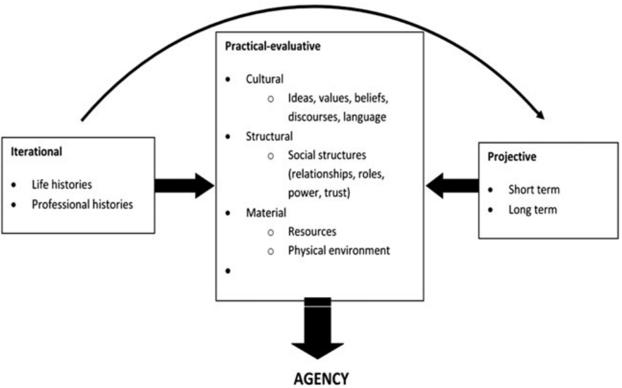
- For this paper, the authors primarily analyzed interview data from all three phases, using codes from an agency model and then open coding to interpret beliefs and aspirations.
## Limitations
- The authors explicitly say the data refer to “one particular though nonetheless interesting case,” so the findings are limited in scope.
- The study draws primarily on the stories of six classroom teachers, which is a small sample; this is evident in the text.
- The analysis focuses on interviews and selected themes from one reform context in Scotland, so transferability beyond this setting is not established; this is evident in the text.
Model-written summary. Check it against the paper before relying on it.
Integrity signals
Registry
Cites
Statistics
Figures
Verification
Claims the paper makes
0 Valid · 2 Not valid · 30 Not checked · 99 Own results and interpretations
A result the paper reports from its own data — it cites no other source for it, so there is none to check. The quote shows it is in the paper.
In the paper
“The significance of what was often referred to as a safe and caring learning environment for everyone who came into their classrooms was articulated strongly.”
§ 4. Teachers’ beliefs > 4.1. Beliefs relating to children and young people
boosted- Asserted: passes — The authors put it forward as true.
- Checkable: passes — It can be checked against evidence.
- Load-bearing: unclear — It is unclear whether the paper’s conclusions depend on it.
- Based: passes — The paper gives a reason why it holds.
A result the paper reports from its own data — it cites no other source for it, so there is none to check. The quote shows it is in the paper.
In the paper
“In analysing the data, we were struck by the similarity of beliefs articulated across this small group of teachers, despite their location in different sectors of education.”
plain- Asserted: passes — The authors put it forward as true.
- Checkable: passes — It can be checked against evidence.
- Load-bearing: passes — The paper’s conclusions depend on it.
- Based: passes — The paper gives a reason why it holds.
A result the paper reports from its own data — it cites no other source for it, so there is none to check. The quote shows it is in the paper.
In the paper
“The data clearly convey the strong sense of teachers’ professional responsibility towards their students.”
§ 4. Teachers’ beliefs > 4.1. Beliefs relating to children and young people
boosted- Asserted: passes — The authors put it forward as true.
- Checkable: passes — It can be checked against evidence.
- Load-bearing: unclear — It is unclear whether the paper’s conclusions depend on it.
- Based: passes — The paper gives a reason why it holds.
A result the paper reports from its own data — it cites no other source for it, so there is none to check. The quote shows it is in the paper.
In the paper
“Indeed, only one participant strongly referred to the importance of subject knowledge, lamenting what she saw as the detrimental effects of vocationalism on the academic content of her subject.”
§ 4. Teachers’ beliefs > 4.2. Beliefs about the role of the teacher
plainSingle case- Asserted: passes — The authors put it forward as true.
- Checkable: passes — It can be checked against evidence.
- Load-bearing: unclear — It is unclear whether the paper’s conclusions depend on it.
- Based: passes — The paper gives a reason why it holds.
A result the paper reports from its own data — it cites no other source for it, so there is none to check. The quote shows it is in the paper.
In the paper
“these discourses appear to be fairly restricted in scope, more geared to short-term goals, and predominantly articulated via the language of recent policy documentation.”
hedged- Asserted: passes — The authors put it forward as true.
- Checkable: passes — It can be checked against evidence.
- Load-bearing: passes — The paper’s conclusions depend on it.
- Based: passes — The paper gives a reason why it holds.
57 more claims
Create a free account to see all 131 claims and every source verdict.
- It may state two separate claims as one. 39
- Probably not a substantial claim. 46
Claims other papers make about this one
Each is checked against this paper’s own text: does it say what the citing paper says it does?
The cited source says what the claim attributes to it.
In the citing paper
“This absence leaves teachers unsure about their roles and contributions (Biesta et al. 2015).”
From Unveiling teachers’ professional agency and decision-making in professional learning: the illusion of choice (2025) · cites this paper as Biesta et al. 2015
The cited source says what the claim attributes to it.
In the citing paper
“As Biesta et al. (2015) suggests, teachers' agency is influenced not just by their attributes, but also by their professional experience.”
From Unveiling teachers’ professional agency and decision-making in professional learning: the illusion of choice (2025) · cites this paper as Biesta et al. 2015
The cited source says what the claim attributes to it.
In the citing paper
“Likewise Biesta, Priestley and Robinson (2015) point to a lack of discourses among teachers that constructs education in terms other than the technical-rational concerns of 'efficiency' to include questions of purpose and value.”
From Teacher agency and professional learning communities; what can Learning Rounds in Scotland teach us? (2017) · cites this paper as Biesta, Priestley and Robinson (2015)
The cited source says what the claim attributes to it.
In the citing paper
“Biesta, Priestley and Robinson (2015) report that the Scottish teachers in their research had a very similar set of views about teaching, learning and education more broadly, even though they were from diverse locations and sectors.”
From Teacher agency and professional learning communities; what can Learning Rounds in Scotland teach us? (2017) · cites this paper as Biesta, Priestley and Robinson (2015)
The cited source says what the claim attributes to it.
In the citing paper
“Biesta, Priestley and Robinson (2015) report a similar experience in their research on teacher agency.”
From Teacher agency and professional learning communities; what can Learning Rounds in Scotland teach us? (2017) · cites this paper as Biesta, Priestley and Robinson (2015)
1 more claim about this paper
Create a free account to see every claim other papers make about this one.
Citations
Cites
Outline of a Theory of Practice
Bourdieu, P. (1977) · doi:10.1017/cbo9780511812507 · Cited by 27,606
(1984) · Cited by 21,166
Outline of a Theory of Practice.
Frank, A. W., & Bourdieu, P. (1980) · Contemporary Sociology · doi:10.2307/2066038 · Cited by 14,545
Teachers' beliefs and educational research: cleaning up a messy construct
Pajares, M. F. (1992) · Review of Educational Research · doi:10.3102/00346543062003307 · Cited by 9,007 · cited 2×
“In the discussion section, we explore what this reveals about the role of beliefs in teacher agency.”
BackgroundEmirbayer, M., & Mische, A. (1998) · American Journal of Sociology · doi:10.1086/231294 · Cited by 6,165
Outline of a Theory of Practice
BOURDIEU, P. (2007) · On Violence · doi:10.2307/j.ctv120qr2d.16 · Cited by 5,527
Realist Social Theory: The Morphogenetic Approach
Archer, M. S. (1995) · Cambridge University Press eBooks · doi:10.1017/cbo9780511557675 · Cited by 3,125
Change Forces: Probing the Depths of Educational Reform
Fullan, M. (1993) · doi:10.4324/9780203059005 · Cited by 3,111
Realist social theory the morphogenetic approach
Archer, M. S. (1995) · Cited by 2,938
Change Forces: Probing the Depths of Educational Reform
Davies, S., & Fullan, M. (1995) · Canadian Public Policy / Analyse de Politiques · doi:10.2307/3552051 · Cited by 2,809
Research works printed but not linked: 3
- Brown, S., & McIntyre, D. (1993). Making sense of teaching: Developing teachers and teaching. Buckingham: Open University Press. (Open in a new window)Google Scholar
- Hollis, M. (1994). The philosophy of social science: An introduction. Cambridge: Cambridge University Press. (Open in a new window)Google Scholar · doi:10.1017/ccol0521447801
- Nieveen N. (2011 September 14). Teachers’ professional development in curriculum design in the Netherlands. Paper presented at the European Conference for Educational Research Berlin.
Cited by
Items 901–1,000 of 1,289
Shikokoti, H. (2024) · SSRN Electronic Journal · doi:10.2139/ssrn.4884087 · Cited by 1
Bilingual Educators' Practices for Supporting Hispanic Bilingual Students' Success in School
Lerwick, A. P. M. (2022) · University of North Texas Digital Library (University of North Texas) · doi:10.12794/metadc2048699 · Cited by 1
Guo, J., Shen, M., Jia, T., & Zhang, C. (2026) · Research Square · doi:10.21203/rs.3.rs-8512548/v1 · Cited by 1
Implementation of an AVID Elementary Program in a Technology-Rich Environment
Large, M. J. (2017) · ScholarWorks (Boise State University) · doi:10.18122/b2xm7v
Do Professional Learning Communities reify or interrupt the language of pedagogical practice?
Philpott, C. (2017) · Problemy Wczesnej Edukacji · doi:10.5604/01.3001.0010.5583
Teachers’ Recommendations for Professional Learning
Trần, L. T., & Lê, T. T. T. (2017) · Springer eBooks · doi:10.1007/978-3-319-70515-6_6
eacher evaluation policies and practices in Kuwaiti primary schools
Aljenahi, N. B. E. A. (2016)
Teacher Education and Inclusionary Practices: Sharing Delhi University Experiences.
Raina, J. (2016) · The Journal for Critical Education Policy Studies · Cited by 1
Biancotti, S. (2018) · ResearchOnline at James Cook University (James Cook University) · doi:10.4225/28/5b19b1f403e1f
Practitioner Research in Schools: Revealing the Efficacy Agency Cycle
Resnick, E. (2018) · Chapman University Digital Commons (Chapman University) · doi:10.36837/chapman.000030
The Complexities of Learner Agency and Teacher Agency in Foreign Language Education
Teng, M. F. (2018) · Springer eBooks · doi:10.1007/978-981-13-0728-7_5
Global citizenship education in the biology classroom: an exploratory study in Scotland
Margiotta, R. (2018) · Enlighten: Theses (The University of Glasgow) · Cited by 1
The Teachers’ Own Music Learning Experiences and Personal Beliefs
Barton, G. M. (2018) · Springer eBooks · doi:10.1007/978-3-319-95408-0_6
Student Agency – a Case Study of Primary School Aged Children
Cronin, B. M. (2018) · Tuwhera (Auckland University of Technology) · Cited by 1
Frith, C. (2018) · Minerva Access (University of Melbourne)
Glaés-Coutts, L. (2018) · TSpace (University of Toronto) · Cited by 1
Rahmung – Wandel und Professionalität
Lehmann-Wermser, A. (2019) · Springer eBooks · doi:10.1007/978-3-658-20487-7_11
Innovation in einer kleinen Fachgruppe – das Beispiel Musik
Lehmann-Wermser, A. (2019) · Springer eBooks · doi:10.1007/978-3-658-20487-7_12
Cude, M. D., & Kisirkoi, F. (2018) · Journal of international social studies
Chain Reaction: The Irish Context
O'Reilly, J., Guilfoyle, L., & Lehane, L. (2019) · Advances in educational technologies and instructional design book series · doi:10.4018/978-1-5225-5439-4.ch004
Thompson, C., & Hopkins, N. (2019) · Encyclopaideia · doi:10.6092/issn.1825-8670/9345
Investigating the professional agency of English teachers in rural Ukrainian public schools
Park, J. (2019) · Jyväskylä University Digital Archive (University of Jyväskylä)
Gibby, C. (2018) · Sunderland Repository (University of Sunderland)
Supporting Educator Professional Growth In Times Of Change
Doyle, A. M. (2019) · DUNE - DigitalUNE (University of New England)
Professional Learning of English Language Teacher Educators in Finland and Japan
Green, C. (2019) · Jyväskylä University Digital Archive (University of Jyväskylä) · Cited by 1
An asset-based view of agentic facultyPreprint
Strubbe, L. E., Madsen, A., McKagan, S. B., & Sayre, E. C. (2019) · arXiv (Cornell University) · Cited by 1
Jacobs, A. (2019) · ThinkIR: The University of Louisville's Institutional Repository (University of Louisville) · doi:10.18297/etd/3337
The Role of ‘Autonomy’ in Teaching Expertise: The Role of ‘Autonomy’ in Teaching Expertise
Bucelli, I. (2017) · London School of Economics and Political Science Research Online (London School of Economics and Political Science)
Duarte, P., & Moreira, A. I. (2020) · Da Investigação às Práticas · doi:10.25757/invep.v10i1.204 · Cited by 6
Gennari, C. (2019) · White Rose eTheses Online (University of Leeds, The University of Sheffield, University of York)
Grassroots Professional Learning : The Homegrown and Human Dimensions of Teacher Learning
Matteo, H. A. F. (2020)
A social-cognitive study of Indonesian Google educator groups
Artati, P. (2020) · Open Access Victoria University of Wellington | Te Herenga Waka (Figshare) · doi:10.26686/wgtn.17147639 · Cited by 2
Mathematics teacher tension: Arising in, and through, their attempt to change practice
Rouleau, A. (2020) · Summit (Simon Fraser University) · Cited by 2
Empowering TAs to work with children
Clarke, E. (2020) · Routledge eBooks · doi:10.4324/9780429057434-14
Physics education research�s implicit views of physics faculty
Franklin, M., Strubbe, L. E., & Sayre, E. C. (2020) · Physics Education Research Conference (PERC) · doi:10.1119/perc.2020.pr.franklin
The impact of a new National Curriculum on subject leaders in primary and secondary Schools
Chubb, S. (2020) · Lancaster EPrints (Lancaster University) · doi:10.17635/lancaster/thesis/1001
What happens when a student’s question crosses a line
Hopman, J. (2020) · Routledge eBooks · doi:10.4324/9780429279379-5
The dilemma of textbook selection
Hopman, J. (2020) · Routledge eBooks · doi:10.4324/9780429279379-7
It May Take Faith: An Investigation of Teacher Persistent Agency in the Crushing Contexts
McDonald, A. L. (2019) · UA Campus Repository (The University of Arizona)
Suleiman, M. M. (2020) · White Rose eTheses Online (University of Leeds, The University of Sheffield, University of York) · Cited by 3
Finding their Flock-professional learning for experienced teachers
Glaés-Coutts, L. (2020) · LA Referencia (Red Federada de Repositorios Institucionales de Publicaciones Científicas)
Early Language Education in Malta
Mifsud, C., & Vella, L. (2020) · Springer international handbooks of education · doi:10.1007/978-3-030-47073-9_29-1 · Cited by 1
Faglege visjonar og læraraktørskap
Halvorsen, Ø. W. (2020) · Nordisk tidsskrift for pedagogikk og kritikk · doi:10.23865/ntpk.v6.1596
Elementary mathematics teacher agency: Examining teacher and ecological capacity
Nguyen, P., Yeo, S., Zhao, W., & Webel, C. (2020) · Mathematics Education Across Cultures: Proceedings of the 42nd Meeting of the North American Chapter of the International Group for the Psychology of Mathematics Education · doi:10.51272/pmena.42.2020-112 · Cited by 1
Ho, H. T. (2021) · Open Access Victoria University of Wellington | Te Herenga Waka (Figshare) · doi:10.26686/wgtn.14131469.v1 · Cited by 7
Branigan, H. (2021) · The Curriculum Journal · doi:10.1002/curj.101 · Cited by 2
Scotland's education policy of Learning for Sustainability, the Anthropocene and learning to resist
Angier, C. (2020) · Stirling Online Research Repository (University of Stirling)
Wang, M. (2020) · Journal of Multilingual Education Research · doi:10.5422/jmer.2020.v10.85-104
Surfacing Teachers’ Aspirations and Decisions Through Digital Design Journals
Peters, L., Sadeh, S., & Brennan, K. A. (2020) · Proceedings. · doi:10.22318/icls2020.2363
Brahe-Orlandi, R., & Nielsen, B. L. (2021) · Studier i læreruddannelse og -profession · doi:10.7146/lup.v6i1.127789 · Cited by 3
Rosenow, J. A. W. (2020) · KU ScholarWorks (The University of Kansas) · Cited by 3
English Education Master Students' Perceptions on Their Agency as Future EFL Teachers
Wijaya, K. F. (2021) · Journal of Foreign Languange Teaching and Learning · doi:10.18196/ftl.v6i2.11994 · Cited by 1
Virgili, U. R. I., Iranzo‐García, P., Barrios-Arós, C., et al. (2021) · Revista Lusófona de Educação · doi:10.24140/issn.1645-7250.rle50.09
Teacher Agency Through Collaborative Expertise-building
Tupas, R. (2021) · The English Teacher · doi:10.52696/avra5411
Sugiharto, S. (2021) · The English Teacher · doi:10.52696/ilmw5019
Öğretmen kimliği araştırmalarında yeni bir kavram: öğretmen etkenliği
Erdem, C. (2020) · Adıyaman Üniversitesi Eğitim Bilimleri Dergisi · Cited by 6
Leslie, P. (2021) · Insight (University of Cumbria) · Cited by 2
Participation and Social Exclusion – Are They Mutually Exclusive Phenomena?
Häbig, J., Zala-Mezö, E., Herzig, P., & Müller-Kuhn, D. (2021) · Transdisciplinary perspectives in educational research · doi:10.1007/978-3-030-80861-7_10
Ryen, E., & Jegstad, K. M. (2022) · Nordic Journal of Comparative and International Education (NJCIE) · doi:10.7577/njcie.4347
(2020) · Emerald Group Publishing Limited eBooks · doi:10.1108/978-1-78973-147-720201016
Distributing teachers, school leaders and other school staff effectively
OECD (2019) · OECD reviews of school resources · doi:10.1787/6920080e-en
Teachers’ working hours (ISCED 2), 2018
OECD (2019) · OECD reviews of school resources · doi:10.1787/01c95516-en
Play in the digital world: beyond the binary logicPreprint
Mertala, P., & Salomaa, S. (2022) · doi:10.35542/osf.io/2fn8j
Layton, K. (2020) · Open Access Victoria University of Wellington | Te Herenga Waka (Figshare) · doi:10.26686/wgtn.17151626.v1
The Role of ‘Autonomy’ in Teaching Expertise
Bucelli, I. (2018) · Wiley eBooks · doi:10.1002/9781119527268.ch2 · Cited by 1
Smith, N. C. (2017) · Digital Repository Service (Northeastern University) · doi:10.17760/d20320140 · Cited by 2
Bassett, S. (2019) · Open Access Victoria University of Wellington | Te Herenga Waka (Figshare) · doi:10.26686/wgtn.17139728
List of tables available on line
OECD (2019) · OECD reviews of school resources · doi:10.1787/2f22855b-en
OECD (2020) · OECD reviews of school resources · doi:10.1787/c2e71983-fr
Vechiato, L. (2022) · Digital Library of Theses and Dissertations (Universidade de São Paulo) · doi:10.11606/d.81.2022.tde-26052022-150731
Repensando la agencia femenina durante la guerra civil. El caso de Mujeres al Servicio de España
Rodríguez, J. P. (2022) · Historia y Política Ideas Procesos y Movimientos Sociales · doi:10.18042/hp.47.08 · Cited by 2
Viesca, K. M., Linzell, C. H., Wang, P., et al. (2022) · Routledge eBooks · doi:10.4324/9781003196228-14
CONCEPT OF TEACHER PROFESSIONAL AGENCY
Пономаренко, Т. І. (2021) · Молодий вчений · doi:10.32839/2304-5809/2021-1-89-52
Bernal, J. C. P., Sánchez, E. R., & Vallejos, R. M. (2022) · Edetania: estudios y propuestas socio-educativas · doi:10.46583/edetania_2022.61.875
Castro-Carrasco, P. J., Adaros, R. T. E., Ávalos, N. D. R., Checón, R. F. T., Bordones, C. A. V., Cuadra-Martínez, D. J., González-Palta, I., & Oyanadel, C. (2022) · Revista Ibero-Americana de Estudos em Educação · doi:10.21723/riaee.v17i2.16699 · Cited by 5
Hardman, M., Taylor, B., & Daly, C. (2022) · Springer eBooks · doi:10.1007/978-3-030-59533-3_19-1 · Cited by 2
Yang, W. (2019) · American Educational Research Association Annual Meeting (AERA) · doi:10.3102/1434160
Lincoln, C. M. (2021) · Digital Repository Service (Northeastern University) · doi:10.17760/d20429208
Moore, P. E. (2020) · Sheffield Hallam University · doi:10.7190/shu-thesis-00456
Στυλιανού, Π. (2022) · Έρευνα στην Εκπαίδευση · doi:10.12681/hjre.31356
Teachers mediating of curriculum making processes
Birbili, M. (2022) · Elsevier eBooks · doi:10.1016/b978-0-12-818630-5.03023-2 · Cited by 2
An exploration of “Schools as Learning Organisations” as a catalyst for school and system change
Elder, Z. (2022) · Cronfa (Swansea University) · doi:10.23889/suthesis.61976 · Cited by 1
Krivosh, L., & Schwartz, M. (2020) · EuroAmerican Journal of Applied Linguistics and Languages · doi:10.21283/2376905x.11.196
Academic Freedom in Teacher Education; Between Certainty and Uncertainty
Cronqvist, M. (2022) · The Australian journal of teacher education · doi:10.14221/ajte.2022v47n6.4
Kusanagi, K. N. (2022) · Education in the Asia-Pacific region · doi:10.1007/978-981-19-5928-8_1
Peruskouluikäisten lasten vanhempien koettu toimijuus covid-19-pandemian hätäetäopetuksen aikana
Turunen, S., Melasalmi, A., Pihlainen, K., & Koskela, T. (2022) · Kasvatus · doi:10.33348/kvt.125521 · Cited by 2
Felipe, A. E., Fascendini, P. Y., & Galván, S. M. (2022) · Revista Científica Sinapsis · doi:10.37117/s.v2i21.715
Simó, V. L., Grimalt‐Álvaro, C., & Puig, N. S. (2023) · Chemistry Education Research and Practice · doi:10.1039/d2rp00179a · Cited by 1
Peron, S. A. (2022) · Digital Repository Service (Northeastern University) · doi:10.17760/d20471065
Powell, S. R. (2023) · Oxford University Press eBooks · doi:10.1093/oso/9780197570838.003.0007
Powell, S. R. (2023) · Oxford University Press eBooks · doi:10.1093/oso/9780197570838.003.0005
Powell, S. R. (2023) · Oxford University Press eBooks · doi:10.1093/oso/9780197570838.003.0004
Powell, S. R. (2023) · Oxford University Press eBooks · doi:10.1093/oso/9780197570838.002.0004
The One-Dimensional Music Program
Powell, S. R. (2023) · Oxford University Press eBooks · doi:10.1093/oso/9780197570838.003.0003
Powell, S. R. (2023) · Oxford University Press eBooks · doi:10.1093/oso/9780197570838.003.0006
Metadata
- Authors
- Biesta, G., Priestley, M., & Robinson, S.
- Affiliations
- ArtEZ University of the Arts (NL)
- University of Stirling (GB)
- Aarhus University (DK)
- Corresponding author
- Biesta, Gert
- Venue
- Teachers and Teaching
- Publisher
- Informa UK Limited
- Published
- 2015-06-15
- Volume
- 21
- Issue
- 6
- Pages
- 624-640
- ISSN
- 1354-0602 (ISSN-L)
- 1470-1278
- OpenAlex
- W1911902575
- Cited by
- 1,318
- References
- 47
- Citations by year
- 2026: 233 · 2025: 161 · 2024: 141 · 2023: 157 · 2022: 139 · 2021: 131 · 2020: 118 · 2019: 96 · 2018: 73 · 2017: 48 · 2016: 17 · 2015: 4
- FWCI
- 236.15
- Type
- journal article
- Language
- en
- Open access
- hybrid
- doi.org
- Licence
- cc-by-nc-nd
- Locations
- Teachers and Teaching (publishedVersion, cc-by-nc-nd)
- Brunel University Research Archive (BURA) (Brunel University London) (submittedVersion)
- Stirling Online Research Repository (University of Stirling) (submittedVersion, cc-by-nc-nd)
- Edinburgh Research Explorer (University of Edinburgh) (submittedVersion, other-oa)
- Funders
- Economic and Social Research Council (ES/I006907/1)
- Topics
- Social Sciences › Education › Teacher Education and Leadership Studies
- Social Sciences › Education › Education Pedagogy and Practices
- Social Sciences › Arts and Humanities › Philosophy › Education, Philosophy, and Society
- Keywords
- teacher agency, teacher beliefs, Curriculum for Excellence, educational reform, teacher professionalism, teacher decision-making, institutional discourse, professional vision, Scotland
About these checks
Registry, retraction, Cites and statistics results are computed, not judged, with one exception: a printed reference that no index lists is read once by a model before it counts as a citation error. Claims are extracted by a model and kept only when their quote appears verbatim in the text; each cited source is then checked, with a model’s help, for whether it says what the claim relies on. Those verdicts can be wrong — read the claim’s quote and the cited source before relying on one.
A language model drew the claims from the paper on 2026-10-11, under version 3 of the claim definition (model deepseek-v4.1-flash, prompt extract-v3).
A second model labelled each claim on 2026-10-11 (model jev-1.13-20260917, definition revision gold-guideline-v0.2).
Statistics and arithmetic are recomputed, not judged.
Confidence bands are shown only for fields calibrated on our annotated test set. None is calibrated yet, so no band is shown.
What counts as a claim ›How we measure confidence ›How we check this ›
Are you an author, or do you see a problem with this page? Request a review
Data sources
Bibliographic data: Semantic Scholar, OpenAlex, Crossref.
Contains information from the Semantic Scholar Academic Graph Datasets, made available under the ODC Attribution License (ODC-BY 1.0).
Semantic Scholar’s data is described in: Kinney, R., et al. (2023). The Semantic Scholar Open Data Platform. arXiv:2301.10140.
