

The role of beliefs in teacher agency
Open accessThe DOI matches its Crossref record; 44 of the 47 references it cites were found in a registry or an index; none of the 31 sources its claims cite is checked for support yet.
Abstract
There is an ongoing tension within educational policy worldwide between countries that seek to reduce the opportunities for teachers to exert judgement and control over their own work, and those who seek to promote it. Some see teacher agency as a weakness within the operation of schools and seek to replace it with evidence-based and data-driven approaches, whereas others argue that because of the complexities of situated educational practices, teacher agency is an indispensable element of good and meaningful education. While the ideological debate about the shape and form of teacher professionalism is important, it is equally important to understand the dynamics of teacher agency and the factors that contribute to its promotion and enhancement. In this paper, we draw from a two-year study into teacher agency against the backdrop of large-scale educational reform – the implementation of Scotland’s Curriculum for Excellence – in order to explore these questions. We focus on teachers’ beliefs in order to get a sense of the individual and collective discourses that inform teachers’ perceptions, judgements and decision-making and that motivate and drive teachers’ action. While the research suggests that beliefs play an important role in teachers’ work, an apparent mismatch between teachers’ individual beliefs and values and wider institutional discourses and cultures, and a relative lack of a clear and robust professional vision of the purposes of education indicate that the promotion of teacher agency does not just rely on the beliefs that individual teachers bring to their practice, but also requires collective development and consideration.
Overview
CoChat Summary
## TL;DR
The paper argues that teacher beliefs matter for agency, but mainly insofar as they are shaped by policy discourse, schooling culture, and limited professional visions of what education is for. Using ethnographic case studies from three Scottish schools during Curriculum for Excellence, the authors find that teachers’ beliefs were often short-term, instrumental, and only loosely connected to broader purposes or values.
## Key findings
- Across the six classroom teachers, beliefs about children, teaching, and educational purpose were notably similar, and often framed by recent policy language rather than a robust professional discourse.
- Teachers strongly emphasized relationships, safety, care, enjoyment, skills, socialisation, and “maximising student potential,” but gave little sustained attention to knowledge, qualification, social justice, or democratic values.
- The paper argues that a narrow view of purpose limits agency: teachers were effective at short-term classroom management and curriculum delivery, but less able to use beliefs to imagine or enact longer-term educational aims.
- The authors report that teachers’ understandings of Curriculum for Excellence were often superficial or vague; some described the curriculum as “airy fairy,” “overly complicated,” or something they were “fumbling about trying.”
## Methods
- Ethnographic research in one Scottish education authority, in one primary school and two secondary schools, focusing on two experienced classroom teachers in each setting; senior managers were also interviewed.
- The project ran over a full year with three data-collection phases and used observation, semi-structured individual and group interviews, a personal/professional history interview, policy-text analysis, and teacher network mapping.
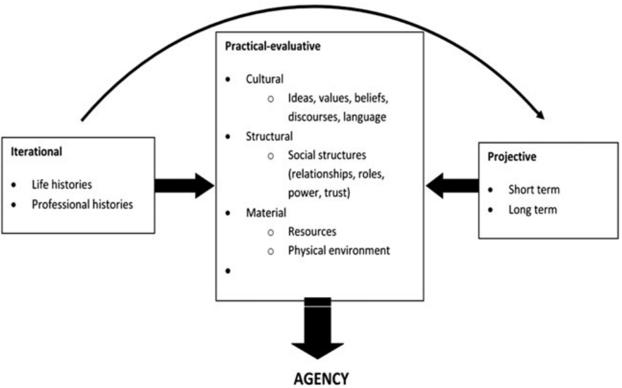
- For this paper, the authors primarily analyzed interview data from all three phases, using codes from an agency model and then open coding to interpret beliefs and aspirations.
## Limitations
- The authors explicitly say the data refer to “one particular though nonetheless interesting case,” so the findings are limited in scope.
- The study draws primarily on the stories of six classroom teachers, which is a small sample; this is evident in the text.
- The analysis focuses on interviews and selected themes from one reform context in Scotland, so transferability beyond this setting is not established; this is evident in the text.
Model-written summary. Check it against the paper before relying on it.
Integrity signals
Registry
Cites
Statistics
Figures
Verification
Claims the paper makes
0 Valid · 2 Not valid · 30 Not checked · 99 Own results and interpretations
A result the paper reports from its own data — it cites no other source for it, so there is none to check. The quote shows it is in the paper.
In the paper
“The significance of what was often referred to as a safe and caring learning environment for everyone who came into their classrooms was articulated strongly.”
§ 4. Teachers’ beliefs > 4.1. Beliefs relating to children and young people
boosted- Asserted: passes — The authors put it forward as true.
- Checkable: passes — It can be checked against evidence.
- Load-bearing: unclear — It is unclear whether the paper’s conclusions depend on it.
- Based: passes — The paper gives a reason why it holds.
A result the paper reports from its own data — it cites no other source for it, so there is none to check. The quote shows it is in the paper.
In the paper
“In analysing the data, we were struck by the similarity of beliefs articulated across this small group of teachers, despite their location in different sectors of education.”
plain- Asserted: passes — The authors put it forward as true.
- Checkable: passes — It can be checked against evidence.
- Load-bearing: passes — The paper’s conclusions depend on it.
- Based: passes — The paper gives a reason why it holds.
A result the paper reports from its own data — it cites no other source for it, so there is none to check. The quote shows it is in the paper.
In the paper
“The data clearly convey the strong sense of teachers’ professional responsibility towards their students.”
§ 4. Teachers’ beliefs > 4.1. Beliefs relating to children and young people
boosted- Asserted: passes — The authors put it forward as true.
- Checkable: passes — It can be checked against evidence.
- Load-bearing: unclear — It is unclear whether the paper’s conclusions depend on it.
- Based: passes — The paper gives a reason why it holds.
A result the paper reports from its own data — it cites no other source for it, so there is none to check. The quote shows it is in the paper.
In the paper
“Indeed, only one participant strongly referred to the importance of subject knowledge, lamenting what she saw as the detrimental effects of vocationalism on the academic content of her subject.”
§ 4. Teachers’ beliefs > 4.2. Beliefs about the role of the teacher
plainSingle case- Asserted: passes — The authors put it forward as true.
- Checkable: passes — It can be checked against evidence.
- Load-bearing: unclear — It is unclear whether the paper’s conclusions depend on it.
- Based: passes — The paper gives a reason why it holds.
A result the paper reports from its own data — it cites no other source for it, so there is none to check. The quote shows it is in the paper.
In the paper
“these discourses appear to be fairly restricted in scope, more geared to short-term goals, and predominantly articulated via the language of recent policy documentation.”
hedged- Asserted: passes — The authors put it forward as true.
- Checkable: passes — It can be checked against evidence.
- Load-bearing: passes — The paper’s conclusions depend on it.
- Based: passes — The paper gives a reason why it holds.
57 more claims
Create a free account to see all 131 claims and every source verdict.
- It may state two separate claims as one. 39
- Probably not a substantial claim. 46
Claims other papers make about this one
Each is checked against this paper’s own text: does it say what the citing paper says it does?
The cited source says what the claim attributes to it.
In the citing paper
“This absence leaves teachers unsure about their roles and contributions (Biesta et al. 2015).”
From Unveiling teachers’ professional agency and decision-making in professional learning: the illusion of choice (2025) · cites this paper as Biesta et al. 2015
The cited source says what the claim attributes to it.
In the citing paper
“As Biesta et al. (2015) suggests, teachers' agency is influenced not just by their attributes, but also by their professional experience.”
From Unveiling teachers’ professional agency and decision-making in professional learning: the illusion of choice (2025) · cites this paper as Biesta et al. 2015
The cited source says what the claim attributes to it.
In the citing paper
“Likewise Biesta, Priestley and Robinson (2015) point to a lack of discourses among teachers that constructs education in terms other than the technical-rational concerns of 'efficiency' to include questions of purpose and value.”
From Teacher agency and professional learning communities; what can Learning Rounds in Scotland teach us? (2017) · cites this paper as Biesta, Priestley and Robinson (2015)
The cited source says what the claim attributes to it.
In the citing paper
“Biesta, Priestley and Robinson (2015) report that the Scottish teachers in their research had a very similar set of views about teaching, learning and education more broadly, even though they were from diverse locations and sectors.”
From Teacher agency and professional learning communities; what can Learning Rounds in Scotland teach us? (2017) · cites this paper as Biesta, Priestley and Robinson (2015)
The cited source says what the claim attributes to it.
In the citing paper
“Biesta, Priestley and Robinson (2015) report a similar experience in their research on teacher agency.”
From Teacher agency and professional learning communities; what can Learning Rounds in Scotland teach us? (2017) · cites this paper as Biesta, Priestley and Robinson (2015)
1 more claim about this paper
Create a free account to see every claim other papers make about this one.
Citations
Cites
Outline of a Theory of Practice
Bourdieu, P. (1977) · doi:10.1017/cbo9780511812507 · Cited by 27,606
(1984) · Cited by 21,166
Outline of a Theory of Practice.
Frank, A. W., & Bourdieu, P. (1980) · Contemporary Sociology · doi:10.2307/2066038 · Cited by 14,545
Teachers' beliefs and educational research: cleaning up a messy construct
Pajares, M. F. (1992) · Review of Educational Research · doi:10.3102/00346543062003307 · Cited by 9,007 · cited 2×
“In the discussion section, we explore what this reveals about the role of beliefs in teacher agency.”
BackgroundEmirbayer, M., & Mische, A. (1998) · American Journal of Sociology · doi:10.1086/231294 · Cited by 6,165
Outline of a Theory of Practice
BOURDIEU, P. (2007) · On Violence · doi:10.2307/j.ctv120qr2d.16 · Cited by 5,527
Realist Social Theory: The Morphogenetic Approach
Archer, M. S. (1995) · Cambridge University Press eBooks · doi:10.1017/cbo9780511557675 · Cited by 3,125
Change Forces: Probing the Depths of Educational Reform
Fullan, M. (1993) · doi:10.4324/9780203059005 · Cited by 3,111
Realist social theory the morphogenetic approach
Archer, M. S. (1995) · Cited by 2,938
Change Forces: Probing the Depths of Educational Reform
Davies, S., & Fullan, M. (1995) · Canadian Public Policy / Analyse de Politiques · doi:10.2307/3552051 · Cited by 2,809
Research works printed but not linked: 3
- Brown, S., & McIntyre, D. (1993). Making sense of teaching: Developing teachers and teaching. Buckingham: Open University Press. (Open in a new window)Google Scholar
- Hollis, M. (1994). The philosophy of social science: An introduction. Cambridge: Cambridge University Press. (Open in a new window)Google Scholar · doi:10.1017/ccol0521447801
- Nieveen N. (2011 September 14). Teachers’ professional development in curriculum design in the Netherlands. Paper presented at the European Conference for Educational Research Berlin.
Cited by
Items 1,101–1,200 of 1,289
Weinberg, A. E., Oster, N. J., Anayatova, D., & Jordan, M. E. (2025) · Environmental Education Research · doi:10.1080/13504622.2025.2575080 · Cited by 1
Lješnjak, S., Caković, D., & Šorgo, A. (2025) · Environmental Education Research · doi:10.1080/13504622.2025.2575297
Moallem, M., Vandiver, M., Loksa, D., Li, Q., Harati, H., Kara, M., Billman, R. H., & Christenson, L. A. (2025) · TechTrends · doi:10.1007/s11528-025-01137-2 · Cited by 2
Designing for adult language learning in a robot-assisted language learning context
Qi, G. Y., Wang, Y., & Chen, N. (2025) · ANU Press eBooks · doi:10.22459/dddlcau.2025.07
Are children still at the heart of education?
Bowman, H. (2025) · Early Years Educator · doi:10.12968/eyed.2025.24.18.20
Rosado, K. A. P. (2024) · Sage Sphere Higher Education · doi:10.63688/mb8xah78
Using the reading sciences and technology for teaching and learning in the Global South
Lysenko, L., Abrami, P. C., Gottardo, A., Wood, E., Wade, A., Kiforo, E., Maniraguha, J. B., Shivachi, A., Iminza, R., Ghaa, C., et al. (2025) · Learning and Instruction · doi:10.1016/j.learninstruc.2025.102259 · Cited by 3
Tambyah, M., & Sempowicz, T. (2025) · International Journal of Inclusive Education · doi:10.1080/13603116.2025.2571711
Leite, L. O., Lustosa, F. G., & Santana, J. S. (2025) · Revista Tempos e Espaços em Educação · doi:10.20952/revtee.v18i37.21740
From Traits to Teaching: Personality's Impact on Teacher Efficacy in the Lower Secondary Schools
Lokaj, L., Bërxulli, D., Gallopeni, F., & Shehu, B. P. (2025) · International Journal of Educational Reform · doi:10.1177/10567879251393723
Yeomans, E. (2025) · Journal of Religious Education · doi:10.1007/s40839-025-00278-z
Aaron, T. (2022) · Emerald Group Publishing Limited eBooks · doi:10.1108/979-8-88730-077-120251012 · Cited by 2
Building and District Policies Impacting Music Instruction
Shaw, R. D., & Bohn, A. (2025) · Bulletin of the Council for Research in Music Education · doi:10.5406/21627223.245.01
Guo, R., Shen, Y., Hinson-Williams, J., LaPoint, S., McKinnon, R., Wood, R., & Bottema‐Beutel, K. (2025) · Autism in Adulthood · doi:10.1177/25739581251395441 · Cited by 1
IDENTIDAD PROFESIONAL EN EL PRÁCTICUM DE EDUCACIÓN INFANTIL: UNA REVISIÓN SISTEMÁTICA
Figueroa-Céspedes, I., & Vergara-Flores, I. (2025) · Cadernos de Pesquisa · doi:10.1590/1980531412111 · Cited by 4
Chen-Zimerman, N., & Orland‐Barak, L. (2025) · European Journal of Teacher Education · doi:10.1080/02619768.2025.2595244
Zhang, H., Cheng, X., & Yang, Q. (2025) · International Journal of Early Childhood · doi:10.1007/s13158-025-00467-9 · Cited by 1
Teachers’ licensure screening in Pakistan: does it assess what it aspires to?
Nawab, A., & Datoo, A. K. (2025) · Teacher Development · doi:10.1080/13664530.2025.2599300
Integrating Sustainability Development Goals Into EFL Classrooms
Le, H. N. A., Le-Khanh, H., & Ngo, N. T. D. (2025) · IGI Global eBooks · doi:10.4018/979-8-3373-2587-3.ch008
Anlı, G. (2025) · Batı anadolu eğitim bilimleri dergisi · doi:10.51460/baebd.1758796
Chung, A. H. S., & Ho, S. K. (2025) · Cogent Education · doi:10.1080/2331186x.2025.2610031
Understanding Learning Environments
Khine, M. S., & Koul, R. B. (2026) · Springer eBooks · doi:10.1007/978-981-95-4326-7_1
Olid, C. S., & Yélamos, E. M. (2025) · Revista Practicum · doi:10.24310/rep.10.2.2025.22868 · Cited by 1
Parkin, N., Hobson, K., Poortinga, W., Stead, M., Newth, J. L., Reeves, J. P., & Gattis, M. (2026) · British Educational Research Journal · doi:10.1002/berj.70103 · Cited by 4
Exploring teacher agency in using new language materials: an ecological perspective
Chen, Y., & Shu, D. (2026) · Language Culture and Curriculum · doi:10.1080/07908318.2026.2612966 · Cited by 2
Indian music teachers’ agency when establishing an in-school music education programme in schools
Brøske, B. Å. (2026) · Music Education Research · doi:10.1080/14613808.2025.2593364 · Cited by 1
Chen, X., Shu, D., & Barrot, J. S. (2026) · Computer Assisted Language Learning · doi:10.1080/09588221.2026.2612993 · Cited by 2
El papel de la agencia académica en el desempeño académico de estudiantes de la UNAM
Ramírez, J. J. B., & Gómez, E. A. G. (2026) · Revista Digital Internacional de Psicología y Ciencia Social · doi:10.22402/j.rdipycs.unam.e.11.1.2025.669
Gordon, J., Nourie, K., & Steward, H. (2026) · British Educational Research Journal · doi:10.1002/berj.70117 · Cited by 3
Türkoğlu, M. E., & Cansoy, R. (2026) · SAGE Open · doi:10.1177/21582440261417410 · Cited by 2
Meekaew, N., Khamnoi, S., Kulwongsa, A., & Saenkum, D. (2026) · Social Sciences & Humanities Open · doi:10.1016/j.ssaho.2026.102511 · Cited by 1
Policy and Practice: Navigating the Supports and Barriers to Diverse YA Literature in Schools
Savitz, R. S., & Howard, C. M. (2026) · Literacy Research and Instruction · doi:10.1080/19388071.2025.2611919 · Cited by 1
Amorim, L. R. P. (2026) · Journal of Microbiology and Biology Education · doi:10.1128/jmbe.00007-26
Etken Öğretmenlik ile Öğretim Programı Okuryazarlığı Arasındaki İlişki
Berberoğlu, A., & Altındağ, A. (2024) · DergiPark (Istanbul University)
Wilson, A., & Puryear, A. (2026) · Journal of Early Childhood Teacher Education · doi:10.1080/10901027.2026.2624561
Harðardóttir, E. (2026) · International Journal of Inclusive Education · doi:10.1080/13603116.2026.2626532
Huang, J. (2026) · The EUrASEANs journal on global socio-economic dynamics · doi:10.35678/2539-5645.11.1.2026.221
Cachia, E., Cassar, A. M., Darmanin, M., Gauci, S. A., & Schembri, H. (2026) · Education Sciences · doi:10.3390/educsci16020304 · Cited by 1
What Keeps Secondary School Teachers Motivated? A Qualitative Study from Urban Indian Classrooms
Ved, A. S., & Kareem, J. (2026) · International Journal of Educational Reform · doi:10.1177/10567879261419029
Unlocking Social and Financial Returns: Ethnography as the Key for Getting Impact Investing Right
Casciola, L., Petri, J., Gargeya, Y., & Fisker, B. (2025) · Ethnographic Praxis in Industry Conference Proceedings · doi:10.1111/epic.70003
Mathematics Teachers’ Experiences with Curricular Change
Hadley, G., Robinson, I. M., Husband, M., & Jutras, M. (2026) · Canadian Journal of Science, Mathematics and Technology Education · doi:10.1007/s42330-026-00460-x
Pre-service teachers’ perceived agency in developing family–school cooperation for language learning
Hosseini, M., Dewilde, J., & Haukås, Å. (2026) · Journal of Educational Change · doi:10.1007/s10833-026-09543-w
Marshal, N., & Bedeker, M. (2026) · Journal of Language Identity & Education · doi:10.1080/15348458.2026.2619887 · Cited by 1
Mynott, J. P., Wrynn, B., Beveren, P. V., Czerniawski, G., & Batista, P. (2026) · European Journal of Teacher Education · doi:10.1080/02619768.2026.2642181
Exploring multilingualism-related beliefs in Quebec: teachers’ perspectives
Villabona, N., Gartziarena, M., Paquet, P.-L., & Ta, G. (2026) · International Journal of Multilingualism · doi:10.1080/14790718.2026.2641061
Hauch, H. F., Kutschke, N., Schuster, A., et al. (2026) · BMC Medical Education · doi:10.1186/s12909-026-10170-5
Exploring Finnish vocational teachers’ agency in teaching migrant students
Kärkkäinen, K., Tarnanen, M., & Umarik, M. (2026) · Nordic Journal of Vocational Education and Training · doi:10.3384/njvet.2242-458x.2616145
Stokes, K. J. (2026) · London Review of Education · doi:10.14324/lre.24.1.05
Standen, C. H., & Rojas-Mora, P. (2026) · Teaching and Teacher Education · doi:10.1016/j.tate.2026.105495
Chang, Y.-Y. (2026) · Asian Journal of Interdisciplinary Research · doi:10.54392/ajir2617 · Cited by 1
Moral Agency in Saudi Education: Defining Suitable Outcomes Within Curriculum Reform
Alharbi, M. (2026) · Open Education Studies · doi:10.1515/edu-2025-0137 · Cited by 1
Key learning experiences in the construction of professional teacher identity
Rojas, J. E. C., Barril, J. P., Fauré, J., Almuna, J., & Salter, P. (2025) · Mind Culture and Activity · doi:10.1080/10749039.2026.2646666
Irgatoğlu, A., & Yurttadur, O. (2026) · IGI Global eBooks · doi:10.4018/979-8-3373-5692-1.ch012 · Cited by 1
Hinman, T. B., Collett, J., & Wilson, B. (2026) · English Teaching Practice & Critique · doi:10.1108/etpc-09-2025-0232
Bilingual teacher agency in preschool environment
Protassova, E. Y., & Silkin, S. (2026) · Journal of Multilingual and Multicultural Development · doi:10.1080/01434632.2026.2639951
Amorati, R., & Pirovano, E. (2026) · Language Learning Journal · doi:10.1080/09571736.2026.2639013 · Cited by 1
Renn, J., Li, H., Choi, W., et al. (2026) · Bilingual Research Journal · doi:10.1080/15235882.2026.2642143
März, V., Gaikhorst, L., Geijsel, F. P., & Nieuwenhoven, C. V. (2026) · European Journal of Teacher Education · doi:10.1080/02619768.2026.2650830
AI in Education: Between Modernization and the Substitution of Knowledge
Baloch, N. Z. M. (2026) · Springer eBooks · doi:10.1007/60490_2026_10
Finkenstaedt-Quinn, S. A., Harrold, A., Gibas, M., Long, A., & Shultz, G. V. (2026) · Disciplinary and Interdisciplinary Science Education Research · doi:10.1186/s43031-026-00160-4 · Cited by 2
Liu, Z., & Noel, T. K. (2026) · The Asia-Pacific Education Researcher · doi:10.1007/s40299-026-01100-6 · Cited by 1
Fang, M., Wang-Hiles, L., & Jiang, X. (2026) · Educational linguistics · doi:10.1007/978-3-032-15648-8_10 · Cited by 1
Hibbs, B. (2026) · Educational linguistics · doi:10.1007/978-3-032-15648-8_5
Hamman‐Ortiz, L., & Hesson, S. (2026) · Educational linguistics · doi:10.1007/978-3-032-15648-8_12
Transnational Identity as Resource for Collective Agency: A Transmodal Collaborative Autoethnography
Fairley, M. J., Young, A., Elshimi, E., & Fathelbab, H. H. (2026) · Educational linguistics · doi:10.1007/978-3-032-15648-8_8 · Cited by 1
Patterson-Craven, S. (2026) · Cambridge Journal of Education · doi:10.1080/0305764x.2025.2536661 · Cited by 1
Tool for Teachers’ Reflection on Their Agency for Change (TRAC)
Pantić, N. (2026) · Springer eBooks · doi:10.1007/978-3-032-03265-2_7
Why Competence is Not Enough? The Case of Agency for Inclusive Practice
Pantić, N., & Florian, L. (2026) · Springer eBooks · doi:10.1007/978-3-032-03265-2_3
Policy Contexts and Teacher Agency for Inclusion in India and Sweden
Dutt, K. G. (2026) · Springer eBooks · doi:10.1007/978-3-032-03265-2_4
Change Agency and Teacher Development
Pantić, N. (2026) · Springer eBooks · doi:10.1007/978-3-032-03265-2_2 · Cited by 1
Yan, L., & Weng, T. (2026) · Language Teaching Research · doi:10.1177/13621688261433883 · Cited by 5
Views and Suggestions of Turkish Teachers on Lesson Plans
Birol, M. E., & Rüzgâr, M. E. (2026) · Van Yüzüncü Yıl Üniversitesi Eğitim Fakültesi dergisi/Yüzüncü Yıl Üniversitesi Eğitim Fakültesi dergisi · doi:10.33711/yyuefd.1620403
Development and validation of the School Contexts of Outdoor Learning (SCOOL) scale
Parkin, N., Hobson, K., Poortinga, W., Stead, M., Newth, J. L., Reeves, J. P., Marshall, M., & Gattis, M. (2026) · Journal of Environmental Psychology · doi:10.1016/j.jenvp.2026.103034 · Cited by 1
Beyond what teachers say: the practice reality of environmental education in Azerbaijan
Mehdiyeva, A. (2026) · Environmental Education Research · doi:10.1080/13504622.2026.2662329
Mphatsoane-Sesoane, L., Jita, L. C., & Tshelane, M. D. (2026) · Education Sciences · doi:10.3390/educsci16050742 · Cited by 1
Flexible working and professional relationships in schools: An ecological approach
Cook, V., Müller, L.-M., Taylor, B., & Burn, H. (2026) · British Educational Research Journal · doi:10.1002/berj.70207 · Cited by 1
Şengül, Ö. (2026) · Journal of Physics Conference Series · doi:10.1088/1742-6596/3203/1/012070
Khâm, B. (2026) · IGI Global eBooks · doi:10.4018/979-8-2600-1885-9.ch007
Be, B., Pon, S., Pech, R., & Kann, S. (2026) · IGI Global eBooks · doi:10.4018/979-8-3373-7325-6.ch008
González-Ballesteros, L. M., Roncancio, C. A. C., de Castro, S. F., Gómez, Ó., Vásquez-Ponce, M., Vallejo-Caiza, I., Restrepo-Escudero, L., Pérez-Lalinde, S., de Castro-González, C. F., Gómez–Restrepo, C., et al. (2026) · Teaching and Teacher Education · doi:10.1016/j.tate.2026.105605 · Cited by 1
Linking teacher resistance, agency, and alienation: principal support’s moderating role
Çepni, O., Savaş, G., Palaz, T., Erdoğan, O., & Kılınç, A. Ç. (2026) · Irish Educational Studies · doi:10.1080/03323315.2026.2675306
Liu, M., & Chan, H. L.-H. (2026) · New Zealand Journal of Educational Studies · doi:10.1007/s40841-026-00450-5
Exploring the interplay between EFL teacher assessment agency, L2 grit, and teacher buoyancy
Mehri, M., Abdulhussein, S. H., Ali, I. S. M., & An-Nassrawi, A. A. A. (2026) · Discover Psychology · doi:10.1007/s44202-026-00723-6
Influence of preservice teacher education on mathematics teaching efficiency of beginning teachers
Osiakwan, J. K., Ntow, F. D., & Davis, E. K. (2026) · Teaching and Teacher Education · doi:10.1016/j.tate.2026.105644 · Cited by 4
Developing Professional Learning Networks as a Strategy for Innovation and Change
Vanlommel, K. (2026) · Springer international handbooks of education · doi:10.1007/978-3-031-88898-4_52-1 · Cited by 1
Teacher agency in continuous professional learning: a systematic mapping review in the Global South
TABATA, S. (2026) · Journal of International Cooperation in Education · doi:10.1108/jice-07-2025-0041
Forbes, K., & Morea, N. (2026) · Learning in Context · doi:10.1016/j.lecon.2026.100026
Pedagogical Innovation and Its Enemies: Prospects from Technology and AI
Andreadakis, Z. (2026) · Sustainable development goals series · doi:10.1007/978-3-032-22167-4_5
Comparative Perspective on Curriculum Design: The Philippines and Global Educational Systems
Gucor, M. D., & Adlaon, M. S. (2026) · Acta Pedagogia Asiana · doi:10.53623/apga.v5i2.1091
Arastaman, G., Fidan, T., & Çetinkaya, A. (2026) · Educational Studies · doi:10.1080/03055698.2026.2683075
Su, Y. (2026) · International Journal of Chinese Education · doi:10.1177/2212585x261455670 · Cited by 2
Teacher identity grafting and its associations with instructional practices and value orientations
Yang, H., Huang, R., & Lee, D. H. L. (2026) · Journal of Educational Change · doi:10.1007/s10833-026-09555-6
Katerji, R., & Sarieddine, D. (2026) · Leadership and Policy in Schools · doi:10.1080/15700763.2026.2683828
Teacher professionalism and agency in managerialised schools
Eklund, S. C., & Fırtın, C. E. (2026) · International Journal of Educational Management · doi:10.1108/ijem-12-2025-0994
Beyond retention: an ecological analysis of teacher commitment and agency in rural China
Wei, J., Wang, S., & Fan, S. (2026) · Frontiers in Psychology · doi:10.3389/fpsyg.2026.1790474
Xia, X., & Bentley, L. R. (2026) · International Journal of Science Education · doi:10.1080/09500693.2026.2675721
Uştuk, Ö., & Yazan, B. (2026) · Teaching and Teacher Education · doi:10.1016/j.tate.2026.105685
What professional judgements do teachers make in utilising resources on contemporary science?
Vamvakas, M. (2026) · International Journal of Science Education · doi:10.1080/09500693.2026.2677218
Building teacher agency through translanguaging
Jang, S. Y., Navarro-Cruz, G. E., & Song, A. (2026) · Journal of Multilingual and Multicultural Development · doi:10.1080/01434632.2026.2687644
Metadata
- Authors
- Biesta, G., Priestley, M., & Robinson, S.
- Affiliations
- ArtEZ University of the Arts (NL)
- University of Stirling (GB)
- Aarhus University (DK)
- Corresponding author
- Biesta, Gert
- Venue
- Teachers and Teaching
- Publisher
- Informa UK Limited
- Published
- 2015-06-15
- Volume
- 21
- Issue
- 6
- Pages
- 624-640
- ISSN
- 1354-0602 (ISSN-L)
- 1470-1278
- OpenAlex
- W1911902575
- Cited by
- 1,318
- References
- 47
- Citations by year
- 2026: 233 · 2025: 161 · 2024: 141 · 2023: 157 · 2022: 139 · 2021: 131 · 2020: 118 · 2019: 96 · 2018: 73 · 2017: 48 · 2016: 17 · 2015: 4
- FWCI
- 236.15
- Type
- journal article
- Language
- en
- Open access
- hybrid
- doi.org
- Licence
- cc-by-nc-nd
- Locations
- Teachers and Teaching (publishedVersion, cc-by-nc-nd)
- Brunel University Research Archive (BURA) (Brunel University London) (submittedVersion)
- Stirling Online Research Repository (University of Stirling) (submittedVersion, cc-by-nc-nd)
- Edinburgh Research Explorer (University of Edinburgh) (submittedVersion, other-oa)
- Funders
- Economic and Social Research Council (ES/I006907/1)
- Topics
- Social Sciences › Education › Teacher Education and Leadership Studies
- Social Sciences › Education › Education Pedagogy and Practices
- Social Sciences › Arts and Humanities › Philosophy › Education, Philosophy, and Society
- Keywords
- teacher agency, teacher beliefs, Curriculum for Excellence, educational reform, teacher professionalism, teacher decision-making, institutional discourse, professional vision, Scotland
About these checks
Registry, retraction, Cites and statistics results are computed, not judged, with one exception: a printed reference that no index lists is read once by a model before it counts as a citation error. Claims are extracted by a model and kept only when their quote appears verbatim in the text; each cited source is then checked, with a model’s help, for whether it says what the claim relies on. Those verdicts can be wrong — read the claim’s quote and the cited source before relying on one.
A language model drew the claims from the paper on 2026-10-11, under version 3 of the claim definition (model deepseek-v4.1-flash, prompt extract-v3).
A second model labelled each claim on 2026-10-11 (model jev-1.13-20260917, definition revision gold-guideline-v0.2).
Statistics and arithmetic are recomputed, not judged.
Confidence bands are shown only for fields calibrated on our annotated test set. None is calibrated yet, so no band is shown.
What counts as a claim ›How we measure confidence ›How we check this ›
Are you an author, or do you see a problem with this page? Request a review
Data sources
Bibliographic data: Semantic Scholar, OpenAlex, Crossref.
Contains information from the Semantic Scholar Academic Graph Datasets, made available under the ODC Attribution License (ODC-BY 1.0).
Semantic Scholar’s data is described in: Kinney, R., et al. (2023). The Semantic Scholar Open Data Platform. arXiv:2301.10140.
