

The role of beliefs in teacher agency
Open accessThe DOI matches its Crossref record; 44 of the 47 references it cites were found in a registry or an index; none of the 31 sources its claims cite is checked for support yet.
Abstract
There is an ongoing tension within educational policy worldwide between countries that seek to reduce the opportunities for teachers to exert judgement and control over their own work, and those who seek to promote it. Some see teacher agency as a weakness within the operation of schools and seek to replace it with evidence-based and data-driven approaches, whereas others argue that because of the complexities of situated educational practices, teacher agency is an indispensable element of good and meaningful education. While the ideological debate about the shape and form of teacher professionalism is important, it is equally important to understand the dynamics of teacher agency and the factors that contribute to its promotion and enhancement. In this paper, we draw from a two-year study into teacher agency against the backdrop of large-scale educational reform – the implementation of Scotland’s Curriculum for Excellence – in order to explore these questions. We focus on teachers’ beliefs in order to get a sense of the individual and collective discourses that inform teachers’ perceptions, judgements and decision-making and that motivate and drive teachers’ action. While the research suggests that beliefs play an important role in teachers’ work, an apparent mismatch between teachers’ individual beliefs and values and wider institutional discourses and cultures, and a relative lack of a clear and robust professional vision of the purposes of education indicate that the promotion of teacher agency does not just rely on the beliefs that individual teachers bring to their practice, but also requires collective development and consideration.
Overview
CoChat Summary
## TL;DR
The paper argues that teacher beliefs matter for agency, but mainly insofar as they are shaped by policy discourse, schooling culture, and limited professional visions of what education is for. Using ethnographic case studies from three Scottish schools during Curriculum for Excellence, the authors find that teachers’ beliefs were often short-term, instrumental, and only loosely connected to broader purposes or values.
## Key findings
- Across the six classroom teachers, beliefs about children, teaching, and educational purpose were notably similar, and often framed by recent policy language rather than a robust professional discourse.
- Teachers strongly emphasized relationships, safety, care, enjoyment, skills, socialisation, and “maximising student potential,” but gave little sustained attention to knowledge, qualification, social justice, or democratic values.
- The paper argues that a narrow view of purpose limits agency: teachers were effective at short-term classroom management and curriculum delivery, but less able to use beliefs to imagine or enact longer-term educational aims.
- The authors report that teachers’ understandings of Curriculum for Excellence were often superficial or vague; some described the curriculum as “airy fairy,” “overly complicated,” or something they were “fumbling about trying.”
## Methods
- Ethnographic research in one Scottish education authority, in one primary school and two secondary schools, focusing on two experienced classroom teachers in each setting; senior managers were also interviewed.
- The project ran over a full year with three data-collection phases and used observation, semi-structured individual and group interviews, a personal/professional history interview, policy-text analysis, and teacher network mapping.
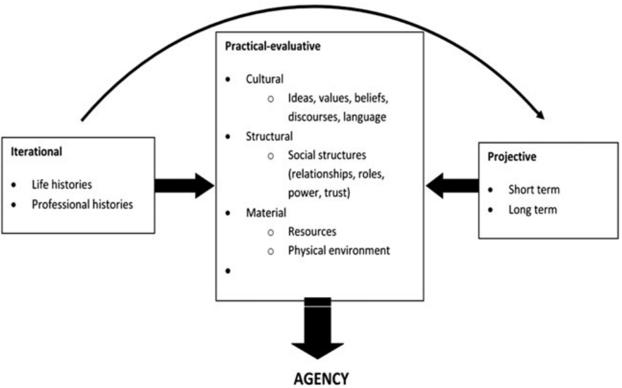
- For this paper, the authors primarily analyzed interview data from all three phases, using codes from an agency model and then open coding to interpret beliefs and aspirations.
## Limitations
- The authors explicitly say the data refer to “one particular though nonetheless interesting case,” so the findings are limited in scope.
- The study draws primarily on the stories of six classroom teachers, which is a small sample; this is evident in the text.
- The analysis focuses on interviews and selected themes from one reform context in Scotland, so transferability beyond this setting is not established; this is evident in the text.
Model-written summary. Check it against the paper before relying on it.
Integrity signals
Registry
Cites
Statistics
Figures
Verification
Claims the paper makes
0 Valid · 2 Not valid · 30 Not checked · 99 Own results and interpretations
A result the paper reports from its own data — it cites no other source for it, so there is none to check. The quote shows it is in the paper.
In the paper
“The significance of what was often referred to as a safe and caring learning environment for everyone who came into their classrooms was articulated strongly.”
§ 4. Teachers’ beliefs > 4.1. Beliefs relating to children and young people
boosted- Asserted: passes — The authors put it forward as true.
- Checkable: passes — It can be checked against evidence.
- Load-bearing: unclear — It is unclear whether the paper’s conclusions depend on it.
- Based: passes — The paper gives a reason why it holds.
A result the paper reports from its own data — it cites no other source for it, so there is none to check. The quote shows it is in the paper.
In the paper
“In analysing the data, we were struck by the similarity of beliefs articulated across this small group of teachers, despite their location in different sectors of education.”
plain- Asserted: passes — The authors put it forward as true.
- Checkable: passes — It can be checked against evidence.
- Load-bearing: passes — The paper’s conclusions depend on it.
- Based: passes — The paper gives a reason why it holds.
A result the paper reports from its own data — it cites no other source for it, so there is none to check. The quote shows it is in the paper.
In the paper
“The data clearly convey the strong sense of teachers’ professional responsibility towards their students.”
§ 4. Teachers’ beliefs > 4.1. Beliefs relating to children and young people
boosted- Asserted: passes — The authors put it forward as true.
- Checkable: passes — It can be checked against evidence.
- Load-bearing: unclear — It is unclear whether the paper’s conclusions depend on it.
- Based: passes — The paper gives a reason why it holds.
A result the paper reports from its own data — it cites no other source for it, so there is none to check. The quote shows it is in the paper.
In the paper
“Indeed, only one participant strongly referred to the importance of subject knowledge, lamenting what she saw as the detrimental effects of vocationalism on the academic content of her subject.”
§ 4. Teachers’ beliefs > 4.2. Beliefs about the role of the teacher
plainSingle case- Asserted: passes — The authors put it forward as true.
- Checkable: passes — It can be checked against evidence.
- Load-bearing: unclear — It is unclear whether the paper’s conclusions depend on it.
- Based: passes — The paper gives a reason why it holds.
A result the paper reports from its own data — it cites no other source for it, so there is none to check. The quote shows it is in the paper.
In the paper
“these discourses appear to be fairly restricted in scope, more geared to short-term goals, and predominantly articulated via the language of recent policy documentation.”
hedged- Asserted: passes — The authors put it forward as true.
- Checkable: passes — It can be checked against evidence.
- Load-bearing: passes — The paper’s conclusions depend on it.
- Based: passes — The paper gives a reason why it holds.
57 more claims
Create a free account to see all 131 claims and every source verdict.
- It may state two separate claims as one. 39
- Probably not a substantial claim. 46
Claims other papers make about this one
Each is checked against this paper’s own text: does it say what the citing paper says it does?
The cited source says what the claim attributes to it.
In the citing paper
“This absence leaves teachers unsure about their roles and contributions (Biesta et al. 2015).”
From Unveiling teachers’ professional agency and decision-making in professional learning: the illusion of choice (2025) · cites this paper as Biesta et al. 2015
The cited source says what the claim attributes to it.
In the citing paper
“As Biesta et al. (2015) suggests, teachers' agency is influenced not just by their attributes, but also by their professional experience.”
From Unveiling teachers’ professional agency and decision-making in professional learning: the illusion of choice (2025) · cites this paper as Biesta et al. 2015
The cited source says what the claim attributes to it.
In the citing paper
“Likewise Biesta, Priestley and Robinson (2015) point to a lack of discourses among teachers that constructs education in terms other than the technical-rational concerns of 'efficiency' to include questions of purpose and value.”
From Teacher agency and professional learning communities; what can Learning Rounds in Scotland teach us? (2017) · cites this paper as Biesta, Priestley and Robinson (2015)
The cited source says what the claim attributes to it.
In the citing paper
“Biesta, Priestley and Robinson (2015) report that the Scottish teachers in their research had a very similar set of views about teaching, learning and education more broadly, even though they were from diverse locations and sectors.”
From Teacher agency and professional learning communities; what can Learning Rounds in Scotland teach us? (2017) · cites this paper as Biesta, Priestley and Robinson (2015)
The cited source says what the claim attributes to it.
In the citing paper
“Biesta, Priestley and Robinson (2015) report a similar experience in their research on teacher agency.”
From Teacher agency and professional learning communities; what can Learning Rounds in Scotland teach us? (2017) · cites this paper as Biesta, Priestley and Robinson (2015)
1 more claim about this paper
Create a free account to see every claim other papers make about this one.
Citations
Cites
Outline of a Theory of Practice
Bourdieu, P. (1977) · doi:10.1017/cbo9780511812507 · Cited by 27,606
(1984) · Cited by 21,166
Outline of a Theory of Practice.
Frank, A. W., & Bourdieu, P. (1980) · Contemporary Sociology · doi:10.2307/2066038 · Cited by 14,545
Teachers' beliefs and educational research: cleaning up a messy construct
Pajares, M. F. (1992) · Review of Educational Research · doi:10.3102/00346543062003307 · Cited by 9,007 · cited 2×
“In the discussion section, we explore what this reveals about the role of beliefs in teacher agency.”
BackgroundEmirbayer, M., & Mische, A. (1998) · American Journal of Sociology · doi:10.1086/231294 · Cited by 6,165
Outline of a Theory of Practice
BOURDIEU, P. (2007) · On Violence · doi:10.2307/j.ctv120qr2d.16 · Cited by 5,527
Realist Social Theory: The Morphogenetic Approach
Archer, M. S. (1995) · Cambridge University Press eBooks · doi:10.1017/cbo9780511557675 · Cited by 3,125
Change Forces: Probing the Depths of Educational Reform
Fullan, M. (1993) · doi:10.4324/9780203059005 · Cited by 3,111
Realist social theory the morphogenetic approach
Archer, M. S. (1995) · Cited by 2,938
Change Forces: Probing the Depths of Educational Reform
Davies, S., & Fullan, M. (1995) · Canadian Public Policy / Analyse de Politiques · doi:10.2307/3552051 · Cited by 2,809
Research works printed but not linked: 3
- Brown, S., & McIntyre, D. (1993). Making sense of teaching: Developing teachers and teaching. Buckingham: Open University Press. (Open in a new window)Google Scholar
- Hollis, M. (1994). The philosophy of social science: An introduction. Cambridge: Cambridge University Press. (Open in a new window)Google Scholar · doi:10.1017/ccol0521447801
- Nieveen N. (2011 September 14). Teachers’ professional development in curriculum design in the Netherlands. Paper presented at the European Conference for Educational Research Berlin.
Cited by
Items 601–700 of 1,289
Research Trends in Teacher Agency: A Bibliometric Analysis From 1995 to 2023
Fan, Y., & Zhu, J. (2025) · SAGE Open · doi:10.1177/21582440251363695 · Cited by 4
“The above keywords effectively reflect the practical-evaluative and projective dimensions of agency, which emerge from the intersections of present contexts and future goals (Biesta et al., 2015).”
InfluentialExploring teacher agency through ecological approach: insights from teacher networks
Wichaidit, S. (2025) · Teacher Development · doi:10.1080/13664530.2025.2568668 · Cited by 9
Kuusalu, S.-R., Patzelt, M., & Maijala, M. (2025) · European Journal of Applied Linguistics · doi:10.1515/eujal-2024-0022 · Cited by 3
Honing innovative language teaching through teaching competitions: The role of teacher agency
Ruan, X., Yu, N., & Zhu, Y. (2025) · Language Teaching Research · doi:10.1177/13621688251383764 · Cited by 3
Farrow, J., Farrow, M. J., & Zhang, C. (2025) · Education Sciences · doi:10.3390/educsci15111496 · Cited by 4
Affordances and learner agency: Chinese EFL learners’ English vlogging practices on Douyin
Li, Y., & Feng, D. (2025) · System · doi:10.1016/j.system.2025.103963 · Cited by 4
Diao, Y., & Cheng, C. (2026) · Teaching and Teacher Education · doi:10.1016/j.tate.2026.105436 · Cited by 7
Tan, X. (2026) · Digital studies in language and literature · doi:10.1515/dsll-2025-0021 · Cited by 3
Relational dimensions of teacher agency: Five purposes for exercising agency in university
Kusters, M., Rushton, E. A. C., van der Rijst, R. M., & Admiraal, W. (2026) · Teaching and Teacher Education · doi:10.1016/j.tate.2026.105467 · Cited by 6
Hajar, A. (2026) · Educational linguistics · doi:10.1007/978-3-032-15648-8_7 · Cited by 3
Atasoy, R., & Özkul, R. (2026) · Journal of Organizational Change Management · doi:10.1108/jocm-04-2025-0302 · Cited by 4
Dhammarungruang, B., & Wudthayagorn, J. (2021) · rEFLections · doi:10.61508/refl.v28i2.251286 · Cited by 7
Resources for planning and teaching mathematics: a Swedish upper-secondary school case study
Gustafsson, M., van Bommel, J., & Liljekvist, Y. (2023) · Journal of Curriculum Studies · doi:10.1080/00220272.2023.2281912 · Cited by 17
Human-Centred Learning Analytics and AI in Education: a Systematic Literature Review
Alfredo, R., Echeverría, V., Jin, Y., et al. (2023) · arXiv (Cornell University) · doi:10.48550/arxiv.2312.12751 · Cited by 3
Emancipation or Instrumentalisation in Erasmus+ Mobility: A Literature Review
Bronze, J. C., Leite, C. M. F. A. F., & Monteiro, A. M. R. (2025) · Center for Educational Policy Studies Journal · doi:10.26529/cepsj.1802 · Cited by 9
Professional Growth of STEM Teachers: Viewing from Entrepreneurial Frame
Tan, A.-L., & Teo, T. (2024) · Research in Science Education · doi:10.1007/s11165-024-10179-0 · Cited by 5
Çakır, N. A., & Ünlü, N. A. (2024) · TED EĞİTİM VE BİLİM · doi:10.15390/eb.2024.11241 · Cited by 5
Earle, S. (2024) · European Journal of Teacher Education · doi:10.1080/02619768.2024.2385047 · Cited by 4
Zhao, T., Huang, J. L., & Edırısıngha, P. (2024) · The Asia-Pacific Education Researcher · doi:10.1007/s40299-024-00917-3 · Cited by 5
Hendriksen, N., Westbroek, H. B., Janssen, F. J. J. M., & van Muijlwijk‐Koezen, J. E. (2024) · Professional Development in Education · doi:10.1080/19415257.2024.2426506 · Cited by 7
Chaaban, Y., Al’Abri, K. M., & Romanowski, M. H. (2025) · Power and Education · doi:10.1177/17577438241312608 · Cited by 4
Interpreting the curricula: Multifactorial sense-making by preschool teachers in Turkey
BAŞAR, T., & Dilek, H. (2025) · Teaching and Teacher Education · doi:10.1016/j.tate.2025.105060 · Cited by 5
Teng, M. F. (2018) · Springer eBooks · doi:10.1007/978-981-13-0728-7_6 · Cited by 5
The particularity of practice: superintendents’ agency for school development
Hardy, I. J., & Salo, P. (2019) · International Journal of Leadership in Education · doi:10.1080/13603124.2019.1629696 · Cited by 5
School leaders’ perspectives of Welsh education reform
Roberts, F., & King, P. (2020) · Education 3-13 · doi:10.1080/03004279.2020.1760330 · Cited by 3
Sutono, A. A., & Budiraharjo, M. (2020) · International Journal of Education · doi:10.17509/ije.v13i1.24589 · Cited by 6
Cupbearers to the King: Humility, Hope and Hospitality for Formational Practice
Butcher, A., & Norsworthy, B. (2021) · Springer eBooks · doi:10.1007/978-981-15-8856-3_16 · Cited by 3
The Role of Resources in Promoting Teaching and Learning in South Africa
Molaudzi, A. M. (2020) · Global education systems · doi:10.1007/978-3-030-43042-9_35-1 · Cited by 9
Fosse, B. O., & Scheie, J. T. (2021) · Acta Didactica Norden · doi:10.5617/adno.8362 · Cited by 5
Digón-Regueiro, P., Gewerc-Barujel, A., & Pérez-Crego, C. (2021) · Pedagogies: An International Journal · doi:10.1080/1554480x.2021.2013235 · Cited by 3
Triggering Factors that Reinforce or Change EFL Preservice Teachers’ Beliefs during the Practicum
Periñan-Morales, A. A., González, J. J. V., & Arcila-Valencia, J. A. (2022) · PROFILE Issues in Teachers Professional Development · doi:10.15446/profile.v24n1.90342 · Cited by 7
Torabi, S., & Maleki, R. (2022) · Anatolian Journal of Education · doi:10.29333/aje.2022.7110a · Cited by 3
Qi, G. Y., & Wang, Y. (2022) · The JALT CALL Journal · doi:10.29140/jaltcall.v18n1.569 · Cited by 7
Kipp, A. L. (2022) · Continuity in Education · doi:10.5334/cie.43 · Cited by 4
Spooner‐Lane, R., Buchanan, J., Jordan, K., Broadley, T., Wall, R. W., & Hardy, G. (2022) · Springer eBooks · doi:10.1007/978-981-19-2904-5_8 · Cited by 4
Norozi, S. A., & Moen, T. (2022) · Frontiers in Education · doi:10.3389/feduc.2022.963460 · Cited by 3
Application of teachers’ philosophies on literacy teaching and learning in rural schools
Dyasi, M. S. H., & Mosito, C. P. (2022) · Southern African Linguistics and Applied Language Studies · doi:10.2989/16073614.2022.2077224 · Cited by 3
What affects the teaching agency of university instructors? A social realist perspective
Zhuang, T., Cheung, A., Lau, W. W. F., & Su, Y. (2023) · Asia Pacific Journal of Education · doi:10.1080/02188791.2023.2167807 · Cited by 7
Melasalmi, A., Tanhuanpää, S., & Koskela, T. (2023) · Research Papers in Education · doi:10.1080/02671522.2023.2177881 · Cited by 10
Educators in Israel define cultural competence
Shapira, N., Shonfeld, M., Friedman, D., & Falah, J. (2023) · Frontiers in Education · doi:10.3389/feduc.2023.1131352 · Cited by 4
Teachers as change agents in the implementation of English-medium instruction policy in Vietnam
Tri, D. H. (2023) · European Journal of Language Policy · doi:10.3828/ejlp.2023.7 · Cited by 3
Teacher Identity as a Barrier and Bridge to Peace Pedagogies
Clarke-Habibi, S. (2023) · Springer eBooks · doi:10.1007/978-3-031-26246-3_7 · Cited by 3
Alternative futures of Finnish comprehensive school
Nilivaara, P., & Soini, T. (2023) · Policy Futures in Education · doi:10.1177/14782103231173615 · Cited by 11
Teacher perspectives on writing instruction in the Language Introduction Program in Sweden
Magnusson, U., & Rejman, K. (2023) · Writing & Pedagogy · doi:10.1558/wap.23269 · Cited by 5
Smith, L. (2023) · Cambridge Journal of Education · doi:10.1080/0305764x.2023.2237955 · Cited by 4
CLIL teacher beliefs as they emerge working in tandem
Alas, E., Ljalikova, A., & Jung, M. (2023) · Journal of Immersion and Content-Based Language Education · doi:10.1075/jicb.22001.ala · Cited by 5
Claiming a space in the W/writerly community to increase English Language Arts teacher agency
Goldsmith, C. (2023) · English Teaching Practice & Critique · doi:10.1108/etpc-04-2023-0032 · Cited by 3
Merdeka Belajar Curriculum: A Study on EFL Teachers' Varying Expressions of Agency
Lubis, S. H., Fauzıatı, E., & Rochsantiningsih, D. (2023) · Voices of English Language Education Society · doi:10.29408/veles.v7i2.22517 · Cited by 10
Myklebust, H., & Fagerbakke, I. M. (2024) · Learning Culture and Social Interaction · doi:10.1016/j.lcsi.2024.100825 · Cited by 10
Tool or Toy? Teachers’ Beliefs on Technology Integration in the Preschool Classroom
Ross, R. K., Lake, V. E., Beisly, A. H., & Lim, B. Y. (2024) · IntechOpen eBooks · doi:10.5772/intechopen.1006597 · Cited by 3
Augustsson, C., Högman, J., & Hultman, A. L. (2024) · Health Education Journal · doi:10.1177/00178969241280767 · Cited by 11
Muszyńska, B., & Stewart, M. A. (2025) · Journal of Language Identity & Education · doi:10.1080/15348458.2025.2467194 · Cited by 3
Teaching technology to young learners: teachers’ individual competencies
Korkeaniemi, A., Lindfors, E., & Kiviranta, L. (2025) · International Journal of Technology and Design Education · doi:10.1007/s10798-025-09973-2 · Cited by 24
Δανιά, Α., & Impedovo, M.-A. (2025) · Professional Development in Education · doi:10.1080/19415257.2025.2499143 · Cited by 3
Hanafi, Y., Saefi, M., Ikhsan, M. A., Diyana, T. N., Faizin, N., Ramadhan, M. R., Hanifah, U., & Mubarok, N. (2025) · British Journal of Religious Education · doi:10.1080/01416200.2025.2524040 · Cited by 8
Öğrencilerin Başarısı ve Öğrenmesine Yönelik Öğretmen Görüşleri Ölçeği (ÖBÖY-ÖGÖ)
Kırkıç, K. A., Aydın, E., & Yahşi, Ö. (2020) · İZÜ Eğitim Dergisi · doi:10.46423/izujed.732823 · Cited by 4
ELT Prospective Teachers’ Beliefs About Target Language Use in EFL Classrooms
KORKMAZ, Ş. Ç. (2021) · Anadolu Journal Of Educational Sciences International · doi:10.18039/ajesi.874181 · Cited by 4
Glastra, F. J., & de Brabander, C. J. (2021) · Frontline Learning Research · doi:10.14786/flr.v9i4.831 · Cited by 3
Heritage Language Early Years’ Immersion: Irish-Medium Preschools in Ireland
Hickey, T. M. (2022) · Springer international handbooks of education · doi:10.1007/978-3-030-91662-6_15 · Cited by 6
Samtidsdans i møte med erfaringsrike kropper - inkluderende kunstdidaktiske grep i dans
Østern, T. P. (2015) · Nordic Journal of Art and Research · doi:10.7577/if.v4i2.1553 · Cited by 3
Hansen, D. R., & Bøje, J. D. (2017) · Power and Education · doi:10.1177/1757743817692600 · Cited by 4
Terhart, E. (2018) · VIERTELJAHRSSCHRIFT FÜR WISSENSCHAFTLICHE PÄDAGOGIK · doi:10.30965/25890581-09403009 · Cited by 3
Riding on commitment and marketing: language teachers as policymakers in a Finnish school
Criss, M. K. (2020) · Language Policy · doi:10.1007/s10993-020-09546-0 · Cited by 4
Teacher trainees' understandings of mentoring within a Middle Eastern BEd program
Pattisson, J. (2020) · International Journal of Mentoring and Coaching in Education · doi:10.1108/ijmce-04-2019-0058 · Cited by 5
Development of Preservice Teachers’ Sense of Agency
Hull, M. M., & Uematsu, H. (2020) · Challenges in physics education · doi:10.1007/978-3-030-51182-1_17 · Cited by 6
‘It’s not from a textbook, it’s from your real life’
Schwartz, M., & Segev, M. C. (2021) · Journal of Multilingual Theories and Practices · doi:10.1558/jmtp.18424 · Cited by 3
Yun, S., & Lim, S. (2021) · Eurasia Journal of Mathematics Science and Technology Education · doi:10.29333/ejmste/11308 · Cited by 5
The Accordion Book Project: Reflections on Learning and Teaching
Elkin, T., & Mistry, A. (2022) · River Publishers eBooks · doi:10.1201/9781003337263-6 · Cited by 3
Kempton, G. A. (2017) · Queensland University of Technology · doi:10.5204/thesis.eprints.110591 · Cited by 6
Ogwang, T. H. (2018) · Stirling Online Research Repository (University of Stirling) · Cited by 6
The impact of curriculum change on the working lives of rural teachers
Mashele, S. F. (2018) · UpSpace Institutional Repository (University of Pretoria) · Cited by 7
Dekker, S. V. (2024) · University of Groningen research database (University of Groningen / Centre for Information Technology) · doi:10.33612/diss.1012163524 · Cited by 6
Giaber, R. B. (2023) · London Review of Education · doi:10.14324/lre.21.1.15 · Cited by 7
Kim, Y. O., Yun, S., & Yang, H. S. (2023) · Frontiers in Education · doi:10.3389/feduc.2023.1200092 · Cited by 3
Joubert, A., & Jong, K. D. (2023) · Journal of Language and Discrimination · doi:10.1558/jld.26519 · Cited by 5
Identity as pedagogy: appreciative inquiry into the stories of our pedagogies
Tucker, A. (2024) · Pedagogies An International Journal · doi:10.1080/1554480x.2024.2302475 · Cited by 3
Educators of deaf and hearing interpreting students as agents of change: challenging the curriculum
Urdal, G. H. S., Skaten, I., & Tiselius, E. (2024) · The Interpreter and Translator Trainer · doi:10.1080/1750399x.2024.2317627 · Cited by 2
Supporting kindergarten staff’s agency in inclusion through long-term in-service training
Nelis, P., Pedaste, M., & Leijen, Ä. (2024) · Journal of Early Childhood Teacher Education · doi:10.1080/10901027.2024.2410401 · Cited by 5
Emden, M., Bewersdorff, A., & Baur, A. (2025) · Science Education · doi:10.1002/sce.21943 · Cited by 3
Conditions and agency for multilingual students in higher education
Dahlström, H., & Norberg, M. (2025) · Cogent Education · doi:10.1080/2331186x.2025.2490428 · Cited by 2
Theorizations of teacher agency: in relations, ecologies and immanent events
Hardman, M. (2025) · Journal of Philosophy of Education · doi:10.1093/jopedu/qhaf035 · Cited by 8
Language Teacher Agency: A Systematic Review
Karimi, M. N., & Mansouri, B. (2025) · Springer international handbooks of education · doi:10.1007/978-3-031-47310-4_10 · Cited by 5
Zhang, T., Wang, Y., & Jiang, Z. (2025) · Humanities and Social Sciences Communications · doi:10.1057/s41599-025-05526-z · Cited by 3
Teacher’s agency orientations in flipped learning: An ecological perspective
Toivola, M., Rajala, A., & Kumpulainen, K. (2025) · International Journal of Educational Research · doi:10.1016/j.ijer.2025.102837 · Cited by 3
Tao, L., & Weng, T. (2025) · TESOL Quarterly · doi:10.1002/tesq.70034 · Cited by 4
Barriers and Enablers of Interdisciplinary Climate Education: Insights From Secondary Teachers
Castellazzi, E., Hakkarainen, V., Saari, M. H., & Raymond, C. M. (2025) · Australian Journal of Environmental Education · doi:10.1017/aee.2025.10086 · Cited by 4
Storey, M. (2025) · Journal of Educational Change · doi:10.1007/s10833-025-09539-y · Cited by 3
Wright, G. W., Poor, S. V., Barron, V., & Gaskin, A. (2025) · Science Education · doi:10.1002/sce.70039 · Cited by 3
The Development and Psychometric Properties of a Doctoral Student Agency Scale
Huang, L., Ruan, Q., & Wang, K. (2025) · Behavioral Sciences · doi:10.3390/bs15121715 · Cited by 4
McClam, R., Shelton, A., Shepard, L., Cruz, R. A., Caroleo, S. A., & Love, M. L. (2025) · School-University Partnerships · doi:10.1108/sup-05-2025-0026 · Cited by 2
Wu, X., Liu, J., & Ni, H. (2025) · Teaching and Teacher Education · doi:10.1016/j.tate.2025.105371 · Cited by 10
Murphy-Graham, E. E., Lample, J., Kabay, S., & Nourani, V. (2026) · Teaching and Teacher Education · doi:10.1016/j.tate.2025.105329 · Cited by 3
Zakai-Mashiach, M. (2026) · Journal of Research in Special Educational Needs · doi:10.1111/1471-3802.70062 · Cited by 5
Özkul, R. (2026) · BMC Psychology · doi:10.1186/s40359-026-04163-8 · Cited by 9
Chen, Z., & Murray, N. L. (2026) · Learning Culture and Social Interaction · doi:10.1016/j.lcsi.2026.101002 · Cited by 4
Su, J., Wang, Z., Qiang, Z., & Wang, Z. (2026) · Journal of Intelligence · doi:10.3390/jintelligence14080182 · Cited by 11
Expectations to mentoring as support for professional development
Helleve, I., Ulvik, M., & Roness, D. (2019) · Nordisk tidsskrift for utdanning og praksis · doi:10.23865/up.v13.1971 · Cited by 6
Polish Teacher Competencies in Teaching Students from Migrant Backgrounds in Preparatory Classes
Pamuła-Behrens, M. (2021) · Studia Migracyjne – Przegląd Polonijny · doi:10.4467/25444972smpp.21.057.14810 · Cited by 2
Fidler, A. (2022) · Education 3-13 · doi:10.1080/03004279.2022.2069841 · Cited by 3
Stahl, G., Brock, C. H., Sharplin, E., Caldwell, D., Young, J., & Boyd, F. B. (2022) · Asia Pacific Journal of Education · doi:10.1080/02188791.2022.2071213 · Cited by 3
Metadata
- Authors
- Biesta, G., Priestley, M., & Robinson, S.
- Affiliations
- ArtEZ University of the Arts (NL)
- University of Stirling (GB)
- Aarhus University (DK)
- Corresponding author
- Biesta, Gert
- Venue
- Teachers and Teaching
- Publisher
- Informa UK Limited
- Published
- 2015-06-15
- Volume
- 21
- Issue
- 6
- Pages
- 624-640
- ISSN
- 1354-0602 (ISSN-L)
- 1470-1278
- OpenAlex
- W1911902575
- Cited by
- 1,318
- References
- 47
- Citations by year
- 2026: 233 · 2025: 161 · 2024: 141 · 2023: 157 · 2022: 139 · 2021: 131 · 2020: 118 · 2019: 96 · 2018: 73 · 2017: 48 · 2016: 17 · 2015: 4
- FWCI
- 236.15
- Type
- journal article
- Language
- en
- Open access
- hybrid
- doi.org
- Licence
- cc-by-nc-nd
- Locations
- Teachers and Teaching (publishedVersion, cc-by-nc-nd)
- Brunel University Research Archive (BURA) (Brunel University London) (submittedVersion)
- Stirling Online Research Repository (University of Stirling) (submittedVersion, cc-by-nc-nd)
- Edinburgh Research Explorer (University of Edinburgh) (submittedVersion, other-oa)
- Funders
- Economic and Social Research Council (ES/I006907/1)
- Topics
- Social Sciences › Education › Teacher Education and Leadership Studies
- Social Sciences › Education › Education Pedagogy and Practices
- Social Sciences › Arts and Humanities › Philosophy › Education, Philosophy, and Society
- Keywords
- teacher agency, teacher beliefs, Curriculum for Excellence, educational reform, teacher professionalism, teacher decision-making, institutional discourse, professional vision, Scotland
About these checks
Registry, retraction, Cites and statistics results are computed, not judged, with one exception: a printed reference that no index lists is read once by a model before it counts as a citation error. Claims are extracted by a model and kept only when their quote appears verbatim in the text; each cited source is then checked, with a model’s help, for whether it says what the claim relies on. Those verdicts can be wrong — read the claim’s quote and the cited source before relying on one.
A language model drew the claims from the paper on 2026-10-11, under version 3 of the claim definition (model deepseek-v4.1-flash, prompt extract-v3).
A second model labelled each claim on 2026-10-11 (model jev-1.13-20260917, definition revision gold-guideline-v0.2).
Statistics and arithmetic are recomputed, not judged.
Confidence bands are shown only for fields calibrated on our annotated test set. None is calibrated yet, so no band is shown.
What counts as a claim ›How we measure confidence ›How we check this ›
Are you an author, or do you see a problem with this page? Request a review
Data sources
Bibliographic data: Semantic Scholar, OpenAlex, Crossref.
Contains information from the Semantic Scholar Academic Graph Datasets, made available under the ODC Attribution License (ODC-BY 1.0).
Semantic Scholar’s data is described in: Kinney, R., et al. (2023). The Semantic Scholar Open Data Platform. arXiv:2301.10140.
