

The role of beliefs in teacher agency
Open accessThe DOI matches its Crossref record; 44 of the 47 references it cites were found in a registry or an index; none of the 31 sources its claims cite is checked for support yet.
Abstract
There is an ongoing tension within educational policy worldwide between countries that seek to reduce the opportunities for teachers to exert judgement and control over their own work, and those who seek to promote it. Some see teacher agency as a weakness within the operation of schools and seek to replace it with evidence-based and data-driven approaches, whereas others argue that because of the complexities of situated educational practices, teacher agency is an indispensable element of good and meaningful education. While the ideological debate about the shape and form of teacher professionalism is important, it is equally important to understand the dynamics of teacher agency and the factors that contribute to its promotion and enhancement. In this paper, we draw from a two-year study into teacher agency against the backdrop of large-scale educational reform – the implementation of Scotland’s Curriculum for Excellence – in order to explore these questions. We focus on teachers’ beliefs in order to get a sense of the individual and collective discourses that inform teachers’ perceptions, judgements and decision-making and that motivate and drive teachers’ action. While the research suggests that beliefs play an important role in teachers’ work, an apparent mismatch between teachers’ individual beliefs and values and wider institutional discourses and cultures, and a relative lack of a clear and robust professional vision of the purposes of education indicate that the promotion of teacher agency does not just rely on the beliefs that individual teachers bring to their practice, but also requires collective development and consideration.
Overview
CoChat Summary
## TL;DR
The paper argues that teacher beliefs matter for agency, but mainly insofar as they are shaped by policy discourse, schooling culture, and limited professional visions of what education is for. Using ethnographic case studies from three Scottish schools during Curriculum for Excellence, the authors find that teachers’ beliefs were often short-term, instrumental, and only loosely connected to broader purposes or values.
## Key findings
- Across the six classroom teachers, beliefs about children, teaching, and educational purpose were notably similar, and often framed by recent policy language rather than a robust professional discourse.
- Teachers strongly emphasized relationships, safety, care, enjoyment, skills, socialisation, and “maximising student potential,” but gave little sustained attention to knowledge, qualification, social justice, or democratic values.
- The paper argues that a narrow view of purpose limits agency: teachers were effective at short-term classroom management and curriculum delivery, but less able to use beliefs to imagine or enact longer-term educational aims.
- The authors report that teachers’ understandings of Curriculum for Excellence were often superficial or vague; some described the curriculum as “airy fairy,” “overly complicated,” or something they were “fumbling about trying.”
## Methods
- Ethnographic research in one Scottish education authority, in one primary school and two secondary schools, focusing on two experienced classroom teachers in each setting; senior managers were also interviewed.
- The project ran over a full year with three data-collection phases and used observation, semi-structured individual and group interviews, a personal/professional history interview, policy-text analysis, and teacher network mapping.
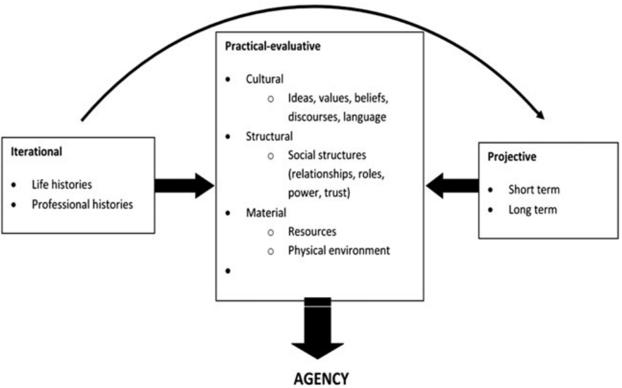
- For this paper, the authors primarily analyzed interview data from all three phases, using codes from an agency model and then open coding to interpret beliefs and aspirations.
## Limitations
- The authors explicitly say the data refer to “one particular though nonetheless interesting case,” so the findings are limited in scope.
- The study draws primarily on the stories of six classroom teachers, which is a small sample; this is evident in the text.
- The analysis focuses on interviews and selected themes from one reform context in Scotland, so transferability beyond this setting is not established; this is evident in the text.
Model-written summary. Check it against the paper before relying on it.
Integrity signals
Registry
Cites
Statistics
Figures
Verification
Claims the paper makes
0 Valid · 2 Not valid · 30 Not checked · 99 Own results and interpretations
A result the paper reports from its own data — it cites no other source for it, so there is none to check. The quote shows it is in the paper.
In the paper
“The significance of what was often referred to as a safe and caring learning environment for everyone who came into their classrooms was articulated strongly.”
§ 4. Teachers’ beliefs > 4.1. Beliefs relating to children and young people
boosted- Asserted: passes — The authors put it forward as true.
- Checkable: passes — It can be checked against evidence.
- Load-bearing: unclear — It is unclear whether the paper’s conclusions depend on it.
- Based: passes — The paper gives a reason why it holds.
A result the paper reports from its own data — it cites no other source for it, so there is none to check. The quote shows it is in the paper.
In the paper
“In analysing the data, we were struck by the similarity of beliefs articulated across this small group of teachers, despite their location in different sectors of education.”
plain- Asserted: passes — The authors put it forward as true.
- Checkable: passes — It can be checked against evidence.
- Load-bearing: passes — The paper’s conclusions depend on it.
- Based: passes — The paper gives a reason why it holds.
A result the paper reports from its own data — it cites no other source for it, so there is none to check. The quote shows it is in the paper.
In the paper
“The data clearly convey the strong sense of teachers’ professional responsibility towards their students.”
§ 4. Teachers’ beliefs > 4.1. Beliefs relating to children and young people
boosted- Asserted: passes — The authors put it forward as true.
- Checkable: passes — It can be checked against evidence.
- Load-bearing: unclear — It is unclear whether the paper’s conclusions depend on it.
- Based: passes — The paper gives a reason why it holds.
A result the paper reports from its own data — it cites no other source for it, so there is none to check. The quote shows it is in the paper.
In the paper
“Indeed, only one participant strongly referred to the importance of subject knowledge, lamenting what she saw as the detrimental effects of vocationalism on the academic content of her subject.”
§ 4. Teachers’ beliefs > 4.2. Beliefs about the role of the teacher
plainSingle case- Asserted: passes — The authors put it forward as true.
- Checkable: passes — It can be checked against evidence.
- Load-bearing: unclear — It is unclear whether the paper’s conclusions depend on it.
- Based: passes — The paper gives a reason why it holds.
A result the paper reports from its own data — it cites no other source for it, so there is none to check. The quote shows it is in the paper.
In the paper
“these discourses appear to be fairly restricted in scope, more geared to short-term goals, and predominantly articulated via the language of recent policy documentation.”
hedged- Asserted: passes — The authors put it forward as true.
- Checkable: passes — It can be checked against evidence.
- Load-bearing: passes — The paper’s conclusions depend on it.
- Based: passes — The paper gives a reason why it holds.
57 more claims
Create a free account to see all 131 claims and every source verdict.
- It may state two separate claims as one. 39
- Probably not a substantial claim. 46
Claims other papers make about this one
Each is checked against this paper’s own text: does it say what the citing paper says it does?
The cited source says what the claim attributes to it.
In the citing paper
“This absence leaves teachers unsure about their roles and contributions (Biesta et al. 2015).”
From Unveiling teachers’ professional agency and decision-making in professional learning: the illusion of choice (2025) · cites this paper as Biesta et al. 2015
The cited source says what the claim attributes to it.
In the citing paper
“As Biesta et al. (2015) suggests, teachers' agency is influenced not just by their attributes, but also by their professional experience.”
From Unveiling teachers’ professional agency and decision-making in professional learning: the illusion of choice (2025) · cites this paper as Biesta et al. 2015
The cited source says what the claim attributes to it.
In the citing paper
“Likewise Biesta, Priestley and Robinson (2015) point to a lack of discourses among teachers that constructs education in terms other than the technical-rational concerns of 'efficiency' to include questions of purpose and value.”
From Teacher agency and professional learning communities; what can Learning Rounds in Scotland teach us? (2017) · cites this paper as Biesta, Priestley and Robinson (2015)
The cited source says what the claim attributes to it.
In the citing paper
“Biesta, Priestley and Robinson (2015) report that the Scottish teachers in their research had a very similar set of views about teaching, learning and education more broadly, even though they were from diverse locations and sectors.”
From Teacher agency and professional learning communities; what can Learning Rounds in Scotland teach us? (2017) · cites this paper as Biesta, Priestley and Robinson (2015)
The cited source says what the claim attributes to it.
In the citing paper
“Biesta, Priestley and Robinson (2015) report a similar experience in their research on teacher agency.”
From Teacher agency and professional learning communities; what can Learning Rounds in Scotland teach us? (2017) · cites this paper as Biesta, Priestley and Robinson (2015)
1 more claim about this paper
Create a free account to see every claim other papers make about this one.
Citations
Cites
Outline of a Theory of Practice
Bourdieu, P. (1977) · doi:10.1017/cbo9780511812507 · Cited by 27,606
(1984) · Cited by 21,166
Outline of a Theory of Practice.
Frank, A. W., & Bourdieu, P. (1980) · Contemporary Sociology · doi:10.2307/2066038 · Cited by 14,545
Teachers' beliefs and educational research: cleaning up a messy construct
Pajares, M. F. (1992) · Review of Educational Research · doi:10.3102/00346543062003307 · Cited by 9,007 · cited 2×
“In the discussion section, we explore what this reveals about the role of beliefs in teacher agency.”
BackgroundEmirbayer, M., & Mische, A. (1998) · American Journal of Sociology · doi:10.1086/231294 · Cited by 6,165
Outline of a Theory of Practice
BOURDIEU, P. (2007) · On Violence · doi:10.2307/j.ctv120qr2d.16 · Cited by 5,527
Realist Social Theory: The Morphogenetic Approach
Archer, M. S. (1995) · Cambridge University Press eBooks · doi:10.1017/cbo9780511557675 · Cited by 3,125
Change Forces: Probing the Depths of Educational Reform
Fullan, M. (1993) · doi:10.4324/9780203059005 · Cited by 3,111
Realist social theory the morphogenetic approach
Archer, M. S. (1995) · Cited by 2,938
Change Forces: Probing the Depths of Educational Reform
Davies, S., & Fullan, M. (1995) · Canadian Public Policy / Analyse de Politiques · doi:10.2307/3552051 · Cited by 2,809
Research works printed but not linked: 3
- Brown, S., & McIntyre, D. (1993). Making sense of teaching: Developing teachers and teaching. Buckingham: Open University Press. (Open in a new window)Google Scholar
- Hollis, M. (1994). The philosophy of social science: An introduction. Cambridge: Cambridge University Press. (Open in a new window)Google Scholar · doi:10.1017/ccol0521447801
- Nieveen N. (2011 September 14). Teachers’ professional development in curriculum design in the Netherlands. Paper presented at the European Conference for Educational Research Berlin.
Cited by
Items 801–900 of 1,289
Emam, M. M., Eid, G. K., Hassanein, E. E. A., حمدان, ع. س. م., Al‐Salmi, L., Ismael, M., & Qalhati, A. A. (2026) · School Psychology International · doi:10.1177/01430343261421238 · Cited by 1
Yu, S., Xue, Q., Xu, Y., Li, Y., & Wang, C. (2026) · Asia-Pacific Journal of Teacher Education · doi:10.1080/1359866x.2026.2633699 · Cited by 1
Rorije, H., & Vanlommel, K. (2026) · Journal of Educational Change · doi:10.1007/s10833-026-09544-9 · Cited by 5
Macias, R., & Damjanovic, V. (2026) · Journal of Early Childhood Teacher Education · doi:10.1080/10901027.2026.2637611 · Cited by 1
Tishenina, M. (2026) · Studies in Philosophy and Education · doi:10.1007/s11217-026-10051-w · Cited by 5
Collective agency in instructional leadership teams: tracing development at the next level of work
Zumpe, E., & Aramburo, C. M. (2026) · Journal of Educational Change · doi:10.1007/s10833-026-09548-5 · Cited by 2
Sparreskog, C. R. (2026) · Education Sciences · doi:10.3390/educsci16030468 · Cited by 1
An illustrated tutorial on mixed-method social network analysis of embedded network agency
Pantić, N., Coppe, T., & Viry, G. (2026) · Network Science · doi:10.1017/nws.2026.10024 · Cited by 3
Park, H. (2026) · Behavioral Sciences · doi:10.3390/bs16040515 · Cited by 3
Classroom boundaries and teacher agency: Challenges of implementing Ireland's new primary curriculum
Nally, M., Sullivan, C. O. R., & Bacon, K. (2026) · The Curriculum Journal · doi:10.1002/curj.70054 · Cited by 2
Lee, J. C.-K., Ho, J. P. J., & Gu, M. M. (2026) · International Journal of Applied Linguistics · doi:10.1111/ijal.70182 · Cited by 2
Vietnamese Primary Teachers' Autonomy in the Context of Educational Reform
Truong, T. D., Dinh, H. T., Ha, X. V., et al. (2026) · European Journal of Education · doi:10.1111/ejed.70587 · Cited by 1
Teacher wellbeing as a systemic phenomenon: a psychological needs and ecological systems analysis
Hartnett, H. (2026) · Health Education · doi:10.1108/he-06-2025-0102 · Cited by 1
Kokoç, M., Karaca, B., & Fatma Zeynep, E. R. (2026) · European Journal of Teacher Education · doi:10.1080/02619768.2026.2662594 · Cited by 3
Teachers’ Agentic Moves with Student Aspirations
Walker, A., Burke, J., McDonough, S., & Plunkett, M. (2026) · Springer eBooks · doi:10.1007/978-981-95-6382-1_24 · Cited by 1
Teacher leaders and policy making: Examining access, influence, and boundaries
Ghamrawi, N., & Al-Fadala, A. (2026) · Management in Education · doi:10.1177/08920206261451152 · Cited by 1
Science Teachers’ Perspectives on Locality and Place-Based Education
Demirhan, E., Orhan, U., Mısır, M. E., et al. (2025) · Research in Science Education · doi:10.1007/s11165-025-10297-3 · Cited by 1
Teacher identity and transformative agency in international programs at Vietnamese universities
Luong, P. M., & Tran, L. T. (2026) · Journal for Multicultural Education · doi:10.1108/jme-09-2025-0244 · Cited by 2
Gal, I., Schreiber, K. P., Bansilal, S., Fielding-Wells, J., Porciúncula, M., & Geiger, V. (2026) · Mathematics Education Research Journal · doi:10.1007/s13394-026-00579-y · Cited by 1
The classroom as space for change: teachers’ daily reports on the uptake of curricular concepts
Mathé, N. E. H., Brevik, L. M., Guðmundsdóttir, G. B., & Barreng, R. L. S. (2026) · Journal of Curriculum Studies · doi:10.1080/00220272.2026.2680401 · Cited by 1
Wang, H., & Zheng, Y. (2026) · Digital studies in language and literature · doi:10.1515/dsll-2026-0018 · Cited by 1
Professional agency as a psychological mechanism linking AI integration to language teacher identity
Zou, S., Zuo, C., & Yang, Z. (2026) · Frontiers in Psychology · doi:10.3389/fpsyg.2026.1808230 · Cited by 3
Bilgiç, B., & Sever, D. (2026) · International Journal of Educational Technology in Higher Education · doi:10.1186/s41239-026-00601-0 · Cited by 2
Filippi, G., & Titley, A. (2026) · International Journal of Development Education and Global Learning · doi:10.14324/ijdegl.18.1.08 · Cited by 1
Kotsis, K., & Stylos, G. (2026) · Frontiers in Education · doi:10.3389/feduc.2026.1845045 · Cited by 2
Reinstituting teacher agency and classroom resilience amid geopolitics of AI homogenisation
Ficapal‐Cusí, P., Rajmil, D., & Torrent‐Sellens, J. (2026) · Pedagogy Culture and Society · doi:10.1080/14681366.2026.2709075 · Cited by 2
”Kompetenceløft i undervisningsfagene” - sætter det sig spor i skolens praksis?
Nielsen, B. L., Lund, J. H., & Frederiksen, L. L. (2017) · Studier i læreruddannelse og -profession · doi:10.7146/lup.v2i2.27690 · Cited by 2
Teacher agency: perspectives and limits
Ferrari, L., & Taddei, A. (2017) · Ricerche di pedagogia e didattica · doi:10.6092/issn.1970-2221/7634 · Cited by 7
Professional Standardization and Teacher Agency? What Space for Leadership Development?
Mifsud, D. (2018) · Springer eBooks · doi:10.1007/978-3-319-76174-9_8 · Cited by 1
Hopman, J. (2019) · Professionalism and Teacher Education · doi:10.1007/978-981-13-7002-1_8 · Cited by 1
Alatiq, A. (2020) · CentAUR (University of Reading) · doi:10.48683/1926.00094603 · Cited by 5
Artificial boundaries? Shaping policy through empowering research
O’Keeffe, S. (2021) · Irish Educational Studies · doi:10.1080/03323315.2021.1899022 · Cited by 2
Uncovering missing links in collegial learning conversations
Fletcher, A. K., & Wennergren, A. (2021) · Forskning og Forandring · doi:10.23865/fof.v4.2147 · Cited by 1
Gleeson, J., O’Gorman, J. G., & O’Neill, M. (2018) · International Studies in Catholic Education · doi:10.1080/19422539.2018.1418946 · Cited by 1
RetractedSeay, D. (2021) · Cited by 1
Target Language Use in EFL Classrooms: Turkish EFL Teachers’ Beliefs and Practices
Korkmaz, Ş. Ç. (2021) · IJELTAL (Indonesian Journal of English Language Teaching and Applied Linguistics) · doi:10.21093/ijeltal.v6i1.930 · Cited by 7
Ribaeus, K., & Hultman, A. L. (2022) · Journal of Praxis in Higher Education · doi:10.47989/kpdc116 · Cited by 1
Promoting powerful professional learning for school staff
OECD (2019) · OECD reviews of school resources · doi:10.1787/3f8c06df-en · Cited by 2
The Role of Resources in Promoting Teaching and Learning in South Africa
Molaudzi, A. M. (2021) · Global education systems · doi:10.1007/978-3-030-44217-0_35 · Cited by 3
Media Education in Finnish Early Childhood Teacher Education: A Curricular Analysis
Salomaa, S., & Mertala, P. (2022) · Early childhood research and education · doi:10.1007/978-3-030-95512-0_6 · Cited by 2
Opettajaopiskelijoiden kielitoinen toimijuus monikielisten oppijoiden etäohjauksessa
Aalto, E., Skinnari, K., Mård-Miettinen, K., & Siponkoski, M. (2022) · Ainedidaktiikka · doi:10.23988/ad.109917 · Cited by 7
Anand, K., & Lall, M. (2022) · UCL Press eBooks · doi:10.2307/j.ctv2f4v5nz · Cited by 29
Lim, S., & Yun, S. (2022) · Journal of Baltic Science Education · doi:10.33225/jbse/22.21.1040 · Cited by 4
Classroom management: A case study of English teaching and learning in a secondary school in Nepal
Sabrina, A. (2022) · Leksika Jurnal Bahasa Sastra dan Pengajarannya · doi:10.30595/lks.v16i2.13661 · Cited by 1
It’s Easier to Imagine the End of Music Education than the End of Competition
Powell, S. R. (2023) · Oxford University Press eBooks · doi:10.1093/oso/9780197570838.003.0002 · Cited by 1
Language Teachers on Teaching Strategies Using Online Distance Learning Modality during the Pandemic
HIPOLITO, A. (2023) · International Journal of English Language Studies · doi:10.32996/ijels.2023.5.2.5 · Cited by 2
Hopeless Cases or Just Hard Nuts to Crack? Stories of “Difficult” Foreign Language Learners
Nosidlak, K. (2023) · Theory and Practice of Second Language Acquisition · doi:10.31261/tapsla.12573 · Cited by 1
Supporting teachers' professionalism: A legacy of Kenneth Goodman
Gilles, C. (2023) · Journal of Adolescent & Adult Literacy · doi:10.1002/jaal.1307 · Cited by 2
Perceptions and beliefs of Indian secondary school teachers regarding story telling
Dwivedi, A., & Sarangapani, P. M. (2023) · Pedagogies An International Journal · doi:10.1080/1554480x.2023.2252811 · Cited by 1
Blakeborough, J., & Roosalu, T. (2023) · Advances in sustainability science and technology · doi:10.1007/978-981-99-5540-4_6 · Cited by 1
Ser buen docente en tiempos de cambio: el ejemplo de Macedonia (del Norte)
Atanasoska, T. (2023) · Revista Internacional de Educación y Análisis Social Crítico Mañé Ferrer & Swartz · doi:10.51896/easc.v1i2.332 · Cited by 1
Flerstemmige perspektiver i norsk utdanningsforskning. Spenninger og muligheter
Øien, O. B., Øien, O. B., Heggernes, S. L., Heggernes, S. L., Karlsen, A. M. F., Karlsen, A. M. F., Angelo, E., Skutlaberg, K. B., Merzliakova, E., Bolstad, O. H., et al. (2023) · doi:10.23865/noasp.212 · Cited by 2
Caride, E. G., & Rivas, A. (2023) · Asia Pacific Journal of Educators and Education · doi:10.21315/apjee2023.38.2.6 · Cited by 1
Manuel, M. (2024) · ASEE Annual Conference & Exposition · doi:10.18260/1-2--41186 · Cited by 1
Leek, J., & Śliwerski, B. (2024) · Curriculum Perspectives · doi:10.1007/s41297-024-00225-2 · Cited by 2
Barnehagelærere og læreres kompetanse i helhetlig seksualitetsveiledning og -undervisning
Mælan, E. N., & Fjeld, W. (2024) · Norsk pedagogisk tidsskrift · doi:10.18261/npt.108.1.7 · Cited by 1
5. Anerkjennelse som pedagogisk praksis: Lærerrollen i grunnskole for voksne
Elden, I. (2024) · Fagbokforlaget eBooks · doi:10.55669/oa340105 · Cited by 1
Tekster og lesere: Et nærmere blikk på ungdomstrinnet
Bakken, A. S., Bjørke, E., Blix, M., Hennig, Å., Hoem, T. F., Kjelen, H. A., Kolberg, A. R., Vie, I.-K. L., Lyngstad, M. E., Moen, A.-H., et al. (2024) · Fagbokforlaget eBooks · doi:10.55669/oa3502 · Cited by 3
Leite, L. O., & Lustosa, F. G. (2024) · Educação e Pesquisa · doi:10.1590/s1678-4634202450275634 · Cited by 1
Simamora, R. M., Sarjiwo, S., & Alfan, S. F. (2024) · Studies in Learning and Teaching · doi:10.46627/silet.v5i1.357 · Cited by 2
Lješnjak, S., Caković, D., & Šorgo, A. (2024) · Journal of Baltic Science Education · doi:10.33225/jbse/24.23.679 · Cited by 1
Yan, D. (2024) · Future in Educational Research · doi:10.1002/fer3.58 · Cited by 3
García, M. S. (2025) · European Journal of Teacher Education · doi:10.1080/02619768.2025.2498410 · Cited by 4
Battaglia, N., Wood, E., Gottardo, A., Chovu, L., Ghaa, C., Santhosh, E., Vogel, N., Wade, A., & Abrami, P. C. (2025) · Education Sciences · doi:10.3390/educsci15060709 · Cited by 2
Molins, L. L., Yélamos, E. M., & Olid, C. S. (2025) · Revista Practicum · doi:10.24310/rep.10.1.2025.21947 · Cited by 1
Kim, J. (2025) · Asia Pacific Journal of Education · doi:10.1080/02188791.2025.2594587 · Cited by 2
Health, Physical Education Content, and Teacher Knowledge/Identity
Fadale, C., & Powell, P. J. (2017) · Emerald Group Publishing Limited eBooks · doi:10.1108/s1479-368720160000028014 · Cited by 1
Restrictive physical interventions and teacher professionalism: a discussion
Willis, J. (2018) · British Journal of Special Education · doi:10.1111/1467-8578.12215 · Cited by 1
Trainers' perspectives of teacher professional development
Parpucu, H. (2019) · UNI ScholarWorks (University of Northern Iowa) · Cited by 1
The Dynamics of Inclusivity in Teaching and Assessing Mathematics for Lower Grade Learners
Long, C. M., & Nyoni, P. N. (2020) · Advances in religious and cultural studies (ARCS) book series · doi:10.4018/978-1-7998-4867-7.ch007 · Cited by 1
Developing Engagement with Data
Maxwell, G. S. (2021) · The enabling power of assessment · doi:10.1007/978-3-030-63539-8_10 · Cited by 1
Hazır, O., & KIYAK, Ü. E. (2021) · Hacettepe University Journal of Education · doi:10.16986/huje.2021069059 · Cited by 1
Framåtsyftande bedömning i tidig läsundervisning : Teori och praktik
Andersson, U. B. (2021) · Linköping studies in behavioural science · doi:10.3384/diss.diva-175577 · Cited by 18
Priyanto, D., & Dharin, A. (2021) · Pegem Journal of Education and Instruction · Cited by 1
Görsel Sanatlar Öğretmen Adaylarının Eğitim İnançlarının İncelenmesi
Kara, S. (2021) · Bilim Eğitim Sanat ve Teknoloji Dergisi (BEST Dergi) · doi:10.46328/bestdergi.64 · Cited by 1
Writing in academic Slovene: state and origins of students’ knowledge and skills
Logar, N. (2021) · Slovene Linguistic Studies · doi:10.3986/sjsls.13.1.05 · Cited by 1
Building capacity for grassroots reform: an Australian case study
Seward-Linger, R., Dowden, T., & Andrews, D. (2021) · Asia Pacific Education Review · doi:10.1007/s12564-021-09724-7 · Cited by 1
Bağcı, Ş. E. (2021) · Springer eBooks · doi:10.1007/978-3-658-29189-1_21 · Cited by 1
Writing Our Identities as Teacher Educators and Self-Study Researchers in Two Languages
Guðjónsdóttir, H., & Jónsdóttir, S. R. (2021) · Self-study of teaching and teacher education practices (Print)/Self-study of teaching and teacher education practices · doi:10.1007/978-981-16-2498-8_10 · Cited by 2
Born-freei learner identities: Changing teacher beliefs to initiate appropriate educational change
Vandeyar, S. (2021) · South African Journal of Education · doi:10.15700/saje.v41ns2a2106 · Cited by 4
Early Language Education in Malta
Mifsud, C. L., & Vella, L. A. (2022) · Springer international handbooks of education · doi:10.1007/978-3-030-91662-6_29 · Cited by 1
Hvordan kan vi forstå lærerrollen når skolen foregår hjemme?
Svanes, I. K., Andersson-Bakken, E., & Bjørkvold, T. (2021) · Studier i Pædagogisk Filosofi · doi:10.7146/spf.v10i1.122635 · Cited by 2
Henderson, D. J., Tangen, D., Alwi, A., Alwi, A., & Shaari, Z. A. H. (2022) · Springer eBooks · doi:10.1007/978-981-19-2904-5_6 · Cited by 2
Winters, G., & Maguire, H. (2022) · Routledge Open Research · doi:10.12688/routledgeopenres.17558.1
Designing Activities for Teaching Music Improvisation in Preschools – Evaluating Outcomes and Tools
MacGlone, U. (2022) · River Publishers eBooks · doi:10.1201/9781003337263-4 · Cited by 3
Ursekar, C. P., & Naik, S. S. (2023) · International Journal of Science Education · doi:10.1080/09500693.2023.2214686 · Cited by 1
Deschênes, M., & Parent, S. (2022) · Revue des sciences de l éducation · doi:10.7202/1103273ar · Cited by 6
Farmasari, S., Wardana, L. A., Baharuddin, B., Amrullah, A., Isnaeni, M., & Lail, H. (2023) · REID (Research and Evaluation in Education) · doi:10.21831/reid.v9i1.51393 · Cited by 4
King, D. (2017) · White Rose eTheses Online (University of Leeds, The University of Sheffield, University of York) · Cited by 3
Gamal, G. E., Morgan, A.-M., & Nye, A. (2018) · RUNE (Research UNE) · Cited by 4
Manuel, M. (2019) · ThinkTech (Texas Tech University) · Cited by 2
Evans, N. S. (2020) · The Journal of Environmental Education · doi:10.1080/00958964.2019.1692185 · Cited by 1
Internationalisation of the business curriculum in Australian and Vietnamese universities
Phan, L. T. H. (2019) · Own your potential (DEAKIN) · Cited by 3
Amels, J. (2021) · University of Groningen research database (University of Groningen / Centre for Information Technology) · doi:10.33612/diss.160149825 · Cited by 3
INVESTIGATING THE RELATIONSHIP BETWEEN TEACHER AGENCY, STUDENT ENGAGEMENT, AND STUDENT ACHIEVEMENT
Hawthorne-Kocak, C. (2021) · Digital Commons - URI (University of Rhode Island) · doi:10.23860/hawthorne-kocak-catherine-2021 · Cited by 5
Improvement Science: Improving Employee Engagement
Carpenter, R. S. (2022) · PDXScholar (Portland State University) · doi:10.15760/etd.7803 · Cited by 1
Sang, G. (2022) · Encyclopedia of Teacher Education · doi:10.1007/978-981-16-8679-5_271 · Cited by 1
(2023) · Rural Environment. Education. Personality · doi:10.22616/reep.2023.16 · Cited by 1
Choir Teacher Agency and Culturally Sustaining Pedagogy
Schramm, K. (2024) · The Research Repository @ WVU (West Virginia University) · doi:10.33915/etd.12450 · Cited by 1
Metadata
- Authors
- Biesta, G., Priestley, M., & Robinson, S.
- Affiliations
- ArtEZ University of the Arts (NL)
- University of Stirling (GB)
- Aarhus University (DK)
- Corresponding author
- Biesta, Gert
- Venue
- Teachers and Teaching
- Publisher
- Informa UK Limited
- Published
- 2015-06-15
- Volume
- 21
- Issue
- 6
- Pages
- 624-640
- ISSN
- 1354-0602 (ISSN-L)
- 1470-1278
- OpenAlex
- W1911902575
- Cited by
- 1,318
- References
- 47
- Citations by year
- 2026: 233 · 2025: 161 · 2024: 141 · 2023: 157 · 2022: 139 · 2021: 131 · 2020: 118 · 2019: 96 · 2018: 73 · 2017: 48 · 2016: 17 · 2015: 4
- FWCI
- 236.15
- Type
- journal article
- Language
- en
- Open access
- hybrid
- doi.org
- Licence
- cc-by-nc-nd
- Locations
- Teachers and Teaching (publishedVersion, cc-by-nc-nd)
- Brunel University Research Archive (BURA) (Brunel University London) (submittedVersion)
- Stirling Online Research Repository (University of Stirling) (submittedVersion, cc-by-nc-nd)
- Edinburgh Research Explorer (University of Edinburgh) (submittedVersion, other-oa)
- Funders
- Economic and Social Research Council (ES/I006907/1)
- Topics
- Social Sciences › Education › Teacher Education and Leadership Studies
- Social Sciences › Education › Education Pedagogy and Practices
- Social Sciences › Arts and Humanities › Philosophy › Education, Philosophy, and Society
- Keywords
- teacher agency, teacher beliefs, Curriculum for Excellence, educational reform, teacher professionalism, teacher decision-making, institutional discourse, professional vision, Scotland
About these checks
Registry, retraction, Cites and statistics results are computed, not judged, with one exception: a printed reference that no index lists is read once by a model before it counts as a citation error. Claims are extracted by a model and kept only when their quote appears verbatim in the text; each cited source is then checked, with a model’s help, for whether it says what the claim relies on. Those verdicts can be wrong — read the claim’s quote and the cited source before relying on one.
A language model drew the claims from the paper on 2026-10-11, under version 3 of the claim definition (model deepseek-v4.1-flash, prompt extract-v3).
A second model labelled each claim on 2026-10-11 (model jev-1.13-20260917, definition revision gold-guideline-v0.2).
Statistics and arithmetic are recomputed, not judged.
Confidence bands are shown only for fields calibrated on our annotated test set. None is calibrated yet, so no band is shown.
What counts as a claim ›How we measure confidence ›How we check this ›
Are you an author, or do you see a problem with this page? Request a review
Data sources
Bibliographic data: Semantic Scholar, OpenAlex, Crossref.
Contains information from the Semantic Scholar Academic Graph Datasets, made available under the ODC Attribution License (ODC-BY 1.0).
Semantic Scholar’s data is described in: Kinney, R., et al. (2023). The Semantic Scholar Open Data Platform. arXiv:2301.10140.
