

The role of beliefs in teacher agency
Open accessThe DOI matches its Crossref record; 44 of the 47 references it cites were found in a registry or an index; none of the 31 sources its claims cite is checked for support yet.
Abstract
There is an ongoing tension within educational policy worldwide between countries that seek to reduce the opportunities for teachers to exert judgement and control over their own work, and those who seek to promote it. Some see teacher agency as a weakness within the operation of schools and seek to replace it with evidence-based and data-driven approaches, whereas others argue that because of the complexities of situated educational practices, teacher agency is an indispensable element of good and meaningful education. While the ideological debate about the shape and form of teacher professionalism is important, it is equally important to understand the dynamics of teacher agency and the factors that contribute to its promotion and enhancement. In this paper, we draw from a two-year study into teacher agency against the backdrop of large-scale educational reform – the implementation of Scotland’s Curriculum for Excellence – in order to explore these questions. We focus on teachers’ beliefs in order to get a sense of the individual and collective discourses that inform teachers’ perceptions, judgements and decision-making and that motivate and drive teachers’ action. While the research suggests that beliefs play an important role in teachers’ work, an apparent mismatch between teachers’ individual beliefs and values and wider institutional discourses and cultures, and a relative lack of a clear and robust professional vision of the purposes of education indicate that the promotion of teacher agency does not just rely on the beliefs that individual teachers bring to their practice, but also requires collective development and consideration.
Overview
CoChat Summary
## TL;DR
The paper argues that teacher beliefs matter for agency, but mainly insofar as they are shaped by policy discourse, schooling culture, and limited professional visions of what education is for. Using ethnographic case studies from three Scottish schools during Curriculum for Excellence, the authors find that teachers’ beliefs were often short-term, instrumental, and only loosely connected to broader purposes or values.
## Key findings
- Across the six classroom teachers, beliefs about children, teaching, and educational purpose were notably similar, and often framed by recent policy language rather than a robust professional discourse.
- Teachers strongly emphasized relationships, safety, care, enjoyment, skills, socialisation, and “maximising student potential,” but gave little sustained attention to knowledge, qualification, social justice, or democratic values.
- The paper argues that a narrow view of purpose limits agency: teachers were effective at short-term classroom management and curriculum delivery, but less able to use beliefs to imagine or enact longer-term educational aims.
- The authors report that teachers’ understandings of Curriculum for Excellence were often superficial or vague; some described the curriculum as “airy fairy,” “overly complicated,” or something they were “fumbling about trying.”
## Methods
- Ethnographic research in one Scottish education authority, in one primary school and two secondary schools, focusing on two experienced classroom teachers in each setting; senior managers were also interviewed.
- The project ran over a full year with three data-collection phases and used observation, semi-structured individual and group interviews, a personal/professional history interview, policy-text analysis, and teacher network mapping.
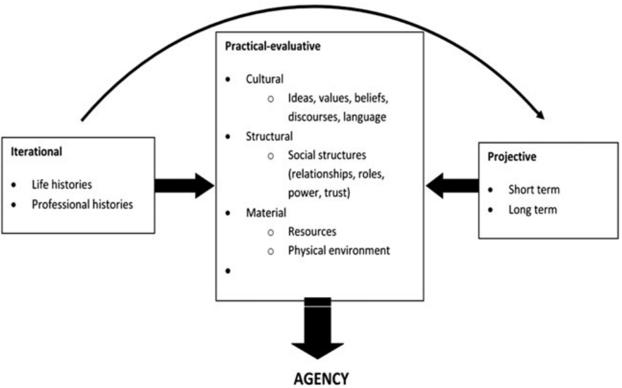
- For this paper, the authors primarily analyzed interview data from all three phases, using codes from an agency model and then open coding to interpret beliefs and aspirations.
## Limitations
- The authors explicitly say the data refer to “one particular though nonetheless interesting case,” so the findings are limited in scope.
- The study draws primarily on the stories of six classroom teachers, which is a small sample; this is evident in the text.
- The analysis focuses on interviews and selected themes from one reform context in Scotland, so transferability beyond this setting is not established; this is evident in the text.
Model-written summary. Check it against the paper before relying on it.
Integrity signals
Registry
Cites
Statistics
Figures
Verification
Claims the paper makes
0 Valid · 2 Not valid · 30 Not checked · 99 Own results and interpretations
A result the paper reports from its own data — it cites no other source for it, so there is none to check. The quote shows it is in the paper.
In the paper
“The significance of what was often referred to as a safe and caring learning environment for everyone who came into their classrooms was articulated strongly.”
§ 4. Teachers’ beliefs > 4.1. Beliefs relating to children and young people
boosted- Asserted: passes — The authors put it forward as true.
- Checkable: passes — It can be checked against evidence.
- Load-bearing: unclear — It is unclear whether the paper’s conclusions depend on it.
- Based: passes — The paper gives a reason why it holds.
A result the paper reports from its own data — it cites no other source for it, so there is none to check. The quote shows it is in the paper.
In the paper
“In analysing the data, we were struck by the similarity of beliefs articulated across this small group of teachers, despite their location in different sectors of education.”
plain- Asserted: passes — The authors put it forward as true.
- Checkable: passes — It can be checked against evidence.
- Load-bearing: passes — The paper’s conclusions depend on it.
- Based: passes — The paper gives a reason why it holds.
A result the paper reports from its own data — it cites no other source for it, so there is none to check. The quote shows it is in the paper.
In the paper
“The data clearly convey the strong sense of teachers’ professional responsibility towards their students.”
§ 4. Teachers’ beliefs > 4.1. Beliefs relating to children and young people
boosted- Asserted: passes — The authors put it forward as true.
- Checkable: passes — It can be checked against evidence.
- Load-bearing: unclear — It is unclear whether the paper’s conclusions depend on it.
- Based: passes — The paper gives a reason why it holds.
A result the paper reports from its own data — it cites no other source for it, so there is none to check. The quote shows it is in the paper.
In the paper
“Indeed, only one participant strongly referred to the importance of subject knowledge, lamenting what she saw as the detrimental effects of vocationalism on the academic content of her subject.”
§ 4. Teachers’ beliefs > 4.2. Beliefs about the role of the teacher
plainSingle case- Asserted: passes — The authors put it forward as true.
- Checkable: passes — It can be checked against evidence.
- Load-bearing: unclear — It is unclear whether the paper’s conclusions depend on it.
- Based: passes — The paper gives a reason why it holds.
A result the paper reports from its own data — it cites no other source for it, so there is none to check. The quote shows it is in the paper.
In the paper
“these discourses appear to be fairly restricted in scope, more geared to short-term goals, and predominantly articulated via the language of recent policy documentation.”
hedged- Asserted: passes — The authors put it forward as true.
- Checkable: passes — It can be checked against evidence.
- Load-bearing: passes — The paper’s conclusions depend on it.
- Based: passes — The paper gives a reason why it holds.
57 more claims
Create a free account to see all 131 claims and every source verdict.
- It may state two separate claims as one. 39
- Probably not a substantial claim. 46
Claims other papers make about this one
Each is checked against this paper’s own text: does it say what the citing paper says it does?
The cited source says what the claim attributes to it.
In the citing paper
“This absence leaves teachers unsure about their roles and contributions (Biesta et al. 2015).”
From Unveiling teachers’ professional agency and decision-making in professional learning: the illusion of choice (2025) · cites this paper as Biesta et al. 2015
The cited source says what the claim attributes to it.
In the citing paper
“As Biesta et al. (2015) suggests, teachers' agency is influenced not just by their attributes, but also by their professional experience.”
From Unveiling teachers’ professional agency and decision-making in professional learning: the illusion of choice (2025) · cites this paper as Biesta et al. 2015
The cited source says what the claim attributes to it.
In the citing paper
“Likewise Biesta, Priestley and Robinson (2015) point to a lack of discourses among teachers that constructs education in terms other than the technical-rational concerns of 'efficiency' to include questions of purpose and value.”
From Teacher agency and professional learning communities; what can Learning Rounds in Scotland teach us? (2017) · cites this paper as Biesta, Priestley and Robinson (2015)
The cited source says what the claim attributes to it.
In the citing paper
“Biesta, Priestley and Robinson (2015) report that the Scottish teachers in their research had a very similar set of views about teaching, learning and education more broadly, even though they were from diverse locations and sectors.”
From Teacher agency and professional learning communities; what can Learning Rounds in Scotland teach us? (2017) · cites this paper as Biesta, Priestley and Robinson (2015)
The cited source says what the claim attributes to it.
In the citing paper
“Biesta, Priestley and Robinson (2015) report a similar experience in their research on teacher agency.”
From Teacher agency and professional learning communities; what can Learning Rounds in Scotland teach us? (2017) · cites this paper as Biesta, Priestley and Robinson (2015)
1 more claim about this paper
Create a free account to see every claim other papers make about this one.
Citations
Cites
Outline of a Theory of Practice
Bourdieu, P. (1977) · doi:10.1017/cbo9780511812507 · Cited by 27,606
(1984) · Cited by 21,166
Outline of a Theory of Practice.
Frank, A. W., & Bourdieu, P. (1980) · Contemporary Sociology · doi:10.2307/2066038 · Cited by 14,545
Teachers' beliefs and educational research: cleaning up a messy construct
Pajares, M. F. (1992) · Review of Educational Research · doi:10.3102/00346543062003307 · Cited by 9,007 · cited 2×
“In the discussion section, we explore what this reveals about the role of beliefs in teacher agency.”
BackgroundEmirbayer, M., & Mische, A. (1998) · American Journal of Sociology · doi:10.1086/231294 · Cited by 6,165
Outline of a Theory of Practice
BOURDIEU, P. (2007) · On Violence · doi:10.2307/j.ctv120qr2d.16 · Cited by 5,527
Realist Social Theory: The Morphogenetic Approach
Archer, M. S. (1995) · Cambridge University Press eBooks · doi:10.1017/cbo9780511557675 · Cited by 3,125
Change Forces: Probing the Depths of Educational Reform
Fullan, M. (1993) · doi:10.4324/9780203059005 · Cited by 3,111
Realist social theory the morphogenetic approach
Archer, M. S. (1995) · Cited by 2,938
Change Forces: Probing the Depths of Educational Reform
Davies, S., & Fullan, M. (1995) · Canadian Public Policy / Analyse de Politiques · doi:10.2307/3552051 · Cited by 2,809
Research works printed but not linked: 3
- Brown, S., & McIntyre, D. (1993). Making sense of teaching: Developing teachers and teaching. Buckingham: Open University Press. (Open in a new window)Google Scholar
- Hollis, M. (1994). The philosophy of social science: An introduction. Cambridge: Cambridge University Press. (Open in a new window)Google Scholar · doi:10.1017/ccol0521447801
- Nieveen N. (2011 September 14). Teachers’ professional development in curriculum design in the Netherlands. Paper presented at the European Conference for Educational Research Berlin.
Cited by
Items 501–600 of 1,289
Professional development needs of preschool teachers regarding inclusive education in Türkiye
Yılmaz, B., & Karasu, N. (2025) · Journal of Research in Special Educational Needs · doi:10.1111/1471-3802.70042 · Cited by 7
Empowered to act: How leadership fosters teacher agency
Ertaş, B. D., Özdemir, M., & Vural, G. (2025) · Educational Management Administration & Leadership · doi:10.1177/17411432251400268 · Cited by 9
Kwon, Y., Kim, D., Kang, M., & Cho, G. (2025) · Children · doi:10.3390/children12121681 · Cited by 10
“This exemplifies teacher agency, which Biesta et al. [37] define as the capacity to act purposefully and reflectively within one’s context.”
Osman, M. A., Omar, A. M., Ahmed, A. M., Farah, A. A. S., & Abdullahi, A. M. (2026) · Cogent Education · doi:10.1080/2331186x.2026.2652695 · Cited by 9
survey to measure perceived agency of teachers
Hull, M. M., & Uematsu, H. (2020) · International Journal of Physics & Chemistry Education · doi:10.51724/ijpce.v12i3.82 · Cited by 7
Crossing the line: constructs of TA identity
Geeson, R., & Clarke, E. (2022) · Pastoral Care in Education · doi:10.1080/02643944.2022.2032813 · Cited by 8
“Similarly, when considering teacher identity, Biesta et al. (2015) highlighted that ‘motion’ (Soini et al., 2015) resulted in teachers ‘left regularly confused about their role’ due in part to ‘externally imposed systems which alter the dynamics of schooling’ (p. 636).”
BackgroundHazır, O., Harris, R., & Williams, T. I. (2022) · Cambridge Journal of Education · doi:10.1080/0305764x.2022.2086216 · Cited by 6
“Because the ecological model does not capture the intersection between two environments – university and school – we propose an adaptation (Figure 3) derived from Biesta et al. (2015).”
BackgroundMethodWang, L., & Lam, R. (2022) · Frontiers in Education · doi:10.3389/feduc.2022.909048 · Cited by 7
“It emphasizes the integration of time and context when teachers and scholars understand agency within an individual’s life course and within an everchanging environment (Biesta et al., 2015).”
BackgroundTeacher agency in the reform of universal primary education in Uganda
Ogwang, T. (2022) · Curriculum Journal · doi:10.1002/curj.187 · Cited by 4
An audit of commercialisation and outsourcing across the primary school curriculum
Cowan, J., Sperka, L., Hogan, A., & Enright, E. (2024) · Teachers and Teaching · doi:10.1080/13540602.2024.2355178 · Cited by 7
“This combination of teacher intuition and pragmatism (i.e. the limitations of context and budget) is always dealt with agentically (Biesta et al., 2015).”
InfluentialChen, S., Zhang, L. J., & McNaughton, S. (2024) · Language Teaching Research · doi:10.1177/13621688241293151 · Cited by 12
Deciding to act: Teachers' willingness to implement inclusive practices
Pace, E. M., & Aiello, P. (2016) · EDUCATION SCIENCES AND SOCIETY · doi:10.3280/ess1-2016oa3502 · Cited by 11
Teaching assistants managing behaviour – who knows how they do it? Agency is the answer
Clarke, E., & Visser, J. G. (2019) · Support for Learning · doi:10.1111/1467-9604.12273 · Cited by 10
Agency as the achievement of reform ownership
Godfrey, L., & Olson, C. (2019) · English Teaching: Practice and Critique · doi:10.1108/etpc-12-2018-0127 · Cited by 4
The language of teacher agency in an eighth grade ELA classroom
Loretto, A. (2019) · English Teaching Practice & Critique · doi:10.1108/etpc-12-2018-0122 · Cited by 7
Taking Control: Self-directed Professional Development and Teacher Agency
Rose, K. (2020) · Cited by 9
Pilihan Materi Pembelajaran Guru Pjok SMA dalam Memenuhi Tuntutan Kompetensi Dasar Kurikulum 2013
Diharjo, M. Z., & Wiguno, L. T. H. (2021) · Sport Science and Health · doi:10.17977/um062v3i32021p98-106 · Cited by 9
Eady, M. J., Woolrych, T. J., & Green, C. A. (2021) · Multicultural Education Review · doi:10.1080/2005615x.2021.1964263 · Cited by 6
“The values and beliefs of teachers influence how these skills are taught in classrooms, and may differ from teacher to teacher (Biesta et al., 2015).”
BackgroundMacGlone, U., Wilson, G., & MacDonald, R. (2021) · Psychology of Music · doi:10.1177/03057356211055216 · Cited by 10
“For the teacher, there is more agency in creating the curriculum content to meet the specific needs of their environment (Biesta et al., 2015).”
BackgroundWang, L., & Woo, E. (2022) · Asia Pacific Journal of Education · doi:10.1080/02188791.2022.2122023 · Cited by 5
“In this description, agency is not considered a property, but as a practice, representing “a quality of the engagement of actors with temporal-relational contexts-for-action, not a quality of the actors themselves” (Biesta, Priestley, & Robinson, 2015, p. 626).”
Leite, L. O., Havu‐Nuutinen, S., & Sointu, E. T. (2022) · Scandinavian Journal of Educational Research · doi:10.1080/00313831.2022.2127879 · Cited by 11
“According to the ecological perspective of STPA, the engagement of actors is a practice that occurs in “ temporal-relational contexts-for-action ” (Biesta et al., 2015, p. 626).”
BackgroundGura, T., Gura, O., Castanheira, P., & Roma, O. (2022) · ScienceRise Pedagogical Education · doi:10.15587/2519-4984.2022.264230 · Cited by 8
“These results show a tendency, well recognised in the research, for teachers to perceive educational reforms as a mediating factor that will impact on their agency and sense of professional identity [19].”
ResultInstructors’ navigation and appropriation of gender-inclusive Spanish at a U.S. University
Fuentes, R., & Soler, I. G. (2022) · Current Issues in Language Planning · doi:10.1080/14664208.2022.2150499 · Cited by 10
“Ahearn (2001) defines agency as ‘socioculturally mediated capacity to act’ (112); yet agency is not a personal trait that individuals possess but rather something they do in response to a range of ecological factors (Biesta et al., 2015).”
BackgroundInfluentialThe use of ICT in Secondary Music Education and its relationship with teachers’ beliefs
Portero, G. H., & Bravo, M. P. C. (2022) · Digital Education Review · doi:10.1344/der.2022.42.1-15 · Cited by 9
Xu, Y., Chen, J., & He, L. (2023) · Chinese Journal of Applied Linguistics · doi:10.1515/cjal-2023-0206 · Cited by 6
How efficiently are we using our understanding of the tacit dimension of teaching?
Enow, L. (2023) · Review of Education · doi:10.1002/rev3.3411 · Cited by 7
Finefter‐Rosenbluh, I., Berry, A. K., & Ryan, T. (2023) · Journal of Teacher Education · doi:10.1177/00224871231200278 · Cited by 8
“…of teacher agency relies on teachers’ perceptions of their practice and collective processes of development and shared considerations (e.g., Biesta et al., 2015), fitting the juxtaposition between student voice as a human rights discourse and teacher professional learning (e.g.,…”
BackgroundUnsettling teacher preparation: cultivating liminality and remaking space
Gray, T., & Phillips, A. J. (2023) · International Journal of Social Pedagogy · doi:10.14324/111.444.ijsp.2023.v12.x.017 · Cited by 7
“(p. 137) By extension, teacher agency is a dialogical process that engages actors in particular time and space (Priestley et al., 2015); in the case of this study, the teacher educator asserted teacher agency within a specific university context.”
BackgroundLeón, K., Rogers, P., Quezada, R. L., & Velázquez, S. (2024) · Journal of Education for Teaching International Research and Pedagogy · doi:10.1080/02607476.2023.2296446 · Cited by 6
Moran, J. J., Craig, M., & Collins, D. J. (2024) · Sports Coaching Review · doi:10.1080/21640629.2024.2321047 · Cited by 11
“…be more appropriate, as wherever curriculum policy or guidance is derived from, be it professional club or national governing body, those policies should (but rarely do) afford practitioners the flexibility and agency to develop the curriculum they implement (Biesta, Priestley, & Robinson, 2015).”
Schwartz, M., Toren, N. K., Dror, O., & Lavy, S. (2024) · International Journal of Leadership in Education · doi:10.1080/13603124.2024.2312982 · Cited by 10
“…that may distinguish policymakers in education from teachers as agents who are more oriented to decision-making around day-to-day classroom practice, which ‘often seem[s] to be short-term in nature, focusing on process rather than longer-term significance and impact’ (Biesta et al., 2015, p. 636).”
A Longitudinal Teacher Case Study on the Development of Creative Self‐Regulation and Agency
Anderson, R. (2025) · The Journal of Creative Behavior · doi:10.1002/jocb.1534 · Cited by 9
The Role of ‘Autonomy’ in Teaching Expertise
Bucelli, I. (2017) · Journal of Philosophy of Education · doi:10.1111/1467-9752.12252 · Cited by 9
The Role of Caring in Schools: A Tanzanian Case Study
Chachage, K., Walls, J., & Mwakalinga, Y. (2019) · Journal of International Comparative Education · doi:10.14425/jice.2019.8.1.41 · Cited by 8
Lundvall, S., & Jakobsson, B. T. (2020) · European Journal for Sport and Society · doi:10.1080/16138171.2020.1823692 · Cited by 9
The Role of Teacher Agency in Promoting Inclusion in a Chinese Primary School
Qu, X. (2021) · International Journal of Disability Development and Education · doi:10.1080/1034912x.2021.1929084 · Cited by 6
Teacher Perceptions of Student Developmental Needs: It’s all Emotional
Hinchcliff, E. B., & Newberry, M. (2021) · The Australian journal of teacher education · doi:10.14221/ajte.2021v46n9.4 · Cited by 6
“Yet within the profession of teaching there are few opportunities for such discourse and analytic reflection (Artelt, 2016; Biesta et al., 2015), which may prevent teachers from improving and refining their ability to recognize and attend to the needs presented in the classrooms.”
BackgroundHung, D. W. L., & Lim, M. M.-C. (2022) · Education in the Asia-Pacific region · doi:10.1007/978-981-16-6034-4_9 · Cited by 5
Teachers’ beliefs as a component of motivational force of professional agency
Krämer, M., & Engeström, R. (2019) · Learning Culture and Social Interaction · doi:10.1016/j.lcsi.2019.03.007 · Cited by 9
Phelan, A. M., & Hansen, D. R. (2019) · McGill Journal of Education / Revue des sciences de l'éducation de McGill · doi:10.7202/1056286ar · Cited by 5
“…some educational researchers recognize the relation between institutional and societal structures and agency and use concepts such as habitus (Bourdieu, 1977), “structuration” (Giddens, 1984), and ANT (actor-network-theory, Latour, 2005) to guide thinking about teacher agency (Biesta et al. 2015).”
BackgroundTeachers Learning: Engagement, Identity, and Agency in Powerful Professional Development
Noonan, J. (2016) · Digital Access to Scholarship at Harvard (DASH) (Harvard University) · Cited by 15
Implementing Education Policies
OECD (2018) · Implementing education policies · doi:10.1787/26176580 · Cited by 6
Ajani, O. A., & Govender, S. (2024) · International Journal of Research in Business and Social Science (2147-4478) · doi:10.20525/ijrbs.v13i5.3350 · Cited by 9
Fernández, L. S., Llauradó, E. V., & Martínez, L. M. (2024) · European Public & Social Innovation Review · doi:10.31637/epsir-2025-671 · Cited by 10
Kiramba, L. K., & Trainin, G. (2025) · The Urban Review · doi:10.1007/s11256-025-00748-6 · Cited by 6
“Teacher agency is the power of a teacher to act and shape their practice and work-place (Biesta et al., 2015; Priestley et al., 2015).”
Empowering Teacher Agency in the Era of Artificial Intelligence: Challenges and Strategies
Li, M., Wang, Y., & Han, X. (2025) · Lecture notes in computer science · doi:10.1007/978-981-96-8430-4_1 · Cited by 7
Patching The Leaky Bucket : Understanding WL teacher identity‐agency and attrition
Moser, K. (2025) · Foreign Language Annals · doi:10.1111/flan.70009 · Cited by 5
From uncertainty to advocacy: A Teacher's journey in translanguaging pedagogy
Wong, C., & Gallagher, M. (2025) · System · doi:10.1016/j.system.2025.103827 · Cited by 8
Freires, T., de Oliveira, A. C. N., Pinto, D., & Torres, A. C. (2025) · The Curriculum Journal · doi:10.1002/curj.70010 · Cited by 8
Mphatsoane-Sesoane, L., & Jita, L. C. (2025) · Discover Education · doi:10.1007/s44217-025-00944-2 · Cited by 16
“In high-income countries such as the UK and Australia, data-driven governance and accountability have reshaped leadership into managerial roles focused on compliance and standardization [5, 7, 8].”
InfluentialExploring teacher agency in universities: three types of agentic actions
Kusters, M., de Vetten, A., Rushton, E., van der Rijst, R. M., & Admiraal, W. (2025) · Studies in Higher Education · doi:10.1080/03075079.2025.2604095 · Cited by 8
Agentic Leadership During a War Crisis: School Principals Displaced by War
Bar-On, Y., & Schechter, C. (2026) · Education Sciences · doi:10.3390/educsci16010156 · Cited by 4
“This capacity develops gradually and is influenced by personal resources, efforts, and structural contexts (Biesta et al., 2015, 2017).”
Conway, C. M. (2022) · Bulletin of the Council for Research in Music Education · doi:10.5406/21627223.232.03 · Cited by 4
Schwartz, M., & Shogen, M. (2024) · Languages · doi:10.3390/languages9080275 · Cited by 5
Ovadiya, T. (2024) · Reflective Practice · doi:10.1080/14623943.2024.2398296 · Cited by 6
“Teachers who practice reflection may implement effective new methods of instruction by continually examining their own beliefs (Biesta et al., 2015), challenging their assumptions about daily instruction (Nolan & Molla, 2018), and taking actions to improve their teaching.”
From teacher agency to teacher agencies : A response-able re-conceptualization
Ashraf, T. (2025) · Educational Philosophy and Theory · doi:10.1080/00131857.2025.2495750 · Cited by 5
“…verbs that are used in the literature to describe what teachers do with their agency include: teachers enact agency (Ashton, 2021; Brodie, 2021; Priestley et al., 2015); teachers exhibit agency (Buchanan, 2015); teachers have the capacity to act (Campbell, 2012); and teachers employ and…”
InfluentialJia, Q., Wang, D., & Ding, J. (2025) · SAGE Open · doi:10.1177/21582440251342633 · Cited by 8
“‘‘Beliefs,’’ ‘‘school,’’ and ‘‘knowledge’’ (Biesta et al., 2015; Lai et al., 2016; Zhang et al., 2011) dominate Cluster Two in which belief is the most frequently discussed topic.”
InfluentialQi, J., & Derakhshan, A. (2025) · European Journal of Education · doi:10.1111/ejed.70365 · Cited by 11
Tripathi, T. (2025) · Frontiers in Education · doi:10.3389/feduc.2025.1678998 · Cited by 8
Wirthová, J. (2021) · European Educational Research Journal · doi:10.1177/1474904121993251 · Cited by 7
“Hereby, the Czech case does not point to much in the way of the return of teachers’ agency as an important dimension of teachers’ professionalism (Biesta et al., 2015).”
BackgroundMartin, V., Héroux, S., Homier, M., et al. (2021) · Canadian Journal of Science Mathematics and Technology Education · doi:10.1007/s42330-021-00134-w · Cited by 4
“L’agentivité d’une personne enseignante est définie par Biesta et al. (2015) comme sa contribution active à la structuration de son travail et de ses conditions de réalisation.”
BackgroundXu, X., Sit, H. H. W., & Li, H. (2022) · Sustainability · doi:10.3390/su141610085 · Cited by 4
Gundarina, O. (2022) · Language Learning Journal · doi:10.1080/09571736.2022.2073383 · Cited by 6
Conceptualising Early Career Teachers’ Agency and Accounts of Social Action in Disadvantaged Schools
Kettle, M., Burnett, B., Lampert, J., et al. (2022) · The Australian journal of teacher education · doi:10.14221/ajte.2022v47n8.1 · Cited by 4
Developing a distance-based doctoral supervisory model: Inquiry over disrupted trajectories
Qi, G. Y., Skyrme, G., & White, C. (2023) · Distance Education · doi:10.1080/01587919.2023.2198483 · Cited by 5
“Focusing on the individual ’ s active engagement in constructing their own life-course (Elder et al., 2003), agency-for-becoming sheds light on “ influences from the past and orientations towards the future ” (Biesta et al., 2015, p. 626).”
BackgroundTeaching Science Out-of-field: Beliefs and Practices
Campbell, C., Vale, C., & Speldewinde, C. (2023) · European Journal of Mathematics and Science Education · doi:10.12973/ejmse.4.2.133 · Cited by 8
“The teachers’ teaching practices and interpreted beliefs also seem to be related to the disciplinary context of their teaching (Biesta et al., 2015; Hancock & Gallard, 2017; Rochette, 2022) and aligned with their pedagogical knowledge (Hobbs & Quinn, 2020).”
BackgroundInfluentialOn the threshold of being a teacher: motivations and ideals of 116 Dutch student teachers
Simonsz, H., Leeman, Y. A. M., & Veugelers, W. (2023) · Asia-Pacific Journal of Teacher Education · doi:10.1080/1359866x.2023.2231880 · Cited by 4
“In the introduction, we stated that teachers lack vocabulary for and a clear vision of the purpose of education (Biesta et al., 2015; Leeman & Wardekker, 2014), but they must relate to the educational perspectives expressed in the professional community and school contexts in which they work. Nickel and Zimmer (2019)…”
BackgroundInfluentialEnhancing Teachers’ Professional Identity in a Reflective Learning MOOC
Rodrigues-Silva, J., & Alsina, ́. (2024) · International Journal of Emerging Technologies in Learning (iJET) · doi:10.3991/ijet.v19i01.38897 · Cited by 11
Mok, I. A. C., Chen, M., Ho, C.-P., & Lui, C. T. (2024) · Advances in STEM education · doi:10.1007/978-3-031-52924-5_14 · Cited by 4
Percepción docente sobre el fenómeno de la neuroeducación en una institución pública de Colombia
Hoyos, C. F. E. (2024) · Voces y Silencios Revista Latinoamericana de Educación · doi:10.18175/vys15.1.2024.4 · Cited by 7
Михайловна, М. А. (2024) · Voprosy Obrazovaniya/ Educational Studies Moscow · doi:10.17323/vo-2024-16663 · Cited by 4
Villavicencio, A., Martin, W. B., Fancsali, C., et al. (2024) · Journal of Research on Technology in Education · doi:10.1080/15391523.2024.2410183 · Cited by 4
“…in one’s capacity to apply new skills in the classroom (Parsons & Vaughn, 2016)—particularly important for a subject that most teachers are unfamiliar with, such as CS. Agency is not some-thing that teachers either have or do not have but is rather something that teachers do (Biesta et al., 2015).”
InfluentialRound, M. (2024) · Sex Education · doi:10.1080/14681811.2024.2436026 · Cited by 5
“Biesta, Priestly, and Robinson (2015) concep-tualised teacher agency as an interplay between past influences, future orientations and present engagement, taking into account the structural context.”
Foregrounding language teacher agency and positioning of EFL teachers in the research-practice nexus
Liu, Z., & McVee, M. B. (2025) · System · doi:10.1016/j.system.2025.103682 · Cited by 8
Henderson, D. J. (2017) · History Education Research Journal · doi:10.18546/herj.15.1.10 · Cited by 4
Profesní aktérství začínajících učitelů v základních školách
Píšová, M., & Hanušová, S. (2019) · ORBIS SCHOLAE · doi:10.14712/23363177.2019.1 · Cited by 4
Stanulis, R. N., & Guenther, A. R. (2020) · Medical Science Educator · doi:10.1007/s40670-020-01162-1 · Cited by 5
“Teachers need to feel they are making an active contribution to their work as teachers and to shaping the teaching environment [21].”
BackgroundWang, L., Kimura, Y., & Yurita, M. (2022) · Asia Pacific Journal of Education · doi:10.1080/02188791.2022.2031880 · Cited by 8
Araújo, S. B. (2022) · European Early Childhood Education Research Journal · doi:10.1080/1350293x.2022.2081345 · Cited by 13
“Literature on teaching and teachers’ education has been emphasizing the impact of the beliefs these professionals hold on their perceptions, interpretations, decision-making and practice (Biesta, Priestley, and Robinson 2015; Blömeke, Dunekacke, and Jenβen 2017).”
BackgroundWhen Data Don't Drive: Teacher Agency in Data Use Efforts in Low-Performing Schools
Lockton, M. (2019) · American Educational Research Association Annual Meeting (AERA) · doi:10.3102/1434900 · Cited by 4
Stetsenko, A. (2022) · Praxis Educativa · doi:10.5212/praxeduc.v.18.21106.005 · Cited by 15
Emam, M., Hilal, Y. Y., Mohamed, N., & Al-Mahdy, Y. F. H. (2022) · Educational Action Research · doi:10.1080/09650792.2022.2159470 · Cited by 5
Pemahaman Guru tentang Makna Pendidikan Agama bagi Anak Usia Dini
Rahiem, M. D. H. (2023) · Jurnal Obsesi Jurnal Pendidikan Anak Usia Dini · doi:10.31004/obsesi.v7i2.4211 · Cited by 4
What do you want your teachers to know? Using intergenerational reflections in education research
Vanner, C. (2023) · International Journal of Qualitative Studies in Education · doi:10.1080/09518398.2023.2233916 · Cited by 5
“While there is increasing attention to the value of teacher agency (Biesta et al., 2015), it comes after entrenched movements toward teachers’ deprofessionalization in favour of standardization (Tsang & Qin, 2020).”
BackgroundTeaching reading in rural secondary schools in Sabah: A preliminary study
Universiti Teknologi MARA Sabah Branch, K. K. C., Lee, J. Y. V., Wong, A. S. C., & Universiti Teknologi MARA Sabah Branch, K. K. C. (2020) · Borneo AKademika · doi:10.24191/bav4i4/80758 · Cited by 6
Brinkmann, L. M. (2024) · Bellaterra Journal of Teaching & Learning Language & Literature · doi:10.5565/rev/jtl3.1268 · Cited by 7
“Re-searching teachers’ beliefs is important in understanding teachers’ actions and decision-making in the classroom (Barkhuizen, 2016; Biesta et al., 2015; Haukås, 2016; Makarova et al., 2021; Pajares, 1992; Zheng, 2015).”
BackgroundOpettajan toimijuus muutoksessa – Yhteisopetusta pienin askelin
Takala, M., & Saarinen, M. (2020) · Työelämän tutkimus · doi:10.37455/tt.97976 · Cited by 38
“A Passion and Enthusiasm to Bring out the Best in All”: Regional Candidate Teacher Motivations
Sheridan, L. (2019) · The Australian journal of teacher education · doi:10.14221/ajte.2019v44n12.5 · Cited by 5
Amery, E. (2020) · Interchange · doi:10.1007/s10780-020-09409-x · Cited by 6
Decisicion Making through the Angle of the Ecological Model of Agency
Pedaste, M., & Leijen, Ä. (2020) · IEEE International Conference on Advanced Learning Technologies (ICALT) · doi:10.1109/icalt49669.2020.00080 · Cited by 4
Wang, M. (2020) · Critical Inquiry in Language Studies · doi:10.1080/15427587.2020.1796483 · Cited by 7
Agency and development of key competences in nonformal learning contexts
Põlda, H., Roosalu, T., Karu, K., Teder, L., & Lepik, M. (2021) · Eesti Haridusteaduste Ajakiri = Estonian Journal of Education · doi:10.12697/eha.2021.9.1.03 · Cited by 8
Sigurðardóttir, I. Ó., & Mörk, S. B. (2022) · Teachers and Teaching · doi:10.1080/13540602.2022.2062729 · Cited by 7
“Teacher agency is a factor that needs to be more emphasised in the schooling system since, like according to Biesta et al. (2015), many believe it ‘is an indispensable element of good and meaningful education’ (p.”
BackgroundInfluentialMohamed, L., & Ahmad, T. B. T. (2019) · IIUM Journal of Educational Studies · doi:10.31436/ijes.v6i2.265 · Cited by 4
“According to Biesta et al. (2015), underlying beliefs about their personal and professional roles inform the judgments and choices made by teachers.”
BackgroundValidation of a survey to measure pre-service teachers’ sense of agency
Hull, M. M., Vormayr, K., & Uematsu, H. (2021) · Journal of Physics Conference Series · doi:10.1088/1742-6596/1929/1/012085 · Cited by 4
Exploring Metacognition in Primary School Classrooms
Branigan, H. (2019) · Stirling Online Research Repository (University of Stirling) · Cited by 8
Atuguba, J. A. (2019) · University of Birmingham Institutional Research Archive (University of Birmingham) · Cited by 9
Raising the Curtain: Positioning and Identity Construction in Online Language Teacher Education
Steadman, A. N. (2020) · UA Campus Repository (The University of Arizona) · Cited by 9
Alsaleh, A. A. (2024) · International journal of comparative education and development · doi:10.1108/ijced-05-2023-0038 · Cited by 4
Yuan, F., Li, J., & Mao, Y. (2025) · SAGE Open · doi:10.1177/21582440251320058 · Cited by 9
“In line with existing research findings concerning learning opportunities and constraints on PLCs, this study situated teacher agency in teachers’ developmental trajectory from the ecological perspective (Daly et al., 2020; Priestley et al., 2015; shown in Figure 2).”
Influential
Metadata
- Authors
- Biesta, G., Priestley, M., & Robinson, S.
- Affiliations
- ArtEZ University of the Arts (NL)
- University of Stirling (GB)
- Aarhus University (DK)
- Corresponding author
- Biesta, Gert
- Venue
- Teachers and Teaching
- Publisher
- Informa UK Limited
- Published
- 2015-06-15
- Volume
- 21
- Issue
- 6
- Pages
- 624-640
- ISSN
- 1354-0602 (ISSN-L)
- 1470-1278
- OpenAlex
- W1911902575
- Cited by
- 1,318
- References
- 47
- Citations by year
- 2026: 233 · 2025: 161 · 2024: 141 · 2023: 157 · 2022: 139 · 2021: 131 · 2020: 118 · 2019: 96 · 2018: 73 · 2017: 48 · 2016: 17 · 2015: 4
- FWCI
- 236.15
- Type
- journal article
- Language
- en
- Open access
- hybrid
- doi.org
- Licence
- cc-by-nc-nd
- Locations
- Teachers and Teaching (publishedVersion, cc-by-nc-nd)
- Brunel University Research Archive (BURA) (Brunel University London) (submittedVersion)
- Stirling Online Research Repository (University of Stirling) (submittedVersion, cc-by-nc-nd)
- Edinburgh Research Explorer (University of Edinburgh) (submittedVersion, other-oa)
- Funders
- Economic and Social Research Council (ES/I006907/1)
- Topics
- Social Sciences › Education › Teacher Education and Leadership Studies
- Social Sciences › Education › Education Pedagogy and Practices
- Social Sciences › Arts and Humanities › Philosophy › Education, Philosophy, and Society
- Keywords
- teacher agency, teacher beliefs, Curriculum for Excellence, educational reform, teacher professionalism, teacher decision-making, institutional discourse, professional vision, Scotland
About these checks
Registry, retraction, Cites and statistics results are computed, not judged, with one exception: a printed reference that no index lists is read once by a model before it counts as a citation error. Claims are extracted by a model and kept only when their quote appears verbatim in the text; each cited source is then checked, with a model’s help, for whether it says what the claim relies on. Those verdicts can be wrong — read the claim’s quote and the cited source before relying on one.
A language model drew the claims from the paper on 2026-10-11, under version 3 of the claim definition (model deepseek-v4.1-flash, prompt extract-v3).
A second model labelled each claim on 2026-10-11 (model jev-1.13-20260917, definition revision gold-guideline-v0.2).
Statistics and arithmetic are recomputed, not judged.
Confidence bands are shown only for fields calibrated on our annotated test set. None is calibrated yet, so no band is shown.
What counts as a claim ›How we measure confidence ›How we check this ›
Are you an author, or do you see a problem with this page? Request a review
Data sources
Bibliographic data: Semantic Scholar, OpenAlex, Crossref.
Contains information from the Semantic Scholar Academic Graph Datasets, made available under the ODC Attribution License (ODC-BY 1.0).
Semantic Scholar’s data is described in: Kinney, R., et al. (2023). The Semantic Scholar Open Data Platform. arXiv:2301.10140.
