

The role of beliefs in teacher agency
Open accessThe DOI matches its Crossref record; 44 of the 47 references it cites were found in a registry or an index; none of the 31 sources its claims cite is checked for support yet.
Abstract
There is an ongoing tension within educational policy worldwide between countries that seek to reduce the opportunities for teachers to exert judgement and control over their own work, and those who seek to promote it. Some see teacher agency as a weakness within the operation of schools and seek to replace it with evidence-based and data-driven approaches, whereas others argue that because of the complexities of situated educational practices, teacher agency is an indispensable element of good and meaningful education. While the ideological debate about the shape and form of teacher professionalism is important, it is equally important to understand the dynamics of teacher agency and the factors that contribute to its promotion and enhancement. In this paper, we draw from a two-year study into teacher agency against the backdrop of large-scale educational reform – the implementation of Scotland’s Curriculum for Excellence – in order to explore these questions. We focus on teachers’ beliefs in order to get a sense of the individual and collective discourses that inform teachers’ perceptions, judgements and decision-making and that motivate and drive teachers’ action. While the research suggests that beliefs play an important role in teachers’ work, an apparent mismatch between teachers’ individual beliefs and values and wider institutional discourses and cultures, and a relative lack of a clear and robust professional vision of the purposes of education indicate that the promotion of teacher agency does not just rely on the beliefs that individual teachers bring to their practice, but also requires collective development and consideration.
Overview
CoChat Summary
## TL;DR
The paper argues that teacher beliefs matter for agency, but mainly insofar as they are shaped by policy discourse, schooling culture, and limited professional visions of what education is for. Using ethnographic case studies from three Scottish schools during Curriculum for Excellence, the authors find that teachers’ beliefs were often short-term, instrumental, and only loosely connected to broader purposes or values.
## Key findings
- Across the six classroom teachers, beliefs about children, teaching, and educational purpose were notably similar, and often framed by recent policy language rather than a robust professional discourse.
- Teachers strongly emphasized relationships, safety, care, enjoyment, skills, socialisation, and “maximising student potential,” but gave little sustained attention to knowledge, qualification, social justice, or democratic values.
- The paper argues that a narrow view of purpose limits agency: teachers were effective at short-term classroom management and curriculum delivery, but less able to use beliefs to imagine or enact longer-term educational aims.
- The authors report that teachers’ understandings of Curriculum for Excellence were often superficial or vague; some described the curriculum as “airy fairy,” “overly complicated,” or something they were “fumbling about trying.”
## Methods
- Ethnographic research in one Scottish education authority, in one primary school and two secondary schools, focusing on two experienced classroom teachers in each setting; senior managers were also interviewed.
- The project ran over a full year with three data-collection phases and used observation, semi-structured individual and group interviews, a personal/professional history interview, policy-text analysis, and teacher network mapping.
- For this paper, the authors primarily analyzed interview data from all three phases, using codes from an agency model and then open coding to interpret beliefs and aspirations.
## Limitations
- The authors explicitly say the data refer to “one particular though nonetheless interesting case,” so the findings are limited in scope.
- The study draws primarily on the stories of six classroom teachers, which is a small sample; this is evident in the text.
- The analysis focuses on interviews and selected themes from one reform context in Scotland, so transferability beyond this setting is not established; this is evident in the text.
Model-written summary. Check it against the paper before relying on it.
Integrity signals
Registry
Cites
Statistics
Figures
Verification
Claims the paper makes
0 Valid · 2 Not valid · 30 Not checked · 99 Own results and interpretations
A result the paper reports from its own data — it cites no other source for it, so there is none to check. The quote shows it is in the paper.
In the paper
“The significance of what was often referred to as a safe and caring learning environment for everyone who came into their classrooms was articulated strongly.”
§ 4. Teachers’ beliefs > 4.1. Beliefs relating to children and young people
boosted- Asserted: passes — The authors put it forward as true.
- Checkable: passes — It can be checked against evidence.
- Load-bearing: unclear — It is unclear whether the paper’s conclusions depend on it.
- Based: passes — The paper gives a reason why it holds.
A result the paper reports from its own data — it cites no other source for it, so there is none to check. The quote shows it is in the paper.
In the paper
“In analysing the data, we were struck by the similarity of beliefs articulated across this small group of teachers, despite their location in different sectors of education.”
plain- Asserted: passes — The authors put it forward as true.
- Checkable: passes — It can be checked against evidence.
- Load-bearing: passes — The paper’s conclusions depend on it.
- Based: passes — The paper gives a reason why it holds.
A result the paper reports from its own data — it cites no other source for it, so there is none to check. The quote shows it is in the paper.
In the paper
“The data clearly convey the strong sense of teachers’ professional responsibility towards their students.”
§ 4. Teachers’ beliefs > 4.1. Beliefs relating to children and young people
boosted- Asserted: passes — The authors put it forward as true.
- Checkable: passes — It can be checked against evidence.
- Load-bearing: unclear — It is unclear whether the paper’s conclusions depend on it.
- Based: passes — The paper gives a reason why it holds.
A result the paper reports from its own data — it cites no other source for it, so there is none to check. The quote shows it is in the paper.
In the paper
“Indeed, only one participant strongly referred to the importance of subject knowledge, lamenting what she saw as the detrimental effects of vocationalism on the academic content of her subject.”
§ 4. Teachers’ beliefs > 4.2. Beliefs about the role of the teacher
plainSingle case- Asserted: passes — The authors put it forward as true.
- Checkable: passes — It can be checked against evidence.
- Load-bearing: unclear — It is unclear whether the paper’s conclusions depend on it.
- Based: passes — The paper gives a reason why it holds.
A result the paper reports from its own data — it cites no other source for it, so there is none to check. The quote shows it is in the paper.
In the paper
“these discourses appear to be fairly restricted in scope, more geared to short-term goals, and predominantly articulated via the language of recent policy documentation.”
hedged- Asserted: passes — The authors put it forward as true.
- Checkable: passes — It can be checked against evidence.
- Load-bearing: passes — The paper’s conclusions depend on it.
- Based: passes — The paper gives a reason why it holds.
57 more claims
Create a free account to see all 131 claims and every source verdict.
- It may state two separate claims as one. 39
- Probably not a substantial claim. 46
Claims other papers make about this one
Each is checked against this paper’s own text: does it say what the citing paper says it does?
The cited source says what the claim attributes to it.
In the citing paper
“This absence leaves teachers unsure about their roles and contributions (Biesta et al. 2015).”
From Unveiling teachers’ professional agency and decision-making in professional learning: the illusion of choice (2025) · cites this paper as Biesta et al. 2015
The cited source says what the claim attributes to it.
In the citing paper
“As Biesta et al. (2015) suggests, teachers' agency is influenced not just by their attributes, but also by their professional experience.”
From Unveiling teachers’ professional agency and decision-making in professional learning: the illusion of choice (2025) · cites this paper as Biesta et al. 2015
The cited source says what the claim attributes to it.
In the citing paper
“Likewise Biesta, Priestley and Robinson (2015) point to a lack of discourses among teachers that constructs education in terms other than the technical-rational concerns of 'efficiency' to include questions of purpose and value.”
From Teacher agency and professional learning communities; what can Learning Rounds in Scotland teach us? (2017) · cites this paper as Biesta, Priestley and Robinson (2015)
The cited source says what the claim attributes to it.
In the citing paper
“Biesta, Priestley and Robinson (2015) report that the Scottish teachers in their research had a very similar set of views about teaching, learning and education more broadly, even though they were from diverse locations and sectors.”
From Teacher agency and professional learning communities; what can Learning Rounds in Scotland teach us? (2017) · cites this paper as Biesta, Priestley and Robinson (2015)
The cited source says what the claim attributes to it.
In the citing paper
“Biesta, Priestley and Robinson (2015) report a similar experience in their research on teacher agency.”
From Teacher agency and professional learning communities; what can Learning Rounds in Scotland teach us? (2017) · cites this paper as Biesta, Priestley and Robinson (2015)
1 more claim about this paper
Create a free account to see every claim other papers make about this one.
Citations
Cites
Outline of a Theory of Practice
Bourdieu, P. (1977) · doi:10.1017/cbo9780511812507 · Cited by 27,606
(1984) · Cited by 21,166
Outline of a Theory of Practice.
Frank, A. W., & Bourdieu, P. (1980) · Contemporary Sociology · doi:10.2307/2066038 · Cited by 14,545
Teachers' beliefs and educational research: cleaning up a messy construct
Pajares, M. F. (1992) · Review of Educational Research · doi:10.3102/00346543062003307 · Cited by 9,007 · cited 2×
“In the discussion section, we explore what this reveals about the role of beliefs in teacher agency.”
BackgroundEmirbayer, M., & Mische, A. (1998) · American Journal of Sociology · doi:10.1086/231294 · Cited by 6,165
Outline of a Theory of Practice
BOURDIEU, P. (2007) · On Violence · doi:10.2307/j.ctv120qr2d.16 · Cited by 5,527
Realist Social Theory: The Morphogenetic Approach
Archer, M. S. (1995) · Cambridge University Press eBooks · doi:10.1017/cbo9780511557675 · Cited by 3,125
Change Forces: Probing the Depths of Educational Reform
Fullan, M. (1993) · doi:10.4324/9780203059005 · Cited by 3,111
Realist social theory the morphogenetic approach
Archer, M. S. (1995) · Cited by 2,938
Change Forces: Probing the Depths of Educational Reform
Davies, S., & Fullan, M. (1995) · Canadian Public Policy / Analyse de Politiques · doi:10.2307/3552051 · Cited by 2,809
Research works printed but not linked: 3
- Brown, S., & McIntyre, D. (1993). Making sense of teaching: Developing teachers and teaching. Buckingham: Open University Press. (Open in a new window)Google Scholar
- Hollis, M. (1994). The philosophy of social science: An introduction. Cambridge: Cambridge University Press. (Open in a new window)Google Scholar · doi:10.1017/ccol0521447801
- Nieveen N. (2011 September 14). Teachers’ professional development in curriculum design in the Netherlands. Paper presented at the European Conference for Educational Research Berlin.
Cited by
Items 301–400 of 1,289
Alam, M. J., Ahsan, A. H. M., & Ogawa, K. (2023) · Discover Education · doi:10.1007/s44217-023-00063-w · Cited by 17
“The participants responded in that manner because it was closely observed that cultural elements in a child’s education aid in [33–36].”
BackgroundSLADE: A Method for Designing Human-Centred Learning Analytics Systems
Alfredo, R., Echeverría, V., Jin, Y., Swiecki, Z., Gašević, D., & Martínez‐Maldonado, R. (2024) · International Conference on Learning Analytics and Knowledge (LAK) · doi:10.1145/3636555.3636847 · Cited by 23
“In educational contexts, human control can vary: high, as seen when learners actively control the LA systems, or low, when they merely receive information without exerting any autonomy [6, 32].”
BackgroundThe curriculum in school external evaluation frameworks in Portugal and England
Figueiredo, C., Leite, C. M. F. A. F., & Fernandes, P. T. (2016) · Research in Comparative and International Education · doi:10.1177/1745499916661933 · Cited by 19
“…object and a strictly structured set of contents into a conception that sees it as a process, opened to the characteristics of the context and the people involved (Biesta et al., 2015; Doyle, 1992; Fernandes, 2011; Leite, 2002; Leite and Fernandes, 2014; Miller and Seller, 1985; Pacheco, 1996).”
BackgroundExamining Narratives of Conflict and Agency : Insights into Non-Local English Teacher Identity
Loo, D. B., Trakulkasemsuk, W., & Zilli, P. J. (2017) · The Journal of AsiaTEFL · doi:10.18823/asiatefl.2017.14.2.6.292 · Cited by 28
Fletcher, A. K. (2018) · Assessment Matters · doi:10.18296/am.0032 · Cited by 21
“As Biesta, Priestley, and Robinson (2015) point out, agency is something people do, rather than a capacity, competence or property they have.”
BackgroundInfluentialAgency in educational language planning: perspectives from higher education in Tunisia
Badwan, K. (2019) · Current Issues in Language Planning · doi:10.1080/14664208.2019.1700056 · Cited by 19
Engeström, R., & Käyhkö, L. (2021) · Journal of the Learning Sciences · doi:10.1080/10508406.2021.1908296 · Cited by 26
“In their answers, the course teachers and students examined developmental challenges within the context of practical issues related to the school curriculum and their role in the here-and-now concerning “the practical-evaluative dimension of agency” (Biesta et al., 2015, p. 637).”
BackgroundHarris, R. (2021) · Journal of Curriculum Studies · doi:10.1080/00220272.2021.1884294 · Cited by 26
“Other studies have focused on teachers’ agency and their ability to engage with and influence change (Biesta et al., 2015; Priestley et al., 2012).”
BackgroundTeaching as a new mission: Swedish preschool teachers’ collegial discussions
Hildén, E., Hultman, A. L., & Ribaeus, K. (2021) · Early Years Journal of International Research and Development · doi:10.1080/09575146.2021.1880374 · Cited by 32
“In times of educational change, teacher agency is often called for, highlighting agency as a significant dimension of teachers’ professionalism (Biesta, Priestley, and Robinson 2015).”
BackgroundVargas, S., Narea, M., & Irribarra, D. T. (2021) · Psykhe (Santiago) · doi:10.7764/psykhe.2019.21809 · Cited by 29
Moriche, M. P. R., Vasco-González, M., Pareja, D. G., & Gómez, J. P. (2022) · Revista Electrónica Interuniversitaria de Formación del Profesorado · doi:10.6018/reifop.512851 · Cited by 20
Erss, M. (2023) · Pedagogy Culture and Society · doi:10.1080/14681366.2023.2225529 · Cited by 20
“An ecological approach perceives agency as an emergent phenomenon which can be achieved by combining individual capacity and contextual and structural dimensions in their temporal settings (Biesta, Priestley, and Robinson 2015; Emirbayer and Mische 1998).”
InfluentialSutherland, L., Markauskaitė, L., & Cruickshank, K. (2023) · Professional Development in Education · doi:10.1080/19415257.2023.2217432 · Cited by 20
“The resources, contextual and structural factors all impact the expression of agency (Priestley et al .”
BackgroundThe professional role and identity of teachers in the private and state education sectors
Connolly, M. R., & Hughes-Stanton, J. (2020) · British Journal of Sociology of Education · doi:10.1080/01425692.2020.1764333 · Cited by 13
Polmear, M., Bielefeldt, A. R., Knight, D. W., Swan, C., & Canney, N. E. (2020) · Science and Engineering Ethics · doi:10.1007/s11948-020-00261-x · Cited by 17
Ahmad, H., Latada, F. B., Wahab, M. N. A., Shah, S. R., & Khan, K. (2018) · International Journal of English Linguistics · doi:10.5539/ijel.v8n6p37 · Cited by 19
Herrera-Seda, C., & Pantić, N. (2025) · Education Sciences · doi:10.3390/educsci15030316 · Cited by 22
“Following the ecological perspective, ‘agency’ is not an individual capacity or something that teachers “pos-sess” but something that is “achieved” in the transaction with others (Priestley et al., 2015).”
Teachers’ agentic actions in tight and loosely coupled effective secondary schools in Chile
Montecinos, C., Cortéz, M., Valenzuela, J. P., Zett, I., & Zoro, B. (2022) · Teaching and Teacher Education · doi:10.1016/j.tate.2022.103731 · Cited by 14
Xu, S., & Lu, C. (2022) · Teaching and Teacher Education · doi:10.1016/j.tate.2022.103845 · Cited by 18
Alajmi, M., & Alsaleh, A. A. (2023) · International Journal of Leadership in Education · doi:10.1080/13603124.2023.2298204 · Cited by 17
Wright, G. W., Delgado, C., & Rende, K. (2024) · Journal of Research in Science Teaching · doi:10.1002/tea.21942 · Cited by 18
Gong, Y., Zhang, L., & Li, W.-D. (2024) · System (Linköping) · doi:10.1016/j.system.2024.103420 · Cited by 12
Rethinking teacher agency: cybernetics, action research, and the process-oriented rationality
Lee, S. Y. (2021) · Journal of Curriculum Studies · doi:10.1080/00220272.2020.1858451 · Cited by 16
“Teacher agency, in this context, is understood from an ecological perspective (Biesta et al., 2015); it highlights teacher’s agential role as ‘actors’ to ‘act by means of their environment’ who can interactively execute the individual efforts ‘in particular, and in a sense, always unique…”
BackgroundBolyard, J. J., & Baker, C. K. (2021) · Professional Development in Education · doi:10.1080/19415257.2021.1876150 · Cited by 12
Teacher communities as a context for professional learning: a preschool case study
Damjanovic, V., & Blank, J. (2021) · Professional Development in Education · doi:10.1080/19415257.2021.1883718 · Cited by 25
“Teachers tend to focus on the here and now and completing specific finite goals (Biesta et al. (2015).”
BackgroundMaking decisions about attainment grouping in mathematics: teacher agency and autonomy in Norway
Eriksen, E., Solomon, Y., Bjerke, A. H., Gray, J., & Kleve, B. (2022) · Research Papers in Education · doi:10.1080/02671522.2022.2135014 · Cited by 12
“In this paper, we use Biesta, Priestley, and Robinson (2015) model to analyse interviews with thirteen Norwegian mathematics teachers, with the aim of understanding the exercise of agency in their reflections on grouping practices in both theory and practice, and relate this to their proximity to…”
BackgroundMethodInfluentialSchooling, teachers in Jamaica and social responsibility: rethinking teacher preparation
Roofe, C. (2018) · Social Responsibility Journal · doi:10.1108/srj-10-2017-0202 · Cited by 12
Modes of Teacher Participation in the Digitalization of School
Dirckinck‐Holmfeld, L., Ipsen, B. J., Tamborg, A. L., Dreyøe, J., Allsopp, B. B., & Misfeldt, M. (2019) · Designs for Learning · doi:10.16993/dfl.109 · Cited by 15
Student absenteeism and ecological agency
Kipp, A. L., & Clark, J. S. (2021) · Improving Schools · doi:10.1177/1365480221992884 · Cited by 19
“The concept of agency has been theorized over the past 15 years in educational research, most commonly theorizing the work of teachers found in international school contexts (Balgopal, 2020; Biesta et al., 2015; Imants et al., 2013; Tao & Gao, 2017; Wallen & Tormey, 2019).”
BackgroundInfluential张, 杰., Ge, Y., Du, J., & Hu, Z. (2024) · Acta Psychologica · doi:10.1016/j.actpsy.2024.104673 · Cited by 21
Elementary teachers’ agency: the role of perceived professional space and autonomy
Nguyen, P., Webel, C., Yeo, S., & Zhao, W. (2022) · Journal of Curriculum Studies · doi:10.1080/00220272.2022.2081821 · Cited by 19
“For example, teachers’ deficit discourses about students, such as labelling certain students as ‘poor’ or ‘able’, limit agency by providing teachers justification for relinquishing responsibility for student learning (Biesta et al., 2015).”
BackgroundInfluentialvan Leeuwen, A., & Rummel, N. (2022) · Unterrichtswissenschaft · doi:10.1007/s42010-022-00156-9 · Cited by 19
“Another defining teacher characteristic that separated acceptable from unacceptable dashboards roles was the importance teachers assigned to agency , that is, the teacher’s active contribution to shaping his or her own activities and to influence the classroom environment (Biesta et al. 2015).”
BackgroundUnderstanding Language Teacher Agency
Reeves, J. R. (2022) · Educational linguistics · doi:10.1007/978-3-031-13161-5_6 · Cited by 11
Chen, M. (2023) · Heliyon · doi:10.1016/j.heliyon.2023.e15981 · Cited by 18
“Among the limited number of teacher studies, collective traits of teacher agency, such as self-regulation and leadership, were more discussed than actions of individual teachers [95,96].”
Brown, S., Küçük, Z. D., Rickard, A., Lonergan, J., Abernethy, R., McNerney, L., McNerney, E., Foley, R., Behan, A., Byrne, A., et al. (2023) · International Research in Geographical and Environmental Education · doi:10.1080/10382046.2023.2214044 · Cited by 19
“Based on the ecological model, however, it should be noted that structures of schooling systems and cultures of schools also play important roles for teachers to achieve agency (Biesta et al., 2015).”
BackgroundTeachers’ appreciation of autonomy as a personal interpretation of professional reality
Schwarz-Franco, O., & Hadar, L. (2024) · Teaching and Teacher Education : An International Journal of Research and Studies · doi:10.1016/j.tate.2024.104501 · Cited by 10
Teachers’ Insights on Cultivating Inclusive Education for Students with Complex Support Needs
Mansouri, M. C., Miller, A. L., Kurth, J. A., Ruhter, L. C., Wilt, C. L., Toews, S. G., & Morningstar, M. E. (2024) · Teachers College Record The Voice of Scholarship in Education · doi:10.1177/01614681241302637 · Cited by 23
“Although partnerships with others in the school community are fundamental for collaboration (Biesta et al., 2015), more information is needed to understand how teachers find allies who are willing to partner for inclusive practices.”
Two teachers’ positioning toward Meaningful PE: agency, sensemaking, and ownership
Beni, S., Fletcher, T., & Chróinín, D. N. (2024) · Physical Education and Sport Pedagogy · doi:10.1080/17408989.2024.2439966 · Cited by 16
Milton, E., Morgan, A., Davies, A. J., Connolly, M. R., Donnelly, D., & Ellis, I. (2020) · International Journal of Leadership in Education · doi:10.1080/13603124.2020.1811898 · Cited by 16
“, 2018); within the lower accountability phases there have been attempts to encourage professional agency (Biesta et al., 2015) rooted in more occupationally-orientated understandings of headteachers’ professional practice (Connolly et al.”
BackgroundInfluentialCiencias bilingües: how dual language teachers cultivate equity in dual language classrooms
Martell, M. A. N. (2021) · International Journal of Bilingual Education and Bilingualism · doi:10.1080/13670050.2020.1870925 · Cited by 16
“Not only is the CCT an agent of social change (Biesta, Priestley, and Robinson 2015), but the CCT also prepares students to be self-advocates, agents of social change and to engage in the transformation of education (Pantić 2015).”
BackgroundTeachers’ Perspective on Student’s Right to Participation in Classroom Management
Thoyibi, M., Hikmat, M. H., & Prasetyarini, A. (2021) · Asian Journal of University Education · doi:10.24191/ajue.v17i1.12602 · Cited by 11
“This finding confirmed the earlier studies (Abbas, 2003) that Muslim individuals were very much influenced by the religious norms (Biesta et al., 2015).”
ResultCircumventing erosion of professional learner identity development among beginning teachers
Larsen, E., & Allen, J. M. (2021) · Teaching Education · doi:10.1080/10476210.2021.2011193 · Cited by 15
“…speaks to agency as strongly connected to self-efficacy, defining it as the individual’s beliefs about their ability to influence their lives, it is pertinent within the context of this study to consider the later work of researchers such as Biesta et al. (2015), Edwards (2015) and Ahearn (2001).”
BackgroundXu, L., Fang, S., & Hobbs, L. (2022) · International Journal of Science and Mathematics Education · doi:10.1007/s10763-022-10267-5 · Cited by 44
Understanding Rural School Teachers’ Professional Agency and Its Relationship to Social Structure
Sang, G., Huang, J., Chao, T.-Y., Ye, B., & Muthanna, A. (2022) · Educational Studies · doi:10.1080/00131946.2022.2051033 · Cited by 17
“In this pattern of thinking, teachers’ professional agency is based on the interplay of agentic capacity (individual factors, like commitment, value, role, belief, and power) and agentic spaces (contextual factors, like societal change, role expectations, and social network) (Biesta et al., 2015).”
BackgroundInformation and Communication Technology and Education: Meaningful Change through Teacher Agency
Albion, P., & Tondeur, J. (2018) · Springer international handbooks of education · doi:10.1007/978-3-319-53803-7_25-2 · Cited by 16
‘I’m aware of that, but … ’: breaking the silence on moral distress among language teachers
Thumvichit, A. (2023) · Language Culture and Curriculum · doi:10.1080/07908318.2023.2189268 · Cited by 12
“According to Biesta et al. (2015), teacher agency is related to teachers’ ability to make their own decisions and act independently within their professional roles.”
BackgroundAfter the Pandemic: Teacher Professional Development for the Digital Educational Innovation
Eradze, M., Martino, D. D., Tinterri, A., Albó, L., Bardone, E., Sunar, A. S., & Dipace, A. (2023) · Education Sciences · doi:10.3390/educsci13050432 · Cited by 29
“…beyond individual factors, One of these challenges is to go beyond individual factors, beliefs, perceptions and properties as suggested by Biesta [37]: “relative lack of a clear and robust professional vision of the purposes of education indicate that the promotion of teacher agency does not…”
BackgroundInfluentialTeacher Professional Development: Perspectives from a Research Experience with Teachers
Molina, C. A., & Sepúlveda, F. (2023) · Revista Electrónica Educare · doi:10.15359/ree.27-2.15870 · Cited by 11
“On the other hand, the concept of agency capacity that teachers have regarding their professional learning, as indicated by Biesta et al. (2015) refers to how teachers do something to grow professionally, which in turn shows how commited they are commitment to the context in which their practice…”
BackgroundChapman, S., Wright, P., & Pascoe, R. (2019) · Journal of Curriculum Studies · doi:10.1080/00220272.2019.1694074 · Cited by 18
“This development, for example, might involve personal responses in areas such as beliefs and identity (Biesta et al., 2015; Pyhältö et al., 2014; Sloan, 2006), or attributes or inclinations that play out as a result of action to a particular situation.”
BackgroundNatural Sciences Teachers’ Beliefs as Barriers for Integrating ICTs in a Technology-rich Context
Juggernath, A., & Govender, N. (2020) · African Journal of Research in Mathematics Science and Technology Education · doi:10.1080/18117295.2020.1736854 · Cited by 17
“The BIUT framework further provides a basis for mapping teacher agency —‘ the opportunities for teachers to exert judgement and control over their own work ’ (Biesta et al., 2015, p. 624).”
BackgroundContesting quality teaching: Teachers’ pragmatic agency and the debate about teacher evaluation
Anagnostopoulos, D., Wilson, S. M., & Charles-Harris, S. (2020) · Teaching and Teacher Education · doi:10.1016/j.tate.2020.103246 · Cited by 22
Shavard, G. (2021) · Professional Development in Education · doi:10.1080/19415257.2021.1879216 · Cited by 20
Educating Teachers as Agents of Social Justice: A Virtue Ethical Perspective
Pantić, N., & Carr, D. (2017) · Springer eBooks · doi:10.1007/978-3-319-54389-5_5 · Cited by 15
The Place of Leadership Development for Change Agency in Teacher Education Curricula for Diversity
Forde, C., & Dickson, B. (2017) · Springer eBooks · doi:10.1007/978-3-319-54389-5_7 · Cited by 16
Yang, W., Li, Y., Zhou, W., & Li, H. (2020) · ECNU Review of Education · doi:10.1177/2096531120917163 · Cited by 15
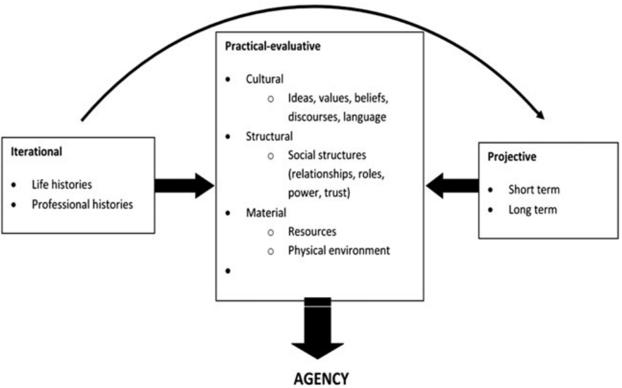
“According to Biesta et al. (2015), the achievement of agency is informed by past experience (the personal/iterational dimension) and enacted within the influences of cultural, structural, and material resources (the practical-evaluative dimension) (see Figure 1 for a model of agency which is based…”
BackgroundMethodJackson, C., Beer, J. J. D., & White, L. (2020) · Perspectives in Education · doi:10.18820/2519593x/pie.v38i1.16 · Cited by 14
Teachers’ transformative agency in a Change Laboratory in a Finnish elementary school
Hyrkkö, S., & Kajamaa, A. M. (2025) · Teaching and Teacher Education · doi:10.1016/j.tate.2025.105011 · Cited by 19
Cathcart, S., Priestley, M., Priestley, A., & Rushton, E. A. C. (2026) · Review of Education · doi:10.1002/rev3.70131 · Cited by 18
Self-citationPedagogical rationales of flipped learning in the accounts of Finnish mathematics teachers
Toivola, M., Rajala, A. J., & Kumpulainen, K. (2022) · Pedagogies An International Journal · doi:10.1080/1554480x.2022.2077341 · Cited by 17
“These visions are partly shaped by sociocultural and institutional conditions (Biesta et al., 2015; Rajala & Kumpulainen, 2017).”
BackgroundRydin, M., Gericke, N., Christenson, N., & Haglund, J. (2025) · International Journal of Science Education · doi:10.1080/09500693.2025.2466771 · Cited by 15
“It also involves the societal and curricular context of the topic (Biesta et al., 2015; Fives & Buehl, 2012).”
Voces en la identidad de estudiantes de profesorado
Lara-Subiabre, B. A., Alvarado, V. H., & Ojeda, Y. E. V. (2020) · Revista de Estudios y Experiencias en Educación · doi:10.21703/rexe.20201939lara-subiabre12 · Cited by 18
Lü, X., Leung, F., & Li, N. (2020) · Educational Studies in Mathematics · doi:10.1007/s10649-020-10006-z · Cited by 15
“…beliefs from teachers’ past experiences contribute to the iterational dimension of agency; beliefs impact teachers’ engagement with the present, which concerns the practical-evaluative dimension, and beliefs oriented towards the future influence the project dimension (Biesta et al., 2015, p. 637).”
BackgroundInfluentialLearning to teach science during the clinical experience: Agency, opportunity, and struggle
Windschitl, M., Lohwasser, K., Tasker, T., Shim, S., & Long, C. (2021) · Science Education · doi:10.1002/sce.21667 · Cited by 12
Xin, R., & Brion‐Meisels, G. (2022) · Educational Action Research · doi:10.1080/09650792.2022.2058973 · Cited by 19
“…qualitative findings are similar to other studies that show the importance of participation in decision-making, valuing teachers’ views and work, collegial support, and professional skills and knowledge in building teachers’ sense of agency (Biesta, Priestley, and Robinson 2015; Pantić 2017).”
BackgroundResultPresent and Future of Teacher Education Admission: Perspectives From Europe
Pipere, A., Kravale-Pauliņa, M., & Oļehnoviča, E. (2022) · Journal of Teacher Education for Sustainability · doi:10.2478/jtes-2022-0011 · Cited by 13
Self-assessment as a student-agentic zone of proximate competence development
Fletcher, A. K. (2022) · Educational Review · doi:10.1080/00131911.2022.2103520 · Cited by 17
“As mentioned before, I thoroughly enjoyed the writing project and will de fi nitely do it again … Monica ’ s con fi dence in her own judgement as a teacher (Biesta et al., 2015) was markedly di ff erent from the sentiments expressed by the less experienced teachers who taught the Year 4 PT groups,…”
BackgroundCultivating teacher candidates who support student agency: Four promising practices
Massey, D. D., & Wall, A. (2020) · Theory Into Practice · doi:10.1080/00405841.2019.1702449 · Cited by 6
“We focused our review of the literature on how teacher educators can create environments that support agency and cultivate an agentic mind-set in teacher candidates (Biesta et al., 2015).”
BackgroundInfluentialExtension and remodelling of teachers’ perceived professional space
Halvorsen, Ø. W., Eide, L., & Ulvik, M. (2019) · Teachers and Teaching · doi:10.1080/13540602.2019.1702519 · Cited by 13
Leadership and professional identity in school teacher training in Spain (Catalonia)
Iranzo‐García, P., Camarero‐Figuerola, M., García, J. M. T., & Arós, R. B. (2020) · Journal of Education for Teaching International Research and Pedagogy · doi:10.1080/02607476.2020.1750935 · Cited by 21
“…placed on initial training regarding the active competences that enable future teachers to identify and establish themselves as main agents (Biesta, Priestley, and Robinson 2015), it is crucial to explore how school teachers’ initial training helps them to construct their identities as…”
BackgroundMesker, P., Wassink, H., & Bakker, C. (2020) · Teacher Development · doi:10.1080/13664530.2020.1747531 · Cited by 13
Teacher and Student Reciprocal Agency in Odds-Beating Schools
Leo, A., Wilcox, K. C., Kramer, C. S., Lawson, H. A., & Min, M. (2020) · Teachers College Record The Voice of Scholarship in Education · doi:10.1177/016146812012201212 · Cited by 13
“At a more microlevel, teacher agency has been seen to be influenced by the beliefs that they hold about their professional identities (Biesta et al., 2015; Hattie & Zierer, 2018).”
BackgroundÜzüm, B., Yazan, B., Mary, L., & Akayoğlu, S. (2022) · Language Learning Journal · doi:10.1080/09571736.2022.2080857 · Cited by 12
“Thereby, our findings align with and further support Biesta et al.’s (2015) suggestion that ‘agency should be understood as a configuration of influences from the past, orientations towards the future and engagement with the present’ (626).”
ResultAksjonsforskning - et bidrag til en praksisnær og teoriorientert lærerutdanning
Ulvik, M., Riese, H., & Roness, D. (2016) · Norsk pedagogisk tidsskrift · doi:10.18261/issn.1504-2987-2016-03-06 · Cited by 20
Attitudes and Teacher Efficacy among Italian and Austrian Teachers: a Comparative Study
Hecht, P., Aiello, P., Pace, E. M., et al. (2017) · DOAJ (DOAJ: Directory of Open Access Journals) · Cited by 10
Student teacher’s boundary experiences during an international teaching internship
Mesker, P., Wassink, H., Akkerman, S. F., & Bakker, C. (2018) · Cogent Education · doi:10.1080/2331186x.2018.1498577 · Cited by 13
“Educators who want to have a richer understanding of when an experience of discontinuity matters for beginning teachers ’ professional development have to consider taking an ecological perspective on student teachers ’ professional development (Biesta et al., 2015; Mishra & Koehler, 2006).”
Slabina, P., & Aava, K. (2019) · Eesti Haridusteaduste Ajakiri = Estonian Journal of Education · doi:10.12697/eha.2019.7.1.04 · Cited by 27
Teacher Educators as Agents of Change: New Tools as Enablers
Bourke, T., Henderson, D. J., Spooner‐Lane, R., & White, S. (2022) · Springer eBooks · doi:10.1007/978-981-19-2904-5_1 · Cited by 11
Teacher Agency in Multilingual Education Policy in an Islamic Boarding School in Indonesia
Abdurrizal, M., Sumardi, S., & Putra, K. A. (2022) · AL-ISHLAH Jurnal Pendidikan · doi:10.35445/alishlah.v14i3.1206 · Cited by 25
“(A) According to Biesta et al. (2015), teacher is considered a professional agency in the agency discourse; teachers make an active contribution to the learning process and take an important portion in the process of meaningful education.”
BackgroundInfluentialSetlik, J., & da Silva, H. C. (2023) · Teaching and Teacher Education · doi:10.1016/j.tate.2023.104112 · Cited by 9
A narrative exploration of agency in the education-migration nexus
Brotherhood, T. (2023) · Asia Pacific Education Review · doi:10.1007/s12564-023-09859-9 · Cited by 14
“2 These contextual factors are recognized in multiple theories of agency, and have been described by different researchers as the ‘political opportunity structure’ (Baubock, 2006), the ‘ecological conditions and circumstances’ of agency (Biesta & Tedder, 2007; Biesta et al., 2015), the ‘situational logic of opportunit…”
BackgroundSantiago-Saamong, C. R., Oropilla, C. T., Bautista, A., & Capio, C. M. (2024) · Pedagogy Culture and Society · doi:10.1080/14681366.2024.2301836 · Cited by 12
“However, there is little understanding of ECEC teachers’ agency, which refers to their ‘active contributions in shaping their work and work conditions’ (Biesta, Priestley, and Robinson 2015, 624) in relation to the promotion of physical activity in ECEC settings.”
Zumpe, E. (2024) · Journal of Educational Change · doi:10.1007/s10833-023-09500-x · Cited by 18
“Studies in this line of inquiry have revealed how educators’ beliefs, sensemaking, and decision-making practices can shape the implementation of reforms in consequential ways (Biesta et al., 2015; Bridwell-Mitch-ell, 2015; Coburn, 2006; Datnow et al., 2012; Park et al., 2012).”
Constructing child participation in early years classrooms: An exploration from Wales
Waters, J., Murphy, A., Chicken, S., Tyrie, J., & Clement, J. A. (2024) · Children & Society · doi:10.1111/chso.12848 · Cited by 10
Leijen, Ä., Pedaste, M., & Baucal, A. (2024) · Frontiers in Education · doi:10.3389/feduc.2024.1336401 · Cited by 19
Bibliometric Review of Teacher Professional Identity Scholarship Over Two Decades
Yan, Y. (2024) · SAGE Open · doi:10.1177/21582440241241173 · Cited by 27
“The other two are articles that investigated teacher agency (Biesta et al., 2015; Tao & Gao, 2017).”
Lu, C., Obenchain, K. M., & Zhang, Y. (2024) · Teaching and Teacher Education · doi:10.1016/j.tate.2024.104628 · Cited by 18
Kusters, M., Rushton, E. A. C., de Vetten, A., Admiraal, W., & van der Rijst, R. M. (2025) · Teaching in Higher Education · doi:10.1080/13562517.2025.2562584 · Cited by 15
“Rather, genuine quality lies in lecturers’ ability to achieve agency, i.e., purposefully and deliberately navigating challenging teaching practices, which is interrelated with beliefs about what constitutes teaching and learning (Biesta, Priestley, and Robinson 2015).”
InfluentialScholten, D. J., Wijtmans, M., Dekker, S. J., Vuuregge, A. H., Boon, E. J. J., Vos, J. C., Siderius, M. H., Westbroek, H. B., & van Muijlwijk‐Koezen, J. E. (2021) · Journal of Chemical Education · doi:10.1021/acs.jchemed.1c00644 · Cited by 10
Praksisopplæringens oppfattende og erfarte formål sett fra ulike aktørperspektiv
Ulvik, M., Eide, L., Helleve, I., & Kvam, E. K. (2021) · Nordisk tidsskrift for utdanning og praksis · doi:10.23865/up.v15.2949 · Cited by 17
Sánchez-Cabrero, R., & Gómez, F. J. P. (2021) · ESPIRAL CUADERNOS DEL PROFESORADO · doi:10.25115/ecp.v15i30.5064 · Cited by 17
“En segundo lugar, la necesidad de seguir aumentando, complejizando y actualizando el conocimiento sobre el alumnado que participa en dichos programas de formación inicial docente (Benarroch et al., 2013; Biesta et al., 2015; Cochran y Zeichner, 2009; Darling- Hammond, 2017).”
BackgroundTeachers’ Collaborative Work at the Boundaries of Professional Responsibility for Student Wellbeing
Shavard, G. (2022) · Scandinavian Journal of Educational Research · doi:10.1080/00313831.2022.2042851 · Cited by 20
“Others point to the central role of teachers’ tacit and often conflicting assumptions regarding students’ socioemotional needs (Biesta et al., 2015; Graham et al., 2011; Rothì et al., 2008).”
BackgroundKoyuncu, S., Kumpulainen, K., & Kuusisto, A. (2023) · Education Sciences · doi:10.3390/educsci13121177 · Cited by 20
Cong‐Lem, N., Truong, K. D., Zhu, B., & Long, Z. (2024) · Language Learning Journal · doi:10.1080/09571736.2024.2349052 · Cited by 16
“This perspective also underscores the role of pragmatic actions enabled by available means within the local environment in defining agency (Biesta, Priestley, and Robinson 2015).”
Towards a Virtuosity of School Leadership: clinical support and supervision as professional learning
Bainbridge, A., Reid, H., & Negro, G. D. (2019) · Professional Development in Education · doi:10.1080/19415257.2019.1700152 · Cited by 9
“Drawing on interviews that included senior school leaders, Biesta et al. (2015) provide an ecological model of teacher agency, noting that teachers hold a ‘mishmash’ of competing and vague ideas about the purpose of education, often stuck within current hegemonic discourses of surveillance and…”
BackgroundA New Concept in Teacher Identıty Research: Teacher Agency
Erdem, C. (2020) · Adıyaman Üniversitesi Eğitim Bilimleri Dergisi · doi:10.17984/adyuebd.712097 · Cited by 17
“Teacher agency is defined as the active contributions of teachers to shape the work they do during the teaching process and the situation they are in (Biesta et al., 2015).”
BackgroundInfluentialSusanti, Y. P., & Subekti, A. S. (2020) · Pedagogy Journal of English Language Teaching · doi:10.32332/pedagogy.v8i2.2274 · Cited by 15
“Teachers‟ beliefs affect teachers‟ decision-making as well as heavily influence their teaching methods, including materials and activities in class (Biesta et al., 2015; Farrell & Ives, 2015).”
BackgroundHigher Education’s Marketization Impact on EFL Instructor Moral Stress, Identity, and Agency
Scott, T. (2020) · English Language Teaching · doi:10.5539/elt.v14n1p99 · Cited by 13
“EFL instructors’ experience and judgment regarding student needs have been replaced by an institutionally designed data-generated curriculum (Biesta et al., 2015) that strives to satisfy student wants.”
BackgroundUssa, L. J. R., Parra, Y. J. F., & Cortés-Ibañez, A. M. (2020) · GiST Education and Learning Research Journal · doi:10.26817/16925777.831 · Cited by 34
Continuing the debate on teacher autonomy: A capabilities perspective
Klerk, E. D. D., & Barnett, E. P. (2020) · Journal of Education · doi:10.17159/2520-9868/i81a06 · Cited by 9
“If teachers know how to do agency (Biesta et al., 2015), they may be positioned to become autonomous agents (De Klerk et al., 2012).”
BackgroundNovice teachers’ developing beliefs on learner motivation: An agentic perspective
Glas, K., Martínez-Miranda, M., & Dittmar, P. (2021) · International Journal of Educational Research · doi:10.1016/j.ijer.2021.101820 · Cited by 14
Metadata
- Authors
- Biesta, G., Priestley, M., & Robinson, S.
- Affiliations
- ArtEZ University of the Arts (NL)
- University of Stirling (GB)
- Aarhus University (DK)
- Corresponding author
- Biesta, Gert
- Venue
- Teachers and Teaching
- Publisher
- Informa UK Limited
- Published
- 2015-06-15
- Volume
- 21
- Issue
- 6
- Pages
- 624-640
- ISSN
- 1354-0602 (ISSN-L)
- 1470-1278
- OpenAlex
- W1911902575
- Cited by
- 1,318
- References
- 47
- Citations by year
- 2026: 233 · 2025: 161 · 2024: 141 · 2023: 157 · 2022: 139 · 2021: 131 · 2020: 118 · 2019: 96 · 2018: 73 · 2017: 48 · 2016: 17 · 2015: 4
- FWCI
- 236.15
- Type
- journal article
- Language
- en
- Open access
- hybrid
- doi.org
- Licence
- cc-by-nc-nd
- Locations
- Teachers and Teaching (publishedVersion, cc-by-nc-nd)
- Brunel University Research Archive (BURA) (Brunel University London) (submittedVersion)
- Stirling Online Research Repository (University of Stirling) (submittedVersion, cc-by-nc-nd)
- Edinburgh Research Explorer (University of Edinburgh) (submittedVersion, other-oa)
- Funders
- Economic and Social Research Council (ES/I006907/1)
- Topics
- Social Sciences › Education › Teacher Education and Leadership Studies
- Social Sciences › Education › Education Pedagogy and Practices
- Social Sciences › Arts and Humanities › Philosophy › Education, Philosophy, and Society
- Keywords
- teacher agency, teacher beliefs, Curriculum for Excellence, educational reform, teacher professionalism, teacher decision-making, institutional discourse, professional vision, Scotland
About these checks
Registry, retraction, Cites and statistics results are computed, not judged, with one exception: a printed reference that no index lists is read once by a model before it counts as a citation error. Claims are extracted by a model and kept only when their quote appears verbatim in the text; each cited source is then checked, with a model’s help, for whether it says what the claim relies on. Those verdicts can be wrong — read the claim’s quote and the cited source before relying on one.
A language model drew the claims from the paper on 2026-10-11, under version 3 of the claim definition (model deepseek-v4.1-flash, prompt extract-v3).
A second model labelled each claim on 2026-10-11 (model jev-1.13-20260917, definition revision gold-guideline-v0.2).
Statistics and arithmetic are recomputed, not judged.
Confidence bands are shown only for fields calibrated on our annotated test set. None is calibrated yet, so no band is shown.
What counts as a claim ›How we measure confidence ›How we check this ›
Are you an author, or do you see a problem with this page? Request a review
Data sources
Bibliographic data: Semantic Scholar, OpenAlex, Crossref.
Contains information from the Semantic Scholar Academic Graph Datasets, made available under the ODC Attribution License (ODC-BY 1.0).
Semantic Scholar’s data is described in: Kinney, R., et al. (2023). The Semantic Scholar Open Data Platform. arXiv:2301.10140.
