

The role of beliefs in teacher agency
Open accessThe DOI matches its Crossref record; 44 of the 47 references it cites were found in a registry or an index; none of the 31 sources its claims cite is checked for support yet.
Abstract
There is an ongoing tension within educational policy worldwide between countries that seek to reduce the opportunities for teachers to exert judgement and control over their own work, and those who seek to promote it. Some see teacher agency as a weakness within the operation of schools and seek to replace it with evidence-based and data-driven approaches, whereas others argue that because of the complexities of situated educational practices, teacher agency is an indispensable element of good and meaningful education. While the ideological debate about the shape and form of teacher professionalism is important, it is equally important to understand the dynamics of teacher agency and the factors that contribute to its promotion and enhancement. In this paper, we draw from a two-year study into teacher agency against the backdrop of large-scale educational reform – the implementation of Scotland’s Curriculum for Excellence – in order to explore these questions. We focus on teachers’ beliefs in order to get a sense of the individual and collective discourses that inform teachers’ perceptions, judgements and decision-making and that motivate and drive teachers’ action. While the research suggests that beliefs play an important role in teachers’ work, an apparent mismatch between teachers’ individual beliefs and values and wider institutional discourses and cultures, and a relative lack of a clear and robust professional vision of the purposes of education indicate that the promotion of teacher agency does not just rely on the beliefs that individual teachers bring to their practice, but also requires collective development and consideration.
Overview
CoChat Summary
## TL;DR
The paper argues that teacher beliefs matter for agency, but mainly insofar as they are shaped by policy discourse, schooling culture, and limited professional visions of what education is for. Using ethnographic case studies from three Scottish schools during Curriculum for Excellence, the authors find that teachers’ beliefs were often short-term, instrumental, and only loosely connected to broader purposes or values.
## Key findings
- Across the six classroom teachers, beliefs about children, teaching, and educational purpose were notably similar, and often framed by recent policy language rather than a robust professional discourse.
- Teachers strongly emphasized relationships, safety, care, enjoyment, skills, socialisation, and “maximising student potential,” but gave little sustained attention to knowledge, qualification, social justice, or democratic values.
- The paper argues that a narrow view of purpose limits agency: teachers were effective at short-term classroom management and curriculum delivery, but less able to use beliefs to imagine or enact longer-term educational aims.
- The authors report that teachers’ understandings of Curriculum for Excellence were often superficial or vague; some described the curriculum as “airy fairy,” “overly complicated,” or something they were “fumbling about trying.”
## Methods
- Ethnographic research in one Scottish education authority, in one primary school and two secondary schools, focusing on two experienced classroom teachers in each setting; senior managers were also interviewed.
- The project ran over a full year with three data-collection phases and used observation, semi-structured individual and group interviews, a personal/professional history interview, policy-text analysis, and teacher network mapping.
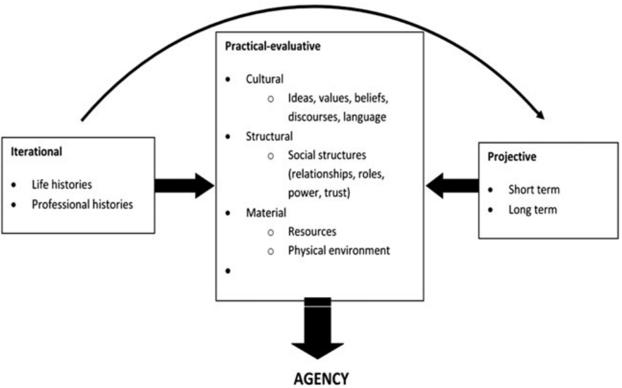
- For this paper, the authors primarily analyzed interview data from all three phases, using codes from an agency model and then open coding to interpret beliefs and aspirations.
## Limitations
- The authors explicitly say the data refer to “one particular though nonetheless interesting case,” so the findings are limited in scope.
- The study draws primarily on the stories of six classroom teachers, which is a small sample; this is evident in the text.
- The analysis focuses on interviews and selected themes from one reform context in Scotland, so transferability beyond this setting is not established; this is evident in the text.
Model-written summary. Check it against the paper before relying on it.
Integrity signals
Registry
Cites
Statistics
Figures
Verification
Claims the paper makes
0 Valid · 2 Not valid · 30 Not checked · 99 Own results and interpretations
A result the paper reports from its own data — it cites no other source for it, so there is none to check. The quote shows it is in the paper.
In the paper
“The significance of what was often referred to as a safe and caring learning environment for everyone who came into their classrooms was articulated strongly.”
§ 4. Teachers’ beliefs > 4.1. Beliefs relating to children and young people
boosted- Asserted: passes — The authors put it forward as true.
- Checkable: passes — It can be checked against evidence.
- Load-bearing: unclear — It is unclear whether the paper’s conclusions depend on it.
- Based: passes — The paper gives a reason why it holds.
A result the paper reports from its own data — it cites no other source for it, so there is none to check. The quote shows it is in the paper.
In the paper
“In analysing the data, we were struck by the similarity of beliefs articulated across this small group of teachers, despite their location in different sectors of education.”
plain- Asserted: passes — The authors put it forward as true.
- Checkable: passes — It can be checked against evidence.
- Load-bearing: passes — The paper’s conclusions depend on it.
- Based: passes — The paper gives a reason why it holds.
A result the paper reports from its own data — it cites no other source for it, so there is none to check. The quote shows it is in the paper.
In the paper
“The data clearly convey the strong sense of teachers’ professional responsibility towards their students.”
§ 4. Teachers’ beliefs > 4.1. Beliefs relating to children and young people
boosted- Asserted: passes — The authors put it forward as true.
- Checkable: passes — It can be checked against evidence.
- Load-bearing: unclear — It is unclear whether the paper’s conclusions depend on it.
- Based: passes — The paper gives a reason why it holds.
A result the paper reports from its own data — it cites no other source for it, so there is none to check. The quote shows it is in the paper.
In the paper
“Indeed, only one participant strongly referred to the importance of subject knowledge, lamenting what she saw as the detrimental effects of vocationalism on the academic content of her subject.”
§ 4. Teachers’ beliefs > 4.2. Beliefs about the role of the teacher
plainSingle case- Asserted: passes — The authors put it forward as true.
- Checkable: passes — It can be checked against evidence.
- Load-bearing: unclear — It is unclear whether the paper’s conclusions depend on it.
- Based: passes — The paper gives a reason why it holds.
A result the paper reports from its own data — it cites no other source for it, so there is none to check. The quote shows it is in the paper.
In the paper
“these discourses appear to be fairly restricted in scope, more geared to short-term goals, and predominantly articulated via the language of recent policy documentation.”
hedged- Asserted: passes — The authors put it forward as true.
- Checkable: passes — It can be checked against evidence.
- Load-bearing: passes — The paper’s conclusions depend on it.
- Based: passes — The paper gives a reason why it holds.
57 more claims
Create a free account to see all 131 claims and every source verdict.
- It may state two separate claims as one. 39
- Probably not a substantial claim. 46
Claims other papers make about this one
Each is checked against this paper’s own text: does it say what the citing paper says it does?
The cited source says what the claim attributes to it.
In the citing paper
“This absence leaves teachers unsure about their roles and contributions (Biesta et al. 2015).”
From Unveiling teachers’ professional agency and decision-making in professional learning: the illusion of choice (2025) · cites this paper as Biesta et al. 2015
The cited source says what the claim attributes to it.
In the citing paper
“As Biesta et al. (2015) suggests, teachers' agency is influenced not just by their attributes, but also by their professional experience.”
From Unveiling teachers’ professional agency and decision-making in professional learning: the illusion of choice (2025) · cites this paper as Biesta et al. 2015
The cited source says what the claim attributes to it.
In the citing paper
“Likewise Biesta, Priestley and Robinson (2015) point to a lack of discourses among teachers that constructs education in terms other than the technical-rational concerns of 'efficiency' to include questions of purpose and value.”
From Teacher agency and professional learning communities; what can Learning Rounds in Scotland teach us? (2017) · cites this paper as Biesta, Priestley and Robinson (2015)
The cited source says what the claim attributes to it.
In the citing paper
“Biesta, Priestley and Robinson (2015) report that the Scottish teachers in their research had a very similar set of views about teaching, learning and education more broadly, even though they were from diverse locations and sectors.”
From Teacher agency and professional learning communities; what can Learning Rounds in Scotland teach us? (2017) · cites this paper as Biesta, Priestley and Robinson (2015)
The cited source says what the claim attributes to it.
In the citing paper
“Biesta, Priestley and Robinson (2015) report a similar experience in their research on teacher agency.”
From Teacher agency and professional learning communities; what can Learning Rounds in Scotland teach us? (2017) · cites this paper as Biesta, Priestley and Robinson (2015)
1 more claim about this paper
Create a free account to see every claim other papers make about this one.
Citations
Cites
Outline of a Theory of Practice
Bourdieu, P. (1977) · doi:10.1017/cbo9780511812507 · Cited by 27,606
(1984) · Cited by 21,166
Outline of a Theory of Practice.
Frank, A. W., & Bourdieu, P. (1980) · Contemporary Sociology · doi:10.2307/2066038 · Cited by 14,545
Teachers' beliefs and educational research: cleaning up a messy construct
Pajares, M. F. (1992) · Review of Educational Research · doi:10.3102/00346543062003307 · Cited by 9,007 · cited 2×
“In the discussion section, we explore what this reveals about the role of beliefs in teacher agency.”
BackgroundEmirbayer, M., & Mische, A. (1998) · American Journal of Sociology · doi:10.1086/231294 · Cited by 6,165
Outline of a Theory of Practice
BOURDIEU, P. (2007) · On Violence · doi:10.2307/j.ctv120qr2d.16 · Cited by 5,527
Realist Social Theory: The Morphogenetic Approach
Archer, M. S. (1995) · Cambridge University Press eBooks · doi:10.1017/cbo9780511557675 · Cited by 3,125
Change Forces: Probing the Depths of Educational Reform
Fullan, M. (1993) · doi:10.4324/9780203059005 · Cited by 3,111
Realist social theory the morphogenetic approach
Archer, M. S. (1995) · Cited by 2,938
Change Forces: Probing the Depths of Educational Reform
Davies, S., & Fullan, M. (1995) · Canadian Public Policy / Analyse de Politiques · doi:10.2307/3552051 · Cited by 2,809
Research works printed but not linked: 3
- Brown, S., & McIntyre, D. (1993). Making sense of teaching: Developing teachers and teaching. Buckingham: Open University Press. (Open in a new window)Google Scholar
- Hollis, M. (1994). The philosophy of social science: An introduction. Cambridge: Cambridge University Press. (Open in a new window)Google Scholar · doi:10.1017/ccol0521447801
- Nieveen N. (2011 September 14). Teachers’ professional development in curriculum design in the Netherlands. Paper presented at the European Conference for Educational Research Berlin.
Cited by
Items 401–500 of 1,289
Comparison of teacher agency for collaboration within and across curriculum teams
Lau, I. T. Y. (2021) · Teacher Development · doi:10.1080/13664530.2021.1942971 · Cited by 13
“By observing school culture as their foundation (Little 1993), the teachers gain control over social constraints when the development follows the contextual track (Biesta, Priestley, and Robinson 2015; Feeney 2016).”
BackgroundPorter, K., Miles, P. J., & Donaldson, D. I. (2022) · Frontiers in Psychology · doi:10.3389/fpsyg.2022.987690 · Cited by 16
“On the one hand is the perception that recent education initiatives necessitate teachers’ active engagement in collective issues requiring change, such as shaping pedagogical practices, curriculum reform, and social progress (Pyhältö et al., 2014; Biesta et al., 2015; Priestley et al., 2015).”
BackgroundDesigntænkning som didaktisk metode: Læringsdesign for teknologisk forestillingskraft og handlekraft
Paaskesen, R. B., & Nørgård, R. T. (2016) · Tidsskriftet Læring og Medier (LOM) · doi:10.7146/lom.v9i16.24201 · Cited by 13
Mentoring secondary English trainee teachers: a case study
Pinnick, S. (2020) · English in Education · doi:10.1080/04250494.2020.1777097 · Cited by 12
“Such opportunities could give teachers being more agency (Biesta, Priestley, and Robinson 2015) in their own development.”
BackgroundEDUCATION REFORM AND TEACHER AGENCY
Cheng, C.-C., & Huang, K.-H. (2018) · Problems of Education in the 21st Century · doi:10.33225/pec/18.76.286 · Cited by 7
Time in the experience of agency and emotion in English language learning in rural Vietnam
White, C., & Pham, C. H. (2017) · Innovation in Language Learning and Teaching · doi:10.1080/17501229.2017.1317256 · Cited by 9
“Duyen’s proactive involvement in Manh’s language studies represented past, present and future connections (Biesta, Priestley, and Robinson 2015; Dufva and Aro 2014) that contributed to shaping his agency in language learning in terms of grasping and creating learning opportunities in the home…”
BackgroundEspeland, Å., Kvile, S., & Holdhus, K. (2019) · Research Studies in Music Education · doi:10.1177/1321103x19861003 · Cited by 19
Two worlds collide? Mapping the third space of ICT integration in early childhood educationPreprint
Mertala, P. (2019) · SocArXiv (OSF Preprints) · doi:10.31235/osf.io/tf4rk · Cited by 12
Gao, X. A., & Tao, J. (2019) · Encyclopedia of Teacher Education · doi:10.1007/978-981-13-1179-6_123-2 · Cited by 9
“This confirms the important role of teacher beliefs in the exercise of professional agency (e.g. Biesta et al., 2015).”
InfluentialDeveloping Techno-mathematical Literacies in higher technical professional education
van der Wal, N. J. (2020) · Utrecht University Repository (Utrecht University) · doi:10.33540/422 · Cited by 17
Yang, P. (2021) · Pedagogies An International Journal · doi:10.1080/1554480x.2021.1944870 · Cited by 9
“In broadest terms, teacher agency may be defined as “[teachers’] active contribution to shaping their work and its conditions” (Biesta et al., 2015, p. 624).”
BackgroundDekker, S. V., Kootstra, L. M., Loerts, H., & Duarte, J. (2023) · Multilingual education · doi:10.1007/978-3-031-37027-4_13 · Cited by 13
Pre-service teachers’ agency to enact multilingual pedagogies: A longitudinal case study
Iversen, J. Y. (2024) · European Educational Research Journal · doi:10.1177/14749041241290381 · Cited by 10
“Rather, the environment provides the conditions upon which teachers can act (Biesta et al., 2015).”
InfluentialCreativity and Generative AI for Preservice Teachers
Butler-Ulrich, T., Hughes, J., & Morrison, L. (2024) · IntechOpen eBooks · doi:10.5772/intechopen.1007517 · Cited by 13
Hammond, L., Fargher, M., & Walshe, N. (2024) · International Research in Geographical and Environmental Education · doi:10.1080/10382046.2024.2426476 · Cited by 10
“To explore this further, we deductively coded the data using Priestley et al.’s (2015) key dimensions of teacher agency model (Figure 1).”
InfluentialLanguage teacher educator psychology: A research agenda
Sak, M., & Yuan, R. E. (2025) · Language Teaching · doi:10.1017/s0261444825000163 · Cited by 10
“Recent discussions on agency highlight the importance of taking an ecological view, which posits that agency is not just a personal trait, but it results from the interplay of individual abilities, the use of available resources, and environmental conditions (Biesta et al., 2015).”
Deniz, Ü., & Pinar, W. F. (2025) · Journal of Curriculum Studies · doi:10.1080/00220272.2025.2506431 · Cited by 13
“…extends beyond examining individual agency to consider how institutional structures shape the possibilities for professional identity development within centralized contexts, addressing calls for more contextually-situated understandings of teacher agency (Pantić, 2015; Priestley et al., 2015).”
InfluentialTang, K. (2025) · Discover Sustainability · doi:10.1007/s43621-025-01334-2 · Cited by 15
Kyritsi, K., & Davis, J. M. (2020) · Improving Schools · doi:10.1177/1365480220968332 · Cited by 22
“Furthermore, it has been suggested that CfE has opened up new directions towards interdisciplinarity that take us away from rigid divisions and categorisations of subjects towards a more flexible pedagogy (Biesta et al., 2015).”
BackgroundUniversidad del Desarrollo, C., & Moreno, P. M. (2021) · Praxis Educativa · doi:10.19137/praxiseducativa-2021-250302 · Cited by 14
“…que facilita u obstruye la mejora educativa; de tal manera que, si creen que las reformas educativas son adecuadas y comparten los principios de la misma, existen mayores posibilidades de que se genere un cambio en sus prácticas en coherencia con los postulados de la reforma (Biesta et al., 2015).”
BackgroundTeacher agency in the selection of literary texts
Watson, A. M., Kelly, L., Foley, J., Kneen, J., Chapman, S., Smith, L., & Thomas, H. (2022) · English in Education · doi:10.1080/04250494.2022.2085550 · Cited by 19
Exploring teacher and student knowledge of sentence‐level language features
Knecht, R., Larson, L., & Townsend, D. (2023) · Journal of Adolescent & Adult Literacy · doi:10.1002/jaal.1290 · Cited by 10
Analysing teachers’ figurative language to shed new light on teacher resilience
Peel, K., Kelly, N., Danaher, P. A., Harreveld, B., & Mulligan, D. (2023) · Teaching and Teacher Education · doi:10.1016/j.tate.2023.104175 · Cited by 25
Polyphonic agency as precondition for teachers’ research literacy
Heikkilä, M., & Eriksen, A. (2023) · Educational Philosophy and Theory · doi:10.1080/00131857.2023.2224560 · Cited by 12
“On the other hand, departing from the concept that agency is something that teachers can have, it can also refer to something that teachers do, that is, “the quality of the engagement of actors with temporal–relational contexts-for-action” (Biesta et al., 2015, p. 626).”
BackgroundMethodConnected by emotion: Teacher agency in an online science education course during COVID ‐19
Fu, G., & Clarke, A. (2023) · Journal of Research in Science Teaching · doi:10.1002/tea.21886 · Cited by 8
Teacher agency in using students’ questions in climate change education
Sihvonen, P., Herranen, J. K., Uusi-Äijö, V., & Aksela, M. K. (2023) · Interdisciplinary Journal of Environmental and Science Education · doi:10.29333/ijese/13724 · Cited by 12
Cho, J., Heinz, M., & Choi, J.-Y. (2023) · Irish Educational Studies · doi:10.1080/03323315.2023.2261431 · Cited by 8
“Biesta, Priestley, and Robinson (2015) suggest that teachers ’ beliefs about teaching and about educational purpose inform teachers ’ perceptions, judgements and decision-making, motivating their actions.”
BackgroundRuan, X., Zhu, Y., & Toom, A. (2024) · Humanities and Social Sciences Communications · doi:10.1057/s41599-024-02696-0 · Cited by 12
van Vijfeijken, M., van Schilt-Mol, T., van den Bergh, L., Scholte, R. H. J., & Denessen, E. J. P. G. (2024) · Frontiers in Education · doi:10.3389/feduc.2024.1244113 · Cited by 20
Developing Scenarios for Exploring Teacher Agency in Universities: A Multimethod Study
Kusters, M., de Vetten, A., Admiraal, W., & van der Rijst, R. M. (2024) · Frontline Learning Research · doi:10.14786/flr.v12i2.1419 · Cited by 8
“In an ecological approach, teacher agency entails that this ‘responsiveness’ is informed by lecturers' professional histories, oriented towards future objectives and aspirations, and enacted in concrete situations (Biesta & Tedder, 2007; Priestley et al., 2015).”
BackgroundInfluentialAccountability en Chile. Un Estudio Sociocrítico sobre Innovación Educativa y Control de la Docencia
Pascual, J., & Rodríguez‐Gómez, D. (2018) · Revista Iberoamericana de Evaluación Educativa · doi:10.15366/riee2018.11.2.007 · Cited by 8
Understanding Teacher Agency and Organizational Response to Reform Mandates
Connors, S. P., & Bengtson, E. (2020) · The New Educator · doi:10.1080/1547688x.2020.1797258 · Cited by 11
Tao, Y. (2021) · Current Issues in Language Planning · doi:10.1080/14664208.2021.1988420 · Cited by 9
Hultman, A. L., Bergh, A., Lennartsdotter, M., & Löfgren, H. (2022) · Education Inquiry · doi:10.1080/20004508.2021.2022583 · Cited by 4
Teacher’s beliefs and flexible language strategies in a monolingual preschool classroom
Gelir, İ. (2022) · Education 3-13 · doi:10.1080/03004279.2022.2061028 · Cited by 14
Arango, X. F., Jiménez, H. S., & Sánchez-Ávilez, C. R. (2023) · RELATEC Revista Latinoamericana de Tecnología Educativa · doi:10.17398/1695-288x.22.1.57 · Cited by 13
“…de la agencia de los docentes significa considerar sus assamblages –personales y biografías profesionales, proyección a corto y largo plazo, pero también culturales, materiales y estructurales que influyen en el ejercicio de su poder para tomar decisiones sobre sus acciones (Biesta et al., 2015).”
BackgroundInfluentialThe important building blocks of newcomer immigrant students’ education in the Norwegian context
Norozi, S. A. (2023) · Frontiers in Education · doi:10.3389/feduc.2022.1084053 · Cited by 15
“Teachers’ personal views and beliefs on values and learning affect their practices and assessments of collaboration (Biesta et al., 2015).”
BackgroundSelf-initiated online communities of teachers as an expanded meso space
Eradze, M., Bardone, E., Tinterri, A., & Dipace, A. (2023) · Professional Development in Education · doi:10.1080/19415257.2023.2181380 · Cited by 8
“…does not just rely on the beliefs that individual teachers bring to their practice, but also requires collective development and consideration’ (Biesta 2015), we suggest going beyond to the micro level factors (individual beliefs or properties) to create conditions for TPD, educational…”
Alexiadou, N., Holm, A., Rönnberg, L., & Carlbaum, S. (2023) · Educational Review · doi:10.1080/00131911.2023.2228507 · Cited by 8
“Agency is manifested through these “actor-situation transactions” and is concerned with the ways in which teachers can critically respond to, and shape, their work environment (Biesta et al., 2015, p. 626).”
InfluentialFuture teachers as agents of language revitalisation: the case of Galician early childhood education
DePalma, R., Zapico-Barbeito, M.-H., & Sobrino-Freire, I. (2018) · Language Culture and Curriculum · doi:10.1080/07908318.2018.1504402 · Cited by 8
“Biesta, Priestley, and Robinson (2015) argue that teacher agency is limited by ‘relative absence of a robust professional discourse that teachers can bring to the situations in which they work’ (Biesta et al., 2015, p. 638).”
BackgroundCowley, J. G., McIntosh, I., Kiely, J., & Collins, D. J. (2021) · International Journal of Adolescent Medicine and Health · doi:10.1515/ijamh-2021-0003 · Cited by 9
Chapman, S. (2019) · Murdoch University Research Portal · Cited by 16
Porto, M. (2022) · Teaching Education · doi:10.1080/10476210.2022.2078299 · Cited by 7
“Moreover, teachers usually lack this vision as they struggle in the face of short-term goals and performative regulations imposed by educational institutions and top-down policies (Biesta et al., 2015).”
BackgroundData infrastructuring in schools: New forms of professional edu-data expertise and agency
Grant, L. (2024) · Research in Education · doi:10.1177/00345237241257177 · Cited by 13
“Similarly, agency and expertise, as core parts of professionalism, are not characteristics of individuals, but emerge through the relations between individuals, local practices and policies and other human and non-human elements (Biesta et al., 2015).”
Rushton, E. A. C., Walshe, N., Kitson, A., & Sharp, S. (2024) · Journal of Professional Capital and Community · doi:10.1108/jpcc-06-2024-0093 · Cited by 16
Finnish teachers’ experiences with transformative digital agency
Korhonen, T., Karme, S., Airaksinen, J., Laakso, N., & Salo, L. (2024) · Cogent Education · doi:10.1080/2331186x.2024.2402683 · Cited by 22
“Teachers ’ beliefs are intertwined with their professional agency and reflect their past experiences (Biesta et al., 2015).”
Conceptualizing ‘quality of education’: an analysis of European political documents on education
Figueiredo, C. (2025) · Frontiers in Education · doi:10.3389/feduc.2025.1463412 · Cited by 7
“…and agency, that is, their role as co-constructors and co-authors of the curriculum and the teaching and learning process, as well as their preparedness to act more than to execute (Leite and Fernandes, 2010; Priestley, 2011, 2012; Mouraz et al., 2013; Priestley et al., 2013; Biesta et al., 2015).”
Examining Student Teachers’ Agency in an AI-Supported Learning Environment: Q Methodology Research
Chaaban, Y., Jung, S.-G., Medina, J., Azem, J. Y., Salminen, J. O., & Jansen, B. J. J. (2025) · International Journal of Artificial Intelligence in Education · doi:10.1007/s40593-025-00529-y · Cited by 16
“Student agency can thus be “achieved by individuals, through the interplay of personal capacities and the resources, affordances and constraints of the environment” (Priestley et al., 2015, p. 19).”
Du, X., & Curdt‐Christiansen, X. L. (2025) · Teaching and Teacher Education · doi:10.1016/j.tate.2025.105345 · Cited by 13
Mesker, P., Wassink, H., & Bakker, C. (2017) · Professional Development in Education · doi:10.1080/19415257.2017.1347806 · Cited by 7
“2009, Biesta et al .”
Manninen, E., Hökkä, P. K., Tarnanen, M., & Vähäsantanen, K. (2022) · Education Sciences · doi:10.3390/educsci12120900 · Cited by 15
“Hence, commonly agreed rules can also facilitate the practicing agency by staff members [26,29].”
BackgroundThe Intersection of Culturally Responsive Pedagogy and Engineering Design in Secondary STEM
Manuel, M., Gottlieb, J., Svarovsky, G., & Hite, R. L. (2023) · Journal of Pre-College Engineering Education Research (J-PEER) · doi:10.7771/2157-9288.1380 · Cited by 13
“As such, this work also contributes to the literature on teacher agency, a developing and important field in the realm of teacher education research that is scarcely explored and reported (Biesta et al., 2015; Cheng & Huang, 2018; Va¨ha¨santanen, 2015).”
BackgroundZeng, C., & Yung, K. W. H. (2023) · International perspectives on English language teaching · doi:10.1007/978-3-031-26817-5_5 · Cited by 7
Costa, P. I. D., Karimpour, S., & Nazari, M. (2023) · Applied Linguistics Review · doi:10.1515/applirev-2022-0191 · Cited by 9
Nazari, M., Keshvari, Z., & Hu, G. (2024) · System · doi:10.1016/j.system.2024.103542 · Cited by 13
Ulvik, M., Kvam, E. K., & Eide, L. (2021) · Scandinavian Journal of Educational Research · doi:10.1080/00313831.2020.1869071 · Cited by 10
Fung, D. C.-L. (2021) · International Journal of Educational Research · doi:10.1016/j.ijer.2021.101908 · Cited by 17
Lynch, J. (2021) · The School community journal/School community journal · Cited by 29
Cone, L. (2022) · Teachers and Teaching · doi:10.1080/13540602.2022.2098272 · Cited by 13
“…through reforms from above, scholars have emphasised the material and situated aspects of teacher professionality as an ongoing effect of such entangled relations that cannot be reduced to causal suggestions of implementation and efficiency (Biesta et al., 2015; Gorodetsky & Barak, 2016).”
BackgroundTeaching in emergency remote classrooms: reflections for professional learning
Chen, M. (2023) · Educational Research · doi:10.1080/00131881.2023.2167729 · Cited by 15
“Reflective teachers may be empowered to implement and sustain effective classroom instruction by continually examining teacher beliefs (Biesta, Priestley, and Robinson 2015), challenging assumptions about daily instruction (Nolan and Molla 2018) and taking actions to improve their teaching (Opfer…”
BackgroundRelationship between the Use of ICT in Secondary Education Music Teaching and Teachers’ Beliefs
Bravo, M. P. C., & Portero, G. H. (2023) · Education in the Knowledge Society (EKS) · doi:10.14201/eks.28509 · Cited by 14
Research: ELA Teachers and Whiteness: Hesitancy as Barrier to Teacher Agency Development
Cook, M. P. (2022) · English Education · doi:10.58680/ee202231979 · Cited by 7
Pham, C. H., Chau, N. N. T., & Nguyen, K. H. N. (2023) · Cogent Education · doi:10.1080/2331186x.2023.2236456 · Cited by 12
“Each of the teachers, drawing own their personal and social networks and the resources afforded across settings, is responsible for their agentive behavior seen as “temporal-relational contexts-for-action” (Biesta et al., 2015, p. 626).”
BackgroundInfluentialAdaptive teacher leadership in a pandemic context: The case of Roma education in Bulgaria
Lambrev, V. S. (2024) · Teaching and Teacher Education · doi:10.1016/j.tate.2024.104483 · Cited by 10
Novoa-Echaurren, Á. (2024) · Education Sciences · doi:10.3390/educsci14030254 · Cited by 17
Talvio, M., Hietajärvi, L., Matischek-Jauk, M., & Lonka, K. (2019) · Electronic Journal of Research in Educational Psychology · doi:10.25115/ejrep.v17i48.2166 · Cited by 13
Canlas, I. P., & Karpudewan, M. (2021) · Research in Science & Technological Education · doi:10.1080/02635143.2021.1978421 · Cited by 7
“Research suggests that teacher agency is a result of interweaving individual factors (e.g. values, beliefs, norms, etc.) and contextual factors (e.g. local culture and tradition, school context, etc.) that works differently in different circumstances (Biesta, Priestley, and Robinson 2015).”
BackgroundLau, J., Vähäsantanen, K., & Collin, K. M. (2023) · Asia Pacific Journal of Education · doi:10.1080/02188791.2023.2283368 · Cited by 12
“…the temporal chordal triad in the dynamics of the actor with context, the ecological approach conceptualizes agency as an achievement in the temporal and spatial ecology of individual efforts, available resources, and contextual and structural factors (Biesta & Tedder, 2007; Biesta et al., 2015).”
Influential“If we can’t advocate for ourselves, nobody else will”: Teacher agency during early childhood reform
Robertson, N., Bussey, K., & Morrissey, A. (2023) · Australasian Journal of Early Childhood · doi:10.1177/18369391231208731 · Cited by 8
“For ECTs, freedom is afforded by professional agency, which involves the “ active contribution to shaping their work and its conditions – for the overall quality of education ” (Biesta, et al., 2015, p. 624).”
BackgroundZhang, Q., & Lam, C. C. (2024) · Asian Journal for Mathematics Education · doi:10.1177/27527263241258263 · Cited by 6
“Teachers ’ values, in fl uenced by their own beliefs and societal context (Biesta et al., 2015), naturally lean towards pro fi ciency and achievement.”
BackgroundThe Role of Habitus, Structure, and Agency in the Implementation of Science Reform Practices
Makori, H. K., Morales, C. J., & Bayer, I. S. (2025) · Science Education · doi:10.1002/sce.21973 · Cited by 10
Influence of Anti-DEI Legislation on Biology Instructors’ Agency Regarding Inclusive Content
Choi, Y. H., Duran, A., Casper, A. M., & Eddy, S. L. (2025) · The Journal of Higher Education · doi:10.1080/00221546.2025.2551382 · Cited by 6
“In the context of higher education, examining the various influences on teaching through the lens of instructor agency is relatively novel compared to K-12 contexts (e.g., Biesta et al., 2015; Priestley et al., 2012).”
Kim, A. (2026) · Education and Information Technologies · doi:10.1007/s10639-025-13892-z · Cited by 12
“Likewise, professional autonomy in teaching has been identified as a core enabling condition for agency (Biesta et al., 2015 ; Eteläpelto et al., 2013 ).”
Wen, B., Wang, Q., Gooden, A., Grasso, F., Chen, Q., & Shen, J. (2023) · The Asia-Pacific Education Researcher · doi:10.1007/s40299-023-00723-3 · Cited by 7
“In addition, they demonstrated teacher agency (Biesta, et al., 2015).”
de Melo, M. J. C., de Almeida, L. A. A., & Leite, C. M. F. A. F. (2023) · Educar em Revista · doi:10.1590/1984-0411.87031 · Cited by 6
Westerholm, K., & Lindqvist, H. (2023) · European Journal of Special Needs Education · doi:10.1080/08856257.2023.2263715 · Cited by 7
“‘Teacher agency’ concerns how teachers achieve temporally constructed engagement within a structure to create possible courses of action to respond to dilemmas or problems they face while teaching (Biesta, Priestley, and Robinson 2015).”
BackgroundHopman, J., & Clark, T. (2023) · Education Sciences · doi:10.3390/educsci13111141 · Cited by 10
EFL Writing Teachers’ Agency in Response to AI Emergence from an Ecological Perspective
Le-Khanh, H., Do, K., & Tran–Thanh, V. (2024) · Studies in computational intelligence · doi:10.1007/978-3-031-63447-5_5 · Cited by 11
Motivation to Become a Teacher: Emerging Trends From a Study of Preservice Teacher Education
Chandran, M. K., Padalkar, S., & Shimray, R. A. (2024) · Contemporary Education Dialogue · doi:10.1177/09731849241300796 · Cited by 11
“It emerges in response to a dynamic problem (Biesta et al., 2015).”
Paths towards transformative agency - Creating repertoires for socio-educational change
Erstad, O., Puigcercós, R. M., & Rivera-Vargas, P. (2025) · Acta Psychologica · doi:10.1016/j.actpsy.2025.104894 · Cited by 12
The challenges of teaching for human rights in Nigeria: knowledge, pedagogy and activism
Obiagu, A. N., & Nwaubani, O. O. (2020) · Human Rights Education Review · doi:10.7577/hrer.3804 · Cited by 6
Skinnari, K. (2020) · Journal for the Psychology of Language Learning · doi:10.52598/jpll/2/2/2 · Cited by 13
“…experienced and enacted and consequently can be defined both as a Journal for the Psychology of Language Learning ISSN 2642-7001. https://www.jpll.org/ teacher’s sense of self (Vähäsantanen, 2013) and the teachers’ active contribution to shaping their work and its conditions (Biesta et al., 2015).”
BackgroundYumarnamto, M., & Prijambodo, V. L. (2020) · International Journal of Education · doi:10.17509/ije.v13i2.24794 · Cited by 13
“They are often conceptualized as the beliefs about the profession (teaching), about the learners and learning, and about the subject matters (Allen, 2002; Andrews, 2003; Biesta et al., 2015; Borg, 2001; Gleeson & Davison, 2016; Karabenick & Noda, 2004; Lin, 2013; Peacock, 2001; Zacharias, 2003).”
BackgroundInformation and Communication Technology and Education: Meaningful Change through Teacher Agency
Albion, P., & Tondeur, J. (2018) · Springer international handbooks of education · doi:10.1007/978-3-319-53803-7_25-1 · Cited by 11
Meta-emotion philosophy in teachers from kindergarten to middle school
Ciucci, E., & Baroncelli, A. (2024) · Current Psychology · doi:10.1007/s12144-024-05705-2 · Cited by 11
“On this regard, there is growing evidence that teachers’ emotional intelligence, beliefs and personal values motivate and drive their professional self-efficacy and behaviors toward students (Biesta et al., 2015; Jennings & Greenberg, 2009; Thatheus & Selva-kumar, 2022; Wu et al., 2019).”
Why can’t everyone pass? Context responsive teaching and learning in urban primary schools
Roofe, C. (2017) · Pedagogy Culture and Society · doi:10.1080/14681366.2017.1417893 · Cited by 13
“According to Biesta, Priestley, and Robinson (2015), teacher agency is typically viewed as a quality within educators, a matter of personal capacity to act usually in response to stimuli within their pedagogical environment.”
BackgroundThe Changing Landscape of Leadership in Early Childhood Education in China
Ho, D. C. W., Wang, M., & He, P. (2019) · IntechOpen eBooks · doi:10.5772/intechopen.84799 · Cited by 9
Talvio, M., & Lonka, K. (2019) · Springer eBooks · doi:10.1007/978-3-030-20020-6_14 · Cited by 9
Curriculum as place: The social relevance of the secondary school curriculum in Jamaica
Roofe, C. (2020) · The Curriculum Journal · doi:10.1002/curj.70 · Cited by 8
Rodríguez, T. R., Domínguez-Almansa, A., & Facal, R. L. (2020) · Revista Electrónica Educare · doi:10.15359/ree.24-3.24 · Cited by 6
Factors in Agency Development: A Supervisory Teaching Perspective
Crowhurst, P., & Cornish, L. (2020) · The Australian journal of teacher education · doi:10.14221/ajte.2020v45n9.2 · Cited by 8
“For Vol 45, 9, September 2020 26 example, Beista, Preistley, and Robinson (2017) argue for a conceptualisation of agency that is temporal and linked to action in a particular situation.”
BackgroundDiving deep into numeracy, cross-curricular professional development
Connolly, C., Carr, E., & Knox, S. (2021) · International Journal of Mathematical Education in Science and Technology · doi:10.1080/0020739x.2021.1986160 · Cited by 19
“The effectiveness of the teacher agency, the activity resulting from individual practice and perceived work context (Biesta et al., 2015), in NDD professional development is analysed by identifying features that were critical to its success.”
BackgroundSebald, A. M., Howe, J., & Balgopal, M. M. (2021) · School Science and Mathematics · doi:10.1111/ssm.12508 · Cited by 17
Distance education for pupils with intellectual disabilities – teachers’ experiences
Sirkko, R., & Takala, M. (2022) · Education Inquiry · doi:10.1080/20004508.2022.2073054 · Cited by 13
Karousiou, C., Vrikki, M., & Evagorou, M. (2022) · Professional Development in Education · doi:10.1080/19415257.2022.2095661 · Cited by 13
“Teachers’ professionalism is also influenced by the degree of agency they can exercise or according to the degree to which structures such as external mandates can control or shape the professional practices and who they are (Biesta et al .”
Nguyen, T., Hoang, T., Trần, L. T., & Blackmore, J. (2025) · Current Issues in Language Planning · doi:10.1080/14664208.2025.2451454 · Cited by 9
“…agency, which emphasises the capacity of individuals, the ecological perspective views agency as ‘an emerging phenomenon of the ecological conditions through which it is enacted’ (Priestley et al., 2015, p. 3) Some articles suggested frameworks that explain how teachers respond to language policy.”
Negotiating adolescents' physically active life during the school day
Hoy, S., Jakobsson, B. T., Lunde, C., & Larsson, H. (2025) · Frontiers in Sports and Active Living · doi:10.3389/fspor.2025.1505189 · Cited by 9
“Similarly, teacher agency as an indispensable element in good and meaningful education has promoted the inclusion of this context-actor (relational) perspective in research related to school staff (30, 31).”
Alsharefeen, R., & Al‐Deaibes, M. (2025) · Cogent Education · doi:10.1080/2331186x.2025.2538964 · Cited by 7
“” In other words, agency implies that actors critically engage with temporal – relational contexts-for-action (Biesta et al., 2015, p. 626).”
InfluentialWalshe, N., & Rushton, E. A. C. (2025) · British Educational Research Journal · doi:10.1002/berj.70036 · Cited by 14
“Thirdly, the ecological approach underscores the temporal quality of teacher agency, where agency is enacted in the present, informed by the past and oriented to the future (Priestley et al., 2015).”
InfluentialDurrani, N., Khan, M. Y., & Novelli, M. (2025) · International Journal of Educational Research · doi:10.1016/j.ijer.2025.102834 · Cited by 6
Metadata
- Authors
- Biesta, G., Priestley, M., & Robinson, S.
- Affiliations
- ArtEZ University of the Arts (NL)
- University of Stirling (GB)
- Aarhus University (DK)
- Corresponding author
- Biesta, Gert
- Venue
- Teachers and Teaching
- Publisher
- Informa UK Limited
- Published
- 2015-06-15
- Volume
- 21
- Issue
- 6
- Pages
- 624-640
- ISSN
- 1354-0602 (ISSN-L)
- 1470-1278
- OpenAlex
- W1911902575
- Cited by
- 1,318
- References
- 47
- Citations by year
- 2026: 233 · 2025: 161 · 2024: 141 · 2023: 157 · 2022: 139 · 2021: 131 · 2020: 118 · 2019: 96 · 2018: 73 · 2017: 48 · 2016: 17 · 2015: 4
- FWCI
- 236.15
- Type
- journal article
- Language
- en
- Open access
- hybrid
- doi.org
- Licence
- cc-by-nc-nd
- Locations
- Teachers and Teaching (publishedVersion, cc-by-nc-nd)
- Brunel University Research Archive (BURA) (Brunel University London) (submittedVersion)
- Stirling Online Research Repository (University of Stirling) (submittedVersion, cc-by-nc-nd)
- Edinburgh Research Explorer (University of Edinburgh) (submittedVersion, other-oa)
- Funders
- Economic and Social Research Council (ES/I006907/1)
- Topics
- Social Sciences › Education › Teacher Education and Leadership Studies
- Social Sciences › Education › Education Pedagogy and Practices
- Social Sciences › Arts and Humanities › Philosophy › Education, Philosophy, and Society
- Keywords
- teacher agency, teacher beliefs, Curriculum for Excellence, educational reform, teacher professionalism, teacher decision-making, institutional discourse, professional vision, Scotland
About these checks
Registry, retraction, Cites and statistics results are computed, not judged, with one exception: a printed reference that no index lists is read once by a model before it counts as a citation error. Claims are extracted by a model and kept only when their quote appears verbatim in the text; each cited source is then checked, with a model’s help, for whether it says what the claim relies on. Those verdicts can be wrong — read the claim’s quote and the cited source before relying on one.
A language model drew the claims from the paper on 2026-10-11, under version 3 of the claim definition (model deepseek-v4.1-flash, prompt extract-v3).
A second model labelled each claim on 2026-10-11 (model jev-1.13-20260917, definition revision gold-guideline-v0.2).
Statistics and arithmetic are recomputed, not judged.
Confidence bands are shown only for fields calibrated on our annotated test set. None is calibrated yet, so no band is shown.
What counts as a claim ›How we measure confidence ›How we check this ›
Are you an author, or do you see a problem with this page? Request a review
Data sources
Bibliographic data: Semantic Scholar, OpenAlex, Crossref.
Contains information from the Semantic Scholar Academic Graph Datasets, made available under the ODC Attribution License (ODC-BY 1.0).
Semantic Scholar’s data is described in: Kinney, R., et al. (2023). The Semantic Scholar Open Data Platform. arXiv:2301.10140.
