

Principals' digital transformational leadership, teachers' commitment, and school effectiveness
Open accessThe DOI matches its Crossref record, with a small difference in title or year; 96 of the 96 references it cites were found in a registry or an index; 1 of the 35 sources its claims cite were checked for support.
Abstract
The knowledge about principals' digital transformational leadership in schools is scarce.This lacuna is problematic because recently many countries switched to remote schooling and online learning models during the COVID-19 pandemic.The new situation changed the principal's role to one of distant digital leadership, working with teachers and students remotely.The present study aims to investigate principals' digital transformational leadership and its outcomes.The research is based on data from 380 teachers in Bahrain.The findings and their implications for effective remote schooling are discussed.
Overview
CoChat Summary
TL;DR
In a cross-sectional survey of 380 teachers in Bahrain during COVID-19, principals’ digital transformational leadership was positively associated with teachers’ affective organisational commitment, which in turn predicted perceived school effectiveness in remote schooling. The effect of digital transformational leadership on perceived school effectiveness was fully mediated by affective commitment.
Key findings
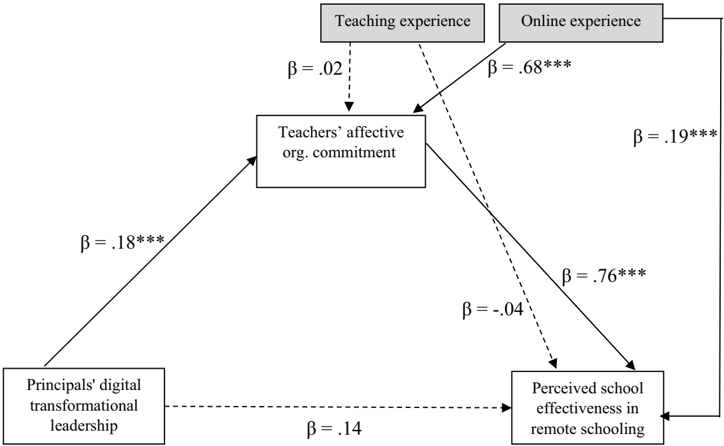
- Principals’ digital transformational leadership was positively related to teachers’ organisational commitment in remote schooling (H1 supported).
- Teachers’ organisational commitment in remote schooling was positively related to perceived school effectiveness in remote schooling (H2 supported).
- The effect of principals’ digital transformational leadership on perceived school effectiveness in remote schooling was fully mediated via teachers’ organisational commitment (H3 supported); standardised indirect effect = .13, 95% CI [.06, .21].
- The study reports a very high digital transformational leadership score (M = 4.81) and a high correlation between affective commitment and school effectiveness in online settings (M = .78; compared with M = .54 in regular school settings).
Methods
- Quantitative correlational, cross-sectional design using data from a wider project on school leadership during the COVID-19 pandemic in Bahrain; convenience sample of 380 teachers recruited via social media platforms (31.3% primary; 48.7% female; mean age 40.27 years, SD = 8.51; mean seniority 13.83 years, SD = 8.14).
- Measures: adapted Short Transformational Leadership scale for digital manifestations (4 items retained after removing 3; α = .72), affective organisational commitment scale (6 items; α = .97), and adapted School Effectiveness Index for remote schooling (8 items; α = .97), all on 5-point Likert scales.
- Analysis: partial correlations controlling for prior online instruction experience; single-step mediation test in SPSS PROCESS Model 4 with 5,000 bootstrapping iterations, with teaching experience and prior online instruction as controls; gender and education were omitted after non-significant relations.
Limitations
- Stated: cross-sectional data limit causal inference; single-source self-report data may create common method variance, and organisational effectiveness was based on subjective accounts rather than objective measures; controls reduced inflation but future research is recommended.
- Stated: the very high digital transformational leadership score (M = 4.81) may reflect hierarchy-respecting culture, an effort effect, or similar high scores in Bahrain public organisations (M = 4.42 in Al-Shammari & Khalifa, 2019); the high online commitment–effectiveness correlation (M = .78 vs. .54 in regular settings) may reflect isolated remote work; national context may affect results, so research in other countries is advised.
- Evident from the text: the sample was a convenience sample recruited through social media because of COVID-19-related obstacles, and three of seven digital transformational leadership items were removed due to structural misfit or lowered reliability, which the authors attribute to cultural and contextual differences.
Model-written summary. Check it against the paper before relying on it.
Integrity signals
Registry
Cites
Statistics
Figures


Verification
Claims the paper makes
1 Valid · 0 Not valid · 20 Not checked · 14 Own results and interpretations
The cited sources support only part of this claim — read each source’s verdict below.
In the paper
“Teachers' organisational commitment was found to have an important effect on motivational outcomes (see full description in the review by Bogler & Berkovich, (2022)) such as (a) teachers' intention to leave the school”
§ Principals' digital transformational leadership, teachers' commitment, and school effectiveness > Organisational commitment and school performance in online settings
What the sources say
- Not matchedcites Bogler & Berkovich, 2022
An author–year citation the paper’s reference list doesn’t settle. We don’t search these by name.
- Not matchedcites Oman-Imran, Allil, and Mahmoud, 2017
An author–year citation the paper’s reference list doesn’t settle. We don’t search these by name.
- Partly supportedcites McInerney, Ganotice, King, Marsh, & Morin, 2015 matched to “Exploring commitment and turnover intentions among teachers: What we can learn from Hong Kong teachers” (2015) sourceExperimental — accuracy not yet measured
The Abstract (p. 2) reports prior research linking teacher commitment to turnover and school success, which supports the claim as background. But the paper’s own regression analyses concern Hong Kong teachers’ psychological well-being; the Limitations and Future Directions (p. 28) propose studying intention to stay in school in future. It therefore does not establish an effect on teachers’ intention to leave, organisational citizenship behaviour, or school-effectiveness outcomes in its own study. (LLM, conf=0.84)
boostedstates a cause- Asserted: passes — The authors put it forward as true.
- Checkable: passes — It can be checked against evidence.
- Load-bearing: passes — The paper’s conclusions depend on it.
- Based: passes — The paper gives a reason why it holds.
- Not matched
A result the paper reports from its own data — it cites no other source for it, so there is none to check. The quote shows it is in the paper.
In the paper
“Principals' digital transformational leadership is positively related to teachers' organisational commitment in remote schooling (H1)”
- Also stated in: § Discussion · hedged
“it seems that, as recently suggested, virtual transformational leadership behaviours promoted stronger affective connection with the organisation (Mysirlaki & Paraskeva, 2020).”
§ Principals' digital transformational leadership, teachers' commitment, and school effectiveness > Results
plainstates an association- Asserted: passes — The authors put it forward as true.
- Checkable: passes — It can be checked against evidence.
- Load-bearing: passes — The paper’s conclusions depend on it.
- Based: passes — The paper gives a reason why it holds.
- Also stated in: § Discussion · hedged
A result the paper reports from its own data — it cites no other source for it, so there is none to check. The quote shows it is in the paper.
In the paper
“the effect of principals' digital transformational leadership on perceived school effectiveness in remote schooling is fully mediated via teachers' organisational commitment in remote schooling (H3).”
§ Principals' digital transformational leadership, teachers' commitment, and school effectiveness > Results
plainstates a cause- Asserted: passes — The authors put it forward as true.
- Checkable: passes — It can be checked against evidence.
- Load-bearing: passes — The paper’s conclusions depend on it.
- Based: passes — The paper gives a reason why it holds.
A result the paper reports from its own data — it cites no other source for it, so there is none to check. The quote shows it is in the paper.
In the paper
“teachers' organisational commitment in remote schooling is positively related to perceived school effectiveness in remote schooling (H2).”
§ Principals' digital transformational leadership, teachers' commitment, and school effectiveness > Results
plainstates an association- Asserted: passes — The authors put it forward as true.
- Checkable: passes — It can be checked against evidence.
- Load-bearing: passes — The paper’s conclusions depend on it.
- Based: passes — The paper gives a reason why it holds.
A result the paper reports from its own data — it cites no other source for it, so there is none to check. The quote shows it is in the paper.
In the paper
“Third, the findings indicated a very high digital transformational leadership score (M = 4.81).”
§ Principals' digital transformational leadership, teachers' commitment, and school effectiveness > Discussion
plain- Asserted: passes — The authors put it forward as true.
- Checkable: passes — It can be checked against evidence.
- Load-bearing: unclear — It is unclear whether the paper’s conclusions depend on it.
- Based: passes — The paper gives a reason why it holds.
18 more claims
Create a free account to see all 35 claims and to verify the 1 reference still open.
- Probably not a substantial claim. 10
- It may state two separate claims as one. 2
Citations
Cites
Baron, R. M., & Kenny, D. A. (1986) · Journal of Personality and Social Psychology · doi:10.1037/0022-3514.51.6.1173 · Cited by 91,532
(2013) · Cited by 44,563
Leadership and Performance beyond Expectations
Longshore, J. M., & Bass, B. M. (1987) · The Academy of Management Review · doi:10.2307/258081 · Cited by 12,412
Bass, B. M., & Riggio, R. E. (2006) · doi:10.4324/9781410617095 · Cited by 4,812
Education and the COVID-19 pandemic
Daniel, S. J. (2020) · PROSPECTS · doi:10.1007/s11125-020-09464-3 · Cited by 2,425
A Literature Review on Impact of COVID-19 Pandemic on Teaching and Learning
Pokhrel, S., & Chhetri, R. (2021) · Higher Education for the Future · doi:10.1177/2347631120983481 · Cited by 2,400 · cited 1×
“Students, teachers, and the educational leadership had to change their teaching and learning patterns and implement online learning and virtual team models (Daniel, 2020; Pokhrel & Chhetri, 2021).”
Educational Administration: Theory, Research, and Practice
Hoy, W. K., & Miskel, C. G. (1978) · Medical Entomology and Zoology · Cited by 1,986
Contextualizing Performances of Family Firms: The Perspective of Business History
Colli, A. (2012) · Family Business Review · doi:10.1177/0894486511426872 · Cited by 1,931
Effective Schools for the Urban Poor
Edmonds, R. R. (1979) · Educational leadership · Cited by 1,912
HALLINGER, P. (2003) · Cambridge Journal of Education · doi:10.1080/0305764032000122005 · Cited by 1,860
Exploring the Principal's Contribution to School Effectiveness: 1980‐1995∗
Hallinger, P., & Heck, R. H. (1998) · School Effectiveness and School Improvement · doi:10.1080/0924345980090203 · Cited by 1,569
DERUE, D. S., NAHRGANG, J. D., WELLMAN, N., & HUMPHREY, S. E. (2011) · Personnel Psychology · doi:10.1111/j.1744-6570.2010.01201.x · Cited by 1,356 · cited 1×
“It is also considered as one of the most important and influential types of leadership models in creating and facilitating organisational change in schools (Bass & Riggio, 2006; Derue, Scott, Nahrgang, Wellman, & Humphrey, 2011).”
Educational Administration: Theory, Research, and Practice
(2008) · Journal of Educational Administration · doi:10.1108/09578230810849862 · Cited by 1,071
Common method bias in applied settings: The dilemma of researching in organizations
Jordan, P. J., & Troth, A. C. (2020) · Australian Journal of Management · doi:10.1177/0312896219871976 · Cited by 997 · cited 1×
“Second, the study used a single source for the data, which is known to create common method variance that might influence results (Jordan & Troth, 2020).”
Pieterse, A. N., van Knippenberg, D., Schippers, M., & Stam, D. (2010) · Journal of Organizational Behavior · doi:10.1002/job.650 · Cited by 969
Effects of COVID-19 pandemic in daily life
Haleem, A., Javaid, M., & Vaishya, R. (2020) · Current Medicine Research and Practice · doi:10.1016/j.cmrp.2020.03.011 · Cited by 929 · cited 1×
“In the last two years, the world has witnessed the outbreak of the COVID-19 pandemic, which represented a challenge to daily life and routines (Domhnaill, Ciarán, & McCoy, 2021; Haleem, Javaid, & Vaishya, 2020).”
A Short Measure of Transformational Leadership
Carless, S. A., Wearing, A. J., & Mann, L. (2000) · Journal of Business and Psychology · doi:10.1023/a:1022991115523 · Cited by 918
Pearson, C. M., & Clair, J. A. (1998) · The Academy of Management Review · doi:10.2307/259099 · Cited by 888
Meyer, J. P., Allen, N. J., & Gellatly, I. R. (1990) · Journal of Applied Psychology · doi:10.1037//0021-9010.75.6.710 · Cited by 844
A Review of Transformational School Leadership Research 1996–2005
Leithwood, K., & Jantzi, D. (2005) · Leadership and Policy in Schools · doi:10.1080/15700760500244769 · Cited by 776 · cited 3×
“In the course of turbulent situations, the transformational leader creates a sense of direction for employees and provides them the support needed to act determinedly despite uncertainty (Kim, Jinyoung, & Ho Shin, 2021; Leithwood & Jantzi, 2005).”
Charismatic and transformational leadership in organizations
Conger, J. A. (1999) · The Leadership Quarterly · doi:10.1016/s1048-9843(99)00012-0 · Cited by 772 · cited 2×
“The study reconfirms earlier claims about the dominance of transfor-mational leadership during an organisational crisis (Conger, 1999; Kim, Jinyoung, & Ho Shin, 2021), in particular leadership in its digital form (Purvanova & Bono, 2009).”
E-leadership: Re-examining transformations in leadership source and transmission
Avolio, B. J., Sosik, J. J., Kahai, S. S., & Baker, B. (2014) · The Leadership Quarterly · doi:10.1016/j.leaqua.2013.11.003 · Cited by 584
Teacher Commitment, Working Conditions, and Differential Incentive Policies
Firestone, W. A., & Pennell, J. R. (1993) · Review of Educational Research · doi:10.2307/1170498 · Cited by 552
Yan, W., & Han, Y. (2018) · Global Encyclopedia of Public Administration, Public Policy, and Governance · doi:10.1007/978-3-319-20928-9_2236 · Cited by 511
Transformational leadership in context: Face-to-face and virtual teams
Purvanova, R. K., & Bono, J. E. (2009) · The Leadership Quarterly · doi:10.1016/j.leaqua.2009.03.004 · Cited by 472 · cited 2×
“Early works found that transformational leadership is an important aspect of online leadership because it plays a crucial role in virtual teams (Purvanova & Bono, 2009).”
Leadership styles and organizational commitment: literature review
Yahaya, R., & Ebrahim, F. (2016) · Journal of Management Development · doi:10.1108/jmd-01-2015-0004 · Cited by 469
Open schools, healthy schools : measuring organizational climate
Hoy, W. K., Tarter, C. J., & Kottkamp, R. B. (1991) · Sage eBooks · Cited by 446
School Effectiveness Findings 1979–2002
Rutter, M., & Maughan, B. (2002) · Journal of School Psychology · doi:10.1016/s0022-4405(02)00124-3 · Cited by 432
Managing Crises: Threats, Dilemmas, Opportunities
Rosenthal, U., Boin, A., & Comfort, L. K. (2001) · Cited by 422
Principal's Time Use and School Effectiveness
Horng, E. L., Klasik, D., & Loeb, S. (2010) · American Journal of Education · doi:10.1086/653625 · Cited by 393
Principals' leadership and teachers' motivation: Self‐determination theory analysis
Eyal, O., & Roth, G. (2011) · Journal of Educational Administration · doi:10.1108/09578231111129055 · Cited by 388
Antecedents and Consequences of Teacher Organizational and Professional Commitment
Somech, A., & Bogler, R. (2002) · Educational Administration Quarterly · doi:10.1177/001316102237672 · Cited by 354
Serrat, O. (2017) · Springer eBooks · doi:10.1007/978-981-10-0983-9 · Cited by 277
Leader cognition in real-world settings: How do leaders think about crises?
Mumford, M. D., Friedrich, T. L., Caughron, J. J., & Byrne, C. L. (2007) · The Leadership Quarterly · doi:10.1016/j.leaqua.2007.09.002 · Cited by 256
Black-Robbins, C. (1992) · NASSP Bulletin · doi:10.1177/019263659207654223 · Cited by 231
Dou, D., Devos, G., & Valcke, M. (2017) · Educational Management Administration & Leadership · doi:10.1177/1741143216653975 · Cited by 216
Jin, Y. (2010) · Communication Research · doi:10.1177/0093650210368256 · Cited by 209
Expert Problem Solving: Evidence from School and District Leaders
Leithwood, K. A. (1994) · Cited by 194
Transformational School Leadership Effects on Student Achievement
Sun, J., & Leithwood, K. (2012) · Leadership and Policy in Schools · doi:10.1080/15700763.2012.681001 · Cited by 184
Larkin, I. M., Brantley‐Dias, L., & Lokey-Vega, A. (2016) · Online Learning · doi:10.24059/olj.v20i3.986 · Cited by 164
AFFECTIVE ORGANIZATIONAL COMMITMENT AND JOB SATISFACTION: A CROSS‐NATIONAL COMPARATIVE STUDY
CHORDIYA, R., SABHARWAL, M., & GOODMAN, D. (2017) · Public Administration · doi:10.1111/padm.12306 · Cited by 160
Transformational leadership and organisational performance: Three serially mediating mechanisms
Katou, A. A. (2015) · Employee Relations · doi:10.1108/er-05-2014-0056 · Cited by 145
Teacher’s turnover intentions: Examining the impact of motivation and organizational commitment
Imran, R., Allil, K., & Mahmoud, A. B. (2017) · International Journal of Educational Management · doi:10.1108/ijem-05-2016-0131 · Cited by 141
Charoensukmongkol, P., & Puyod, J. V. (2021) · International Journal of Leadership in Education · doi:10.1080/13603124.2021.1882701 · Cited by 129
Emotional intelligence and transformational leadership in virtual teams: lessons from MMOGs
Mysirlaki, S., & Paraskeva, F. (2020) · Leadership & Organization Development Journal · doi:10.1108/lodj-01-2019-0035 · Cited by 126
Charlier, S. D., Stewart, G. L., Greco, L. M., & Reeves, C. J. (2016) · The Leadership Quarterly · doi:10.1016/j.leaqua.2016.05.002 · Cited by 125
A Theoretical Framework and Exploration of Organizational Effectiveness of Schools
Hoy, W. K., & Ferguson, J. (1985) · Educational Administration Quarterly · doi:10.1177/0013161x85021002006 · Cited by 124
Whillans, A., Perlow, L., & Turek, A. (2021) · Information and Organization · doi:10.1016/j.infoandorg.2021.100343 · Cited by 118
Zhang, X., Zhang, Y., Sun, Y., Lytras, M. D., de Pablos, P. O., & He, W. (2017) · Studies in Higher Education · doi:10.1080/03075079.2017.1296824 · Cited by 118
Berkovich, I., & Bogler, R. (2020) · Educational Management Administration & Leadership · doi:10.1177/1741143220907321 · Cited by 114
Self-citationAldholay, A. H., Abdullah, Z., Isaac, O., & Mutahar, A. M. (2019) · Information Technology and People · doi:10.1108/itp-02-2018-0095 · Cited by 113
Teacher commitment: Exploring associations with relationships and emotions
Hun, J. S. (2014) · Teaching and Teacher Education · doi:10.1016/j.tate.2014.07.004 · Cited by 112
Sayadi, Y. (2016) · Management in Education · doi:10.1177/0892020615625363 · Cited by 109
Transformational leadership in crisis situations: evidence from the People's Republic of China
Zhang, Z., Jia, M., & Gu, L. (2012) · The International Journal of Human Resource Management · doi:10.1080/09585192.2011.639027 · Cited by 106
Transformational leadership in the educational system of the United Arab Emirates
Litz, D., & Scott, S. (2016) · Educational Management Administration & Leadership · doi:10.1177/1741143216636112 · Cited by 100
McInerney, D. M., Ganotice, F. A., King, R. B., Marsh, H. W., & Morin, A. J. S. (2015) · Teaching and Teacher Education · doi:10.1016/j.tate.2015.08.004 · Cited by 95
Impact of satisfaction and commitment on teachers’ organizational citizenship
Şeşen, H., & Basim, H. N. (2012) · Educational Psychology · doi:10.1080/01443410.2012.670900 · Cited by 95
Işık, A. N. (2020) · International Journal of Educational Leadership and Management · doi:10.17583/ijelm.2020.4114 · Cited by 90
Almutairi, D. O. (2015) · International Journal of Business and Management · doi:10.5539/ijbm.v11n1p231 · Cited by 85 · cited 1×
“Another study involving 227 nurses from Saudi Arabia indicated that employees’ affective organisational commitment partially mediates the association between trans-formational leadership and employees’ job performance (Almutairi, 2016).”
ICT, Leadership in Education and E−leadership.
Gurr *, D. (2004) · Discourse: Studies in the Cultural Politics of Education · doi:10.1080/0159630042000178518 · Cited by 79
POPPER, M. (2004) · Journal for the Theory of Social Behaviour · doi:10.1111/j.0021-8308.2004.00238.x · Cited by 76 · cited 2×
“Virtual interactions with transformational leaders appear to have contributed to providing direction to the staff, as previously reported regarding conventional communication with transformational leaders (Kim, Jinyoung, & Ho Shin, 2021; Leithwood & Jantzi, 2005; Popper, 2004).”
Home broadband and student engagement during COVID-19 emergency remote teaching
Domhnaill, C. M., Mohan, G., & McCoy, S. (2021) · Distance Education · doi:10.1080/01587919.2021.1986372 · Cited by 75
A profile of high-performing global virtual teams
Lippert, H., & Dulewicz, V. (2017) · Team Performance Management · doi:10.1108/tpm-09-2016-0040 · Cited by 75
How emotional is transformational leadership really?: Some suggestions for a necessary extension
Küpers, W., & Weibler, J. (2006) · Leadership & Organization Development Journal · doi:10.1108/01437730610677972 · Cited by 72 · cited 1×
“These positive emotions are considered integral influences of transformational leadership in routine times (Küpers & Weibler, 2006).”
E. Nir, A., & Hameiri, L. (2014) · Journal of Educational Administration · doi:10.1108/jea-01-2013-0007 · Cited by 71 · cited 2×
“This complements the existing studies indicating a connection between conventional transformational leadership and effectiveness (Maroufkhani, Nourani, & Bin Boerhannoeddin, 2015; Nir & Hameiri, 2014).”
Berkovich, I., & Eyal, O. (2017) · Journal of Educational Administration · doi:10.1108/jea-07-2016-0072 · Cited by 71 · cited 5×
“Yet, there is relatively little empirical knowledge about the mechanisms of operation by which transformational leadership behaviours affect school performance (Berkovich & Eyal, 2017; Berkovich, 2018).”
InfluentialSelf-citationKim, H., Im, J., & Shin, Y. H. (2021) · Journal of Hospitality and Tourism Management · doi:10.1016/j.jhtm.2021.07.010 · Cited by 70 · cited 4×
“In the course of turbulent situations, the transformational leader creates a sense of direction for employees and provides them the support needed to act determinedly despite uncertainty (Kim, Jinyoung, & Ho Shin, 2021; Leithwood & Jantzi, 2005).”
InfluentialBerkovich, I. (2017) · Educational Management Administration & Leadership · doi:10.1177/1741143217714253 · Cited by 69
Self-citationA Systematic Review of Empirical Evidence on Teachers’ Organizational Commitment 1994–2018
Bogler, R., & Berkovich, I. (2020) · Leadership and Policy in Schools · doi:10.1080/15700763.2020.1774783 · Cited by 61
Self-citationOrganizational Ethics and Teachers’ Intent to Leave: An Integrative Approach
Shapira‐Lishchinsky, O., & Rosenblatt, Z. (2009) · Educational Administration Quarterly · doi:10.1177/0013161x09347340 · Cited by 59
Predicting conflict management based on organizational commitment and selected demographic variables
Balay, R. (2007) · Asia Pacific Education Review · doi:10.1007/bf03029266 · Cited by 58
Bogler, R., Caspi, A., & Roccas, S. (2013) · Educational Management Administration & Leadership · doi:10.1177/1741143212474805 · Cited by 57
Instructional and transformational leadership: alternative and complementary models?
Bush, T. (2014) · Educational Management Administration & Leadership · doi:10.1177/1741143214526830 · Cited by 54
School effectiveness and truancy: a multilevel study of upper secondary schools in Stockholm
Ramberg, J., Brolin Låftman, S., Fransson, E., & Modin, B. (2019) · International Journal of Adolescence and Youth · doi:10.1080/02673843.2018.1503085 · Cited by 52
Sivagnanam, P., Pillai, A. R., Elangovan, R., & Parayitam, S. (2022) · Knowledge and Process Management · doi:10.1002/kpm.1722 · Cited by 44
Personnel Implications of Public Sector Virtual Organizations
Green, D. D., & Roberts, G. E. (2010) · Public Personnel Management · doi:10.1177/009102601003900103 · Cited by 42
E-Leadership and Teacher Development Using ICT
Mishra, P., Henriksen, D., Boltz, L. O., & Richardson, C. (2015) · Lecture notes in educational technology · doi:10.1007/978-3-662-47956-8_13 · Cited by 42
Holt, D., Palmer, S. R., Gosper, M. V., Sankey, M., & Allan, G. (2014) · Distance Education · doi:10.1080/01587919.2015.955261 · Cited by 40
Taufiq-Hail, G. A.-M., Sarea, A. M. Y., & Hawaldar, I. T. (2021) · Journal of Open Innovation Technology Market and Complexity · doi:10.3390/joitmc7040224 · Cited by 40
Baroudi, S. (2022) · International Journal of Leadership in Education · doi:10.1080/13603124.2022.2108506 · Cited by 37
Virtual communication, transformational leadership, and implicit leadership
Salter, C., Green, M., Duncan, P. A., Berre, A., & Torti, C. (2010) · Journal of Leadership Studies · doi:10.1002/jls.20164 · Cited by 35
Dr., C. A. A. Q. A.-C. O. E., Masry-Herzallah, A., Stavissky, Y., & Ahad Haam school Betah Tikva, I. (2021) · International Journal of Instruction · doi:10.29333/iji.2021.14451a · Cited by 34 · cited 3×
“The study extends the first results on the effectiveness of principals’ conventional transfor-mational leadership during the COVID-19 pandemic (Masry-Herzallah & Stavissky, 2021) to the virtual form of this leadership style.”
Exploring E-Leadership of Principals: Increasing School Effectiveness by Learning Management System
Akram, M., & Khan, A. M. (2020) · Journal of Education & Social Sciences · doi:10.20547/jess0812008102 · Cited by 32
Transformational leadership for crisis management
Pillai, R. (2013) · Edward Elgar Publishing eBooks · doi:10.4337/9781781006405.00011 · Cited by 31
Enabling School Structures: Principal Leadership and Organizational Commitment of Teachers
Sinden, J. E., Hoy, W. K., & Sweetland, S. R. (2004) · Journal of School Leadership · doi:10.1177/105268460401400204 · Cited by 26
School Effectiveness: An Overview of Conceptual, Methodological and Empirical Foundations
Burušić, J., Babarović, T., & Velić, M. Š. (2016) · Springer eBooks · doi:10.1007/978-3-319-29880-1_2 · Cited by 25
Wu, C.-C., Lee, W., & Lin, R. S.-J. (2011) · The International Journal of Human Resource Management · doi:10.1080/09585192.2011.637056 · Cited by 22
Al-Shammari, M. M., & Khalifa, N. Y. (2019) · International Journal of Human Capital and Information Technology Professionals · doi:10.4018/ijhcitp.2019070102 · Cited by 18 · cited 1×
“…hierarchy-respecting culture; others studies on public organisation in Bahrain also reported high transformational leadership scores ( M = 4.42 in Al-Shammari & Khalifa, 2019), and may be partly due to effort effect, as respondents attributed and valued leaders’ behaviours more favourably…”
InfluentialSchool Effectiveness and Educational Management
Alfirević, N., Burušić, J., Pavičić, J., et al. (2016) · Springer eBooks · doi:10.1007/978-3-319-29880-1 · Cited by 16
Jin, Y., Pang, A., & Cameron, G. T. (2008) · Cited by 15
Retaining K-12 Online Teachers: A Predictive Model for K-12 Online Teacher Turnover
Larkin, I., Lokey-Vega, A., & Brantley-Dias, L. (2018) · Journal of Online Learning Research · doi:10.70725/349809kveshm · Cited by 13
Bass, B. M., & Riggio, R. E. (2006) · Psychology Press eBooks · doi:10.4324/9781410617095-15 · Cited by 10
Karabatak, S., Alanoğlu, M., & Şengür, D. (2018) · doi:10.6084/ejes.v0i0.2006 · Cited by 10
High-performance work systems and school effectiveness: the case of Malaysian secondary schools
Maroufkhani, P., Nourani, M., & Boerhannoeddin, A. B. (2015) · Asia Pacific Education Review · doi:10.1007/s12564-015-9389-2 · Cited by 9
Alkoofi, A. A. M. I. (2016) · Durham e-Theses (Durham University) · Cited by 9
Karabatak, S., Alanoğlu, M., & Şengür, D. (2018) · Open Access Publishing Group - European Journal of Education Studies · doi:10.46827/ejes.v0i0.2006 · Cited by 3
Cited by
Gao, P., & Gao, Y. (2024) · Behavioral Sciences · doi:10.3390/bs14050362 · Cited by 128
Leading the AI transformation in schools: it starts with a digital mindset
Pietsch, M., & Mah, D.-K. (2024) · Educational Technology Research and Development · doi:10.1007/s11423-024-10439-w · Cited by 136
Teaching and learning challenges due to the COVID-19 pandemic: A systematic review
Tan, C. Y., Jang, S. T., Lam, S. M., An, A. Q., & Lo, U. K. V. (2025) · Educational Research Review · doi:10.1016/j.edurev.2025.100667 · Cited by 47
Organizational resilience and transformational leadership for managing complex school systems
Zadok, A., Benoliel, P. S., & Schechter, C. (2024) · Frontiers in Education · doi:10.3389/feduc.2024.1333551 · Cited by 89
Digital Transformation in Secondary Schools: A Systematic Literature Review
Yuliandari, T. M., Putri, A., & Rosmansyah, Y. (2023) · IEEE Access · doi:10.1109/access.2023.3306603 · Cited by 50
Metadata
- Authors
- Berkovich, I., & Hassan, T.
- Affiliations
- Open University of Israel (IL)
- Brunel University of London (GB)
- Corresponding author
- Berkovich, Izhak
- Venue
- Education Inquiry
- Publisher
- Informa UK Limited
- Published
- 2023-02-03
- Volume
- 16
- Issue
- 2
- Pages
- 177-194
- ISSN
- 2000-4508 (ISSN-L)
- OpenAlex
- W4319072504
- Cited by
- 51
- References
- 94
- Citations by year
- 2026: 17 · 2025: 17 · 2024: 12 · 2023: 5
- FWCI
- 37.79
- Type
- journal article
- Language
- en
- Open access
- diamond
- doi.org
- Licence
- Locations
- Education Inquiry (publishedVersion, cc-by-nc)
- DOAJ (DOAJ: Directory of Open Access Journals) (submittedVersion, cc-by-sa)
- Topics
- Social Sciences › Education › School Leadership and Teacher Performance
- Social Sciences › Education › Education and Communication Studies
- Social Sciences › Education › Educational Leadership and Practices
- Keywords
- school principals, teacher commitment, school effectiveness, distance education, online learning, COVID-19 pandemic, digital leadership, Bahrain
About these checks
Registry, retraction, Cites and statistics results are computed, not judged, with one exception: a printed reference that no index lists is read once by a model before it counts as a citation error. Claims are extracted by a model and kept only when their quote appears verbatim in the text; each cited source is then checked, with a model’s help, for whether it says what the claim relies on. Those verdicts can be wrong — read the claim’s quote and the cited source before relying on one.
The claim verdicts this report counts are experimental: their accuracy is not yet measured.
A language model drew the claims from the paper on 2026-10-10, under version 3 of the claim definition (model deepseek-v4.1-flash, prompt extract-v3).
A second model labelled each claim on 2026-10-10 (model jev-1.13-20260917, definition revision gold-guideline-v0.2).
Cited sources are checked with a language model’s help (gpt-6-sol).
Statistics and arithmetic are recomputed, not judged.
Confidence bands are shown only for fields calibrated on our annotated test set. None is calibrated yet, so no band is shown.
What counts as a claim ›How we measure confidence ›How we check this ›
Are you an author, or do you see a problem with this page? Request a review
Data sources
Bibliographic data: Semantic Scholar, OpenAlex, Crossref.
Contains information from the Semantic Scholar Academic Graph Datasets, made available under the ODC Attribution License (ODC-BY 1.0).
Semantic Scholar’s data is described in: Kinney, R., et al. (2023). The Semantic Scholar Open Data Platform. arXiv:2301.10140.
