

An integrated AI literacy framework for higher‑education teachers: a critical review and conceptual synthesis
Open accessThe DOI matches its Crossref record; 103 of the 107 references it cites were found in a registry or an index; 30 of the 74 sources its claims cite were checked for support.
Abstract
The rapid adoption of generative artificial intelligence (GenAI) in higher education necessitates a comprehensive understanding of AI literacy among educators. This critical interpretive synthesis aimed to identify emerging themes in teacher AI literacy and to synthesise those themes into an integrated framework. Guided by PRISMA principles, a systematic search yielded 23 peer‑reviewed studies. These articles were subjected to critical interpretive synthesis to resolve conceptual conflicts and include competencies overlooked in existing frameworks. The study identified significant gaps in ethical understanding, innovative use of AI and institutional support among faculty. Conceptualised as a holistic competency model, the framework extends beyond core foundational knowledge and pedagogical application to encompass advanced capabilities in evaluating, creating and deploying AI tools. Eight core dimensions were identified: foundational knowledge and understanding, application and pedagogical integration, critical evaluation, innovation, ethical, epistemic, legal and institutional governance and emotional and professional wellbeing. By incorporating epistemic, legal governance and emotional dimensions, the integrated eight-dimension framework provides educators with human-centred oversight of responsible and ethical AI pedagogy. The study underscores the necessity for higher education institutions to adopt tiered, long-term GenAI literacy training that integrates foundational knowledge with advanced AI competencies, thereby fostering responsible GenAI adoption that enhances student learning.
Overview
CoChat Summary
## TL;DR
This critical interpretive synthesis reviewed 23 peer-reviewed studies (2022–2026) on higher-education teachers’ AI literacy and distilled them into an eight-dimension framework. It argues that teacher AI literacy must go beyond technical use to include pedagogy, ethics, epistemic responsibility, legal governance, innovation, and emotional wellbeing.
## Key findings
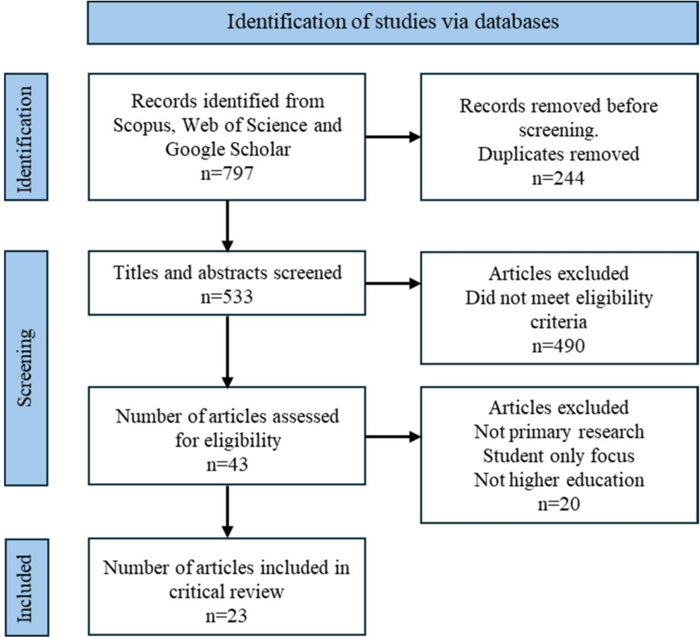
- The search identified 797 records; after removing 244 duplicates, screening, and full-text review, 23 articles remained for synthesis.
- Across the reviewed studies, the main themes were teachers’ perceptions of AI, digital and AI proficiencies, ethical considerations, curriculum design, institutional support, and psychological factors influencing AI adoption.
- The review found a persistent gap between technical capability and ethical readiness: many faculty had moderate to strong foundational knowledge of GenAI, but ethical understanding and institutional policy awareness were weak.
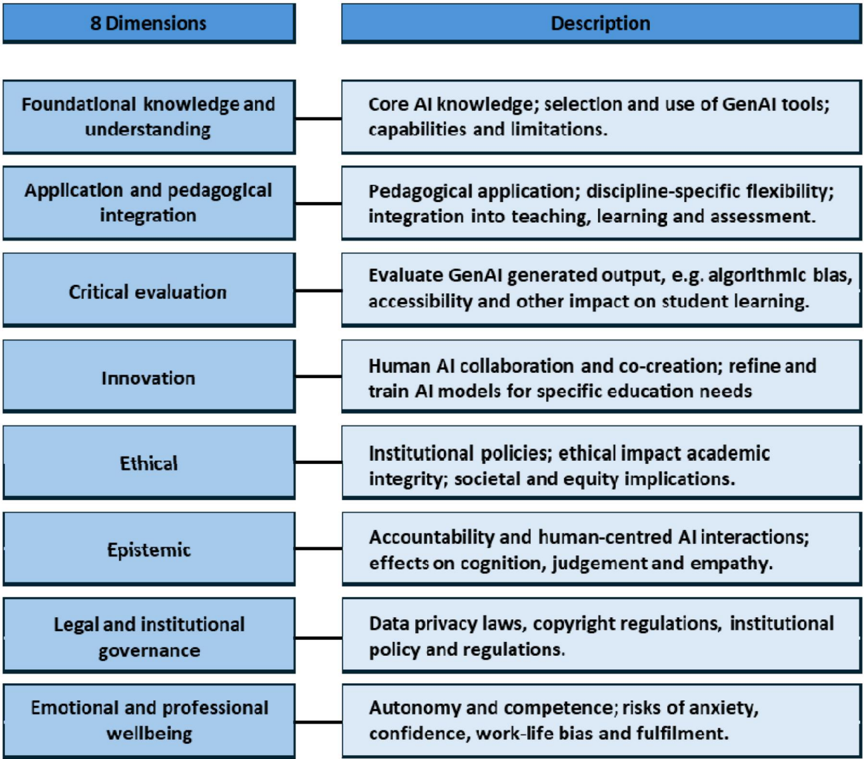
- The synthesis produced 8 core dimensions: foundational knowledge and understanding; application and pedagogical integration; critical evaluation; innovation; ethical; epistemic; legal and institutional governance; and emotional and professional wellbeing.
- The paper reports that adoption of GenAI tools was positively associated with institutional and community support, autonomy, and competence, while barriers included perceived risk, time investment, and negative outcome expectations.
## Methods
- The study is a critical interpretive synthesis / integrative qualitative literature review of teacher AI literacy in higher education.
- It searched Scopus, Web of Science, and Google Scholar for English-language peer-reviewed empirical quantitative and qualitative studies published from 2022 to 2026; studies focused exclusively on students, and systematic/critical reviews, were excluded from the final dataset.
- Analysis used an interpretive, inductive approach with concurrent data extraction and close reading/conceptual annotation, guided by PRISMA principles and without formal quality appraisal or meta-analysis.
## Limitations
- The paper states that limitations include potential interpretive subjectivity due to single-authorship and the absence of formal quality appraisal because conceptual synthesis was prioritized over evidence weighting.
- It says the eight-dimension model is conceptual rather than empirically validated and has not yet been tested through teacher surveys, AI literacy metrics, or longitudinal studies.
- It notes the framework lacks an itemisation metric, which may limit operational utility, though this was a deliberate tradeoff for flexibility.
- Evident from the text: the review is limited to English-language publications and peer-reviewed studies from 2022–2026, so its scope is narrow for a rapidly evolving topic.
Model-written summary. Check it against the paper before relying on it.
Integrity signals
Registry
Cites
Statistics
Figures




Verification
Claims the paper makes
17 Valid · 11 Not valid · 24 Not checked · 60 Own results and interpretations
At least one cited source doesn’t support this claim or points to a different paper, and none confirmed it — see the verdicts below.
In the paper
“Similarly, while institutional policies and integrity were discussed, explicit coverage of legal and regulatory frameworks (e.g.GDPR, copyright) was absent (Holmes & Porayska-Pomsta, 2023;Huang, 2023).”
§ An integrated AI literacy framework for higher-education teachers: a critical review and conceptual synthesis > 3.3. Synthesis into an integrated AI literacy framework
What the sources say
- Not matchedcites Holmes & Porayska-Pomsta, 2023
An author–year citation the paper’s reference list doesn’t settle. We don’t search these by name.
- Disputedcites Huang, 2023 matched to “Ethics of artificial intelligence in education: Student privacy and data protection” (2023) sourceExperimental — accuracy not yet measured
The Student Data Privacy section explicitly discusses the General Data Protection Regulation and its right to erasure. The paper also discusses legal regulatory regimes in Optimizing the Regulation of Personal Data Usage. This contradicts the claim that explicit coverage of legal and regulatory frameworks, including GDPR, was absent; these passages do not address copyright. (LLM, conf=0.90)
Checked by a reasoning model — may be wrong.
plain- Asserted: passes — The authors put it forward as true.
- Checkable: passes — It can be checked against evidence.
- Load-bearing: passes — The paper’s conclusions depend on it.
- Based: passes — The paper gives a reason why it holds.
- Not matched
The cited sources support only part of this claim — read each source’s verdict below.
In the paper
“The study identified significant gaps in ethical understanding, innovative use of AI and institutional support among faculty.”
- Also stated in: § 3.2. Conceptualising an AI literacy framework · plain
“Although educators generally possess relatively strong foundational knowledge of AI concepts and technical proficiency, ethical understanding and awareness remained weak (Abisheva et al., 2024;Salhab, 2024).”
§ An integrated AI literacy framework for higher-education teachers: a critical review and conceptual synthesis > Abstract
What the sources say
- Partly supportedcites Abisheva et al., 2024 matched to “Formation of Ethical Competences for AI Use in English Foreign Language Teachings” (2024) sourceExperimental — accuracy not yet measured
The Abstract describes a study of 60 university EFL teachers in Kazakhstan, and the Demographic Category Details section reports moderate ethical knowledge and notably lower knowledge of data-privacy laws. This supports a need for further ethical training in that group, but not a significant gap among higher-education faculty generally. The paper also reports difficulty incorporating AI into teaching and limited formal training, rather than establishing all three gaps in the citing sentence as stated. (LLM, conf=0.84)
- Not checked yetcites Salhab, 2024 matched to “AI Literacy across Curriculum Design: Investigating College Instructor’s Perspectives” (2024) source
Checked before — its earlier verdict is held back until a new check runs.
plain- Asserted: passes — The authors put it forward as true.
- Checkable: passes — It can be checked against evidence.
- Load-bearing: passes — The paper’s conclusions depend on it.
- Based: passes — The paper gives a reason why it holds.
- Also stated in: § 3.2. Conceptualising an AI literacy framework · plain
The cited sources support only part of this claim — read each source’s verdict below.
In the paper
“For example, the adoption of GenAI tools was positively associated with institutional and community support, autonomy and competence (Ayyoub et al., 2025;Wut et al., 2025).”
§ An integrated AI literacy framework for higher-education teachers: a critical review and conceptual synthesis > 3.2. Conceptualising an AI literacy framework
What the sources say
- Partly supportedcites Ayyoub et al., 2025 matched to “Advancing higher education with GenAI: factors influencing educator AI literacy” (2025) sourceExperimental — accuracy not yet measured
The Discussion reports that community support positively relates to educators’ AI literacy and competencies, and describes competencies as mediators in AI adoption. It does not report a positive association between adoption and autonomy; its measured outcome is primarily AI literacy rather than adoption of GenAI tools. (LLM, conf=0.86)
- Not checked — no full text of the sourcecites Wut et al., 2025 matched to “Does perceived risk of AI matter? Teachers’ AI literacy and institutional support: perspective from self-determination theory” (2025) source
plainstates an association- Asserted: passes — The authors put it forward as true.
- Checkable: passes — It can be checked against evidence.
- Load-bearing: unclear — It is unclear whether the paper’s conclusions depend on it.
- Based: passes — The paper gives a reason why it holds.
- Partly supported
The cited sources support only part of this claim — read each source’s verdict below.
In the paper
“Despite the proliferation of AI literacy frameworks, a critical gap remains in their applicability to higher education faculty.”
§ An integrated AI literacy framework for higher-education teachers: a critical review and conceptual synthesis > 1.5. Rationale of an AI literacy framework for higher education teachers
What the sources say
- Not matchedcites Cukurova and Miao, 2024
An author–year citation the paper’s reference list doesn’t settle. We don’t search these by name.
- Partly supportedcites Hackl et al., 2026 matched to “The AI literacy heptagon: A structured approach to AI literacy in higher education” (2026) sourceExperimental — accuracy not yet measured
Section 2.1 (p. 3) describes numerous AI literacy frameworks but says none provides a coherent, actionable synthesis for higher education. Section 2.2 adds that educators lack concrete implementation guidelines. These passages support a gap in higher education, but they do not identify higher education faculty specifically as the population for whom the frameworks are inapplicable. (LLM, conf=0.86)
- Partly supportedcites Zawacki-Richter et al., 2019 matched to “Systematic review of research on artificial intelligence applications in higher education – where are the educators?” (2019) sourceExperimental — accuracy not yet measured
The review’s concluding discussion (page not available) identifies a lack of educator perspectives on AI applications in higher education and calls for more research by educators and learning designers. It does not assess AI literacy frameworks or say that existing frameworks are inapplicable to higher education faculty. (LLM, conf=0.78)
plain- Asserted: passes — The authors put it forward as true.
- Checkable: passes — It can be checked against evidence.
- Load-bearing: passes — The paper’s conclusions depend on it.
- Based: passes — The paper gives a reason why it holds.
- Not matched
Every source the paper cites for this claim was checked and supports it.
In the paper
“Studies reported correlations between AI literacy levels and faculty anxiety or job satisfaction (Huang & Zhao, 2025;Xie et al., 2025).”
§ An integrated AI literacy framework for higher-education teachers: a critical review and conceptual synthesis > 4.1. RQ1. How can contemporary research inform on emerging themes in AI literacy among higher education teachers?
What the sources say
- Supportedcites Huang & Zhao, 2025 matched to “The impact of AI literacy on work–life balance and job satisfaction among university faculty: a self-determination theory perspective” (2025) source
The Introduction reports a positive correlation between AI proficiency and job satisfaction, and the paper’s own survey examines AI literacy and job satisfaction among university faculty (Abstract, Methods and Results). This supports the job-satisfaction side of the sentence; it does not require Huang and Zhao to have measured anxiety, which may be the point of the other citation. (LLM, conf=0.88)
- Supportedcites Xie et al., 2025 matched to “Exploring AI Literacy and AI‐Induced Emotions among Chinese University English Language Teachers: The Partial Least Square Structural Equation Modeling (PLS‐SEM) Approach” (2025) source
Section 4.1 (Preliminary Analysis) reports significant positive bivariate correlations between dimensions of AI literacy and AI-induced emotions, including anxiety, among university EFL teachers. The paper separately finds that AI literacy did not significantly predict anxiety; that result does not negate the reported correlations. (LLM, conf=0.92)
plainstates an association- Asserted: passes — The authors put it forward as true.
- Checkable: passes — It can be checked against evidence.
- Load-bearing: passes — The paper’s conclusions depend on it.
- Based: passes — The paper gives a reason why it holds.
- Supported
28 more claims · 2 with their cited sources checked
Create a free account to see all 112 claims and to verify the 17 references still open.
- Probably not a substantial claim. 55
- The quote only partly states this claim. 5
- It may state two separate claims as one. 44
Citations
Cites
Preferred reporting items for systematic reviews and meta-analyses: the PRISMA Statement.
(2009) · PubMed Central · Cited by 44,859
Liberati, A., Altman, D. G., Tetzlaff, J., Mulrow, C., Gotzsche, P. C., Ioannidis, J. P. A., Clarke, M., Devereaux, P. J., Kleijnen, J., & Moher, D. (2009) · BMJ · doi:10.1136/bmj.b2700 · Cited by 17,648
ChatGPT for good? On opportunities and challenges of large language models for education
Kasneci, E., Sessler, K., Küchemann, S., Bannert, M., Dementieva, D., Fischer, F., Gasser, U., Groh, G., Günnemann, S., Hüllermeier, E., et al. (2023) · Learning and Individual Differences · doi:10.1016/j.lindif.2023.102274 · Cited by 15,365
Zawacki-Richter, O., Marín, V. I., Bond, M., & Gouverneur, F. (2019) · International Journal of Educational Technology in Higher Education · doi:10.1186/s41239-019-0171-0 · Cited by 7,242
Writing Integrative Literature Reviews: Guidelines and Examples
Torraco, R. J. (2005) · Human Resource Development Review · doi:10.1177/1534484305278283 · Cited by 3,534
Deo, R. C. (2015) · Circulation · doi:10.1161/circulationaha.115.001593 · Cited by 3,466
What is AI Literacy? Competencies and Design Considerations
Long, D., & Magerko, B. (2020) · Proceedings of the 2020 CHI Conference on Human Factors in Computing Systems · doi:10.1145/3313831.3376727 · Cited by 3,241
Anderson, J. R., Boyle, C. F., & Reiser, B. J. (1985) · Science · doi:10.1126/science.228.4698.456 · Cited by 3,119
VanLEHN, K. (2011) · Educational Psychologist · doi:10.1080/00461520.2011.611369 · Cited by 2,323
Dixon-Woods, M., Cavers, D., Agarwal, S., Annandale, E., Arthur, A., Harvey, J., Hsu, R., Katbamna, S., Olsen, R., Smith, L., et al. (2006) · BMC Medical Research Methodology · doi:10.1186/1471-2288-6-35 · Cited by 2,289
Conceptualizing AI literacy: An exploratory review
Ng, D. T. K., Leung, J. K. L., Chu, S. K. W., & Qiao, M. S. (2021) · Computers and Education: Artificial Intelligence · doi:10.1016/j.caeai.2021.100041 · Cited by 2,205
ChatGPT: Bullshit spewer or the end of traditional assessments in higher education?
(2023) · Journal of Applied Learning & Teaching · doi:10.37074/jalt.2023.6.1.9 · Cited by 1,806
Artificial intelligence: A powerful paradigm for scientific research
Xu, Y., Liu, X., Cao, X., Huang, C., Liu, E., Qian, S., Liu, X., Wu, Y., Dong, F., Qiu, C.-W., et al. (2021) · The Innovation · doi:10.1016/j.xinn.2021.100179 · Cited by 1,726
Ethics of AI in Education: Towards a Community-Wide Framework
Holmes, W., Porayska-Pomsta, K., Holstein, K., Sutherland, E., Baker, T., Shum, S. B., Santos, O. C., Rodrigo, M. T., Cukurova, M., Bittencourt, I. I., et al. (2022) · International Journal of Artificial Intelligence in Education · doi:10.1007/s40593-021-00239-1 · Cited by 1,437
AI Tools in Society: Impacts on Cognitive Offloading and the Future of Critical Thinking
Gerlich, M. (2025) · Societies · doi:10.3390/soc15010006 · Cited by 1,248
AI Tools in Society: Impacts on Cognitive Offloading and the Future of Critical Thinking
Gerlich, M. (2025) · doi:10.2139/ssrn.5082524 · Cited by 1,238
Evolution and Revolution in Artificial Intelligence in Education
Roll, I., & Wylie, R. (2016) · International Journal of Artificial Intelligence in Education · doi:10.1007/s40593-016-0110-3 · Cited by 1,229
State of the art and practice in AI in education
Holmes, W., & Tuomi, I. (2022) · European Journal of Education · doi:10.1111/ejed.12533 · Cited by 1,093
Baker, R. S., & Hawn, A. (2022) · International Journal of Artificial Intelligence in Education · doi:10.1007/s40593-021-00285-9 · Cited by 993
Adaptive Learning Using Artificial Intelligence in e-Learning: A Literature Review
Gligorea, I., Cioca, M., Oancea, R., Gorski, A.-T., Gorski, H., & Tudorache, P. (2023) · Education Sciences · doi:10.3390/educsci13121216 · Cited by 980
AI in CAI: An Artificial-Intelligence Approach to Computer-Assisted Instruction
Carbonell, J. (1970) · IEEE Transactions on Man Machine Systems · doi:10.1109/tmms.1970.299942 · Cited by 955
Detecting hallucinations in large language models using semantic entropy
Farquhar, S., Kossen, J., Kuhn, L., & Gal, Y. (2024) · Nature · doi:10.1038/s41586-024-07421-0 · Cited by 934
Effectiveness of Intelligent Tutoring Systems: A Meta-Analytic Review
Kulik, J. A., & Fletcher, J. D. (2016) · Review of Educational Research · doi:10.3102/0034654315581420 · Cited by 930
Challenges and Opportunities of Generative AI for Higher Education as Explained by ChatGPT
Michel-Villarreal, R., Vilalta-Perdomo, E., Salinas-Navarro, D. E., Thierry-Aguilera, R., & Gerardou, F. S. (2023) · Education Sciences · doi:10.3390/educsci13090856 · Cited by 877
Bond, M., Khosravi, H., De Laat, M., Bergdahl, N., Negrea, V., Oxley, E., Pham, P., Chong, S. W., & Siemens, G. (2024) · International Journal of Educational Technology in Higher Education · doi:10.1186/s41239-023-00436-z · Cited by 852
Eysenbach, G. (2023) · JMIR Medical Education · doi:10.2196/46885 · Cited by 840
(2016) · doi:10.3389/fpsyg · Cited by 801
Transparency and the black box problem: why we do not trust AI
von Eschenbach, W. J. (2021) · Philosophy & Technology · doi:10.1007/s13347-021-00477-0 · Cited by 786
What are artificial intelligence literacy and competency? A comprehensive framework to support them
Chiu, T. K. F., Ahmad, Z., Ismailov, M., & Sanusi, I. T. (2024) · Computers and Education Open · doi:10.1016/j.caeo.2024.100171 · Cited by 570
AutoTutor: A tutor with dialogue in natural language
Graesser, A. C., Lu, S., Jackson, G. T., Mitchell, H. H., Ventura, M., Olney, A., & Louwerse, M. M. (2004) · Behavior Research Methods, Instruments, & Computers · doi:10.3758/bf03195563 · Cited by 555
Intelligent tutoring systems: an overview
Nwana, H. (1990) · Artificial Intelligence Review · doi:10.1007/bf00168958 · Cited by 531
A Scoping Review on How Generative Artificial Intelligence Transforms Assessment in Higher Education
Xia, Q., Weng, X., Ouyang, F., Lin, T. J., & Chiu, T. K. F. (2024) · International Journal of Educational Technology in Higher Education · doi:10.1186/s41239-024-00468-z · Cited by 493
McCarthy, J. (2007) · Artificial Intelligence · doi:10.1016/j.artint.2007.10.009 · Cited by 396
Will generative AI replace teachers in higher education? A study of teacher and student perceptions
Chan, C. K. Y., & Tsi, L. H. Y. (2024) · Studies in Educational Evaluation · doi:10.1016/j.stueduc.2024.101395 · Cited by 387
The AI Revolution in Education: Will AI Replace or Assist Teachers in Higher Education?
Chan, C. K. Y., & Tsi, L. H. Y. (2023) · arXiv · doi:10.48550/arxiv.2305.01185 · Cited by 387
Fuchs, K. (2023) · Frontiers in Education · doi:10.3389/feduc.2023.1166682 · Cited by 353
Learning to work with the black box: Pedagogy for a world with artificial intelligence
Bearman, M., & Ajjawi, R. (2023) · British Journal of Educational Technology · doi:10.1111/bjet.13337 · Cited by 346
Generative AI Literacy: Twelve Defining Competencies
Annapureddy, R., Fornaroli, A., & Gatica-Perez, D. (2025) · Digital Government: Research and Practice · doi:10.1145/3685680 · Cited by 333
An Overview of the World of MOOCs
Baturay, M. H. (2015) · Procedia - Social and Behavioral Sciences · doi:10.1016/j.sbspro.2015.01.685 · Cited by 310
Ethics of artificial intelligence in education: Student privacy and data protection
Huang, L. (2023) · Science Insights Education Frontiers · doi:10.15354/sief.23.re202 · Cited by 305
AutoTutor and Family: A Review of 17 Years of Natural Language Tutoring
Nye, B. D., Graesser, A. C., & Hu, X. (2014) · International Journal of Artificial Intelligence in Education · doi:10.1007/s40593-014-0029-5 · Cited by 286
Generative AI for Customizable Learning Experiences
Pesovski, I., Santos, R., Henriques, R., & Trajkovik, V. (2024) · Sustainability · doi:10.3390/su16073034 · Cited by 274
Wang, H., Dang, A., Wu, Z., & Mac, S. (2024) · Computers and Education: Artificial Intelligence · doi:10.1016/j.caeai.2024.100326 · Cited by 272
Celik, I. (2023) · Telematics and Informatics · doi:10.1016/j.tele.2023.102026 · Cited by 269
The Ethics of Artificial Intelligence in Education: Practices, Challenges, and Debates
Holmes, W., & Porayska-Pomsta, K. (2022) · doi:10.4324/9780429329067 · Cited by 258
Batista, J., Mesquita, A., & Carnaz, G. (2024) · Information · doi:10.3390/info15110676 · Cited by 256
A Systematic Review of Generative AI for Teaching and Learning Practice
Ogunleye, B., Zakariyyah, K. I., Ajao, O., Olayinka, O., & Sharma, H. (2024) · Education Sciences · doi:10.3390/educsci14060636 · Cited by 251
Integrating AI in education: Opportunities, challenges, and ethical considerations
Eden, C. A., Chisom, O. N., & Adeniyi, I. S. (2024) · Magna Scientia Advanced Research and Reviews · doi:10.30574/msarr.2024.10.2.0039 · Cited by 227
Towards social generative AI for education: theory, practices and ethics
Sharples, M. (2023) · Learning: Research and Practice · doi:10.1080/23735082.2023.2261131 · Cited by 217
The cognitive paradox of AI in education: Between enhancement and erosion
Jose, B., Cherian, J., Verghis, A. M., Varghise, S. M., S, M., & Joseph, S. (2025) · Frontiers in Psychology · doi:10.3389/fpsyg.2025.1550621 · Cited by 212
Corbett, A. T., Koedinger, K. R., & Anderson, J. R. (1997) · Handbook of Human-Computer Interaction · doi:10.1016/b978-044481862-1.50103-5 · Cited by 210
Opportunities and Challenges of Integrating Generative Artificial Intelligence in Education
AlAli, R. M., & Wardat, Y. (2024) · International Journal of Religion · doi:10.61707/8y29gv34 · Cited by 202
The ethical implications of using generative chatbots in higher education
Williams, R. T. (2024) · Frontiers in Education · doi:10.3389/feduc.2023.1331607 · Cited by 183
Kurtz, G., Amzalag, M., Shaked, N., Zaguri, Y., Kohen-Vacs, D., Gal, E., Zailer, G., & Barak-Medina, E. (2024) · Education Sciences · doi:10.3390/educsci14050503 · Cited by 181
Khlaif, Z. N., Ayyoub, A., Hamamra, B., Bensalem, E., Mitwally, M. A. A., Ayyoub, A., Hattab, M. K., & Shadid, F. (2024) · Education Sciences · doi:10.3390/educsci14101090 · Cited by 177
Black-box artificial intelligence: an epistemological and critical analysis
Carabantes, M. (2020) · AI & SOCIETY · doi:10.1007/s00146-019-00888-w · Cited by 170
Al-Abdullatif, A. M. (2024) · Education Sciences · doi:10.3390/educsci14111209 · Cited by 169
The Use of Generative AI Tools in Higher Education: Ethical and Pedagogical Principles
Nguyen, K. V. (2025) · Journal of Academic Ethics · doi:10.1007/s10805-025-09607-1 · Cited by 163
Zhan, Y., & Yan, Z. (2026) · Assessment & Evaluation in Higher Education · doi:10.1080/02602938.2025.2471821 · Cited by 162
Bozkurt, A. (2023) · Open Praxis · doi:10.55982/openpraxis.15.4.609 · Cited by 138
The intertwined histories of artificial intelligence and education
Doroudi, S. (2023) · International Journal of Artificial Intelligence in Education · doi:10.1007/s40593-022-00313-2 · Cited by 129
Exploring the impact of ChatGPT: conversational AI in education
Bettayeb, A. M., Abu Talib, M., Sobhe Altayasinah, A. Z., & Dakalbab, F. (2024) · Frontiers in Education · doi:10.3389/feduc.2024.1379796 · Cited by 127
Dringó-Horváth, I., Rajki, Z., & Nagy, J. T. (2025) · Education Sciences · doi:10.3390/educsci15070868 · Cited by 114
Bobula, M. (2024) · Journal of Learning Development in Higher Education · doi:10.47408/jldhe.vi30.1137 · Cited by 113
Talk is cheap: why structural assessment changes are needed for a time of GenAI
Corbin, T., Dawson, P., & Liu, D. (2025) · Assessment & Evaluation in Higher Education · doi:10.1080/02602938.2025.2503964 · Cited by 107
Haroud, S., & Saqri, N. (2025) · Education Sciences · doi:10.3390/educsci15040396 · Cited by 101
Ethics and governance of generative AI in education: a systematic review on responsible adoption
Alfiras, M., Emran, A. Q., & Mohamed, A. M. A. (2025) · Discover Education · doi:10.1007/s44217-025-01051-y · Cited by 87
Iqbal, J., Hashmi, Z. F., Asghar, M. Z., & Abid, M. N. (2025) · Scientific Reports · doi:10.1038/s41598-025-01676-x · Cited by 82
Thüs, D., Malone, S., & Brünken, R. (2024) · Frontiers in Psychology · doi:10.3389/fpsyg.2024.1474892 · Cited by 66
Integrating AI and machine learning in STEM education: Challenges and opportunities
Joseph, O. B., & Uzondu, N. C. (2024) · Computer Science & IT Research Journal · doi:10.51594/csitrj.v5i8.1379 · Cited by 64
Jose, B., Cleetus, A., Joseph, B., Joseph, L., Jose, B., & John, A. K. (2025) · Frontiers in Education · doi:10.3389/feduc.2025.1647687 · Cited by 63
A survey study of chinese teachers’ continuous intentions to teach artificial intelligence
Chai, C. S., Liang, S., & Wang, X. (2023) · Education and Information Technologies · doi:10.1007/s10639-023-12430-z · Cited by 62
AI Literacy across Curriculum Design: Investigating College Instructor’s Perspectives
Salhab, R. (2024) · Online Learning · doi:10.24059/olj.v28i2.4426 · Cited by 62
Tan, X. J., Cheng, G., & Ling, M. H. (2025) · Computers and Education Artificial Intelligence · doi:10.1016/j.caeai.2025.100521 · Cited by 60
Huang, L., & Zhao, Y. (2025) · Frontiers in Psychology · doi:10.3389/fpsyg.2025.1669247 · Cited by 55
PLATO: An Automatic Teaching Device
Bitzer, D. L., Braunfeld, P., & Lichtenberger, W. W. (1961) · IRE Transactions on Education · doi:10.1109/te.1961.4322215 · Cited by 54
Advancing higher education with GenAI: factors influencing educator AI literacy
Ayyoub, A. M., Khlaif, Z. N., Shamali, M., Abu Eideh, B., Assali, A., Hattab, M. K., Barham, K. A., & Bsharat, T. R. K. (2025) · Frontiers in Education · doi:10.3389/feduc.2025.1530721 · Cited by 44
Holmes, W. (2024) · International Journal of Artificial Intelligence in Education · doi:10.1007/s40593-023-00352-3 · Cited by 41
The AI literacy heptagon: A structured approach to AI literacy in higher education
Hackl, V., Müller, A. E., & Sailer, M. (2026) · Computers and Education: Artificial Intelligence · doi:10.1016/j.caeai.2026.100540 · Cited by 41
Empowering EFL teachers’ perceptions of generative AI-mediated self-professionalism
Nazim, M., & Alzubi, A. A. F. (2025) · PLoS ONE · doi:10.1371/journal.pone.0326735 · Cited by 38
Eyal, L. (2025) · Computers and Education Open · doi:10.1016/j.caeo.2025.100291 · Cited by 33
Xie, X., Teng, M. F., Zhang, L. J., & Alamer, A. (2025) · International Journal of Applied Linguistics · doi:10.1111/ijal.12798 · Cited by 31
E-Learning and a Case Study of Coursera and edX Online Platforms
Likovič, A., & Rojko, K. (2022) · Research in social change · doi:10.2478/rsc-2022-0008 · Cited by 29
Tan, X., Cheng, G., & Ling, M. H. (2025) · Computers and Education: Artificial Intelligence · doi:10.1016/j.caeai.2025.100461 · Cited by 27
Wut, T.-M., Ka-man Sum, C., & Shun-mun Wong, H. (2025) · Education and Information Technologies · doi:10.1007/s10639-025-13685-4 · Cited by 24
The Epistemic Downside of Using LLM-Based Generative AI in Academic Writing
Tang, B. L. (2025) · Publications · doi:10.3390/publications13040063 · Cited by 24
Teachers' digital competencies for effective AI integration in higher education in Oman
Khalil, H., & Alsenaidi, S. (2024) · Journal of Education and e-Learning Research · doi:10.20448/jeelr.v11i4.6097 · Cited by 23
Integrating Artificial Intelligence into Higher Education Assessment
Williams, A. (2025) · Intersection: A Journal at the Intersection of Assessment and Learning · doi:10.61669/001c.131915 · Cited by 22
Self-citationEnhancing AI literacy for educators: Where to start and to what end?
Pei, B., Lu, J., Zhang, Z., Tuffour, P., & Park, S. (2026) · Computers and Education Artificial Intelligence · doi:10.1016/j.caeai.2026.100550 · Cited by 22
Ethical and Responsible AI in Education: Situated Ethics for Democratic Learning
Hummel, S. (2025) · Education Sciences · doi:10.3390/educsci15121594 · Cited by 21
Bezus, S. N., Абдужалилов, Х., & Raitskaya, L. (2020) · International Conference on Education and Multimedia Technology (ICEMT) · doi:10.1145/3416797.3416839 · Cited by 20
Human-Centered AI: Designing Intelligent Systems that Empower, Not Replace
Purwanto, A. N. I. (2025) · RIGGS Journal of Artificial Intelligence and Digital Business · doi:10.31004/riggs.v4i3.2450 · Cited by 18
Rampelt, F., Ruppert, R., Schleiß, J., Mah, D.-K., Bata, K., & Egloffstein, M. (2025) · Open Praxis · doi:10.55982/openpraxis.17.1.766 · Cited by 16
Formation of Ethical Competences for AI Use in English Foreign Language Teachings
Abisheva, C., Aykenova, R., Idrissova, M., Umirzakova, L., Irgebaeva, N., Koldasbaeva, Z., Nossiyeva, N., Aipova, А., Doldinova, S., & Smoilov, S. (2024) · Qubahan Academic Journal · doi:10.48161/qaj.v4n4a1256 · Cited by 15
Chkarka, F., & Fatmi, H. (2025) · Journal of Academic Ethics · doi:10.1007/s10805-025-09684-2 · Cited by 15
De Silva, D., Jayatilleke, S., El-Ayoubi, M., Issadeen, Z., Moraliyage, H., & Mills, N. (2024) · Machine Learning and Knowledge Extraction · doi:10.3390/make6020051 · Cited by 14
Acosta-Enriquez, B. G., Huamaní Jordan, O., Morales-Angaspilco, J. E., Campoverde Ventura, G., Ruiz Carrillo, J. A., Blanco- García, L. E., & Huaranga Rivera, L. (2025) · Computers in Human Behavior Reports · doi:10.1016/j.chbr.2025.100829 · Cited by 11
Geiger, C., & Lazzaro, F. D. (2025) · Discover Sustainability · doi:10.1007/s43621-025-01918-y · Cited by 10
Computer Assisted Instruction (CAI): A New Approach in the Field of Education
Nazimuddin, S. (2015) · International Journal of Scientific Engineering and Research · doi:10.70729/ijser15366 · Cited by 8
Ali, S. I., & Shaban, M. (2026) · Nurse Education in Practice · doi:10.1016/j.nepr.2026.104771 · Cited by 8
Williams, A. E. (2025) · International Journal of Research in Education and Science · doi:10.46328/ijres.1302 · Cited by 7
Self-citationDing, N., Chen, M., & Hu, L. (2025) · Acta Psychologica · doi:10.1016/j.actpsy.2025.105709 · Cited by 7
The obligation to restrict AI in student writing
Taylor, M. R. (2026) · Journal of Philosophy of Education · doi:10.1093/jopedu/qhaf097 · Cited by 6
Transforming Engineering Education Through Enhancing AI Literacy of College Teachers
Yu, H., Sun, P., Wanru, G., & Baoshan, L. (2025) · Journal of Integrated Design and Process Science · doi:10.1177/10920617251405473 · Cited by 6
Jogezai, N., Baloch, F. A., Jaffar, M., & Khilji, G. (2025) · Quality Assurance in Education · doi:10.1108/qae-12-2024-0255 · Cited by 5
Barbero (2014) · doi:10.1016/j · Cited by 1
Woolf, B. P. (2009) · Building Intelligent Interactive Tutors · doi:10.1016/b978-0-12-373594-2.00003-4
Research works printed but not linked: 7
- 23. Cern� y, M. (2023). AI literacy in higher education: Theory and design. In International Conference on New Media Pedagogy (pp 364-379). Springer.
- 30. Cukurova, M., & Miao, F. (2024). AI competency framework for teachers. UNESCO Publishing.
- 49. Holmes, W., & Miao, F. (2023). Guidance for generative AI in education and research. Unesco Publishing.
- 53. Holt, P., & Wood, P. (1990). Intelligent tutoring systems: A review for beginners. Canadian Journal of Learning and Technology, 19, 10723.
- 69. Luckin, R., & Holmes, W. (2016). Intelligence unleashed: An argument for AI in education. UCL Knowledge Lab.
- 70. McCarthy, J. (2007). What is artificial intelligence? Standford University.
- 103. Woolf, B. P. (2010). Building intelligent interactive tutors: Student-centered strategies for revolutionizing e-learning.
Cited by
Xiang, Y., Zhan, F., & 蔡钦林 (2026) · Global Education Bulletin · doi:10.71052/grb2025/nxgj6555 · Cited by 1
Faizul, M. F. A., Mukmin, T., Fauzi, M., & Isnaini, M. (2026) · Berkala Ilmiah Pendidikan · doi:10.51214/bip.v6i2.2225 · Cited by 2
“…more recent frameworks by Bustillos et al. (2026) incorporating instrumental, algorithmic, ethical, epistemological, and institutional dimensions, Williams (2026) with eight core dimensions including foundational knowledge, pedagogical integration, critical evaluation, innovation, ethical,…”
Metadata
- Authors
- Williams, A.
- Affiliations
- University College London (GB)
- Corresponding author
- Williams, Andrew
- ORCID
- Williams, Andrew
- Venue
- Cogent Education
- Publisher
- Informa UK Limited
- Published
- 2026-07-08
- Volume
- 13
- Issue
- 1
- ISSN
- 2331-186X (ISSN-L)
- OpenAlex
- W7167843361
- Cited by
- 2
- References
- 95
- Citations by year
- 2026: 2
- FWCI
- 18.94
- Type
- journal article
- Language
- en
- Open access
- gold
- doi.org
- Licence
- cc-by
- creativecommons.org/licenses/by/4.0/ (vor)
- doi.org/10.1080/policies-text-data-mining (tdm)
- Locations
- Cogent Education (publishedVersion, cc-by)
- DOAJ (DOAJ: Directory of Open Access Journals) (acceptedVersion)
- Topics
- Physical Sciences › Computer Science › Computer Science Applications › Online Learning and Analytics
- Physical Sciences › Computer Science › Artificial Intelligence › Ethics and Social Impacts of AI
- Health Sciences › Medicine › Health Informatics › Artificial Intelligence in Healthcare and Education
- Keywords
- AI literacy, generative AI, higher education teachers, teacher competence, AI literacy framework, ethical AI, AI governance, epistemic competence
About these checks
Registry, retraction, Cites and statistics results are computed, not judged, with one exception: a printed reference that no index lists is read once by a model before it counts as a citation error. Claims are extracted by a model and kept only when their quote appears verbatim in the text; each cited source is then checked, with a model’s help, for whether it says what the claim relies on. Those verdicts can be wrong — read the claim’s quote and the cited source before relying on one.
The claim verdicts this report counts are experimental: their accuracy is not yet measured.
A language model drew the claims from the paper on 2026-10-06, under version 3 of the claim definition (model deepseek-v4.1-flash, prompt extract-v3).
A second model labelled each claim on 2026-10-06 (model jev-1.13-20260917, definition revision gold-guideline-v0.2).
Cited sources are checked with a language model’s help (gpt-6-sol).
Statistics and arithmetic are recomputed, not judged.
Confidence bands are shown only for fields calibrated on our annotated test set. None is calibrated yet, so no band is shown.
What counts as a claim ›How we measure confidence ›How we check this ›
Are you an author, or do you see a problem with this page? Request a review
Data sources
Bibliographic data: Semantic Scholar, OpenAlex, Crossref.
Contains information from the Semantic Scholar Academic Graph Datasets, made available under the ODC Attribution License (ODC-BY 1.0).
Semantic Scholar’s data is described in: Kinney, R., et al. (2023). The Semantic Scholar Open Data Platform. arXiv:2301.10140.
