

Easy quantitative assessment of genome editing by sequence trace decomposition
Open accessThe DOI matches its Crossref record; 19 of the 19 references it cites were found in a registry or an index.
Abstract
The efficacy and the mutation spectrum of genome editing methods can vary substantially depending on the targeted sequence. A simple, quick assay to accurately characterize and quantify the induced mutations is therefore needed. Here we present TIDE, a method for this purpose that requires only a pair of PCR reactions and two standard capillary sequencing runs. The sequence traces are then analyzed by a specially developed decomposition algorithm that identifies the major induced mutations in the projected editing site and accurately determines their frequency in a cell population. This method is cost-effective and quick, and it provides much more detailed information than current enzyme-based assays. An interactive web tool for automated decomposition of the sequence traces is available. TIDE greatly facilitates the testing and rational design of genome editing strategies.
Overview
The claims and statistics of this paper haven’t been checked yet.
Free: it reads the open-access text and checks the first 5 claims that cite a source we can check. Create a free account to check every claim.
Integrity signals
Registry
Cites
Statistics
Figures
Verification
Claims the paper makes
The claims and statistics of this paper haven’t been checked yet.
Free: it reads the open-access text and checks the first 5 claims that cite a source we can check. Create a free account to check every claim.
Claims other papers make about this one
Each is checked against this paper’s own text: does it say what the citing paper says it does?
The source backs part of the claim, not all of it — or backs it for a different population, condition or comparison.
In the citing paper
“Long-term nuclease expression (10 days after transduction), which has been demonstrated to highly favor non-specific cleavages41, did not generate any unspecific CFTR editing above TIDE background levels (about 1%)38; whereas AsCas12a-crRNA+11/wt efficiently edited the CFTR gene (86.3%, Fig. 2b).”
From Allele specific repair of splicing mutations in cystic fibrosis through AsCas12a genome editing (2019) · cites this paper as [38]
Experimental — accuracy not yet measuredThe source backs part of the claim, not all of it — or backs it for a different population, condition or comparison.
In the citing paper
“Genotyping was performed by Sanger sequencing of PCR amplicons of genomic target sites with individual alleles deconvoluted by TIDE analysis of chromatograms[33].”
From Genome-scale CRISPR screening for modifiers of cellular LDL uptake (2021) · cites this paper as [33]
Experimental — accuracy not yet measuredIn the citing paper
“Tracking of InDels by Decomposition (TIDE) is an effective web tool (https://tide.nki.nl) that can be used to analyse sequencing data, which estimates the spectra and frequencies of small insertions and deletions generated from gene editing (Brinkman et al., 2014).”
From Genetic resources and precise gene editing for targeted improvement of barley abiotic stress tolerance (2023) · cites this paper as Brinkman et al., 2014
Self-check
Percentages, sums and reported differences re-computed from the paper’s own numbers.
The self-check needs the paper’s full text.
Citations
Cites
Multiplex Genome Engineering Using CRISPR/Cas Systems
Cong, L., Ran, F. A., Cox, D., Lin, S., Barretto, R., Habib, N., Hsu, P. D., Wu, X., Jiang, W., Marraffini, L. A., et al. (2013) · Science · doi:10.1126/science.1231143 · Cited by 15,339
Bioconductor: open software development for computational biology and bioinformatics
Gentleman, R. C., Carey, V. J., Bates, D. M., Bolstad, B., Dettling, M., Dudoit, S., Ellis, B., Gautier, L., Ge, Y., Gentry, J., et al. (2004) · Genome Biology · doi:10.1186/gb-2004-5-10-r80 · Cited by 12,172 · cited 3×
“scf format) are imported into TIDE using the R Bioconductor (15) package sangerseqR (version 1.”
MethodInfluentialGenome engineering using the CRISPR-Cas9 system
Ran, F. A., Hsu, P. D., Wright, J., Agarwala, V., Scott, D. A., & Zhang, F. (2013) · Nature Protocols · doi:10.1038/nprot.2013.143 · Cited by 11,133 · cited 1×
“edu/) (13) and CHOPCHOP (https://chopchop.”
DNA targeting specificity of RNA-guided Cas9 nucleases
Hsu, P. D., Scott, D. A., Weinstein, J. A., Ran, F. A., Konermann, S., Agarwala, V., Li, Y., Fine, E. J., Wu, X., Shalem, O., et al. (2013) · Nature Biotechnology · doi:10.1038/nbt.2647 · Cited by 4,741 · cited 1×
“However, the efficacy and the spectrum of mutations vary greatly depending on the RGEN target site and cells used ((17,18) and this report).”
BackgroundZFN, TALEN, and CRISPR/Cas-based methods for genome engineering
Gaj, T., Gersbach, C. A., & Barbas, C. F. (2013) · Trends in Biotechnology · doi:10.1016/j.tibtech.2013.04.004 · Cited by 3,820 · cited 3×
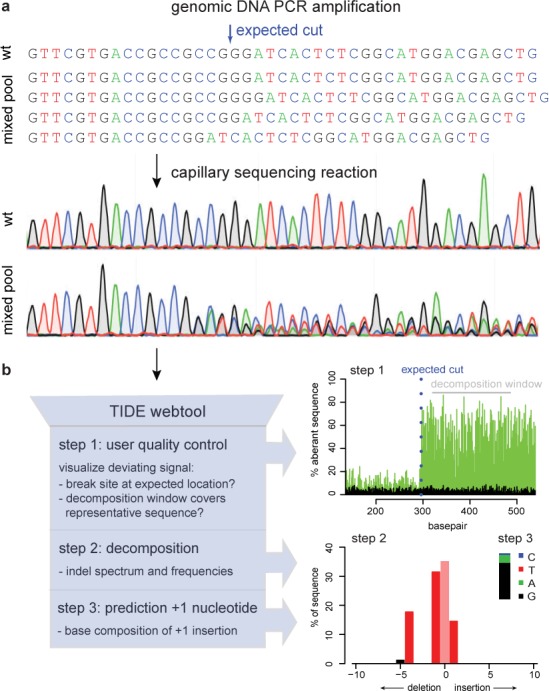
“(b) Overview of TIDE algorithm and output, which consists of three main steps: (1) Visualization of aberrant sequence signal in control (black) and treated sample (green), the expected break site (vertical dotted line) and the region used for decomposition (gray bar); (2) Decomposition yielding the spectrum of indels…”
BackgroundMethodGenetic screens in human cells using the CRISPR-Cas9 system
Wang, T., Wei, J. J., Sabatini, D. M., & Lander, E. S. (2014) · Science · doi:10.1126/science.1246981 · Cited by 2,856
Improving CRISPR-Cas nuclease specificity using truncated guide RNAs
Fu, Y., Sander, J. D., Reyon, D., Cascio, V. M., & Joung, J. K. (2014) · Nature Biotechnology · doi:10.1038/nbt.2808 · Cited by 1,993 · cited 1×
“However, the efficacy and the spectrum of mutations vary greatly depending on the RGEN target site and cells used ((17,18) and this report).”
BackgroundCHOPCHOP: a CRISPR/Cas9 and TALEN web tool for genome editing
Montague, T. G., Cruz, J. M., Gagnon, J. A., Church, G. M., & Valen, E. (2014) · Nucleic Acids Research · doi:10.1093/nar/gku410 · Cited by 1,234
Cas9 as a versatile tool for engineering biology
Mali, P., Esvelt, K. M., & Church, G. M. (2013) · Nature Methods · doi:10.1038/nmeth.2649 · Cited by 1,197 · cited 1×
“For example, with RGENs one typically needs to test several single-guide RNAs (sgRNAs) that are predicted to target the endonuclease to a gene of interest (6).”
BackgroundA guide to genome engineering with programmable nucleases
Kim, H., & Kim, J.-S. (2014) · Nature Reviews Genetics · doi:10.1038/nrg3686 · Cited by 1,163 · cited 3×
“(b) Overview of TIDE algorithm and output, which consists of three main steps: (1) Visualization of aberrant sequence signal in control (black) and treated sample (green), the expected break site (vertical dotted line) and the region used for decomposition (gray bar); (2) Decomposition yielding the spectrum of indels…”
BackgroundMethod
Cited by
Items 901–1,000 of 1,019
Collias, D., Leenay, R. T., Slotkowski, R., Zuo, Z., Collins, S. P., McGirr, B. A., Liu, J., & Beisel, C. L. (2020) · Science Advances · doi:10.1126/sciadv.abb4054 · Cited by 28
ETV7 regulates breast cancer stem-like cell features by repressing IFN-response genes
Pezzè, L., Meškytė, E. M., Forcato, M., Pontalti, S., Badowska, K. A., Rizzotto, D., Skvortsova, I., Bicciato, S., & Ciribilli, Y. (2021) · Cell Death and Disease · doi:10.1038/s41419-021-04005-y · Cited by 26
Optimization of lipid nanoparticles for gene editing of the liver via intraduodenal delivery
Zhu, Y., Cai, S. S., Ma, J., Cheng, L., Wei, C. Y., Aggarwal, A., Toh, W. H., Shin, C., Shen, R., Kong, J., et al. (2024) · Biomaterials · doi:10.1016/j.biomaterials.2024.122559 · Cited by 25
How to use CRISPR/Cas9 in plants: from target site selection to DNA repair
Přibylová, A., & Fischer, L. (2024) · Journal of Experimental Botany · doi:10.1093/jxb/erae147 · Cited by 26
Pulice, J. L., & Meyerson, M. M. (2023) · Molecular Cell · doi:10.1016/j.molcel.2025.03.001 · Cited by 26
CRISPR/Cas9-Mediated Genome Editing for Huntington’s Disease
Vachey, G., & Déglon, N. (2018) · Methods in molecular biology · doi:10.1007/978-1-4939-7825-0_21 · Cited by 25
Efficient CRISPR/Cas9‐Mediated Mutagenesis in Primary Murine T Lymphocytes
Huang, B., Johansen, K. H., & Schwartzberg, P. L. (2018) · Current Protocols in Immunology · doi:10.1002/cpim.62 · Cited by 26
Collins, M. A., Li, Y., & Bowser, R. P. (2020) · Acta Neuropathologica Communications · doi:10.1186/s40478-020-00965-y · Cited by 24
Induced Liver Regeneration Enhances CRISPR/Cas9-Mediated Gene Repair in Tyrosinemia Type 1
Zhang, Q., Tiyaboonchai, A., Nygaard, S. C., Baradar, K., Major, A. M., Balaji, N., & Grompe, M. (2021) · Human Gene Therapy · doi:10.1089/hum.2020.042 · Cited by 28
“The resultant plasmids were used to transfect the human liver cell line Huh7 cells (purchased from ATCC) and the indel frequencies were evaluated by Tide analysis 3 days after transfection.(12) The most active sgRNA was chosen and cloned into pAAV2 plasmid under the control of U6 promoter.”
MethodSu, C., Lu, F. Y., Soldan, S. S., Lamontagne, J., Tang, H., Napoletani, G., Farrell, P. J., Tempera, I., Kossenkov, A. V., & Lieberman, P. M. (2021) · PLoS Pathogens · doi:10.1371/journal.ppat.1009834 · Cited by 25
“The sequence trace was analyzed by the TIDE algorithm (available at https://tide.nki.nl) [77].”
A human iPSC-derived inducible neuronal model of Niemann-Pick disease, type C1
Prabhu, A. V., Kang, I., Pace, R. D., Wassif, C. A., Fujiwara, H., Kell, P. J., Jiang, X., Ory, D. S., Bonifacino, J. S., Ward, M. E., et al. (2021) · BMC Biology · doi:10.1186/s12915-021-01133-x · Cited by 25
TCR-induced FOXP3 expression by CD8+ T cells impairs their anti-tumor activity
Lozano, T., Conde, E., Martín-Otal, C., Navarro, F. C., Lasarte-Cía, A., Nasrallah, R., Alignani, D., Gorraiz, M., Sarobe, P., Romero, J. P., et al. (2021) · Cancer Letters · doi:10.1016/j.canlet.2021.12.030 · Cited by 24
TNFR2 is critical for TNF-induced rheumatoid arthritis fibroblast-like synoviocyte inflammation
Suto, T., Tosevska, A., von Dalwigk, K., Kugler, M., Dellinger, M., Stanic, I., Platzer, A., Niederreiter, B., Sevelda, F., Bonelli, M. M., et al. (2022) · Rheumatology · doi:10.1093/rheumatology/keac124 · Cited by 25
Boosting targeted genome editing using the hei-tag
Thumberger, T., Tavhelidse, T., Triana, J. A. G., Medert, R., Cornean, A., Welz, B., Freichel, M., & Wittbrodt, J. (2022) · eLife · doi:10.7554/elife.70558 · Cited by 27
Kubala, J. M., Laursen, K. B., Schreiner, R. P., Williams, R. M., van der Mijn, J. C., Crowley, M. J. P., Mongan, N. P., Nanus, D. M., Heller, D. A., & Gudas, L. J. (2023) · Cancer Biology & Therapy · doi:10.1080/15384047.2023.2170669 · Cited by 26
“Single-cell dilutions were plated and individual clones were genotyped by PCR amplification, followed by TIDE analysis.(15) This approach resulted in the generation of the monoclonal NDUFA4L2 KO line RCC4-Mc-2.”
MethodBelosludtsev, K. N., Serov, D. A., Ilzorkina, A. I., Starinets, V. S., Dubinin, M. V., Talanov, E. Y., Karagyaur, M. N., Primak, A. L., & Belosludtseva, N. V. (2023) · Antioxidants · doi:10.3390/antiox12071459 · Cited by 24
“The “TIDE: Tracking of Indels by the Decomposition” software [35] was used for analysis of sequencing results of the edited genes to elucidate”
MethodFANCD2-dependent mitotic DNA synthesis relies on PCNA K164 ubiquitination
Leung, W., Baxley, R. M., Traband, E. L., Chang, Y., Rogers, C. B., Wang, L., Durrett, W., Bromley, K., Fiedorowicz, L., Thakar, T., et al. (2023) · Cell Reports · doi:10.1016/j.celrep.2023.113523 · Cited by 25
The molecular basis of tRNA selectivity by human pseudouridine synthase 3
Lin, T.-Y., Kleemann, L., Jeżowski, J., Dobosz, D., Rawski, M., Indyka, P., Ważny, G., Mehta, R., Chramiec‐Głąbik, A., Koziej, L., et al. (2024) · Molecular Cell · doi:10.1016/j.molcel.2024.06.013 · Cited by 26
Goodman, M., Arumugam, P. I., Pillis, D. M., Loberg, A., Nasimuzzaman, M., Lynn, D., van der Loo, J. C. M., Dexheimer, P. J., Keddache, M. A., Bauer, T. R., et al. (2017) · Journal of Virology · doi:10.1128/jvi.01639-17 · Cited by 25
“The gRNA efficiency was determined using the tracking of indels by decomposition (TIDE) assay (63).”
MethodDistinct SoxB1 networks are required for naïve and primed pluripotency
Corsinotti, A., Wong, F. C. K., Tatar, T., Szczerbinska, I., Halbritter, F., Colby, D., Gogolok, S., Pantier, R., Liggat, K., Mirfazeli, E. S., et al. (2017) · eLife · doi:10.7554/elife.27746 · Cited by 24
“The frequency and length of indels induced by CRISPR/Cas9-mediated targeting of the endogenous Sox2 locus were investigated by TIDE (Tracking of Indels by Decomposition) analysis (Brinkman et al, 2014).”
MethodRatcliffe, C. D. H., Siddiqui, N., Coelho, P. P., Laterreur, N., Cookey, T. N., Sonenberg, N., & Park, M. (2018) · The Journal of Cell Biology · doi:10.1083/jcb.201804106 · Cited by 25
“Microexon splicing patterns Microexon PSI values were determined by adapting a protocol designed for estimating the frequency of genome editing events (Brinkman et al., 2014).”
MethodBouchard, M. F., Bergeron, F., Delaney, J. G., Harvey, L.-M., & Viger, R. S. (2019) · Endocrinology · doi:10.1210/en.2019-00047 · Cited by 32
“Amplicons were sequenced and analyzed using the Web tool TIDE (for tracking indels by decomposition) to evaluate the extent of Cas9-mediated rearrangements that occurred (53) and to identify the desired mutated or deleted alleles.”
MethodProduction and Validation of Lentiviral Vectors for CRISPR/Cas9 Delivery
Ryø, L. B., Thomsen, E. A., & Mikkelsen, J. G. (2019) · Methods in molecular biology · doi:10.1007/978-1-4939-9170-9_7 · Cited by 26
Genome Editing with CRISPR‐Cas: An Overview
Robb, G. B. (2019) · Current Protocols Essential Laboratory Techniques · doi:10.1002/cpet.36 · Cited by 30
Murine Surf4 is essential for early embryonic development
Emmer, B. T., Lascuna, P. J., Tang, V. T., Kotnik, E. N., Saunders, T. L., Khoriaty, R. N., & Ginsburg, D. (2020) · PLoS ONE · doi:10.1371/journal.pone.0227450 · Cited by 24
“The relative proportion of each Surf4 allele was quantified by decomposition of Sanger sequencing chromatograms with TIDE indel analysis [45].”
MethodBreau, K. A., Ok, M. T., Gomez-Martinez, I., Burclaff, J., Kohn, N. P., & Magness, S. T. (2022) · Stem Cell Reports · doi:10.1016/j.stemcr.2022.04.005 · Cited by 25
“TIDE analysis, which detects and quantifies insertion/deletion (indel) mutations by sequencing (Brinkman et al., 2014), showed 34.”
BackgroundThe importance of DNAPKcs for blunt DNA end joining is magnified when XLF is weakened
Cisneros‐Aguirre, M., Lopezcolorado, F. W., Tsai, L. J., Bhargava, R., & Stark, J. M. (2022) · Nature Communications · doi:10.1038/s41467-022-31365-6 · Cited by 28
Hong, W., Xie, X., Gu, W., Zheng, Z., Zhuo, J., Shao, Z., Huan, L., Zhang, B., Niu, J., Gao, S., et al. (2024) · New Phytologist · doi:10.1111/nph.20123 · Cited by 25
“TIDE (Brinkman et al ., 2014) analysis of Sanger sequencing data from chimeras 3, 5, 8, and 22 revealed indel frequencies of 43.4%, 29.7%, 28.8%, and 25.9%, respectively (Fig.”
InfluentialHomologous recombination promotes non-immunogenic mitotic cell death upon DNA damage
Szmyd, R., Casolin, S., French, L., Manjón, A. G., Walter, M., Cavalli, L., Nelson, C. B., Page, S. G., Dhawan, A., Hau, E. K. C., et al. (2025) · Nature Cell Biology · doi:10.1038/s41556-024-01557-x · Cited by 28
Lewis, R. T., Sinigiani, V., Maziak, N., Koós, K., Bersaglieri, C., Zemp, I., Ashiono, C., Ciaudo, C., Horváth, P., Vaquerizas, J. M., et al. (2026) · Nature Cell Biology · doi:10.1038/s41556-025-01822-7 · Cited by 26
Lamarthée, B., Burger, C., Leclaire, C., Lebraud, E., Zablocki, A., Morin, L., Lebreton, X., Charreau, B. L., Snanoudj, R., Charbonnier, S., et al. (2021) · Journal of the American Society of Nephrology · doi:10.1681/asn.2021050689 · Cited by 24
Generation of mutant pigs by lipofection-mediated genome editing in embryos
Hirata, M., Wittayarat, M., Namula, Z., Le, Q. A., Lin, Q., Takebayashi, K., Thongkittidilok, C., Mito, T., Tomonari, S., Tanihara, F., et al. (2021) · Scientific Reports · doi:10.1038/s41598-021-03325-5 · Cited by 23
Transposase-CRISPR mediated targeted integration (TransCRISTI) in the human genome
Bazaz, M. R., Seno, M. M. G., & Dehghani, H. (2022) · Scientific Reports · doi:10.1038/s41598-022-07158-8 · Cited by 24
Rathbone, T., Ates, I., Fernando, L. P., Addlestone, E., Lee, C. M., Richards, V. P., & Cottle, R. N. (2022) · The CRISPR Journal · doi:10.1089/crispr.2021.0134 · Cited by 24
Yee, J. X., Rastani, A., & Soden, M. E. (2022) · Journal of Neurophysiology · doi:10.1152/jn.00194.2022 · Cited by 24
Liang, Y., Han, W., Xu, C., Wang, J., Zhang, J., An, J., Liu, W., Liu, J., Zhang, Z., Shi, J., et al. (2023) · Advanced Functional Materials · doi:10.1002/adfm.202301256 · Cited by 23
Molecular mechanisms of tubulogenesis revealed in the sea star hydro-vascular organ
Perillo, M., Swartz, S. Z., Pieplow, C. A., & Wessel, G. M. (2023) · Nature Communications · doi:10.1038/s41467-023-37947-2 · Cited by 24
“The fi rst package: TIDE (Tracking of Indels by Decomposition (V. 3.3.0); 55 is used for the Six1/2 and Delta mutants.”
InfluentialIron oxide-coupled CRISPR-nCas9-based genome editing assessment in mucopolysaccharidosis IVA mice
Leal, A. F., Çelik, B., Nidhi, F., Khan, S. A., Tomatsu, S., & Alméciga-Díaz, C. J. (2023) · Molecular Therapy — Methods & Clinical Development · doi:10.1016/j.omtm.2023.101153 · Cited by 24
Rapid and Sensitive Assessment of Globin Chains for Gene and Cell Therapy of Hemoglobinopathies
Loucari, C. C., Patsali, P., van Dijk, T. B., Stephanou, C., Papasavva, P. L., Zanti, M., Kurita, R., Nakamura, Y., Christou, S., Sitarou, M., et al. (2018) · Human Gene Therapy Methods · doi:10.1089/hgtb.2017.190 · Cited by 23
“nl) was then used to decompose the mixed traces and determine the insertion and deletion pattern typical of the designer nucleases in hand.(49)”
MethodGermline Mutations in FAF1 Are Associated With Hereditary Colorectal Cancer
Bonjoch, L., Franch‐Expósito, S., Garré, P., Belhadj, S., Muñoz, J., Arnau‐Collell, C., Díaz‐Gay, M., Gratacós-Mulleras, A., Raimondi, G., Esteban-Jurado, C., et al. (2020) · Gastroenterology · doi:10.1053/j.gastro.2020.03.015 · Cited by 23
Chien, J. C.-Y., Tabet, E. I., Pinkham, K., da Hora, C. C., Chang, J. C.-Y., Lin, S., Badr, C. E., & Lai, C. P. (2020) · Nucleic Acids Research · doi:10.1093/nar/gkaa669 · Cited by 23
“In recent years, alternative strategies including tracking of indels by decomposition (TIDE) and tracking of insertions, deletions and recombination events (TIDER) have been developed (24,25).”
Development of a Transformable Fast-Flowering Mini-Maize as a Tool for Maize Gene Editing
McCaw, M., Lee, K., Kang, M., Zobrist, J. D., Azanu, M. K., Birchler, J. A., & Wang, K. (2021) · Frontiers in Genome Editing · doi:10.3389/fgeed.2020.622227 · Cited by 23
“Then the target gene gl2 was analyzed by Sanger sequencing and trace file analyses using the TIDE (Brinkman et al., 2014) and ICE (Hsiau et al.”
MethodInfluentialNon-invasive and high-throughput interrogation of exon-specific isoform expression
Truong, D. J., Phlairaharn, T., Eßwein, B., Gruber, C., Tümen, D., Baligács, E., Armbrust, N., Vaccaro, F. L., Lederer, E.-M., Beck, E. M., et al. (2021) · Nature Cell Biology · doi:10.1038/s41556-021-00678-x · Cited by 23
Dhoke, N. R., Kim, H., Selvaraj, S., Azzag, K., Zhou, H., Oliveira, N. A. D. J., Tungtur, S. K., Ortiz‐Cordero, C., Kiley, J., Lu, Q. L., et al. (2021) · Cell Reports · doi:10.1016/j.celrep.2021.109360 · Cited by 24
Baron, Y., Sens, J., Lange, L., Nassauer, L., Klatt, D., Hoffmann, D., Kleppa, M., Barbosa, P. V., Keisker, M., Steinberg, V., et al. (2022) · Molecular Therapy — Nucleic Acids · doi:10.1016/j.omtn.2021.12.033 · Cited by 24
“TP53 supernatants and assessed theTP53 insertion and deletion (indel) frequencies within these cultures via tracking of indels by decomposition (TIDE) analysis.(62) Strikingly, the lowest applied particle dose with 83 SpCas9.”
MethodBresser, K., Logtenberg, M. E. W., Toebes, M., Proost, N., Sprengers, J., Siteur, B., Boeije, M., Kroese, L. J., & Schumacher, T. N. (2022) · OncoImmunology · doi:10.1080/2162402x.2022.2049486 · Cited by 24
Du, J., Shang, J., Chen, F., Zhang, Y., Yin, N., Xie, T., Zhang, H., Yu, J., & Liu, F. (2017) · Molecular Cancer Therapeutics · doi:10.1158/1535-7163.mct-17-0090 · Cited by 23
“For example, a sequence trace decomposition strategy has been developed for the identification of short sequence deletions and insertions (43), and it has been reported that a digital PCR-based assay enabled the simultaneous detection of HR and NHEJ of the nuclease-induced DSBs (44).”
MethodPan, X., Huang, P., Ali, S., Renslo, B., Hutchinson, T. E., Erwin, N., Greenberg, Z., Ding, Z., Li, Y., Warnecke, A., et al. (2025) · Science Translational Medicine · doi:10.1126/scitranslmed.adn3993 · Cited by 24
TRIM37 prevents formation of condensate-organized ectopic spindle poles to ensure mitotic fidelity
Meitinger, F., Kong, D., Ohta, M., Desai, A. B., Oegema, K., & Lončarek, J. (2021) · The Journal of Cell Biology · doi:10.1083/jcb.202010180 · Cited by 22
Jain, S., Xun, G., Abesteh, S., Ho, S., Lingamaneni, M., Martin, T. A., Tasan, I., Che, Y., & Zhao, H. (2021) · ACS Synthetic Biology · doi:10.1021/acssynbio.0c00548 · Cited by 22
Evaluation of two in vitro assays for tumorigenicity assessment of CRISPR-Cas9 genome-edited cells
Lemmens, M., Fischer, B., Zogg, M., Rodrigues, L. U., Kerr, G., Río-Espínola, A. D., Schaeffer, F., Maddalo, D., Dubost, V., Piaia, A., et al. (2021) · Molecular Therapy — Methods & Clinical Development · doi:10.1016/j.omtm.2021.09.004 · Cited by 23
Verma, M., Loh, N. Y., Sabaratnam, R., Vasan, S. K., van Dam, A. D., Todorčević, M., Neville, M., Toledo, E. M., Karpe, F., & Christodoulides, C. (2022) · Metabolism · doi:10.1016/j.metabol.2022.155240 · Cited by 27
Evolution of a chordate-specific mechanism for myoblast fusion
Zhang, H., Shang, R., Kim, K., Zheng, W. H., Johnson, C. J., Sun, L., Niu, X., Liu, L., Zhou, J., Liu, L., et al. (2022) · Science Advances · doi:10.1126/sciadv.add2696 · Cited by 23
FACS-assisted CRISPR-Cas9 genome editing of human induced pluripotent stem cells
Caillaud, A., Lévêque, A., Thedrez, A., Girardeau, A., Canac, R., Bray, L., Baudic, M., Barc, J., Gaborit, N., Lamirault, G., et al. (2022) · STAR Protocols · doi:10.1016/j.xpro.2022.101680 · Cited by 25
Mattis, K. K., Krentz, N. A. J., Metzendorf, C., Abaitua, F., Spigelman, A. F., Sun, H., Iklé, J. M., Thaman, S., Rottner, A. K., Bautista, A., et al. (2023) · Diabetologia · doi:10.1007/s00125-022-05856-6 · Cited by 23
“Sanger sequencing followed by TIDE analysis [37] of PCR products surrounding the cut sites at exons 4, 5, 8 and 12 revealed an editing efficiency of 2–24% (ESM Fig.”
MethodMazouzi, A., Moser, S. C., Abascal, F., van den Broek, B., Velasco‐Herrera, M. D. C., van der Heijden, I., Hekkelman, M. L., Drenth, A. P., van der Burg, E., Kroese, L. J., et al. (2023) · Science Advances · doi:10.1126/sciadv.adf4409 · Cited by 25
“Successful editing of selected clones was verified by Sanger sequencing of the polymerase chain reaction (PCR) products, generated using primers listed in table S4 and TIDE analysis ( 44 ), or loss of the targeted protein was assessed by immuno-blotting.”
Stephenson, A. A., Nicolau, S., Vetter, T. A., Dufresne, G., Frair, E. C., Sarff, J., Wheeler, G. L., Kelly, B., White, P., & Flanigan, K. M. (2023) · Molecular Therapy — Methods & Clinical Development · doi:10.1016/j.omtm.2023.08.009 · Cited by 23
“The sequencing data were analyzed using TIDE to estimate gene editing activity.(43)”
MethodGüngör, B., Biró, J. B., Domonkos, Á., Horváth, B., & Kaló, P. (2023) · Scientific Reports · doi:10.1038/s41598-023-47608-5 · Cited by 22
Genome editing prospects for heat stress tolerance in cereal crops
Pandey, S., Divakar, S., & Singh, A. K. (2024) · Plant Physiology and Biochemistry · doi:10.1016/j.plaphy.2024.108989 · Cited by 24
Tempora, P., D’Amico, S., Gragera, P., Damiani, V., Król, K., Scaldaferri, V., Pandey, K., Chung, S., Lucarini, V., Giorda, E., et al. (2024) · Journal of Experimental & Clinical Cancer Research · doi:10.1186/s13046-024-03180-y · Cited by 22
Deciphering a cryptic minefield: A guide to Cryptosporidium gp60 subtyping
Robinson, G., Chalmers, R. M., Elwin, K., Guy, R. A., Bessonov, K., Troell, K., & Xiao, L. (2025) · Current Research in Parasitology and Vector-Borne Diseases · doi:10.1016/j.crpvbd.2025.100257 · Cited by 22
“TIDE (Tracking of InDels by Decomposition) is an algorithm originally developed to analyse DNA sequencing data for the identification and quantification of indels (insertions and deletions) in heterogeneous populations (Brinkman et al., 2014).”
Tálas, A., Kulcsár, P. I., Weinhardt, N., Borsy, A., Tóth, E., Szebényi, K., Krausz, S. L., Huszár, K., Vida, I., Sturm, Á., et al. (2017) · DNA Research · doi:10.1093/dnares/dsx029 · Cited by 24
Etard, C., Joshi, S., Stegmaier, J., Mikut, R., & Strähle, U. (2017) · Zebrafish · doi:10.1089/zeb.2017.1454 · Cited by 22
Turan, S., Boerstler, T., Kavyanifar, A., Loskarn, S., Reis, A., Winner, B., & Lie, D. C. (2019) · Human Molecular Genetics · doi:10.1093/hmg/ddz089 · Cited by 22
Multiplexed CRISPR/Cas9 gene knockout with simple crRNA:tracrRNA co-transfection
Khan, F. J., Yuen, G., & Luo, J. (2019) · Cell & Bioscience · doi:10.1186/s13578-019-0304-0 · Cited by 21
Modeling Neuronal Diseases in Zebrafish in the Era of CRISPR
Espino-Saldaña, Á. E., Rodríguez-Ortiz, R., Pereida‐Jaramillo, E., & Martínez‐Torres, A. (2019) · Current Neuropharmacology · doi:10.2174/1570159x17666191001145550 · Cited by 25
YAMASHITA, S., Kogasaka, Y., Hiradate, Y., Tanemura, K., & Sendai, Y. (2019) · Journal of Reproduction and Development · doi:10.1262/jrd.2019-088 · Cited by 23
Andersen, N.-S. B., Jørgensen, S. E., Skipper, K. A., Larsen, S. M., Heinz, J., Thomsen, M. M., Farahani, E., Cai, Y., Hait, A. S., Kay, L., et al. (2020) · Autophagy · doi:10.1080/15548627.2020.1831800 · Cited by 22
Brachyury controls Ciona notochord fate as part of a feed-forward network
Reeves, W., Shimai, K., Winkley, K., & Veeman, M. T. (2021) · Development · doi:10.1242/dev.195230 · Cited by 23
Partial p53 reactivation is sufficient to induce cancer regression
Klimovich, B., Meyer, L., Merle, N., Neumann, M. M., König, A. M., Ananikidis, N., Keber, C. U., Elmshäuser, S., Timofeev, O. N., & Stiewe, T. (2022) · Journal of Experimental & Clinical Cancer Research · doi:10.1186/s13046-022-02269-6 · Cited by 23
“CRISPR-mediated Trp53 knock-out was confirmed by Sanger sequencing and InDel analysis using the TIDE algorithm [53].”
MethodIdentification and characterization of RBM12 as a novel regulator of fetal hemoglobin expression
Wakabayashi, A., Kihiu, M., Sharma, M., Thrasher, A. J., Saari, M. S., Quesnel-Vallières, M., Abdulmalik, O. Y., Peslak, S. A., Khandros, E., Keller, C. A., et al. (2022) · Blood Advances · doi:10.1182/bloodadvances.2022007904 · Cited by 23
Applications of CRISPR genome editing technology in drug target identification and validation
Lu, Q., Livi, G. P., Modha, S. S., Yusa, K., Macarrón, R., & Dow, D. J. (2017) · Expert Opinion on Drug Discovery · doi:10.1080/17460441.2017.1317244 · Cited by 29
“On-target changes in genome-edited cells can be readily monitored by the T7 endonuclease-based Surveyor assay [45], or sequencing-based procedures such as the TIDE assay [46] or the OutKnocker Mi-seq assay [47].”
MethodGenetic knockdown and knockout approaches in HydraPreprint
Lommel, M., Tursch, A., Rustarazo-Calvo, L., Trageser, B., & Holstein, T. W. (2017) · bioRxiv (Cold Spring Harbor Laboratory) · doi:10.1101/230300 · Cited by 23
“The GFP locus of treated and mock-treated animals was sequenced by Sanger sequencing following decomposition of the sequence tracks using the TIDE software (Brinkman et al., 2014).”
MethodInfluentialRNA Pol II inhibition activates cell death independently from the loss of transcription
Harper, N. W., Birdsall, G. A., Honeywell, M. E., Ward, K. M., Pai, A. A., & Lee, M. J. (2025) · Cell · doi:10.1016/j.cell.2025.07.034 · Cited by 21
Digital detection of endonuclease mediated gene disruption in the HIV provirus
Sedlak, R. H., Liang, S. Y., Niyonzima, N., Feelixge, H. S. D. S., Roychoudhury, P., Greninger, A. L., Weber, N. D., Boissel, S., Scharenberg, A. M., Cheng, A., et al. (2016) · Scientific Reports · doi:10.1038/srep20064 · Cited by 23
Shi, X. E., Kitano, A., Jiang, Y., Luu, V., Hoegenauer, K. A., & Nakada, D. (2018) · Experimental Hematology · doi:10.1016/j.exphem.2018.04.009 · Cited by 21
“PCR amplicons spanning Cas9 cleavage sites were Sanger sequenced and the TIDE program was used as previously described(Brinkman et al., 2014).”
MethodKnock-In of a Large Reporter Gene via the High-Throughput Microinjection of the CRISPR/Cas9 System
Chen, S., Jiao, Y., Pan, F., Guan, Z., Cheng, S. H., & Sun, D. B. (2022) · IEEE Transactions on Biomedical Engineering · doi:10.1109/tbme.2022.3149530 · Cited by 23
“The sequencing results were analyzed using TIDE software [47].”
MethodEstablishment of an Efficient Genome Editing System in Lettuce Without Sacrificing Specificity
Pan, W., Liu, X., Li, D., & Zhang, H. (2022) · Frontiers in Plant Science · doi:10.3389/fpls.2022.930592 · Cited by 22
“The sequencing chromatogram were decoded with the TIDE program2 (Brinkman et al., 2014).”
MethodWidmer, C. A., Klebic, I., Domanitskaya, N., Decollogny, M., Howald, D., Siffert, M., Essers, P., Nowicka, Z., Stokar‐Regenscheit, N., van de Ven, M., et al. (2022) · Cancer Research Communications · doi:10.1158/2767-9764.crc-22-0208 · Cited by 23
“S3D) or harvested and the gDNA isolated and processed for subsequent TIDE analysis as described previously (28).”
MethodInfluentialCrystal structure of the CDK11 kinase domain bound to the small-molecule inhibitor OTS964
Kelso, S., O’Brien, S., Kurinov, I. V., Angers, S., & Sicheri, F. (2022) · Structure · doi:10.1016/j.str.2022.10.003 · Cited by 21
PAQR8 promotes breast cancer recurrence and confers resistance to multiple therapies
Chen, S., Paul, M. R., Sterner, C. J., Belka, G. K., Wang, D., Xu, P. J., Sreekumar, A., Pan, T.-C., Pant, D. K., Makhlin, I., et al. (2023) · Breast Cancer Research · doi:10.1186/s13058-022-01559-3 · Cited by 25
“B eGFP to mCherry ratios determined by ddPCR after injecting a mixture of 80% H2B‑eGFP‑labeled Paqr8-OE cells and 20% H2B‑mCherry‑labeled control cells.”
MethodInfluentialWatanuki, S., Kobayashi, H., Sugiura, Y., Yamamoto, M., Karigane, D., Shiroshita, K., Sorimachi, Y., Fujita, S., Morikawa, T., Koide, S., et al. (2024) · eLife · doi:10.7554/elife.87674 · Cited by 22
Chatterjee, D., Zhang, Y., Yoka, C. D. N., Dutilleul, A., Khalfi, S., Hernalsteens, O., Salinas, T. R. W., Dias, J., Chen, H., Smail, Y., et al. (2023) · Cell Reports · doi:10.1016/j.celrep.2023.112634 · Cited by 21
Bevill, S. M., Casaní-Galdón, S., Farran, C. A. E., Cytrynbaum, E. G., Macias, K. A., Oldeman, S. E., Oliveira, K. J., Moore, M. M., Hegazi, E., Adriaens, C., et al. (2023) · Cell Genomics · doi:10.1016/j.xgen.2023.100321 · Cited by 23
Female Aedes aegypti mosquitoes use communal cues to manage population density at breeding sites
Costa‐da‐Silva, A. L., Cabal, S., Lopez, K., Boloix, J., Rodriguez, B. G., Marrero, K. M., Bellantuono, A. J., & DeGennaro, M. (2024) · Communications Biology · doi:10.1038/s42003-024-05830-5 · Cited by 21
Chromatin context-dependent effects of epigenetic drugs on CRISPR-Cas9 editing
Schep, R., Trauernicht, M., Vergara, X., Friskes, A., Morris, B., Gregoricchio, S., Manzo, S. G., Zwart, W. T., Beijersbergen, R. L., Medema, R. H., et al. (2024) · Nucleic Acids Research · doi:10.1093/nar/gkae570 · Cited by 23
“We used TIDE ( 43 ) to determine indel spectra and to estimate the changes in TIF upon drug treatment.”
MethodInfluentialNoda, T., Oji, A., & Ikawa, M. (2017) · Methods in molecular biology · doi:10.1007/978-1-4939-7128-2_6 · Cited by 21
Computational design of anti-CRISPR proteins with improved inhibition potency
Mathony, J., Harteveld, Z., Schmelas, C., zu Belzen, J. U., Aschenbrenner, S., Sun, W. Y., Hoffmann, M. D., Stengl, C., Scheck, A., Georgeon, S., et al. (2020) · Nature Chemical Biology · doi:10.1038/s41589-020-0518-9 · Cited by 23
Felce, J. H., Parolini, L., Sezgin, E., Céspedes, P. F., Korobchevskaya, K., Jones, M., Peng, Y., Dong, T., Fritzsche, M., Aarts, D. G. A. L., et al. (2021) · Frontiers in Cell and Developmental Biology · doi:10.3389/fcell.2020.608484 · Cited by 23
Chernyakov, D., Groß, A., Fischer, A., Bornkessel, N., Schultheiß, C., Gerloff, D., & Edemir, B. (2021) · Journal of Experimental & Clinical Cancer Research · doi:10.1186/s13046-021-01982-y · Cited by 21
Different DNA repair pathways are involved in single-strand break-induced genomic changes in plants
Wolter, F., Schindele, P., Beying, N., Scheben, A., & Puchta, H. (2021) · The Plant Cell · doi:10.1093/plcell/koab204 · Cited by 21
“In order to determine guide RNA efficiencies, the respective target regions from 10 pooled transgenic plants each, transformed with the T-DNA harboring the Cas9 nuclease programmed to target the individual target sites, were amplified and subjected to TIDE analysis (Brinkman et al., 2014).”
MethodFagg, W. S., Liu, N., Braunschweig, U., de Castro, K. L. P., Chen, X., Ditmars, F. S., Widen, S. G., Donohue, J. P., Módis, K., Russell, W. K., et al. (2022) · Nucleic Acids Research · doi:10.1093/nar/gkac327 · Cited by 24
Bossert, J. M., Mejías-Aponte, C. A., Saunders, T. L., Altidor, L., Emery, M. A., Fredriksson, I., Batista, A., Claypool, S. M., Caldwell, K. E., Reiner, D. J., et al. (2023) · Journal of Neuroscience · doi:10.1523/jneurosci.2049-22.2023 · Cited by 23
Chen, P.-F., Hsiao, J. S., Sirois, C. L., & Chamberlain, S. J. (2016) · Scientific Reports · doi:10.1038/srep25368 · Cited by 23
Jabalera, Y., Tascón, I., Samperio, S., López-Alonso, J. P., González-Lopez, M., Aransay, A. M., Abascal-Palacios, G., Beisel, C. L., Ubarretxena‐Belandia, I., & Pérez‐Jiménez, R. (2024) · Nature Biotechnology · doi:10.1038/s41587-024-02461-3 · Cited by 26
“19).”
Characterization of host proteins interacting with the lymphocytic choriomeningitis virus L protein
Khamina, K., Lercher, A., Caldera, M., Schliehe, C., Vilagos, B., Sahin, M., Kosack, L., Bhattacharya, A., Májek, P., Stukalov, A., et al. (2017) · PLoS Pathogens · doi:10.1371/journal.ppat.1006758 · Cited by 21
Wang, Z., Zhang, C., Warden, C., Liu, Z., Yuan, Y., Guo, C., Wang, C., Wang, J., Wu, X., Ermel, R. W., et al. (2022) · Communications Biology · doi:10.1038/s42003-022-03340-w · Cited by 20
A novel nanoluciferase transgenic reporter measures proteinuria in zebrafish
Naylor, R. W., Lemarie, E., Jackson-Crawford, A., Davenport, B., Mironov, A., Lowe, M., & Lennon, R. (2022) · Kidney International · doi:10.1016/j.kint.2022.05.019 · Cited by 20
Angeli, P. D., Reuter, P., Hauser, S., Schöls, L. J., Štingl, K., Wissinger, B., & Kohl, S. (2022) · Molecular Therapy — Nucleic Acids · doi:10.1016/j.omtn.2022.07.023 · Cited by 29
“to the instructions present in the original publication.(63) Primers used for the amplification and sequencing of the genomic locus are listed in Table S2.”
MethodWang, Y., Li, R., Zhu, Z., Yuan, Z., Wang, C., Wang, L., Zhang, D., & Yang, L. (2022) · Sensors and Actuators B Chemical · doi:10.1016/j.snb.2022.132781 · Cited by 20
Metadata
- Authors
- Brinkman, E. K., Chen, T., Amendola, M., & van Steensel, B.
- Affiliations
- The Netherlands Cancer Institute (NL)
- Division of Gene Regulation, Netherlands Cancer Institute, Plesmanlaan 121, 1016 HM Amsterdam, the Netherlands
- Venue
- Nucleic Acids Research
- Publisher
- Oxford University Press (OUP)
- Published
- 2014-10-09
- Volume
- 42
- Issue
- 22
- Pages
- e168-e168
- ISSN
- 0305-1048 (ISSN-L)
- 1362-4962
- PMC
- PMC4267669
- OpenAlex
- W2106070783
- Cited by
- 2,390
- References
- 19
- Citations by year
- 2026: 184 · 2025: 261 · 2024: 253 · 2023: 290 · 2022: 280 · 2021: 259 · 2020: 263 · 2019: 241 · 2018: 186 · 2017: 105 · 2016: 48 · 2015: 16 · 2014: 2
- FWCI
- 23.39
- Type
- journal article
- Language
- en
- Open access
- gold
- doi.org
- Locations
- Nucleic Acids Research (publishedVersion, cc-by)
- Europe PMC (PubMed Central) (publishedVersion, cc-by)
- PubMed Central (publishedVersion, cc-by)
- PubMed (publishedVersion)
- HAL (submittedVersion)
- Institutional Research Information System University of Ferrara (University of Ferrara) (submittedVersion)
- Funders
- ZonMw
- Nederlandse Organisatie voor Wetenschappelijk Onderzoek
- FP7 Ideas: European Research Council (293662)
- Topics
- Life Sciences › Biochemistry, Genetics and Molecular Biology › Molecular Biology › CRISPR and Genetic Engineering
- Life Sciences › Biochemistry, Genetics and Molecular Biology › Molecular Biology › RNA regulation and disease
- Life Sciences › Biochemistry, Genetics and Molecular Biology › Cancer Research › Cancer Genomics and Diagnostics
- Keywords
- genome editing, tides, induced mutation, CRISPR/Cas9, editing sites, mutation spectrum, web-based tool, PCR-based assays
- MeSH terms
- Algorithms, Cells, Cultured, DNA Mutational Analysis, Humans, Software, Polymerase Chain Reaction, Mutagenesis, K562 Cells, Genomics, INDEL Mutation, CRISPR-Cas Systems
About these checks
Registry, retraction, Cites and statistics results are computed, not judged, with one exception: a printed reference that no index lists is read once by a model before it counts as a citation error. Claims are extracted by a model and kept only when their quote appears verbatim in the text; each cited source is then checked, with a model’s help, for whether it says what the claim relies on. Those verdicts can be wrong — read the claim’s quote and the cited source before relying on one.
Statistics and arithmetic are recomputed, not judged.
Confidence bands are shown only for fields calibrated on our annotated test set. None is calibrated yet, so no band is shown.
What counts as a claim ›How we measure confidence ›How we check this ›
Are you an author, or do you see a problem with this page? Request a review
Data sources
Bibliographic data: Semantic Scholar, OpenAlex, Crossref.
Contains information from the Semantic Scholar Academic Graph Datasets, made available under the ODC Attribution License (ODC-BY 1.0).
Semantic Scholar’s data is described in: Kinney, R., et al. (2023). The Semantic Scholar Open Data Platform. arXiv:2301.10140.
