

Easy quantitative assessment of genome editing by sequence trace decomposition
Open accessThe DOI matches its Crossref record; 19 of the 19 references it cites were found in a registry or an index.
Abstract
The efficacy and the mutation spectrum of genome editing methods can vary substantially depending on the targeted sequence. A simple, quick assay to accurately characterize and quantify the induced mutations is therefore needed. Here we present TIDE, a method for this purpose that requires only a pair of PCR reactions and two standard capillary sequencing runs. The sequence traces are then analyzed by a specially developed decomposition algorithm that identifies the major induced mutations in the projected editing site and accurately determines their frequency in a cell population. This method is cost-effective and quick, and it provides much more detailed information than current enzyme-based assays. An interactive web tool for automated decomposition of the sequence traces is available. TIDE greatly facilitates the testing and rational design of genome editing strategies.
Overview
The claims and statistics of this paper haven’t been checked yet.
Free: it reads the open-access text and checks the first 5 claims that cite a source we can check. Create a free account to check every claim.
Integrity signals
Registry
Cites
Statistics
Figures
Verification
Claims the paper makes
The claims and statistics of this paper haven’t been checked yet.
Free: it reads the open-access text and checks the first 5 claims that cite a source we can check. Create a free account to check every claim.
Claims other papers make about this one
Each is checked against this paper’s own text: does it say what the citing paper says it does?
The source backs part of the claim, not all of it — or backs it for a different population, condition or comparison.
In the citing paper
“Long-term nuclease expression (10 days after transduction), which has been demonstrated to highly favor non-specific cleavages41, did not generate any unspecific CFTR editing above TIDE background levels (about 1%)38; whereas AsCas12a-crRNA+11/wt efficiently edited the CFTR gene (86.3%, Fig. 2b).”
From Allele specific repair of splicing mutations in cystic fibrosis through AsCas12a genome editing (2019) · cites this paper as [38]
Experimental — accuracy not yet measuredThe source backs part of the claim, not all of it — or backs it for a different population, condition or comparison.
In the citing paper
“Genotyping was performed by Sanger sequencing of PCR amplicons of genomic target sites with individual alleles deconvoluted by TIDE analysis of chromatograms[33].”
From Genome-scale CRISPR screening for modifiers of cellular LDL uptake (2021) · cites this paper as [33]
Experimental — accuracy not yet measuredIn the citing paper
“Tracking of InDels by Decomposition (TIDE) is an effective web tool (https://tide.nki.nl) that can be used to analyse sequencing data, which estimates the spectra and frequencies of small insertions and deletions generated from gene editing (Brinkman et al., 2014).”
From Genetic resources and precise gene editing for targeted improvement of barley abiotic stress tolerance (2023) · cites this paper as Brinkman et al., 2014
Self-check
Percentages, sums and reported differences re-computed from the paper’s own numbers.
The self-check needs the paper’s full text.
Citations
Cites
Multiplex Genome Engineering Using CRISPR/Cas Systems
Cong, L., Ran, F. A., Cox, D., Lin, S., Barretto, R., Habib, N., Hsu, P. D., Wu, X., Jiang, W., Marraffini, L. A., et al. (2013) · Science · doi:10.1126/science.1231143 · Cited by 15,339
Bioconductor: open software development for computational biology and bioinformatics
Gentleman, R. C., Carey, V. J., Bates, D. M., Bolstad, B., Dettling, M., Dudoit, S., Ellis, B., Gautier, L., Ge, Y., Gentry, J., et al. (2004) · Genome Biology · doi:10.1186/gb-2004-5-10-r80 · Cited by 12,172 · cited 3×
“scf format) are imported into TIDE using the R Bioconductor (15) package sangerseqR (version 1.”
MethodInfluentialGenome engineering using the CRISPR-Cas9 system
Ran, F. A., Hsu, P. D., Wright, J., Agarwala, V., Scott, D. A., & Zhang, F. (2013) · Nature Protocols · doi:10.1038/nprot.2013.143 · Cited by 11,133 · cited 1×
“edu/) (13) and CHOPCHOP (https://chopchop.”
DNA targeting specificity of RNA-guided Cas9 nucleases
Hsu, P. D., Scott, D. A., Weinstein, J. A., Ran, F. A., Konermann, S., Agarwala, V., Li, Y., Fine, E. J., Wu, X., Shalem, O., et al. (2013) · Nature Biotechnology · doi:10.1038/nbt.2647 · Cited by 4,741 · cited 1×
“However, the efficacy and the spectrum of mutations vary greatly depending on the RGEN target site and cells used ((17,18) and this report).”
BackgroundZFN, TALEN, and CRISPR/Cas-based methods for genome engineering
Gaj, T., Gersbach, C. A., & Barbas, C. F. (2013) · Trends in Biotechnology · doi:10.1016/j.tibtech.2013.04.004 · Cited by 3,820 · cited 3×
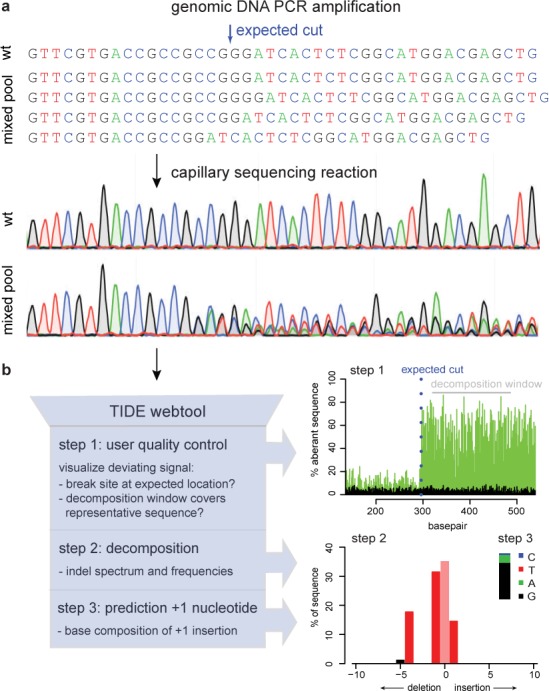
“(b) Overview of TIDE algorithm and output, which consists of three main steps: (1) Visualization of aberrant sequence signal in control (black) and treated sample (green), the expected break site (vertical dotted line) and the region used for decomposition (gray bar); (2) Decomposition yielding the spectrum of indels…”
BackgroundMethodGenetic screens in human cells using the CRISPR-Cas9 system
Wang, T., Wei, J. J., Sabatini, D. M., & Lander, E. S. (2014) · Science · doi:10.1126/science.1246981 · Cited by 2,856
Improving CRISPR-Cas nuclease specificity using truncated guide RNAs
Fu, Y., Sander, J. D., Reyon, D., Cascio, V. M., & Joung, J. K. (2014) · Nature Biotechnology · doi:10.1038/nbt.2808 · Cited by 1,993 · cited 1×
“However, the efficacy and the spectrum of mutations vary greatly depending on the RGEN target site and cells used ((17,18) and this report).”
BackgroundCHOPCHOP: a CRISPR/Cas9 and TALEN web tool for genome editing
Montague, T. G., Cruz, J. M., Gagnon, J. A., Church, G. M., & Valen, E. (2014) · Nucleic Acids Research · doi:10.1093/nar/gku410 · Cited by 1,234
Cas9 as a versatile tool for engineering biology
Mali, P., Esvelt, K. M., & Church, G. M. (2013) · Nature Methods · doi:10.1038/nmeth.2649 · Cited by 1,197 · cited 1×
“For example, with RGENs one typically needs to test several single-guide RNAs (sgRNAs) that are predicted to target the endonuclease to a gene of interest (6).”
BackgroundA guide to genome engineering with programmable nucleases
Kim, H., & Kim, J.-S. (2014) · Nature Reviews Genetics · doi:10.1038/nrg3686 · Cited by 1,163 · cited 3×
“(b) Overview of TIDE algorithm and output, which consists of three main steps: (1) Visualization of aberrant sequence signal in control (black) and treated sample (green), the expected break site (vertical dotted line) and the region used for decomposition (gray bar); (2) Decomposition yielding the spectrum of indels…”
BackgroundMethod
Cited by
Items 501–600 of 1,019
CRISPR mediated genome engineering to develop climate smart rice: Challenges and opportunities
Biswal, A. K., Mangrauthia, S. K., Reddy, M. R., & Yugandhar, P. (2019) · Seminars in Cell and Developmental Biology · doi:10.1016/j.semcdb.2019.04.005 · Cited by 63
Meyer, L. K., Huang, B. J., Delgado-Martín, C., Roy, R., Hechmer, A., Wandler, A. M., Vincent, T. L., Fortina, P. M., Olshen, A. B., Wood, B. L., et al. (2020) · Journal of Clinical Investigation · doi:10.1172/jci130189 · Cited by 61
“The amplicons were Sanger sequenced 444 and the sequencing traces were analyzed using the TIDE analysis software (34).”
MethodThe E3 Ubiquitin Ligase Mind Bomb 1 Controls Adenovirus Genome Release at the Nuclear Pore Complex
Bauer, M., Flatt, J. W., Seiler, D., Cardel, B., Emmenlauer, M., Boucke, K., Suomalainen, M., Hemmi, S., & Greber, U. F. (2019) · Cell Reports · doi:10.1016/j.celrep.2019.11.064 · Cited by 58
“com/), which allows quantitative assessment of genome editing by sequence trace decomposition (Brinkman et al., 2014).”
BackgroundBennett, H. W., Gustavsson, A., Bayas, C. A., Petrov, P. N., Mooney, N. A., Moerner, W. E., & Jackson, P. K. (2020) · Molecular Biology of the Cell · doi:10.1091/mbc.e19-09-0499 · Cited by 59
“Singlecell clones were expanded and subjected to genomic DNA PCR combined with TIDE analysis (Brinkman et al., 2014) as well as screening by IF.”
MethodDelivery of Cas9/sgRNA Ribonucleoprotein Complexes via Hydroxystearyl Oligoamino Amides
Kuhn, J., Lin, Y., Levačić, A. K., Danaf, N. A., Peng, L., Höhn, M., Lamb, D. C., Wagner, E., & Lächelt, U. (2020) · Bioconjugate Chemistry · doi:10.1021/acs.bioconjchem.9b00853 · Cited by 60
Abdel‐Mawgoud, A. M., & Stephanopoulos, G. N. (2020) · Metabolic Engineering · doi:10.1016/j.ymben.2020.07.008 · Cited by 61
A proteome-wide map of 20(S)-hydroxycholesterol interactors in cell membranes
Cheng, Y.-S., Zhang, T., Ma, X., Pratuangtham, S., Zhang, G. C., Ondrus, A. A., Mafi, A., Lomenick, B., Jones, J. J., & Ondrus, A. E. (2021) · Nature Chemical Biology · doi:10.1038/s41589-021-00907-2 · Cited by 56
CAR-engineered lymphocyte persistence is governed by a FAS ligand–FAS autoregulatory circuit
Yi, F., Cohen, T., Zimmerman, N., Dündar, F., Zumbo, P., Eltilib, R., Brophy, E. J., Arkin, H., Feucht, J., Gormally, M. V., et al. (2025) · Nature Cancer · doi:10.1038/s43018-025-01009-x · Cited by 57
ERα promotes murine hematopoietic regeneration through the Ire1α-mediated unfolded protein response
Chapple, R. H., Hu, T., Tseng, Y.-J., Liu, L., Kitano, A., Luu, V., Hoegenauer, K. A., Iwawaki, T., Li, Q., & Nakada, D. (2018) · eLife · doi:10.7554/elife.31159 · Cited by 57
“Indels were quantified using the TIDE deconstruction algorithm (Brinkman et al., 2014).”
MethodAXL Is a Putative Tumor Suppressor and Dormancy Regulator in Prostate Cancer
Axelrod, H. D., Valkenburg, K. C., Amend, S. R., Hicks, J. L., Parsana, P., Torga, G., Marzo, A. M. D., & Pienta, K. J. (2018) · Molecular Cancer Research · doi:10.1158/1541-7786.mcr-18-0718 · Cited by 55
“Clonality of the alterations was confirmed using TIDE analysis (19).”
MethodCas9+ conditionally-immortalized macrophages as a tool for bacterial pathogenesis and beyond
Roberts, A. W., Popov, L. M., Mitchell, G., Ching, K. L., Licht, D. J., Golovkine, G. R., Barton, G. M., & Cox, J. S. (2019) · eLife · doi:10.7554/elife.45957 · Cited by 57
“To broadly assess genome editing efficacy in Cas9 CIMs, we introduced 40 individual gRNAs targeting a total of 17 genes into these cells, selected for puromycin resistant cells, and assessed genome editing in the resulting populations by PCR amplification of the target sites and sequence analysis using Tracking Indels…”
Moyo, M., Parker, J. B., & Chakravarti, D. (2020) · Nature Communications · doi:10.1038/s41467-020-14701-6 · Cited by 58
Widespread microRNA degradation elements in target mRNAs can assist the encoded proteins
Li, L., Sheng, P., Li, T., Fields, C. J., Hiers, N. M., Wang, Y., Li, J., Guardia, C. M., Licht, J. D., & Xie, M. (2021) · Genes & Development · doi:10.1101/gad.348874.121 · Cited by 56
“S8B; Brinkman et al. 2014).”
Hardouin, G., Antoniou, P., Martinucci, P., Félix, T., Manceau, S., Joseph, L., Masson, C., Scaramuzza, S., Ferrari, G., Cavazzana, M., et al. (2022) · Blood · doi:10.1182/blood.2022016629 · Cited by 60
CRISPR-Mediated Editing of the B Cell Receptor in Primary Human B Cells
Greiner, V., Bou-Puerto, R., Liu, S., Herbel, C., Carmona, E. M., & Goldberg, M. S. (2019) · iScience · doi:10.1016/j.isci.2019.01.032 · Cited by 57
Fellenberg, C., Corea, O. R. A., Yan, L., Archinuk, F., Piirtola, E., Gordon, H. O. W., Reichelt, M., Brandt, W., Wulff, J. E., Ehlting, J., et al. (2019) · The Plant Journal · doi:10.1111/tpj.14615 · Cited by 54
Synergistic gene editing in human iPS cells via cell cycle and DNA repair modulation
Maurissen, T. L., & Woltjen, K. (2020) · Nature Communications · doi:10.1038/s41467-020-16643-5 · Cited by 53
Metabolic engineering generates a transgene-free safety switch for cell therapy
Wiebking, V., Patterson, J. O., Martin, R. M., Chanda, M. K., Lee, C. M., Srifa, W., Bao, G., & Porteus, M. H. (2020) · Nature Biotechnology · doi:10.1038/s41587-020-0580-6 · Cited by 59
Ex vivo editing of human hematopoietic stem cells for erythroid expression of therapeutic proteins
Pavani, G., Laurent, M., Fabiano, A., Cantelli, E., Sakkal, A., Corre, G., Lenting, P. J., Concordet, J.-P., Toueille, M., Miccio, A., et al. (2020) · Nature Communications · doi:10.1038/s41467-020-17552-3 · Cited by 49
Self-citationFunctional Radiogenetic Profiling Implicates ERCC6L2 in Non-homologous End Joining
Francica, P., Mutlu, M., Blomen, V. A., Oliveira, C., Nowicka, Z., Trenner, A., Gerhards, N. M., Bouwman, P., Stickel, E., Hekkelman, M. L., et al. (2020) · Cell Reports · doi:10.1016/j.celrep.2020.108068 · Cited by 55
“Using tracking of indels by decomposition (TIDE) analysis (Brinkman et al., 2014), we confirmed efficient modification of the target sites in the polyclonal population (Figures S2A and S2B).”
MethodHait, A. S., Olagnier, D. P., Sancho‐Shimizu, V., Skipper, K. A., Helleberg, M., Larsen, S. M., Bodda, C., Moldovan, L. I., Ren, F., Andersen, N.-S. B., et al. (2020) · Science Immunology · doi:10.1126/sciimmunol.abc2691 · Cited by 59
Nishimura, T., Suchy, F. P., Bhadury, J., Igarashi, K. J., Charlesworth, C. T., & Nakauchi, H. (2020) · Cell stem cell · doi:10.1016/j.stem.2020.11.019 · Cited by 56
“Genomic DNA was extracted from blastocysts for Igf1r locus analysis tracking indels by decomposition (TIDE webtool; Brinkman et al., 2014).”
MethodVaricella‐Zoster virus ORF9 is an antagonist of the DNA sensor cGAS
Hertzog, J., Zhou, W., Fowler, G., Rigby, R. E., Bridgeman, A., Blest, H. T. W., Cursi, C., Chauveau, L., Davenne, T., Warner, B. E., et al. (2022) · The EMBO Journal · doi:10.15252/embj.2021109217 · Cited by 58
“Sequencing traces were analysed using the TIDE software (https:// tide.nki.nl; Brinkman et al , 2014).”
CRISPR-based genome editing in primary human pancreatic islet cells
Bevacqua, R. J., Dai, X.-Q., Lam, J. Y., Gu, X., Friedlander, M. S. H., Tellez, K., Miguel-Escalada, I., Bonàs‐Guarch, S., Atla, G., Zhao, W., et al. (2021) · Nature Communications · doi:10.1038/s41467-021-22651-w · Cited by 56
CHD7 regulates otic lineage specification and hair cell differentiation in human inner ear organoids
Nie, J., Ueda, Y., Solivais, A. J., & Hashino, E. (2022) · Nature Communications · doi:10.1038/s41467-022-34759-8 · Cited by 54
Baysal, C., Bortesi, L., Zhu, C., Farré, G., Schillberg, S., & Christou, P. (2016) · Molecular Breeding · doi:10.1007/s11032-016-0533-4 · Cited by 53
“The inserts were sequenced in pools, and chromatograms with multiple peaks were analyzed using TIDE (http://tide-calculator.nki.nl/) as previously reported (Brinkman et al. 2014).”
MethodBollen, Y., Post, J., Koo, B.-K., & Snippert, H. J. G. (2018) · Nucleic Acids Research · doi:10.1093/nar/gky571 · Cited by 53
“When integrating epitope tags and other small modifications, the frequency of correctly modified clones can be estimated within the bulk population using TIDER, an adaptation of the popular TIDE algorithm which decomposes Sanger sequencing data generated from multiple alleles (95,96).”
MethodTanihara, F., Hirata, M., Nguyen, N. T., Le, Q. A., Hirano, T., & Otoi, T. (2019) · Journal of Reproduction and Development · doi:10.1262/jrd.2018-116 · Cited by 59
Cancer-specific loss of TERT activation sensitizes glioblastoma to DNA damage
Amen, A. M., Fellmann, C., Soczek, K. M., Ren, S. M., Lew, R. J., Knott, G. J., Park, J. E., McKinney, A., Mancini, A., Doudna, J. A., et al. (2021) · Proceedings of the National Academy of Sciences · doi:10.1073/pnas.2008772118 · Cited by 55
A role for Rab11 in the homeostasis of the endosome-lysosomal pathway
Zulkefli, K. L., Houghton, F. J., Gosavi, P., & Gleeson, P. A. (2019) · Experimental Cell Research · doi:10.1016/j.yexcr.2019.04.010 · Cited by 52
Ricana, C. L., Lyddon, T. D., Dick, R. A., & Johnson, M. C. (2020) · PLoS Pathogens · doi:10.1371/journal.ppat.1008646 · Cited by 55
“Sequences were screened using TIDE (Tracking of Indels by Decomposition; [49]) by comparing Sanger sequence traces of the WT control to the KO.”
MethodThe BTLA–HVEM axis restricts CAR T cell efficacy in cancer
Guruprasad, P., Carturan, A., Zhang, Y., Cho, J. H., Kumashie, K. G., Patel, R. P., Kim, K.-H., Lee, J.-S., Lee, Y., Kim, J. H., et al. (2024) · Nature Immunology · doi:10.1038/s41590-024-01847-4 · Cited by 55
A line attractor encoding a persistent internal state requires neuropeptide signaling
Mountoufaris, G., Nair, A., Yang, B., Kim, D.-W., Vinograd, A., Kim, S., Linderman, S. W., & Anderson, D. J. (2024) · Cell · doi:10.1016/j.cell.2024.08.015 · Cited by 60
“Editing efficiency as measured by sequence trace decomposition 79 varied from 32%–81%, depending on the gRNA.”
Nady, N., Gupta, A., Ma, Z., Swigut, T., Koide, A., Koide, S., & Wysocka, J. (2015) · eLife · doi:10.7554/elife.10150 · Cited by 56
“The results were analyzed with Sequencher 5.1 software and TIDE (Brinkman et al., 2014).”
MethodInfluentialEnhanced Genome Editing with Cas9 Ribonucleoprotein in Diverse Cells and Organisms
Farboud, B., Jarvis, E., Roth, T. L., Shin, J., Corn, J. E., Marson, A., Meyer, B. J., Patel, N. H., & Hochstrasser, M. L. (2018) · Journal of Visualized Experiments · doi:10.3791/57350 · Cited by 44
Kounatidou, E. E., Nakjang, S., McCracken, S. R., Dehm, S. M., Robson, C. N., Jones, D. L., & Gaughan, L. (2019) · Nucleic Acids Research · doi:10.1093/nar/gkz286 · Cited by 53
“Two specific guide RNAs (gRNAs) were designed to the desired locus, co-expressed with Cas9 and the cleavage efficiency was determined using both SURVEYOR endonuclease and TIDE analysis in CWR22Rv1 cells (36) (Supplementary Figure S1A and B).”
MethodABCC1 and glutathione metabolism limit the efficacy of BCL-2 inhibitors in acute myeloid leukemia
Ebner, J., Schmoellerl, J., Piontek, M., Manhart, G., Troester, S., Carter, B. Z., Neubauer, H. A., Moriggl, R., Szakács, G., Zuber, J. A., et al. (2023) · Nature Communications · doi:10.1038/s41467-023-41229-2 · Cited by 53
Mechanisms of hematopoietic clonal dominance in VEXAS syndrome
Molteni, R., Fiumara, M., Campochiaro, C., Alfieri, R. R., Pacini, G., Licari, E., Tomelleri, A., Diral, E., Varesi, A., Weber, A., et al. (2025) · Nature Medicine · doi:10.1038/s41591-025-03623-9 · Cited by 52
Clinical applications of CRISPR‐based genome editing and diagnostics
Foss, D. V., Hochstrasser, M. L., & Wilson, R. C. (2019) · Transfusion · doi:10.1111/trf.15126 · Cited by 54
van de Kooij, B., Creixell, P., van Vlimmeren, A. E., Joughin, B. A., Miller, C. J., Haider, N., Simpson, C. D., Linding, R., Stambolic, V., Turk, B. E., et al. (2019) · eLife · doi:10.7554/elife.44635 · Cited by 55
Anti-CRISPR AcrIIA5 Potently Inhibits All Cas9 Homologs Used for Genome Editing
García, B., Lee, J., Edraki, A., Hidalgo-Reyes, Y., Erwood, S., Mir, A., Trost, C. N., Seroussi, U., Stanley, S. Y., Cohn, R. D., et al. (2019) · Cell Reports · doi:10.1016/j.celrep.2019.10.017 · Cited by 58
“Efficiency of genome editing at the genomic VEGFA target site was measured by TIDE analysis (Brinkman et al., 2014).”
BackgroundMethodInfluentialPaul, B. T., Tesfay, L., Winkler, C. R., Torti, F. M., & Torti, S. V. (2019) · Scientific Reports · doi:10.1038/s41598-019-55907-z · Cited by 55
Mate discrimination among subspecies through a conserved olfactory pathway
Khallaf, M. A., Auer, T. O., Grabe, V., Depetris-Chauvin, A., Ammagarahalli, B., Zhang, D., Lavista-Llanos, S., Kaftan, F., Weißflog, J., Matzkin, L. M., et al. (2020) · Science Advances · doi:10.1126/sciadv.aba5279 · Cited by 52
Cruz, L. J., van Dijk, T., Vepris, O., Li, T. M. W. Y., Schomann, T., Baldazzi, F., Kurita, R., Nakamura, Y., Grosveld, F. G., Philipsen, S., et al. (2020) · Biomaterials · doi:10.1016/j.biomaterials.2020.120580 · Cited by 54
A coordinated progression of progenitor cell states initiates urinary tract development
Sanchez-Ferras, O., Pacis, A., Sotiropoulou, M., Zhang, Y., Wang, Y. C., Bourgey, M., Bourque, G., Ragoussis, J., & Bouchard, M. (2021) · Nature Communications · doi:10.1038/s41467-021-22931-5 · Cited by 61
Efficient generation of isogenic primary human myeloid cells using CRISPR-Cas9 ribonucleoproteins
Hiatt, J. B., Cavero, D. A., McGregor, M., Zheng, W., Budzik, J. M., Roth, T. L., Haas, K. M., Wu, D., Rathore, U., Meyer‐Franke, A., et al. (2021) · Cell Reports · doi:10.1016/j.celrep.2021.109105 · Cited by 58
“Mutational efficiency was then determined by comparison of non-targeting and gene-targeting sample chromatograms using the TIDE Web Tool (Brinkman et al., 2014).”
CRISPR/Cas9 System: A Bacterial Tailor for Genomic Engineering
Lone, B. A., Karna, S. K. L., Ahmad, F., Shahi, N., & Pokharel, Y. R. (2018) · Genetics Research International · doi:10.1155/2018/3797214 · Cited by 60
“On-target mutations (indel or HDR) can be validated by Sanger sequencing, mismatch cleavage assays (CEL-I nuclease and T7 endonuclease I (T7EI) [79, 80], Restriction Fragment Length Polymorphism (RFLP) analysis, or sequencing-based methods [81].”
BackgroundKuil, L. E., Oosterhof, N., Geurts, S. N., van der Linde, H. C., Meijering, E. H. W., & van Ham, T. J. (2019) · Disease Models & Mechanisms · doi:10.1242/dmm.037762 · Cited by 53
Zhang, Y., Nishiyama, T., Li, H. Z., Huang, J. H., Atmanli, A., Sanchez‐Ortiz, E., Wang, Z., Mireault, A. A., Mammen, P. P. A., Bassel‐Duby, R., et al. (2021) · Molecular Therapy — Methods & Clinical Development · doi:10.1016/j.omtm.2021.05.014 · Cited by 56
de Vries, L., Brouckaert, M., Chanoca, A. A., Kim, H., Regner, M. R., Timokhin, V. I., Sun, Y., Meester, B. D., Doorsselaere, J. V., Goeminne, G., et al. (2021) · Plant Biotechnology Journal · doi:10.1111/pbi.13651 · Cited by 56
ter Brugge, P., Moser, S. C., Bièche, I., Kristel, P., Ibadioune, S., Eeckhoutte, A., de Bruijn, R., van der Burg, E., Lutz, C., Annunziato, S., et al. (2023) · Nature Communications · doi:10.1038/s41467-023-37537-2 · Cited by 52
Prado, G. S., Rocha, D. C., dos Santos, L. N., Contiliani, D. F., Nóbile, P. M., Martinati, J. C., Padilha, L., Maluf, M. P., Lubini, G., Pereira, T. C., et al. (2024) · Frontiers in Plant Science · doi:10.3389/fpls.2023.1331258 · Cited by 57
“…the screening of gene-edited events by conventional methods, such as T7 endonuclease 1 (T7E1) (Li et al., 2013), Surveyor nuclease (Cong et al., 2013), high-resolution melting (HRM) analysis (Montgomery et al., 2007) and direct sequencing of PCR-ampli fi ed target regions (Brinkman et al., 2014).”
MethodEXO1 protects BRCA1-deficient cells against toxic DNA lesions
van de Kooij, B., Schreuder, A., Pavani, R., Garzero, V., Uruci, S., Wendel, T. J., van Hoeck, A., Alonso, M. S. M., Everts, M., Koerse, D., et al. (2024) · Molecular Cell · doi:10.1016/j.molcel.2023.12.039 · Cited by 48
Generating Mouse Models Using CRISPR‐Cas9‐Mediated Genome Editing
Qin, W., Kutny, P. M., Maser, R. S., Dion, S., Lamont, J. D., Zhang, Y., Perry, G. A., & Wang, H. (2016) · Current Protocols in Mouse Biology · doi:10.1002/9780470942390.mo150178 · Cited by 52
“Allele composition in a particular founder mouse could be analyzed using the TIDE software program, which decomposes the alleles (Brinkman et al., 2014; Fig.”
MethodBanerjee, A., Falzarano, D., Rapin, N., Lew, J. M., & Misra, V. (2019) · Viruses · doi:10.3390/v11020152 · Cited by 49
“Primers IRF3-CRISPR-gDNA-F3: AGGCTTTCTGTGGGGGATTG and IRF3-CRISPR-gDNA-R3: AGATGCCAAAGTCCTCCTG were used to amplify the 607 bp locus in the genomic DNA by conventional PCR. Deletions were confirmed by sequencing (Macrogen) and the sequencing results were analyzed using an online tool (Tracking of Indels by Decompositi…”
Bruntraeger, M., Byrne, M. L., Long, K. R., & Bassett, A. R. (2019) · Methods in molecular biology · doi:10.1007/978-1-4939-9170-9_11 · Cited by 50
Functional profiling of single CRISPR/Cas9-edited human long-term hematopoietic stem cells
Wagenblast, E., Azkanaz, M., Smith, S. A., Shakib, L., McLeod, J. L., Krivdova, G., Araújo, J., Shultz, L. D., Gan, O. I., Dick, J. E., et al. (2019) · Nature Communications · doi:10.1038/s41467-019-12726-0 · Cited by 53
Ambrosino, L., Colantuono, C., Diretto, G., Fiore, A., & Chiusano, M. L. (2020) · Plants · doi:10.3390/plants9050591 · Cited by 59
“In particular, several software have been developed to predict and select CRISPR/Cas9 targets for genome editing, such as the web based tools E-CRISP [132], TIDE [133], CHOPCHOP [134] and CCTop [135].”
MethodTanihara, F., Hirata, M., Nguyen, N. T., Sawamoto, O., Kikuchi, T., Doi, M., & Otoi, T. (2020) · BMC Biotechnology · doi:10.1186/s12896-020-00638-7 · Cited by 50
“were determined by sanger sequencing and subsequent analysis using the TIDE (tracking of indels by decomposition) bioinformatics package [22].”
MethodBaculoviral delivery of CRISPR/Cas9 facilitates efficient genome editing in human cells
Hindriksen, S., Bramer, A. J., Truong, M. A., Vromans, M. J. M., Post, J. B., Verlaan-Klink, I., Snippert, H. J. G., Lens, S. M. A., & Hadders, M. A. (2017) · PLoS ONE · doi:10.1371/journal.pone.0179514 · Cited by 51
“Sequence traces were further analyzed using TIDE through the web interface at https://tide-calculator. nki.nl [30].”
Guo, X., Mahlakõiv, T., Ye, Q., Somanchi, S. S., He, S., Rana, H., DiFiglia, A., Gleason, J., van der Touw, W., HARIRI, R. J., et al. (2021) · Journal for ImmunoTherapy of Cancer · doi:10.1136/jitc-2020-001975 · Cited by 54
Albanese, M., Ruhle, A., Mittermaier, J., Mejías‐Pérez, E., Gapp, M., Linder, A., Schmacke, N. A., Hofmann, K., Hennrich, A. A., Levy, D. N., et al. (2021) · Nature Methods · doi:10.1038/s41592-021-01328-8 · Cited by 52
Stewart, S. E., Menzies, S. A., Popa, S. J., Yarkoni, N. S., Petrunkina, A. M., Lehner, P. J., & Moreau, K. (2017) · Journal of Cell Science · doi:10.1242/jcs.206425 · Cited by 49
Non-viral delivery of CRISPR/Cas9 complex using CRISPR-GPS nanocomplexes
Jain, P., Lo, J. H.-J., Rananaware, S. R., Downing, M. A., Panda, A., Tai, M., Raghavan, S., Fleming, H. E., & Bhatia, S. N. (2019) · Nanoscale · doi:10.1039/c9nr01786k · Cited by 49
Hulton, C. H., Costa, E. A., Shah, N., Quintanal-Villalonga, À., Heller, G., de Stanchina, E., Rudin, C. M., & Poirier, J. T. (2020) · Nature Cancer · doi:10.1038/s43018-020-0040-8 · Cited by 50
Genome editing in animals with minimal PAM CRISPR-Cas9 enzymes
Vicencio, J., Sánchez-Bolaños, C., Moreno-Sánchez, I., Brena, D., Vejnar, C. E., Kukhtar, D., Ruiz-López, M., Cots-Ponjoan, M., Rubio, A., Melero, N. R., et al. (2022) · Nature Communications · doi:10.1038/s41467-022-30228-4 · Cited by 51
Janssen, A., Colmenares, S. U., Lee, T., & Karpen, G. H. (2018) · Genes & Development · doi:10.1101/gad.317537.118 · Cited by 52
“Analysis of Sanger sequences was per-formedusingtheTIDE(trackingofindelsbydecomposition)algo-rithm (http://tide.nki.nl), a computational protocol designed by the laboratory of Dr. Bas van Steensel and published previously (Brinkman et al. 2014).”
Failure to detect DNA-guided genome editing using Natronobacterium gregoryi Argonaute
Lee, S. H., Turchiano, G., Ata, H., Nowsheen, S., Romito, M., Lou, Z., Ryu, S.-M., Ekker, S. C., Cathomen, T., & Kim, J. (2016) · Nature Biotechnology · doi:10.1038/nbt.3753 · Cited by 47
May, D., Paldi, K., & Altpeter, F. (2023) · The Plant Genome · doi:10.1002/tpg2.20298 · Cited by 50
“Computational tools such as Tracking of Indels by Decomposition (TIDE) (Brinkman et al., 2014) and Inference of CRISPR Edits (ICE) (Conant et al., 2022) enable quantitative assessment of the extent and type of targeted mutations using Sanger sequencing data for crops with low to moderate level of ploidy.”
MethodMcLean, Z. L., Gao, D., Correia, K., Roy, J. C. L., Shibata, S., Farnum, I. N., Valdepenas-Mellor, Z., Kovalenko, M. V., Rapuru, M., Morini, E., et al. (2024) · Nature Communications · doi:10.1038/s41467-024-47485-0 · Cited by 50
Remyelination protects neurons from DLK-mediated neurodegeneration
Duncan, G. J., Ingram, S. D., Emberley, K., Hill, J. Q., Cordano, C., Abdelhak, A., McCane, M., Jenks, J. E., Jabassini, N., Ananth, K., et al. (2024) · Nature Communications · doi:10.1038/s41467-024-53429-5 · Cited by 49
“SgRNAs were tested in the modi fi ed px333 plasmid and validated by TIDE (tracking of indels by decomposition) 79 .”
Targeting the MIF/CXCR7/AKT Signaling Pathway in Castration-Resistant Prostate Cancer
Rafiei, S., Gui, B., Wu, J., Liu, X. S., Kibel, A. S., & Li, J. (2019) · Molecular Cancer Research · doi:10.1158/1541-7786.mcr-18-0412 · Cited by 49
“S4), although the gene editing efficacy at on-target site is around 40% to 70% estimated by sequence trace decomposition (27).”
BackgroundMethodBridge Helix of Cas9 Modulates Target DNA Cleavage and Mismatch Tolerance
Babu, K., Amrani, N., Jiang, W., Yogesha, S. D., Nguyen, R., Qin, P. Z., & Rajan, R. (2019) · Biochemistry · doi:10.1021/acs.biochem.8b01241 · Cited by 49
Moro, L. N., Viale, D. L., Bastón, J. I., Arnold, V., Suvá, M., Wiedenmann, E. A., Olguín, M., Miriuka, S., & Vichera, G. D. (2020) · Scientific Reports · doi:10.1038/s41598-020-72040-4 · Cited by 49
Evaluation of Homology-Independent CRISPR-Cas9 Off-Target Assessment Methods
Chaudhari, H. G., Penterman, J. N., Whitton, H. J., Spencer, S. J., Flanagan, N., Zhang, M. C. L., Huang, E., Khedkar, A. S., Toomey, J. M., Shearer, C. A., et al. (2020) · The CRISPR Journal · doi:10.1089/crispr.2020.0053 · Cited by 49
Hu, Y., Stilp, A. M., McHugh, C., Rao, S., Jain, D., Zheng, X., Lane, J., de Bellefon, S. M., Raffield, L. M., Chen, M., et al. (2021) · The American Journal of Human Genetics · doi:10.1016/j.ajhg.2021.04.003 · Cited by 51
“PCR products were subject to Sanger sequencing and then TIDE analysis to quantify indel mutations.(45) Meanwhile, total RNA was extracted from bulk cells and expression of genes of”
MethodInfluentialCo-regulation and function of FOXM1/RHNO1 bidirectional genes in cancer
Barger, C. J., Chee, L., Albahrani, M., Muñoz-Trujillo, C., Boghean, L., Branick, C., Odunsi, K. O., Drapkin, R., Zou, L., & Karpf, A. R. (2021) · eLife · doi:10.7554/elife.55070 · Cited by 52
Vlaming, H., Mimoso, C. A., Field, A. R., Martin, B. J. E., & Adelman, K. (2022) · Nature Structural & Molecular Biology · doi:10.1038/s41594-022-00785-9 · Cited by 48
TPC2 rescues lysosomal storage in mucolipidosis type IV, Niemann–Pick type C1, and Batten disease
Rosato, A. S., Krogsaeter, E., Jaślan, D., Abrahamian, C., Montefusco, S., Soldati, C., Spix, B., Pizzo, M. T., Grieco, G., Böck, J., et al. (2022) · EMBO Molecular Medicine · doi:10.15252/emmm.202115377 · Cited by 47
Kos, K., Salvagno, C., Wellenstein, M. D., Aslam, M. A., Meijer, D. A., Hau, C., Vrijland, K., Kaldenbach, D., Raeven, E. A. M., Schmittnaegel, M., et al. (2022) · OncoImmunology · doi:10.1080/2162402x.2022.2063225 · Cited by 47
Laustsen, A., Bak, R. O., Krapp, C., Kjær, L., Egedahl, J. H., Petersen, C. C., Pillai, S. K., Tang, H. Q., Uldbjerg, N., Porteus, M. H., et al. (2018) · Nature Communications · doi:10.1038/s41467-018-05816-y · Cited by 49
CRISPR/Cas system: A game changing genome editing technology, to treat human genetic diseases
Hussain, W., Mahmood, T., Hussain, J. S., Ali, N., Shah, T. M., Qayyum, S., & Khan, I. (2018) · Gene · doi:10.1016/j.gene.2018.10.072 · Cited by 49
“elegans at lower cost and little time, is an important strategy which is already presented in tractable microorganism (Brinkman et al., 2014).”
BackgroundMethodKuil, L. E., Martí, A. L., Mascaro, A. C., van den Bosch, J. C., van den Berg, P., van der Linde, H. C., Schoonderwoerd, K. C., Ruijter, G. J. G., & van Ham, T. J. (2019) · Glia · doi:10.1002/glia.23641 · Cited by 48
“Genomic DNA surrounding the gRNA target site was sequenced using Sanger sequencing and indel efficiency was determined using the online tool TIDE (Brinkman et al., 2014) (Table 2).”
MethodKoeppel, I., Hertig, C. W., Hoffie, R. E., & Kumlehn, J. (2019) · International Journal of Molecular Sciences · doi:10.3390/ijms20112647 · Cited by 49
“Various bioinformatic tools, such as Tracking of Indels by DEcomposition (TIDE) [116] and DSDecode [117], provide the opportunity to read out such peaks, thereby determining the different allele variants present in the analyzed plant sample.”
MethodTanihara, F., Hirata, M., Nguyen, N. T., Le, Q. A., Wittayarat, M., Fahrudin, M., Hirano, T., & Otoi, T. (2019) · Animal Biotechnology · doi:10.1080/10495398.2019.1668801 · Cited by 49
Grajcarek, J., Monlong, J., Nishinaka-Arai, Y., Nakamura, M., Nagai, M., Matsuo, S., Lougheed, D., Sakurai, H., Saito, M. K., Bourque, G., et al. (2019) · Nature Communications · doi:10.1038/s41467-019-12829-8 · Cited by 43
Aztekin, C., Hiscock, T. W., Butler, R., Andino, F. D. J., Robert, J., Gurdon, J. B., & Jullien, J. (2020) · Development · doi:10.1242/dev.185496 · Cited by 51
“efficiency of gRNA cutting was assessed by TIDE analysis (Brinkman et al., 2014).”
MethodMatsumoto, D., Tamamura, H., & Nomura, W. (2020) · Communications Biology · doi:10.1038/s42003-020-01340-2 · Cited by 49
Rodrigues, J. G., Duarte, H. O., Gomes, C., Balmaña, M., Martins, Á. M., Hensbergen, P. J., de Ru, A. H., Lima, J. P., Albergaria, A., van Veelen, P. A., et al. (2021) · Cellular Oncology · doi:10.1007/s13402-021-00606-z · Cited by 52
Topological tuning of DNA mobility in entangled solutions of supercoiled plasmids
Smrek, J., Garamella, J., Robertson‐Anderson, R. M., & Michieletto, D. (2021) · Science Advances · doi:10.1126/sciadv.abf9260 · Cited by 49
Cell cycle regulation of ER membrane biogenesis protects against chromosome missegregation
Merta, H., Carrasquillo Rodríguez, J. W., Anjur-Dietrich, M. I., Vitale, T., Granade, M. E., Harris, T. E., Needleman, D. J., & Bahmanyar, S. (2021) · Developmental Cell · doi:10.1016/j.devcel.2021.11.009 · Cited by 51
Kulcsár, P. I., Tálas, A., Tóth, E., Nyeste, A., Ligeti, Z., Welker, Z., & Welker, E. (2020) · Nature Communications · doi:10.1038/s41467-020-15021-5 · Cited by 45
G-quadruplex-based CRISPR photoswitch for spatiotemporal control of genomic modulation
Deng, H., Xu, H., Wang, Y., Jia, R., Ma, X., Feng, Y., & Chen, H. (2023) · Nucleic Acids Research · doi:10.1093/nar/gkad178 · Cited by 45
“…of CRISPR-Cas9 gene editing, a CRISPR RNA / trans-activating CRISPR RNA (crRNA / tracrRNA) duplex or chimeric single-stranded guide RNA (sgRNA) leads Cas9 to recognize and cleave the target locus, which contains a protospacer adjacent motif (PAM) and complementary spacer sequences of gRNA (4).”
Structure of the human heparan sulfate polymerase complex EXT1-EXT2
Leisico, F., Omeiri, J., Le Narvor, C., Beaudouin, J., Hons, M., Fenel, D., Schoehn, G., Couté, Y., Bonnaffé, D., Sadir, R., et al. (2022) · Nature Communications · doi:10.1038/s41467-022-34882-6 · Cited by 45
Chromatin regulation of transcriptional enhancers and cell fate by the Sotos syndrome gene NSD1
Sun, Z., Lin, Y., Islam, M. T., Koche, R. P., Hedehus, L., Liu, D., Huang, C., Vierbuchen, T., Sawyers, C. L., & Helin, K. (2023) · Molecular Cell · doi:10.1016/j.molcel.2023.06.007 · Cited by 46
Antitumor Immune Responses in B2M -Deficient Cancers
Torrejon, D. Y., Galvez, M., Abril-Rodríguez, G., Campbell, K. M., Medina, E., Vega-Crespo, A., Kalbasi, A. K., Comín-Anduix, B., & Ribas, A. (2023) · Cancer Immunology Research · doi:10.1158/2326-6066.cir-23-0139 · Cited by 49
Comprehensive Protocols for CRISPR/Cas9‐based Gene Editing in Human Pluripotent Stem Cells
Santos, D. P., Kiskinis, E., Eggan, K. C., & Merkle, F. T. (2016) · Current Protocols in Stem Cell Biology · doi:10.1002/cpsc.15 · Cited by 46
“, 2014), deconvolution of Sanger sequencing reads (Brinkman et al., 2014; Hill et al., 2014), and barcoded deep sequencing (Bell et al.”
BackgroundMethodPawar, S., Ungricht, R., Tiefenboeck, P., Leroux, J., & Kutay, U. (2017) · eLife · doi:10.7554/elife.28202 · Cited by 45
“PCR products were sequenced and analyzed for insertions/deletions around the target sequence using the tide web tool (http://tide.nki.nl, [Brinkman et al., 2014]).”
MethodElectroporation-Based CRISPR/Cas9 Gene Editing Using Cas9 Protein and Chemically Modified sgRNAs
Laustsen, A., & Bak, R. O. (2019) · Methods in molecular biology · doi:10.1007/978-1-4939-9170-9_9 · Cited by 48
Amoasii, L., Li, H. Z., Zhang, Y., Min, Y.-L., Sanchez‐Ortiz, E., Shelton, J. M., Long, C., Mireault, A. A., Bhattacharyya, S., McAnally, J., et al. (2019) · Nature Communications · doi:10.1038/s41467-019-12335-x · Cited by 47
Metadata
- Authors
- Brinkman, E. K., Chen, T., Amendola, M., & van Steensel, B.
- Affiliations
- The Netherlands Cancer Institute (NL)
- Division of Gene Regulation, Netherlands Cancer Institute, Plesmanlaan 121, 1016 HM Amsterdam, the Netherlands
- Venue
- Nucleic Acids Research
- Publisher
- Oxford University Press (OUP)
- Published
- 2014-10-09
- Volume
- 42
- Issue
- 22
- Pages
- e168-e168
- ISSN
- 0305-1048 (ISSN-L)
- 1362-4962
- PMC
- PMC4267669
- OpenAlex
- W2106070783
- Cited by
- 2,390
- References
- 19
- Citations by year
- 2026: 184 · 2025: 261 · 2024: 253 · 2023: 290 · 2022: 280 · 2021: 259 · 2020: 263 · 2019: 241 · 2018: 186 · 2017: 105 · 2016: 48 · 2015: 16 · 2014: 2
- FWCI
- 23.39
- Type
- journal article
- Language
- en
- Open access
- gold
- doi.org
- Locations
- Nucleic Acids Research (publishedVersion, cc-by)
- Europe PMC (PubMed Central) (publishedVersion, cc-by)
- PubMed Central (publishedVersion, cc-by)
- PubMed (publishedVersion)
- HAL (submittedVersion)
- Institutional Research Information System University of Ferrara (University of Ferrara) (submittedVersion)
- Funders
- ZonMw
- Nederlandse Organisatie voor Wetenschappelijk Onderzoek
- FP7 Ideas: European Research Council (293662)
- Topics
- Life Sciences › Biochemistry, Genetics and Molecular Biology › Molecular Biology › CRISPR and Genetic Engineering
- Life Sciences › Biochemistry, Genetics and Molecular Biology › Molecular Biology › RNA regulation and disease
- Life Sciences › Biochemistry, Genetics and Molecular Biology › Cancer Research › Cancer Genomics and Diagnostics
- Keywords
- genome editing, tides, induced mutation, CRISPR/Cas9, editing sites, mutation spectrum, web-based tool, PCR-based assays
- MeSH terms
- Algorithms, Cells, Cultured, DNA Mutational Analysis, Humans, Software, Polymerase Chain Reaction, Mutagenesis, K562 Cells, Genomics, INDEL Mutation, CRISPR-Cas Systems
About these checks
Registry, retraction, Cites and statistics results are computed, not judged, with one exception: a printed reference that no index lists is read once by a model before it counts as a citation error. Claims are extracted by a model and kept only when their quote appears verbatim in the text; each cited source is then checked, with a model’s help, for whether it says what the claim relies on. Those verdicts can be wrong — read the claim’s quote and the cited source before relying on one.
Statistics and arithmetic are recomputed, not judged.
Confidence bands are shown only for fields calibrated on our annotated test set. None is calibrated yet, so no band is shown.
What counts as a claim ›How we measure confidence ›How we check this ›
Are you an author, or do you see a problem with this page? Request a review
Data sources
Bibliographic data: Semantic Scholar, OpenAlex, Crossref.
Contains information from the Semantic Scholar Academic Graph Datasets, made available under the ODC Attribution License (ODC-BY 1.0).
Semantic Scholar’s data is described in: Kinney, R., et al. (2023). The Semantic Scholar Open Data Platform. arXiv:2301.10140.
