

Easy quantitative assessment of genome editing by sequence trace decomposition
Open accessThe DOI matches its Crossref record; 19 of the 19 references it cites were found in a registry or an index.
Abstract
The efficacy and the mutation spectrum of genome editing methods can vary substantially depending on the targeted sequence. A simple, quick assay to accurately characterize and quantify the induced mutations is therefore needed. Here we present TIDE, a method for this purpose that requires only a pair of PCR reactions and two standard capillary sequencing runs. The sequence traces are then analyzed by a specially developed decomposition algorithm that identifies the major induced mutations in the projected editing site and accurately determines their frequency in a cell population. This method is cost-effective and quick, and it provides much more detailed information than current enzyme-based assays. An interactive web tool for automated decomposition of the sequence traces is available. TIDE greatly facilitates the testing and rational design of genome editing strategies.
Overview
The claims and statistics of this paper haven’t been checked yet.
Free: it reads the open-access text and checks the first 5 claims that cite a source we can check. Create a free account to check every claim.
Integrity signals
Registry
Cites
Statistics
Figures
Verification
Claims the paper makes
The claims and statistics of this paper haven’t been checked yet.
Free: it reads the open-access text and checks the first 5 claims that cite a source we can check. Create a free account to check every claim.
Claims other papers make about this one
Each is checked against this paper’s own text: does it say what the citing paper says it does?
The source backs part of the claim, not all of it — or backs it for a different population, condition or comparison.
In the citing paper
“Long-term nuclease expression (10 days after transduction), which has been demonstrated to highly favor non-specific cleavages41, did not generate any unspecific CFTR editing above TIDE background levels (about 1%)38; whereas AsCas12a-crRNA+11/wt efficiently edited the CFTR gene (86.3%, Fig. 2b).”
From Allele specific repair of splicing mutations in cystic fibrosis through AsCas12a genome editing (2019) · cites this paper as [38]
Experimental — accuracy not yet measuredThe source backs part of the claim, not all of it — or backs it for a different population, condition or comparison.
In the citing paper
“Genotyping was performed by Sanger sequencing of PCR amplicons of genomic target sites with individual alleles deconvoluted by TIDE analysis of chromatograms[33].”
From Genome-scale CRISPR screening for modifiers of cellular LDL uptake (2021) · cites this paper as [33]
Experimental — accuracy not yet measuredIn the citing paper
“Tracking of InDels by Decomposition (TIDE) is an effective web tool (https://tide.nki.nl) that can be used to analyse sequencing data, which estimates the spectra and frequencies of small insertions and deletions generated from gene editing (Brinkman et al., 2014).”
From Genetic resources and precise gene editing for targeted improvement of barley abiotic stress tolerance (2023) · cites this paper as Brinkman et al., 2014
Self-check
Percentages, sums and reported differences re-computed from the paper’s own numbers.
The self-check needs the paper’s full text.
Citations
Cites
Multiplex Genome Engineering Using CRISPR/Cas Systems
Cong, L., Ran, F. A., Cox, D., Lin, S., Barretto, R., Habib, N., Hsu, P. D., Wu, X., Jiang, W., Marraffini, L. A., et al. (2013) · Science · doi:10.1126/science.1231143 · Cited by 15,339
Bioconductor: open software development for computational biology and bioinformatics
Gentleman, R. C., Carey, V. J., Bates, D. M., Bolstad, B., Dettling, M., Dudoit, S., Ellis, B., Gautier, L., Ge, Y., Gentry, J., et al. (2004) · Genome Biology · doi:10.1186/gb-2004-5-10-r80 · Cited by 12,172 · cited 3×
“scf format) are imported into TIDE using the R Bioconductor (15) package sangerseqR (version 1.”
MethodInfluentialGenome engineering using the CRISPR-Cas9 system
Ran, F. A., Hsu, P. D., Wright, J., Agarwala, V., Scott, D. A., & Zhang, F. (2013) · Nature Protocols · doi:10.1038/nprot.2013.143 · Cited by 11,133 · cited 1×
“edu/) (13) and CHOPCHOP (https://chopchop.”
DNA targeting specificity of RNA-guided Cas9 nucleases
Hsu, P. D., Scott, D. A., Weinstein, J. A., Ran, F. A., Konermann, S., Agarwala, V., Li, Y., Fine, E. J., Wu, X., Shalem, O., et al. (2013) · Nature Biotechnology · doi:10.1038/nbt.2647 · Cited by 4,741 · cited 1×
“However, the efficacy and the spectrum of mutations vary greatly depending on the RGEN target site and cells used ((17,18) and this report).”
BackgroundZFN, TALEN, and CRISPR/Cas-based methods for genome engineering
Gaj, T., Gersbach, C. A., & Barbas, C. F. (2013) · Trends in Biotechnology · doi:10.1016/j.tibtech.2013.04.004 · Cited by 3,820 · cited 3×
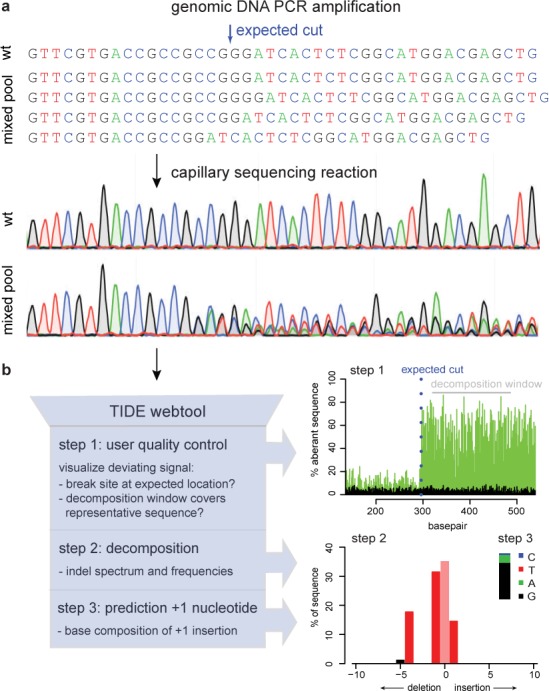
“(b) Overview of TIDE algorithm and output, which consists of three main steps: (1) Visualization of aberrant sequence signal in control (black) and treated sample (green), the expected break site (vertical dotted line) and the region used for decomposition (gray bar); (2) Decomposition yielding the spectrum of indels…”
BackgroundMethodGenetic screens in human cells using the CRISPR-Cas9 system
Wang, T., Wei, J. J., Sabatini, D. M., & Lander, E. S. (2014) · Science · doi:10.1126/science.1246981 · Cited by 2,856
Improving CRISPR-Cas nuclease specificity using truncated guide RNAs
Fu, Y., Sander, J. D., Reyon, D., Cascio, V. M., & Joung, J. K. (2014) · Nature Biotechnology · doi:10.1038/nbt.2808 · Cited by 1,993 · cited 1×
“However, the efficacy and the spectrum of mutations vary greatly depending on the RGEN target site and cells used ((17,18) and this report).”
BackgroundCHOPCHOP: a CRISPR/Cas9 and TALEN web tool for genome editing
Montague, T. G., Cruz, J. M., Gagnon, J. A., Church, G. M., & Valen, E. (2014) · Nucleic Acids Research · doi:10.1093/nar/gku410 · Cited by 1,234
Cas9 as a versatile tool for engineering biology
Mali, P., Esvelt, K. M., & Church, G. M. (2013) · Nature Methods · doi:10.1038/nmeth.2649 · Cited by 1,197 · cited 1×
“For example, with RGENs one typically needs to test several single-guide RNAs (sgRNAs) that are predicted to target the endonuclease to a gene of interest (6).”
BackgroundA guide to genome engineering with programmable nucleases
Kim, H., & Kim, J.-S. (2014) · Nature Reviews Genetics · doi:10.1038/nrg3686 · Cited by 1,163 · cited 3×
“(b) Overview of TIDE algorithm and output, which consists of three main steps: (1) Visualization of aberrant sequence signal in control (black) and treated sample (green), the expected break site (vertical dotted line) and the region used for decomposition (gray bar); (2) Decomposition yielding the spectrum of indels…”
BackgroundMethod
Cited by
Items 701–800 of 1,019
Predictable CRISPR/Cas9-Mediated COL7A1 Reframing for Dystrophic Epidermolysis Bullosa
Köcher, T., March, O. P., Bischof, J., Liemberger, B., Hainzl, S., Klausegger, A., Hoog, A., Strunk, D., Bauer, J. W., & Koller, U. (2020) · Journal of Investigative Dermatology · doi:10.1016/j.jid.2020.02.012 · Cited by 37
Kaeuferle, T., Deisenberger, L., Jablonowski, L., Stief, T. A., Blaeschke, F., Willier, S. M., & Feuchtinger, T. F. (2020) · Molecular Therapy · doi:10.1016/j.ymthe.2020.06.002 · Cited by 36
“PCR products were Sanger sequenced, and KO rate was determined using TIDE as described previously.(26)”
MethodEnhancing site-specific DNA integration by a Cas9 nuclease fused with a DNA donor-binding domain
Ma, S., Wang, X., Hu, Y., Lv, J., Liu, C., Liao, K., Guo, X., Wang, D., Lin, Y., & Rong, Z. (2020) · Nucleic Acids Research · doi:10.1093/nar/gkaa779 · Cited by 41
“The tracking of indels by decomposition (TIDE) assay is a bioinformatics tool to estimate the frequency of insertions and deletions (indels) in a pool of cells (37).”
MethodLehne, F., Pokrant, T., Parbin, S., Salinas, G., Großhans, J., Rust, K., Faix, J., & Bogdan, S. (2022) · Nature Communications · doi:10.1038/s41467-022-30167-0 · Cited by 37
Asprosin promotes feeding through SK channel–dependent activation of AgRP neurons
Feng, B. C., Liu, H., Mishra, I., Duerrschmid, C., Gao, P., Xu, P., Wang, C., & He, Y. (2023) · Science Advances · doi:10.1126/sciadv.abq6718 · Cited by 40
Collateral lethality between HDAC1 and HDAC2 exploits cancer-specific NuRD complex vulnerabilities
Zhang, Y., Remillard, D., Onubogu, U., Karakyriakou, B., Asiaban, J. N., Ramos, A. R., Bowland, K., Bishop, T. R., Barta, P. A., Nance, S., et al. (2023) · Nature Structural & Molecular Biology · doi:10.1038/s41594-023-01041-4 · Cited by 36
Emerging Gene Therapeutics for Epidermolysis Bullosa under Development
Bischof, J., Hierl, M., & Koller, U. (2024) · International Journal of Molecular Sciences · doi:10.3390/ijms25042243 · Cited by 39
“If more details about the nature of off-target cleavage are desired—for example, information about specific indels created—sequencing data can be combined with the tracking of indels by decomposition (TIDE), deconvolution of complex DNA repair (DECODR) or CRISP-ID tool [185–187].”
MethodImpact of Genetic Variation on CRISPR-Cas Targeting
Canver, M. C., Joung, J. K., & Pinello, L. (2018) · The CRISPR Journal · doi:10.1089/crispr.2017.0016 · Cited by 37
Efficient and high-fidelity base editor with expanded PAM compatibility for cytidine dinucleotide
Liu, Z., Chen, S., Jia, Y., Shan, H., Chen, M., Song, Y., Lai, L., & Li, Z. (2021) · Science China Life Sciences · doi:10.1007/s11427-020-1775-2 · Cited by 35
Controlling genetic heterogeneity in gene-edited hematopoietic stem cells by single-cell expansion
Becker, H. J., Ishida, R., Wilkinson, A. C., Kimura, T., Lee, M. S. J., Coban, C., Ota, Y., Tanaka, Y., Roskamp, M., Sano, T., et al. (2023) · Cell Stem Cell · doi:10.1016/j.stem.2023.06.002 · Cited by 32
Stat3-mediated alterations in lysosomal membrane protein composition
Lloyd‐Lewis, B., Krueger, C. C., Sargeant, T. J., D’Angelo, M. E., Deery, M. J., Feret, R., Howard, J. A., Lilley, K. S., & Watson, C. J. (2018) · Journal of Biological Chemistry · doi:10.1074/jbc.ra118.001777 · Cited by 36
“Deletion of Stat3 was confirmed by TIDE analysis (62) and Western blotting.”
Jeong, J., Jager, A., Domizi, P., Pavel-Dinu, M., Gojenola, L., 岩崎, 正., Wei, M. C., Pan, F., Zehnder, J. L., Porteus, M. H., et al. (2019) · Blood Advances · doi:10.1182/bloodadvances.2019000450 · Cited by 38
Improved Cas9 activity by specific modifications of the tracrRNA
Scott, T. A., Urak, R. Z., Soemardy, C., & Morris, K. V. (2019) · Scientific Reports · doi:10.1038/s41598-019-52616-5 · Cited by 39
Doccini, S., Morani, F., Nesti, C., Pezzini, F., Calza, G., Soliymani, R., Signore, G., Rocchiccioli, S., Kanninen, K. M., Huuskonen, M. T., et al. (2020) · Cell Death Discovery · doi:10.1038/s41420-020-0250-y · Cited by 35
Discovering How Heme Controls Genome Function Through Heme-omics
Liao, R., Zheng, Y., Liu, X., Zhang, Y., Seim, G. L., Tanimura, N., Wilson, G. M., Hematti, P., Coon, J. J., Fan, J., et al. (2020) · Cell Reports · doi:10.1016/j.celrep.2020.107832 · Cited by 35
“T7 endonuclease assay identified indels, and TIDE analysis (Brinkman et al., 2014) estimated a 13%–22% editing efficiency (Figure 6E).”
MethodYu, H., Liu, C., & Dixon, R. A. (2021) · Biotechnology for Biofuels · doi:10.1186/s13068-021-02026-5 · Cited by 35
Li, Y., Yang, C. G., Liu, Z., Du, S., Can, S., Zhang, H., Zhang, L., Huang, X., Xiao, Z., Li, X., et al. (2022) · Molecular Cancer · doi:10.1186/s12943-021-01462-z · Cited by 37
“The knockout efficiency was determined by the Tracking of Indels by Decomposition (TIDE) [28] (Fig.”
MethodMac, Q. D., Sivakumar, A., Phuengkham, H., Xu, C., Bowen, J. R., Su, F., Stentz, S. Z., Sim, H., Harris, A. M., Li, T. T., et al. (2022) · Nature Biomedical Engineering · doi:10.1038/s41551-022-00852-y · Cited by 37
“The PCR products were sequenced by Sanger sequencing, and sequencing results were analysed with TIDE (Tracking of Indels by Decomposition) analysis 44 to confirm knockout efficiency.”
MethodSimon, D. A., Tálas, A., Kulcsár, P. I., Biczók, Z., Krausz, S. L., Várady, G., & Welker, E. (2022) · eLife · doi:10.7554/elife.69504 · Cited by 40
“dsODN tag integration and efficient indel formation were verified on the ontarget site by Sanger sequencing followed by TIDE (Brinkman et al., 2014) analysis or by NGS.”
MethodCornean, A., Gierten, J., Welz, B., Mateo, J. L., Thumberger, T., & Wittbrodt, J. (2022) · eLife · doi:10.7554/elife.72124 · Cited by 38
Dynamics of Indel Profiles Induced by Various CRISPR/Cas9 Delivery Methods
Kosicki, M., Rajan, S. S., Lorenzetti, F. C., Wandall, H. H., Narimatsu, Y., Metzakopian, E., & Bennett, E. (2017) · Progress in molecular biology and translational science · doi:10.1016/bs.pmbts.2017.09.003 · Cited by 35
Murphy, J. C., Harrington, E. M., Schumann, S., Vasconcelos, E. J. R., Mottram, T. J., Harper, K. L., Aspden, J. L., & Whitehouse, A. (2023) · Nature Communications · doi:10.1038/s41467-023-35914-5 · Cited by 34
Genome-wide ATAC-see screening identifies TFDP1 as a modulator of global chromatin accessibility
Ishii, S., Kakizuka, T., Park, S., Tagawa, A., Sanbo, C., Tanabe, H., Ohkawa, Y., Nakanishi, M., Nakai, K., & Miyanari, Y. (2024) · Nature Genetics · doi:10.1038/s41588-024-01658-1 · Cited by 37
Schwann cell-secreted PGE2 promotes sensory neuron excitability during development
Kantarci, H., Elvira, P. D., Thottumkara, A. P., O’Connell, E. M., Iyer, M., Donovan, L. J., Dugan, M. Q., Ambiel, N., Granados, A. A., Zeng, H., et al. (2024) · Cell · doi:10.1016/j.cell.2024.07.033 · Cited by 35
Epigenetic mechanisms controlling human leukemia stem cells and therapy resistance
Takao, S., Morell, V., Uni, M., Slavit, A., Rha, S., Cheng, S., Schmalbrock, L. K., Brown, F. C., Beneyto‐Calabuig, S., Koche, R. P., et al. (2025) · Nature Communications · doi:10.1038/s41467-025-58370-9 · Cited by 35
“Although with some variability among individual mice, genomic DNA analysis of leukemia cell mutant allele frequencies before and after transplantation using the tracking of indels by decomposition (TIDE) method 55 showed signi fi cant enrichment of JUN -knockout but not AAVS1 -tar- geted clones upon leukemia progressio…”
InfluentialRepair protein persistence at DNA lesions characterizes XPF defect with Cockayne syndrome features
Sabatella, M., Theil, A. F., Ribeiro-Silva, C., Slyšková, J., Thijssen, K. L., Voskamp, C., Lans, H., & Vermeulen, W. (2018) · Nucleic Acids Research · doi:10.1093/nar/gky774 · Cited by 33
“Following transfection of U2OS cells with plasmids expressing Cas9 and sgRNAs targeting exon 1 and exon 2 of XPF, we selected an XPF KO clone carrying multiple indel mutations in both exons predicted to lead to early truncation of the protein, as revealed by sequencing and tracking indels by decomposition analysis (31…”
MethodNamula, Z., Wittayarat, M., Hirata, M., Hirano, T., Nguyen, N. T., Le, Q. A., Fahrudin, M., Tanihara, F., & Otoi, T. (2019) · In Vitro Cellular & Developmental Biology - Animal · doi:10.1007/s11626-019-00385-w · Cited by 38
Teoh, S. T., Ogrodzinski, M. P., & Lunt, S. Y. (2020) · Cancer Letters · doi:10.1016/j.canlet.2020.07.031 · Cited by 34
MtSUPERMAN plays a key role in compound inflorescence and flower development in Medicago truncatula
Rodas, A. L., Roque, E., Hamza, R., Gómez‐Mena, C., Minguet, E. G., Wen, J., Mysore, K. S., Beltrán, J. P., & Cañas, L. A. (2020) · The Plant Journal · doi:10.1111/tpj.15075 · Cited by 35
Lu, Z., Yao, X., Lyu, P., Yadav, M., Yoo, K. W., Atala, A., & Lu, B. (2021) · The CRISPR Journal · doi:10.1089/crispr.2020.0106 · Cited by 40
Gu, C., Xiao, L., Shang, J., Xu, X., He, L., & Xiang, Y. (2021) · Chemical Science · doi:10.1039/d1sc01194d · Cited by 35
Coiled-coil heterodimer-based recruitment of an exonuclease to CRISPR/Cas for enhanced gene editing
Lainšček, D., Forstnerič, V., Mikolič, V., Malenšek, Š., Pečan, P., Benčina, M., Sever, M., Podgornik, H., & Jerala, R. (2022) · Nature Communications · doi:10.1038/s41467-022-31386-1 · Cited by 39
Zhang, Y., Li, H. Z., Nishiyama, T., McAnally, J., Sanchez‐Ortiz, E., Huang, J. H., Mammen, P. P. A., Bassel‐Duby, R., & Olson, E. N. (2022) · Molecular Therapy — Nucleic Acids · doi:10.1016/j.omtn.2022.07.024 · Cited by 34
“Genomic DNA and cDNA were PCR amplified using LongAmp Taq DNA Polymerase (New England Biolabs) PCR products were sequenced and analyzed by TIDE analysis.(44) Primer sequences are listed in Table S3.”
MethodSIQ: easy quantitative measurement of mutation profiles in sequencing data
van Schendel, R., Schimmel, J., & Tijsterman, M. (2022) · NAR Genomics and Bioinformatics · doi:10.1093/nargab/lqac063 · Cited by 34
Benabdallah, N. S., Dalal, V., Scott, R. W., Marcous, F., Sotiriou, A., Kommoss, F. K. F., Pejkovska, A., Gaspar, L., Wagner, L., Rivera, F. J. S., et al. (2023) · Nature Structural & Molecular Biology · doi:10.1038/s41594-023-01096-3 · Cited by 36
“Following Sanger sequencing of the PCR amplicons, sequences were analyzed using the TIDE website (http://shinyapps.datacurators.nl/tide) to calculate the percentage of insertions and deletions and assess sgRNA efficiency 74 .”
MethodCreating Heritable Mutations in Drosophila with CRISPR-Cas9
Port, F., & Bullock, S. L. (2016) · Methods in molecular biology · doi:10.1007/978-1-4939-6371-3_7 · Cited by 37
van de Vrugt, H. J., Harmsen, T., Riepsaame, J., Alexantya, G., van Mil, S. E., de Vries, Y., Ali, R. B., Huijbers, I. J., Dorsman, J. C., Wolthuis, R. M. F., et al. (2019) · Scientific Reports · doi:10.1038/s41598-018-36506-w · Cited by 40
Highly Efficient Gene Disruption of Murine and Human Hematopoietic Progenitor Cells by CRISPR/Cas9
Brunetti, L., Gundry, M. C., Kitano, A., Nakada, D., & Goodell, M. A. (2018) · Journal of Visualized Experiments · doi:10.3791/57278-v · Cited by 37
Buikhuisen, J. Y., Gomez Barila, P. M., Torang, A., Dekker, D., de Jong, J. H., Cameron, K., Vitale, S., Stassi, G., van Hooff, S. R., Castro, M. A. A., et al. (2021) · Cancers · doi:10.3390/cancers13040801 · Cited by 33
“Successful knockout of AKT3 in single cell clones was assessed by Sanger sequencing (forward primer 5′–cagcattgcaaaaaggttatttt, reverse primer 5′–aacctctatgctaagggactgaaa) followed by indel analysis using TIDE [50], and confirmed on western blot.”
Methodde Koning, R., Daryanavard, H., Garmyn, J., Kiekens, R., Toili, M. E. M., & Angenon, G. (2023) · Frontiers in Plant Science · doi:10.3389/fpls.2023.1233418 · Cited by 34
“To determine the in planta INDEL and KO scores, the bioinformatics program Tracking of Indels by Decomposition (TIDE) was used (Brinkman et al., 2014).”
MethodCRISPR/Cas9: a powerful tool in colorectal cancer research
Hu, Y., Liu, L., Jiang, Q., Fang, W., Chen, Y., Hong, Y., & Zhai, X. (2023) · Journal of Experimental & Clinical Cancer Research · doi:10.1186/s13046-023-02901-z · Cited by 42
Cui, J., Christin, J. R., Reisz, J. A., Cendali, F. I., Sanawar, R., de Miranda, M. C., D’Alessandro, A., & Guo, W. (2023) · Science Advances · doi:10.1126/sciadv.adh1891 · Cited by 34
“A TIDE assay was used to assess editing efficiency by CRISPR-Cas9 as in the previous study ( 71 ).”
MethodBehavioral control by striatal adenosine A2A‐dopamine D2 receptor heteromers
Taura, J. J., Valle-León, M., Sahlholm, K., Watanabe, M., Craenenbroeck, K. V., Fernández‐Dueñas, V., Ferré, S., & Ciruela, F. (2017) · Genes Brain & Behavior · doi:10.1111/gbb.12432 · Cited by 39
Qi, C., Li, D., Jiang, X., Jia, X., Lu, L., Wang, Y., Sun, J., Shao, Y., & Wei, M. (2018) · Molecular Therapy — Nucleic Acids · doi:10.1016/j.omtn.2018.05.012 · Cited by 37
“Except T7E1 digestion assay, another simple and quantitative assessment of genome editing is TIDE (Tracking of Indels by Decomposition) analysis.(24) TIDE required two parallel PCR reactions for the cell pool and sequencing, and the sequencing data were then analyzed on the R-coded online software (https://tide.”
MethodInfluentialTransbilayer phospholipid movement facilitates the translocation of annexin across membranes
Stewart, S. E., Ashkenazi, A., Williamson, A., Rubinsztein, D. C., & Moreau, K. (2018) · Journal of Cell Science · doi:10.1242/jcs.217034 · Cited by 33
“PCR products were sequenced by Sanger sequencing and insertions and deletions analysed by using the Tracking of Indels by DEcomposition (TIDE) web tool (Brinkman et al., 2014).”
MethodDissecting PARP inhibitor resistance with functional genomics
Pettitt, S. J., & Lord, C. J. (2019) · Current Opinion in Genetics & Development · doi:10.1016/j.gde.2019.03.001 · Cited by 34
“Competition assays using synthetic CRISPR gRNAs and TIDE analysis [62] to look at enrichment of frameshift variants in mixed populations of CRISPR mutants under selection can help to address this bottleneck.”
Li, S. W., Yu, B., Byrne, G., Wright, M., O’Rourke, S. M., Mesa, K. A., & Berman, P. W. (2019) · Biotechnology and Bioengineering · doi:10.1002/bit.27016 · Cited by 33
SHLD2 promotes class switch recombination by preventing inactivating deletions within the Igh locus
Ling, A. K., Munro, M., Chaudhary, N., Li, C., Berrú, M., Wu, B. W., Durocher, D., & Martín, A. (2020) · EMBO Reports · doi:10.15252/embr.201949823 · Cited by 34
Duval, R., Nicolas, G., Willemetz, A., Murakami, Y., Mikdar, M., Vrignaud, C., Megahed, H., Cartron, J., Masson, C., Wehbi, S., et al. (2021) · Blood · doi:10.1182/blood.2020009810 · Cited by 33
Efficient correction of Duchenne muscular dystrophy mutations by SpCas9 and dual gRNAs
Xiang, X., Zhao, X., Pan, X., Dong, Z., Yu, J., Li, S., Liang, X., Han, P., Qu, K., Jensen, J., et al. (2021) · Molecular Therapy — Nucleic Acids · doi:10.1016/j.omtn.2021.03.005 · Cited by 44
Eggenschwiler, R., Gschwendtberger, T., Felski, C., Jahn, C., Länger, F. P., Sterneckert, J. L., Hermann, A., Lühmann, J. L., Steinemann, D., Haase, A., et al. (2021) · Scientific Reports · doi:10.1038/s41598-021-01689-2 · Cited by 35
Tian, R., Liu, J., Fan, W., Li, R., Cui, Z., Jin, Z., Huang, Z., Xie, H., Li, L., Huang, Z., et al. (2021) · Molecular Therapy — Oncolytics · doi:10.1016/j.omto.2021.12.011 · Cited by 33
“Editing efficiency analysis by TIDE assay A TIDE assay was used to assess editing efficiency as in a previous study.(21) Genomic DNA was extracted with the EasyPure Genomic DNA Kit (Transgen, catalog number TEE101-01) according to the manufacturer’s instructions.”
MethodGordon, H. O. W., Fellenberg, C., Lackus, N. D., Archinuk, F., Sproule, A., Nakamura, Y., Köllner, T. G., Gershenzon, J., Overy, D. P., & Constabel, C. P. (2022) · The Plant Cell · doi:10.1093/plcell/koac135 · Cited by 33
Jedličková, V., Mácová, K., Štefková, M., Butula, J., Staveníková, J., Sedláček, M., & Robert, H. S. (2022) · Frontiers in Plant Science · doi:10.3389/fpls.2022.919290 · Cited by 34
“The online tool TIDE4 was used for chromatogram decoding (Brinkman et al., 2014).”
MethodBrault, J., Liu, T., Liu, S., Lawson, A., Choi, U., Kozhushko, N., Bzhilyanskaya, V., Pavel-Dinu, M., Meis, R. J., Eckhaus, M., et al. (2023) · Frontiers in Immunology · doi:10.3389/fimmu.2022.1067417 · Cited by 38
“com/) (22) after PCR amplification (primers Fwd 5'-GAAGGTAATGATTTAGAGGAGAAGGTG and Rev 5'AGCCTAGGCAACATAGTGAGACCCTG) and Sanger sequencing (CCR Genomics Core, NCI, NIH).”
MethodThe Rise of CRISPR/Cas for Genome Editing in Stem Cells
Shui, B., Hernández-Matías, L., Guo, Y., & Peng, Y. (2016) · Stem Cells International · doi:10.1155/2016/8140168 · Cited by 38
“Recent progress in bioinformatics tools (such as TIDE, Tracking of Indels by DEcomposition) enabled successful digital decoding of Sanger sequencing from a mixture of complex indels, generated by a unique CRISPR-targeting event into separate mutant species [76– 78].”
Discovery of Covalent CDK14 Inhibitors with Pan-TAIRE Family Specificity
Ferguson, F. M., Doctor, Z. M., Ficarro, S. B., Browne, C. M., Marto, J. A., Johnson, J. L., Yaron, T. M., Cantley, L. C., Kim, N. D., Sim, T., et al. (2019) · Cell chemical biology · doi:10.1016/j.chembiol.2019.02.015 · Cited by 34
Bai, M., Han, Y., Wu, Y., Liao, J., Li, L., Wang, L., Li, Q., Xing, W., Chen, L., Zou, W., et al. (2019) · PLoS Biology · doi:10.1371/journal.pbio.3000350 · Cited by 33
Araldi, R. P., Khalil, C., Grignet, P. H., Teixeira, M. R., de Melo, T. C., Módolo, D. G., Fernandes, L. G. V., Ruiz, J. L. M., & de Souza, E. B. (2020) · Gene · doi:10.1016/j.gene.2020.144636 · Cited by 36
Genome-scale CRISPR screening for modifiers of cellular LDL uptake
Emmer, B. T., Sherman, E. J., Lascuna, P. J., Graham, S. E., Willer, C. J., & Ginsburg, D. (2021) · PLOS Genetics · doi:10.1371/journal.pgen.1009285 · Cited by 32
“with individual alleles deconvoluted by TIDE analysis of chromatograms[33].”
MethodExner, T., Romero‐Brey, I., Yifrach, E., Rivera‐Monroy, J. E., Schrul, B., Zouboulis, C. C., Stremmel, W., Honsho, M., Bartenschlager, R. F. W., Zalckvar, E., et al. (2019) · Journal of Cell Science · doi:10.1242/jcs.223016 · Cited by 36
“To estimate the knockout efficiency of the guide in the pool the TIDE algorithm was used (Brinkman et al., 2014) comparing the chromatograms derived from the wildtype locus and the guide-targeted locus.”
MethodEditing a Stomatal Developmental Gene in Rice with CRISPR/Cpf1
Yin, X., Anand, A., Quick, P., & Bandyopadhyay, A. (2019) · Methods in molecular biology · doi:10.1007/978-1-4939-8991-1_19 · Cited by 32
IRF2 is a master regulator of human keratinocyte stem cell fate
Mercado, N., Schutzius, G., Kolter, C., Estoppey, D., Bergling, S., Roma, G., Keller, C. G., Nigsch, F., Salathe, A., Terranova, R., et al. (2019) · Nature Communications · doi:10.1038/s41467-019-12559-x · Cited by 37
Campbell, B. W., Hoyle, J. W., Bucciarelli, B., Stec, A. O., Samac, D. A., Parrott, W. A., & Stupar, R. M. (2019) · Scientific Reports · doi:10.1038/s41598-019-51240-7 · Cited by 35
Efficient Genome Editing in Multiple Salmonid Cell Lines Using Ribonucleoprotein Complexes
Gratacap, R. L., Jin, Y., Mantsopoulou, M., & Houston, R. D. (2020) · Marine Biotechnology · doi:10.1007/s10126-020-09995-y · Cited by 36
“abi files) was used to assess the editing efficiency and nature of the induced edits using the Inference of CRISPR Edits (ICE, Synthego Inc) software for Cas9 or TIDE software (Brinkman et al. 2014) for Cas12a to determine the editing efficiency (% of cells containing putative indels).”
MethodCRISPR/Cas9 ribonucleoprotein-mediated knockin generation in hTERT-RPE1 cells
Ghetti, S., Burigotto, M., Mattivi, A., Magnani, G., Casini, A., Bianchi, A., Cereseto, A., & Fava, L. L. (2021) · STAR Protocols · doi:10.1016/j.xpro.2021.100407 · Cited by 32
Deep learning is widely applicable to phenotyping embryonic development and disease
Naert, T., Çiçek, Ö., Ogar, P., Bürgi, M., Shaidani, N., Kaminski, M. M., Xu, Y., Grand, K., Vujanovic, M., Prata, D., et al. (2021) · Development · doi:10.1242/dev.199664 · Cited by 33
“Assessment of gene-editing efficiencies was performed by Sanger analysis and trace deconvolution analysis as previously described (primers are listed in Table S1C) (Brinkman et al., 2014; Naert and Vleminckx, 2018b).”
MethodHigh-throughput methods for genome editing: the more the better
Huang, Y., Shang, M., Liu, T., & Wang, K. (2022) · PLANT PHYSIOLOGY · doi:10.1093/plphys/kiac017 · Cited by 35
Double-strand break toxicity is chromatin context independent
Friskes, A., Koob, L., Krenning, L., Severson, T., Koeleman, E. S., Vergara, X., Schubert, M., van den Berg, J., Evers, B., Manjón, A. G., et al. (2022) · Nucleic Acids Research · doi:10.1093/nar/gkac758 · Cited by 32
“Also, TIDE uses a confidence measurement (R2), which demonstrates the reliance of Indel assessment.”
MethodInfluentialHandler, H. P., Duvick, L. A., Mitchell, J. S., Cvetanović, M., Reighard, M., Soles, A., Mather, K. B., Rainwater, O., Serres, S., Nichols‐Meade, T., et al. (2022) · Neuron · doi:10.1016/j.neuron.2022.11.017 · Cited by 34
Zhang, P., Pei, S., Liu, J.-L., Zhang, X., Feng, Y., Gong, Z., Zeng, T., Li, J., & Wang, W. T. (2023) · Frontiers in Oncology · doi:10.3389/fonc.2022.1088931 · Cited by 32
Rojas-López, M., Zajac, A. S., Wood, T. E., Miller, K. A., Gil-Marqués, M. L., Hachey, A. C., Kharbanda, V., Egger, K. T., & Goldberg, M. B. (2023) · Science Immunology · doi:10.1126/sciimmunol.abo4767 · Cited by 33
A hierarchical pathway for assembly of the distal appendages that organize primary cilia
(2025) · doi:10.7554/elife.85999 · Cited by 32
“After selection with 10 µg/ml puromycin, cells were subjected to immunoblotting, immunofluorescence, or genomic PCR combined with TIDE analysis ( Brinkman et al., 2014 ) to determine knockout efficiency.”
Efficient in vivo editing of OTC-deficient patient-derived primary human hepatocytes
Ginn, S. L., Amaya, A. K., Liao, S. H. Y., Zhu, E., Cunningham, S. C., Lee, M., Hallwirth, C. V., Logan, G. J., Tay, S. S., Cesare, A. J., et al. (2019) · JHEP Reports · doi:10.1016/j.jhepr.2019.100065 · Cited by 36
“As an alternative method for assessing guide strand efficiency, PCR products were sent to the AGRF for Sanger Sequencing and analysed using TIDE.23 Additionally, the PCR products from 1 mouse per guide were cloned and individually sequenced to confirm the results obtained by Surveyor® and TIDE analysis.”
MethodEvolutionary Biology and Gene Editing of Cat Allergen, Fel d 1
Brackett, N. F., Davis, B. W., Adli, M., Pomés, A., & Chapman, M. D. (2022) · The CRISPR Journal · doi:10.1089/crispr.2021.0101 · Cited by 31
Skin graft with dermis and appendages generated in vivo by cell competition
Nagano, H., Mizuno, N., Sato, H., Mizutani, E., Yanagida, A., Kano, M., Kasai, M., Yamamoto, H., Watanabe, M., Suchy, F. P., et al. (2024) · Nature Communications · doi:10.1038/s41467-024-47527-7 · Cited by 33
“The data were analyzed using TIDE 33 .”
Gretarsson, K. H., Abini-Agbomson, S., Gloor, S. L., Weinberg, D. N., McCuiston, J. L., Kumary, V. U. S., Hickman, A. R., Sahu, V., Lee, R., Xu, X., et al. (2024) · Science Advances · doi:10.1126/sciadv.adp0975 · Cited by 33
“For single-clone isolation, transfected cells were seeded at low density (1000 cells per 9.6 cm 2 ) for expansion, and successful KO lines were confirmed by immunoblot (to DNMT3L) and sequencing over the sgRNA target location (analysis with Tracking of Indels by Decomposition tool) ( 71 ).”
InfluentialHemming, M. L., Lawlor, M. A., Andersen, J. L., Hagan, T., Chipashvili, O., Scott, T. G., Raut, C. P., Sicińska, E., Armstrong, S. A., Demetri, G. D., et al. (2019) · Cancer Research · doi:10.1158/0008-5472.can-18-1888 · Cited by 32
An improved strategy for CRISPR/Cas9 gene knockout and subsequent wildtype and mutant gene rescue
Jin, J., Xu, Y., Huo, L., Ma, L., Scott, A. W., Pizzi, M. P., Li, Y., Wang, Y., Yao, X., Song, S., et al. (2020) · PLoS ONE · doi:10.1371/journal.pone.0228910 · Cited by 38
“Tracking of indels by decomposition (TIDE) analyses followed authors’ instruction [10] to identify the major induced mutations in the projected editing sites and determine their frequencies in the cell populations.”
MethodQuagliano, A., Gopalakrishnapillai, A., Kolb, E. A., & Barwe, S. P. (2020) · Blood Advances · doi:10.1182/bloodadvances.2020001592 · Cited by 31
Hamar, J. C., & Kültz, D. (2021) · Scientific Reports · doi:10.1038/s41598-021-87068-3 · Cited by 32
Therapeutic liver repopulation by transient acetaminophen selection of gene-modified hepatocytes
Vonada, A., Tiyaboonchai, A., Nygaard, S. C., Posey, J., Peters, A. M., Winn, S. R., Cantore, A., Naldini, L., Harding, C. O., & Grompe, M. (2021) · Science Translational Medicine · doi:10.1126/scitranslmed.abg3047 · Cited by 31
Compact Cje3Cas9 for Efficient In Vivo Genome Editing and Adenine Base Editing
Chen, S., Liu, Z., Xie, W., Yu, H., Lai, L., & Li, Z. (2022) · The CRISPR Journal · doi:10.1089/crispr.2021.0143 · Cited by 31
“Amplicons were subjected to Sanger sequencing and analyzed by tracking of indels by decomposition (TIDE) 24 or EditR.”
Fäßler, F., Javoor, M. G., Datler, J., Döring, H., Hofer, F. W., Dimchev, G. A., Hodirnau, V.-V., Faix, J., Rottner, K., & Schur, F. K. M. (2023) · Science Advances · doi:10.1126/sciadv.add6495 · Cited by 33
Kam, C. S., Ho, D. W., Ming, V. S., Tian, L., Sze, K. M., Zhang, V. X., Tsui, Y., Husain, A., Lee, J. M., Wong, C. C., et al. (2023) · Cellular and Molecular Gastroenterology and Hepatology · doi:10.1016/j.jcmgh.2023.02.004 · Cited by 32
“Paired sequencing data were evaluated further for potential insertion and deletion (INDEL) events introduced around the sgRNA target regions in PFKFB4 genes in the KO cells by in silico Tracking of Indels by Decomposition (TIDE) analysis.(34)”
MethodCorneal gene therapy: Structural and mechanistic understanding
Kumar, R., Sinha, N. R., & Mohan, R. R. (2023) · The Ocular Surface · doi:10.1016/j.jtos.2023.05.007 · Cited by 32
Targeted genome editing in polyploids: lessons from Brassica
Ahmad, N., Fatima, S., Mehmood, M. A., Zaman, Q. U., Atif, R. M., Zhou, W., Rahman, M., & Gill, R. A. (2023) · Frontiers in Plant Science · doi:10.3389/fpls.2023.1152468 · Cited by 36
“Computational tools like tracking of indels by decomposition (TIDE) (Brinkman et al., 2014) and Inference if CRISPR edits (ICE; Conant et al.”
MethodNeumayer, G., Torkelson, J. L., Li, S., McCarthy, K., Zhen, H. H., Vangipuram, M., Mader, M. M.-D., Gebeyehu, G., Jaouni, T. M., Jackow, J., et al. (2024) · Nature Communications · doi:10.1038/s41467-024-49400-z · Cited by 35
Ladd, B., Mazzola, A. M., Bihani, T., Lai, Z., Bradford, J. R., Collins, M. P., Barry, E., Goeppert, A. U., Weir, H. M., Hearne, K., et al. (2016) · Oncotarget · doi:10.18632/oncotarget.10852 · Cited by 32
“Tide analysis [58] was used to confirm the frame shift mutation of the 2nd ER allele.”
MethodResidual apoptotic activity of a tumorigenic p53 mutant improves cancer therapy responses
Timofeev, O. N., Klimovich, B., Schneikert, J., Wanzel, M., Pavlakis, E., Noll, J., Mutlu, S., Elmshäuser, S., Nist, A., Mernberger, M., et al. (2019) · The EMBO Journal · doi:10.15252/embj.2019102096 · Cited by 33
“Knock-out of p53 in the pool of cells was confirmed by p53 immunofluorescence staining, Sanger sequencing of the targeted Trp53 region, and InDel analysis using the TIDE algorithm (Brinkman et al , 2014). sgRNA and primer sequences are listed in Table EV1.”
Susceptibility to Innate Immune Activation in Genetically Mediated Myocarditis
Selgrade, D. F., Fullenkamp, D. E., Chychula, I. A., Li, B., Dellefave-Castillo, L., Dubash, A. D., Ohiri, J., Monroe, T. O., Blancard, M., Tomar, G., et al. (2024) · Journal of Clinical Investigation · doi:10.1172/jci180254 · Cited by 30
“After 10 days, colonies were isolated and then screened by Sanger sequencing and TIDE analysis (67).”
MethodCRISPR-edited human ES-derived oligodendrocyte progenitor cells improve remyelination in rodents
Wagstaff, L. J., Bestard-Cuche, N., Kaczmarek, M., Fidanza, A., McNeil, L., Franklin, R. J. M., & Williams, A. C. (2024) · Nature Communications · doi:10.1038/s41467-024-52444-w · Cited by 30
Tooley, K., Jerby‐Arnon, L., Escobar, G., Krovi, S. H., Mangani, D., Dandekar, G., Cheng, H., Madi, A., Goldschmidt, E., Lambden, C., et al. (2024) · Cell Reports Medicine · doi:10.1016/j.xcrm.2024.101640 · Cited by 36
Major nuclear locales define nuclear genome organization and function beyond A and B compartments
Gholamalamdari, O., van Schaik, T., Wang, Y., Kumar, P., Zhang, L., Zhang, Y., Gonzalez, G. A. H., Vouzas, A. E., Zhao, P. A., Gilbert, D. M., et al. (2025) · eLife · doi:10.7554/elife.99116.4 · Cited by 17
“The LBR KO clone, K562 LBR-KO #19, was generated, using the LBR2 oligonucleotide GCCG ATGG TGAA GTGG TAAG to produce the gRNA , and validated previously, using TIDE ( Brinkman et al., 2014 ) to check for frameshifts in all alleles as described elsewhere ( Schep et al., 2021 ).”
Shen, Q., Ray, S. C., Evans, H. M., Deepe, G. S., & Rappleye, C. A. (2020) · mBio · doi:10.1128/mbio.02712-19 · Cited by 34
Christie, K. A., Robertson, L. J., Conway, C., Blighe, K., DeDionisio, L., Chao-Shern, C., Kowalczyk, A. M., Marshall, J., Turnbull, D. M., Nesbit, M. A., et al. (2020) · Molecular Therapy · doi:10.1016/j.ymthe.2020.05.002 · Cited by 33
Bi‐allelic VPS16 variants limit HOPS/CORVET levels and cause a mucopolysaccharidosis‐like disease
Sofou, K., Meier, K., Sanderson, L. E., Kaminski, D., Montoliu‐Gaya, L., Samuelsson, E., Blomqvist, M., Agholme, L., Gärtner, J., Mühlhausen, C., et al. (2021) · EMBO Molecular Medicine · doi:10.15252/emmm.202013376 · Cited by 33
“Genomic DNA surrounding the gRNA target site was sequenced using Sanger sequencing (Fwd: 5’ – TATGGGTTGTCAGTCAGCTTT – 3’, Rev: 5’ – TTGGAATGG GTGTGTGTGAATG – 3’) and indel efficiency and frequency were determined using the online tool TIDE (Brinkman et al, 2014).”
Human cytomegalovirus-induced host protein citrullination is crucial for viral replication
Griffante, G., Gugliesi, F., Pasquero, S., Dell’Oste, V., Biolatti, M., Salinger, A. J., Mondal, S., Thompson, P. R., Weerapana, E., Lebbink, R. J., et al. (2021) · Nature Communications · doi:10.1038/s41467-021-24178-6 · Cited by 33
Zhai, L.-M., Zhao, Y., Xiao, R.-L., Zhang, S., Tian, B., Li, X., Zhang, R., Ma, R.-S., & Liang, H. (2022) · Nanoscale · doi:10.1039/d2nr04281a · Cited by 30
Paniagua, I., Tayeh, Z., Falcone, M., Hernández-Pérez, S., Cerutti, A., & Jacobs, J. J. L. (2022) · Nature Communications · doi:10.1038/s41467-022-32861-5 · Cited by 30
Metadata
- Authors
- Brinkman, E. K., Chen, T., Amendola, M., & van Steensel, B.
- Affiliations
- The Netherlands Cancer Institute (NL)
- Division of Gene Regulation, Netherlands Cancer Institute, Plesmanlaan 121, 1016 HM Amsterdam, the Netherlands
- Venue
- Nucleic Acids Research
- Publisher
- Oxford University Press (OUP)
- Published
- 2014-10-09
- Volume
- 42
- Issue
- 22
- Pages
- e168-e168
- ISSN
- 0305-1048 (ISSN-L)
- 1362-4962
- PMC
- PMC4267669
- OpenAlex
- W2106070783
- Cited by
- 2,390
- References
- 19
- Citations by year
- 2026: 184 · 2025: 261 · 2024: 253 · 2023: 290 · 2022: 280 · 2021: 259 · 2020: 263 · 2019: 241 · 2018: 186 · 2017: 105 · 2016: 48 · 2015: 16 · 2014: 2
- FWCI
- 23.39
- Type
- journal article
- Language
- en
- Open access
- gold
- doi.org
- Locations
- Nucleic Acids Research (publishedVersion, cc-by)
- Europe PMC (PubMed Central) (publishedVersion, cc-by)
- PubMed Central (publishedVersion, cc-by)
- PubMed (publishedVersion)
- HAL (submittedVersion)
- Institutional Research Information System University of Ferrara (University of Ferrara) (submittedVersion)
- Funders
- ZonMw
- Nederlandse Organisatie voor Wetenschappelijk Onderzoek
- FP7 Ideas: European Research Council (293662)
- Topics
- Life Sciences › Biochemistry, Genetics and Molecular Biology › Molecular Biology › CRISPR and Genetic Engineering
- Life Sciences › Biochemistry, Genetics and Molecular Biology › Molecular Biology › RNA regulation and disease
- Life Sciences › Biochemistry, Genetics and Molecular Biology › Cancer Research › Cancer Genomics and Diagnostics
- Keywords
- genome editing, tides, induced mutation, CRISPR/Cas9, editing sites, mutation spectrum, web-based tool, PCR-based assays
- MeSH terms
- Algorithms, Cells, Cultured, DNA Mutational Analysis, Humans, Software, Polymerase Chain Reaction, Mutagenesis, K562 Cells, Genomics, INDEL Mutation, CRISPR-Cas Systems
About these checks
Registry, retraction, Cites and statistics results are computed, not judged, with one exception: a printed reference that no index lists is read once by a model before it counts as a citation error. Claims are extracted by a model and kept only when their quote appears verbatim in the text; each cited source is then checked, with a model’s help, for whether it says what the claim relies on. Those verdicts can be wrong — read the claim’s quote and the cited source before relying on one.
Statistics and arithmetic are recomputed, not judged.
Confidence bands are shown only for fields calibrated on our annotated test set. None is calibrated yet, so no band is shown.
What counts as a claim ›How we measure confidence ›How we check this ›
Are you an author, or do you see a problem with this page? Request a review
Data sources
Bibliographic data: Semantic Scholar, OpenAlex, Crossref.
Contains information from the Semantic Scholar Academic Graph Datasets, made available under the ODC Attribution License (ODC-BY 1.0).
Semantic Scholar’s data is described in: Kinney, R., et al. (2023). The Semantic Scholar Open Data Platform. arXiv:2301.10140.
