

Easy quantitative assessment of genome editing by sequence trace decomposition
Open accessThe DOI matches its Crossref record; 19 of the 19 references it cites were found in a registry or an index.
Abstract
The efficacy and the mutation spectrum of genome editing methods can vary substantially depending on the targeted sequence. A simple, quick assay to accurately characterize and quantify the induced mutations is therefore needed. Here we present TIDE, a method for this purpose that requires only a pair of PCR reactions and two standard capillary sequencing runs. The sequence traces are then analyzed by a specially developed decomposition algorithm that identifies the major induced mutations in the projected editing site and accurately determines their frequency in a cell population. This method is cost-effective and quick, and it provides much more detailed information than current enzyme-based assays. An interactive web tool for automated decomposition of the sequence traces is available. TIDE greatly facilitates the testing and rational design of genome editing strategies.
Overview
The claims and statistics of this paper haven’t been checked yet.
Free: it reads the open-access text and checks the first 5 claims that cite a source we can check. Create a free account to check every claim.
Integrity signals
Registry
Cites
Statistics
Figures
Verification
Claims the paper makes
The claims and statistics of this paper haven’t been checked yet.
Free: it reads the open-access text and checks the first 5 claims that cite a source we can check. Create a free account to check every claim.
Claims other papers make about this one
Each is checked against this paper’s own text: does it say what the citing paper says it does?
The source backs part of the claim, not all of it — or backs it for a different population, condition or comparison.
In the citing paper
“Long-term nuclease expression (10 days after transduction), which has been demonstrated to highly favor non-specific cleavages41, did not generate any unspecific CFTR editing above TIDE background levels (about 1%)38; whereas AsCas12a-crRNA+11/wt efficiently edited the CFTR gene (86.3%, Fig. 2b).”
From Allele specific repair of splicing mutations in cystic fibrosis through AsCas12a genome editing (2019) · cites this paper as [38]
Experimental — accuracy not yet measuredThe source backs part of the claim, not all of it — or backs it for a different population, condition or comparison.
In the citing paper
“Genotyping was performed by Sanger sequencing of PCR amplicons of genomic target sites with individual alleles deconvoluted by TIDE analysis of chromatograms[33].”
From Genome-scale CRISPR screening for modifiers of cellular LDL uptake (2021) · cites this paper as [33]
Experimental — accuracy not yet measuredIn the citing paper
“Tracking of InDels by Decomposition (TIDE) is an effective web tool (https://tide.nki.nl) that can be used to analyse sequencing data, which estimates the spectra and frequencies of small insertions and deletions generated from gene editing (Brinkman et al., 2014).”
From Genetic resources and precise gene editing for targeted improvement of barley abiotic stress tolerance (2023) · cites this paper as Brinkman et al., 2014
Self-check
Percentages, sums and reported differences re-computed from the paper’s own numbers.
The self-check needs the paper’s full text.
Citations
Cites
Multiplex Genome Engineering Using CRISPR/Cas Systems
Cong, L., Ran, F. A., Cox, D., Lin, S., Barretto, R., Habib, N., Hsu, P. D., Wu, X., Jiang, W., Marraffini, L. A., et al. (2013) · Science · doi:10.1126/science.1231143 · Cited by 15,339
Bioconductor: open software development for computational biology and bioinformatics
Gentleman, R. C., Carey, V. J., Bates, D. M., Bolstad, B., Dettling, M., Dudoit, S., Ellis, B., Gautier, L., Ge, Y., Gentry, J., et al. (2004) · Genome Biology · doi:10.1186/gb-2004-5-10-r80 · Cited by 12,172 · cited 3×
“scf format) are imported into TIDE using the R Bioconductor (15) package sangerseqR (version 1.”
MethodInfluentialGenome engineering using the CRISPR-Cas9 system
Ran, F. A., Hsu, P. D., Wright, J., Agarwala, V., Scott, D. A., & Zhang, F. (2013) · Nature Protocols · doi:10.1038/nprot.2013.143 · Cited by 11,133 · cited 1×
“edu/) (13) and CHOPCHOP (https://chopchop.”
DNA targeting specificity of RNA-guided Cas9 nucleases
Hsu, P. D., Scott, D. A., Weinstein, J. A., Ran, F. A., Konermann, S., Agarwala, V., Li, Y., Fine, E. J., Wu, X., Shalem, O., et al. (2013) · Nature Biotechnology · doi:10.1038/nbt.2647 · Cited by 4,741 · cited 1×
“However, the efficacy and the spectrum of mutations vary greatly depending on the RGEN target site and cells used ((17,18) and this report).”
BackgroundZFN, TALEN, and CRISPR/Cas-based methods for genome engineering
Gaj, T., Gersbach, C. A., & Barbas, C. F. (2013) · Trends in Biotechnology · doi:10.1016/j.tibtech.2013.04.004 · Cited by 3,820 · cited 3×
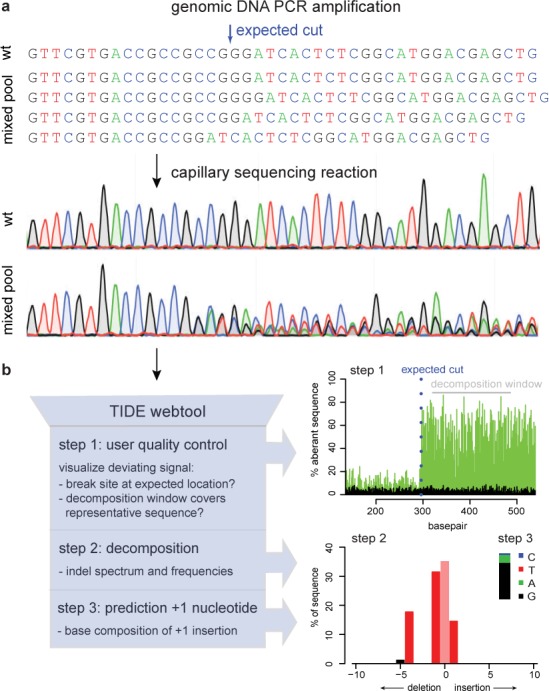
“(b) Overview of TIDE algorithm and output, which consists of three main steps: (1) Visualization of aberrant sequence signal in control (black) and treated sample (green), the expected break site (vertical dotted line) and the region used for decomposition (gray bar); (2) Decomposition yielding the spectrum of indels…”
BackgroundMethodGenetic screens in human cells using the CRISPR-Cas9 system
Wang, T., Wei, J. J., Sabatini, D. M., & Lander, E. S. (2014) · Science · doi:10.1126/science.1246981 · Cited by 2,856
Improving CRISPR-Cas nuclease specificity using truncated guide RNAs
Fu, Y., Sander, J. D., Reyon, D., Cascio, V. M., & Joung, J. K. (2014) · Nature Biotechnology · doi:10.1038/nbt.2808 · Cited by 1,993 · cited 1×
“However, the efficacy and the spectrum of mutations vary greatly depending on the RGEN target site and cells used ((17,18) and this report).”
BackgroundCHOPCHOP: a CRISPR/Cas9 and TALEN web tool for genome editing
Montague, T. G., Cruz, J. M., Gagnon, J. A., Church, G. M., & Valen, E. (2014) · Nucleic Acids Research · doi:10.1093/nar/gku410 · Cited by 1,234
Cas9 as a versatile tool for engineering biology
Mali, P., Esvelt, K. M., & Church, G. M. (2013) · Nature Methods · doi:10.1038/nmeth.2649 · Cited by 1,197 · cited 1×
“For example, with RGENs one typically needs to test several single-guide RNAs (sgRNAs) that are predicted to target the endonuclease to a gene of interest (6).”
BackgroundA guide to genome engineering with programmable nucleases
Kim, H., & Kim, J.-S. (2014) · Nature Reviews Genetics · doi:10.1038/nrg3686 · Cited by 1,163 · cited 3×
“(b) Overview of TIDE algorithm and output, which consists of three main steps: (1) Visualization of aberrant sequence signal in control (black) and treated sample (green), the expected break site (vertical dotted line) and the region used for decomposition (gray bar); (2) Decomposition yielding the spectrum of indels…”
BackgroundMethod
Cited by
Items 801–900 of 1,019
Ijezie, E. C., O’Dowd, J. M., Kuan, M. I., Faeth, A. R., & Fortunato, E. A. (2023) · Journal of Virology · doi:10.1128/jvi.01718-22 · Cited by 32
“0 control populations were compared using TIDE analysis (83).”
MethodKong, H., Zhuo, C., Yi, K., Zheng, C., Mintz, R. L., Lao, Y., Zhong, Q., Ju, E., Wang, H., Shao, D., et al. (2023) · Nano Today · doi:10.1016/j.nantod.2023.102040 · Cited by 31
Bialk, P. A., Sansbury, B. M., Rivera-Torres, N., Bloh, K. M., Man, D., & Kmiec, E. B. (2016) · Scientific Reports · doi:10.1038/srep32681 · Cited by 31
TRAP-seq identifies cystine/glutamate antiporter as a driver of recovery from liver injury
Wang, A. W., Wangensteen, K. J., Wang, Y. J., Zahm, A. M., Moss, N. G., Erez, N., & Kaestner, K. H. (2018) · Journal of Clinical Investigation · doi:10.1172/jci95120 · Cited by 33
van Harten, A. M., Poell, J. B., Buijze, M., Brink, A., Wells, S. I., Leemans, C. R., Wolthuis, R. M. F., & Brakenhoff, R. H. (2019) · Oral Oncology · doi:10.1016/j.oraloncology.2019.09.004 · Cited by 34
Comprehensive single-cell genome analysis at nucleotide resolution using the PTA Analysis Toolbox
Middelkamp, S., Manders, F., Peci, F., van Roosmalen, M. J., González, D. M., Bertrums, E. J. M., van der Werf, I. M., Derks, L. L. M., Groenen, N. M., Verheul, M., et al. (2023) · Cell Genomics · doi:10.1016/j.xgen.2023.100389 · Cited by 30
Cömert, C., Kjær-Sørensen, K., Hansen, J., Carlsen, J., Just, J., Meaney, B. F., Østergaard, E., Luo, Y., Oxvig, C., Laursen, L. S., et al. (2024) · Molecular Metabolism · doi:10.1016/j.molmet.2024.102009 · Cited by 33
“The ef fi ciencies of the 10 pairs of sgRNAs on genomic DNA sequences from 1-day post-injection embryos were tested using the TIDE software (https://tide-calculator.nki.nl/) [52].”
MethodSingle-Step, High-Efficiency CRISPR-Cas9 Genome Editing in Primary Human Disease-Derived Fibroblasts
Martufi, M., Good, R. B., Rapiteanu, R., Schmidt, T., Patili, E., Tvermosegaard, K., New, M. I., Nanthakumar, C. B., Betts, J. C., Blanchard, A. D., et al. (2019) · The CRISPR Journal · doi:10.1089/crispr.2018.0047 · Cited by 32
Chen, X., Lloyd, S. M., Kweon, J., Gamalong, G. M., & Bao, X. (2021) · Nature Communications · doi:10.1038/s41467-020-20674-3 · Cited by 30
Hashimoto, M., Saito, Y., Nakagawa, R., Ogahara, I., Takagi, S., Takata, S., Amitani, H., Endo, M., Yuki, H., Ramilowski, J. A., et al. (2021) · Nature Cancer · doi:10.1038/s43018-021-00177-w · Cited by 31
Current widely-used web-based tools for CRISPR nucleases, base editors, and prime editors
Hwang, G., Song, B., & Bae, S. (2021) · Gene and Genome Editing · doi:10.1016/j.ggedit.2021.100004 · Cited by 44
Versatile and efficient in vivo genome editing with compact Streptococcus pasteurianus Cas9
Liu, Z., Chen, S., Xie, W., Song, Y., Li, J., Lai, L., & Li, Z. (2021) · Molecular Therapy · doi:10.1016/j.ymthe.2021.06.013 · Cited by 29
New Frontiers: Precise Editing of Allergen Genes Using CRISPR
Brackett, N. F., Pomés, A., & Chapman, M. D. (2022) · Frontiers in Allergy · doi:10.3389/falgy.2021.821107 · Cited by 33
“Briefly, control and CRISPR-edited DNA chromatogram traces are uploaded to the platform, which then identifies all possible indels for the control trace and determines the relative abundance of those indels in the mixed trace of the edited sample (19, 20).”
BackgroundBollen, Y., Hageman, J. H., van Leenen, P., Derks, L. L. M., Ponsioen, B., Amorie, J. R. B. D., Verlaan-Klink, I., van den Bos, M., Terstappen, L. W. M. M., van Boxtel, R., et al. (2022) · PLoS Biology · doi:10.1371/journal.pbio.3001527 · Cited by 30
“Using TIDE analysis [17], we show that wild-type Cas9 conditions result in a high frequency of indels within the secondary allele, whereas knock-in organoids generated via ITPN displayed >99% sequence integrity of their secondary allele (S2 Fig).”
MethodJamal, K., Galbiati, A., Armenia, J., Illuzzi, G., Hall, J., Bentouati, S., Barrell, D. G., Ahdesmaki, M. J., O’Connor, M. J., Leo, E., et al. (2022) · Cancer Research Communications · doi:10.1158/2767-9764.crc-22-0119 · Cited by 30
“Cell lines were expanded and the KO of the gene of interest was validated by immunoblot, TIDE or ICE sequencing (18, 19) or an RT-PCR to assess theKOefficiency.”
Borsenberger, V., Onésime, D., Lestrade, D., Rigouin, C., Neuvéglise, C., Daboussi, F., & Bordes, F. (2018) · Journal of Molecular Biology · doi:10.1016/j.jmb.2018.08.024 · Cited by 30
Matsumoto, D., Matsugi, E., Kishi, K., Inoue, Y., Nigorikawa, K., & Nomura, W. (2024) · Molecular Therapy — Nucleic Acids · doi:10.1016/j.omtn.2024.102124 · Cited by 31
Gonzalo-Hansen, C., Steurer, B., Janssens, R. C., Zhou, D., van Sluis, M., Lans, H., & Marteijn, J. A. (2024) · Nucleic Acids Research · doi:10.1093/nar/gkae618 · Cited by 29
Delivery of Prime editing in human stem cells using pseudoviral NanoScribes particles
Halegua, T., Risson, V., Carras, J., Rouyer, M., Coudert, L., Jacquier, A., Schaeffer, L., Ohlmann, T., & Mangeot, P. E. (2025) · Nature Communications · doi:10.1038/s41467-024-55604-0 · Cited by 29
Nutlin-Induced Apoptosis Is Specified by a Translation Program Regulated by PCBP2 and DHX30
Rizzotto, D., Zaccara, S., Rossi, A., Galbraith, M. D., Andrysík, Z., Pandey, A., Sullivan, K. D., Quattrone, A., Espinosa, J. M., Dassi, E., et al. (2020) · Cell Reports · doi:10.1016/j.celrep.2020.03.011 · Cited by 31
Sharon, D. M., Nesdoly, S., Yang, H. J., Gélinas, J., Xia, Y., Ansorge, S., & Kamen, A. (2020) · Scientific Reports · doi:10.1038/s41598-020-68934-y · Cited by 29
Torsin ATPases influence chromatin interaction of the Torsin regulator LAP1
Luithle, N., de Bos, J. U., Hovius, R., Maslennikova, D., Lewis, R. T., Ungricht, R., Fierz, B., & Kutay, U. (2020) · eLife · doi:10.7554/elife.63614 · Cited by 28
Plasma membrane perforation by GSDME during apoptosis-driven secondary necrosis
Schutter, E. D., Ramon, J., Pfeuty, B., Tender, C. A. D., Stremersch, S., Raemdonck, K., de Beeck, K. O., Declercq, W., Riquet, F. B., Braeckmans, K., et al. (2021) · Cellular and Molecular Life Sciences · doi:10.1007/s00018-021-04078-0 · Cited by 29
“Allele editing was analyzed using TIDE [32].”
Loss of function of the nuclear envelope protein LEMD2 causes DNA damage–dependent cardiomyopathy
Caravia, X. M., Ramirez-Martinez, A., Gan, P., Wang, F., McAnally, J., Xu, L., Bassel‐Duby, R., Liu, N., & Olson, E. N. (2022) · Journal of Clinical Investigation · doi:10.1172/jci158897 · Cited by 30
“AAVs were prepared by the Boston Children’s Hospital Viral Core (Boston, Massachusetts, USA), as previously described (60).”
Quon, S., Yu, B., Russ, B. E., Tsyganov, K., Nguyen, H., Toma, C., Heeg, M., Hocker, J. D., Milner, J. J., Crotty, S., et al. (2023) · Immunity · doi:10.1016/j.immuni.2023.03.017 · Cited by 30
MYC is a clinically significant driver of mTOR inhibitor resistance in breast cancer
Bhin, J., Yemelyanenko, J., Chao, X., Klarenbeek, S., Opdam, M., Malka, Y., Hoekman, L., Kruger, D. T., Bleijerveld, O. B., Brambillasca, C. S., et al. (2023) · The Journal of Experimental Medicine · doi:10.1084/jem.20211743 · Cited by 34
“Sequencing results were used to estimate the spectrum and frequency of small insertions and deletions (indels) generated in the different samples and time points following the TIDE analysis methodology (Brinkman et al., 2014).”
InfluentialSteyer, B., Carlson-Stevermer, J., Angenent-Mari, N., Khalil, A. S., Harkness, T., & Saha, K. (2015) · Acta Biomaterialia · doi:10.1016/j.actbio.2015.12.036 · Cited by 31
“These assays can be difficult to standardize [32,33] and do not monitor the cargo trafficking and editing processes in situ.”
Detection of genome-edited mutant clones by a simple competition-based PCR method
原山, 武., & Riezman, H. (2017) · PLoS ONE · doi:10.1371/journal.pone.0179165 · Cited by 31
“TIDE (Tracking of Indels by DEcomposition) [16] analysis was performed to confirm that samples used in the optimization steps are mutants.”
MethodMérindol, N., Far, M. E., Sylla, M., Masroori, N., Dufour, C., Li, J., Cherry, P., Plourde, M. B., Tremblay, C. L., & Berthoux, L. (2018) · PLoS Pathogens · doi:10.1371/journal.ppat.1007398 · Cited by 32
“…cells transduced with pLCv2-CAG or pLCv2-T5gRNA2 treated for 10 days with puromycin (1 μ g/ml; Invivogen), sequenced and submitted to the in silico TIDE assay which quantitates percentages of indels by sequencing decomposition, in comparison with the unedited control (S5C, S5D and S5E Fig) [68].”
Gobillot, T. A., Humes, D. G., Sharma, A., Kikawa, C., & Overbaugh, J. M. (2020) · Viruses · doi:10.3390/v12050503 · Cited by 29
Moffa, L., Mannino, G., Bevilacqua, I., Gambino, G., Perrone, I., Pagliarani, C., Bertea, C. M., Spada, A., Narduzzo, A., Zizzamia, E., et al. (2024) · The Plant Journal · doi:10.1111/tpj.17204 · Cited by 29
Galvanin (TMEM154) is an electric-field sensor for directed cell migration
Belliveau, N. M., Footer, M. J., Platenkamp, A., Rodriguez, C., Kim, H., Prinz, C. K., van Loon, A. P., Lin, Y., Eustis, T. E., Chan, M. M., et al. (2026) · Cell · doi:10.1016/j.cell.2026.04.026 · Cited by 30
Redesigning small ruminant genomes with CRISPR toolkit: Overview and perspectives
Kalds, P., Gao, Y., Zhou, S., Cai, B., Huang, X., Wang, X., & Chen, Y. (2020) · Theriogenology · doi:10.1016/j.theriogenology.2020.02.015 · Cited by 27
Taharabaru, T., Yokoyama, R., Higashi, T., Mohammed, A. F. A., Inoue, M., Maeda, Y. K., Niidome, T., Onodera, R., & Motoyama, K. (2020) · ACS Applied Materials & Interfaces · doi:10.1021/acsami.9b21667 · Cited by 27
Huang, J. Y., Kan, S., Sandfeld, E. K., Dalton, N. D., Rangel, A. D., Chan, Y., Davis‐Turak, J., Neumann, J. C., & Wang, R. (2020) · Scientific Reports · doi:10.1038/s41598-020-65259-8 · Cited by 28
CRISPR-Csy4-Mediated Editing of Rotavirus Double-Stranded RNA Genome
Papa, G., Venditti, L., Braga, L., Schneider, E., Giacca, M., Petris, G., & Burrone, Ó. R. (2020) · Cell Reports · doi:10.1016/j.celrep.2020.108205 · Cited by 27
“The PCR products were either sequenced and analysed using the TIDE software (Brinkman et al., 2014) or gel purified before HindIII-XhoI digestion and cloning into pcDNA 3.1 plasmid.”
MethodInfluentialChatukuta, P., & Rey, M. E. C. (2020) · Virology Journal · doi:10.1186/s12985-020-01453-4 · Cited by 29
“com/; [16]) and MAFTT version 7 (https ://mafft .”
Disruption of the MSL complex inhibits tumour maintenance by exacerbating chromosomal instability
Monserrat, J., Morales, C., Richardson, L., Wilson, T. S., Patel, H., Domart, M., Horswell, S. D., Song, O., Jiang, M., Crawford, M. R., et al. (2021) · Nature Cell Biology · doi:10.1038/s41556-021-00657-2 · Cited by 29
Kingston, E. R., & Bartel, D. P. (2021) · RNA · doi:10.1261/rna.078746.121 · Cited by 27
“After culture for 2–3 wk, clonal lines were screened for lesions by PCR amplification of the targeted locus followed by TIDE analysis of the amplicon (Brinkman et al. 2014).”
MethodKöcher, T., Bischof, J., Haas, S. A., March, O. P., Liemberger, B., Hainzl, S., Illmer, J., Hoog, A., Muigg, K., Binder, H., et al. (2021) · Molecular Therapy — Nucleic Acids · doi:10.1016/j.omtn.2021.05.015 · Cited by 28
“Single clones and resulting PCR products were Sanger sequenced and subsequently analyzed via CRISPR-ID.(62)”
MethodVangheluwe, N., & Beeckman, T. (2021) · Genes · doi:10.3390/genes12060884 · Cited by 27
“The frequency of different alleles of the targeted gene was determined by sanger sequencing and subsequent TIDE analysis [47].”
MethodRahim, M., Nakhe, A. Y., Banerjee, D. R., Hawes, E. M., Bosma, K. J., Rosch, J. C., Oeser, J. K., Wang, B., Lippmann, E. S., Jacobson, D. A., et al. (2022) · Journal of Biological Chemistry · doi:10.1016/j.jbc.2022.101729 · Cited by 30
“After three rounds of transfection, the βTC3 cells were expanded and prospectively analyzed for G6pc2 expression and activity by TIDE (Tracking of Indels by Decomposition) analysis (52) and a stable isotope-based glucose cycling assay (8), respectively.”
MethodLeal, A. F., & Alméciga-Díaz, C. J. (2022) · Gene Therapy · doi:10.1038/s41434-022-00344-3 · Cited by 29
A BORC-dependent molecular pathway for vesiculation of cell corpse phagolysosomes
Fazeli, G., Levin‐Konigsberg, R., Bassik, M. C., Stigloher, C., & Wehman, A. M. (2023) · Current Biology · doi:10.1016/j.cub.2022.12.041 · Cited by 27
CRISPR-Cas9 editing of TLR4 to improve the outcome of cardiac cell therapy
Schary, Y., Rotem, I., Caller, T., Lewis, N., Shaihov–Teper, O., Brzezinski, R. Y., Lendengolts, D., Raanani, E., Sternik, L., Naftali‐Shani, N., et al. (2023) · Scientific Reports · doi:10.1038/s41598-023-31286-4 · Cited by 29
Inhibitory CARs fail to protect from immediate T cell cytotoxicity
Funk, M. A., Heller, G., Waidhofer‐Söllner, P., Leitner, J. M., & Steinberger, P. (2024) · Molecular Therapy · doi:10.1016/j.ymthe.2024.02.022 · Cited by 29
Widespread chromatin context-dependencies of DNA double-strand break repair proteins
Vergara, X., Manjón, A. G., de Haas, M., Morris, B., Schep, R., Leemans, C., Friskes, A., Beijersbergen, R. L., Sanders, M. A., Medema, R. H., et al. (2024) · Nature Communications · doi:10.1038/s41467-024-49232-x · Cited by 29
Li, Z., Jella, K. K., Jaafar, L., Li, S., Park, S., Story, M. D., Wang, H., Wang, Y., & Dynan, W. S. (2018) · Scientific Reports · doi:10.1038/s41598-018-29350-5 · Cited by 33
HIT-Cas9: A CRISPR/Cas9 Genome-Editing Device under Tight and Effective Drug Control
Zhao, C., Zhao, Y., Zhang, J., Lu, J., Chen, L., Zhang, Y., Yue, Y., Xu, J., Wei, S., & Wang, Y. (2018) · Molecular Therapy — Nucleic Acids · doi:10.1016/j.omtn.2018.08.022 · Cited by 27
Grotz, A. K., Abaitua, F., Navarro‐Guerrero, E., Hastoy, B., Ebner, D. V., & Gloyn, A. L. (2019) · Wellcome Open Research · doi:10.12688/wellcomeopenres.15447.2 · Cited by 27
Zhou, W., Brown, W., Bardhan, A., Delaney, M., Ilk, A. S., Rauen, R. R., Kahn, S. I., Tsang, M., & Deiters, A. (2020) · Angewandte Chemie · doi:10.1002/ange.201914575 · Cited by 27
Genome-scale targeted mutagenesis in Brassica napus using a pooled CRISPR libraryPreprint
He, J., Zhang, K., Yan, S., Tang, M., Zhou, W., Yin, Y., Chen, K., Zhang, C., & Li, M. (2023) · Genome Research · doi:10.1101/gr.277650.123 · Cited by 29
“Amplicons of the selected off-target sites were sequenced by the Sanger method, and the editing interrogation was conducted by the online server of TIDE (Brinkman et al. 2014).”
Direct-seq: programmed gRNA scaffold for streamlined scRNA-seq in CRISPR screen
Song, Q., Ni, K., Liu, M., Li, Y., Wang, L., Wang, Y., Liu, Y., Yu, Z., Qi, Y., Lu, Z., et al. (2020) · Genome Biology · doi:10.1186/s13059-020-02044-w · Cited by 26
Chai, N., Haney, M. S., Couthouis, J., Morgens, D. W., Benjamin, A., Wu, K., Ousey, J., Fang, S., Finer, S., Bassik, M. C., et al. (2020) · Brain Research · doi:10.1016/j.brainres.2019.146601 · Cited by 26
Technical considerations for the use of CRISPR/Cas9 in hematology research
Gundry, M. C., Dever, D. P., Yudovich, D., Bauer, D. E., Haas, S., Wilkinson, A. C., & Singbrant, S. (2017) · Experimental Hematology · doi:10.1016/j.exphem.2017.07.006 · Cited by 26
“A number of assays can be used for estimating indel frequencies, although PCR of the target locus followed by amplicon sequencing of the PCR products to obtain accurate estimates of indel rates is recommended (Hendel et al., 2015b, Brinkman et al., 2014).”
BackgroundWang, Q., Capelletti, S., Liu, J., Janssen, J. M., & Gonçalves, M. A. F. V. (2024) · Nucleic Acids Research · doi:10.1093/nar/gkae057 · Cited by 26
“Prime editing activities in HEK293T cells transfected with prime editing constructs were assessed through the analysis of Sanger sequencing chromatogram peaks by using the Inference of CRISPR Edits (ICE) or Tracking of Indels by De-composition (TIDE) software packages ( 39 ,40 ).”
Kulicke, C. A., Swarbrick, G. M., Ladd, N. A., Cansler, M. E., Null, M. D., Worley, A. H., Lemon, C., Ahmed, T., Bennett, J., Lust, T. N., et al. (2024) · Communications Biology · doi:10.1038/s42003-024-05912-4 · Cited by 28
“Sanger sequencing was performed by capillary electrophoresis at the 456 OHSU Vollum Institute DNA Sequencing Core and sequences were analyzed by TIDE [59] and ICE 457 [60].”
MethodTranslation suppresses exogenous target RNA-mediated microRNA decay
Li, T., Li, L., Hiers, N. M., Sheng, P., Wang, Y., Traugot, C. M., Effinger-Morris, J. F., Akaphan, P., Liu, Y., Bian, J., et al. (2025) · Nature Communications · doi:10.1038/s41467-025-60374-4 · Cited by 28
“Polyclonalknockoutef fi ciencywas determinedbyPCRampli fi cationofgenomicDNAatthetargetedlocus, followed by TIDE analysis 75 .”
Moir-Meyer, G., Cheong, P. L., Olijnik, A.-A., Brown, J. M., Knight, S. J. L., King, A. J., Kurita, R., Nakamura, Y., Gibbons, R. J., Higgs, D. R., et al. (2018) · Methods and Protocols · doi:10.3390/mps1030028 · Cited by 26
“Indels may be analyzed in by combining Sanger sequencing with TIDE software [25], or amplification products may be cloned and sequenced.”
MethodMultiplexed promoterless gene expression with CRISPReader
Zhan, H., Zhou, Q. Y., Gao, Q., Li, J., Huang, W., & Liu, Y. (2019) · Genome biology · doi:10.1186/s13059-019-1712-5 · Cited by 26
An optimized QF-binary expression system for use in zebrafish
Burgess, J., Burrows, J. T. A., Sadhak, R., Chiang, S., Weiss, A., D’Amata, C., Molinaro, A. M., Zhu, S., Long, M., Hu, C., et al. (2020) · Developmental Biology · doi:10.1016/j.ydbio.2020.07.007 · Cited by 26
DNA polymerase theta suppresses mitotic crossing over
Carvajal-Garcia, J., Crown, K. N., Ramsden, D. A., & Sekelsky, J. J. (2021) · PLoS Genetics · doi:10.1371/journal.pgen.1009267 · Cited by 27
“In addition, we harvested DNA from the cells, amplified the genomic regions across the Cas9 site and used tracking of indels by decomposition (TIDE) [32] to calculate the fraction of chromatids that had an indel at the target sites (% editing) (Fig 3A).”
MethodInfluentialANALISIS KEMISKINAN DI SEKTOR PERTANIAN (Studi Kasus Komoditas Padi di Kabupaten Malang)
Syairozi, M. I. (2021) · Media Ekonomi · doi:10.25105/me.v28i2.7169 · Cited by 45
Xu, H., Kita, Y., Bang, U., Gee, P., & Hotta, A. (2021) · STAR Protocols · doi:10.1016/j.xpro.2021.100965 · Cited by 26
“Potential solution Although ICE or TIDE are useful because they analyze indels using Sanger sequence data, high quality Sanger electrogram data are necessary for analysis and the results are not reliable if the quality of the data is low (Brinkman et al., 2014).”
MethodHoughton, B. C., Panchal, N., Haas, S. A., Chmielewski, K. O., Hildenbeutel, M., Whittaker, T. E., Mussolino, C., Cathomen, T., Thrasher, A. J., & Booth, C. (2022) · Frontiers in Genome Editing · doi:10.3389/fgeed.2022.828489 · Cited by 28
“1 file was the input to the online TIDE tool (Brinkman et al., 2014) (TALENs), or ICE software (Cas9/Cas12a, Synthego) which generated the % modification score.”
MethodBoutzen, H., Tonekaboni, S. A. M., Chan‐Seng‐Yue, M., Murison, A., Takayama, N., Mbong, N., Wagenblast, E., Orouji, E., Arruda, A., Mitchell, A., et al. (2022) · Leukemia · doi:10.1038/s41375-022-01697-9 · Cited by 28
Tetraspanin-5–mediated MHC class I clustering is required for optimal CD8 T cell activation
Colbert, J. D., Cruz, F. M., Baer, C. E., & Rock, K. L. (2022) · Proceedings of the National Academy of Sciences · doi:10.1073/pnas.2122188119 · Cited by 28
Coelho, R., Tozzi, A., Disler, M., Lombardo, F. C., Fedier, A., López, M. N., Freuler, F., Jacob, F., & Heinzelmann-Schwarz, V. A. (2022) · Cell Death and Disease · doi:10.1038/s41419-022-05347-x · Cited by 32
“Analysis of Cas9 activity using TIDE assay Genomic DNA of Cas9 expressing non-transduced (control) or transduced cells with sgRNAs targeting AAVS1 (mock) sg1_AAVS1_5′-ACT GTT GAC GGC GGC GAT GT-3′, sg2_AAVS1_5′-GCT GAT ACC GTC GGC GTT GG-3′; TP53 sg1_TP53_5′-AGA TGG CCA TGG CGC GGA CG-3; or RPA3 sg1_RPA3 5′-CCC AGG TC…”
MethodInfluentialPokrant, T., Hein, J. I., Körber, S., Disanza, A., Pich, A., Scita, G., Rottner, K., & Faix, J. (2023) · Proceedings of the National Academy of Sciences · doi:10.1073/pnas.2217437120 · Cited by 28
“Successful, consecutive inactivation of IRSp53 (designated as 1xKO) and IRSp53/IRTKS (2xKO) in independent clonal cell lines was confirmed by TIDE (tracking of indels by decomposition) analyses (40), and further validated by immunoblotting ( SI Appendix , Fig.”
An optimized SpCas9 high-fidelity variant for direct protein delivery
Pedrazzoli, E., Bianchi, A., Umbach, A., Amistadi, S., Brusson, M., Frati, G., Ciciani, M., Badowska, K. A., Arosio, D., Miccio, A., et al. (2023) · Molecular Therapy · doi:10.1016/j.ymthe.2023.03.007 · Cited by 27
“…and HDR events were evaluated by deconvolution of chromatographic traces using the tracking indels by deconvolution (TIDE) software (http://shinyapps.datacurators.nl/tide/) 38 or the Synthego ICE analysis tool (v.2) after Sanger sequencing the puri fi ed PCR products (EasyRun Service, Microsynth).”
Calviño, C., Ceballos, C., Piérola, A. A., Jáuregui, P., Calleja-Cervantes, M. E., Martín‐Úriz, P. S., Rodríguez-Márquez, P., Martín-Mallo, Á., Iglesias, E., Abizanda, G., et al. (2023) · Frontiers in Immunology · doi:10.3389/fimmu.2023.1270843 · Cited by 28
“In vitro cleavage ef fi ciency was evaluated by TIDE (6) after transfection of Streptococcus pyogenes Cas9 (SpCas9) and sgRNA ribonucleoprotein complexes (RNP) in the Jurkat cell line.”
InfluentialPARG-deficient tumor cells have an increased dependence on EXO1/FEN1-mediated DNA repair
Andronikou, C., Burdová, K., Dibitetto, D., Lieftink, C., Malzer, E., Kuiken, H. J., Gogola, E., Chaudhuri, A. R., Beijersbergen, R. L., Hanzlíková, H., et al. (2024) · The EMBO Journal · doi:10.1038/s44318-024-00043-2 · Cited by 27
“…were puri fi ed using the QIAquick PCR puri fi cation kit (Qiagen) according to the manufacturer ’ s protocol and submitted with corresponding forward primers for Sanger sequencing to con fi rm target modi fi cations using the TIDE (Tracking of Indels by Decomposition) algorithm (Brinkman et al, 2014).”
MethodCombining CRISPR/Cas9 and rAAV Templates for Efficient Gene Editing
Kaulich, M., & Dowdy, S. F. (2015) · Nucleic Acid Therapeutics · doi:10.1089/nat.2015.0545 · Cited by 27
“However, several open questions remain: (1) How to identify and validate off-target effects? (2) How to avoid the CRISPR/ Cas9-mediated cut on the second strand for heterozygous targeting strategies? (3) How to increase the overall targeting efficiency with HDR templates that do not contain selectable markers? First,…”
MethodComparative genomics reveals that loss of lunatic fringe (LFNG) promotes melanoma metastasis
Velasco‐Herrera, M. D. C., van der Weyden, L., Nsengimana, J., Speak, A. O., Sjöberg-Herrera, M. K., Bishop, D. T., Jönsson, G. B., Newton‐Bishop, J., & Adams, D. J. (2018) · Molecular Oncology · doi:10.1002/1878-0261.12161 · Cited by 28
“Sequences amplified from the Lfng locus were analysed with TIDE (Brinkman et al., 2014) to identify clones with disruptive mutations.”
MethodRodriguez, L., Voorhies, M., Gilmore, S. A., Beyhan, S., Myint, A., & Sil, A. (2019) · PLoS Biology · doi:10.1371/journal.pbio.3000168 · Cited by 27
RetractedA Quantitative Genetic Interaction Map of HIV Infection
Gordon, D. E., Watson, A., Roguev, A., Zheng, S., Jang, G. Μ., Kane, J., Xu, J., Guo, J. Z., Stevenson, E. J., Swaney, D. L., et al. (2020) · Molecular Cell · doi:10.1016/j.molcel.2020.02.004 · Cited by 29
Newman, A., Starrs, L. M., & Burgio, G. (2020) · BioEssays · doi:10.1002/bies.202000047 · Cited by 31
Duan, L., Hu, M., Tamm, J. A., Grinberg, Y. Y., Shen, F., Chai, Y., Xi, H. S., Gibilisco, L., Ravikumar, B., Gautam, V., et al. (2021) · Scientific Reports · doi:10.1038/s41598-021-82658-7 · Cited by 28
Rapid interrogation of cancer cell of origin through CRISPR editing
Feng, W., Cao, Z., Lim, P. X., Zhao, H., Luo, H., Mao, N., Lee, Y. S., Rivera, A. A., Choi, D., Wu, C., et al. (2021) · Proceedings of the National Academy of Sciences · doi:10.1073/pnas.2110344118 · Cited by 25
Glucocorticoids Suppress NF-κB–Mediated Neutrophil Control of Aspergillus fumigatus Hyphal Growth
Thrikawala, S. U., Anderson, M. H., & Rosowski, E. E. (2024) · The Journal of Immunology · doi:10.4049/jimmunol.2400021 · Cited by 26
Profound synthetic lethality between SMARCAL1 and FANCM
Feng, S., Liu, K., Shang, J., Hoeg, L., Pastore, G., Yang, W. E., Roy, S., Sastre-Moreno, G., Young, J. T. F., Wu, W., et al. (2024) · Molecular Cell · doi:10.1016/j.molcel.2024.10.016 · Cited by 27
Potentiating anti-tumor immunity by re-engaging immune synapse molecules
Zhou, X., Xu, T., Li, C., He, Y., Hu, Y., Gong, H., Li, J., Jiang, H., Wen, L., Fu, Y., et al. (2025) · Cell Reports Medicine · doi:10.1016/j.xcrm.2025.101975 · Cited by 35
Lin, L., Petersen, T. S., Jensen, K. T., Bolund, L., Kühn, R., & Luo, Y. (2017) · Journal of Biotechnology · doi:10.1016/j.jbiotec.2017.02.024 · Cited by 25
“Quantifications of indel frequencies were performed using the TIDE assay as 8 described previously (Brinkman et al., 2014).”
MethodComprehensive analysis of nucleocytoplasmic dynamics of mRNA in Drosophila cells
Chen, T., & van Steensel, B. (2017) · PLOS Genetics · doi:10.1371/journal.pgen.1006929 · Cited by 26
Self-citationMapping genetic interactions in cancer: a road to rational combination therapies
Tutuncuoglu, B., & Krogan, N. J. (2019) · Genome Medicine · doi:10.1186/s13073-019-0680-4 · Cited by 26
Defining the fetal origin of MLL-AF4 infant leukemia highlights specific fatty acid requirements
Symeonidou, V., Jakobczyk, H., Bashanfer, S., Malouf, C., Fotopoulou, F., Kotecha, R. S., Anderson, R. A., Finch, A. J., & Ottersbach, K. (2021) · Cell Reports · doi:10.1016/j.celrep.2021.109900 · Cited by 33
In vivo CRISPR-Cas9 inhibition of hepatic LDH as treatment of primary hyperoxaluria
Martínez-Turrillas, R., Martín-Mallo, Á., Rodríguez-Diaz, S., Zapata‐Linares, N., Rodríguez-Márquez, P., Martín‐Úriz, P. S., Vilas‐Zornoza, A., Calleja-Cervantes, M. E., SALIDO, E. C., Prósper, F., et al. (2022) · Molecular Therapy — Methods & Clinical Development · doi:10.1016/j.omtm.2022.03.006 · Cited by 25
Escobar, M., Li, J., Patel, A., Liu, S., Xu, Q., & Hilton, I. B. (2022) · ACS Synthetic Biology · doi:10.1021/acssynbio.2c00156 · Cited by 28
Automated identification of sequence-tailored Cas9 proteins using massive metagenomic data
Ciciani, M., Demozzi, M., Pedrazzoli, E., Visentin, E., Pezzè, L., Signorini, L. F., Blanco‐Míguez, A., Zolfo, M., Asnicar, F., Casini, A., et al. (2022) · Nature Communications · doi:10.1038/s41467-022-34213-9 · Cited by 26
“6),resulting in the NRVNRT PAM whereV=A, C or G; R=G or A. c Wild-type (WT) and P23H RHO alleles, showing the mutation resulting in the P23H substitution (in red)and matching PAMonthe mutated allele(highlightedin blue). d Editingactivity(%signi fi cantindelsobtainedbyTIDEanalysis,seeMethods: Cell culture and indels ana…”
MethodYıldırım, K., Kavas, M., Küçük, İ. S., Seçgin, Z., & Gökçek-Saraç, Ç. (2023) · International Journal of Molecular Sciences · doi:10.3390/ijms24076515 · Cited by 28
Frizzled2 receives WntA signaling during butterfly wing pattern formation
Hanly, J. J., Loh, L. S., Mazo‐Vargas, A., Rivera‐Miranda, T. S., Livraghi, L., Tendolkar, A., Day, C. R., Liutikaite, N., Earls, E., Corning, O. B. W. H., et al. (2023) · Development · doi:10.1242/dev.201868 · Cited by 26
Thürkauf, M., Lin, S., Oliveri, F., Grimm, D., Platt, R. J., & Rüegg, M. A. (2023) · Nature Communications · doi:10.1038/s41467-023-41769-7 · Cited by 27
“TIDE was applied to sequencing chromatograms to assess CRISPR-editing ef fi ciency of the target locus 55 .”
Lipo-Xenopeptide Polyplexes for CRISPR/Cas9 based Gene editing at ultra-low dose
Germer, J., Lessl, A.-L., Pöhmerer, J., Grau, M., Weidinger, E., Höhn, M., Yazdi, M., Cappelluti, M. A., Lombardo, A., Lächelt, U., et al. (2024) · Journal of Controlled Release · doi:10.1016/j.jconrel.2024.04.037 · Cited by 27
“Sanger sequencing data was evaluated by the TIDE web tool (https://tid e.nki.nl/) applying an indel size range of 25 and default settings for decomposition and alignment windows [66,67].”
Transgene‐free genome editing in poplar
Hoengenaert, L., Anders, C., Doorsselaere, J. V., Vanholme, R., & Boerjan, W. (2025) · New Phytologist · doi:10.1111/nph.20415 · Cited by 26
“Purified amplicons were sent for Sanger sequencing (Eurofins Genomics) and the obtained sequencing chromatograms were analyzed for gene editing using TIDE (Brinkman et al ., 2014), ICE (ICE A NALYSIS 2019. v.3.0.”
InfluentialPeriwal, V. (2016) · Briefings in Bioinformatics · doi:10.1093/bib/bbw052 · Cited by 28
Roesch, F., OhAinle, M., & Emerman, M. (2018) · Retrovirology · doi:10.1186/s12977-018-0409-2 · Cited by 30
“Using TIDE analysis, a tool specifically designed to assess the percentage of cells edited by sgRNAs in heterogeneous populations [32], we determined that IFITM2/3 knockout cells are highly edited for ifitm2 (71%) and ifitm3 (78%), while NTC and IFITM1 knockout cells showed no editing at these loci.”
Dabrowska, M., Czubak, K., Juzwa, W., Krzyżosiak, W. J., Olejniczak, M., & Kozłowski, P. (2018) · Nucleic Acids Research · doi:10.1093/nar/gky505 · Cited by 28
“All of them need only basic and easily accessible laboratory equipment, such as a thermocycler and either a CE-apparatus (TIDE, IDAA, qEvaCRISPR) or ddPCR equipment dedicated to droplet generation and counting.”
MethodInfluentialCRL4AMBRA1 targets Elongin C for ubiquitination and degradation to modulate CRL5 signaling
Chen, S., Jang, G. Μ., Hüttenhain, R., Gordon, D. E., Du, D., Newton, B. W., Johnson, J. R., Hiatt, J. B., Hultquist, J. F., Johnson, T. L., et al. (2018) · The EMBO Journal · doi:10.15252/embj.201797508 · Cited by 29
Nasri, M., Mir, P., Dannenmann, B., Amend, D., Skroblyn, T., Xu, Y., Schulze‐Osthoff, K., Klimiankou, M., Welte, K., & Skokowa, J. (2019) · Blood Advances · doi:10.1182/bloodadvances.2017015511 · Cited by 26
“Sanger sequencing of purified PCR product was performed by Eurofins Genomics and analyzed using the TIDE (Tracking of Indels by Decomposition) webtool developed by Brinkman et al.22 Establishment of gene-edited cell lines and human iPSCs from single-cell clones using limiting dilution Cells were serially diluted to 0.…”
MethodInfluentialFilippova, J. A., Matveeva, A. M., Zhuravlev, E. S., Balakhonova, E., Prokhorova, D. V., Malanin, S., Mahmud, R. S., Grigoryeva, T. V., Anufrieva, K. S., Semenov, D. V., et al. (2019) · Frontiers in Pharmacology · doi:10.3389/fphar.2019.01246 · Cited by 26
Metadata
- Authors
- Brinkman, E. K., Chen, T., Amendola, M., & van Steensel, B.
- Affiliations
- The Netherlands Cancer Institute (NL)
- Division of Gene Regulation, Netherlands Cancer Institute, Plesmanlaan 121, 1016 HM Amsterdam, the Netherlands
- Venue
- Nucleic Acids Research
- Publisher
- Oxford University Press (OUP)
- Published
- 2014-10-09
- Volume
- 42
- Issue
- 22
- Pages
- e168-e168
- ISSN
- 0305-1048 (ISSN-L)
- 1362-4962
- PMC
- PMC4267669
- OpenAlex
- W2106070783
- Cited by
- 2,390
- References
- 19
- Citations by year
- 2026: 184 · 2025: 261 · 2024: 253 · 2023: 290 · 2022: 280 · 2021: 259 · 2020: 263 · 2019: 241 · 2018: 186 · 2017: 105 · 2016: 48 · 2015: 16 · 2014: 2
- FWCI
- 23.39
- Type
- journal article
- Language
- en
- Open access
- gold
- doi.org
- Locations
- Nucleic Acids Research (publishedVersion, cc-by)
- Europe PMC (PubMed Central) (publishedVersion, cc-by)
- PubMed Central (publishedVersion, cc-by)
- PubMed (publishedVersion)
- HAL (submittedVersion)
- Institutional Research Information System University of Ferrara (University of Ferrara) (submittedVersion)
- Funders
- ZonMw
- Nederlandse Organisatie voor Wetenschappelijk Onderzoek
- FP7 Ideas: European Research Council (293662)
- Topics
- Life Sciences › Biochemistry, Genetics and Molecular Biology › Molecular Biology › CRISPR and Genetic Engineering
- Life Sciences › Biochemistry, Genetics and Molecular Biology › Molecular Biology › RNA regulation and disease
- Life Sciences › Biochemistry, Genetics and Molecular Biology › Cancer Research › Cancer Genomics and Diagnostics
- Keywords
- genome editing, tides, induced mutation, CRISPR/Cas9, editing sites, mutation spectrum, web-based tool, PCR-based assays
- MeSH terms
- Algorithms, Cells, Cultured, DNA Mutational Analysis, Humans, Software, Polymerase Chain Reaction, Mutagenesis, K562 Cells, Genomics, INDEL Mutation, CRISPR-Cas Systems
About these checks
Registry, retraction, Cites and statistics results are computed, not judged, with one exception: a printed reference that no index lists is read once by a model before it counts as a citation error. Claims are extracted by a model and kept only when their quote appears verbatim in the text; each cited source is then checked, with a model’s help, for whether it says what the claim relies on. Those verdicts can be wrong — read the claim’s quote and the cited source before relying on one.
Statistics and arithmetic are recomputed, not judged.
Confidence bands are shown only for fields calibrated on our annotated test set. None is calibrated yet, so no band is shown.
What counts as a claim ›How we measure confidence ›How we check this ›
Are you an author, or do you see a problem with this page? Request a review
Data sources
Bibliographic data: Semantic Scholar, OpenAlex, Crossref.
Contains information from the Semantic Scholar Academic Graph Datasets, made available under the ODC Attribution License (ODC-BY 1.0).
Semantic Scholar’s data is described in: Kinney, R., et al. (2023). The Semantic Scholar Open Data Platform. arXiv:2301.10140.
