

Easy quantitative assessment of genome editing by sequence trace decomposition
Open accessThe DOI matches its Crossref record; 19 of the 19 references it cites were found in a registry or an index.
Abstract
The efficacy and the mutation spectrum of genome editing methods can vary substantially depending on the targeted sequence. A simple, quick assay to accurately characterize and quantify the induced mutations is therefore needed. Here we present TIDE, a method for this purpose that requires only a pair of PCR reactions and two standard capillary sequencing runs. The sequence traces are then analyzed by a specially developed decomposition algorithm that identifies the major induced mutations in the projected editing site and accurately determines their frequency in a cell population. This method is cost-effective and quick, and it provides much more detailed information than current enzyme-based assays. An interactive web tool for automated decomposition of the sequence traces is available. TIDE greatly facilitates the testing and rational design of genome editing strategies.
Overview
The claims and statistics of this paper haven’t been checked yet.
Free: it reads the open-access text and checks the first 5 claims that cite a source we can check. Create a free account to check every claim.
Integrity signals
Registry
Cites
Statistics
Figures
Verification
Claims the paper makes
The claims and statistics of this paper haven’t been checked yet.
Free: it reads the open-access text and checks the first 5 claims that cite a source we can check. Create a free account to check every claim.
Claims other papers make about this one
Each is checked against this paper’s own text: does it say what the citing paper says it does?
The source backs part of the claim, not all of it — or backs it for a different population, condition or comparison.
In the citing paper
“Long-term nuclease expression (10 days after transduction), which has been demonstrated to highly favor non-specific cleavages41, did not generate any unspecific CFTR editing above TIDE background levels (about 1%)38; whereas AsCas12a-crRNA+11/wt efficiently edited the CFTR gene (86.3%, Fig. 2b).”
From Allele specific repair of splicing mutations in cystic fibrosis through AsCas12a genome editing (2019) · cites this paper as [38]
Experimental — accuracy not yet measuredThe source backs part of the claim, not all of it — or backs it for a different population, condition or comparison.
In the citing paper
“Genotyping was performed by Sanger sequencing of PCR amplicons of genomic target sites with individual alleles deconvoluted by TIDE analysis of chromatograms[33].”
From Genome-scale CRISPR screening for modifiers of cellular LDL uptake (2021) · cites this paper as [33]
Experimental — accuracy not yet measuredIn the citing paper
“Tracking of InDels by Decomposition (TIDE) is an effective web tool (https://tide.nki.nl) that can be used to analyse sequencing data, which estimates the spectra and frequencies of small insertions and deletions generated from gene editing (Brinkman et al., 2014).”
From Genetic resources and precise gene editing for targeted improvement of barley abiotic stress tolerance (2023) · cites this paper as Brinkman et al., 2014
Self-check
Percentages, sums and reported differences re-computed from the paper’s own numbers.
The self-check needs the paper’s full text.
Citations
Cites
Multiplex Genome Engineering Using CRISPR/Cas Systems
Cong, L., Ran, F. A., Cox, D., Lin, S., Barretto, R., Habib, N., Hsu, P. D., Wu, X., Jiang, W., Marraffini, L. A., et al. (2013) · Science · doi:10.1126/science.1231143 · Cited by 15,339
Bioconductor: open software development for computational biology and bioinformatics
Gentleman, R. C., Carey, V. J., Bates, D. M., Bolstad, B., Dettling, M., Dudoit, S., Ellis, B., Gautier, L., Ge, Y., Gentry, J., et al. (2004) · Genome Biology · doi:10.1186/gb-2004-5-10-r80 · Cited by 12,172 · cited 3×
“scf format) are imported into TIDE using the R Bioconductor (15) package sangerseqR (version 1.”
MethodInfluentialGenome engineering using the CRISPR-Cas9 system
Ran, F. A., Hsu, P. D., Wright, J., Agarwala, V., Scott, D. A., & Zhang, F. (2013) · Nature Protocols · doi:10.1038/nprot.2013.143 · Cited by 11,133 · cited 1×
“edu/) (13) and CHOPCHOP (https://chopchop.”
DNA targeting specificity of RNA-guided Cas9 nucleases
Hsu, P. D., Scott, D. A., Weinstein, J. A., Ran, F. A., Konermann, S., Agarwala, V., Li, Y., Fine, E. J., Wu, X., Shalem, O., et al. (2013) · Nature Biotechnology · doi:10.1038/nbt.2647 · Cited by 4,741 · cited 1×
“However, the efficacy and the spectrum of mutations vary greatly depending on the RGEN target site and cells used ((17,18) and this report).”
BackgroundZFN, TALEN, and CRISPR/Cas-based methods for genome engineering
Gaj, T., Gersbach, C. A., & Barbas, C. F. (2013) · Trends in Biotechnology · doi:10.1016/j.tibtech.2013.04.004 · Cited by 3,820 · cited 3×
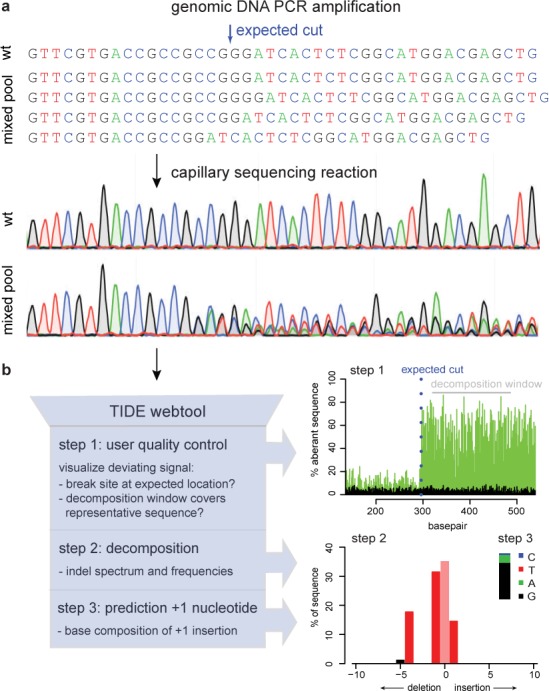
“(b) Overview of TIDE algorithm and output, which consists of three main steps: (1) Visualization of aberrant sequence signal in control (black) and treated sample (green), the expected break site (vertical dotted line) and the region used for decomposition (gray bar); (2) Decomposition yielding the spectrum of indels…”
BackgroundMethodGenetic screens in human cells using the CRISPR-Cas9 system
Wang, T., Wei, J. J., Sabatini, D. M., & Lander, E. S. (2014) · Science · doi:10.1126/science.1246981 · Cited by 2,856
Improving CRISPR-Cas nuclease specificity using truncated guide RNAs
Fu, Y., Sander, J. D., Reyon, D., Cascio, V. M., & Joung, J. K. (2014) · Nature Biotechnology · doi:10.1038/nbt.2808 · Cited by 1,993 · cited 1×
“However, the efficacy and the spectrum of mutations vary greatly depending on the RGEN target site and cells used ((17,18) and this report).”
BackgroundCHOPCHOP: a CRISPR/Cas9 and TALEN web tool for genome editing
Montague, T. G., Cruz, J. M., Gagnon, J. A., Church, G. M., & Valen, E. (2014) · Nucleic Acids Research · doi:10.1093/nar/gku410 · Cited by 1,234
Cas9 as a versatile tool for engineering biology
Mali, P., Esvelt, K. M., & Church, G. M. (2013) · Nature Methods · doi:10.1038/nmeth.2649 · Cited by 1,197 · cited 1×
“For example, with RGENs one typically needs to test several single-guide RNAs (sgRNAs) that are predicted to target the endonuclease to a gene of interest (6).”
BackgroundA guide to genome engineering with programmable nucleases
Kim, H., & Kim, J.-S. (2014) · Nature Reviews Genetics · doi:10.1038/nrg3686 · Cited by 1,163 · cited 3×
“(b) Overview of TIDE algorithm and output, which consists of three main steps: (1) Visualization of aberrant sequence signal in control (black) and treated sample (green), the expected break site (vertical dotted line) and the region used for decomposition (gray bar); (2) Decomposition yielding the spectrum of indels…”
BackgroundMethod
Cited by
Items 1,001–1,020 of 1,020
Schaaf, C. R., Polkoff, K. M., Carter, A., Stewart, A. S., Sheahan, B. J., Freund, J. M., Ginzel, J. D., Snyder, J. C., Roper, J., Piedrahita, J. A., et al. (2023) · The FASEB Journal · doi:10.1096/fj.202300223r · Cited by 20
Lewis, M., Prouzet‐Mauléon, V., Lichou, F., Richard, E., Iggo, R., Turcq, B., & Mahon, F. (2020) · Cancer Medicine · doi:10.1002/cam4.3231 · Cited by 19
Karunarathne, S., Walker, E., Sharma, D., Li, C., & Han, Y. (2023) · Journal of Zhejiang University-SCIENCE B · doi:10.1631/jzus.b2200552 · Cited by 18
“Tracking of InDels by Decom‐ position (TIDE) is an effective web tool (https://tide. nki.nl) that can be used to analyse sequencing data, which estimates the spectra and frequencies of small insertions and deletions generated from gene editing (Brinkman et al., 2014).”
Hoang, H.-D., Graber, T. E., Jia, J.-J., Vaidya, N., Gilchrist, V. H., Xiang, X., Li, W., Cowan, K. N., Gkogkas, C. G., Jaramillo, M., et al. (2019) · Cell Reports · doi:10.1016/j.celrep.2019.11.072 · Cited by 18
“Tracking of indels by decomposition (TIDE) analysis (Brinkman et al., 2014) determined that the Inpp5e locus was modified at a frequency close to 100% with a mixture of three in-”
MethodA general genome editing strategy using CRISPR lipid nanoparticle spherical nucleic acids
Han, Z., Huang, C., Luo, T., & Mirkin, C. A. (2025) · Proceedings of the National Academy of Sciences · doi:10.1073/pnas.2426094122 · Cited by 17
“Alternatively, PCR amplicons were sequenced by Sanger sequencing, and indel rates were assessed by TIDE (51).”
InfluentialEukaryotic-driven directed evolution of Cas9 nucleases
(2024) · doi:10.1186/s13059-024-03215-9 · Cited by 15
“Cells were collected after 3 days and lysed with QuickExtract DNA Extraction Solution (Lucigen): endogenous loci were PCR amplified with HOT FIREPol MultiPlex Mix (Solis BioDyne), Sanger sequenced and analyzed with the TIDE tool [62].”
MethodAdnan Awad, S., Dufva, O., Klievink, J., Karjalainen, E., Ianevski, A., Pietarinen, P., Kim, D., Potdar, S., Wolf, M., Lotfi, K., et al. (2024) · Cell Reports Medicine · doi:10.1016/j.xcrm.2024.101521 · Cited by 14
Okada, K., Aoki, K., Tabei, T., Sugio, K., Imai, K., Bonkohara, Y., & Kamachi, Y. (2022) · Nucleic Acids Research · doi:10.1093/nar/gkac100 · Cited by 14
“To overcome this problem, Sanger sequencing-based TIDE and ICE were developed, in which indels are assessed computationally by comparing Sanger sequence traces of PCR amplicons derived from edited and unedited genomic DNAs.”
InfluentialTLNRD1 is a CCM complex component and regulates endothelial barrier integrity
Ball, N. J., Ghimire, S., Follain, G., Pajari, A. O., Wurzinger, D., Vaitkevičiūtė, M., Cowell, A. R., Berki, B., Ivaska, J., Paatero, I., et al. (2024) · Journal of Cell Biology · doi:10.1083/jcb.202310030 · Cited by 11
Beck, D., Cao, H., Tian, F., Huang, Y., Jiang, M., Zhao, H., Tai, X., Xu, W., Kosasih, H. J., Kealy, D. J., et al. (2024) · Nature Communications · doi:10.1038/s41467-024-54096-2 · Cited by 9
“The PCR products are next sub-jectedtostandardSangersequencingandthesequencedata fi les of the edited samples and the wild-type samples were analyzed by the TIDE webtool (http://tide.nki.nl).”
InfluentialCreeth, R., Thompson, A., & Kevei, Z. (2025) · Frontiers in Genome Editing · doi:10.3389/fgeed.2025.1589431 · Cited by 9
Human cellular model systems of β-thalassemia enable in-depth analysis of disease phenotype
Daniels, D. E., Ferrer-Vicens, I., Hawksworth, J., Andrienko, T. N., Finnie, E. M., Bretherton, N. S., Ferguson, D. C. J., Oliveira, A. S. F., Szeto, J.-Y. A., Wilson, M. C., et al. (2023) · Nature Communications · doi:10.1038/s41467-023-41961-9 · Cited by 8
(2024) · doi:10.1016/j.devcel.2024.12.015 · Cited by 8
Focused ultrasound‐mediated APOE4 knockdown in mouse brain
Zheng, K., Tsitsos, F. N., Batts, A. J., Ji, R., Nuriel, T., Konofagou, E. E., & Leong, K. W. (2025) · Alzheimer's & Dementia · doi:10.1002/alz.70464 · Cited by 8
A Pan-RNase Inhibitor Enabling CRISPR-mRNA Platforms for Engineering of Primary Human Monocytes
Laoharawee, K., Johnson, M. J., Lahr, W. S., Sipe, C. J., Kleinboehl, E., Peterson, J. J., Lonetree, C.-L., Bell, J. B., Slipek, N. J., Crane, A. T., et al. (2022) · International Journal of Molecular Sciences · doi:10.3390/ijms23179749 · Cited by 7
“CRISPR-Cas9 ribonucleoproteins (RNPs) complexes with these chemically modified sgRNAs were then individually electroporated into monocytes and the cells were cultured for 5 days before Sanger sequencing and analysis for non-homologous end joining derived insertions/deletions (indels), using the TIDE algorithm [35].”
MethodKameda-Smith, M. M., Zhu, H., Luo, E.-C., Suk, Y., Xella, A., Yee, B., Chokshi, C., Xing, S., Tan, F., Fox, R. G., et al. (2022) · Nature Communications · doi:10.1038/s41467-022-35118-3 · Cited by 7
Myristoylated Neuronal Calcium Sensor-1 captures the preciliary vesicle at distal appendages
Kanie, T., Ng, R., Abbott, K. L., Tanvir, N. M., Lorentzen, E., Pongs, O., & Jackson, P. K. (2025) · eLife · doi:10.7554/elife.85998 · Cited by 5
“After selection with 10 µg/ml puromycin, cells were subjected to immunoblotting, IF, or genomic PCR combined with TIDE analysis ( Brinkman et al., 2014 ) to determine knockout efficiency.”
Liu, H., Francis, L., Dagley, L. F., Cobbold, S. A., Webb, A. I., Komander, D., Villadangos, J. A., & Mintern, J. D. (2025) · Scientific Reports · doi:10.1038/s41598-025-25817-4 · Cited by 2
“Target editing of clonal cell lines was assessed using Sanger sequencing and ICE CRSIPR Analysis Tool 40 .”
Liu, H., Francis, L., Dagley, L. F., Cobbold, S. A., Webb, A. I., Komander, D., Villadangos, J. A., & Mintern, J. D. (2025) · doi:10.21203/rs.3.rs-6763007/v1 · Cited by 2
Jonsson, G., Hofmann, M., Mereiter, S., Hartley‐Tassell, L., Onji, M., Sakic, I., Oliveira, T., Hoffmann, D., Novatchkova, M., Schleiffer, A., et al. (2026) · The FEBS Journal · doi:10.1111/febs.70236 · Cited by 1
“The editing efficiency was assessed using TIDE analysis [75].”
Metadata
- Authors
- Brinkman, E. K., Chen, T., Amendola, M., & van Steensel, B.
- Affiliations
- The Netherlands Cancer Institute (NL)
- Division of Gene Regulation, Netherlands Cancer Institute, Plesmanlaan 121, 1016 HM Amsterdam, the Netherlands
- Venue
- Nucleic Acids Research
- Publisher
- Oxford University Press (OUP)
- Published
- 2014-10-09
- Volume
- 42
- Issue
- 22
- Pages
- e168-e168
- ISSN
- 0305-1048 (ISSN-L)
- 1362-4962
- PMC
- PMC4267669
- OpenAlex
- W2106070783
- Cited by
- 2,390
- References
- 19
- Citations by year
- 2026: 184 · 2025: 261 · 2024: 253 · 2023: 290 · 2022: 280 · 2021: 259 · 2020: 263 · 2019: 241 · 2018: 186 · 2017: 105 · 2016: 48 · 2015: 16 · 2014: 2
- FWCI
- 23.39
- Type
- journal article
- Language
- en
- Open access
- gold
- doi.org
- Locations
- Nucleic Acids Research (publishedVersion, cc-by)
- Europe PMC (PubMed Central) (publishedVersion, cc-by)
- PubMed Central (publishedVersion, cc-by)
- PubMed (publishedVersion)
- HAL (submittedVersion)
- Institutional Research Information System University of Ferrara (University of Ferrara) (submittedVersion)
- Funders
- ZonMw
- Nederlandse Organisatie voor Wetenschappelijk Onderzoek
- FP7 Ideas: European Research Council (293662)
- Topics
- Life Sciences › Biochemistry, Genetics and Molecular Biology › Molecular Biology › CRISPR and Genetic Engineering
- Life Sciences › Biochemistry, Genetics and Molecular Biology › Molecular Biology › RNA regulation and disease
- Life Sciences › Biochemistry, Genetics and Molecular Biology › Cancer Research › Cancer Genomics and Diagnostics
- Keywords
- genome editing, tides, induced mutation, CRISPR/Cas9, editing sites, mutation spectrum, web-based tool, PCR-based assays
- MeSH terms
- Algorithms, Cells, Cultured, DNA Mutational Analysis, Humans, Software, Polymerase Chain Reaction, Mutagenesis, K562 Cells, Genomics, INDEL Mutation, CRISPR-Cas Systems
About these checks
Registry, retraction, Cites and statistics results are computed, not judged, with one exception: a printed reference that no index lists is read once by a model before it counts as a citation error. Claims are extracted by a model and kept only when their quote appears verbatim in the text; each cited source is then checked, with a model’s help, for whether it says what the claim relies on. Those verdicts can be wrong — read the claim’s quote and the cited source before relying on one.
Statistics and arithmetic are recomputed, not judged.
Confidence bands are shown only for fields calibrated on our annotated test set. None is calibrated yet, so no band is shown.
What counts as a claim ›How we measure confidence ›How we check this ›
Are you an author, or do you see a problem with this page? Request a review
Data sources
Bibliographic data: Semantic Scholar, OpenAlex, Crossref.
Contains information from the Semantic Scholar Academic Graph Datasets, made available under the ODC Attribution License (ODC-BY 1.0).
Semantic Scholar’s data is described in: Kinney, R., et al. (2023). The Semantic Scholar Open Data Platform. arXiv:2301.10140.
