

Easy quantitative assessment of genome editing by sequence trace decomposition
Open accessThe DOI matches its Crossref record; 19 of the 19 references it cites were found in a registry or an index.
Abstract
The efficacy and the mutation spectrum of genome editing methods can vary substantially depending on the targeted sequence. A simple, quick assay to accurately characterize and quantify the induced mutations is therefore needed. Here we present TIDE, a method for this purpose that requires only a pair of PCR reactions and two standard capillary sequencing runs. The sequence traces are then analyzed by a specially developed decomposition algorithm that identifies the major induced mutations in the projected editing site and accurately determines their frequency in a cell population. This method is cost-effective and quick, and it provides much more detailed information than current enzyme-based assays. An interactive web tool for automated decomposition of the sequence traces is available. TIDE greatly facilitates the testing and rational design of genome editing strategies.
Overview
The claims and statistics of this paper haven’t been checked yet.
Free: it reads the open-access text and checks the first 5 claims that cite a source we can check. Create a free account to check every claim.
Integrity signals
Registry
Cites
Statistics
Figures
Verification
Claims the paper makes
The claims and statistics of this paper haven’t been checked yet.
Free: it reads the open-access text and checks the first 5 claims that cite a source we can check. Create a free account to check every claim.
Claims other papers make about this one
Each is checked against this paper’s own text: does it say what the citing paper says it does?
The source backs part of the claim, not all of it — or backs it for a different population, condition or comparison.
In the citing paper
“Long-term nuclease expression (10 days after transduction), which has been demonstrated to highly favor non-specific cleavages41, did not generate any unspecific CFTR editing above TIDE background levels (about 1%)38; whereas AsCas12a-crRNA+11/wt efficiently edited the CFTR gene (86.3%, Fig. 2b).”
From Allele specific repair of splicing mutations in cystic fibrosis through AsCas12a genome editing (2019) · cites this paper as [38]
Experimental — accuracy not yet measuredThe source backs part of the claim, not all of it — or backs it for a different population, condition or comparison.
In the citing paper
“Genotyping was performed by Sanger sequencing of PCR amplicons of genomic target sites with individual alleles deconvoluted by TIDE analysis of chromatograms[33].”
From Genome-scale CRISPR screening for modifiers of cellular LDL uptake (2021) · cites this paper as [33]
Experimental — accuracy not yet measuredIn the citing paper
“Tracking of InDels by Decomposition (TIDE) is an effective web tool (https://tide.nki.nl) that can be used to analyse sequencing data, which estimates the spectra and frequencies of small insertions and deletions generated from gene editing (Brinkman et al., 2014).”
From Genetic resources and precise gene editing for targeted improvement of barley abiotic stress tolerance (2023) · cites this paper as Brinkman et al., 2014
Self-check
Percentages, sums and reported differences re-computed from the paper’s own numbers.
The self-check needs the paper’s full text.
Citations
Cites
Multiplex Genome Engineering Using CRISPR/Cas Systems
Cong, L., Ran, F. A., Cox, D., Lin, S., Barretto, R., Habib, N., Hsu, P. D., Wu, X., Jiang, W., Marraffini, L. A., et al. (2013) · Science · doi:10.1126/science.1231143 · Cited by 15,339
Bioconductor: open software development for computational biology and bioinformatics
Gentleman, R. C., Carey, V. J., Bates, D. M., Bolstad, B., Dettling, M., Dudoit, S., Ellis, B., Gautier, L., Ge, Y., Gentry, J., et al. (2004) · Genome Biology · doi:10.1186/gb-2004-5-10-r80 · Cited by 12,172 · cited 3×
“scf format) are imported into TIDE using the R Bioconductor (15) package sangerseqR (version 1.”
MethodInfluentialGenome engineering using the CRISPR-Cas9 system
Ran, F. A., Hsu, P. D., Wright, J., Agarwala, V., Scott, D. A., & Zhang, F. (2013) · Nature Protocols · doi:10.1038/nprot.2013.143 · Cited by 11,133 · cited 1×
“edu/) (13) and CHOPCHOP (https://chopchop.”
DNA targeting specificity of RNA-guided Cas9 nucleases
Hsu, P. D., Scott, D. A., Weinstein, J. A., Ran, F. A., Konermann, S., Agarwala, V., Li, Y., Fine, E. J., Wu, X., Shalem, O., et al. (2013) · Nature Biotechnology · doi:10.1038/nbt.2647 · Cited by 4,741 · cited 1×
“However, the efficacy and the spectrum of mutations vary greatly depending on the RGEN target site and cells used ((17,18) and this report).”
BackgroundZFN, TALEN, and CRISPR/Cas-based methods for genome engineering
Gaj, T., Gersbach, C. A., & Barbas, C. F. (2013) · Trends in Biotechnology · doi:10.1016/j.tibtech.2013.04.004 · Cited by 3,820 · cited 3×
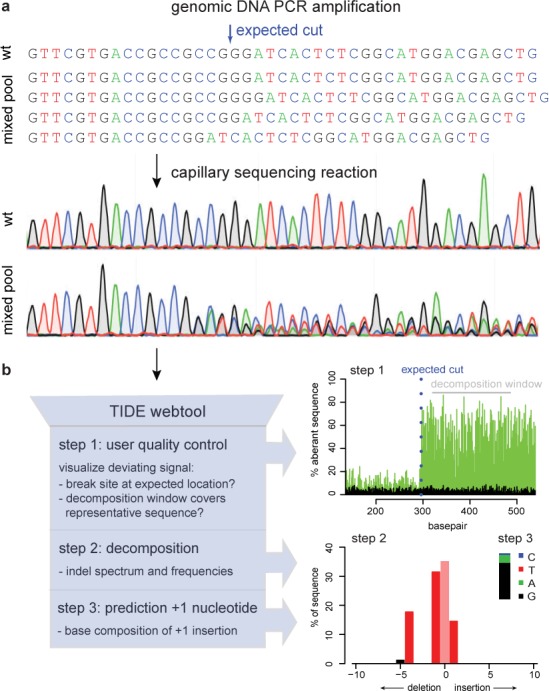
“(b) Overview of TIDE algorithm and output, which consists of three main steps: (1) Visualization of aberrant sequence signal in control (black) and treated sample (green), the expected break site (vertical dotted line) and the region used for decomposition (gray bar); (2) Decomposition yielding the spectrum of indels…”
BackgroundMethodGenetic screens in human cells using the CRISPR-Cas9 system
Wang, T., Wei, J. J., Sabatini, D. M., & Lander, E. S. (2014) · Science · doi:10.1126/science.1246981 · Cited by 2,856
Improving CRISPR-Cas nuclease specificity using truncated guide RNAs
Fu, Y., Sander, J. D., Reyon, D., Cascio, V. M., & Joung, J. K. (2014) · Nature Biotechnology · doi:10.1038/nbt.2808 · Cited by 1,993 · cited 1×
“However, the efficacy and the spectrum of mutations vary greatly depending on the RGEN target site and cells used ((17,18) and this report).”
BackgroundCHOPCHOP: a CRISPR/Cas9 and TALEN web tool for genome editing
Montague, T. G., Cruz, J. M., Gagnon, J. A., Church, G. M., & Valen, E. (2014) · Nucleic Acids Research · doi:10.1093/nar/gku410 · Cited by 1,234
Cas9 as a versatile tool for engineering biology
Mali, P., Esvelt, K. M., & Church, G. M. (2013) · Nature Methods · doi:10.1038/nmeth.2649 · Cited by 1,197 · cited 1×
“For example, with RGENs one typically needs to test several single-guide RNAs (sgRNAs) that are predicted to target the endonuclease to a gene of interest (6).”
BackgroundA guide to genome engineering with programmable nucleases
Kim, H., & Kim, J.-S. (2014) · Nature Reviews Genetics · doi:10.1038/nrg3686 · Cited by 1,163 · cited 3×
“(b) Overview of TIDE algorithm and output, which consists of three main steps: (1) Visualization of aberrant sequence signal in control (black) and treated sample (green), the expected break site (vertical dotted line) and the region used for decomposition (gray bar); (2) Decomposition yielding the spectrum of indels…”
BackgroundMethod
Cited by
Items 601–700 of 1,019
Gehrmann, U., Burbage, M., Zueva, E., Goudot, C., Esnault, C., Ye, M., Carpier, J.-M., Burgdorf, N., Hoyler, T., Suárez, G., et al. (2019) · Proceedings of the National Academy of Sciences · doi:10.1073/pnas.1901639116 · Cited by 47
Generation of pRSAD2 gene knock-in pig via CRISPR/Cas9 technology
Xie, Z., Jiao, H., Xiao, H., Jiang, Y., Liu, Z., Qi, C., Zhao, D., Jiao, S., Yu, T., Tang, X., et al. (2019) · Antiviral Research · doi:10.1016/j.antiviral.2019.104696 · Cited by 48
A G protein–coupled receptor mediates neuropeptide-induced oocyte maturation in the jellyfish Clytia
Quiroga-Artigas, G., Lapébie, P., Leclère, L., Bauknecht, P., Uveira, J., Chevalier, S., Jékely, G., Momose, T., & Houliston, E. (2020) · PLoS Biology · doi:10.1371/journal.pbio.3000614 · Cited by 45
“PCR products were sequenced and mutation efficiency was assessed using TIDE analyses [69].”
MethodWillsey, H. R., Xu, Y., Everitt, A., Dea, J., Exner, C. R. T., Willsey, A. J., State, M. W., & Harland, R. M. (2020) · Development · doi:10.1242/dev.189290 · Cited by 53
“Mutational efficiency was estimated by sequence deconvolution by tracking of INDELs (TIDE) (Brinkman et al., 2014; DeLay et al., 2018).”
MethodTechnologies and Computational Analysis Strategies for CRISPR Applications
Clement, K., Hsu, J. Y., Canver, M. C., Joung, J. K., & Pinello, L. (2020) · Molecular Cell · doi:10.1016/j.molcel.2020.06.012 · Cited by 51
“These tools can be used for the quantification of both NHEJ/ MMEJ and HDR outcomes and are able to infer individual allelic frequencies (Brinkman et al., 2014, 2018; Hsiau et al., 2019).”
MethodHoffmann, M. D., Mathony, J., Upmeier zu Belzen, J., Harteveld, Z., Aschenbrenner, S., Stengl, C., Grimm, D., Correia, B. E., Eils, R., & Niopek, D. (2021) · Nucleic Acids Research · doi:10.1093/nar/gkaa1198 · Cited by 45
Wahida, A., Müller, M., Hiergeist, A., Popper, B., Steiger, K., Branca, C., Tschurtschenthaler, M., Engleitner, T., Donakonda, S., Coninck, J. D., et al. (2021) · Science Immunology · doi:10.1126/sciimmunol.abf7235 · Cited by 49
Schaefer, E. J., Wang, H. C., Karp, H. Q., Meyer, C. A., Cejas, P., Gearhart, M. D., Adelman, E. R., Fares, I., Apffel, A. M., Lim, K., et al. (2022) · Blood Cancer Discovery · doi:10.1158/2643-3230.bcd-21-0115 · Cited by 51
“Single-cell clones were isolated by limiting dilution, expanded, and screened by Sanger sequencing and TIDE (Tracking of Indels by DEcomposition) analysis (40).”
MethodStructure of the human heparan sulfate polymerase complex EXT1-EXT2
(2022) · doi:10.1101/2022.06.19.496623 · Cited by 45
Přibylová, A., Fischer, L., Pyott, D. E., Bassett, A. R., & Molnár, A. (2022) · New Phytologist · doi:10.1111/nph.18212 · Cited by 46
“The efficacy of gene editing was calculated using TIDE (https://tide.nki.nl/) (Brinkman et al., 2014).”
MethodRubio, A., Luoni, M., Giannelli, S. G., Radice, I., Iannielli, A., Cancellieri, C., Berardino, C. D., Regalia, G., Lazzari, G., Menegon, A., et al. (2016) · Scientific Reports · doi:10.1038/srep37540 · Cited by 45
Momose, T., Cian, A. D., Shiba, K., Inaba, K., Giovannangeli, C., & Concordet, J. (2018) · Scientific Reports · doi:10.1038/s41598-018-30188-0 · Cited by 50
E3 ubiquitin ligase Wwp1 regulates ciliary dynamics of the Hedgehog receptor Smoothened
Lv, B., Stuck, M. W., Desai, P. B., Cabrera, O. A., & Pazour, G. J. (2021) · Journal of Cell Biology · doi:10.1083/jcb.202010177 · Cited by 44
“Sequencing results were analyzed with CRISPResso2, TIDE (Tracking of Indels by Decomposition), CRISP-ID, and SWS (Sanger sequencing and MicrosoftWordwildcard searching)methods (Brinkman et al., 2014; Clement et al., 2019; Dehairs et al., 2016; Jie et al., 2017).”
MethodPaving the way towards precise and safe CRISPR genome editing
Śledziński, P., Dabrowska, M., Nowaczyk, M., & Olejniczak, M. (2021) · Biotechnology Advances · doi:10.1016/j.biotechadv.2021.107737 · Cited by 45
Genetic studies of human–chimpanzee divergence using stem cell fusions
Song, J. H. T., Grant, R. L., Behrens, V. C., Kučka, M., Kingman, G. A. R., Soltys, V., Chan, Y. F., & Kingsley, D. M. (2021) · Proceedings of the National Academy of Sciences · doi:10.1073/pnas.2117557118 · Cited by 44
Hoogstraat, M., Lips, E. H., Mayayo‐Peralta, I., Mulder, L., Kristel, P., van der Heijden, I., Annunziato, S., van Seijen, M., Nederlof, P. M., Sonke, G. S., et al. (2022) · npj Breast Cancer · doi:10.1038/s41523-022-00428-8 · Cited by 48
Wessel, G. M., Kiyomoto, M., Shen, T., & Yajima, M. (2020) · Scientific Reports · doi:10.1038/s41598-020-58584-5 · Cited by 51
Wandler, A. M., Huang, B. J., Craig, J. W., Hayes, K., Yan, H. H., Meyer, L. K., Scacchetti, A., Monsalve, G. C., Dail, M., Li, Q., et al. (2020) · Leukemia · doi:10.1038/s41375-020-0748-6 · Cited by 44
Sharma, S. K., Gupta, O. P., Pathaw, N., Sharma, D., Maibam, A., Sharma, P., Sanasam, J., Karkute, S. G., Kumar, S., & Bhattacharjee, B. (2021) · Frontiers in Nutrition · doi:10.3389/fnut.2021.751512 · Cited by 46
“However, most of the developed methods are expensive (PCR and qPCR), sensitive, time-consuming (Sanger sequencing, ACT-PCR, and MSBSP-PCR), less accurate (low detection specificity in CAPS), and unable to detect more significant indel mutations (131, 133).”
MethodCox, M. J., Roman, C. M., Tapper, E. E., Siegler, E. L., Chappell, D. B., Durrant, C., Ahmed, O., Sinha, S., Mwangi, R., Scott, N. E., et al. (2022) · Leukemia · doi:10.1038/s41375-022-01572-7 · Cited by 44
Zhang, P., Liu, J.-L., Pei, S., Wu, D., Xie, J., Liu, J., & Li, J. (2023) · Frontiers in Immunology · doi:10.3389/fimmu.2023.1189520 · Cited by 48
UHRF1 is a mediator of KRAS driven oncogenesis in lung adenocarcinoma
Kostyrko, K., Román, M., Lee, A. G., Simpson, D. R., Dinh, P., Leung, S. G., Marini, K. D., Kelly, M. R., Broyde, J., Califano, A., et al. (2023) · Nature Communications · doi:10.1038/s41467-023-39591-2 · Cited by 43
Wang, C., Sun, M. J., Shao, C., Schlicker, L., Zhuo, Y., Harim, Y., Peng, T., Tian, W., Stöffler, N., Schneider, M., et al. (2024) · npj Precision Oncology · doi:10.1038/s41698-024-00500-5 · Cited by 45
“The single-cell spheres were screened by Sanger sequencing (Biosune, Shanghai, China), and the results were analyzed using the TIDE web tool 57 .”
A Comparison of Techniques to Evaluate the Effectiveness of Genome Editing
Germini, D., Tsfasman, T., Zakharova, V., Sjakste, N., Lipinski, M., & Vassetzky, Y. S. (2017) · Trends in biotechnology · doi:10.1016/j.tibtech.2017.10.008 · Cited by 46
Kadi, N. E., Wang, L., Davis, A., Körkaya, H., Cooke, A., Vadnala, V., Brown, N. A., Betz, B. L., Cascalho, M., Kalemkerian, G. P., et al. (2018) · Cancer Research · doi:10.1158/0008-5472.can-17-3370 · Cited by 45
“Using the TIDE web-tool software (28), sequencing results were assessed and AICDA mutated clones were selected.”
CRISPR-Cas9-Mediated Mutagenesis of the Rubisco Small Subunit Family in Nicotiana tabacum
Donovan, S., Mao, Y., Orr, D. J., Carmo‐Silva, E., & McCormick, A. J. (2020) · Frontiers in Genome Editing · doi:10.3389/fgeed.2020.605614 · Cited by 44
“The TIDE tool was used to identify and determine the frequency of different mutations in samples that likely had more than one allele by analyzing the sequencing chromatograms from mutant and wild-type plants (Figure 2C) (Brinkman et al., 2014).”
MethodA more efficient CRISPR-Cas12a variant derived from Lachnospiraceae bacterium MA2020
Tran, M. H., Park, H., Nobles, C. L., Karunadharma, P. P., Pan, L., Zhong, G., Wang, H., He, W., Ou, T., Crynen, G. C., et al. (2021) · Molecular Therapy — Nucleic Acids · doi:10.1016/j.omtn.2021.02.012 · Cited by 42
“Sanger sequencing and Tracking of Indels by Decomposition assay (TIDE) were used to quantify the editing efficiency in this and the following experiments, because the TIDE assay has been shown to be more reliable and reproducible than endonucleasemismatch cleavage assay in detecting homing endonuclease activity.(30,31…”
MethodEfficient and precise generation of Tay–Sachs disease model in rabbit by prime editing system
Qian, Y., Zhao, D., Sui, T., Chen, M., Liu, Z., Liu, H., Zhang, T., Chen, S., Lai, L., & Li, Z. (2021) · Cell Discovery · doi:10.1038/s41421-021-00276-z · Cited by 44
Spatiotemporal changes in gibberellin content are required for soybean nodulation
Chu, X., Su, H., Hayashi, S., Gresshoff, P. M., & Ferguson, B. J. (2021) · New Phytologist · doi:10.1111/nph.17902 · Cited by 42
Predictable NHEJ Insertion and Assessment of HDR Editing Strategies in Plants
Molla, K. A., Shih, J., Wheatley, M. S., & Yang, Y. (2022) · Frontiers in Genome Editing · doi:10.3389/fgeed.2022.825236 · Cited by 45
“Purified PCR products were sequenced and decoded using TIDE for editing outcomes (Brinkman et al., 2014).”
MethodBhin, J., Dias, M. P., Gogola, E., Rolfs, F., Piersma, S. R., de Bruijn, R., de Ruiter, J. R., van den Broek, B., Duarte, A. A., Sol, W., et al. (2023) · Cell Reports · doi:10.1016/j.celrep.2023.112538 · Cited by 44
Mechanism of ribosome-associated mRNA degradation during tubulin autoregulation
Höpfler, M., Absmeier, E., Peak-Chew, S.-Y., Vartholomaiou, E., Passmore, L. A., Gasic, I., & Hegde, R. S. (2023) · Molecular Cell · doi:10.1016/j.molcel.2023.05.020 · Cited by 41
Carnie, C. J., Götz, M. J., Palma-Chaundler, C. S., Weickert, P., Wanders, A. R., Serrano-Benítez, A., Li, H., Gupta, V., Awwad, S. W., Blum, C., et al. (2024) · The EMBO Journal · doi:10.1038/s44318-024-00108-2 · Cited by 42
“Given the competitive nature of this work, we feel that a full mechanistic explanation of DCTD-mediated 5-aza-dC toxicity is beyond the scope of this manuscript.”
Kelly, L. M., Rutter, J. C., Lin, K., Ling, F., Duchmann, M., Latour, E., Arang, N., Pasquer, H., Ho‐Nhat, D., Charles, J., et al. (2024) · Nature Cancer · doi:10.1038/s43018-024-00782-5 · Cited by 44
“Nontargeting control sequences were aligned to sg PIK3CG and sg PIK3R5 sequences to quantify the efficiency of the sgRNA using the TIDE online tool 67 .”
Cochrane, R. W., Robino, R. A., Granger, B., Allen, E., Vaena, S. G., Romeo, M. J., de Cubas, A. A., Berto, S., & Ferreira, L. M. R. (2024) · Molecular Therapy — Methods & Clinical Development · doi:10.1016/j.omtm.2024.101385 · Cited by 44
“Indeed, PRF1 knockout CAR Tregs (59% indel ef fi ciency by tracking of indels by decomposition [TIDE] analysis 53 ) were less effective at killing NALM6 cells than their wild-type (WT) counterparts (Figure 2F).”
Scully, E. J., Shabani, E., Rangel, G. W., Grüring, C., Kanjee, U., Clark, M. A., Chaand, M., Kurita, R., Nakamura, Y., Ferreira, M. U., et al. (2019) · American Journal of Hematology · doi:10.1002/ajh.25543 · Cited by 47
A Dual sgRNA Approach for Functional Genomics in Arabidopsis thaliana
Pauwels, L., Clercq, R. D., Goossens, J., Iñigo, S., Williams, C. J., Ron, M., Britt, A., & Goossens, A. (2018) · G3 Genes Genomes Genetics · doi:10.1534/g3.118.200046 · Cited by 51
“For confirmation of TIDE spectra, the PCR amplicon was cut from gel, purified using GeneJET PCR purification kit (Thermo Scientific) and cloned into pJET1.”
MethodInfluentialUsing CRISPR/Cas9 to Knock Out GM-CSF in CAR-T Cells
Sterner, R. M., Cox, M. J., Sakemura, R. L., & Kenderian, S. S. (2019) · Journal of Visualized Experiments · doi:10.3791/59629 · Cited by 46
Wu, Y., Zhang, J., Peng, B., Tian, D., Zhang, D., Li, Y., Feng, X., Liu, J., Li, J., Zhang, T., et al. (2019) · Nature Communications · doi:10.1038/s41467-019-10748-2 · Cited by 46
Improving Horticultural Crops via CRISPR/Cas9: Current Successes and Prospects
Bhatta, B. P., & Malla, S. (2020) · Plants · doi:10.3390/plants9101360 · Cited by 54
A convergent molecular network underlying autism and congenital heart disease
Rosenthal, S. B., Willsey, H. R., Xu, Y., Yuan, M., Dea, J., Wang, S., Curtis, C., Sempou, E., Khokha, M. K., Chi, N. C., et al. (2021) · Cell Systems · doi:10.1016/j.cels.2021.07.009 · Cited by 43
Mutation-specific reporter for optimization and enrichment of prime editing
Schene, I. F., Joore, I. P., Baijens, J. H. L., Stevelink, R., Kok, G., Shehata, S., Ilcken, E. F., Nieuwenhuis, E. C. M., Bolhuis, D. P., van Rees, R. C. M., et al. (2022) · Nature Communications · doi:10.1038/s41467-022-28656-3 · Cited by 37
Reversal of viral and epigenetic HLA class I repression in Merkel cell carcinoma
Lee, P. C., Klaeger, S., Le, P. M., Korthauer, K. D., Cheng, J., Ananthapadmanabhan, V., Frost, T. C., Stevens, J. D., Wong, A. Y. L., Iorgulescu, J. B., et al. (2022) · Journal of Clinical Investigation · doi:10.1172/jci151666 · Cited by 47
“Gene editing and protein knockout were confirmed by Sanger sequencing using tracking of indels by decomposition (TIDE) (ref.”
Marker-free co-selection for successive rounds of prime editing in human cells
Levesque, S., Mayorga, D., Fiset, J.-P., Goupil, C., Duringer, A., Loiselle, A., Bouchard, E., Agudelo, D., & Doyon, Y. (2022) · Nature Communications · doi:10.1038/s41467-022-33669-z · Cited by 41
“To repurpose themTORC1 signaling reporter mVenus-TOSI previously developed for mouse(55), the N-terminal residues (1-82) of the human PDCD4 gene were codon optimized using the GenSmartTM codon optimization tool, synthesized as a gBlocksTM, and cloned into ATP1A1_T804N_hPGK1_mScarlet-I_Donor (Addgene 173207) upstream o…”
MethodLevesque, S., Cosentino, A., Verma, A., Genovese, P., & Bauer, D. E. (2024) · Nature Biotechnology · doi:10.1038/s41587-024-02266-4 · Cited by 43
“Sequencing traces with little to no background were used for quantification using BEAT 40 for substitutions and TIDE 38 for indels.”
InfluentialDiving into marine genomics with CRISPR/Cas9 systems
Momose, T., & Concordet, J. (2016) · Marine Genomics · doi:10.1016/j.margen.2016.10.003 · Cited by 44
Nielsen, C., van Putten, S. M., Lund, I. K., Melander, M. C., Nørregaard, K. S., Jürgensen, H. J., Reckzeh, K., Christensen, K. R., Ingvarsen, S., Gårdsvoll, H., et al. (2017) · Oncotarget · doi:10.18632/oncotarget.17883 · Cited by 41
“To determine indels and DNA sequences of knockout clones, the PCR-products were first purified by QIAQuick PCR purification before direct Sanger sequencing followed by TIDE and “mixed sequence reader” analysis [74, 75].”
Curative Ex Vivo Hepatocyte-Directed Gene Editing in a Mouse Model of Hereditary Tyrosinemia Type 1
VanLith, C. J., Guthman, R. M., Nicolas, C. T., Allen, K. L., Du, Z., Joo, D. J., Nyberg, S. L., Lillegard, J. B., & Hickey, R. (2018) · Human Gene Therapy · doi:10.1089/hum.2017.252 · Cited by 41
“Chromatogram results were analyzed using the free online tool, Tracking of Indels by DEcomposition (TIDE).(21) This program uses decomposition algorithms in order to compare mixed pool and control chromatograms and to determine the probability of various indels in the experimental group.”
MethodCRISPR/Cas9-mediated knockout of clinically relevant alloantigenes in human primary T cells
Kamali, E., Rahbarizadeh, F., Hojati, Z., & Frödin, M. (2021) · BMC Biotechnology · doi:10.1186/s12896-020-00665-4 · Cited by 44
“The CRISPR/Cas9-induced indel frequencies were quantified by Indel Detection by Amplicon Analysis (IDAA), using procedures we described previously [26] and by Tracking of Indels by Decomposition (TIDE), as described by others [46].”
MethodTanihara, F., Hirata, M., Nguyen, N. T., Sawamoto, O., Kikuchi, T., & Otoi, T. (2021) · International Journal of Molecular Sciences · doi:10.3390/ijms22052249 · Cited by 40
“The TIDE (tracking of indels by decomposition) bioinformatics package [23] was used to determine the genome editing efficiency of each gRNA combination (Figure 1).”
MethodLAP2alpha maintains a mobile and low assembly state of A-type lamins in the nuclear interior
Naetar, N., Georgiou, K., Knapp, C., Bronshtein, I., Zier, E., Fichtinger, P., Dechat, T., Garini, Y., & Foisner, R. (2021) · eLife · doi:10.7554/elife.63476 · Cited by 41
Oura, S., Noda, T., Morimura, N., Hitoshi, S., Nishimasu, H., Nagai, Y., Nureki, O., & Ikawa, M. (2021) · Communications Biology · doi:10.1038/s42003-021-02304-w · Cited by 42
Cromer, M. K., Barsan, V. V., Jaeger, E., Wang, M., Hampton, J. P., Chen, F., Kennedy, D., Xiao, J., Khrebtukova, I., Granat, A., et al. (2022) · Nature Communications · doi:10.1038/s41467-022-32233-z · Cited by 38
Wünnemann, F., Fotsing Tadjo, T., Beaudoin, M., Lalonde, S., Lo, K. S., Kleinstiver, B. P., & Lettre, G. (2023) · PLOS Genetics · doi:10.1371/journal.pgen.1010680 · Cited by 39
Choquet, K., Baxter‐Koenigs, A. R., Dülk, S.-L., Smalec, B. M., Rouskin, S., & Churchman, L. S. (2023) · Nature Structural & Molecular Biology · doi:10.1038/s41594-023-01035-2 · Cited by 43
Serrano-Benítez, A., Wells, S. E., Drummond‐Clarke, L., Russo, L. C., Thomas, J. C., Leal, G. A., Farrow, M., Edgerton, J. M., Balasubramanian, S., Yang, M. H., et al. (2023) · The EMBO Journal · doi:10.15252/embj.2022113190 · Cited by 43
“Successfully gene-edited clones were selected on the basis of TIDE analysis (https://tide-calculator.nki.nl; Brinkman et al , 2014) and confirmed, when possible, by immunoblotting.”
Samach, A., Mafessoni, F., Gross, O., Melamed‐Bessudo, C., Hayut, S. F., Dahan‐Meir, T., Amsellem, Z., Pawlowski, W. P., & Levy, A. A. (2023) · The Plant Cell · doi:10.1093/plcell/koad209 · Cited by 42
Small molecule induced STING degradation facilitated by the HECT ligase HERC4
Mutlu, M., Schmidt, I., Morrison, A. I., Goretzki, B., Freuler, F., Begue, D., Simić, O., Pythoud, N., Ahrné, E., Kapps, S., et al. (2024) · Nature Communications · doi:10.1038/s41467-024-48922-w · Cited by 42
“The modi fi cation rate on the cut-site was assessed by PCR followed by tracking of indels by decomposition (TIDE) analysis 39 (Fig.”
A long noncoding RNA at the cortex locus controls adaptive coloration in butterflies
Livraghi, L., Hanly, J. J., Evans, E., Wright, C. J., Loh, L. S., Mazo‐Vargas, A., Kamrava, K., Carter, A., van der Heijden, E. S. M., Reed, R. D., et al. (2024) · Proceedings of the National Academy of Sciences · doi:10.1073/pnas.2403326121 · Cited by 39
Haley, R. M., Padilla, M. S., El-Mayta, R. D., Joseph, R. A., Weber, J. A., Figueroa‐Espada, C. G., Mukalel, A. J., Ricciardi, A. S., Palanki, R., Geisler, H. C., et al. (2025) · ACS Nano · doi:10.1021/acsnano.4c16617 · Cited by 43
Roszko, K. L., Bi, R., Gorvin, C. M., Bräuner‐Osborne, H., Xiong, X., Inoue, A., Thakker, R. V., Strømgaard, K., Gardella, T. J., & Mannstadt, M. (2017) · JCI Insight · doi:10.1172/jci.insight.91079 · Cited by 39
“The efficacy of different sgRNA to create double-stranded DNA breaks was estimated by determining the frequency of mutations that were created in vitro in C3HT101⁄2 cells using the TIDE algorithm (39).”
MethodTumor Suppressor Activity of Selenbp1, a Direct Nkx2-1 Target, in Lung Adenocarcinoma
Caswell, D. R., Chuang, C.-H., Ma, R. K., Winters, I. P., Snyder, E. L., & Winslow, M. M. (2018) · Molecular Cancer Research · doi:10.1158/1541-7786.mcr-18-0392 · Cited by 41
Tewary, M., Dziedzicka, D., Östblom, J., Prochazka, L., Shakiba, N., Heydari, T., Aguilar‐Hidalgo, D., Woodford, C. M., Piccinini, E., Becerra‐Alonso, D., et al. (2019) · PLoS Biology · doi:10.1371/journal.pbio.3000081 · Cited by 40
“Underlying numerical data for this figure can be found in https://osf.io/zrvxj/. gRNA, guide RNA; hESC, human embryonic stem cell; PCR, Polymerase chain reaction; PE, Phycoerythrin; SSEA4, Stage-specific embryonic antigen-4; TGA, nucleic acid sequence; TIDE, Tracking of Indels by DEcomposition; WT, wild type.”
InfluentialIPO11 mediates βcatenin nuclear import in a subset of colorectal cancers
Mis, M., O’Brien, S., Steinhart, Z., Lin, S., Hart, T., Moffat, J., & Angers, S. (2019) · The Journal of Cell Biology · doi:10.1083/jcb.201903017 · Cited by 43
Baxley, R. M., Leung, W., Schmit, M., Matson, J. P., Yin, L., Oram, M. K., Wang, L., Taylor, J., Hedberg, J., Rogers, C. B., et al. (2021) · Nature Communications · doi:10.1038/s41467-021-21878-x · Cited by 40
Cas9 RNP transfection by vapor nanobubble photoporation for ex vivo cell engineering
Raes, L., Pille, M., Harizaj, A., Goetgeluk, G., Hoeck, J. V., Stremersch, S., Fraire, J. C., Brans, T., de Jong, O. G., Maas-Bakker, R. F., et al. (2021) · Molecular Therapy — Nucleic Acids · doi:10.1016/j.omtn.2021.08.014 · Cited by 42
Gavrilov, M. M., Yang, J., Zou, R. S., Ma, W., Lee, C.-Y., Mohapatra, S., Kang, J., Liao, T.-W., Myong, S., & Ha, T. (2022) · Nature Communications · doi:10.1038/s41467-022-34076-0 · Cited by 39
Martignago, D., Falavigna, V. D. S., Lombardi, A. V., Gao, H., Krukowski, P. K., Galbiati, M., Tonelli, C., Coupland, G., & Conti, L. (2023) · PLoS Genetics · doi:10.1371/journal.pgen.1010766 · Cited by 41
“Mutant alleles were identified by Sanger sequencing and when needed, the chromatograms were deciphered using TIDE [65].”
MethodMurray, A., Gough, G., Cindrić, A., Vučković, F., Koschut, D., Borelli, V., Petrović, D. J., Bekavac, A., Plećaš, A., Hribljan, V., et al. (2023) · EBioMedicine · doi:10.1016/j.ebiom.2023.104692 · Cited by 48
RNA transcripts regulate G-quadruplex landscapes through G-loop formation
Sato, K., Lyu, J., van den Berg, J., Braat, D., Cruz, V. M., Luzón, C. N., Schimmel, J., Esteban-Jurado, C., Alemany, M., Dreyer, J., et al. (2025) · Science · doi:10.1126/science.adr0493 · Cited by 41
Brandl, C., Ortiz, O., Röttig, B., Wefers, B., Wurst, W., & Kühn, R. (2015) · FEBS Open Bio · doi:10.1016/j.fob.2014.11.009 · Cited by 36
“For the analysis of gene editing PCR products were sequenced and analyzed using the TIDE tool [36].”
MethodCRISPR/Cas9‐Mediated Genome Editing in Epstein‐Barr Virus‐Transformed Lymphoblastoid B‐Cell Lines
Jiang, S., Wang, L. W., Walsh, M. J., Trudeau, S. J., Gerdt, C., Zhao, B., & Gewurz, B. E. (2018) · Current Protocols in Molecular Biology · doi:10.1002/cpmb.51 · Cited by 45
Efficient genome editing using CRISPR/Cas9 ribonucleoprotein approach in cultured medaka fish cells
Liu, Q., Yuan, Y., Zhu, F., Hong, Y., & Ge, R. (2018) · Biology Open · doi:10.1242/bio.035170 · Cited by 38
“After PAGE, the heteroduplex DNA bands were recovered for sequencing and the off-target events were counted using TIDE.”
MethodInfluentialGeneration of viable PDX1 gene‐edited founder pigs as providers of nonmosaics
Tanihara, F., Hirata, M., Nguyen, N. T., Le, Q. A., Hirano, T., & Otoi, T. (2020) · Molecular Reproduction and Development · doi:10.1002/mrd.23335 · Cited by 38
“The TIDE bioinformatics package (Brinkman et al., 2014) was used to determine the genotype of the blastocysts.”
MethodGenome-Wide Screens Reveal that Resveratrol Induces Replicative Stress in Human Cells
Benslimane, Y., Bertomeu, T., Coulombe‐Huntington, J., McQuaid, M. E., Sánchez‐Osuna, M., Papadopoli, D. J., Avizonis, D. Z., Russo, M. D. S. T., Huard, C., Topisirović, I., et al. (2020) · Molecular Cell · doi:10.1016/j.molcel.2020.07.010 · Cited by 41
Kumar, R. J., Chao, H. X., Simpson, D. A., Feng, W., Cho, M.-G., Roberts, V., Sullivan, A. R., Shah, S., Wozny, A., Fagan‐Solis, K. D., et al. (2020) · NAR Cancer · doi:10.1093/narcan/zcaa038 · Cited by 38
“samples transfected with a full complement of Cas9-RNP (Supplementary Figure S4F and G) (50).”
BackgroundORF10–Cullin-2–ZYG11B complex is not required for SARS-CoV-2 infection
Mena, E. L., Donahue, C. J., Vaites, L. P., Li, J., Róna, G., O’Leary, C., Lignitto, L., Miwatani-Minter, B., Paulo, J. A., Dhabaria, A., et al. (2021) · Proceedings of the National Academy of Sciences · doi:10.1073/pnas.2023157118 · Cited by 39
Brandenburg, J., Marwitz, S., Tazoll, S. C., Waldow, F., Kalsdorf, B., Vierbuchen, T., Scholzen, T. E., Groß, A., Goldenbaum, S., Hölscher, A., et al. (2021) · Journal of Clinical Investigation · doi:10.1172/jci141833 · Cited by 40
“Clones with frameshift mutations on both alleles (identified InDels for ACC1 620 and ACC2 KO cells were -7/+1 and -1/+2, respectively) were identified using the 621 Tracking of Indels by Decomposition (TIDE) online software (75) and used for further 622 experiments.”
MethodLacchini, E., Erffelinck, M., Mertens, J., Marcou, S., Molina‐Hidalgo, F. J., Tzfadia, O., Venegas‐Molina, J., Cárdenas, P. D., Pollier, J., Tava, A., et al. (2023) · New Phytologist · doi:10.1111/nph.18763 · Cited by 37
Germline mutations in a G protein identify signaling cross-talk in T cells
Ham, H., Jing, H., Lamborn, I. T., Kober, M. M., Koval, A., Berchiche, Y. A., Anderson, D. E., Druey, K. M., Mandl, J. N., Isidor, B., et al. (2024) · Science · doi:10.1126/science.add8947 · Cited by 41
“CRISPR-Cas9 – mediated KO efficiency was evaluated by immunoblotting or estimated via TIDE assay ( 72 ).”
MethodNing, B., Zhao, W., Chen, Q., Liu, P., Li, Q., Li, W., & Wang, R.-F. (2017) · Nature Communications · doi:10.1038/s41467-017-00301-4 · Cited by 37
Kas, S. M., de Ruiter, J. R., Schipper, K., Schut, E., Bombardelli, L., Wientjens, E., Drenth, A. P., de Korte‐Grimmerink, R., Mahakena, S., Phillips, C., et al. (2018) · Cancer Research · doi:10.1158/0008-5472.can-18-0757 · Cited by 40
Disrupted ER membrane protein complex–mediated topogenesis drives congenital neural crest defects
Marquez, J., Criscione, J., Charney, R. M., Prasad, M. S., Hwang, W. Y., Mis, E. K., García‐Castro, M. I., & Khokha, M. K. (2020) · Journal of Clinical Investigation · doi:10.1172/jci129308 · Cited by 38
Rapid and precise genome editing in a marine diatom, Thalassiosira pseudonana by Cas9 nickase (D10A)
Nawaly, H., Tsuji, Y., & Matsuda, Y. (2020) · Algal Research · doi:10.1016/j.algal.2020.101855 · Cited by 40
Selective Modulation of a Pan-Essential Protein as a Therapeutic Strategy in Cancer
Malone, C. F., Dharia, N. V., Kugener, G., Forman, A. B., Rothberg, M. V., Abdusamad, M., Gonzalez, A. E., Kuljanin, M., Robichaud, A. L., Conway, A. S., et al. (2021) · Cancer Discovery · doi:10.1158/2159-8290.cd-20-1213 · Cited by 40
CRISPR-targetedMAGT1insertion restores XMEN patient hematopoietic stem cells and lymphocytes
Brault, J., Liu, T., Bello, E. A., Liu, S., Sweeney, C. L., Meis, R. J., Koontz, S. M., Corsino, C. I., Choi, U., Vayssière, G., et al. (2021) · Blood · doi:10.1182/blood.2021011192 · Cited by 38
Yeap, W., Khan, N. C. M., Jamalludin, N., Muad, M. R., Appleton, D. R., & Kulaveerasingam, H. (2021) · Frontiers in Plant Science · doi:10.3389/fpls.2021.773656 · Cited by 39
“High transformation efficiency gene editing has been reported in monocot plant species including 57% in maize, 80% in wheat, 64% in rice, and 14.3% in sorghum (Xu et al., 2014; Char et al., 2017, 2020; Macovei et al., 2018; Zhang et al., 2018).”
BackgroundInfluentialCRISPR–Cas9-mediated chromosome engineering in Arabidopsis thaliana
Rönspies, M., Schindele, P., Wetzel, R., & Puchta, H. (2022) · Nature Protocols · doi:10.1038/s41596-022-00686-7 · Cited by 38
Carusillo, A., Haider, S., Schäfer, R., Rhiel, M., Türk, D., Chmielewski, K. O., Klermund, J., Mosti, L., Andrieux, G., Schäfer, R., et al. (2023) · Nucleic Acids Research · doi:10.1093/nar/gkad255 · Cited by 40
“To this end, we profiled the mutational landscape at the AAVS1 target site using TIDE (Tracking of Indels by De-composition) (32).”
Ahn, Y. J., Kim, H., Choi, S., Mazo‐Molina, C., Prokchorchik, M., Zhang, N., Kim, B., Mang, H., Koehler, N., Kim, J., et al. (2023) · New Phytologist · doi:10.1111/nph.19073 · Cited by 37
FIRRM/C1orf112 is synthetic lethal with PICH and mediates RAD51 dynamics
Stok, C., Tsaridou, S., van den Tempel, N., Everts, M., Wierenga, E., Bakker, F. J., Kok, Y., Alves, I. T., Jae, L. T., Raas, M. W. D., et al. (2023) · Cell Reports · doi:10.1016/j.celrep.2023.112668 · Cited by 30
Kiritsy, M. C., Ankley, L. M., Trombley, J. D., Huizinga, G. P., Lord, A. E., Orning, P., Elling, R., Fitzgerald, K. A., & Olive, A. J. (2021) · eLife · doi:10.7554/elife.65110 · Cited by 39
“Successful editing was verified by genotyping the Cd11b locus for indels at the sgRNA targeting sequence using Tracking of Indels by Decomposition (TIDE) analysis (Brinkman et al., 2014).”
MethodCiraolo, E., Althoff, S., Ruß, J., Rosnev, S., Butze, M., Pühl, M., Frentsch, M., Bullinger, L., & Na, I. (2022) · International Journal of Molecular Sciences · doi:10.3390/ijms23063207 · Cited by 40
Öktem, M., de Jong, O. G., & Mastrobattista, E. (2023) · Pharmaceutics · doi:10.3390/pharmaceutics15102500 · Cited by 37
“A duration of 48 h following transfection, genomic DNA was isolated, and the target region of the CCR5 gene was ampli fi ed via PCR. Gene editing was assessed semi-quantitatively via a T7 endonuclease assay (Figure 4C) and quantitatively via the TIDE analysis assay (Figure 4D) [37].”
MethodInfluentialTGF-β specifies T FH versus T H 17 cell fates in murine CD4 + T cells through c-Maf
Chang, Y., Bach, L., Hasiuk, M., Wen, L., Elmzzahi, T., Tsui, C., Gutiérrez-Melo, N., Steffen, T., Utzschneider, D. T., Raj, T., et al. (2024) · Science Immunology · doi:10.1126/sciimmunol.add4818 · Cited by 42
Donnelly, H., Ross, E. A., Xiao, Y., Hermantara, R., Taqi, A. F., Doherty-Boyd, W. S., Cassels, J. E., Tsimbouri, P. M., Dunn, K. M., Hay, J., et al. (2024) · Nature Communications · doi:10.1038/s41467-024-50054-0 · Cited by 39
Hirata, M., Tanihara, F., Wittayarat, M., Hirano, T., Nguyen, N. T., Le, Q. A., Namula, Z., Nii, M., & Otoi, T. (2019) · In Vitro Cellular & Developmental Biology - Animal · doi:10.1007/s11626-019-00338-3 · Cited by 37
Terada, Y., Jo, N., Arakawa, Y., Sakakura, M., Yamada, Y., Ukai, T., Kabata, M., Mitsunaga, K., Mineharu, Y., Ohta, S., et al. (2019) · Cell Reports · doi:10.1016/j.celrep.2019.02.009 · Cited by 41
Due, H., Schönherz, A. A., Ryø, L. B., Primo, M. N., Jespersen, D. S., Thomsen, E. A., Roug, A. S., Xiao, M., Tan, X., Pang, Y., et al. (2019) · Blood Advances · doi:10.1182/bloodadvances.2018029660 · Cited by 38
“Indel frequencies were determined by sequence-based Tracking of Indels by Decomposition analysis.(32) miR-155 knockout clones from single-cell expansion were generated by seeding 96-well plates at concentrations of 0.”
MethodLi, B., Ren, N., Yang, L., Liu, J., & Huang, Q. (2019) · Scientific Reports · doi:10.1038/s41598-019-55463-6 · Cited by 38
Metadata
- Authors
- Brinkman, E. K., Chen, T., Amendola, M., & van Steensel, B.
- Affiliations
- The Netherlands Cancer Institute (NL)
- Division of Gene Regulation, Netherlands Cancer Institute, Plesmanlaan 121, 1016 HM Amsterdam, the Netherlands
- Venue
- Nucleic Acids Research
- Publisher
- Oxford University Press (OUP)
- Published
- 2014-10-09
- Volume
- 42
- Issue
- 22
- Pages
- e168-e168
- ISSN
- 0305-1048 (ISSN-L)
- 1362-4962
- PMC
- PMC4267669
- OpenAlex
- W2106070783
- Cited by
- 2,390
- References
- 19
- Citations by year
- 2026: 184 · 2025: 261 · 2024: 253 · 2023: 290 · 2022: 280 · 2021: 259 · 2020: 263 · 2019: 241 · 2018: 186 · 2017: 105 · 2016: 48 · 2015: 16 · 2014: 2
- FWCI
- 23.39
- Type
- journal article
- Language
- en
- Open access
- gold
- doi.org
- Locations
- Nucleic Acids Research (publishedVersion, cc-by)
- Europe PMC (PubMed Central) (publishedVersion, cc-by)
- PubMed Central (publishedVersion, cc-by)
- PubMed (publishedVersion)
- HAL (submittedVersion)
- Institutional Research Information System University of Ferrara (University of Ferrara) (submittedVersion)
- Funders
- ZonMw
- Nederlandse Organisatie voor Wetenschappelijk Onderzoek
- FP7 Ideas: European Research Council (293662)
- Topics
- Life Sciences › Biochemistry, Genetics and Molecular Biology › Molecular Biology › CRISPR and Genetic Engineering
- Life Sciences › Biochemistry, Genetics and Molecular Biology › Molecular Biology › RNA regulation and disease
- Life Sciences › Biochemistry, Genetics and Molecular Biology › Cancer Research › Cancer Genomics and Diagnostics
- Keywords
- genome editing, tides, induced mutation, CRISPR/Cas9, editing sites, mutation spectrum, web-based tool, PCR-based assays
- MeSH terms
- Algorithms, Cells, Cultured, DNA Mutational Analysis, Humans, Software, Polymerase Chain Reaction, Mutagenesis, K562 Cells, Genomics, INDEL Mutation, CRISPR-Cas Systems
About these checks
Registry, retraction, Cites and statistics results are computed, not judged, with one exception: a printed reference that no index lists is read once by a model before it counts as a citation error. Claims are extracted by a model and kept only when their quote appears verbatim in the text; each cited source is then checked, with a model’s help, for whether it says what the claim relies on. Those verdicts can be wrong — read the claim’s quote and the cited source before relying on one.
Statistics and arithmetic are recomputed, not judged.
Confidence bands are shown only for fields calibrated on our annotated test set. None is calibrated yet, so no band is shown.
What counts as a claim ›How we measure confidence ›How we check this ›
Are you an author, or do you see a problem with this page? Request a review
Data sources
Bibliographic data: Semantic Scholar, OpenAlex, Crossref.
Contains information from the Semantic Scholar Academic Graph Datasets, made available under the ODC Attribution License (ODC-BY 1.0).
Semantic Scholar’s data is described in: Kinney, R., et al. (2023). The Semantic Scholar Open Data Platform. arXiv:2301.10140.
