

Easy quantitative assessment of genome editing by sequence trace decomposition
Open accessThe DOI matches its Crossref record; 19 of the 19 references it cites were found in a registry or an index.
Abstract
The efficacy and the mutation spectrum of genome editing methods can vary substantially depending on the targeted sequence. A simple, quick assay to accurately characterize and quantify the induced mutations is therefore needed. Here we present TIDE, a method for this purpose that requires only a pair of PCR reactions and two standard capillary sequencing runs. The sequence traces are then analyzed by a specially developed decomposition algorithm that identifies the major induced mutations in the projected editing site and accurately determines their frequency in a cell population. This method is cost-effective and quick, and it provides much more detailed information than current enzyme-based assays. An interactive web tool for automated decomposition of the sequence traces is available. TIDE greatly facilitates the testing and rational design of genome editing strategies.
Overview
The claims and statistics of this paper haven’t been checked yet.
Free: it reads the open-access text and checks the first 5 claims that cite a source we can check. Create a free account to check every claim.
Integrity signals
Registry
Cites
Statistics
Figures
Verification
Claims the paper makes
The claims and statistics of this paper haven’t been checked yet.
Free: it reads the open-access text and checks the first 5 claims that cite a source we can check. Create a free account to check every claim.
Claims other papers make about this one
Each is checked against this paper’s own text: does it say what the citing paper says it does?
The source backs part of the claim, not all of it — or backs it for a different population, condition or comparison.
In the citing paper
“Long-term nuclease expression (10 days after transduction), which has been demonstrated to highly favor non-specific cleavages41, did not generate any unspecific CFTR editing above TIDE background levels (about 1%)38; whereas AsCas12a-crRNA+11/wt efficiently edited the CFTR gene (86.3%, Fig. 2b).”
From Allele specific repair of splicing mutations in cystic fibrosis through AsCas12a genome editing (2019) · cites this paper as [38]
Experimental — accuracy not yet measuredThe source backs part of the claim, not all of it — or backs it for a different population, condition or comparison.
In the citing paper
“Genotyping was performed by Sanger sequencing of PCR amplicons of genomic target sites with individual alleles deconvoluted by TIDE analysis of chromatograms[33].”
From Genome-scale CRISPR screening for modifiers of cellular LDL uptake (2021) · cites this paper as [33]
Experimental — accuracy not yet measuredIn the citing paper
“Tracking of InDels by Decomposition (TIDE) is an effective web tool (https://tide.nki.nl) that can be used to analyse sequencing data, which estimates the spectra and frequencies of small insertions and deletions generated from gene editing (Brinkman et al., 2014).”
From Genetic resources and precise gene editing for targeted improvement of barley abiotic stress tolerance (2023) · cites this paper as Brinkman et al., 2014
Self-check
Percentages, sums and reported differences re-computed from the paper’s own numbers.
The self-check needs the paper’s full text.
Citations
Cites
Multiplex Genome Engineering Using CRISPR/Cas Systems
Cong, L., Ran, F. A., Cox, D., Lin, S., Barretto, R., Habib, N., Hsu, P. D., Wu, X., Jiang, W., Marraffini, L. A., et al. (2013) · Science · doi:10.1126/science.1231143 · Cited by 15,339
Bioconductor: open software development for computational biology and bioinformatics
Gentleman, R. C., Carey, V. J., Bates, D. M., Bolstad, B., Dettling, M., Dudoit, S., Ellis, B., Gautier, L., Ge, Y., Gentry, J., et al. (2004) · Genome Biology · doi:10.1186/gb-2004-5-10-r80 · Cited by 12,172 · cited 3×
“scf format) are imported into TIDE using the R Bioconductor (15) package sangerseqR (version 1.”
MethodInfluentialGenome engineering using the CRISPR-Cas9 system
Ran, F. A., Hsu, P. D., Wright, J., Agarwala, V., Scott, D. A., & Zhang, F. (2013) · Nature Protocols · doi:10.1038/nprot.2013.143 · Cited by 11,133 · cited 1×
“edu/) (13) and CHOPCHOP (https://chopchop.”
DNA targeting specificity of RNA-guided Cas9 nucleases
Hsu, P. D., Scott, D. A., Weinstein, J. A., Ran, F. A., Konermann, S., Agarwala, V., Li, Y., Fine, E. J., Wu, X., Shalem, O., et al. (2013) · Nature Biotechnology · doi:10.1038/nbt.2647 · Cited by 4,741 · cited 1×
“However, the efficacy and the spectrum of mutations vary greatly depending on the RGEN target site and cells used ((17,18) and this report).”
BackgroundZFN, TALEN, and CRISPR/Cas-based methods for genome engineering
Gaj, T., Gersbach, C. A., & Barbas, C. F. (2013) · Trends in Biotechnology · doi:10.1016/j.tibtech.2013.04.004 · Cited by 3,820 · cited 3×
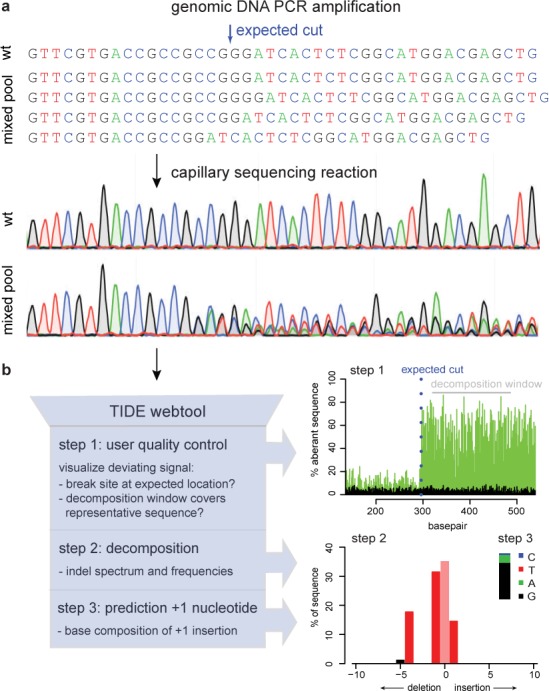
“(b) Overview of TIDE algorithm and output, which consists of three main steps: (1) Visualization of aberrant sequence signal in control (black) and treated sample (green), the expected break site (vertical dotted line) and the region used for decomposition (gray bar); (2) Decomposition yielding the spectrum of indels…”
BackgroundMethodGenetic screens in human cells using the CRISPR-Cas9 system
Wang, T., Wei, J. J., Sabatini, D. M., & Lander, E. S. (2014) · Science · doi:10.1126/science.1246981 · Cited by 2,856
Improving CRISPR-Cas nuclease specificity using truncated guide RNAs
Fu, Y., Sander, J. D., Reyon, D., Cascio, V. M., & Joung, J. K. (2014) · Nature Biotechnology · doi:10.1038/nbt.2808 · Cited by 1,993 · cited 1×
“However, the efficacy and the spectrum of mutations vary greatly depending on the RGEN target site and cells used ((17,18) and this report).”
BackgroundCHOPCHOP: a CRISPR/Cas9 and TALEN web tool for genome editing
Montague, T. G., Cruz, J. M., Gagnon, J. A., Church, G. M., & Valen, E. (2014) · Nucleic Acids Research · doi:10.1093/nar/gku410 · Cited by 1,234
Cas9 as a versatile tool for engineering biology
Mali, P., Esvelt, K. M., & Church, G. M. (2013) · Nature Methods · doi:10.1038/nmeth.2649 · Cited by 1,197 · cited 1×
“For example, with RGENs one typically needs to test several single-guide RNAs (sgRNAs) that are predicted to target the endonuclease to a gene of interest (6).”
BackgroundA guide to genome engineering with programmable nucleases
Kim, H., & Kim, J.-S. (2014) · Nature Reviews Genetics · doi:10.1038/nrg3686 · Cited by 1,163 · cited 3×
“(b) Overview of TIDE algorithm and output, which consists of three main steps: (1) Visualization of aberrant sequence signal in control (black) and treated sample (green), the expected break site (vertical dotted line) and the region used for decomposition (gray bar); (2) Decomposition yielding the spectrum of indels…”
BackgroundMethod
Cited by
Items 101–200 of 1,019
Systematic identification of human SNPs affecting regulatory element activity
(2018) · doi:10.1101/460402 · Cited by 205
Jansing, J., Sack, M., Augustine, S. M., Fischer, R., & Bortesi, L. (2019) · Plant Biotechnology Journal · doi:10.1111/pbi.12981 · Cited by 201
“The amplicons were then sequenced in house using the Sanger method, and the results were analysed using Clone Manager v9 Professional (Scientific & Educational Software, Denver) and the online tool TIDE (Brinkman et al., 2014).”
MethodImpact of chromatin context on Cas9-induced DNA double-strand break repair pathway balance
Schep, R., Brinkman, E. K., Leemans, C., Vergara, X., van der Weide, R. H., Morris, B., van Schaik, T., Manzo, S. G., Peric-Hupkes, D., van den Berg, J., et al. (2021) · Molecular Cell · doi:10.1016/j.molcel.2021.03.032 · Cited by 193
Self-citationAgarwal, S., Aznar, M. A., Rech, A. J., Good, C. R., Kuramitsu, S., Da, T., Gohil, M., Chen, L., Hong, S.-J. A., Ravikumar, P., et al. (2023) · Immunity · doi:10.1016/j.immuni.2023.09.001 · Cited by 185
Engineered anti-CRISPR proteins for optogenetic control of CRISPR–Cas9
Bubeck, F., Hoffmann, M. D., Harteveld, Z., Aschenbrenner, S., Bietz, A., Waldhauer, M. C., Börner, K., Fakhiri, J., Schmelas, C., Dietz, L., et al. (2018) · Nature Methods · doi:10.1038/s41592-018-0178-9 · Cited by 201
A Genetically Engineered Primary Human Natural Killer Cell Platform for Cancer Immunotherapy
Pomeroy, E. J., Hunzeker, J. T., Kluesner, M. G., Lahr, W. S., Smeester, B. A., Crosby, M. R., Lonetree, C.-L., Yamamoto, K., Bendzick, L., Miller, J. S., et al. (2020) · Molecular Therapy · doi:10.1016/j.ymthe.2019.10.009 · Cited by 195
Prime editing efficiency and fidelity are enhanced in the absence of mismatch repair
Ferreira da Silva, J., Oliveira, G. P., Arasa-Verge, E. A., Kagiou, C., Moretton, A., Timelthaler, G., Jiricny, J., & Loizou, J. I. (2022) · Nature Communications · doi:10.1038/s41467-022-28442-1 · Cited by 181
“Genomic DNA was extracted 96 hours after transfection, by removing the medium, resuspending the cells in a lysis solution (100 μL DirectPCR Lysis Reagent (Cell) (Viagen Biotech), 76 μL of water and 4 μL Proteinase K) and incubating 45 minutes at 55 °C and 45 minutes at 85 °C. Prime editing efficiency was determined by…”
InfluentialRasul, M. F., Hussen, B. M., Salihi, A., Ismael, B. S., Jalal, P. J., Zanichelli, A., Jamali, E., Baniahmad, A., Ghafouri-Fard, S., Basiri, A., et al. (2022) · Molecular Cancer · doi:10.1186/s12943-021-01487-4 · Cited by 171
Breslow, D. K., Hoogendoorn, S., Kopp, A. R., Morgens, D. W., Vu, B. K., Kennedy, M. C., Han, K., Li, A., Hess, G. T., Bassik, M. C., et al. (2018) · Nature Genetics · doi:10.1038/s41588-018-0054-7 · Cited by 194
“Gel-purified PCR products were subjected to Sanger sequencing, and resulting chromatograms were analyzed using TIDE (Tracking of Indels by Sequence Decomposition) 34 .”
Ling, S., Yang, S., Hu, X., Yin, D., Dai, Y., Qian, X., Wang, D., Pan, X., Hong, J., Sun, X., et al. (2021) · Nature Biomedical Engineering · doi:10.1038/s41551-020-00656-y · Cited by 179
Kagoya, Y., Guo, T., Yeung, B., Saso, K., Anczurowski, M., Wang, C.-H., Murata, K., Sugata, K., Saijo, H., Matsunaga, Y., et al. (2020) · Cancer Immunology Research · doi:10.1158/2326-6066.cir-18-0508 · Cited by 178
“Knockout efficiency was quantified by TIDE analysis (38), and by measuring surface HLA class II expression in the same samples.”
MethodFu, B., Liao, J., Chen, S., Li, W., Wang, Q., Hu, J., Yang, F., Hsiao, S., Jiang, Y., Wang, L., et al. (2022) · Nature Medicine · doi:10.1038/s41591-022-01906-z · Cited by 181
Okada, A., Arndell, T., Borisjuk, N., Sharma, N., Watson‐Haigh, N. S., Tucker, E. J., Baumann, U., Langridge, P., & Whitford, R. (2019) · Plant Biotechnology Journal · doi:10.1111/pbi.13106 · Cited by 181
“TIDE (Tracking of Indels by DEcomposition) analysis (Brinkman et al., 2014) of Sanger sequence traces (Data S1-S14) confirmed the presence of targeted mutations in GL353119 (+1/ 3) and FL353-19 (+1/+1; Figure 2b).”
BackgroundMethodInfluentialMELK is not necessary for the proliferation of basal-like breast cancer cells
Huang, H.-T., Seo, H.-S., Zhang, T., Wang, Y., Jiang, B., Li, Q., Buckley, D. L., Nabet, B., Roberts, J. M., Paulk, J., et al. (2017) · eLife · doi:10.7554/elife.26693 · Cited by 177
“Genotyping analysis around the cut site aided by TIDE (Brinkman et al., 2014) further confirmed frame shifts or larger deletions on both alleles (Figure 3—figure supplement 2, Figure 3—source data 1).”
MethodMarker-free coselection for CRISPR-driven genome editing in human cells
Agudelo, D., Duringer, A., Bozoyan, L., Huard, C. C., Carter, S., Loehr, J., Synodinou, D., Drouin, M., Salsman, J., Dellaire, G., et al. (2017) · Nature Methods · doi:10.1038/nmeth.4265 · Cited by 183
Stopschinski, B. E., Holmes, B. B., Miller, G. M., Manon, V. A., Vaquer-Alicea, J., Prueitt, W. L., Hsieh-Wilson, L. C., & Diamond, M. I. (2018) · Journal of Biological Chemistry · doi:10.1074/jbc.ra117.000378 · Cited by 180
“(18) found that the results of TIDE analysis are nearly identical for both DNA strands, we did not sequence the opposite strands.”
BackgroundMethodInfluentialEfficient targeted insertion of large DNA fragments without DNA donors
Wang, J., He, Z., Wang, G., Zhang, R., Duan, J., Gao, P., Lei, X., Qiu, H., Zhang, C., Zhang, Y., et al. (2022) · Nature Methods · doi:10.1038/s41592-022-01399-1 · Cited by 168
Genome editing via delivery of Cas9 ribonucleoprotein
DeWitt, M. A., Corn, J. E., & Carroll, D. (2017) · Methods · doi:10.1016/j.ymeth.2017.04.003 · Cited by 174
“The TIDE method, which is based on deconvolution of Sanger sequences of mixed PCR products using an on-line analysis tool, is also popular[26].”
MethodPearson, J. D., Huang, K., Pacal, M., McCurdy, S. R., Lu, S., Aubry, A., Yu, T., Wadosky, K. M., Zhang, L., Wang, T., et al. (2021) · Cancer Cell · doi:10.1016/j.ccell.2021.06.016 · Cited by 175
“Knockout was confirmed in bulk populations by Western blotting and/or genomic DNA sequencing followed by TIDE analysis (Brinkman et al., 2014) 8–10 days after selection, and cells plated for growth curves.”
MethodGenome editing of HBG1 and HBG2 to induce fetal hemoglobin
Métais, J.-Y., Doerfler, P. A., Mayuranathan, T., Bauer, D. E., Fowler, S. C., Hsieh, M. M., Katta, V., Keriwala, S., Lazzarotto, C. R., Luk, K., et al. (2019) · Blood Advances · doi:10.1182/bloodadvances.2019000820 · Cited by 177
CRIS.py: A Versatile and High-throughput Analysis Program for CRISPR-based Genome Editing
Connelly, J. P., & Pruett-Miller, S. M. (2019) · Scientific Reports · doi:10.1038/s41598-019-40896-w · Cited by 174
“py has many advantages: (1) the ability to analyze from”
Targeting TBK1 to overcome resistance to cancer immunotherapy
Sun, Y., Revach, O.-Y., Anderson, S., Kessler, E. A., Wolfe, C. H., Jenney, A., Mills, C. E., Robitschek, E. J., Davis, T. G. R., Kim, S., et al. (2023) · Nature · doi:10.1038/s41586-023-05704-6 · Cited by 174
Serif, M., Dubois, G., Finoux, A.-L., Teste, M.-A., Jallet, D., & Daboussi, F. (2018) · Nature Communications · doi:10.1038/s41467-018-06378-9 · Cited by 168
Evaluating and enhancing target specificity of gene-editing nucleases and deaminases
Kim, D., Luk, K., Wolfe, S. A., & Kim, J.-S. (2019) · Annual Review of Biochemistry · doi:10.1146/annurev-biochem-013118-111730 · Cited by 171
Lattanzi, A., Camarena, J., Lahiri, P., Segal, H., Srifa, W., Vakulskas, C. A., Frock, R. L., Kenrick, J., Lee, C., Talbott, N., et al. (2021) · Science Translational Medicine · doi:10.1126/scitranslmed.abf2444 · Cited by 167
Carlson-Stevermer, J., Abdeen, A. A., Kohlenberg, L., Goedland, M., Molugu, K., Lou, M., & Saha, K. (2017) · Nature Communications · doi:10.1038/s41467-017-01875-9 · Cited by 170
Sun, Q., Lin, L., Liu, D., Wu, D., Fang, Y., Wu, J., & Wang, Y. (2018) · International Journal of Molecular Sciences · doi:10.3390/ijms19092716 · Cited by 161
“com) [60] to evaluate the existence of editing events and mutation efficiency with p-value < 0.”
BackgroundRapid Quantitative Evaluation of CRISPR Genome Editing by TIDE and TIDER
Brinkman, E. K., & van Steensel, B. (2019) · Methods in Molecular Biology · doi:10.1007/978-1-4939-9170-9_3 · Cited by 165
Self-citationTMEM 41B is a novel regulator of autophagy and lipid mobilization
Moretti, F., Bergman, P., Dodgson, S., Marcellin, D., Claerr, I., Goodwin, J. M., DeJesus, R., Kang, Z., Antczak, C., Begue, D., et al. (2018) · EMBO reports · doi:10.15252/embr.201845889 · Cited by 170
“Since we were unable to identify an antibody to monitor endogenous levels of TMEM41B, we sequenced the TMEM41B genomic locus of the knockout (KO) cell population and confirmed editing in 63% of all sequences using the TIDE method [19].”
Jayavaradhan, R., Pillis, D. M., Goodman, M., Zhang, F., Zhang, Y., Andreassen, P. R., & Malik, P. (2019) · Nature Communications · doi:10.1038/s41467-019-10735-7 · Cited by 164
Bloh, K., Kanchana, R., Bialk, P., Banas, K., Zhang, Z., Yoo, B.-C., & Kmiec, E. B. (2021) · The CRISPR Journal · doi:10.1089/crispr.2020.0022 · Cited by 165
“14 Any potential sequences with contribution < 0.5% or p -value > 0.05 are not considered in the inference data, and so they are removed.”
InfluentialDolan, A. E., Hou, Z., Xiao, Y., Gramelspacher, M. J., Heo, J., Howden, S. E., Freddolino, L., Ke, A., & Zhang, Y. (2019) · Molecular Cell · doi:10.1016/j.molcel.2019.03.014 · Cited by 158
“6A, 6C–D), consistent with the indel formation rates assessed using the tracking of indels by decomposition (TIDE) analysis (Brinkman et al., 2014) and T7E1 assay (Guschin et al.”
MethodMeyer, S. N., Scuoppo, C., Vlasevska, S., Bal, É., Holmes, A. B., Holloman, M., Garcia‐Ibanez, L., Nataraj, S. E., Duval, R., Vantrimpont, T., et al. (2019) · Immunity · doi:10.1016/j.immuni.2019.08.006 · Cited by 171
“Induction of Cas9 expression and disruption of the target gene were verified in the bulk population at day 3 post-induction by immunoblotting and PCR amplification/sequencing of the edited site, followed by TIDE analysis, a specifically developed decomposition algorithm that uses sequence traces to identify the major…”
Tóth, E., Varga, É., Kulcsár, P. I., Kocsis-Jutka, V., Krausz, S. L., Nyeste, A., Welker, Z., Huszár, K., Ligeti, Z., Tálas, A., et al. (2020) · Nucleic Acids Research · doi:10.1093/nar/gkaa110 · Cited by 149
“Tracking of Indels by DEcomposition (TIDE) method (23) was applied for analysing mutations and determining their frequency in a cell population using different crRNAs and LbCas12a variants.”
MethodKEAP1 loss modulates sensitivity to kinase targeted therapy in lung cancer
Krall, E. B., Wang, B., Munoz, D. M., Ilic, N., Raghavan, S., Niederst, M. J., Yu, K., Ruddy, D. A., Aguirre, A. J., Kim, J. W., et al. (2017) · eLife · doi:10.7554/elife.18970 · Cited by 160
“TIDE-PCR We performed TIDE-PCR (Brinkman et al., 2014) on CALU1 and HCC364 sgKEAP1 cells (forward primer CTGGTACATGACAGCACCGT and reverse primer TGCTTCACCTACTTTGCAGGA for sgKEAP1–1 cells; forward primer CTCCAGTTTCCTGCCTTGACAT and reverse primer GAACCCCA TGCAGCCAGAT for sgKEAP1–2 cells) and found the editing efficiency…”
MethodInfluentialPaunovska, K., Gil, C. J., Lokugamage, M. P., Sago, C. D., Sato, M., Lando, G. N., Gamboa Castro, M., Bryksin, A. V., & Dahlman, J. E. (2018) · ACS Nano · doi:10.1021/acsnano.8b03640 · Cited by 160
Human Semaphorin 3 Variants Link Melanocortin Circuit Development and Energy Balance
van der Klaauw, A. A., Croizier, S., Mendes de Oliveira, E., Stadler, L. K. J., Park, S., Kong, Y., Banton, M. C., Tandon, P., Hendricks, A. E., Keogh, J. M., et al. (2019) · Cell · doi:10.1016/j.cell.2018.12.009 · Cited by 151
PAK4 inhibition improves PD-1 blockade immunotherapy
Abril-Rodriguez, G., Torrejon, D. Y., Liu, W., Zaretsky, J. M., Nowicki, T. S., Tsoi, J., Puig-Saus, C., Baselga-Carretero, I., Medina, E., Quist, M. J., et al. (2019) · Nature Cancer · doi:10.1038/s43018-019-0003-0 · Cited by 157
“Genomic DNA was isolated for each clone (NucleoSpin Tissue XS; Macherey Nagel), and after PCR amplifying the PAK4 sequence, we used the tracking of indels by decomposition (TIDE) 51 web tool to evaluate and confirm knockout efficiency (Extended Data Figs.”
TRIM37 controls cancer-specific vulnerability to PLK4 inhibition
Meitinger, F., Ohta, M., Lee, K.-Y., Watanabe, S., Davis, R. L., Anzola, J. V., Kabeche, R., Jenkins, D. A., Shiau, A. K., Desai, A. B., et al. (2020) · Nature · doi:10.1038/s41586-020-2710-1 · Cited by 169
“Gene knockout was determined by genotyping of the sequence surrounding the CRISPR cut site 35 and/or by immunoblotting.”
InfluentialThe RNA-Binding Protein PUM2 Impairs Mitochondrial Dynamics and Mitophagy During Aging
D’Amico, D., Mottis, A., Potenza, F., Sorrentino, V., Li, H., Romani, M., Lemos, V., Schoonjans, K., Zamboni, N., Knott, G., et al. (2019) · Molecular Cell · doi:10.1016/j.molcel.2018.11.034 · Cited by 159
Targeted homology-directed repair in blood stem and progenitor cells with CRISPR nanoformulations
Shahbazi, R., Sghia-Hughes, G., Reid, J. L., Kubek, S., Haworth, K. G., Humbert, O., Kiem, H.-P., & Adair, J. E. (2019) · Nature Materials · doi:10.1038/s41563-019-0385-5 · Cited by 161
TMEM41B acts as an ER scramblase required for lipoprotein biogenesis and lipid homeostasis
Huang, D., Xu, B., Liu, L., Wu, L., Zhu, Y., Ghanbarpour, A., Wang, Y., Chen, F.-J., Lyu, J., Hu, Y., et al. (2021) · Cell Metabolism · doi:10.1016/j.cmet.2021.05.006 · Cited by 157
Barazas, M., Annunziato, S., Pettitt, S. J., de Krijger, I., Ghezraoui, H., Roobol, S. J., Lutz, C., Frankum, J., Song, F. F., Brough, R., et al. (2018) · Cell Reports · doi:10.1016/j.celrep.2018.04.046 · Cited by 155
“The polyclonal targeted populations were efficiently modified for the target site (Figures 2B–2D), as shown by TIDE (tracking of insertions or deletions [indels] by decomposition) analysis (Brinkman et al., 2014).”
MethodInfluentialCordova, A. F., Ritchie, C., Böhnert, V., & Li, L. (2021) · ACS Central Science · doi:10.1021/acscentsci.1c00440 · Cited by 163
“Knockout efficiency was determined by amplifying the region of genomic DNA surrounding sgRNA target sites (using the primers listed in Supplementary Table 1), performing Sanger sequencing, and using the sequencing trace to estimate knockout efficiency through TIDE analysis.(69)”
Jacobi, A. M., Rettig, G. R., Turk, R., Collingwood, M. A., Zeiner, S. A., Quadros, R. M., Harms, D. W., Bonthuis, P. J., Gregg, C., Ohtsuka, M., et al. (2017) · Methods · doi:10.1016/j.ymeth.2017.03.021 · Cited by 147
“For example, Sanger sequencing results can be analyzed using sequence trace decomposition (“TIDE” analysis) [17], fluorescent-labeled primer-extension on an amplicon spanning the Cas9 cut site can be used to map indels using Indel Detection by Amplicon Analysis (IDAA) [18], or high resolution melt analysis (HRM) can b…”
MethodGeneration of a Collection of Mutant Tomato Lines Using Pooled CRISPR Libraries
Jacobs, T. B., Zhang, N., Patel, D., & Martin, G. B. (2017) · Plant Physiology · doi:10.1104/pp.17.00489 · Cited by 151
“Overlapping chromatograms at the cleavage site indicated a potential mutation, and the online program TIDEwas used to estimatemutations and allele frequencies (Brinkman et al., 2014).”
MethodDomain-focused CRISPR screen identifies HRI as a fetal hemoglobin regulator in human erythroid cells
Grevet, J. D., Lan, X., Hamagami, N., Edwards, C. R., Sankaranarayanan, L., Ji, X., Bhardwaj, S. K., Face, C. J., Posocco, D. F., Abdulmalik, O., et al. (2018) · Science · doi:10.1126/science.aao0932 · Cited by 153
RHINO directs MMEJ to repair DNA breaks in mitosis
Brambati, A., Sacco, O., Porcella, S. Y., Heyza, J. R., Kareh, M., Schmidt, J. C., & Sfeir, A. J. (2023) · Science · doi:10.1126/science.adh3694 · Cited by 157
Enhancer Architecture and Essential Core Regulatory Circuitry of Chronic Lymphocytic Leukemia
Ott, C. J., Federation, A. J., Schwartz, L. S., Kasar, S., Klitgaard, J. L., Lenci, R., Li, Q., Lawlor, M., Fernandes, S. M., Souza, A., et al. (2018) · Cancer Cell · doi:10.1016/j.ccell.2018.11.001 · Cited by 153
Annunziato, S., Kas, S. M., Nethe, M., Yücel, H., Del Bravo, J., Pritchard, C., Bin Ali, R., van Gerwen, B., Siteur, B., Drenth, A. P., et al. (2016) · Genes & Development · doi:10.1101/gad.279190.116 · Cited by 144
“PCR products were Sanger-sequenced using the FW primer, and CRISPR/ Cas9-induced editing efficacy was quantified with the TIDE algo-rithm as described (Brinkman et al. 2014; http://tide.nki.nl).”
BRCA-deficient mouse mammary tumor organoids to study cancer-drug resistance
Duarte, A. A., Gogola, E., Sachs, N., Barazas, M., Annunziato, S., de Ruiter, J. R., Velds, A., Blatter, S., Houthuijzen, J. M., van de Ven, M., et al. (2017) · Nature Methods · doi:10.1038/nmeth.4535 · Cited by 158
“The frequencies of insertions and deletions (indels) were measured using the tracking of indels by decomposition (TIDE) method 23 .”
Bi-allelic Loss of CDKN2A Initiates Melanoma Invasion via BRN2 Activation
Zeng, H., Jorapur, A., Shain, A. H., Lang, U. E., Torres, R., Zhang, Y., McNeal, A. S., Botton, T., Lin, J., Donne, M., et al. (2018) · Cancer Cell · doi:10.1016/j.ccell.2018.05.014 · Cited by 137
“After 3 days, genomic DNA was harvested for indel analysis via the TIDE approach(Brinkman et al., 2014).”
MethodMitigation of off-target toxicity in CRISPR-Cas9 screens for essential non-coding elements
Tycko, J., Wainberg, M., Marinov, G. K., Ursu, O., Hess, G. T., Ego, B. K., Aradhana, Li, A., Truong, A., Trevino, A. E., et al. (2019) · Nature Communications · doi:10.1038/s41467-019-11955-7 · Cited by 148
Characteristics of Genome Editing Mutations in Cereal Crops
Zhu, C., Bortesi, L., Baysal, C., Twyman, R. M., Fischer, R., Capell, T., Schillberg, S., & Christou, P. (2016) · Trends in Plant Science · doi:10.1016/j.tplants.2016.08.009 · Cited by 163
“Bulk PCR products can also be analyzed by Sanger sequencing and subsequent decoding of superimposed chromatograms [86,87] or by next generation sequencing (NGS) followed by software-based analysis [88].”
MethodLin, A., Giuliano, C. J., Sayles, N. M., & Sheltzer, J. M. (2017) · eLife · doi:10.7554/elife.24179 · Cited by 144
“TIDE analysis, which decomposes raw sequencing traces into linear combinations of indel mutations (Brinkman et al., 2014), revealed high cutting efficiency at most targeted loci (Figure 1B and Figure 1—figure supplements 1–3).”
MethodInfluentialRamos‐Ibeas, P., Sang, F., Zhu, Q., Tang, W. W. C., Withey, S., Klisch, D., Wood, L., Loose, M., Surani, M. A., & Alberio, R. (2019) · Nature Communications · doi:10.1038/s41467-019-08387-8 · Cited by 155
Overcoming Genetically Based Resistance Mechanisms to PD-1 Blockade
Torrejon, D. Y., Abril-Rodriguez, G., Champhekar, A. S., Tsoi, J., Campbell, K. M., Kalbasi, A., Parisi, G., Zaretsky, J. M., Garcia-Diaz, A., Puig-Saus, C., et al. (2020) · Cancer Discovery · doi:10.1158/2159-8290.cd-19-1409 · Cited by 146
“Disruption was confirmed by Sanger sequencing with Tracking of Indels by Decomposition (64) (TIDE) web tool and finally confirmed by western blot.”
MethodRASGRP1 deficiency causes immunodeficiency with impaired cytoskeletal dynamics
Salzer, E., Cagdas, D., Hons, M., Mace, E. M., Garncarz, W., Petronczki, Ö. Y., Platzer, R., Pfajfer, L., Bilic, I., Ban, S. A., et al. (2016) · Nature Immunology · doi:10.1038/ni.3575 · Cited by 144
Labuhn, M., Perkins, K., Matzk, S., Varghese, L. N., Garnett, C., Papaemmanuil, E., Metzner, M., Kennedy, A., Amstislavskiy, V. S., Risch, T., et al. (2019) · Cancer Cell · doi:10.1016/j.ccell.2019.06.007 · Cited by 153
Anti-CRISPR-mediated control of gene editing and synthetic circuits in eukaryotic cells
Nakamura, M., Srinivasan, P., Chavez, M., Carter, M. A., Dominguez, A. A., La Russa, M., Lau, M. B., Abbott, T. R., Xu, X., Zhao, D., et al. (2019) · Nature Communications · doi:10.1038/s41467-018-08158-x · Cited by 146
Lattanzi, A., Meneghini, V., Pavani, G., Amor, F., Ramadier, S., Felix, T., Antoniani, C., Masson, C., Alibeu, O., Lee, C., et al. (2019) · Molecular Therapy · doi:10.1016/j.ymthe.2018.10.008 · Cited by 135
“To evaluate NHEJ efficiency at each gRNA on-target site, we performed PCR followed by Sanger sequencing and TIDE analysis (tracking of indels by decomposition).(61) To detect deletion and inversion events, we performed Droplet Digital PCR (QX200 Droplet Digital PCR System, Bio-Rad, Hercules, CA, USA), using QX200 EvaG…”
MethodSelf-citationGenome Engineering in Rice Using Cas9 Variants that Recognize NG PAM Sequences
Hua, K., Tao, X., Han, P., Wang, R., & Zhu, J.-K. (2019) · Molecular Plant · doi:10.1016/j.molp.2019.03.009 · Cited by 139
CRISPR-STAT: an easy and reliable PCR-based method to evaluate target-specific sgRNA activity
Carrington, B., Varshney, G. K., Burgess, S. M., & Sood, R. (2015) · Nucleic Acids Research · doi:10.1093/nar/gkv802 · Cited by 139
“Recently two sequence-based methods, termed TIDE and CRISPR-GA, were developed for quantitative assessment of sgRNA activity in the cell culture experiments (26,27).”
MethodRogers, Z. N., McFarland, C. D., Winters, I. P., Naranjo, S., Chuang, C.-H., Petrov, D., & Winslow, M. M. (2017) · Nature Methods · doi:10.1038/nmeth.4297 · Cited by 147
“DNA was then extracted from all cells and the targeted tumor suppressor gene locus was amplified by PCR. PCR amplicons were Sanger sequenced and analyzed using TIDE analysis to quantify percent indel formation 54 .”
Gesicle-Mediated Delivery of CRISPR/Cas9 Ribonucleoprotein Complex for Inactivating the HIV Provirus
Campbell, L. A., Coke, L. M., Richie, C. T., Fortuno, L. V., Park, A. Y., & Harvey, B. K. (2019) · Molecular Therapy · doi:10.1016/j.ymthe.2018.10.002 · Cited by 133
A widespread role for SLC transmembrane transporters in resistance to cytotoxic drugs
Girardi, E., César-Razquin, A., Lindinger, S., Papakostas, K., Konecka, J., Hemmerich, J., Kickinger, S., Kartnig, F., Gürtl, B., Klavins, K., et al. (2020) · Nature Chemical Biology · doi:10.1038/s41589-020-0483-3 · Cited by 133
“Editing efficiency was determined with Tide-seq 59 .”
Zhou, W., Brown, W., Bardhan, A., Delaney, M., Ilk, A. S., Rauen, R. R., Kahn, S. I., Tsang, M., & Deiters, A. (2020) · Angewandte Chemie International Edition · doi:10.1002/anie.201914575 · Cited by 143
Weber, L., Frati, G., Felix, T., Hardouin, G., Casini, A., Wollenschlaeger, C., Meneghini, V., Masson, C., De Cian, A., Chalumeau, A., et al. (2020) · Science Advances · doi:10.1126/sciadv.aay9392 · Cited by 140
Self-citationLong Terminal Repeat CRISPR-CAR-Coupled “Universal” T Cells Mediate Potent Anti-leukemic Effects
Georgiadis, C., Preece, R., Nickolay, L., Etuk, A., Petrova, A., Ladon, D., Danyi, A., Humphryes-Kirilov, N., Ajetunmobi, A., Kim, D., et al. (2018) · Molecular Therapy · doi:10.1016/j.ymthe.2018.02.025 · Cited by 137
Dynamic nanoscale morphology of the ER surveyed by STED microscopy
Schroeder, L. K., Barentine, A. E. S., Merta, H., Schweighofer, S., Zhang, Y., Baddeley, D., Bewersdorf, J., & Bahmanyar, S. (2018) · The Journal of Cell Biology · doi:10.1083/jcb.201809107 · Cited by 148
“The remaining cells were grown, and bulk population genomic DNA was isolated for genotyping by sequencing and screening for indels by Tracking of Indels by Decomposition (TIDE) deconvolution (Brinkman et al., 2014) using the primers listed below.”
Shanthinie, A., Jaganathan, D., Ramanathan, V., Rahman, H., Palaniswamy, R., Kambale, R., & Raveendran, M. (2020) · PLoS ONE · doi:10.1371/journal.pone.0237018 · Cited by 140
“Obtained results were confirmed by uploading the chromatogram files into TIDE analysis tool [42].”
Epitope base editing CD45 in hematopoietic cells enables universal blood cancer immune therapy
Wellhausen, N., O’Connell, R. P., Lesch, S., Engel, N. W., Rennels, A. K., Gonzales, D. M., Herbst, F., Young, R. M., García, K. C., Weiner, D. B., et al. (2023) · Science Translational Medicine · doi:10.1126/scitranslmed.adi1145 · Cited by 144
Lee, C. Q. E., Kerouanton, B., Chothani, S. P., Zhang, S., Chen, Y., Mantri, C. K., Hock, D. H., Lim, R., Nadkarni, R., Huynh, V. T., et al. (2021) · Nature Communications · doi:10.1038/s41467-021-22397-5 · Cited by 147
UDiTaS™, a genome editing detection method for indels and genome rearrangements
Giannoukos, G., Ciulla, D. M., Marco, E., Abdulkerim, H. S., Barrera, L. A., Bothmer, A., Dhanapal, V., Gloskowski, S. W., Jayaram, H., Maeder, M. L., et al. (2018) · BMC Genomics · doi:10.1186/s12864-018-4561-9 · Cited by 134
Martyn, I., Brivanlou, A. H., & Siggia, E. D. (2019) · Development · doi:10.1242/dev.172791 · Cited by 140
Context-dependent regulation of ferroptosis sensitivity
Magtanong, L., Mueller, G. D., Williams, K. J., Billmann, M., Chan, K., Armenta, D. A., Pope, L. E., Moffat, J., Boone, C., Myers, C. L., et al. (2022) · Cell Chemical Biology · doi:10.1016/j.chembiol.2022.06.004 · Cited by 123
Generation and validation of homozygous fluorescent knock-in cells using CRISPR-Cas9 genome editing
Koch, B., Nijmeijer, B., Kueblbeck, M., Cai, Y., Walther, N., & Ellenberg, J. (2018) · Nature Protocols · doi:10.1038/nprot.2018.042 · Cited by 134
Crossing enhanced and high fidelity SpCas9 nucleases to optimize specificity and cleavage
Kulcsár, P. I., Tálas, A., Huszár, K., Ligeti, Z., Tóth, E., Weinhardt, N., Fodor, E., & Welker, E. (2017) · Genome Biology · doi:10.1186/s13059-017-1318-8 · Cited by 130
“We expected that such type of 284 targets are a better match for the higher fidelity HeF nuclease variants and tested the nucleases on 285 this target by measuring on-target and off-target indel generation through TIDE [36].”
MethodInfluentialComputational Tools and Resources for CRISPR/Cas Genome Editing
Li, C., Chu, W., Gill, R. A., Sang, S., Shi, Y., Hu, X., Yang, Y., Zaman, Q. U., & Zhang, B. (2023) · Genomics, Proteomics & Bioinformatics · doi:10.1016/j.gpb.2022.02.006 · Cited by 129
“For example, tracking of indels by decomposition assesses (TIDE) is a decomposition algorithm that is able to precisely determine the indel spectrum and frequency of targeted mutations generated by CRISPR/Cas9 genome editing [103].”
BackgroundGiannelli, S. G., Luoni, M., Castoldi, V., Massimino, L., Cabassi, T., Angeloni, D., Demontis, G. C., Leocani, L., Andreazzoli, M., & Broccoli, V. (2018) · Human Molecular Genetics · doi:10.1093/hmg/ddx438 · Cited by 127
“The quantification of genome modification was also obtained using the TIDE software, which allowed to interpolate the chromatograms produced by direct Sanger sequencing of the previously described PCR products or which applies a deconvolution algorithm on the sequencing traces to identify the indel mutations proximal…”
MethodHertzog, J., Dias Junior, A. G., Rigby, R. E., Donald, C. L., Mayer, A., Sezgin, E., Song, C., Jin, B., Hublitz, P., Eggeling, C., et al. (2018) · European Journal of Immunology · doi:10.1002/eji.201847483 · Cited by 134
ABCC1 transporter exports the immunostimulatory cyclic dinucleotide cGAMP
Maltbaek, J. H., Cambier, S., Snyder, J. M., & Stetson, D. B. (2022) · Immunity · doi:10.1016/j.immuni.2022.08.006 · Cited by 137
“Following 3–5 days of selection in appropriate antibiotic, successful targeting was verified through population-level Sanger sequencing and analysis using Tracking of Indels by DEcomposition (TIDE) (Brinkman et al., 2014).”
Metabolic programs of T cell tissue residency empower tumour immunity
Reina-Campos, M., Heeg, M., Kennewick, K., Mathews, I. T., Galletti, G., Luna, V., Nguyen, Q., Huang, H., Milner, J. J., Hu, K. H., et al. (2023) · Nature · doi:10.1038/s41586-023-06483-w · Cited by 132
Microinjection for precision genome editing in Caenorhabditis elegans
Ghanta, K. S., Ishidate, T., & Mello, C. C. (2021) · STAR Protocols · doi:10.1016/j.xpro.2021.100748 · Cited by 149
“Alternatively, TIDE analysis on pooled F1 genomic DNA can be performed (Dokshin et al., 2018) (Brinkman et al., 2014).”
ATXN1L, CIC, and ETS Transcription Factors Modulate Sensitivity to MAPK Pathway Inhibition
Wang, B., Krall, E. B., Aguirre, A. J., Kim, M., Widlund, H. R., Doshi, M. B., Sicinska, E., Sulahian, R., Goodale, A., Cowley, G. S., et al. (2017) · Cell Reports · doi:10.1016/j.celrep.2017.01.031 · Cited by 128
“We generated ATXN1LKO cells and assessed the efficiency of ATXN1L knockout by TIDE (Tracking of Indels by DEcomposition, Brinkman et al., 2014), a method to quantify the frequency of mutations induced by CRISPR-Cas9, as we were unable to identify an ATXN1L-specific antibody for immunoblotting (Figure S7).”
MethodAn engineered ScCas9 with broad PAM range and high specificity and activity
Chatterjee, P., Jakimo, N., Lee, J., Amrani, N., Rodríguez, T., Koseki, S., Tysinger, E., Qing, R., Hao, S., Sontheimer, E. J., et al. (2020) · Nature Biotechnology · doi:10.1038/s41587-020-0517-0 · Cited by 138
Tracy: basecalling, alignment, assembly and deconvolution of sanger chromatogram trace files
Rausch, T., Fritz, M. H.-Y., Untergasser, A., & Benes, V. (2020) · BMC Genomics · doi:10.1186/s12864-020-6635-8 · Cited by 130
Role of Dopamine Receptors in the Anticancer Activity of ONC201
Kline, C. L. B., Ralff, M. D., Lulla, A. R., Wagner, J., Abbosh, P. H., Dicker, D. T., Allen, J. E., & El‐Deiry, W. S. (2017) · Neoplasia · doi:10.1016/j.neo.2017.10.002 · Cited by 137
“.ab1 chromatograms were inputted into TIDE [13] (https://tide-calculator.nki.nl/) to determine indel rates.”
MethodInfluentialMair, B., Tomic, J., Masud, S. N., Tonge, P., Weiss, A., Usaj, M., Tong, A. H. Y., Kwan, J. J., Brown, K. R., Titus, E., et al. (2019) · Cell Reports · doi:10.1016/j.celrep.2019.02.041 · Cited by 127
Honaker, Y., Hubbard, N., Xiang, Y., Fisher, L., Hagin, D., Sommer, K., Song, Y., Yang, S. J., Lopez, C., Tappen, T., et al. (2020) · Science Translational Medicine · doi:10.1126/scitranslmed.aay6422 · Cited by 128
Afatinib restrains K-RAS–driven lung tumorigenesis
Moll, H. P., Pranz, K., Musteanu, M., Grabner, B., Hruschka, N., Mohrherr, J., Aigner, P., Stiedl, P., Brcic, L., Laszlo, V., et al. (2018) · Science Translational Medicine · doi:10.1126/scitranslmed.aao2301 · Cited by 125
Editing the genome of hiPSC with CRISPR/Cas9: disease models
Bassett, A. R. (2017) · Mammalian Genome · doi:10.1007/s00335-017-9684-9 · Cited by 109
Biolatti, M., Dell’Oste, V., Pautasso, S., Gugliesi, F., von Einem, J., Krapp, C., Jakobsen, M. R., Borgogna, C., Gariglio, M., Andrea, M. D., et al. (2017) · Journal of Virology · doi:10.1128/jvi.01774-17 · Cited by 127
“Verification of genetic KO was carried out by 174 RT-qPCR, Western blot, and TIDE (Tracking of Indels by DEcomposition) analysis (48).”
InfluentialA CRISPR-Cas9 delivery system for in vivo screening of genes in the immune system
LaFleur, M. W., Nguyen, T. H., Coxe, M. A., Yates, K. B., Trombley, J. D., Weiss, S. A., Brown, F. D., Gillis, J. E., Coxe, D. J., Doench, J. G., et al. (2019) · Nature Communications · doi:10.1038/s41467-019-09656-2 · Cited by 116
Human Neonatal Fc Receptor Is the Cellular Uncoating Receptor for Enterovirus B
Zhao, X., Zhang, G., Liu, S., Chen, X., Peng, R., Dai, L., Qu, X., Li, S., Song, H., Gao, Z., et al. (2019) · Cell · doi:10.1016/j.cell.2019.04.035 · Cited by 125
An inducible genome editing system for plants
Wang, X., Ye, L., Lyu, M., Ursache, R., Löytynoja, A., & Mähönen, A. P. (2020) · Nature Plants · doi:10.1038/s41477-020-0695-2 · Cited by 125
Lee, C. M., Cradick, T. J., Fine, E. J., & Bao, G. (2016) · Molecular Therapy · doi:10.1038/mt.2016.1 · Cited by 121
Hultquist, J. F., Hiatt, J., Schumann, K., McGregor, M. J., Roth, T. L., Haas, P., Doudna, J. A., Marson, A., & Krogan, N. J. (2019) · Nature Protocols · doi:10.1038/s41596-018-0069-7 · Cited by 125
Targeted mutagenesis in a human-parasitic nematode
Gang, S. S., Castelletto, M. L., Bryant, A. S., Yang, E. C., Mancuso, N., Lopez, J. B., Pellegrini, M. A., & Hallem, E. A. (2017) · PLoS Pathogens · doi:10.1371/journal.ppat.1006675 · Cited by 131
“We attempted to identify indels through Sanger sequencing of the target region, heteroduplexed DNA detection by polyacrylamide gel electrophoresis (PAGE) [26], T7E1 endonuclease activity [27], and TIDE (Tracking of Indels by sequence DEcomposition) [28].”
HIV-specific humoral immune responses by CRISPR/Cas9-edited B cells
Hartweger, H., McGuire, A. T., Horning, M., Taylor, J. J., Dosenovic, P., Yost, D., Gazumyan, A., Seaman, M. S., Stamatatos, L., Janković, M., et al. (2019) · The Journal of Experimental Medicine · doi:10.1084/jem.20190287 · Cited by 130
“nl) using samples receiving scramble or irrelevant HPRT-targeting crRNA as the reference (Brinkman et al., 2014).”
Method
Metadata
- Authors
- Brinkman, E. K., Chen, T., Amendola, M., & van Steensel, B.
- Affiliations
- The Netherlands Cancer Institute (NL)
- Division of Gene Regulation, Netherlands Cancer Institute, Plesmanlaan 121, 1016 HM Amsterdam, the Netherlands
- Venue
- Nucleic Acids Research
- Publisher
- Oxford University Press (OUP)
- Published
- 2014-10-09
- Volume
- 42
- Issue
- 22
- Pages
- e168-e168
- ISSN
- 0305-1048 (ISSN-L)
- 1362-4962
- PMC
- PMC4267669
- OpenAlex
- W2106070783
- Cited by
- 2,390
- References
- 19
- Citations by year
- 2026: 184 · 2025: 261 · 2024: 253 · 2023: 290 · 2022: 280 · 2021: 259 · 2020: 263 · 2019: 241 · 2018: 186 · 2017: 105 · 2016: 48 · 2015: 16 · 2014: 2
- FWCI
- 23.39
- Type
- journal article
- Language
- en
- Open access
- gold
- doi.org
- Locations
- Nucleic Acids Research (publishedVersion, cc-by)
- Europe PMC (PubMed Central) (publishedVersion, cc-by)
- PubMed Central (publishedVersion, cc-by)
- PubMed (publishedVersion)
- HAL (submittedVersion)
- Institutional Research Information System University of Ferrara (University of Ferrara) (submittedVersion)
- Funders
- ZonMw
- Nederlandse Organisatie voor Wetenschappelijk Onderzoek
- FP7 Ideas: European Research Council (293662)
- Topics
- Life Sciences › Biochemistry, Genetics and Molecular Biology › Molecular Biology › CRISPR and Genetic Engineering
- Life Sciences › Biochemistry, Genetics and Molecular Biology › Molecular Biology › RNA regulation and disease
- Life Sciences › Biochemistry, Genetics and Molecular Biology › Cancer Research › Cancer Genomics and Diagnostics
- Keywords
- genome editing, tides, induced mutation, CRISPR/Cas9, editing sites, mutation spectrum, web-based tool, PCR-based assays
- MeSH terms
- Algorithms, Cells, Cultured, DNA Mutational Analysis, Humans, Software, Polymerase Chain Reaction, Mutagenesis, K562 Cells, Genomics, INDEL Mutation, CRISPR-Cas Systems
About these checks
Registry, retraction, Cites and statistics results are computed, not judged, with one exception: a printed reference that no index lists is read once by a model before it counts as a citation error. Claims are extracted by a model and kept only when their quote appears verbatim in the text; each cited source is then checked, with a model’s help, for whether it says what the claim relies on. Those verdicts can be wrong — read the claim’s quote and the cited source before relying on one.
Statistics and arithmetic are recomputed, not judged.
Confidence bands are shown only for fields calibrated on our annotated test set. None is calibrated yet, so no band is shown.
What counts as a claim ›How we measure confidence ›How we check this ›
Are you an author, or do you see a problem with this page? Request a review
Data sources
Bibliographic data: Semantic Scholar, OpenAlex, Crossref.
Contains information from the Semantic Scholar Academic Graph Datasets, made available under the ODC Attribution License (ODC-BY 1.0).
Semantic Scholar’s data is described in: Kinney, R., et al. (2023). The Semantic Scholar Open Data Platform. arXiv:2301.10140.
