

Easy quantitative assessment of genome editing by sequence trace decomposition
Open accessThe DOI matches its Crossref record; 19 of the 19 references it cites were found in a registry or an index.
Abstract
The efficacy and the mutation spectrum of genome editing methods can vary substantially depending on the targeted sequence. A simple, quick assay to accurately characterize and quantify the induced mutations is therefore needed. Here we present TIDE, a method for this purpose that requires only a pair of PCR reactions and two standard capillary sequencing runs. The sequence traces are then analyzed by a specially developed decomposition algorithm that identifies the major induced mutations in the projected editing site and accurately determines their frequency in a cell population. This method is cost-effective and quick, and it provides much more detailed information than current enzyme-based assays. An interactive web tool for automated decomposition of the sequence traces is available. TIDE greatly facilitates the testing and rational design of genome editing strategies.
Overview
The claims and statistics of this paper haven’t been checked yet.
Free: it reads the open-access text and checks the first 5 claims that cite a source we can check. Create a free account to check every claim.
Integrity signals
Registry
Cites
Statistics
Figures
Verification
Claims the paper makes
The claims and statistics of this paper haven’t been checked yet.
Free: it reads the open-access text and checks the first 5 claims that cite a source we can check. Create a free account to check every claim.
Claims other papers make about this one
Each is checked against this paper’s own text: does it say what the citing paper says it does?
The source backs part of the claim, not all of it — or backs it for a different population, condition or comparison.
In the citing paper
“Long-term nuclease expression (10 days after transduction), which has been demonstrated to highly favor non-specific cleavages41, did not generate any unspecific CFTR editing above TIDE background levels (about 1%)38; whereas AsCas12a-crRNA+11/wt efficiently edited the CFTR gene (86.3%, Fig. 2b).”
From Allele specific repair of splicing mutations in cystic fibrosis through AsCas12a genome editing (2019) · cites this paper as [38]
Experimental — accuracy not yet measuredThe source backs part of the claim, not all of it — or backs it for a different population, condition or comparison.
In the citing paper
“Genotyping was performed by Sanger sequencing of PCR amplicons of genomic target sites with individual alleles deconvoluted by TIDE analysis of chromatograms[33].”
From Genome-scale CRISPR screening for modifiers of cellular LDL uptake (2021) · cites this paper as [33]
Experimental — accuracy not yet measuredIn the citing paper
“Tracking of InDels by Decomposition (TIDE) is an effective web tool (https://tide.nki.nl) that can be used to analyse sequencing data, which estimates the spectra and frequencies of small insertions and deletions generated from gene editing (Brinkman et al., 2014).”
From Genetic resources and precise gene editing for targeted improvement of barley abiotic stress tolerance (2023) · cites this paper as Brinkman et al., 2014
Self-check
Percentages, sums and reported differences re-computed from the paper’s own numbers.
The self-check needs the paper’s full text.
Citations
Cites
Multiplex Genome Engineering Using CRISPR/Cas Systems
Cong, L., Ran, F. A., Cox, D., Lin, S., Barretto, R., Habib, N., Hsu, P. D., Wu, X., Jiang, W., Marraffini, L. A., et al. (2013) · Science · doi:10.1126/science.1231143 · Cited by 15,339
Bioconductor: open software development for computational biology and bioinformatics
Gentleman, R. C., Carey, V. J., Bates, D. M., Bolstad, B., Dettling, M., Dudoit, S., Ellis, B., Gautier, L., Ge, Y., Gentry, J., et al. (2004) · Genome Biology · doi:10.1186/gb-2004-5-10-r80 · Cited by 12,172 · cited 3×
“scf format) are imported into TIDE using the R Bioconductor (15) package sangerseqR (version 1.”
MethodInfluentialGenome engineering using the CRISPR-Cas9 system
Ran, F. A., Hsu, P. D., Wright, J., Agarwala, V., Scott, D. A., & Zhang, F. (2013) · Nature Protocols · doi:10.1038/nprot.2013.143 · Cited by 11,133 · cited 1×
“edu/) (13) and CHOPCHOP (https://chopchop.”
DNA targeting specificity of RNA-guided Cas9 nucleases
Hsu, P. D., Scott, D. A., Weinstein, J. A., Ran, F. A., Konermann, S., Agarwala, V., Li, Y., Fine, E. J., Wu, X., Shalem, O., et al. (2013) · Nature Biotechnology · doi:10.1038/nbt.2647 · Cited by 4,741 · cited 1×
“However, the efficacy and the spectrum of mutations vary greatly depending on the RGEN target site and cells used ((17,18) and this report).”
BackgroundZFN, TALEN, and CRISPR/Cas-based methods for genome engineering
Gaj, T., Gersbach, C. A., & Barbas, C. F. (2013) · Trends in Biotechnology · doi:10.1016/j.tibtech.2013.04.004 · Cited by 3,820 · cited 3×
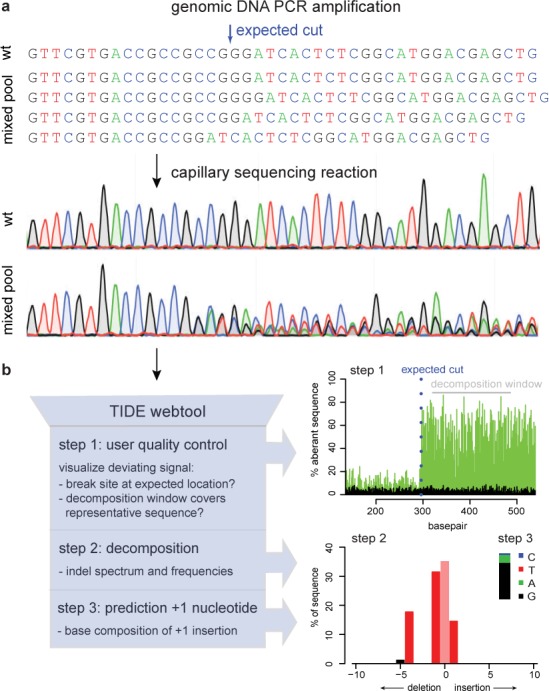
“(b) Overview of TIDE algorithm and output, which consists of three main steps: (1) Visualization of aberrant sequence signal in control (black) and treated sample (green), the expected break site (vertical dotted line) and the region used for decomposition (gray bar); (2) Decomposition yielding the spectrum of indels…”
BackgroundMethodGenetic screens in human cells using the CRISPR-Cas9 system
Wang, T., Wei, J. J., Sabatini, D. M., & Lander, E. S. (2014) · Science · doi:10.1126/science.1246981 · Cited by 2,856
Improving CRISPR-Cas nuclease specificity using truncated guide RNAs
Fu, Y., Sander, J. D., Reyon, D., Cascio, V. M., & Joung, J. K. (2014) · Nature Biotechnology · doi:10.1038/nbt.2808 · Cited by 1,993 · cited 1×
“However, the efficacy and the spectrum of mutations vary greatly depending on the RGEN target site and cells used ((17,18) and this report).”
BackgroundCHOPCHOP: a CRISPR/Cas9 and TALEN web tool for genome editing
Montague, T. G., Cruz, J. M., Gagnon, J. A., Church, G. M., & Valen, E. (2014) · Nucleic Acids Research · doi:10.1093/nar/gku410 · Cited by 1,234
Cas9 as a versatile tool for engineering biology
Mali, P., Esvelt, K. M., & Church, G. M. (2013) · Nature Methods · doi:10.1038/nmeth.2649 · Cited by 1,197 · cited 1×
“For example, with RGENs one typically needs to test several single-guide RNAs (sgRNAs) that are predicted to target the endonuclease to a gene of interest (6).”
BackgroundA guide to genome engineering with programmable nucleases
Kim, H., & Kim, J.-S. (2014) · Nature Reviews Genetics · doi:10.1038/nrg3686 · Cited by 1,163 · cited 3×
“(b) Overview of TIDE algorithm and output, which consists of three main steps: (1) Visualization of aberrant sequence signal in control (black) and treated sample (green), the expected break site (vertical dotted line) and the region used for decomposition (gray bar); (2) Decomposition yielding the spectrum of indels…”
BackgroundMethod
Cited by
Optimized sgRNA design to maximize activity and minimize off-target effects of CRISPR-Cas9
Doench, J. G., Fusi, N., Sullender, M., Hegde, M., Vaimberg, E. W., Donovan, K. F., Smith, I., Tothova, Z., Wilen, C., Orchard, R., et al. (2016) · Nature Biotechnology · doi:10.1038/nbt.3437 · Cited by 4,637
“Cells were divided into small molecule and no-selection conditions, cell counts were taken at each passage to determine population doublings, and pellets were collected at day 0 and day 14 of 6-thioguanine treatment for analysis of indels using the TIDE web portal 29 .”
ACSL4 dictates ferroptosis sensitivity by shaping cellular lipid composition
Doll, S., Proneth, B., Tyurina, Y. Y., Panzilius, E., Kobayashi, S., Ingold, I., Irmler, M., Beckers, J., Aichler, M., Walch, A., et al. (2017) · Nature Chemical Biology · doi:10.1038/nchembio.2239 · Cited by 4,293
Selenium Utilization by GPX4 Is Required to Prevent Hydroperoxide-Induced Ferroptosis
Ingold, I., Berndt, C., Schmitt, S., Doll, S., Poschmann, G., Buday, K., Roveri, A., Peng, X., Porto Freitas, F., Seibt, T., et al. (2018) · Cell · doi:10.1016/j.cell.2017.11.048 · Cited by 1,656
“…LLC https://www.flowjo.com/solutions/ flowjo/downloads ImageJ NIH https://imagej.nih.gov/ij/download.html TIDE: Tracking of Indels by DEcomposition Brinkman et al., 2014 https://tide.nki.nl/ Wave XFe Analyzer 2.2.0 Seahorse Bioscience…”
InfluentialCD24 signalling through macrophage Siglec-10 is a target for cancer immunotherapy
Barkal, A. A., Brewer, R. E., Markovic, M., Kowarsky, M., Barkal, S. A., Zaro, B. W., Krishnan, V., Hatakeyama, J., Dorigo, O., Barkal, L. J., et al. (2019) · Nature · doi:10.1038/s41586-019-1456-0 · Cited by 1,385
Promoter-bound METTL3 maintains myeloid leukaemia by m6A-dependent translation control
Barbieri, I., Tzelepis, K., Pandolfini, L., Shi, J., Millán-Zambrano, G., Robson, S. C., Aspris, D., Migliori, V., Bannister, A. J., Han, N., et al. (2017) · Nature · doi:10.1038/nature24678 · Cited by 1,086
Chemically modified guide RNAs enhance CRISPR-Cas genome editing in human primary cells
Hendel, A., Bak, R. O., Clark, J. T., Kennedy, A. B., Ryan, D. E., Roy, S., Steinfeld, I., Lunstad, B. D., Kaiser, R. J., Wilkens, A. B., et al. (2015) · Nature Biotechnology · doi:10.1038/nbt.3290 · Cited by 1,090
Inference of CRISPR Edits from Sanger Trace Data
Conant, D., Hsiau, T., Rossi, N., Oki, J., Maures, T., Waite, K., Yang, J., Joshi, S., Kelso, R., Holden, K., et al. (2022) · The CRISPR Journal · doi:10.1089/crispr.2021.0113 · Cited by 804
Multiplex genome editing to generate universal CAR T cells resistant to PD1 inhibition
Ren, J., Liu, X., Fang, C., Jiang, S., June, C. H., & Zhao, Y. (2017) · Clinical Cancer Research · doi:10.1158/1078-0432.ccr-16-1300 · Cited by 942
BCL11A enhancer dissection by Cas9-mediated in situ saturating mutagenesis
Canver, M. C., Smith, E. C., Sher, F., Pinello, L., Sanjana, N. E., Shalem, O., Chen, D. D., Schupp, P. G., Vinjamur, D. S., Garcia, S. P., et al. (2015) · Nature · doi:10.1038/nature15521 · Cited by 886
CRISPR/Cas9 β-globin gene targeting in human haematopoietic stem cells
Dever, D. P., Bak, R. O., Reinisch, A., Camarena, J., Washington, G., Nicolas, C. E., Pavel-Dinu, M., Saxena, N., Wilkens, A. B., Mantri, S., et al. (2016) · Nature · doi:10.1038/nature20134 · Cited by 864
Vakulskas, C. A., Dever, D. P., Rettig, G. R., Turk, R., Jacobi, A. M., Collingwood, M. A., Bode, N. M., McNeill, M. S., Yan, S., Camarena, J., et al. (2018) · Nature Medicine · doi:10.1038/s41591-018-0137-0 · Cited by 782
Developmental and oncogenic programs in H3K27M gliomas dissected by single-cell RNA-seq
Filbin, M. G., Tirosh, I., Hovestadt, V., Shaw, M. L., Escalante, L. E., Mathewson, N. D., Neftel, C., Frank, N., Pelton, K., Hebert, C. M., et al. (2018) · Science · doi:10.1126/science.aao4750 · Cited by 696
Dissecting cell identity via network inference and in silico gene perturbation
Kamimoto, K., Stringa, B., Hoffmann, C. M., Jindal, K., Solnica-Krezel, L., & Morris, S. A. (2023) · Nature · doi:10.1038/s41586-022-05688-9 · Cited by 677
The shieldin complex mediates 53BP1-dependent DNA repair
Noordermeer, S. M., Adam, S., Setiaputra, D., Barazas, M., Pettitt, S. J., Ling, A. K., Olivieri, M., Álvarez-Quilón, A., Moatti, N., Zimmermann, M., et al. (2018) · Nature · doi:10.1038/s41586-018-0340-7 · Cited by 645
Barkal, A. A., Weiskopf, K., Kao, K. S., Gordon, S. R., Rosental, B., Yiu, Y. Y., George, B. M., Markovic, M., Ring, N. G., Tsai, J. M., et al. (2018) · Nature Immunology · doi:10.1038/s41590-017-0004-z · Cited by 558
Narayan, V., Barber-Rotenberg, J. S., Jung, I.-Y., Lacey, S. F., Rech, A. J., Davis, M. M., Hwang, W.-T., Lal, P., Carpenter, E. L., Maude, S. L., et al. (2022) · Nature Medicine · doi:10.1038/s41591-022-01726-1 · Cited by 533
EditR: A Method to Quantify Base Editing from Sanger Sequencing
Kluesner, M. G., Nedveck, D. A., Lahr, W. S., Garbe, J. R., Abrahante, J. E., Webber, B. R., & Moriarity, B. S. (2018) · The CRISPR Journal · doi:10.1089/crispr.2018.0014 · Cited by 565
“0.1 and helped by incorporating design from TIDE and Poly Peak Parser.18,19 The former identifies simple indel mixtures from Sanger sequencing data, while the latter calculates the frequency and composition of complex indel mixtures.”
BackgroundMethodInfluentialMutational processes shape the landscape of TP53 mutations in human cancer
Giacomelli, A. O., Yang, X., Lintner, R. E., McFarland, J. M., Duby, M., Kim, J., Howard, T. P., Takeda, D. Y., Ly, S. H., Kim, E., et al. (2018) · Nature Genetics · doi:10.1038/s41588-018-0204-y · Cited by 556
A Genetic Map of the Response to DNA Damage in Human Cells
Olivieri, M., Cho, T., Álvarez-Quilón, A., Li, K., Schellenberg, M. J., Zimmermann, M., Hustedt, N., Rossi, S. E., Adam, S., Melo, H., et al. (2020) · Cell · doi:10.1016/j.cell.2020.05.040 · Cited by 551
Gene editing restores dystrophin expression in a canine model of Duchenne muscular dystrophy
Amoasii, L., Hildyard, J. C. W., Li, H., Sanchez-Ortiz, E., Mireault, A., Caballero, D., Harron, R., Stathopoulou, T.-R., Massey, C., Shelton, J. M., et al. (2018) · Science · doi:10.1126/science.aau1549 · Cited by 546
Plant gene editing through de novo induction of meristems
Maher, M. F., Nasti, R. A., Vollbrecht, M., Starker, C. G., Clark, M. D., & Voytas, D. F. (2020) · Nature Biotechnology · doi:10.1038/s41587-019-0337-2 · Cited by 541
Yoo, S., Mittelstein, D. R., Hurt, R. C., Lacroix, J., & Shapiro, M. G. (2022) · Nature Communications · doi:10.1038/s41467-022-28040-1 · Cited by 492
Potent antitumor efficacy of anti-GD2 CAR T cells in H3-K27M+ diffuse midline gliomas
Mount, C. W., Majzner, R. G., Sundaresh, S., Arnold, E. P., Kadapakkam, M., Haile, S., Labanieh, L., Hulleman, E., Woo, P. J., Rietberg, S. P., et al. (2018) · Nature Medicine · doi:10.1038/s41591-018-0006-x · Cited by 499
Hi-TOM: a platform for high-throughput tracking of mutations induced by CRISPR/Cas systems
Liu, Q., Wang, C., Jiao, X., Zhang, H., Song, L., Li, Y., Gao, C., & Wang, K. (2019) · Science China Life Sciences · doi:10.1007/s11427-018-9402-9 · Cited by 496
Han, K., Jeng, E. E., Hess, G. T., Morgens, D. W., Li, A., & Bassik, M. C. (2017) · Nature Biotechnology · doi:10.1038/nbt.3834 · Cited by 498
“To assess indel frequency, TIDE was used to compare the sequence trace files from the test sample containing the targeting sgRNA to a control sample containing safe harbor sgRNAs and quantify the distribution of indels in the test sample 48 .”
Loss of p53 triggers WNT-dependent systemic inflammation to drive breast cancer metastasis
Wellenstein, M. D., Coffelt, S. B., Duits, D. E. M., van Miltenburg, M. H., Slagter, M., de Rink, I., Henneman, L., Kas, S. M., Prekovic, S., Hau, C.-S., et al. (2019) · Nature · doi:10.1038/s41586-019-1450-6 · Cited by 500
Structure-guided chemical modification of guide RNA enables potent non-viral in vivo genome editing
Yin, H., Song, C.-Q., Suresh, S., Wu, Q., Walsh, S., Rhym, L. H., Mintzer, E., Bolukbasi, M. F., Zhu, L. J., Kauffman, K., et al. (2017) · Nature Biotechnology · doi:10.1038/nbt.4005 · Cited by 499
A highly specific SpCas9 variant is identified by in vivo screening in yeast
Casini, A., Olivieri, M., Petris, G., Montagna, C., Reginato, G., Maule, G., Lorenzin, F., Prandi, D., Romanel, A., Demichelis, F., et al. (2018) · Nature Biotechnology · doi:10.1038/nbt.4066 · Cited by 493
Kim, M. Y., Yu, K.-R., Kenderian, S. S., Ruella, M., Chen, S., Shin, T.-H., Aljanahi, A. A., Schreeder, D., Klichinsky, M., Shestova, O., et al. (2018) · Cell · doi:10.1016/j.cell.2018.05.013 · Cited by 459
Am I ready for CRISPR? A user's guide to genetic screens
Doench, J. G. (2018) · Nature Reviews Genetics · doi:10.1038/nrg.2017.97 · Cited by 452
TGF-β inhibition via CRISPR promotes the long-term efficacy of CAR T cells against solid tumors
Tang, N., Cheng, C., Zhang, X., Qiao, M., Li, N., Mu, W., Wei, X.-F., Han, W., & Wang, H. (2020) · JCI Insight · doi:10.1172/jci.insight.133977 · Cited by 413
Acetate Production from Glucose and Coupling to Mitochondrial Metabolism in Mammals
Liu, X., Cooper, D. E., Cluntun, A. A., Warmoes, M. O., Zhao, S., Reid, M. A., Liu, J., Lund, P. J., Lopes, M., Garcia, B. A., et al. (2018) · Cell · doi:10.1016/j.cell.2018.08.040 · Cited by 416
“Single-cell outgrowth was confirmed by sequencing and TIDE analysis (Brinkman et al., 2014).”
Genome Engineering with CRISPR-Cas9 in the Mosquito Aedes aegypti
Kistler, K. E., Vosshall, L. B., & Matthews, B. J. (2015) · Cell Reports · doi:10.1016/j.celrep.2015.03.009 · Cited by 403
A versatile system for rapid multiplex genome-edited CAR T cell generation
Ren, J., Zhang, X., Liu, X., Fang, C., Jiang, S., June, C. H., & Zhao, Y. (2017) · Oncotarget · doi:10.18632/oncotarget.15218 · Cited by 397
“Seven potential off-target sites for either TRAC or B2m were sequenced and measured by TIDE to determine the off-target events produced by the one-shot CRISPR system [28].”
MethodCRISPR-Cas9-mediated multiplex gene editing in CAR-T cells
Liu, X., Zhang, Y., Cheng, C., Cheng, A. W., Zhang, X., Li, N., Xia, C., Wei, X., Liu, X., & Wang, H. (2017) · Cell Research · doi:10.1038/cr.2016.142 · Cited by 396
Dokshin, G. A., Ghanta, K. S., Piscopo, K. M., & Mello, C. C. (2018) · Genetics · doi:10.1534/genetics.118.301532 · Cited by 411
CRISPR screens identify genomic ribonucleotides as a source of PARP-trapping lesions
Zimmermann, M., Murina, O., Reijns, M. A. M., Agathanggelou, A., Challis, R., Tarnauskaitė, Ž., Muir, M., Fluteau, A., Aregger, M., McEwan, A., et al. (2018) · Nature · doi:10.1038/s41586-018-0291-z · Cited by 401
Genome editing reveals a role for OCT4 in human embryogenesis
Fogarty, N. M. E., McCarthy, A., Snijders, K. E., Powell, B. E., Kubikova, N., Blakeley, P., Lea, R., Elder, K., Wamaitha, S. E., Kim, D., et al. (2017) · Nature · doi:10.1038/nature24033 · Cited by 392
“PCR amplicons were analysed by Sanger sequencing and indels were quantified by TIDE webtool 38 .”
MethodGogola, E., Duarte, A. A., de Ruiter, J. R., Wiegant, W. W., Schmid, J. A., de Bruijn, R., James, D. I., Guerrero Llobet, S., Vis, D. J., Annunziato, S., et al. (2018) · Cancer Cell · doi:10.1016/j.ccell.2018.05.008 · Cited by 374
Activating ESR1 Mutations Differentially Affect the Efficacy of ER Antagonists
Toy, W., Weir, H., Razavi, P., Lawson, M., Goeppert, A. U., Mazzola, A. M., Smith, A., Wilson, J., Morrow, C., Wong, W. L., et al. (2017) · Cancer Discovery · doi:10.1158/2159-8290.cd-15-1523 · Cited by 368
“org Tide analysis (25) was used to confirm the frameshift mutation of the second ESR1 allele.”
MethodLee, B., Lee, K., Panda, S., Gonzales-Rojas, R., Chong, A., Bugay, V., Park, H. M., Brenner, R., Murthy, N., & Lee, H. Y. (2018) · Nature Biomedical Engineering · doi:10.1038/s41551-018-0252-8 · Cited by 361
“The sequencing result was analysed with TIDE software to quantify indel mutation efficiency (https://tide-calculator.nki.nl/) 52 .”
MethodDisabling Cas9 by an anti-CRISPR DNA mimic
Shin, J., Jiang, F., Liu, J.-J., Bray, N. L., Rauch, B. J., Baik, S. H., Nogales, E., Bondy-Denomy, J., Corn, J. E., & Doudna, J. A. (2017) · Science Advances · doi:10.1126/sciadv.1701620 · Cited by 354
A Survey of Validation Strategies for CRISPR-Cas9 Editing
Sentmanat, M. F., Peters, S. T., Florian, C. P., Connelly, J. P., & Pruett-Miller, S. M. (2018) · Scientific Reports · doi:10.1038/s41598-018-19441-8 · Cited by 341
Mangeot, P. E., Risson, V., Fusil, F., Marnef, A., Laurent, E., Blin, J., Mournetas, V., Massouridès, E., Sohier, T. J. M., Corbin, A., et al. (2019) · Nature Communications · doi:10.1038/s41467-018-07845-z · Cited by 346
Divergent Routes toward Wnt and R-spondin Niche Independency during Human Gastric Carcinogenesis
Nanki, K., Toshimitsu, K., Takano, A., Fujii, M., Shimokawa, M., Ohta, Y., Matano, M., Seino, T., Nishikori, S., Ishikawa, K., et al. (2018) · Cell · doi:10.1016/j.cell.2018.07.027 · Cited by 332
Optimized CRISPR guide RNA design for two high-fidelity Cas9 variants by deep learning
Wang, D., Zhang, C., Wang, B., Li, B., Wang, Q., Liu, D., Wang, H., Zhou, Y., Shi, L., Lan, F., et al. (2019) · Nature Communications · doi:10.1038/s41467-019-12281-8 · Cited by 331
Zischewski, J., Fischer, R., & Bortesi, L. (2017) · Biotechnology Advances · doi:10.1016/j.biotechadv.2016.12.003 · Cited by 323
Fang, Y., & Tyler, B. M. (2016) · Molecular Plant Pathology · doi:10.1111/mpp.12318 · Cited by 310
“disambiguated using the web-tool TIDE (Brinkman et al., 2014).”
Sago, C. D., Lokugamage, M. P., Paunovska, K., Vanover, D. A., Monaco, C. M., Shah, N. N., Gamboa Castro, M., Anderson, S. E., Rudoltz, T. G., Lando, G. N., et al. (2018) · Proceedings of the National Academy of Sciences · doi:10.1073/pnas.1811276115 · Cited by 313
“To confirm protein silencing was mediated by gene editing, we measured (40) ICAM-2 insertions and deletions (indels) in lung, spleen, and kidney endothelial cells and found between 30 and 70% editing per locus, leading to overall ICAM-2 indel percentages of 135, 95, and 123% indel, respectively for 7C2 (Fig.”
Chen, H., Gao, S., Liu, W., Wong, C.-C., Wu, J., Wu, J., Liu, D., Gou, H., Kang, W., Zhai, J., et al. (2021) · Gastroenterology · doi:10.1053/j.gastro.2020.11.013 · Cited by 311
Scalable, Continuous Evolution of Genes at Mutation Rates above Genomic Error Thresholds
Ravikumar, A., Arzumanyan, G. A., Obadi, M. K. A., Javanpour, A. A., & Liu, C. C. (2018) · Cell · doi:10.1016/j.cell.2018.10.021 · Cited by 300
Steinhart, Z., Pavlovic, Z., Chandrashekhar, M., Hart, T., Wang, X., Zhang, X., Robitaille, M., Brown, K. R., Jaksani, S., Overmeer, R., et al. (2017) · Nature Medicine · doi:10.1038/nm.4219 · Cited by 297
Singh, N., Lee, Y. G., Shestova, O., Ravikumar, P., Hayer, K. E., Hong, S. J., Lu, X. M., Pajarillo, R., Agarwal, S., Kuramitsu, S., et al. (2020) · Cancer Discovery · doi:10.1158/2159-8290.cd-19-0813 · Cited by 295
“R2 values were calculated, reflecting goodness of fit after nonnegative linear modeling by TIDE software (37).”
MethodInference of CRISPR Edits from Sanger Trace Data
Hsiau, T., Conant, D., Rossi, N., Maures, T., Waite, K., Yang, J., Joshi, S., Kelso, R., Holden, K., Enzmann, B. L., et al. (2018) · bioRxiv (Cold Spring Harbor Laboratory) · doi:10.1101/251082 · Cited by 295
Efficient CRISPR/Cas9-Mediated Genome Editing in Mice by Zygote Electroporation of Nuclease
Qin, W., Dion, S. L., Kutny, P. M., Zhang, Y., Cheng, A. W., Jillette, N. L., Malhotra, A., Geurts, A. M., Chen, Y.-G., & Wang, H. (2015) · Genetics · doi:10.1534/genetics.115.176594 · Cited by 293
“Using the TIDE software (Brinkman et al. 2014) to decompose sequencing traces, we found four mice carrying more than two Tet2 alleles among the 11 shown in Figure 2.”
MethodGuanylate-binding proteins convert cytosolic bacteria into caspase-4 signaling platforms
Wandel, M. P., Kim, B.-H., Park, E.-S., Boyle, K. B., Nayak, K., Lagrange, B., Herod, A., Henry, T., Zilbauer, M., Rohde, J., et al. (2020) · Nature Immunology · doi:10.1038/s41590-020-0697-2 · Cited by 284
Kinetics and Fidelity of the Repair of Cas9-Induced Double-Strand DNA Breaks
Brinkman, E. K., Chen, T., de Haas, M., Holland, H. A., Akhtar, W., & van Steensel, B. (2018) · Molecular Cell · doi:10.1016/j.molcel.2018.04.016 · Cited by 275
Self-citationPhase I study of CAR-T cells with PD-1 and TCR disruption in mesothelin-positive solid tumors
Wang, Z., Li, N., Feng, K., Chen, M., Zhang, Y., Liu, Y., Yang, Q., Nie, J., Tang, N., Zhang, X., et al. (2021) · Cellular & Molecular Immunology · doi:10.1038/s41423-021-00749-x · Cited by 265
“PD-L1 expression at baseline was assessed in 15/ 17 patients enrolled (14/15 patients infused) with available samples (Supplementary Table 5).”
InfluentialBeckwith, K. S., Beckwith, M. S., Ullmann, S., Sætra, R. S., Kim, H., Marstad, A., Åsberg, S. E., Strand, T. A., Haug, M., Niederweis, M., et al. (2020) · Nature Communications · doi:10.1038/s41467-020-16143-6 · Cited by 282
Aird, E. J., Lovendahl, K. N., St. Martin, A., Harris, R. S., & Gordon, W. R. (2018) · Communications Biology · doi:10.1038/s42003-018-0054-2 · Cited by 250
Vasohibins encode tubulin detyrosinating activity
Nieuwenhuis, J., Adamopoulos, A., Bleijerveld, O. B., Mazouzi, A., Stickel, E., Celie, P., Altelaar, M., Knipscheer, P., Perrakis, A., Blomen, V. A., et al. (2017) · Science · doi:10.1126/science.aao5676 · Cited by 266
Highly Efficient Genome Editing of Murine and Human Hematopoietic Progenitor Cells by CRISPR/Cas9
Gundry, M. C., Brunetti, L., Lin, A., Mayle, A. E., Kitano, A., Wagner, D., Hsu, J. I., Hoegenauer, K. A., Rooney, C. M., Goodell, M. A., et al. (2016) · Cell Reports · doi:10.1016/j.celrep.2016.09.092 · Cited by 265
“Sanger sequencing and TIDE analysis (Brinkman et al., 2014) revealed that approximately 50% of the sequence reads accrued small indels between 4bp deletion and 2bp insertion (Figure S2A, B).”
MethodA compact, high-accuracy Cas9 with a dinucleotide PAM for in vivo genome editing
Edraki, A., Mir, A., Ibraheim, R., Gainetdinov, I., Yoon, Y., Song, C.-Q., Cao, Y., Gallant, J., Xue, W., Rivera-Pérez, J. A., et al. (2019) · Molecular Cell · doi:10.1016/j.molcel.2018.12.003 · Cited by 265
“A uthor M anuscript A uthor M anuscript A uthor M anuscript A uthor M anuscript REAGENT or RESOURCE SOURCE IDENTIFIER Mendeley Data http://dx.doi.org/10.17632/tv8tswbd4b.1 Experimental Models: Cell Lines Human: HEK293T Human: K562 Mouse: Hepa1-6 Human: Primary Dermal Fibroblast; Normal, Adult (HDFa) ATCC PCS-201-012 H…”
MethodInfluentialVaidyanathan, S., Azizian, K. T., Haque, A. K. M. A., Henderson, J. M., Hendel, A., Shore, S., Antony, J. S., Hogrefe, R. I., Kormann, M. S. D., Porteus, M. H., et al. (2018) · Molecular Therapy Nucleic Acids · doi:10.1016/j.omtn.2018.06.010 · Cited by 262
“Indels were quantitated using TIDE analysis.(61) Based on this initial screen, we narrowed our list to 11 candidate mRNAs (each with and without HPLC purification; Table 1, lead candidates).”
MethodTarget-Specific Precision of CRISPR-Mediated Genome Editing
Chakrabarti, A. M., Henser-Brownhill, T., Monserrat, J., Poetsch, A. R., Luscombe, N. M., & Scaffidi, P. (2019) · Molecular Cell · doi:10.1016/j.molcel.2018.11.031 · Cited by 257
“In agreement with previous studies that examined a limited number of sites (Brinkman et al., 2014; van Overbeek et al., 2016), we observed that RGN-induced editing was highly reproducible across biological replicates (Spearman’s coefficient 0.”
ResultInfluentialMalzahn, A. A., Tang, X., Lee, K., Ren, Q., Sretenovic, S., Zhang, Y., Chen, H., Kang, M., Bao, Y., Zheng, X., et al. (2019) · BMC Biology · doi:10.1186/s12915-019-0629-5 · Cited by 245
“The oligonucleotide ZmGl2-exon2-F1 was used for Sanger sequencing, and the resulting trace files were analyzed by the Tracking of Indels by Decomposition (TIDE) [56] and DSDecode [57].”
MethodPTPN2 regulates the generation of exhausted CD8+ T cell subpopulations and restrains tumor immunity
LaFleur, M. W., Nguyen, T. H., Coxe, M. A., Miller, B. C., Yates, K. B., Gillis, J. E., Sen, D. R., Gaudiano, E. F., Al Abosy, R., Freeman, G. J., et al. (2019) · Nature Immunology · doi:10.1038/s41590-019-0480-4 · Cited by 245
Decaestecker, W., Buono, R. A., Pfeiffer, M. L., Vangheluwe, N., Jourquin, J., Karimi, M., Van Isterdael, G., Beeckman, T., Nowack, M. K., & Jacobs, T. B. (2019) · The Plant Cell · doi:10.1105/tpc.19.00454 · Cited by 258
“We performed TIDE analysis (Tracking of Indels by DEcomposition; Brinkman et al., 2014) to determine the frequency and type of knockout alleles generated.”
MethodOmega-3 Fatty Acids Activate Ciliary FFAR4 to Control Adipogenesis
Hilgendorf, K. I., Johnson, C. T., Mezger, A., Rice, S. L., Norris, A. M., Demeter, J., Greenleaf, W. J., Reiter, J. F., Kopinke, D., & Jackson, P. K. (2019) · Cell · doi:10.1016/j.cell.2019.11.005 · Cited by 251
“Knockout efficiency was determined 10 days post-infection by TIDE analysis (Brinkman et al., 2014).”
Precise correction of Duchenne muscular dystrophy exon deletion mutations by base and prime editing
Chemello, F., Chai, A. C., Li, H., Rodriguez-Caycedo, C., Sanchez-Ortiz, E., Atmanli, A., Mireault, A. A., Liu, N., Bassel-Duby, R., & Olson, E. N. (2021) · Science Advances · doi:10.1126/sciadv.abg4910 · Cited by 244
CRISPR screen in regulatory T cells reveals modulators of Foxp3
Cortez, J. T., Montauti, E., Shifrut, E., Gatchalian, J., Zhang, Y., Shaked, O., Xu, Y., Roth, T. L., Simeonov, D. R., Zhang, Y., et al. (2020) · Nature · doi:10.1038/s41586-020-2246-4 · Cited by 233
The ZSWIM8 ubiquitin ligase mediates target-directed microRNA degradation
Shi, C. Y., Kingston, E. R., Kleaveland, B., Lin, D. H., Stubna, M. W., & Bartel, D. P. (2020) · Science · doi:10.1126/science.abc9359 · Cited by 236
Activities and specificities of CRISPR/Cas9 and Cas12a nucleases for targeted mutagenesis in maize
Lee, K., Zhang, Y., Kleinstiver, B. P., Guo, J. A., Aryee, M. J., Miller, J., Malzahn, A., Zarecor, S., Lawrence‐Dill, C. J., Joung, J. K., et al. (2019) · Plant Biotechnology Journal · doi:10.1111/pbi.12982 · Cited by 232
“sequence trace files were analyzed using the Tracking of Indels by Decomposition (TIDE; Brinkman et al., 2014) and DSDecode (Liu et al.”
BackgroundMethodInfluentialMacLeod, G., Bozek, D. A., Rajakulendran, N., Monteiro, V., Ahmadi, M., Steinhart, Z., Kushida, M. M., Yu, H., Coutinho, F. J., Cavalli, F. M. G., et al. (2019) · Cell Reports · doi:10.1016/j.celrep.2019.03.047 · Cited by 239
Frequent aneuploidy in primary human T cells after CRISPR–Cas9 cleavage
Nahmad, A. D., Reuveni, E., Goldschmidt, E., Tenne, T., Liberman, M., Horovitz-Fried, M., Khosravi, R., Kobo, H., Reinstein, E., Madi, A., et al. (2022) · Nature Biotechnology · doi:10.1038/s41587-022-01377-0 · Cited by 212
Logtenberg, M. E. W., Jansen, J. H. M., Raaben, M., Toebes, M., Franke, K., Brandsma, A. M., Matlung, H. L., Fauster, A., Gomez-Eerland, R., Bakker, N. A. M., et al. (2019) · Nature Medicine · doi:10.1038/s41591-019-0356-z · Cited by 240
CRISPR-Cas9 mediated LAG-3 disruption in CAR-T cells
Zhang, Y., Zhang, X., Cheng, C., Mu, W., Liu, X., Li, N., Wei, X., Liu, X., Xia, C., & Wang, H. (2017) · Frontiers of Medicine · doi:10.1007/s11684-017-0543-6 · Cited by 239
Small-molecule inhibitor of OGG1 suppresses proinflammatory gene expression and inflammation
Visnes, T., Cázares-Körner, A., Hao, W., Wallner, O., Masuyer, G., Loseva, O., Mortusewicz, O., Wiita, E., Sarno, A., Manoilov, A., et al. (2018) · Science · doi:10.1126/science.aar8048 · Cited by 233
CRISPR-Cas9 and CRISPR-Cpf1 mediated targeting of a stomatal developmental gene EPFL9 in rice
Yin, X., Biswal, A. K., Dionora, J., Perdigon, K. M., Balahadia, C. P., Mazumdar, S., Chater, C., Lin, H.-C., Coe, R. A., Kretzschmar, T., et al. (2017) · Plant Cell Reports · doi:10.1007/s00299-017-2118-z · Cited by 228
Partial DNA-guided Cas9 enables genome editing with reduced off-target activity
Yin, H., Song, C.-Q., Suresh, S., Kwan, S.-Y., Wu, Q., Walsh, S., Ding, J., Bogorad, R. L., Zhu, L. J., Wolfe, S. A., et al. (2018) · Nature Chemical Biology · doi:10.1038/nchembio.2559 · Cited by 240
An Organoid Biobank of Neuroendocrine Neoplasms Enables Genotype-Phenotype Mapping
Kawasaki, K., Toshimitsu, K., Matano, M., Fujita, M., Fujii, M., Togasaki, K., Ebisudani, T., Shimokawa, M., Takano, A., Takahashi, S., et al. (2020) · Cell · doi:10.1016/j.cell.2020.10.023 · Cited by 238
Aneichyk, T., Hendriks, W. T., Yadav, R., Shin, D., Gao, D., Vaine, C. A., Collins, R. L., Domingo, A., Currall, B., Stortchevoi, A., et al. (2018) · Cell · doi:10.1016/j.cell.2018.02.011 · Cited by 228
TASL is the SLC15A4-associated adaptor for IRF5 activation by TLR7–9
Heinz, L. X., Lee, J., Kapoor, U., Kartnig, F., Sedlyarov, V., Papakostas, K., César-Razquin, A., Essletzbichler, P., Goldmann, U., Stefanovic, A., et al. (2020) · Nature · doi:10.1038/s41586-020-2282-0 · Cited by 229
“Editing efficiencies for sgRNAs targeting SLC15A2 and SLC15A3 were determined by TIDE 49 Codon-optimized cDNAs for human SLC15A3, human and murine SLC15A4, SLC15A3/ SLC15A4 swap mutants, and human wildtype and scanning mutants of TASL were obtained from Genscript.”
Webber, B. R., Lonetree, C.-L., Kluesner, M. G., Johnson, M. J., Pomeroy, E. J., Diers, M. D., Lahr, W. S., Draper, G. M., Slipek, N. J., Smeester, B. A., et al. (2019) · Nature Communications · doi:10.1038/s41467-019-13007-6 · Cited by 232
Exhaustion-associated cholesterol deficiency dampens the cytotoxic arm of antitumor immunity
Yan, C., Zheng, L., Jiang, S., Yang, H., Guo, J., Jiang, L.-Y., Li, T., Zhang, H., Bai, Y., Lou, Y., et al. (2023) · Cancer Cell · doi:10.1016/j.ccell.2023.04.016 · Cited by 221
Prospective functional classification of all possible missense variants in PPARG
UK Monogenic Diabetes Consortium, Majithia, A. R., Myocardial Infarction Genetics Consortium, UK Congenital Lipodystrophy Consortium, Tsuda, B., Agostini, M., Gnanapradeepan, K., Rice, R., Peloso, G., Patel, K. A., et al. (2016) · Nature Genetics · doi:10.1038/ng.3700 · Cited by 227
Jensen, K. T., Fløe, L., Petersen, T. S., Huang, J., Xu, F., Bolund, L., Luo, Y., & Lin, L. (2017) · FEBS Letters · doi:10.1002/1873-3468.12707 · Cited by 225
Mutations in KEOPS-complex genes cause nephrotic syndrome with primary microcephaly
Braun, D. A., Rao, J., Mollet, G., Schapiro, D., Daugeron, M.-C., Tan, W., Gribouval, O., Boyer, O., Revy, P., Jobst-Schwan, T., et al. (2017) · Nature Genetics · doi:10.1038/ng.3933 · Cited by 220
Dufva, O., Koski, J., Maliniemi, P., Ianevski, A., Klievink, J., Leitner, J., Pölönen, P., Hohtari, H., Saeed, K., Hannunen, T., et al. (2020) · Blood · doi:10.1182/blood.2019002121 · Cited by 224
Oligogenic inheritance of a human heart disease involving a genetic modifier
Gifford, C. A., Ranade, S. S., Samarakoon, R., Salunga, H. T., de Soysa, T. Y., Huang, Y., Zhou, P., Elfenbein, A., Wyman, S. K., Bui, Y. K., et al. (2019) · Science · doi:10.1126/science.aat5056 · Cited by 213
Sather, B. D., Romano Ibarra, G. S., Sommer, K., Curinga, G., Hale, M., Khan, I. F., Singh, S., Song, Y., Gwiazda, K., Sahni, J., et al. (2015) · Science Translational Medicine · doi:10.1126/scitranslmed.aac5530 · Cited by 223
LZTR1 is a regulator of RAS ubiquitination and signaling
Bigenzahn, J. W., Collu, G. M., Kartnig, F., Pieraks, M., Vladimer, G. I., Heinz, L. X., Sedlyarov, V., Schischlik, F., Fauster, A., Rebsamen, M., et al. (2018) · Science · doi:10.1126/science.aap8210 · Cited by 223
Genotoxic effects of base and prime editing in human hematopoietic stem cells
Fiumara, M., Ferrari, S., Omer-Javed, A., Beretta, S., Albano, L., Canarutto, D., Varesi, A., Gaddoni, C., Brombin, C., Cugnata, F., et al. (2024) · Nature Biotechnology · doi:10.1038/s41587-023-01915-4 · Cited by 220
“…BE and Cas9 efficiencies were measured by PCR amplification at the target locus, followed by amplicon Sanger sequencing (Eurofins Scientific), whose results were then analyzed by EditR software (http:// baseeditr.com) 48 using default parameters or by TIDE software (https:// tide.nki.nl/) 49 .”
Design and analysis of CRISPR–Cas experiments
Hanna, R. E., & Doench, J. G. (2020) · Nature Biotechnology · doi:10.1038/s41587-020-0490-7 · Cited by 208
“Finally, by documenting the exact analyses performed, these tools support reproducible analyses and mitigate user error.”
MethodTransferrin receptor 1 is a reticulocyte-specific receptor for Plasmodium vivax
Gruszczyk, J., Kanjee, U., Chan, L.-J., Menant, S., Malleret, B., Lim, N. T. Y., Schmidt, C. Q., Mok, Y.-F., Lin, K.-M., Pearson, R. D., et al. (2018) · Science · doi:10.1126/science.aan1078 · Cited by 212
Apc-mutant cells act as supercompetitors in intestinal tumour initiation
van Neerven, S. M., de Groot, N. E., Nijman, L. E., Scicluna, B. P., van Driel, M. S., Lecca, M. C., Warmerdam, D. O., Kakkar, V., Moreno, L. F., Vieira Braga, F. A., et al. (2021) · Nature · doi:10.1038/s41586-021-03558-4 · Cited by 211
Guo, X., Jiang, H., Shi, B., Zhou, M., Zhang, H., Shi, Z., Du, G., Luo, H., Wu, X., Wang, Y., et al. (2018) · Frontiers in Pharmacology · doi:10.3389/fphar.2018.01118 · Cited by 206
“As for the evaluation of Tracking of Indels by Decomposition (TIDE) (Brinkman et al., 2014), the purified DNA fragments spanning the gene-editing target sites were Sanger-sequenced using the primers PD-1-seqForward (5TCCCCAGCACTGCCTCTGTCACTC3) and PD1-seq-Reverse (5CACAGCTC AGGGTAAGGGGCAGA3) by Genewiz (Suzhou, China)…”
MethodInfluentialEasy quantification of template-directed CRISPR/Cas9 editing
Brinkman, E. K., Kousholt, A. N., Harmsen, T., Leemans, C., Chen, T., Jonkers, J., & van Steensel, B. (2018) · Nucleic Acids Research · doi:10.1093/nar/gky164 · Cited by 201
“The frequently used Tracking of Indels by DEcomposition (TIDE) method (14) is much simpler and cheaper, as it requires only two standard Sanger capillary sequencing reactions and an easy-to-use web tool for data analysis.”
Self-citationMartin, R. M., Ikeda, K., Cromer, M. K., Uchida, N., Nishimura, T., Romano, R., Tong, A. J., Lemgart, V. T., Camarena, J., Pavel-Dinu, M., et al. (2019) · Cell Stem Cell · doi:10.1016/j.stem.2019.04.001 · Cited by 206
High-throughput identification of human SNPs affecting regulatory element activity
(2019) · doi:10.1038/s41588-019-0455-2 · Cited by 205
Metadata
- Authors
- Brinkman, E. K., Chen, T., Amendola, M., & van Steensel, B.
- Affiliations
- The Netherlands Cancer Institute (NL)
- Division of Gene Regulation, Netherlands Cancer Institute, Plesmanlaan 121, 1016 HM Amsterdam, the Netherlands
- Venue
- Nucleic Acids Research
- Publisher
- Oxford University Press (OUP)
- Published
- 2014-10-09
- Volume
- 42
- Issue
- 22
- Pages
- e168-e168
- ISSN
- 0305-1048 (ISSN-L)
- 1362-4962
- PMC
- PMC4267669
- OpenAlex
- W2106070783
- Cited by
- 2,390
- References
- 19
- Citations by year
- 2026: 184 · 2025: 261 · 2024: 253 · 2023: 290 · 2022: 280 · 2021: 259 · 2020: 263 · 2019: 241 · 2018: 186 · 2017: 105 · 2016: 48 · 2015: 16 · 2014: 2
- FWCI
- 23.39
- Type
- journal article
- Language
- en
- Open access
- gold
- doi.org
- Locations
- Nucleic Acids Research (publishedVersion, cc-by)
- Europe PMC (PubMed Central) (publishedVersion, cc-by)
- PubMed Central (publishedVersion, cc-by)
- PubMed (publishedVersion)
- HAL (submittedVersion)
- Institutional Research Information System University of Ferrara (University of Ferrara) (submittedVersion)
- Funders
- ZonMw
- Nederlandse Organisatie voor Wetenschappelijk Onderzoek
- FP7 Ideas: European Research Council (293662)
- Topics
- Life Sciences › Biochemistry, Genetics and Molecular Biology › Molecular Biology › CRISPR and Genetic Engineering
- Life Sciences › Biochemistry, Genetics and Molecular Biology › Molecular Biology › RNA regulation and disease
- Life Sciences › Biochemistry, Genetics and Molecular Biology › Cancer Research › Cancer Genomics and Diagnostics
- Keywords
- genome editing, tides, induced mutation, CRISPR/Cas9, editing sites, mutation spectrum, web-based tool, PCR-based assays
- MeSH terms
- Algorithms, Cells, Cultured, DNA Mutational Analysis, Humans, Software, Polymerase Chain Reaction, Mutagenesis, K562 Cells, Genomics, INDEL Mutation, CRISPR-Cas Systems
About these checks
Registry, retraction, Cites and statistics results are computed, not judged, with one exception: a printed reference that no index lists is read once by a model before it counts as a citation error. Claims are extracted by a model and kept only when their quote appears verbatim in the text; each cited source is then checked, with a model’s help, for whether it says what the claim relies on. Those verdicts can be wrong — read the claim’s quote and the cited source before relying on one.
Statistics and arithmetic are recomputed, not judged.
Confidence bands are shown only for fields calibrated on our annotated test set. None is calibrated yet, so no band is shown.
What counts as a claim ›How we measure confidence ›How we check this ›
Are you an author, or do you see a problem with this page? Request a review
Data sources
Bibliographic data: Semantic Scholar, OpenAlex, Crossref.
Contains information from the Semantic Scholar Academic Graph Datasets, made available under the ODC Attribution License (ODC-BY 1.0).
Semantic Scholar’s data is described in: Kinney, R., et al. (2023). The Semantic Scholar Open Data Platform. arXiv:2301.10140.
