

Easy quantitative assessment of genome editing by sequence trace decomposition
Open accessThe DOI matches its Crossref record; 19 of the 19 references it cites were found in a registry or an index.
Abstract
The efficacy and the mutation spectrum of genome editing methods can vary substantially depending on the targeted sequence. A simple, quick assay to accurately characterize and quantify the induced mutations is therefore needed. Here we present TIDE, a method for this purpose that requires only a pair of PCR reactions and two standard capillary sequencing runs. The sequence traces are then analyzed by a specially developed decomposition algorithm that identifies the major induced mutations in the projected editing site and accurately determines their frequency in a cell population. This method is cost-effective and quick, and it provides much more detailed information than current enzyme-based assays. An interactive web tool for automated decomposition of the sequence traces is available. TIDE greatly facilitates the testing and rational design of genome editing strategies.
Overview
The claims and statistics of this paper haven’t been checked yet.
Free: it reads the open-access text and checks the first 5 claims that cite a source we can check. Create a free account to check every claim.
Integrity signals
Registry
Cites
Statistics
Figures
Verification
Claims the paper makes
The claims and statistics of this paper haven’t been checked yet.
Free: it reads the open-access text and checks the first 5 claims that cite a source we can check. Create a free account to check every claim.
Claims other papers make about this one
Each is checked against this paper’s own text: does it say what the citing paper says it does?
The source backs part of the claim, not all of it — or backs it for a different population, condition or comparison.
In the citing paper
“Long-term nuclease expression (10 days after transduction), which has been demonstrated to highly favor non-specific cleavages41, did not generate any unspecific CFTR editing above TIDE background levels (about 1%)38; whereas AsCas12a-crRNA+11/wt efficiently edited the CFTR gene (86.3%, Fig. 2b).”
From Allele specific repair of splicing mutations in cystic fibrosis through AsCas12a genome editing (2019) · cites this paper as [38]
Experimental — accuracy not yet measuredThe source backs part of the claim, not all of it — or backs it for a different population, condition or comparison.
In the citing paper
“Genotyping was performed by Sanger sequencing of PCR amplicons of genomic target sites with individual alleles deconvoluted by TIDE analysis of chromatograms[33].”
From Genome-scale CRISPR screening for modifiers of cellular LDL uptake (2021) · cites this paper as [33]
Experimental — accuracy not yet measuredIn the citing paper
“Tracking of InDels by Decomposition (TIDE) is an effective web tool (https://tide.nki.nl) that can be used to analyse sequencing data, which estimates the spectra and frequencies of small insertions and deletions generated from gene editing (Brinkman et al., 2014).”
From Genetic resources and precise gene editing for targeted improvement of barley abiotic stress tolerance (2023) · cites this paper as Brinkman et al., 2014
Self-check
Percentages, sums and reported differences re-computed from the paper’s own numbers.
The self-check needs the paper’s full text.
Citations
Cites
Multiplex Genome Engineering Using CRISPR/Cas Systems
Cong, L., Ran, F. A., Cox, D., Lin, S., Barretto, R., Habib, N., Hsu, P. D., Wu, X., Jiang, W., Marraffini, L. A., et al. (2013) · Science · doi:10.1126/science.1231143 · Cited by 15,339
Bioconductor: open software development for computational biology and bioinformatics
Gentleman, R. C., Carey, V. J., Bates, D. M., Bolstad, B., Dettling, M., Dudoit, S., Ellis, B., Gautier, L., Ge, Y., Gentry, J., et al. (2004) · Genome Biology · doi:10.1186/gb-2004-5-10-r80 · Cited by 12,172 · cited 3×
“scf format) are imported into TIDE using the R Bioconductor (15) package sangerseqR (version 1.”
MethodInfluentialGenome engineering using the CRISPR-Cas9 system
Ran, F. A., Hsu, P. D., Wright, J., Agarwala, V., Scott, D. A., & Zhang, F. (2013) · Nature Protocols · doi:10.1038/nprot.2013.143 · Cited by 11,133 · cited 1×
“edu/) (13) and CHOPCHOP (https://chopchop.”
DNA targeting specificity of RNA-guided Cas9 nucleases
Hsu, P. D., Scott, D. A., Weinstein, J. A., Ran, F. A., Konermann, S., Agarwala, V., Li, Y., Fine, E. J., Wu, X., Shalem, O., et al. (2013) · Nature Biotechnology · doi:10.1038/nbt.2647 · Cited by 4,741 · cited 1×
“However, the efficacy and the spectrum of mutations vary greatly depending on the RGEN target site and cells used ((17,18) and this report).”
BackgroundZFN, TALEN, and CRISPR/Cas-based methods for genome engineering
Gaj, T., Gersbach, C. A., & Barbas, C. F. (2013) · Trends in Biotechnology · doi:10.1016/j.tibtech.2013.04.004 · Cited by 3,820 · cited 3×
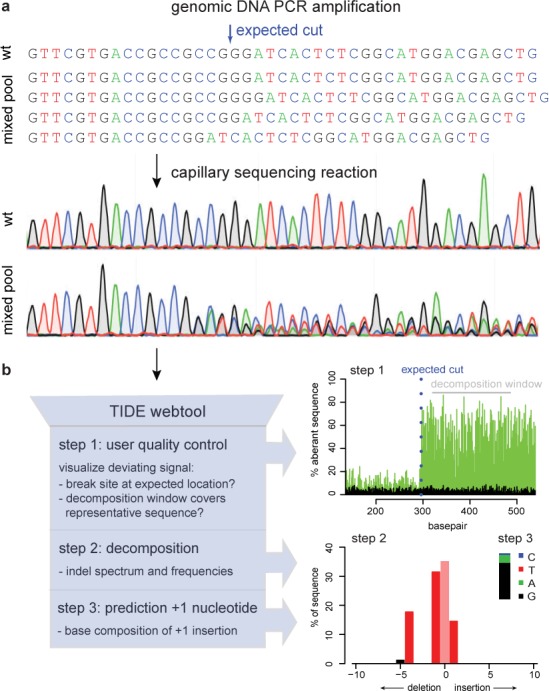
“(b) Overview of TIDE algorithm and output, which consists of three main steps: (1) Visualization of aberrant sequence signal in control (black) and treated sample (green), the expected break site (vertical dotted line) and the region used for decomposition (gray bar); (2) Decomposition yielding the spectrum of indels…”
BackgroundMethodGenetic screens in human cells using the CRISPR-Cas9 system
Wang, T., Wei, J. J., Sabatini, D. M., & Lander, E. S. (2014) · Science · doi:10.1126/science.1246981 · Cited by 2,856
Improving CRISPR-Cas nuclease specificity using truncated guide RNAs
Fu, Y., Sander, J. D., Reyon, D., Cascio, V. M., & Joung, J. K. (2014) · Nature Biotechnology · doi:10.1038/nbt.2808 · Cited by 1,993 · cited 1×
“However, the efficacy and the spectrum of mutations vary greatly depending on the RGEN target site and cells used ((17,18) and this report).”
BackgroundCHOPCHOP: a CRISPR/Cas9 and TALEN web tool for genome editing
Montague, T. G., Cruz, J. M., Gagnon, J. A., Church, G. M., & Valen, E. (2014) · Nucleic Acids Research · doi:10.1093/nar/gku410 · Cited by 1,234
Cas9 as a versatile tool for engineering biology
Mali, P., Esvelt, K. M., & Church, G. M. (2013) · Nature Methods · doi:10.1038/nmeth.2649 · Cited by 1,197 · cited 1×
“For example, with RGENs one typically needs to test several single-guide RNAs (sgRNAs) that are predicted to target the endonuclease to a gene of interest (6).”
BackgroundA guide to genome engineering with programmable nucleases
Kim, H., & Kim, J.-S. (2014) · Nature Reviews Genetics · doi:10.1038/nrg3686 · Cited by 1,163 · cited 3×
“(b) Overview of TIDE algorithm and output, which consists of three main steps: (1) Visualization of aberrant sequence signal in control (black) and treated sample (green), the expected break site (vertical dotted line) and the region used for decomposition (gray bar); (2) Decomposition yielding the spectrum of indels…”
BackgroundMethod
Cited by
Items 301–400 of 1,019
Duchêne, B. L., Cherif, K., Iyombe-Engembe, J.-P., Guyon, A., Rousseau, J., Ouellet, D. L., Barbeau, X., Lagüe, P., & Tremblay, J. P. (2018) · Molecular Therapy · doi:10.1016/j.ymthe.2018.08.010 · Cited by 99
Pattabhi, S., Lotti, S. N., Berger, M. P., Singh, S., Lux, C. T., Jacoby, K., Lee, C., Negre, O., Scharenberg, A. M., & Rawlings, D. J. (2019) · Molecular Therapy - Nucleic Acids · doi:10.1016/j.omtn.2019.05.025 · Cited by 91
“The sequences were analyzed using TIDE or inference of CRISPR edits (ICE) algorithm to measure INDELs following editing.(48,49)”
MethodJeng, E. E., Bhadkamkar, V., Ibe, N. U., Gause, H., Jiang, L., Chan, J., Jian, R., Jimenez‐Morales, D., Stevenson, E. J., Krogan, N. J., et al. (2019) · Cell Host & Microbe · doi:10.1016/j.chom.2019.08.017 · Cited by 92
“Gene editing efficiency was determined by Sanger sequencing and analyzing the resulting chromatograms using TIDE software (Brinkman et al., 2014).”
MethodIdentification of a potent and selective covalent Pin1 inhibitor
Pinch, B. J., Doctor, Z. M., Nabet, B., Browne, C. M., Seo, H., Mohardt, M. L., Kozono, S., Lian, X., Manz, T. D., Chun, Y., et al. (2020) · Nature Chemical Biology · doi:10.1038/s41589-020-0550-9 · Cited by 92
Zhang, X., Jin, H., Huang, X., Chaurasiya, B., Dong, D., Shanley, T. P., & Zhao, Y. (2022) · Cell Reports · doi:10.1016/j.celrep.2021.110196 · Cited by 93
“The gDNA containing the gRNA-target sequence was also amplified by PCR and the PCR product was then used for Sanger DNA sequencing to determine indels using Tide software analysis (Brinkman et al., 2014).”
MethodIdentification of an alternative triglyceride biosynthesis pathway
McLelland, G.-L., Lopez-Osias, M., Verzijl, C. R. C., Ellenbroek, B. D., Oliveira, R. A., Boon, N. J., Dekker, M., van den Hengel, L. G., Ali, R., Janssen, H., et al. (2023) · Nature · doi:10.1038/s41586-023-06497-4 · Cited by 84
Zhang, N., Roberts, H. M., Eck, J. M. V., & Martin, G. B. (2020) · Frontiers in Plant Science · doi:10.3389/fpls.2020.00010 · Cited by 100
“ab1 format) with superimposed chromatograms (Brinkman et al., 2014), thus avoiding tedious and expensive cloning and multi-clone sequencing for mutation analysis.”
MethodInfluentialZhang, N., Pombo, M. A., Rosli, H. G., & Martin, G. B. (2020) · PLANT PHYSIOLOGY · doi:10.1104/pp.20.00144 · Cited by 102
“Geneious R11 and the web-based tool called Tracking of Indels by Decomposition (https:// tide.deskgen.com; Brinkman et al., 2014) were used to determine the mutation type and frequency using the sequencing files (ab1. format) as described in Zhang et al. (2020).”
MethodYuen, G., Khan, F. J., Gao, S., Stommel, J. M., Batchelor, E., Wu, X., & Luo, J. (2017) · Nucleic Acids Research · doi:10.1093/nar/gkx843 · Cited by 97
“To assess the allelic frequency of indel mutation introduced by Cas9/sgRNA at the EGFP target sites, we used both the TIDE analysis (22) of Sanger sequencing chromatograms and the Illumina MiSeq platform.”
MethodInfluentialZabaleta, N., Barberia, M., Martín-Higueras, C., Zapata‐Linares, N., Betancor, I., Rodríguez-Diaz, S., Martínez-Turrillas, R., Torella, L., Vales, Á., Olagüe, C., et al. (2018) · Nature Communications · doi:10.1038/s41467-018-07827-1 · Cited by 96
High-throughput genome-wide phenotypic screening via immunomagnetic cell sorting
Mair, B., Aldridge, P. M., Atwal, R. S., Philpott, D. N., Zhang, M., Masud, S. N., Labib, M., Tong, A. H. Y., Sargent, E. H., Angers, S., et al. (2019) · Nature Biomedical Engineering · doi:10.1038/s41551-019-0454-8 · Cited by 91
Pavani, G., Fabiano, A., Laurent, M., Amor, F., Cantelli, E., Chalumeau, A., Maule, G., Tachtsidi, A., Concordet, J., Cereseto, A., et al. (2021) · Blood Advances · doi:10.1182/bloodadvances.2020001996 · Cited by 104
Self-citationIn-depth analysis reveals complex molecular aetiology in a cohort of idiopathic cerebral palsy
Li, N., Zhou, P., Tang, H., He, L., Fang, X., Zhao, J., Wang, X., Qi, Y., Sun, C., Lin, Y., et al. (2021) · Brain · doi:10.1093/brain/awab209 · Cited by 97
Ungricht, R., Guibbal, L., Lasbennes, M.-C., Orsini, V., Beibel, M., Waldt, A., Cuttat, R., Carbone, W., Basler, A., Roma, G., et al. (2021) · Cell stem cell · doi:10.1016/j.stem.2021.11.001 · Cited by 90
CRISPR/Cas9 microinjection in oocytes disables pancreas development in sheep
Vilariño, M., Rashid, S. T., Suchy, F. P., McNabb, B. R., van der Meulen, T., Fine, E. J., Ahsan, S. D., Mursaliyev, N., Sebastiano, V., Diab, S. S., et al. (2017) · Scientific Reports · doi:10.1038/s41598-017-17805-0 · Cited by 90
Further analysis of barley MORC 1 using a highly efficient RNA ‐guided Cas9 gene‐editing system
Kumar, N., Galli, M., Ordon, J., Stuttmann, J., Kogel, K., & Imani, J. (2018) · Plant Biotechnology Journal · doi:10.1111/pbi.12924 · Cited by 96
Cell-to-Cell Heterogeneity in p38-Mediated Cross-Inhibition of JNK Causes Stochastic Cell Death
Miura, H., Kondo, Y., Matsuda, M., & Aoki, K. (2018) · Cell Reports · doi:10.1016/j.celrep.2018.08.020 · Cited by 88
Port, F., Muschalik, N., & Bullock, S. L. (2015) · G3 Genes|Genomes|Genetics · doi:10.1534/g3.115.019083 · Cited by 87
Allele specific repair of splicing mutations in cystic fibrosis through AsCas12a genome editing
Maule, G., Casini, A., Montagna, C., Ramalho, A. S., De Boeck, K., Debyser, Z., Carlon, M. S., Petris, G., & Cereseto, A. (2019) · Nature Communications · doi:10.1038/s41467-019-11454-9 · Cited by 86
Ramlee, M. K., Yan, T., Cheung, A. M. S., Chuah, C. T. H., & Li, S. (2015) · Scientific Reports · doi:10.1038/srep15587 · Cited by 91
Fujihara, Y., Noda, T., Kobayashi, K., Oji, A., Kobayashi, S., Matsumura, T., Larasati, T., Oura, S., Kojima‐Kita, K., Yu, Z., et al. (2019) · Proceedings of the National Academy of Sciences · doi:10.1073/pnas.1908736116 · Cited by 86
Zhang, P., Pei, S., Gong, Z., Feng, Y., Zhang, X., Yang, F., & Wang, W. T. (2023) · Frontiers in Immunology · doi:10.3389/fimmu.2023.1115272 · Cited by 86
Bisphosphoglycerate mutase controls serine pathway flux via 3-phosphoglycerate
Oslund, R., Su, X., Haugbro, M., Kee, J., Esposito, M., David, Y., Wang, B., Ge, E. J., Perlman, D. H., Kang, Y., et al. (2017) · Nature Chemical Biology · doi:10.1038/nchembio.2453 · Cited by 94
Loss of mouse Stmn2 function causes motor neuropathy
Juan, I. G. S., Nash, L. A., Smith, K. S., Leyton-Jaimes, M. F., Qian, M., Klim, J. R., Limone, F., Dorr, A. B., Couto, A., Pintacuda, G., et al. (2022) · Neuron · doi:10.1016/j.neuron.2022.02.011 · Cited by 93
Antoniou, P., Hardouin, G., Martinucci, P., Frati, G., Félix, T., Chalumeau, A., Fontana, L., Martin, J., Masson, C., Brusson, M., et al. (2022) · Nature Communications · doi:10.1038/s41467-022-34493-1 · Cited by 88
Self-citationVierbuchen, T., Bang, C., Rosigkeit, H., Schmitz, R. A., & Heine, H. (2017) · Frontiers in Immunology · doi:10.3389/fimmu.2017.01535 · Cited by 93
“The occurrence of InDel mutations was analyzed using the Tracking of Indels by Decomposition (TIDE)2 online software (61).”
MethodS-Geranylgeranyl-l-glutathione is a ligand for human B cell-confinement receptor P2RY8
Lu, E., Wolfreys, F. D., Muppidi, J. R., Xu, Y., & Cyster, J. G. (2019) · Nature · doi:10.1038/s41586-019-1003-z · Cited by 97
Non-homologous DNA increases gene disruption efficiency by altering DNA repair outcomes
Richardson, C. D., Ray, G. J., Bray, N. L., & Corn, J. E. (2016) · Nature Communications · doi:10.1038/ncomms12463 · Cited by 80
WNT signaling memory is required for ACTIVIN to function as a morphogen in human gastruloids
Yoney, A., Etoc, F., Ruzo, A., Metzger, J. J., Martyn, I., Li, S., Kirst, C., Carroll, T., Siggia, E. D., & Brivanlou, A. H. (2018) · eLife · doi:10.7554/elife.38279 · Cited by 89
“The resulting chromatograms were decomposed using the Tide web-based tool (Brinkman et al., 2014).”
MethodRoy, A., Zhai, Y., Ortiz-Eriamiatoe, J., Neff, M. M., Mandal, B., Mukherjee, S. K., & Pappu, H. R. (2019) · PLoS ONE · doi:10.1371/journal.pone.0223765 · Cited by 92
Ebisudani, T., Hamamoto, J., Togasaki, K., Mitsuishi, A., Sugihara, K., Shinozaki, T., Fukushima, T., Kawasaki, K., Seino, T., Oda, M., et al. (2023) · Cell Reports · doi:10.1016/j.celrep.2023.112212 · Cited by 85
Baxter, A. E., Huang, H., Giles, J. R., Chen, Z., Wu, J. E., Drury, S., Tuite-Dalton, K. A., Park, S. L., Torres, L., Simone, B. W., et al. (2023) · Immunity · doi:10.1016/j.immuni.2023.05.008 · Cited by 89
Deterministic evolution and stringent selection during preneoplasia
Karlsson, K., Przybilla, M. J., Kotler, E., Khan, A., Xu, H., Karagyozova, K., Sockell, A., Wong, W. H., Liu, K., Mah, A., et al. (2023) · Nature · doi:10.1038/s41586-023-06102-8 · Cited by 83
Genotyping genome‐edited mutations in plants using CRISPR ribonucleoprotein complexes
Liang, Z., Chen, K., Yan, Y., Zhang, Y., & Gao, C. (2018) · Plant Biotechnology Journal · doi:10.1111/pbi.12938 · Cited by 90
“Bioinformatics online tools, such as DSDecode (Liu et al., 2015) and TIDE (Brinkman et al., 2014), were developed to decode mutation types from multiple traces of chromatograms derived from PCR amplicons.”
BackgroundOptical control of sphingosine-1-phosphate formation and function
Morstein, J., Hill, R. Z., Novak, A. J. E., Feng, S., Norman, D. D., Donthamsetti, P., Frank, J. A., 原山, 武., Williams, B. M., Parrill, A. L., et al. (2019) · Nature Chemical Biology · doi:10.1038/s41589-019-0269-7 · Cited by 87
Lee, K., Jeon, I., Yu, H., Kim, S., Kim, H., Ahn, S., Lee, J., Lee, S.-K., & Kim, H. U. (2021) · Frontiers in Plant Science · doi:10.3389/fpls.2021.702930 · Cited by 87
“The ab1 files generated from Sanger sequencing of wild type (WT) and genome-edited Camelina were analyzed with the webbased tool TIDE (Brinkman et al., 2014) (http://tide.deskgen. com) or DsDecodeM (Liu et al., 2015) (http://skl.scau.edu.cn/ dsdecode/).”
MethodControl of cell proliferation by memories of mitosis
Meitinger, F., Belal, H., Davis, R. L., Martinez, M. B., Shiau, A. K., Oegema, K., & Desai, A. B. (2024) · Science · doi:10.1126/science.add9528 · Cited by 90
“Gene knock-out was assessed by genotyping of the sequence surrounding the CRISPR cut site (Brinkman et al., 2014) and/or by immunoblotting.”
MethodLopes, R., & Prasad, M. K. (2024) · Frontiers in Bioengineering and Biotechnology · doi:10.3389/fbioe.2023.1339189 · Cited by 82
Cromer, M. K., Camarena, J., Martin, R. M., Lesch, B. J., Vakulskas, C. A., Bode, N. M., Kurgan, G., Collingwood, M. A., Rettig, G. R., Behlke, M. A., et al. (2021) · Nature Medicine · doi:10.1038/s41591-021-01284-y · Cited by 82
Internal checkpoint regulates T cell neoantigen reactivity and susceptibility to PD1 blockade
Palmer, D. C., Webber, B. R., Patel, Y. K., Johnson, M. J., Kariya, C. M., Lahr, W. S., Parkhurst, M. R., Gartner, J. J., Prickett, T. D., Lowery, F. J., et al. (2022) · Med · doi:10.1016/j.medj.2022.07.008 · Cited by 88
Shen, C., Hsu, M., Chang, C.-W., Lin, M., Hwu, J. R., Tu, Y., & Hu, Y. (2018) · Nucleic Acids Research · doi:10.1093/nar/gky1165 · Cited by 86
“Moreover, the sensitivity of the mismatch cleavage assay we used was considered relatively low (41,42), therefore we employed an additional method (TIDE, tracking of indel by decomposition (43)) to analyze the on-target/off-”
MethodAliaga, N., Zhang, C., Presa, S., Srivastava, A. K., Granell, A., Alabadí, D., Sadanandom, A., Blázquez, M. A., & Minguet, E. G. (2019) · Frontiers in Plant Science · doi:10.3389/fpls.2019.01150 · Cited by 93
Interpretation of cancer mutations using a multiscale map of protein systems
Zheng, F., Kelly, M. R., Ramms, D. J., Heintschel, M. L., Tao, K., Tutuncuoglu, B., Lee, J. J., Ono, K., Foussard, H., Chen, M., et al. (2021) · Science · doi:10.1126/science.abf3067 · Cited by 81
“6% under these conditions through TIDE analysis (120).”
BackgroundDDI2 Is a Ubiquitin-Directed Endoprotease Responsible for Cleavage of Transcription Factor NRF1
Dirac-Svejstrup, A. B., Walker, J., Faull, P. A., Encheva, V., Akimov, V., Puglia, M., Perkins, D., Kuemper, S., Hunjan, S. S., Blagoev, B., et al. (2020) · Molecular Cell · doi:10.1016/j.molcel.2020.05.035 · Cited by 87
Genomic architecture of a genetically assimilated seasonal color pattern
van der Burg, K. R. L., Lewis, J. J., Brack, B. J., Fandino, R. A., Mazo‐Vargas, A., & Reed, R. D. (2020) · Science · doi:10.1126/science.aaz3017 · Cited by 84
“If the smaller band was at too low of a concentration, the larger band was gel purified, sequenced and analyzed with TIDE – a software package that determines the mutation frequency from CRISPR/Cas9 induced mutations ( 39 ) (fig.”
MethodMaggio, I., Liu, J., Janssen, J. M., Chen, X., & Gonçalves, M. A. F. V. (2016) · Scientific Reports · doi:10.1038/srep37051 · Cited by 77
Guide Swap enables genome-scale pooled CRISPR-Cas9 screening in human primary cells
Ting, P. Y., Parker, A. E., Lee, J. S., Trussell, C., Sharif, O., Luna, F., Federe, G., Barnes, S. W., Walker, J. R., Vance, J., et al. (2018) · Nature Methods · doi:10.1038/s41592-018-0149-1 · Cited by 80
Li, C., Zong, Y., Jin, S., Zhu, H., Lin, D., Li, S., Qiu, J.-L., Wang, Y., & Gao, C. (2020) · Genome Biology · doi:10.1186/s13059-020-02051-x · Cited by 79
Single and Dual Vector Gene Therapy with AAV9-PHP.B Rescues Hearing in Tmc1 Mutant Mice
Wu, J. H., Solanes, P., Nist-Lund, C. A., Spataro, S., Shubina-Oleinik, O., Marcovich, I., Goldberg, H., Schneider, B. L., & Holt, J. R. (2020) · Molecular Therapy · doi:10.1016/j.ymthe.2020.11.016 · Cited by 84
“In order to quantify cleavage efficiency by CRISPR-Cas9, the web tool TIDE was used to quantify the formation of indels at a target locus.(32) To determine cleavage frequency, we compared the control sample transfected with the Cas9-expressing plasmid only with test samples cotransfected with the Cas9- and gRNA-expres…”
MethodDubreuil, M. M., Morgens, D. W., Okumoto, K., Honsho, M., Contrepois, K., Lee-McMullen, B., Traber, G. M., Sood, R. S., Dixon, S. J., Snyder, M. P., et al. (2020) · Cell Reports · doi:10.1016/j.celrep.2020.01.013 · Cited by 79
“Gene editing efficiency was determined by Sanger sequencing and analyzing the resulting chromatograms using TIDE software (Brinkman et al., 2014).”
MethodgRNA validation for wheat genome editing with the CRISPR-Cas9 system
Arndell, T., Sharma, N., Langridge, P., Baumann, U., Watson-Haigh, N. S., & Whitford, R. (2019) · BMC Biotechnology · doi:10.1186/s12896-019-0565-z · Cited by 77
Srifa, W., Kosaric, N., Amorin, A., Jadi, O., Park, Y., Mantri, S., Camarena, J., Gurtner, G. C., & Porteus, M. H. (2020) · Nature Communications · doi:10.1038/s41467-020-16065-3 · Cited by 79
Evans, L. T., Anglen, T., Scott, P. M., Lukasik, K., Lončarek, J., & Holland, A. J. (2020) · The EMBO Journal · doi:10.15252/embj.2020105106 · Cited by 82
“(Brinkman et al , 2014).”
Heslop, J. A., Pournasr, B., Liu, J.-T., & Duncan, S. A. (2021) · Cell Reports · doi:10.1016/j.celrep.2021.109145 · Cited by 69
“Identified potential INDELs were confirmed by analyzing the amplicons using TIDE analysis and nucleotide sequencing (Brinkman et al., 2014).”
MethodAtkins, A., Chung, C.-H., Allen, A. G., Dampier, W., Gurrola, T. E., Sariyer, I. K., Nonnemacher, M. R., & Wigdahl, B. L. (2021) · Frontiers in Genome Editing · doi:10.3389/fgeed.2021.673022 · Cited by 90
Maggio, I., Stefanucci, L., Janssen, J. M., Liu, J., Chen, X., Mouly, V., & Gonçalves, M. A. F. V. (2016) · Nucleic Acids Research · doi:10.1093/nar/gkv1540 · Cited by 75
“nl) (40) by using as input the PCR product chromatograms derived from edited and unedited DNA as indicated.”
MethodWei, J., Wagner, S., Maclean, P. H., Brophy, B., Cole, S., Smolenski, G., Carlson, D. F., Fahrenkrug, S. C., Wells, D. N., & Laible, G. (2018) · Scientific Reports · doi:10.1038/s41598-018-25654-8 · Cited by 85
Control of homologous recombination by the HROB–MCM8–MCM9 pathwayPreprint
Hustedt, N., Saito, Y., Zimmermann, M., Álvarez-Quilón, A., Setiaputra, D., Adam, S., McEwan, A., Yuan, J. Y., Olivieri, M., Zhao, Y., et al. (2019) · Genes & Development · doi:10.1101/gad.329508.119 · Cited by 79
“Clones were screened by TIDE analysis (Brinkman et al. 2014), and loss of protein expression was confirmed by immunoblotting and qPCR (forMCM8 knockouts).”
MethodPosttranslational modification of microtubules by the MATCAP detyrosinase
Landskron, L., Bak, J., Adamopoulos, A., Kaplani, K., Moraiti, M., van den Hengel, L. G., Song, J.-Y., Bleijerveld, O. B., Nieuwenhuis, J., Heidebrecht, T., et al. (2022) · Science · doi:10.1126/science.abn6020 · Cited by 78
“Compound heterozygote clones were identified with the TIDE web tool (35) and further confirmed by subcloning of the PCR amplicons and sequencing.”
MethodThe GATOR–Rag GTPase pathway inhibits mTORC1 activation by lysosome-derived amino acids
Hesketh, G. G., Papazotos, F., Pawling, J., Rajendran, D., Knight, J. D. R., Martinez, S., Taipale, M., Schramek, D., Dennis, J. W., & Gingras, A.-C. (2020) · Science · doi:10.1126/science.aaz0863 · Cited by 77
The evening complex integrates photoperiod signals to control flowering in rice
Andrade, L., Lu, Y., Cordeiro, A. M., Costa, J. M. F., Wigge, P. A., Saibo, N. J. M., & Jaeger, K. E. (2022) · Proceedings of the National Academy of Sciences · doi:10.1073/pnas.2122582119 · Cited by 89
In Vivo Genome Editing Partially Restores Alpha1-Antitrypsin in a Murine Model of AAT Deficiency
Song, C.-Q., Wang, D., Jiang, T., O'Connor, K., Tang, Q., Cai, L., Li, X., Weng, Z., Yin, H., Gao, G., et al. (2018) · Human Gene Therapy · doi:10.1089/hum.2017.225 · Cited by 75
“2F to amplify the genomic DNA and performed Tracking of Indels by DEcomposition analysis to measure indel rate.(26) *15% indels were observed in the treated mice (Fig.”
MethodSimultaneous reprogramming and gene editing of human fibroblasts
Howden, S. E., Thomson, J. A., & Little, M. H. (2018) · Nature Protocols · doi:10.1038/nprot.2018.007 · Cited by 82
Yu, Y., Guo, Y., Tian, Q., Lan, Y., Yeh, H., Zhang, M., Tasan, I., Jain, S., & Zhao, H. (2019) · Nature Chemical Biology · doi:10.1038/s41589-019-0432-1 · Cited by 81
Huang, P., Peslak, S. A., Lan, X., Khandros, E., Yano, J. A., Sharma, M., Keller, C. A., Giardine, B. M., Qin, K., Abdulmalik, O. Y., et al. (2020) · Blood · doi:10.1182/blood.2020005301 · Cited by 81
Human papillomavirus E7 oncoprotein targets RNF168 to hijack the host DNA damage response
Sitz, J., Blanchet, S. A., Gameiro, S. F., Biquand, E., Morgan, T. M., Galloy, M., Dessapt, J., Lavoie, E. G., Blondeau, A., Smith, B. C., et al. (2019) · Proceedings of the National Academy of Sciences · doi:10.1073/pnas.1906102116 · Cited by 77
Sun, X., Bizhanova, A., Matheson, T. D., Yu, J., Zhu, L. J., & Kaufman, P. D. (2017) · Molecular and Cellular Biology · doi:10.1128/mcb.00569-16 · Cited by 76
Cas9 Allosteric Inhibition by the Anti-CRISPR Protein AcrIIA6
Fuchsbauer, O., Swuec, P., Zimberger, C., Amigues, B., Levesque, S., Agudelo, D., Duringer, A., Chaves-Sanjuán, A., Spinelli, S., Rousseau, G. M., et al. (2019) · Molecular Cell · doi:10.1016/j.molcel.2019.09.012 · Cited by 82
Vaccine elicitation of HIV broadly neutralizing antibodies from engineered B cells
Huang, D., Tran, J. T., Olson, A., Vollbrecht, T., Tenuta, M., Guryleva, M. V., Fuller, R. P., Schiffner, T., Abadejos, J. R., Couvrette, L. J., et al. (2020) · Nature Communications · doi:10.1038/s41467-020-19650-8 · Cited by 76
Sago, C. D., Lokugamage, M. P., Loughrey, D., Lindsay, K. E., Hincapie, R., Krupczak, B. R., Kalathoor, S., Sato, M., Echeverri, E. S., Fitzgerald, J. P., et al. (2022) · Nature Biomedical Engineering · doi:10.1038/s41551-022-00847-9 · Cited by 76
Kang, M., Lee, K., Finley, T., Chappell, H., Veena, V., & Wang, K. (2022) · Frontiers in Plant Science · doi:10.3389/fpls.2022.860971 · Cited by 76
“To interpret these data generated from the direct sequencing, the presence of indel mutations at the target site was analyzed by TIDE (Brinkman et al., 2014) and ICE (Hsiau et al.”
MethodInfluentialPhospholipase D3 degrades mitochondrial DNA to regulate nucleotide signaling and APP metabolism
Van Acker, Z. P., Perdok, A., Hellemans, R., North, K., Vorsters, I., Cappel, C., Dehairs, J., Swinnen, J. V., Sannerud, R., Bretou, M., et al. (2023) · Nature Communications · doi:10.1038/s41467-023-38501-w · Cited by 67
An erythroid-specific ATP2B4 enhancer mediates red blood cell hydration and malaria susceptibility
Lessard, S., Gatof, E. S., Beaudoin, M., Schupp, P. G., Sher, F., Ali, A., Prehar, S., Kurita, R., Nakamura, Y., Baena, E., et al. (2017) · Journal of Clinical Investigation · doi:10.1172/jci94378 · Cited by 82
“to a publicly available sequence deconvolution algorithm (37).”
MethodMitochondria-specific photoactivation to monitor local sphingosine metabolism and function
Feng, S., 原山, 武., Montessuit, S., David, F. P., Winssinger, N., Martinou, J., & Riezman, H. (2018) · eLife · doi:10.7554/elife.34555 · Cited by 78
“Since ceramides are much more abundant lipids than sphingoid bases in cells ((Simanshu et al., 2013; Shaner et al., 2009; Canals et al., 2010), Figure 3—figure supplement 1), we prepared stable isotope labelled caged sphingosine so that the newly produced ceramides can be distinguished from the…”
BackgroundRobust activation of microhomology-mediated end joining for precision gene editing applications
Ata, H., Ekstrom, T. L., Martínez-Gálvez, G., Mann, C. M., Dvornikov, A. V., Schaefbauer, K. J., Ma, A. C., Dobbs, D., Clark, K. J., & Ekker, S. C. (2018) · PLOS Genetics · doi:10.1371/journal.pgen.1007652 · Cited by 71
CRISPR-Cas9 vectors for genome editing and host engineering in the baculovirus–insect cell system
Mabashi‐Asazuma, H., & Jarvis, D. L. (2017) · Proceedings of the National Academy of Sciences · doi:10.1073/pnas.1705836114 · Cited by 75
“We performed TIDE analysis as described previously (40).”
MethodEfficient gene targeting in Nicotiana tabacum using CRISPR/SaCas9 and temperature tolerant LbCas12a
Huang, T., Armstrong, B., Schindele, P., & Puchta, H. (2021) · Plant Biotechnology Journal · doi:10.1111/pbi.13546 · Cited by 75
“Sequencing results were analysed by TIDE analysis for quantification of the mutation induction (Brinkman et al ., 2014).”
Live-cell imaging of circadian clock protein dynamics in CRISPR-generated knock-in cells
Gabriel, C. H., del Olmo, M., Zehtabian, A., Jäger, M., Reischl, S., van Dijk, H., Ulbricht, C., Rakhymzhan, A. A., Korte, T., Koller, B., et al. (2021) · Nature Communications · doi:10.1038/s41467-021-24086-9 · Cited by 78
Control of gene editing by manipulation of DNA repair mechanisms
Danner, E. W., Bashir, S., Yumlu, S., Wurst, W., Wefers, B., & Kühn, R. (2017) · Mammalian Genome · doi:10.1007/s00335-017-9688-5 · Cited by 80
“The resulting mixture of sequencing traces can be computationally deconvoluted by either TIDE (Brinkman et al.”
MethodGisler, S., Gonçalves, J. P., Akhtar, W., de Jong, J., Pindyurin, A. V., Wessels, L. F. A., & van Lohuizen, M. (2019) · Nature Communications · doi:10.1038/s41467-019-09551-w · Cited by 83
Versatile and robust genome editing with Streptococcus thermophilus CRISPR1-Cas9
Agudelo, D., Carter, S., Velimirovic, M., Duringer, A., Rivest, J.-F., Levesque, S., Loehr, J., Mouchiroud, M., Cyr, D., Waters, P. J., et al. (2020) · Genome Research · doi:10.1101/gr.255414.119 · Cited by 85
“TIDE analysis was performed using a significance cut-off value for decomposition of P<0.001 (Brinkman et al. 2014).”
MethodInfluentialMin, Y.-L., Chemello, F., Li, H. Z., Rodríguez-Caycedo, C., Sanchez‐Ortiz, E., Mireault, A. A., McAnally, J., Shelton, J. M., Zhang, Y., Bassel‐Duby, R., et al. (2020) · Molecular Therapy · doi:10.1016/j.ymthe.2020.05.024 · Cited by 80
“RT-PCR products were sequenced and analyzed by TIDE analysis.(46) Primer sequences are listed in Table S1.”
MethodCody, J. P., Maher, M. F., Nasti, R. A., Starker, C. G., Chamness, J. C., & Voytas, D. F. (2022) · Nature Protocols · doi:10.1038/s41596-022-00749-9 · Cited by 75
Kas, S. M., de Ruiter, J. R., Schipper, K., Annunziato, S., Schut, E., Klarenbeek, S., Drenth, A. P., van der Burg, E., Klijn, C. N., ten Hoeve, J. J., et al. (2017) · Nature Genetics · doi:10.1038/ng.3905 · Cited by 81
Annunziato, S., de Ruiter, J. R., Henneman, L., Brambillasca, C. S., Lutz, C., Vaillant, F., Ferrante, F., Drenth, A. P., van der Burg, E., Siteur, B., et al. (2019) · Nature Communications · doi:10.1038/s41467-019-08301-2 · Cited by 70
Shapiro, J., Iancu, O., Jacobi, A. M., McNeill, M. S., Turk, R., Rettig, G. R., Amit, I., Tovin-Recht, A., Yakhini, Z., Behlke, M. A., et al. (2020) · Molecular Therapy - Methods & Clinical Development · doi:10.1016/j.omtm.2020.04.027 · Cited by 70
“TIDE analysis is an easy-to-use and cost-effective method, especially when analyzing a small number of samples.(31) Amplicons flanking the RAG2 and RAG1 target sites from CD34 HSPCs were either analyzed by NGS or Sanger sequencing, followed by TIDE analysis.”
MethodNAMPT-derived NAD+ fuels PARP1 to promote skin inflammation through parthanatos cell death
Martínez-Morcillo, F. J., Cantón-Sandoval, J., Martínez-Navarro, F. J., Cabas, I., Martínez‐Vicente, I., Armistead, J., Hatzold, J., López‐Muñoz, A., Martínez‐Menchón, T., Corbalán-Vélez, R., et al. (2021) · PLoS Biology · doi:10.1371/journal.pbio.3001455 · Cited by 75
Activation of γ-globin expression by hypoxia-inducible factor 1α
Feng, R., Mayuranathan, T., Huang, P., Doerfler, P. A., Li, Y., Yao, Y., Zhang, J., Palmer, L. E., Mayberry, K. D., Christakopoulos, G. E., et al. (2022) · Nature · doi:10.1038/s41586-022-05312-w · Cited by 74
Circuit coordination of opposing neuropeptide and neurotransmitter signals
Soden, M. E., Yee, J. X., & Zweifel, L. S. (2023) · Nature · doi:10.1038/s41586-023-06246-7 · Cited by 73
Cholesterol mobilization regulates dendritic cell maturation and the immunogenic response to cancer
Belabed, M., Park, M. D., Blouin, C. M., Balan, S., Moon, C. Y., Freed, G. S., Quijada‐Álamo, M., Peros, A., Mattiuz, R., Reid, A. M., et al. (2025) · Nature Immunology · doi:10.1038/s41590-024-02065-8 · Cited by 77
Schiwon, M., Ehrke‐Schulz, E., Oswald, A., Bergmann, T., Michler, T., Protzer, U., & Ehrhardt, A. (2018) · Molecular Therapy — Nucleic Acids · doi:10.1016/j.omtn.2018.05.006 · Cited by 76
“For quantification of the editing efficacy by a method named TIDE (tracking of indels by decomposition), the same PCR products were analyzed by Sanger sequencing (Eurofins Genomics, Ebersberg, Germany) and the chromatograms analyzed using the TIDE online tool.(37)”
MethodBialk, P. A., Wang, Y., Banas, K. H., & Kmiec, E. B. (2018) · Molecular Therapy — Oncolytics · doi:10.1016/j.omto.2018.10.002 · Cited by 77
“Clonal allelic analyses of individual A549 cell clones were analyzed by the software program TIDE to determine the individual sub-sequences within the multi-peaked breakdown product after CRISPR/ Cas9 activity.(25) The TIDE analyses provide a visual of the sequence decomposition, the indel patterns of the clone, as we…”
MethodFetal hemoglobin rescues ineffective erythropoiesis in sickle cell disease
Hoss, S. E., Cochet, S., Godard, A., Yan, H., Dussiot, M., Frati, G., Boutonnat-Faucher, B., Laurance, S., Renaud, O., Joseph, L., et al. (2020) · Haematologica · doi:10.3324/haematol.2020.265462 · Cited by 77
“days after electroporation by Sanger sequencing followed by tracking of indels by decomposition (TIDE) analysis.(13)”
MethodGenome editing with CRISPR/Cas9 in Pinus radiata (D. Don)
Poovaiah, C. R., Phillips, L., Geddes, B., Reeves, C., Sorieul, M., & Thorlby, G. J. (2021) · BMC Plant Biology · doi:10.1186/s12870-021-03143-x · Cited by 76
Inhibition of mitochondrial translation suppresses glioblastoma stem cell growth
Sighel, D., Notarangelo, M., Aibara, S., Re, A., Ricci, G., Guida, M., Soldano, A., Adami, V., Ambrosini, C., Broso, F., et al. (2021) · Cell Reports · doi:10.1016/j.celrep.2021.109024 · Cited by 76
Antigen glycosylation regulates efficacy of CAR T cells targeting CD19
Heard, A. D., Landmann, J. H., Hansen, A. R., Papadopolou, A., Hsu, Y.-S., Selli, M. E., Warrington, J. M., Lattin, J., Chang, J., Ha, H., et al. (2022) · Nature Communications · doi:10.1038/s41467-022-31035-7 · Cited by 71
“R 2 values were calculated, re fl ecting the goodness of fi t after non-negative linear modeling by TIDE software 32 .”
Harnessing clonal gametes in hybrid crops to engineer polyploid genomes
Wang, Y., Fuentes, R. R., van Rengs, W. M. J., Effgen, S., Zaidan, M. W. A. M., Franzen, R., Susanto, T., Fernandes, J. B., Mercier, R., & Underwood, C. J. (2024) · Nature Genetics · doi:10.1038/s41588-024-01750-6 · Cited by 76
Mapping the sugar dependency for rational generation of a DNA-RNA hybrid-guided Cas9 endonuclease
Rueda, F. O., Bista, M., Newton, M. D., Goeppert, A. U., Cuomo, M. E., Gordon, E., Kröner, F., Read, J. A., Wrigley, J. D., Rueda, D., et al. (2017) · Nature Communications · doi:10.1038/s41467-017-01732-9 · Cited by 74
Ngo, A., Shurtleff, M. J., Popova, K. D., Kulsuptrakul, J., Weissman, J. S., & Puschnik, A. S. (2019) · eLife · doi:10.7554/elife.48469 · Cited by 74
Current Bioinformatics Tools to Optimize CRISPR/Cas9 Experiments to Reduce Off-Target Effects
Naeem, M., & Alkhnbashi, O. S. (2023) · International Journal of Molecular Sciences · doi:10.3390/ijms24076261 · Cited by 70
“A new and advanced version of TIDE has been designed, Tracking Insertions, Deletions, and Recombination (TIDER), which can detect off-target effects introduced by both INDELS and HDR pathways [72,73].”
Background
Metadata
- Authors
- Brinkman, E. K., Chen, T., Amendola, M., & van Steensel, B.
- Affiliations
- The Netherlands Cancer Institute (NL)
- Division of Gene Regulation, Netherlands Cancer Institute, Plesmanlaan 121, 1016 HM Amsterdam, the Netherlands
- Venue
- Nucleic Acids Research
- Publisher
- Oxford University Press (OUP)
- Published
- 2014-10-09
- Volume
- 42
- Issue
- 22
- Pages
- e168-e168
- ISSN
- 0305-1048 (ISSN-L)
- 1362-4962
- PMC
- PMC4267669
- OpenAlex
- W2106070783
- Cited by
- 2,390
- References
- 19
- Citations by year
- 2026: 184 · 2025: 261 · 2024: 253 · 2023: 290 · 2022: 280 · 2021: 259 · 2020: 263 · 2019: 241 · 2018: 186 · 2017: 105 · 2016: 48 · 2015: 16 · 2014: 2
- FWCI
- 23.39
- Type
- journal article
- Language
- en
- Open access
- gold
- doi.org
- Locations
- Nucleic Acids Research (publishedVersion, cc-by)
- Europe PMC (PubMed Central) (publishedVersion, cc-by)
- PubMed Central (publishedVersion, cc-by)
- PubMed (publishedVersion)
- HAL (submittedVersion)
- Institutional Research Information System University of Ferrara (University of Ferrara) (submittedVersion)
- Funders
- ZonMw
- Nederlandse Organisatie voor Wetenschappelijk Onderzoek
- FP7 Ideas: European Research Council (293662)
- Topics
- Life Sciences › Biochemistry, Genetics and Molecular Biology › Molecular Biology › CRISPR and Genetic Engineering
- Life Sciences › Biochemistry, Genetics and Molecular Biology › Molecular Biology › RNA regulation and disease
- Life Sciences › Biochemistry, Genetics and Molecular Biology › Cancer Research › Cancer Genomics and Diagnostics
- Keywords
- genome editing, tides, induced mutation, CRISPR/Cas9, editing sites, mutation spectrum, web-based tool, PCR-based assays
- MeSH terms
- Algorithms, Cells, Cultured, DNA Mutational Analysis, Humans, Software, Polymerase Chain Reaction, Mutagenesis, K562 Cells, Genomics, INDEL Mutation, CRISPR-Cas Systems
About these checks
Registry, retraction, Cites and statistics results are computed, not judged, with one exception: a printed reference that no index lists is read once by a model before it counts as a citation error. Claims are extracted by a model and kept only when their quote appears verbatim in the text; each cited source is then checked, with a model’s help, for whether it says what the claim relies on. Those verdicts can be wrong — read the claim’s quote and the cited source before relying on one.
Statistics and arithmetic are recomputed, not judged.
Confidence bands are shown only for fields calibrated on our annotated test set. None is calibrated yet, so no band is shown.
What counts as a claim ›How we measure confidence ›How we check this ›
Are you an author, or do you see a problem with this page? Request a review
Data sources
Bibliographic data: Semantic Scholar, OpenAlex, Crossref.
Contains information from the Semantic Scholar Academic Graph Datasets, made available under the ODC Attribution License (ODC-BY 1.0).
Semantic Scholar’s data is described in: Kinney, R., et al. (2023). The Semantic Scholar Open Data Platform. arXiv:2301.10140.
