

Easy quantitative assessment of genome editing by sequence trace decomposition
Open accessThe DOI matches its Crossref record; 19 of the 19 references it cites were found in a registry or an index.
Abstract
The efficacy and the mutation spectrum of genome editing methods can vary substantially depending on the targeted sequence. A simple, quick assay to accurately characterize and quantify the induced mutations is therefore needed. Here we present TIDE, a method for this purpose that requires only a pair of PCR reactions and two standard capillary sequencing runs. The sequence traces are then analyzed by a specially developed decomposition algorithm that identifies the major induced mutations in the projected editing site and accurately determines their frequency in a cell population. This method is cost-effective and quick, and it provides much more detailed information than current enzyme-based assays. An interactive web tool for automated decomposition of the sequence traces is available. TIDE greatly facilitates the testing and rational design of genome editing strategies.
Overview
The claims and statistics of this paper haven’t been checked yet.
Free: it reads the open-access text and checks the first 5 claims that cite a source we can check. Create a free account to check every claim.
Integrity signals
Registry
Cites
Statistics
Figures
Verification
Claims the paper makes
The claims and statistics of this paper haven’t been checked yet.
Free: it reads the open-access text and checks the first 5 claims that cite a source we can check. Create a free account to check every claim.
Claims other papers make about this one
Each is checked against this paper’s own text: does it say what the citing paper says it does?
The source backs part of the claim, not all of it — or backs it for a different population, condition or comparison.
In the citing paper
“Long-term nuclease expression (10 days after transduction), which has been demonstrated to highly favor non-specific cleavages41, did not generate any unspecific CFTR editing above TIDE background levels (about 1%)38; whereas AsCas12a-crRNA+11/wt efficiently edited the CFTR gene (86.3%, Fig. 2b).”
From Allele specific repair of splicing mutations in cystic fibrosis through AsCas12a genome editing (2019) · cites this paper as [38]
Experimental — accuracy not yet measuredThe source backs part of the claim, not all of it — or backs it for a different population, condition or comparison.
In the citing paper
“Genotyping was performed by Sanger sequencing of PCR amplicons of genomic target sites with individual alleles deconvoluted by TIDE analysis of chromatograms[33].”
From Genome-scale CRISPR screening for modifiers of cellular LDL uptake (2021) · cites this paper as [33]
Experimental — accuracy not yet measuredIn the citing paper
“Tracking of InDels by Decomposition (TIDE) is an effective web tool (https://tide.nki.nl) that can be used to analyse sequencing data, which estimates the spectra and frequencies of small insertions and deletions generated from gene editing (Brinkman et al., 2014).”
From Genetic resources and precise gene editing for targeted improvement of barley abiotic stress tolerance (2023) · cites this paper as Brinkman et al., 2014
Self-check
Percentages, sums and reported differences re-computed from the paper’s own numbers.
The self-check needs the paper’s full text.
Citations
Cites
Multiplex Genome Engineering Using CRISPR/Cas Systems
Cong, L., Ran, F. A., Cox, D., Lin, S., Barretto, R., Habib, N., Hsu, P. D., Wu, X., Jiang, W., Marraffini, L. A., et al. (2013) · Science · doi:10.1126/science.1231143 · Cited by 15,339
Bioconductor: open software development for computational biology and bioinformatics
Gentleman, R. C., Carey, V. J., Bates, D. M., Bolstad, B., Dettling, M., Dudoit, S., Ellis, B., Gautier, L., Ge, Y., Gentry, J., et al. (2004) · Genome Biology · doi:10.1186/gb-2004-5-10-r80 · Cited by 12,172 · cited 3×
“scf format) are imported into TIDE using the R Bioconductor (15) package sangerseqR (version 1.”
MethodInfluentialGenome engineering using the CRISPR-Cas9 system
Ran, F. A., Hsu, P. D., Wright, J., Agarwala, V., Scott, D. A., & Zhang, F. (2013) · Nature Protocols · doi:10.1038/nprot.2013.143 · Cited by 11,133 · cited 1×
“edu/) (13) and CHOPCHOP (https://chopchop.”
DNA targeting specificity of RNA-guided Cas9 nucleases
Hsu, P. D., Scott, D. A., Weinstein, J. A., Ran, F. A., Konermann, S., Agarwala, V., Li, Y., Fine, E. J., Wu, X., Shalem, O., et al. (2013) · Nature Biotechnology · doi:10.1038/nbt.2647 · Cited by 4,741 · cited 1×
“However, the efficacy and the spectrum of mutations vary greatly depending on the RGEN target site and cells used ((17,18) and this report).”
BackgroundZFN, TALEN, and CRISPR/Cas-based methods for genome engineering
Gaj, T., Gersbach, C. A., & Barbas, C. F. (2013) · Trends in Biotechnology · doi:10.1016/j.tibtech.2013.04.004 · Cited by 3,820 · cited 3×
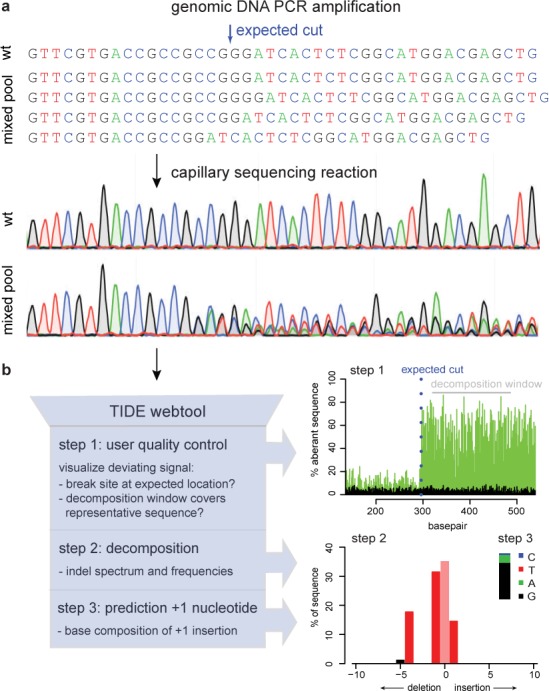
“(b) Overview of TIDE algorithm and output, which consists of three main steps: (1) Visualization of aberrant sequence signal in control (black) and treated sample (green), the expected break site (vertical dotted line) and the region used for decomposition (gray bar); (2) Decomposition yielding the spectrum of indels…”
BackgroundMethodGenetic screens in human cells using the CRISPR-Cas9 system
Wang, T., Wei, J. J., Sabatini, D. M., & Lander, E. S. (2014) · Science · doi:10.1126/science.1246981 · Cited by 2,856
Improving CRISPR-Cas nuclease specificity using truncated guide RNAs
Fu, Y., Sander, J. D., Reyon, D., Cascio, V. M., & Joung, J. K. (2014) · Nature Biotechnology · doi:10.1038/nbt.2808 · Cited by 1,993 · cited 1×
“However, the efficacy and the spectrum of mutations vary greatly depending on the RGEN target site and cells used ((17,18) and this report).”
BackgroundCHOPCHOP: a CRISPR/Cas9 and TALEN web tool for genome editing
Montague, T. G., Cruz, J. M., Gagnon, J. A., Church, G. M., & Valen, E. (2014) · Nucleic Acids Research · doi:10.1093/nar/gku410 · Cited by 1,234
Cas9 as a versatile tool for engineering biology
Mali, P., Esvelt, K. M., & Church, G. M. (2013) · Nature Methods · doi:10.1038/nmeth.2649 · Cited by 1,197 · cited 1×
“For example, with RGENs one typically needs to test several single-guide RNAs (sgRNAs) that are predicted to target the endonuclease to a gene of interest (6).”
BackgroundA guide to genome engineering with programmable nucleases
Kim, H., & Kim, J.-S. (2014) · Nature Reviews Genetics · doi:10.1038/nrg3686 · Cited by 1,163 · cited 3×
“(b) Overview of TIDE algorithm and output, which consists of three main steps: (1) Visualization of aberrant sequence signal in control (black) and treated sample (green), the expected break site (vertical dotted line) and the region used for decomposition (gray bar); (2) Decomposition yielding the spectrum of indels…”
BackgroundMethod
Cited by
Items 401–500 of 1,019
The transcriptional repressor complex FRS7-FRS12 regulates flowering time and growth in Arabidopsis
Ritter, A., Iñigo, S., Fernández‐Calvo, P., Heyndrickx, K. S., Dhondt, S., Shi, H., Milde, L. D., Bossche, R. V., Clercq, R. D., Eeckhout, D., et al. (2017) · Nature Communications · doi:10.1038/ncomms15235 · Cited by 76
Magnotti, F., Lefeuvre, L., Benezech, S., Malsot, T., Waeckel, L., Martin, A., Kerever, S., Chirita, D., Desjonquères, M., Duquesne, A., et al. (2019) · EMBO Molecular Medicine · doi:10.15252/emmm.201910547 · Cited by 69
“The obtained sequence files were analyzed using the sequence trace decomposition software TIDE (Brinkman et al, 2014; Appendix Fig S7).”
MethodDuarte, H. O., Rodrigues, J. G., Gomes, C., Hensbergen, P. J., Ederveen, A. L. H., de Ru, A. H., Mereiter, S., Polónia, A., Fernandes, E., Ferreira, J. A., et al. (2021) · Oncogene · doi:10.1038/s41388-021-01801-w · Cited by 74
Huse, K., Bai, B., Hilden, V. I., Bollum, L. K., Våtsveen, T. K., Munthe, L. A., Smeland, E. B., Irish, J. M., Wälchli, S., & Myklebust, J. H. (2022) · The Journal of Immunology · doi:10.4049/jimmunol.2200144 · Cited by 75
Interferon-ε is a tumour suppressor and restricts ovarian cancer
Marks, Z. R. C., Campbell, N. K., Mangan, N. E., Vandenberg, C. J., Gearing, L. J., Matthews, A. Y., Gould, J. A., Tate, M. D., Wray‐McCann, G., Ying, L., et al. (2023) · Nature · doi:10.1038/s41586-023-06421-w · Cited by 70
Tissue-Specific Gene Inactivation inXenopus laevis: Knockout oflhx1in the Kidney with CRISPR/Cas9
DeLay, B. D., Corkins, M. E., Hanania, H. L., Salanga, M. C., Deng, J. M., Sudou, N., Taira, M., Horb, M. E., & Miller, R. K. (2017) · Genetics · doi:10.1534/genetics.117.300468 · Cited by 69
“Upon knockout, TIDE analysis indicated that slc45a2 was edited mosaically in all five embryos tested (Supplemental Material, Figure S1) (Brinkman et al. 2014).”
MethodTan, Z., Jiang, Y., Ganewatta, M. S., Kumar, R., Keith, A. R., Twaroski, K., Pengo, T., Tolar, J., Lodge, T. P., & Reineke, T. M. (2019) · Macromolecules · doi:10.1021/acs.macromol.9b01645 · Cited by 71
Izmiryan, A., Ganier, C., Bovolenta, M., Schmitt, A., Mavilio, F., & Hovnanian, A. (2018) · Molecular Therapy Nucleic Acids · doi:10.1016/j.omtn.2018.06.008 · Cited by 68
“nl), as initially described by Brinkman and colleagues.(65)”
van de Kooij, B., Kruswick, A., van Attikum, H., & Yaffe, M. B. (2022) · Nature Communications · doi:10.1038/s41467-022-32743-w · Cited by 73
Depalmitoylation rewires FLT3-ITD signaling and exacerbates leukemia progression
Lv, K., Ren, J., Han, X., Gui, J., Gong, C., & Tong, W. (2021) · Blood · doi:10.1182/blood.2021011582 · Cited by 68
Yin, C., Zhang, T., Li, F., Yang, F., Putatunda, R., Young, W., Khalili, K., Hu, W., & Zhang, Y. (2016) · AIDS · doi:10.1097/qad.0000000000001079 · Cited by 73
Caromile, L. A., Dortche, K., Rahman, M. M., Grant, C. L., Stoddard, C., Ferrer, F. A., & Shapiro, L. H. (2017) · Science Signaling · doi:10.1126/scisignal.aag3326 · Cited by 66
Improved Delivery of CRISPR/Cas9 System Using Magnetic Nanoparticles into Porcine Fibroblast
Hryhorowicz, M., Grześkowiak, B., Mazurkiewicz, N., Śledziński, P., Lipiński, D., & Słomski, R. (2019) · Molecular Biotechnology · doi:10.1007/s12033-018-0145-9 · Cited by 67
Scrudato, M. L., Poulard, K., Sourd, C., Tomé, S., Klein, A. F., Corre, G., Huguet-Lachon, A., Furling, D., Gourdon, G., & Buj‐Bello, A. (2019) · Molecular Therapy · doi:10.1016/j.ymthe.2019.05.021 · Cited by 70
ARIH2 Is a Vif-Dependent Regulator of CUL5-Mediated APOBEC3G Degradation in HIV Infection
Hüttenhain, R., Xu, J., Burton, L. A., Gordon, D. E., Hultquist, J. F., Johnson, J. R., Satkamp, L., Hiatt, J., Rhee, D. Y., Baek, K., et al. (2019) · Cell Host & Microbe · doi:10.1016/j.chom.2019.05.008 · Cited by 65
Perenthaler, E., Nikoncuk, A., Yousefi, S., Berdowski, W. M., Alsagob, M., Čapo, I., van der Linde, H. C., van den Berg, P., Jacobs, E. H., Putar, D., et al. (2019) · Acta Neuropathologica · doi:10.1007/s00401-019-02109-6 · Cited by 69
“Mutants with a high level of out-of-frame indels in both genes were identified using TIDE [18] and intercrossed to obtain germ line transmission.”
MethodBialk, P., Rivera-Torres, N., Strouse, B., & Kmiec, E. B. (2015) · PLOS ONE · doi:10.1371/journal.pone.0129308 · Cited by 68
“Our intent here is not to develop correlations between the level of gene editing and DNA cleavage since this particular assay is sensitive to some variability and activity can be dependent on background signals when polymorphisms are present in the target genome [37].”
BackgroundNasri, M., Ritter, M. U., Mir, P., Dannenmann, B., Aghaallaei, N., Amend, D., Makaryan, V., Xu, Y., Fletcher, B., Bernhard, R., et al. (2019) · Haematologica · doi:10.3324/haematol.2019.221804 · Cited by 70
Herhaus, P., Habringer, S., Philipp-Abbrederis, K., Vag, T., Gerngross, C., Schottelius, M., Slotta-Huspenina, J., Steiger, K., Altmann, T., Weisser, T., et al. (2016) · Haematologica · doi:10.3324/haematol.2016.142976 · Cited by 67
“Indel formation was assessed as described previously.(27)”
Scott, T., Moyo, B., Nicholson, S., Maepa, M. B., Watashi, K., Ely, A., Weinberg, M. S., & Arbuthnot, P. (2017) · Scientific Reports · doi:10.1038/s41598-017-07642-6 · Cited by 64
MLL-fusion-driven leukemia requires SETD2 to safeguard genomic integrity
Skucha, A., Ebner, J., Schmoellerl, J., Roth, M., Eder, T., César‐Razquin, A., Stukalov, A., Vittori, S., Muhar, M., Lu, B., et al. (2018) · Nature Communications · doi:10.1038/s41467-018-04329-y · Cited by 69
Nedd4-Binding Protein 1 and TNFAIP3-Interacting Protein 1 Control MHC-1 Display in Neuroblastoma
Spel, L., Nieuwenhuis, J., Haarsma, R., Stickel, E., Bleijerveld, O. B., Altelaar, M. A. F., Boelens, J. J., Brummelkamp, T. R., Nierkens, S., & Boes, M. L. (2018) · Cancer Research · doi:10.1158/0008-5472.can-18-0545 · Cited by 69
“For non-clonal cell lines, PCR product was subjected to sanger sequencing to obtain mutation profiles based onTIDE assay (22), using nested sanger sequencing primers Fw_N4BP1_seq: 50-CTACAGCTCTCCAAGTGAAACATTTGAG-30 and Fw_TNIP1_seq: 50-CATTCTCCCACACTCGAGTGG- 30.”
MethodBrandt, K. M., Gunn, H., Moretti, N., & Zemetra, R. S. (2020) · Frontiers in Plant Science · doi:10.3389/fpls.2020.00769 · Cited by 62
Gene Editing and Genotoxicity: Targeting the Off-Targets
Blattner, G., Cavazza, A., Thrasher, A. J., & Turchiano, G. (2020) · Frontiers in Genome Editing · doi:10.3389/fgeed.2020.613252 · Cited by 70
“…Lazzarotto et al., 2020), the ligation of adapters in SITE-seq (selective enrichment and identification of adapter-tagged DNA ends by sequencing) (Cameron et al., 2017) or End-seq (DNA end sequencing) (Canela et al., 2016), or deep sequencing and identification of identical 5’ DNA fragments in…”
Nakauchi, Y., Azizi, A., Thomas, D., Corces, M. R., Reinisch, A., Sharma, R., Cruz Hernandez, D., Köhnke, T., Karigane, D., Fan, A., et al. (2022) · Blood Cancer Discovery · doi:10.1158/2643-3230.bcd-21-0143 · Cited by 58
Guiding ATR and PARP inhibitor combinations with chemogenomic screens
Zimmermann, M., Bernier, C., Kaiser, B., Fournier, S., Li, L., Desjardins, J., Skeldon, A. M., Rimkunas, V. M., Veloso, A., Young, J. T. F., et al. (2022) · Cell Reports · doi:10.1016/j.celrep.2022.111081 · Cited by 69
Efficient Homology-Directed Repair with Circular Single-Stranded DNA Donors
Iyer, S., Mir, A., Vega‐Badillo, J., Roscoe, B. P., Ibraheim, R., Zhu, L. J., Lee, J., Liu, P., Luk, K., Mintzer, E., et al. (2022) · The CRISPR Journal · doi:10.1089/crispr.2022.0058 · Cited by 69
“S4).(34) Next, we tested different types of ssDNA donors or a plasmid donor with SpyCas9 and AspCas12a RNPs.”
MethodGenome Editing with CRISPR-Cas9: Can It Get Any Better?
Haeussler, M., & Concordet, J. (2016) · Journal of genetics and genomics/Journal of Genetics and Genomics · doi:10.1016/j.jgg.2016.04.008 · Cited by 70
“Direct Sanger sequencing of PCR products of the target sequence can also be performed (Brinkman et al., 2014), which is not very sensitive but useful to detect the most efficient guide RNAs needed for knockin experiments.”
BackgroundLee, J., Snyder, E. R., Liu, Y., Gu, X., Wang, J., Flowers, B. M., Kim, Y. J., Park, S., Szot, G. L., Hruban, R. H., et al. (2017) · Nature Communications · doi:10.1038/ncomms14686 · Cited by 61
Reprogramming Cancer into Antigen-Presenting Cells as a Novel Immunotherapy
Linde, M. H., Fan, A. C., Köhnke, T., Trotman-Grant, A. C., Gurev, S. F., Phan, P., Zhao, F., Haddock, N. L., Nuno, K. A., Gars, E. J., et al. (2023) · Cancer Discovery · doi:10.1158/2159-8290.cd-21-0502 · Cited by 68
Costimulatory domains direct distinct fates of CAR-driven T cell dysfunction
Selli, M. E., Landmann, J. H., Terekhova, M., Lattin, J., Heard, A. D., Hsu, Y.-S., Chang, T.-C., Chang, J., Warrington, J. M., Ha, H., et al. (2023) · Blood · doi:10.1182/blood.2023020100 · Cited by 91
Jilani, S., Saco, J. D., Mugarza, E., Pujol-Morcillo, A., Chokry, J., Ng, C., Abril-Rodríguez, G., Berger-Manerio, D., Pant, A., Hu, J. G., et al. (2024) · Nature Communications · doi:10.1038/s41467-024-45221-2 · Cited by 65
Liu, I., Cruzeiro, G. A. V., Bjerke, L. M., Rogers, R. F., Grabovska, Y., Beck, A., Mackay, A. G., Barron, T., Hack, O. A., Quezada, M. A., et al. (2024) · Cancer Cell · doi:10.1016/j.ccell.2024.08.006 · Cited by 71
Sugi, T., Tu, V., Ma, Y., Tomita, T., & Weiss, L. M. (2017) · mBio · doi:10.1128/mbio.01289-17 · Cited by 74
Benati, D., Miselli, F., Cocchiarella, F., Patrizi, C., Carretero, M., Baldassarri, S., Ammendola, V., Has, C., Colloca, S., Río, M. D., et al. (2018) · Molecular Therapy · doi:10.1016/j.ymthe.2018.07.024 · Cited by 69
Dppa2 and Dppa4 counteract de novo methylation to establish a permissive epigenome for development
Gretarsson, K. H., & Hackett, J. A. (2020) · Nature Structural & Molecular Biology · doi:10.1038/s41594-020-0445-1 · Cited by 68
Tanihara, F., Hirata, M., Nguyen, N. T., Le, Q. A., Hirano, T., Takemoto, T., Nakai, M., Fuchimoto, D.-I., & Otoi, T. (2018) · PLOS ONE · doi:10.1371/journal.pone.0206360 · Cited by 63
Voogd, C., Brian, L. A., Wu, R., Wang, T., Allan, A. C., & Varkonyi‐Gasic, E. (2022) · New Phytologist · doi:10.1111/nph.17916 · Cited by 66
Targeting colorectal cancer with small-molecule inhibitors of ALDH1B1
Feng, Z., Hom, M. E., Bearrood, T. E., Rosenthal, Z. C., Fernández, D., Ondrus, A. E., Gu, Y., McCormick, A. K., Tomaske, M. G., Marshall, C. R., et al. (2022) · Nature Chemical Biology · doi:10.1038/s41589-022-01048-w · Cited by 65
Pei, S., Zhang, P., Chen, H., Zhao, S., Dai, Y., Yang, L., Kang, Y., Zheng, M., Xia, Y., & Xie, H. (2023) · Frontiers in Endocrinology · doi:10.3389/fendo.2023.1135297 · Cited by 71
Kanjee, U., Grüring, C., Chaand, M., Lin, K., Egan, E. S., Manzo, J., Jones, P. L., Yu, T. M., Barker, R. H., Weekes, M. P., et al. (2017) · Proceedings of the National Academy of Sciences · doi:10.1073/pnas.1711310114 · Cited by 64
“Individual clones were screened by Sanger sequencing using the primer set BSG-1-seq-F 5ʹ–AAGCAGGAAGGAAGAAATG; BSG-1-seq-RC 5ʹ–TTCACGCCCACACACAGAG followed by TIDE analysis (86) to find biallelic knockouts.”
MethodSun, L., Zhao, C., Fu, Z. F., Fu, Y., Su, Z., Li, Y., Zhou, Y., Tan, Y., Li, J., Xiang, Y., et al. (2021) · PLoS Pathogens · doi:10.1371/journal.ppat.1010113 · Cited by 68
“Editing efficiency was examined using Tracking of Indels by Decomposition (TIDE) program [70].”
MethodMirzaei, H. R., Pourghadamyari, H., Rahmati, M., Mohammadi, A., Nahand, J. S., Rezaei, A., Mirzaei, H., & Hadjati, J. (2018) · Cancer Letters · doi:10.1016/j.canlet.2018.03.010 · Cited by 66
Annunziato, S., Lutz, C., Henneman, L., Bhin, J., Wong, K., Siteur, B., van Gerwen, B., de Korte‐Grimmerink, R., Zafra, M. P., Schatoff, E. M., et al. (2020) · The EMBO Journal · doi:10.15252/embj.2019102169 · Cited by 64
“Amplicons were sequenced using the FW primer and CRISPR/Cas9-induced base edits and indels were quantified as described with EditR and TIDE (Kluesner et al , 2018, https://moriaritylab.shinyapps.io/editr_v10; Brinkman et al , 2014, http://tide.nki.nl).”
Neggers, J. E., Paolella, B. R., Asfaw, A., Rothberg, M. V., Skipper, T. A., Yang, A., Kalekar, R. L., Krill-Burger, J. M., Dharia, N. V., Kugener, G., et al. (2020) · Cell Reports · doi:10.1016/j.celrep.2020.108493 · Cited by 67
Zhao, C., Zheng, X., Qu, W., Li, G., Li, X., Miao, Y., Han, X., Liu, X., Li, Z., Ma, Y., et al. (2017) · International Journal of Biological Sciences · doi:10.7150/ijbs.21312 · Cited by 65
“In this study, TIDE (Tracking of Indels by DEcomposition), a simple assay to determine the spectrum and frequency of targeted mutations generated in a pool of cells by CRISPR/Cas9, was conducted using the on-target sites of the sgRNAs as the positive control [17], and the cleavage activity of 17-, 18-, 19-, and 20-nt…”
MethodIdoko-Akoh, A., Taylor, L., Sang, H., & McGrew, M. J. (2018) · Scientific Reports · doi:10.1038/s41598-018-33244-x · Cited by 64
Budzik, J. M., Swaney, D. L., Jimenez‐Morales, D., Johnson, J. R., Garelis, N. E., Repasy, T., Roberts, A. W., Popov, L. M., Parry, T. J., Pratt, D. R., et al. (2020) · eLife · doi:10.7554/elife.51461 · Cited by 68
“In pooled populations of edited macrophages, the editing efficiency at exon 9 or 10 calculated by TIDE analysis (Brinkman et al., 2014) was 90.”
MethodRNA-guided retargeting of Sleeping Beauty transposition in human cells
Kovač, A., Miskey, C., Menzel, M., Grueso, E., Gogol‐Döring, A., & Ivics, Z. (2020) · eLife · doi:10.7554/elife.53868 · Cited by 64
“The sequences were analyzed using the TIDE online tool ( Brinkman et al., 2014 ).”
MethodMicrohomology-assisted scarless genome editing in human iPSCs
Kim, S.-I., Matsumoto, T., Kagawa, H., Nakamura, M., Hirohata, R., Ueno, A., Ohishi, M., Sakuma, T., Soga, T., Yamamoto, T., et al. (2018) · Nature Communications · doi:10.1038/s41467-018-03044-y · Cited by 60
Liang, Y., Eudes, A., Yogiswara, S., Jing, B., Benites, V. T., Yamanaka, R., Cheng-Yue, C., Baidoo, E. E. K., Mortimer, J. C., Scheller, H. V., et al. (2019) · Biotechnology for Biofuels · doi:10.1186/s13068-019-1467-y · Cited by 63
“The results were analyzed using TIDE (Tracking of Indels by Decomposition), a tool which identifies the type and frequency of small indels in the region close to the projected editing site [53].”
Multiplexed Knockouts in the Model Diatom Phaeodactylum by Episomal Delivery of a Selectable Cas9
Moosburner, M., Gholami, P., McCarthy, J. K., Tan, M. H., Bielinski, V. A., & Allen, A. E. (2020) · Frontiers in Microbiology · doi:10.3389/fmicb.2020.00005 · Cited by 66
“TIDE (Tracking of Indels by DEconvolution, Brinkman et al., 2014) sequence analysis is an online-based software2 that analyzes raw sequencing data to find one or multiple indels mutations at a Cas9 target site.”
BackgroundMethodCas9 deactivation with photocleavable guide RNAs
Zou, R. S., Liu, Y., Wu, B., & Ha, T. (2021) · Molecular Cell · doi:10.1016/j.molcel.2021.02.007 · Cited by 64
“Percent of insertions and deletions (indels) 3 days after RNP delivery was computed from a combination of Sanger Sequencing/TIDE analysis (Brinkman et al., 2014) and targeted deep sequencing.”
MethodA gonad-expressed opsin mediates light-induced spawning in the jellyfish ClytiaPreprint
Quiroga-Artigas, G., Lapébie, P., Leclère, L., Takeda, N., Deguchi, R., Jékely, G., Momose, T., & Houliston, E. (2017) · bioRxiv (Cold Spring Harbor Laboratory) · doi:10.1101/140210 · Cited by 61
“PCR products were sequenced and mutation efficiency was assessed using TIDE analyses (Figure 3, figure supplement 1), which estimates the mutation composition from a heterogeneous PCR product in comparison to a wild type sequence (Brinkman et al., 2014).”
MethodMLL leukemia induction by genome editing of human CD34+ hematopoietic cells
Buechele, C., Breese, E. H., Schneidawind, D., Lin, C.-H., Jeong, J., Duque-Afonso, J., Wong, S. H. K., Smith, K. S., Negrin, R. S., Porteus, M., et al. (2015) · Blood · doi:10.1182/blood-2015-05-646398 · Cited by 60
“Additionally, we quantified allele modification frequencies using TIDE analysis (Figure 1D).(21) The MLL TALEN pair most efficient at cleavage was used in subsequent experiments to target a DNA DSB at the preselected genomic site of the MLL gene in primary cells.”
MethodInfluentialGutiérrez-Guerrero, A., Abrey-Recalde, M. J., Mangeot, P. E., Costa, C., Bernadin, O., Perian, S., Fusil, F., Froment, G., Martinez-Turtos, A., Krug, A., et al. (2021) · Frontiers in Genome Editing · doi:10.3389/fgeed.2021.604371 · Cited by 60
Shahi, N., Mallik, S. K., & Sarma, D. (2021) · Aquaculture · doi:10.1016/j.aquaculture.2021.737423 · Cited by 63
Protein tyrosine phosphatase receptor δ serves as the orexigenic asprosin receptor
Mishra, I., Xie, W. R., Bournat, J. C., He, Y., Wang, C., Silva, E. S., Liu, H., Ku, Z., Chen, Y., Erokwu, B. O., et al. (2022) · Cell Metabolism · doi:10.1016/j.cmet.2022.02.012 · Cited by 67
Bendre, S., Rondelet, A., Hall, C., Schmidt, N., Lin, Y., Brouhard, G. J., & Bird, A. W. (2016) · The Journal of Cell Biology · doi:10.1083/jcb.201606081 · Cited by 63
Gene editing in mouse zygotes using the CRISPR/Cas9 system
Wefers, B., Bashir, S., Rossius, J., Wurst, W., & Kühn, R. (2017) · Methods · doi:10.1016/j.ymeth.2017.02.008 · Cited by 71
Gene editing and clonal isolation of human induced pluripotent stem cells using CRISPR/Cas9
Yumlu, S., Stumm, J., Bashir, S., Dreyer, A.-K., Lisowski, P., Danner, E. W., & Kühn, R. (2017) · Methods · doi:10.1016/j.ymeth.2017.05.009 · Cited by 70
van Veen, M., Matas-Rico, E., van de Wetering, K., Leyton-Puig, D., Kedziora, K. M., Lorenzi, V. D., Bultsma, Y., van den Broek, B., Jalink, K., Sidénius, N., et al. (2017) · eLife · doi:10.7554/elife.23649 · Cited by 60
Phenomics-Based Quantification of CRISPR-Induced Mosaicism in Zebrafish
Watson, C. J., Monstad-Rios, A. T., Bhimani, R. M., Gistelinck, C., Willaert, A., Coucke, P. J., Hsu, Y., & Kwon, R. Y. (2020) · Cell Systems · doi:10.1016/j.cels.2020.02.007 · Cited by 62
Genome-wide CRISPR screens identify critical targets to enhance CAR-NK cell antitumor potency
Biederstädt, A., Başar, R., Park, J.-M., Uprety, N., Shrestha, R., Silva, F. R., Dede, M., Watts, J., Acharya, S., Xiong, D., et al. (2025) · Cancer Cell · doi:10.1016/j.ccell.2025.07.021 · Cited by 65
CRISPR/Cas9-mediated knock-in of an optimized TetO repeat for live cell imaging of endogenous loci
Tasan, I., Šustáčková, G., Zhang, L., Kim, J., Sivaguru, M., HamediRad, M., Wang, Y., Genova, J., Ma, J., Belmont, A. S., et al. (2018) · Nucleic Acids Research · doi:10.1093/nar/gky501 · Cited by 65
“We performed Tracking of Indel DEcomposition analysis to determine cutting efficiency of region 8 sgRNA and compared it to region 3 sgRNA as a positive control (48).”
MethodCas9-expressing chickens and pigs as resources for genome editing in livestock
Rieblinger, B., Sid, H., Duda, D., Bozoglu, T. M., Klinger, R., Schlickenrieder, A., Lengyel, K., Flisikowski, K., Flisikowska, T., Simm, N., et al. (2021) · Proceedings of the National Academy of Sciences · doi:10.1073/pnas.2022562118 · Cited by 65
“The resulting amplicons were sequenced (Eurofins Genomics) and analyzed with TIDE (http://shinyapps.datacurators.nl/tide/) (71).”
UBB pseudogene 4 encodes functional ubiquitin variants
Dubois, M., Meller, A., Samandi, S., Brunelle, M., Frion, J., Brunet, M. A., Toupin, A., Beaudoin, M. C., Jacques, J., Lévesque, D., et al. (2020) · Nature Communications · doi:10.1038/s41467-020-15090-6 · Cited by 60
Schmidt, M. J., Gupta, A. K., Bednarski, C., Gehrig-Giannini, S., Richter, F. M., Pitzler, C., Gamalinda, M., Galonska, C., Takeuchi, R., Wang, K., et al. (2021) · Nature Communications · doi:10.1038/s41467-021-24454-5 · Cited by 64
Confalonieri, M., Carelli, M., Gianoglio, S., Moglia, A., Biazzi, E., & Tava, A. (2021) · Frontiers in Plant Science · doi:10.3389/fpls.2021.690231 · Cited by 58
Evaluation of CRISPR gene-editing tools in zebrafish
Uribe‐Salazar, J. M., Kaya, G., Sekar, A., Weyenberg, K., Ingamells, C., & Dennis, M. Y. (2022) · BMC Genomics · doi:10.1186/s12864-021-08238-1 · Cited by 62
“Cleavage scores obtained by an in vivo assessment of 50 gRNAs via Sanger sequencing and deconvolution tools (ICE and TIDE) were concordant with Illumina sequencing, the gold standard in predicting efficiencies, as previously reported [34].”
InfluentialPPM1D mutations are oncogenic drivers of de novo diffuse midline glioma formation
Khadka, P., Reitman, Z. J., Lu, S. D., Buchan, G. B. J., Gionet, G. L., Dubois, F. P. B., Carvalho, D. M., Shih, J., Zhang, S., Greenwald, N. F., et al. (2022) · Nature Communications · doi:10.1038/s41467-022-28198-8 · Cited by 66
“For TIDE analysis, Ppm1d exon6 sequence was ampli fi ed using the aforementioned primers using gDNA template from cells or tumor samples electroporated with Ppm1d gRNA#1 or LacZ gRNA.”
Langille, E. R., Al‐Zahrani, K. N., Ma, Z., Liang, M., Uusküla-Reimand, L., Espín, R., Teng, K., Malik, A., Bergholtz, H., Ghamrasni, S. E., et al. (2022) · Cancer Discovery · doi:10.1158/2159-8290.cd-21-0865 · Cited by 61
Radiosensitivity Is an Acquired Vulnerability of PARPi-Resistant BRCA1-Deficient Tumors
Barazas, M., Gasparini, A., Huang, Y., Küçükosmanoğlu, A., Annunziato, S., Bouwman, P., Sol, W., Kersbergen, A. J., Proost, N., de Korte‐Grimmerink, R., et al. (2019) · Cancer Research · doi:10.1158/0008-5472.can-18-2077 · Cited by 62
Selvaraj, S., Dhoke, N. R., Kiley, J., Mateos-Aierdi, A. J., Tungtur, S. K., Mondragón-González, R., Killeen, G., Oliveira, V. K. P., de Munaín, A. L., & Perlingeiro, R. C. R. (2019) · Molecular Therapy · doi:10.1016/j.ymthe.2019.08.011 · Cited by 60
Characterization of Cas12a nucleases reveals diverse PAM profiles between closely-related orthologs
Jacobsen, T. L., Ttofali, F., Liao, C., Manchalu, S., Gray, B. N., & Beisel, C. L. (2020) · Nucleic Acids Research · doi:10.1093/nar/gkaa272 · Cited by 62
“After 72 hours post-transfection, we analyzed the frequency of indels formed by TIDE analysis (36) using the non-PAM TAGCT as a reference (Figure 4C).”
MethodInfluentialImproving the anti-solid tumor efficacy of CAR-T cells by inhibiting adenosine signaling pathway
Li, N., Tang, N., Cheng, C., Hu, T., Wei, X., Han, W., & Wang, H. (2020) · OncoImmunology · doi:10.1080/2162402x.2020.1824643 · Cited by 65
Hennig, S. L., Owen, J. R., Lin, J. C., Young, A. E., Ross, P. J., Eenennaam, A. L. V., & Murray, J. D. (2020) · Scientific Reports · doi:10.1038/s41598-020-78264-8 · Cited by 64
Lloyd, R. L., Urban, V., Muñoz‐Martínez, F., Ayestaran, I., Thomas, J. C., de Renty, C., O’Connor, M. J., Forment, J. V., Galanty, Y., & Jackson, S. P. (2021) · Nucleic Acids Research · doi:10.1093/nar/gkab628 · Cited by 59
“Using CRISPR-based cell-growth competition assays (44,53), we provisionally validated both genes alongside various other resistance-gene hits from the Atm WT screens that commonly acquire missense mutations and/or reduced expression in cancer (Prkar1a (54– 56), Flcn (57,58), E2f8, Ccnc (59) and Cdk8 (60)) (Figure 2A).”
BackgroundMethodThakore, P. I., Schnell, A., Zhao, M., Huang, L., Hou, Y., Christian, E., Zaghouani, S., Wang, C., Singh, V., Ma, S., et al. (2022) · doi:10.1101/2022.02.26.482041 · Cited by 57
Le, Q. A., Tanihara, F., Wittayarat, M., Namula, Z., Sato, Y., Lin, Q., Takebayashi, K., Hirata, M., & Otoi, T. (2021) · BMC Research Notes · doi:10.1186/s13104-020-05412-8 · Cited by 59
“The PCR products were analyzed by Sanger sequencing and the TIDE (tracking of indels by decomposition) bioinformatics package [18] as described previously [19].”
MethodTopoisomerase IIα represses transcription by enforcing promoter-proximal pausing
Herrero-Ruíz, A., Martínez‐García, P. M., Bautista, J., Millán-Zambrano, G., Lieberman, J. A., Jimeno-González, S., & Cortés‐Ledesma, F. (2021) · Cell Reports · doi:10.1016/j.celrep.2021.108977 · Cited by 59
Lin, M., Yang, Z., Yang, Y., Peng, Y., Li, J., Du, Y., Sun, Q. L., Gao, D., Yuan, Q., Zhou, Y. J., et al. (2021) · Nano Today · doi:10.1016/j.nantod.2021.101359 · Cited by 59
Mesenchymal tumor organoid models recapitulate rhabdomyosarcoma subtypes
Meister, M. T., Koerkamp, M. J. A. G., de Souza, T. M., Breunis, W. B., Frazer‐Mendelewska, E., Brok, M. O., DeMartino, J., Manders, F., Calandrini, C., Kerstens, H. H. D., et al. (2022) · EMBO Molecular Medicine · doi:10.15252/emmm.202216001 · Cited by 63
Efficient Gene Reframing Therapy for Recessive Dystrophic Epidermolysis Bullosa with CRISPR/Cas9
Takashima, S., Shinkuma, S., Fujita, Y., Nomura, T., Ujiie, H., Natsuga, K., Iwata, H., Nakamura, H., Vorobyev, A., Abe, R., et al. (2019) · Journal of Investigative Dermatology · doi:10.1016/j.jid.2019.02.015 · Cited by 63
Ikeda, A., Fujii, W., Sugiura, K., & Naito, K. (2019) · Communications Biology · doi:10.1038/s42003-019-0627-8 · Cited by 57
Computational Tools and Resources Supporting CRISPR-Cas Experiments
Śledziński, P., Nowaczyk, M., & Olejniczak, M. (2020) · Cells · doi:10.3390/cells9051288 · Cited by 62
“Some of tool such as Tracking of Indels by Decomposition (TIDE) are intended to analyze Sanger sequencing results of the targeted locus, providing a comprehensive profile of all insertions and deletions that occurred in a sample [49].”
MethodScharenberg, S. G., Poletto, É., Lucot, K. L., Colella, P., Sheikali, A., Montine, T. J., Porteus, M. H., & Gomez‐Ospina, N. (2020) · Nature Communications · doi:10.1038/s41467-020-17148-x · Cited by 59
Dissecting ELANE neutropenia pathogenicity by human HSC gene editing
Rao, S., Yao, Y., de Brito, J. S., Yao, Q., Shen, A. H., Watkinson, R. E., Kennedy, A. L., Coyne, S. M., Ren, C., Zeng, J., et al. (2021) · Cell stem cell · doi:10.1016/j.stem.2020.12.015 · Cited by 57
A systematic genome-wide mapping of oncogenic mutation selection during CRISPR-Cas9 genome editing
Sinha, S., Barbosa, K., Cheng, K., Leiserson, M. D. M., Jain, P., Deshpande, A. J., Wilson, D. M., Ryan, B. M., Luo, J., Ronai, Z. A., et al. (2021) · Nature Communications · doi:10.1038/s41467-021-26788-6 · Cited by 59
“Clones were then tested for editing e�ciency by performing TIDE analysis 42 .”
MethodMinimized combinatorial CRISPR screens identify genetic interactions in autophagy
Diehl, V., Wegner, M., Grumati, P., Husnjak, K., Schaubeck, S., Gubaš, A., Shah, V. J., Polat, I. H., Langschied, F., Prieto‐Garcia, C., et al. (2021) · Nucleic Acids Research · doi:10.1093/nar/gkab309 · Cited by 73
“Guide RNA performance was evaluated by Tracking of Indels by Decomposition (TIDE) assay, as described previously (39).”
MethodLaible, G., Cole, S., Brophy, B., Wei, J., Leath, S. R., Jivanji, S., Littlejohn, M. D., & Wells, D. N. (2021) · BMC Genomics · doi:10.1186/s12864-021-08175-z · Cited by 62
“Tracking of Indels by DEcomposition (TIDE [60],) was used where required to dissect sequences of different gRNA/Cas9-generated mutations intertwined in the sequencing result of the amplified target region.”
MethodBEAT: A Python program to quantify base editing from Sanger sequencing
Xu, L., Liu, Y., & Han, R. (2019) · The CRISPR Journal · doi:10.1089/crispr.2019.0017 · Cited by 56
USP16 counteracts mono-ubiquitination of RPS27a and promotes maturation of the 40S ribosomal subunit
Montellese, C., van den Heuvel, J., Ashiono, C., Dörner, K., Melnik, A., Jonas, S., Zemp, I., Picotti, P., Gillet, L. C. J., & Kutay, U. (2020) · eLife · doi:10.7554/elife.54435 · Cited by 58
From Genome Sequencing to CRISPR-Based Genome Editing for Climate-Resilient Forest Trees
Cao, H. X., Vu, G. T. H., & Gailing, O. (2022) · International Journal of Molecular Sciences · doi:10.3390/ijms23020966 · Cited by 61
Dis, E. S. V., Fox, D., Morrison, H. M., Fines, D. M., Babirye, J. P., McCann, L. H., Rawal, S. L., Cox, J. S., & Stanley, S. A. (2022) · PLoS Pathogens · doi:10.1371/journal.ppat.1010721 · Cited by 64
CLSTN3β enforces adipocyte multilocularity to facilitate lipid utilization
Qian, K., Tol, M. J., Wu, J., Uchiyama, L. F., Xu, X., Cui, L., Bedard, A. H., Weston, T. A., Rajendran, P. S., Vergnes, L., et al. (2022) · Nature · doi:10.1038/s41586-022-05507-1 · Cited by 60
Self-assembling protein nanoparticles for cytosolic delivery of nucleic acids and proteins
Eweje, F., Ibrahim, V., Shajii, A., Walsh, M. L., Ahmad, K., Alrefai, A., Miyasato, D. L., Davis, J. R., Ham, H. O., Li, K., et al. (2025) · Nature Biotechnology · doi:10.1038/s41587-025-02664-2 · Cited by 67
Ramalho-Carvalho, J., Gonçalves, C. S., Graça, I. C. R., Bidarra, D., Pereira-Silva, E., Salta, S., Godinho, M. I., Gómez, A., Esteller, M., Costa, B. M., et al. (2018) · Clinical Epigenetics · doi:10.1186/s13148-018-0475-2 · Cited by 57
“As output, the quantitative spectrum of indels around the cut site was obtained [13].”
BackgroundMethodInfluentialCRISPR/Cas9-mediated targeted T-DNA integration in rice
Lee, K., Eggenberger, A. L., Banakar, R., McCaw, M., Zhu, H., Main, M., Kang, M., Gelvin, S. B., & Wang, K. (2019) · Plant Molecular Biology · doi:10.1007/s11103-018-00819-1 · Cited by 57
Mouasni, S., Gonzalez, V., Schmitt, A., Bennana, E., Guillonneau, F., Mistou, S., Avouac, J., Ea, H., Devauchelle‐Pensec, V., Gottenberg, J., et al. (2019) · Cell Death and Disease · doi:10.1038/s41419-019-1412-9 · Cited by 61
Metadata
- Authors
- Brinkman, E. K., Chen, T., Amendola, M., & van Steensel, B.
- Affiliations
- The Netherlands Cancer Institute (NL)
- Division of Gene Regulation, Netherlands Cancer Institute, Plesmanlaan 121, 1016 HM Amsterdam, the Netherlands
- Venue
- Nucleic Acids Research
- Publisher
- Oxford University Press (OUP)
- Published
- 2014-10-09
- Volume
- 42
- Issue
- 22
- Pages
- e168-e168
- ISSN
- 0305-1048 (ISSN-L)
- 1362-4962
- PMC
- PMC4267669
- OpenAlex
- W2106070783
- Cited by
- 2,390
- References
- 19
- Citations by year
- 2026: 184 · 2025: 261 · 2024: 253 · 2023: 290 · 2022: 280 · 2021: 259 · 2020: 263 · 2019: 241 · 2018: 186 · 2017: 105 · 2016: 48 · 2015: 16 · 2014: 2
- FWCI
- 23.39
- Type
- journal article
- Language
- en
- Open access
- gold
- doi.org
- Locations
- Nucleic Acids Research (publishedVersion, cc-by)
- Europe PMC (PubMed Central) (publishedVersion, cc-by)
- PubMed Central (publishedVersion, cc-by)
- PubMed (publishedVersion)
- HAL (submittedVersion)
- Institutional Research Information System University of Ferrara (University of Ferrara) (submittedVersion)
- Funders
- ZonMw
- Nederlandse Organisatie voor Wetenschappelijk Onderzoek
- FP7 Ideas: European Research Council (293662)
- Topics
- Life Sciences › Biochemistry, Genetics and Molecular Biology › Molecular Biology › CRISPR and Genetic Engineering
- Life Sciences › Biochemistry, Genetics and Molecular Biology › Molecular Biology › RNA regulation and disease
- Life Sciences › Biochemistry, Genetics and Molecular Biology › Cancer Research › Cancer Genomics and Diagnostics
- Keywords
- genome editing, tides, induced mutation, CRISPR/Cas9, editing sites, mutation spectrum, web-based tool, PCR-based assays
- MeSH terms
- Algorithms, Cells, Cultured, DNA Mutational Analysis, Humans, Software, Polymerase Chain Reaction, Mutagenesis, K562 Cells, Genomics, INDEL Mutation, CRISPR-Cas Systems
About these checks
Registry, retraction, Cites and statistics results are computed, not judged, with one exception: a printed reference that no index lists is read once by a model before it counts as a citation error. Claims are extracted by a model and kept only when their quote appears verbatim in the text; each cited source is then checked, with a model’s help, for whether it says what the claim relies on. Those verdicts can be wrong — read the claim’s quote and the cited source before relying on one.
Statistics and arithmetic are recomputed, not judged.
Confidence bands are shown only for fields calibrated on our annotated test set. None is calibrated yet, so no band is shown.
What counts as a claim ›How we measure confidence ›How we check this ›
Are you an author, or do you see a problem with this page? Request a review
Data sources
Bibliographic data: Semantic Scholar, OpenAlex, Crossref.
Contains information from the Semantic Scholar Academic Graph Datasets, made available under the ODC Attribution License (ODC-BY 1.0).
Semantic Scholar’s data is described in: Kinney, R., et al. (2023). The Semantic Scholar Open Data Platform. arXiv:2301.10140.
