

Easy quantitative assessment of genome editing by sequence trace decomposition
Open accessThe DOI matches its Crossref record; 19 of the 19 references it cites were found in a registry or an index.
Abstract
The efficacy and the mutation spectrum of genome editing methods can vary substantially depending on the targeted sequence. A simple, quick assay to accurately characterize and quantify the induced mutations is therefore needed. Here we present TIDE, a method for this purpose that requires only a pair of PCR reactions and two standard capillary sequencing runs. The sequence traces are then analyzed by a specially developed decomposition algorithm that identifies the major induced mutations in the projected editing site and accurately determines their frequency in a cell population. This method is cost-effective and quick, and it provides much more detailed information than current enzyme-based assays. An interactive web tool for automated decomposition of the sequence traces is available. TIDE greatly facilitates the testing and rational design of genome editing strategies.
Overview
The claims and statistics of this paper haven’t been checked yet.
Free: it reads the open-access text and checks the first 5 claims that cite a source we can check. Create a free account to check every claim.
Integrity signals
Registry
Cites
Statistics
Figures
Verification
Claims the paper makes
The claims and statistics of this paper haven’t been checked yet.
Free: it reads the open-access text and checks the first 5 claims that cite a source we can check. Create a free account to check every claim.
Claims other papers make about this one
Each is checked against this paper’s own text: does it say what the citing paper says it does?
The source backs part of the claim, not all of it — or backs it for a different population, condition or comparison.
In the citing paper
“Long-term nuclease expression (10 days after transduction), which has been demonstrated to highly favor non-specific cleavages41, did not generate any unspecific CFTR editing above TIDE background levels (about 1%)38; whereas AsCas12a-crRNA+11/wt efficiently edited the CFTR gene (86.3%, Fig. 2b).”
From Allele specific repair of splicing mutations in cystic fibrosis through AsCas12a genome editing (2019) · cites this paper as [38]
Experimental — accuracy not yet measuredThe source backs part of the claim, not all of it — or backs it for a different population, condition or comparison.
In the citing paper
“Genotyping was performed by Sanger sequencing of PCR amplicons of genomic target sites with individual alleles deconvoluted by TIDE analysis of chromatograms[33].”
From Genome-scale CRISPR screening for modifiers of cellular LDL uptake (2021) · cites this paper as [33]
Experimental — accuracy not yet measuredIn the citing paper
“Tracking of InDels by Decomposition (TIDE) is an effective web tool (https://tide.nki.nl) that can be used to analyse sequencing data, which estimates the spectra and frequencies of small insertions and deletions generated from gene editing (Brinkman et al., 2014).”
From Genetic resources and precise gene editing for targeted improvement of barley abiotic stress tolerance (2023) · cites this paper as Brinkman et al., 2014
Self-check
Percentages, sums and reported differences re-computed from the paper’s own numbers.
The self-check needs the paper’s full text.
Citations
Cites
Multiplex Genome Engineering Using CRISPR/Cas Systems
Cong, L., Ran, F. A., Cox, D., Lin, S., Barretto, R., Habib, N., Hsu, P. D., Wu, X., Jiang, W., Marraffini, L. A., et al. (2013) · Science · doi:10.1126/science.1231143 · Cited by 15,339
Bioconductor: open software development for computational biology and bioinformatics
Gentleman, R. C., Carey, V. J., Bates, D. M., Bolstad, B., Dettling, M., Dudoit, S., Ellis, B., Gautier, L., Ge, Y., Gentry, J., et al. (2004) · Genome Biology · doi:10.1186/gb-2004-5-10-r80 · Cited by 12,172 · cited 3×
“scf format) are imported into TIDE using the R Bioconductor (15) package sangerseqR (version 1.”
MethodInfluentialGenome engineering using the CRISPR-Cas9 system
Ran, F. A., Hsu, P. D., Wright, J., Agarwala, V., Scott, D. A., & Zhang, F. (2013) · Nature Protocols · doi:10.1038/nprot.2013.143 · Cited by 11,133 · cited 1×
“edu/) (13) and CHOPCHOP (https://chopchop.”
DNA targeting specificity of RNA-guided Cas9 nucleases
Hsu, P. D., Scott, D. A., Weinstein, J. A., Ran, F. A., Konermann, S., Agarwala, V., Li, Y., Fine, E. J., Wu, X., Shalem, O., et al. (2013) · Nature Biotechnology · doi:10.1038/nbt.2647 · Cited by 4,741 · cited 1×
“However, the efficacy and the spectrum of mutations vary greatly depending on the RGEN target site and cells used ((17,18) and this report).”
BackgroundZFN, TALEN, and CRISPR/Cas-based methods for genome engineering
Gaj, T., Gersbach, C. A., & Barbas, C. F. (2013) · Trends in Biotechnology · doi:10.1016/j.tibtech.2013.04.004 · Cited by 3,820 · cited 3×
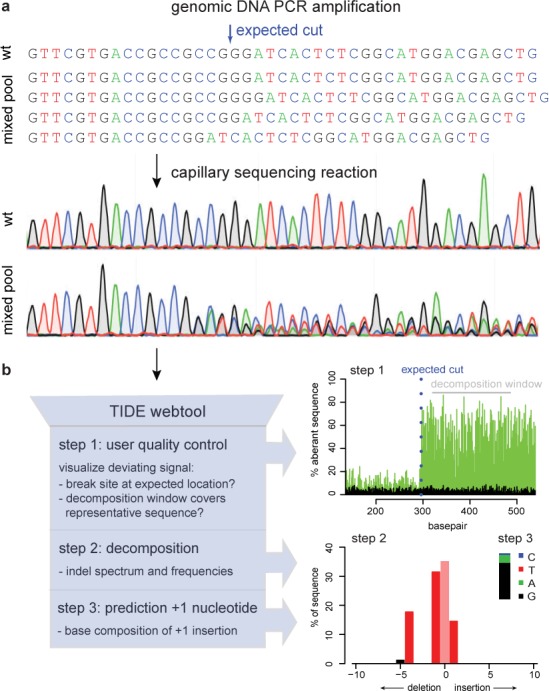
“(b) Overview of TIDE algorithm and output, which consists of three main steps: (1) Visualization of aberrant sequence signal in control (black) and treated sample (green), the expected break site (vertical dotted line) and the region used for decomposition (gray bar); (2) Decomposition yielding the spectrum of indels…”
BackgroundMethodGenetic screens in human cells using the CRISPR-Cas9 system
Wang, T., Wei, J. J., Sabatini, D. M., & Lander, E. S. (2014) · Science · doi:10.1126/science.1246981 · Cited by 2,856
Improving CRISPR-Cas nuclease specificity using truncated guide RNAs
Fu, Y., Sander, J. D., Reyon, D., Cascio, V. M., & Joung, J. K. (2014) · Nature Biotechnology · doi:10.1038/nbt.2808 · Cited by 1,993 · cited 1×
“However, the efficacy and the spectrum of mutations vary greatly depending on the RGEN target site and cells used ((17,18) and this report).”
BackgroundCHOPCHOP: a CRISPR/Cas9 and TALEN web tool for genome editing
Montague, T. G., Cruz, J. M., Gagnon, J. A., Church, G. M., & Valen, E. (2014) · Nucleic Acids Research · doi:10.1093/nar/gku410 · Cited by 1,234
Cas9 as a versatile tool for engineering biology
Mali, P., Esvelt, K. M., & Church, G. M. (2013) · Nature Methods · doi:10.1038/nmeth.2649 · Cited by 1,197 · cited 1×
“For example, with RGENs one typically needs to test several single-guide RNAs (sgRNAs) that are predicted to target the endonuclease to a gene of interest (6).”
BackgroundA guide to genome engineering with programmable nucleases
Kim, H., & Kim, J.-S. (2014) · Nature Reviews Genetics · doi:10.1038/nrg3686 · Cited by 1,163 · cited 3×
“(b) Overview of TIDE algorithm and output, which consists of three main steps: (1) Visualization of aberrant sequence signal in control (black) and treated sample (green), the expected break site (vertical dotted line) and the region used for decomposition (gray bar); (2) Decomposition yielding the spectrum of indels…”
BackgroundMethod
Cited by
Items 201–300 of 1,019
The Self-Inactivating KamiCas9 System for the Editing of CNS Disease Genes
Merienne, N., Vachey, G., de Longprez, L., Meunier, C., Zimmer, V., Perriard, G., Canales, M., Mathias, A., Herrgott, L., Beltraminelli, T., et al. (2017) · Cell Reports · doi:10.1016/j.celrep.2017.08.075 · Cited by 115
Cromer, M. K., Vaidyanathan, S., Ryan, D. E., Curry, B., Lucas, A. B., Camarena, J., Kaushik, M., Hay, S. R., Martin, R. M., Steinfeld, I., et al. (2018) · Molecular Therapy · doi:10.1016/j.ymthe.2018.06.002 · Cited by 120
In vitro–transcribed guide RNAs trigger an innate immune response via the RIG-I pathway
Wienert, B., Shin, J., Zelin, E., Pestal, K., & Corn, J. E. (2018) · PLOS Biology · doi:10.1371/journal.pbio.2005840 · Cited by 119
Maurano, M. M., Snyder, J. M., Connelly, C. F., Henao‐Mejia, J., Sidrauski, C., & Stetson, D. B. (2021) · Immunity · doi:10.1016/j.immuni.2021.07.001 · Cited by 125
Genome-wide identification of the genetic basis of amyotrophic lateral sclerosis
Zhang, S., Cooper-Knock, J., Weimer, A. K., Shi, M., Moll, T., Marshall, J. N. G., Harvey, C., Nezhad, H. G., Franklin, J., Souza, C. D. S., et al. (2022) · Neuron · doi:10.1016/j.neuron.2021.12.019 · Cited by 116
“Sequencing trace files were uploaded to both TIDE (Brinkman et al., 2014) and ICE (https://ice.synthego.com), and an indel efficiency calculated.”
The Epstein-Barr Virus Regulome in Lymphoblastoid Cells
Jiang, S., Zhou, H., Liang, J., Gerdt, C., Wang, C., Ke, L., Schmidt, S. C. S., Narita, Y., Ma, Y., Wang, S., et al. (2017) · Cell Host & Microbe · doi:10.1016/j.chom.2017.09.001 · Cited by 124
Displacement of WDR5 from Chromatin by a WIN Site Inhibitor with Picomolar Affinity
Aho, E. R., Wang, J., Gogliotti, R. D., Howard, G. C., Phan, J., Acharya, P., Macdonald, J. D., Cheng, K., Lorey, S. L., Lu, B., et al. (2019) · Cell Reports · doi:10.1016/j.celrep.2019.02.047 · Cited by 123
“Clones were validated for p53 knockout by western blot and Tracking of Indels by Decomposition (TIDE) sequencing analysis (Brinkman et al., 2014).”
MethodYu, Y., Wu, X., Guan, N., Shao, J., Li, H., Chen, Y., Yuan, P., Li, D., & Ye, H. (2020) · Science Advances · doi:10.1126/sciadv.abb1777 · Cited by 126
Engineered Cas9 extracellular vesicles as a novel gene editing tool
Osteikoetxea, X., Silva, A., Lázaro‐Ibáñez, E., Salmond, N., Shatnyeva, O., Stein, J., Schick, J., Wren, S., Lindgren, J., Firth, M., et al. (2022) · Journal of Extracellular Vesicles · doi:10.1002/jev2.12225 · Cited by 113
“Gene editing of PCSK was measured using Tracking of Indels by DEcomposition (TIDE) (Brinkman et al., 2014) and amplicon next-generation sequencing.”
MethodNoncoding translation mitigation
Kesner, J. S., Chen, Z., Shi, P., Aparicio, A. O., Murphy, M. R., Guo, Y., Trehan, A., Lipponen, J. E., Recinos, Y., Myeku, N., et al. (2023) · Nature · doi:10.1038/s41586-023-05946-4 · Cited by 123
Sessa, A., Fagnocchi, L., Mastrototaro, G., Massimino, L., Zaghi, M., Indrigo, M., Cattaneo, S., Martini, D., Gabellini, C., Pucci, C., et al. (2019) · Neuron · doi:10.1016/j.neuron.2019.07.013 · Cited by 116
Global detection of DNA repair outcomes induced by CRISPR–Cas9
Liu, M., Zhang, W., Xin, C., Yin, J., Shang, Y., Chen, A., Li, J., Meng, F., & Hu, J. (2021) · Nucleic Acids Research · doi:10.1093/nar/gkab686 · Cited by 127
Janssen, A., Breuer, G. A., Brinkman, E. K., van der Meulen, A. I., Borden, S. V., van Steensel, B., Bindra, R. S., LaRocque, J. R., & Karpen, G. H. (2016) · Genes & Development · doi:10.1101/gad.283028.116 · Cited by 112
“Changes in H3K9 methylation levels and distributions are seen in aging (Chen et al. 2014) and cancer (Sulli et al. 2012; Ellinger et al. 2014).”
Self-citationVSV-G-Enveloped Vesicles for Traceless Delivery of CRISPR-Cas9
Montagna, C., Petris, G., Casini, A., Maule, G., Franceschini, G. M., Zanella, I., Conti, L., Arnoldi, F., Burrone, O. R., Zentilin, L., et al. (2018) · Molecular Therapy Nucleic Acids · doi:10.1016/j.omtn.2018.05.010 · Cited by 117
“Purified PCR products were analyzed by sequencing and applying the TIDE tool.(38) Detection of the deletion in the EGFP locus after Multi-VEsiCas treatment was revealed by PCR amplification using oligonucleotides EGFP fw and EGFP rev.”
MethodSlyšková, J., Sabatella, M., Ribeiro-Silva, C., Stok, C., Theil, A. F., Vermeulen, W., & Lans, H. (2018) · Nucleic Acids Research · doi:10.1093/nar/gky764 · Cited by 121
“Tracking of indels by decomposition (TIDE) (27) was used to analyze insertion/deletion (indel) frequency in DLD-1 cells transduced with sgRNA lentiviruses.”
MethodInfluentialFischer, K., Rieblinger, B., Hein, R., Sfriso, R., Zuber, J., Fischer, A., Klinger, B., Liang, W., Flisikowski, K., Kurome, M., et al. (2019) · Xenotransplantation · doi:10.1111/xen.12560 · Cited by 117
In planta gene targeting can be enhanced by the use of CRISPR/Cas12a
Wolter, F., & Puchta, H. (2019) · The Plant Journal · doi:10.1111/tpj.14488 · Cited by 135
“The mutagenesis efficiency was determined using the TIDE software (Brinkman et al., 2014), which identifies the major induced mutations in the projected editing site by analyzing the sequence traces by a decomposition algorithm.”
MethodCRISPR-based gene editing enables FOXP3 gene repair in IPEX patient cells
Goodwin, M., Lee, E., Lakshmanan, U., Shipp, S., Froessl, L., Barzaghi, F., Passerini, L., Narula, M., Sheikali, A., Lee, C. M., et al. (2020) · Science Advances · doi:10.1126/sciadv.aaz0571 · Cited by 114
“1B), as indicated by the frequency of insertion deletion (indel) mutations detected by TIDE analysis ( 21 ).”
Neggers, J. E., Kwanten, B., Dierckx, T., Noguchi, H., Voet, A., Bral, L., Minner, K., Massant, B., Kint, N., Delforge, M., et al. (2018) · Nature Communications · doi:10.1038/s41467-017-02349-8 · Cited by 112
Parallel evolution of ancient, pleiotropic enhancers underlies butterfly wing pattern mimicry
Lewis, J. J., Geltman, R. C., Pollak, P. C., Rondem, K. E., Belleghem, S. M. V., Hubisz, M. J., Munn, P. R., Zhang, L., Benson, C., Mazo‐Vargas, A., et al. (2019) · Proceedings of the National Academy of Sciences · doi:10.1073/pnas.1907068116 · Cited by 123
CRISPR/Cas9 gene editing in legume crops: Opportunities and challenges
Bhowmik, P., Konkin, D. J. F., Polowick, P. L., Hodgins, C. L., Subedi, M., Xiang, D., Yu, B., Patterson, N. A., Rajagopalan, N., Babic, V., et al. (2021) · Legume Science · doi:10.1002/leg3.96 · Cited by 125
“The LOD is dependent on indel length, and although the LOD can be as low as 1–2% (Brinkman et al., 2014), we expect an LOD of approximately 10% in practice for these Sangerbased methods.”
BackgroundMethodDiscovery of synthetic lethal and tumor suppressor paralog pairs in the human genome
Parrish, P. C. R., Thomas, J. D., Gabel, A. M., Kamlapurkar, S., Bradley, R. K., & Berger, A. H. (2021) · Cell Reports · doi:10.1016/j.celrep.2021.109597 · Cited by 123
“nl/tide/) which uses Sanger traces to approximate CRISPR editing efficiencies (Brinkman et al., 2014).”
Kriegsman, B. A., Vangala, P., Chen, B. J., Meraner, P., Brass, A. L., Garber, M., & Rock, K. L. (2019) · The Journal of Immunology · doi:10.4049/jimmunol.1900475 · Cited by 114
“In addition, sgRNAs were checked for high indel efficiencies in transduced cells by TIDE analysis (17).”
MethodRegulatory T cells use arginase 2 to enhance their metabolic fitness in tissues
Lowe, M. M., Boothby, I. C., Clancy, S., Ahn, R. S., Liao, W. J., Nguyen, D. N., Schumann, K., Marson, A., Mahuron, K. M., Kingsbury, G. A., et al. (2019) · JCI Insight · doi:10.1172/jci.insight.129756 · Cited by 117
“) was used for analysis of editing efficiency by sequence trace decomposition quantifying insertions and deletions (indels) using the TIDE algorithm (48).”
BackgroundMethodSashidhar, N., Harloff, H. J., Potgieter, L., & Jung, C. (2020) · Plant Biotechnology Journal · doi:10.1111/pbi.13380 · Cited by 108
Efficient engineering of human and mouse primary cells using peptide-assisted genome editing
Zhang, Z., Baxter, A. E., Ren, D., Qin, K., Chen, Z., Collins, S. M., Huang, H., Komar, C. A., Bailer, P. F., Parker, J. B., et al. (2023) · Nature Biotechnology · doi:10.1038/s41587-023-01756-1 · Cited by 117
CRISPR/Cas9 editing of APP C-terminus attenuates β-cleavage and promotes α-cleavage
Sun, J., Carlson-Stevermer, J., Das, U., Shen, M., Delenclos, M., Snead, A. M., Koo, S. Y., Wang, L., Qiao, D., Loi, J., et al. (2019) · Nature Communications · doi:10.1038/s41467-018-07971-8 · Cited by 112
Embryonic POU5F1 is Required for Expanded Bovine Blastocyst Formation
Daigneault, B. W., Rajput, S. K., Smith, G. W., & Ross, P. J. (2018) · Scientific Reports · doi:10.1038/s41598-018-25964-x · Cited by 112
Precise therapeutic gene correction by a simple nuclease-induced double-stranded break
Iyer, S., Suresh, S., Guo, D., Daman, K., Chen, J. C. J., Liu, P., Zieger, M., Luk, K., Roscoe, B. P., Mueller, C., et al. (2019) · Nature · doi:10.1038/s41586-019-1076-8 · Cited by 111
Cell-specific CRISPR–Cas9 activation by microRNA-dependent expression of anti-CRISPR proteins
Hoffmann, M. D., Aschenbrenner, S., Grosse, S., Rapti, K., Domenger, C., Fakhiri, J., Mastel, M., Börner, K., Eils, R., Grimm, D., et al. (2019) · Nucleic Acids Research · doi:10.1093/nar/gkz271 · Cited by 111
“We then cotransduced Huh-7 or HeLa cells with combinations of these vectors, while varying the AcrIIA4 vector dose, and measured the frequency of insertions and deletions at the target loci using a T7 endonuclease assay and TIDE sequencing (41).”
MethodHumbert, O., Radtke, S., Samuelson, C., Carrillo, R. R., Perez, A. M., Reddy, S. S., Lux, C., Pattabhi, S., Schefter, L. E., Negre, O., et al. (2019) · Science Translational Medicine · doi:10.1126/scitranslmed.aaw3768 · Cited by 111
Lonowski, L. A., Narimatsu, Y., Riaz, A., Delay, C. E., Yang, Z., Niola, F., Duda, K., Ober, E. A., Clausen, H., Wandall, H. H., et al. (2017) · Nature Protocols · doi:10.1038/nprot.2016.165 · Cited by 112
Decoding non-random mutational signatures at Cas9 targeted sites
Taheri-Ghahfarokhi, A., Taylor, B. J. M., Nitsch, R., Lundin, A., Cavallo, A.-L., Madeyski-Bengtson, K., Karlsson, F., Clausen, M., Hicks, R., Mayr, L. M., et al. (2018) · Nucleic Acids Research · doi:10.1093/nar/gky653 · Cited by 103
“Size (1-99) Categorization In-frame Frameshift Frame analysis RefSeq: ATGCCAGCCTGGAAGCACGAATGGTTGGAAAG ∆16: ATGCCAGCCT----------------GGAAAG Right base”
MethodAll-in-one adeno-associated virus delivery and genome editing by Neisseria meningitidis Cas9 in vivo
Ibraheim, R., Song, C.-Q., Mir, A., Amrani, N., Xue, W., & Sontheimer, E. J. (2018) · Genome Biology · doi:10.1186/s13059-018-1515-0 · Cited by 113
Álvarez-Quilón, A., Wojtaszek, J. L., Mathieu, M., Patel, T., Appel, C. D., Hustedt, N., Rossi, S. E., Wallace, B. D., Setiaputra, D., Adam, S., et al. (2020) · Molecular Cell · doi:10.1016/j.molcel.2020.05.021 · Cited by 122
Genome Editing in Human Pluripotent Stem Cells: Approaches, Pitfalls, and Solutions
Hendriks, W. T., Warren, C. R., & Cowan, C. A. (2016) · Cell Stem Cell · doi:10.1016/j.stem.2015.12.002 · Cited by 110
“Here, two Sanger sequence traces, one from a control and another from a sgRNA-transfected genomic DNA PCR sample, are uploaded and analyzed by a decomposition algorithm (Brinkman et al., 2014).”
MethodThe CEP19-RABL2 GTPase Complex Binds IFT-B to Initiate Intraflagellar Transport at the Ciliary Base
Kanie, T., Abbott, K. L., Mooney, N. A., Plowey, E. D., Demeter, J., & Jackson, P. K. (2017) · Developmental Cell · doi:10.1016/j.devcel.2017.05.016 · Cited by 109
“After selection with 10 μg/ml puromycin, cells were subjected to immunoblotting, immunofluorescence, or genomic PCR combined with TIDE analysis (Brinkman et al., 2014) to determine knockout efficiency.”
MethodSteinparzer, I., Sedlyarov, V., Rubin, J. D., Eislmayr, K., Galbraith, M. D., Levandowski, C. B., Vcelkova, T., Sneezum, L., Wascher, F., Amman, F., et al. (2019) · Molecular Cell · doi:10.1016/j.molcel.2019.07.034 · Cited by 103
Krishnan, V., Tallapragada, S., Schaar, B. T., Kamat, K., Chanana, A. M., Zhang, Y., Patel, S. A., Parkash, V., Rinker-Schaeffer, C. W., Folkins, A. K., et al. (2020) · Communications Biology · doi:10.1038/s42003-020-01246-z · Cited by 121
Control of osteocyte dendrite formation by Sp7 and its target gene osteocrin
Wang, J. S., Kamath, T., Mazur, C. M., Mirzamohammadi, F., Rotter, D., Hojo, H., Castro, C. D., Tokavanich, N., Patel, R., Govea, N., et al. (2021) · Nature Communications · doi:10.1038/s41467-021-26571-7 · Cited by 99
Resources for the design of CRISPR gene editing experiments
Graham, D. B., & Root, D. E. (2015) · Genome Biology · doi:10.1186/s13059-015-0823-x · Cited by 103
“Furthermore, programs such as ‘tracking of indels by decomposition’ (TIDE) have been developed to assist users in PCR primer design and downstream sequence deconvolution of CRISPR target sites [70].”
MethodOptimizing genome editing strategy by primer-extension-mediated sequencing
Yin, J., Liu, M., Liu, Y., Wu, J., Gan, T., Zhang, W., Li, Y., Zhou, Y., & Hu, J. (2019) · Cell Discovery · doi:10.1038/s41421-019-0088-8 · Cited by 107
A consensus set of genetic vulnerabilities to ATR inhibition
Hustedt, N., Álvarez-Quilón, A., McEwan, A., Yuan, J. Y., Cho, T., Koob, L., Hart, T., & Durocher, D. (2019) · Open Biology · doi:10.1098/rsob.190156 · Cited by 108
Bennett, E., Petersen, B. L., Johansen, I. E., Niu, Y., Yang, Z., Chamberlain, C. A., Met, Ö., Wandall, H. H., & Frödin, M. (2020) · Nucleic Acids Research · doi:10.1093/nar/gkaa975 · Cited by 122
“The methods are very robust, yielding near-identical editing profiles in replicate experiments and the indel detection sensitivity is 2–4% (120,122).”
BackgroundMethodInfluentialThe SPPL3-Defined Glycosphingolipid Repertoire Orchestrates HLA Class I-Mediated Immune Responses
Jongsma, M. L. M., de Waard, A. A., Raaben, M., Zhang, T., Cabukusta, B., Platzer, R., Blomen, V. A., Xagara, A., Verkerk, T., Bliss, S., et al. (2021) · Immunity · doi:10.1016/j.immuni.2020.11.003 · Cited by 108
Combining Zebrafish and CRISPR/Cas9: Toward a More Efficient Drug Discovery Pipeline
Cornet, C., Donato, V. D., & Terriente, J. (2018) · Frontiers in Pharmacology · doi:10.3389/fphar.2018.00703 · Cited by 117
Becker, J. R., Cuella-Martin, R., Barazas, M., Liu, R., Oliveira, C., Oliver, A. W., Bilham, K., Holt, A. B., Blackford, A. N., Heierhorst, J., et al. (2018) · Nature Communications · doi:10.1038/s41467-018-07855-x · Cited by 110
Enhanced Cas12a editing in mammalian cells and zebrafish
Liu, P., Luk, K., Shin, M., Idrizi, F., Kwok, S., Roscoe, B., Mintzer, E., Suresh, S., Morrison, K., Frazão, J. B., et al. (2019) · Nucleic Acids Research · doi:10.1093/nar/gkz184 · Cited by 109
“Sanger sequencing was performed by a commercial service (Genewiz) and chromatograms were analyzed for indel rate and composition using TIDE Analysis (32) or Synthego ICE (https://ice.”
MethodTools for experimental and computational analyses of off-target editing by programmable nucleases
Bao, X. R., Pan, Y., Lee, C. M., Davis, T. H., & Bao, G. (2021) · Nature Protocols · doi:10.1038/s41596-020-00431-y · Cited by 106
“TIDE (tracking of indels by decomposition): R code and webtool for analyzing Sanger sequence fi les of CRISPR-edited cells.”
MethodPriming Human Repopulating Hematopoietic Stem and Progenitor Cells for Cas9/sgRNA Gene Targeting
Charlesworth, C. T., Camarena, J., Cromer, M. K., Vaidyanathan, S., Bak, R. O., Carte, J. M., Potter, J., Dever, D. P., & Porteus, M. H. (2018) · Molecular Therapy — Nucleic Acids · doi:10.1016/j.omtn.2018.04.017 · Cited by 109
“Frequencies of indels in cells were analyzed using TIDE software with sequenced PCR products of genomic DNA, extracted 4 days after electroporation as previously described.(58) Primers used for amplifying PCR fragments for TIDE at the b-globin locus are as follows: HBB TIDE primer forward (Fw) 50-CCAACTCCTAAGCCAGTGC C…”
MethodDamiano-Guercio, J., Kurzawa, L., Mueller, J. O., Dimchev, G. A., Schaks, M., Némethová, M., Pokrant, T., Brühmann, S., Linkner, J., Blanchoin, L., et al. (2020) · eLife · doi:10.7554/elife.55351 · Cited by 110
“sequence trace decomposition web tool (https://tide.deskgen.com/; Brinkman et al., 2014) and”
MethodCRISPR/Cas System and Factors Affecting Its Precision and Efficiency
Javaid, N., & Choi, S. (2021) · Frontiers in Cell and Developmental Biology · doi:10.3389/fcell.2021.761709 · Cited by 121
“, 2015) and direct Sanger sequencing of the target sequence PCR products, particularly for knock-in experiments (Brinkman et al., 2014), DNA capillary”
BackgroundCRISPR screens decode cancer cell pathways that trigger γδ T cell detection
Mamedov, M. R., Vedova, S., Freimer, J. W., Sahu, A. D., Ramesh, A., Arce, M. M., Meringa, A. D., Ota, M., Chen, P. A., Hanspers, K., et al. (2023) · Nature · doi:10.1038/s41586-023-06482-x · Cited by 109
DOF2.1 Controls Cytokinin-Dependent Vascular Cell Proliferation Downstream of TMO5/LHW
Smet, W., Sevilem, I., Balaguer, M. A. D. L., Wybouw, B., Mor, E., Miyashima, S., Blob, B., Roszak, P., Jacobs, T. B., Boekschoten, M. V., et al. (2019) · Current Biology · doi:10.1016/j.cub.2018.12.041 · Cited by 105
Dias, M. P., Tripathi, V., van der Heijden, I., Cong, K., Manolika, E. M., Bhin, J., Gogola, E., Galanos, P., Annunziato, S., Lieftink, C., et al. (2021) · Molecular Cell · doi:10.1016/j.molcel.2021.09.005 · Cited by 108
A limited number of double-strand DNA breaks is sufficient to delay cell cycle progression
van den Berg, J., G. Manjón, A., Kielbassa, K., Feringa, F. M., Freire, R., & Medema, R. H. (2018) · Nucleic Acids Research · doi:10.1093/nar/gky786 · Cited by 98
“Application of the TIDE assay [27] was performed in parallel, which showed that as much as 80% of the alleles had been edited in the absence of Nutlin3a selection (Fig.”
MethodDiscovery of a selective inhibitor of doublecortin like kinase 1
Ferguson, F. M., Nabet, B., Raghavan, S., Liu, Y., Leggett, A. L., Kuljanin, M., Kalekar, R. L., Yang, A., He, S., Wang, J., et al. (2020) · Nature Chemical Biology · doi:10.1038/s41589-020-0506-0 · Cited by 107
CRISPR screens in plants: approaches, guidelines, and future prospects
Gaillochet, C., Develtere, W., & Jacobs, T. B. (2021) · The Plant Cell · doi:10.1093/plcell/koab099 · Cited by 109
Genome Editing Technologies: Defining a Path to Clinic
Corrigan-Curay, J., O'Reilly, M., Kohn, D. B., Cannon, P. M., Bao, G., Bushman, F. D., Carroll, D., Cathomen, T., Joung, J. K., Roth, D., et al. (2015) · Molecular Therapy · doi:10.1038/mt.2015.54 · Cited by 100
Proliferative polyploid cells give rise to tumors via ploidy reduction
Matsumoto, T., Wakefield, L., Peters, A. M., Peto, M., Spellman, P. T., & Grompe, M. (2021) · Nature Communications · doi:10.1038/s41467-021-20916-y · Cited by 103
Willsey, H. R., Exner, C. R. T., Xu, Y., Everitt, A., Sun, N., Wang, B., Dea, J., Schmunk, G., Zaltsman, Y., Teerikorpi, N., et al. (2021) · Neuron · doi:10.1016/j.neuron.2021.01.002 · Cited by 96
Funk, J., Merino, F., Schaks, M., Rottner, K., Raunser, S., & Bieling, P. (2021) · Nature Communications · doi:10.1038/s41467-021-25682-5 · Cited by 90
Sialic Acid Metabolism: A Key Player in Breast Cancer Metastasis Revealed by Metabolomics
Teoh, S. T., Ogrodzinski, M. P., Ross, C. R., Hunter, K. W., & Lunt, S. Y. (2018) · Frontiers in Oncology · doi:10.3389/fonc.2018.00174 · Cited by 105
“PCR products were agarose gelpurified, sequenced by ACGT Inc.2 and the results analyzed using Tracking of Indels by Decomposition3 (46) to identify the indels.”
MethodJacquelin, S., Straube, J., Cooper, L., Vu, T., Song, A., Bywater, M., Baxter, E., Heidecker, M., Wackrow, B., Porter, A., et al. (2018) · Blood · doi:10.1182/blood-2018-04-846220 · Cited by 99
Kimberland, M. L., Hou, W., Alfonso-Pecchio, A. R., Wilson, S., Rao, Y., Zhang, S., & Lu, Q. (2018) · Journal of Biotechnology · doi:10.1016/j.jbiotec.2018.08.007 · Cited by 109
Potent Cas9 Inhibition in Bacterial and Human Cells by AcrIIC4 and AcrIIC5 Anti-CRISPR Proteins
Lee, J., Mir, A., Edraki, A., Garcia, B., Amrani, N., Lou, H. E., Gainetdinov, I., Pawluk, A., Ibraheim, R., Gao, X. D., et al. (2018) · mBio · doi:10.1128/mbio.02321-18 · Cited by 99
“Then, we confirmed genome editing inhibition by AcrIIC4 Hpa and AcrIIC5 Smu using tracking of indels by decomposition (TIDE) analysis (34) (Fig.”
Tang, Q., Liu, J., Jiang, Y. Y., Zhang, M., Mao, L., & Wang, M. (2019) · ACS Applied Materials & Interfaces · doi:10.1021/acsami.9b17749 · Cited by 101
TALEN outperforms Cas9 in editing heterochromatin target sites
Jain, S., Shukla, S., Che, Y., Zhang, M., Fatma, Z., Lingamaneni, M., Abesteh, S., Lane, S., Xiong, X., Wang, Y., et al. (2021) · Nature Communications · doi:10.1038/s41467-020-20672-5 · Cited by 105
Chronic Myelogenous Leukemia– Initiating Cells Require Polycomb Group Protein EZH2
Xie, H., Peng, C., Huang, J., Li, B. E., Kim, W., Smith, E. C., Fujiwara, Y., Qi, J., Cheloni, G., Das, P. P., et al. (2016) · Cancer Discovery · doi:10.1158/2159-8290.cd-15-1439 · Cited by 106
Hit and go CAS9 delivered through a lentiviral based self-limiting circuit
Petris, G., Casini, A., Montagna, C., Lorenzin, F., Prandi, D., Romanel, A., Zasso, J., Conti, L., Demichelis, F., & Cereseto, A. (2017) · Nature Communications · doi:10.1038/ncomms15334 · Cited by 98
Frameshift indels introduced by genome editing can lead to in-frame exon skipping
Lalonde, S., Stone, O. A., Lessard, S., Lavertu, A., Desjardins, J., Beaudoin, M., Rivas, M. A., Stainier, D. Y. R., & Lettre, G. (2017) · PLoS ONE · doi:10.1371/journal.pone.0178700 · Cited by 108
Winters, I. P., Chiou, S.-H., Paulk, N. K., McFarland, C. D., Lalgudi, P. V., Ma, R. K., Lisowski, L., Connolly, A. J., Petrov, D. A., Kay, M. A., et al. (2017) · Nature Communications · doi:10.1038/s41467-017-01519-y · Cited by 94
A split CRISPR–Cpf1 platform for inducible genome editing and gene activation
Nihongaki, Y., Otabe, T., Ueda, Y., & Sato, M. (2019) · Nature Chemical Biology · doi:10.1038/s41589-019-0338-y · Cited by 108
CRISPR-enhanced human adipocyte browning as cell therapy for metabolic disease
Tsagkaraki, E., Nicoloro, S. M. C., DeSouza, T., Solivan-Rivera, J., Desai, A., Lifshitz, L. M., Shen, Y., Kelly, M., Guilherme, A., Henriques, F. D. S., et al. (2021) · Nature Communications · doi:10.1038/s41467-021-27190-y · Cited by 101
A molecular glue degrader of the WIZ transcription factor for fetal hemoglobin induction
Ting, P. Y., Borikar, S., Kerrigan, J. R., Thomsen, N. M., Aghania, E., Hinman, A. E., Reyes, A., Pizzato, N., Fodor, B. D., Wu, F., et al. (2024) · Science · doi:10.1126/science.adk6129 · Cited by 97
Sox2 is required for tumor development and cancer cell proliferation in osteosarcoma
Maurizi, G., Verma, N., Gadi, A., Mansukhani, A., & Basilico, C. (2018) · Oncogene · doi:10.1038/s41388-018-0292-2 · Cited by 107
“c Mixed DNA sequence deconvolution using the TIDE software [31] shows the percentage of cells with deletions and insertions at T0 and T4; at least 77% (p < 0.”
Multiple Routes to Oncogenesis Are Promoted by the Human Papillomavirus–Host Protein Network
Eckhardt, M., Zhang, W., Gross, A. M., Von Dollen, J., Johnson, J. R., Franks-Skiba, K. E., Swaney, D. L., Johnson, T. L., Jang, G. M., Shah, P. S., et al. (2018) · Cancer Discovery · doi:10.1158/2159-8290.cd-17-1018 · Cited by 95
Ribonucleotide incorporation enables repair of chromosome breaks by nonhomologous end joining
Pryor, J. M., Conlin, M. P., Carvajal-Garcia, J., Luedeman, M. E., Luthman, A. J., Small, G. W., & Ramsden, D. A. (2018) · Science · doi:10.1126/science.aat2477 · Cited by 100
Neuron-Specific Genome Modification in the Adult Rat Brain Using CRISPR-Cas9 Transgenic Rats
Bäck, S., Necarsulmer, J., Whitaker, L. R., Coke, L. M., Koivula, P., Heathward, E. J., Fortuno, L. V., Zhang, Y., Yeh, C. G., Baldwin, H. A., et al. (2019) · Neuron · doi:10.1016/j.neuron.2019.01.035 · Cited by 91
Parent, A. V., Faleo, G., Chavez, J., Saxton, M., Berrios, D. I., Kerper, N. R., Tang, Q., & Hebrok, M. (2021) · Cell Reports · doi:10.1016/j.celrep.2021.109538 · Cited by 96
“Genomic regions flanking the CRISPR target sites were PCR amplified using primers outlined in Table S4 and the efficiency of genomic editing was determined using TIDE analysis (Brinkman et al., 2014).”
Zhang, Y., Shen, S., Zhao, G., Xu, C.-F., Zhang, H.-B., Luo, Y.-L., Cao, Z.-T., Shi, J., Zhao, Z.-B., Lian, Z.-X., et al. (2019) · Biomaterials · doi:10.1016/j.biomaterials.2019.119302 · Cited by 96
Functional CRISPR dissection of gene networks controlling human regulatory T cell identity
Schumann, K., Raju, S. S., Lauber, M., Kolb, S., Shifrut, E., Cortez, J. T., Skartsis, N., Nguyen, V. Q., Woo, J. M., Roth, T. L., et al. (2020) · Nature Immunology · doi:10.1038/s41590-020-0784-4 · Cited by 88
Oka, Y., Hamada, M., Nakazawa, Y., Muramatsu, H., Okuno, Y., Higasa, K., Shimada, M., Takeshima, H., Hanada, K., Hirano, T., et al. (2020) · Science Advances · doi:10.1126/sciadv.abd7197 · Cited by 101
Coordinated chemokine expression defines macrophage subsets across tissues
Li, X., Mara, A. B., Musial, S. C., Rawat, K., King, W. T., Kolling, F. W., Gerebtsov, N., & Jakubzick, C. (2024) · Nature Immunology · doi:10.1038/s41590-024-01826-9 · Cited by 100
“The quantities of gRNA and Cas9 protein used were determined in reference to the methodology presented in previous research 51 resultant data 52 .”
Elongation factor ELOF1 drives transcription-coupled repair and prevents genome instability
Geijer, M. E., Zhou, D., Selvam, K., Steurer, B., Mukherjee, C., Evers, B., Cugusi, S., van Toorn, M., van der Woude, M., Janssens, R. C., et al. (2021) · Nature Cell Biology · doi:10.1038/s41556-021-00692-z · Cited by 94
Teixeira, M., Py, B. F., Bosc, C., Laubreton, D., Moutin, M., Marvel, J., Flamant, F., & Markossian, S. (2018) · Scientific Reports · doi:10.1038/s41598-017-18826-5 · Cited by 104
CRISPR-Cas9 Circular Permutants as Programmable Scaffolds for Genome Modification
Oakes, B. L., Fellmann, C., Rishi, H. S., Taylor, K. L., Ren, S. M., Nadler, D. C., Yokoo, R., Arkin, A. P., Doudna, J. A., & Savage, D. F. (2019) · Cell · doi:10.1016/j.cell.2018.11.052 · Cited by 97
“Genome editing quantification using TIDE was carried out as recommended (Brinkman et al., 2014).”
Camerlengo, F., Frittelli, A., Sparks, C. A., Doherty, A., Martignago, D., Larré, C., Lupi, R., Sestili, F., & Masci, S. (2020) · Frontiers in Sustainable Food Systems · doi:10.3389/fsufs.2020.00104 · Cited by 106
“com) in order to assess the efficiency of gene editing resulting from NHEJ-mediated repair of the target loci (Brinkman et al., 2014).”
BackgroundMapping the cellular origin and early evolution of leukemia in Down syndrome
Wagenblast, E., Araújo, J., Gan, O. I., Cutting, S. K., Murison, A., Krivdova, G., Azkanaz, M., McLeod, J. L., Smith, S. A., Gratton, B., et al. (2021) · Science · doi:10.1126/science.abf6202 · Cited by 98
In vivo engineered B cells secrete high titers of broadly neutralizing anti-HIV antibodies in mice
Nahmad, A. D., Lazzarotto, C. R., Zelikson, N., Kustin, T., Tenuta, M., Huang, D., Reuveni, I., Nataf, D., Raviv, Y., Horovitz‐Fried, M., et al. (2022) · Nature Biotechnology · doi:10.1038/s41587-022-01328-9 · Cited by 97
Raikar, S. S., Fleischer, L. C., Moot, R., Fedanov, A., Paik, N. Y., Knight, K. A., Doering, C. B., & Spencer, H. T. (2017) · OncoImmunology · doi:10.1080/2162402x.2017.1407898 · Cited by 98
“Using a decomposition algorithm, the software identifies the frequency of indels around the break site.(37) TIDE analysis indicated that within our sorted population of CD5-negative Jurkat T cells, 77% of the population was edited.”
MethodPotting, C., Crochemore, C., Moretti, F., Nigsch, F., Schmidt, I., Manneville, C., Carbone, W., Knehr, J., DeJesus, R., Lindeman, A., et al. (2018) · Proceedings of the National Academy of Sciences · doi:10.1073/pnas.1711023115 · Cited by 93
“In some cases, the effects were mild, which can be partially explained by inefficient editing as assessed by the TIDE (Tracking of Indels by Decomposition) sequence trace composition assay (27) (Fig.”
MethodPOLθ processes ssDNA gaps and promotes replication fork progression in BRCA1-deficient cells
Schrempf, A., Bernardo, S., Arasa-Verge, E. A., Ramírez-Otero, M. A., Wilson, J., Kirchhofer, D., Timelthaler, G., Ambros, A. M., Kaya, A., Wieder, M., et al. (2022) · Cell Reports · doi:10.1016/j.celrep.2022.111716 · Cited by 98
Temperature effect on CRISPR-Cas9 mediated genome editing
Xiang, G., Zhang, X., An, C., Cheng, C., & Wang, H. (2017) · Journal of genetics and genomics/Journal of Genetics and Genomics · doi:10.1016/j.jgg.2017.03.004 · Cited by 100
“First, we determined th total indel frequencies of samples with and without donor oligo under different temperatures by TIDE (Tracking Indels by DEcomposition) analysis (Brinkman et al., 2014), and the trends were similar to previous results (Fig.”
ResultTranscription factor competition at the γ-globin promoters controls hemoglobin switching
Liu, N., Xu, S., Yao, Q., Zhu, Q., Kai, Y., Hsu, J. Y., Sakon, P., Pinello, L., Yuan, G.-C., Bauer, D. E., et al. (2021) · Nature Genetics · doi:10.1038/s41588-021-00798-y · Cited by 86
A gonad-expressed opsin mediates light-induced spawning in the jellyfish Clytia
Quiroga-Artigas, G., Lapébie, P., Leclère, L., Takeda, N., Deguchi, R., Jékely, G., Momose, T., & Houliston, E. (2018) · eLife · doi:10.7554/elife.29555 · Cited by 105
Bruedigam, C., Porter, A. H., Song, A., de Wei, G. V. I., Stoll, T. M., Straube, J., Cooper, L. T., Cheng, G., Kahl, V. F. S., Sobinoff, A. P., et al. (2023) · Nature Cancer · doi:10.1038/s43018-023-00653-5 · Cited by 102
“Editing was confirmed by TIDE analysis 17 and reduced protein levels (Extended Data Fig.”
MethodJain, D., Meydan, C., Lange, J., Bouuaert, C. C., Lailler, N., Mason, C. E., Anderson, K. V., & Keeney, S. (2017) · PLoS Genetics · doi:10.1371/journal.pgen.1006964 · Cited by 96
“Sequence traces were analyzed using TIDE [68], CRISP-ID [69], and Poly Peak Parser [70].”
MethodEngineering of Primary Human B cells with CRISPR/Cas9 Targeted Nuclease
Johnson, M. J., Laoharawee, K., Lahr, W. S., Webber, B. R., & Moriarity, B. S. (2018) · Scientific Reports · doi:10.1038/s41598-018-30358-0 · Cited by 92
Liver stage malaria infection is controlled by host regulators of lipid peroxidation
Kain, H. S., Glennon, E. K. K., Vijayan, K., Arang, N., Douglass, A. N., Fortin, C. L., Zuck, M., Lewis, A. J., Whiteside, S. L., Dudgeon, D. R., et al. (2020) · Cell Death & Differentiation · doi:10.1038/s41418-019-0338-1 · Cited by 91
Metadata
- Authors
- Brinkman, E. K., Chen, T., Amendola, M., & van Steensel, B.
- Affiliations
- The Netherlands Cancer Institute (NL)
- Division of Gene Regulation, Netherlands Cancer Institute, Plesmanlaan 121, 1016 HM Amsterdam, the Netherlands
- Venue
- Nucleic Acids Research
- Publisher
- Oxford University Press (OUP)
- Published
- 2014-10-09
- Volume
- 42
- Issue
- 22
- Pages
- e168-e168
- ISSN
- 0305-1048 (ISSN-L)
- 1362-4962
- PMC
- PMC4267669
- OpenAlex
- W2106070783
- Cited by
- 2,390
- References
- 19
- Citations by year
- 2026: 184 · 2025: 261 · 2024: 253 · 2023: 290 · 2022: 280 · 2021: 259 · 2020: 263 · 2019: 241 · 2018: 186 · 2017: 105 · 2016: 48 · 2015: 16 · 2014: 2
- FWCI
- 23.39
- Type
- journal article
- Language
- en
- Open access
- gold
- doi.org
- Locations
- Nucleic Acids Research (publishedVersion, cc-by)
- Europe PMC (PubMed Central) (publishedVersion, cc-by)
- PubMed Central (publishedVersion, cc-by)
- PubMed (publishedVersion)
- HAL (submittedVersion)
- Institutional Research Information System University of Ferrara (University of Ferrara) (submittedVersion)
- Funders
- ZonMw
- Nederlandse Organisatie voor Wetenschappelijk Onderzoek
- FP7 Ideas: European Research Council (293662)
- Topics
- Life Sciences › Biochemistry, Genetics and Molecular Biology › Molecular Biology › CRISPR and Genetic Engineering
- Life Sciences › Biochemistry, Genetics and Molecular Biology › Molecular Biology › RNA regulation and disease
- Life Sciences › Biochemistry, Genetics and Molecular Biology › Cancer Research › Cancer Genomics and Diagnostics
- Keywords
- genome editing, tides, induced mutation, CRISPR/Cas9, editing sites, mutation spectrum, web-based tool, PCR-based assays
- MeSH terms
- Algorithms, Cells, Cultured, DNA Mutational Analysis, Humans, Software, Polymerase Chain Reaction, Mutagenesis, K562 Cells, Genomics, INDEL Mutation, CRISPR-Cas Systems
About these checks
Registry, retraction, Cites and statistics results are computed, not judged, with one exception: a printed reference that no index lists is read once by a model before it counts as a citation error. Claims are extracted by a model and kept only when their quote appears verbatim in the text; each cited source is then checked, with a model’s help, for whether it says what the claim relies on. Those verdicts can be wrong — read the claim’s quote and the cited source before relying on one.
Statistics and arithmetic are recomputed, not judged.
Confidence bands are shown only for fields calibrated on our annotated test set. None is calibrated yet, so no band is shown.
What counts as a claim ›How we measure confidence ›How we check this ›
Are you an author, or do you see a problem with this page? Request a review
Data sources
Bibliographic data: Semantic Scholar, OpenAlex, Crossref.
Contains information from the Semantic Scholar Academic Graph Datasets, made available under the ODC Attribution License (ODC-BY 1.0).
Semantic Scholar’s data is described in: Kinney, R., et al. (2023). The Semantic Scholar Open Data Platform. arXiv:2301.10140.
