

The DOI matches its Crossref record; 28 of the 28 references it cites were found in a registry or an index.
Food waste within food supply chains: quantification and potential for change to 2050
Open accessAbstract
Food waste in the global food supply chain is reviewed in relation to the prospects for feeding a population of nine billion by 2050. Different definitions of food waste with respect to the complexities of food supply chains (FSCs)are discussed. An international literature review found a dearth of data on food waste and estimates varied widely; those for post-harvest losses of grain in developing countries might be overestimated. As much of the post-harvest loss data for developing countries was collected over 30 years ago, current global losses cannot be quantified. A significant gap exists in the understanding of the food waste implications of the rapid development of 'BRIC' economies. The limited data suggest that losses are much higher at the immediate post-harvest stages in developing countries and higher for perishable foods across industrialized and developing economies alike. For affluent economies, post-consumer food waste accounts for the greatest overall losses. To supplement the fragmentary picture and to gain a forward view, interviews were conducted with international FSC experts. The analyses highlighted the scale of the problem, the scope for improved system efficiencies and the challenges of affecting behavioural change to reduce post-consumer waste in affluent populations.
Overview
The claims and statistics of this paper haven’t been checked yet.
Run the check — free, no account needed. It reads the open-access text and checks the sources it cites.
Integrity signals
Registry
Cites
Statistics
Figures
Verification
Claims the paper makes
The claims and statistics of this paper haven’t been checked yet.
Run the check — free, no account needed. It reads the open-access text and checks the sources it cites.
Claims other papers make about this one
Each is checked against this paper’s own text: does it say what the citing paper says it does?
The cited source says what the claim attributes to it.
In the citing paper
“According to Parfitt et al. [24], four main criteria affect FW during this stage: household size and composition, income, culture, and demographic factors.”
From Understanding Food Loss and Waste—Why Are We Losing and Wasting Food? (2019) · cites this paper as [24]
In the citing paper
“At the final stages of the FSC such as during retail and final consumption, the term food waste is applied and generally relates closer to behavioral issues (The Government Office for Science, 2011a; Parfitt et al., 2010).”
From The food waste hierarchy as a framework for the management of food surplus and food waste (2014) · cites this paper as Parfitt et al., 2010
In the citing paper
“Food is lost or wasted throughout the FSC, from the initial stage of agriculture to the final consumption stage (Parfitt et al., 2010; Smil, 2004).”
From The food waste hierarchy as a framework for the management of food surplus and food waste (2014) · cites this paper as Parfitt et al., 2010
In the citing paper
“Waste affects the entire food system from production to post harvest (including inside the home) (102).”
From Food Consumption and its Impact on Cardiovascular Disease: Importance of Solutions Focused on the Globalized Food System (2015) · cites this paper as [102]
In the citing paper
“It is also noteworthy that the FAO estimates that one-third of all food produced for human consumption globally is wasted before it is consumed, which has both social and environmental costs that have been precisely measured in the US (100–102).”
From Food Consumption and its Impact on Cardiovascular Disease: Importance of Solutions Focused on the Globalized Food System (2015) · cites this paper as [102]
In the citing paper
“Alternatively, many food wastes can be considered as a valuable source of nutrients with the potential to be processed into products to feed the world's increasing population [14, 26].”
From Progress towards Sustainable Utilisation and Management of Food Wastes in the Global Economy (2016) · cites this paper as [14]
In the citing paper
“With the increase in disposable incomes, and the consequent change in lifestyles, the amount of waste in the household has grown relentlessly over time (Parfitt et al., 2010).”
From Domestic food practices: A study of food management behaviors and the role of food preparation planning in reducing waste (2018) · cites this paper as Parfitt et al., 2010
In the citing paper
“Urbanization requires extensions of food supply systems (Parfitt et al. 2010).”
From Drivers of food waste and their implications for sustainable policy development (2016) · cites this paper as Parfitt et al. 2010
In the citing paper
“This promotes disconnections from food (Parfitt et al. 2010), so that people have no sense of what their food is made of or how it was produced (Fischler 1999).”
From Drivers of food waste and their implications for sustainable policy development (2016) · cites this paper as Parfitt et al. 2010
In the citing paper
“There are few peer-reviewed articles on national food loss and waste for developed countries and the estimates that do exist vary widely [11].”
From Estimated fresh produce shrink and food loss in U.S. supermarkets (2015) · cites this paper as [11]
Self-check
Percentages, sums and reported differences re-computed from the paper’s own numbers.
The self-check needs the paper’s full text.
Citations
Cites
Bocquier, P. (2005) · Demographic Research · doi:10.4054/demres.2005.12.9 · Cited by 1,746
The Progressive Increase of Food Waste in America and Its Environmental Impact
Hall, K. D., Guo, J., Dore, M., & Chow, C. C. (2009) · PLoS ONE · doi:10.1371/journal.pone.0007940 · Cited by 748
INCREASING FOOD AVAILABILITY BY REDUCING POSTHARVEST LOSSES OF FRESH PRODUCE
Kader, A. A. (2005) · Acta Horticulturae · doi:10.17660/actahortic.2005.682.296 · Cited by 539
Waste: uncovering the global food scandal
(2010) · Choice Reviews Online · doi:10.5860/choice.47-3773 · Cited by 406
Saving water: from field to fork. Curbing losses and wastage in the food chain
Lundqvist, J., de Fraiture, C., & Molden, D. J. (2008) · Digital Library Of The Commons Repository (Indiana University) · Cited by 343
Rice is life: scientific perspectives for the 21st century
Toriyama, K., Heong, K. L., & Hardy, B. (2005) · Cited by 321
An analysis of a community food waste stream
Griffin, M. K., Sobal, J., & Lyson, T. A. (2008) · Agriculture and Human Values · doi:10.1007/s10460-008-9178-1 · Cited by 299
A Perspective on Postharvest Horticulture (1978-2003)
Kader, A. A. (2003) · HortScience · doi:10.21273/hortsci.38.5.1004 · Cited by 177
Stabilizing food markets in eastern and southern Africa
Jayne, T. S., Zulu, B., & Nijhoff, J. J. (2006) · Food Policy · doi:10.1016/j.foodpol.2006.03.008 · Cited by 157
Improving efficiency and reducing waste in our food system
Smil, V. (2004) · Environmental Sciences · doi:10.1076/evms.1.1.17.23766 · Cited by 146
Research works printed but not linked: 28
- Baek,, 2009, Change of MSW composition attributed by ban on direct landfill of food waste in Korea
- Blond,, 1984, The agricultural development systems project in Egypt, 42
- Chen,, 2005, Changes in food retailing in Asia: implications of supermarket procurement practices for farmers and traditional marketing systems.
- Choudhury,, 2006, Recent developments in reducing post-harvest losses in the Asia-Pacific region., 5
- Exodus, 2006, Quantitative assessment of the nature, scale and origin of post consumer food waste arising in Great Britain.
- FAO, 1981, Food loss prevention in perishable crops
- FSA, 2008, Consumer attitudes to food standards
- Garnett,, 2006, Fruit and vegetables and UK greenhouse gas emissions: exploring the relationship.
- Grolleaud,, 2002, Post-harvest losses: discovering the full story
- Guerra,, 1998, Estudio de las perdidas post-cosecha en nueve rubros horticolas, Proc. Interam. Soc. Trop. Hort., 42, 404
- Liang,, 1993, China's post-harvest grain losses and the means of their reduction and elimination, Jingji dili (Econ. Geogr.), 1, 92
- Mercado-Villavieja,, 1976, A study of household edible food wastage in four regions of the Philippines, Philippine J. Nutr. Jan–June, 45
- Morgan,, 2009, Fruit and vegetable consumption and waste in Australia
- Pekcan,, 2006, Household food wastage in Turkey.
- Phan,, 1995, Drying research and application in the Mekong Delta of Vietnam
- Reardon,, 2007, and Berdegué J. A
- Rolle,, 2006, Improving postharvest management and marketing in the Asia-Pacific region: issues and challenges trends in the fruit and vegetable sector.
- Smil,, 2004, Feeding the world: how much more rice do we need?, 21
- United Nations, 2002, COMTRADE, Commodity Trade Data Base
- United Nations, 2008, World Urbanization Prospects, The 2007 Revision Population Database
- USEPA, 2009, Municipal solid waste generation, recycling, and disposal in the United States: facts and Figures for 2008
- World Economic Forum, 2010, Redesigning business value: a roadmap for sustainable consumption, 16
- World Food Programme, 2009, Hunger and markets
- WRAP, 2008, The food we waste
- WRAP, 2009, Household food and drink waste in the UK
- WRAP, 2009, Down the drain: quantification and exploration of food and drink waste disposed of to the sewer by households in the UK
- WRAP, 2010, A review of waste arisings in the supply of food and drink to UK households
- Yong,, 1997, Grain postproduction practices and loss estimates in South China, Agric. Mechanisation Asia Africa Latin Am., 28, 37
Cited by
Sorted by citations
Items 201–300 of 1,011
Food wasters: Profiling consumers’ attitude to waste food in Italy
Gaiani, S., Caldeira, S., Adorno, V., Segrè, A., & Vittuari, M. (2017) · Waste Management · doi:10.1016/j.wasman.2017.11.012 · Cited by 209
Aderibigbe, O. R., Ezekiel, O. O., Owolade, S. O., Korese, J. K., Sturm, B., & Hensel, O. (2020) · Critical Reviews in Food Science and Nutrition · doi:10.1080/10408398.2020.1825323 · Cited by 201
“But in developed countries, using combined harvesters is preferred (Parfitt, Barthel, and Macnaughton 2010; Hodges, Buzby, and Bennett 2011).”
BackgroundBravi, L., Francioni, B., Murmura, F., & Savelli, E. (2019) · Resources Conservation and Recycling · doi:10.1016/j.resconrec.2019.104586 · Cited by 226
An overview of current status of cold chain in China
Zhao, H., Liu, S., Tian, C., Yan, G. F., & Wang, D. (2018) · International Journal of Refrigeration · doi:10.1016/j.ijrefrig.2018.02.024 · Cited by 195
Perspectives on sustainable food packaging:– is bio-based plastics a solution?
Mendes, A. C., & Pedersen, G. A. (2021) · Trends in Food Science & Technology · doi:10.1016/j.tifs.2021.03.049 · Cited by 199
Recent Advances in Reducing Food Losses in the Supply Chain of Fresh Agricultural Produce
Onwude, D. I., Chen, G., Eke-emezie, N., Kabutey, A., Khaled, A. Y., & Sturm, B. (2020) · Processes · doi:10.3390/pr8111431 · Cited by 205
Packaging Strategies That Save Food: A Research Agenda for 2030
Wikström, F., Verghese, K., Auras, R. A., Olsson, A., Williams, H., Wever, R., Grönman, K., Pettersen, M. K., Møller, H., & Soukka, R. (2018) · Journal of Industrial Ecology · doi:10.1111/jiec.12769 · Cited by 220
“…consumer behavior (Baker et al. 2009; Bloom 2010; Buzby and Hyman 2012; Essonanawe Edjabou et al. 2016; Gunders et al. 2017; Gustavsson et al. 2011; Jorgen Hanssen et al. 2016; Lipinski et al. 2013; Parfitt et al. 2010; Qi and Roe 2016; Quested et al. 2013; Silvennoinen et al. 2014; Stuart 2009).”
BackgroundTeigiserova, D. A., Hamelin, L., & Thomsen, M. (2019) · Resources Conservation and Recycling · doi:10.1016/j.resconrec.2019.05.003 · Cited by 207
Food Surplus and Its Climate Burdens
Hiç, C., Pradhan, P., Diego Rybski, A., & Kropp, J. P. (2016) · Environmental Science & Technology · doi:10.1021/acs.est.5b05088 · Cited by 213
Drivers and barriers towards circular economy in agri‐food supply chain: A review
Mehmood, A., Ahmed, S., Viza, E., Bogush, A. A., & Ayyub, R. M. (2021) · Business Strategy & Development · doi:10.1002/bsd2.171 · Cited by 203
“…traditional linear economy of ‘take-make-consume- dispose of’ into a circular system including reduction, maintenances, repair, reusing, refurbishing, remanufacturing, and recycling to ensure little or zero generation of waste (Esposito et al., 2020; Gustavsson et al., 2013; Parfitt et al., 2010).”
BackgroundFruit and vegetable waste management and the challenge of fresh-cut salad
Plazzotta, S., Manzocco, L., & Nicoli, M. C. (2017) · Trends in Food Science & Technology · doi:10.1016/j.tifs.2017.02.013 · Cited by 204
Lundy, M., & PARRELLA, M. P. (2015) · PLoS ONE · doi:10.1371/journal.pone.0118785 · Cited by 190
“Protein-capture benefits aside, GHG emissions that result from food waste decomposition in landfills [24][25] could be drastically reduced if waste streams were diverted via insect metabolism.”
BackgroundHousehold food waste behavior: Avenues for future research
Porpino, G. (2016) · Journal of the Association for Consumer Research · doi:10.1086/684528 · Cited by 188
“…interpretation of food labels (Parfitt et al. 2010; Milne 2012; Abeliotis, Lasaridi, and Chroni 2014) Dietary transition / more diversified diet (Parfitt et al. 2010) Large plates / visual consumption norms (Wansink and van Ittersum 2013) Behavioral and/or cultural: Overpreparation (Blair and…”
BackgroundInfluentialSaini, A., Panesar, P. S., & Bera, M. B. (2019) · Bioresources and Bioprocessing · doi:10.1186/s40643-019-0261-9 · Cited by 189
Jiménez-Moreno, N., Esparza, I., Bimbela, F., Gandía, L. M., & Ancín-Azpilicueta, C. (2020) · Critical Reviews in Environmental Science and Technology · doi:10.1080/10643389.2019.1694819 · Cited by 188
Retail food waste: mapping causes and reduction practices
de Moraes, C. C., Costa, F. H. D. O., Pereira, C. R., da Silva, A. L., & Delai, I. (2020) · Journal of Cleaner Production · doi:10.1016/j.jclepro.2020.120124 · Cited by 213
Complexity of the International Agro-Food Trade Network and Its Impact on Food Safety
Ercsey-Ravasz, M., Toroczkai, Z., Lakner, Z., & Baranyi, J. (2012) · PLoS ONE · doi:10.1371/journal.pone.0037810 · Cited by 186
“This would: 1) contribute to protection against outbreaks and intentional attacks; 2) help devise better traceability methods and thus increase consumer confidence; 3) allow for a better distribution of food and thus reduction of wastage [21], estimated to be about 30 – 40% globally [2]; 4) increase the reliability an…”
BackgroundFood System Sustainability and Food Security: Connecting the Dots
Capone, R., Bilali, H. E., Debs, P., Cardone, G., & Driouech, N. (2014) · Journal of food security · doi:10.12691/jfs-2-1-2 · Cited by 201
“[82], the term ‘food losses’ refers to the decrease in edible food mass throughout the part of the supply chain leading specifically to edible food for human consumption.”
BackgroundPackaging-Related Food Losses and Waste: An Overview of Drivers and Issues
Wohner, B., Pauer, E., Heinrich, V., & Tacker, M. (2019) · Sustainability · doi:10.3390/su11010264 · Cited by 185
“(2010) refer to ‘food loss’ as a ‘decrease in edible food mass throughout the part of the supply chain that specifically leads to edible food for human consumption’ and that it occurs at the stages before reaching the customer [10].”
BackgroundFood loss and food waste research in the Arab world: a systematic review
Abiad, M. G., & Meho, L. I. (2018) · Food Security · doi:10.1007/s12571-018-0782-7 · Cited by 185
An exploratory study of food waste management practices in the UK grocery retail sector
Filimonau, V., & Gherbin, A. (2017) · Journal of Cleaner Production · doi:10.1016/j.jclepro.2017.07.229 · Cited by 189
“In contrast, Parfitt et al. (2010) suggest that ‘food waste’ is more frequently used to mark the amounts of disposed food in the consumption phase, thus relating to consumer behaviour, while the term ‘food loss’ is more appropriate when describing all pre-household stages of the food system.”
BackgroundInfluentialRetail store operations and food waste
Teller, C., Holweg, C., Reiner, G., & Kotzab, H. W. (2018) · Journal of Cleaner Production · doi:10.1016/j.jclepro.2018.02.280 · Cited by 187
Papargyropoulou, E., Steinberger, J. K., Wright, N., Lozano, R., Padfield, R., & Ujang, Z. (2019) · Sustainability · doi:10.3390/su11216016 · Cited by 205
“Most importantly, it is recognised that food waste reduction has an important role to play in the quest for global food security [4,35,36].”
BackgroundMichel, M., Eldridge, A. L., Hartmann, C., Klassen-Wigger, P., Ingram, J. S. I., & Meijer, G. W. (2024) · Trends in Food Science & Technology · doi:10.1016/j.tifs.2024.104703 · Cited by 207
Biorecovery of antioxidants from apple pomace by supercritical fluid extraction
Ferrentino, G., Morozova, K., Mosibo, O. K., Ramezani, M., & Scampicchio, M. (2018) · Journal of Cleaner Production · doi:10.1016/j.jclepro.2018.03.165 · Cited by 180
Eriksson, M., Strid, I., & Hansson, P.-A. (2012) · Resources, Conservation and Recycling · doi:10.1016/j.resconrec.2012.08.001 · Cited by 179
Applying Value Stream Mapping to reduce food losses and wastes in supply chains: A systematic review
Steur, H. D., Wesana, J., Dora, M. K., Pearce, D., & Gellynck, X. (2016) · Waste Management · doi:10.1016/j.wasman.2016.08.025 · Cited by 208
“In this context, literature distinguishes ‘‘food losses”, a decrease in edible food mass occurring during production, postharvest and processing from ‘‘food wastes”, any raw or cooked food mass that is discarded at retail and consumption (Gustavsson et al., 2011; Kummu et al., 2012; Miller and Welch, 2013; Parfitt et…”
BackgroundResultInfluentialThe role of red and processed meat in colorectal cancer development: a perspective
Oostindjer, M., Alexander, J., Amdam, G. V., Andersen, G., Bryan, N. S., Chen, D., Corpet, D. E., SMET, S. D., Dragsted, L. O., Haug, A., et al. (2014) · Meat Science · doi:10.1016/j.meatsci.2014.02.011 · Cited by 187
Ingrao, C., Faccilongo, N., Gioia, L. D., & Messineo, A. (2018) · Journal of Cleaner Production · doi:10.1016/j.jclepro.2018.02.267 · Cited by 177
Valorisation of food waste via hydrothermal carbonisation and techno-economic feasibility assessment
Saqib, N. U., Sharma, H. B., Baroutian, S., Dubey, B., & Sarmah, A. K. (2019) · Science of The Total Environment · doi:10.1016/j.scitotenv.2019.06.484 · Cited by 177
Valorisation of pineapple wastes for food and therapeutic applications
Banerjee, S., Ranganathan, V., Patti, A. F., & Arora, A. (2018) · Trends in Food Science & Technology · doi:10.1016/j.tifs.2018.09.024 · Cited by 176
Boulet, M., Hoek, A. C., & Raven, R. P. J. M. (2020) · Appetite · doi:10.1016/j.appet.2020.104856 · Cited by 189
Sirieix, L., Lála, J., & Kocmanová, K. (2017) · Journal of Retailing and Consumer Services · doi:10.1016/j.jretconser.2016.10.004 · Cited by 175
“…food chain have a role to play in preventing and reducing food waste, from those who produce and process foods (farmers, food manufacturers and processors) to those who make foods available for consumption (hospitality sector, retailers) and ultimately consumers themselves (Parfitt et al., 2010).”
BackgroundOptimal inventory policy for a perishable item with demand function sensitive to price and time
Avinadav, T., Herbon, A., & Spiegel, U. (2013) · International Journal of Production Economics · doi:10.1016/j.ijpe.2013.03.022 · Cited by 174
Boxstael, S. V., Devlieghere, F., Berkvens, D. L., Vermeulen, A., & Uyttendaele, M. (2013) · Food Control · doi:10.1016/j.foodcont.2013.08.043 · Cited by 174
Wen, C., Zhang, J., Yao, H., Zhou, J., Duan, Y., Zhang, H., & Ma, H. (2018) · Ultrasonics Sonochemistry · doi:10.1016/j.ultsonch.2018.12.036 · Cited by 173
Global food loss and waste estimates show increasing nutritional and environmental pressures
Gatto, A., & Chepeliev, M. G. (2024) · Nature Food · doi:10.1038/s43016-023-00915-6 · Cited by 195
“Plant-based FLW offers a broader range of reuse possibilities compared with animal-based sources 14 , creating opportunities for using lost and discarded food as feed for livestock or as fertilizer for crop production 35,36 .”
Bioactive Compounds in Food Waste: A Review on the Transformation of Food Waste to Animal Feed
Georganas, A., Giamouri, E., Pappas, A. C., Papadomichelakis, G., Galliou, F., Manios, T., Tsiplakou, E., Fegeros, K., & Zervas, G. (2020) · Foods · doi:10.3390/foods9030291 · Cited by 185
“Food losses that arise at the final sectors of the food supply chain, namely, retail and final consumption, are referred to as “food waste”, whereas food losses occurring during production, post-harvest and processing stages in the food supply chain are regarded as “food loss” [9,10].”
BackgroundFood waste fighters: What motivates people to engage in food sharing?
Schanes, K., & Stagl, S. (2018) · Journal of Cleaner Production · doi:10.1016/j.jclepro.2018.11.162 · Cited by 168
Schmidt, K. (2016) · Resources, Conservation and Recycling · doi:10.1016/j.resconrec.2016.04.006 · Cited by 168
Food security and sustainable resource management
McLaughlin, D. B., & Kinzelbach, W. K. H. (2015) · Water Resources Research · doi:10.1002/2015wr017053 · Cited by 180
Dora, M. K., Biswas, S., Choudhary, S., Nayak, R., & Irani, Z. (2020) · Industrial Marketing Management · doi:10.1016/j.indmarman.2020.10.013 · Cited by 181
Munesue, Y., Masui, T., & Fushima, T. (2014) · Environmental Economics and Policy Studies · doi:10.1007/s10018-014-0083-0 · Cited by 167
“4 Parfitt et al. (2010) define food loss as the decrease in edible food mass throughout the supply chain and note that these losses occur during the production, postharvest and processing stages of the food supply chain, while food losses occurring at the end of the food chain (retail and final…”
BackgroundDíaz-Ruiz, R., Costa‐Font, M., & Roig, J. M. G. (2017) · Journal of Cleaner Production · doi:10.1016/j.jclepro.2017.10.148 · Cited by 168
“This topic has not been studied in detail but some works suggested that marketing 142 attractions such as promotions, also named offer temptation (2x1), can alter consumer’s purchase 143 discipline (Mondéjar-Jiménez et al., 2015; Parfitt et al., 2010; Quested et al., 2013; Setti et al., 144 2016).”
BackgroundResultInfluentialSocio-Demographic Predictors of Food Waste Behavior in Denmark and Spain
Grasso, A. C., Olthof, M. R., Boevé, A. J., van Dooren, C., Lähteenmäki, L., & Brouwer, I. A. (2019) · Sustainability · doi:10.3390/su11123244 · Cited by 172
“Also, socio-demographics such as income and household composition have been shown to influence food waste, but were not assessed in this study [46,47].”
BackgroundAnalysis of challenges inhibiting the reduction of waste in food supply chain
Gokarn, S., & Kuthambalayan, T. S. (2017) · Journal of Cleaner Production · doi:10.1016/j.jclepro.2017.09.028 · Cited by 166
Frank, S. M., Webster, J. L., McKenzie, B. L., Geldsetzer, P., Manne‐Goehler, J., Andall‐Brereton, G., Houéhanou, C., Houinato, D. S., Gurung, M. S., Bicaba, B. W., et al. (2019) · Journal of Nutrition · doi:10.1093/jn/nxz040 · Cited by 179
Food Loss and Waste Prevention Strategies from Farm to Fork
Nicastro, R., & Carillo, P. (2021) · Sustainability · doi:10.3390/su13105443 · Cited by 201
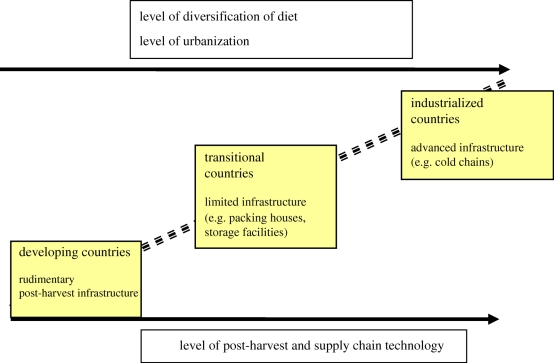
“[9] considered the differences in post-harvest losses between developing, transition and developed countries.”
BackgroundInsights into the management of food waste in developing countries: with special reference to India
Sahoo, A., Dwivedi, A., Madheshiya, P., Kumar, U., Sharma, R. K., & Tiwari, S. (2023) · Environmental Science and Pollution Research · doi:10.1007/s11356-023-27901-6 · Cited by 182
“…that is of acceptable quality and qualified for human consumption but is not consumed because it is squandered either before or after it deteriorates,” Parfitt et al. (2010) described it as the “spoilt food arising at the end of the food cycle, which refers to retailers’ and consumers’ practice.””
Estimating the magnitude of food waste generated in South Africa
Oelofse, S. H. H., & Nahman, A. (2012) · Waste Management & Research The Journal for a Sustainable Circular Economy · doi:10.1177/0734242x12457117 · Cited by 177
“Post-harvest losses are influenced by available technologies and the extent to which markets for agricultural produce have developed (Parfitt et al., 2010).”
BackgroundInfluentialLand system change and food security: towards multi-scale land system solutions
Verburg, P. H., Mertz, O., Erb, K., Haberl, H., & Wu, W. (2013) · Current Opinion in Environmental Sustainability · doi:10.1016/j.cosust.2013.07.003 · Cited by 176
Attitudes and behaviors shaping household food waste generation: Lessons from Lebanon
Mattar, L., Abiad, M. G., Chalak, A., Diab, M., & Hassan, H. F. (2018) · Journal of Cleaner Production · doi:10.1016/j.jclepro.2018.07.085 · Cited by 175
Perspectives on food waste management: Prevention and social innovations
Al-Obadi, M. A., Ayad, H. A., Pokharel, S., & Ayari, M. A. (2022) · Sustainable Production and Consumption · doi:10.1016/j.spc.2022.02.012 · Cited by 174
The contribution of food waste to global and European nitrogen pollution
Grizzetti, B., Pretato, U., Lassaletta, L., Billen, G., & Garnier, J. A. (2013) · Environmental Science & Policy · doi:10.1016/j.envsci.2013.05.013 · Cited by 174
Amicarelli, V., & Bux, C. (2020) · British Food Journal · doi:10.1108/bfj-07-2020-0658 · Cited by 186
Bhatt, S., Lee, J., Deutsch, J., Ayaz, H., Fulton, B., & Suri, R. (2018) · Journal of Consumer Behaviour · doi:10.1002/cb.1689 · Cited by 162
Food waste and losses in primary production: Qualitative insights from horticulture
Beausang, C., Hall, C., & Toma, L. (2017) · Resources Conservation and Recycling · doi:10.1016/j.resconrec.2017.07.042 · Cited by 192
“It is often associated with “wasteful behaviour” and a conscious decision to throw away food (FAO, 2011; Kummu et al. 2012; Parfitt et al. 2010).”
BackgroundInfluentialManaging food security through food waste and loss: Small data to big data
Irani, Z., Sharif, A. M., Lee, H., Aktaş, E., Topaloğlu, Z., Wout, T. V., & Huda, S. (2017) · Computers & Operations Research · doi:10.1016/j.cor.2017.10.007 · Cited by 165
Reisch, L. A., Sunstein, C. R., Andor, M., Döbbe, F., Meier, J., & Haddaway, N. (2020) · Journal of Cleaner Production · doi:10.1016/j.jclepro.2020.123717 · Cited by 177
Household food waste in Greece: A questionnaire survey
Ponis, S. T., Papanikolaou, P.-A., Katimertzoglou, P., Ntalla, A. C., & Xenos, K. I. (2017) · Journal of Cleaner Production · doi:10.1016/j.jclepro.2017.02.165 · Cited by 158
Sustainable diets: The interaction between food industry, nutrition, health and the environment
Alsaffar, A. A. (2015) · Food Science and Technology International · doi:10.1177/1082013215572029 · Cited by 159
“Food losses occurring at the end of the food chain (retail and final consumption) are rather called ‘‘food waste’’, which relates to retailers’ and consumers’ behaviour (Parfitt et al., 2010).”
BackgroundPotential water saving through changes in European diets
Vanham, D., Hoekstra, A. Y., & Bidoglio, G. (2013) · Environment International · doi:10.1016/j.envint.2013.09.011 · Cited by 168
Sial, T. A., Khan, M. N., Lan, Z., Kumbhar, F., Ying, Z., Zhang, J., Sun, D., & Li, X. (2019) · Process Safety and Environmental Protection · doi:10.1016/j.psep.2018.10.030 · Cited by 158
Spiker, M. L., Hiza, H. A. B., Siddiqi, S. M., & Neff, R. A. (2017) · Journal of the Academy of Nutrition and Dietetics · doi:10.1016/j.jand.2017.03.015 · Cited by 157
Modelling of food loss within life cycle assessment: From current practice towards a systematisation
Corrado, S., Ardente, F., Sala, S., & Saouter, E. (2016) · Journal of Cleaner Production · doi:10.1016/j.jclepro.2016.06.050 · Cited by 178
Determinants of household food waste behavior in Tehran city: A structural model
Fami, H. S., Aramyan, L. H., Sijtsema, S. J., & Alambeigi, A. (2019) · Resources Conservation and Recycling · doi:10.1016/j.resconrec.2018.12.033 · Cited by 160
Consumer-Related Food Waste: Role of Food Marketing and Retailers and Potential for Action
Aschemann‐Witzel, J., de Hooge, I. E., & Normann, A. (2016) · Journal of International Food & Agribusiness Marketing · doi:10.1080/08974438.2015.1110549 · Cited by 173
Mitigating greenhouse gas emissions in agriculture: From farm production to food consumption
Qian, Y., Xu, X., Hillier, J., Cheng, K., & Pan, G. (2017) · Journal of Cleaner Production · doi:10.1016/j.jclepro.2017.02.172 · Cited by 156
Trade and the equitability of global food nutrient distribution
Wood, S. A., Smith, M. R., Fanzo, J., Remans, R., & DeFries, R. (2018) · Nature Sustainability · doi:10.1038/s41893-017-0008-6 · Cited by 169
Filimonau, V., Todorova, E., Mzembe, A. N., Sauer, L., & Yankholmes, A. (2020) · Journal of Cleaner Production · doi:10.1016/j.jclepro.2020.120775 · Cited by 177
Climate Change and Chronic Food Insecurity in Sub-Saharan Africa
Baptista, D. M. S., Farid, M., Fayad, D., Kemoe, L., Lanci, L., Muehlschlegel, T., Mitra, P., Okou, C., SPRAY, J. G., Tuitoek, K., et al. (2022) · Departmental Paper · doi:10.5089/9798400218507.087 · Cited by 153
Traditional methods of food grains preservation and storage in Nigeria and India
Adesina, J. M., Singh, N. B., Sahoo, D., & Rajashekar, Y. (2019) · Annals of Agricultural Science Cairo · doi:10.1016/j.aoas.2019.12.003 · Cited by 152
Krishnan, R., Phan, P. Y., Agarwal, R., Kaur, A., & Bajada, C. (2020) · Resources Conservation and Recycling · doi:10.1016/j.resconrec.2020.105253 · Cited by 152
Analyzing Barriers of Circular Food Supply Chains and Proposing Industry 4.0 Solutions
Ada, N., Kazançoğlu, Y., Sezer, M. D., Ede-Senturk, C., Ozer, I., & Ram, M. (2021) · Sustainability · doi:10.3390/su13126812 · Cited by 174
“(B19) Need for Data Integration [26,78] (B20) Lack of Eco-efficiency of the Technological Processes [16,41,47,48,54,79]”
BackgroundRural household food waste characteristics and driving factors in China
Li, Y., Wang, L., Liu, G., & Cheng, S. (2020) · Resources Conservation and Recycling · doi:10.1016/j.resconrec.2020.105209 · Cited by 156
Factors affecting food security and contribution of modern technologies in food sustainability
Jagadeesan, P. (2011) · Journal of the Science of Food and Agriculture · doi:10.1002/jsfa.4666 · Cited by 150
The impacts of postharvest storage innovations on food security and welfare in Ethiopia
Tesfaye, W. M., & Tirivayi, N. (2018) · Food Policy · doi:10.1016/j.foodpol.2018.01.004 · Cited by 167
Sadhukhan, J., Dugmore, T. I. J., Matharu, A. S., Martínez-Hernández, E., Aburto, J., Rahman, P. K. S. M., & Lynch, J. M. (2020) · Sustainability · doi:10.3390/su12051976 · Cited by 177
Tackling food waste in all-inclusive resort hotels
Okumuş, B., Taheri, B., Giritlioğlu, İ., & Gannon, M. J. (2020) · International Journal of Hospitality Management · doi:10.1016/j.ijhm.2020.102543 · Cited by 159
“While food loss (FL) refers to reduction in food quality during production (Parfitt et al., 2010), food waste (FW) encompasses food that is discarded or spoiled at the consumer level (Aschemann-Witzel et al.”
BackgroundSage, C. L. (2012) · Journal of Rural Studies · doi:10.1016/j.jrurstud.2012.02.005 · Cited by 149
Shashi, S., Cerchione, R., Singh, R., Centobelli, P., & Shabani, A. (2018) · International Journal of Logistics Management · doi:10.1108/ijlm-01-2017-0007 · Cited by 103
Impact of feedstock composition on pyrolysis of low-cost, protein- and lignin-rich biomass: A review
Cheng, F., Bayat, H., Jena, U., & Brewer, C. E. (2020) · Journal of Analytical and Applied Pyrolysis · doi:10.1016/j.jaap.2020.104780 · Cited by 154
Food Waste and the ‘Green’ Consumer
McCarthy, B., & Liu, H. (2017) · Australasian Marketing Journal (AMJ) · doi:10.1016/j.ausmj.2017.04.007 · Cited by 165
“Recent studies have shown that individuals with high environmental concern and high civic consciousness waste less food (Barr, 2007; Melbye et al., 2016; Parfitt et al., 2010).”
BackgroundUnderstanding food waste behavior: The role of morals, habits and knowledge
Aydın, A. E., & Yıldırım, P. (2020) · Journal of Cleaner Production · doi:10.1016/j.jclepro.2020.124250 · Cited by 186
Circular bioeconomy strategies: From scientific research to commercially viable products
Brandão, A. S., Gonçalves, A., & Santos, J. M. R. C. A. (2021) · Journal of Cleaner Production · doi:10.1016/j.jclepro.2021.126407 · Cited by 148
POST-HARVEST LOSSES AND STRATEGIES TO REDUCE THEM
Kiaya, V. (2014) · Cited by 146
“Reduce Food Waste, Save Money”: Testing a Novel Intervention to Reduce Household Food Waste
van der Werf, P., Seabrook, J. A., & Gilliland, J. (2019) · Environment and Behavior · doi:10.1177/0013916519875180 · Cited by 169
Italian consumers’ income and food waste behavior
Setti, M., Falasconi, L., Segrè, A., Cusano, I., & Vittuari, M. (2016) · British Food Journal · doi:10.1108/bfj-11-2015-0427 · Cited by 145
Managing and manipulating the rhizosphere microbiome for plant health: A systems approach
Wallenstein, M. D. (2017) · Rhizosphere · doi:10.1016/j.rhisph.2017.04.004 · Cited by 145
Luo, H., Yang, R., Zhao, Y., Wang, Z., Zheng, L., Huang, M., & Zeng, Q. (2018) · Bioresource Technology · doi:10.1016/j.biortech.2018.01.007 · Cited by 144
The Road to Biorenewables: Carbohydrates to Commodity Chemicals
Sheldon, R. A. (2018) · ACS Sustainable Chemistry & Engineering · doi:10.1021/acssuschemeng.8b00376 · Cited by 153
Methane emissions as energy reservoir: Context, scope, causes and mitigation strategies
Chai, X., Tonjes, D. J., & Mahajan, D. (2016) · Progress in Energy and Combustion Science · doi:10.1016/j.pecs.2016.05.001 · Cited by 149
“543 Increasing incomes lead to less consumption of starchy food and more consumption of 544 meats, dairy, and fish [72].”
BackgroundNormative prompts reduce consumer food waste in restaurants
Stöckli, S., Dorn, M., & Liechti, S. (2018) · Waste Management · doi:10.1016/j.wasman.2018.04.047 · Cited by 142
Quantity and quality food losses across the value Chain: A Comparative analysis
Delgado, L., Schuster, M., & Torero, M. (2020) · Food Policy · doi:10.1016/j.foodpol.2020.101958 · Cited by 165
“1) and the fact that food loss may occur at each stage (e.g., FAO, 2011; Lipinski et al., 2013; Parfitt et al, 2010).”
What gets measured gets managed: A new method of measuring household food waste
Elimelech, E., Ayalon, O., & Ert, E. (2018) · Waste Management · doi:10.1016/j.wasman.2018.03.031 · Cited by 155
How to promote a new and sustainable food consumption model: A fuzzy cognitive map study
Morone, P., Falcone, P. M., & Lopolito, A. (2018) · Journal of Cleaner Production · doi:10.1016/j.jclepro.2018.10.075 · Cited by 141
Food Loss and Waste in Meat Sector—Why the Consumption Stage Generates the Most Losses?
Karwowska, M., Łaba, S., & Szczepański, K. (2021) · Sustainability · doi:10.3390/su13116227 · Cited by 162
Thermodynamic performance analysis of a vapor compression–absorption cascaded refrigeration system
Jain, V., Kachhwaha, S. S., & Sachdeva, G. (2013) · Energy Conversion and Management · doi:10.1016/j.enconman.2013.08.024 · Cited by 140
Thakali, A., & MacRae, J. D. (2020) · Environmental Research · doi:10.1016/j.envres.2020.110635 · Cited by 144
The impact of COVID-19 pandemic on food waste behaviour of young people
Burlea‐Schiopoiu, A., Ogarcă, R. F., Barbu, C. M., Crăciun, L., Băloi, I. C., & Mihai, L. (2021) · Journal of Cleaner Production · doi:10.1016/j.jclepro.2021.126333 · Cited by 143
“Thus, young people don’t have a clear understanding of “use by” and “best before” dates (Parfitt et al., 2010) and might unnecessarily throw away food (FAO, IFAD, WFP, 2014).”
Background
Metadata
- Authors
- Parfitt, J., Barthel, M., & Macnaughton, S.
- Affiliations
- Resource Futures, Bristol, UK 1
- Wrap (United Kingdom) (GB)
- Corresponding author
- Parfitt, Julian
- Venue
- Philosophical Transactions of the Royal Society B: Biological Sciences
- Publisher
- The Royal Society
- Published
- 2010-09-27
- Volume
- 365
- Issue
- 1554
- Pages
- 3065-3081
- ISSN
- 0962-8436 (ISSN-L)
- 1471-2970
- PMC
- PMC2935112
- OpenAlex
- W2138803696
- Cited by
- 3,197
- References
- 28
- Citations by year
- 2026: 148 · 2025: 229 · 2024: 233 · 2023: 278 · 2022: 286 · 2021: 330 · 2020: 359 · 2019: 310 · 2018: 254 · 2017: 209 · 2016: 166 · 2015: 136 · 2014: 116 · 2013: 73 · 2012: 46
- FWCI
- 5.41
- Type
- journal article
- Language
- en
- Open access
- hybrid
- doi.org
- Licence
- Locations
- Philosophical Transactions of the Royal Society B Biological Sciences (publishedVersion, cc-by)
- PubMed Central (publishedVersion, cc-by)
- PubMed (publishedVersion)
- Topics
- Life Sciences › Agricultural and Biological Sciences › Food Science › Food Waste Reduction and Sustainability
- Physical Sciences › Environmental Science › Ecology › Agriculture Sustainability and Environmental Impact
- Life Sciences › Agricultural and Biological Sciences › Food Science › Agricultural and Food Production Studies
- Keywords
- food waste, food supply chain, post-harvest losses, global food security, developing countries, BRIC countries, behavior change, food loss reduction
- MeSH terms
- Agriculture, Food Supply, Humans
About these checks
Registry, retraction, Cites and statistics results are computed, not judged, with one exception: a printed reference that no index lists is read once by a model before it counts as a citation error. Claims are extracted by a model and kept only when their quote appears verbatim in the text; each cited source is then checked, with a model’s help, for whether it says what the claim relies on. Those verdicts can be wrong — read the claim’s quote and the cited source before relying on one.
Statistics and arithmetic are recomputed, not judged.
Confidence bands are shown only for fields calibrated on our annotated test set. None is calibrated yet, so no band is shown.
What counts as a claim ›How we measure confidence ›How we check this ›
Are you an author, or do you see a problem with this page? Request a review
