

Domain randomization for transferring deep neural networks from simulation to the real world
Open accessThe DOI matches its Crossref record; 71 of the 71 references it cites were found in a registry or an index; 8 of the 17 sources its claims cite were checked for support.
Abstract
Bridging the `reality gap' that separates simulated robotics from experiments on hardware could accelerate robotic research through improved data availability. This paper explores domain randomization, a simple technique for training models on simulated images that transfer to real images by randomizing rendering in the simulator. With enough variability in the simulator, the real world may appear to the model as just another variation. We focus on the task of object localization, which is a stepping stone to general robotic manipulation skills. We find that it is possible to train a real-world object detector that is accurate to 1.5 cm and robust to distractors and partial occlusions using only data from a simulator with non-realistic random textures. To demonstrate the capabilities of our detectors, we show they can be used to perform grasping in a cluttered environment. To our knowledge, this is the first successful transfer of a deep neural network trained only on simulated RGB images (without pre-training on real images) to the real world for the purpose of robotic control.
Overview
CoChat Summary
TL;DR
This paper introduces domain randomization: training an object detector on simulated RGB images with randomized rendering, textures, lighting, camera pose, and distractors so that the real world appears as another variation. The authors show that a detector trained only in simulation can localize objects in the real world accurately enough to grasp them in clutter.
Key findings
- Real-world object detectors trained only on simulated images localized objects to within about 1.5 cm on average, including with distractors and partial occlusions; per-object errors in Table I range from 0.6 ± 0.3 cm to 3.2 ± 5.8 cm depending on object and condition.
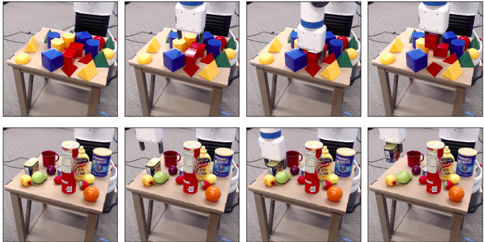
- The pipeline enabled a Fetch robot to detect and pick up the target object in 38 out of 40 trials in increasingly cluttered scenes, and a detector trained on a Spam can succeeded in 9 of 10 trials with previously unseen YCB food distractors.
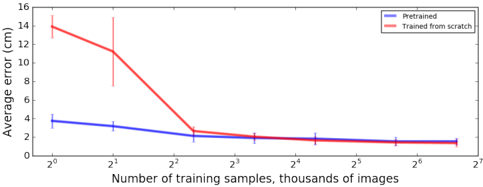
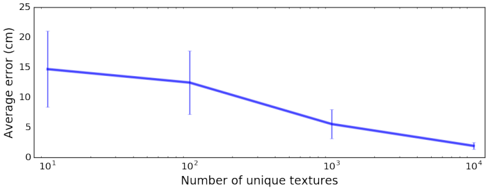
- Ablations found sensitivity to number of training images, number of unique textures, presence of distractors in training, and camera randomization; random noise had negligible effect. Performance improved up to around 50,000 training samples, and degraded significantly with fewer than 1,000 textures.
- ImageNet pretraining was not essential with enough data: random weight initialization achieved nearly the same real-world transfer performance as pretrained initialization, though pretraining helped in the low-data regime.
Methods
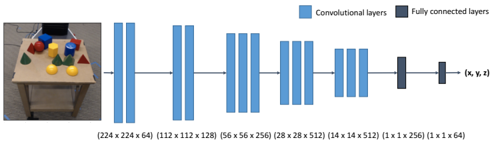
- The authors trained a modified VGG-16 convolutional neural network to map a single 224×224 monocular webcam image to Cartesian coordinates of object(s) of interest, using simulated images rendered by MuJoCo.
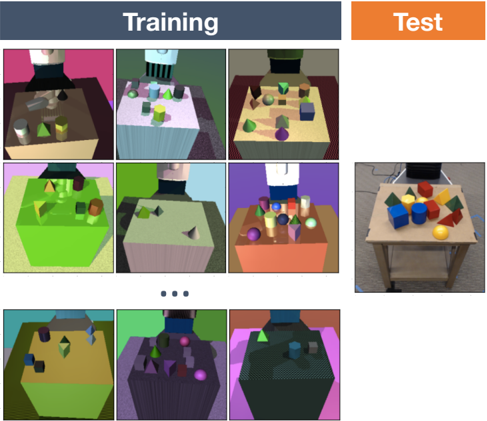
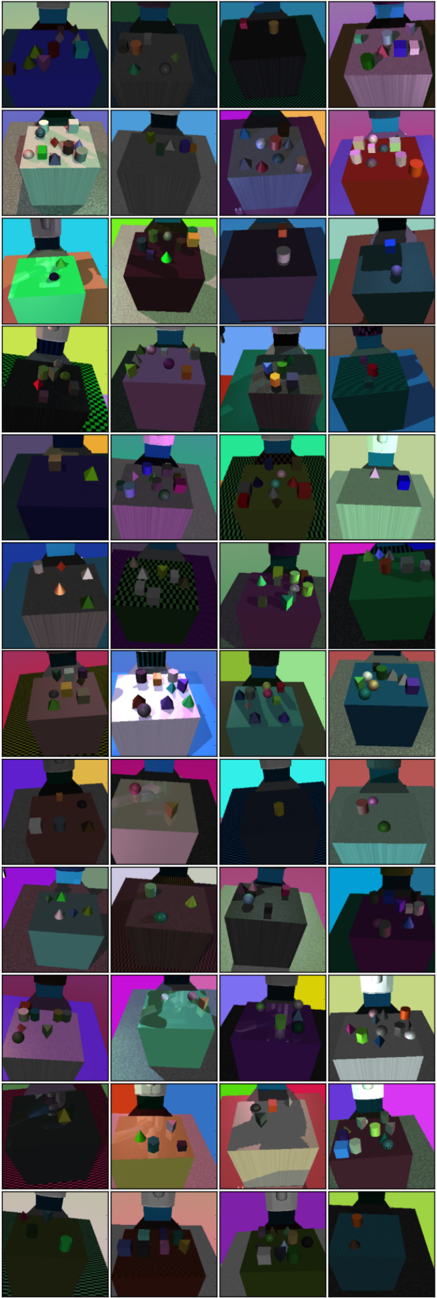
- Domain randomization varied number/shape of distractors, object positions and textures, table/floor/skybox/robot textures, camera position/orientation/field of view, number and properties of lights, and image noise. Textures were random RGB values, gradients, or checker patterns; 0–10 distractor objects were added per scene.
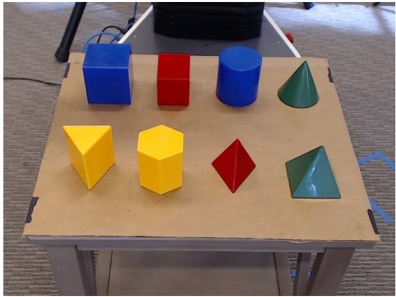
- Training used stochastic gradient descent with Adam on an L2 loss, learning rates around 1e-4, and batch sizes of 25, 50, or 100. Evaluation used 480 webcam images of eight geometric objects at 70–105 cm from a fixed camera, with 60 labeled images per object: 20 alone, 20 with distractors, and 20 partially occluded.
Limitations
- The paper states that the detectors still overfit simulated training data: simulated error was 0.3–0.5 cm versus about 1.5 cm in the real world, and no real-world validation could be done during training because no real data were assumed available.
- The paper states future work is needed for contact-rich manipulation or higher precision, and that the method fixes table height, effectively making the task 2D pose estimation from a single monocular uncalibrated camera.
- Evident from the text: evaluation is limited to eight geometric objects plus one Spam can, the test camera position remains constant across all images, and lighting and surrounding scene were not controlled.
Model-written summary. Check it against the paper before relying on it.
Integrity signals
Registry
Cites
Statistics
Figures
Verification
Claims the paper makes
2 Valid · 8 Not valid · 7 Not checked · 32 Own results and interpretations
The cited sources support only part of this claim — read each source’s verdict below.
In the paper
“Although previous work demonstrated the ability to perform robotic control using a neural network pretrained on ImageNet and fine-tuned on randomized rendered pixels [37], this paper provides the first demonstration that domain randomization can be useful for robotic tasks requiring precision.”
What the sources say
- Partly supportedcites [37] [37] Fereshteh Sadeghi and Sergey Levine. (cad) 2 RL: Real single-image flight without a single real image. arXiv preprint arXiv:1611.04201 , 2016. - sourceExperimental — accuracy not yet measured
The citation [37] is attached to the preceding claim about prior work, not to the citing authors’ claim that their own paper is the first to demonstrate precision robotics. Section 3.1 (p. 4) says LSDA pretrains a CNN on ImageNet classification data and fine-tunes it, but for object detection. It does not report robotic control or fine-tuning on randomized rendered pixels. (LLM, conf=0.84)
boostedstates a cause- Asserted: passes — The authors put it forward as true.
- Checkable: passes — It can be checked against evidence.
- Load-bearing: passes — The paper’s conclusions depend on it.
- Based: passes — The paper gives a reason why it holds.
- Partly supported
The cited sources that could be checked couldn’t confirm or dispute this claim.
In the paper
“Rather than relying on controller robustness, Yu et al. [53] use a model trained on varied physics to perform system identification using online trajectory data, but their approach is not shown to succeed in the real world.”
What the sources say
- Could not verifycites [53] [53] Wenhao Yu, C Karen Liu, and Greg Turk. Preparing for the unknown: Learning a universal policy with online system identification. arXiv preprint arXiv:1702.02453 , 2017. - sourceExperimental — accuracy not yet measured
The cited paper discusses image classification and localisation with convolutional networks (A.1, p. 10; A.2, p. 11), not Yu et al.'s approach. Searches for varied-physics training, online trajectory-based system identification, and real-world success found no passage addressing the claim. Our copy therefore cannot verify it. (LLM, conf=0.78)
plain- Asserted: passes — The authors put it forward as true.
- Checkable: passes — It can be checked against evidence.
- Load-bearing: unclear — It is unclear whether the paper’s conclusions depend on it.
- Based: passes — The paper gives a reason why it holds.
- Could not verify
The cited sources that could be checked couldn’t confirm or dispute this claim.
In the paper
“Though using realistic RGB rendering alone has had limited success for transferring to real robotic tasks [16], incorporating realistic simulation of depth information can allow models trained on rendered images to transfer reasonably well to the real world [32].”
What the sources say
- Could not verifycites [16] [16] Stephen James and Edward Johns. 3d simulation for robot arm control with deep q-learning. arXiv preprint arXiv:1609.03759 , 2016. - sourceExperimental — accuracy not yet measured
The Introduction (§1) and Conclusion (§8) describe Adam as a method for stochastic optimization, while the CNN experiment (§6.3) concerns training on image datasets. Searches for realistic RGB rendering and sim-to-real robotic transfer found no passage addressing whether RGB rendering alone has had limited success on real robotic tasks. (LLM, conf=0.78)
plain- Asserted: passes — The authors put it forward as true.
- Checkable: passes — It can be checked against evidence.
- Load-bearing: passes — The paper’s conclusions depend on it.
- Based: passes — The paper gives a reason why it holds.
- Could not verify
The cited sources that could be checked couldn’t confirm or dispute this claim.
In the paper
“However, their experiments - collision avoidance in hallways and open spaces - do not demonstrate the ability to deal with high-precision tasks.”
What the sources say
- Could not verifycites [37] [37] Fereshteh Sadeghi and Sergey Levine. (cad) 2 RL: Real single-image flight without a single real image. arXiv preprint arXiv:1611.04201 , 2016. - sourceExperimental — accuracy not yet measured
The Experiments section (p. 5) evaluates LSDA on an object-detection dataset, not Sadeghi and Levine’s collision-avoidance experiments. Searches for Sadeghi and Levine, hallway or open-space collision avoidance, and high-precision tasks found no passage addressing the claim. (LLM, conf=0.76)
plain- Asserted: passes — The authors put it forward as true.
- Checkable: passes — It can be checked against evidence.
- Load-bearing: passes — The paper’s conclusions depend on it.
- Based: passes — The paper gives a reason why it holds.
- Could not verify
A result the paper reports from its own data — it cites no other source for it, so there is none to check. The quote shows it is in the paper.
In the paper
“However, using a pre-trained model can significantly improve performance when less training data is used.”
plainstates a cause- Asserted: passes — The authors put it forward as true.
- Checkable: passes — It can be checked against evidence.
- Load-bearing: unclear — It is unclear whether the paper’s conclusions depend on it.
- Based: passes — The paper gives a reason why it holds.
29 more claims
Create a free account to see all 49 claims and to verify the 7 references still open.
- Probably not a substantial claim. 11
- It may state two separate claims as one. 8
Claims other papers make about this one
Each is checked against this paper’s own text: does it say what the citing paper says it does?
The source backs part of the claim, not all of it — or backs it for a different population, condition or comparison.
In the citing paper
“Most policies trained in simulation generalize poorly to the real-world due to agents adapting to specific visual details of the simulator.”
From Language-Based Augmentation to Address Shortcut Learning in Object-Goal Navigation (2023) · cites this paper as [8]
Experimental — accuracy not yet measuredThe source backs part of the claim, not all of it — or backs it for a different population, condition or comparison.
In the citing paper
“In robotic vision tasks including object localization [53], object detection [54], pose estimation [55], and semantic segmentation [56], the training data from simulator always have different textures, lighting, and camera positions from the realistic environments.”
From Sim-to-Real Transfer in Deep Reinforcement Learning for Robotics: a Survey (2020) · cites this paper as [53]
Experimental — accuracy not yet measuredThe source backs part of the claim, not all of it — or backs it for a different population, condition or comparison.
In the citing paper
“These artifacts limit the applicability of generative videos in physics-sensitive domains such as robotics [25,26], autonomous driving [27], simulationbased design, and scientific visualization [28].”
From PhyStruct-Video: Structured Physics State Spaces for Physically Consistent Video Generation (2025) · cites this paper as [25]
Experimental — accuracy not yet measuredThe source backs part of the claim, not all of it — or backs it for a different population, condition or comparison.
In the citing paper
“In domain randomization, the inputs during learning are “randomized” in the sense of being warped or corrupted in particular ways.”
From The overfitted brain: Dreams evolved to assist generalization (2021) · cites this paper as [144]
Experimental — accuracy not yet measuredThe source backs part of the claim, not all of it — or backs it for a different population, condition or comparison.
In the citing paper
“Domain randomization is a domain generalization technique that introduces drastic changes in the training image appearances, which forces the network to learn domain-invariant features between training and target domains [39].”
From A Fully Differentiable Framework for 2D/3D Registration and the Projective Spatial Transformers (2024) · cites this paper as [39]
Experimental — accuracy not yet measured
8 more claims about this paper
Create a free account to see every claim other papers make about this one.
Self-check
Percentages, sums and reported differences re-computed from the paper’s own numbers.
Each contradiction between two passages listed here was confirmed by an independent check.
Rated minor: it would not touch a result — a value no result rests on, a p-value that stays on the same side of the significance level, or a conflict that is clerical, resolved elsewhere in the paper, or outside its own findings.
In the paper
§ A. Experimental Setup · p. 4
“Each training sample consists of (a) a rendered image of the object and one or more distractors (also from among the geometric object set) on a simulated tabletop”
§ A. Domain randomization · p. 4
“Between 0 and 10 distractor objects are added to the table in each scene.”
Citations
Cites
Very Deep Convolutional Networks for Large-Scale Image Recognition
Simonyan, K., & Zisserman, A. (2014) · arXiv · doi:10.48550/arxiv.1409.1556 · Cited by 114,148 · cited 1×
“In particular, we use a modified version the VGG-16 architecture [42] shown in Figure 2.”
MethodAdam: A Method for Stochastic Optimization
Kingma, D. P., & Ba, J. (2014) · arXiv · doi:10.48550/arxiv.1412.6980 · Cited by 98,946 · cited 1×
“We found that using a learning rate of around 1e − 4 (as opposed to the standard 1e − 3 for Adam) improved convergence and helped avoid a common local optimum, mapping all objects to the center of the table.”
MethodLeCun, Y., Bengio, Y., & Hinton, G. (2015) · Nature · doi:10.1038/nature14539 · Cited by 84,126
Human-level control through deep reinforcement learning
Mnih, V., Kavukcuoglu, K., Silver, D., Rusu, A. A., Veness, J., Bellemare, M. G., Graves, A., Riedmiller, M., Fidjeland, A. K., Ostrovski, G., et al. (2015) · Nature · doi:10.1038/nature14236 · Cited by 30,357 · cited 3×
“Learning in simulation is especially promising for building on recent results using deep reinforcement learning to achieve human-level performance on tasks like Atari [27] and robotic control [21], [38].”
BackgroundResultHow transferable are features in deep neural networks?
Yosinski, J., Clune, J., Bengio, Y., & Lipson, H. (2014) · arXiv · doi:10.48550/arxiv.1411.1792 · Cited by 6,061 · cited 1×
“A variety of approaches have been proposed, including re-training the model in the target domain (e.g., [52]), adapting the weights of the model based on the statistics of the source and target domains (e.g., [22]), learning invariant features between domains (e.g., [47]), and learning a mapping…”
BackgroundMuJoCo: A physics engine for model-based control
Todorov, E., Erez, T., & Tassa, Y. (2012) · 2012 IEEE/RSJ International Conference on Intelligent Robots and Systems · doi:10.1109/iros.2012.6386109 · Cited by 4,767 · cited 1×
“We render images using the MuJoCo Physics Engine’s [45] built-in renderer.”
MethodTrust region policy optimization
Schulman, J., Levine, S., Moritz, P., Jordan, M. I., & Abbeel, P. (2015) · arXiv · doi:10.48550/arxiv.1502.05477 · Cited by 4,578 · cited 1×
“Learning in simulation is especially promising for building on recent results using deep reinforcement learning to achieve human-level performance on tasks like Atari [29] and robotic control [26], [41].”
ResultSelf-citationLearning Transferable Features with Deep Adaptation Networks
Long, M., Cao, Y., Wang, J., & Jordan, M. I. (2015) · arXiv · doi:10.48550/arxiv.1502.02791 · Cited by 4,505 · cited 1×
“omputer vision community has devoted significant study to the problem of adapting vision-based models trained in a source domain to a previously unseen target domain (see, e.g., [9], [14], [15], [19], [23], [25], [51]). A variety of approaches have been proposed, including re-training the model in the target domain (e.…”
BackgroundEnd-to-End Training of Deep Visuomotor Policies
Levine, S., Finn, C., Darrell, T., et al. (2015) · Journal of machine learning research · doi:10.5555/2946645.2946684 · Cited by 3,987
Describing Textures in the Wild
Cimpoi, M., Maji, S., Kokkinos, I., Mohamed, S., & Vedaldi, A. (2014) · 2014 IEEE Conference on Computer Vision and Pattern Recognition · doi:10.1109/cvpr.2014.461 · Cited by 2,438 · cited 1×
“To examine how our detectors would perform on objects with complex textures, we created simulated scenes in which the object of interest is given a texture from the Describable Textures Dataset (DTD) [4].”
Method
Research works printed but not linked: 3
- [24] David G Lowe. Three-dimensional object recognition from single two-dimensional images. Artificial intelligence , 31(3):355-395, 1987. -
- [49] Melonee Wise, Michael Ferguson, Derek King, Eric Diehr, and David Dymesich. Fetch and freight: Standard platforms for service robot applications. In Workshop on Autonomous Mobile Service Robots , 2016. -
- sucan, 0, MoveIt!
Cited by
Items 901–1,000 of 2,970
Chen, Y., Zeng, C., Wang, Z., Lu, P., & Yang, C. (2022) · Robotica · doi:10.1017/s0263574722001230 · Cited by 17
“Domain randomization [4, 5] randomizes the visual information or dynamic parameters in the simulated environment, which is a popular method in zero-shot sim-to-real transfer.”
BackgroundMethodMarker-Embedded Tactile Image Generation via Generative Adversarial Networks
Kim, W. D., Yang, S.-H., Kim, W., Kim, J.-J., Kim, C.-H., & Kim, J. (2023) · IEEE Robotics and Automation Letters · doi:10.1109/lra.2023.3284370 · Cited by 17
“Similar to data-driven methods in other robotic applications [17], [18], the performance and efficiency of data-driven methods in vision-based tactile sensor applications can be increased through simulations.”
A Deep Learning Framework for Soft Robots with Synthetic Data
Sapai, S., Loo, J. Y., Ding, Z. Y., Tan, C. P., Baskaran, V. M., & Nurzaman, S. G. (2023) · Soft Robotics · doi:10.1089/soro.2022.0188 · Cited by 17
“36,37 Alter-natively, previous studies 38–40 employ domain randomization, whereby the dynamics of a simulated environment are randomly changed, thus allowing a trained model to generalize better to unseen real-world scenarios.”
Value of process understanding in the era of machine learning: A case for recession flow prediction
Istalkar, P., Kadu, A., & Biswal, B. (2023) · Journal of Hydrology · doi:10.1016/j.jhydrol.2023.130350 · Cited by 14
Contact-Rich SE(3)-Equivariant Robot Manipulation Task Learning via Geometric Impedance Control
Seo, J., Prakash, N. P. S., Zhang, X., Wang, C., Choi, J., Tomizuka, M., & Horowitz, R. (2023) · IEEE Robotics and Automation Letters · doi:10.1109/lra.2023.3346748 · Cited by 35
“The dynamic equations of motion for rigid-link robotic manipulators are given by: where M ( q ) ∈ R n × n is the symmetric positive definite inertia matrix, C ( q, ˙ q ) ∈ R n × n is a Coriolis matrix, G ( q ) ∈ R n is a moment term due to gravity, T ∈ R n is a control input, and T e ∈ R n is an…”
BackgroundExploring the Sim2Real Gap using Digital Twins
Sudhakar, S., Hanzelka, J., Bobillot, J., Randhavane, T., Joshi, N., & Vineet, V. (2023) · IEEE/CVF International Conference on Computer Vision (ICCV) · doi:10.1109/iccv51070.2023.01867 · Cited by 21
“In Domain Generalization, the target distribution is unknown so prior DA methods do not work perfectly in these scenarios, rather approaches such as domain randomization [27], data augmentation [15], and domain-invariant learning [33] are commonly used.”
BackgroundFlato, Y., Harel, R., Tamar, A., Nathan, R., & Beatus, T. (2024) · Nature Communications · doi:10.1038/s41467-024-48670-x · Cited by 22
Inverse Deep Learning Raytracing for heliostat surface prediction
Lewen, J., Pargmann, M., Cherti, M., Jitsev, J., Pitz‐Paal, R., & Quinto, D. M. (2025) · Solar Energy · doi:10.1016/j.solener.2025.113312 · Cited by 18
Learning Object Localization and 6D Pose Estimation from Simulation and Weakly Labeled Real Images
Mercier, J.-P., Mitash, C., Giguère, P., & Boularias, A. (2019) · Proceedings - IEEE International Conference on Robotics and Automation/Proceedings · doi:10.1109/icra.2019.8794112 · Cited by 11
Pérez, S. A. H., Marinho, M. M., Harada, K., & Mitsuishi, M. (2020) · International Journal of Computer Assisted Radiology and Surgery · doi:10.1007/s11548-020-02185-0 · Cited by 12
“However, we do expect the presented framework, possibly in conjunction with other techniques such as image translation for domain transfer [21], to be applicable to clinical imageswhen clinical data becomes available.”
BackgroundPyraPose: Feature Pyramids for Fast and Accurate Object Pose Estimation under Domain Shift
Thalhammer, S., Leitner, M., Patten, T., & Vincze, M. (2021) · Proceedings - IEEE International Conference on Robotics and Automation/Proceedings · doi:10.1109/icra48506.2021.9562108 · Cited by 30
“The two most common strategies for synthetic-to-real transfer for learning-based pose estimation are unsupervised domain adaptation and domain randomization [34].”
BackgroundTGA: Two-level Group Attention for Assembly State Detection
Liu, H., Su, Y., Rambach, J. R., Pagani, A., & Stricker, D. (2020) · IEEE International Symposium on Mixed and Augmented Reality Adjunct (ISMAR-Adjunct) · doi:10.1109/ismar-adjunct51615.2020.00074 · Cited by 17
“Considering the gap from synthetic to real-world data, we applied the technique of domain randomization [28], sampling the 3D model by randomly varying the several aspects of the scene:”
MethodYu, Y., Chen, W., Liu, Q., et al. (2021) · doi:10.2118/204105-ms · Cited by 13
Generating Synthetic Data for Deep Learning using VR Digital Twin
Mukhopadhyay, A., Reddy, G. S. R., Mukherjee, I., et al. (2021) · International Conference on Cloud and Big Data Computing (ICCBDC) · doi:10.1145/3481646.3481655 · Cited by 13
“Synthetic data has exhibited propitious outcomes in the past [5, 6] and the turnaround time for generating labelled data for a new product variant is also drastically reduced [4].”
BackgroundAn architecture for sim-to-real and real-to-sim experimentation in robotic systems
Vrabič, R., Škulj, G., Malus, A., Kozjek, D., Selak, L., Bračun, D., & Podržaj, P. (2021) · Procedia CIRP · doi:10.1016/j.procir.2021.11.057 · Cited by 16
ActiveZero: Mixed Domain Learning for Active Stereovision with Zero Annotation
Liu, I., Yang, E., Tao, J., Chen, R., Zhang, X., Ran, Q., Liu, Z., & Su, H. (2022) · IEEE Computer Society Conference on Computer Vision and Pattern Recognition/Proceedings - IEEE Computer Society Conference on Computer Vision and Pattern Recognition/Proceedings · doi:10.1109/cvpr52688.2022.01269 · Cited by 15
“[33] proposed using domain randomization through randomizing rendering in the simulator to train a robust model that would interpret the real domain as just another variation of the simulation domain.”
MethodSimulation-Aided Handover Prediction From Video Using Recurrent Image-to-Motion Networks
Mavsar, M., Ridge, B., Pahič, R., Morimoto, J., & Ude, A. (2022) · IEEE Transactions on Neural Networks and Learning Systems · doi:10.1109/tnnls.2022.3175720 · Cited by 15
“The challenge lies in transferring models trained with simulated data to the real world [9], [10].”
BackgroundMethodLearning to Predict Collision Risk from Simulated Video Data
Schoonbeek, T. J., Piva, F. J., Abdolhay, H. R., & Dubbelman, G. (2022) · IEEE Intelligent Vehicles Symposium · doi:10.1109/iv51971.2022.9827228 · Cited by 19
MPNP: Multi-Policy Neural Planner for Urban Driving
Cheng, J., Ren, X., Wang, S., & Liu, M. (2022) · IEEE/RSJ International Conference on Intelligent Robots and Systems (IROS) · doi:10.1109/iros47612.2022.9982111 · Cited by 18
“As [20] suggests, many end-to-end driving policies learned in the simulator do not transfer to real world even with transfer learning techniques like domain randomization [21].”
Background6D Pose Estimation of Transparent Object From Single RGB Image for Robotic Manipulation
Byambaa, M., Koutaki, G., & Choimaa, L. (2022) · IEEE Access · doi:10.1109/access.2022.3217811 · Cited by 20
“To address this issue, domain randomization [32], [34] was introduced as a viable solution that drives the network to learn to focus on critical data aspects by randomizing the training input in non-realistic ways.”
BackgroundExperimental Results on Synthetic Data Generation in Unreal Engine 5 for Real-World Object Detection
Damian, A., Filip, C., Nistor, A., Petrariu, I., Mariuc, C., & Stratan, V. (2023) · International Conference on Engineering of Modern Electric Systems · doi:10.1109/emes58375.2023.10171761 · Cited by 26
“Tremblay et al [12] employed Domain Randomization (DR) [13] for training deep neural networks for OD, concluding that it is an effective and inexpensive method with potential to outperform more labor-intensive and expensive datasets when combined with fine-tuning on real images.”
MethodKim, T., & Lee, J.-H. (2020) · IEEE Access · doi:10.1109/access.2020.3015245 · Cited by 15
“To this end, we applied an episodic randomization learning approach that randomizes the environment parameters in every episode [13], [14].”
MethodOvercoming Challenges of Applying Reinforcement Learning for Intelligent Vehicle Control
Pina, R., Tibebu, H., Hook, J., Silva, D., & KONDOZ, A. M. (2021) · Sensors · doi:10.3390/s21237829 · Cited by 13
“However, it would be impossible to acco nt in simulation all the infinite possible v lues t the senso s could measure due to the randomness present in the real world or uncertainties related to the sensors [45,46].”
BackgroundResultKim, T., Park, Y., Park, Y., Lee, S. H., & Suh, I. H. (2021) · IEEE/RSJ International Conference on Intelligent Robots and Systems (IROS) · doi:10.1109/iros51168.2021.9635931 · Cited by 14
“Fortunately, several recent studies have addressed this problem via domain adaptation [33], [34], and domain randomization [35], [36].”
BackgroundReinforcement Learning Testbed for Power-Consumption OptimizationPreprint
Moriyama, T., Magistris, G. D., Tatsubori, M., et al. (2018) · arXiv (Cornell University) · doi:10.48550/arxiv.1808.10427 · Cited by 13
“Domain adaptation and transfer learning [13,4] constitute important steps towards the application of such model-based DRL techniques.”
MethodRL-CycleGAN: Reinforcement Learning Aware Simulation-To-RealPreprint
Rao, K., Harris, C. J., Irpan, A., et al. (2020) · arXiv (Cornell University) · doi:10.48550/arxiv.2006.09001 · Cited by 13
“training images automatically [3] to randomizing the simulation environment in the hopes that such randomization will improve the transferability of the learned representations [27, 29, 18, 24, 17].”
BackgroundMessage-Aware Graph Attention Networks for Large-Scale Multi-Robot Path PlanningPreprint
Li, Q., Lin, W., Liu, Z., et al. (2020) · arXiv (Cornell University) · doi:10.48550/arxiv.2011.13219 · Cited by 13
“robot control policies for an increasing number of tasks [10].”
BackgroundLearning Visual Robotic Control Efficiently with Contrastive Pre-training and Data Augmentation
Zhan, A., Zhao, R., Pinto, L., Abbeel, P., & Laskin, M. (2020) · arXiv · doi:10.48550/arxiv.2012.07975 · Cited by 28
Self-citationDiscovering Diverse Multi-Agent Strategic Behavior via Reward RandomizationPreprint
Tang, Z., Yu, C., Chen, B., Xu, H., Wang, X., Fang, F., Du, S. S., Wang, Y., & Wu, Y. (2021) · arXiv (Cornell University) · doi:10.48550/arxiv.2103.04564 · Cited by 56
“RR is conceptually related to domain randomization (Tobin et al., 2017) with the difference that we train separate policies instead of a single universal one, which suffers from mode collapse (see appendix D.2.3).”
BackgroundInfluentialDelta Hedging of Derivatives using Deep Reinforcement LearningPreprint
Giurca, A., & Borovkova, S. (2021) · SSRN Electronic Journal · doi:10.2139/ssrn.3847272 · Cited by 21
Deep Learning for Embodied Vision Navigation: A SurveyPreprint
Zhu, F., Zhu, Y., Lee, V. C., Liang, X., & Chang, X. (2021) · arXiv (Cornell University) · doi:10.48550/arxiv.2108.04097 · Cited by 39
“Sim-real transferring have been well studied in the field of robotic control [211], [212].”
BackgroundPlanar Robot Casting with Real2Sim2Real Self-Supervised LearningPreprint
Lim, V., Huang, H., Chen, L. Y., Wang, J., Ichnowski, J., Seita, D., Laskey, M., & Goldberg, K. Y. (2021) · arXiv (Cornell University) · doi:10.48550/arxiv.2111.04814 · Cited by 13
“An alternative is to use domain randomization over vision [47, 54] or dynamics [43] parameters in simulation.”
BackgroundMethodA Survey of Multi-Agent Reinforcement Learning for Cooperative Control in Multi-AUV Systems
Wibisono, A., Song, H.-K., & Lee, B. M. (2025) · IEEE Access · doi:10.1109/access.2025.3609457 · Cited by 18
“Domain/dynamics randomization: randomize physical and sensor parameters (drag coefficients, currents, acoustic Signal-to-Noise Ratio (SNR), communication latency) within realistic ranges during training to improve policy robustness on E test [87], [88], [89].”
GESCAM : A Dataset and Method on Gaze Estimation for Classroom Attention Measurement
Mathew, A. M., Khan, A. A., Khalid, T., & Souissi, R. (2024) · IEEE/CVF Conference on Computer Vision and Pattern Recognition Workshops (CVPRW) · doi:10.1109/cvprw63382.2024.00068 · Cited by 12
“Matching the simulated data with physical reality using high-quality rendering is one approach proposed by [32].”
MethodChen, J., Yu, C., Xie, Y., Gao, F., Chen, Y., Yu, S., Tang, W., Ji, S., Mu, M., Wu, Y., et al. (2025) · IEEE Robotics and Automation Letters · doi:10.1109/lra.2025.3575011 · Cited by 38
Visual-tactile pretraining and online multitask learning for humanlike manipulation dexterity
Ye, Q., Liu, Q., Wang, S., Chen, J., Cui, Y., Jin, K., Chen, H., Cai, X., Li, G., & Chen, J. (2026) · Science Robotics · doi:10.1126/scirobotics.ady2869 · Cited by 33
A data-centric approach to anomaly detection in layer-based additive manufacturing
Zeiser, A., Özcan, B., Kracke, C., van Stein, B., & Bäck, T. (2023) · at - Automatisierungstechnik · doi:10.1515/auto-2022-0104 · Cited by 14
“In principle, the concept intends to reach high generalisation for the real-world data by transfer learning with models trained solely on synthetic data [6, 7].”
Self-supervised Cloth Reconstruction via Action-conditioned Cloth Tracking
Huang, Z., Lin, X., & Held, D. (2023) · Proceedings - IEEE International Conference on Robotics and Automation/Proceedings · doi:10.1109/icra48891.2023.10160653 · Cited by 22
“One strategy to bridge this gap (“sim2real”) is to randomize the simulation parameters to create a diverse set of training data [40], [41], [42], [43], with an underlying assumption that the randomized simulation data will cover the distribution of real data.”
BackgroundAutomatically Prepare Training Data for YOLO Using Robotic In-Hand Observation and Synthesis
Chen, H., Wan, W., Matsushita, M., Kotaka, T., & Harada, K. (2023) · IEEE Transactions on Automation Science and Engineering · doi:10.1109/tase.2023.3304420 · Cited by 19
“Tobin et al. [33] proposed the concept of domain randomization (DR).”
BackgroundChen, R., Li, H., Yan, G., Peng, H., & Zhang, Q. (2023) · Entropy · doi:10.3390/e25101409 · Cited by 12
“Current research focuses on the rationality of the decision logic after the introduction of reinforcement learning training in a specific scenario [32,33], whereas this paper focuses on making the existing decision algorithm rapidly scalable as more and more realistic situations are introduced to quickly adapt to a mo…”
BackgroundevoBOT – Design and Learning-Based Control of a Two-Wheeled Compound Inverted Pendulum Robot
Klokowski, P., Eßer, J., Gramse, N., Pschera, B., Plitt, M., Feldmeier, F., Bajpai, S., Jestel, C., Bach, N., Urbann, O., et al. (2023) · IEEE/RSJ International Conference on Intelligent Robots and Systems (IROS) · doi:10.1109/iros55552.2023.10342128 · Cited by 17
“To transfer trained policies from simulation to the real robots, the idea of domain randomization is to highly ran-domize the simulation [34] and first has been proposed for randomizing visual features [29].”
MethodIOSG: Image-Driven Object Searching and Grasping
Yu, H., Lou, X., Yang, Y., & Choi, C. (2023) · IEEE/RSJ International Conference on Intelligent Robots and Systems (IROS) · doi:10.1109/iros55552.2023.10342009 · Cited by 12
“In the test case 1 and 2, we apply domain randomization [33], [34] to non-target objects; while in test case 3 and 4 we use YCB [35] objects with complex textures to create cluttered scenes.”
MethodMachine learning based spray process quantification
Jose, B., & Hampp, F. (2023) · International Journal of Multiphase Flow · doi:10.1016/j.ijmultiphaseflow.2023.104702 · Cited by 14
Eversberg, L., & Lambrecht, J. (2024) · Journal of Imaging · doi:10.3390/jimaging10010016 · Cited by 19
“However, using synthetic images to train computer vision models and then testing them on real-world images creates a domain gap that continues to be a challenge in this field of research [5].”
BackgroundXiao, R., Yang, C., Jiang, Y., & Zhang, H. (2024) · Robotica · doi:10.1017/s0263574724000092 · Cited by 15
“Reference [43] uses domain randomization for transfer and help raise in domain error, but substantially reducing out of domain error.”
MethodMahmud, Z., Hungler, P. C., & Etemad, A. (2024) · IEEE Transactions on Artificial Intelligence · doi:10.1109/tai.2024.3366174 · Cited by 15
“To prevent this from happening, we adopt domain randomization [67] by applying visual transformations such as Gaussian noise, blur, and change of contrast to augment the simulated so that they better reflect the distribution of the real-world images.”
MethodMPT: Mesh Pre-Training with Transformers for Human Pose and Mesh Reconstruction
Lin, K., Lin, C.-C., Liang, L., Liu, Z., & Wang, L. (2024) · IEEE Winter Conference on Applications of Computer Vision · doi:10.1109/wacv57701.2024.00338 · Cited by 28
“However, models trained on synthetic data may not perform well on real images due to the domain gap between synthetic and real data [16, 53, 54].”
BackgroundVision-state Fusion: Improving Deep Neural Networks for Autonomous Robotics
Cereda, E., Bonato, S., Nava, M., Giusti, A., & Palossi, D. (2024) · Journal of Intelligent & Robotic Systems · doi:10.1007/s10846-024-02091-6 · Cited by 12
“By choosing a strong baseline, we consider the challenging scenario in which we improve over an already established approach, where there is a small margin of improvement.”
InfluentialWheelPose: Data Synthesis Techniques to Improve Pose Estimation Performance on Wheelchair Users
Huang, W. A., Ghahremani, S., Pei, S., & Zhang, Y. (2024) · CHI Conference on Human Factors in Computing Systems · doi:10.1145/3613904.3642555 · Cited by 18
“PSP is built on the idea of domain randomization [92] where different aspects of a simulation environment are independently randomized to diversify the generated synthetic data, exposing models to a wider array of different environments during training and improving testing accuracy [94, 99].”
BackgroundMethodArrayBot: Reinforcement Learning for Generalizable Distributed Manipulation through Touch
Xue, Z., Zhang, H., Cheng, J., He, Z., Ju, Y., Lin, C., Zhang, G., & Xu, H. (2024) · Proceedings - IEEE International Conference on Robotics and Automation/Proceedings · doi:10.1109/icra57147.2024.10610350 · Cited by 29
“To strengthen the significance of our finding, we exempt the usage of domain randomization [37], which is accepted as a critical technique for the successful sim-to-real transfer of many RL-discovered policies [29], [3].”
MethodLearning Quadrupedal Locomotion with Impaired Joints Using Random Joint Masking
Kim, M., Shin, U., & Kim, J.-Y. (2024) · Proceedings - IEEE International Conference on Robotics and Automation/Proceedings · doi:10.1109/icra57147.2024.10610088 · Cited by 21
“Another branch is reducing the domain gap between simulation and the real world by adapting environmental state [21], [22], using domain randomization [20], [23], [24], and leveraging teach-student training method [6], [21], [16].”
BackgroundWang, X., Liu, J., Ni, Y., Chi, W., & Fu, Y. (2024) · IEEE Transactions on Geoscience and Remote Sensing · doi:10.1109/tgrs.2024.3443915 · Cited by 25
“For example, Tobin et al. [19] generate more training data for generalization in real-world environments through domain randomization enhancement methods.”
BackgroundConvergence and Sample Complexity of Policy Gradient Methods for Stabilizing Linear Systems
Zhao, F., Fu, X., & You, K. (2024) · IEEE Transactions on Automatic Control · doi:10.1109/tac.2024.3455508 · Cited by 31
“Recent years have witnessed tremendous success in applications of reinforcement learning (RL) in continuous control [1]– [3] and sequential decision-making problems [4], [5].”
BackgroundReinforcement learning in cold atom experiments
Reinschmidt, M., Fortágh, J., Günther, A., & Volchkov, V. (2024) · Nature Communications · doi:10.1038/s41467-024-52775-8 · Cited by 33
“This approach is similar to domain randomization that induces variability during training on simulations, making the agent more robust in real world environments 37 .”
Optimizing bucket-filling strategies for wheel loaders inside a dream environment
Eriksson, D., Ghabcheloo, R., & Geimer, M. (2024) · Automation in Construction · doi:10.1016/j.autcon.2024.105804 · Cited by 17
MAGIC VFM -Meta-Learning Adaptation for Ground Interaction Control With Visual Foundation Models
Lupu, E. S., Xie, F., Preiss, J. A., Alindogan, J., Anderson, M., & Chung, S. (2024) · IEEE Transactions on Robotics · doi:10.1109/tro.2024.3475212 · Cited by 27
“Recently, reinforcement learning (RL) has shown significant promise in facilitating the development of efficient controllers through experiential learning [12]–[14].”
BackgroundGaspar, F. L., Carreira, D., Rodrigues, N. M. M., Miragaia, R., Ribeiro, J., Costa, P., & Pereira, A. M. D. J. (2025) · Engineering Applications of Artificial Intelligence · doi:10.1016/j.engappai.2025.110019 · Cited by 19
Jing, X., Qian, K., & Vincze, M. (2025) · IEEE Transactions on Circuits and Systems for Video Technology · doi:10.1109/tcsvt.2025.3543288 · Cited by 18
Safe Multi-Agent Reinforcement Learning for Behavior-Based Cooperative Navigation
Dawood, M., Pan, S., Dengler, N., Zhou, S., Schoellig, A. P., & Bennewitz, M. (2025) · IEEE Robotics and Automation Letters · doi:10.1109/lra.2025.3560830 · Cited by 32
“Unlike approaches that focus on improving simulation realism [10], [11], we emphasize the need to ensure RL is safe for real-world deployment.”
Indoor Multi-Sensory Self-Supervised Autonomous Mobile Robotic Navigation
Xu, J., Guo, H., & Wu, S. (2018) · IEEE International Conference on Industrial Internet (ICII) · doi:10.1109/icii.2018.00021 · Cited by 12
“There are some works that address transferring learned policy from simulation to real world [26] [22].”
3D Part Guided Image Editing for Fine-Grained Object Understanding
Liu, Z., Lu, F., Wang, P., Miao, H., Zhang, L., Yang, R., & Zhou, B. (2020) · IEEE Computer Society Conference on Computer Vision and Pattern Recognition/Proceedings - IEEE Computer Society Conference on Computer Vision and Pattern Recognition/Proceedings · doi:10.1109/cvpr42600.2020.01135 · Cited by 15
“Domain randomization [43] is widely used for vehicle detection [31, 45], which gets the optimal performance.”
BackgroundDexterous Robotic Grasping with Object-Centric Visual Affordances.
Mandikal, P., & Grauman, K. L. (2020) · Cited by 16
Learning Semantic Keypoint Representations for Door Opening Manipulation
Wang, J., Lin, S., Hu, C., Zhu, Y., & Zhu, L. (2020) · IEEE Robotics and Automation Letters · doi:10.1109/lra.2020.3026963 · Cited by 21
“technique [31] to augment the dataset.”
Domain Adaptation Through Task Distillation
Zhou, B., Kalra, N., & Krähenbühl, P. (2020) · Lecture notes in computer science · doi:10.1007/978-3-030-58574-7_40 · Cited by 17
“Domain randomization requires no real-world labels and are especially popular in transferring robotic manipulation tasks [1, 22, 35, 50].”
Generalization-Based Acquisition of Training Data for Motor Primitive Learning by Neural Networks
Lončarević, Z., Pahič, R., Ude, A., & Gams, A. (2021) · Applied Sciences · doi:10.3390/app11031013 · Cited by 12
“between the simulation and real-world [36,37], but it still remains an open topic of research.”
BackgroundReactive Long Horizon Task Execution via Visual Skill and Precondition Models
Mukherjee, S., Paxton, C., Mousavian, A., Fishman, A., Likhachev, M. A., & Fox, D. (2021) · IEEE/RSJ International Conference on Intelligent Robots and Systems (IROS) · doi:10.1109/iros51168.2021.9636037 · Cited by 20
“Techniques like domain randomization [6], [9] have been used to allow policies trained on visual perception to transfer from simulation to the real-world.”
BackgroundMethodPrado, A., Zhang, H., & Agrawal, S. K. (2021) · Proceedings - IEEE International Conference on Robotics and Automation/Proceedings · doi:10.1109/icra48506.2021.9561246 · Cited by 12
“Adding realistic noise to the simulated training dataset (domain randomization) may improve learning and produce a more robust prediction [35].”
BackgroundTan, S., Guo, D., Liu, H., Zhang, X., & Sun, F. (2021) · Autonomous Robots · doi:10.1007/s10514-021-10014-9 · Cited by 15
“Also, as a not fully resolved task by the research community, there have been many existing works on improving sim-to-real transfer performance (Tobin et al. 2017; Peng et al. 2018; Chebotar et al. 2019; Jeong et al. 2020).”
BackgroundCoach-assisted multi-agent reinforcement learning framework for unexpected crashed agents
Zhao, J., Zhao, Y., Wang, W., Yang, M., Hu, X., Zhou, W., Hao, J., & Li, H. (2022) · Frontiers of Information Technology & Electronic Engineering · doi:10.1631/fitee.2100594 · Cited by 15
“Another cause is the mismatch between the simulated environment’s data distribution and the real environment, which has inspired related research on domain adaptation (Higgins et al., 2017; Traoré et al., 2019; Arndt et al., 2020) and domain randomization (Tobin et al., 2017).”
BackgroundLearning Generalized Knowledge From a Single Domain on Urban-Scene Segmentation
Li, X., Li, M., Li, X., & Guo, X. (2022) · IEEE Transactions on Multimedia · doi:10.1109/tmm.2022.3224328 · Cited by 20
“For single-source DG, most existing methods [10], [13], [48], [49], [50] strive to solve this issue from the perspective of augmenting single source domain, such as domain randomization [12], [48] or style transformation [13], [51] to diversify the distribution of single source domain.”
MethodGrasp Stability Assessment Through Attention-Guided Cross-Modality Fusion and Transfer Learning
Zhang, Z., Zhou, Z., Wang, H., Zhang, Z., Huang, H., & Cao, Q. (2023) · IEEE/RSJ International Conference on Intelligent Robots and Systems (IROS) · doi:10.1109/iros55552.2023.10342411 · Cited by 20
“Some works investigated the effectiveness of domain randomization techniques in transferring a model trained on simulated RGB images to real-world images [15], [16].”
BackgroundComprehensive analysis of synthetic learning applied to neonatal brain MRI segmentation
Valabrègue, R., Girka, F., Pron, A., Rousseau, F., & Auzias, G. (2024) · Human Brain Mapping · doi:10.1002/hbm.26674 · Cited by 20
“The approach proposed by Billot et al. is based on the “do-main randomization” concept Tobin et al. (2017); Tremblay et al. (2018), which postulates that the variations across real data from di ff erent domains need to be encompassed within the distribution of the generated synthetic data.”
MethodVisual Transfer For Reinforcement Learning Via Wasserstein Domain Confusion
Roy, J., & Konidaris, G. (2021) · Proceedings of the AAAI Conference on Artificial Intelligence · doi:10.1609/aaai.v35i11.17139 · Cited by 17
“It then assumes the features extracted from the target domain will fall into a similar distribution (Tobin et al. 2017; Andrychowicz et al. 2020; Akkaya et al. 2019).”
BackgroundEvolving the Behavior of Machines: From Micro to Macroevolution
Mouret, J.-B. (2020) · iScience · doi:10.1016/j.isci.2020.101731 · Cited by 19
Online BayesSim for Combined Simulator Parameter Inference and Policy Improvement
Possas, R., Barcelos, L., Oliveira, R., Fox, D., & Ramos, F. T. (2020) · IEEE/RSJ International Conference on Intelligent Robots and Systems (IROS) · doi:10.1109/iros45743.2020.9341401 · Cited by 13
“Simulation parameters can vary from physical properties such as damping, friction and object masses [1] to visual parameters like textures, shapes and reflection [4].”
The CoSTAR Block Stacking Dataset: Learning with Workspace Constraints
Hundt, A., Jain, V., Lin, C., Paxton, C., & Hager, G. D. (2019) · IEEE/RSJ International Conference on Intelligent Robots and Systems (IROS) · doi:10.1109/iros40897.2019.8967784 · Cited by 14
“Authors have explored simulation [17], [18], [19] and image composition [20] to generate training data that transfers to physical scenarios.”
BackgroundUsing a thousand optimization tasks to learn hyperparameter search strategiesPreprint
Metz, L., Maheswaranathan, N., Sun, R., Freeman, C. D., Poole, B., & Sohl‐Dickstein, J. (2020) · arXiv (Cornell University) · doi:10.48550/arxiv.2002.11887 · Cited by 47
“ful for both training and generalization (Heess et al., 2017; Tobin et al., 2017; Cobbe et al., 2018; OpenAI et al., 2019).”
MethodRobust Reinforcement Learning using Adversarial PopulationsPreprint
Vinitsky, E., Du, Y., Parvate, K., Jang, K., Abbeel, P., & Bayen, A. M. (2020) · arXiv (Cornell University) · doi:10.48550/arxiv.2008.01825 · Cited by 111
“ization has been successfully used to build accurate object detectors solely from simulated data (Tobin et al., 2017) and to zero-shot transfer a quadcopter flight policy from simulation (Sadeghi & Levine, 2016).”
MethodSelf-citationReinforcement Learning for Robust Parameterized Locomotion Control of Bipedal RobotsPreprint
Li, Z., Cheng, X., Peng, X. B., et al. (2021) · arXiv (Cornell University) · doi:10.48550/arxiv.2103.14295 · Cited by 12
Self-citationSynthSeg: Domain Randomisation for Segmentation of Brain MRI Scans of any Contrast and ResolutionPreprint
Billot, B., Greve, D. N., Puonti, O., Thielscher, A., Leemput, K. V., Fischl, B. R., Dalca, A. V., & Iglesias, J. E. (2021) · arXiv (Cornell University) · Cited by 12
Daily electric vehicle charging dataset for training reinforcement learning algorithms
Gholizadeh, N., & Musílek, P. (2024) · Data in Brief · doi:10.1016/j.dib.2024.110587 · Cited by 22
“…end, methods such as Koopman-mixup [ 5 ], differential privacy-based data augmentation [ 6 ], variational autoencoder-based augmentation [ 7 ], model-assisted experience augmentation [ 8 ], random translation and random amplitude scaling [ 9 ], and domain randomization [ 10 ] have been developed.”
MethodPhone2Proc: Bringing Robust Robots into Our Chaotic World
Deitke, M., Hendrix, R., Farhadi, A., Ehsani, K., & Kembhavi, A. (2023) · 2023 IEEE/CVF Conference on Computer Vision and Pattern Recognition (CVPR) · doi:10.1109/cvpr52729.2023.00932 · Cited by 11
“This does help [50,57], but too much randomization can degrade training efficacy [39], and hand-tuning appropriate randomiza-”
BackgroundWang, Y., Ji, Y., Tsuchiya, H., et al. (2025) · IEEE Transactions on Robotics · doi:10.1109/tro.2025.3562048 · Cited by 11
Shahin, M., Hosseinzadeh, A., & Chen, F. F. (2025) · The International Journal of Advanced Manufacturing Technology · doi:10.1007/s00170-025-16667-5 · Cited by 24
Sun, L., Hu, Z., Todd, M., & Zeng, J.-C. (2025) · Structural And Multidisciplinary Optimization · doi:10.1007/s00158-025-04183-9 · Cited by 20
“Future research should focus on improving the robustness of inference methods under model misspecification by developing generative models that can better generalize to unseen conditions or boundary assumptions (Tobin et al. 2017).”
Automated Commissioning of Offline-Generated Robot Programs
Tanz, L., & Daub, R. (2022) · Procedia CIRP · doi:10.1016/j.procir.2022.05.067 · Cited by 11
Using Simulation Optimization to Improve Zero-shot Policy Transfer of Quadrotors
Gronauer, S., Kissel, M., Sacchetto, L., Korte, M., & Diepold, K. J. (2022) · IEEE/RSJ International Conference on Intelligent Robots and Systems (IROS) · doi:10.1109/iros47612.2022.9981229 · Cited by 17
“Another approach is to randomize the rendering of image-based observations in the simulation [27].”
BackgroundAdaptive Texture Filtering for Single-Domain Generalized Segmentation
Li, X., Li, M., Wang, Y., Ren, C.-X., & Guo, X. (2023) · Proceedings of the AAAI Conference on Artificial Intelligence · doi:10.1609/aaai.v37i2.25229 · Cited by 13
Learning Perceptual Hallucination for Multi-Robot Navigation in Narrow Hallways
Park, J., Xiao, X., Warnell, G., Yedidsion, H., & Stone, P. (2023) · Proceedings - IEEE International Conference on Robotics and Automation/Proceedings · doi:10.1109/icra48891.2023.10161327 · Cited by 23
“conditions in simulation and those in the real world, we further employ domain randomization [24], [25].”
MethodOsa, T., Osajima, N., Aizawa, M., & Harada, T. (2023) · IEEE Robotics and Automation Letters · doi:10.1109/lra.2023.3296933 · Cited by 11
“One prevalent approach is domain randomization, in which a policy is trained under various conditions [21].”
BackgroundSim2Real Transfer of Reinforcement Learning for Concentric Tube Robots
Iyengar, K., Sadati, S. M. H., Bergeles, C., Spurgeon, S. K., & Stoyanov, D. V. (2023) · IEEE Robotics and Automation Letters · doi:10.1109/lra.2023.3303714 · Cited by 16
“In previous work, successful inverse kinematics and path following of various CTR systems have been demonstrated, but not transferred to hardware, thus a Sim2Real strategy like domain randomization [18] is required.”
BackgroundMethodSim2real flower detection towards automated Calendula harvesting
Vierbergen, W., Willekens, A., Dekeyser, D., Cool, S., & wyffels, F. (2023) · Biosystems Engineering · doi:10.1016/j.biosystemseng.2023.08.016 · Cited by 14
Variance Reduced Domain Randomization for Reinforcement Learning With Policy Gradient
Jiang, Y., Li, C., Dai, W., Zou, J., & Xiong, H. (2023) · IEEE Transactions on Pattern Analysis and Machine Intelligence · doi:10.1109/tpami.2023.3330332 · Cited by 24
Domain Randomization for Robust, Affordable and Effective Closed-Loop Control of Soft Robots
Tiboni, G., Protopapa, A., Tommasi, T., & Averta, G. (2023) · IEEE/RSJ International Conference on Intelligent Robots and Systems (IROS) · doi:10.1109/iros55552.2023.10342537 · Cited by 19
“Such approach has been widely investigated both for randomizing the visual appearance of the simulator [28], [29], [30], and its dynamics parameters [15], [16].”
BackgroundSim-to-Real Transfer of Compliant Bipedal Locomotion on Torque Sensor-Less Gear-Driven Humanoid
Masuda, S., & Takahashi, K. (2023) · IEEE-RAS International Conference on Humanoid Robots (Humanoids) · doi:10.1109/humanoids57100.2023.10375181 · Cited by 20
“There are two popular approaches to narrow this reality gap; making simulations more realistic and making control policy robust against model errors using methods such as Domain randomization [7].”
BackgroundGeneralizable Fourier Augmentation for Unsupervised Video Object Segmentation
Song, H., Su, T., Zheng, Y., Zhang, K., Лю, Б., & Dong, L. (2024) · Proceedings of the AAAI Conference on Artificial Intelligence · doi:10.1609/aaai.v38i5.28295 · Cited by 20
IndoorSim-to-OutdoorReal: Learning to Navigate Outdoors Without Any Outdoor Experience
Truong, J., Zitkovich, A., Chernova, S., Batra, D., Zhang, T., Tan, J., & Yu, W. (2024) · IEEE Robotics and Automation Letters · doi:10.1109/lra.2024.3385611 · Cited by 23
Li, X., Park, J., Reberg-Horton, C. S., Mirsky, S. B., Lobaton, E. J., & Xiang, L. (2024) · IEEE/CVF Conference on Computer Vision and Pattern Recognition Workshops (CVPRW) · doi:10.1109/cvprw63382.2024.00557 · Cited by 22
“Data generation using these techniques has been successful in Sim2Real transfer for object detection tasks [26].”
Time-resolved deep reinforcement learning for control of the flow past an airfoil
Li, K., Liang, Z., Fan, H., & Liang, W. (2025) · Physics of Fluids · doi:10.1063/5.0245111 · Cited by 12
Reinforced Intelligence Through Active Interaction in Real World: A Survey on Embodied AI
Kwon, W., Baek, S., Baek, J., Shin, W., Gwak, M., Park, P., & Lee, S. (2025) · International Journal of Control Automation and Systems · doi:10.1007/s12555-025-0127-1 · Cited by 14
“Domain randomization [53] and zero-shot transfer methods [54] enable successful policy application in real-world settings despite discrepancies between simulation and reality.”
Metadata
- Authors
- Tobin, J., Fong, R., Ray, A., Schneider, J., Zaremba, W., & Abbeel, P.
- Affiliations
- University of California, Berkeley (US)
- OpenAI (United States) (US)
- International Computer Science Institute (US)
- ORCID
- Abbeel, Pieter
- Venue
- 2017 IEEE/RSJ International Conference on Intelligent Robots and Systems (IROS)
- Publisher
- IEEE
- Published
- 2017-09
- Pages
- 23-30
- ISSN
- 2153-0858 (ISSN-L)
- OpenAlex
- W2605102758
- Semantic Scholar
- 32ceb28e45a445df4d89df281bb0e3ab5aab1a2a
- Cited by
- 3,124
- References
- 69
- Citations by year
- 2026: 413 · 2025: 433 · 2024: 336 · 2023: 403 · 2022: 374 · 2021: 422 · 2020: 352 · 2019: 256 · 2018: 106 · 2017: 25
- FWCI
- 92.18
- Type
- conference paper
- Language
- en
- Open access
- green
- arxiv.org
- Locations
- IEEE/RSJ International Conference on Intelligent Robots and Systems (IROS) (publishedVersion)
- arXiv (Cornell University) (submittedVersion)
- arXiv (Cornell University)
- Topics
- Physical Sciences › Computer Science › Artificial Intelligence › Reinforcement Learning in Robotics
- Physical Sciences › Engineering › Control and Systems Engineering › Robot Manipulation and Learning
- Physical Sciences › Computer Science › Artificial Intelligence › Domain Adaptation and Few-Shot Learning
- Keywords
- domain randomization, sim-to-real transfer, reality gap, object detection, object localization, robotic grasping, cluttered environments, distractor robustness, partial occlusion, robotic manipulation
About these checks
Registry, retraction, Cites and statistics results are computed, not judged, with one exception: a printed reference that no index lists is read once by a model before it counts as a citation error. Claims are extracted by a model and kept only when their quote appears verbatim in the text; each cited source is then checked, with a model’s help, for whether it says what the claim relies on. Those verdicts can be wrong — read the claim’s quote and the cited source before relying on one.
The claim verdicts this report counts are experimental: their accuracy is not yet measured.
A language model drew the claims from the paper on 2026-10-10, under version 3 of the claim definition (model deepseek-v4.1-flash, prompt extract-v3).
A second model labelled each claim on 2026-10-10 (model jev-1.13-20260917, definition revision gold-guideline-v0.2).
Cited sources are checked with a language model’s help (gpt-6-sol).
Statistics and arithmetic are recomputed, not judged.
Confidence bands are shown only for fields calibrated on our annotated test set. None is calibrated yet, so no band is shown.
What counts as a claim ›How we measure confidence ›How we check this ›
Are you an author, or do you see a problem with this page? Request a review
Data sources
Bibliographic data: Semantic Scholar, OpenAlex, Crossref.
Contains information from the Semantic Scholar Academic Graph Datasets, made available under the ODC Attribution License (ODC-BY 1.0).
Semantic Scholar’s data is described in: Kinney, R., et al. (2023). The Semantic Scholar Open Data Platform. arXiv:2301.10140.
