

Domain randomization for transferring deep neural networks from simulation to the real world
Open accessThe DOI matches its Crossref record; 71 of the 71 references it cites were found in a registry or an index; 8 of the 17 sources its claims cite were checked for support.
Abstract
Bridging the `reality gap' that separates simulated robotics from experiments on hardware could accelerate robotic research through improved data availability. This paper explores domain randomization, a simple technique for training models on simulated images that transfer to real images by randomizing rendering in the simulator. With enough variability in the simulator, the real world may appear to the model as just another variation. We focus on the task of object localization, which is a stepping stone to general robotic manipulation skills. We find that it is possible to train a real-world object detector that is accurate to 1.5 cm and robust to distractors and partial occlusions using only data from a simulator with non-realistic random textures. To demonstrate the capabilities of our detectors, we show they can be used to perform grasping in a cluttered environment. To our knowledge, this is the first successful transfer of a deep neural network trained only on simulated RGB images (without pre-training on real images) to the real world for the purpose of robotic control.
Overview
CoChat Summary
TL;DR
This paper introduces domain randomization: training an object detector on simulated RGB images with randomized rendering, textures, lighting, camera pose, and distractors so that the real world appears as another variation. The authors show that a detector trained only in simulation can localize objects in the real world accurately enough to grasp them in clutter.
Key findings
- Real-world object detectors trained only on simulated images localized objects to within about 1.5 cm on average, including with distractors and partial occlusions; per-object errors in Table I range from 0.6 ± 0.3 cm to 3.2 ± 5.8 cm depending on object and condition.
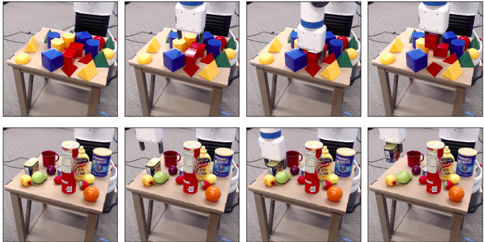
- The pipeline enabled a Fetch robot to detect and pick up the target object in 38 out of 40 trials in increasingly cluttered scenes, and a detector trained on a Spam can succeeded in 9 of 10 trials with previously unseen YCB food distractors.
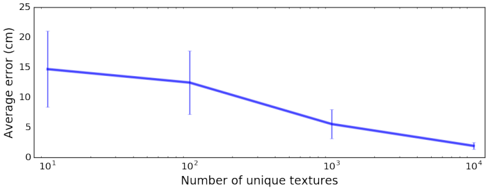
- Ablations found sensitivity to number of training images, number of unique textures, presence of distractors in training, and camera randomization; random noise had negligible effect. Performance improved up to around 50,000 training samples, and degraded significantly with fewer than 1,000 textures.
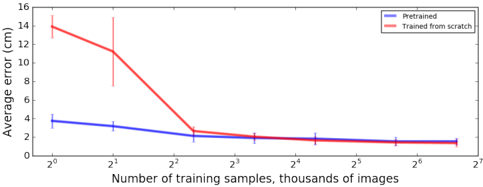
- ImageNet pretraining was not essential with enough data: random weight initialization achieved nearly the same real-world transfer performance as pretrained initialization, though pretraining helped in the low-data regime.
Methods
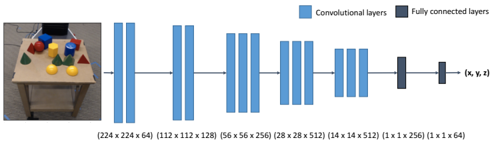
- The authors trained a modified VGG-16 convolutional neural network to map a single 224×224 monocular webcam image to Cartesian coordinates of object(s) of interest, using simulated images rendered by MuJoCo.
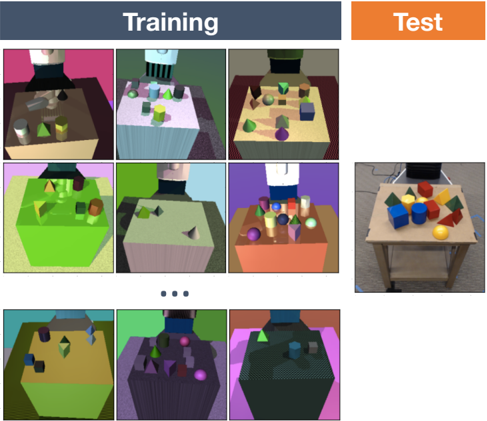
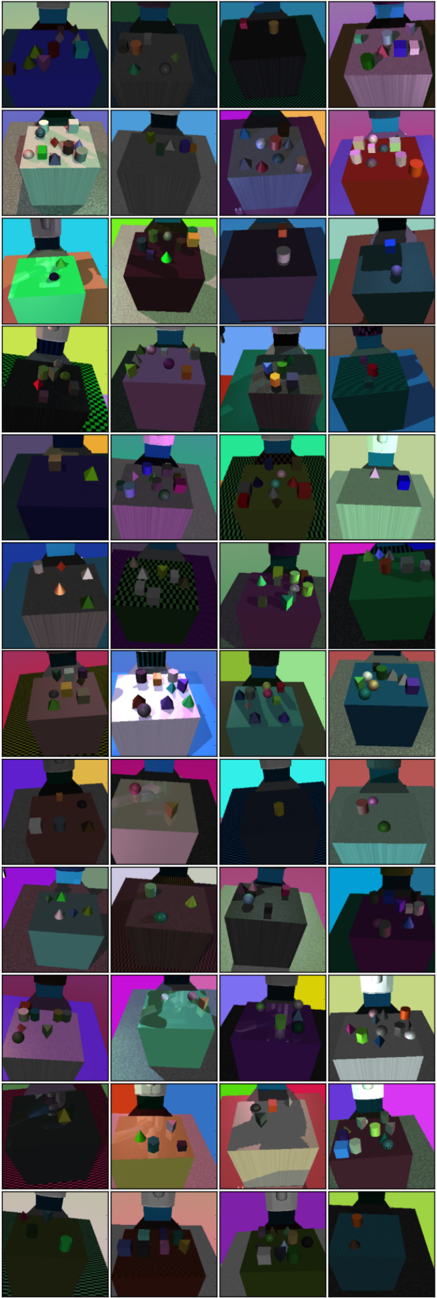
- Domain randomization varied number/shape of distractors, object positions and textures, table/floor/skybox/robot textures, camera position/orientation/field of view, number and properties of lights, and image noise. Textures were random RGB values, gradients, or checker patterns; 0–10 distractor objects were added per scene.
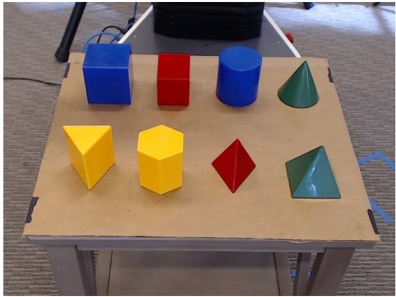
- Training used stochastic gradient descent with Adam on an L2 loss, learning rates around 1e-4, and batch sizes of 25, 50, or 100. Evaluation used 480 webcam images of eight geometric objects at 70–105 cm from a fixed camera, with 60 labeled images per object: 20 alone, 20 with distractors, and 20 partially occluded.
Limitations
- The paper states that the detectors still overfit simulated training data: simulated error was 0.3–0.5 cm versus about 1.5 cm in the real world, and no real-world validation could be done during training because no real data were assumed available.
- The paper states future work is needed for contact-rich manipulation or higher precision, and that the method fixes table height, effectively making the task 2D pose estimation from a single monocular uncalibrated camera.
- Evident from the text: evaluation is limited to eight geometric objects plus one Spam can, the test camera position remains constant across all images, and lighting and surrounding scene were not controlled.
Model-written summary. Check it against the paper before relying on it.
Integrity signals
Registry
Cites
Statistics
Figures
Verification
Claims the paper makes
2 Valid · 8 Not valid · 7 Not checked · 32 Own results and interpretations
The cited sources support only part of this claim — read each source’s verdict below.
In the paper
“Although previous work demonstrated the ability to perform robotic control using a neural network pretrained on ImageNet and fine-tuned on randomized rendered pixels [37], this paper provides the first demonstration that domain randomization can be useful for robotic tasks requiring precision.”
What the sources say
- Partly supportedcites [37] [37] Fereshteh Sadeghi and Sergey Levine. (cad) 2 RL: Real single-image flight without a single real image. arXiv preprint arXiv:1611.04201 , 2016. - sourceExperimental — accuracy not yet measured
The citation [37] is attached to the preceding claim about prior work, not to the citing authors’ claim that their own paper is the first to demonstrate precision robotics. Section 3.1 (p. 4) says LSDA pretrains a CNN on ImageNet classification data and fine-tunes it, but for object detection. It does not report robotic control or fine-tuning on randomized rendered pixels. (LLM, conf=0.84)
boostedstates a cause- Asserted: passes — The authors put it forward as true.
- Checkable: passes — It can be checked against evidence.
- Load-bearing: passes — The paper’s conclusions depend on it.
- Based: passes — The paper gives a reason why it holds.
- Partly supported
The cited sources that could be checked couldn’t confirm or dispute this claim.
In the paper
“Rather than relying on controller robustness, Yu et al. [53] use a model trained on varied physics to perform system identification using online trajectory data, but their approach is not shown to succeed in the real world.”
What the sources say
- Could not verifycites [53] [53] Wenhao Yu, C Karen Liu, and Greg Turk. Preparing for the unknown: Learning a universal policy with online system identification. arXiv preprint arXiv:1702.02453 , 2017. - sourceExperimental — accuracy not yet measured
The cited paper discusses image classification and localisation with convolutional networks (A.1, p. 10; A.2, p. 11), not Yu et al.'s approach. Searches for varied-physics training, online trajectory-based system identification, and real-world success found no passage addressing the claim. Our copy therefore cannot verify it. (LLM, conf=0.78)
plain- Asserted: passes — The authors put it forward as true.
- Checkable: passes — It can be checked against evidence.
- Load-bearing: unclear — It is unclear whether the paper’s conclusions depend on it.
- Based: passes — The paper gives a reason why it holds.
- Could not verify
The cited sources that could be checked couldn’t confirm or dispute this claim.
In the paper
“Though using realistic RGB rendering alone has had limited success for transferring to real robotic tasks [16], incorporating realistic simulation of depth information can allow models trained on rendered images to transfer reasonably well to the real world [32].”
What the sources say
- Could not verifycites [16] [16] Stephen James and Edward Johns. 3d simulation for robot arm control with deep q-learning. arXiv preprint arXiv:1609.03759 , 2016. - sourceExperimental — accuracy not yet measured
The Introduction (§1) and Conclusion (§8) describe Adam as a method for stochastic optimization, while the CNN experiment (§6.3) concerns training on image datasets. Searches for realistic RGB rendering and sim-to-real robotic transfer found no passage addressing whether RGB rendering alone has had limited success on real robotic tasks. (LLM, conf=0.78)
plain- Asserted: passes — The authors put it forward as true.
- Checkable: passes — It can be checked against evidence.
- Load-bearing: passes — The paper’s conclusions depend on it.
- Based: passes — The paper gives a reason why it holds.
- Could not verify
The cited sources that could be checked couldn’t confirm or dispute this claim.
In the paper
“However, their experiments - collision avoidance in hallways and open spaces - do not demonstrate the ability to deal with high-precision tasks.”
What the sources say
- Could not verifycites [37] [37] Fereshteh Sadeghi and Sergey Levine. (cad) 2 RL: Real single-image flight without a single real image. arXiv preprint arXiv:1611.04201 , 2016. - sourceExperimental — accuracy not yet measured
The Experiments section (p. 5) evaluates LSDA on an object-detection dataset, not Sadeghi and Levine’s collision-avoidance experiments. Searches for Sadeghi and Levine, hallway or open-space collision avoidance, and high-precision tasks found no passage addressing the claim. (LLM, conf=0.76)
plain- Asserted: passes — The authors put it forward as true.
- Checkable: passes — It can be checked against evidence.
- Load-bearing: passes — The paper’s conclusions depend on it.
- Based: passes — The paper gives a reason why it holds.
- Could not verify
A result the paper reports from its own data — it cites no other source for it, so there is none to check. The quote shows it is in the paper.
In the paper
“However, using a pre-trained model can significantly improve performance when less training data is used.”
plainstates a cause- Asserted: passes — The authors put it forward as true.
- Checkable: passes — It can be checked against evidence.
- Load-bearing: unclear — It is unclear whether the paper’s conclusions depend on it.
- Based: passes — The paper gives a reason why it holds.
29 more claims
Create a free account to see all 49 claims and to verify the 7 references still open.
- Probably not a substantial claim. 11
- It may state two separate claims as one. 8
Claims other papers make about this one
Each is checked against this paper’s own text: does it say what the citing paper says it does?
The source backs part of the claim, not all of it — or backs it for a different population, condition or comparison.
In the citing paper
“Most policies trained in simulation generalize poorly to the real-world due to agents adapting to specific visual details of the simulator.”
From Language-Based Augmentation to Address Shortcut Learning in Object-Goal Navigation (2023) · cites this paper as [8]
Experimental — accuracy not yet measuredThe source backs part of the claim, not all of it — or backs it for a different population, condition or comparison.
In the citing paper
“In robotic vision tasks including object localization [53], object detection [54], pose estimation [55], and semantic segmentation [56], the training data from simulator always have different textures, lighting, and camera positions from the realistic environments.”
From Sim-to-Real Transfer in Deep Reinforcement Learning for Robotics: a Survey (2020) · cites this paper as [53]
Experimental — accuracy not yet measuredThe source backs part of the claim, not all of it — or backs it for a different population, condition or comparison.
In the citing paper
“These artifacts limit the applicability of generative videos in physics-sensitive domains such as robotics [25,26], autonomous driving [27], simulationbased design, and scientific visualization [28].”
From PhyStruct-Video: Structured Physics State Spaces for Physically Consistent Video Generation (2025) · cites this paper as [25]
Experimental — accuracy not yet measuredThe source backs part of the claim, not all of it — or backs it for a different population, condition or comparison.
In the citing paper
“In domain randomization, the inputs during learning are “randomized” in the sense of being warped or corrupted in particular ways.”
From The overfitted brain: Dreams evolved to assist generalization (2021) · cites this paper as [144]
Experimental — accuracy not yet measuredThe source backs part of the claim, not all of it — or backs it for a different population, condition or comparison.
In the citing paper
“Domain randomization is a domain generalization technique that introduces drastic changes in the training image appearances, which forces the network to learn domain-invariant features between training and target domains [39].”
From A Fully Differentiable Framework for 2D/3D Registration and the Projective Spatial Transformers (2024) · cites this paper as [39]
Experimental — accuracy not yet measured
8 more claims about this paper
Create a free account to see every claim other papers make about this one.
Self-check
Percentages, sums and reported differences re-computed from the paper’s own numbers.
Each contradiction between two passages listed here was confirmed by an independent check.
Rated minor: it would not touch a result — a value no result rests on, a p-value that stays on the same side of the significance level, or a conflict that is clerical, resolved elsewhere in the paper, or outside its own findings.
In the paper
§ A. Experimental Setup · p. 4
“Each training sample consists of (a) a rendered image of the object and one or more distractors (also from among the geometric object set) on a simulated tabletop”
§ A. Domain randomization · p. 4
“Between 0 and 10 distractor objects are added to the table in each scene.”
Citations
Cites
Very Deep Convolutional Networks for Large-Scale Image Recognition
Simonyan, K., & Zisserman, A. (2014) · arXiv · doi:10.48550/arxiv.1409.1556 · Cited by 114,148 · cited 1×
“In particular, we use a modified version the VGG-16 architecture [42] shown in Figure 2.”
MethodAdam: A Method for Stochastic Optimization
Kingma, D. P., & Ba, J. (2014) · arXiv · doi:10.48550/arxiv.1412.6980 · Cited by 98,946 · cited 1×
“We found that using a learning rate of around 1e − 4 (as opposed to the standard 1e − 3 for Adam) improved convergence and helped avoid a common local optimum, mapping all objects to the center of the table.”
MethodLeCun, Y., Bengio, Y., & Hinton, G. (2015) · Nature · doi:10.1038/nature14539 · Cited by 84,126
Human-level control through deep reinforcement learning
Mnih, V., Kavukcuoglu, K., Silver, D., Rusu, A. A., Veness, J., Bellemare, M. G., Graves, A., Riedmiller, M., Fidjeland, A. K., Ostrovski, G., et al. (2015) · Nature · doi:10.1038/nature14236 · Cited by 30,357 · cited 3×
“Learning in simulation is especially promising for building on recent results using deep reinforcement learning to achieve human-level performance on tasks like Atari [27] and robotic control [21], [38].”
BackgroundResultHow transferable are features in deep neural networks?
Yosinski, J., Clune, J., Bengio, Y., & Lipson, H. (2014) · arXiv · doi:10.48550/arxiv.1411.1792 · Cited by 6,061 · cited 1×
“A variety of approaches have been proposed, including re-training the model in the target domain (e.g., [52]), adapting the weights of the model based on the statistics of the source and target domains (e.g., [22]), learning invariant features between domains (e.g., [47]), and learning a mapping…”
BackgroundMuJoCo: A physics engine for model-based control
Todorov, E., Erez, T., & Tassa, Y. (2012) · 2012 IEEE/RSJ International Conference on Intelligent Robots and Systems · doi:10.1109/iros.2012.6386109 · Cited by 4,767 · cited 1×
“We render images using the MuJoCo Physics Engine’s [45] built-in renderer.”
MethodTrust region policy optimization
Schulman, J., Levine, S., Moritz, P., Jordan, M. I., & Abbeel, P. (2015) · arXiv · doi:10.48550/arxiv.1502.05477 · Cited by 4,578 · cited 1×
“Learning in simulation is especially promising for building on recent results using deep reinforcement learning to achieve human-level performance on tasks like Atari [29] and robotic control [26], [41].”
ResultSelf-citationLearning Transferable Features with Deep Adaptation Networks
Long, M., Cao, Y., Wang, J., & Jordan, M. I. (2015) · arXiv · doi:10.48550/arxiv.1502.02791 · Cited by 4,505 · cited 1×
“omputer vision community has devoted significant study to the problem of adapting vision-based models trained in a source domain to a previously unseen target domain (see, e.g., [9], [14], [15], [19], [23], [25], [51]). A variety of approaches have been proposed, including re-training the model in the target domain (e.…”
BackgroundEnd-to-End Training of Deep Visuomotor Policies
Levine, S., Finn, C., Darrell, T., et al. (2015) · Journal of machine learning research · doi:10.5555/2946645.2946684 · Cited by 3,987
Describing Textures in the Wild
Cimpoi, M., Maji, S., Kokkinos, I., Mohamed, S., & Vedaldi, A. (2014) · 2014 IEEE Conference on Computer Vision and Pattern Recognition · doi:10.1109/cvpr.2014.461 · Cited by 2,438 · cited 1×
“To examine how our detectors would perform on objects with complex textures, we created simulated scenes in which the object of interest is given a texture from the Describable Textures Dataset (DTD) [4].”
Method
Research works printed but not linked: 3
- [24] David G Lowe. Three-dimensional object recognition from single two-dimensional images. Artificial intelligence , 31(3):355-395, 1987. -
- [49] Melonee Wise, Michael Ferguson, Derek King, Eric Diehr, and David Dymesich. Fetch and freight: Standard platforms for service robot applications. In Workshop on Autonomous Mobile Service Robots , 2016. -
- sucan, 0, MoveIt!
Cited by
Items 401–500 of 2,970
Such, F. P., Rawal, A., Lehman, J., Stanley, K. O., & Clune, J. (2019) · arXiv (Cornell University) · doi:10.48550/arxiv.1912.07768 · Cited by 123
“In other words, GTNs could learn to produce something similar to domain randomization (Tobin et al., 2017; Andrychowicz et al., 2018) to improve generalization, an exciting prospect.”
BackgroundSUNRISE: A Simple Unified Framework for Ensemble Learning in Deep Reinforcement LearningPreprint
Lee, K., Laskin, M., Srinivas, A., & Abbeel, P. (2020) · arXiv (Cornell University) · doi:10.48550/arxiv.2007.04938 · Cited by 168
“[43] Tobin, Josh, Fong, Rachel, Ray, Alex, Schneider, Jonas, Zaremba, Wojciech, and Abbeel, Pieter.”
BackgroundSelf-citationscAnt —an open-source platform for the creation of 3D models of arthropods (and other small objects)
Plum, F., & Labonte, D. (2021) · PeerJ · doi:10.7717/peerj.11155 · Cited by 52
Coupling Vision and Proprioception for Navigation of Legged Robots
Fu, Z., Kumar, A., Agarwal, A., Qi, H., Malik, J., & Pathak, D. (2022) · IEEE Computer Society Conference on Computer Vision and Pattern Recognition/Proceedings - IEEE Computer Society Conference on Computer Vision and Pattern Recognition/Proceedings · doi:10.1109/cvpr52688.2022.01676 · Cited by 103
Self-improving situation awareness for human–robot-collaboration using intelligent Digital Twin
Müller, M. S., Ruppert, T., Jazdi, N., & Weyrich, M. (2023) · Journal of Intelligent Manufacturing · doi:10.1007/s10845-023-02138-9 · Cited by 64
“Concrete approaches to how this works are proposed in Tobin et al. (2017).”
Holo-Dex: Teaching Dexterity with Immersive Mixed Reality
Arunachalam, S. P., Güzey, I., Chintala, S., & Pinto, L. (2023) · 2023 IEEE International Conference on Robotics and Automation (ICRA) · doi:10.1109/icra48891.2023.10160547 · Cited by 45
NeRF2Real: Sim2real Transfer of Vision-guided Bipedal Motion Skills using Neural Radiance Fields
Byravan, A., Humplik, J., Hasenclever, L., Brussee, A., Nori, F., Haarnoja, T., Moran, B., Bohez, S., Sadeghi, F., Vujatovic, B., et al. (2023) · Proceedings - IEEE International Conference on Robotics and Automation/Proceedings · doi:10.1109/icra48891.2023.10161544 · Cited by 83
“Careful system identification and techniques such as Domain Randomization [41], Domain Adaptation [42] and Real2sim [43] have helped to reduce the discrepancies between simulation and reality for the system dynamics and sensor model, enabling successes on tasks such as Rubik’s cube solving with a dexterous hand [3], gr…”
Reinforcement Learning of CPG-Regulated Locomotion Controller for a Soft Snake Robot
Liu, X., Onal, C. D., & Fu, J. (2023) · IEEE Transactions on Robotics · doi:10.1109/tro.2023.3286046 · Cited by 56
“With this approach, we can improve the sim-to-real performance of an RL snake controller by tuning its signal amplitude, instead of relying on the environment-based methods such as domain randomization [33] or other data augmentation techniques, which are computationally expensive.”
MethodGrounding Language for Transfer in Deep Reinforcement Learning
Narasimhan, K., Barzilay, R., & Jaakkola, T. (2018) · Journal of Artificial Intelligence Research · doi:10.1613/jair.1.11263 · Cited by 44
Garcia-Garcia, A., Martinez-Gonzalez, P., Oprea, S., Castro-Vargas, J. A., Orts-Escolano, S., Garcia-Rodriguez, J., & Jover-Alvarez, A. (2018) · 2018 IEEE/RSJ International Conference on Intelligent Robots and Systems (IROS) · doi:10.1109/iros.2018.8594495 · Cited by 42
“Furthermore, some of them have highlighted the fact that training machine learning algorithms on virtual worlds even improves accuracy when they are applied to real-world scenarios [24] [25].”
BackgroundAffordance Learning for End-to-End Visuomotor Robot Control
Hämäläinen, A., Arndt, K., Ghadirzadeh, A., & Kyrki, V. (2019) · IEEE/RSJ International Conference on Intelligent Robots and Systems (IROS) · doi:10.1109/iros40897.2019.8968596 · Cited by 52
“artificial textures make the input images look unrealistic, high variation allows the model to generalize to real world environments [6].”
BackgroundMethodEfficient Bimanual Manipulation Using Learned Task Schemas
Chitnis, R., Tulsiani, S., Gupta, S., & Gupta, A. (2020) · 2020 IEEE International Conference on Robotics and Automation (ICRA) · doi:10.1109/icra40945.2020.9196958 · Cited by 43
“More recent techniques include learning from model ensembles [16] and utilizing domain randomization [17], [18], [19], in which physical properties of a simulated environment are randomized to allow learned policies to be robust.”
MethodDomain Stylization: A Fast Covariance Matching Framework Towards Domain Adaptation
Dündar, A., Liu, M.-Y., Yu, Z., Wang, T.-C., Zedlewski, J., & Kautz, J. (2020) · IEEE Transactions on Pattern Analysis and Machine Intelligence · doi:10.1109/tpami.2020.2969421 · Cited by 49
“The method [66] aims at generalizing a model, trained purely using synthetic data, to recognize real world cases by providing sufficient simulated variability at training time.”
MethodSingle Shot 6D Object Pose Estimation
Kleeberger, K., & Huber, M. F. (2020) · Proceedings - IEEE International Conference on Robotics and Automation/Proceedings · doi:10.1109/icra40945.2020.9197207 · Cited by 59
“we use a technique called domain randomization [40].”
MethodYang, Q., Lin, Y., Wang, J., Bao, J., Wang, X., Ma, L., Zhou, Z., Yang, Q., Cai, S., He, H., et al. (2022) · IEEE Transactions on Medical Imaging · doi:10.1109/tmi.2022.3179981 · Cited by 50
SE3-Pose-Nets: Structured Deep Dynamics Models for Visuomotor Control
Byravan, A., Leeb, F., Meier, F., & Fox, D. (2018) · 2018 IEEE International Conference on Robotics and Automation (ICRA) · doi:10.1109/icra.2018.8461184 · Cited by 40
“There are potentially multiple ways to tackle this problem, including curriculum and active learning, physical grounding of the pose space and through the use of domain randomization [24] techniques to facilitate sim-to-real transfer and generalization to novel scenarios.”
BackgroundAuto-generated Wires Dataset for Semantic Segmentation with Domain-Independence
Zanella, R., Caporali, A., Tadaka, K., Gregorio, D. D., & Palli, G. (2021) · International Conference on Computer, Control and Robotics (ICCCR) · doi:10.1109/icccr49711.2021.9349395 · Cited by 57
“This process, known as domain randomization [13], [20], aims to provide enough synthetic variability in training data such that at test time the model is able to generalize to real-world data.”
BackgroundObject Detection Using Deep CNNs Trained on Synthetic ImagesPreprint
Rajpura, P., Bojinov, H., & Hegde, R. S. (2017) · arXiv (Cornell University) · doi:10.48550/arxiv.1706.06782 · Cited by 112
“perform domain randomization with low-fidelity rendered images from 3D meshes, however their objective is to locate simpler polygon-shaped objects restricted to a table top in world coordinates [27].”
BackgroundSingle-view robot pose and joint angle estimation via render & compare
Labbé, Y., Carpentier, J., Aubry, M., & Šivic, J. (2021) · IEEE Computer Society Conference on Computer Vision and Pattern Recognition/Proceedings - IEEE Computer Society Conference on Computer Vision and Pattern Recognition/Proceedings · doi:10.1109/cvpr46437.2021.00170 · Cited by 79
“All of these datasets are synthetic, generated using similar procedures based on domain randomization [51, 32, 47, 20].”
MethodBenchmarking Reinforcement Learning Techniques for Autonomous Navigation
Xu, Z., Liu, B., Xiao, X., Nair, A., & Stone, P. (2023) · Proceedings - IEEE International Conference on Robotics and Automation/Proceedings · doi:10.1109/icra48891.2023.10160583 · Cited by 82
“error data, has achieved tremendous progress on multiple fronts, including safety [4]–[6], generalizability [7]–[10], sample efficiency [11], [12], and addressing temporal data [13]–[15].”
BackgroundChen, S., Liu, G., Zhou, Z., Zhang, K., & Wang, J. (2023) · IEEE Transactions on Intelligent Vehicles · doi:10.1109/tiv.2023.3307134 · Cited by 54
Triantafyllidis, E., Acero, F., Liu, Z., & Li, Z. (2023) · Nature Machine Intelligence · doi:10.1038/s42256-023-00709-2 · Cited by 69
A deep neural network for real-time optoacoustic image reconstruction with adjustable speed of sound
Dehner, C., Zahnd, G., Ntziachristos, V., & Jüstel, D. (2023) · Nature Machine Intelligence · doi:10.1038/s42256-023-00724-3 · Cited by 55
“We used a SOS step size of 5 m s –1 to enable SOS adjustments The table shows the mean values and in brackets the 25th and 75th percentiles for the 166 multispectral stacks from the in vivo test dataset.”
Challenges for Monocular 6-D Object Pose Estimation in Robotics
Thalhammer, S., Bauer, D., Hönig, P., Weibel, J.-B., García‐Rodríguez, J., & Vincze, M. (2024) · IEEE Transactions on Robotics · doi:10.1109/tro.2024.3433870 · Cited by 79
“Besidesthesestrategies, especiallydomainrandomizationprovidesgreatpotentialfor overcomingthesim-to-realgapofneuralnetworksforrobotic applications[20],[107],[108],[109],[110].”
MetaGrasp: Data Efficient Grasping by Affordance Interpreter Network
Cai, J., Cheng, H., Zhang, Z., & Su, J. (2019) · Proceedings - IEEE International Conference on Robotics and Automation/Proceedings · doi:10.1109/icra.2019.8793912 · Cited by 47
“Because we can easily have access to a large amount of annotated data from virtual environment, many works turned into simulator to generate training samples, especially in object manipulation task [28], [29], [30], [31].”
BackgroundCrossing the Gap: A Deep Dive into Zero-Shot Sim-to-Real Transfer for Dynamics
Valassakis, E., Ding, Z., & Johns, E. (2020) · IEEE/RSJ International Conference on Intelligent Robots and Systems (IROS) · doi:10.1109/iros45743.2020.9341617 · Cited by 63
“dress the visual [16], [29] or dynamics [1], [3], [4], [24], [34], [35] adaptation problems, and either attempt zeroshot transfer [1], [16], or require real-world test-time data through meta-learning [5], residual learning [18], real-world optimisation, [33] or mixed training between simulation and”
BackgroundDomain Adaptation In Reinforcement Learning Via Latent Unified State Representation
Xing, J., Nagata, T., Chen, K., Zou, X., Neftci, E., & Krichmar, J. L. (2021) · Proceedings of the AAAI Conference on Artificial Intelligence · doi:10.1609/aaai.v35i12.17251 · Cited by 75
Young, S., Gandhi, D., Tulsiani, S., Gupta, A., Abbeel, P., & Pinto, L. (2020) · arXiv · doi:10.48550/arxiv.2008.04899 · Cited by 42
“It has also been extensively used in context of RL, where domain randomization is proposed to transfer learning from simulation to real world [36, 37, 38].”
BackgroundSelf-citationLim, V., Huang, H., Chen, L. Y., Wang, J., Ichnowski, J., Seita, D., Laskey, M., & Goldberg, K. Y. (2022) · Proceedings - IEEE International Conference on Robotics and Automation/Proceedings · doi:10.1109/icra46639.2022.9811651 · Cited by 117
“An alternative is to use domain randomization over vision [47, 54] or dynamics [43] parameters in simulation.”
BackgroundMethodBi-level Alignment for Cross-Domain Crowd Counting
Gong, S., Zhang, S., Yang, J. J., Dai, D., & Schiele, B. (2022) · IEEE Computer Society Conference on Computer Vision and Pattern Recognition/Proceedings - IEEE Computer Society Conference on Computer Vision and Pattern Recognition/Proceedings · doi:10.1109/cvpr52688.2022.00739 · Cited by 54
“One direct way is to generate various styles of images by style transfer CNN [29] or data augmentation [23].”
BackgroundDomain Randomization for Scene-Specific Car Detection and Pose Estimation
Khirodkar, R., Yoo, D., & Kitani, K. (2019) · IEEE Winter Conference on Applications of Computer Vision · doi:10.1109/wacv.2019.00210 · Cited by 60
“[26], [7], [19], [18] used domain randomization for grasping objects.”
Simulation-Based Evaluation and Optimization of Control Strategies in Buildings
Kontes, G. D., Giannakis, G. B., Sánchez, V., de Agustín-Camacho, P., Romero-Amorrortu, A., Panagiotidou, N., Rovas, D., Steiger, S., Mutschler, C., & Grün, G. (2018) · Energies · doi:10.3390/en11123376 · Cited by 49
“Another option would be to formulate the problem as a Reinforcement Learning setup and take advantage of recent advances in deep reinforcement learning research [101–103] combined with simulation to reality control transfer approaches [104,105] to mitigate the computationally complex problem of control design in the o…”
BackgroundLearning Deep Visuomotor Policies for Dexterous Hand Manipulation
Jain, D., Li, A. R., Singhal, S., Rajeswaran, A., Kumar, V., & Todorov, E. V. (2019) · Proceedings - IEEE International Conference on Robotics and Automation/Proceedings · doi:10.1109/icra.2019.8794033 · Cited by 61
“Some works have concentrated on being able to transfer results from simulation to hardware – for example, using ensemble meth-ods like domain randomization [25], [26], or progressively adapting the visual features [27].”
BackgroundThe Societal Implications of Deep Reinforcement Learning
Whittlestone, J., Arulkumaran, K., & Crosby, M. (2021) · Journal of Artificial Intelligence Research · doi:10.1613/jair.1.12360 · Cited by 68
“…randomisation’—randomising various aspects of the simulation (e.g., lighting, background clutter, friction coefficients, etc.), so that DRL agents learn policies that are robust to variations in these in the real world (Tobin et al., 2017; James et al., 2017; Peng et al., 2018; OpenAI et al., 2019).”
BackgroundSynthetic Object Recognition Dataset for Industries
Akar, C. A., Tekli, J., Jess, D., Khoury, M., Kamradt, M., & Guthe, M. (2022) · SIBGRAPI Conference on Graphics, Patterns and Images (SIBGRAPI) · doi:10.1109/sibgrapi55357.2022.9991784 · Cited by 60
“However, one main challenge arises with synthetic image generation: the “reality gap”, i.e. the difference between real and synthetic images [12], [13].”
BackgroundVariance-reduced $Q$-learning is minimax optimalPreprint
Wainwright, M. J. (2019) · arXiv (Cornell University) · doi:10.48550/arxiv.1906.04697 · Cited by 102
“Given the explosion in the amount of available data and computing power, recent years have witnessed dramatic success of reinforcement learning (RL) techniques in various application domains (e.g., [30, 19, 26, 22, 27]).”
BackgroundiGibson 1.0: a Simulation Environment for Interactive Tasks in Large Realistic ScenesPreprint
Shen, B., Xia, F., Li, C., et al. (2020) · arXiv (Cornell University) · doi:10.48550/arxiv.2012.02924 · Cited by 41
Why Generalization in RL is Difficult: Epistemic POMDPs and Implicit Partial Observability
Ghosh, D., Rahme, J., Kumar, A., Zhang, A., Adams, R. P., & Levine, S. (2021) · arXiv · doi:10.48550/arxiv.2107.06277 · Cited by 41
“[39] Joshua Tobin, Rachel Fong, Alex Ray, J.”
Gao, Y., Chen, J., Chen, X., Wang, C., Hu, J., Deng, F., & Lam, T. L. (2023) · IEEE Transactions on Robotics · doi:10.1109/tro.2023.3257541 · Cited by 45
“using the standard domain randomization technique [76].”
Learning and Adapting Agile Locomotion Skills by Transferring Experience
Smith, L. E., Kew, J. C., Li, T., Luu, L., Peng, X. B., Ha, S., Tan, J., & Levine, S. (2023) · Robotics: Science and Systems · doi:10.15607/rss.2023.xix.051 · Cited by 80
Grand challenges in industrial and systems engineering
Karwowski, W., Salvendy, G., Albert, L. A., Kim, W. C., Denton, B. T., Dessouky, M. M., Dolgui, A. B., Duffy, V. G., Kumara, S. R. T., Li, J., et al. (2025) · International Journal of Production Research · doi:10.1080/00207543.2024.2432463 · Cited by 52
“Major concepts, among others, are domain randomisation (Tobin et al. 2017), so that the learning system is insensitive to environmental variations, and meta-learning, which is training a system to best adapt/learn to unseen environments (Finn et al. 2019), and variable domain fidelity, which…”
Flappy Hummingbird: An Open Source Dynamic Simulation of Flapping Wing Robots and Animals
Fei, F., Tu, Z., Yang, Y., Zhang, J., & Deng, X. (2019) · Proceedings - IEEE International Conference on Robotics and Automation/Proceedings · doi:10.1109/icra.2019.8794089 · Cited by 49
“For reinforcement learning applications, dynamics randomization can be used to achieve a robust control policy [21], [22].”
MethodSimulation-driven machine learning for robotics and automation
El-Shamouty, M., Kleeberger, K., Lämmle, A., & Huber, M. F. (2019) · tm - Technisches Messen · doi:10.1515/teme-2019-0072 · Cited by 51
“Simulations allow reducing [26] or avoiding [25, 6] the expensive procedure of real-world data collection.”
BackgroundMethodInfluentialPedersen, O.-M., Misimi, E., & Chaumette, F. (2020) · Proceedings - IEEE International Conference on Robotics and Automation/Proceedings · doi:10.1109/icra40945.2020.9197196 · Cited by 51
“However, several disadvantages have been observed using this technique, such as a failure to detect objects on the edge of the image frame [19] or a failure to grasp irregular objects [20].”
BackgroundChallenges of Reinforcement Learning
Ding, Z., & Dong, H. (2020) · Springer eBooks · doi:10.1007/978-981-15-4095-0_7 · Cited by 92
Animal-in-the-Loop: Using Interactive Robotic Conspecifics to Study Social Behavior in Animal Groups
Landgraf, T., Gebhardt, G. H. W., Bierbach, D., Romańczuk, P., Musiolek, L. M., Hafner, V. V., & Krause, J. (2020) · Annual Review of Control Robotics and Autonomous Systems · doi:10.1146/annurev-control-061920-103228 · Cited by 50
Mo, Y., Ma, S., Gong, H., Chen, Z., Zhang, J., & Tao, D. (2021) · IEEE Internet of Things Journal · doi:10.1109/jiot.2021.3068736 · Cited by 44
Never Stop Learning: The Effectiveness of Fine-Tuning in Robotic Reinforcement LearningPreprint
Julian, R., Swanson, B., Sukhatme, G. S., Levine, S., Finn, C., & Hausman, K. (2020) · arXiv (Cornell University) · doi:10.48550/arxiv.2004.10190 · Cited by 123
“Other works have leveraged experience in simulation [56, 66, 57, 62, 45, 55, 48, 22, 19] or”
BackgroundSchmedemann, O., Baaß, M., Schoepflin, D., & Schüppstuhl, T. (2022) · Procedia CIRP · doi:10.1016/j.procir.2022.05.115 · Cited by 56
Indoor Synthetic Data Generation: A Systematic Review
Schieber, H., Demir, K. C., Kleinbeck, C., Yang, S. H., & Roth, D. (2024) · Computer Vision and Image Understanding · doi:10.1016/j.cviu.2023.103907 · Cited by 55
Will your next surgeon be a robot? Autonomy and AI in robotic surgery
Schmidgall, S., Opfermann, J. D., Kim, J. W., & Krieger, A. (2025) · Science Robotics · doi:10.1126/scirobotics.adt0187 · Cited by 77
Gottipati, S. K., Seo, K., Bhatt, D., Mai, V., Jatavallabhula, K. M., & Paull, L. (2019) · IEEE Robotics and Automation Letters · doi:10.1109/lra.2019.2932575 · Cited by 46
Pixel-Attentive Policy Gradient for Multi-Fingered Grasping in Cluttered Scenes
Wu, B., Akinola, I., & Allen, P. K. (2019) · IEEE/RSJ International Conference on Intelligent Robots and Systems (IROS) · doi:10.1109/iros40897.2019.8968263 · Cited by 42
“learns grasping in simulation and proposes sample-efficient sim-to-real frameworks such as domain adaptation [12], domain randomization [13], and randomized-to-canonical adaptation [14] to transfer to the real world.”
BackgroundSim-to-Real Quadrotor Landing via Sequential Deep Q-Networks and Domain Randomization
Polvara, R., Patacchiola, M., Hanheide, M., & Neumann, G. M. (2020) · Robotics · doi:10.3390/robotics9010008 · Cited by 50
“Domain transfer techniques have been recently identified as a solution for reducing this gap, with one of the most effective approaches being Domain Randomization (DR) [10].”
BackgroundMethodLeveraging combinatorial testing for safety-critical computer vision datasets
Gladisch, C., Heinzemann, C., Herrmann, M., & Woehrle, M. (2020) · IEEE/CVF Conference on Computer Vision and Pattern Recognition Workshops (CVPRW) · doi:10.1109/cvprw50498.2020.00170 · Cited by 48
“Techniques like image augmentation and domain randomization are used to extend and increase the variation of an existing dataset [16].”
MethodEmpty Cities: A Dynamic-Object-Invariant Space for Visual SLAM
Bescos, B., Cadena, C., & Neira, J. (2020) · IEEE Transactions on Robotics · doi:10.1109/tro.2020.3031267 · Cited by 41
“Models trained on synthetic data can be useful for real-world vision tasks [53]–[56].”
BackgroundLiu, W., Luo, B., & Liu, J. (2021) · IEEE Geoscience and Remote Sensing Letters · doi:10.1109/lgrs.2021.3052017 · Cited by 46
Monocular Camera-Based Complex Obstacle Avoidance via Efficient Deep Reinforcement Learning
Ding, J., Gao, L., Liu, W., Piao, H., Pan, J., Du, Z., Yang, X., & Yin, B. (2022) · IEEE Transactions on Circuits and Systems for Video Technology · doi:10.1109/tcsvt.2022.3203974 · Cited by 42
Transferring Multi-Agent Reinforcement Learning Policies for Autonomous Driving using Sim-to-Real
Candela, E., Parada, L., Marques, L., Georgescu, T.-A., Demiris, Y., & Angeloudis, P. (2022) · IEEE/RSJ International Conference on Intelligent Robots and Systems (IROS) · doi:10.1109/iros47612.2022.9981319 · Cited by 57
Attention Diversification for Domain Generalization
Meng, R., Li, X., Chen, W., Yang, S., Song, J., Wang, X., Zhang, L., Song, M., Xie, D., & Pu, S. (2022) · Lecture notes in computer science · doi:10.1007/978-3-031-19830-4_19 · Cited by 74
Chaffre, T., Moras, J., Chan-Hon-Tong, A., & Marzat, J. (2020) · Proceedings of the 17th International Conference on Informatics in Control, Automation and Robotics · doi:10.5220/0009821603140323 · Cited by 38
“In its original version (Sadeghi and Levine, 2016; Tobin et al., 2017), each randomization parameter Φ i was restricted to an interval ] , i = 1 ,... , N .”
BackgroundSelf-Supervised Tumor Segmentation With Sim2Real Adaptation
Zhang, X., Xie, W., Huang, C., Zhang, Y., Chen, X., Tian, Q. C., & Wang, Y. (2023) · IEEE Journal of Biomedical and Health Informatics · doi:10.1109/jbhi.2023.3240844 · Cited by 53
“To improve the generalisation ability, domain randomization [46], [47] is often adopted.”
MethodA Comparison of PPO, TD3 and SAC Reinforcement Algorithms for Quadruped Walking Gait Generation
Mock, J. W., & Muknahallipatna, S. (2023) · Journal of Intelligent Learning Systems and Applications · doi:10.4236/jilsa.2023.151003 · Cited by 61
Iizuka, R., Xia, J., & Yokoya, N. (2023) · IEEE Transactions on Geoscience and Remote Sensing · doi:10.1109/tgrs.2023.3344670 · Cited by 50
“A popular technique in DG is style randomization (SR) [16], [17], [18], [19], [20], which increases the input space by introducing variability in image style.”
MethodA Human–Robot Collaboration Controller Utilizing Confidence for Disagreement Adjustment
Ma, M., & Cheng, L. (2024) · IEEE Transactions on Robotics · doi:10.1109/tro.2024.3370025 · Cited by 45
Waghmare, A. V., Singh, V. P., Varshney, T., & Sanjeevikumar, P. (2025) · Discover Applied Sciences · doi:10.1007/s42452-025-07529-6 · Cited by 63
“By incorporating strategies like domain randomization [154], transfer learning [155], adaptive simulators and digital twins [156], RL implementation can be advanced and this gap can be narrowed.”
From Virtual Demonstration to Real-World Manipulation Using LSTM and MDN
Rahmatizadeh, R., Abolghasemi, P., Behal, A., & Bölöni, L. L. (2018) · Proceedings of the AAAI Conference on Artificial Intelligence · doi:10.1609/aaai.v32i1.12099 · Cited by 53
“Another approach for improving the virtual to physical transfer is to increase the generality of the policy learned in simulation through domain randomization (Tobin et al. 2017).”
BackgroundThe limits and potentials of deep learning for robotics
Sünderhauf, N., Brock, O., Scheirer, W., Hadsell, R., Fox, D., Leitner, J., Upcroft, B., Abbeel, P., Burgard, W., Milford, M., et al. (2018) · The International Journal of Robotics Research · doi:10.1177/0278364918770733 · Cited by 38
“Another promising recent direction is domain randomization [97], [118].”
BackgroundSelf-citationJosifovski, J., Kerzel, M., Pregizer, C., Posniak, L., & Wermter, S. (2018) · IEEE/RSJ International Conference on Intelligent Robots and Systems (IROS) · doi:10.1109/iros.2018.8594379 · Cited by 44
“A recent approach by Tobin et al. [11] evaluates the transfer of knowledge from a simulated to a real-world scenario for a CNN-based model for object localization.”
BackgroundLearning to fly: computational controller design for hybrid UAVs with reinforcement learning
Xu, J., Du, T., Foshey, M., Li, B., Zhu, B., Schulz, A., & Matusik, W. (2019) · ACM Transactions on Graphics · doi:10.1145/3306346.3322940 · Cited by 65
“A few notable papers have managed to close this gap for specific types of robots through domain randomization [Andrychowicz et al. 2018; Sadeghi and Levine 2017; Tan et al. 2018; Tobin et al. 2017], more accurate modeling [Bansal et al. 2016; Fu et al. 2016], or better sensing [Hwangbo et al. 2017].”
BackgroundMitra, R., Naruse, H., & Abe, T. (2020) · Journal of Geophysical Research Earth Surface · doi:10.1029/2020jf005583 · Cited by 40
“The random generation of arti fi cial training data sets for different parameters was adopted to bypass the drawbacks of using real measurements to train the inverse model (Le et al., 2017; Tobin et al., 2017; Tremblay et al., 2018).”
MethodDomain Randomization for Demand Response of an Electric Water Heater
Peirelinck, T., Hermans, C., Spiessens, F., & Deconinck, G. (2020) · IEEE Transactions on Smart Grid · doi:10.1109/tsg.2020.3024656 · Cited by 43
“Tobin et al. [10] state that with enough variability during the training phase, the RL agent will be able to generalize to dynamics seen in the test phase.”
BackgroundMethodInfluentialInformation Theoretic Regret Bounds for Online Nonlinear ControlPreprint
Kakade, S. M., Krishnamurthy, A., Lowrey, K., Ohnishi, M., & Sun, W. (2020) · arXiv (Cornell University) · doi:10.48550/arxiv.2006.12466 · Cited by 137
“…demanding sequential decision making tasks ranging from robotic hand manipulation [Todorov et al., 2012, Al Borno et al., 2012, Kumar et al., 2016, Tobin et al., 2017, Lowrey et al., 2018, Akkaya et al., 2019] to game playing [Silver et al., 2016, Bellemare et al., 2016, Pathak et al., 2017,…”
BackgroundReinforcement Learning of Active Vision for Manipulating Objects under Occlusions
Cheng, R., Agarwal, A., & Fragkiadaki, K. (2018) · arXiv · doi:10.48550/arxiv.1811.08067 · Cited by 38
“[5] use synthetic data augmentation to learn detectors in cluttered environments.”
BackgroundLearning to Navigate Sidewalks in Outdoor Environments
Sorokin, M., Tan, J., Liu, C. K., & Ha, S. (2022) · IEEE Robotics and Automation Letters · doi:10.1109/lra.2022.3145947 · Cited by 65
“For instance, previous work [20], [21] investigated the Domain Randomization approach by applying random textures to the world surfaces to learn texture agnostic visual features.”
BackgroundOu, Y., & Tavakoli, M. (2023) · IEEE Robotics and Automation Letters · doi:10.1109/lra.2023.3254860 · Cited by 39
“Another solution to bridging the “reality gap” is domain randomization [12], where the simulation environment is randomized to cover a large range of properties during training, so that the learned policy works across a domain that includes the real world environment.”
BackgroundLearning to Locomote with Artificial Neural-Network and CPG-based Control in a Soft Snake Robot
Liu, X., Gasoto, R., Jiang, Z., Onal, C. D., & Fu, J. (2020) · IEEE/RSJ International Conference on Intelligent Robots and Systems (IROS) · doi:10.1109/iros45743.2020.9340763 · Cited by 37
GPS Spoofing Detection Method for Small UAVs Using 1D Convolution Neural Network
Sung, Y.-H., Park, S.-J., Kim, D.-Y., & Kim, S. (2022) · Sensors · doi:10.3390/s22239412 · Cited by 55
“Domain randomization [28] might be helpful, but it is still a challenging problem.”
BackgroundA Fully Differentiable Framework for 2D/3D Registration and the Projective Spatial Transformers
Gao, C., Feng, A., Liu, X., Taylor, R. H., Armand, M., & Unberath, M. (2024) · IEEE Transactions on Medical Imaging · doi:10.1109/tmi.2023.3299588 · Cited by 55
“Domain randomization is a domain generalization technique that introduces drastic changes in the training image appearances, which forces the network to learn domain-invariant features between training and target domains [39].”
BackgroundSensor Transfer: Learning Optimal Sensor Effect Image Augmentation for Sim-to-Real Domain Adaptation
Carlson, A., Skinner, K. A., Vasudevan, R., & Johnson‐Roberson, M. (2019) · IEEE Robotics and Automation Letters · doi:10.1109/lra.2019.2896470 · Cited by 48
“complex indoor and outdoor environments [18], [19].”
OffsetNet: Deep Learning for Localization in the Lung using Rendered Images
Sganga, J., Eng, D. K.-M., Graetzel, C. F., & Camarillo, D. B. (2019) · Proceedings - IEEE International Conference on Robotics and Automation/Proceedings · doi:10.1109/icra.2019.8793940 · Cited by 52
“5) Icam Image taken by a bronchoscope in the lung phantom Isim Image rendered by OpenGL using the lung CT Irsim Image rendered by OpenGL using the lung CT with varied rendering parameters and varied noise, smoothing and occlusions added [18] Igsim Image rendered by OpenGL using the lung CT, then passed through the gen…”
MethodLearning to Assemble: Estimating 6D Poses for Robotic Object-Object Manipulation
Stevšić, S., Christen, S., & Hilliges, O. (2020) · IEEE Robotics and Automation Letters · doi:10.1109/lra.2020.2967325 · Cited by 41
Stillleben: Realistic Scene Synthesis for Deep Learning in Robotics
Schwarz, M., & Behnke, S. (2020) · Proceedings - IEEE International Conference on Robotics and Automation/Proceedings · doi:10.1109/icra40945.2020.9197309 · Cited by 45
“[3], who demonstrated learning of an object detection task on entirely synthetic data, with later execution on a real robotic system.”
BackgroundAutonomous Single-Image Drone Exploration With Deep Reinforcement Learning and Mixed Reality
Devo, A., Mao, J., Costante, G., & Loianno, G. (2022) · IEEE Robotics and Automation Letters · doi:10.1109/lra.2022.3154019 · Cited by 41
Transfer Learning by Finetuning Pretrained CNNs Entirely with Synthetic Images
Rajpura, P., Aggarwal, A., Goyal, M., Gupta, S., Talukdar, J., Bojinov, H., & Hegde, R. S. (2018) · Communications in computer and information science · doi:10.1007/978-981-13-0020-2_45 · Cited by 44
Optimizing Crop Management with Reinforcement Learning and Imitation Learning
Tao, R., Zhao, P., Wu, J., Martin, N. F., Harrison, M. T., Ferreira, C., Kalantari, Z., & Hovakimyan, N. (2023) · International Joint Conference on Artificial Intelligence · doi:10.24963/ijcai.2023/691 · Cited by 69
Ullah, F., Ullah, I., Khan, K., Khan, S., & Amin, F. (2025) · Applied Intelligence · doi:10.1007/s10489-024-06139-w · Cited by 48
“One ingenious approach to effectively harnessing these synthetic datasets is through the application of domain randomization [76].”
InfluentialModeling Camera Effects to Improve Visual Learning from Synthetic Data
Carlson, A., Skinner, K. A., Vasudevan, R., & Johnson‐Roberson, M. (2019) · Lecture notes in computer science · doi:10.1007/978-3-030-11009-3_31 · Cited by 49
“al [27] focus on the task of object localization trained with synthetic data.”
BackgroundAutomatic control of cardiac ablation catheter with deep reinforcement learning method
You, H., Bae, E., Moon, Y., Kweon, J., & Choi, J. (2019) · Journal of Mechanical Science and Technology · doi:10.1007/s12206-019-1036-0 · Cited by 41
Linder, T., Pfeiffer, K., Vaškevičius, N., Schirmer, R. F., & Arras, K. O. (2020) · Proceedings - IEEE International Conference on Robotics and Automation/Proceedings · doi:10.1109/icra40945.2020.9196899 · Cited by 41
“[20] explore domain randomization for robotic manipulation.”
One-Shot Unsupervised Cross-Domain Detection
D’Innocente, A., Borlino, F. C., Bucci, S., Caputo, B., & Tommasi, T. (2020) · Lecture notes in computer science · doi:10.1007/978-3-030-58517-4_43 · Cited by 42
“More recently the Div-Match approach [28] re-elaborated the idea of domain randomization [46]: multiple CycleGAN [54] applications with different constraints produce three extra source variants with which the target can be aligned at different extent through an adversarial multi-domain discriminator.”
MethodVisuotactile-RL: Learning Multimodal Manipulation Policies with Deep Reinforcement Learning
Hansen, J., Hogan, F. R., Rivkin, D., Meger, D., Jenkin, M. R. M., & Dudek, G. (2022) · Proceedings - IEEE International Conference on Robotics and Automation/Proceedings · doi:10.1109/icra46639.2022.9812019 · Cited by 69
“Domain randomization (DR), where a simulated environment is randomized during agent training [29] is a common tool for improving robustness in sim2real.”
BackgroundAerial Monocular 3D Object Detection
Hu, Y., Fang, S., Xie, W., & Chen, S. (2023) · IEEE Robotics and Automation Letters · doi:10.1109/lra.2023.3245421 · Cited by 53
“illumination, reflection, etc, we take inspiration from domain randomization [23], conduct aggressive color augmentations on the simulation data, and train the model to be invariant to them.”
MethodYue, L., Yang, R., Zuo, J., Zhang, Y., Li, Q., & Zhang, Y. (2022) · IEEE Access · doi:10.1109/access.2022.3202938 · Cited by 41
“…policy stability, 3) DOMAIN RANDOMIZATION To improve the robustness of the agent policy and adapt to a diversified environment, random perturbations are added to the scenario in the training process [41], as shown in (15). where x and y are the fighter, jammer, and IADS coordinates, respectively.”
MethodYang, L., Huang, B., Li, Q., Tsai, Y.-Y., Lee, W. W., Song, C., & Pan, J. (2023) · IEEE Robotics and Automation Letters · doi:10.1109/lra.2023.3264759 · Cited by 65
“Domain Randomization [31] is adapted to enable policy trained solely in simulation to transfer to a real robot.”
Learning robots to grasp by demonstration
De Coninck, E., Verbelen, T., Van Molle, P., Simoens, P., & Dhoedt, B. (2020) · Robotics and Autonomous Systems · doi:10.1016/j.robot.2020.103474 · Cited by 34
Explainable Deep Classification Models for Domain Generalization
Zunino, A., Bargal, S. A., Volpi, R., Sameki, M., Zhang, J., Sclaroff, S., Murino, V., & Saenko, K. (2021) · IEEE/CVF Conference on Computer Vision and Pattern Recognition Workshops (CVPRW) · doi:10.1109/cvprw53098.2021.00361 · Cited by 57
“Domain randomization [31] allows improving performance on unseen, real data when training on rendered data.”
BackgroundPose-Dependent Weights and Domain Randomization for Fully Automatic X-Ray to CT Registration
Grimm, M., Esteban, J., Unberath, M., & Navab, N. (2021) · IEEE Transactions on Medical Imaging · doi:10.1109/tmi.2021.3073815 · Cited by 34
“Domain Randomization: Building upon the work of [10], this method proposes a new technique to bridge the domain gap, inspired by the domain randomization [14] works in robotics.”
ManiSkill: Generalizable Manipulation Skill Benchmark with Large-Scale Demonstrations
Mu, T., Ling, Z., Xiang, F., Yang, D., Li, X., Tao, S., Huang, Z., Jia, Z., & Su, H. (2021) · arXiv · doi:10.48550/arxiv.2107.14483 · Cited by 34
“Moreover, the complexity of articulated objects forbids augmenting objects by simply varying physical parameters as in sim2real [23, 24].”
BackgroundLiu, X., Wang, G., Liu, Z., Liu, Y., Liu, Z., & Huang, P. (2023) · IEEE Transactions on Automation Science and Engineering · doi:10.1109/tase.2023.3288037 · Cited by 44
“For the second problem, many sim-to-real methods have been presented [5], [6], but the transfer process is usually inefficient.”
Background
Metadata
- Authors
- Tobin, J., Fong, R., Ray, A., Schneider, J., Zaremba, W., & Abbeel, P.
- Affiliations
- University of California, Berkeley (US)
- OpenAI (United States) (US)
- International Computer Science Institute (US)
- ORCID
- Abbeel, Pieter
- Venue
- 2017 IEEE/RSJ International Conference on Intelligent Robots and Systems (IROS)
- Publisher
- IEEE
- Published
- 2017-09
- Pages
- 23-30
- ISSN
- 2153-0858 (ISSN-L)
- OpenAlex
- W2605102758
- Semantic Scholar
- 32ceb28e45a445df4d89df281bb0e3ab5aab1a2a
- Cited by
- 3,124
- References
- 69
- Citations by year
- 2026: 413 · 2025: 433 · 2024: 336 · 2023: 403 · 2022: 374 · 2021: 422 · 2020: 352 · 2019: 256 · 2018: 106 · 2017: 25
- FWCI
- 92.18
- Type
- conference paper
- Language
- en
- Open access
- green
- arxiv.org
- Locations
- IEEE/RSJ International Conference on Intelligent Robots and Systems (IROS) (publishedVersion)
- arXiv (Cornell University) (submittedVersion)
- arXiv (Cornell University)
- Topics
- Physical Sciences › Computer Science › Artificial Intelligence › Reinforcement Learning in Robotics
- Physical Sciences › Engineering › Control and Systems Engineering › Robot Manipulation and Learning
- Physical Sciences › Computer Science › Artificial Intelligence › Domain Adaptation and Few-Shot Learning
- Keywords
- domain randomization, sim-to-real transfer, reality gap, object detection, object localization, robotic grasping, cluttered environments, distractor robustness, partial occlusion, robotic manipulation
About these checks
Registry, retraction, Cites and statistics results are computed, not judged, with one exception: a printed reference that no index lists is read once by a model before it counts as a citation error. Claims are extracted by a model and kept only when their quote appears verbatim in the text; each cited source is then checked, with a model’s help, for whether it says what the claim relies on. Those verdicts can be wrong — read the claim’s quote and the cited source before relying on one.
The claim verdicts this report counts are experimental: their accuracy is not yet measured.
A language model drew the claims from the paper on 2026-10-10, under version 3 of the claim definition (model deepseek-v4.1-flash, prompt extract-v3).
A second model labelled each claim on 2026-10-10 (model jev-1.13-20260917, definition revision gold-guideline-v0.2).
Cited sources are checked with a language model’s help (gpt-6-sol).
Statistics and arithmetic are recomputed, not judged.
Confidence bands are shown only for fields calibrated on our annotated test set. None is calibrated yet, so no band is shown.
What counts as a claim ›How we measure confidence ›How we check this ›
Are you an author, or do you see a problem with this page? Request a review
Data sources
Bibliographic data: Semantic Scholar, OpenAlex, Crossref.
Contains information from the Semantic Scholar Academic Graph Datasets, made available under the ODC Attribution License (ODC-BY 1.0).
Semantic Scholar’s data is described in: Kinney, R., et al. (2023). The Semantic Scholar Open Data Platform. arXiv:2301.10140.
