

Domain randomization for transferring deep neural networks from simulation to the real world
Open accessThe DOI matches its Crossref record; 71 of the 71 references it cites were found in a registry or an index; 8 of the 17 sources its claims cite were checked for support.
Abstract
Bridging the `reality gap' that separates simulated robotics from experiments on hardware could accelerate robotic research through improved data availability. This paper explores domain randomization, a simple technique for training models on simulated images that transfer to real images by randomizing rendering in the simulator. With enough variability in the simulator, the real world may appear to the model as just another variation. We focus on the task of object localization, which is a stepping stone to general robotic manipulation skills. We find that it is possible to train a real-world object detector that is accurate to 1.5 cm and robust to distractors and partial occlusions using only data from a simulator with non-realistic random textures. To demonstrate the capabilities of our detectors, we show they can be used to perform grasping in a cluttered environment. To our knowledge, this is the first successful transfer of a deep neural network trained only on simulated RGB images (without pre-training on real images) to the real world for the purpose of robotic control.
Overview
CoChat Summary
TL;DR
This paper introduces domain randomization: training an object detector on simulated RGB images with randomized rendering, textures, lighting, camera pose, and distractors so that the real world appears as another variation. The authors show that a detector trained only in simulation can localize objects in the real world accurately enough to grasp them in clutter.
Key findings
- Real-world object detectors trained only on simulated images localized objects to within about 1.5 cm on average, including with distractors and partial occlusions; per-object errors in Table I range from 0.6 ± 0.3 cm to 3.2 ± 5.8 cm depending on object and condition.
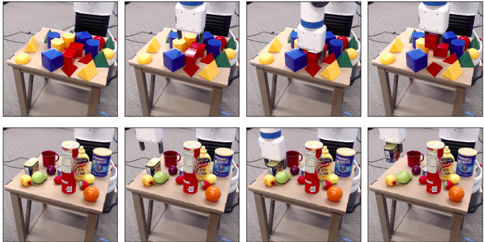
- The pipeline enabled a Fetch robot to detect and pick up the target object in 38 out of 40 trials in increasingly cluttered scenes, and a detector trained on a Spam can succeeded in 9 of 10 trials with previously unseen YCB food distractors.
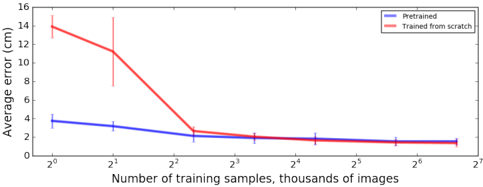
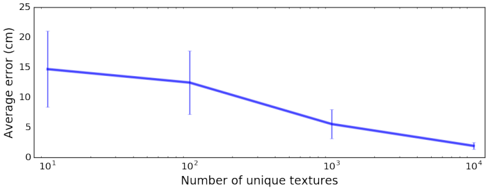
- Ablations found sensitivity to number of training images, number of unique textures, presence of distractors in training, and camera randomization; random noise had negligible effect. Performance improved up to around 50,000 training samples, and degraded significantly with fewer than 1,000 textures.
- ImageNet pretraining was not essential with enough data: random weight initialization achieved nearly the same real-world transfer performance as pretrained initialization, though pretraining helped in the low-data regime.
Methods
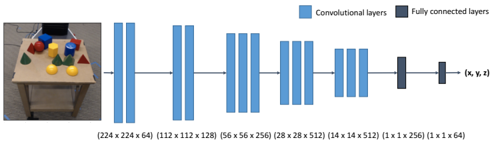
- The authors trained a modified VGG-16 convolutional neural network to map a single 224×224 monocular webcam image to Cartesian coordinates of object(s) of interest, using simulated images rendered by MuJoCo.
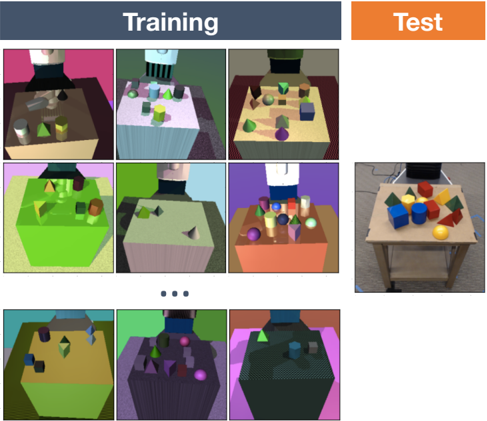
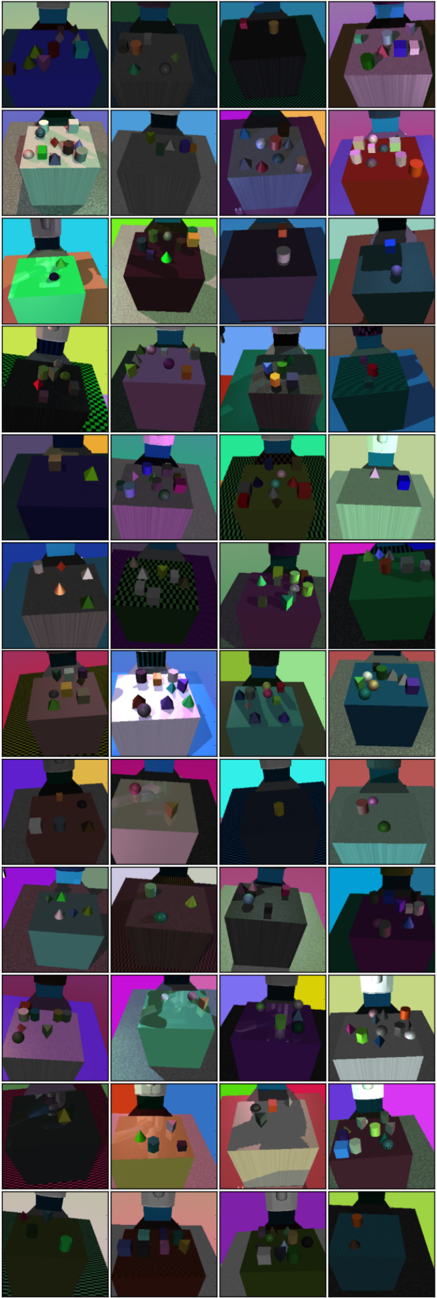
- Domain randomization varied number/shape of distractors, object positions and textures, table/floor/skybox/robot textures, camera position/orientation/field of view, number and properties of lights, and image noise. Textures were random RGB values, gradients, or checker patterns; 0–10 distractor objects were added per scene.
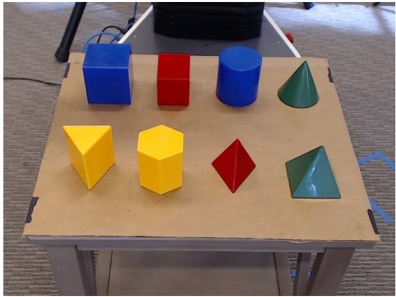
- Training used stochastic gradient descent with Adam on an L2 loss, learning rates around 1e-4, and batch sizes of 25, 50, or 100. Evaluation used 480 webcam images of eight geometric objects at 70–105 cm from a fixed camera, with 60 labeled images per object: 20 alone, 20 with distractors, and 20 partially occluded.
Limitations
- The paper states that the detectors still overfit simulated training data: simulated error was 0.3–0.5 cm versus about 1.5 cm in the real world, and no real-world validation could be done during training because no real data were assumed available.
- The paper states future work is needed for contact-rich manipulation or higher precision, and that the method fixes table height, effectively making the task 2D pose estimation from a single monocular uncalibrated camera.
- Evident from the text: evaluation is limited to eight geometric objects plus one Spam can, the test camera position remains constant across all images, and lighting and surrounding scene were not controlled.
Model-written summary. Check it against the paper before relying on it.
Integrity signals
Registry
Cites
Statistics
Figures
Verification
Claims the paper makes
2 Valid · 8 Not valid · 7 Not checked · 32 Own results and interpretations
The cited sources support only part of this claim — read each source’s verdict below.
In the paper
“Although previous work demonstrated the ability to perform robotic control using a neural network pretrained on ImageNet and fine-tuned on randomized rendered pixels [37], this paper provides the first demonstration that domain randomization can be useful for robotic tasks requiring precision.”
What the sources say
- Partly supportedcites [37] [37] Fereshteh Sadeghi and Sergey Levine. (cad) 2 RL: Real single-image flight without a single real image. arXiv preprint arXiv:1611.04201 , 2016. - sourceExperimental — accuracy not yet measured
The citation [37] is attached to the preceding claim about prior work, not to the citing authors’ claim that their own paper is the first to demonstrate precision robotics. Section 3.1 (p. 4) says LSDA pretrains a CNN on ImageNet classification data and fine-tunes it, but for object detection. It does not report robotic control or fine-tuning on randomized rendered pixels. (LLM, conf=0.84)
boostedstates a cause- Asserted: passes — The authors put it forward as true.
- Checkable: passes — It can be checked against evidence.
- Load-bearing: passes — The paper’s conclusions depend on it.
- Based: passes — The paper gives a reason why it holds.
- Partly supported
The cited sources that could be checked couldn’t confirm or dispute this claim.
In the paper
“Rather than relying on controller robustness, Yu et al. [53] use a model trained on varied physics to perform system identification using online trajectory data, but their approach is not shown to succeed in the real world.”
What the sources say
- Could not verifycites [53] [53] Wenhao Yu, C Karen Liu, and Greg Turk. Preparing for the unknown: Learning a universal policy with online system identification. arXiv preprint arXiv:1702.02453 , 2017. - sourceExperimental — accuracy not yet measured
The cited paper discusses image classification and localisation with convolutional networks (A.1, p. 10; A.2, p. 11), not Yu et al.'s approach. Searches for varied-physics training, online trajectory-based system identification, and real-world success found no passage addressing the claim. Our copy therefore cannot verify it. (LLM, conf=0.78)
plain- Asserted: passes — The authors put it forward as true.
- Checkable: passes — It can be checked against evidence.
- Load-bearing: unclear — It is unclear whether the paper’s conclusions depend on it.
- Based: passes — The paper gives a reason why it holds.
- Could not verify
The cited sources that could be checked couldn’t confirm or dispute this claim.
In the paper
“Though using realistic RGB rendering alone has had limited success for transferring to real robotic tasks [16], incorporating realistic simulation of depth information can allow models trained on rendered images to transfer reasonably well to the real world [32].”
What the sources say
- Could not verifycites [16] [16] Stephen James and Edward Johns. 3d simulation for robot arm control with deep q-learning. arXiv preprint arXiv:1609.03759 , 2016. - sourceExperimental — accuracy not yet measured
The Introduction (§1) and Conclusion (§8) describe Adam as a method for stochastic optimization, while the CNN experiment (§6.3) concerns training on image datasets. Searches for realistic RGB rendering and sim-to-real robotic transfer found no passage addressing whether RGB rendering alone has had limited success on real robotic tasks. (LLM, conf=0.78)
plain- Asserted: passes — The authors put it forward as true.
- Checkable: passes — It can be checked against evidence.
- Load-bearing: passes — The paper’s conclusions depend on it.
- Based: passes — The paper gives a reason why it holds.
- Could not verify
The cited sources that could be checked couldn’t confirm or dispute this claim.
In the paper
“However, their experiments - collision avoidance in hallways and open spaces - do not demonstrate the ability to deal with high-precision tasks.”
What the sources say
- Could not verifycites [37] [37] Fereshteh Sadeghi and Sergey Levine. (cad) 2 RL: Real single-image flight without a single real image. arXiv preprint arXiv:1611.04201 , 2016. - sourceExperimental — accuracy not yet measured
The Experiments section (p. 5) evaluates LSDA on an object-detection dataset, not Sadeghi and Levine’s collision-avoidance experiments. Searches for Sadeghi and Levine, hallway or open-space collision avoidance, and high-precision tasks found no passage addressing the claim. (LLM, conf=0.76)
plain- Asserted: passes — The authors put it forward as true.
- Checkable: passes — It can be checked against evidence.
- Load-bearing: passes — The paper’s conclusions depend on it.
- Based: passes — The paper gives a reason why it holds.
- Could not verify
A result the paper reports from its own data — it cites no other source for it, so there is none to check. The quote shows it is in the paper.
In the paper
“However, using a pre-trained model can significantly improve performance when less training data is used.”
plainstates a cause- Asserted: passes — The authors put it forward as true.
- Checkable: passes — It can be checked against evidence.
- Load-bearing: unclear — It is unclear whether the paper’s conclusions depend on it.
- Based: passes — The paper gives a reason why it holds.
29 more claims
Create a free account to see all 49 claims and to verify the 7 references still open.
- Probably not a substantial claim. 11
- It may state two separate claims as one. 8
Claims other papers make about this one
Each is checked against this paper’s own text: does it say what the citing paper says it does?
The source backs part of the claim, not all of it — or backs it for a different population, condition or comparison.
In the citing paper
“Most policies trained in simulation generalize poorly to the real-world due to agents adapting to specific visual details of the simulator.”
From Language-Based Augmentation to Address Shortcut Learning in Object-Goal Navigation (2023) · cites this paper as [8]
Experimental — accuracy not yet measuredThe source backs part of the claim, not all of it — or backs it for a different population, condition or comparison.
In the citing paper
“In robotic vision tasks including object localization [53], object detection [54], pose estimation [55], and semantic segmentation [56], the training data from simulator always have different textures, lighting, and camera positions from the realistic environments.”
From Sim-to-Real Transfer in Deep Reinforcement Learning for Robotics: a Survey (2020) · cites this paper as [53]
Experimental — accuracy not yet measuredThe source backs part of the claim, not all of it — or backs it for a different population, condition or comparison.
In the citing paper
“These artifacts limit the applicability of generative videos in physics-sensitive domains such as robotics [25,26], autonomous driving [27], simulationbased design, and scientific visualization [28].”
From PhyStruct-Video: Structured Physics State Spaces for Physically Consistent Video Generation (2025) · cites this paper as [25]
Experimental — accuracy not yet measuredThe source backs part of the claim, not all of it — or backs it for a different population, condition or comparison.
In the citing paper
“In domain randomization, the inputs during learning are “randomized” in the sense of being warped or corrupted in particular ways.”
From The overfitted brain: Dreams evolved to assist generalization (2021) · cites this paper as [144]
Experimental — accuracy not yet measuredThe source backs part of the claim, not all of it — or backs it for a different population, condition or comparison.
In the citing paper
“Domain randomization is a domain generalization technique that introduces drastic changes in the training image appearances, which forces the network to learn domain-invariant features between training and target domains [39].”
From A Fully Differentiable Framework for 2D/3D Registration and the Projective Spatial Transformers (2024) · cites this paper as [39]
Experimental — accuracy not yet measured
8 more claims about this paper
Create a free account to see every claim other papers make about this one.
Self-check
Percentages, sums and reported differences re-computed from the paper’s own numbers.
Each contradiction between two passages listed here was confirmed by an independent check.
Rated minor: it would not touch a result — a value no result rests on, a p-value that stays on the same side of the significance level, or a conflict that is clerical, resolved elsewhere in the paper, or outside its own findings.
In the paper
§ A. Experimental Setup · p. 4
“Each training sample consists of (a) a rendered image of the object and one or more distractors (also from among the geometric object set) on a simulated tabletop”
§ A. Domain randomization · p. 4
“Between 0 and 10 distractor objects are added to the table in each scene.”
Citations
Cites
Very Deep Convolutional Networks for Large-Scale Image Recognition
Simonyan, K., & Zisserman, A. (2014) · arXiv · doi:10.48550/arxiv.1409.1556 · Cited by 114,148 · cited 1×
“In particular, we use a modified version the VGG-16 architecture [42] shown in Figure 2.”
MethodAdam: A Method for Stochastic Optimization
Kingma, D. P., & Ba, J. (2014) · arXiv · doi:10.48550/arxiv.1412.6980 · Cited by 98,946 · cited 1×
“We found that using a learning rate of around 1e − 4 (as opposed to the standard 1e − 3 for Adam) improved convergence and helped avoid a common local optimum, mapping all objects to the center of the table.”
MethodLeCun, Y., Bengio, Y., & Hinton, G. (2015) · Nature · doi:10.1038/nature14539 · Cited by 84,126
Human-level control through deep reinforcement learning
Mnih, V., Kavukcuoglu, K., Silver, D., Rusu, A. A., Veness, J., Bellemare, M. G., Graves, A., Riedmiller, M., Fidjeland, A. K., Ostrovski, G., et al. (2015) · Nature · doi:10.1038/nature14236 · Cited by 30,357 · cited 3×
“Learning in simulation is especially promising for building on recent results using deep reinforcement learning to achieve human-level performance on tasks like Atari [27] and robotic control [21], [38].”
BackgroundResultHow transferable are features in deep neural networks?
Yosinski, J., Clune, J., Bengio, Y., & Lipson, H. (2014) · arXiv · doi:10.48550/arxiv.1411.1792 · Cited by 6,061 · cited 1×
“A variety of approaches have been proposed, including re-training the model in the target domain (e.g., [52]), adapting the weights of the model based on the statistics of the source and target domains (e.g., [22]), learning invariant features between domains (e.g., [47]), and learning a mapping…”
BackgroundMuJoCo: A physics engine for model-based control
Todorov, E., Erez, T., & Tassa, Y. (2012) · 2012 IEEE/RSJ International Conference on Intelligent Robots and Systems · doi:10.1109/iros.2012.6386109 · Cited by 4,767 · cited 1×
“We render images using the MuJoCo Physics Engine’s [45] built-in renderer.”
MethodTrust region policy optimization
Schulman, J., Levine, S., Moritz, P., Jordan, M. I., & Abbeel, P. (2015) · arXiv · doi:10.48550/arxiv.1502.05477 · Cited by 4,578 · cited 1×
“Learning in simulation is especially promising for building on recent results using deep reinforcement learning to achieve human-level performance on tasks like Atari [29] and robotic control [26], [41].”
ResultSelf-citationLearning Transferable Features with Deep Adaptation Networks
Long, M., Cao, Y., Wang, J., & Jordan, M. I. (2015) · arXiv · doi:10.48550/arxiv.1502.02791 · Cited by 4,505 · cited 1×
“omputer vision community has devoted significant study to the problem of adapting vision-based models trained in a source domain to a previously unseen target domain (see, e.g., [9], [14], [15], [19], [23], [25], [51]). A variety of approaches have been proposed, including re-training the model in the target domain (e.…”
BackgroundEnd-to-End Training of Deep Visuomotor Policies
Levine, S., Finn, C., Darrell, T., et al. (2015) · Journal of machine learning research · doi:10.5555/2946645.2946684 · Cited by 3,987
Describing Textures in the Wild
Cimpoi, M., Maji, S., Kokkinos, I., Mohamed, S., & Vedaldi, A. (2014) · 2014 IEEE Conference on Computer Vision and Pattern Recognition · doi:10.1109/cvpr.2014.461 · Cited by 2,438 · cited 1×
“To examine how our detectors would perform on objects with complex textures, we created simulated scenes in which the object of interest is given a texture from the Describable Textures Dataset (DTD) [4].”
Method
Research works printed but not linked: 3
- [24] David G Lowe. Three-dimensional object recognition from single two-dimensional images. Artificial intelligence , 31(3):355-395, 1987. -
- [49] Melonee Wise, Michael Ferguson, Derek King, Eric Diehr, and David Dymesich. Fetch and freight: Standard platforms for service robot applications. In Workshop on Autonomous Mobile Service Robots , 2016. -
- sucan, 0, MoveIt!
Cited by
Items 801–900 of 2,970
Sim2Real Instance-Level Style Transfer for 6D Pose Estimation
Ikeda, T., Tanishige, S., Amma, A., Sudano, M., Audren, H., & Nishiwaki, K. (2022) · IEEE/RSJ International Conference on Intelligent Robots and Systems (IROS) · doi:10.1109/iros47612.2022.9981878 · Cited by 24
“For DR, several methods [6], [13], [14], [15] are proposed.”
MethodDAPPER: Label-Free Performance Estimation after Personalization for Heterogeneous Mobile Sensing
Gong, T., Kim, Y., Orzikulova, A., Liu, Y., Hwang, S. J., Shin, J., & Lee, S.-J. (2023) · Proceedings of the ACM on Interactive Mobile Wearable and Ubiquitous Technologies · doi:10.1145/3596256 · Cited by 23
“Our data generation methodology is inspired by the principle of domain randomization, postulating that the disparities between source and target domains could be represented as variations within the source domain [55, 75].”
MethodDomain adaptive Sim-to-Real segmentation of oropharyngeal organs
Wang, G., Ren, T.-A., Lai, J., Bai, L., & Ren, H. (2023) · Medical & Biological Engineering & Computing · doi:10.1007/s11517-023-02877-0 · Cited by 16
Liebers, C., Prochazka, M., Pfützenreuter, N., et al. (2023) · International Journal of Human-Computer Interaction · doi:10.1080/10447318.2023.2238945 · Cited by 16
“Such, they allow constructing various training environments from a set of reconstructed objects by randomizing their properties such as location or orientation (Tobin et al., 2017).”
BackgroundModel Barrier: A Compact Un-Transferable Isolation Domain for Model Intellectual Property Protection
Wang, L., Wang, M., Zhang, D., & Fu, H. (2023) · IEEE Computer Society Conference on Computer Vision and Pattern Recognition/Proceedings - IEEE Computer Society Conference on Computer Vision and Pattern Recognition/Proceedings · doi:10.1109/cvpr52729.2023.01961 · Cited by 30
“[31] used domain randomization to generate more training data from simulated environments for generalization in real environments.”
MethodLearning Robotic Powder Weighing from Simulation for Laboratory Automation
Kadokawa, Y., Hamaya, M., & Tanaka, K. (2023) · IEEE/RSJ International Conference on Intelligent Robots and Systems (IROS) · doi:10.1109/iros55552.2023.10342463 · Cited by 26
“The trained policies by DR can be transferred to a single [24, 25], or several real-robot environments [10, 26, 27].”
BackgroundBridging the simulation-to-real gap of depth images for deep reinforcement learning
Jang, Y., Baek, J., Jeon, S. J., & Han, S. (2024) · Expert Systems with Applications · doi:10.1016/j.eswa.2024.124310 · Cited by 19
SplatSim: Zero-Shot Sim2Real Transfer of RGB Manipulation Policies Using Gaussian Splatting
Qureshi, M. N., Garg, S., Yandún, F., Held, D., Kantor, G. A., & Silwal, A. (2025) · Proceedings - IEEE International Conference on Robotics and Automation/Proceedings · doi:10.1109/icra55743.2025.11128339 · Cited by 114
“Embodied Gaussians [47] directly learns a forward model for robot-object interactions, requiring real-world data for each new robot and object, while we offload dynamics to a physics engine and focus on RGB-based policy deployment.”
VQA With No Questions-Answers Training
Vatashsky, B.-Z., & Ullman, S. (2020) · IEEE Computer Society Conference on Computer Vision and Pattern Recognition/Proceedings - IEEE Computer Society Conference on Computer Vision and Pattern Recognition/Proceedings · doi:10.1109/cvpr42600.2020.01039 · Cited by 19
RoboNet: Large-Scale Multi-Robot Learning
Dasari, S., Ebert, F., Tian, S., Nair, S., Bucher, B., Schmeckpeper, K., Singh, S., Levine, S., & Finn, C. (2019) · Digital Eprints Services at ISB (DESI) (Indian School of Business) · doi:10.48550/arxiv.1910.11215 · Cited by 16
“A number of works have studied learning representations and policies that transfer across domains, including transfer from simulation to the real world [1, 33, 34], transfer across different dynamics [35, 36, 37, 2], transfer across robot morphologies with invariant feature spaces [38] and modularity [39], transfer ac…”
BackgroundTRASS: Time Reversal as Self-Supervision
Nair, S., Babaeizadeh, M., Finn, C., Levine, S., & Kumar, V. (2020) · Proceedings - IEEE International Conference on Robotics and Automation/Proceedings · doi:10.1109/icra40945.2020.9196862 · Cited by 26
“These methods have also been shown to work well when trained in simulation with domain randomization and transferred to a physical robot [3], [19], [20] , a strategy which we use in our method.”
MethodDomain randomization-enhanced deep learning models for bird detection
Mao, X., Chow, J. K., Tan, P. S., Liu, K.-F., Wu, J., Su, Z., Cheong, Y. H., Ooi, G. L., Pang, C. C., & Wang, Y.-H. (2021) · Scientific Reports · doi:10.1038/s41598-020-80101-x · Cited by 20
“For example, domain randomization with synthetic data helps to train robotic manipulation for grasping specific objects 43 and for learning collision avoidance 44 and gets promising results.”
BackgroundCausal Reasoning in Simulation for Structure and Transfer Learning of Robot Manipulation Policies
Lee, T. E., Zhao, J. A., Sawhney, A. S., Girdhar, S., & Kroemer, O. (2021) · Proceedings - IEEE International Conference on Robotics and Automation/Proceedings · doi:10.1109/icra48506.2021.9561439 · Cited by 50
“Sim-to-real learning is often combined with domain randomization (DR) [5], which involves training the skill on a wide range of task instances in simulation such that the resulting skill is more robust and generalizes across task variations.”
BackgroundOta, K., Jha, D. K., Romeres, D., van Baar, J., Smith, K. A., Semitsu, T., Oiki, T., Sullivan, A., Nikovski, D. N., & Tenenbaum, J. B. (2021) · IEEE Robotics and Automation Letters · doi:10.1109/lra.2021.3068887 · Cited by 23
“However, these simulators still cannot model or represent the physical system accurately enough for control, and this has driven a lot of work in the area of sim-to-real transfer [18], [19].”
BackgroundData-Efficient Framework for Real-World Multiple Sound Source 2d Localization
Moing, G. L., Vinayavekhin, P., Agravante, D. J., Inoue, T., Vongkulbhisal, J., Munawar, A., & Tachibana, R. (2021) · IEEE International Conference on Acoustics Speech and Signal Processing · doi:10.1109/icassp39728.2021.9413695 · Cited by 23
“Method S+ uses domain randomization [24] by using TrainS+ instead of TrainS in method S.”
MethodComputing operation procedures for chemical plants using whole-plant simulation models
Kubosawa, S., Onishi, T., & Tsuruoka, Y. (2021) · Control Engineering Practice · doi:10.1016/j.conengprac.2021.104878 · Cited by 15
Learning Urban Driving Policies using Deep Reinforcement Learning
Agarwal, T., Arora, H., & Schneider, J. (2021) · IEEE International Conference on Intelligent Transportation Systems (ITSC) · doi:10.1109/itsc48978.2021.9564412 · Cited by 25
Self-citationGrando, R. B., de Jesus, J. C., Kich, V. A., Kolling, A. H., Pinheiro, P. M., Guerra, R. D. S., & Drews, P. (2022) · Latin American Robotics Symposium, Brazilian Symposium on Robotics and Workshop on Robotics in Education (LARS/SBR/WRE) · doi:10.1109/lars/sbr/wre56824.2022.9995813 · Cited by 18
“For more traditional types of vehicles, several works have been published demonstrating how efficiently Deep-RL can solve the mapless navigation problem [18].”
BackgroundGrasping virtual fish: A step towards robotic deep learning from demonstration in virtual reality
Dyrstad, J. S., & Mathiassen, J. R. (2017) · IEEE International Conference on Robotics and Biomimetics (ROBIO) · doi:10.1109/robio.2017.8324578 · Cited by 18
“learning already has proven itself capable in transfer learning to the real world, as long as domain randomization is realistic [15].”
BackgroundNiu, H., Hu, J., Cui, Z., & Zhang, Y. (2021) · International Conference on Computer Science and Application Engineering (CSAE) · doi:10.1145/3487075.3487177 · Cited by 24
“The policy parameter θ is trained to maximize the expected reward average across a distribution of configurations: θ∗ = arg max θ Eξ∼Ξ [ Eπθ ,τ∼eξ [R (τ )] ] (1) Peng et al. [12] master a good understanding of the essence: Discrepancies between the Source and Target Domains are modeled as variability in the Source Dom…”
BackgroundInfluentialVR-Goggles for Robots: Real-to-sim Domain Adaptation for Visual ControlPreprint
Zhang, J., Tai, L., Yun, P., et al. (2018) · arXiv (Cornell University) · doi:10.48550/arxiv.1802.00265 · Cited by 16
Danielczuk, M., Matl, M., Gupta, S., Li, A. C., Lee, A., Mahler, J., & Goldberg, K. Y. (2018) · arXiv (Cornell University) · Cited by 18
Tay, Y., Wang, S., Tuan, L. A., Fu, J., Phan, M. C., Yuan, X., Rao, J., Hui, S. C., & Zhang, A. (2019) · arXiv (Cornell University) · doi:10.48550/arxiv.1905.10847 · Cited by 15
“train our models with diverse views of the same story which is inspired by domain randomization (Tobin et al., 2017).”
BackgroundResultInfluentialSituational Fusion of Visual Representation for Visual NavigationPreprint
Shen, B., Xu, D., Zhu, Y., Guibas, L. J., Fei-Fei, L., & Savarese, S. (2019) · arXiv (Cornell University) · doi:10.48550/arxiv.1908.09073 · Cited by 12
“A series of methods have been developed to improve the generalization of policy learning towards novel visual observations [36], noisy environment dynamics [23, 30], and new task instances [31, 41].”
BackgroundRobust and Generalizable Visual Representation Learning via Random ConvolutionsPreprint
Xu, Z., Liu, D., Yang, J., Raffel, C., & Niethammer, M. (2020) · arXiv (Cornell University) · doi:10.48550/arxiv.2007.13003 · Cited by 268
“As the training data in [32] is synthesized in a virtual environment, it is possible to generate diverse training samples by randomly selecting background images, colors, lighting, and textures of foreground objects.”
BackgroundMethodA Survey of Data Augmentation in Domain Generalization
Zhong, Y., Zhou, W., & Wang, Z. (2025) · Neural Processing Letters · doi:10.1007/s11063-025-11747-9 · Cited by 33
Self-Adapting Recurrent Models for Object Pushing from Learning in Simulation
Lin, C., Grner, M., Ruppel, P., Liang, H., Hendrich, N., & Zhang, J. (2020) · IEEE/RSJ International Conference on Intelligent Robots and Systems (IROS) · doi:10.1109/iros45743.2020.9341076 · Cited by 24
“Performing robotic learning in simulation has recently become especially promising for reaching human-level performance in various tasks such as tool use [12], object localization [18] and games like Atari [20].”
BackgroundLi, M., Jie, Y., Kong, Y., & Cheng, H. (2022) · Proceedings - IEEE International Conference on Robotics and Automation/Proceedings · doi:10.1109/icra46639.2022.9812163 · Cited by 22
“We use the domain randomization technique [30] in order to avoid overfitting and bridge the sim-to-real gap.”
MethodSynthetic Data for Multi-Parameter Camera-Based Physiological Sensing
McDuff, D., Liu, X., Hernandez, J., Wood, E., & Baltrušaitis, T. (2021) · Annual International Conference of the IEEE Engineering in Medicine and Biology Society (EMBC) · doi:10.1109/embc46164.2021.9631031 · Cited by 23
“[25], [26], [27], [28], [29], [30], [7], [5], [8], [4], [6].”
Few-leaf Learning: Weed Segmentation in Grasslands
Güldenring, R., Boukas, E., Ravn, O., & Nalpantidis, L. (2021) · IEEE/RSJ International Conference on Intelligent Robots and Systems (IROS) · doi:10.1109/iros51168.2021.9636770 · Cited by 21
“Domain Randomization [24], [25] as well as Domain”
MethodLearning-Based Fabric Folding and Box Wrapping
Wang, X., Zhao, J., Jiang, X., & Liu, Y. (2022) · IEEE Robotics and Automation Letters · doi:10.1109/lra.2022.3158434 · Cited by 19
AKAGAWA, T., & Sakaino, S. (2022) · IEEJ Journal of Industry Applications · doi:10.1541/ieejjia.22002155 · Cited by 17
Josifovski, J., Malmir, M., Klarmann, N., Žagar, B. L., Navarro-Guerrero, N., & Knoll, A. (2022) · IEEE/RSJ International Conference on Intelligent Robots and Systems (IROS) · doi:10.1109/iros47612.2022.9981951 · Cited by 34
“As matching and correctly simulating all relevant realworld phenomena for a robotic task is often complicated to achieve, other approaches [20], [12], [21], [22] rely on randomization of the critical simulation parameters during model training to increase model robustness and minimize the effects of the mismatch betwe…”
BackgroundMethodInfluentialTang, H., & Jia, K. (2023) · IEEE Computer Society Conference on Computer Vision and Pattern Recognition/Proceedings - IEEE Computer Society Conference on Computer Vision and Pattern Recognition/Proceedings · doi:10.1109/cvpr52729.2023.01531 · Cited by 36
“We admit that such a study has been done for detection and scene understanding in prior methods [62, 79, 81], but the generalizability of those results to image classification is lack of guarantee.”
BackgroundMethodInfluentialSpaceHopper: A Small-Scale Legged Robot for Exploring Low-Gravity Celestial Bodies
Spiridonov, A., Buehler, F., Berclaz, M., Schelbert, V., Geurts, J., Krasnova, E., Steinke, E., Toma, J., Wuethrich, J., Polat, R., et al. (2024) · Proceedings - IEEE International Conference on Robotics and Automation/Proceedings · doi:10.1109/icra57147.2024.10610057 · Cited by 36
“To transfer the policies to the real robot, we employ domain randomization [38] of the robot’s link masses, the center of mass, DOF frictions, and P&D-Gains.”
MethodCyberDemo: Augmenting Simulated Human Demonstration for Real-World Dexterous Manipulation
Wang, J., Qin, Y., Kuang, K., Korkmaz, Y., Gurumoorthy, A., Su, H., & Wang, X. (2024) · IEEE Computer Society Conference on Computer Vision and Pattern Recognition/Proceedings - IEEE Computer Society Conference on Computer Vision and Pattern Recognition/Proceedings · doi:10.1109/cvpr52733.2024.01700 · Cited by 48
“By pre-training in simulated environments, the manipulation policy can better generalize to new objects with novel geometries and contact patterns.”
Udupa, S., Gurunath, P., Sikdar, A., & Sundaram, S. (2024) · IEEE Computer Society Conference on Computer Vision and Pattern Recognition/Proceedings - IEEE Computer Society Conference on Computer Vision and Pattern Recognition/Proceedings · doi:10.1109/cvpr52733.2024.00564 · Cited by 33
“Data Augmentation and Domain Randomization Data augmentation and domain randomization [40] techniques are used to expand the training data for better generalization.”
MethodLi, D., & Okhrin, O. (2024) · Communications Engineering · doi:10.1038/s44172-024-00292-3 · Cited by 25
da Silva, M. A. F. M., Seoane, A., Mures, O. A., López, A. M., & Iglesias-Guitián, J. A. (2025) · The Visual Computer · doi:10.1007/s00371-025-03811-1 · Cited by 19
“Domain randomization [34] introduced the idea that randomizing material parameters, among others, could force neural networks to learn the essential features of the objects of interest.”
Learning Robust Task Priorities of QP-Based Whole-Body Torque-Controllers
Charbonneau, M., Modugno, V., Nori, F., Oriolo, G., Pucci, D., & Ivaldi, S. (2018) · IEEE-RAS International Conference on Humanoid Robots (Humanoids) · doi:10.1109/humanoids.2018.8624995 · Cited by 17
“This approach can benefit from domain randomization (DR) [14], which consists in randomizing some aspects of the simulation to enrich the range of possible environments experienced by the learner.”
BackgroundDeep unsupervised state representation learning with robotic priors: a robustness analysis
Lesort, T., Seurin, M., Li, X., Díaz-Rodríguez, N., & Filliat, D. (2019) · International Joint Conference on Neural Networks (IJCNN) · doi:10.1109/ijcnn.2019.8852042 · Cited by 18
“• Dataset 4: Colorful75: We added domain randomization [2], [3], i.”
BackgroundMethodBlendTorch: A Real-Time, Adaptive Domain Randomization Library
Heindl, C., Brunner, L., Zambal, S., & Scharinger, J. (2021) · Lecture notes in computer science · doi:10.1007/978-3-030-68799-1_39 · Cited by 24
“[8] as well as Sadeghi et al.”
Calibration-Free Monocular Vision-Based Robot Manipulations With Occlusion Awareness
Luo, Y., Dong, K., Zhao, L., Sun, Z., Cheng, E., Kan, H., Zhou, C. Q., & Song, B. (2021) · IEEE Access · doi:10.1109/access.2021.3082947 · Cited by 20
“In [3], a detector that based on the VGG-16 [42] has been trained to regress 3D Cartesian coordinates of the target object.”
BackgroundMethodInfluentialSedov, E. V., Freire, P. J., Seredin, V. V., Kolbasin, V. A., Kamalian-Kopae, M., Chekhovskoy, I. S., Turitsyn, S. K., & Prilepsky, J. E. (2021) · Scientific Reports · doi:10.1038/s41598-021-02252-9 · Cited by 16
Context is Everything: Implicit Identification for Dynamics Adaptation
Evans, B., Thankaraj, A., & Pinto, L. (2022) · Proceedings - IEEE International Conference on Robotics and Automation/Proceedings · doi:10.1109/icra46639.2022.9812119 · Cited by 51
What Matters For Meta-Learning Vision Regression Tasks?
Gao, N., Ziesche, H., Vien, N. A., Volpp, M., & Neumann, G. M. (2022) · IEEE Computer Society Conference on Computer Vision and Pattern Recognition/Proceedings - IEEE Computer Society Conference on Computer Vision and Pattern Recognition/Proceedings · doi:10.1109/cvpr52688.2022.01436 · Cited by 35
“For ShapeNet2D, we additionally employ DR [37] by regenerating background images for all training data after every 2k training iterations while the data used for evaluation remain the same.”
Sim-to-Real Transfer of Robotic Assembly with Visual Inputs Using CycleGAN and Force Control
Yuan, C., Shi, Y., Feng, Q., Chang, C., Liu, M., Chen, Z., Knoll, A., & Zhang, J. (2022) · IEEE International Conference on Robotics and Biomimetics (ROBIO) · doi:10.1109/robio55434.2022.10011878 · Cited by 21
“DR helps the trained policy to adapt to different dynamics and generalize to dynamics of the real world [5], allowing the randomization of parameters for visual or pixel-based inputs such as lighting and textures [33].”
BackgroundDeffayet, R., Thonet, T., Renders, J.-M., & de Rijke, M. (2022) · ACM SIGIR Forum · doi:10.1145/3582900.3582905 · Cited by 30
“On top of building simulators from real data, some approaches aim to bridge the gap between simulation and reality, for example with domain randomization [Tobin et al., 2017; OpenAI et al., 2020].”
BackgroundYang, P., Liu, H., Roznere, M., & Li, A. Q. (2023) · Springer proceedings in advanced robotics · doi:10.1007/978-3-031-25555-7_7 · Cited by 20
End-to-End Deep Learning for Robotic Following
Pierre, J. M. (2018) · International Conference on Mechatronics Systems and Control Engineering (ICMSCE) · doi:10.1145/3185066.3185084 · Cited by 14
“In addition, in order to learn how to deal with situations where real-world data collection with enough diversity may be not be feasible, it would be interesting to explore deep learning techniques beyond supervised learning such as unsupervised domain adaptation [21], domain randomization [22], and dynamics randomiza…”
BackgroundSynthetically Trained 3D Visual Tracker of Underwater Vehicles
Koreitem, K., Li, J., Karp, I., Manderson, T., Shkurti, F., & Dudek, G. (2018) · MTS/IEEE OCEANS Conference (OCEANS) · doi:10.1109/oceans.2018.8604597 · Cited by 17
“A variety of object representations have been tried, including 3D object centroid [6], 3D bounding box [21], 3D skeleton [22], and CAD model instances retrieved from a database [23].”
BackgroundMethodData-Augmented Contact Model for Rigid Body SimulationPreprint
Jiang, Y., Sun, J., & Liu, C. K. (2018) · arXiv (Cornell University) · doi:10.48550/arxiv.1803.04019 · Cited by 19
“Besides building a more realistic simulation, domain randomization is also a promising approach to sim-to-real transfer [26], [27], [28].”
BackgroundSim2real transfer learning for 3D human pose estimation: motion to the rescuePreprint
Doersch, C., & Zisserman, A. (2019) · arXiv (Cornell University) · doi:10.48550/arxiv.1907.02499 · Cited by 144
Flight Controller Synthesis Via Deep Reinforcement LearningPreprint
Koch, W. (2019) · arXiv (Cornell University) · doi:10.48550/arxiv.1909.06493 · Cited by 31
Learning Dense Visual Correspondences in Simulation to Smooth and Fold Real FabricsPreprint
Ganapathi, A., Sundaresan, P., Thananjeyan, B., et al. (2020) · arXiv (Cornell University) · doi:10.48550/arxiv.2003.12698 · Cited by 15
“Due to the recent success of sim-to-real transfer [30, 43], many recent papers leverage simulation to learn fabric manipulation policies.”
Generalization in Reinforcement Learning by Soft Data AugmentationPreprint
Hansen, N., & Wang, X. (2020) · arXiv (Cornell University) · doi:10.48550/arxiv.2011.13389 · Cited by 15
“An example of the former is random cropping [9], [39], whereas examples of the latter are domain randomization [12], [13] and random convolution [9], [16].”
BackgroundRMA: Rapid Motor Adaptation for Legged Robots
Kumar, A., Fu, Z., Pathak, D., & Malik, J. (2021) · arXiv
“…to the following baselines: 1) A1 Controller: The default robot manufacturer’s controller which uses a force-based control scheme with MPC. 2) Robustness through Domain Randomization (Robust): The base policy is trained without z t to be robust to the variations in the training range [52, 40].”
BackgroundMethodInfluentialOmniLRS: A Photorealistic Simulator for Lunar Robotics
Richard, A., Kamohara, J., Uno, K., Santra, S., van der Meer, D., Olivares-Mendez, M., & Yoshida, K. (2024) · 2024 IEEE International Conference on Robotics and Automation (ICRA) · doi:10.1109/icra57147.2024.10610026 · Cited by 15
“This is crucial for perception tasks since models trained using simulation data can fail to generalize toreal world without accurate modeling [35].”
A Comprehensive Survey of Data Augmentation in Visual Reinforcement Learning
Ma, G., Ding, Z., Yuan, Z., Wang, X., Yuan, B., & Tao, D. (2025) · International Journal of Computer Vision · doi:10.1007/s11263-025-02472-w · Cited by 72
“In addition, this survey does not cover a similar topic named domain randomization (DR) [57, 58], which aims to solve the sim-to-real problem in robot control by tuning the physical simulator’s parameter distribution toward the reality as closely as possible [59].”
Discovering State and Action Abstractions for Generalized Task and Motion Planning
Curtis, A., Silver, T., Tenenbaum, J. B., Lozano‐Pérez, T., & Kaelbling, L. P. (2022) · Proceedings of the AAAI Conference on Artificial Intelligence · doi:10.1609/aaai.v36i5.20475 · Cited by 41
“While some work has been done on finding generalizable policies, these generalization capabilities are limited to visual changes or changes to the dynamics of the simulated environments (Lee et al. 2019; Tobin et al. 2017; Peng et al. 2018).”
BackgroundForce-Vision Sensor Fusion Improves Learning-Based Approach for Self-Closing Door Pulling
Sun, Y., Zhang, L., & Ma, O. (2021) · IEEE Access · doi:10.1109/access.2021.3118594 · Cited by 14
“To ensure the generalization capability of learned policies and bridge the gap between the simulation and the reality, domain randomization [30] is often used.”
BackgroundRetro-RL: Reinforcing Nominal Controller With Deep Reinforcement Learning for Tilting-Rotor Drones
Nahrendra, I. M. A., Tirtawardhana, C., Yu, B., Lee, E. M., & Myung, H. (2022) · IEEE Robotics and Automation Letters · doi:10.1109/lra.2022.3189446 · Cited by 23
“Thus, πRL is trained in the simulation with domain randomization [33], resulting in generalization for a broad spectrum of uncertainties.”
MethodRobot Imitation Learning From Image-Only Observation Without Real-World Interaction
Xu, X., You, M., Zhou, H., Qian, Z., & He, B. (2022) · IEEE/ASME Transactions on Mechatronics · doi:10.1109/tmech.2022.3217048 · Cited by 17
“1) Domain Randomization: Training a model with randomized physical coefficients, such as gravity, friction, and visual texture, through the domain randomization method [30], [31], [32] bridges the model’s gap between the simulator and the”
Dynamic Motion Planning Model for Multirobot Using Graph Neural Network and Historical Information
Li, J., Su, Z., & Qiu, Y. (2023) · Advanced Intelligent Systems · doi:10.1002/aisy.202300036 · Cited by 18
Learning to Assist Bimanual Teleoperation Using Interval Type-2 Polynomial Fuzzy Inference
Wang, Z., Fei, H., Huang, Y., Rouxel, Q., Xiao, B. J., Li, Z., & Burdet, E. (2023) · IEEE Transactions on Cognitive and Developmental Systems · doi:10.1109/tcds.2023.3272730 · Cited by 14
“Different from transfer learning [8], [9], [10], learning from demonstration [11], [12], [13], [14] or human posture prediction in physical human–robot interaction [15], our idea is to generate human–robot assistive control based on the coordination observed in bimanual control or in the…”
Dexterous Manipulation from Images: Autonomous Real-World RL via Substep Guidance
Xu, K., Hu, Z., Doshi, R., Rovinsky, A., Kumar, V., Gupta, A. K., & Levine, S. (2023) · Proceedings - IEEE International Conference on Robotics and Automation/Proceedings · doi:10.1109/icra48891.2023.10161493 · Cited by 36
Multi-View Keypoints for Reliable 6D Object Pose Estimation
Li, A., & Schoellig, A. P. (2023) · Proceedings - IEEE International Conference on Robotics and Automation/Proceedings · doi:10.1109/icra48891.2023.10160354 · Cited by 18
“The depth images are rendered using NxView, a depth camera simulator supplied with the Ensenso camera A total of 500 different scenes are rendered for use as training data, which are cropped around individual object instances and augmented using Domain Randomization [21].”
MethodAHEGC: Adaptive Hindsight Experience Replay With Goal-Amended Curiosity Module for Robot Control
Zeng, H., Zhang, P., Li, F., Lin, C., & Zhou, J. (2023) · IEEE Transactions on Neural Networks and Learning Systems · doi:10.1109/tnnls.2023.3296765 · Cited by 19
“With raw RGB and depth camera images, the CNN was trained for object and target position prediction [47], respectively.”
MethodBlanco–Mulero, D., Alcan, G., Abu‐Dakka, F. J., & Kyrki, V. (2023) · IEEE/RSJ International Conference on Intelligent Robots and Systems (IROS) · doi:10.1109/iros55552.2023.10342002 · Cited by 24
“In addition, to improve the sim-to-real transfer we also perform Domain Randomisation [22] and randomise the internal parameters of the cloth, including the stiffness, mass, size, colour, and initial cloth configuration.”
MethodPark, T. H., & D’Amico, S. (2024) · Proceedings - IEEE International Conference on Robotics and Automation/Proceedings · doi:10.1109/icra57147.2024.10610138 · Cited by 19
“One approach is domain randomization [31], [32] which aims to randomize various aspects of the synthetic images and rendering pipeline so that the target images appear as another randomized instances of the training set.”
BackgroundAutonomous Underwater Vehicle Docking Under Realistic Assumptions Using Deep Reinforcement Learning
Palomeras, N., & Ridao, P. (2024) · Drones · doi:10.3390/drones8110673 · Cited by 14
A systematic review of deep learning applications in database query execution
Miličević, B., & Babovic, Z. B. (2024) · Journal Of Big Data · doi:10.1186/s40537-024-01025-1 · Cited by 37
“The authors investigate the use of reinforcement learning (RL) for join order selection, and their findings indicate that RTOS works better than ReJoin, DQ, and SkinnerDB [74, 94].”
Autonomous Driving Small-Scale Cars: A Survey of Recent Development
Li, D., Auerbach, P., & Okhrin, O. (2025) · IEEE Transactions on Intelligent Transportation Systems · doi:10.1109/tits.2025.3572394 · Cited by 38
“…introduces simulation variability, such as lighting conditions, textures, object appearances, and physics properties to improve robustness [74]; platforms like Duckietown and DeepRacer integrate this for Sim2Real mitigation [6], [32], [75], though excessive randomization risks reducing…”
SADA: Semantic Adversarial Diagnostic Attacks for Autonomous Applications
Hamdi, A., Mueller, M., & Ghanem, B. (2020) · Proceedings of the AAAI Conference on Artificial Intelligence · doi:10.1609/aaai.v34i07.6722 · Cited by 31
“While our analysis is done in simulation only, we would like to highlight that sim-to-real transfer is a very active research field nowadays [35, 40, 41, 42, 46].”
MethodUnsupervised Cross-Modal Alignment for Multi-person 3D Pose Estimation
Kundu, J. N., Revanur, A., Waghmare, G., Venkatesh, R., & Babu, R. V. (2020) · Lecture notes in computer science · doi:10.1007/978-3-030-58601-0_3 · Cited by 18
“Second, along with the Image-to-2D model, one can not expect to be provided with its labeled training dataset owing to proprietary [39,31] or even memory [9,28] constraints.”
BackgroundLearning Affordance Space in Physical World for Vision-based Robotic Object Manipulation
Wu, H., Zhang, Z., Cheng, H., Yang, K., Liu, J., & Guo, Z. (2020) · Proceedings - IEEE International Conference on Robotics and Automation/Proceedings · doi:10.1109/icra40945.2020.9196783 · Cited by 19
“In order to break the gap between simulation and reality, we randomly change the appearance of all models, similar to the method of domain randomization [25], [31], [32].”
BackgroundMethodAdversarial Feature Training for Generalizable Robotic Visuomotor Control
Chen, X., Ghadirzadeh, A., Björkman, M., & Jensfelt, P. (2020) · Proceedings - IEEE International Conference on Robotics and Automation/Proceedings · doi:10.1109/icra40945.2020.9197505 · Cited by 19
Loing, V., Marlet, R., & Aubry, M. (2018) · HAL (Le Centre pour la Communication Scientifique Directe) · Cited by 14
Distributed Reinforcement Learning of Targeted Grasping with Active Vision for Mobile Manipulators
Fujita, Y., Uenishi, K., Ummadisingu, A., Nagarajan, P., Masuda, S., & Castro, M. Y. (2020) · IEEE/RSJ International Conference on Intelligent Robots and Systems (IROS) · doi:10.1109/iros45743.2020.9341605 · Cited by 22
“3) using a dataset of simulated scenes with and without randomization of texture, color, lighting, and camera parameters [29], as shown in Fig.”
MethodReinforcement learning applied to machine vision: state of the art
Hafiz, A. M., Parah, S. A., & Bhat, R. (2021) · International Journal of Multimedia Information Retrieval · doi:10.1007/s13735-021-00209-2 · Cited by 16
A Gamified Simulator and Physical Platform for Self-Driving Algorithm Training and Validation
Παππάς, Γ., Siegel, J. E., Politopoulos, K., & Sun, Y. (2021) · Electronics · doi:10.3390/electronics10091112 · Cited by 17
A Novel Simulation-Reality Closed-Loop Learning Framework for Autonomous Robot Skill Learning
Jiang, R., He, B., Wang, Z., Zhou, Y., Xu, S., & Li, X. (2021) · IEEE Transactions on Cognitive and Developmental Systems · doi:10.1109/tcds.2021.3118294 · Cited by 17
“DR methods add noise to simulated images by randomizing the textures, lighting, cropping, and camera position to make the control policy more robust to environmental differences and more applicable to the real world [22], [23].”
BackgroundWorld-in-the-Loop Simulation for Autonomous Systems Validation
Hildebrandt, C., & Elbaum, S. G. (2021) · Proceedings - IEEE International Conference on Robotics and Automation/Proceedings · doi:10.1109/icra48506.2021.9561240 · Cited by 20
“Second, developers can use multiple and more sophisticated simulators to combine their strengths [27].”
BackgroundFormula-driven Supervised Learning with Recursive Tiling Patterns
Kataoka, H., Matsumoto, A., Yamada, R., Satoh, Y., Yamagata, E., & Inoue, N. (2021) · IEEE International Conference on Computer Vision Workshops · doi:10.1109/iccvw54120.2021.00455 · Cited by 28
“In relation to synthetic image datasets, FDSL is also different from Domain Randomization (e.g., [33, 31]).”
MethodRobust Segmentation of Brain MRI in the Wild with Hierarchical CNNs and No Retraining
Billot, B., Magdamo, C., Arnold, S. E., Das, S., & Iglesias, J. E. (2022) · Lecture notes in computer science · doi:10.1007/978-3-031-16443-9_52 · Cited by 16
Attribute Descent: Simulating Object-Centric Datasets on the Content Level and Beyond
Yao, Y., Zheng, L., Yang, X., Napthade, M., & Gedeon, T. (2023) · IEEE Transactions on Pattern Analysis and Machine Intelligence · doi:10.1109/tpami.2023.3338291 · Cited by 22
“Others manually create their own simulation environments and objects [28], [30], [36], [37], [38], and find it is beneficial to use random attribute within a reasonable range to create random content [4], [39], [40].”
BackgroundSchepper, T. D., Camelo, M., Famaey, J., & Latré, S. (2020) · International Journal of Network Management · doi:10.1002/nem.2100 · Cited by 19
Maneuvering Target Tracking using the Autoencoder-Interacting Multiple Model Filter
Vedula, K., Weiss, M. L., Paffenroth, R. C., Uzarski, J. R., & Brown, D. R. (2020) · Asilomar Conference on Signals, Systems and Computers (ACSSC) · doi:10.1109/ieeeconf51394.2020.9443396 · Cited by 15
“4) Calculates output state and covariance estimates.”
Triyonoputro, J. C., Wan, W., & Harada, K. (2019) · arXiv (Cornell University) · doi:10.48550/arxiv.1902.09157 · Cited by 14
“The loss at the end of epoch 40 for these less varied image categories was also smaller, albeit overfitting existed in all trained networks, similar to [39].”
BackgroundMethodInfluentialCharakorn, R., Thawornwattana, Y., Itthipuripat, S., Pawlowski, N., Manoonpong, P., & Dilokthanakul, N. (2020) · arXiv (Cornell University) · doi:10.48550/arxiv.2001.08957 · Cited by 16
“One way to combat this problem is to have as many variations in the data as possible to help the models disentangle less important variations or nuisance factors from the more important ones, which would allow for better generalisation across tasks and situations [4], [5].”
BackgroundThe Impact of Non-stationarity on Generalisation in Deep Reinforcement LearningPreprint
Igl, M., Farquhar, G., Luketina, J., Böhmer, W., & Whiteson, S. (2020) · arXiv (Cornell University) · Cited by 17
SimNet: Enabling Robust Unknown Object Manipulation from Pure Synthetic Data via StereoPreprint
Kollar, T., Laskey, M., Stone, K., Thananjeyan, B., & Tjersland, M. (2021) · arXiv (Cornell University) · doi:10.48550/arxiv.2106.16118 · Cited by 34
“An alternative is to use simulation to automatically label a large dataset of images [2, 4, 5, 6, 7, 8, 9, 10, 11, 12].”
BackgroundMethodInfluentialSim-to-Real in Reinforcement Learning for Everyone
Vacaro, J., Marques, G., Oliveira, B., Paz, G., Paula, T., Staehler, W., & Murphy, D. (2019) · 2019 Latin American Robotics Symposium (LARS), 2019 Brazilian Symposium on Robotics (SBR) and 2019 Workshop on Robotics in Education (WRE) · doi:10.1109/lars-sbr-wre48964.2019.00060 · Cited by 13
“Domain randomization is a set of techniques to reduce the differences between the simulation environment and the real world [9].”
BackgroundMethodInfluentialPose Estimation for Non-Cooperative Rendezvous Using Neural Networks
Sharma, S., & D'Amico, S. (2019) · arXiv · Cited by 40
“43,44”
Integrating Contact-Aware CPG System for Learning-Based Soft Snake Robot Locomotion Controllers
Liu, X., Onal, C. D., & Fu, J. (2025) · IEEE Transactions on Robotics · doi:10.1109/tro.2025.3539173 · Cited by 14
Controlling diverse robots by inferring Jacobian fields with deep networks
Li, S., Zhang, A., Chen, B., Matusik, H., Liu, C., Rus, D. L., & Sitzmann, V. (2025) · Nature · doi:10.1038/s41586-025-09170-0 · Cited by 37
“We apply domain randomization techniques [53, 54, 55] to the input images during training.”
A Survey on Reinforcement Learning Methods for UAV Systems
Chen, H., Lin, Y., Fu, M., Yao, L., & Sheng, Q. Z. (2025) · ACM Computing Surveys · doi:10.1145/3769426 · Cited by 31
Physical AI: Evolution, Progress, Challenges, and Prospects
Wu, E., Liu, Y., Xu, T., Ren, L.-X., Qin, Y.-M., Wei, M.-Y., He, X., Yuan, D.-Y., Hou, W.-C., Ma, Z.-W., et al. (2026) · Journal of Computer Science and Technology · doi:10.1007/s11390-026-6258-x · Cited by 24
Stochastic Sampling Simulation for Pedestrian Trajectory Prediction
Anderson, C., Du, X., Vasudevan, R., & Johnson‐Roberson, M. (2019) · IEEE/RSJ International Conference on Intelligent Robots and Systems (IROS) · doi:10.1109/iros40897.2019.8967857 · Cited by 27
“In contrast, domain randomization (DR) methods [27], [28] were used to “bridge the gap” between simulation and reality.”
MethodC.DOT - Convolutional Deep Object Tracker for Augmented Reality Based Purely on Synthetic Data
Thiel, K. K., Naumann, F., Jundt, E., Günnemann, S., & Klinker, G. (2021) · IEEE Transactions on Visualization and Computer Graphics · doi:10.1109/tvcg.2021.3089096 · Cited by 14
“Domain Randomization (DR) [28] is a rather exceptional approach that uses a strong data enhancement strategy to create a broadly distributed source domain.”
Background
Metadata
- Authors
- Tobin, J., Fong, R., Ray, A., Schneider, J., Zaremba, W., & Abbeel, P.
- Affiliations
- University of California, Berkeley (US)
- OpenAI (United States) (US)
- International Computer Science Institute (US)
- ORCID
- Abbeel, Pieter
- Venue
- 2017 IEEE/RSJ International Conference on Intelligent Robots and Systems (IROS)
- Publisher
- IEEE
- Published
- 2017-09
- Pages
- 23-30
- ISSN
- 2153-0858 (ISSN-L)
- OpenAlex
- W2605102758
- Semantic Scholar
- 32ceb28e45a445df4d89df281bb0e3ab5aab1a2a
- Cited by
- 3,124
- References
- 69
- Citations by year
- 2026: 413 · 2025: 433 · 2024: 336 · 2023: 403 · 2022: 374 · 2021: 422 · 2020: 352 · 2019: 256 · 2018: 106 · 2017: 25
- FWCI
- 92.18
- Type
- conference paper
- Language
- en
- Open access
- green
- arxiv.org
- Locations
- IEEE/RSJ International Conference on Intelligent Robots and Systems (IROS) (publishedVersion)
- arXiv (Cornell University) (submittedVersion)
- arXiv (Cornell University)
- Topics
- Physical Sciences › Computer Science › Artificial Intelligence › Reinforcement Learning in Robotics
- Physical Sciences › Engineering › Control and Systems Engineering › Robot Manipulation and Learning
- Physical Sciences › Computer Science › Artificial Intelligence › Domain Adaptation and Few-Shot Learning
- Keywords
- domain randomization, sim-to-real transfer, reality gap, object detection, object localization, robotic grasping, cluttered environments, distractor robustness, partial occlusion, robotic manipulation
About these checks
Registry, retraction, Cites and statistics results are computed, not judged, with one exception: a printed reference that no index lists is read once by a model before it counts as a citation error. Claims are extracted by a model and kept only when their quote appears verbatim in the text; each cited source is then checked, with a model’s help, for whether it says what the claim relies on. Those verdicts can be wrong — read the claim’s quote and the cited source before relying on one.
The claim verdicts this report counts are experimental: their accuracy is not yet measured.
A language model drew the claims from the paper on 2026-10-10, under version 3 of the claim definition (model deepseek-v4.1-flash, prompt extract-v3).
A second model labelled each claim on 2026-10-10 (model jev-1.13-20260917, definition revision gold-guideline-v0.2).
Cited sources are checked with a language model’s help (gpt-6-sol).
Statistics and arithmetic are recomputed, not judged.
Confidence bands are shown only for fields calibrated on our annotated test set. None is calibrated yet, so no band is shown.
What counts as a claim ›How we measure confidence ›How we check this ›
Are you an author, or do you see a problem with this page? Request a review
Data sources
Bibliographic data: Semantic Scholar, OpenAlex, Crossref.
Contains information from the Semantic Scholar Academic Graph Datasets, made available under the ODC Attribution License (ODC-BY 1.0).
Semantic Scholar’s data is described in: Kinney, R., et al. (2023). The Semantic Scholar Open Data Platform. arXiv:2301.10140.
