

Domain randomization for transferring deep neural networks from simulation to the real world
Open accessThe DOI matches its Crossref record; 71 of the 71 references it cites were found in a registry or an index; 8 of the 17 sources its claims cite were checked for support.
Abstract
Bridging the `reality gap' that separates simulated robotics from experiments on hardware could accelerate robotic research through improved data availability. This paper explores domain randomization, a simple technique for training models on simulated images that transfer to real images by randomizing rendering in the simulator. With enough variability in the simulator, the real world may appear to the model as just another variation. We focus on the task of object localization, which is a stepping stone to general robotic manipulation skills. We find that it is possible to train a real-world object detector that is accurate to 1.5 cm and robust to distractors and partial occlusions using only data from a simulator with non-realistic random textures. To demonstrate the capabilities of our detectors, we show they can be used to perform grasping in a cluttered environment. To our knowledge, this is the first successful transfer of a deep neural network trained only on simulated RGB images (without pre-training on real images) to the real world for the purpose of robotic control.
Overview
CoChat Summary
TL;DR
This paper introduces domain randomization: training an object detector on simulated RGB images with randomized rendering, textures, lighting, camera pose, and distractors so that the real world appears as another variation. The authors show that a detector trained only in simulation can localize objects in the real world accurately enough to grasp them in clutter.
Key findings
- Real-world object detectors trained only on simulated images localized objects to within about 1.5 cm on average, including with distractors and partial occlusions; per-object errors in Table I range from 0.6 ± 0.3 cm to 3.2 ± 5.8 cm depending on object and condition.
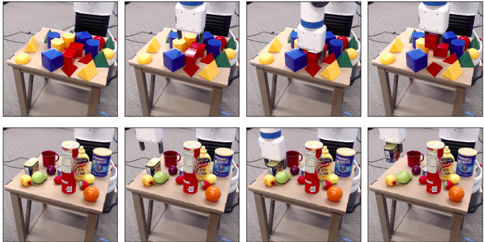
- The pipeline enabled a Fetch robot to detect and pick up the target object in 38 out of 40 trials in increasingly cluttered scenes, and a detector trained on a Spam can succeeded in 9 of 10 trials with previously unseen YCB food distractors.
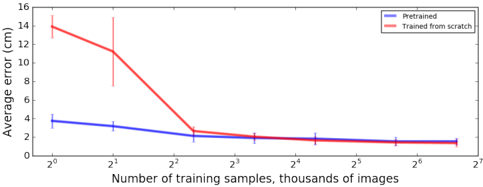
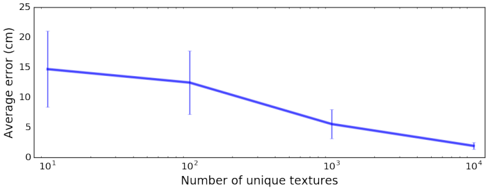
- Ablations found sensitivity to number of training images, number of unique textures, presence of distractors in training, and camera randomization; random noise had negligible effect. Performance improved up to around 50,000 training samples, and degraded significantly with fewer than 1,000 textures.
- ImageNet pretraining was not essential with enough data: random weight initialization achieved nearly the same real-world transfer performance as pretrained initialization, though pretraining helped in the low-data regime.
Methods
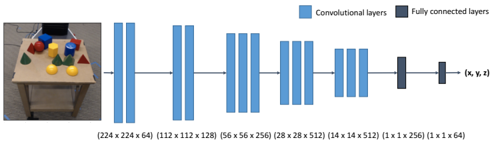
- The authors trained a modified VGG-16 convolutional neural network to map a single 224×224 monocular webcam image to Cartesian coordinates of object(s) of interest, using simulated images rendered by MuJoCo.
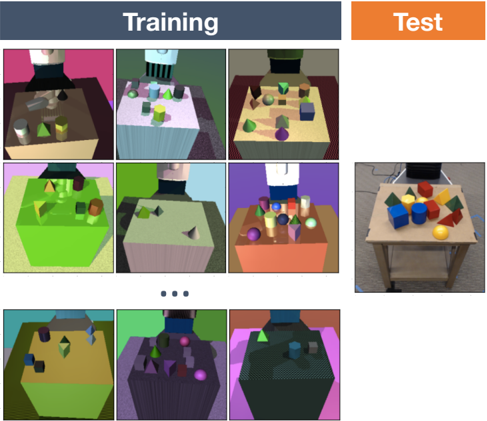
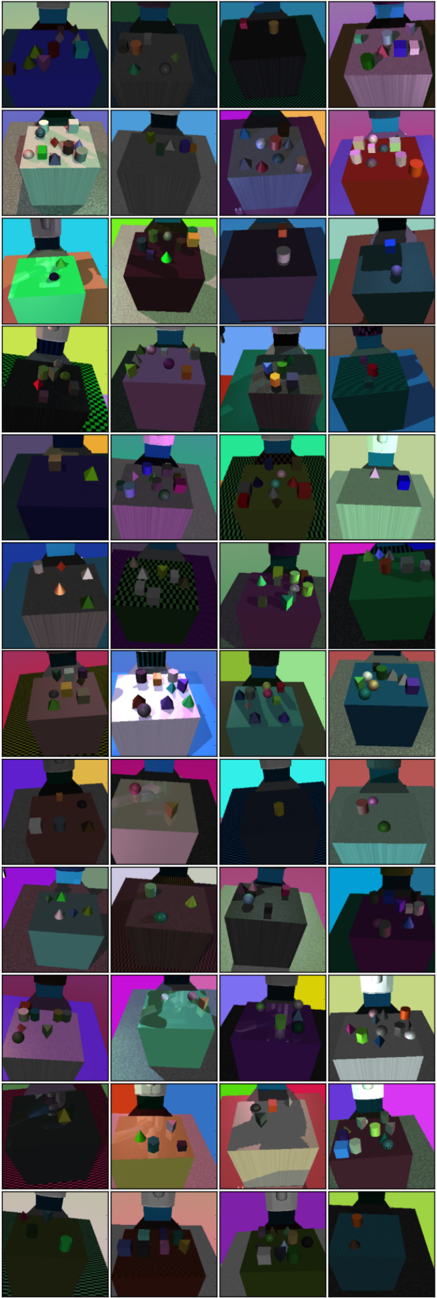
- Domain randomization varied number/shape of distractors, object positions and textures, table/floor/skybox/robot textures, camera position/orientation/field of view, number and properties of lights, and image noise. Textures were random RGB values, gradients, or checker patterns; 0–10 distractor objects were added per scene.
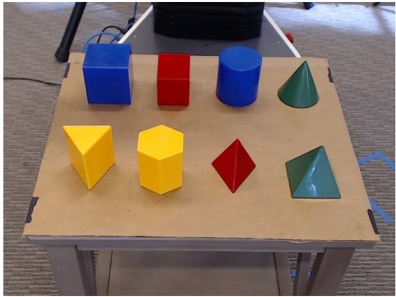
- Training used stochastic gradient descent with Adam on an L2 loss, learning rates around 1e-4, and batch sizes of 25, 50, or 100. Evaluation used 480 webcam images of eight geometric objects at 70–105 cm from a fixed camera, with 60 labeled images per object: 20 alone, 20 with distractors, and 20 partially occluded.
Limitations
- The paper states that the detectors still overfit simulated training data: simulated error was 0.3–0.5 cm versus about 1.5 cm in the real world, and no real-world validation could be done during training because no real data were assumed available.
- The paper states future work is needed for contact-rich manipulation or higher precision, and that the method fixes table height, effectively making the task 2D pose estimation from a single monocular uncalibrated camera.
- Evident from the text: evaluation is limited to eight geometric objects plus one Spam can, the test camera position remains constant across all images, and lighting and surrounding scene were not controlled.
Model-written summary. Check it against the paper before relying on it.
Integrity signals
Registry
Cites
Statistics
Figures
Verification
Claims the paper makes
2 Valid · 8 Not valid · 7 Not checked · 32 Own results and interpretations
The cited sources support only part of this claim — read each source’s verdict below.
In the paper
“Although previous work demonstrated the ability to perform robotic control using a neural network pretrained on ImageNet and fine-tuned on randomized rendered pixels [37], this paper provides the first demonstration that domain randomization can be useful for robotic tasks requiring precision.”
What the sources say
- Partly supportedcites [37] [37] Fereshteh Sadeghi and Sergey Levine. (cad) 2 RL: Real single-image flight without a single real image. arXiv preprint arXiv:1611.04201 , 2016. - sourceExperimental — accuracy not yet measured
The citation [37] is attached to the preceding claim about prior work, not to the citing authors’ claim that their own paper is the first to demonstrate precision robotics. Section 3.1 (p. 4) says LSDA pretrains a CNN on ImageNet classification data and fine-tunes it, but for object detection. It does not report robotic control or fine-tuning on randomized rendered pixels. (LLM, conf=0.84)
boostedstates a cause- Asserted: passes — The authors put it forward as true.
- Checkable: passes — It can be checked against evidence.
- Load-bearing: passes — The paper’s conclusions depend on it.
- Based: passes — The paper gives a reason why it holds.
- Partly supported
The cited sources that could be checked couldn’t confirm or dispute this claim.
In the paper
“Rather than relying on controller robustness, Yu et al. [53] use a model trained on varied physics to perform system identification using online trajectory data, but their approach is not shown to succeed in the real world.”
What the sources say
- Could not verifycites [53] [53] Wenhao Yu, C Karen Liu, and Greg Turk. Preparing for the unknown: Learning a universal policy with online system identification. arXiv preprint arXiv:1702.02453 , 2017. - sourceExperimental — accuracy not yet measured
The cited paper discusses image classification and localisation with convolutional networks (A.1, p. 10; A.2, p. 11), not Yu et al.'s approach. Searches for varied-physics training, online trajectory-based system identification, and real-world success found no passage addressing the claim. Our copy therefore cannot verify it. (LLM, conf=0.78)
plain- Asserted: passes — The authors put it forward as true.
- Checkable: passes — It can be checked against evidence.
- Load-bearing: unclear — It is unclear whether the paper’s conclusions depend on it.
- Based: passes — The paper gives a reason why it holds.
- Could not verify
The cited sources that could be checked couldn’t confirm or dispute this claim.
In the paper
“Though using realistic RGB rendering alone has had limited success for transferring to real robotic tasks [16], incorporating realistic simulation of depth information can allow models trained on rendered images to transfer reasonably well to the real world [32].”
What the sources say
- Could not verifycites [16] [16] Stephen James and Edward Johns. 3d simulation for robot arm control with deep q-learning. arXiv preprint arXiv:1609.03759 , 2016. - sourceExperimental — accuracy not yet measured
The Introduction (§1) and Conclusion (§8) describe Adam as a method for stochastic optimization, while the CNN experiment (§6.3) concerns training on image datasets. Searches for realistic RGB rendering and sim-to-real robotic transfer found no passage addressing whether RGB rendering alone has had limited success on real robotic tasks. (LLM, conf=0.78)
plain- Asserted: passes — The authors put it forward as true.
- Checkable: passes — It can be checked against evidence.
- Load-bearing: passes — The paper’s conclusions depend on it.
- Based: passes — The paper gives a reason why it holds.
- Could not verify
The cited sources that could be checked couldn’t confirm or dispute this claim.
In the paper
“However, their experiments - collision avoidance in hallways and open spaces - do not demonstrate the ability to deal with high-precision tasks.”
What the sources say
- Could not verifycites [37] [37] Fereshteh Sadeghi and Sergey Levine. (cad) 2 RL: Real single-image flight without a single real image. arXiv preprint arXiv:1611.04201 , 2016. - sourceExperimental — accuracy not yet measured
The Experiments section (p. 5) evaluates LSDA on an object-detection dataset, not Sadeghi and Levine’s collision-avoidance experiments. Searches for Sadeghi and Levine, hallway or open-space collision avoidance, and high-precision tasks found no passage addressing the claim. (LLM, conf=0.76)
plain- Asserted: passes — The authors put it forward as true.
- Checkable: passes — It can be checked against evidence.
- Load-bearing: passes — The paper’s conclusions depend on it.
- Based: passes — The paper gives a reason why it holds.
- Could not verify
A result the paper reports from its own data — it cites no other source for it, so there is none to check. The quote shows it is in the paper.
In the paper
“However, using a pre-trained model can significantly improve performance when less training data is used.”
plainstates a cause- Asserted: passes — The authors put it forward as true.
- Checkable: passes — It can be checked against evidence.
- Load-bearing: unclear — It is unclear whether the paper’s conclusions depend on it.
- Based: passes — The paper gives a reason why it holds.
29 more claims
Create a free account to see all 49 claims and to verify the 7 references still open.
- Probably not a substantial claim. 11
- It may state two separate claims as one. 8
Claims other papers make about this one
Each is checked against this paper’s own text: does it say what the citing paper says it does?
The source backs part of the claim, not all of it — or backs it for a different population, condition or comparison.
In the citing paper
“Most policies trained in simulation generalize poorly to the real-world due to agents adapting to specific visual details of the simulator.”
From Language-Based Augmentation to Address Shortcut Learning in Object-Goal Navigation (2023) · cites this paper as [8]
Experimental — accuracy not yet measuredThe source backs part of the claim, not all of it — or backs it for a different population, condition or comparison.
In the citing paper
“In robotic vision tasks including object localization [53], object detection [54], pose estimation [55], and semantic segmentation [56], the training data from simulator always have different textures, lighting, and camera positions from the realistic environments.”
From Sim-to-Real Transfer in Deep Reinforcement Learning for Robotics: a Survey (2020) · cites this paper as [53]
Experimental — accuracy not yet measuredThe source backs part of the claim, not all of it — or backs it for a different population, condition or comparison.
In the citing paper
“These artifacts limit the applicability of generative videos in physics-sensitive domains such as robotics [25,26], autonomous driving [27], simulationbased design, and scientific visualization [28].”
From PhyStruct-Video: Structured Physics State Spaces for Physically Consistent Video Generation (2025) · cites this paper as [25]
Experimental — accuracy not yet measuredThe source backs part of the claim, not all of it — or backs it for a different population, condition or comparison.
In the citing paper
“In domain randomization, the inputs during learning are “randomized” in the sense of being warped or corrupted in particular ways.”
From The overfitted brain: Dreams evolved to assist generalization (2021) · cites this paper as [144]
Experimental — accuracy not yet measuredThe source backs part of the claim, not all of it — or backs it for a different population, condition or comparison.
In the citing paper
“Domain randomization is a domain generalization technique that introduces drastic changes in the training image appearances, which forces the network to learn domain-invariant features between training and target domains [39].”
From A Fully Differentiable Framework for 2D/3D Registration and the Projective Spatial Transformers (2024) · cites this paper as [39]
Experimental — accuracy not yet measured
8 more claims about this paper
Create a free account to see every claim other papers make about this one.
Self-check
Percentages, sums and reported differences re-computed from the paper’s own numbers.
Each contradiction between two passages listed here was confirmed by an independent check.
Rated minor: it would not touch a result — a value no result rests on, a p-value that stays on the same side of the significance level, or a conflict that is clerical, resolved elsewhere in the paper, or outside its own findings.
In the paper
§ A. Experimental Setup · p. 4
“Each training sample consists of (a) a rendered image of the object and one or more distractors (also from among the geometric object set) on a simulated tabletop”
§ A. Domain randomization · p. 4
“Between 0 and 10 distractor objects are added to the table in each scene.”
Citations
Cites
Very Deep Convolutional Networks for Large-Scale Image Recognition
Simonyan, K., & Zisserman, A. (2014) · arXiv · doi:10.48550/arxiv.1409.1556 · Cited by 114,148 · cited 1×
“In particular, we use a modified version the VGG-16 architecture [42] shown in Figure 2.”
MethodAdam: A Method for Stochastic Optimization
Kingma, D. P., & Ba, J. (2014) · arXiv · doi:10.48550/arxiv.1412.6980 · Cited by 98,946 · cited 1×
“We found that using a learning rate of around 1e − 4 (as opposed to the standard 1e − 3 for Adam) improved convergence and helped avoid a common local optimum, mapping all objects to the center of the table.”
MethodLeCun, Y., Bengio, Y., & Hinton, G. (2015) · Nature · doi:10.1038/nature14539 · Cited by 84,126
Human-level control through deep reinforcement learning
Mnih, V., Kavukcuoglu, K., Silver, D., Rusu, A. A., Veness, J., Bellemare, M. G., Graves, A., Riedmiller, M., Fidjeland, A. K., Ostrovski, G., et al. (2015) · Nature · doi:10.1038/nature14236 · Cited by 30,357 · cited 3×
“Learning in simulation is especially promising for building on recent results using deep reinforcement learning to achieve human-level performance on tasks like Atari [27] and robotic control [21], [38].”
BackgroundResultHow transferable are features in deep neural networks?
Yosinski, J., Clune, J., Bengio, Y., & Lipson, H. (2014) · arXiv · doi:10.48550/arxiv.1411.1792 · Cited by 6,061 · cited 1×
“A variety of approaches have been proposed, including re-training the model in the target domain (e.g., [52]), adapting the weights of the model based on the statistics of the source and target domains (e.g., [22]), learning invariant features between domains (e.g., [47]), and learning a mapping…”
BackgroundMuJoCo: A physics engine for model-based control
Todorov, E., Erez, T., & Tassa, Y. (2012) · 2012 IEEE/RSJ International Conference on Intelligent Robots and Systems · doi:10.1109/iros.2012.6386109 · Cited by 4,767 · cited 1×
“We render images using the MuJoCo Physics Engine’s [45] built-in renderer.”
MethodTrust region policy optimization
Schulman, J., Levine, S., Moritz, P., Jordan, M. I., & Abbeel, P. (2015) · arXiv · doi:10.48550/arxiv.1502.05477 · Cited by 4,578 · cited 1×
“Learning in simulation is especially promising for building on recent results using deep reinforcement learning to achieve human-level performance on tasks like Atari [29] and robotic control [26], [41].”
ResultSelf-citationLearning Transferable Features with Deep Adaptation Networks
Long, M., Cao, Y., Wang, J., & Jordan, M. I. (2015) · arXiv · doi:10.48550/arxiv.1502.02791 · Cited by 4,505 · cited 1×
“omputer vision community has devoted significant study to the problem of adapting vision-based models trained in a source domain to a previously unseen target domain (see, e.g., [9], [14], [15], [19], [23], [25], [51]). A variety of approaches have been proposed, including re-training the model in the target domain (e.…”
BackgroundEnd-to-End Training of Deep Visuomotor Policies
Levine, S., Finn, C., Darrell, T., et al. (2015) · Journal of machine learning research · doi:10.5555/2946645.2946684 · Cited by 3,987
Describing Textures in the Wild
Cimpoi, M., Maji, S., Kokkinos, I., Mohamed, S., & Vedaldi, A. (2014) · 2014 IEEE Conference on Computer Vision and Pattern Recognition · doi:10.1109/cvpr.2014.461 · Cited by 2,438 · cited 1×
“To examine how our detectors would perform on objects with complex textures, we created simulated scenes in which the object of interest is given a texture from the Describable Textures Dataset (DTD) [4].”
Method
Research works printed but not linked: 3
- [24] David G Lowe. Three-dimensional object recognition from single two-dimensional images. Artificial intelligence , 31(3):355-395, 1987. -
- [49] Melonee Wise, Michael Ferguson, Derek King, Eric Diehr, and David Dymesich. Fetch and freight: Standard platforms for service robot applications. In Workshop on Autonomous Mobile Service Robots , 2016. -
- sucan, 0, MoveIt!
Cited by
Language Models are Few-Shot Learners
Brown, T. B., Mann, B., Ryder, N., Subbiah, M., Kaplan, J., Dhariwal, P., Neelakantan, A., Shyam, P., Sastry, G., Askell, A., et al. (2020) · arXiv · doi:10.48550/arxiv.2005.14165 · Cited by 23,372
A survey on Image Data Augmentation for Deep Learning
Shorten, C., & Khoshgoftaar, T. M. (2019) · Journal of Big Data · doi:10.1186/s40537-019-0197-0 · Cited by 13,203
Shortcut learning in deep neural networks
Geirhos, R., Jacobsen, J.-H., Michaelis, C., Zemel, R., Brendel, W., Bethge, M., & Wichmann, F. A. (2020) · Nature Machine Intelligence · doi:10.1038/s42256-020-00257-z · Cited by 2,224
“helps a lot in closing this gap [70, 71].”
BackgroundAndrychowicz, M., Wolski, F., Ray, A., Schneider, J., Fong, R., Welinder, P., McGrew, B., Tobin, J., Abbeel, P., & Zaremba, W. (2017) · arXiv · doi:10.48550/arxiv.1707.01495 · Cited by 1,355
Self-citationDomain Generalization: A Survey
Zhou, K., Liu, Z., Qiao, Y., Xiang, T., & Loy, C. C. (2022) · IEEE Transactions on Pattern Analysis and Machine Intelligence · doi:10.1109/tpami.2022.3195549 · Cited by 1,315
“For instance, Yarats et al. [215] proposed a reconstruction loss based on auto-encoders; Laskin et al. [216] combined RL with an unsupervised contrastive learning loss.”
BackgroundMethodSim-to-Real Transfer of Robotic Control with Dynamics Randomization
Peng, X. B., Andrychowicz, M., Zaremba, W., & Abbeel, P. (2018) · 2018 IEEE International Conference on Robotics and Automation (ICRA) · doi:10.1109/icra.2018.8460528 · Cited by 1,309
Self-citationAn Introduction to Deep Reinforcement Learning
Vincent, F.-L., Peter, H., Riashat, I., Marc, G. B., & Joelle, P. (2018) · Foundations and Trends® in Machine Learning · doi:10.1561/2200000071 · Cited by 1,286
Generalizing to unseen domains: A survey on domain generalization
Wang, J., Lan, C., Liu, C., Ouyang, Y., Qin, T., Lu, W., Chen, Y., Zeng, W., & Yu, P. (2022) · IEEE Transactions on Knowledge and Data Engineering · doi:10.1109/tkde.2022.3178128 · Cited by 1,046
“[32] first used this method to generate more training data from the simulated environment for generalization”
MethodContinuous control for robot based on deep reinforcement learning
Zhang, S. (2020) · doi:10.32657/10356/90191 · Cited by 951
“[41] proposed a domain randomization method which randomly renders the images from simulation to approximate to the images of the real”
MethodSim-to-Real Transfer in Deep Reinforcement Learning for Robotics: a Survey
Zhao, W., Queralta, J. P., & Westerlund, T. (2020) · 2020 IEEE Symposium Series on Computational Intelligence (SSCI) · doi:10.1109/ssci47803.2020.9308468 · Cited by 941
“In robotic vision tasks including object localization [53], object detection [54], pose estimation [55], and semantic segmentation [56], the training data from simulator always have different textures, lighting, and camera positions from the realistic environments.”
BackgroundTraining Deep Networks with Synthetic Data: Bridging the Reality Gap by Domain Randomization
Tremblay, J., Prakash, A., Acuna, D., Brophy, M., Jampani, V., Anil, C., To, T., Cameracci, E., Boochoon, S., & Birchfield, S. (2018) · 2018 IEEE/CVF Conference on Computer Vision and Pattern Recognition Workshops (CVPRW) · doi:10.1109/cvprw.2018.00143 · Cited by 884
“[32], who propose to close the reality gap by generating synthetic data with sufficient variation that the network views real-world data as just another variation.”
BackgroundMethodInfluentialDomain Generalization by Solving Jigsaw Puzzles
Carlucci, F. M., D'Innocente, A., Bucci, S., Caputo, B., & Tommasi, T. (2019) · 2019 IEEE/CVF Conference on Computer Vision and Pattern Recognition (CVPR) · doi:10.1109/cvpr.2019.00233 · Cited by 813
“This solution was at first presented with the name of domain randomization [43] for samples from simulated environments whose variety was extended with random renderings.”
MethodIntegrating Scientific Knowledge with Machine Learning for Engineering and Environmental Systems
Willard, J., Jia, X., Xu, S., Steinbach, M., & Kumar, V. (2023) · ACM Computing Surveys · doi:10.1145/3514228 · Cited by 878
“1) [266] [10] [219] [158] [140] [182] [203] [76] [86] [130] [174] [204] [231] [313] [121] [125] [187] [92] [306] [180] [298] [184] [267] [39] [247] [133] [130] [231] [298] [173] [66] [24] [255] [12] [17] [203] [204] [213] [239] [125] [281] [214] [176] [249] [310] [309] [311] [245] [78] [266] [297] [279] [241] [278] [2…”
BackgroundQuantifying Generalization in Reinforcement Learning
Cobbe, K., Klimov, O., Hesse, C., Kim, T., & Schulman, J. (2018) · arXiv · doi:10.48550/arxiv.1812.02341 · Cited by 769
“This method closely resembles domain randomization (Tobin et al., 2017), used in robotics to transfer from simulations to the real world.”
MethodGibson Env: Real-World Perception for Embodied Agents
Xia, F., Zamir, A. R., He, Z., Sax, A., Malik, J., & Savarese, S. (2018) · 2018 IEEE/CVF Conference on Computer Vision and Pattern Recognition · doi:10.1109/cvpr.2018.00945 · Cited by 763
“Domain Adaptation and Transferring to Real-World: With popularity of simulators, different approaches for domain adaption for transferring the results to real world has been investigated [11, 25, 85, 71, 89, 93], e.”
BackgroundSim-to-Real: Learning Agile Locomotion For Quadruped Robots
Tan, J., Zhang, T., Coumans, E., Iscen, A., Bai, Y., Hafner, D., Bohez, S., & Vanhoucke, V. (2018) · Robotics: Science and Systems XIV · doi:10.15607/rss.2018.xiv.010 · Cited by 735
“A robust controller can be learned by injecting noise to the simulation [19], adding perturbations to the simulated robot [37], leveraging multiple simulators [3], using domain randomization [48] and dynamics randomization [29, 40, 34].”
MethodSim-to-Real: Learning Agile Locomotion For Quadruped Robots
Tan, J., Zhang, T., Coumans, E., Iscen, A., Bai, Y., Hafner, D., Bohez, S., & Vanhoucke, V. (2018) · arXiv · doi:10.48550/arxiv.1804.10332 · Cited by 734
SynthSeg: Segmentation of brain MRI scans of any contrast and resolution without retraining
Billot, B., Greve, D. N., Puonti, O., Thielscher, A., Van Leemput, K., Fischl, B., Dalca, A. V., & Iglesias, J. E. (2023) · Medical Image Analysis · doi:10.1016/j.media.2023.102789 · Cited by 641
“So far, DR has been used to control robotic arms [61], and for car detection in street views [63].”
InfluentialSurvey of Deep Reinforcement Learning for Motion Planning of Autonomous Vehicles
Aradi, S. (2022) · IEEE Transactions on Intelligent Transportation Systems · doi:10.1109/tits.2020.3024655 · Cited by 639
Using Simulation and Domain Adaptation to Improve Efficiency of Deep Robotic Grasping
Bousmalis, K., Irpan, A., Wohlhart, P., Bai, Y., Kelcey, M., Kalakrishnan, M., Downs, L., Ibarz, J., Pastor, P., Konolige, K., et al. (2018) · 2018 IEEE International Conference on Robotics and Automation (ICRA) · doi:10.1109/icra.2018.8460875 · Cited by 636
Unity: A General Platform for Intelligent Agents
Juliani, A., Berges, V.-P., Teng, E., Cohen, A., Harper, J., Elion, C., Goy, C., Gao, Y., Henry, H., Mattar, M., et al. (2018) · arXiv · doi:10.48550/arxiv.1809.02627 · Cited by 626
“This often works by ensuring that the data distribution of the real world is covered within all of the variations presented within the simulation (Tobin et al., 2017).”
BackgroundSolving Rubik's Cube with a Robot Hand
OpenAI, Akkaya, I., Andrychowicz, M., Chociej, M., Litwin, M., McGrew, B., Petron, A., Paino, A., Plappert, M., Powell, G., et al. (2019) · arXiv · doi:10.48550/arxiv.1910.07113 · Cited by 602
Self-citationEnd-to-End Autonomous Driving: Challenges and Frontiers
Chen, L., Wu, P., Chitta, K., Jaeger, B., Geiger, A., & Li, H. (2024) · IEEE Transactions on Pattern Analysis and Machine Intelligence · doi:10.1109/tpami.2024.3435937 · Cited by 610
“Domainrandomization[265], [266],[267]isalsoasimpleandeffectivesim-to-realtechnique forRLpolicylearning,whichisfurtheradaptedforend-to-end autonomousdriving[188],[268].”
Learning ambidextrous robot grasping policies
Mahler, J., Matl, M., Satish, V., Danielczuk, M., DeRose, B., McKinley, S., & Goldberg, K. (2019) · Science Robotics · doi:10.1126/scirobotics.aau4984 · Cited by 563
“4, eaau4984 (2019) 16 January 2019 and domain randomization over a diverse range of objects, cameras, and parameters of physics for robust transfer from simulation to reality (17, 20, 22).”
BackgroundData collection and quality challenges in deep learning: a data-centric AI perspective
Whang, S. E., Roh, Y., Song, H., & Lee, J.-G. (2023) · The VLDB Journal · doi:10.1007/s00778-022-00775-9 · Cited by 573
How to train your robot with deep reinforcement learning: Lessons we have learned
Ibarz, J., Tan, J., Finn, C., Kalakrishnan, M., Pastor, P., & Levine, S. (2021) · The International Journal of Robotics Research · doi:10.1177/0278364920987859 · Cited by 570
“This can include various dynamics parameters (Peng et al. 2018b; Tan et al. 2018) of the robot and the environment, as well as visual and rendering parameters such as textures and lighting (Sadeghi and Levine 2017; Tobin et al. 2017).”
BackgroundImplicit 3D Orientation Learning for 6D Object Detection from RGB Images
Sundermeyer, M., Marton, Z.-C., Durner, M., Brucker, M., & Triebel, R. (2018) · Lecture Notes in Computer Science · doi:10.1007/978-3-030-01231-1_43 · Cited by 564
“[36] demonstrated the potential of the Domain Randomization (DR) paradigm for 3D shape detection using CNNs.”
BackgroundMethodInfluentialThe limits and potentials of deep learning for robotics
Sünderhauf, N., Brock, O., Scheirer, W. J., Hadsell, R. T., Fox, D., Leitner, J., Upcroft, B., Abbeel, P., Burgard, W., Milford, M. J., et al. (2018) · QUT ePrints (Queensland University of Technology) · Cited by 519
Self-citationModel-based Reinforcement Learning: A Survey
M. Moerland, T., Broekens, J., Plaat, A., & M. Jonker, C. (2023) · Foundations and Trends in Machine Learning · doi:10.1561/2200000086 · Cited by 524
Isaac Gym: High Performance GPU-Based Physics Simulation For Robot Learning
Makoviychuk, V., Wawrzyniak, L., Guo, Y., Lu, M., Storey, K., Macklin, M., Hoeller, D., Rudin, N., Allshire, A., Handa, A., et al. (2021) · arXiv · doi:10.48550/arxiv.2108.10470 · Cited by 509
“Each environment is duplicated as many times as needed, while preserving the ability for variations between copies ( e.g. via Domain Randomization [15]).”
BackgroundContinual Test-Time Domain Adaptation
Wang, Q., Fink, O., Van Gool, L., & Dai, D. (2022) · 2022 IEEE/CVF Conference on Computer Vision and Pattern Recognition (CVPR) · doi:10.1109/cvpr52688.2022.00706 · Cited by 502
“Domain randomization is one of the most popular methods which improves the model generalizability by learning from different synthesis parameters of simulation environments [56, 57].”
BackgroundClosing the Sim-to-Real Loop: Adapting Simulation Randomization with Real World Experience
Chebotar, Y., Handa, A., Makoviychuk, V., Macklin, M., Issac, J., Ratliff, N., & Fox, D. (2019) · 2019 International Conference on Robotics and Automation (ICRA) · doi:10.1109/icra.2019.8793789 · Cited by 457
“As it was shown in [6, 7, 9], it is possible to design a distribution of simulation parameters p (⇠), such that a policy trained on P⇠⇠p would perform well on a real world dynamics distribution.”
BackgroundMethodTartanAir: A Dataset to Push the Limits of Visual SLAM
Wang, W., Zhu, D., Wang, X., Hu, Y., Qiu, Y., Wang, C., Hu, Y., Kapoor, A., & Scherer, S. (2020) · 2020 IEEE/RSJ International Conference on Intelligent Robots and Systems (IROS) · doi:10.1109/iros45743.2020.9341801 · Cited by 456
“A large number of studies show that by domain randomization [23], [24], namely increasing the”
BackgroundA Survey on Safety-Critical Driving Scenario Generation—A Methodological Perspective
Ding, W., Xu, C., Arief, M., Lin, H., Li, B., & Zhao, D. (2023) · IEEE Transactions on Intelligent Transportation Systems · doi:10.1109/tits.2023.3259322 · Cited by 436
“methods [123] to the adversarial generation.”
CosyPose: Consistent multi-view multi-object 6D pose estimationPreprint
Labbé, Y., Carpentier, J., Aubry, M., & Šivic, J. (2020) · arXiv (Cornell University) · Cited by 434
A Survey on Data Augmentation for Text Classification
Bayer, M., Kaufhold, M.-A., & Reuter, C. (2023) · ACM Computing Surveys · doi:10.1145/3544558 · Cited by 425
“With the help of adversarial training, these automatic adversarial example generators can be used as data augmentation methods, as done, for example, in [23], [7], [24], or [25], in order for models to be less susceptible to such easy alterations.”
Synthetic Data for Deep Learning
Nikolenko, S. I. (2021) · Springer Optimization and Its Applications · doi:10.1007/978-3-030-75178-4 · Cited by 423
“The work [588] did the first steps to show that domain randomization works well; they used simple geometric shapes (polyhedra) as both target and distractor objects, random textures such as gradient fills or checkered patterns.”
BackgroundJames, S., Wohlhart, P., Kalakrishnan, M., Kalashnikov, D., Irpan, A., Ibarz, J., Levine, S., Hadsell, R., & Bousmalis, K. (2019) · 2019 IEEE/CVF Conference on Computer Vision and Pattern Recognition (CVPR) · doi:10.1109/cvpr.2019.01291 · Cited by 420
A Survey of Embodied AI: From Simulators to Research Tasks
Duan, J., Yu, S., Tan, H. L., Zhu, H., & Tan, C. (2022) · IEEE Transactions on Emerging Topics in Computational Intelligence · doi:10.1109/tetci.2022.3141105 · Cited by 420
“However, Sim2Real [27]–[29] and robotics in the physical world will not be covered in this paper.”
BackgroundInfluentialModel-Based Control of Soft Robots: A Survey of the State of the Art and Open Challenges
Della Santina, C., Duriez, C., & Rus, D. (2023) · IEEE Control Systems · doi:10.1109/mcs.2023.3253419 · Cited by 402
“Models developed from first principles can be used to create virtual environments where robots can evolve [221], [222] or learn new skills [93], [223], [224].”
BackgroundDeep Domain-Adversarial Image Generation for Domain Generalisation
Zhou, K., Yang, Y., Hospedales, T., & Xiang, T. (2020) · Proceedings of the AAAI Conference on Artificial Intelligence · doi:10.1609/aaai.v34i07.7003 · Cited by 388
“We assume that augmenting the original training data of source domains with synthetic data from unseen domains could make the task model intrinsically more domain-generalisable (Tobin et al. 2017; Yue et al. 2019).”
BackgroundYue, X., Zhang, Y., Zhao, S., Sangiovanni-Vincentelli, A., Keutzer, K., & Gong, B. (2019) · 2019 IEEE/CVF International Conference on Computer Vision (ICCV) · doi:10.1109/iccv.2019.00219 · Cited by 374
“This is partially due to the community’s recent exploration to embodied vision [46, 62, 2], in which the perception has to be embodied and purposive for an agent to actively perceive and/or navigate through a physical environment [7, 10].”
BackgroundInfluentialLearning to Generate Novel Domains for Domain Generalization
Zhou, K., Yang, Y., Hospedales, T., & Xiang, T. (2020) · Lecture Notes in Computer Science · doi:10.1007/978-3-030-58517-4_33 · Cited by 382
“, the most straightforward way to improve model generalization is increasing the diversity of available source domains [49] (see Fig.”
InfluentialPath planning and obstacle avoidance for AUV: A review
Cheng, C., Sha, Q., He, B., & Li, G. (2021) · Ocean Engineering · doi:10.1016/j.oceaneng.2021.109355 · Cited by 378
Learning Agile Robotic Locomotion Skills by Imitating Animals
Bin Peng, X., Coumans, E., Zhang, T., Lee, T.-W., Tan, J., & Levine, S. (2020) · Robotics: Science and Systems XVI · doi:10.15607/rss.2020.xvi.064 · Cited by 357
“Domain randomization is a simple strategy for improving a policy’s robustness to dynamics variations [52, 60, 42].”
BackgroundAsymmetric Actor Critic for Image-Based Robot Learning
Pinto, L., Andrychowicz, M., Welinder, P., Zaremba, W., & Abbeel, P. (2018) · Robotics: Science and Systems XIV · doi:10.15607/rss.2018.xiv.008 · Cited by 343
“Another option is to train entirely on rendered partial observations (camera images) of the robot [11], [17].”
BackgroundMethodResultInfluentialSelf-citationGeneralizing to Unseen Domains via Adversarial Data Augmentation
Volpi, R., Namkoong, H., Şener, O., Duchi, J. C., Murino, V., & Savarese, S. (2018) · arXiv (Cornell University) · doi:10.48550/arxiv.1805.12018 · Cited by 343
“[37] proposes domain randomization, which applies to simulated data and creates a variety of random renderings with the simulator, hoping that the real world will be interpreted as one of them.”
BackgroundA Review of Single-Source Deep Unsupervised Visual Domain Adaptation
Zhao, S., Yue, X., Zhang, S., Li, B., Zhao, H., Wu, B., Krishna, R., Gonzalez, J. E., Sangiovanni-Vincentelli, A. L., Seshia, S. A., et al. (2022) · IEEE Transactions on Neural Networks and Learning Systems · doi:10.1109/tnnls.2020.3028503 · Cited by 352
Deep Adversarial Training for Multi-Organ Nuclei Segmentation in Histopathology Images
Mahmood, F., Borders, D., Chen, R. J., Mckay, G. N., Salimian, K. J., Baras, A., & Durr, N. J. (2020) · IEEE Transactions on Medical Imaging · doi:10.1109/tmi.2019.2927182 · Cited by 340
Fan, T., Long, P., Liu, W., & Pan, J. (2020) · The International Journal of Robotics Research · doi:10.1177/0278364920916531 · Cited by 332
“Tobin et al. (2017) introduced domain randomization to train a robust and transferable policy for manipulation tasks.”
BackgroundInfluentialWu, L., Zhang, J., Zhou, W., An, P., Shen, L., Liu, J., Jiang, X., Huang, X., Mu, G., Wan, X., et al. (2019) · Gut · doi:10.1136/gutjnl-2018-317366 · Cited by 316
Measuring Domain Shift for Deep Learning in Histopathology
Stacke, K., Eilertsen, G., Unger, J., & Lundstrom, C. (2021) · IEEE Journal of Biomedical and Health Informatics · doi:10.1109/jbhi.2020.3032060 · Cited by 318
“Insummary,themaximumactivationfeaturespointtothe high sensitivity of training setup, where differences in model”
BackgroundCrDoCo: Pixel-Level Domain Transfer With Cross-Domain Consistency
Chen, Y.-C., Lin, Y.-Y., Yang, M.-H., & Huang, J.-B. (2019) · 2019 IEEE/CVF Conference on Computer Vision and Pattern Recognition (CVPR) · doi:10.1109/cvpr.2019.00189 · Cited by 292
“Training the model on large-scale synthetic datasets has been extensively studied in semantic segmentation [41, 42, 15, 14, 7, 17, 34, 35, 53], multi-view stereo [18], depth estimation [48], optical flow [40, 19, 21], amodal segmentation [16], and object detection [7, 30].”
ResultAlexopoulos, K., Nikolakis, N., & Chryssolouris, G. (2020) · International Journal of Computer Integrated Manufacturing · doi:10.1080/0951192x.2020.1747642 · Cited by 309
“…presented a system for training deep neural networks for object detection using synthetic images based on the technique of domain randomization (Tobin et al. 2017), in which the parameters of the simulator – such as lighting, pose, object textures, etc. – are randomized in non-realistic ways…”
MethodReinforcement Learning with Augmented Data
Laskin, M., Lee, K., Stooke, A., Pinto, L., Abbeel, P., & Srinivas, A. (2020) · arXiv · doi:10.48550/arxiv.2004.14990 · Cited by 299
Self-citationRobust Multi-Agent Reinforcement Learning via Minimax Deep Deterministic Policy Gradient
Li, S., Wu, Y., Cui, X., Dong, H., Fang, F., & Russell, S. (2019) · Proceedings of the AAAI Conference on Artificial Intelligence · doi:10.1609/aaai.v33i01.33014213 · Cited by 290
“This problem is also studied recently with deep neural networks, such as adding random noise to input (Tobin et al. 2017) or dynamics (Peng et al.”
BackgroundIntegrating Physics-Based Modeling with Machine Learning: A Survey
Willard, J., Jia, X., Xu, S., Steinbach, M. S., & Kumar, V. (2020) · Cited by 435
A Survey on Learning-Based Robotic Grasping
Kleeberger, K., Bormann, R., Kraus, W., & Huber, M. F. (2020) · Current Robotics Reports · doi:10.1007/s43154-020-00021-6 · Cited by 290
FSDR: Frequency Space Domain Randomization for Domain Generalization
Huang, J., Guan, D., Xiao, A., & Lu, S. (2021) · 2021 IEEE/CVF Conference on Computer Vision and Pattern Recognition (CVPR) · doi:10.1109/cvpr46437.2021.00682 · Cited by 288
“Single-source DG handles generalization by domain randomization that augment data [64, 70] or domains [77, 50].”
BackgroundMethodInfluentialNeural-Fly enables rapid learning for agile flight in strong winds
O’Connell, M., Shi, G., Shi, X., Azizzadenesheli, K., Anandkumar, A., Yue, Y., & Chung, S.-J. (2022) · Science Robotics · doi:10.1126/scirobotics.abm6597 · Cited by 288
“Another popular deep-learning approach for control in dynamic environments is robust policy learning via domain randomization [41, 42, 43].”
BackgroundWILDS: A Benchmark of in-the-Wild Distribution Shifts
Koh, P. W., Sagawa, S., Marklund, H., Xie, S. M., Zhang, M., Balsubramani, A., Hu, W., Yasunaga, M., Phillips, R. L., Gao, I., et al. (2020) · arXiv · doi:10.48550/arxiv.2012.07421 · Cited by 518
“These problems have manifested in many ways, including shifts induced by weather and lighting changes (Wulfmeier et al., 2018), location changes (Gupta et al., 2018), and the simulation-to-real-world gap (Sadeghi and Levine, 2017; Tobin et al., 2017).”
Deep Drone Racing: From Simulation to Reality With Domain Randomization
Loquercio, A., Kaufmann, E., Ranftl, R., Dosovitskiy, A., Koltun, V., & Scaramuzza, D. (2020) · IEEE Transactions on Robotics · doi:10.1109/tro.2019.2942989 · Cited by 272
“In order to increase the generalization abilities and robustness of our perception system, we propose to use domain randomization [10].”
MethodA Review of Physics Simulators for Robotic Applications
Collins, J., Chand, S., Vanderkop, A., & Howard, D. (2021) · IEEE Access · doi:10.1109/access.2021.3068769 · Cited by 276
“The ability to randomise the textures of rendered objects in simulation and characteristics of the camera used to render them is built into MuJoCo and demonstrated in [42].”
BackgroundStructured Domain Randomization: Bridging the Reality Gap by Context-Aware Synthetic Data
Prakash, A., Boochoon, S., Brophy, M., Acuna, D., Cameracci, E., State, G., Shapira, O., & Birchfield, S. (2019) · 2019 International Conference on Robotics and Automation (ICRA) · doi:10.1109/icra.2019.8794443 · Cited by 266
“[13] introduced the concept of Domain Randomization (DR), in which realistic rendering is intentionally avoided in favor of random variation.”
BackgroundGraph Neural Networks for Decentralized Multi-Robot Path Planning
Li, Q., Gama, F., Ribeiro, A., & Prorok, A. (2020) · 2020 IEEE/RSJ International Conference on Intelligent Robots and Systems (IROS) · doi:10.1109/iros45743.2020.9341668 · Cited by 271
“Learning-based methods have proven effective at designing robot control policies for an increasing number of tasks [17], [18].”
BackgroundAnyGrasp: Robust and Efficient Grasp Perception in Spatial and Temporal Domains
Fang, H.-S., Wang, C., Fang, H., Gou, M., Liu, J., Yan, H., Liu, W., Xie, Y., & Lu, C. (2023) · IEEE Transactions on Robotics · doi:10.1109/tro.2023.3281153 · Cited by 276
Virtual to Real Reinforcement Learning for Autonomous Driving
Pan, X., You, Y., Wang, Z., & Lu, C. (2017) · Procedings of the British Machine Vision Conference 2017 · doi:10.5244/c.31.11 · Cited by 326
“These models either first train a model in virtual environment and then fine-tune in the real environment [21], or learn an alignment between virtual image and real image by finding representations that are shared between the two domains [27], or use randomized rendered virtual environments to train and then test in r…”
BackgroundImage Augmentation Is All You Need: Regularizing Deep Reinforcement Learning from Pixels
Kostrikov, I., Yarats, D., & Fergus, R. (2020) · arXiv · doi:10.48550/arxiv.2004.13649 · Cited by 267
“There are also domain randomization techniques [52, 49] which synthetically apply similar variations, but assume control of the data generation procedure, in contrast to our method.”
Omnidata: A Scalable Pipeline for Making Multi-Task Mid-Level Vision Datasets from 3D Scans
Eftekhar, A., Sax, A., Malik, J., & Zamir, A. (2021) · 2021 IEEE/CVF International Conference on Computer Vision (ICCV) · doi:10.1109/iccv48922.2021.01061 · Cited by 258
“In robotics and re-inforcement learning where 3D simulators are more standard, data augmentation was introduced as “domain ran-domization” [59], and common augmentations include texture and background randomization on the scene mesh.”
BackgroundTowards Out-Of-Distribution Generalization: A Survey
Liu, J., Shen, Z., He, Y., Zhang, X., Xu, R., Yu, H., & Cui, P. (2021) · arXiv · doi:10.48550/arxiv.2108.13624 · Cited by 253
Learning Dexterous In-Hand Manipulation
OpenAI, Andrychowicz, M., Baker, B., Chociej, M., Jozefowicz, R., McGrew, B., Pachocki, J., Petron, A., Plappert, M., Powell, G., et al. (2018) · arXiv · doi:10.48550/arxiv.1808.00177 · Cited by 248
Self-citationLearning by Playing - Solving Sparse Reward Tasks from Scratch
Riedmiller, M., Hafner, R., Lampe, T., Neunert, M., Degrave, J., Van de Wiele, T., Mnih, V., Heess, N., & Springenberg, J. T. (2018) · arXiv (Cornell University) · doi:10.48550/arxiv.1802.10567 · Cited by 242
“…Ghosh et al., 2018; Forestier et al., 2017), transfer of learned policies from simulation to reality (see Duan et al. (2017); Sadeghi et al. (2017); Tobin et al. (2017); Rusu et al. (2017) for recent examples), learning from demonstrations (Ross et al., 2011; Vecerik et al., 2017; Kober & Peters,…”
BackgroundScenic: a language for scenario specification and scene generation
Fremont, D. J., Dreossi, T., Ghosh, S., Yue, X., Sangiovanni-Vincentelli, A. L., & Seshia, S. A. (2019) · Proceedings of the 40th ACM SIGPLAN Conference on Programming Language Design and Implementation · doi:10.1145/3314221.3314633 · Cited by 241
“There has been a large amount of work on generating synthetic data for specific applications, including text recognition [28], text localization [27], robotic object grasping [57], and autonomous driving [30,11].”
BackgroundSim-to-real reinforcement learning for deformable object manipulation
Matas, J., James, S., & Davison, A. J. (2018) · arXiv · doi:10.48550/arxiv.1806.07851 · Cited by 241
Billot, B., Magdamo, C., Cheng, Y., Arnold, S. E., Das, S., & Iglesias, J. E. (2023) · Proceedings of the National Academy of Sciences · doi:10.1073/pnas.2216399120 · Cited by 229
Review of Deep Learning Methods in Robotic Grasp Detection
Caldera, S., Rassau, A., & Chai, D. (2018) · Multimodal Technologies and Interaction · doi:10.3390/mti2030057 · Cited by 219
“As pointed out by Tobin et al. [14], most applications lacked domain specific data.”
BackgroundInfluentialMeta-Sim: Learning to Generate Synthetic DatasetsPreprint
(2020) · DSpace@MIT (Massachusetts Institute of Technology) · Cited by 236
On Pre-trained Image Features and Synthetic Images for Deep Learning
Hinterstoisser, S., Lepetit, V., Wohlhart, P., & Konolige, K. (2019) · Lecture Notes in Computer Science · doi:10.1007/978-3-030-11009-3_42 · Cited by 217
“This is often referred to as domain gap between synthetic and real data and the transfer from one to another usually results in deteriorated performance as also observed by others [22].”
BackgroundMethodRoboTHOR: An Open Simulation-to-Real Embodied AI Platform
Deitke, M., Han, W., Herrasti, A., Kembhavi, A., Kolve, E., Mottaghi, R., Salvador, J., Schwenk, D., VanderBilt, E., Wallingford, M., et al. (2020) · 2020 IEEE/CVF Conference on Computer Vision and Pattern Recognition (CVPR) · doi:10.1109/cvpr42600.2020.00323 · Cited by 220
“The main approaches are based on randomization of the source domain to better generalize to the target domain [63, 29, 51, 44, 61], learning the mapping between some abstraction or higher order statistics of the source and target domains [27, 59, 19, 35, 76, 42, 78], interpolating between the source and the target dom…”
MethodReinforcement Learning for Robust Parameterized Locomotion Control of Bipedal Robots
Li, Z., Cheng, X., Peng, X. B., Abbeel, P., Levine, S., Berseth, G., & Sreenath, K. (2021) · 2021 IEEE International Conference on Robotics and Automation (ICRA) · doi:10.1109/icra48506.2021.9560769 · Cited by 219
Self-citationDarla Improving zero-shot transfer in reinforcement learning
Higgins, I., Pal, A., Rusu, A. A., Matthey, L., Burgess, C. P., Pritzel, A., Botvinick, M., Blundell, C., & Lerchner, A. (2017) · arXiv · doi:10.48550/arxiv.1707.08475 · Cited by 219
“, 2016) has not yet translated as well to reality, despite various attempts (Tobin et al., 2017; Tzeng et al., 2016; Daftry et al., 2016; Finn et al., 2015; Rusu et al., 2016).”
BackgroundReinforcement and Imitation Learning for Diverse Visuomotor Skills
Zhu, Y., Wang, Z., Merel, J., Rusu, A., Erez, T., Cabi, S., Tunyasuvunakool, S., Kramár, J., Hadsell, R., de Freitas, N., et al. (2018) · Robotics: Science and Systems XIV · doi:10.15607/rss.2018.xiv.009 · Cited by 260
“It is impractical to conduct a fair comparison with previous work [17, 47, 50] that implemented different tasks and different configurations.”
BackgroundMethodInfluentialLearning Robust Control Policies for End-to-End Autonomous Driving From Data-Driven Simulation
Amini, A., Gilitschenski, I., Phillips, J., Moseyko, J., Banerjee, R., Karaman, S., & Rus, D. (2020) · IEEE Robotics and Automation Letters · doi:10.1109/lra.2020.2966414 · Cited by 204
“Comparison of simulated domain randomization [13] and adaptation [9] as well as real-world imitation learning [2] to learning within VISTA (left-to-right).”
BackgroundMethodReal-world humanoid locomotion with reinforcement learning
Radosavovic, I., Xiao, T., Zhang, B., Darrell, T., Malik, J., & Sreenath, K. (2024) · Science Robotics · doi:10.1126/scirobotics.adi9579 · Cited by 212
PhaseLink: A Deep Learning Approach to Seismic Phase Association
Ross, Z. E., Yue, Y., Meier, M., Hauksson, E., & Heaton, T. H. (2019) · Journal of Geophysical Research: Solid Earth · doi:10.1029/2018jb016674 · Cited by 208
“Another attractive feature of our approach is that it is trained entirely from synthesized data using simple 1-D velocity models (this paradigm is generically known as “sim-to-real” in the machine learning community; Dosovitskiy et al., 2017; Shafaei et al., 2016; Shotton et al., 2011; Tobin et al., 2017; Wang & Eisne…”
MethodTechnology readiness levels for machine learning systems
Lavin, A., Gilligan-Lee, C. M., Visnjic, A., Ganju, S., Newman, D., Ganguly, S., Lange, D., Baydin, A. G., Sharma, A., Gibson, A., et al. (2022) · Nature Communications · doi:10.1038/s41467-022-33128-9 · Cited by 209
“Advancements in physics engines and graphics processing have advanced AI environment and data-generation capabilities, putting increased emphasis on transitioning models across the simulation-to-reality gap [31, 32, 33].”
BackgroundTransferring End-to-End Visuomotor Control from Simulation to Real World for a Multi-Stage Task
James, S., Davison, A. J., & Johns, E. (2017) · arXiv · doi:10.48550/arxiv.1707.02267 · Cited by 208
“During development of this work, a paper emerged that also used domain randomisation [21], except that the focus was on pose estimation rather than end-to-end control.”
MethodGo-Explore: a New Approach for Hard-Exploration Problems
Ecoffet, A., Huizinga, J., Lehman, J., Stanley, K. O., & Clune, J. (2019) · arXiv · doi:10.48550/arxiv.1901.10995 · Cited by 205
“in robotics), one can then use any of the many available techniques for transferring the robust policy from simulation to the real world [59, 60, 81].”
BackgroundZhao, C., & Shen, W. (2022) · Mechanical Systems and Signal Processing · doi:10.1016/j.ymssp.2022.108990 · Cited by 198
Salvato, E., Fenu, G., Medvet, E., & Pellegrino, F. A. (2021) · IEEE Access · doi:10.1109/access.2021.3126658 · Cited by 200
“Experimental results show that their approaches surpass the one of [75] in terms of performances and, in particular, (c) turns out to be the best.”
BackgroundMessage-Aware Graph Attention Networks for Large-Scale Multi-Robot Path Planning
Li, Q., Lin, W., Liu, Z., & Prorok, A. (2021) · IEEE Robotics and Automation Letters · doi:10.1109/lra.2021.3077863 · Cited by 198
“robot control policies for an increasing number of tasks [10].”
BackgroundAffective Image Content Analysis: Two Decades Review and New Perspectives
Zhao, S., Yao, X., Yang, J., Jia, G., Ding, G., Chua, T.-S., Schuller, B. W., & Keutzer, K. (2022) · IEEE Transactions on Pattern Analysis and Machine Intelligence · doi:10.1109/tpami.2021.3094362 · Cited by 198
“To enrich the generalization ability, one possible solution is to randomize the labeled source images to a sufficient number of domains in the training stage using domain randomization [183], and then, the target domain belongs to the randomized domains to a large extent and thus, the models trained on the randomized…”
MethodSHIFT: A Synthetic Driving Dataset for Continuous Multi-Task Domain Adaptation
Sun, T., Segu, M., Postels, J., Wang, Y., Van Gool, L., Schiele, B., Tombari, F., & Yu, F. (2022) · 2022 IEEE/CVF Conference on Computer Vision and Pattern Recognition (CVPR) · doi:10.1109/cvpr52688.2022.02068 · Cited by 194
“Techniques to prevent, counteract or assess its im-1 pact have been developed in the form of domain generalization [28, 44, 76, 84], domain adaptation [14, 38, 80, 87], uncertainty estimation [13, 32, 39, 54] and out-of-distribution (OOD) detection [24,53,64,89].”
BackgroundNeural Network-Based Pose Estimation for Noncooperative Spacecraft Rendezvous
Sharma, S., & D'Amico, S. (2020) · IEEE Transactions on Aerospace and Electronic Systems · doi:10.1109/taes.2020.2999148 · Cited by 196
A Survey of Zero-shot Generalisation in Deep Reinforcement Learning
Kirk, R., Zhang, A., Grefenstette, E., & Rocktäschel, T. (2023) · Journal of Artificial Intelligence Research · doi:10.1613/jair.1.14174 · Cited by 193
“Tobin et al. (2017), Sadeghi and Levine (2017) and Peng et al. (2018) introduced this idea in the setting of sim-to-real transfer in robotics.”
BackgroundMethodComposable Deep Reinforcement Learning for Robotic Manipulation
Haarnoja, T., Pong, V., Zhou, A., Dalal, M., Abbeel, P., & Levine, S. (2018) · 2018 IEEE International Conference on Robotics and Automation (ICRA) · doi:10.1109/icra.2018.8460756 · Cited by 187
“transfers them into real world [14], [15], [16], [17].”
BackgroundSelf-citationSegmenting Unknown 3D Objects from Real Depth Images using Mask R-CNN Trained on Synthetic Data
Danielczuk, M., Matl, M., Gupta, S., Li, A., Lee, A., Mahler, J., & Goldberg, K. (2019) · 2019 International Conference on Robotics and Automation (ICRA) · doi:10.1109/icra.2019.8793744 · Cited by 178
“To sample a single datapoint, we first sample a state xk ∼ p(x) using a dataset of 3D CAD models, dynamic simulation, and domain randomization [17] over the object states, camera intrinsic parameters, and camera pose for robust transfer from simulation to reality.”
MethodTang, Z., Naphade, M., Birchfield, S., Tremblay, J., Hodge, W., Kumar, R., Wang, S., & Yang, X. (2019) · 2019 IEEE/CVF International Conference on Computer Vision (ICCV) · doi:10.1109/iccv.2019.00030 · Cited by 172
“A popular approach to overcome the so-called reality gap is domain randomization [34, 35], in which a model is trained with extreme visual variety so that when presented with a real-world image the model treats it as just another variation.”
BackgroundMethodEnd-to-End Navigation Strategy With Deep Reinforcement Learning for Mobile Robots
Shi, H., Shi, L., Xu, M., & Hwang, K.-S. (2020) · IEEE Transactions on Industrial Informatics · doi:10.1109/tii.2019.2936167 · Cited by 176
“The model trained in the simulation is not always applicable to a real scene because of the large difference between the virtual world and reality [17], [18].”
BackgroundVariable Compliance Control for Robotic Peg-in-Hole Assembly: A Deep-Reinforcement-Learning Approach
Beltran-Hernandez, C. C., Petit, D., Ramirez-Alpizar, I. G., & Harada, K. (2020) · Applied Sciences · doi:10.3390/app10196923 · Cited by 177
“To close the reality gap between the physics simulator and real-world dynamics, we used domain randomization [45].”
Method
Metadata
- Authors
- Tobin, J., Fong, R., Ray, A., Schneider, J., Zaremba, W., & Abbeel, P.
- Affiliations
- University of California, Berkeley (US)
- OpenAI (United States) (US)
- International Computer Science Institute (US)
- ORCID
- Abbeel, Pieter
- Venue
- 2017 IEEE/RSJ International Conference on Intelligent Robots and Systems (IROS)
- Publisher
- IEEE
- Published
- 2017-09
- Pages
- 23-30
- ISSN
- 2153-0858 (ISSN-L)
- OpenAlex
- W2605102758
- Semantic Scholar
- 32ceb28e45a445df4d89df281bb0e3ab5aab1a2a
- Cited by
- 3,124
- References
- 69
- Citations by year
- 2026: 413 · 2025: 433 · 2024: 336 · 2023: 403 · 2022: 374 · 2021: 422 · 2020: 352 · 2019: 256 · 2018: 106 · 2017: 25
- FWCI
- 92.18
- Type
- conference paper
- Language
- en
- Open access
- green
- arxiv.org
- Locations
- IEEE/RSJ International Conference on Intelligent Robots and Systems (IROS) (publishedVersion)
- arXiv (Cornell University) (submittedVersion)
- arXiv (Cornell University)
- Topics
- Physical Sciences › Computer Science › Artificial Intelligence › Reinforcement Learning in Robotics
- Physical Sciences › Engineering › Control and Systems Engineering › Robot Manipulation and Learning
- Physical Sciences › Computer Science › Artificial Intelligence › Domain Adaptation and Few-Shot Learning
- Keywords
- domain randomization, sim-to-real transfer, reality gap, object detection, object localization, robotic grasping, cluttered environments, distractor robustness, partial occlusion, robotic manipulation
About these checks
Registry, retraction, Cites and statistics results are computed, not judged, with one exception: a printed reference that no index lists is read once by a model before it counts as a citation error. Claims are extracted by a model and kept only when their quote appears verbatim in the text; each cited source is then checked, with a model’s help, for whether it says what the claim relies on. Those verdicts can be wrong — read the claim’s quote and the cited source before relying on one.
The claim verdicts this report counts are experimental: their accuracy is not yet measured.
A language model drew the claims from the paper on 2026-10-10, under version 3 of the claim definition (model deepseek-v4.1-flash, prompt extract-v3).
A second model labelled each claim on 2026-10-10 (model jev-1.13-20260917, definition revision gold-guideline-v0.2).
Cited sources are checked with a language model’s help (gpt-6-sol).
Statistics and arithmetic are recomputed, not judged.
Confidence bands are shown only for fields calibrated on our annotated test set. None is calibrated yet, so no band is shown.
What counts as a claim ›How we measure confidence ›How we check this ›
Are you an author, or do you see a problem with this page? Request a review
Data sources
Bibliographic data: Semantic Scholar, OpenAlex, Crossref.
Contains information from the Semantic Scholar Academic Graph Datasets, made available under the ODC Attribution License (ODC-BY 1.0).
Semantic Scholar’s data is described in: Kinney, R., et al. (2023). The Semantic Scholar Open Data Platform. arXiv:2301.10140.
