

Domain randomization for transferring deep neural networks from simulation to the real world
Open accessThe DOI matches its Crossref record; 71 of the 71 references it cites were found in a registry or an index; 8 of the 17 sources its claims cite were checked for support.
Abstract
Bridging the `reality gap' that separates simulated robotics from experiments on hardware could accelerate robotic research through improved data availability. This paper explores domain randomization, a simple technique for training models on simulated images that transfer to real images by randomizing rendering in the simulator. With enough variability in the simulator, the real world may appear to the model as just another variation. We focus on the task of object localization, which is a stepping stone to general robotic manipulation skills. We find that it is possible to train a real-world object detector that is accurate to 1.5 cm and robust to distractors and partial occlusions using only data from a simulator with non-realistic random textures. To demonstrate the capabilities of our detectors, we show they can be used to perform grasping in a cluttered environment. To our knowledge, this is the first successful transfer of a deep neural network trained only on simulated RGB images (without pre-training on real images) to the real world for the purpose of robotic control.
Overview
CoChat Summary
TL;DR
This paper introduces domain randomization: training an object detector on simulated RGB images with randomized rendering, textures, lighting, camera pose, and distractors so that the real world appears as another variation. The authors show that a detector trained only in simulation can localize objects in the real world accurately enough to grasp them in clutter.
Key findings
- Real-world object detectors trained only on simulated images localized objects to within about 1.5 cm on average, including with distractors and partial occlusions; per-object errors in Table I range from 0.6 ± 0.3 cm to 3.2 ± 5.8 cm depending on object and condition.
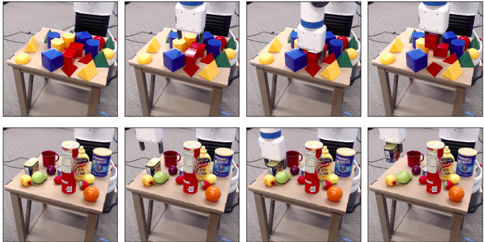
- The pipeline enabled a Fetch robot to detect and pick up the target object in 38 out of 40 trials in increasingly cluttered scenes, and a detector trained on a Spam can succeeded in 9 of 10 trials with previously unseen YCB food distractors.
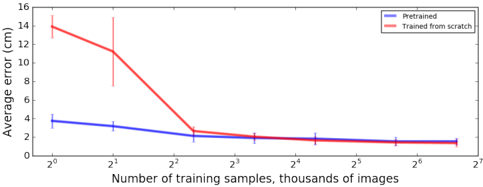
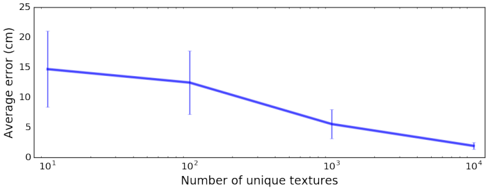
- Ablations found sensitivity to number of training images, number of unique textures, presence of distractors in training, and camera randomization; random noise had negligible effect. Performance improved up to around 50,000 training samples, and degraded significantly with fewer than 1,000 textures.
- ImageNet pretraining was not essential with enough data: random weight initialization achieved nearly the same real-world transfer performance as pretrained initialization, though pretraining helped in the low-data regime.
Methods
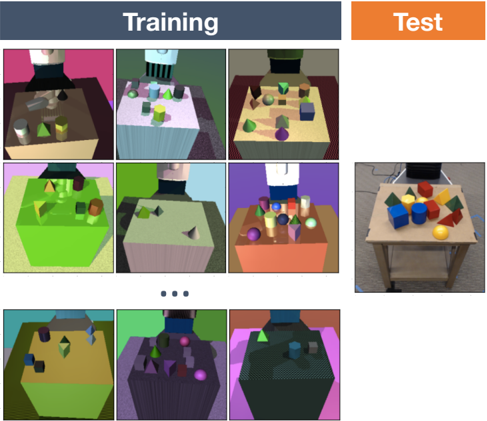
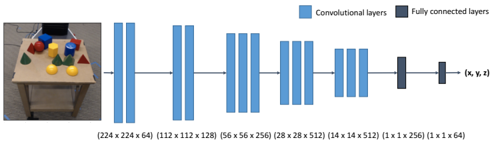
- The authors trained a modified VGG-16 convolutional neural network to map a single 224×224 monocular webcam image to Cartesian coordinates of object(s) of interest, using simulated images rendered by MuJoCo.
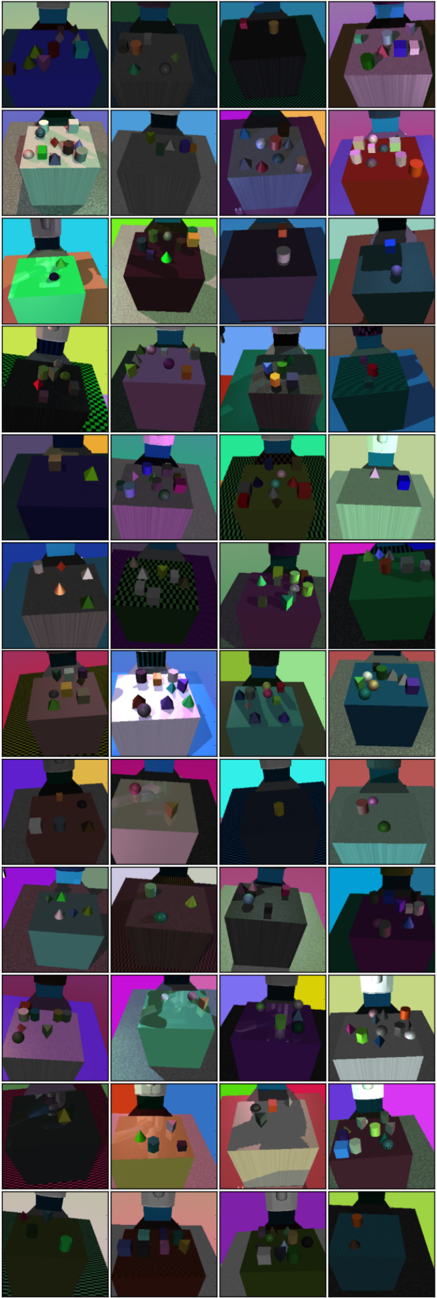
- Domain randomization varied number/shape of distractors, object positions and textures, table/floor/skybox/robot textures, camera position/orientation/field of view, number and properties of lights, and image noise. Textures were random RGB values, gradients, or checker patterns; 0–10 distractor objects were added per scene.
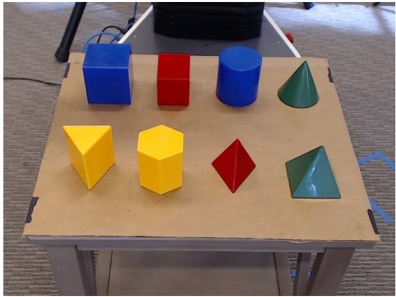
- Training used stochastic gradient descent with Adam on an L2 loss, learning rates around 1e-4, and batch sizes of 25, 50, or 100. Evaluation used 480 webcam images of eight geometric objects at 70–105 cm from a fixed camera, with 60 labeled images per object: 20 alone, 20 with distractors, and 20 partially occluded.
Limitations
- The paper states that the detectors still overfit simulated training data: simulated error was 0.3–0.5 cm versus about 1.5 cm in the real world, and no real-world validation could be done during training because no real data were assumed available.
- The paper states future work is needed for contact-rich manipulation or higher precision, and that the method fixes table height, effectively making the task 2D pose estimation from a single monocular uncalibrated camera.
- Evident from the text: evaluation is limited to eight geometric objects plus one Spam can, the test camera position remains constant across all images, and lighting and surrounding scene were not controlled.
Model-written summary. Check it against the paper before relying on it.
Integrity signals
Registry
Cites
Statistics
Figures
Verification
Claims the paper makes
2 Valid · 8 Not valid · 7 Not checked · 32 Own results and interpretations
The cited sources support only part of this claim — read each source’s verdict below.
In the paper
“Although previous work demonstrated the ability to perform robotic control using a neural network pretrained on ImageNet and fine-tuned on randomized rendered pixels [37], this paper provides the first demonstration that domain randomization can be useful for robotic tasks requiring precision.”
What the sources say
- Partly supportedcites [37] [37] Fereshteh Sadeghi and Sergey Levine. (cad) 2 RL: Real single-image flight without a single real image. arXiv preprint arXiv:1611.04201 , 2016. - sourceExperimental — accuracy not yet measured
The citation [37] is attached to the preceding claim about prior work, not to the citing authors’ claim that their own paper is the first to demonstrate precision robotics. Section 3.1 (p. 4) says LSDA pretrains a CNN on ImageNet classification data and fine-tunes it, but for object detection. It does not report robotic control or fine-tuning on randomized rendered pixels. (LLM, conf=0.84)
boostedstates a cause- Asserted: passes — The authors put it forward as true.
- Checkable: passes — It can be checked against evidence.
- Load-bearing: passes — The paper’s conclusions depend on it.
- Based: passes — The paper gives a reason why it holds.
- Partly supported
The cited sources that could be checked couldn’t confirm or dispute this claim.
In the paper
“Rather than relying on controller robustness, Yu et al. [53] use a model trained on varied physics to perform system identification using online trajectory data, but their approach is not shown to succeed in the real world.”
What the sources say
- Could not verifycites [53] [53] Wenhao Yu, C Karen Liu, and Greg Turk. Preparing for the unknown: Learning a universal policy with online system identification. arXiv preprint arXiv:1702.02453 , 2017. - sourceExperimental — accuracy not yet measured
The cited paper discusses image classification and localisation with convolutional networks (A.1, p. 10; A.2, p. 11), not Yu et al.'s approach. Searches for varied-physics training, online trajectory-based system identification, and real-world success found no passage addressing the claim. Our copy therefore cannot verify it. (LLM, conf=0.78)
plain- Asserted: passes — The authors put it forward as true.
- Checkable: passes — It can be checked against evidence.
- Load-bearing: unclear — It is unclear whether the paper’s conclusions depend on it.
- Based: passes — The paper gives a reason why it holds.
- Could not verify
The cited sources that could be checked couldn’t confirm or dispute this claim.
In the paper
“Though using realistic RGB rendering alone has had limited success for transferring to real robotic tasks [16], incorporating realistic simulation of depth information can allow models trained on rendered images to transfer reasonably well to the real world [32].”
What the sources say
- Could not verifycites [16] [16] Stephen James and Edward Johns. 3d simulation for robot arm control with deep q-learning. arXiv preprint arXiv:1609.03759 , 2016. - sourceExperimental — accuracy not yet measured
The Introduction (§1) and Conclusion (§8) describe Adam as a method for stochastic optimization, while the CNN experiment (§6.3) concerns training on image datasets. Searches for realistic RGB rendering and sim-to-real robotic transfer found no passage addressing whether RGB rendering alone has had limited success on real robotic tasks. (LLM, conf=0.78)
plain- Asserted: passes — The authors put it forward as true.
- Checkable: passes — It can be checked against evidence.
- Load-bearing: passes — The paper’s conclusions depend on it.
- Based: passes — The paper gives a reason why it holds.
- Could not verify
The cited sources that could be checked couldn’t confirm or dispute this claim.
In the paper
“However, their experiments - collision avoidance in hallways and open spaces - do not demonstrate the ability to deal with high-precision tasks.”
What the sources say
- Could not verifycites [37] [37] Fereshteh Sadeghi and Sergey Levine. (cad) 2 RL: Real single-image flight without a single real image. arXiv preprint arXiv:1611.04201 , 2016. - sourceExperimental — accuracy not yet measured
The Experiments section (p. 5) evaluates LSDA on an object-detection dataset, not Sadeghi and Levine’s collision-avoidance experiments. Searches for Sadeghi and Levine, hallway or open-space collision avoidance, and high-precision tasks found no passage addressing the claim. (LLM, conf=0.76)
plain- Asserted: passes — The authors put it forward as true.
- Checkable: passes — It can be checked against evidence.
- Load-bearing: passes — The paper’s conclusions depend on it.
- Based: passes — The paper gives a reason why it holds.
- Could not verify
A result the paper reports from its own data — it cites no other source for it, so there is none to check. The quote shows it is in the paper.
In the paper
“However, using a pre-trained model can significantly improve performance when less training data is used.”
plainstates a cause- Asserted: passes — The authors put it forward as true.
- Checkable: passes — It can be checked against evidence.
- Load-bearing: unclear — It is unclear whether the paper’s conclusions depend on it.
- Based: passes — The paper gives a reason why it holds.
29 more claims
Create a free account to see all 49 claims and to verify the 7 references still open.
- Probably not a substantial claim. 11
- It may state two separate claims as one. 8
Claims other papers make about this one
Each is checked against this paper’s own text: does it say what the citing paper says it does?
The source backs part of the claim, not all of it — or backs it for a different population, condition or comparison.
In the citing paper
“Most policies trained in simulation generalize poorly to the real-world due to agents adapting to specific visual details of the simulator.”
From Language-Based Augmentation to Address Shortcut Learning in Object-Goal Navigation (2023) · cites this paper as [8]
Experimental — accuracy not yet measuredThe source backs part of the claim, not all of it — or backs it for a different population, condition or comparison.
In the citing paper
“In robotic vision tasks including object localization [53], object detection [54], pose estimation [55], and semantic segmentation [56], the training data from simulator always have different textures, lighting, and camera positions from the realistic environments.”
From Sim-to-Real Transfer in Deep Reinforcement Learning for Robotics: a Survey (2020) · cites this paper as [53]
Experimental — accuracy not yet measuredThe source backs part of the claim, not all of it — or backs it for a different population, condition or comparison.
In the citing paper
“These artifacts limit the applicability of generative videos in physics-sensitive domains such as robotics [25,26], autonomous driving [27], simulationbased design, and scientific visualization [28].”
From PhyStruct-Video: Structured Physics State Spaces for Physically Consistent Video Generation (2025) · cites this paper as [25]
Experimental — accuracy not yet measuredThe source backs part of the claim, not all of it — or backs it for a different population, condition or comparison.
In the citing paper
“In domain randomization, the inputs during learning are “randomized” in the sense of being warped or corrupted in particular ways.”
From The overfitted brain: Dreams evolved to assist generalization (2021) · cites this paper as [144]
Experimental — accuracy not yet measuredThe source backs part of the claim, not all of it — or backs it for a different population, condition or comparison.
In the citing paper
“Domain randomization is a domain generalization technique that introduces drastic changes in the training image appearances, which forces the network to learn domain-invariant features between training and target domains [39].”
From A Fully Differentiable Framework for 2D/3D Registration and the Projective Spatial Transformers (2024) · cites this paper as [39]
Experimental — accuracy not yet measured
8 more claims about this paper
Create a free account to see every claim other papers make about this one.
Self-check
Percentages, sums and reported differences re-computed from the paper’s own numbers.
Each contradiction between two passages listed here was confirmed by an independent check.
Rated minor: it would not touch a result — a value no result rests on, a p-value that stays on the same side of the significance level, or a conflict that is clerical, resolved elsewhere in the paper, or outside its own findings.
In the paper
§ A. Experimental Setup · p. 4
“Each training sample consists of (a) a rendered image of the object and one or more distractors (also from among the geometric object set) on a simulated tabletop”
§ A. Domain randomization · p. 4
“Between 0 and 10 distractor objects are added to the table in each scene.”
Citations
Cites
Very Deep Convolutional Networks for Large-Scale Image Recognition
Simonyan, K., & Zisserman, A. (2014) · arXiv · doi:10.48550/arxiv.1409.1556 · Cited by 114,148 · cited 1×
“In particular, we use a modified version the VGG-16 architecture [42] shown in Figure 2.”
MethodAdam: A Method for Stochastic Optimization
Kingma, D. P., & Ba, J. (2014) · arXiv · doi:10.48550/arxiv.1412.6980 · Cited by 98,946 · cited 1×
“We found that using a learning rate of around 1e − 4 (as opposed to the standard 1e − 3 for Adam) improved convergence and helped avoid a common local optimum, mapping all objects to the center of the table.”
MethodLeCun, Y., Bengio, Y., & Hinton, G. (2015) · Nature · doi:10.1038/nature14539 · Cited by 84,126
Human-level control through deep reinforcement learning
Mnih, V., Kavukcuoglu, K., Silver, D., Rusu, A. A., Veness, J., Bellemare, M. G., Graves, A., Riedmiller, M., Fidjeland, A. K., Ostrovski, G., et al. (2015) · Nature · doi:10.1038/nature14236 · Cited by 30,357 · cited 3×
“Learning in simulation is especially promising for building on recent results using deep reinforcement learning to achieve human-level performance on tasks like Atari [27] and robotic control [21], [38].”
BackgroundResultHow transferable are features in deep neural networks?
Yosinski, J., Clune, J., Bengio, Y., & Lipson, H. (2014) · arXiv · doi:10.48550/arxiv.1411.1792 · Cited by 6,061 · cited 1×
“A variety of approaches have been proposed, including re-training the model in the target domain (e.g., [52]), adapting the weights of the model based on the statistics of the source and target domains (e.g., [22]), learning invariant features between domains (e.g., [47]), and learning a mapping…”
BackgroundMuJoCo: A physics engine for model-based control
Todorov, E., Erez, T., & Tassa, Y. (2012) · 2012 IEEE/RSJ International Conference on Intelligent Robots and Systems · doi:10.1109/iros.2012.6386109 · Cited by 4,767 · cited 1×
“We render images using the MuJoCo Physics Engine’s [45] built-in renderer.”
MethodTrust region policy optimization
Schulman, J., Levine, S., Moritz, P., Jordan, M. I., & Abbeel, P. (2015) · arXiv · doi:10.48550/arxiv.1502.05477 · Cited by 4,578 · cited 1×
“Learning in simulation is especially promising for building on recent results using deep reinforcement learning to achieve human-level performance on tasks like Atari [29] and robotic control [26], [41].”
ResultSelf-citationLearning Transferable Features with Deep Adaptation Networks
Long, M., Cao, Y., Wang, J., & Jordan, M. I. (2015) · arXiv · doi:10.48550/arxiv.1502.02791 · Cited by 4,505 · cited 1×
“omputer vision community has devoted significant study to the problem of adapting vision-based models trained in a source domain to a previously unseen target domain (see, e.g., [9], [14], [15], [19], [23], [25], [51]). A variety of approaches have been proposed, including re-training the model in the target domain (e.…”
BackgroundEnd-to-End Training of Deep Visuomotor Policies
Levine, S., Finn, C., Darrell, T., et al. (2015) · Journal of machine learning research · doi:10.5555/2946645.2946684 · Cited by 3,987
Describing Textures in the Wild
Cimpoi, M., Maji, S., Kokkinos, I., Mohamed, S., & Vedaldi, A. (2014) · 2014 IEEE Conference on Computer Vision and Pattern Recognition · doi:10.1109/cvpr.2014.461 · Cited by 2,438 · cited 1×
“To examine how our detectors would perform on objects with complex textures, we created simulated scenes in which the object of interest is given a texture from the Describable Textures Dataset (DTD) [4].”
Method
Research works printed but not linked: 3
- [24] David G Lowe. Three-dimensional object recognition from single two-dimensional images. Artificial intelligence , 31(3):355-395, 1987. -
- [49] Melonee Wise, Michael Ferguson, Derek King, Eric Diehr, and David Dymesich. Fetch and freight: Standard platforms for service robot applications. In Workshop on Autonomous Mobile Service Robots , 2016. -
- sucan, 0, MoveIt!
Cited by
Items 1,201–1,300 of 2,970
Semi-supervised Viewpoint Estimation with Geometry-Aware Conditional Generation
Mariotti, O., & Bilen, H. (2020) · Lecture notes in computer science · doi:10.1007/978-3-030-66096-3_42 · Cited by 10
“Motivated by the fact that accurate 3D models and diverse background scenes are not always available, domain randomization [39] addresses the reality gap by simulating a wide range of environments at training time and assume that the variability of the simulation is significant enough to generalize the real world.”
BackgroundHigh-Quality Dialogue Diversification by Intermittent Short Extension Ensembles
Tang, Z., Kulkarni, H., & Yang, G. H. (2021) · Findings of the Association for Computational Linguistics: ACL (Findings of ACL) · doi:10.18653/v1/2021.findings-acl.163 · Cited by 11
ScoopNet: 6DOF Pose Estimation pipeline for Origami-inspired Worm Robots
Lal, R., Swaminathan, R., Seenivasan, L., Qiu, L., & Ren, H. (2021) · IEEE International Conference on Development and Learning (ICDL) · doi:10.1109/icdl49984.2021.9515617 · Cited by 8
Espadinha, J., Лебедев, И. М., Lukic, L., & Bernardino, A. J. M. (2021) · IEEE Intelligent Vehicles Symposium · doi:10.1109/iv48863.2021.9576034 · Cited by 12
Shaping Progressive Net of Reinforcement Learning for Policy Transfer with Human Evaluative Feedback
Juan, R., Huang, J., Gómez, R., Nakamura, K., Sha, Q., He, B., & Li, G. (2021) · IEEE/RSJ International Conference on Intelligent Robots and Systems (IROS) · doi:10.1109/iros51168.2021.9636061 · Cited by 15
“With domain randomization, an agent first learns by randomizing visual information or physical parameters in simulation [5].”
BackgroundMethodMetzner, M., Albrecht, F., Fiegert, M., et al. (2021) · International Journal of Computer Integrated Manufacturing · doi:10.1080/0951192x.2021.2004618 · Cited by 8
“One approach employs domain randomization, the variation of different image parameters such as background, lighting and material properties to increase heterogeneity of the training set aiming to increase model robustness (Tobin et al. 2017).”
BackgroundEquidistant and Uniform Data Augmentation for 3D Objects
Morozov, A., Zgyatti, D., & Popov, P. A. (2021) · IEEE Access · doi:10.1109/access.2021.3138162 · Cited by 8
“These could be useful in training machine learning models for complex many-body systems, such as autonomous vehicles (42; 43), robotics (26; 44; 45), or indoor drone navigation (46; 47; 48).”
BackgroundCombining Local and Global Pose Estimation for Precise Tracking of Similar Objects
Gard, N., Hilsmann, A., & Eisert, P. (2022) · International Joint Conference on Computer Vision, Imaging and Computer Graphics Theory and Applications (VISIGRAPP) · doi:10.5220/0010882700003124 · Cited by 11
“To address the domain gap, i.e. the different properties of real and synthetic images that affect the accuracy of a CNN trained on synthetic data only, we use domain randomization (Tobin et al., 2017).”
MethodJokar, M., & Semperlotti, F. (2022) · Computers & Structures · doi:10.1016/j.compstruc.2022.106784 · Cited by 8
Peterson, M., Du, M., Springle, B., & Black, J. T. (2022) · Aerospace · doi:10.3390/aerospace9050254 · Cited by 10
“This method is defined as an auxiliary domain [22].”
BackgroundMethodOnline Reflective Learning for Robust Medical Image Segmentation
Huang, Y., Yang, X., Huang, X., Liang, J., Zhou, X., Chen, C., Dou, H., Hu, X. C., Cao, Y., & Ni, D. (2022) · Lecture notes in computer science · doi:10.1007/978-3-031-16452-1_62 · Cited by 11
On high stiffness of soft robots for compatibility of deformation and function
HAGIWARA, K., Yamamoto, K., Shibata, Y., Komagata, M., & Nakamura, Y. (2022) · Advanced Robotics · doi:10.1080/01691864.2022.2117574 · Cited by 8
“We use domain adaptation or domain randomization [31] to determine the position of not only green objects but general objects such as daily necessities.”
MethodDeep Learning for Victims Detection from Virtual and Real Search and Rescue Environments
Ulloa, C. C., Garcia, M., del Cerro, J., et al. (2022) · Lecture notes in networks and systems · doi:10.1007/978-3-031-21062-4_1 · Cited by 8
Robust Counterexample-guided Optimization for Planning from Differentiable Temporal Logic
Dawson, C., & Fan, C. (2022) · IEEE/RSJ International Conference on Intelligent Robots and Systems (IROS) · doi:10.1109/iros47612.2022.9981382 · Cited by 8
“First, we take inspiration from the success of domain randomization in robust machine learning [24]: instead of optimizing θ with respect to a single fixed χ∗, we can maintain a dataset XN = {χi}i=1,.”
MethodRihm, G. B., Schueler, M., Nentwich, C., Esche, E., & Repke, J. (2023) · Chemie Ingenieur Technik · doi:10.1002/cite.202200228 · Cited by 10
Domain Generalised Faster R-CNN
Seemakurthy, K., Fox, C., Aptoula, E., & Bosilj, P. (2023) · Proceedings of the AAAI Conference on Artificial Intelligence · doi:10.1609/aaai.v37i2.25312 · Cited by 12
“Domain randomisation (Tobin et al. 2017; Yue et al. 2019) is a complementary approach to DG, which relies on synthetically generated variations of the input data to obtain more generalisable features.”
MethodZero-Shot Policy Transfer with Disentangled Task Representation of Meta-Reinforcement Learning
Wu, Z., Xie, Y., Lian, W.-Z., Wang, C.-H., Guo, Y., Chen, J., Schaal, S., & Tomizuka, M. (2022) · IEEE International Conference on Robotics and Automation · doi:10.1109/icra48891.2023.10160764 · Cited by 15
“This is usually achieved by domain randomization, which randomizes the tasks with a wide task distribution in simulation and assumes the realworld task is captured by this distribution [11], [12], [13].”
BackgroundFrom Video Game to Real Robot: The Transfer Between Action Spaces
Karttunen, J. P., Kanervisto, A., Kyrki, V., & Hautamäki, V. (2020) · IEEE International Conference on Acoustics Speech and Signal Processing · doi:10.1109/icassp40776.2020.9053221 · Cited by 12
“To address this, one can try to create as realistic simulation as possible or use methods like domain randomization [2] for training more general policies.”
MethodProgramming by Visual Demonstration for Pick-and-Place Tasks using Robot Skills
Peng, H., Lu, T., Cai, Y., & Wang, S. (2019) · IEEE International Conference on Robotics and Biomimetics (ROBIO) · doi:10.1109/robio49542.2019.8961481 · Cited by 8
“Tobin [14] randomizes the simulator to expose the model to a wide range of environments at training time, then uses this method to train the detection network from the simulated data and deploy the detection network on a Fetch robot.”
BackgroundMethodQi, C. R. (2020) · Springer eBooks · doi:10.1007/978-3-030-44070-1_11 · Cited by 15
Generative Modeling of Environments with Scene Grammars and Variational Inference
Izatt, G., & Tedrake, R. (2020) · Proceedings - IEEE International Conference on Robotics and Automation/Proceedings · doi:10.1109/icra40945.2020.9196910 · Cited by 13
“Photorealistic renderers have proven invaluable for providing densely labeled datasets for training deep learning systems for robot perception [1] [2] – with domain randomization [3] and domain adaptation [4] closing the gap even further.”
BackgroundZero-Shot Transfer Learning of a Throwing Task via Domain Randomization
Park, S., Kim, J.-G., & Kim, H. J. (2020) · International Conference on Control, Automation and Systems (ICCAS) · doi:10.23919/iccas50221.2020.9268312 · Cited by 11
“Generally, DR is regarded as one of the reliable methods for the zero-shot domain transfer, where a policy optimized in the source domain (e.g. simulation) is tested on the target domain (e.g. real world) without fine-tuning [6, 7].”
MethodRobot Sound Interpretation: Combining Sight and Sound in Learning-Based Control
Chang, P., Liu, S., Chen, H., & Driggs-Campbell, K. (2020) · IEEE/RSJ International Conference on Intelligent Robots and Systems (IROS) · doi:10.1109/iros45743.2020.9341196 · Cited by 14
“To narrow the gap between rendered and real-world images, we use domain randomization to learn robust visual features [41].”
MethodAutonomous Driving in the Lung using Deep Learning for LocalizationPreprint
Sganga, J., Eng, D. K.-M., Graetzel, C. F., & Camarillo, D. B. (2019) · arXiv (Cornell University) · doi:10.48550/arxiv.1907.08136 · Cited by 28
“Image Styles Icam Image taken by a bronchoscope within the lung Isim Image rendered by OpenGL using the lung CT Irsim Isim image with varied rendering parameters and varied noise, smoothing and occlusions added [21] Error between True and Estimated Locations ep Position error (mm), defined as ep in [10] ed Direction a…”
MethodKumar, A., Buckley, T., Lanier, J. B., Wang, Q., Kavelaars, A. T., & Kuzovkin, I. (2019) · arXiv (Cornell University) · doi:10.48550/arxiv.1910.08639 · Cited by 18
“Training of robotic agents in the real world is being approached either directly [27], [28], [29], [30], [31], [32], [33], [34] or via different techniques that transfer the agents that were initially trained in simulation to the real world [35], [36], [37].”
Background$H_\infty$ Model-free Reinforcement Learning with Robust Stability GuaranteePreprint
Han, M., Tian, Y., Zhang, L., Wang, J., & Pan, W. (2019) · arXiv (Cornell University) · doi:10.48550/arxiv.1911.02875 · Cited by 20
“To overcome these drawbacks, various efforts are made to enhance the robustness of the policy Jakobi et al. [1995], Tobin et al. [2017], Mordatch et al. [2015], since a robust policy has a greater chance of successful generalization and transfer.”
Curriculum in Gradient-Based Meta-Reinforcement LearningPreprint
Mehta, B., Deleu, T., Raparthy, S. C., Pal, C., & Paull, L. (2020) · arXiv (Cornell University) · doi:10.48550/arxiv.2002.07956 · Cited by 18
“Using a method called domain randomization [Tobin et al., 2017], several recent methods [OpenAI et al., 2019, Mozifian et al., 2019] propose how to learn a curriculum of randomizations - which randomized environments would be most useful to show the learning agent in order to make progress on the…”
BackgroundMethodReinforcement Learning Generalization with Surprise MinimizationPreprint
Chen, J. Z. (2020) · arXiv (Cornell University) · doi:10.48550/arxiv.2004.12399 · Cited by 22
“It has been shown (Tobin et al., 2017) that robust representations can be learned by the RL agent if diverse observations are provided during training.”
BackgroundProbabilistic Active Meta-Learning
Kaddour, J., Sæmundsson, S., & Deisenroth, M. P. (2020) · neural information processing systems · doi:10.48550/arxiv.2007.08949 · Cited by 27
“We compare PAML to uniform sampling (UNI), used in recent meta-learning work [1, 15] and equivalent to domain randomization [16], Latin hypercube sampling (LHS) of the parameterization”
MethodPredicting Infectiousness for Proactive Contact TracingPreprint
Bengio, Y., Gupta, P., Maharaj, T., Rahaman, N., Weiß, M., Deleu, T., Muller, E. B., Qu, M., Schmidt, V. M., St-Charles, P.-L., et al. (2020) · arXiv (Cornell University) · doi:10.48550/arxiv.2010.12536 · Cited by 18
“The overall technique resembles that of domain-randomization (Tobin et al., 2017; Sadeghi & Levine, 2016) in the Sim2Real literature, where its efficacy is well studied for transfer from RGB images to robotic control, e.”
MethodIntervention Design for Effective Sim2Real TransferPreprint
Mozifian, M., Zhang, A., Pineau, J., & Meger, D. (2020) · arXiv (Cornell University) · doi:10.48550/arxiv.2012.02055 · Cited by 18
“[8] introduced domain randomization for sim2real transfer, which randomizes the rendering configuration in the simulator, and posited that with enough variability in the simulator, the real world could appear just as another variation.”
BackgroundContext-Aware Safe Reinforcement Learning for Non-Stationary EnvironmentsPreprint
Chen, B., Liu, Z., Zhu, J., et al. (2021) · arXiv (Cornell University) · doi:10.48550/arxiv.2101.00531 · Cited by 8
“Moreover, they are usually not adaptive to non-stationary disturbances, which are common in many realistic safety-critical applications [9].”
Backgroundse(3)-TrackNet: Data-driven 6D Pose Tracking by Calibrating Image Residuals in Synthetic Domains
Wen, B., Mitash, C., Ren, B., & Bekris, K. E. (2020) · 2020 IEEE/RSJ International Conference on Intelligent Robots and Systems (IROS) · doi:10.1109/iros45743.2020.9341314 · Cited by 126
“Prior work implements the idea of domain randomization by randomly changing the number of objects, poses, textures, lighting, etc, where object poses are usually directly sampled from some predetermined distribution [1], [12], [18].”
BackgroundMethodInfluentialHazardNet: Road Debris Detection by Augmentation of Synthetic Models
Choe, T. E., Wu, J., Lin, X., Kwon, K., & Park, M. (2023) · IEEE/CVF Conference on Computer Vision and Pattern Recognition Workshops (CVPRW) · doi:10.1109/cvprw59228.2023.00021 · Cited by 13
“The concept was first introduced in [55] to expose deep neural networks (DNNs) to a wide range of different environments by randomizing the simulator when generating training data.”
BackgroundMethodTagliabue, A., & How, J. P. (2024) · IEEE Robotics and Automation Letters · doi:10.1109/lra.2024.3386053 · Cited by 14
Economical Quadrupedal Multi-Gait Locomotion via Gait-Heuristic Reinforcement Learning
Wei, L., Zou, J., Yu, X., Liu, L., Liao, J., Wang, W., & Zhang, T. (2024) · Journal of Bionic Engineering · doi:10.1007/s42235-024-00517-3 · Cited by 7
“To bridge the gap between simulation and the real world environments (sim-to-real gap), we apply domain randomization [25].”
Benyamen, H., Chowdhury, M., & Keshmiri, S. (2024) · Journal of Dynamic Systems Measurement and Control · doi:10.1115/1.4065804 · Cited by 8
Invariance Learning Under Uncertainty for Single Domain Generalization Person Re-Identification
Peng, W., Chen, H., Li, Y., & Sun, J. (2024) · IEEE Transactions on Instrumentation and Measurement · doi:10.1109/tim.2024.3453330 · Cited by 10
“For the first time, this approach was used to generate more training data from simulated environments for generalization to real environments [21].”
BackgroundMethodContinual Domain Randomization
Josifovski, J., Auddy, S., Malmir, M., Piater, J., Knoll, A., & Navarro-Guerrero, N. (2024) · IEEE/RSJ International Conference on Intelligent Robots and Systems (IROS) · doi:10.1109/iros58592.2024.10802060 · Cited by 22
“For this reason, domain randomization (DR) [3], [12]–[18] has become a widely used sim2real technique.”
Zihui, Y. A. N., Liang, X., Hou, Y., Aiwu, Y. A. N. G., ZHANG, J., & Wang, N. (2025) · Chinese Journal of Aeronautics · doi:10.1016/j.cja.2024.103391 · Cited by 7
Li, M., Feng, X., Wu, Z.-M., Bai, J., & Yang, F. (2025) · Tunnelling and Underground Space Technology · doi:10.1016/j.tust.2025.106755 · Cited by 9
VR-Robo: A Real-to-Sim-to-Real Framework for Visual Robot Navigation and Locomotion
Zhu, S., Mou, L., Li, D., Ye, B., Huang, R., & Zhao, H. (2025) · IEEE Robotics and Automation Letters · doi:10.1109/lra.2025.3575648 · Cited by 50
Ou, Y., & Tavakoli, M. (2025) · IEEE Transactions on Automation Science and Engineering · doi:10.1109/tase.2025.3576731 · Cited by 18
“Domain randomization (DR) [46] is a common approach to obtaining a transferrable policy.”
Sim-to-Real Transfer of Deep Reinforcement Learning Agents for Online Coverage Path Planning
Jonnarth, A., Johansson, O., Zhao, J. W., & Felsberg, M. (2025) · IEEE Access · doi:10.1109/access.2025.3581035 · Cited by 15
“Domain randomization has been utilized to randomize physical parameters in simulation, such as mass and joint damping [9], or to randomize textures and lighting conditions in the image domain [10].”
Liu, Q. Z., Liu, Y., Yan, Y., Qian, J., & Jiang, X. (2025) · IEEE Transactions on Instrumentation and Measurement · doi:10.1109/tim.2025.3580815 · Cited by 13
“In recent years, domain randomization (DR) methods [24], [25], [26], [27] have been used to address data shortages in industrial applications [28].”
InfluentialZhang, J., & Zhang, H. (2025) · Mathematics · doi:10.3390/math13132087 · Cited by 11
Samak, C. V., Samak, T. V., & Krovi, V. (2025) · IEEE Robotics and Automation Letters · doi:10.1109/lra.2025.3592085 · Cited by 13
“For example, [17] proposes an interesting approach of using pre-recorded data to approximate ego viewpoint with a synthetic vehicle rendered as an obstacle during training.”
Generalizable Pareto-Optimal Offloading With Reinforcement Learning in Mobile Edge Computing
Yang, N., Wen, J., Zhang, M., & Tang, M. (2025) · IEEE Transactions on Services Computing · doi:10.1109/tsc.2025.3604371 · Cited by 21
FRASA: An End-to-End Reinforcement Learning Agent for Fall Recovery and Stand Up of Humanoid Robots
Gaspard, C., Duclusaud, M., Passault, G., Daniel, M., & Ly, O. (2025) · Proceedings - IEEE International Conference on Robotics and Automation/Proceedings · doi:10.1109/icra55743.2025.11128664 · Cited by 23
“To enhance the robustness and generalization of the learned policy, we employ extensive domain randomization [27] in our simulation environment.”
Ferreira, H. C., & Barbosa, R. S. (2025) · Future Internet · doi:10.3390/fi17100437 · Cited by 12
AeroVerse-Review: Comprehensive survey on aerial embodied vision-and-language navigation
Yao, F., Liu, Y., Zhang, W., Zhu, Z., Li, C., Liu, N., Hu, P., Yue, Y., Wei, K., He, X. J., et al. (2025) · The Innovation Informatics · doi:10.59717/j.xinn-inform.2025.100015 · Cited by 26
Guo, S., Zhong, Y., Feng, Z., Kang, S., & Chen, J. (2025) · Journal of Information and Intelligence · doi:10.1016/j.jiixd.2025.12.005 · Cited by 17
Learning on the Fly: Rapid Policy Adaptation via Differentiable Simulation
Pan, J., Xing, J., Reiter, R., Zhai, Y., Aljalbout, E., & Scaramuzza, D. (2026) · IEEE Robotics and Automation Letters · doi:10.1109/lra.2026.3655300 · Cited by 34
Learning Category-level Implicit 3D Rotation Representations for 6D Pose Estimation from RGB Images
Li, X., Cai, Y., Wang, S., & Lu, T. (2019) · IEEE International Conference on Robotics and Biomimetics (ROBIO) · doi:10.1109/robio49542.2019.8961408 · Cited by 7
“To bridge the gap between simulation and reality, we adopt the domain randomization (DR) [19] technique by performing random lights, contrast normalization, Gaussian blur, color channel shuffle and occlusion to synthetic view images.”
MethodA Multi-Step CNN-Based Estimation of Aircraft Landing Gear Angles
Li, F., Wu, Z., Li, J., Lai, Z., Zhao, B., & Chen, M. (2021) · Sensors · doi:10.3390/s21248440 · Cited by 6
“[58] proved the broad application prospect of random field sample generation through ablation experiments.”
BackgroundUltrafast water–fat separation using deep learning–based single‐shot MRI
Chen, X., Wang, W., Huang, J., Wu, J., Chen, L., Cai, C., Cai, S., & Chen, Z. (2022) · Magnetic Resonance in Medicine · doi:10.1002/mrm.29172 · Cited by 9
“Nowadays, SPEN MRI has been successfully applied to many fields, such as functional MRI, 23 real-time imaging, 24 diffusion imaging, 25 CEST MRI, 26 and quantitative imaging.”
BackgroundMethodInfluentialAlbeaik, S., Wu, T., Vurimi, G., Chou, F., Lu, X., & Bayen, A. M. (2022) · Journal of Field Robotics · doi:10.1002/rob.22131 · Cited by 8
“Domain randomization (Tobin et al., 2017) could also be used eliminating the need for data from the field.”
MethodSynthetic to Real Gap Estimation of Autonomous Driving Datasets using Feature Embedding
Gadipudi, N., Elamvazuthi, I., Sanmugam, M., Izhar, L. I., Prasetyo, T., Jegadeeshwaran, R., & Ali, S. S. A. (2022) · IEEE International Symposium in Robotics and Manufacturing Automation (ROMA) · doi:10.1109/roma55875.2022.9915679 · Cited by 14
“DR hugely relies on the distribution of different objects and can be used as a standard metric for simulation to the real gap [12].”
BackgroundVisual Navigation Subject to Embodied Mismatch
Liu, X., Guo, D., Liu, H., Zhang, X., & Sun, F. (2023) · IEEE Transactions on Cognitive and Developmental Systems · doi:10.1109/tcds.2023.3238840 · Cited by 9
“One promising approach is domain randomization which randomizes the parameters in the source domain [13], [45], or randomize the dynamics of the simulator [12] to generalize the learned policy to the real-world scenarios.”
BackgroundMethodChen, R., Liu, I., Yang, E., Tao, J., Zhang, X., Ran, Q., Liu, Z., Xu, J. L., & Su, H. (2023) · IEEE Transactions on Pattern Analysis and Machine Intelligence · doi:10.1109/tpami.2023.3305399 · Cited by 7
Learning Nonprehensile Dynamic Manipulation: Sim2real Vision-Based Policy With a Surgical Robot
Gondokaryono, R., Haiderbhai, M., Suryadevara, S. A., & Kahrs, L. A. (2023) · IEEE Robotics and Automation Letters · doi:10.1109/lra.2023.3312038 · Cited by 11
“In our previous work [3], we created a novel simulation for the dVRK inside Unity3D and showed that a robust visuomotor policy could be trained efficiently in simulation and transferred to real through our sim2real training pipeline using Domain Randomization.”
MethodInfluentialGrando, R. B., de Jesus, J. C., Kich, V. A., Kolling, A. H., Mateus, M. G., Guerra, R. D. S., & Drews, P. (2023) · Latin American Robotics Symposium, Brazilian Symposium on Robotics and Workshop on Robotics in Education (LARS/SBR/WRE) · doi:10.1109/lars/sbr/wre59448.2023.10333008 · Cited by 8
“Several Deep-RL works in robotics have previously been carried out for the mapless navigation problem, demonstrating how efficiently we may solve the problem utilizing learning techniques [20].”
BackgroundForce Map: Learning to Predict Contact Force Distribution from Vision
Hanai, R., Domae, Y., Ramírez-Alpizar, I. G., Leme, B., & Ogata, T. (2023) · IEEE/RSJ International Conference on Intelligent Robots and Systems (IROS) · doi:10.1109/iros55552.2023.10342092 · Cited by 10
“Domain randomization [1][2] was used to generalize the model trained with only synthetic data to real-scene images.”
MethodAdaptive Control Strategy for Quadruped Robots in Actuator Degradation Scenarios
Wu, X., Dong, W., Lai, H., Yu, Y. H., & Wen, Y. (2023) · International Conference on Distributed Artificial Intelligence (DAI) · doi:10.1145/3627676.3627686 · Cited by 14
Test-time Personalizable Forecasting of 3D Human Poses
Cui, Q., Sun, H., Lu, J., Li, W., Li, B., Yi, H., & Wang, H. (2023) · IEEE/CVF International Conference on Computer Vision (ICCV) · doi:10.1109/iccv51070.2023.00032 · Cited by 14
“For this purpose, a variety of works are proposed, e.g ., adversarial attack [57, 60], image perturbation [60], and domain randomization [46, 47], where the main heuristic is to learn cross-domain invariant feature.”
BackgroundSheng, Y., Liu, H., Li, J., & Han, Q. (2024) · Measurement Science and Technology · doi:10.1088/1361-6501/ad2666 · Cited by 7
“Domain randomization is an effective way to improve the distribution mismatch problem [36], which optimizes training strategies by providing the richest possible training scenarios.”
Wu, Y., Zhang, J., Wu, S., Mao, S., & Wang, Y. (2023) · Globecom · doi:10.1109/globecom54140.2023.10437833 · Cited by 7
“However, the “reality gap” challenges this methodology, a phenomenon where the virtual-learned policies cannot be directly applied to real robotic applications [15].”
Liebers, C., Megarajan, P., Auda, J., Stratmann, T. C., Pfingsthorn, M. F., Gruenefeld, U., & Schneegaß, S. (2024) · Multimodal Technologies and Interaction · doi:10.3390/mti8030018 · Cited by 9
Disease‐driven domain generalization for neuroimaging‐based assessment of Alzheimer's disease
Lteif, D., Sreerama, S., Bargal, S. A., Plummer, B. A., Au, R., & Kolachalama, V. B. (2024) · Human Brain Mapping · doi:10.1002/hbm.26707 · Cited by 14
“A group of methods have been proposed to tackle DG via data manipulation, which could either be data augmentation or generation (Cubuk et al., 2020; Tobin et al., 2017; Volpi et al., 2018; Zhang et al., 2018; Zhou et al., 2020).”
MethodImproving object detector training on synthetic data by starting with a strong baseline methodology
Ruis, F., Liezenga, A. M., Heslinga, F. G., Ballan, L., Eker, T. A., den Hollander, R. J. M., van Leeuwen, M. C., Dijk, J., & Huizinga, W. (2024) · Synthetic Data for Artificial Intelligence and Machine Learning: Tools, Techniques, and Applications · doi:10.1117/12.3013441 · Cited by 20
“…by the reality gap, recent literature explores data diversity, 45 coherent in-context placement, 46 coverage in viewpoint and scale distributions, 47 variation in clutter and occlusions, 3 unrealistic 48 or structured 4 domain randomization, 5,49 photorealism 50,51 or a combination of the last two.”
BackgroundTWIST: Teacher-Student World Model Distillation for Efficient Sim-to-Real Transfer
Yamada, J., Rigter, M. P., Collins, J., & Posner, I. (2024) · Proceedings - IEEE International Conference on Robotics and Automation/Proceedings · doi:10.1109/icra57147.2024.10610450 · Cited by 28
“Existing approaches to sim-to-real transfer utilise techniques such as domain randomisation (DR) [32], system identification [33], and domain adaptation [34].”
BackgroundMethodDeep Model Predictive Optimization
Sacks, J., Rana, R., Huang, K., Spitzer, A., Shi, G., & Boots, B. (2024) · Proceedings - IEEE International Conference on Robotics and Automation/Proceedings · doi:10.1109/icra57147.2024.10611492 · Cited by 25
“To improve performance, we used domain randomization (DR) [6]–[8] on the mass, randomly scaling it by a factor in [0 .”
MethodReal2Sim Transfer using Differentiable Physics
Heiden, E., Millard, D., & Sukhatme, G. S. (2019) · Cited by 7
Experiences from Real-World Evolution with DyRET: Dynamic Robot for Embodied Testing
Nygaard, T. F., Nordmoen, J., Ellefsen, K. O., Martin, C. P., Tørresen, J., & Glette, K. (2019) · Communications in computer and information science · doi:10.1007/978-3-030-35664-4_6 · Cited by 9
The Autoencoder-Kalman Filter: Theory and Practice
Weiss, M. L., Paffenroth, R. C., & Uzarski, J. R. (2019) · Asilomar Conference on Signals, Systems and Computers (ACSSC) · doi:10.1109/ieeeconf44664.2019.9048687 · Cited by 9
“The application of domain randomization has been explored in domains such as robotics [11] but, as far as we are aware, has not been widely adopted in the signal processing community.”
Background2D-Key-Points-Localization-Driven 3D Aircraft Pose Estimation
Li, Y., Yu, R., & Zhu, B. (2020) · IEEE Access · doi:10.1109/access.2020.3026209 · Cited by 8
“We adopted domain randomization (DR) skill [12] in the AKO platform to strengthen the network general applicability.”
MethodRapid Pose Label Generation through Sparse Representation of Unknown Objects
Singh, R., Benallegue, M., Yoshiyasu, Y., & Kanehiro, F. (2021) · Proceedings - IEEE International Conference on Robotics and Automation/Proceedings · doi:10.1109/icra48506.2021.9561277 · Cited by 8
“The complications involved in acquisition of real-world training data have inspired methods such as [5], [14] which are trained only on synthetic or photo-realistic simulated data.”
MethodWhere is my hand? Deep hand segmentation for visual self-recognition in humanoid robots
Almeida, A., Vicente, P., & Bernardino, A. J. M. (2021) · Robotics and Autonomous Systems · doi:10.1016/j.robot.2021.103857 · Cited by 8
“We apply domain randomization [18] to generate a dataset with enough variability to overcome the reality gap, i.”
MethodEstimating 3D Motion and Forces of Human–Object Interactions from Internet Videos
Li, Z., Sedlář, J., Carpentier, J., Laptev, I., Mansard, N., & Šivic, J. (2022) · International Journal of Computer Vision · doi:10.1007/s11263-021-01540-1 · Cited by 19
“…intra-class variation of instance surface appearance as well as changes caused by illumination, we applied domain randomization (Loing et al., 2018; Tobin et al., 2017): the geometrically transformed 2D mask was filled with a random (foreground) image and pasted on another random (background)…”
MethodZhang, H., Wang, J., Wu, Z., Wang, Y., & Wang, D. (2021) · IEEE/RSJ International Conference on Intelligent Robots and Systems (IROS) · doi:10.1109/iros51168.2021.9636519 · Cited by 12
“Various methods have been proposed for this problem, such as meta-learning [21], system identi(cid:2)cation [22], and domain randomization [23].”
MethodAerobatic Tic-Toc Control of Planar Quadcopters via Reinforcement Learning
Wang, Z., Gros, R., & Zhao, S. (2022) · IEEE Robotics and Automation Letters · doi:10.1109/lra.2022.3142730 · Cited by 7
“The latter helps strengthening the RL controller’s generalization ability and stability [14].”
BackgroundDeep Reinforcement Learning for Autonomous Aerobraking Maneuver Planning
Falcone, G., & Putnam, Z. R. (2022) · AIAA SciTech Forum · doi:10.2514/6.2022-2497 · Cited by 11
Manipulation of free-floating objects using Faraday flows and deep reinforcement learning
Hardman, D. K., Thuruthel, T. G., & Fumiya Iida, A. (2022) · Scientific Reports · doi:10.1038/s41598-021-04204-9 · Cited by 6
“This would also aid in finding policies that are more robust due to unavoidable errors incurred while replicating the setup 29 .”
BackgroundKrump, M., & Stütz, P. (2022) · Lecture notes in computer science · doi:10.1007/978-3-030-98260-7_1 · Cited by 8
Dong, K., Luo, Y., Cheng, E., Sun, Z., Zhao, L., Zhang, Q., Zhou, C. Q., & Song, B. (2022) · IEEE/ASME International Conference on Advanced Intelligent Mechatronics · doi:10.1109/aim52237.2022.9863259 · Cited by 21
“With the help of deep learning-based image processing techniques [27]–[30], DRL often takes a representation learning via transforming the images into a meaningful form with physical meaning, such as the position and distance [1], and this process is called state representation.”
InfluentialZhao, W., Fan, Y., Wang, H., Gemmeke, H., van Dongen, K. W. A., Hopp, T., & Hesser, J. (2022) · Physics in Medicine and Biology · doi:10.1088/1361-6560/acaeed · Cited by 9
Sim-to-real via latent prediction: Transferring visual non-prehensile manipulation policies
Rizzardo, C., Chen, F., & Caldwell, D. G. (2023) · Frontiers in Robotics and AI · doi:10.3389/frobt.2022.1067502 · Cited by 15
“The core idea of the method is to randomize visual [Tobin et al. (2017)] and physical [Peng et al. (2017)] characteristics of the simulated environment, so that once the agent is transferred in the real world it can interpret the new domain as just another random variation.”
MethodData augmentation using Heuristic Masked Language Modeling
Liu, X., Zhong, Y., Wang, J., & Li, P. (2023) · International Journal of Machine Learning and Cybernetics · doi:10.1007/s13042-023-01784-y · Cited by 6
“Hence, inappropriate operations of augmentation on the text make changes to the semantic information, resulting in the failure to maintain the consistency of the label [5].”
BackgroundSynthesizing 3D Gait Data with Personalized Walking Style and Appearance
Cheng, Y., Zhang, G., Huang, S., Wang, Z., Cheng, X., & Lin, J. (2023) · Applied Sciences · doi:10.3390/app13042084 · Cited by 9
Object-Oriented Option Framework for Robotics Manipulation in Clutter
Pang, J.-C., Yang, S., Chen, X., Yang, X., Yu, Y., Ma, M., Guo, Z., Yang, H. H., & Huang, B. X. (2023) · IEEE/RSJ International Conference on Intelligent Robots and Systems (IROS) · doi:10.1109/iros55552.2023.10342335 · Cited by 12
“Even if reconstruction errors exist, promising techniques in Sim2Real [51, 52, 53] can alleviate such errors.”
BackgroundA Multi-task Learning Framework for Grasping-Position Detection and Few-Shot Classification
Yokota, Y., Suzuki, K., Kanazawa, Y., & Takebayashi, T. (2020) · IEEE/SICE International Symposium on System Integration (SII) · doi:10.1109/sii46433.2020.9025946 · Cited by 9
“Therefore, in recent years, many studies have applied deep neural networks (DNNs), which have multiple layers to implement these tasks[1][2][3][4] and have achieved high accuracy.”
BackgroundReal-world Robot Reaching Skill Learning Based on Deep Reinforcement Learning
Liu, N., Lü, T., Cai, Y., Wang, R., & Wang, S. (2020) · Chinese Control and Decision Conference (CCDC) · doi:10.1109/ccdc49329.2020.9164770 · Cited by 7
“Tobin et al.[10] proposes to randomize the texture of objects, lighting conditions, and camera positions during training, in the hope that the learned model will generalize naturally to real-world scenarios.”
BackgroundContact Localization for Robot Arms in Motion without Torque Sensing
Liang, J., & Kroemer, O. (2021) · Proceedings - IEEE International Conference on Robotics and Automation/Proceedings · doi:10.1109/icra48506.2021.9562058 · Cited by 15
“Because there are mismatches in simulated and real dynamics (sim-to-real gap), we use Domain Randomization [30] to generate data across a distribution of robot dynamics models.”
MethodDrone Model Identification by Convolutional Neural Network from Video Stream
Wisniewski, M., Rana, Z. A., & Petrunin, I. V. (2021) · IEEE/AIAA Digital Avionics Systems Conference (DASC) · doi:10.1109/dasc52595.2021.9594392 · Cited by 11
“A deep neural network trained used to control a robot arm based on visual input [19] appears to be one of the”
BackgroundMethod6D Pose Estimation for Bin-Picking based on Improved Mask R-CNN and DenseFusion
Wang, H., Situ, H., & Zhuang, C. (2021) · IEEE International Conference on Emerging Technologies and Factory Automation (ETFA) · doi:10.1109/etfa45728.2021.9613149 · Cited by 10
Towards Synthetic AI Training Data for Image Classification in Intralogistic Settings
Schoepflin, D., Iyer, K., Gomse, M., & Schüppstuhl, T. (2022) · Springer eBooks · doi:10.1007/978-3-030-74032-0_27 · Cited by 8
“Approaches like [13] use a fully automated and randomized composition of front-and background, whereas approaches like [9] utilize context true scene compositions.”
MethodLearning intraoperative organ manipulation with context-based reinforcement learning
D’Ettorre, C., Zirino, S., Dei, N. N., Stilli, A., Momi, E. D., & Stoyanov, D. V. (2022) · International Journal of Computer Assisted Radiology and Surgery · doi:10.1007/s11548-022-02630-2 · Cited by 7
“Reinforcement Learning (RL) is a machine learning training method [8] that has been used vastly in robotic industrial applications [9].”
BackgroundMonte-Carlo Tree Search for Efficient Visually Guided Rearrangement Planning
Labbé, Y., Zagoruyko, S., Kalevatykh, I., Laptev, I., Carpentier, J., Aubry, M., & Šivic, J. (2020) · IEEE Robotics and Automation Letters · doi:10.1109/lra.2020.2980984 · Cited by 102
“The strength of our method however is that this accuracy remains constant for up to 6 previously unknown objects, a situation with which neither [30] nor [10] can deal with.”
BackgroundMethodResultInfluentialCross-Domain Complementary Learning with Synthetic Data for Multi-Person Part Segmentation.Preprint
Lin, K., Wang, L., Luo, K., et al. (2019) · arXiv (Cornell University) · Cited by 7
Zero-Shot Reinforcement Learning with Deep Attention Convolutional Neural NetworksPreprint
Genç, Ş., Mallya, S., Bodapati, S., Sun, T., & Tao, Y. (2020) · arXiv (Cornell University) · doi:10.48550/arxiv.2001.00605 · Cited by 11
“In [3] and [4] , the authors used domain and dynamics randomization, respectively.”
Metadata
- Authors
- Tobin, J., Fong, R., Ray, A., Schneider, J., Zaremba, W., & Abbeel, P.
- Affiliations
- University of California, Berkeley (US)
- OpenAI (United States) (US)
- International Computer Science Institute (US)
- ORCID
- Abbeel, Pieter
- Venue
- 2017 IEEE/RSJ International Conference on Intelligent Robots and Systems (IROS)
- Publisher
- IEEE
- Published
- 2017-09
- Pages
- 23-30
- ISSN
- 2153-0858 (ISSN-L)
- OpenAlex
- W2605102758
- Semantic Scholar
- 32ceb28e45a445df4d89df281bb0e3ab5aab1a2a
- Cited by
- 3,124
- References
- 69
- Citations by year
- 2026: 413 · 2025: 433 · 2024: 336 · 2023: 403 · 2022: 374 · 2021: 422 · 2020: 352 · 2019: 256 · 2018: 106 · 2017: 25
- FWCI
- 92.18
- Type
- conference paper
- Language
- en
- Open access
- green
- arxiv.org
- Locations
- IEEE/RSJ International Conference on Intelligent Robots and Systems (IROS) (publishedVersion)
- arXiv (Cornell University) (submittedVersion)
- arXiv (Cornell University)
- Topics
- Physical Sciences › Computer Science › Artificial Intelligence › Reinforcement Learning in Robotics
- Physical Sciences › Engineering › Control and Systems Engineering › Robot Manipulation and Learning
- Physical Sciences › Computer Science › Artificial Intelligence › Domain Adaptation and Few-Shot Learning
- Keywords
- domain randomization, sim-to-real transfer, reality gap, object detection, object localization, robotic grasping, cluttered environments, distractor robustness, partial occlusion, robotic manipulation
About these checks
Registry, retraction, Cites and statistics results are computed, not judged, with one exception: a printed reference that no index lists is read once by a model before it counts as a citation error. Claims are extracted by a model and kept only when their quote appears verbatim in the text; each cited source is then checked, with a model’s help, for whether it says what the claim relies on. Those verdicts can be wrong — read the claim’s quote and the cited source before relying on one.
The claim verdicts this report counts are experimental: their accuracy is not yet measured.
A language model drew the claims from the paper on 2026-10-10, under version 3 of the claim definition (model deepseek-v4.1-flash, prompt extract-v3).
A second model labelled each claim on 2026-10-10 (model jev-1.13-20260917, definition revision gold-guideline-v0.2).
Cited sources are checked with a language model’s help (gpt-6-sol).
Statistics and arithmetic are recomputed, not judged.
Confidence bands are shown only for fields calibrated on our annotated test set. None is calibrated yet, so no band is shown.
What counts as a claim ›How we measure confidence ›How we check this ›
Are you an author, or do you see a problem with this page? Request a review
Data sources
Bibliographic data: Semantic Scholar, OpenAlex, Crossref.
Contains information from the Semantic Scholar Academic Graph Datasets, made available under the ODC Attribution License (ODC-BY 1.0).
Semantic Scholar’s data is described in: Kinney, R., et al. (2023). The Semantic Scholar Open Data Platform. arXiv:2301.10140.
