

Domain randomization for transferring deep neural networks from simulation to the real world
Open accessThe DOI matches its Crossref record; 71 of the 71 references it cites were found in a registry or an index; 8 of the 17 sources its claims cite were checked for support.
Abstract
Bridging the `reality gap' that separates simulated robotics from experiments on hardware could accelerate robotic research through improved data availability. This paper explores domain randomization, a simple technique for training models on simulated images that transfer to real images by randomizing rendering in the simulator. With enough variability in the simulator, the real world may appear to the model as just another variation. We focus on the task of object localization, which is a stepping stone to general robotic manipulation skills. We find that it is possible to train a real-world object detector that is accurate to 1.5 cm and robust to distractors and partial occlusions using only data from a simulator with non-realistic random textures. To demonstrate the capabilities of our detectors, we show they can be used to perform grasping in a cluttered environment. To our knowledge, this is the first successful transfer of a deep neural network trained only on simulated RGB images (without pre-training on real images) to the real world for the purpose of robotic control.
Overview
CoChat Summary
TL;DR
This paper introduces domain randomization: training an object detector on simulated RGB images with randomized rendering, textures, lighting, camera pose, and distractors so that the real world appears as another variation. The authors show that a detector trained only in simulation can localize objects in the real world accurately enough to grasp them in clutter.
Key findings
- Real-world object detectors trained only on simulated images localized objects to within about 1.5 cm on average, including with distractors and partial occlusions; per-object errors in Table I range from 0.6 ± 0.3 cm to 3.2 ± 5.8 cm depending on object and condition.
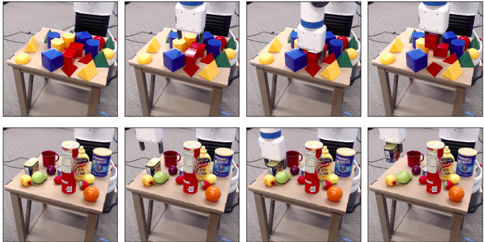
- The pipeline enabled a Fetch robot to detect and pick up the target object in 38 out of 40 trials in increasingly cluttered scenes, and a detector trained on a Spam can succeeded in 9 of 10 trials with previously unseen YCB food distractors.
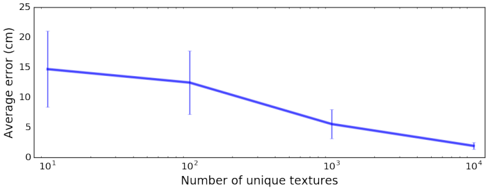
- Ablations found sensitivity to number of training images, number of unique textures, presence of distractors in training, and camera randomization; random noise had negligible effect. Performance improved up to around 50,000 training samples, and degraded significantly with fewer than 1,000 textures.
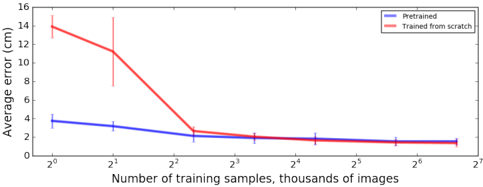
- ImageNet pretraining was not essential with enough data: random weight initialization achieved nearly the same real-world transfer performance as pretrained initialization, though pretraining helped in the low-data regime.
Methods
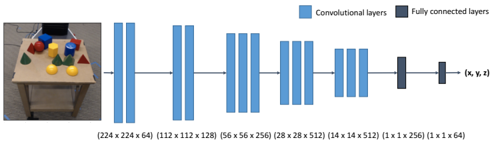
- The authors trained a modified VGG-16 convolutional neural network to map a single 224×224 monocular webcam image to Cartesian coordinates of object(s) of interest, using simulated images rendered by MuJoCo.
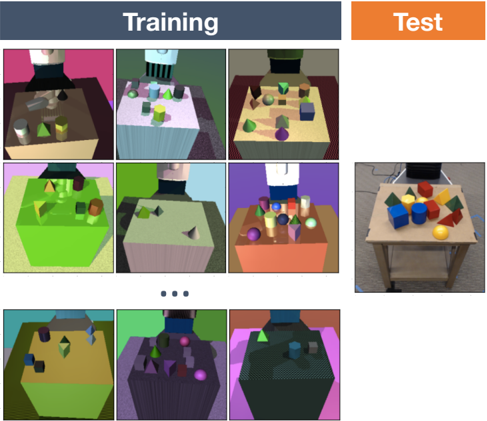
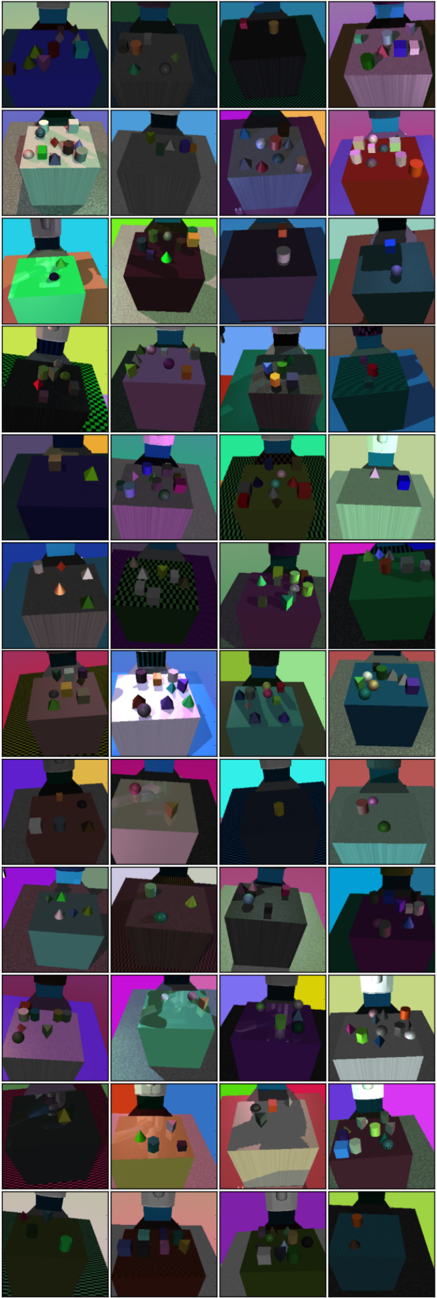
- Domain randomization varied number/shape of distractors, object positions and textures, table/floor/skybox/robot textures, camera position/orientation/field of view, number and properties of lights, and image noise. Textures were random RGB values, gradients, or checker patterns; 0–10 distractor objects were added per scene.
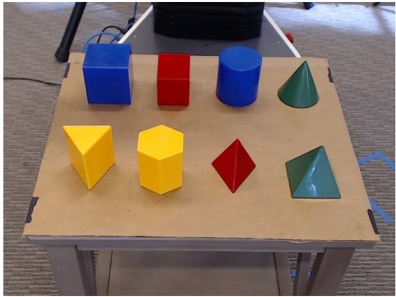
- Training used stochastic gradient descent with Adam on an L2 loss, learning rates around 1e-4, and batch sizes of 25, 50, or 100. Evaluation used 480 webcam images of eight geometric objects at 70–105 cm from a fixed camera, with 60 labeled images per object: 20 alone, 20 with distractors, and 20 partially occluded.
Limitations
- The paper states that the detectors still overfit simulated training data: simulated error was 0.3–0.5 cm versus about 1.5 cm in the real world, and no real-world validation could be done during training because no real data were assumed available.
- The paper states future work is needed for contact-rich manipulation or higher precision, and that the method fixes table height, effectively making the task 2D pose estimation from a single monocular uncalibrated camera.
- Evident from the text: evaluation is limited to eight geometric objects plus one Spam can, the test camera position remains constant across all images, and lighting and surrounding scene were not controlled.
Model-written summary. Check it against the paper before relying on it.
Integrity signals
Registry
Cites
Statistics
Figures
Verification
Claims the paper makes
2 Valid · 8 Not valid · 7 Not checked · 32 Own results and interpretations
The cited sources support only part of this claim — read each source’s verdict below.
In the paper
“Although previous work demonstrated the ability to perform robotic control using a neural network pretrained on ImageNet and fine-tuned on randomized rendered pixels [37], this paper provides the first demonstration that domain randomization can be useful for robotic tasks requiring precision.”
What the sources say
- Partly supportedcites [37] [37] Fereshteh Sadeghi and Sergey Levine. (cad) 2 RL: Real single-image flight without a single real image. arXiv preprint arXiv:1611.04201 , 2016. - sourceExperimental — accuracy not yet measured
The citation [37] is attached to the preceding claim about prior work, not to the citing authors’ claim that their own paper is the first to demonstrate precision robotics. Section 3.1 (p. 4) says LSDA pretrains a CNN on ImageNet classification data and fine-tunes it, but for object detection. It does not report robotic control or fine-tuning on randomized rendered pixels. (LLM, conf=0.84)
boostedstates a cause- Asserted: passes — The authors put it forward as true.
- Checkable: passes — It can be checked against evidence.
- Load-bearing: passes — The paper’s conclusions depend on it.
- Based: passes — The paper gives a reason why it holds.
- Partly supported
The cited sources that could be checked couldn’t confirm or dispute this claim.
In the paper
“Rather than relying on controller robustness, Yu et al. [53] use a model trained on varied physics to perform system identification using online trajectory data, but their approach is not shown to succeed in the real world.”
What the sources say
- Could not verifycites [53] [53] Wenhao Yu, C Karen Liu, and Greg Turk. Preparing for the unknown: Learning a universal policy with online system identification. arXiv preprint arXiv:1702.02453 , 2017. - sourceExperimental — accuracy not yet measured
The cited paper discusses image classification and localisation with convolutional networks (A.1, p. 10; A.2, p. 11), not Yu et al.'s approach. Searches for varied-physics training, online trajectory-based system identification, and real-world success found no passage addressing the claim. Our copy therefore cannot verify it. (LLM, conf=0.78)
plain- Asserted: passes — The authors put it forward as true.
- Checkable: passes — It can be checked against evidence.
- Load-bearing: unclear — It is unclear whether the paper’s conclusions depend on it.
- Based: passes — The paper gives a reason why it holds.
- Could not verify
The cited sources that could be checked couldn’t confirm or dispute this claim.
In the paper
“Though using realistic RGB rendering alone has had limited success for transferring to real robotic tasks [16], incorporating realistic simulation of depth information can allow models trained on rendered images to transfer reasonably well to the real world [32].”
What the sources say
- Could not verifycites [16] [16] Stephen James and Edward Johns. 3d simulation for robot arm control with deep q-learning. arXiv preprint arXiv:1609.03759 , 2016. - sourceExperimental — accuracy not yet measured
The Introduction (§1) and Conclusion (§8) describe Adam as a method for stochastic optimization, while the CNN experiment (§6.3) concerns training on image datasets. Searches for realistic RGB rendering and sim-to-real robotic transfer found no passage addressing whether RGB rendering alone has had limited success on real robotic tasks. (LLM, conf=0.78)
plain- Asserted: passes — The authors put it forward as true.
- Checkable: passes — It can be checked against evidence.
- Load-bearing: passes — The paper’s conclusions depend on it.
- Based: passes — The paper gives a reason why it holds.
- Could not verify
The cited sources that could be checked couldn’t confirm or dispute this claim.
In the paper
“However, their experiments - collision avoidance in hallways and open spaces - do not demonstrate the ability to deal with high-precision tasks.”
What the sources say
- Could not verifycites [37] [37] Fereshteh Sadeghi and Sergey Levine. (cad) 2 RL: Real single-image flight without a single real image. arXiv preprint arXiv:1611.04201 , 2016. - sourceExperimental — accuracy not yet measured
The Experiments section (p. 5) evaluates LSDA on an object-detection dataset, not Sadeghi and Levine’s collision-avoidance experiments. Searches for Sadeghi and Levine, hallway or open-space collision avoidance, and high-precision tasks found no passage addressing the claim. (LLM, conf=0.76)
plain- Asserted: passes — The authors put it forward as true.
- Checkable: passes — It can be checked against evidence.
- Load-bearing: passes — The paper’s conclusions depend on it.
- Based: passes — The paper gives a reason why it holds.
- Could not verify
A result the paper reports from its own data — it cites no other source for it, so there is none to check. The quote shows it is in the paper.
In the paper
“However, using a pre-trained model can significantly improve performance when less training data is used.”
plainstates a cause- Asserted: passes — The authors put it forward as true.
- Checkable: passes — It can be checked against evidence.
- Load-bearing: unclear — It is unclear whether the paper’s conclusions depend on it.
- Based: passes — The paper gives a reason why it holds.
29 more claims
Create a free account to see all 49 claims and to verify the 7 references still open.
- Probably not a substantial claim. 11
- It may state two separate claims as one. 8
Claims other papers make about this one
Each is checked against this paper’s own text: does it say what the citing paper says it does?
The source backs part of the claim, not all of it — or backs it for a different population, condition or comparison.
In the citing paper
“Most policies trained in simulation generalize poorly to the real-world due to agents adapting to specific visual details of the simulator.”
From Language-Based Augmentation to Address Shortcut Learning in Object-Goal Navigation (2023) · cites this paper as [8]
Experimental — accuracy not yet measuredThe source backs part of the claim, not all of it — or backs it for a different population, condition or comparison.
In the citing paper
“In robotic vision tasks including object localization [53], object detection [54], pose estimation [55], and semantic segmentation [56], the training data from simulator always have different textures, lighting, and camera positions from the realistic environments.”
From Sim-to-Real Transfer in Deep Reinforcement Learning for Robotics: a Survey (2020) · cites this paper as [53]
Experimental — accuracy not yet measuredThe source backs part of the claim, not all of it — or backs it for a different population, condition or comparison.
In the citing paper
“These artifacts limit the applicability of generative videos in physics-sensitive domains such as robotics [25,26], autonomous driving [27], simulationbased design, and scientific visualization [28].”
From PhyStruct-Video: Structured Physics State Spaces for Physically Consistent Video Generation (2025) · cites this paper as [25]
Experimental — accuracy not yet measuredThe source backs part of the claim, not all of it — or backs it for a different population, condition or comparison.
In the citing paper
“In domain randomization, the inputs during learning are “randomized” in the sense of being warped or corrupted in particular ways.”
From The overfitted brain: Dreams evolved to assist generalization (2021) · cites this paper as [144]
Experimental — accuracy not yet measuredThe source backs part of the claim, not all of it — or backs it for a different population, condition or comparison.
In the citing paper
“Domain randomization is a domain generalization technique that introduces drastic changes in the training image appearances, which forces the network to learn domain-invariant features between training and target domains [39].”
From A Fully Differentiable Framework for 2D/3D Registration and the Projective Spatial Transformers (2024) · cites this paper as [39]
Experimental — accuracy not yet measured
8 more claims about this paper
Create a free account to see every claim other papers make about this one.
Self-check
Percentages, sums and reported differences re-computed from the paper’s own numbers.
Each contradiction between two passages listed here was confirmed by an independent check.
Rated minor: it would not touch a result — a value no result rests on, a p-value that stays on the same side of the significance level, or a conflict that is clerical, resolved elsewhere in the paper, or outside its own findings.
In the paper
§ A. Experimental Setup · p. 4
“Each training sample consists of (a) a rendered image of the object and one or more distractors (also from among the geometric object set) on a simulated tabletop”
§ A. Domain randomization · p. 4
“Between 0 and 10 distractor objects are added to the table in each scene.”
Citations
Cites
Very Deep Convolutional Networks for Large-Scale Image Recognition
Simonyan, K., & Zisserman, A. (2014) · arXiv · doi:10.48550/arxiv.1409.1556 · Cited by 114,148 · cited 1×
“In particular, we use a modified version the VGG-16 architecture [42] shown in Figure 2.”
MethodAdam: A Method for Stochastic Optimization
Kingma, D. P., & Ba, J. (2014) · arXiv · doi:10.48550/arxiv.1412.6980 · Cited by 98,946 · cited 1×
“We found that using a learning rate of around 1e − 4 (as opposed to the standard 1e − 3 for Adam) improved convergence and helped avoid a common local optimum, mapping all objects to the center of the table.”
MethodLeCun, Y., Bengio, Y., & Hinton, G. (2015) · Nature · doi:10.1038/nature14539 · Cited by 84,126
Human-level control through deep reinforcement learning
Mnih, V., Kavukcuoglu, K., Silver, D., Rusu, A. A., Veness, J., Bellemare, M. G., Graves, A., Riedmiller, M., Fidjeland, A. K., Ostrovski, G., et al. (2015) · Nature · doi:10.1038/nature14236 · Cited by 30,357 · cited 3×
“Learning in simulation is especially promising for building on recent results using deep reinforcement learning to achieve human-level performance on tasks like Atari [27] and robotic control [21], [38].”
BackgroundResultHow transferable are features in deep neural networks?
Yosinski, J., Clune, J., Bengio, Y., & Lipson, H. (2014) · arXiv · doi:10.48550/arxiv.1411.1792 · Cited by 6,061 · cited 1×
“A variety of approaches have been proposed, including re-training the model in the target domain (e.g., [52]), adapting the weights of the model based on the statistics of the source and target domains (e.g., [22]), learning invariant features between domains (e.g., [47]), and learning a mapping…”
BackgroundMuJoCo: A physics engine for model-based control
Todorov, E., Erez, T., & Tassa, Y. (2012) · 2012 IEEE/RSJ International Conference on Intelligent Robots and Systems · doi:10.1109/iros.2012.6386109 · Cited by 4,767 · cited 1×
“We render images using the MuJoCo Physics Engine’s [45] built-in renderer.”
MethodTrust region policy optimization
Schulman, J., Levine, S., Moritz, P., Jordan, M. I., & Abbeel, P. (2015) · arXiv · doi:10.48550/arxiv.1502.05477 · Cited by 4,578 · cited 1×
“Learning in simulation is especially promising for building on recent results using deep reinforcement learning to achieve human-level performance on tasks like Atari [29] and robotic control [26], [41].”
ResultSelf-citationLearning Transferable Features with Deep Adaptation Networks
Long, M., Cao, Y., Wang, J., & Jordan, M. I. (2015) · arXiv · doi:10.48550/arxiv.1502.02791 · Cited by 4,505 · cited 1×
“omputer vision community has devoted significant study to the problem of adapting vision-based models trained in a source domain to a previously unseen target domain (see, e.g., [9], [14], [15], [19], [23], [25], [51]). A variety of approaches have been proposed, including re-training the model in the target domain (e.…”
BackgroundEnd-to-End Training of Deep Visuomotor Policies
Levine, S., Finn, C., Darrell, T., et al. (2015) · Journal of machine learning research · doi:10.5555/2946645.2946684 · Cited by 3,987
Describing Textures in the Wild
Cimpoi, M., Maji, S., Kokkinos, I., Mohamed, S., & Vedaldi, A. (2014) · 2014 IEEE Conference on Computer Vision and Pattern Recognition · doi:10.1109/cvpr.2014.461 · Cited by 2,438 · cited 1×
“To examine how our detectors would perform on objects with complex textures, we created simulated scenes in which the object of interest is given a texture from the Describable Textures Dataset (DTD) [4].”
Method
Research works printed but not linked: 3
- [24] David G Lowe. Three-dimensional object recognition from single two-dimensional images. Artificial intelligence , 31(3):355-395, 1987. -
- [49] Melonee Wise, Michael Ferguson, Derek King, Eric Diehr, and David Dymesich. Fetch and freight: Standard platforms for service robot applications. In Workshop on Autonomous Mobile Service Robots , 2016. -
- sucan, 0, MoveIt!
Cited by
Items 501–600 of 2,970
Kaiser, J., Xu, C., Eichler, A., García, A. S., Stein, O., Bründermann, E., Kuropka, W., Dinter, H., Mayet, F., Vinatier, T., et al. (2024) · Scientific Reports · doi:10.1038/s41598-024-66263-y · Cited by 60
“While some of the design choices, such as inferring changes to the actuator settings instead of the actuator settings directly, can be applied to other tuning tasks with relative ease, others, such as domain randomisation 48,49 , require specialised engineering for each considered tuning task.”
BackgroundBaines, R. L., Fish, F. E., Bongard, J., & Kramer-Bottiglio, R. K. (2024) · Nature Reviews Materials · doi:10.1038/s41578-024-00711-z · Cited by 54
“As structured and pre-known environmental transitions do not fully capture the diverse challenges that AM robots may encounter in real-world deployment, a viable alternative is to implement active shape-morphing mechanisms.”
Diffusion models for robotic manipulation: a survey
Wolf, R., Shi, Y., Liu, S., & Rayyes, R. (2025) · Frontiers in Robotics and AI · doi:10.3389/frobt.2025.1606247 · Cited by 113
“In comparison to other strategies, such as domain randomization (Tremblay et al., 2018; Tobin et al., 2017), data augmentation with DMs directly augments the real-world data, making the data grounded in the physical world.”
A Data-Efficient Framework for Training and Sim-to-Real Transfer of Navigation Policies
Bharadhwaj, H., Wang, Z., Bengio, Y., & Paull, L. (2019) · Proceedings - IEEE International Conference on Robotics and Automation/Proceedings · doi:10.1109/icra.2019.8794310 · Cited by 44
“1) Learning Invariant Representations: Domain randomization [12], [25]–[27], [34]–[36] bridges the”
BackgroundLearning to Navigate Endoscopic Capsule Robots
Turan, M., Almalıoğlu, Y., Gilbert, H. B., Mahmood, F., Durr, N. J., Araújo, H. J., Sari, A. E., Ajay, A., & Sitti, M. (2019) · IEEE Robotics and Automation Letters · doi:10.1109/lra.2019.2924846 · Cited by 41
“controller accuracy to sub-millimeter scale making the approach relevant for biopsy-like operations [25].”
BackgroundDomain Randomization for Active Pose Estimation
Ren, X., Luo, J., Solowjow, E., Ojea, J. A., Gupta, A., Tamar, A., & Abbeel, P. (2019) · Proceedings - IEEE International Conference on Robotics and Automation/Proceedings · doi:10.1109/icra.2019.8794126 · Cited by 46
“Recently proposed methods proposing leveraging simulation as a tool for model-based pose estimation given accurate models of objects in an environment [ 7], [8], [9].”
BackgroundMethodInfluentialSelf-citationTarget-Independent Domain Adaptation for WBC Classification Using Generative Latent Search
Pandey, P., Prathosh, A. P., Kyatham, V., Mishra, D., & Dastidar, T. R. (2020) · IEEE Transactions on Medical Imaging · doi:10.1109/tmi.2020.3009029 · Cited by 38
“4) Domain Randomization: Domain Randomization [37] (DR) is another class of methods related to UDA that are used to improve the generalization of classifiers.”
MethodRethinking Domain Generalization Baselines
Borlino, F. C., D’Innocente, A., & Tommasi, T. (2021) · Proceedings - International Conference on Pattern Recognition/Proceedings/International Conference on Pattern Recognition · doi:10.1109/icpr48806.2021.9412735 · Cited by 35
“of synthetic objects and robotics applications [20], to the most complex use of adversarial gradients [21], [7].”
BackgroundSock, J., Garcia-Hernando, G., Armagan, A., & Kim, T. (2020) · International Conference on 3D Vision (3DV) · doi:10.1109/3dv50981.2020.00039 · Cited by 40
“Domain randomisation hypothesises that enough variability in augmentation for simulated images will generalise to real images [39].”
BackgroundVision-Based Gesture Recognition in Human-Robot Teams Using Synthetic Data
de Melo, C. M., Rothrock, B. A., Gurram, P. K., Ulutan, O., & Manjunath, B. S. (2020) · IEEE/RSJ International Conference on Intelligent Robots and Systems (IROS) · doi:10.1109/iros45743.2020.9340728 · Cited by 35
“In robot control domains, because of the difficulty and danger of training robots in real environments, synthetic data has often been used to teach robots visual space recognition [35] [36], navigation [37], object detection [38], and grasping control [39] [40] [41].”
MethodLearning Visual Feedback Control for Dynamic Cloth Folding
Hietala, J., Blanco–Mulero, D., Alcan, G., & Kyrki, V. (2022) · IEEE/RSJ International Conference on Intelligent Robots and Systems (IROS) · doi:10.1109/iros47612.2022.9981376 · Cited by 69
Understanding Domain Randomization for Sim-to-real TransferPreprint
Chen, X., Hu, J., Jin, C., Li, L., & Wang, L. (2021) · arXiv (Cornell University) · doi:10.48550/arxiv.2110.03239 · Cited by 148
“This theorem implies the importance of randomization and memory in the domain randomization algorithms (Sadeghi & Levine, 2016; Tobin et al., 2017; Peng et al., 2018; OpenAI et al., 2018).”
BackgroundMethodInfluentialYu, X., Tseng, H.-H., Yoo, S., Ling, H., & Lin, Y. (2024) · IEEE Transactions on Image Processing · doi:10.1109/tip.2024.3404241 · Cited by 42
“Various techniques utilize different augmentations to simulate the unseen test domain conditions, including domain randomization [19], [20], [21], [22], adversarial data augmentation [23], [24], [25] and data/feature generation [26], [27], [28], [29], [30], [31], [32], [33], [34].”
MethodArcieri, G., Hoelzl, C., Schwery, O., Straub, D., Papakonstantinou, K. G., & Chatzi, E. (2024) · Machine Learning · doi:10.1007/s10994-024-06559-2 · Cited by 38
“We propose the use of domain randomization (Tobin et al., 2017) of the POMDP environment, which is enabled by our POMDP inference scheme through the recovery of parameter distributions, in order to enhance the robustness of the RL solution to model uncertainty.”
DIViS: Domain Invariant Visual Servoing for Collision-Free Goal Reaching
Sadeghi, F. (2019) · Robotics: Science and Systems · doi:10.15607/rss.2019.xv.055 · Cited by 37
“It was then broadly used for various robot learning tasks [51, 29, 61, 2, 46, 60, 45, 43, 56, 37].”
MethodModel-Based Generalization Under Parameter Uncertainty Using Path Integral Control
Abraham, I., Handa, A., Ratliff, N., Lowrey, K., Murphey, T. D., & Fox, D. (2020) · IEEE Robotics and Automation Letters · doi:10.1109/lra.2020.2972836 · Cited by 63
“2972836 Learning robot tasks in physics simulators and applying the learned skills to the real world (also known as sim-to-real) has been studied quite extensively [1]–[4].”
BackgroundReal–Sim–Real Transfer for Real-World Robot Control Policy Learning with Deep Reinforcement Learning
Liu, N., Cai, Y., Lu, T., Wang, R., & Wang, S. (2020) · Applied Sciences · doi:10.3390/app10051555 · Cited by 42
“Although lots of approaches have been proposed to bridge the reality gap, such as domain randomization (DR) [9] and domain adaptation (DA) [10], bridging the reality gap is still a challenging problem.”
BackgroundMethodScalable Designs for Reinforcement Learning-Based Wide-Area Damping Control
Mukherjee, S., Chakrabortty, A., Bai, H., Darvishi, A., & Fardanesh, B. (2021) · IEEE Transactions on Smart Grid · doi:10.1109/tsg.2021.3050419 · Cited by 38
“In the AI community, papers such as [43], [44] emphasize techniques that can transfer control policies to the actual environment.”
BackgroundWePerson: Learning a Generalized Re-identification Model from All-weather Virtual Data
Li, H., Ye, M., & Du, B. (2021) · ACM International Conference on Multimedia (ACM MM) · doi:10.1145/3474085.3475455 · Cited by 34
“[34] proposes to use the domain randomization method in the synthesis system to bridge the reality gap between the simulation and the real world.”
MethodAI Wings: An AIoT Drone System for Commanding ArduPilot UAVs
Lai, K.-T., Chung, Y.-T., Su, J.-J., Lai, C.-H., & Huang, Y.-H. (2022) · IEEE Systems Journal · doi:10.1109/jsyst.2022.3189011 · Cited by 43
“[31] demonstrated that object detectors trained using simulated RGB images can be accurate to 1.”
BackgroundValassakis, E., Papagiannis, G., Di Palo, N., & Johns, E. (2022) · 2022 IEEE/RSJ International Conference on Intelligent Robots and Systems (IROS) · doi:10.1109/iros47612.2022.9981982 · Cited by 32
“In order to account for the reality gap [24], we randomise various simulated environment conditions, such as (1) light parameters including the number, colour, location and strength of light sources, (2) the number of distractor objects present in the live images, and (3) object colour and texture parameters.”
MethodShi, Y., Yuan, C., Tsitos, A., Cong, L., Hadjar, H., Chen, Z., & Zhang, J. (2023) · IEEE Transactions on Cognitive and Developmental Systems · doi:10.1109/tcds.2023.3237734 · Cited by 40
“Although domain randomization [34], [40], [50] makes it easier to transfer a policy from simulation to real environments, researchers [49] have found that it requires manually defining randomized physics parameters near reasonable physical values of the real setup, which needs fine calibration and…”
BackgroundUrgo, M., Terkaj, W., & Simonetti, G. (2024) · CIRP journal of manufacturing science and technology · doi:10.1016/j.cirpj.2024.03.005 · Cited by 48
Recent Advances in Reinforcement Learning for Chemical Process Control
Devarakonda, V. S., Sun, W., Tang, X., & Tian, Y. (2025) · Processes · doi:10.3390/pr13061791 · Cited by 44
Learning better generative models for dexterous, single-view grasping of novel objects
Kopicki, M., Belter, D., & Wyatt, J. (2019) · The International Journal of Robotics Research · doi:10.1177/0278364919865338 · Cited by 35
“Recently, deep learning has been applied to learn such mappings (Kumra and Kanan, 2017; Morrison et al., 2018; Redmon and Angelova, 2015; Tobin et al., 2017).”
BackgroundMethodDESK: A Robotic Activity Dataset for Dexterous Surgical Skills Transfer to Medical Robots
Madapana, N., Rahman, M. M., Sanchez‐Tamayo, N., Balakuntala, M. V., Gonzalez, G., Bindu, J. P., Venkatesh, L. N. V., Zhang, X., Noguera, J. A. B., Low, T., et al. (2019) · IEEE/RSJ International Conference on Intelligent Robots and Systems (IROS) · doi:10.1109/iros40897.2019.8967760 · Cited by 36
A Reinforcement Learning Approach for Transient Control of Liquid Rocket Engines
Waxenegger-Wilfing, G., Dresia, K., Deeken, J. C., & Oschwald, M. (2021) · IEEE Transactions on Aerospace and Electronic Systems · doi:10.1109/taes.2021.3074134 · Cited by 42
“Domain randomization [48] can produce agents that generalize well to a wide range of environments.”
BackgroundSim-to-Real 6D Object Pose Estimation via Iterative Self-training for Robotic Bin Picking
Chen, K., Cao, R., James, S., Li, Y., Liu, Y., Abbeel, P., & Dou, Q. (2022) · Lecture notes in computer science · doi:10.1007/978-3-031-19842-7_31 · Cited by 39
Self-citationDisCoRL: Continual Reinforcement Learning via Policy Distillation
Traoré, K. R., Caselles-Dupré, H., Lesort, T., Sun, T., Cai, G., Díaz-Rodríguez, N., & Filliat, D. (2019) · arXiv (Cornell University) · doi:10.48550/arxiv.1907.05855 · Cited by 31
“One of these approaches is Domain Randomization [Tobin et al., 2017], which we use in this paper.”
BackgroundMethodInfluentialThe Distracting Control Suite -- A Challenging Benchmark for Reinforcement Learning from Pixels
Stone, A., Ramirez, O., Konolige, K., & Jonschkowski, R. (2021) · arXiv · doi:10.48550/arxiv.2101.02722 · Cited by 31
Sim-to-Real Transfer of Accurate Grasping with Eye-In-Hand Observations and Continuous Control
Yan, M., Frosio, I., Tyree, S., & Kautz, J. (2017) · arXiv · doi:10.48550/arxiv.1712.03303 · Cited by 31
“to detect the pose of the objects in the scene, and then using inverse kinematics to plan a trajectory to reach and grasp the desired object [9, 13, 23].”
BackgroundMethodInfluentialInterchangeable Reinforcement-Learning Flight Controller for Fixed-Wing UASs
Chowdhury, M., & Keshmiri, S. (2024) · IEEE Transactions on Aerospace and Electronic Systems · doi:10.1109/taes.2024.3351608 · Cited by 36
“Dynamic randomization is shown to be an effective method in reducing the controller’s reliance on the dynamics model’s fidelity and closing the reality-gap in [20], [26], [28], [29], [30], [31], [32], and [33].”
MethodLearning Agile Locomotion on Risky Terrains
Zhang, C., Rudin, N., Hoeller, D., & Hutter, M. (2024) · IEEE/RSJ International Conference on Intelligent Robots and Systems (IROS) · doi:10.1109/iros58592.2024.10801909 · Cited by 89
“We use domain randomization to improve robustness and facilitate sim-to-real transfer [34], [35].”
CorNet: Generic 3D Corners for 6D Pose Estimation of New Objects without Retraining
Pitteri, G., Ilić, S., & Lepetit, V. (2019) · IEEE International Conference on Computer Vision Workshops · doi:10.1109/iccvw.2019.00342 · Cited by 39
“Another interesting approach is domain randomization [32], which generates synthetic training images with random appearance, by varying the object textures and rendering parameters, to improve generalization.”
BackgroundPhysically based synthetic image generation for machine learning: a review of pertinent literature
Schraml, D. (2019) · Photonics and Education in Measurement Science · doi:10.1117/12.2533485 · Cited by 34
Model Learning for Robotic Manipulators using Recurrent Neural Networks
Mukhopadhyay, R., Chaki, R., Sutradhar, A., & Chattopadhyay, P. (2019) · IEEE Region 10 Conference (TENCON) · doi:10.1109/tencon.2019.8929622 · Cited by 34
Kong, F., Huang, B., Bradbury, K., & Malof, J. M. (2020) · IEEE Winter Conference on Applications of Computer Vision · doi:10.1109/wacv45572.2020.9093339 · Cited by 37
“designed models of objects, or layouts [12], [13] that can be time-consuming to construct.”
BackgroundIndirect Object-to-Robot Pose Estimation from an External Monocular RGB Camera
Tremblay, J., Tyree, S., Mosier, T., & Birchfield, S. T. (2020) · IEEE/RSJ International Conference on Intelligent Robots and Systems (IROS) · doi:10.1109/iros45743.2020.9341163 · Cited by 30
“Note that in contrast to end-to-end learning [10], [20], [30], [31], [21], [32], [33], the modular approach presented here has the advantage that the system can be repurposed without having to retrain all the networks.”
BackgroundMethodInfluentialWiedemann, T., Vlaicu, C., Josifovski, J., & Viseras, A. (2021) · IEEE Access · doi:10.1109/access.2021.3052024 · Cited by 29
“In this respect a more complex simulator might be necessary to reduce the mismatch, or techniques like Domain Randomization [38], [39] that rely on many variations of simple simulations.”
MethodDROID: Minimizing the Reality Gap Using Single-Shot Human Demonstration
Tsai, Y.-Y., Xu, H., Ding, Z., Zhang, C., Johns, E., & Huang, B. (2021) · IEEE Robotics and Automation Letters · doi:10.1109/lra.2021.3062311 · Cited by 39
“the real world [18] or by collecting real world data for optimizing the simulated model parameters [19]–[21].”
BackgroundPassive Sonar Target Classification Using Deep Generative $\beta $-VAE
Chandran, C. S., Kamal, S., Mujeeb, A., & Supriya, M. H. (2021) · IEEE Signal Processing Letters · doi:10.1109/lsp.2021.3071255 · Cited by 33
“Thoughmulti-tasklearning[17], dataaugmentation[18]andtransferlearning[19]havebeen devisedtoalleviatethedatarequirements,approachesbasedon unsupervisedrepresentationlearningthatcancapturethesalient factorsofvariationinthedatahavebeenfoundtoyieldmore promisingresultsonnumeroustasks[20],[21].”
Peres, R. S., Guedes, M., Miranda, F., & Barata, J. (2021) · IEEE Access · doi:10.1109/access.2021.3082690 · Cited by 38
“Recent research from OpenAI has shown that techniques such as domain randomization [23], [24] can be employed to generate synthetic data using simulation in increasingly difficult environments, which in turn can be used to train robust ML models capable of generalizing well to real-world tasks.”
MethodUnsupervised Visual Attention and Invariance for Reinforcement Learning
Wang, X., Lian, L., & Yu, S. X. (2021) · IEEE Computer Society Conference on Computer Vision and Pattern Recognition/Proceedings - IEEE Computer Society Conference on Computer Vision and Pattern Recognition/Proceedings · doi:10.1109/cvpr46437.2021.00661 · Cited by 59
“all possible variations quickly becomes infeasible; domain randomization methods [50, 55, 44, 45, 59] apply augmentations in a simulated environment and train a domain-agnostic universal policy conditioned on estimated discrepancies between testing and training scenarios.”
BackgroundSelf-Supervised 2D/3D Registration for X-Ray to CT Image Fusion
Jaganathan, S., Kukla, M., Wang, J., Shetty, K., & Maier, A. (2023) · 2023 IEEE/CVF Winter Conference on Applications of Computer Vision (WACV) · doi:10.1109/wacv56688.2023.00281 · Cited by 30
“Unsupervised Domain Adaptation The domain gap introduced due to the use of simulated data is bridged either by improving the realism of the simulated data [54, 48] or by performing unsupervised domain adaptation to minimize the domain gap [1, 7, 61, 36, 49, 16, 45, 17].”
BackgroundMethodActive Domain RandomizationPreprint
Mehta, B., Diaz, M., Golemo, F., Pal, C., & Paull, L. (2019) · arXiv (Cornell University) · doi:10.48550/arxiv.1904.04762 · Cited by 286
“One promising approach for zero-shot transfer has been domain randomization (Tobin et al., 2017).”
BackgroundMethodKrishnan, S., Boroujerdian, B., Fu, W., Faust, A., & Reddi, V. J. (2019) · arXiv (Cornell University) · Cited by 33
"Other-Play" for Zero-Shot CoordinationPreprint
Hu, H., Lerer, A. K., Peysakhovich, A., & Foerster, J. (2020) · arXiv (Cornell University) · doi:10.48550/arxiv.2003.02979 · Cited by 195
“This amounts to applying a very specific kind of asymmetric domain randomization (Tobin et al., 2017) during training.”
BackgroundInfluentialAutomatic Data Augmentation for Generalization in Reinforcement LearningPreprint
Răileanu, R., Goldstein, M., Yarats, D., Kostrikov, I., & Fergus, R. (2021) · arXiv (Cornell University) · Cited by 122
DoorGym: A Scalable Door Opening Environment And Baseline Agent
Urakami, Y., Hodgkinson, A., Carlin, C., Leu, R., Rigazio, L., & Abbeel, P. (2019) · arXiv · doi:10.48550/arxiv.1908.01887 · Cited by 30
“Tobin et al, 2017 [14] abandons using realistic textures and instead uses synthetic textures to accomplish fine-grained tasks such as object detection.”
Self-citationUniversal Test-time Adaptation through Weight Ensembling, Diversity Weighting, and Prior Correction
Marsden, R. A., Döbler, M., & Yang, B. (2024) · IEEE Winter Conference on Applications of Computer Vision · doi:10.1109/wacv57701.2024.00254 · Cited by 106
“Domain generalization aims to address potential domain shifts by improving the robustness and generalization of the model directly during training [14, 12, 32, 48, 50].”
BackgroundReinforcement Learning for Blind Stair Climbing with Legged and Wheeled-Legged Robots
Chamorro, S., Klemm, V., Valls, M. D. L. I., Pal, C., & Siegwart, R. (2024) · Proceedings - IEEE International Conference on Robotics and Automation/Proceedings · doi:10.1109/icra57147.2024.10610069 · Cited by 64
“Isaac Gym supports domain randomization techniques [24], which can enhance the robustness of RL agents by introducing variations in the environment during training, thus aiding in the transfer of learned policies to the real world.”
BackgroundSynthetic data in generalizable, learning-based neuroimaging
Gopinath, K. K., Hoopes, A., Alexander, D. C., Arnold, S. E., Balbastre, Y., Billot, B., Casamitjana, A., Cheng, Y., Chua, R. Y. Z., Edlow, B. L., et al. (2024) · Imaging Neuroscience · doi:10.1162/imag_a_00337 · Cited by 50
Domain Randomization for Simulation-Based Policy Optimization with Transferability Assessment
Muratore, F., Treede, F., Gienger, M., & Peters, J. (2018) · MPG.PuRe (Max Planck Society) · Cited by 66
Learning to Pour using Deep Deterministic Policy Gradients
Do, C., Gordillo, C., & Burgard, W. (2018) · IEEE/RSJ International Conference on Intelligent Robots and Systems (IROS) · doi:10.1109/iros.2018.8593654 · Cited by 34
A Supervised Approach to Predicting Noise in Depth Images
Sweeney, C., Izatt, G., & Tedrake, R. (2019) · Proceedings - IEEE International Conference on Robotics and Automation/Proceedings · doi:10.1109/icra.2019.8793820 · Cited by 30
Lucchi, M., Zindler, F., Mühlbacher-Karrer, S., & Pichler, H. (2020) · IEEE/RSJ International Conference on Intelligent Robots and Systems (IROS) · doi:10.1109/iros45743.2020.9340956 · Cited by 40
“Subsequently, latest advancements use domain randomization to train models in simulation and deploy them on the real robots, with [9], [10] or without [11], [12], [13], [14] some additional fine tuning involved.”
MethodInto the Unknown: Active Monitoring of Neural Networks
Lukina, A., Schilling, C., & Henzinger, T. A. (2021) · Lecture notes in computer science · doi:10.1007/978-3-030-88494-9_3 · Cited by 40
“…technological development in many research areas, e.g., automated object localization as a stepping stone to successful real-world robotic applications (Tobin et al. 2017) or automated prediction of drug-target interactions as an initial step of drug discovery (Rifaioglu et al. 2020).”
BackgroundPolicy Transfer via Kinematic Domain Randomization and Adaptation
Exarchos, I., Jiang, Y., Yu, W., & Liu, C. K. (2021) · Proceedings - IEEE International Conference on Robotics and Automation/Proceedings · doi:10.1109/icra48506.2021.9561982 · Cited by 41
Learning from Simulation, Racing in Reality
Chisari, E., Liniger, A., Rupenyan, A., Gool, L. V., & Lygeros, J. (2021) · Proceedings - IEEE International Conference on Robotics and Automation/Proceedings · doi:10.1109/icra48506.2021.9562079 · Cited by 46
“Tools such as domain or model randomization [19], [10], [20] often drastically help the sim-to-real transfer, by randomizing the observation and model of the simulator.”
Domain randomization for neural network classification
Valtchev, S. Z., & Wu, J. (2021) · Journal Of Big Data · doi:10.1186/s40537-021-00455-5 · Cited by 46
“In an attempt to narrow the reality gap, domain randomization is introduced to simulate a sufficiently large amount of variations such that real world data is viewed as simply another domain variation [7, 9].”
BackgroundMethodGrounded action transformation for sim-to-real reinforcement learning
Hanna, J. P., Desai, S., Karnan, H., Warnell, G., & Stone, P. (2021) · Machine Learning · doi:10.1007/s10994-021-05982-z · Cited by 46
“Unlike the dynamics randomization techniques discussed above, in this setting domain randomization means randomizing features of the simulator’s rendered images (Sadeghi & Lev-ine, 2017; Tobin et al., 2017, 2018; Pinto et al., 2017a).”
BackgroundMethodTask2Sim: Towards Effective Pre-training and Transfer from Synthetic Data
Mishra, S., Panda, R., Phoo, C. P., Chen, C.-F. R., Karlinsky, L., Saenko, K., Saligrama, V., & Feris, R. (2022) · IEEE Computer Society Conference on Computer Vision and Pattern Recognition/Proceedings - IEEE Computer Society Conference on Computer Vision and Pattern Recognition/Proceedings · doi:10.1109/cvpr52688.2022.00898 · Cited by 52
“The most prevalent approach in a setting similar to ours, is domain randomization [2, 25, 44, 59, 74], which learns pre-trained models from datasets generated by randomly varying simulator parameters.”
BackgroundMethodLiu, C., Li, Y., Huang, C. X., Zhao, Y., & Zhao, Z. (2022) · International Journal of Production Research · doi:10.1080/00207543.2022.2027041 · Cited by 29
“…simulators with different physical parameters and fully randomising these parameters to train the target model to adapt to the real environment (Tobin et al. 2017), while it is still very difficult to bridge the distribution gap between the simulation environment and the real environment when…”
BackgroundEßer, J., Bach, N., Jestel, C., Urbann, O., & Kerner, S. (2022) · IEEE Robotics & Automation Magazine · doi:10.1109/mra.2022.3207664 · Cited by 48
“Tobin et al. [123] first introduced the idea of randomizing rendering in the simulator to transfer neural networks to reality for the purpose of robotic control.”
BackgroundMarkerless Camera-to-Robot Pose Estimation via Self-Supervised Sim-to-Real Transfer
Lu, J., Richter, F., & Yip, M. C. (2023) · IEEE Computer Society Conference on Computer Vision and Pattern Recognition/Proceedings - IEEE Computer Society Conference on Computer Vision and Pattern Recognition/Proceedings · doi:10.1109/cvpr52729.2023.02040 · Cited by 56
Reinforcement Learning for Computer Vision and Robot Navigation
Bernstein, A., Burnaev, E. V., & Kachan, O. (2018) · Lecture notes in computer science · doi:10.1007/978-3-319-96133-0_20 · Cited by 31
Towards Goal-Directed Navigation Through Combining Learning Based Global and Local Planners
Zhou, X., Gao, Y., & Guan, L. (2019) · Sensors · doi:10.3390/s19010176 · Cited by 32
Data-Efficient Learning for Sim-to-Real Robotic Grasping using Deep Point Cloud Prediction NetworksPreprint
Yan, X., Khansari, M., Hsu, J., Gong, Y., Bai, Y., Pirk, S., & Lee, H. (2019) · arXiv (Cornell University) · doi:10.48550/arxiv.1906.08989 · Cited by 39
E-VAT: An Asymmetric End-to-End Approach to Visual Active Exploration and Tracking
Dionigi, A., Devo, A., Guiducci, L., & Costante, G. (2022) · IEEE Robotics and Automation Letters · doi:10.1109/lra.2022.3150866 · Cited by 28
A survey on underwater coral image segmentation based on deep learning
Li, M., Zhang, H., Gruen, A., & Li, D. (2024) · Geo-spatial Information Science · doi:10.1080/10095020.2024.2343323 · Cited by 44
“…beneficial to explore more deep learning-based oversampling strategies for enhancing underwater coral image samples, such as neural style transfer (Tobin et al. 2017; Ye et al. 2023) and meta-learning schemes (Gama et al. 2023; Zoph and Le 2016), which could help generate new samples reflecting…”
On-line object detection: a robotics challenge
Maiettini, E., Pasquale, G., Rosasco, L., & Natale, L. (2019) · Autonomous Robots · doi:10.1007/s10514-019-09894-9 · Cited by 32
“We compare results with fine-tuning Faster R-CNN last layers (Tobin et al. 2017), for both feature and classification learning.”
BackgroundResultView-Invariant Loop Closure with Oriented Semantic Landmarks
Li, J., Koreitem, K., Meger, D., & Dudek, G. (2020) · Proceedings - IEEE International Conference on Robotics and Automation/Proceedings · doi:10.1109/icra40945.2020.9196886 · Cited by 31
“Following the methodology of domain randomization [27], we generate synthetic training data by rendering CAD models of objects taken from ShapeNet [28] using a variety of lighting conditions.”
MethodTowards Fully-Synthetic Training for Industrial Applications
Mayershofer, C., Ge, T., & Fottner, J. (2021) · Springer eBooks · doi:10.1007/978-981-33-4359-7_53 · Cited by 50
“In the fashion of [29] and [31], we place distractors in our scenes.”
BackgroundBenchmarking Domain Randomisation for Visual Sim-to-Real Transfer
Alghonaim, R., & Johns, E. (2021) · Proceedings - IEEE International Conference on Robotics and Automation/Proceedings · doi:10.1109/icra48506.2021.9561134 · Cited by 32
Positioning of the Robotic Arm Using Different Reinforcement Learning Algorithms
Lindner, T., Milecki, A., & Wyrwał, D. (2021) · International Journal of Control Automation and Systems · doi:10.1007/s12555-020-0069-6 · Cited by 31
“During each trajectory rollout, all the experience tuples ( s t , a t , r t , s t + 1 ) are saved and stored in a finite-sized cache, where s t indicates a state in time t , a t – action in time t , r t – reward in time t , s t is a next a state in time t + 1.”
BackgroundSynthetic training data generation for deep learning based quality inspection
Gutierrez, P., Luschkova, M., Cordier, A., Shukor, M., Schappert, M., & Dahmen, T. (2021) · International Conference on Quality Control by Artificial Vision (QCAV) · doi:10.1117/12.2586824 · Cited by 39
“The use of simulated data in deep learning has been widely studied in the field of autonomous driving, 9 robotics, 10 and more broadly for object detection on images.”
Interactive Process Automation based on lightweight object detection in manufacturing processes
Mangat, A. S., Mangler, J., & Rinderle‐Ma, S. (2021) · Computers in Industry · doi:10.1016/j.compind.2021.103482 · Cited by 36
Contact Pose Identification for Peg-in-Hole Assembly under Uncertainties
Jin, S., Zhu, X., Wang, C., & Tomizuka, M. (2021) · Proceedings of the ... American Control Conference/Proceedings of the American Control Conference · doi:10.23919/acc50511.2021.9482981 · Cited by 42
“Although there is a huge sim-to-real gap [19] between the simulated environment and the real world in terms of friction coefficient, inertia, stiffness, damping ratio, etc.”
BackgroundContext-Aware Safe Reinforcement Learning for Non-Stationary Environments
Chen, B., Liu, Z., Zhu, J., Xu, M., Ding, W., Li, L., & Zhao, D. X. (2021) · Proceedings - IEEE International Conference on Robotics and Automation/Proceedings · doi:10.1109/icra48506.2021.9561593 · Cited by 57
“Moreover, they are usually not adaptive to non-stationary disturbances, which are common in many realistic safety-critical applications [9].”
BackgroundWu, X., Wu, Z., Lu, Y., Ju, L., & Wang, S. (2022) · Proceedings of the AAAI Conference on Artificial Intelligence · doi:10.1609/aaai.v36i3.20177 · Cited by 32
“A typical solution is to perform domain randomization (Tobin et al. 2017) on the source training samples via image stylization or translation which can also be treated as a data/domain augmentation strategy.”
Bio-Inspired Rhythmic Locomotion for Quadruped Robots
Sheng, J., Chen, Y., Fang, X., Zhang, W., Song, R., Zheng, Y., & Li, Y. (2022) · IEEE Robotics and Automation Letters · doi:10.1109/lra.2022.3177289 · Cited by 30
Approximating gradients for differentiable quality diversity in reinforcement learning
Tjanaka, B., Fontaine, M. C., Togelius, J., & Nikolaidis, S. (2022) · Genetic and Evolutionary Computation Conference (GECCO) · doi:10.1145/3512290.3528705 · Cited by 76
“If we frame this challenge as an RL problem, two approaches to design a robustly capable agent would be to (1) design a reward function and (2) apply domain randomization [47, 58].”
MethodValue constrained model-free continuous controlPreprint
Bohez, S., Abdolmaleki, A., Neunert, M., Buchli, J., Heess, N., & Hadsell, R. T. (2019) · arXiv (Cornell University) · doi:10.48550/arxiv.1902.04623 · Cited by 80
“To improve robustness, and with the aim of simulation-to-real transfer, we perform domain randomization [22] on a number of model parameters, as well as apply random external forces to the body (see Appendix B for details).”
MethodFSDR: Frequency Space Domain Randomization for Domain GeneralizationPreprint
Huang, J., Guan, D., Xiao, A., et al. (2021) · arXiv (Cornell University) · doi:10.48550/arxiv.2103.02370 · Cited by 28
“Single-source DG handles generalization by domain randomization that augment data [64, 70] or domains [77, 50].”
BackgroundMethodInfluentialBalaji, B., Mallya, S., Genc, S., Gupta, S., Dirac, L., Khare, V., Roy, G., Sun, T., Tao, Y., Townsend, B., et al. (2019) · arXiv · doi:10.48550/arxiv.1911.01562 · Cited by 27
“Methods include adding noise in dynamics [23], [2] and imagery [12], [52], learning model ensembles [53], [54], adding adversarial noise [25], [55] and assessing simulation bias [24].”
BackgroundFT-Net: Learning Failure Recovery and Fault-Tolerant Locomotion for Quadruped Robots
Luo, Z., Xiao, E., & Lu, P. (2023) · IEEE Robotics and Automation Letters · doi:10.1109/lra.2023.3329766 · Cited by 38
GenNBV: Generalizable Next-Best-View Policy for Active 3D Reconstruction
Chen, X., Li, Q., Wang, T., Xue, T., & Pang, J. (2024) · IEEE Computer Society Conference on Computer Vision and Pattern Recognition/Proceedings - IEEE Computer Society Conference on Computer Vision and Pattern Recognition/Proceedings · doi:10.1109/cvpr52733.2024.01555 · Cited by 95
“In the robotics field, domain randomization [41] allows legged robots to walk on various terrains absent from the training environment.”
BackgroundDai, X., Yuan, X., & Wei, X. (2021) · Applied Intelligence · doi:10.1007/s10489-021-02445-9 · Cited by 27
“The concept of Domain Randomization (DR) was brought forward by Tobin et al. [30], and random and diverse samples in domain randomization were advocated to generate.”
BackgroundSchultheiß, M., Schmette, P., Bodden, J. H., Aichele, J., Müller-Leisse, C., Gassert, F. G., Gassert, F. T., Gawlitza, J. F., Hofmann, F. C., Sasse, D., et al. (2021) · Scientific Reports · doi:10.1038/s41598-021-94750-z · Cited by 36
“However, the application of the trained model on non-simulated radiographs remains challenging and is still under development, referred to as domain randomization: Previous investigations tried to generate real-world car detection or robotic systems by use of synthetic images 44–46 .”
MethodProximal Policy Optimization for Radiation Source Search
Proctor, P., Teuscher, C., Hecht, A., & Osiński, M. (2021) · Journal of Nuclear Engineering · doi:10.3390/jne2040029 · Cited by 28
Model-Based Transfer Reinforcement Learning Based on Graphical Model Representations
Sun, Y., Zhang, K., & Sun, C. (2021) · IEEE Transactions on Neural Networks and Learning Systems · doi:10.1109/tnnls.2021.3107375 · Cited by 28
“Domain randomization [62]–[64] has been widely used on Sim-to-Real application.”
MethodiTD3-CLN: Learn to navigate in dynamic scene through Deep Reinforcement Learning
Jiang, H., Esfahani, M. A., Wu, K., Wan, K.-W., Heng, K.-K., Wang, H., & Jiang, X. (2022) · Neurocomputing · doi:10.1016/j.neucom.2022.06.102 · Cited by 31
Rasmussen, I., Kvalsvik, S., Andersen, P., Aune, T. N., & Hagen, D. (2022) · Applied Sciences · doi:10.3390/app12178534 · Cited by 44
Learning a Generalized Gaze Estimator from Gaze-Consistent Feature
Xu, M., Wang, H., & Lu, F. (2023) · Proceedings of the AAAI Conference on Artificial Intelligence · doi:10.1609/aaai.v37i3.25406 · Cited by 44
VPE: Variational Policy Embedding for Transfer Reinforcement Learning
Atnekvist, I., Kragić, D., & Stork, J. A. (2019) · Proceedings - IEEE International Conference on Robotics and Automation/Proceedings · doi:10.1109/icra.2019.8793556 · Cited by 39
“Domain randomization attempts to find a single policy that works for all instances of a family [7], [8].”
BackgroundHinterstoißer, S., Pauly, O., Heibel, H., Marek, M., & Bokeloh, M. (2019) · arXiv (Cornell University) · doi:10.48550/arxiv.1902.09967 · Cited by 26
“As observed in [30], methods trained on synthetic data and evaluated on real data usually result in deteriorated performance.”
BackgroundMethodInfluentialSim-to-Real: Mapless Navigation for USVs Using Deep Reinforcement Learning
Wang, N., Wang, Y., Zhao, Y., Wang, Y., & Li, Z. (2022) · Journal of Marine Science and Engineering · doi:10.3390/jmse10070895 · Cited by 35
Towards Sim-to-Real Industrial Parts Classification with Synthetic Dataset
Zhu, X., Bilal, T., Mårtensson, P., Hanson, L. Å., Björkman, M., & Maki, A. (2023) · IEEE/CVF Conference on Computer Vision and Pattern Recognition Workshops (CVPRW) · doi:10.1109/cvprw59228.2023.00468 · Cited by 45
Attribute-Based Robotic Grasping With Data-Efficient Adaptation
Yang, Y., Yu, H., Lou, X., Liu, Y., & Choi, C. (2024) · IEEE Transactions on Robotics · doi:10.1109/tro.2024.3353484 · Cited by 38
Surround-View Fisheye Optics in Computer Vision and Simulation: Survey and Challenges
Jakab, D., Deegan, B. M., SHARMA, S. K., Grua, E. M., Horgan, J., Ward, E., van de Ven, P. W. J., Scanlan, A., & Eising, C. (2024) · IEEE Transactions on Intelligent Transportation Systems · doi:10.1109/tits.2024.3368136 · Cited by 37
“In Amini’s experiments [123], VISTA outperformed three other self-driving techniques with viewpoint augmentation: (1) Domain Randomization [124], (2) Sim-to-Real Domain Adaption [125], and (3) Imitation Learning [126].”
Method
Metadata
- Authors
- Tobin, J., Fong, R., Ray, A., Schneider, J., Zaremba, W., & Abbeel, P.
- Affiliations
- University of California, Berkeley (US)
- OpenAI (United States) (US)
- International Computer Science Institute (US)
- ORCID
- Abbeel, Pieter
- Venue
- 2017 IEEE/RSJ International Conference on Intelligent Robots and Systems (IROS)
- Publisher
- IEEE
- Published
- 2017-09
- Pages
- 23-30
- ISSN
- 2153-0858 (ISSN-L)
- OpenAlex
- W2605102758
- Semantic Scholar
- 32ceb28e45a445df4d89df281bb0e3ab5aab1a2a
- Cited by
- 3,124
- References
- 69
- Citations by year
- 2026: 413 · 2025: 433 · 2024: 336 · 2023: 403 · 2022: 374 · 2021: 422 · 2020: 352 · 2019: 256 · 2018: 106 · 2017: 25
- FWCI
- 92.18
- Type
- conference paper
- Language
- en
- Open access
- green
- arxiv.org
- Locations
- IEEE/RSJ International Conference on Intelligent Robots and Systems (IROS) (publishedVersion)
- arXiv (Cornell University) (submittedVersion)
- arXiv (Cornell University)
- Topics
- Physical Sciences › Computer Science › Artificial Intelligence › Reinforcement Learning in Robotics
- Physical Sciences › Engineering › Control and Systems Engineering › Robot Manipulation and Learning
- Physical Sciences › Computer Science › Artificial Intelligence › Domain Adaptation and Few-Shot Learning
- Keywords
- domain randomization, sim-to-real transfer, reality gap, object detection, object localization, robotic grasping, cluttered environments, distractor robustness, partial occlusion, robotic manipulation
About these checks
Registry, retraction, Cites and statistics results are computed, not judged, with one exception: a printed reference that no index lists is read once by a model before it counts as a citation error. Claims are extracted by a model and kept only when their quote appears verbatim in the text; each cited source is then checked, with a model’s help, for whether it says what the claim relies on. Those verdicts can be wrong — read the claim’s quote and the cited source before relying on one.
The claim verdicts this report counts are experimental: their accuracy is not yet measured.
A language model drew the claims from the paper on 2026-10-10, under version 3 of the claim definition (model deepseek-v4.1-flash, prompt extract-v3).
A second model labelled each claim on 2026-10-10 (model jev-1.13-20260917, definition revision gold-guideline-v0.2).
Cited sources are checked with a language model’s help (gpt-6-sol).
Statistics and arithmetic are recomputed, not judged.
Confidence bands are shown only for fields calibrated on our annotated test set. None is calibrated yet, so no band is shown.
What counts as a claim ›How we measure confidence ›How we check this ›
Are you an author, or do you see a problem with this page? Request a review
Data sources
Bibliographic data: Semantic Scholar, OpenAlex, Crossref.
Contains information from the Semantic Scholar Academic Graph Datasets, made available under the ODC Attribution License (ODC-BY 1.0).
Semantic Scholar’s data is described in: Kinney, R., et al. (2023). The Semantic Scholar Open Data Platform. arXiv:2301.10140.
