

Domain randomization for transferring deep neural networks from simulation to the real world
Open accessThe DOI matches its Crossref record; 71 of the 71 references it cites were found in a registry or an index; 8 of the 17 sources its claims cite were checked for support.
Abstract
Bridging the `reality gap' that separates simulated robotics from experiments on hardware could accelerate robotic research through improved data availability. This paper explores domain randomization, a simple technique for training models on simulated images that transfer to real images by randomizing rendering in the simulator. With enough variability in the simulator, the real world may appear to the model as just another variation. We focus on the task of object localization, which is a stepping stone to general robotic manipulation skills. We find that it is possible to train a real-world object detector that is accurate to 1.5 cm and robust to distractors and partial occlusions using only data from a simulator with non-realistic random textures. To demonstrate the capabilities of our detectors, we show they can be used to perform grasping in a cluttered environment. To our knowledge, this is the first successful transfer of a deep neural network trained only on simulated RGB images (without pre-training on real images) to the real world for the purpose of robotic control.
Overview
CoChat Summary
TL;DR
This paper introduces domain randomization: training an object detector on simulated RGB images with randomized rendering, textures, lighting, camera pose, and distractors so that the real world appears as another variation. The authors show that a detector trained only in simulation can localize objects in the real world accurately enough to grasp them in clutter.
Key findings
- Real-world object detectors trained only on simulated images localized objects to within about 1.5 cm on average, including with distractors and partial occlusions; per-object errors in Table I range from 0.6 ± 0.3 cm to 3.2 ± 5.8 cm depending on object and condition.
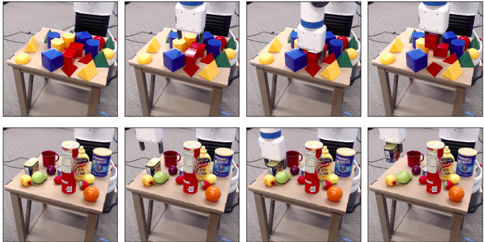
- The pipeline enabled a Fetch robot to detect and pick up the target object in 38 out of 40 trials in increasingly cluttered scenes, and a detector trained on a Spam can succeeded in 9 of 10 trials with previously unseen YCB food distractors.
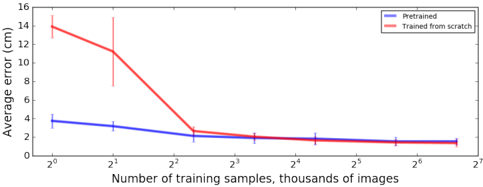
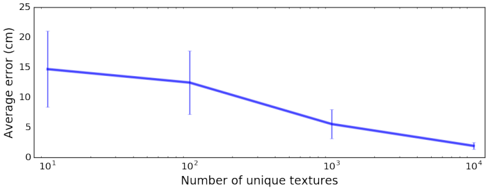
- Ablations found sensitivity to number of training images, number of unique textures, presence of distractors in training, and camera randomization; random noise had negligible effect. Performance improved up to around 50,000 training samples, and degraded significantly with fewer than 1,000 textures.
- ImageNet pretraining was not essential with enough data: random weight initialization achieved nearly the same real-world transfer performance as pretrained initialization, though pretraining helped in the low-data regime.
Methods
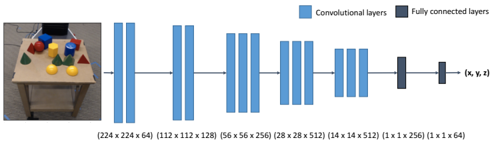
- The authors trained a modified VGG-16 convolutional neural network to map a single 224×224 monocular webcam image to Cartesian coordinates of object(s) of interest, using simulated images rendered by MuJoCo.
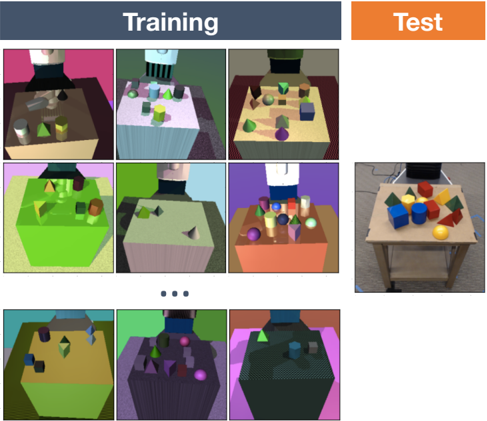
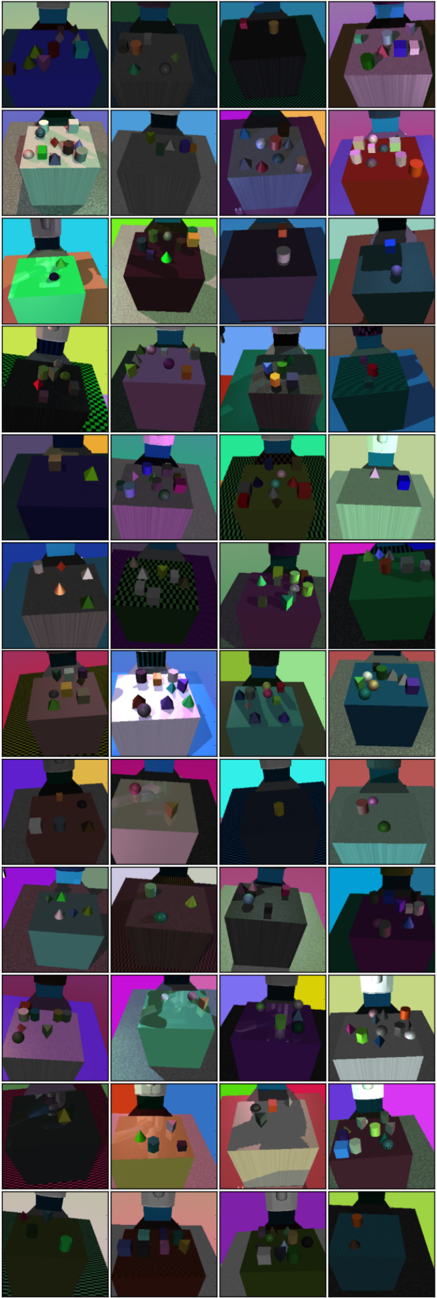
- Domain randomization varied number/shape of distractors, object positions and textures, table/floor/skybox/robot textures, camera position/orientation/field of view, number and properties of lights, and image noise. Textures were random RGB values, gradients, or checker patterns; 0–10 distractor objects were added per scene.
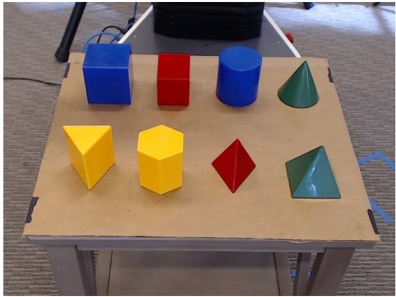
- Training used stochastic gradient descent with Adam on an L2 loss, learning rates around 1e-4, and batch sizes of 25, 50, or 100. Evaluation used 480 webcam images of eight geometric objects at 70–105 cm from a fixed camera, with 60 labeled images per object: 20 alone, 20 with distractors, and 20 partially occluded.
Limitations
- The paper states that the detectors still overfit simulated training data: simulated error was 0.3–0.5 cm versus about 1.5 cm in the real world, and no real-world validation could be done during training because no real data were assumed available.
- The paper states future work is needed for contact-rich manipulation or higher precision, and that the method fixes table height, effectively making the task 2D pose estimation from a single monocular uncalibrated camera.
- Evident from the text: evaluation is limited to eight geometric objects plus one Spam can, the test camera position remains constant across all images, and lighting and surrounding scene were not controlled.
Model-written summary. Check it against the paper before relying on it.
Integrity signals
Registry
Cites
Statistics
Figures
Verification
Claims the paper makes
2 Valid · 8 Not valid · 7 Not checked · 32 Own results and interpretations
The cited sources support only part of this claim — read each source’s verdict below.
In the paper
“Although previous work demonstrated the ability to perform robotic control using a neural network pretrained on ImageNet and fine-tuned on randomized rendered pixels [37], this paper provides the first demonstration that domain randomization can be useful for robotic tasks requiring precision.”
What the sources say
- Partly supportedcites [37] [37] Fereshteh Sadeghi and Sergey Levine. (cad) 2 RL: Real single-image flight without a single real image. arXiv preprint arXiv:1611.04201 , 2016. - sourceExperimental — accuracy not yet measured
The citation [37] is attached to the preceding claim about prior work, not to the citing authors’ claim that their own paper is the first to demonstrate precision robotics. Section 3.1 (p. 4) says LSDA pretrains a CNN on ImageNet classification data and fine-tunes it, but for object detection. It does not report robotic control or fine-tuning on randomized rendered pixels. (LLM, conf=0.84)
boostedstates a cause- Asserted: passes — The authors put it forward as true.
- Checkable: passes — It can be checked against evidence.
- Load-bearing: passes — The paper’s conclusions depend on it.
- Based: passes — The paper gives a reason why it holds.
- Partly supported
The cited sources that could be checked couldn’t confirm or dispute this claim.
In the paper
“Rather than relying on controller robustness, Yu et al. [53] use a model trained on varied physics to perform system identification using online trajectory data, but their approach is not shown to succeed in the real world.”
What the sources say
- Could not verifycites [53] [53] Wenhao Yu, C Karen Liu, and Greg Turk. Preparing for the unknown: Learning a universal policy with online system identification. arXiv preprint arXiv:1702.02453 , 2017. - sourceExperimental — accuracy not yet measured
The cited paper discusses image classification and localisation with convolutional networks (A.1, p. 10; A.2, p. 11), not Yu et al.'s approach. Searches for varied-physics training, online trajectory-based system identification, and real-world success found no passage addressing the claim. Our copy therefore cannot verify it. (LLM, conf=0.78)
plain- Asserted: passes — The authors put it forward as true.
- Checkable: passes — It can be checked against evidence.
- Load-bearing: unclear — It is unclear whether the paper’s conclusions depend on it.
- Based: passes — The paper gives a reason why it holds.
- Could not verify
The cited sources that could be checked couldn’t confirm or dispute this claim.
In the paper
“Though using realistic RGB rendering alone has had limited success for transferring to real robotic tasks [16], incorporating realistic simulation of depth information can allow models trained on rendered images to transfer reasonably well to the real world [32].”
What the sources say
- Could not verifycites [16] [16] Stephen James and Edward Johns. 3d simulation for robot arm control with deep q-learning. arXiv preprint arXiv:1609.03759 , 2016. - sourceExperimental — accuracy not yet measured
The Introduction (§1) and Conclusion (§8) describe Adam as a method for stochastic optimization, while the CNN experiment (§6.3) concerns training on image datasets. Searches for realistic RGB rendering and sim-to-real robotic transfer found no passage addressing whether RGB rendering alone has had limited success on real robotic tasks. (LLM, conf=0.78)
plain- Asserted: passes — The authors put it forward as true.
- Checkable: passes — It can be checked against evidence.
- Load-bearing: passes — The paper’s conclusions depend on it.
- Based: passes — The paper gives a reason why it holds.
- Could not verify
The cited sources that could be checked couldn’t confirm or dispute this claim.
In the paper
“However, their experiments - collision avoidance in hallways and open spaces - do not demonstrate the ability to deal with high-precision tasks.”
What the sources say
- Could not verifycites [37] [37] Fereshteh Sadeghi and Sergey Levine. (cad) 2 RL: Real single-image flight without a single real image. arXiv preprint arXiv:1611.04201 , 2016. - sourceExperimental — accuracy not yet measured
The Experiments section (p. 5) evaluates LSDA on an object-detection dataset, not Sadeghi and Levine’s collision-avoidance experiments. Searches for Sadeghi and Levine, hallway or open-space collision avoidance, and high-precision tasks found no passage addressing the claim. (LLM, conf=0.76)
plain- Asserted: passes — The authors put it forward as true.
- Checkable: passes — It can be checked against evidence.
- Load-bearing: passes — The paper’s conclusions depend on it.
- Based: passes — The paper gives a reason why it holds.
- Could not verify
A result the paper reports from its own data — it cites no other source for it, so there is none to check. The quote shows it is in the paper.
In the paper
“However, using a pre-trained model can significantly improve performance when less training data is used.”
plainstates a cause- Asserted: passes — The authors put it forward as true.
- Checkable: passes — It can be checked against evidence.
- Load-bearing: unclear — It is unclear whether the paper’s conclusions depend on it.
- Based: passes — The paper gives a reason why it holds.
29 more claims
Create a free account to see all 49 claims and to verify the 7 references still open.
- Probably not a substantial claim. 11
- It may state two separate claims as one. 8
Claims other papers make about this one
Each is checked against this paper’s own text: does it say what the citing paper says it does?
The source backs part of the claim, not all of it — or backs it for a different population, condition or comparison.
In the citing paper
“Most policies trained in simulation generalize poorly to the real-world due to agents adapting to specific visual details of the simulator.”
From Language-Based Augmentation to Address Shortcut Learning in Object-Goal Navigation (2023) · cites this paper as [8]
Experimental — accuracy not yet measuredThe source backs part of the claim, not all of it — or backs it for a different population, condition or comparison.
In the citing paper
“In robotic vision tasks including object localization [53], object detection [54], pose estimation [55], and semantic segmentation [56], the training data from simulator always have different textures, lighting, and camera positions from the realistic environments.”
From Sim-to-Real Transfer in Deep Reinforcement Learning for Robotics: a Survey (2020) · cites this paper as [53]
Experimental — accuracy not yet measuredThe source backs part of the claim, not all of it — or backs it for a different population, condition or comparison.
In the citing paper
“These artifacts limit the applicability of generative videos in physics-sensitive domains such as robotics [25,26], autonomous driving [27], simulationbased design, and scientific visualization [28].”
From PhyStruct-Video: Structured Physics State Spaces for Physically Consistent Video Generation (2025) · cites this paper as [25]
Experimental — accuracy not yet measuredThe source backs part of the claim, not all of it — or backs it for a different population, condition or comparison.
In the citing paper
“In domain randomization, the inputs during learning are “randomized” in the sense of being warped or corrupted in particular ways.”
From The overfitted brain: Dreams evolved to assist generalization (2021) · cites this paper as [144]
Experimental — accuracy not yet measuredThe source backs part of the claim, not all of it — or backs it for a different population, condition or comparison.
In the citing paper
“Domain randomization is a domain generalization technique that introduces drastic changes in the training image appearances, which forces the network to learn domain-invariant features between training and target domains [39].”
From A Fully Differentiable Framework for 2D/3D Registration and the Projective Spatial Transformers (2024) · cites this paper as [39]
Experimental — accuracy not yet measured
8 more claims about this paper
Create a free account to see every claim other papers make about this one.
Self-check
Percentages, sums and reported differences re-computed from the paper’s own numbers.
Each contradiction between two passages listed here was confirmed by an independent check.
Rated minor: it would not touch a result — a value no result rests on, a p-value that stays on the same side of the significance level, or a conflict that is clerical, resolved elsewhere in the paper, or outside its own findings.
In the paper
§ A. Experimental Setup · p. 4
“Each training sample consists of (a) a rendered image of the object and one or more distractors (also from among the geometric object set) on a simulated tabletop”
§ A. Domain randomization · p. 4
“Between 0 and 10 distractor objects are added to the table in each scene.”
Citations
Cites
Very Deep Convolutional Networks for Large-Scale Image Recognition
Simonyan, K., & Zisserman, A. (2014) · arXiv · doi:10.48550/arxiv.1409.1556 · Cited by 114,148 · cited 1×
“In particular, we use a modified version the VGG-16 architecture [42] shown in Figure 2.”
MethodAdam: A Method for Stochastic Optimization
Kingma, D. P., & Ba, J. (2014) · arXiv · doi:10.48550/arxiv.1412.6980 · Cited by 98,946 · cited 1×
“We found that using a learning rate of around 1e − 4 (as opposed to the standard 1e − 3 for Adam) improved convergence and helped avoid a common local optimum, mapping all objects to the center of the table.”
MethodLeCun, Y., Bengio, Y., & Hinton, G. (2015) · Nature · doi:10.1038/nature14539 · Cited by 84,126
Human-level control through deep reinforcement learning
Mnih, V., Kavukcuoglu, K., Silver, D., Rusu, A. A., Veness, J., Bellemare, M. G., Graves, A., Riedmiller, M., Fidjeland, A. K., Ostrovski, G., et al. (2015) · Nature · doi:10.1038/nature14236 · Cited by 30,357 · cited 3×
“Learning in simulation is especially promising for building on recent results using deep reinforcement learning to achieve human-level performance on tasks like Atari [27] and robotic control [21], [38].”
BackgroundResultHow transferable are features in deep neural networks?
Yosinski, J., Clune, J., Bengio, Y., & Lipson, H. (2014) · arXiv · doi:10.48550/arxiv.1411.1792 · Cited by 6,061 · cited 1×
“A variety of approaches have been proposed, including re-training the model in the target domain (e.g., [52]), adapting the weights of the model based on the statistics of the source and target domains (e.g., [22]), learning invariant features between domains (e.g., [47]), and learning a mapping…”
BackgroundMuJoCo: A physics engine for model-based control
Todorov, E., Erez, T., & Tassa, Y. (2012) · 2012 IEEE/RSJ International Conference on Intelligent Robots and Systems · doi:10.1109/iros.2012.6386109 · Cited by 4,767 · cited 1×
“We render images using the MuJoCo Physics Engine’s [45] built-in renderer.”
MethodTrust region policy optimization
Schulman, J., Levine, S., Moritz, P., Jordan, M. I., & Abbeel, P. (2015) · arXiv · doi:10.48550/arxiv.1502.05477 · Cited by 4,578 · cited 1×
“Learning in simulation is especially promising for building on recent results using deep reinforcement learning to achieve human-level performance on tasks like Atari [29] and robotic control [26], [41].”
ResultSelf-citationLearning Transferable Features with Deep Adaptation Networks
Long, M., Cao, Y., Wang, J., & Jordan, M. I. (2015) · arXiv · doi:10.48550/arxiv.1502.02791 · Cited by 4,505 · cited 1×
“omputer vision community has devoted significant study to the problem of adapting vision-based models trained in a source domain to a previously unseen target domain (see, e.g., [9], [14], [15], [19], [23], [25], [51]). A variety of approaches have been proposed, including re-training the model in the target domain (e.…”
BackgroundEnd-to-End Training of Deep Visuomotor Policies
Levine, S., Finn, C., Darrell, T., et al. (2015) · Journal of machine learning research · doi:10.5555/2946645.2946684 · Cited by 3,987
Describing Textures in the Wild
Cimpoi, M., Maji, S., Kokkinos, I., Mohamed, S., & Vedaldi, A. (2014) · 2014 IEEE Conference on Computer Vision and Pattern Recognition · doi:10.1109/cvpr.2014.461 · Cited by 2,438 · cited 1×
“To examine how our detectors would perform on objects with complex textures, we created simulated scenes in which the object of interest is given a texture from the Describable Textures Dataset (DTD) [4].”
Method
Research works printed but not linked: 3
- [24] David G Lowe. Three-dimensional object recognition from single two-dimensional images. Artificial intelligence , 31(3):355-395, 1987. -
- [49] Melonee Wise, Michael Ferguson, Derek King, Eric Diehr, and David Dymesich. Fetch and freight: Standard platforms for service robot applications. In Workshop on Autonomous Mobile Service Robots , 2016. -
- sucan, 0, MoveIt!
Cited by
Items 1,101–1,200 of 2,970
Using digital twin to enhance Sim2real transfer for reinforcement learning in 3C assembly
Mu, W., Chen, W., Zhou, H., Liu, N., Shi, H., & Li, J. (2023) · Industrial Robot the international journal of robotics research and application · doi:10.1108/ir-07-2023-0156 · Cited by 9
Machine learning of dissection photographs and surface scanning for quantitative 3D neuropathology
Gazula, H., Tregidgo, H. F. J., Billot, B., Balbastre, Y., Williams-Ramirez, J., Herisse, R., Deden-Binder, L. J., Casamitjana, A., Melief, E. J., Latimer, C. S., et al. (2024) · eLife · doi:10.7554/elife.91398 · Cited by 18
Environment Agnostic Representation for Visual Reinforcement learning
Choi, H., Lee, H., Jeong, S., & Min, D. (2023) · IEEE/CVF International Conference on Computer Vision (ICCV) · doi:10.1109/iccv51070.2023.00031 · Cited by 17
“Our results indicate that learning only vital features through self-supervised learning enables the efficient policy learning, which in turn improves sample efficiency.”
MethodResultInfluentialUncalibrated 6-DoF Robotic Grasping With RGB-D Sensor: A Keypoint-Driven Servoing Method
Luo, J., Zhu, L., Zhang, Z., & Bai, W. (2024) · IEEE Sensors Journal · doi:10.1109/jsen.2024.3367498 · Cited by 10
“Restrictions apply. randomization [35], introducing as much variability as possible in a nonrealistic manner by perturbing the environment (e.g., altering target poses, backgrounds, lighting, and interferences).”
BackgroundSORDI.ai: large-scale synthetic object recognition dataset generation for industries
Akar, C. A., Tekli, J., Khalil, J., Yaghi, A., Haddad, Y., Makhoul, A., & Kamradt, M. (2024) · Multimedia Tools and Applications · doi:10.1007/s11042-024-19731-6 · Cited by 13
Rapid Motor Adaptation for Robotic Manipulator Arms
Liang, Y., Ellis, K., & Henriques, J. (2024) · IEEE Computer Society Conference on Computer Vision and Pattern Recognition/Proceedings - IEEE Computer Society Conference on Computer Vision and Pattern Recognition/Proceedings · doi:10.1109/cvpr52733.2024.01552 · Cited by 39
“Because it relies on ground-truth access to privileged information, this alternative model could never actually run in the real world, but serves as an upper bound on adaptation performance.”
BackgroundMethodExploring Real World Map Change Generalization of Prior-Informed HD Map Prediction Models
Bateman, S. M., Xu, N., Zhao, H., Shalom, Y. B., Gong, V., Long, G., & Maddern, W. (2024) · IEEE/CVF Conference on Computer Vision and Pattern Recognition Workshops (CVPRW) · doi:10.1109/cvprw63382.2024.00459 · Cited by 17
“…as real changes in the world, one would hope that sufficiently diverse perturbations of the prior map in training would minimize the sim2real transfer gap by acting akin to domain randomization [44], where the real distribution is in the support of the synthetic distribution applied to the labels.”
BackgroundIntervenGen: Interventional Data Generation for Robust and Data-Efficient Robot Imitation Learning
Hoque, R., Mandlekar, A., Garrett, C. R., Goldberg, K. Y., & Fox, D. (2024) · IEEE/RSJ International Conference on Intelligent Robots and Systems (IROS) · doi:10.1109/iros58592.2024.10801523 · Cited by 57
“…such as improving policy success rates on a task of interest, making policies robust to errors in perception, and more broadly, acting as a domain randomization [14] procedure to aid in sim-to-real transfer of IL policies without requiring additional data collection from a human supervisor.”
Watanabe, T., Kubo, A., Tsunoda, K., Matsuba, T., Akatsuka, S., Noda, Y., Kioka, H., Izawa, J., Ishii, S., & Nakamura, Y. (2025) · Scientific Reports · doi:10.1038/s41598-025-94163-2 · Cited by 18
Shi, Y., Wang, L., Qureshi, T. A., Deng, Z., Xie, Y., & Li, D. (2025) · Radiology Artificial Intelligence · doi:10.1148/ryai.240586 · Cited by 9
Shahin, M., Chen, F. F., Maghanaki, M., Mehrzadi, H., & Hosseinzadeh, A. (2025) · The International Journal of Advanced Manufacturing Technology · doi:10.1007/s00170-025-15834-y · Cited by 13
“A particularly powerful capability of the Blender-Python approach is domain randomization, which systematically varies scene parameters to create diverse training data [103].”
Vid2Sim: Realistic and Interactive Simulation from Video for Urban Navigation
Xie, Z., Liu, Z., Peng, Z., Wu, W., & Zhou, B. (2025) · IEEE Computer Society Conference on Computer Vision and Pattern Recognition/Proceedings - IEEE Computer Society Conference on Computer Vision and Pattern Recognition/Proceedings · doi:10.1109/cvpr52734.2025.00155 · Cited by 52
“Prior approaches often leverage domain randomization [45, 53, 55] and system identification [9, 43, 52] methods that enhance the agent’s robustness by simulating real-world noises and aligning agent dynamic model with the real-world settings.”
A Real-to-Sim-to-Real Approach to Robotic Manipulation with VLM-Generated Iterative Keypoint Rewards
Patel, S., Yin, X., Huang, W., Garg, S., Nayyeri, H., Fei-Fei, L., Lazebnik, S., & Li, Y. (2025) · Proceedings - IEEE International Conference on Robotics and Automation/Proceedings · doi:10.1109/icra55743.2025.11127585 · Cited by 53
“if done is true then 9: break 10:”
A Survey on UxV Swarms and the Role of Artificial Intelligence as a Technological Enabler
Dimos, A., Skoutas, D. N., Νομικός, Ν., & Skianis, C. (2025) · Drones · doi:10.3390/drones9100700 · Cited by 13
Al-Sharman, M., Edes, L., Sun, B., Jayakumar, V., Tahir, H., Daoud, M. A., Emran, B. J., Rayside, D., & Melek, W. (2025) · IEEE Transactions on Automation Science and Engineering · doi:10.1109/tase.2025.3646982 · Cited by 28
“Furthermore, uncertainties of different driving styles are also considered in developing decision-making schemes for learning optimal crossing policy in multi-agent environments.”
Reinforcement Learning for Robotic Safe Control with Force Sensing
Lin, N., Zhang, L., Chen, Y., Zhu, Y., Chen, R., Wu, P., & Chen, X. (2019) · WRC Symposium on Advanced Robotics and Automation (WRC SARA) · doi:10.1109/wrc-sara.2019.8931917 · Cited by 13
“This kind of sim-to-real problem pervasively exists in robotic tasks [4], [5], and improper transfer often causes safety problems.”
BackgroundSim-to-real transfer in reinforcement learning-based, non-steady-state control for chemical plants
Kubosawa, S., Onishi, T., & Tsuruoka, Y. (2022) · SICE Journal of Control Measurement and System Integration · doi:10.1080/18824889.2022.2029033 · Cited by 12
“Domain randomization [15] is a simple and common method that adapts models to the real world by randomizing simulations (e.”
MethodSemi-Perspective Decoupled Heatmaps for 3D Robot Pose Estimation From Depth Maps
Simoni, A., Pini, S., Borghi, G., & Vezzani, R. (2022) · IEEE Robotics and Automation Letters · doi:10.1109/lra.2022.3193225 · Cited by 17
“quired through the same depth device do not usually require the adoption of challenging domain randomization techniques [38] typically applied on RGB synthetic images to bridge the gap”
BackgroundHierarchical End-to-end Control Policy for Multi-degree-of-freedom Manipulators
Min, C.-H., & Song, J.-B. (2022) · International Journal of Control, Automation and Systems · doi:10.1007/s12555-021-0511-4 · Cited by 9
“Therefore, domain randomization (DR) [44] is employed to bridge the gap between the simulation environment and the real-world test setup.”
MethodModel-driven design space exploration for multi-robot systems in simulation
Harbin, J., Gerasimou, S., Matragkas, N., Zolotas, T., Călinescu, R., & Santana, M. A. (2022) · Software & Systems Modeling · doi:10.1007/s10270-022-01041-w · Cited by 10
“[69] trains models for object localisation on simulated images that transfer to real images by randomising rendering in the simulator.”
BackgroundDeep Learning-Based NMPC for Local Motion Planning of Last-Mile Delivery Robot
Imad, M., Doukhi, O., Lee, D. J., Kim, J. C., & Kim, Y. J. (2022) · Sensors · doi:10.3390/s22218101 · Cited by 13
“Most methods based on this idea rely on gathering labeled data from a virtual environment [19–21].”
MethodGüitta-López, L., Boal, J., & López-López, Á. J. (2022) · Applied Intelligence · doi:10.1007/s10489-022-04227-3 · Cited by 10
“As demonstrated in [5], training models in simulated environments with enough variability can make the agent agnostic to the workspace.”
BackgroundMethodResultBaek, K., & Shim, H. (2022) · IEEE Computer Society Conference on Computer Vision and Pattern Recognition/Proceedings - IEEE Computer Society Conference on Computer Vision and Pattern Recognition/Proceedings · doi:10.1109/cvpr52688.2022.00770 · Cited by 15
“Domain randomization [45] used various illuminations, color, noise, and texture to reduce the performance gap between the simulated and real samples.”
BackgroundReinforcement Learning for Autonomous Underwater Vehicles via Data-Informed Domain Randomization
Lu, W., Cheng, K. D., & Hu, M. (2023) · Applied Sciences · doi:10.3390/app13031723 · Cited by 9
Marker-Based Localization System Using an Active PTZ Camera and CNN-Based Ellipse Detection
Oh, X., Lim, R., Foong, S., & Tan, U.-X. (2023) · IEEE/ASME Transactions on Mechatronics · doi:10.1109/tmech.2023.3274363 · Cited by 10
“We propose to use domain randomisation [35] to simulate our circular LED marker.”
MethodReinforcement Learning in Few-Shot Scenarios: A Survey
Wang, Z., Fu, Q., Chen, J., Wang, Y., Lu, Y., & Wu, H. (2023) · Journal of Grid Computing · doi:10.1007/s10723-023-09663-0 · Cited by 13
Evaluating Domain Randomization in Deep Reinforcement Learning Locomotion Tasks
Ajani, O. S., Hur, S., & Mallipeddi, R. (2023) · Mathematics · doi:10.3390/math11234744 · Cited by 18
Antagonistic Pump With Multiple Pumping Modes for On-Demand Soft Robot Actuation and Control
Zhou, J., Chen, W., Cao, H., He, Q., & Liu, Y. (2023) · IEEE/ASME Transactions on Mechatronics · doi:10.1109/tmech.2023.3339814 · Cited by 12
Corner cases in machine learning processes
Heidecker, F., Bieshaar, M., & Sick, B. (2024) · AI Perspectives & Advances · doi:10.1186/s42467-023-00015-y · Cited by 13
“There is a whole research area on domain adaptation [58, 59], which tries to close this gap and make the model transferable.”
BackgroundCross noise level PET denoising with continuous adversarial domain generalization
Liu, X., Eslahi, S. V., Marin, T., Tiss, A., Chemli, Y., Huang, Y., Johnson, K. A., Fakhri, G. E., & Ouyang, J. (2024) · Physics in Medicine and Biology · doi:10.1088/1361-6560/ad341a · Cited by 13
Mock, J. W., & Muknahallipatna, S. (2024) · Journal of Intelligent Learning Systems and Applications · doi:10.4236/jilsa.2024.162003 · Cited by 15
Intrinsic Language-Guided Exploration for Complex Long-Horizon Robotic Manipulation Tasks
Triantafyllidis, E., Christianos, F., & Li, Z. (2024) · Proceedings - IEEE International Conference on Robotics and Automation/Proceedings · doi:10.1109/icra57147.2024.10611483 · Cited by 22
“The system implements an object detection module based on the VGG-16 backbone [39], initialised with pre-trained weights on the ImageNet dataset and fine-tuned with the OIs in the simulation.”
MethodNguyen, P. D. H., Hoffmann, M., Pattacini, U., & Giorgio Metta, B. (2019) · IEEE International Conference on Development and Learning (ICDL) · doi:10.1109/devlrn.2019.8850681 · Cited by 9
“In addition, to make our training in the simulator more robust and ease the future transfer to the real robot, we employ the domain randomization technique [18].”
MethodDeep Reinforcement Learning for Single-Shot Diagnosis and Adaptation in Damaged Robots
Verma, S., Nair, H., Agarwal, G., Dhar, J., & Shukla, A. (2020) · Joint International Conference on Data Science & Management of Data (CODS-COMAD) · doi:10.1145/3371158.3371168 · Cited by 11
“ization [Peng et al. 2017; Tobin et al. 2017], so as to bridge the gap between simulation and real world.”
BackgroundEdge Based Decision Making In Disaster Response Systems
Wagner, J., & Roopaei, M. (2020) · IEEE Annual Computing and Communication Workshop and Conference (CCWC) · doi:10.1109/ccwc47524.2020.9031219 · Cited by 12
Cruz, N., & Ruíz-del-Solar, J. (2020) · International Joint Conference on Neural Networks (IJCNN) · doi:10.1109/ijcnn48605.2020.9207173 · Cited by 12
“Domain randomization is a promising research direction where different robotic problems are being addressed [10][11][12][13].”
BackgroundMyGym: Modular Toolkit for Visuomotor Robotic Tasks
Vavrečka, M., Sokovnin, N., Mejdrechova, M., & Šejnová, G. (2021) · IEEE International Conference on Tools with Artificial Intelligence (ICTAI) · doi:10.1109/ictai52525.2021.00046 · Cited by 16
“To handle gaps between synthetic data and real-world images with an endless variety of material appearance, colors and lighting conditions, we use the simple and fast technique - domain randomization (Tobin et al. 2017).”
MethodKohtala, S., & Steinert, M. (2021) · Procedia CIRP · doi:10.1016/j.procir.2021.05.092 · Cited by 9
Low-level Pose Control of Tilting Multirotor for Wall Perching Tasks Using Reinforcement Learning
Lee, H., Jeong, M., Kim, C., Lim, H., Park, C., Hwang, S., & Myung, H. (2021) · IEEE/RSJ International Conference on Intelligent Robots and Systems (IROS) · doi:10.1109/iros51168.2021.9636372 · Cited by 10
“Domain randomization is a concept suggested in [24] to reduce the real-to-sim gap in reinforcement learning.”
BackgroundRobust ASV Navigation Through Ground to Water Cross-Domain Deep Reinforcement Learning
Lambert, R., Li, J., Wu, L., & Mahmoudian, N. (2021) · Frontiers in Robotics and AI · doi:10.3389/frobt.2021.739023 · Cited by 11
“Sim2real implementations do this through training neural networks in randomly generated simulated environments (Tobin et al., 2017), approximating real-world dynamics and textures (Kaspar et al., 2020), or learning high-level control policies (Hong et al., 2018; Müller et al., 2018).”
BackgroundLearning With Dual Demonstration Domains: Random Domain-Adaptive Meta-Learning
Hu, Z., Li, W., Gan, Z., Guo, W., Zhu, J., Gao, X. H., Yang, X., Peng, Y., Zuo, Z., Wen, J. Z., et al. (2022) · IEEE Robotics and Automation Letters · doi:10.1109/lra.2022.3145088 · Cited by 8
“…training a model via domain randomization (e.g., random camera positions, object positions, non-realistic textures, and lighting conditions) [4], [43], [44], [44], [43], [45] is proven to be feasible to bridge the gap between simulation and reality, most methods just learn from human…”
BackgroundEnd-to-end learning for off-road terrain navigation using the Chrono open-source simulation platform
Benatti, S., Young, A., Elmquist, A., Taves, J., Tasora, A., Serban, R., & Negruţ, D. (2022) · Multibody System Dynamics · doi:10.1007/s11044-022-09816-1 · Cited by 16
“Enhancing the transferability attribute of simulation-learned control policies represents an area of active research [4–6]; however, this rich topic falls outside the scope of this contribution.”
BackgroundMPR-RL: Multi-Prior Regularized Reinforcement Learning for Knowledge Transfer
Yang, Q., Stork, J. A., & Stoyanov, T. (2022) · IEEE Robotics and Automation Letters · doi:10.1109/lra.2022.3184805 · Cited by 12
Bridging the Reality Gap Between Virtual and Physical Environments Through Reinforcement Learning
Ranaweera, M., & Mahmoud, Q. H. (2023) · IEEE Access · doi:10.1109/access.2023.3249572 · Cited by 14
“increases the variability of the environment [31], [32], [33].”
BackgroundSimulation for Training and Testing Intelligent Systems
Carruth, D. W. (2018) · World Symposium on Digital Intelligence for Systems and Machines (DISA) · doi:10.1109/disa.2018.8490627 · Cited by 11
“Multiple ML methods have demonstrated success in adapting synthetic semantically-labeled data to realistic data while retaining accuracy of annotating for training with results that are equivalent or better than training on annotated real-world datasets [20-25].”
BackgroundKawaharazuka, K., Makabe, T., Makino, S., et al. (2018) · IEEE-RAS International Conference on Humanoid Robots (Humanoids) · doi:10.1109/humanoids.2018.8624923 · Cited by 9
“Also, machine learning is spreading in the robotics field, such as [3], [4], [5], and a humanoid that can act, perceive, and learn in the real world through contact with the environment needs to be developed.”
BackgroundEnhancing A Laparoscopy Training System with Augmented Reality Visualization
Jiang, H., Xu, S., State, A., Feng, F., Fuchs, H., Hong, M., & Rozenblit, J. W. (2019) · Spring Simulation Multiconference · doi:10.23919/springsim.2019.8732876 · Cited by 9
“Since labelling the ground truth pose of photographed triangular prisms is time-consuming, we generated a synthetic dataset via graphics rendering and directly applied the training results to the real data (Tobin et al. 2017).”
MethodImage Compositing for Segmentation of Surgical Tools Without Manual Annotations
García-Peraza-Herrera, L. C., Fidon, L., D’Ettorre, C., Stoyanov, D. V., Vercauteren, T. K., & Sebastien Ourselin, A. (2021) · UCL Discovery (University College London) · Cited by 9
Dyrstad, J. S., Bakken, M., Grøtli, E. I., et al. (2018) · IEEE International Conference on Robotics and Biomimetics (ROBIO) · doi:10.1109/robio.2018.8664766 · Cited by 9
VADRA: Visual Adversarial Domain Randomization and Augmentation.Preprint
Khirodkar, R., Yoo, D., & Kitani, K. (2018) · arXiv (Cornell University) · Cited by 11
Self-Supervised Sim-to-Real Adaptation for Visual Robotic ManipulationPreprint
Jeong, R., Aytar, Y., Khosid, D., et al. (2019) · arXiv (Cornell University) · doi:10.48550/arxiv.1910.09470 · Cited by 9
“Techniques like domain randomization [9], [13] focus on zero-shot transfer.”
BackgroundMethodSample Complexity of Reinforcement Learning using Linearly Combined Model EnsemblesPreprint
Modi, A., Jiang, N., Tewari, A., & Singh, S. P. (2019) · arXiv (Cornell University) · doi:10.48550/arxiv.1910.10597 · Cited by 140
“…prominent success in solving complex and observations rich tasks like games (Mnih et al., 2015; Silver et al., 2016), simulated con-trol problems (Todorov et al., 2012; Lillicrap et al., 2015; Mordatch et al., 2016) and a range of robotics tasks (Christiano et al., 2016; Tobin et al., 2017).”
BackgroundDeep Imitation Learning of Sequential Fabric Smoothing From an Algorithmic SupervisorPreprint
Seita, D., Ganapathi, A., Hoque, R., et al. (2019) · arXiv (Cornell University) · doi:10.48550/arxiv.1910.04854 · Cited by 9
“We use domain randomization [47] during training.”
MethodLearning to Visually Navigate in Photorealistic Environments Without any SupervisionPreprint
Mezghani, L., Sukhbaatar, S., Szlam, A. D., Joulin, A., & Bojanowski, P. (2020) · arXiv (Cornell University) · doi:10.48550/arxiv.2004.04954 · Cited by 14
“33], efficient simulators [9, 18] and dedicated methods to transfer from simulated to real environments [25, 30] have fueled the research in deep learning-based navigation methods.”
Unseen Object Instance Segmentation for Robotic EnvironmentsPreprint
Xie, C., Yu, X., Mousavian, A., et al. (2020) · arXiv (Cornell University) · doi:10.48550/arxiv.2007.08073 · Cited by 9
“Many methods employ some level of rendering randomization [59], [60], [61], [9], [62], [63], including lighting conditions and textures.”
BackgroundMethodHardware as Policy: Mechanical and Computational Co-Optimization using Deep Reinforcement LearningPreprint
Chen, T., He, Z., & Ciocarlie, M. (2020) · arXiv (Cornell University) · doi:10.48550/arxiv.2008.04460 · Cited by 72
“We also apply Domain Randomization [10] in the training to increase the chance of successful simto-real transfer.”
BackgroundMethodInfluentialModeling and Optimization Trade-off in Meta-learningPreprint
Gao, K., & Şener, O. (2020) · arXiv (Cornell University) · doi:10.48550/arxiv.2010.12916 · Cited by 30
“[26] and it does direct search over a distribution of domains (tasks).”
BackgroundOne Solution is Not All You Need: Few-Shot Extrapolation via Structured MaxEnt RL
Kumar, S., Kumar, A., Levine, S., & Finn, C. (2020) · neural information processing systems · doi:10.48550/arxiv.2010.14484 · Cited by 90
“These methods assume that the conditions encountered during training are representative of those during testing, an assumption also common in works that study generalization in reinforcement learning [4, 18] and domain randomization [34, 41] .”
MethodImproving the Generalization of End-to-End Driving through Procedural GenerationPreprint
Li, Q., Peng, Z., Zhang, Q., Liu, C., & Zhou, B. (2020) · arXiv (Cornell University) · doi:10.48550/arxiv.2012.13681 · Cited by 19
“Many machine learning concepts like data augmentation [26], [27], domain randomization [28], [29] and Generative Adversarial Network [30] have been proposed to help design PG algorithms, making the game playable and alleviating the burden”
MethodMoDem-V2: Visuo-Motor World Models for Real-World Robot Manipulation
Lancaster, P., Hansen, N., Rajeswaran, A., & Kumar, V. (2024) · 2024 IEEE International Conference on Robotics and Automation (ICRA) · doi:10.1109/icra57147.2024.10611121 · Cited by 8
“One approach to developing robot manipulation policies that avoid such safety restrictions is simulation to reality transfer [1], [2], [3], [4].”
BackgroundRobot skill learning and the data dilemma it faces: a systematic review
Jiang, R., He, B., Wang, Z., Cheng, X., Sang, H., & Zhou, Y. (2024) · Robotic Intelligence and Automation · doi:10.1108/ria-10-2023-0146 · Cited by 12
Seamless Virtual Reality With Integrated Synchronizer and Synthesizer for Autonomous Driving
Li, H., Han, R., Zhao, Z., Xu, W. D., Hao, Q., Wang, S., & Xu, C. (2024) · IEEE Robotics and Automation Letters · doi:10.1109/lra.2024.3375266 · Cited by 12
“This is because background variation would make the IL model more focused on foreground dynamic obstacles and less sensitive to background environments, which corroborates the observations in [28].”
ResultReview on Peg-in-Hole Insertion Technology Based on Reinforcement Learning
Shen, L., Su, J., & Zhang, X. (2023) · China Automation Congress (CAC) · doi:10.1109/cac59555.2023.10450390 · Cited by 11
“Sim-to-real techniques mainly include domain adaptation [45], [46], domain randomization [47], and progressive networks [48].”
BackgroundTowards Domain-agnostic Depth Completion
Xu, G., Yin, W., Zhang, J., Wang, O., Niklaus, S., Chen, S., & Bian, J.-W. (2024) · Machine Intelligence Research · doi:10.1007/s11633-024-1494-4 · Cited by 12
Listening with generative models
Cusimano, M., Hewitt, L., & McDermott, J. H. (2024) · Cognition · doi:10.1016/j.cognition.2024.105874 · Cited by 8
Design and Control of Roller Grasper V3 for In-Hand Manipulation
Yuan, S., Shao, L., Feng, Y., Sun, J., Xue, T., Yako, C. L., Bohg, J., & Salisbury, J. K. (2024) · IEEE Transactions on Robotics · doi:10.1109/tro.2024.3454388 · Cited by 11
An Acoustic and Optical Dataset for the Perception of Underwater Unexploded Ordnance (UXO)
Dahn, N., Firvida, M. B., Sharma, P., et al. (2024) · doi:10.1109/oceans55160.2024.10754316 · Cited by 8
“This issue can be solved to some degree by employing generative AI methods, e.g. generative adversarial networks (GANs) to generate fake data resembling a reference dataset [24], [25].”
Ghamati, K., Zaraki, A., & Amirabdollahian, F. (2024) · IEEE-RAS International Conference on Humanoid Robots (Humanoids) · doi:10.1109/humanoids58906.2024.10769867 · Cited by 9
“Unmodelled physical effects and differences in sensor fidelity between simulated and real-world environments contribute to this gap [4].”
HPRS: hierarchical potential-based reward shaping from task specifications
Berducci, L., Aguilar, E. A., Ničković, D., & Grosu, R. (2025) · Frontiers in Robotics and AI · doi:10.3389/frobt.2024.1444188 · Cited by 18
From Flies to Robots: Inverted Landing in Small Quadcopters With Dynamic Perching
Habas, B., & Cheng, B. (2025) · IEEE Transactions on Robotics · doi:10.1109/tro.2025.3543263 · Cited by 11
Embodied and Multi-Agent Reinforcement Learning: Advances, Challenges and Opportunities
Tarafdar, R. (2025) · doi:10.38124/ijisrt/25mar1376 · Cited by 12
Environments That Boost Creativity: AI-Generated Living Geometry
Salingaros, N. A. (2025) · Multimodal Technologies and Interaction · doi:10.3390/mti9050038 · Cited by 13
“Sim2Real techniques were initially developed to address the so-called “reality gap” in robotics, helping robotic agents trained in simulated environments to perform tasks effectively in real-world settings [66,67].”
Baja, H., Kallenberg, M., Berghuijs, H. N. C., & Athanasiadis, I. N. (2025) · Computers and Electronics in Agriculture · doi:10.1016/j.compag.2025.110554 · Cited by 11
RL-GSBridge: 3D Gaussian Splatting Based Real2Sim2Real Method for Robotic Manipulation Learning
Wu, Y., Pan, L., Wu, W., Wang, G., Miao, Y., Xu, F., & Wang, H. (2025) · Proceedings - IEEE International Conference on Robotics and Automation/Proceedings · doi:10.1109/icra55743.2025.11128103 · Cited by 48
Natural Humanoid Robot Locomotion with Generative Motion Prior
Zhang, H., Zhang, L., Chen, Z., Chen, L. Y., Wang, Y., & Xiong, R. (2025) · IEEE/RSJ International Conference on Intelligent Robots and Systems (IROS) · doi:10.1109/iros60139.2025.11247682 · Cited by 28
“During the training process of the RL control policy, the frozen generative model synthesizes future whole-body reference motion trajectories for the robot in real time, providing motion guidance to the RL policy network and encouraging the humanoid robot to achieve natural human-like locomotion.”
A Survey on Learning Motion Planning and Control for Mobile Robots: Toward Embodied Intelligence
Wang, M., Niu, Y., Wang, B., Zhang, W., & Wang, C. (2026) · IEEE Transactions on Neural Networks and Learning Systems · doi:10.1109/tnnls.2026.3656889 · Cited by 16
“Tobin et al. [185] trained a visual target location predictor for a grasping task in a simulation with random textures and lighting.”
Learning to Measure the Static Friction Coefficient in Cloth Contact
Rasheed, A. H., Romero, V., Bertails‐Descoubes, F., Wuhrer, S., Franco, J.-S., & Lazarus, A. (2020) · IEEE Computer Society Conference on Computer Vision and Pattern Recognition/Proceedings - IEEE Computer Society Conference on Computer Vision and Pattern Recognition/Proceedings · doi:10.1109/cvpr42600.2020.00993 · Cited by 10
“These include approaches for cross domain transfer learning [15, 30] and interpretable low dimensional representation learning [14].”
Detection of traffic patterns in the radio spectrum for cognitive wireless network management
Camelo, M., Schepper, T. D., Soto, P., Márquez-Barja, J. M., Famaey, J., & Latré, S. (2020) · International Conference on Communications · doi:10.1109/icc40277.2020.9149077 · Cited by 13
“This technique, called Domain Randomization, allows training learning models based only on the simulated data by randomizing all non-essential aspects of the simulation [16].”
MethodLearning from Scarce Information: Using Synthetic Data to Classify Roman Fine Ware Pottery
Jareño, S. J. N., van Helden, D. P., Mirkes, E. M., Tyukin, I., & Allison, P. M. (2021) · Entropy · doi:10.3390/e23091140 · Cited by 20
“In this article, we focus on domain randomization [37, 27, 43, 24] to reduce the gap by encouraging variability of simulation properties, such as object’s colour, illumination, noise, etc.”
BackgroundTransfer Reinforcement Learning for Autonomous Driving
Balakrishnan, A., Lee, J., Gaurav, A., Czarnecki, K., & Sedwards, S. (2021) · ACM Transactions on Modeling and Computer Simulation · doi:10.1145/3449356 · Cited by 8
“DR has been used successfully to model feature space differences such as lighting conditions and camera placement in image-based tasks [38] as well as to develop policies that are robust to uncertainty in the target environment dynamics [1].”
MethodSynthetic data for visual machine learning : A data-centric approach
Tsirikoglou, A. (2022) · Linköping studies in science and technology. Dissertations · doi:10.3384/9789179291754 · Cited by 10
MultiROS: ROS-Based Robot Simulation Environment for Concurrent Deep Reinforcement Learning
Kapukotuwa, J., Lee, B., Devine, D. M., & Qiao, Y. (2022) · IEEE International Conference on Automation Science and Engineering (CASE) · doi:10.1109/case49997.2022.9926475 · Cited by 10
“Therefore, having multiple physics engines permits users to apply domain randomisation techniques [21] to effectively sample experiences from various simulated environments with randomised physics properties.”
BackgroundMoosmann, M., Spenrath, F., Rosport, J., Melzer, P., Kraus, W., Bormann, R., & Huber, M. F. (2022) · IEEE/RSJ International Conference on Intelligent Robots and Systems (IROS) · doi:10.1109/iros47612.2022.9981082 · Cited by 10
“This focuses on generating enough simulated variability at training time so that the model is subsequently able to generalize in the real-world [10].”
BackgroundMethodDOPESLAM: High-Precision ROS-Based Semantic 3D SLAM in a Dynamic Environment
Roch, J., Fayyad, J., & Najjaran, H. (2023) · Sensors · doi:10.3390/s23094364 · Cited by 11
“It uses do-main randomization [19] and a 3D model to bridge the simulation-to-reality gap [20], and can generate any number of images.”
MethodSafe Reinforcement Learning for Transition Control of Ducted-Fan UAVs
Fu, Y. C., Zhao, W., & Liu, L. (2023) · Drones · doi:10.3390/drones7050332 · Cited by 11
Enayati, A. M. S., Dershan, R., Zhang, Z., Richert, D., & Najjaran, H. (2023) · IEEE Transactions on Artificial Intelligence · doi:10.1109/tai.2023.3299252 · Cited by 14
“The randomization can be of any two types visual [24] and dynamic [38].”
BackgroundMethodReliability of Deep Neural Networks for an End-to-End Imitation Learning-Based Lane Keeping
Liu, S., & Müller, S. (2023) · IEEE Transactions on Intelligent Transportation Systems · doi:10.1109/tits.2023.3299229 · Cited by 11
“Applying domain randomization techniques [48], [49] to the simulation training data could be a relatively simple but effective way to partly alleviate this issue.”
MethodDetection of Streaks in Astronomical Images Using Machine Learning
Jeffries, C., & Acuña, R. (2023) · Journal of Artificial Intelligence and Technology · doi:10.37965/jait.2023.0413 · Cited by 14
“The principle of domain randomization [28] allows our synthetic data to generalize to real-world data.”
BackgroundDemystifying deep learning in predictive monitoring for cloud-native SLOs
Morichetta, A., Pusztai, T. W., Vij, D., Pujol, V. C., Raith, P., Xiong, Y., Nastić, S., Dustdar, S., & Zhang, Z. (2023) · IEEE ... International Conference on Cloud Computing · doi:10.1109/cloud60044.2023.00013 · Cited by 9
“Further, each rolling window has a different initial timestamp, providing a randomization characteristic to the training phase aiming at reducing any possible overfitting, similarly as proposed in [23], [24] or [25].”
MethodHybrid Learning- and Model-Based Planning and Control of In-Hand Manipulation
Zarrin, R. S., Jitosho, R., & Yamane, K. (2023) · IEEE/RSJ International Conference on Intelligent Robots and Systems (IROS) · doi:10.1109/iros55552.2023.10342153 · Cited by 13
“To improve robustness, we perform domain randomization [30] during training by adding random variations in the range of [-0.01, 0.01] (m) for position and [-0.1, 0.1] (rad) for orientation to the given initial ( ppp s ,RRR s ) and final ( ppp g ,RRR g ) object poses.”
MethodInfluentialSim-to-Real Vision-Depth Fusion CNNs for Robust Pose Estimation Aboard Autonomous Nano-quadcopters
Crupi, L., Cereda, E., Giusti, A., & Palossi, D. (2023) · IEEE/RSJ International Conference on Intelligent Robots and Systems (IROS) · doi:10.1109/iros55552.2023.10342162 · Cited by 12
“Our entire train and validation sets are acquired with the open-source simulator Webots, implementing a domain randomization technique [25].”
MethodD4D: An RGBD Diffusion Model to Boost Monocular Depth Estimation
Papa, L., Russo, P., & Amerini, I. (2024) · IEEE Transactions on Circuits and Systems for Video Technology · doi:10.1109/tcsvt.2024.3404256 · Cited by 10
“As a result, the data distribution of real samples will differ from synthesized ones, despite many works have been proposed to address the problem via domain adaptation and randomization approaches [8], [9], [10].”
BackgroundWisniewski, M., Rana, Z. A., Petrunin, I. V., Holt, A., & Harman, S. A. (2024) · Drones · doi:10.3390/drones8060235 · Cited by 10
Task and Domain Adaptive Reinforcement Learning for Robot Control
Liu, Y. T., Singh, N., & Ahmad, A. (2024) · IEEE/RSJ International Conference on Intelligent Robots and Systems (IROS) · doi:10.1109/iros58592.2024.10801963 · Cited by 11
“To bridge the domain gaps [3], domain randomization techniques enhance policy robustness by training across varied simulations [21], while domain adaptation aligns representations across source and target domains [22], often employing imitation learning [23].”
Transition Control of a Double-Inverted Pendulum System Using Sim2Real Reinforcement Learning
Lee, T., Ju, D., & Lee, Y. S. (2025) · Machines · doi:10.3390/machines13030186 · Cited by 14
Liu, C., Zhang, W., Xu, W., Lu, B., Li, W., & Zhao, X. (2025) · Sensors · doi:10.3390/s25092720 · Cited by 9
“Domain randomization [57] is a technique that introduces diversity into generating data by randomizing the parameters of a simulator.”
Deep Learning with Domain Randomization for Optimal Filtering
Weiss, M. L., Paffenroth, R. C., Whitehill, J., & Uzarski, J. R. (2019) · International Conference on Machine Learning and Applications · doi:10.1109/icmla.2019.00288 · Cited by 8
“However, utilizing domain randomization [30] allows this to be done in a principled manner.”
BackgroundGhosh, A., Tschiatschek, S., Mahdavi, H., & Singla, A. K. (2020) · Adaptive Agents and Multi-Agents Systems · doi:10.65109/otgb5830 · Cited by 9
“Similarly, approaches for domain randomization aim at learning robust policies by creating a variety of simulated environments and training agents that work well on all of them [15, 37].”
BackgroundLearning to Switch CNNs with Model Agnostic Meta Learning for Fine Precision Visual Servoing
Raj, P., Namboodiri, V. P., & Behera, L. (2020) · IEEE/RSJ International Conference on Intelligent Robots and Systems (IROS) · doi:10.1109/iros45743.2020.9341756 · Cited by 10
“Total list of attributes for domain randomization and the randomization process is same as given in [15].”
MethodInfluentialTraining with synthetic images for object detection and segmentation in real machinery images
Cerpa, A., Meza-Lovon, G., Loaiza, M. E., & Raposo, A. B. (2020) · SIBGRAPI Conference on Graphics, Patterns and Images (SIBGRAPI) · doi:10.1109/sibgrapi51738.2020.00038 · Cited by 10
“This problem is known as the reality gap [1] [2].”
BackgroundMethod
Metadata
- Authors
- Tobin, J., Fong, R., Ray, A., Schneider, J., Zaremba, W., & Abbeel, P.
- Affiliations
- University of California, Berkeley (US)
- OpenAI (United States) (US)
- International Computer Science Institute (US)
- ORCID
- Abbeel, Pieter
- Venue
- 2017 IEEE/RSJ International Conference on Intelligent Robots and Systems (IROS)
- Publisher
- IEEE
- Published
- 2017-09
- Pages
- 23-30
- ISSN
- 2153-0858 (ISSN-L)
- OpenAlex
- W2605102758
- Semantic Scholar
- 32ceb28e45a445df4d89df281bb0e3ab5aab1a2a
- Cited by
- 3,124
- References
- 69
- Citations by year
- 2026: 413 · 2025: 433 · 2024: 336 · 2023: 403 · 2022: 374 · 2021: 422 · 2020: 352 · 2019: 256 · 2018: 106 · 2017: 25
- FWCI
- 92.18
- Type
- conference paper
- Language
- en
- Open access
- green
- arxiv.org
- Locations
- IEEE/RSJ International Conference on Intelligent Robots and Systems (IROS) (publishedVersion)
- arXiv (Cornell University) (submittedVersion)
- arXiv (Cornell University)
- Topics
- Physical Sciences › Computer Science › Artificial Intelligence › Reinforcement Learning in Robotics
- Physical Sciences › Engineering › Control and Systems Engineering › Robot Manipulation and Learning
- Physical Sciences › Computer Science › Artificial Intelligence › Domain Adaptation and Few-Shot Learning
- Keywords
- domain randomization, sim-to-real transfer, reality gap, object detection, object localization, robotic grasping, cluttered environments, distractor robustness, partial occlusion, robotic manipulation
About these checks
Registry, retraction, Cites and statistics results are computed, not judged, with one exception: a printed reference that no index lists is read once by a model before it counts as a citation error. Claims are extracted by a model and kept only when their quote appears verbatim in the text; each cited source is then checked, with a model’s help, for whether it says what the claim relies on. Those verdicts can be wrong — read the claim’s quote and the cited source before relying on one.
The claim verdicts this report counts are experimental: their accuracy is not yet measured.
A language model drew the claims from the paper on 2026-10-10, under version 3 of the claim definition (model deepseek-v4.1-flash, prompt extract-v3).
A second model labelled each claim on 2026-10-10 (model jev-1.13-20260917, definition revision gold-guideline-v0.2).
Cited sources are checked with a language model’s help (gpt-6-sol).
Statistics and arithmetic are recomputed, not judged.
Confidence bands are shown only for fields calibrated on our annotated test set. None is calibrated yet, so no band is shown.
What counts as a claim ›How we measure confidence ›How we check this ›
Are you an author, or do you see a problem with this page? Request a review
Data sources
Bibliographic data: Semantic Scholar, OpenAlex, Crossref.
Contains information from the Semantic Scholar Academic Graph Datasets, made available under the ODC Attribution License (ODC-BY 1.0).
Semantic Scholar’s data is described in: Kinney, R., et al. (2023). The Semantic Scholar Open Data Platform. arXiv:2301.10140.
