

Domain randomization for transferring deep neural networks from simulation to the real world
Open accessThe DOI matches its Crossref record; 71 of the 71 references it cites were found in a registry or an index; 8 of the 17 sources its claims cite were checked for support.
Abstract
Bridging the `reality gap' that separates simulated robotics from experiments on hardware could accelerate robotic research through improved data availability. This paper explores domain randomization, a simple technique for training models on simulated images that transfer to real images by randomizing rendering in the simulator. With enough variability in the simulator, the real world may appear to the model as just another variation. We focus on the task of object localization, which is a stepping stone to general robotic manipulation skills. We find that it is possible to train a real-world object detector that is accurate to 1.5 cm and robust to distractors and partial occlusions using only data from a simulator with non-realistic random textures. To demonstrate the capabilities of our detectors, we show they can be used to perform grasping in a cluttered environment. To our knowledge, this is the first successful transfer of a deep neural network trained only on simulated RGB images (without pre-training on real images) to the real world for the purpose of robotic control.
Overview
CoChat Summary
TL;DR
This paper introduces domain randomization: training an object detector on simulated RGB images with randomized rendering, textures, lighting, camera pose, and distractors so that the real world appears as another variation. The authors show that a detector trained only in simulation can localize objects in the real world accurately enough to grasp them in clutter.
Key findings
- Real-world object detectors trained only on simulated images localized objects to within about 1.5 cm on average, including with distractors and partial occlusions; per-object errors in Table I range from 0.6 ± 0.3 cm to 3.2 ± 5.8 cm depending on object and condition.
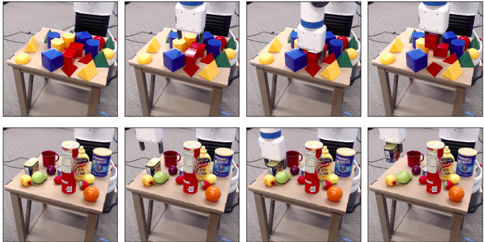
- The pipeline enabled a Fetch robot to detect and pick up the target object in 38 out of 40 trials in increasingly cluttered scenes, and a detector trained on a Spam can succeeded in 9 of 10 trials with previously unseen YCB food distractors.
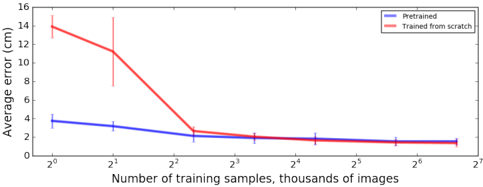
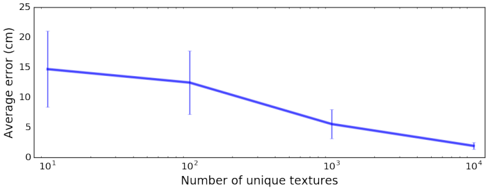
- Ablations found sensitivity to number of training images, number of unique textures, presence of distractors in training, and camera randomization; random noise had negligible effect. Performance improved up to around 50,000 training samples, and degraded significantly with fewer than 1,000 textures.
- ImageNet pretraining was not essential with enough data: random weight initialization achieved nearly the same real-world transfer performance as pretrained initialization, though pretraining helped in the low-data regime.
Methods
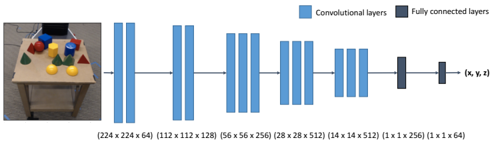
- The authors trained a modified VGG-16 convolutional neural network to map a single 224×224 monocular webcam image to Cartesian coordinates of object(s) of interest, using simulated images rendered by MuJoCo.
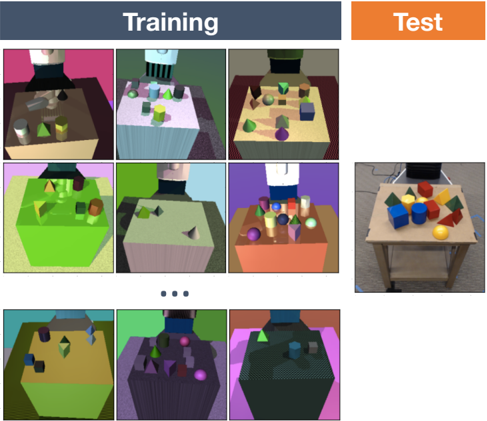
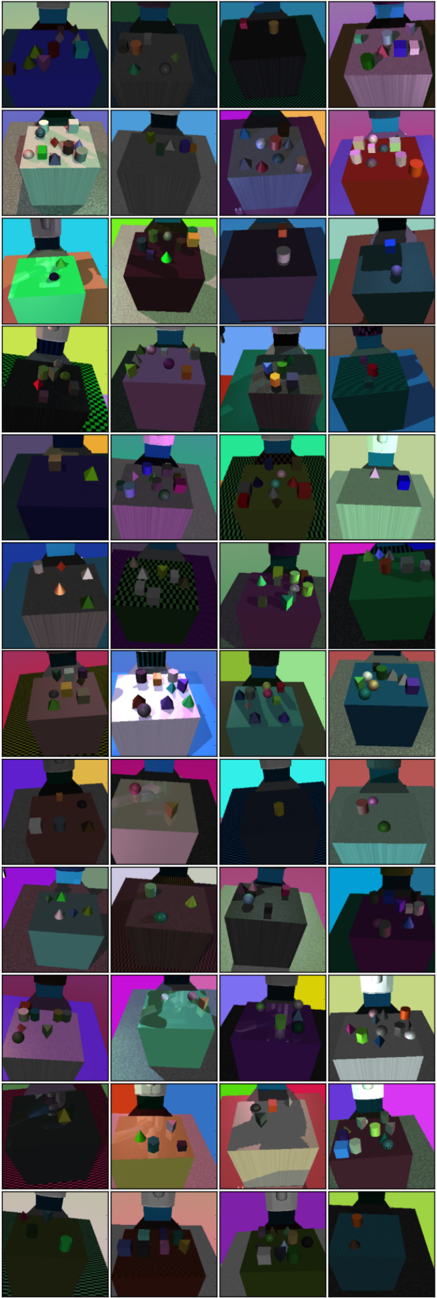
- Domain randomization varied number/shape of distractors, object positions and textures, table/floor/skybox/robot textures, camera position/orientation/field of view, number and properties of lights, and image noise. Textures were random RGB values, gradients, or checker patterns; 0–10 distractor objects were added per scene.
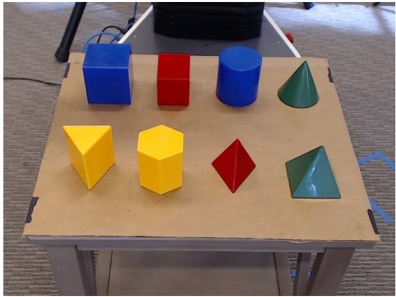
- Training used stochastic gradient descent with Adam on an L2 loss, learning rates around 1e-4, and batch sizes of 25, 50, or 100. Evaluation used 480 webcam images of eight geometric objects at 70–105 cm from a fixed camera, with 60 labeled images per object: 20 alone, 20 with distractors, and 20 partially occluded.
Limitations
- The paper states that the detectors still overfit simulated training data: simulated error was 0.3–0.5 cm versus about 1.5 cm in the real world, and no real-world validation could be done during training because no real data were assumed available.
- The paper states future work is needed for contact-rich manipulation or higher precision, and that the method fixes table height, effectively making the task 2D pose estimation from a single monocular uncalibrated camera.
- Evident from the text: evaluation is limited to eight geometric objects plus one Spam can, the test camera position remains constant across all images, and lighting and surrounding scene were not controlled.
Model-written summary. Check it against the paper before relying on it.
Integrity signals
Registry
Cites
Statistics
Figures
Verification
Claims the paper makes
2 Valid · 8 Not valid · 7 Not checked · 32 Own results and interpretations
The cited sources support only part of this claim — read each source’s verdict below.
In the paper
“Although previous work demonstrated the ability to perform robotic control using a neural network pretrained on ImageNet and fine-tuned on randomized rendered pixels [37], this paper provides the first demonstration that domain randomization can be useful for robotic tasks requiring precision.”
What the sources say
- Partly supportedcites [37] [37] Fereshteh Sadeghi and Sergey Levine. (cad) 2 RL: Real single-image flight without a single real image. arXiv preprint arXiv:1611.04201 , 2016. - sourceExperimental — accuracy not yet measured
The citation [37] is attached to the preceding claim about prior work, not to the citing authors’ claim that their own paper is the first to demonstrate precision robotics. Section 3.1 (p. 4) says LSDA pretrains a CNN on ImageNet classification data and fine-tunes it, but for object detection. It does not report robotic control or fine-tuning on randomized rendered pixels. (LLM, conf=0.84)
boostedstates a cause- Asserted: passes — The authors put it forward as true.
- Checkable: passes — It can be checked against evidence.
- Load-bearing: passes — The paper’s conclusions depend on it.
- Based: passes — The paper gives a reason why it holds.
- Partly supported
The cited sources that could be checked couldn’t confirm or dispute this claim.
In the paper
“Rather than relying on controller robustness, Yu et al. [53] use a model trained on varied physics to perform system identification using online trajectory data, but their approach is not shown to succeed in the real world.”
What the sources say
- Could not verifycites [53] [53] Wenhao Yu, C Karen Liu, and Greg Turk. Preparing for the unknown: Learning a universal policy with online system identification. arXiv preprint arXiv:1702.02453 , 2017. - sourceExperimental — accuracy not yet measured
The cited paper discusses image classification and localisation with convolutional networks (A.1, p. 10; A.2, p. 11), not Yu et al.'s approach. Searches for varied-physics training, online trajectory-based system identification, and real-world success found no passage addressing the claim. Our copy therefore cannot verify it. (LLM, conf=0.78)
plain- Asserted: passes — The authors put it forward as true.
- Checkable: passes — It can be checked against evidence.
- Load-bearing: unclear — It is unclear whether the paper’s conclusions depend on it.
- Based: passes — The paper gives a reason why it holds.
- Could not verify
The cited sources that could be checked couldn’t confirm or dispute this claim.
In the paper
“Though using realistic RGB rendering alone has had limited success for transferring to real robotic tasks [16], incorporating realistic simulation of depth information can allow models trained on rendered images to transfer reasonably well to the real world [32].”
What the sources say
- Could not verifycites [16] [16] Stephen James and Edward Johns. 3d simulation for robot arm control with deep q-learning. arXiv preprint arXiv:1609.03759 , 2016. - sourceExperimental — accuracy not yet measured
The Introduction (§1) and Conclusion (§8) describe Adam as a method for stochastic optimization, while the CNN experiment (§6.3) concerns training on image datasets. Searches for realistic RGB rendering and sim-to-real robotic transfer found no passage addressing whether RGB rendering alone has had limited success on real robotic tasks. (LLM, conf=0.78)
plain- Asserted: passes — The authors put it forward as true.
- Checkable: passes — It can be checked against evidence.
- Load-bearing: passes — The paper’s conclusions depend on it.
- Based: passes — The paper gives a reason why it holds.
- Could not verify
The cited sources that could be checked couldn’t confirm or dispute this claim.
In the paper
“However, their experiments - collision avoidance in hallways and open spaces - do not demonstrate the ability to deal with high-precision tasks.”
What the sources say
- Could not verifycites [37] [37] Fereshteh Sadeghi and Sergey Levine. (cad) 2 RL: Real single-image flight without a single real image. arXiv preprint arXiv:1611.04201 , 2016. - sourceExperimental — accuracy not yet measured
The Experiments section (p. 5) evaluates LSDA on an object-detection dataset, not Sadeghi and Levine’s collision-avoidance experiments. Searches for Sadeghi and Levine, hallway or open-space collision avoidance, and high-precision tasks found no passage addressing the claim. (LLM, conf=0.76)
plain- Asserted: passes — The authors put it forward as true.
- Checkable: passes — It can be checked against evidence.
- Load-bearing: passes — The paper’s conclusions depend on it.
- Based: passes — The paper gives a reason why it holds.
- Could not verify
A result the paper reports from its own data — it cites no other source for it, so there is none to check. The quote shows it is in the paper.
In the paper
“However, using a pre-trained model can significantly improve performance when less training data is used.”
plainstates a cause- Asserted: passes — The authors put it forward as true.
- Checkable: passes — It can be checked against evidence.
- Load-bearing: unclear — It is unclear whether the paper’s conclusions depend on it.
- Based: passes — The paper gives a reason why it holds.
29 more claims
Create a free account to see all 49 claims and to verify the 7 references still open.
- Probably not a substantial claim. 11
- It may state two separate claims as one. 8
Claims other papers make about this one
Each is checked against this paper’s own text: does it say what the citing paper says it does?
The source backs part of the claim, not all of it — or backs it for a different population, condition or comparison.
In the citing paper
“Most policies trained in simulation generalize poorly to the real-world due to agents adapting to specific visual details of the simulator.”
From Language-Based Augmentation to Address Shortcut Learning in Object-Goal Navigation (2023) · cites this paper as [8]
Experimental — accuracy not yet measuredThe source backs part of the claim, not all of it — or backs it for a different population, condition or comparison.
In the citing paper
“In robotic vision tasks including object localization [53], object detection [54], pose estimation [55], and semantic segmentation [56], the training data from simulator always have different textures, lighting, and camera positions from the realistic environments.”
From Sim-to-Real Transfer in Deep Reinforcement Learning for Robotics: a Survey (2020) · cites this paper as [53]
Experimental — accuracy not yet measuredThe source backs part of the claim, not all of it — or backs it for a different population, condition or comparison.
In the citing paper
“These artifacts limit the applicability of generative videos in physics-sensitive domains such as robotics [25,26], autonomous driving [27], simulationbased design, and scientific visualization [28].”
From PhyStruct-Video: Structured Physics State Spaces for Physically Consistent Video Generation (2025) · cites this paper as [25]
Experimental — accuracy not yet measuredThe source backs part of the claim, not all of it — or backs it for a different population, condition or comparison.
In the citing paper
“In domain randomization, the inputs during learning are “randomized” in the sense of being warped or corrupted in particular ways.”
From The overfitted brain: Dreams evolved to assist generalization (2021) · cites this paper as [144]
Experimental — accuracy not yet measuredThe source backs part of the claim, not all of it — or backs it for a different population, condition or comparison.
In the citing paper
“Domain randomization is a domain generalization technique that introduces drastic changes in the training image appearances, which forces the network to learn domain-invariant features between training and target domains [39].”
From A Fully Differentiable Framework for 2D/3D Registration and the Projective Spatial Transformers (2024) · cites this paper as [39]
Experimental — accuracy not yet measured
8 more claims about this paper
Create a free account to see every claim other papers make about this one.
Self-check
Percentages, sums and reported differences re-computed from the paper’s own numbers.
Each contradiction between two passages listed here was confirmed by an independent check.
Rated minor: it would not touch a result — a value no result rests on, a p-value that stays on the same side of the significance level, or a conflict that is clerical, resolved elsewhere in the paper, or outside its own findings.
In the paper
§ A. Experimental Setup · p. 4
“Each training sample consists of (a) a rendered image of the object and one or more distractors (also from among the geometric object set) on a simulated tabletop”
§ A. Domain randomization · p. 4
“Between 0 and 10 distractor objects are added to the table in each scene.”
Citations
Cites
Very Deep Convolutional Networks for Large-Scale Image Recognition
Simonyan, K., & Zisserman, A. (2014) · arXiv · doi:10.48550/arxiv.1409.1556 · Cited by 114,148 · cited 1×
“In particular, we use a modified version the VGG-16 architecture [42] shown in Figure 2.”
MethodAdam: A Method for Stochastic Optimization
Kingma, D. P., & Ba, J. (2014) · arXiv · doi:10.48550/arxiv.1412.6980 · Cited by 98,946 · cited 1×
“We found that using a learning rate of around 1e − 4 (as opposed to the standard 1e − 3 for Adam) improved convergence and helped avoid a common local optimum, mapping all objects to the center of the table.”
MethodLeCun, Y., Bengio, Y., & Hinton, G. (2015) · Nature · doi:10.1038/nature14539 · Cited by 84,126
Human-level control through deep reinforcement learning
Mnih, V., Kavukcuoglu, K., Silver, D., Rusu, A. A., Veness, J., Bellemare, M. G., Graves, A., Riedmiller, M., Fidjeland, A. K., Ostrovski, G., et al. (2015) · Nature · doi:10.1038/nature14236 · Cited by 30,357 · cited 3×
“Learning in simulation is especially promising for building on recent results using deep reinforcement learning to achieve human-level performance on tasks like Atari [27] and robotic control [21], [38].”
BackgroundResultHow transferable are features in deep neural networks?
Yosinski, J., Clune, J., Bengio, Y., & Lipson, H. (2014) · arXiv · doi:10.48550/arxiv.1411.1792 · Cited by 6,061 · cited 1×
“A variety of approaches have been proposed, including re-training the model in the target domain (e.g., [52]), adapting the weights of the model based on the statistics of the source and target domains (e.g., [22]), learning invariant features between domains (e.g., [47]), and learning a mapping…”
BackgroundMuJoCo: A physics engine for model-based control
Todorov, E., Erez, T., & Tassa, Y. (2012) · 2012 IEEE/RSJ International Conference on Intelligent Robots and Systems · doi:10.1109/iros.2012.6386109 · Cited by 4,767 · cited 1×
“We render images using the MuJoCo Physics Engine’s [45] built-in renderer.”
MethodTrust region policy optimization
Schulman, J., Levine, S., Moritz, P., Jordan, M. I., & Abbeel, P. (2015) · arXiv · doi:10.48550/arxiv.1502.05477 · Cited by 4,578 · cited 1×
“Learning in simulation is especially promising for building on recent results using deep reinforcement learning to achieve human-level performance on tasks like Atari [29] and robotic control [26], [41].”
ResultSelf-citationLearning Transferable Features with Deep Adaptation Networks
Long, M., Cao, Y., Wang, J., & Jordan, M. I. (2015) · arXiv · doi:10.48550/arxiv.1502.02791 · Cited by 4,505 · cited 1×
“omputer vision community has devoted significant study to the problem of adapting vision-based models trained in a source domain to a previously unseen target domain (see, e.g., [9], [14], [15], [19], [23], [25], [51]). A variety of approaches have been proposed, including re-training the model in the target domain (e.…”
BackgroundEnd-to-End Training of Deep Visuomotor Policies
Levine, S., Finn, C., Darrell, T., et al. (2015) · Journal of machine learning research · doi:10.5555/2946645.2946684 · Cited by 3,987
Describing Textures in the Wild
Cimpoi, M., Maji, S., Kokkinos, I., Mohamed, S., & Vedaldi, A. (2014) · 2014 IEEE Conference on Computer Vision and Pattern Recognition · doi:10.1109/cvpr.2014.461 · Cited by 2,438 · cited 1×
“To examine how our detectors would perform on objects with complex textures, we created simulated scenes in which the object of interest is given a texture from the Describable Textures Dataset (DTD) [4].”
Method
Research works printed but not linked: 3
- [24] David G Lowe. Three-dimensional object recognition from single two-dimensional images. Artificial intelligence , 31(3):355-395, 1987. -
- [49] Melonee Wise, Michael Ferguson, Derek King, Eric Diehr, and David Dymesich. Fetch and freight: Standard platforms for service robot applications. In Workshop on Autonomous Mobile Service Robots , 2016. -
- sucan, 0, MoveIt!
Cited by
Items 1,401–1,500 of 2,970
Okamoto, W., Kera, H., & Kawamoto, K. (2021) · arXiv (Cornell University) · doi:10.48550/arxiv.2111.10005 · Cited by 22
“Domain randomization has been used to successfully apply Sim2Real for the visual servo control of robot arms [4], [5] and locomotion control of quadruped robots [6].”
BackgroundMethodInfluentialDynamical Feedback Control: Motor Cortex as an Optimal Feedback Controller Based on Neural DynamicsPreprint
Versteeg, C., & Miller, L. E. (2022) · Preprints.org · doi:10.20944/preprints202201.0428.v1 · Cited by 7
“Deep RL models can learn expressive control policies that function across highly variable task conditions, such as altered force environments (OpenAI et al., 2019; Tobin et al., 2017).”
BackgroundOosedo, A., Wada, D., & Hisada, S. (2023) · ROBOMECH Journal · doi:10.1186/s40648-023-00260-0 · Cited by 6
“For example, domain randomization randomly changed the appearance [11, 12] and dynamics [13, 14] of objects from episode to episode in the simulation during training.”
BackgroundDeformable Object Manipulation in Caregiving Scenarios: A Review
Wang, L., & Zhu, J. (2023) · Machines · doi:10.3390/machines11111013 · Cited by 12
BAUODNET for Class Imbalance Learning in Underwater Object Detection
Chen, L., Yu, H., Dong, X., Li, Y., Shen, J., Shen, J., & Xu, Q. (2024) · IEEE Transactions on Emerging Topics in Computational Intelligence · doi:10.1109/tetci.2024.3462249 · Cited by 11
Benchmarking Smoothness and Reducing High-Frequency Oscillations in Continuous Control Policies
Christmann, G. H. G., Luo, Y., Mandala, H., & Chen, W.-C. (2024) · IEEE/RSJ International Conference on Intelligent Robots and Systems (IROS) · doi:10.1109/iros58592.2024.10802057 · Cited by 17
“The policies are trained with domain randomization (DR) [32] to ensure a successful sim-to-real transfer.”
PolyFit: A Peg-in-hole Assembly Framework for Unseen Polygon Shapes via Sim-to-real Adaptation
Lee, G., Lee, J., Noh, S., Ko, M., Kim, K.-M., & Lee, K. (2024) · IEEE/RSJ International Conference on Intelligent Robots and Systems (IROS) · doi:10.1109/iros58592.2024.10802554 · Cited by 15
“Various research initiatives aim to identify and mitigate these disparities, ensuring the effective transfer of learned behaviors from virtual to physical environments [18]–[21].”
Dynamic Collision Alert System for Collaboration of Construction Equipment and Workers
Dzeng, R., Fan, B., & Hsieh, T.-L. (2024) · Buildings · doi:10.3390/buildings15010110 · Cited by 5
Jing, X., & Qian, K. (2025) · Sensors · doi:10.3390/s25010256 · Cited by 9
“Domain randomization-based methods [4,20,21] either randomize object colors, lighting, and physical parameters in the simulator or apply randomized noise processing, lighting variations, and geometric transformations to the captured simulated data.”
A robust deep reinforcement learning approach for the control of crystallization processes
Torraca, J., Capron, B. D. O., & Secchi, A. R. (2025) · Computers & Chemical Engineering · doi:10.1016/j.compchemeng.2025.109114 · Cited by 9
Rambo: RL-Augmented Model-Based Whole-Body Control for Loco-Manipulation
Cheng, J., Kang, D., Fadini, G., Shi, G., & Coros, S. (2025) · IEEE Robotics and Automation Letters · doi:10.1109/lra.2025.3594984 · Cited by 32
“Both rewards are designed to ensure the success of tracking user commands and regularized action.”
Yoon, K.-I., & Lim, S. (2025) · Journal of Computational Design and Engineering · doi:10.1093/jcde/qwaf065 · Cited by 6
One Net to Rule Them All: Domain Randomization in Quadcopter Racing Across Different Platforms
Ferede, R., Blaha, T., Lucassen, E., Wagter, C. D., & de Croon, G. (2025) · Proceedings - IEEE International Conference on Robotics and Automation/Proceedings · doi:10.1109/icra55743.2025.11128790 · Cited by 20
“For instance, DR has facilitated single-shot sim-to-real transfer for robot manipulation [9], visual navigation using synthetic data [10], and object detection [11].”
Learning aggressive animal locomotion skills for quadrupedal robots solely from monocular videos
Liu, Z., Luo, Z., Han, Y., Zhang, J., Chen, Y., Liu, Y., & Lu, P. (2025) · npj Robotics · doi:10.1038/s44182-025-00048-x · Cited by 10
“The domain randomization 43 is adopted to reduce the domain gap, which includes dynamics parameter randomization, motor domain randomization, and payload randomization.”
PIV-FlowDiffuser: Transfer-Learning-Based Denoising Diffusion Models for Particle Image Velocimetry
Zhu, Q., Wang, J., Hu, J., Ai, J., & Lee, Y. (2025) · Sensors · doi:10.3390/s25196077 · Cited by 8
“Second, the neural models mentioned above are trained on synthetic datasets, which may differ significantly from real-world test cases, a discrepancy commonly referred to as the domain gap [38].”
Whole-Body Inverse Dynamics MPC for Legged Loco-Manipulation
Molnar, L., Cheng, J., Fadini, G., Kang, D., Zargarbashi, F., & Coros, S. (2025) · IEEE Robotics and Automation Letters · doi:10.1109/lra.2025.3636005 · Cited by 9
“Aswelackedtheequipmenttomeasure theactualappliedforces,wecouldnotverifywhetherthetargets werepreciselytracked.”
Impact of Static Friction on Sim2Real in Robotic Reinforcement Learning
Hu, X., Sun, Q., He, B., Liu, H., Zhang, X., Lu, C.-C., & Zhong, J. (2025) · IEEE/RSJ International Conference on Intelligent Robots and Systems (IROS) · doi:10.1109/iros60139.2025.11246554 · Cited by 17
“By randomizing the physical properties of the robot, domain randomization significantly enhances the model’s generalization capabilities.”
Luo, Y., Sun, B., Duan, P., Li, S., & Kang, X. (2026) · IEEE Transactions on Geoscience and Remote Sensing · doi:10.1109/tgrs.2026.3676994 · Cited by 10
“Currently, domain generalization semantic segmentation methods can be mainly divided into two categories: style randomization (SR) [21], [22], [23], [24], [25], [26], [27], [28], [29], [30], [31] and feature normalization (FN) [32], [33], [34], [35], [36], [37], [38], [39].”
Evaluation of single-stage vision models for pose estimation of surgical instruments
Burton, W. S., Myers, C. A., Rutherford, M. J., & Rullkoetter, P. J. (2023) · International Journal of Computer Assisted Radiology and Surgery · doi:10.1007/s11548-023-02890-6 · Cited by 8
Xu, B., Hassan, T., & Hussain, I. (2023) · IEEE Access · doi:10.1109/access.2023.3278208 · Cited by 5
“Asfor methods related to learning invariant representation, domain randomization is a common way [10].”
MethodInterpolation Normalization for Contrast Domain Generalization
Wang, M., Chen, J., Wang, H., Wu, H., Liu, Z., & Zhang, Q. (2023) · ACM International Conference on Multimedia (ACM MM) · doi:10.1145/3581783.3611841 · Cited by 5
Deep Reinforcement Learning with Godot Game Engine
Ranaweera, M., & Mahmoud, Q. H. (2024) · Electronics · doi:10.3390/electronics13050985 · Cited by 15
Unbiased Semantic Representation Learning Based on Causal Disentanglement for Domain Generalization
Jin, X., Li, N., Kong, W., Tang, J., & Yang, B. (2024) · ACM Transactions on Multimedia Computing Communications and Applications · doi:10.1145/3659953 · Cited by 6
“Various methods have been proposed for domain generalization, such as data augmentation [52, 59], domain-invariant representation learning [3, 13], and feature disentanglement [21, 42].”
Deep Domain Adaptation: A Sim2Real Neural Approach for Improving Eye-Tracking Systems
Nguyen, V. D., Bailey, R., Diaz, G. J., Ma, C., Fix, A., & Ororbia, A. G. (2024) · Proceedings of the ACM on Computer Graphics and Interactive Techniques · doi:10.1145/3654703 · Cited by 9
“…with it, a major issue emerges – due to the imperfections underlying computer simulation and 3D graphics models, a “reality gap” or mismatch exists between the synthetic data produced by a simulated environment (i.e. synthetic eye images) and the real world [19, 46] (i.e. images of real eyes).”
BackgroundWang, S. J., Zhu, H., & Johnson, A. M. (2024) · Proceedings - IEEE International Conference on Robotics and Automation/Proceedings · doi:10.1109/icra57147.2024.10611059 · Cited by 12
“Domain randomization [10,13–15] aims to train a policy that is effective on a wide range of dynamics, ideally including the real world dynamics, by randomizing simulation parameters during policy training to enhance robustness against variations in system dynamics.”
BackgroundMethodSynset Boulevard: A Synthetic Image Dataset for VMMR*
Sielemann, A., Wolf, S., Roschani, M., Ziehn, J. R., & Beyerer, J. (2024) · Proceedings - IEEE International Conference on Robotics and Automation/Proceedings · doi:10.1109/icra57147.2024.10610650 · Cited by 6
“Generic approaches to bridge this gap are domain randomization (DR) [6] and structured DR (SDR) [7], used for the creation of several synthetic vehicle detection datasets [8]–[10].”
BackgroundExperimental Comparison of Two 6D Pose Estimation Algorithms in Robotic Fruit-Picking Tasks
Alterani, A. B., Costanzo, M., Simone, M. D., Federico, S., & Natale, C. (2024) · Robotics · doi:10.3390/robotics13090127 · Cited by 9
Sparse Convolution-Based 6D Pose Estimation for Robotic Bin-Picking With Point Clouds
Zhuang, C., Niu, W., & Wang, H. (2024) · Journal of Mechanisms and Robotics · doi:10.1115/1.4066281 · Cited by 5
Fan, K., Chen, Z., Liu, Q., Ferrigno, G., & Momi, E. D. (2024) · IEEE Transactions on Medical Robotics and Bionics · doi:10.1109/tmrb.2024.3464089 · Cited by 12
Using Reinforcement Learning for Hydrobatic Maneuvering with Autonomous Underwater Vehicles
Wozniak, G., Bhat, S., & Stenius, I. (2024) · MTS/IEEE OCEANS Conference (OCEANS) · doi:10.1109/oceans51537.2024.10682215 · Cited by 5
“Such Sim2Real transfer is an active research problem in reinforcement learning, and approaches such as domain randomization are being explored in current research [18], [33].”
BackgroundRobotDART: a versatile robot simulator for robotics and machine learning researchers
Chatzilygeroudis, K. I., Totsila, D., & Mouret, J.-B. (2024) · The Journal of Open Source Software · doi:10.21105/joss.06771 · Cited by 6
“…anticipate the diverse needs of researchers; for instance, techniques like privileged reinforcement learning (Joonho Lee et al., 2020) and domain randomization (Tobin et al., 2017) necessitate direct access to various low-level components of the simulator to enable experimentation and innovation.”
BackgroundSemantically controllable augmentations for generalizable robot learning
Chen, Z. Q., Mandi, Z., Bharadhwaj, H., Sharma, M. K., Song, S., Gupta, A., & Kumar, V. (2024) · The International Journal of Robotics Research · doi:10.1177/02783649241273686 · Cited by 39
“These developments span both simulated (Reed et al. 2022; Jiang et al. 2022; Schrittwieser et al. 2020; Espeholt et al. 2018; Sodhani et al. 2021; Kaiser et al. 2019) and real environments (Tobin et al. 2017; Shridhar et al. 2022; Handa et al. 2023; Bousmalis et al. 2023).”
A Benchmark Dataset for Collaborative SLAM in Service Environments
Park, H., Lee, I., Kim, M., Park, H., & Joo, K. (2024) · IEEE Robotics and Automation Letters · doi:10.1109/lra.2024.3491415 · Cited by 10
Khawaldeh, B., Mora, A., & Faris, H. (2024) · Applied Informatics · doi:10.3390/ai5040105 · Cited by 5
“Thus, there is research that has developed domain randomization to transfer from simulation to the real world based on deep neural networks [17], but in 2020, a group of researchers tried to train this type of neural network in CARLA (Car Learning to Act), an open-source simulator for autonomous…”
Lee, Y., Song, S., Park, K.-Y., Koo, B.-M., & Baek, J. (2024) · IEEE Transactions on Instrumentation and Measurement · doi:10.1109/tim.2024.3507042 · Cited by 8
Wang, R., Gao, H., Qiu, H., Luo, L., Chen, M., Dong, Z. Y., & Liu, J. (2025) · IEEE Transactions on Power Systems · doi:10.1109/tpwrs.2025.3528889 · Cited by 5
SOUS VIDE: Cooking Visual Drone Navigation Policies in a Gaussian Splatting Vacuum
Low, J., Adang, M., Yu, J., Nagami, K., & Schwager, M. (2025) · IEEE Robotics and Automation Letters · doi:10.1109/lra.2025.3553785 · Cited by 29
“To the best of our knowledge, SOUS VIDE is the first method to leverage GSplats for generating low-level drone navigation policies for unstructured environments without assistive infrastructure or real-world expert flight data.”
Baja, H., Kallenberg, M., & Athanasiadis, I. N. (2025) · Proceedings of the AAAI Conference on Artificial Intelligence · doi:10.1609/aaai.v39i27.34999 · Cited by 8
Dr.VCoach: employment of advanced deep learning and human–robot interaction for virtual coaching
Cauli, N., & Recupero, D. R. (2025) · Intelligent Service Robotics · doi:10.1007/s11370-025-00603-3 · Cited by 7
“The concept of producing a synthetic dataset with high variability in image appearance is the core idea behind the domain randomization (DR) paradigm introduced by Tobin et al. [33].”
Environment as Policy: Learning to Race in Unseen Tracks
Wang, H., Xing, J., Messikommer, N., & Scaramuzza, D. (2025) · Proceedings - IEEE International Conference on Robotics and Automation/Proceedings · doi:10.1109/icra55743.2025.11127376 · Cited by 14
“This work aims to develop RL agents that generalize effectively to novel track configurations without retraining.”
Zhu, X., Henningsson, J., Li, D., et al. (2025) · Proceedings - IEEE International Conference on Robotics and Automation/Proceedings · doi:10.1109/icra55743.2025.11128647 · Cited by 5
“Initially proposed by Tobin et al. [6], DR has been adopted in several manufacturing applications [1], [4], [7], [8], [9], [10], [11], focusing on industrial products over everyday objects and outdoor environments [12], [13].”
InfluentialZero-Shot Sim-to-Real Reinforcement Learning for Fruit Harvesting
Williams, E., & Polydoros, A. (2025) · IEEE International Conference on Automation Science and Engineering (CASE) · doi:10.1109/case58245.2025.11164009 · Cited by 6
“For example, Tobin et al. [8] trained vision based networks in simulation with random textures and lighting to achieve successful real world robotic perception and control.”
Baumgart, N., Lange‐Hegermann, M., & Mücke, M. (2025) · Machine Vision and Applications · doi:10.1007/s00138-025-01770-0 · Cited by 10
“The experiments reveal that clas - sification is difficult when classes share a similar albedo or have a comparable shape [5], which is typical for industrial objects.”
The Formation Control of Mobile Autonomous Multi-Agent Systems Using Deep Reinforcement Learning
Liu, Q., & Hui, Q. (2019) · IEEE International Systems Conference (SysCon) · doi:10.1109/syscon.2019.8836902 · Cited by 4
“Some DRL algorithms in the continuous action domain are proposed such as asynchronous advantage actor-critic [32] and in [33], they combine the asymmetric actor-critic with domain randomization.”
MethodState-Consistency Loss for Learning Spatial Perception Tasks From Partial Labels
Nava, M., Gambardella, L. M., & Giusti, A. (2021) · IEEE Robotics and Automation Letters · doi:10.1109/lra.2021.3056378 · Cited by 8
Document Domain Randomization for Deep Learning Document Layout Extraction
Ling, M., Chen, J., Möller, T. B., Isenberg, P., Isenberg, T., Sedlmair, M., Laramee, R. S., Shen, H., Wu, J. F., & Giles, C. L. (2021) · Lecture notes in computer science · doi:10.1007/978-3-030-86549-8_32 · Cited by 7
“DDR uses simulation-based training document generation, akin to domain randomization (DR) in robotics [20,34,40,41] and computer vision [15,29].”
MethodZero in on Shape: A Generic 2D-3D Instance Similarity Metric Learned from Synthetic Data
Janik, M., Gard, N., Hilsmann, A., & Eisert, P. (2021) · Proceedings - International Conference on Image Processing · doi:10.1109/icip42928.2021.9506436 · Cited by 7
“We generate the data using Domain Randomization [5] and leverage the siamese architecture of the CNN to reduce the domain gap between the synthetic training data and the real test data.”
BackgroundMethodHamrell, H., & Karlholm, J. (2021) · Artificial Intelligence and Machine Learning in Defense Applications · doi:10.1117/12.2599214 · Cited by 6
“8,9 Therefore, it is of considerable interest to study different ways to refine simulated training data using image-to-image translation.”
BackgroundSim-to-Real Transfer with Action Mapping and State Prediction for Robot Motion Control
Zhu, X., Zheng, X., Zhang, Q., Chen, Z., Liu, Y., & Liang, B. (2021) · Asia-Pacific Conference on Intelligent Robot Systems (ACIRS) · doi:10.1109/acirs52449.2021.9519311 · Cited by 6
Validate on Sim, Detect on Real - Model Selection for Domain Randomization
Leibovich, G., Jacob, G., Endrawis, S., Novik, G., & Tamar, A. (2022) · Proceedings - IEEE International Conference on Robotics and Automation/Proceedings · doi:10.1109/icra46639.2022.9811621 · Cited by 6
“Several techniques have been proposed to alleviate the gap [9], and one of the most popular ones is Domain Randomization (DR) [10], [4], [11], where instead of training on a single simulation environment, models are trained on multiple domains with random variations in environment attributes such as textures, lighting…”
BackgroundMethodInfluentialObject manipulation system based on image-based reinforcement learning
Kim, S., Jo, H., & Song, J. (2022) · Intelligent Service Robotics · doi:10.1007/s11370-021-00402-6 · Cited by 7
“…domain randomization that arbitrarily changes the object colors, lighting conditions, camera positions, and physical B Jae-Bok Song jbsong@korea.ac.kr 1 School of Mechanical Engineering, Korea University, 145 Anam-ro, Seongbuk-gu, Seoul 02841, Korea properties of the objects in the simulations [1].”
BackgroundLearning from Imperfect Demonstrations via Adversarial Confidence Transfer
Cao, Z., Wang, Z., & Sadigh, D. (2022) · Proceedings - IEEE International Conference on Robotics and Automation/Proceedings · doi:10.1109/icra46639.2022.9811891 · Cited by 10
“108 To learn a common latent space, domain randomization methods align the different dynamics by 109 randomizing the dynamics with hand-crafted augmentations [26, 27, 28], but they require that the 110 differences between two dynamics can be covered by the augmentations.”
MethodIORand: A Procedural Videogame Level Generator Based on a Hybrid PCG Algorithm
Moreno-Armendáriz, M. A., Calvo, H., Torres-León, J. A., & Duchanoy, C. A. (2022) · Applied Sciences · doi:10.3390/app12083792 · Cited by 6
“Commonly, this approach uses random [31,32] or semi-random algorithms, such as fractals [33].”
MethodDOPE++: 6D pose estimation algorithm for weakly textured objects based on deep neural networks
Jin, M., Li, J., & Zhang, L. (2022) · PLoS ONE · doi:10.1371/journal.pone.0269175 · Cited by 9
“We independently design a series of comparative experiments to verify the advantages of using virtual reality technology to produce datasets, such as avoiding the problems of a single background, small changes in object position and pose, and easy overfitting that exist in real datasets of YCB videos [41, 42].”
MethodSelf-supervision & meta-learning for one-shot unsupervised cross-domain detection
Borlino, F. C., Polizzotto, S., Caputo, B., & Tommasi, T. (2022) · Computer Vision and Image Understanding · doi:10.1016/j.cviu.2022.103549 · Cited by 10
Fathaah, S. A., Ragunathan, K., Abhijith, P., M, D. R. S. P., & Sankaran, P. (2022) · Journal of Visual Communication and Image Representation · doi:10.1016/j.jvcir.2022.103636 · Cited by 5
End-to-end Reinforcement Learning of Robotic Manipulation with Robust Keypoints Representation
Wang, T., Puang, E. Y., Lee, M., Jing, W., & Wu, Y. (2022) · Asia-Pacific Signal and Information Processing Association Annual Summit and Conference (APSIPA ASC) · doi:10.23919/apsipaasc55919.2022.9980136 · Cited by 10
“We also use domain randomization [37] and adversarial examples [38] in the keypoints training to improve the performance and robustness for sim-to-real transfer.”
MethodMoDA: Map Style Transfer for Self-supervised Domain Adaptation of Embodied Agents
Lee, E. S., Kim, J., Park, S., & Kim, Y. M. (2022) · Lecture notes in computer science · doi:10.1007/978-3-031-19842-7_20 · Cited by 10
“To alleviate Sim2Real gap, domain randomization [12,45] proposes to train the agent in various dynamics and visual simulations, which in turn allows the agent to observe a wide range of domains”
BackgroundChen, Y., Li, X., Guo, S., Ng, X. Y., & Ang, M. H. (2023) · Lecture notes in networks and systems · doi:10.1007/978-3-031-22216-0_41 · Cited by 12
Grasping Complex-Shaped and Thin Objects Using a Generative Grasping Convolutional Neural Network
Kim, J., Nocentini, O., Bashir, M. Z., & Cavallo, F. (2023) · Robotics · doi:10.3390/robotics12020041 · Cited by 6
A Scaling Law for Syn2real Transfer: How Much Is Your Pre-training Effective?
Mikami, H., Fukumizu, K., Murai, S., Suzuki, S., Kikuchi, Y., Suzuki, T., Maeda, S., & Hayashi, K. (2023) · Lecture notes in computer science · doi:10.1007/978-3-031-26409-2_29 · Cited by 34
“For the latter, existing techniques such as domain randomization [60] would be helpful.”
MethodA Dual-Branch Network for Few-Shot Vehicle Re-Identification With Enhanced Global and Local Features
Sun, W., Xu, F., Zhang, X., Hu, Y., Dai, G., & He, X. (2023) · IEEE Transactions on Instrumentation and Measurement · doi:10.1109/tim.2023.3285978 · Cited by 7
“In recent years, the development of deep convolutional neural networks (CNNs) [4] and large-scale datasets [5], [6] expedites the invention of vehicle Re-ID meth-ods [8], [9], [10], [11], [12] to achieve remarkable success.”
BackgroundHabas, B., Langelaan, J. W., & Cheng, B. (2023) · Proceedings - IEEE International Conference on Robotics and Automation/Proceedings · doi:10.1109/icra48891.2023.10160376 · Cited by 8
“By doing so, a more robust policy can be found, which has been shown to improve experimental performance beyond trials without this method [31], [32].”
BackgroundMethodComparison of Different Domain Randomization Methods for Policy Transfer in Reinforcement Learning
Ma, M., Li, H., Hu, G., Liu, S., & Zhao, D. (2023) · IEEE Data Driven Control and Learning Systems Conference (DDCLS) · doi:10.1109/ddcls58216.2023.10166417 · Cited by 6
Exoplanet detection from starshade images using convolutional neural networks
Ahmed, Z., D’Amico, S., Hu, R., & Damiano, M. (2023) · Techniques and Instrumentation for Detection of Exoplanets · doi:10.1117/12.2676600 · Cited by 6
Control of Fab Lifters via Deep Reinforcement Learning: A Semi-MDP Approach
Kim, G., Shin, J.-U., Kim, G., Kim, J., & Yang, I. (2023) · IEEE Transactions on Automation Science and Engineering · doi:10.1109/tase.2023.3308849 · Cited by 6
“Among these, domain randomization [54], a method that aims to produce a policy that works well across the tasks with different physical parameters, can be adopted in our problem by generating diverse lot arrival patterns and learning a controller that performs well on these patterns.”
MethodSound-to-Imagination: An Exploratory Study on Cross-Modal Translation Using Diverse Audiovisual Data
Fanzeres, L. A., & Nadeu, C. (2023) · Applied Sciences · doi:10.3390/app131910833 · Cited by 16
Effects of Markers in Training Datasets on the Accuracy of 6D Pose Estimation
Roßkamp, J., Weller, R., & Zachmann, G. (2024) · IEEE Winter Conference on Applications of Computer Vision · doi:10.1109/wacv57701.2024.00440 · Cited by 8
“And while domain randomization or photorealistic images can be used for training, it is usually best to fine-tune on real data [28,29].”
BackgroundUlhas, S. S., Kannapiran, S., & Berman, S. (2024) · IEEE Intelligent Vehicles Symposium · doi:10.1109/iv55156.2024.10588594 · Cited by 13
“Domain randomization has been successfully applied to bridge the gap between synthetic and real-world data for a variety of tasks, including quadrotor navigation [19] and object grasping [20]–[23].”
BackgroundIndustrial vision inspection using digital twins: bridging CAD models and realistic scenarios
Wang, F., Wu, J., Yang, Z., & Song, Y. (2024) · Journal of Intelligent Manufacturing · doi:10.1007/s10845-024-02485-1 · Cited by 10
“Prior studies (Tobin et al., 2017) mostly concentrate on robot grasping assignments, which are essentially object localization tasks.”
Digital Twin‐Enabled Deep Reinforcement Learning for Safety‐Guaranteed Flocking Motion of UAV Swarm
Li, Z., Lei, L., Shen, G., Liu, X., & Liu, X. (2024) · Transactions on Emerging Telecommunications Technologies · doi:10.1002/ett.70011 · Cited by 10
Curriculum reinforcement learning-based drifting along a general path for autonomous vehicles
Yu, K., Fu, M., Tian, X., Yang, S., & Yang, Y. (2024) · Robotica · doi:10.1017/s026357472400119x · Cited by 7
“Domain randomization involves the introduction of random variations and perturbations into the training environment or simulation to generate a diverse set of training scenarios [42–45].”
A robot path tracking method based on manual guidance and path reinforcement learning
Pan, Y., Chen, C., Li, D., & Zhao, Z. (2024) · Applied Intelligence · doi:10.1007/s10489-024-06098-2 · Cited by 5
“Therefore, DRL algorithms are typically trained in a simulated environment by employing domain randomization techniques [48], which can enhance the generalization.”
Single-Shot 6DoF Pose and 3D Size Estimation for Robotic Strawberry Harvesting
Li, L., & Kasaei, H. (2024) · IEEE/RSJ International Conference on Intelligent Robots and Systems (IROS) · doi:10.1109/iros58592.2024.10802107 · Cited by 16
“To mitigate the common issue of models trained on synthetic datasets underperforming with real-world images, we implemented domain randomization techniques [21], strategically varying camera settings and introducing random lighting conditions within the simulator.”
Fuzzy Ensembles of Reinforcement Learning Policies for Systems With Variable Parameters
Haddad, A. G., Mohiuddin, M. B., Boiko, I. M., & Zweiri, Y. (2025) · IEEE Robotics and Automation Letters · doi:10.1109/lra.2025.3559833 · Cited by 6
A CNN Model for Human Parsing Based on Capacity Optimization
Jiang, Y., & Chi, Z. (2019) · Applied Sciences · doi:10.3390/app9071330 · Cited by 6
“The SM was trained on the images from the PASCAL VOC 2010 Person Part Dataset for body part segmentation [2,63].”
MethodV-PROM: A Benchmark for Visual Reasoning Using Visual Progressive Matrices
Teney, D., Wang, P., Cao, J., Liu, L., Shen, C., & van den Hengel, A. (2020) · Proceedings of the AAAI Conference on Artificial Intelligence · doi:10.1609/aaai.v34i07.6885 · Cited by 27
“Generalisation is a key issues that limits the robustness, and thus practicality of deep learning (see ([19, 17, 13, 39] among many others).”
BackgroundGerken, A., & Spranger, M. (2019) · Proceedings - IEEE International Conference on Robotics and Automation/Proceedings · doi:10.1109/icra.2019.8794347 · Cited by 7
“Approaches to obtaining more data and to apply RL to multiple goal tasks can be a physical simulation of the robot [6] or sample augmentation of existing data [7].”
BackgroundBonatti, R., Madaan, R., Vineet, V., Scherer, S., & Kapoor, A. (2019) · Cited by 6
Towards Learning 3d Object Detection and 6d Pose Estimation from Synthetic Data
Rudorfer, M., Neumann, L., & Krüger, J. (2019) · IEEE International Conference on Emerging Technologies and Factory Automation (ETFA) · doi:10.1109/etfa.2019.8869318 · Cited by 8
“Yet, special care has to be taken to bridge the domain gap that emerges when training with synthetic data but testing with real data [11].”
BackgroundMethodNavigation Agents for the Visually Impaired: A Sidewalk Simulator and ExperimentsPreprint
Weiß, M., Chamorro, S., Girgis, R., Luck, M. M., Kahou, S. E., Cohen, J., Nowrouzezahrai, D., Precup, D., Golemo, F., & Pal, C. (2019) · arXiv (Cornell University) · doi:10.48550/arxiv.1910.13249 · Cited by 14
“Techniques like domain randomization[27] can be used to improve model generalization, but our use of real-world imagery presents a challenge for this approach.”
BackgroundReusable neural skill embeddings for vision-guided whole body movement and object manipulation
Merel, J., Tunyasuvunakool, S., Ahuja, A., Tassa, Y., Hasenclever, L., Pham, V., Erez, T., Wayne, G., & Heess, N. (2019) · Cited by 8
Li, S., Zhou, J., Jia, Z., Yeung, D., & Mason, M. T. (2020) · Springer proceedings in advanced robotics · doi:10.1007/978-3-030-33950-0_22 · Cited by 5
“It has been shown that CNNs trained in synthetic data exhibit reasonable generalization performance on several perception tasks such as object detection and pose estimation [2, 3].”
BackgroundChe, C., Xian, Z., Zeng, X., Gao, X., & Xu, M. (2019) · IEEE International Conference on Bioinformatics and Biomedicine (BIBM) · doi:10.1109/bibm47256.2019.8983110 · Cited by 7
“In this work, we adapt a recently proposed simple yet effective technique named domain randomization [12] to transfer models trained on simulated images to real images.”
MethodEvaluation of Domain Randomization Techniques for Transfer Learning
Grün, S., Höninger, S., Scheikl, P. M., Hein, B., & Kröger, T. (2019) · International Conference on Advanced Robotics (ICAR) · doi:10.1109/icar46387.2019.8981654 · Cited by 8
“Recently, domain randomization has proven to be an effective method for sim-to-real transfer by randomizing the visual appearance [2], [11] and by randomizing objects shapes for a grasp prediction task [7], [13].”
BackgroundMethodResultInfluentialImproving Instance Segmentation using Synthetic Data with Artificial Distractors
Park, K., Lee, H., Yang, H., & Oh, S.-Y. (2020) · International Conference on Control, Automation and Systems (ICCAS) · doi:10.23919/iccas50221.2020.9268390 · Cited by 5
“One of the effective solutions is ‘domain randomization’ [5].”
BackgroundApplying FastPhotoStyle to Synthetic Data for Military Vehicle Detection
Lee, H., Lee, K., Yang, H., & Oh, S.-Y. (2020) · International Conference on Control, Automation and Systems (ICCAS) · doi:10.23919/iccas50221.2020.9268331 · Cited by 5
“Domain Randomization(DR) has been firstly suggested by Tobin et al. [10].”
BackgroundPertila, P. E., Parviainen, M., Myllylä, V., Huttunen, A., & Jarske, P. (2020) · IEEE International Workshop on Multimedia Signal Processing (MMSP) · doi:10.1109/mmsp48831.2020.9287131 · Cited by 8
“Varying the acoustic parameters can be seen as form of domain randomization [14].”
BackgroundInfluentialRichard, A., Aravecchia, S., Schillaci, T., Geist, M., & Pradalier, C. (2021) · IEEE Robotics and Automation Letters · doi:10.1109/lra.2021.3065278 · Cited by 5
“For example, [20], [21] apply DR by making changes in the 3D scenes by ran-”
Quantifying the Use of Domain Randomization
Ani, M., Basevi, H. R. A., & Leonardis, A. (2021) · Proceedings - International Conference on Pattern Recognition/Proceedings/International Conference on Pattern Recognition · doi:10.1109/icpr48806.2021.9412118 · Cited by 5
“Recently, an inexpensive way to achieve transfer from synthetic-to-real, particularly in several robotics applications [6]–[14], is through Domain Randomization (DR).”
BackgroundMethodInfluentialARC: Adversarially Robust Control Policies for Autonomous Vehicles
Kuutti, S., Fallah, S., & Bowden, R. (2021) · IEEE International Conference on Intelligent Transportation Systems (ITSC) · doi:10.1109/itsc48978.2021.9564579 · Cited by 9
Weakly-Supervised Object Detection Learning through Human-Robot Interaction
Maiettini, E., Tikhanoff, V., & Natale, L. (2021) · 2020 IEEE-RAS 20th International Conference on Humanoid Robots (Humanoids) · doi:10.1109/humanoids47582.2021.9555781 · Cited by 5
ViTroVo: in vitro assembly search for in vivo adaptive operator guidance
Grappiolo, C., Pruim, R. H. R., Faeth, M., & de Heer, P. B. U. L. (2021) · The International Journal of Advanced Manufacturing Technology · doi:10.1007/s00170-021-07824-7 · Cited by 9
“Component Dataset comprises of S synthetic images generated in ViTroVo’s Virtual Environment via domain randomisation [62, 63].”
BackgroundMethodAccelerated Robot Skill Acquisition by Reinforcement Learning-Aided Sim-to-Real Domain Adaptation
Loncarcvic, Z., Ude, A., & Gams, A. (2021) · International Conference on Advanced Robotics (ICAR) · doi:10.1109/icar53236.2021.9659351 · Cited by 6
“Domain randomization can also be considered a zero-shot methodology, but it relies on highly randomized simulation, so that it covers the actual distribution of the real-world data [15].”
BackgroundWelding Defect Detection with Deep Learning Architectures
Tripicchio, P., & D’Avella, S. (2022) · IntechOpen eBooks · doi:10.5772/intechopen.101951 · Cited by 8
Wu, K., Wu, M., Chen, Z., Xu, Y., & Li, X. (2022) · Proceedings of the AAAI Conference on Artificial Intelligence · doi:10.1609/aaai.v36i8.20847 · Cited by 14
“For example, the simulation environment is rendered with random textures to train the adaptive policies (Tobin et al. 2017).”
BackgroundLearning-based Ellipse Detection for Robotic Grasps of Cylinders and Ellipsoids
Dong, H., Zhou, J., Qiu, C., Dilip, P. K., & Chen, I. (2022) · Proceedings - IEEE International Conference on Robotics and Automation/Proceedings · doi:10.1109/icra46639.2022.9812363 · Cited by 5
“Allowing for domain randomization [19], we expose the 3D models of the cylindrical objects into various scenarios by Blenderproc [25] for extracting the ellipse ground truth.”
MethodA Swapping Target Q-Value Technique for Data Augmentation in Offline Reinforcement Learning
Joo, H.-T., Baek, I.-C., & Kim, K.-J. (2022) · IEEE Access · doi:10.1109/access.2022.3178194 · Cited by 8
“Online reinforcement learning (RL), combined with deep neural network function approximators, has been successfully applied in robotics [1], [2], Atari games [3], Go [4], and StarCraft [5].”
MethodZakia, U., Barua, A., Jiang, X., & Menon, C. (2022) · IEEE Access · doi:10.1109/access.2022.3187115 · Cited by 5
“This approach can make the simulated data as diverse as possible so that the real data would appear as another variation to the model [23, 24].”
BackgroundProgress and challenges in adaptive robotics
Nolfi, S. (2022) · Frontiers in Robotics and AI · doi:10.3389/frobt.2022.1020462 · Cited by 5
Metadata
- Authors
- Tobin, J., Fong, R., Ray, A., Schneider, J., Zaremba, W., & Abbeel, P.
- Affiliations
- University of California, Berkeley (US)
- OpenAI (United States) (US)
- International Computer Science Institute (US)
- ORCID
- Abbeel, Pieter
- Venue
- 2017 IEEE/RSJ International Conference on Intelligent Robots and Systems (IROS)
- Publisher
- IEEE
- Published
- 2017-09
- Pages
- 23-30
- ISSN
- 2153-0858 (ISSN-L)
- OpenAlex
- W2605102758
- Semantic Scholar
- 32ceb28e45a445df4d89df281bb0e3ab5aab1a2a
- Cited by
- 3,124
- References
- 69
- Citations by year
- 2026: 413 · 2025: 433 · 2024: 336 · 2023: 403 · 2022: 374 · 2021: 422 · 2020: 352 · 2019: 256 · 2018: 106 · 2017: 25
- FWCI
- 92.18
- Type
- conference paper
- Language
- en
- Open access
- green
- arxiv.org
- Locations
- IEEE/RSJ International Conference on Intelligent Robots and Systems (IROS) (publishedVersion)
- arXiv (Cornell University) (submittedVersion)
- arXiv (Cornell University)
- Topics
- Physical Sciences › Computer Science › Artificial Intelligence › Reinforcement Learning in Robotics
- Physical Sciences › Engineering › Control and Systems Engineering › Robot Manipulation and Learning
- Physical Sciences › Computer Science › Artificial Intelligence › Domain Adaptation and Few-Shot Learning
- Keywords
- domain randomization, sim-to-real transfer, reality gap, object detection, object localization, robotic grasping, cluttered environments, distractor robustness, partial occlusion, robotic manipulation
About these checks
Registry, retraction, Cites and statistics results are computed, not judged, with one exception: a printed reference that no index lists is read once by a model before it counts as a citation error. Claims are extracted by a model and kept only when their quote appears verbatim in the text; each cited source is then checked, with a model’s help, for whether it says what the claim relies on. Those verdicts can be wrong — read the claim’s quote and the cited source before relying on one.
The claim verdicts this report counts are experimental: their accuracy is not yet measured.
A language model drew the claims from the paper on 2026-10-10, under version 3 of the claim definition (model deepseek-v4.1-flash, prompt extract-v3).
A second model labelled each claim on 2026-10-10 (model jev-1.13-20260917, definition revision gold-guideline-v0.2).
Cited sources are checked with a language model’s help (gpt-6-sol).
Statistics and arithmetic are recomputed, not judged.
Confidence bands are shown only for fields calibrated on our annotated test set. None is calibrated yet, so no band is shown.
What counts as a claim ›How we measure confidence ›How we check this ›
Are you an author, or do you see a problem with this page? Request a review
Data sources
Bibliographic data: Semantic Scholar, OpenAlex, Crossref.
Contains information from the Semantic Scholar Academic Graph Datasets, made available under the ODC Attribution License (ODC-BY 1.0).
Semantic Scholar’s data is described in: Kinney, R., et al. (2023). The Semantic Scholar Open Data Platform. arXiv:2301.10140.
