

Domain randomization for transferring deep neural networks from simulation to the real world
Open accessThe DOI matches its Crossref record; 71 of the 71 references it cites were found in a registry or an index; 8 of the 17 sources its claims cite were checked for support.
Abstract
Bridging the `reality gap' that separates simulated robotics from experiments on hardware could accelerate robotic research through improved data availability. This paper explores domain randomization, a simple technique for training models on simulated images that transfer to real images by randomizing rendering in the simulator. With enough variability in the simulator, the real world may appear to the model as just another variation. We focus on the task of object localization, which is a stepping stone to general robotic manipulation skills. We find that it is possible to train a real-world object detector that is accurate to 1.5 cm and robust to distractors and partial occlusions using only data from a simulator with non-realistic random textures. To demonstrate the capabilities of our detectors, we show they can be used to perform grasping in a cluttered environment. To our knowledge, this is the first successful transfer of a deep neural network trained only on simulated RGB images (without pre-training on real images) to the real world for the purpose of robotic control.
Overview
CoChat Summary
TL;DR
This paper introduces domain randomization: training an object detector on simulated RGB images with randomized rendering, textures, lighting, camera pose, and distractors so that the real world appears as another variation. The authors show that a detector trained only in simulation can localize objects in the real world accurately enough to grasp them in clutter.
Key findings
- Real-world object detectors trained only on simulated images localized objects to within about 1.5 cm on average, including with distractors and partial occlusions; per-object errors in Table I range from 0.6 ± 0.3 cm to 3.2 ± 5.8 cm depending on object and condition.
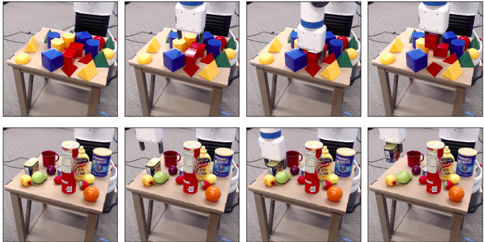
- The pipeline enabled a Fetch robot to detect and pick up the target object in 38 out of 40 trials in increasingly cluttered scenes, and a detector trained on a Spam can succeeded in 9 of 10 trials with previously unseen YCB food distractors.
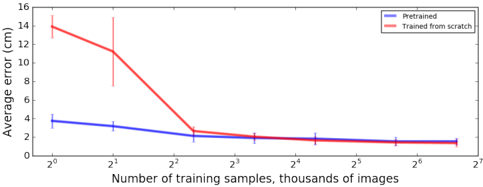
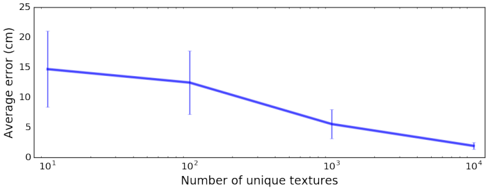
- Ablations found sensitivity to number of training images, number of unique textures, presence of distractors in training, and camera randomization; random noise had negligible effect. Performance improved up to around 50,000 training samples, and degraded significantly with fewer than 1,000 textures.
- ImageNet pretraining was not essential with enough data: random weight initialization achieved nearly the same real-world transfer performance as pretrained initialization, though pretraining helped in the low-data regime.
Methods
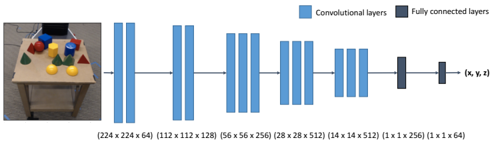
- The authors trained a modified VGG-16 convolutional neural network to map a single 224×224 monocular webcam image to Cartesian coordinates of object(s) of interest, using simulated images rendered by MuJoCo.
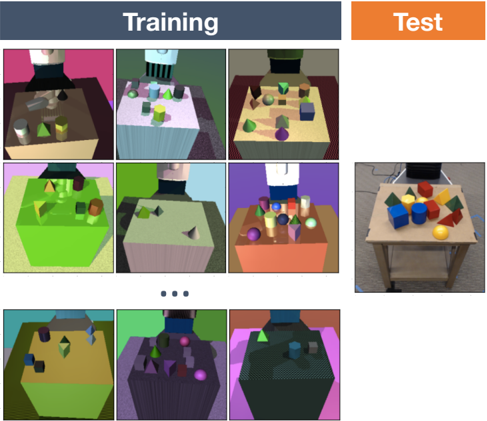
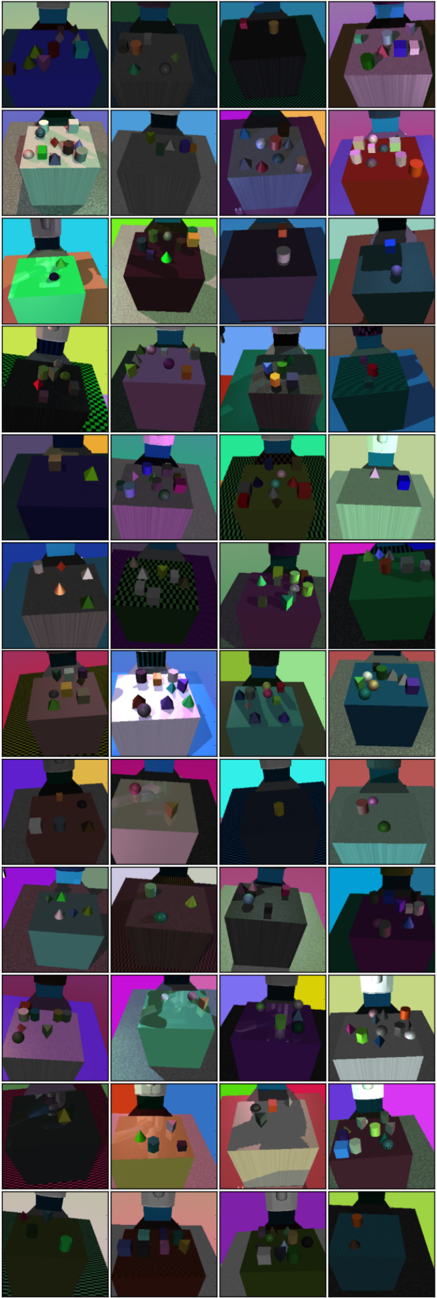
- Domain randomization varied number/shape of distractors, object positions and textures, table/floor/skybox/robot textures, camera position/orientation/field of view, number and properties of lights, and image noise. Textures were random RGB values, gradients, or checker patterns; 0–10 distractor objects were added per scene.
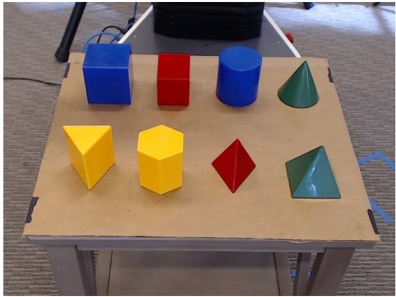
- Training used stochastic gradient descent with Adam on an L2 loss, learning rates around 1e-4, and batch sizes of 25, 50, or 100. Evaluation used 480 webcam images of eight geometric objects at 70–105 cm from a fixed camera, with 60 labeled images per object: 20 alone, 20 with distractors, and 20 partially occluded.
Limitations
- The paper states that the detectors still overfit simulated training data: simulated error was 0.3–0.5 cm versus about 1.5 cm in the real world, and no real-world validation could be done during training because no real data were assumed available.
- The paper states future work is needed for contact-rich manipulation or higher precision, and that the method fixes table height, effectively making the task 2D pose estimation from a single monocular uncalibrated camera.
- Evident from the text: evaluation is limited to eight geometric objects plus one Spam can, the test camera position remains constant across all images, and lighting and surrounding scene were not controlled.
Model-written summary. Check it against the paper before relying on it.
Integrity signals
Registry
Cites
Statistics
Figures
Verification
Claims the paper makes
2 Valid · 8 Not valid · 7 Not checked · 32 Own results and interpretations
The cited sources support only part of this claim — read each source’s verdict below.
In the paper
“Although previous work demonstrated the ability to perform robotic control using a neural network pretrained on ImageNet and fine-tuned on randomized rendered pixels [37], this paper provides the first demonstration that domain randomization can be useful for robotic tasks requiring precision.”
What the sources say
- Partly supportedcites [37] [37] Fereshteh Sadeghi and Sergey Levine. (cad) 2 RL: Real single-image flight without a single real image. arXiv preprint arXiv:1611.04201 , 2016. - sourceExperimental — accuracy not yet measured
The citation [37] is attached to the preceding claim about prior work, not to the citing authors’ claim that their own paper is the first to demonstrate precision robotics. Section 3.1 (p. 4) says LSDA pretrains a CNN on ImageNet classification data and fine-tunes it, but for object detection. It does not report robotic control or fine-tuning on randomized rendered pixels. (LLM, conf=0.84)
boostedstates a cause- Asserted: passes — The authors put it forward as true.
- Checkable: passes — It can be checked against evidence.
- Load-bearing: passes — The paper’s conclusions depend on it.
- Based: passes — The paper gives a reason why it holds.
- Partly supported
The cited sources that could be checked couldn’t confirm or dispute this claim.
In the paper
“Rather than relying on controller robustness, Yu et al. [53] use a model trained on varied physics to perform system identification using online trajectory data, but their approach is not shown to succeed in the real world.”
What the sources say
- Could not verifycites [53] [53] Wenhao Yu, C Karen Liu, and Greg Turk. Preparing for the unknown: Learning a universal policy with online system identification. arXiv preprint arXiv:1702.02453 , 2017. - sourceExperimental — accuracy not yet measured
The cited paper discusses image classification and localisation with convolutional networks (A.1, p. 10; A.2, p. 11), not Yu et al.'s approach. Searches for varied-physics training, online trajectory-based system identification, and real-world success found no passage addressing the claim. Our copy therefore cannot verify it. (LLM, conf=0.78)
plain- Asserted: passes — The authors put it forward as true.
- Checkable: passes — It can be checked against evidence.
- Load-bearing: unclear — It is unclear whether the paper’s conclusions depend on it.
- Based: passes — The paper gives a reason why it holds.
- Could not verify
The cited sources that could be checked couldn’t confirm or dispute this claim.
In the paper
“Though using realistic RGB rendering alone has had limited success for transferring to real robotic tasks [16], incorporating realistic simulation of depth information can allow models trained on rendered images to transfer reasonably well to the real world [32].”
What the sources say
- Could not verifycites [16] [16] Stephen James and Edward Johns. 3d simulation for robot arm control with deep q-learning. arXiv preprint arXiv:1609.03759 , 2016. - sourceExperimental — accuracy not yet measured
The Introduction (§1) and Conclusion (§8) describe Adam as a method for stochastic optimization, while the CNN experiment (§6.3) concerns training on image datasets. Searches for realistic RGB rendering and sim-to-real robotic transfer found no passage addressing whether RGB rendering alone has had limited success on real robotic tasks. (LLM, conf=0.78)
plain- Asserted: passes — The authors put it forward as true.
- Checkable: passes — It can be checked against evidence.
- Load-bearing: passes — The paper’s conclusions depend on it.
- Based: passes — The paper gives a reason why it holds.
- Could not verify
The cited sources that could be checked couldn’t confirm or dispute this claim.
In the paper
“However, their experiments - collision avoidance in hallways and open spaces - do not demonstrate the ability to deal with high-precision tasks.”
What the sources say
- Could not verifycites [37] [37] Fereshteh Sadeghi and Sergey Levine. (cad) 2 RL: Real single-image flight without a single real image. arXiv preprint arXiv:1611.04201 , 2016. - sourceExperimental — accuracy not yet measured
The Experiments section (p. 5) evaluates LSDA on an object-detection dataset, not Sadeghi and Levine’s collision-avoidance experiments. Searches for Sadeghi and Levine, hallway or open-space collision avoidance, and high-precision tasks found no passage addressing the claim. (LLM, conf=0.76)
plain- Asserted: passes — The authors put it forward as true.
- Checkable: passes — It can be checked against evidence.
- Load-bearing: passes — The paper’s conclusions depend on it.
- Based: passes — The paper gives a reason why it holds.
- Could not verify
A result the paper reports from its own data — it cites no other source for it, so there is none to check. The quote shows it is in the paper.
In the paper
“However, using a pre-trained model can significantly improve performance when less training data is used.”
plainstates a cause- Asserted: passes — The authors put it forward as true.
- Checkable: passes — It can be checked against evidence.
- Load-bearing: unclear — It is unclear whether the paper’s conclusions depend on it.
- Based: passes — The paper gives a reason why it holds.
29 more claims
Create a free account to see all 49 claims and to verify the 7 references still open.
- Probably not a substantial claim. 11
- It may state two separate claims as one. 8
Claims other papers make about this one
Each is checked against this paper’s own text: does it say what the citing paper says it does?
The source backs part of the claim, not all of it — or backs it for a different population, condition or comparison.
In the citing paper
“Most policies trained in simulation generalize poorly to the real-world due to agents adapting to specific visual details of the simulator.”
From Language-Based Augmentation to Address Shortcut Learning in Object-Goal Navigation (2023) · cites this paper as [8]
Experimental — accuracy not yet measuredThe source backs part of the claim, not all of it — or backs it for a different population, condition or comparison.
In the citing paper
“In robotic vision tasks including object localization [53], object detection [54], pose estimation [55], and semantic segmentation [56], the training data from simulator always have different textures, lighting, and camera positions from the realistic environments.”
From Sim-to-Real Transfer in Deep Reinforcement Learning for Robotics: a Survey (2020) · cites this paper as [53]
Experimental — accuracy not yet measuredThe source backs part of the claim, not all of it — or backs it for a different population, condition or comparison.
In the citing paper
“These artifacts limit the applicability of generative videos in physics-sensitive domains such as robotics [25,26], autonomous driving [27], simulationbased design, and scientific visualization [28].”
From PhyStruct-Video: Structured Physics State Spaces for Physically Consistent Video Generation (2025) · cites this paper as [25]
Experimental — accuracy not yet measuredThe source backs part of the claim, not all of it — or backs it for a different population, condition or comparison.
In the citing paper
“In domain randomization, the inputs during learning are “randomized” in the sense of being warped or corrupted in particular ways.”
From The overfitted brain: Dreams evolved to assist generalization (2021) · cites this paper as [144]
Experimental — accuracy not yet measuredThe source backs part of the claim, not all of it — or backs it for a different population, condition or comparison.
In the citing paper
“Domain randomization is a domain generalization technique that introduces drastic changes in the training image appearances, which forces the network to learn domain-invariant features between training and target domains [39].”
From A Fully Differentiable Framework for 2D/3D Registration and the Projective Spatial Transformers (2024) · cites this paper as [39]
Experimental — accuracy not yet measured
8 more claims about this paper
Create a free account to see every claim other papers make about this one.
Self-check
Percentages, sums and reported differences re-computed from the paper’s own numbers.
Each contradiction between two passages listed here was confirmed by an independent check.
Rated minor: it would not touch a result — a value no result rests on, a p-value that stays on the same side of the significance level, or a conflict that is clerical, resolved elsewhere in the paper, or outside its own findings.
In the paper
§ A. Experimental Setup · p. 4
“Each training sample consists of (a) a rendered image of the object and one or more distractors (also from among the geometric object set) on a simulated tabletop”
§ A. Domain randomization · p. 4
“Between 0 and 10 distractor objects are added to the table in each scene.”
Citations
Cites
Very Deep Convolutional Networks for Large-Scale Image Recognition
Simonyan, K., & Zisserman, A. (2014) · arXiv · doi:10.48550/arxiv.1409.1556 · Cited by 114,148 · cited 1×
“In particular, we use a modified version the VGG-16 architecture [42] shown in Figure 2.”
MethodAdam: A Method for Stochastic Optimization
Kingma, D. P., & Ba, J. (2014) · arXiv · doi:10.48550/arxiv.1412.6980 · Cited by 98,946 · cited 1×
“We found that using a learning rate of around 1e − 4 (as opposed to the standard 1e − 3 for Adam) improved convergence and helped avoid a common local optimum, mapping all objects to the center of the table.”
MethodLeCun, Y., Bengio, Y., & Hinton, G. (2015) · Nature · doi:10.1038/nature14539 · Cited by 84,126
Human-level control through deep reinforcement learning
Mnih, V., Kavukcuoglu, K., Silver, D., Rusu, A. A., Veness, J., Bellemare, M. G., Graves, A., Riedmiller, M., Fidjeland, A. K., Ostrovski, G., et al. (2015) · Nature · doi:10.1038/nature14236 · Cited by 30,357 · cited 3×
“Learning in simulation is especially promising for building on recent results using deep reinforcement learning to achieve human-level performance on tasks like Atari [27] and robotic control [21], [38].”
BackgroundResultHow transferable are features in deep neural networks?
Yosinski, J., Clune, J., Bengio, Y., & Lipson, H. (2014) · arXiv · doi:10.48550/arxiv.1411.1792 · Cited by 6,061 · cited 1×
“A variety of approaches have been proposed, including re-training the model in the target domain (e.g., [52]), adapting the weights of the model based on the statistics of the source and target domains (e.g., [22]), learning invariant features between domains (e.g., [47]), and learning a mapping…”
BackgroundMuJoCo: A physics engine for model-based control
Todorov, E., Erez, T., & Tassa, Y. (2012) · 2012 IEEE/RSJ International Conference on Intelligent Robots and Systems · doi:10.1109/iros.2012.6386109 · Cited by 4,767 · cited 1×
“We render images using the MuJoCo Physics Engine’s [45] built-in renderer.”
MethodTrust region policy optimization
Schulman, J., Levine, S., Moritz, P., Jordan, M. I., & Abbeel, P. (2015) · arXiv · doi:10.48550/arxiv.1502.05477 · Cited by 4,578 · cited 1×
“Learning in simulation is especially promising for building on recent results using deep reinforcement learning to achieve human-level performance on tasks like Atari [29] and robotic control [26], [41].”
ResultSelf-citationLearning Transferable Features with Deep Adaptation Networks
Long, M., Cao, Y., Wang, J., & Jordan, M. I. (2015) · arXiv · doi:10.48550/arxiv.1502.02791 · Cited by 4,505 · cited 1×
“omputer vision community has devoted significant study to the problem of adapting vision-based models trained in a source domain to a previously unseen target domain (see, e.g., [9], [14], [15], [19], [23], [25], [51]). A variety of approaches have been proposed, including re-training the model in the target domain (e.…”
BackgroundEnd-to-End Training of Deep Visuomotor Policies
Levine, S., Finn, C., Darrell, T., et al. (2015) · Journal of machine learning research · doi:10.5555/2946645.2946684 · Cited by 3,987
Describing Textures in the Wild
Cimpoi, M., Maji, S., Kokkinos, I., Mohamed, S., & Vedaldi, A. (2014) · 2014 IEEE Conference on Computer Vision and Pattern Recognition · doi:10.1109/cvpr.2014.461 · Cited by 2,438 · cited 1×
“To examine how our detectors would perform on objects with complex textures, we created simulated scenes in which the object of interest is given a texture from the Describable Textures Dataset (DTD) [4].”
Method
Research works printed but not linked: 3
- [24] David G Lowe. Three-dimensional object recognition from single two-dimensional images. Artificial intelligence , 31(3):355-395, 1987. -
- [49] Melonee Wise, Michael Ferguson, Derek King, Eric Diehr, and David Dymesich. Fetch and freight: Standard platforms for service robot applications. In Workshop on Autonomous Mobile Service Robots , 2016. -
- sucan, 0, MoveIt!
Cited by
Items 1,601–1,700 of 2,970
Kiemel, J. C., Weitemeyer, R., Meißner, P., & Kröger, T. (2020) · IEEE/RSJ International Conference on Intelligent Robots and Systems (IROS) · doi:10.1109/iros45743.2020.9341001 · Cited by 4
“Domain randomization can be applied to simulated images [13] as well as to physical parameters like friction or damping [14].”
BackgroundEnd-to-end grasping policies for human-in-the-loop robots via deep reinforcement learning
Sharif, M., Erdogmus, D., Amato, C., & Padır, T. (2021) · Proceedings - IEEE International Conference on Robotics and Automation/Proceedings · doi:10.1109/icra48506.2021.9561937 · Cited by 5
“One may also use sim2real methods [39], [40] to transfer the policy to real life.”
MethodAblett, T., Zhai, Y., & Kelly, J. W. (2021) · IEEE/RSJ International Conference on Intelligent Robots and Systems (IROS) · doi:10.1109/iros51168.2021.9636440 · Cited by 6
On learning deep domain-invariant features from 2D synthetic images for industrial visual inspection
Abubakr, A. G., Jovančević, I., Mokhtari, N. I., Abdallah, H. B., & Orteu, J. (2021) · International Conference on Quality Control by Artificial Vision (QCAV) · doi:10.1117/12.2589040 · Cited by 5
“4,6 Many approaches were proposed to overcome the domain gap with non-realistic renders.”
BackgroundMethodInfluentialGraspME - Grasp Manifold Estimator
Hager, J. M., Bauer, R., Toussaint, M., & Mainprice, J. (2021) · IEEE RO-MAN · doi:10.1109/ro-man50785.2021.9515479 · Cited by 8
Cross Domain Robot Imitation with Invariant Representation
Yin, Z.-H., Sun, L., Ma, H., Tomizuka, M., & Li, W.-J. (2022) · Proceedings - IEEE International Conference on Robotics and Automation/Proceedings · doi:10.1109/icra46639.2022.9811668 · Cited by 5
“Learning invariant representations is also related to domain randomization [24], which uses various domains to make”
BackgroundPOIS: Policy-Oriented Instance Segmentation for Ambidextrous Robot Picking
Xu, G., Tao, Y., Jiang, B., et al. (2021) · Proceedings - IEEE International Conference on Robotics and Automation/Proceedings · doi:10.1109/icra48506.2021.9562045 · Cited by 4
“The next step of rendering an RGB image and a depth image applies domain randomization [34] over lighting colour, light source position, object material, and camera pose for robust transfer from simulation to reality.”
BackgroundImproving the Generalization Capability of DNNs for Ultra-low Power Autonomous Nano-UAVs
Cereda, E., Ferri, M., Mantegazza, D., Zimmerman, N., Gambardella, L. M., Guzzi, J., Giusti, A., & Palossi, D. (2021) · International Conference on Distributed Computing in Smart Systems and the Internet of Things (DCOSS-IoT) · doi:10.1109/dcoss52077.2021.00060 · Cited by 6
Bengtson, S. H., Åström, H., Moeslund, T. B., Topp, E. A., & Krueger, V. (2021) · IEEE/RSJ International Conference on Intelligent Robots and Systems (IROS) · doi:10.1109/iros51168.2021.9636839 · Cited by 5
“can be produced, for instance by rendering CAD models of target objects together with real images and domain randomization [3], [15].”
BackgroundMethodSans-Muntadas, A., Skaldebø, M., Nielsen, M. C., & Schjølberg, I. (2022) · IEEE Journal of Oceanic Engineering · doi:10.1109/joe.2021.3126016 · Cited by 4
Coupling Vision and Proprioception for Navigation of Legged Robots
Fu, Z., Kumar, A., Agarwal, A., Qi, H., Malik, J., & Pathak, D. (2022) · IEEE/CVF Conference on Computer Vision and Pattern Recognition Workshops (CVPRW) · doi:10.1109/cvprw56347.2022.00508 · Cited by 7
Weakly Supervised Correspondence Learning
Wang, Z., Cao, Z., Hao, Y., & Sadigh, D. (2022) · Proceedings - IEEE International Conference on Robotics and Automation/Proceedings · doi:10.1109/icra46639.2022.9811729 · Cited by 14
Machine Learning for Cognitive Robotics
Ogata, T., Takahashi, K., Yamada, T., Murata, S., & Sasaki, K. (2022) · The MIT Press eBooks · doi:10.7551/mitpress/13780.003.0014 · Cited by 6
Bayesian Optimisation for Robust Model Predictive Control under Model Parameter Uncertainty
Guzman, R., Oliveira, R. S., & Ramos, F. T. (2022) · Proceedings - IEEE International Conference on Robotics and Automation/Proceedings · doi:10.1109/icra46639.2022.9812406 · Cited by 9
Machine Learning and Cognitive Robotics: Opportunities and Challenges
Tawiah, T. A.-Q. (2022) · IntechOpen eBooks · doi:10.5772/intechopen.107147 · Cited by 8
MasKGrasp: Mask-based Grasping for Scenes with Multiple General Real-world Objects
Lee, J., Hur, J., Hwang, I., & Kim, Y. M. (2022) · IEEE/RSJ International Conference on Intelligent Robots and Systems (IROS) · doi:10.1109/iros47612.2022.9982130 · Cited by 5
“Common approaches to mitigate the domain gap include domain adaptation [40], [41] or domain randomization [42].”
BackgroundBent & Broken Bicycles: Leveraging synthetic data for damaged object re-identification
Piano, L., Pratticò, F. G., Russo, A. S., Lanari, L., Morra, L., & Lamberti, F. (2023) · IEEE Winter Conference on Applications of Computer Vision · doi:10.1109/wacv56688.2023.00486 · Cited by 8
“Domain randomization is a technique used to enhance the variability of synthetic data and has been shown to substantially increase performance in the real world [51].”
MethodAflakian, A., Rastegarpanah, A., & Stolkin, R. (2023) · IEEE Access · doi:10.1109/access.2023.3256724 · Cited by 5
“As mentioned in I-A, DR is a technique for training a model that works in a variety of simulated settings with randomized properties [35].”
MethodMultiview SVBRDF capture from unified shape and illumination
Yuan, L., & Fujishiro, I. (2023) · Visual Informatics · doi:10.1016/j.visinf.2023.06.006 · Cited by 4
Character Behavior Automation Using Deep Reinforcement Learning
Lee, H.-K., Dahouda, M. K., & Joe, I. (2023) · IEEE Access · doi:10.1109/access.2023.3313737 · Cited by 4
Optimizing Reinforcement Learning-Based Visual Navigation for Resource-Constrained Devices
Vijetha, U., & Geetha, V. (2023) · IEEE Access · doi:10.1109/access.2023.3323801 · Cited by 4
“Domain randomization [6] involves training the agent in a variety of simulated environments that differ in many ways (e.g., lighting, textures, object appearance) to help it learn more robust policies that can generalize to real-world environments.”
Zhang, M., Li, M., Wang, K., Yang, T., Feng, Y., & Yu, Y. (2023) · Communications in computer and information science · doi:10.1007/978-981-99-8021-5_3 · Cited by 4
Learning a robust multiagent driving policy for traffic congestion reduction
Zhang, Y., Macke, W., Cui, J., Hornstein, S., Urieli, D., & Stone, P. (2023) · Neural Computing and Applications · doi:10.1007/s00521-023-09183-8 · Cited by 11
Domain Adaptation on Point Clouds for 6D Pose Estimation in Bin-Picking Scenarios
Zhao, L., Sun, M., Lv, W., Zhang, X. Y., & Zeng, L. (2023) · IEEE/RSJ International Conference on Intelligent Robots and Systems (IROS) · doi:10.1109/iros55552.2023.10341920 · Cited by 8
“…simulation platform cannot completely simulate the real environment, such as non-rigid and fluid disturbance; 2) camera difference: the real camera is not ideal, and the point cloud captured by it will look rough and messy due to noise, while the simulation point cloud is very clean and clear [5].”
BackgroundMethodBin-Picking of Novel Objects Through Category-Agnostic-Segmentation: RGB Matters
Raj, P., Bhadang, S., Chaudhary, G., Behera, L., & Sandhan, T. (2023) · IEEE International Conference on Robotic Computing (IRC) · doi:10.1109/irc59093.2023.00045 · Cited by 6
“A variety of methods have been proposed for sim-to-real transfer, including domain randomization [18], [30], data augmentation [31], and adversarial training [32].”
BackgroundMethodActive Reinforcement Learning for Robust Building Control
Jang, D., Yan, L., Spangher, L., & Spanos, C. J. (2024) · Proceedings of the AAAI Conference on Artificial Intelligence · doi:10.1609/aaai.v38i20.30219 · Cited by 12
ContactNet: Online Multi-Contact Planning for Acyclic Legged Robot Locomotion
Bratta, A., Meduri, A., Focchi, M., Righetti, L., & Semini, C. (2024) · International Conference on Ubiquitous Robots (UR) · doi:10.1109/ur61395.2024.10597477 · Cited by 6
“Note that the ContactNet remains robust to noise even though it was not trained for it, as is commonly done using domain randomizing techniques [31].”
MethodMeasuring Bending Angle and Hallucinating Shape of Elongated Deformable Objects
Kicki, P., Bednarek, M., & Walas, K. (2018) · IEEE-RAS International Conference on Humanoid Robots (Humanoids) · doi:10.1109/humanoids.2018.8624980 · Cited by 4
“The use of synthetic data is indispensable in training data hungry Deep Neural Networks, and it is currently widespread practice in the Machine Learning [20].”
BackgroundExploiting Trademark Databases for Robotic Object Fetching
Song, J., & Kurniawati, H. (2019) · Proceedings - IEEE International Conference on Robotics and Automation/Proceedings · doi:10.1109/icra.2019.8793829 · Cited by 4
“, a table for [25] and road for [26]), in our problem, we do not have any such initial scene.”
BackgroundMethodLearning visual policies for building 3D shape categories
Pashevich, A., Kalevatykh, I., Laptev, I., & Schmid, C. (2020) · IEEE/RSJ International Conference on Intelligent Robots and Systems (IROS) · doi:10.1109/iros45743.2020.9341750 · Cited by 5
“Inspired by [33], [36], we render states and train visual policies for a real robot using BC [45] and sim2real [42], [55].”
MethodOne-Shot Shape-Based Amodal-to-Modal Instance Segmentation
Li, A. C., Danielczuk, M., & Goldberg, K. Y. (2020) · IEEE International Conference on Automation Science and Engineering (CASE) · doi:10.1109/case48305.2020.9216733 · Cited by 4
“Domain randomization randomly modifies lighting, pose, and textures in the simulated training dataset to bridge the sim-to-real gap [43, 44].”
BackgroundLearning to Segment Human Body Parts with Synthetically Trained Deep Convolutional Networks
Saviolo, A., Bonotto, M., Evangelista, D., Imperoli, M., Lazzaro, J., Menegatti, E., & Pretto, A. (2022) · Lecture notes in networks and systems · doi:10.1007/978-3-030-95892-3_52 · Cited by 7
“To address this so-called reality gap, multiple techniques have been proposed, such as creating photo-realistic renders [20], adopting domain randomization techniques [21], and learning only the decoder layers of networks while freezing the encoder pre-trained on real data [22].”
Adaptability Preserving Domain Decomposition for Stabilizing Sim2Real Reinforcement Learning
Gao, H., Yang, Z., Su, X. B., Tan, T., & Chen, F. (2020) · IEEE/RSJ International Conference on Intelligent Robots and Systems (IROS) · doi:10.1109/iros45743.2020.9341124 · Cited by 5
“Visual randomization [8], [10], [11] randomizes factors that cause significant visual changes, such as textures of objects and lighting conditions.”
BackgroundFew-Shot System Identification for Reinforcement Learning
Farid, K., & Sakr, N. (2021) · Asia-Pacific Conference on Intelligent Robot Systems (ACIRS) · doi:10.1109/acirs52449.2021.9519314 · Cited by 4
Robust 2D/3D Vehicle Parsing in Arbitrary Camera Views for CVIS
Miao, H., Lu, F., Liu, Z., Zhang, L., Manocha, D., & Zhou, B. (2021) · IEEE/CVF International Conference on Computer Vision (ICCV) · doi:10.1109/iccv48922.2021.01534 · Cited by 9
“In addition, it is not easy to reduce the domain gap between the rendering data (CG style) and the real captured data (photo), though there are some domain adaptation methods ( e.g ., [49]).”
BackgroundInitialisation of Autonomous Aircraft Visual Inspection Systems via CNN-Based Camera Pose Estimation
Oh, X., Loh, L., Foong, S., Koh, Z. B. A., Ng, K. L., Tan, P. K., Toh, P. L. P., & Tan, U.-X. (2021) · Proceedings - IEEE International Conference on Robotics and Automation/Proceedings · doi:10.1109/icra48506.2021.9561575 · Cited by 5
Learning Pre-grasp Pushing Manipulation of Wide and Flat Objects Using Binary Masks
Wu, J., Zhong, S., & Li, Y. (2021) · Lecture notes in computer science · doi:10.1007/978-3-030-92273-3_30 · Cited by 4
6D Pose Estimation of Transparent Objects Using Synthetic Data
Byambaa, M., Koutaki, G., & Choimaa, L. (2022) · Communications in computer and information science · doi:10.1007/978-3-031-06381-7_1 · Cited by 5
Visual Servoing with Geometrically Interpretable Neural Perception
Paolillo, A., Nava, M., Piga, D., & Giusti, A. (2022) · IEEE/RSJ International Conference on Intelligent Robots and Systems (IROS) · doi:10.1109/iros47612.2022.9982163 · Cited by 6
“Furthermore, we adopt a domain randomization [42] strategy: color and texture of the background, lighting conditions, the planar pose of the OOI, and the initial configuration of the robot are all randomized.”
MethodBaşpınar, B. (2023) · Aerospace · doi:10.3390/aerospace10090757 · Cited by 4
“The concept of domain randomization [19] is utilized to consider the variability and create a robust structure during the training.”
MethodA sim2real framework enabling decentralized agents to execute MADDPG tasks
Suh, Y., Woo, S., Kim, H., & Park, D.-H. (2019) · doi:10.1145/3366622.3368146 · Cited by 4
Robotic Grasp Synthesis Using Deep Learning Approaches: A Survey
Vyas, D. R., Markana, A., & Padhiyar, N. U. (2021) · Advances in intelligent systems and computing · doi:10.1007/978-981-15-9953-8_11 · Cited by 5
Gierecker, J., Schoepflin, D., Schmedemann, O., & Schüppstuhl, T. (2022) · Springer eBooks · doi:10.1007/978-3-030-74032-0_26 · Cited by 5
3D Robot Pose Estimation from 2D ImagesPreprint
Heindl, C., Zambal, S., Pönitz, T., Pichler, A., & Scharinger, J. (2019) · arXiv (Cornell University) · doi:10.48550/arxiv.1902.04987 · Cited by 16
“[31]. artificial [30] method simulator produces varying number of , the joint localization neural network, Fig.”
BackgroundFlappy Hummingbird: An Open Source Dynamic Simulation of Flapping Wing Robots and AnimalsPreprint
Fan, F., Tu, Z., Yang, Y., et al. (2019) · arXiv (Cornell University) · doi:10.48550/arxiv.1902.09628 · Cited by 4
“For reinforcement learning applications, dynamics randomization can be used to achieve a robust control policy [21], [22].”
MethodPixel-Attentive Policy Gradient for Multi-Fingered Grasping in Cluttered ScenesPreprint
Wu, B., Akinola, I., & Allen, P. K. (2019) · arXiv (Cornell University) · doi:10.48550/arxiv.1903.03227 · Cited by 4
“learns grasping in simulation and proposes sample-efficient sim-to-real frameworks such as domain adaptation [12], domain randomization [13], and randomized-to-canonical adaptation [14] to transfer to the real world.”
BackgroundTuneNet: One-Shot Residual Tuning for System Identification and Sim-to-Real Robot Task TransferPreprint
Allevato, A., Short, E. S., Pryor, M., & Thomaz, A. L. (2019) · arXiv (Cornell University) · doi:10.48550/arxiv.1907.11200 · Cited by 62
“While some approaches train over a large set of possible parameter values to create a robust policy [8, 9, 10, 11, 2], we are interested in the problem of creating a single “canonical” simulation that behaves as realistically as possible, which can then be used for robust physics prediction or better task planning.”
BackgroundLearning to Manipulate Object Collections Using Grounded State RepresentationsPreprint
Wilson, M., & Hermans, T. (2019) · arXiv (Cornell University) · doi:10.48550/arxiv.1909.07876 · Cited by 25
“This variability makes trained policies more robust and less prone to overfitting to simulator characteristics [10, 12, 15, 31, 32].”
BackgroundMethodContextual Reinforcement Learning of Visuo-tactile Multi-fingered Grasping PoliciesPreprint
Kumar, V. C. V., Hermans, T., Fox, D., Birchfield, S. T., & Tremblay, J. (2019) · arXiv (Cornell University) · doi:10.48550/arxiv.1911.09233 · Cited by 19
“Our approach differs from many recent RL for sim-toreal tasks which attempt to overcome poor parameterization of the system dynamics or object and environment appearance by learning policies robust to high variation in visual sensing [5], [6], [7].”
MethodBlue River Controls: A toolkit for Reinforcement Learning Control Systems on HardwarePreprint
Polzounov, K., Sundar, R., & Redden, L. (2020) · arXiv (Cornell University) · doi:10.48550/arxiv.2001.02254 · Cited by 10
“• Domain randomization has been shown to be a viable method for transfer from simulation to real hardware [20, 21].”
MethodDeep Differentiable Grasp Planner for High-DOF GrippersPreprint
Liu, M., Pan, Z., Xu, K., et al. (2020) · arXiv (Cornell University) · doi:10.48550/arxiv.2002.01530 · Cited by 4
“More recent techniques aim at improving the data efficiency of learning-based planners and also making the planner robust in challenging settings involving arbitrary approaching directions [14], more general gripper types [10, 27], and model discrepancies [20, 45].”
BackgroundLearning Active Task-Oriented Exploration Policies for Bridging the Sim-to-Real GapPreprint
Liang, J., Saxena, S., & Kroemer, O. (2020) · arXiv (Cornell University) · doi:10.48550/arxiv.2006.01952 · Cited by 4
“One popular method to address the sim-to-real gap is Domain Randomization (DR), which can be applied for observation models [30, 32] or dynamics models [25, 21, 19, 20, 28], or both [2].”
Data-efficient visuomotor policy training using reinforcement learning and generative modelsPreprint
Ghadirzadeh, A., Poklukar, P., Kyrki, V., Kragić, D., & Björkman, M. (2020) · arXiv (Cornell University) · doi:10.48550/arxiv.2007.13134 · Cited by 7
“…of the texture and shape of visual objects in simulation and using the trained model directly in the real world setup (zero-shot transfer) [10,23], and (2) training the policy in simulation by randomizing the dynamics of the task and transferring the policy to the real setup by fine-tuning it…”
MethodLearning Cross-Domain Correspondence for Control with Dynamics Cycle-ConsistencyPreprint
Zhang, Q., Xiao, T., Efros, A. A., Pinto, L., & Wang, X. (2020) · arXiv (Cornell University) · doi:10.48550/arxiv.2012.09811 · Cited by 57
“To find cross-domain alignment, researchers have proposed to learn representations which are invariant to the changes unrelated to the downstream task (Tobin et al., 2017; Peng et al., 2018; Gupta et al., 2017; Sermanet et al., 2018; Liu et al., 2017b; Pinto et al., 2017; Sadeghi & Levine, 2016; Yan…”
BackgroundTime Matters in Using Data Augmentation for Vision-based Deep Reinforcement Learning.Preprint
Ko, B., & Ok, J. (2021) · arXiv (Cornell University) · Cited by 4
General Robot Dynamics Learning and Gen2RealPreprint
Xing, D., Li, J., Yang, Y., & Xu, B. (2021) · arXiv (Cornell University) · doi:10.48550/arxiv.2104.02402 · Cited by 4
“Recent techniques utilize this randomization to deal with partial occlusions [32], adapt distribution with a few real-world data [5], and use 3D CAD images as the source inputs [29].”
MethodData-driven 6D Pose Tracking by Calibrating Image Residuals in Synthetic DomainsPreprint
Wen, B., Mitash, C., & Bekris, K. E. (2021) · arXiv (Cornell University) · doi:10.48550/arxiv.2105.14391 · Cited by 6
“Prior work implements the idea of domain randomization by directly sampling object poses from a predetermined distribution [24, 25, 30], which can lead to unrealistic penetration or pile configurations, adversely introducing undesired bias to depth data distribution during learning.”
BackgroundLuis, J. J. G., Crawley, E. F., & Cameron, B. G. (2021) · arXiv (Cornell University) · doi:10.48550/arxiv.2107.03015 · Cited by 4
“To make sure the agent is trained over a wide distribution of states, using data augmentation strategies and randomization are proposed by some authors (Lee et al., 2019a; Tobin et al., 2017).”
MethodA Channel Coding Benchmark for Meta-LearningPreprint
Li, R., Bohdal, O., Mishra, R., Kim, H., Li, D., Lane, N. D., & Hospedales, T. M. (2021) · arXiv (Cornell University) · doi:10.48550/arxiv.2107.07579 · Cited by 11
“This setup aligns with the sim-to-real paradigm that is widely applied in other machine learning applications such as robotics and vision [34; 12] since it is easier to conduct large scale training on simulated data, and evaluate efficient-adaptation on sparser real-world data.”
MethodCROP: Certifying Robust Policies for Reinforcement Learning through Functional SmoothingPreprint
Wu, F., Li, L., Huang, Z., Vorobeychik, Y., Zhao, D. X., & Li, B. (2021) · arXiv (Cornell University) · doi:10.48550/arxiv.2106.09292 · Cited by 44
“Randomization methods (Tobin et al., 2017; Akkaya et al., 2019) were first proposed to encourage exploration.”
MethodFeature Stylization and Domain-aware Contrastive Learning for Domain GeneralizationPreprint
Jeon, S., Hong, K., Lee, P., et al. (2021) · arXiv (Cornell University) · doi:10.48550/arxiv.2108.08596 · Cited by 4
“Recently, domain randomization [26, 49, 60, 61] is another generative stream which diversifies the textures of source domain images, allowing the model to learn texture invariant representations.”
BackgroundInfluentialAutoSoC: Automating Algorithm-SOC Co-design for Aerial RobotsPreprint
Krishnan, S., Tambe, T., Wan, Z., & Reddi, V. J. (2021) · arXiv (Cornell University) · doi:10.48550/arxiv.2109.05683 · Cited by 9
“It is shown that randomization is known to improve the generalization of the model to unforeseen situations(Tobin et al., 2017).”
BackgroundFollow the Gradient: Crossing the Reality Gap using Differentiable Physics (RealityGrad)Preprint
Collins, J., Brown, R. A., Leitner, J., & Howard, D. (2021) · arXiv (Cornell University) · doi:10.48550/arxiv.2109.04674 · Cited by 7
“DR exposes controllers to a wide range of plausible and implausible scenes during training to make the final policy robust to discrepancies between its training and target environment [5].”
The Role of Pretrained Representations for the OOD Generalization of Reinforcement Learning AgentsPreprint
Dittadi, A., Träuble, F., Wüthrich, M., Widmaier, F., Gehler, P., Winther, O., Locatello, F., Bachem, O., Schölkopf, B., & Bauer, S. (2021) · arXiv (Cornell University) · doi:10.48550/arxiv.2107.05686 · Cited by 21
Learning Feasibility to Imitate Demonstrators with Different DynamicsPreprint
Cao, Z., Hao, Y., Li, M., & Sadigh, D. (2021) · arXiv (Cornell University) · doi:10.48550/arxiv.2110.15142 · Cited by 9
“Domain randomization methods learn the correspondence as an invariant latent space 87 by randomizing domains [23, 24, 25].”
MethodSimulation and the Reality Gap: Moments in a prehistory of synthetic dataPreprint
Steinhoff, J., & Hind, S. (2024) · doi:10.33767/osf.io/np3vb · Cited by 4
Craftax: A Lightning-Fast Benchmark for Open-Ended Reinforcement Learning
Matthews, M., Beukman, M., Ellis, B., Samvelyan, M., Jackson, M., Coward, S., & Foerster, J. (2024) · arXiv · doi:10.48550/arxiv.2402.16801 · Cited by 4
“We assess PLR and ACCEL and compare them to Domain Randomisation (Jakobi, 1997; Tobin et al., 2017, DR), which corresponds to uniformly sampling randomly generated levels, as per usual.”
MethodEvaluating Real-World Robot Manipulation Policies in Simulation
Li, X., Hsu, K., Gu, J., Pertsch, K., Mees, O., Walke, H. R., Fu, C., Lunawat, I., Sieh, I., Kirmani, S., et al. (2024) · arXiv · doi:10.48550/arxiv.2405.05941 · Cited by 4
“When choosing aspects of the simulation problem to focus on, we take inspiration from the rich literature on sim-to-real policy learning [2, 52, 64, 75].”
Effective Deployment of CNNs for 3DoF Pose Estimation and Grasping in Industrial Settings
Gregorio, D. D., Zanella, R., Palli, G., & Stefano, L. D. (2021) · Proceedings - International Conference on Pattern Recognition/Proceedings/International Conference on Pattern Recognition · doi:10.1109/icpr48806.2021.9411912 · Cited by 7
“This increasing variability is used in order to achieve Domain Randomization [27] during training and very challenging scenes during the test.”
MethodCADTrack: Instructions and Support for Orientation Disambiguation of Near-Symmetrical Objects
Belo, J. M. E., Wissing, J., Feuchtner, T., & Grønbæk, K. (2023) · Proceedings of the ACM on Human-Computer Interaction · doi:10.1145/3626462 · Cited by 4
“As all our training data is synthetic, we apply domain randomization techniques to create a dataset with enough variability [46].”
BackgroundMethodImproving Offline Reinforcement Learning with Inaccurate Simulators
Hou, Y., Sun, H., Ma, J., & Wu, F. (2024) · Proceedings - IEEE International Conference on Robotics and Automation/Proceedings · doi:10.1109/icra57147.2024.10610833 · Cited by 8
“Domain randomization randomizes the simulation to cover the real distribution of real-world data, including visual randomization [38]–[40] and dynamics randomization [41].”
MethodDomain Generalization for Multi-disease Detection in Fundus Photographs
Matta, S. C., Lamard, M., Borderie, L., Guilcher, A. L., Massin, P., Rottier, J.-B., Cochener, B., & Quellec, G. (2024) · Annual International Conference of the IEEE Engineering in Medicine and Biology Society (EMBC) · doi:10.1109/embc53108.2024.10781556 · Cited by 5
“Data manipulation-based algorithms focus on altering the inputs using data augmentation techniques such as Mixup [7]–[10] or domain randomization [11] (applying different transformations, changing the illumination, the location and texture of objects, for instance).”
A Reinforcement Learning Approach to Non-Prehensile Manipulation Through Sliding
Raei, H., Momi, E. D., & Ajoudani, A. (2025) · IEEE Robotics and Automation Letters · doi:10.1109/lra.2025.3578238 · Cited by 7
“However, due to a lack of accurate friction knowledge, very conservative solutions were implemented that relied on short sliding increments and numerous corrective moves, and the control policy lacked real-time friction adaptation.”
From abstraction to reality: DARPA's vision for robust sim‐to‐real autonomy
Noorani, E., Serlin, Z., Price, B., & Velasquez, A. (2025) · AI Magazine · doi:10.1002/aaai.70015 · Cited by 10
Gao, J., & Yang, Q. (2025) · doi:10.1109/aaiee64965.2025.11100714 · Cited by 3
“…the overall error level, which in reality may originate from the stochastic nature of the scenario, the choice of forecasting algorithm, weather [20], etc., but it has an equal effect on each item within the same sequence. is used to simulate the increase in error within a single sequence as…”
Integrating Reinforcement Learning and Model Predictive Control for Mixed- Logical Dynamical Systems
da Silva, C. F. O., Dabiri, A., & Schutter, B. D. (2025) · IEEE Open Journal of Control Systems · doi:10.1109/ojcsys.2025.3601435 · Cited by 20
“On the learning side, techniques such as domain randomization [47] and dataset augmentation [48] can also be applied to enhance robustness.”
Run-time Observation Interventions Make Vision-Language-Action Models More Visually Robust
Hancock, A. J., Ren, A. Z., & Majumdar, A. (2025) · Proceedings - IEEE International Conference on Robotics and Automation/Proceedings · doi:10.1109/icra55743.2025.11128017 · Cited by 48
“A straightforward and widely used method is to apply large-scale domain randomization to the visual observation [10, 11], often in the form of random noise or simple image manipulation such as cropping and translating.”
Parnada, A., Qu, M., Castellani, M., Chang, H. J., & Wang, Y. (2025) · Proceedings of the Institution of Mechanical Engineers Part I Journal of Systems and Control Engineering · doi:10.1177/09596518251350353 · Cited by 8
“DR 195,197 involves randomising select simulation parameters during in-simulation training and training the agent on the distribution of environments.”
The SYNTHIDIA Dataset: Synthetic Insulator Defect Imaging and Annotation
Liu, Q. Z., Liu, Y., Yan, Y., et al. (2025) · High Voltage · doi:10.1049/hve2.70091 · Cited by 3
Advancements in Obstacle Intrusion Detection Methods for Rail Transit: A Comprehensive Review
Xu, X.-Y., Wang, S.-M., Liu, W., & Ni, Y. (2025) · IEEE Transactions on Instrumentation and Measurement · doi:10.1109/tim.2025.3612624 · Cited by 20
“For example, some studies [235], [236], [237], [238] have considered extracting pixel-level semantic label maps from computer games to supplement real-world images or superimposing 3-”
Trustworthy navigation with variational policy in deep reinforcement learning
Bockrath, K., Ernst, L., Nadeem, R., Pedraza, B., & Dera, D. (2025) · Frontiers in Robotics and AI · doi:10.3389/frobt.2025.1652050 · Cited by 3
H 2 -COMPACT: Human-Humanoid Co-Manipulation via Adaptive Contact Trajectory Policies
Bethala, G. C. R., Huang, H. M., Pudasaini, N., Ali, A. M., Yuan, S., Wen, C., Tzes, A. P., & Fang, Y. (2025) · IEEE-RAS International Conference on Humanoid Robots (Humanoids) · doi:10.1109/humanoids65713.2025.11203041 · Cited by 8
“It drew power from the robot’s internal 24V bus, and all sensor data were transmitted via EtherCAT to the onboard computer [44].”
Shin, S., Kim, D., & Hwang, H. (2025) · IEEE Robotics and Automation Letters · doi:10.1109/lra.2025.3625510 · Cited by 4
Wang, Y., Wen, R., Ishii, H., & Ohya, J. (2025) · Journal of Imaging · doi:10.3390/jimaging11110395 · Cited by 4
Weiser, H., & Höfle, B. (2025) · Methods in Ecology and Evolution · doi:10.1111/2041-210x.70189 · Cited by 5
Zhou, S., Liu, J., Lu, Y., Yang, J., Zhang, Y., & Chen, J. (2025) · Frontiers of Information Technology & Electronic Engineering · doi:10.1631/fitee.2500100 · Cited by 12
Deep Reinforcement Learning Control of a Hexapod Robot
Kim, T. G., Choi, M., Choi, S., Yoon, T., & Choi, D. (2026) · Actuators · doi:10.3390/act15010033 · Cited by 5
Bayesian-optimized CNN-LSTM neural network for predicting road construction dust concentrations
Wang, Y., Su, Y., Zheng, Z., Zhou, Z., & Wang, X. (2026) · Developments in the Built Environment · doi:10.1016/j.dibe.2026.100843 · Cited by 8
Ogbodo, C. O., Rogers, T. J., Borgo, M. D., & Wagg, D. (2026) · Proceedings of the Royal Society A Mathematical Physical and Engineering Sciences · doi:10.1098/rspa.2025.0326 · Cited by 9
Fu, Y., Türkcan, M. K., Ghasemi, M., Mo, Z., Zang, C., Adhikari, A., Kostić, Z., Zussman, G., & Di, X. S. (2026) · IEEE Transactions on Intelligent Transportation Systems · doi:10.1109/tits.2026.3656165 · Cited by 26
“Key methods include domain randomization [206], [226], which introduces variations to augment training data and expose the model to a wide range of scenarios; and domain adaptation [227], [228], a technique of finding mappings to transfer data points observed empirically from two di ff erent data…”
Wang, Y., Fang, Z., Zhao, L., & Chen, W. (2026) · IEEE Transactions on Automation Science and Engineering · doi:10.1109/tase.2026.3673004 · Cited by 10
“Although Domain Randomization [39], [40], [41] has been widely used to mitigate this gap, it still operates within the RL paradigm, does not fundamentally address the limited generalization problem, and further increases the workload of simulation design.”
InstaDrive: Instance-Aware Driving World Models for Realistic and Consistent Video Generation
Yang, Z., Guo, X., Ding, C., Wang, C., Wu, W., & Zhang, Y. (2025) · IEEE/CVF International Conference on Computer Vision (ICCV) · doi:10.1109/iccv51701.2025.02357 · Cited by 14
“GAN-based translation [12] and domain randomization [38] bridge synthetic and real-world data distributions, while datasets like Synthia [32] and Virtual KITTI [5] provide scalable benchmarks for semantic segmentation and autonomous driving.”
Policy Iteration for Multiplicative Noise Output Feedback Control
Gravell, B., Gargiani, M., Lygeros, J., & Summers, T. H. (2022) · IEEE Conference on Decision and Control (CDC) · doi:10.1109/cdc51059.2022.9993098 · Cited by 7
“, bootstrapping [11], domain randomization [12], and dropout [13].”
HaDR: Hand Instance Segmentation Using a Synthetic Multimodal Dataset Based on Domain Randomization
Grushko, S., Vysocký, A., & Chlebek, J. (2026) · AI · doi:10.3390/ai7020072 · Cited by 9
“The term domain randomization was introduced in the works of Tobin et al. [23], where the researchers attempted to mitigate the issue of the "reality gap" by generating unrealistic synthetic RGB training data with sufficient variability in the domain features.”
Chu, W., Wu, S., Fu, F., Ye, Z., & Wu, Z. (2023) · International Journal of Aerospace Engineering · doi:10.1155/2023/6610971 · Cited by 3
Schülein, P., Teufel, H., Vorpahl, R., Emter, I., Bukschat, Y., Pfister, M., Rathmann, N., Diehl, S. J., & Vetter, M. (2023) · EURASIP Journal on Image and Video Processing · doi:10.1186/s13640-023-00612-1 · Cited by 4
“With the rise of synthetic data generation methods, for example Domain Randomization [9], it has already been shown that synthetic data can reduce the amount of real data required [10].”
BackgroundMethodInfluentialTerrain-guided Symmetric Locomotion Generation for Quadrupedal Robots via Reinforcement Learning
Li, X., Gao, W., Li, X., & Zhang, S. (2023) · IEEE International Conference on Robotics and Biomimetics (ROBIO) · doi:10.1109/robio58561.2023.10354605 · Cited by 3
“3) Sim-to-real transfer: Domain randomization is utilized in this work to overcome the sim-to-real gap [23], [31], [32].”
MethodWith synthetic data towards part recognition generalized beyond the training instances
Koch, P., Schlüter, M., & Krüger, J. (2024) · AIP conference proceedings · doi:10.1063/5.0189847 · Cited by 4
The Role of Time Delay in Sim2real Transfer of Reinforcement Learning for Unmanned Aerial Vehicles
Elocla, N. M., Chehadeh, M. S., Boiko, I. M., Swei, S. S.-M., & Zweiri, Y. (2023) · International Conference on Advanced Robotics (ICAR) · doi:10.1109/icar58858.2023.10406926 · Cited by 4
“Successful simulation to reality (S2R) transfer depends mainly on the validity of the used simulator [3]. several methods have been presented to close the S2R gap including domain randomization (DR) in simulation [4], and domain This work was supported by Khalifa University Grant CIRA-2020-082.”
MethodMailhé, C., Ammar, A., Chinesta, F., & Baillargeat, D. (2024) · The Visual Computer · doi:10.1007/s00371-024-03325-2 · Cited by 3
“The first one has been named “domain randomization” [16, 19, 20].”
Metadata
- Authors
- Tobin, J., Fong, R., Ray, A., Schneider, J., Zaremba, W., & Abbeel, P.
- Affiliations
- University of California, Berkeley (US)
- OpenAI (United States) (US)
- International Computer Science Institute (US)
- ORCID
- Abbeel, Pieter
- Venue
- 2017 IEEE/RSJ International Conference on Intelligent Robots and Systems (IROS)
- Publisher
- IEEE
- Published
- 2017-09
- Pages
- 23-30
- ISSN
- 2153-0858 (ISSN-L)
- OpenAlex
- W2605102758
- Semantic Scholar
- 32ceb28e45a445df4d89df281bb0e3ab5aab1a2a
- Cited by
- 3,124
- References
- 69
- Citations by year
- 2026: 413 · 2025: 433 · 2024: 336 · 2023: 403 · 2022: 374 · 2021: 422 · 2020: 352 · 2019: 256 · 2018: 106 · 2017: 25
- FWCI
- 92.18
- Type
- conference paper
- Language
- en
- Open access
- green
- arxiv.org
- Locations
- IEEE/RSJ International Conference on Intelligent Robots and Systems (IROS) (publishedVersion)
- arXiv (Cornell University) (submittedVersion)
- arXiv (Cornell University)
- Topics
- Physical Sciences › Computer Science › Artificial Intelligence › Reinforcement Learning in Robotics
- Physical Sciences › Engineering › Control and Systems Engineering › Robot Manipulation and Learning
- Physical Sciences › Computer Science › Artificial Intelligence › Domain Adaptation and Few-Shot Learning
- Keywords
- domain randomization, sim-to-real transfer, reality gap, object detection, object localization, robotic grasping, cluttered environments, distractor robustness, partial occlusion, robotic manipulation
About these checks
Registry, retraction, Cites and statistics results are computed, not judged, with one exception: a printed reference that no index lists is read once by a model before it counts as a citation error. Claims are extracted by a model and kept only when their quote appears verbatim in the text; each cited source is then checked, with a model’s help, for whether it says what the claim relies on. Those verdicts can be wrong — read the claim’s quote and the cited source before relying on one.
The claim verdicts this report counts are experimental: their accuracy is not yet measured.
A language model drew the claims from the paper on 2026-10-10, under version 3 of the claim definition (model deepseek-v4.1-flash, prompt extract-v3).
A second model labelled each claim on 2026-10-10 (model jev-1.13-20260917, definition revision gold-guideline-v0.2).
Cited sources are checked with a language model’s help (gpt-6-sol).
Statistics and arithmetic are recomputed, not judged.
Confidence bands are shown only for fields calibrated on our annotated test set. None is calibrated yet, so no band is shown.
What counts as a claim ›How we measure confidence ›How we check this ›
Are you an author, or do you see a problem with this page? Request a review
Data sources
Bibliographic data: Semantic Scholar, OpenAlex, Crossref.
Contains information from the Semantic Scholar Academic Graph Datasets, made available under the ODC Attribution License (ODC-BY 1.0).
Semantic Scholar’s data is described in: Kinney, R., et al. (2023). The Semantic Scholar Open Data Platform. arXiv:2301.10140.
