

Domain randomization for transferring deep neural networks from simulation to the real world
Open accessThe DOI matches its Crossref record; 71 of the 71 references it cites were found in a registry or an index; 8 of the 17 sources its claims cite were checked for support.
Abstract
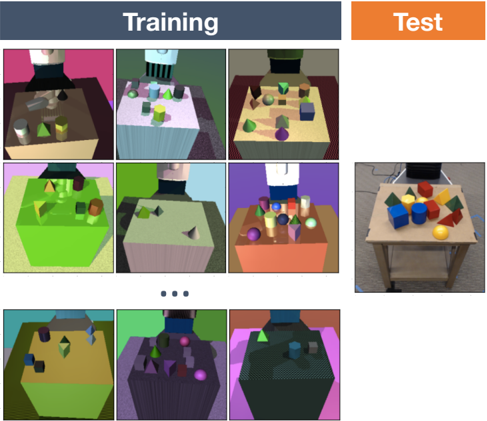
Bridging the `reality gap' that separates simulated robotics from experiments on hardware could accelerate robotic research through improved data availability. This paper explores domain randomization, a simple technique for training models on simulated images that transfer to real images by randomizing rendering in the simulator. With enough variability in the simulator, the real world may appear to the model as just another variation. We focus on the task of object localization, which is a stepping stone to general robotic manipulation skills. We find that it is possible to train a real-world object detector that is accurate to 1.5 cm and robust to distractors and partial occlusions using only data from a simulator with non-realistic random textures. To demonstrate the capabilities of our detectors, we show they can be used to perform grasping in a cluttered environment. To our knowledge, this is the first successful transfer of a deep neural network trained only on simulated RGB images (without pre-training on real images) to the real world for the purpose of robotic control.
Overview
CoChat Summary
TL;DR
This paper introduces domain randomization: training an object detector on simulated RGB images with randomized rendering, textures, lighting, camera pose, and distractors so that the real world appears as another variation. The authors show that a detector trained only in simulation can localize objects in the real world accurately enough to grasp them in clutter.
Key findings
- Real-world object detectors trained only on simulated images localized objects to within about 1.5 cm on average, including with distractors and partial occlusions; per-object errors in Table I range from 0.6 ± 0.3 cm to 3.2 ± 5.8 cm depending on object and condition.
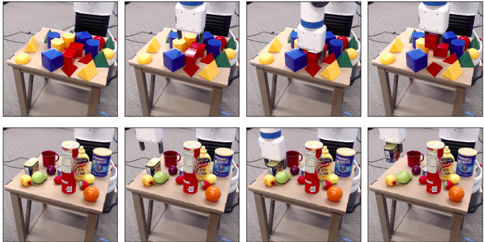
- The pipeline enabled a Fetch robot to detect and pick up the target object in 38 out of 40 trials in increasingly cluttered scenes, and a detector trained on a Spam can succeeded in 9 of 10 trials with previously unseen YCB food distractors.
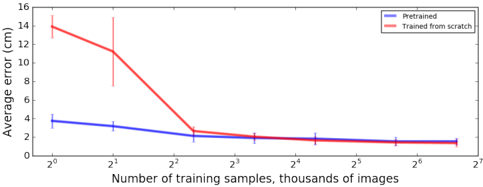
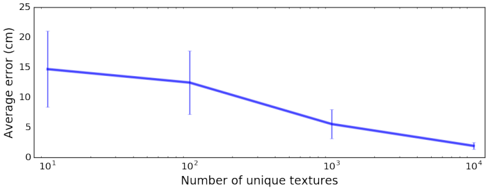
- Ablations found sensitivity to number of training images, number of unique textures, presence of distractors in training, and camera randomization; random noise had negligible effect. Performance improved up to around 50,000 training samples, and degraded significantly with fewer than 1,000 textures.
- ImageNet pretraining was not essential with enough data: random weight initialization achieved nearly the same real-world transfer performance as pretrained initialization, though pretraining helped in the low-data regime.
Methods
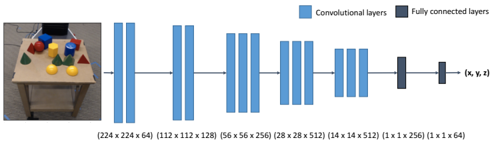
- The authors trained a modified VGG-16 convolutional neural network to map a single 224×224 monocular webcam image to Cartesian coordinates of object(s) of interest, using simulated images rendered by MuJoCo.
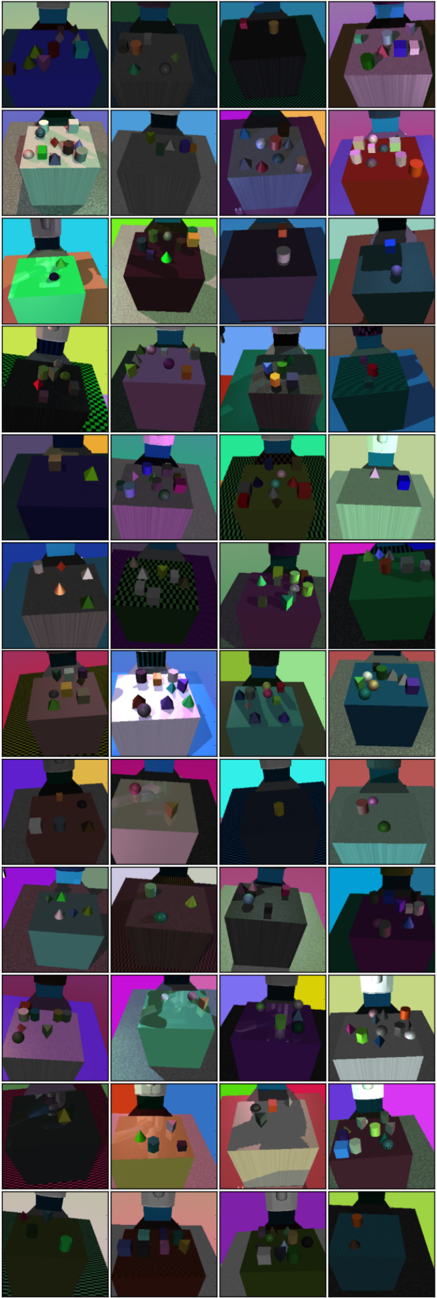
- Domain randomization varied number/shape of distractors, object positions and textures, table/floor/skybox/robot textures, camera position/orientation/field of view, number and properties of lights, and image noise. Textures were random RGB values, gradients, or checker patterns; 0–10 distractor objects were added per scene.
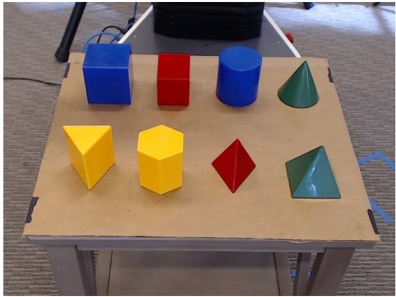
- Training used stochastic gradient descent with Adam on an L2 loss, learning rates around 1e-4, and batch sizes of 25, 50, or 100. Evaluation used 480 webcam images of eight geometric objects at 70–105 cm from a fixed camera, with 60 labeled images per object: 20 alone, 20 with distractors, and 20 partially occluded.
Limitations
- The paper states that the detectors still overfit simulated training data: simulated error was 0.3–0.5 cm versus about 1.5 cm in the real world, and no real-world validation could be done during training because no real data were assumed available.
- The paper states future work is needed for contact-rich manipulation or higher precision, and that the method fixes table height, effectively making the task 2D pose estimation from a single monocular uncalibrated camera.
- Evident from the text: evaluation is limited to eight geometric objects plus one Spam can, the test camera position remains constant across all images, and lighting and surrounding scene were not controlled.
Model-written summary. Check it against the paper before relying on it.
Integrity signals
Registry
Cites
Statistics
Figures
Verification
Claims the paper makes
2 Valid · 8 Not valid · 7 Not checked · 32 Own results and interpretations
The cited sources support only part of this claim — read each source’s verdict below.
In the paper
“Although previous work demonstrated the ability to perform robotic control using a neural network pretrained on ImageNet and fine-tuned on randomized rendered pixels [37], this paper provides the first demonstration that domain randomization can be useful for robotic tasks requiring precision.”
What the sources say
- Partly supportedcites [37] [37] Fereshteh Sadeghi and Sergey Levine. (cad) 2 RL: Real single-image flight without a single real image. arXiv preprint arXiv:1611.04201 , 2016. - sourceExperimental — accuracy not yet measured
The citation [37] is attached to the preceding claim about prior work, not to the citing authors’ claim that their own paper is the first to demonstrate precision robotics. Section 3.1 (p. 4) says LSDA pretrains a CNN on ImageNet classification data and fine-tunes it, but for object detection. It does not report robotic control or fine-tuning on randomized rendered pixels. (LLM, conf=0.84)
boostedstates a cause- Asserted: passes — The authors put it forward as true.
- Checkable: passes — It can be checked against evidence.
- Load-bearing: passes — The paper’s conclusions depend on it.
- Based: passes — The paper gives a reason why it holds.
- Partly supported
The cited sources that could be checked couldn’t confirm or dispute this claim.
In the paper
“Rather than relying on controller robustness, Yu et al. [53] use a model trained on varied physics to perform system identification using online trajectory data, but their approach is not shown to succeed in the real world.”
What the sources say
- Could not verifycites [53] [53] Wenhao Yu, C Karen Liu, and Greg Turk. Preparing for the unknown: Learning a universal policy with online system identification. arXiv preprint arXiv:1702.02453 , 2017. - sourceExperimental — accuracy not yet measured
The cited paper discusses image classification and localisation with convolutional networks (A.1, p. 10; A.2, p. 11), not Yu et al.'s approach. Searches for varied-physics training, online trajectory-based system identification, and real-world success found no passage addressing the claim. Our copy therefore cannot verify it. (LLM, conf=0.78)
plain- Asserted: passes — The authors put it forward as true.
- Checkable: passes — It can be checked against evidence.
- Load-bearing: unclear — It is unclear whether the paper’s conclusions depend on it.
- Based: passes — The paper gives a reason why it holds.
- Could not verify
The cited sources that could be checked couldn’t confirm or dispute this claim.
In the paper
“Though using realistic RGB rendering alone has had limited success for transferring to real robotic tasks [16], incorporating realistic simulation of depth information can allow models trained on rendered images to transfer reasonably well to the real world [32].”
What the sources say
- Could not verifycites [16] [16] Stephen James and Edward Johns. 3d simulation for robot arm control with deep q-learning. arXiv preprint arXiv:1609.03759 , 2016. - sourceExperimental — accuracy not yet measured
The Introduction (§1) and Conclusion (§8) describe Adam as a method for stochastic optimization, while the CNN experiment (§6.3) concerns training on image datasets. Searches for realistic RGB rendering and sim-to-real robotic transfer found no passage addressing whether RGB rendering alone has had limited success on real robotic tasks. (LLM, conf=0.78)
plain- Asserted: passes — The authors put it forward as true.
- Checkable: passes — It can be checked against evidence.
- Load-bearing: passes — The paper’s conclusions depend on it.
- Based: passes — The paper gives a reason why it holds.
- Could not verify
The cited sources that could be checked couldn’t confirm or dispute this claim.
In the paper
“However, their experiments - collision avoidance in hallways and open spaces - do not demonstrate the ability to deal with high-precision tasks.”
What the sources say
- Could not verifycites [37] [37] Fereshteh Sadeghi and Sergey Levine. (cad) 2 RL: Real single-image flight without a single real image. arXiv preprint arXiv:1611.04201 , 2016. - sourceExperimental — accuracy not yet measured
The Experiments section (p. 5) evaluates LSDA on an object-detection dataset, not Sadeghi and Levine’s collision-avoidance experiments. Searches for Sadeghi and Levine, hallway or open-space collision avoidance, and high-precision tasks found no passage addressing the claim. (LLM, conf=0.76)
plain- Asserted: passes — The authors put it forward as true.
- Checkable: passes — It can be checked against evidence.
- Load-bearing: passes — The paper’s conclusions depend on it.
- Based: passes — The paper gives a reason why it holds.
- Could not verify
A result the paper reports from its own data — it cites no other source for it, so there is none to check. The quote shows it is in the paper.
In the paper
“However, using a pre-trained model can significantly improve performance when less training data is used.”
plainstates a cause- Asserted: passes — The authors put it forward as true.
- Checkable: passes — It can be checked against evidence.
- Load-bearing: unclear — It is unclear whether the paper’s conclusions depend on it.
- Based: passes — The paper gives a reason why it holds.
29 more claims
Create a free account to see all 49 claims and to verify the 7 references still open.
- Probably not a substantial claim. 11
- It may state two separate claims as one. 8
Claims other papers make about this one
Each is checked against this paper’s own text: does it say what the citing paper says it does?
The source backs part of the claim, not all of it — or backs it for a different population, condition or comparison.
In the citing paper
“Most policies trained in simulation generalize poorly to the real-world due to agents adapting to specific visual details of the simulator.”
From Language-Based Augmentation to Address Shortcut Learning in Object-Goal Navigation (2023) · cites this paper as [8]
Experimental — accuracy not yet measuredThe source backs part of the claim, not all of it — or backs it for a different population, condition or comparison.
In the citing paper
“In robotic vision tasks including object localization [53], object detection [54], pose estimation [55], and semantic segmentation [56], the training data from simulator always have different textures, lighting, and camera positions from the realistic environments.”
From Sim-to-Real Transfer in Deep Reinforcement Learning for Robotics: a Survey (2020) · cites this paper as [53]
Experimental — accuracy not yet measuredThe source backs part of the claim, not all of it — or backs it for a different population, condition or comparison.
In the citing paper
“These artifacts limit the applicability of generative videos in physics-sensitive domains such as robotics [25,26], autonomous driving [27], simulationbased design, and scientific visualization [28].”
From PhyStruct-Video: Structured Physics State Spaces for Physically Consistent Video Generation (2025) · cites this paper as [25]
Experimental — accuracy not yet measuredThe source backs part of the claim, not all of it — or backs it for a different population, condition or comparison.
In the citing paper
“In domain randomization, the inputs during learning are “randomized” in the sense of being warped or corrupted in particular ways.”
From The overfitted brain: Dreams evolved to assist generalization (2021) · cites this paper as [144]
Experimental — accuracy not yet measuredThe source backs part of the claim, not all of it — or backs it for a different population, condition or comparison.
In the citing paper
“Domain randomization is a domain generalization technique that introduces drastic changes in the training image appearances, which forces the network to learn domain-invariant features between training and target domains [39].”
From A Fully Differentiable Framework for 2D/3D Registration and the Projective Spatial Transformers (2024) · cites this paper as [39]
Experimental — accuracy not yet measured
8 more claims about this paper
Create a free account to see every claim other papers make about this one.
Self-check
Percentages, sums and reported differences re-computed from the paper’s own numbers.
Each contradiction between two passages listed here was confirmed by an independent check.
Rated minor: it would not touch a result — a value no result rests on, a p-value that stays on the same side of the significance level, or a conflict that is clerical, resolved elsewhere in the paper, or outside its own findings.
In the paper
§ A. Experimental Setup · p. 4
“Each training sample consists of (a) a rendered image of the object and one or more distractors (also from among the geometric object set) on a simulated tabletop”
§ A. Domain randomization · p. 4
“Between 0 and 10 distractor objects are added to the table in each scene.”
Citations
Cites
Very Deep Convolutional Networks for Large-Scale Image Recognition
Simonyan, K., & Zisserman, A. (2014) · arXiv · doi:10.48550/arxiv.1409.1556 · Cited by 114,148 · cited 1×
“In particular, we use a modified version the VGG-16 architecture [42] shown in Figure 2.”
MethodAdam: A Method for Stochastic Optimization
Kingma, D. P., & Ba, J. (2014) · arXiv · doi:10.48550/arxiv.1412.6980 · Cited by 98,946 · cited 1×
“We found that using a learning rate of around 1e − 4 (as opposed to the standard 1e − 3 for Adam) improved convergence and helped avoid a common local optimum, mapping all objects to the center of the table.”
MethodLeCun, Y., Bengio, Y., & Hinton, G. (2015) · Nature · doi:10.1038/nature14539 · Cited by 84,126
Human-level control through deep reinforcement learning
Mnih, V., Kavukcuoglu, K., Silver, D., Rusu, A. A., Veness, J., Bellemare, M. G., Graves, A., Riedmiller, M., Fidjeland, A. K., Ostrovski, G., et al. (2015) · Nature · doi:10.1038/nature14236 · Cited by 30,357 · cited 3×
“Learning in simulation is especially promising for building on recent results using deep reinforcement learning to achieve human-level performance on tasks like Atari [27] and robotic control [21], [38].”
BackgroundResultHow transferable are features in deep neural networks?
Yosinski, J., Clune, J., Bengio, Y., & Lipson, H. (2014) · arXiv · doi:10.48550/arxiv.1411.1792 · Cited by 6,061 · cited 1×
“A variety of approaches have been proposed, including re-training the model in the target domain (e.g., [52]), adapting the weights of the model based on the statistics of the source and target domains (e.g., [22]), learning invariant features between domains (e.g., [47]), and learning a mapping…”
BackgroundMuJoCo: A physics engine for model-based control
Todorov, E., Erez, T., & Tassa, Y. (2012) · 2012 IEEE/RSJ International Conference on Intelligent Robots and Systems · doi:10.1109/iros.2012.6386109 · Cited by 4,767 · cited 1×
“We render images using the MuJoCo Physics Engine’s [45] built-in renderer.”
MethodTrust region policy optimization
Schulman, J., Levine, S., Moritz, P., Jordan, M. I., & Abbeel, P. (2015) · arXiv · doi:10.48550/arxiv.1502.05477 · Cited by 4,578 · cited 1×
“Learning in simulation is especially promising for building on recent results using deep reinforcement learning to achieve human-level performance on tasks like Atari [29] and robotic control [26], [41].”
ResultSelf-citationLearning Transferable Features with Deep Adaptation Networks
Long, M., Cao, Y., Wang, J., & Jordan, M. I. (2015) · arXiv · doi:10.48550/arxiv.1502.02791 · Cited by 4,505 · cited 1×
“omputer vision community has devoted significant study to the problem of adapting vision-based models trained in a source domain to a previously unseen target domain (see, e.g., [9], [14], [15], [19], [23], [25], [51]). A variety of approaches have been proposed, including re-training the model in the target domain (e.…”
BackgroundEnd-to-End Training of Deep Visuomotor Policies
Levine, S., Finn, C., Darrell, T., et al. (2015) · Journal of machine learning research · doi:10.5555/2946645.2946684 · Cited by 3,987
Describing Textures in the Wild
Cimpoi, M., Maji, S., Kokkinos, I., Mohamed, S., & Vedaldi, A. (2014) · 2014 IEEE Conference on Computer Vision and Pattern Recognition · doi:10.1109/cvpr.2014.461 · Cited by 2,438 · cited 1×
“To examine how our detectors would perform on objects with complex textures, we created simulated scenes in which the object of interest is given a texture from the Describable Textures Dataset (DTD) [4].”
Method
Research works printed but not linked: 3
- [24] David G Lowe. Three-dimensional object recognition from single two-dimensional images. Artificial intelligence , 31(3):355-395, 1987. -
- [49] Melonee Wise, Michael Ferguson, Derek King, Eric Diehr, and David Dymesich. Fetch and freight: Standard platforms for service robot applications. In Workshop on Autonomous Mobile Service Robots , 2016. -
- sucan, 0, MoveIt!
Cited by
Items 1,701–1,800 of 2,970
A Sim-to-Real Instance Segmentation Framework for Densely Stacked Cartons
Wang, X., Li, J., Zheng, W., Luo, H., Wang, F., Chen, Y., & Huang, R. (2024) · IEEE Robotics and Automation Letters · doi:10.1109/lra.2024.3396409 · Cited by 4
Chen, J., Gao, Y., Hu, J., Deng, F., & Lam, T. L. (2024) · Proceedings - IEEE International Conference on Robotics and Automation/Proceedings · doi:10.1109/icra57147.2024.10610420 · Cited by 3
“• Experimental results show that our method outperforms other methods including learning based method [8], [9] and NBVPlanner [10] by approximately 10.5%-27% on success rate and about 70%-75% on inspection speed.”
InfluentialCross Domain Policy Transfer with Effect Cycle-Consistency
Zhu, R., Dai, T., & Çeliktutan, O. (2024) · Proceedings - IEEE International Conference on Robotics and Automation/Proceedings · doi:10.1109/icra57147.2024.10611110 · Cited by 7
Detecting and Mitigating System-Level Anomalies of Vision-Based Controllers
Gupta, A., Chakraborty, K., & Bansal, S. (2024) · Proceedings - IEEE International Conference on Robotics and Automation/Proceedings · doi:10.1109/icra57147.2024.10611397 · Cited by 8
Creating Synthetic Datasets for Deep Learning used in Machine Vision
Gräßler, I., & Hieb, M. (2024) · Procedia CIRP · doi:10.1016/j.procir.2024.08.371 · Cited by 4
A Methodology to Quantify Simulation- Versus-Reality Differences in Images for Autonomous Robots
Elmquist, A., Serban, R., & Negruţ, D. (2024) · IEEE Sensors Journal · doi:10.1109/jsen.2024.3522050 · Cited by 3
“Mitigating this gap when training perception algorithms has subsequently become an active area of research [5], [7], [8], [9], [10].”
Generalized reinforcement learning control algorithm for fully automated insulin delivery system
Rachim, V. P., Yoo, J., Lee, J., Lee, Y., & Park, S. (2025) · Expert Systems with Applications · doi:10.1016/j.eswa.2025.126909 · Cited by 5
Synthetic data generation procedures for domain-specific environments in manufacturing
Rawal, P., Sompura, M., & Hintze, W. (2025) · Procedia Computer Science · doi:10.1016/j.procs.2025.01.229 · Cited by 3
Ju, D., Lee, J., & Lee, Y. S. (2025) · Mathematics · doi:10.3390/math13121996 · Cited by 7
Kamaras, G., & Ramamoorthy, S. (2025) · IEEE Robotics and Automation Letters · doi:10.1109/lra.2025.3581744 · Cited by 4
“Domain randomisation using wide uniform priors [20], combined with the inherent instability of training RL algorithms, has been shown to not provide the robustness expected in certain tasks [9], [21].”
Marker-Free Multi-Modal Motion Capture for 6-DoF Object Position and Orientation Estimation
Jia, F., Yang, X., Wang, J., Xue, N., Li, J., & Cui, T. (2025) · doi:10.1109/cism64958.2025.11060859 · Cited by 4
“Domain randomization is a method used to artificially create variations in simulations, such as changes in lighting conditions, surface materials, object textures, and camera parameters [41].”
Ma, X., Xie, J., Shao, D., Yao, A., & Dong, C. (2025) · Electronics · doi:10.3390/electronics14142797 · Cited by 6
Zhang, M., Pang, B., Yan, C., et al. (2025) · IEEE Transactions on Intelligent Transportation Systems · doi:10.1109/tits.2025.3589322 · Cited by 3
Ayabe, S., Otomo, T., Kera, H., & Kawamoto, K. (2025) · International Journal of Advanced Robotic Systems · doi:10.1177/17298806251360454 · Cited by 3
Towards contrast- and pathology-agnostic clinical fetal brain MRI segmentation using SynthSeg
Shang, Z., Kaandorp, M., Payette, K., Garcia, M. F., Licandro, R., Langs, G., Verdera, J. A., Hutter, J. M., Menze, B. H., Kasprian, G. J., et al. (2026) · NeuroImage · doi:10.1016/j.neuroimage.2026.121729 · Cited by 5
Empirical Analysis of Sim-and-Real Cotraining of Diffusion Policies For Planar Pushing from Pixels
Wei, A., Agarwal, A., Chen, B., Bosworth, R., Pfaff, N., & Tedrake, R. (2025) · IEEE/RSJ International Conference on Intelligent Robots and Systems (IROS) · doi:10.1109/iros60139.2025.11246304 · Cited by 31
“Here, we cotrain Diffusion Policies [12] and measure performance as the binary success rate on planar-pushing from pixels.”
RGDR: Reward-Guided Domain Randomization for Autonomous Driving
Wang, D.-J., & Ghoreishi, S. F. (2025) · 2025 IEEE 28th International Conference on Intelligent Transportation Systems (ITSC) · doi:10.1109/itsc60802.2025.11423053 · Cited by 6
“6: Average accumulated reward comparison of RGDR (proposed), ADR [14], and UDR [8] in out-of-distribution friction and mass intervals for the CARLA ACC scenario. scenarios, RGDR adaptively prioritizes more informative environments based on real-time reward feedback.”
InfluentialMulti-technology Management of Heterogeneous Wireless Networks
Schepper, T. D., Famaey, J., & Latré, S. (2020) · IEEE/IFIP Network Operations and Management Symposium (NOMS) · doi:10.1109/noms47738.2020.9110369 · Cited by 5
Bäuerle, S., Barth, J., de Menezes, E. T., Steimer, A., & Mikut, R. (2020) · Workshop Computational Intelligence · doi:10.58895/ksp/1000124139-3 · Cited by 4
“This method is called domain randomization and has been tested successfully on other use-cases such as indoor drone flight [6] or robotic grasping and manipulation [5, 7, 8, 9, 10].”
BackgroundMethodBlender as a tool for generating synthetic data
Sieczka, R., & Pańczyk, M. (2020) · Journal of Computer Sciences Institute · doi:10.35784/jcsi.2086 · Cited by 3
Modeling Task Uncertainty for Safe Meta-Imitation Learning
Matsushima, T., Kondo, N., Iwasawa, Y., Nasuno, K., & Matsuo, Y. (2020) · Frontiers in Robotics and AI · doi:10.3389/frobt.2020.606361 · Cited by 6
“These algorithms train a general policy on simulated and diverse environments and then this policy is deployed to the real environment of interest (Tobin et al., 2017; Peng et al., 2018; James et al., 2019).”
BackgroundA Pipeline for Vision-Based On-Orbit Proximity Operations Using Deep Learning and Synthetic Imagery
Schubert, C., Black, K., Fonseka, D., Dhir, A., Deutsch, J., Dhamani, N., Martin, G., & Akella, M. R. (2021) · IEEE Aerospace Conference (AERO) · doi:10.1109/aero50100.2021.9438232 · Cited by 6
“Domain randomization has been shown to help reduce model overfitting and improve simulation-to-real transfer [8, 28].”
BackgroundAutomatic Hanging Point Learning from Random Shape Generation and Physical Function Validation
Takeuchi, K., Yanokura, I., Kakiuchi, Y., Okada, K., & Inaba, M. (2021) · Proceedings - IEEE International Conference on Robotics and Automation/Proceedings · doi:10.1109/icra48506.2021.9561484 · Cited by 4
“It is known that domain randomization [20] is effective in bridging the gap between simulation and the real world.”
BackgroundFault-Aware Robust Control via Adversarial Reinforcement Learning
Yang, F., Yang, C., Guo, D., Liu, H., & Sun, F. (2021) · IEEE International Conference on Cyber Technology in Automation, Control, and Intelligent Systems · doi:10.1109/cyber53097.2021.9588329 · Cited by 15
Learning Camera Control in Dynamic Scenes from Limited Demonstrations
Hanocka, R., Assa, J., Cohen‐Or, D., & Giryes, R. (2022) · Computer Graphics Forum · doi:10.1111/cgf.14444 · Cited by 3
DeepNet-Based 3D Visual Servoing Robotic Manipulation
Al-Shanoon, A. A. S., Wang, Y., & Lang, H. (2022) · Journal of Sensors · doi:10.1155/2022/3511265 · Cited by 5
“A recent solution was reported in [17], in which synthetic data is domain-randomized in nonrealistic manner.”
BackgroundTowards Dynamic Obstacle Avoidance for Robot Manipulators with Deep Reinforcement Learning
Zindler, F., Lucchi, M., Wohlhart, L., Pichler, H., & Hofbaur, M. (2022) · Mechanisms and machine science · doi:10.1007/978-3-031-04870-8_11 · Cited by 5
Torricelli, D., Mizanoor, R. S. M., Lippi, V., Weckx, M., Mathijssen, G., Vanderborght, B., Mergner, T., Lefeber, D., & Rovira, J. L. P. (2019) · Cognitive systems monographs · doi:10.1007/978-3-030-14126-4 · Cited by 4
Sim-to-Real Transfer for Underwater Wireless Optical Communication Alignment Policy between AUVs
Weng, Y., Matsuda, T., Sekimori, Y., et al. (2022) · OCEANS 2022 - Chennai · doi:10.1109/oceanschennai45887.2022.9775437 · Cited by 3
“With enough variability in the simulator, the real world may appear to the model as just another variation [18].”
BackgroundTraining neural networks on domain randomized simulations for ultrasonic inspection
Schlachter, K., Felsner, K., & Zambal, S. (2022) · Open Research Europe · doi:10.12688/openreseurope.14358.2 · Cited by 3
“The main assumption is that with just enough variability in the simulator, the real world appears just as another variation 6 .”
UNICON: Uncertainty-Conditioned Policy for Robust Behavior in Unfamiliar Scenarios
Kim, C., Cho, J., Yoon, H.-S., Seo, S., & Kim, S.-W. (2022) · IEEE Robotics and Automation Letters · doi:10.1109/lra.2022.3189447 · Cited by 4
Sim-to-Real Neural Learning with Domain Randomisation for Humanoid Robot Grasping
Gäde, C., Kerzel, M., Strahl, E., & Wermter, S. (2022) · Lecture notes in computer science · doi:10.1007/978-3-031-15919-0_29 · Cited by 5
Height Normalizing Image Transform for Efficient Scene Specific Pedestrian Detection
Ardö, H., Ahrnbom, M., & Nilsson, M. (2022) · IEEE International Conference on Advanced Video and Signal Based Surveillance (AVSS) · doi:10.1109/avss56176.2022.9959692 · Cited by 3
“Work on domain randomization [30, 29] show that photo-realism is not needed if there is large enough variation in the rendered synthetic dataset.”
BackgroundMethodStyle-Agnostic Reinforcement Learning
Lee, J., Ahn, S., & Park, J. (2022) · Lecture notes in computer science · doi:10.1007/978-3-031-19842-7_35 · Cited by 5
Synthetic Data Generation for Visual Detection of Flattened PET Bottles
Feščenko, V., Ārents, J., & Kadiķis, R. (2022) · Machine Learning and Knowledge Extraction · doi:10.3390/make5010002 · Cited by 4
On Scene Engineering and Domain Randomization: Synthetic Data for Industrial Item Picking
Weisenböhler, M., Hein, B., & Wurll, C. (2023) · Lecture notes in networks and systems · doi:10.1007/978-3-031-22216-0_43 · Cited by 5
Scene Augmentation Methods for Interactive Embodied AI Tasks
Sang, H., Jiang, R., Wang, Z., Zhou, Y., Lu, P., & He, B. (2023) · IEEE Transactions on Instrumentation and Measurement · doi:10.1109/tim.2023.3259033 · Cited by 9
“Learning in a wide distribution of environments has proven to be helpful for making agents more robust when generalizing to unseen scenes [28], [29].”
BackgroundActive Classification of Moving Targets With Learned Control Policies
Serra-Gómez, Á., Montijano, E., Böhmer, W., & Alonso–Mora, J. (2023) · IEEE Robotics and Automation Letters · doi:10.1109/lra.2023.3271508 · Cited by 3
“State space exploration is enhanced [34] to make the learned policy more robust at test time, by randomizing the drone’s initial poses, and the targets’ initial poses, velocities and beliefs over their classes.”
BackgroundInto the unknown: active monitoring of neural networks (extended version)
Kueffner, K., Lukina, A., Schilling, C., & Henzinger, T. A. (2023) · International Journal on Software Tools for Technology Transfer · doi:10.1007/s10009-023-00711-4 · Cited by 7
Controlling a Double-Pendulum Crane by Combining Reinforcement Learning and Conventional Control
Eaglin, G., Poche, T., & Vaughan, J. (2023) · Proceedings of the ... American Control Conference/Proceedings of the American Control Conference · doi:10.23919/acc55779.2023.10156044 · Cited by 3
“Agents are often trained to be robust to modeling error using domain randomization [9], [10].”
BackgroundChristmann, G. H. G., Luo, Y., Soeseno, J. H., & Chen, W.-C. (2023) · Proceedings - IEEE International Conference on Robotics and Automation/Proceedings · doi:10.1109/icra48891.2023.10160776 · Cited by 4
“can be transferred to the real world (sim-to-real), domain randomization (DR) [4] can be applied during training in simulation.”
BackgroundSim-to-Real Policy and Reward Transfer with Adaptive Forward Dynamics Model
Juan, R., Ju, H., Huang, J., Gómez, R., Nakamura, K., & Li, G. (2023) · Proceedings - IEEE International Conference on Robotics and Automation/Proceedings · doi:10.1109/icra48891.2023.10161298 · Cited by 3
“Many sim-toreal algorithms have been proposed to solve this problem, such as domain adaption [3], inverse dynamics model [4], domain randomization [5], [6] and progressive network [7],”
MethodSim-to-Real Deep Reinforcement Learning with Manipulators for Pick-and-Place
Liu, W., Niu, H., Skilton, R., & Carrasco, J. (2023) · Lecture notes in computer science · doi:10.1007/978-3-031-43360-3_20 · Cited by 3
Yu, H., Guo, D., Zhou, Z., Wang, Y., & Xiong, R. (2023) · Chinese Control Conference (CCC) · doi:10.23919/ccc58697.2023.10240732 · Cited by 3
Quentin, P., Knoll, D., & Goehring, D. (2023) · IEEE International Conference on Automation Science and Engineering (CASE) · doi:10.1109/case56687.2023.10260335 · Cited by 7
Domain-Adaptive Vision Transformers for Generalizing Across Visual Domains
Cho, Y., Yun, J., Kwon, J., & Kim, Y. (2023) · IEEE Access · doi:10.1109/access.2023.3324545 · Cited by 3
“Data manipulation, initially proposed as a method for randomly generating learning environments that resemble the real world, aims to generate diverse training data [41].”
MethodDiscovering Fatigued Movements for Virtual Character Animation
Cheema, N., Xu, R., Kim, N. H., Hämäläinen, P., Golyanik, V., Habermann, M., Theobalt, C., & Slusallek, P. (2023) · SIGGRAPH Asia Conference Papers · doi:10.1145/3610548.3618176 · Cited by 8
“As the observation still contains 𝑀 𝐹 values for the expert policy training, we ensure that the expert policies are agnostic to the 𝑀 𝐹 values by randomizing the 𝑀 𝐹 values at every environment step during this phase, as a strategy for domain randomization [Tobin et al. 2017].”
MethodFang, K., Migimatsu, T., Mandlekar, A., Fei-Fei, L., & Bohg, J. (2023) · IEEE/RSJ International Conference on Intelligent Robots and Systems (IROS) · doi:10.1109/iros55552.2023.10341727 · Cited by 14
“Several works use procedurally generated environments in simulation with randomized object properties and dynamics [5,26].”
MethodJiang, Y., Zhou, H., & Fischer, G. S. (2023) · Journal of Medical Robotics Research · doi:10.1142/s2424905x23400093 · Cited by 5
3D Neural Embedding Likelihood: Probabilistic Inverse Graphics for Robust 6D Pose Estimation
Zhou, G., Gothoskar, N., Wang, L., Tenenbaum, J. B., Gutfreund, D., Lázaro-Gredilla, M., George, D., & Mansinghka, V. K. (2023) · IEEE/CVF International Conference on Computer Vision (ICCV) · doi:10.1109/iccv51070.2023.01977 · Cited by 11
“Sim-to-real transfer Recent advances in photorealistic rendering and physics-based simulations [19, 6] and domain randomization [47] have yielded impressive re-sults [13, 49, 36] in sim-to-real 6D object pose estimation.”
BackgroundOgundipe, C., & Ellery, A. A. (2024) · Expert Systems · doi:10.1111/exsy.13549 · Cited by 3
“The prevailing approach is to train an RL-based controller in a physics simulation environment and thereafter transfer to the real world using several sim-to-real techniques (Peng et al., 2018; Tobin et al., 2017).”
Equipment Assembly Recognition for Augmented Reality Guidance
Murray, K., Schierl, J., Foley, K. T., & Đurić, Z. (2024) · IEEE International Conference on Artificial Intelligence and eXtended and Virtual Reality (AIxVR) · doi:10.1109/aixvr59861.2024.00023 · Cited by 5
“To account for the variability in real-world conditions, we apply the concept of domain randomization [17].”
MethodLee, J.-W. (2024) · Buildings · doi:10.3390/buildings14040966 · Cited by 3
On Practical Robust Reinforcement Learning: Adjacent Uncertainty Set and Double-Agent Algorithm
Hwang, U., & Hong, S. (2024) · IEEE Transactions on Neural Networks and Learning Systems · doi:10.1109/tnnls.2024.3385234 · Cited by 8
“It is based on the premise that if the variability in the simulator is large enough, the learned agent will generalize to more practical scenarios with no additional training [12].”
Rolf, J., Wolf, M., & Gerhard, D. (2024) · IFIP advances in information and communication technology · doi:10.1007/978-3-031-62582-4_17 · Cited by 3
An Efficient Model-Based Approach on Learning Agile Motor Skills without Reinforcement
Shi, H., Li, T., Zhu, Q., Sheng, J., Han, L., & Meng, M. Q. ‐. (2024) · Proceedings - IEEE International Conference on Robotics and Automation/Proceedings · doi:10.1109/icra57147.2024.10611560 · Cited by 6
“Furthermore, [9], [32], [33], [16] employ domain randomization techniques to cultivate a robust policy and employ domain adaptation to address the sim2real gap.”
BackgroundMethodAdaptive Gait Modeling and Optimization for Principally Kinematic Systems
Deng, S., Cowan, N. J., & Bittner, B. (2024) · Proceedings - IEEE International Conference on Robotics and Automation/Proceedings · doi:10.1109/icra57147.2024.10611303 · Cited by 4
“Efforts in domain randomization have yielded reinforcement learning agents more capable of generalization and sim-to-real transfer, but often at the expense of achieving precise mastery of individual domains [9], [10].”
BackgroundChekakta, Z., & Aouf, N. (2024) · IEEE Sensors Journal · doi:10.1109/jsen.2024.3435748 · Cited by 3
“Numerous studies aim to tackle the domain shift problem [24].”
BackgroundUsing Only Synthetic Images to Train a Drogue Detector for Aerial Refueling
Rüter, J., & Schmidt, R. (2024) · Lecture notes in computer science · doi:10.1007/978-3-031-71397-2_25 · Cited by 5
ReALFRED: An Embodied Instruction Following Benchmark in Photo-Realistic Environments
Kim, T.-W., Min, C.-H., Kim, B., Kim, J., Jeung, W., & Choi, J. (2024) · Lecture notes in computer science · doi:10.1007/978-3-031-72684-2_20 · Cited by 29
Seed Kernel Counting using Deep Learning for High-Throughput Phenotyping
Margapuri, V., Thapaliya, P., & Neilsen, M. L. (2024) · IEEE International Conference on Internet of Things and Intelligence Systems (IoTaIS) · doi:10.1109/iotais64014.2024.10799282 · Cited by 4
BayRnTune: Adaptive Bayesian Domain Randomization via Strategic Fine-tuning
Huang, T., Sontakke, N., Kumar, K. N., Essa, I. A., Nikolaidis, S., Hong, D. W., & Ha, S. (2024) · IEEE/RSJ International Conference on Intelligent Robots and Systems (IROS) · doi:10.1109/iros58592.2024.10802145 · Cited by 6
“This includes domain randomization [4], [19], [20], [21], adaptation [20], [22], [23], meta-learning [24], [17], and fine-tuning simulationtrained policies on hardware [25].”
InfluentialSkill Transfer and Discovery for Sim-to-Real Learning: A Representation-Based Viewpoint
Ma, H., Ren, Z., Dai, B., & Li, N. (2024) · IEEE/RSJ International Conference on Intelligent Robots and Systems (IROS) · doi:10.1109/iros58592.2024.10801637 · Cited by 2
“The trained policies are directly applied to the real world and no knowledge will be learned from real-world data.”
Fedpartwhole: federated domain generalization via consistent part-whole hierarchies
Radwan, A., & Shehata, M. (2025) · Pattern Analysis and Applications · doi:10.1007/s10044-025-01439-4 · Cited by 5
“We tackle the problem by proposing an architecture that explicitly models the scene’s parse tree, which should be invariant under domain shifts.”
Self-supervised domain transfer for reinforcement learning-based autonomous driving agent
Moni, R., & Gyires-Tóth, B. (2025) · Expert Systems with Applications · doi:10.1016/j.eswa.2025.127809 · Cited by 4
DemoStart: Demonstration-Led Auto-Curriculum Applied to Sim-to-Real with Multi-Fingered Robots
Bauzá, M., Chen, J. E., Dalibard, V., Gileadi, N., Hafner, R., Martins, M. F., Moore, J., Pevceviciute, R., Laurens, A., Rao, D., et al. (2025) · Proceedings - IEEE International Conference on Robotics and Automation/Proceedings · doi:10.1109/icra55743.2025.11127813 · Cited by 26
“For each time step in the demonstrations, we save the full environment state such that each of these states can then be used as the starting state s 0 of a TP. TPs that have a start state towards the end of demonstrations, and therefore require fewer steps to reach a goal state, tend to be easier,…”
Laarossi, I., Franco, A. P., Conde, O. M., et al. (2019) · Seventh European Workshop on Optical Fibre Sensors · doi:10.1117/12.2540012 · Cited by 3
“This learning procedure is called domain randomization and is especially important in cases where robustness and immediacy are required [9].”
BackgroundLearning Visual Servo Policies via Planner Cloning
Viereck, U., Saenko, K., & Platt, R. (2021) · Springer proceedings in advanced robotics · doi:10.1007/978-3-030-71151-1_26 · Cited by 2
“[24] and [2].”
Category-Level 3D Non-Rigid Registration from Single-View RGB Images
Rodríguez, D., Huber, F., & Behnke, S. (2020) · IEEE/RSJ International Conference on Intelligent Robots and Systems (IROS) · doi:10.1109/iros45743.2020.9340878 · Cited by 3
“[14], who trained an object detection”
A Study on the Impact of Domain Randomization for Monocular Deep 6DoF Pose Estimation
Cunha, K., Brito, C., Valença, L., Simões, F., & Teichrieb, V. (2020) · SIBGRAPI Conference on Graphics, Patterns and Images (SIBGRAPI) · doi:10.1109/sibgrapi51738.2020.00052 · Cited by 4
“To tackle this reality gap, Tobin et al. [27] explored the concept of domain randomization of synthetic frames.”
BackgroundPREGAN: Pose Randomization and Estimation for Weakly Paired Image Style Translation
Chen, Z., Guo, J., Xu, X., Wang, Y., Huang, H., Wang, Y., & Xiong, R. (2021) · IEEE Robotics and Automation Letters · doi:10.1109/lra.2021.3061359 · Cited by 5
“[24] utilize DR for addressing the reality gap.”
MethodScheiderer, C., Dorndorf, N., & Meisen, T. (2021) · Transactions on computational science and computational intelligence · doi:10.1007/978-3-030-70296-0_13 · Cited by 6
Schwartzwald, A., Tlachac, M., Guzmán, L., Bacharis, A., & Papanikolopoulos, N. P. (2022) · IEEE Robotics & Automation Magazine · doi:10.1109/mra.2022.3188215 · Cited by 4
“Measurements of the physical prototype were translated into simulation through URDF models, similar to the process described in [9].”
BackgroundMethodInfluentialRanaweera, M., & Mahmoud, Q. H. (2022) · doi:10.21428/594757db.09aa0c75 · Cited by 4
Simulation-to-Reality based Transfer Learning for the Failure Analysis of SiC Power Transistors
Kamm, S., Bickelhaupt, S., Sharma, K., Jazdi, N., Kallfass, I., & Weyrich, M. (2022) · IEEE International Conference on Emerging Technologies and Factory Automation (ETFA) · doi:10.1109/etfa52439.2022.9921681 · Cited by 4
“In [38], a CNN for object detection is transferred from simulated images to real images.”
MethodTransfer Learning in Underwater Operations
Skaldebø, M., Muntadas, A. S., & Schjølberg, I. (2019) · MTS/IEEE OCEANS Conference (OCEANS) · doi:10.1109/oceanse.2019.8867288 · Cited by 3
“[16] developed an object detector that trained using only simulated data.”
MethodDomain Adaptive Robotic Gesture Recognition with Unsupervised Kinematic-Visual Data Alignment
Shi, X., Jin, Y., Dou, Q., Qin, J., & Heng, P. (2021) · IEEE/RSJ International Conference on Intelligent Robots and Systems (IROS) · doi:10.1109/iros51168.2021.9636578 · Cited by 4
“Robotic simulator provides a relatively easy fashion for data collection in a scalable manner, given its economical and safe environment with unlimited maneuver time [12].”
BackgroundDomain Adaptation Using System Invariant Dynamics Models
Wang, S. J., & Johnson, A. M. (2022) · Figshare · doi:10.1184/r1/19443047 · Cited by 8
Reinforcement Learning: An Industrial Perspective
Surana, A. (2021) · Studies in systems, decision and control · doi:10.1007/978-3-030-60990-0_21 · Cited by 3
Hörger, T., Dresia, K., Waxenegger-Wilfing, G., Werling, L. K., & Schlechtriem, S. (2021) · AIAA Propulsion and Energy Forum · doi:10.2514/6.2021-3223 · Cited by 4
Structural Components Recognition Method for Malfunctioned Satellite based on Domain Randomization
Du, H., Hu, H., & He, Y. (2021) · China Automation Congress (CAC) · doi:10.1109/cac53003.2021.9727819 · Cited by 3
Online vs. Offline Adaptive Domain Randomization Benchmark
Tiboni, G., Arndt, K., Averta, G., Kyrki, V., & Tommasi, T. (2023) · Springer proceedings in advanced robotics · doi:10.1007/978-3-031-22731-8_12 · Cited by 7
MANGA: Method Agnostic Neural-policy Generalization and Adaptation
Bharadhwaj, H., Yamaguchi, S., & Maeda, S. (2020) · Proceedings - IEEE International Conference on Robotics and Automation/Proceedings · doi:10.1109/icra40945.2020.9197398 · Cited by 5
“Most previous approaches for transfer to different environments [1], [2], [3], [4] have not explicitly taken advantage of the fact that we can dynamically sample a variety of environments in simulation, and some that have done so [5], 1 Work done while HB interned at Preferred Networks, Inc. Tokyo, Japan 1 Homanga Bha…”
BackgroundDESK: A Robotic Activity Dataset for Dexterous Surgical Skills Transfer to Medical RobotsPreprint
Madapana, N., Rahman, M. M., Sanchez‐Tamayo, N., et al. (2019) · arXiv (Cornell University) · doi:10.48550/arxiv.1903.00959 · Cited by 3
Distributed learning and prediction modelling in radiation oncology
Deist (2019) · Research Publications (Maastricht University) · doi:10.26481/dis.20190405td · Cited by 2
Struckmeier, O. (2019) · arXiv (Cornell University) · doi:10.48550/arxiv.1905.13546 · Cited by 4
“fi then transferring them to real world applications [5].”
BackgroundLearning to Generate Synthetic 3D Training Data through Hybrid GradientPreprint
Yang, D., & Deng, J. (2019) · arXiv (Cornell University) · doi:10.48550/arxiv.1907.00267 · Cited by 3
“Generating 3D training data Synthetic images generated by computer graphics have been extensively used for training deep networks for numerous tasks, including single image 3D reconstruction [54, 22, 39, 23, 65, 9], optical flow estimation [38, 7, 19], human pose estimation [59, 11], action recognition [48], visual qu…”
BackgroundCRAVES: Controlling Robotic Arm with a Vision-based Economic SystemPreprint
Zuo, Y., Qiu, W., Xie, L., et al. (2018) · arXiv (Cornell University) · doi:10.48550/arxiv.1812.00725 · Cited by 3
Learning to Scaffold the Development of Robotic Manipulation SkillsPreprint
Shao, L., Migimatsu, T., & Bohg, J. (2019) · arXiv (Cornell University) · doi:10.48550/arxiv.1911.00969 · Cited by 3
“To reduce the domain gap between simulation and the real world, we utilize domain randomization [26]”
MethodScalable sim-to-real transfer of soft robot designsPreprint
Kriegman, S., Nasab, A. M., Shah, D., et al. (2019) · arXiv (Cornell University) · doi:10.48550/arxiv.1911.10290 · Cited by 3
“[36] 2017 1 1 Rusu et al.”
MANGA: Method Agnostic Neural-policy Generalization and AdaptationPreprint
Bharadhwaj, H., Yamaguchi, S., & Maeda, S. (2019) · arXiv (Cornell University) · doi:10.48550/arxiv.1911.08444 · Cited by 3
“Most previous approaches for transfer to different environments [1], [2], [3], [4] have not explicitly taken advantage of the fact that we can dynamically sample a variety of environments in simulation, and some that have done so [5], 1 Work done while HB interned at Preferred Networks, Inc. Tokyo, Japan 1 Homanga Bha…”
BackgroundSock, J., Castro, P., Armagan, A., Garcia-Hernando, G., & Kim, T. (2020) · arXiv (Cornell University) · Cited by 3
Learning to simulate complex scenesPreprint
Xue, Z., Mao, W., & Zheng, L. (2020) · arXiv (Cornell University) · doi:10.48550/arxiv.2006.14611 · Cited by 3
“First, many methods optimize instance-level attributes, such as position and scale of each object [10, 31, 39].”
BackgroundMethodTowards Generalization and Data Efficient Learning of Deep Robotic GraspingPreprint
Chen, Z., Lin, M., Jia, Z., et al. (2020) · arXiv (Cornell University) · doi:10.48550/arxiv.2007.00982 · Cited by 3
“In [9], the images came from simulations were rendered in randomization, and while the visual perception had seen enough variability over simulations, the real-world images may appear to the model just as another variation.”
BackgroundMethodContinual Learning: Tackling Catastrophic Forgetting in Deep Neural Networks with Replay ProcessesPreprint
Lesort, T. (2020) · arXiv (Cornell University) · doi:10.48550/arxiv.2007.00487 · Cited by 38
“One of these approaches is Domain Randomization Tobin et al. (2017), which we use in this chapter.”
BackgroundMethodInfluentialDistributed Reinforcement Learning of Targeted Grasping with Active Vision for Mobile ManipulatorsPreprint
Fujita, Y., Uenishi, K., Ummadisingu, A., et al. (2020) · arXiv (Cornell University) · doi:10.48550/arxiv.2007.08082 · Cited by 3
“3) using a dataset of simulated scenes with and without randomization of texture, color, lighting, and camera parameters [29], as shown in Fig.”
MethodSimPose: Effectively Learning DensePose and Surface Normals of People from Simulated DataPreprint
Zhu, T., Karlsson, P., & Bregler, C. (2020) · arXiv (Cornell University) · doi:10.48550/arxiv.2007.15506 · Cited by 3
“Domain randomization [43] generates an aggressively diverse training set which varies all factors instead of the training label, and causes the network to learn the inherited information and ignore the distracting randomness.”
BackgroundMethodIntelligence plays dice: Stochasticity is essential for machine learning
Sabuncu, M. R. (2020) · arXiv · doi:10.48550/arxiv.2008.07496 · Cited by 3
“Finally, we have domain randomization [63] - a technique that uses randomly chosen settings for a data synthesizer to create a wide range of training samples with a substantial amount of variability.”
MethodSim-To-Real Transfer for Miniature Autonomous Car RacingPreprint
Chu, Y.-J. R., Wei, T.-H., Huang, J., Chen, Y.-H., & Wu, I. (2020) · arXiv (Cornell University) · doi:10.48550/arxiv.2011.05617 · Cited by 12
“Domain randomization was first introduced in [5] to bridge the sim-to-real gap in an object localization and grasping task.”
BackgroundData-Efficient Framework for Real-world Multiple Sound Source 2D LocalizationPreprint
Moing, G. L., Vinayavekhin, P., Agravante, D. J., et al. (2020) · arXiv (Cornell University) · doi:10.48550/arxiv.2012.05533 · Cited by 3
“Method S+ uses domain randomization [24] by using TrainS+ instead of TrainS in method S.”
Method
Metadata
- Authors
- Tobin, J., Fong, R., Ray, A., Schneider, J., Zaremba, W., & Abbeel, P.
- Affiliations
- University of California, Berkeley (US)
- OpenAI (United States) (US)
- International Computer Science Institute (US)
- ORCID
- Abbeel, Pieter
- Venue
- 2017 IEEE/RSJ International Conference on Intelligent Robots and Systems (IROS)
- Publisher
- IEEE
- Published
- 2017-09
- Pages
- 23-30
- ISSN
- 2153-0858 (ISSN-L)
- OpenAlex
- W2605102758
- Semantic Scholar
- 32ceb28e45a445df4d89df281bb0e3ab5aab1a2a
- Cited by
- 3,124
- References
- 69
- Citations by year
- 2026: 413 · 2025: 433 · 2024: 336 · 2023: 403 · 2022: 374 · 2021: 422 · 2020: 352 · 2019: 256 · 2018: 106 · 2017: 25
- FWCI
- 92.18
- Type
- conference paper
- Language
- en
- Open access
- green
- arxiv.org
- Locations
- IEEE/RSJ International Conference on Intelligent Robots and Systems (IROS) (publishedVersion)
- arXiv (Cornell University) (submittedVersion)
- arXiv (Cornell University)
- Topics
- Physical Sciences › Computer Science › Artificial Intelligence › Reinforcement Learning in Robotics
- Physical Sciences › Engineering › Control and Systems Engineering › Robot Manipulation and Learning
- Physical Sciences › Computer Science › Artificial Intelligence › Domain Adaptation and Few-Shot Learning
- Keywords
- domain randomization, sim-to-real transfer, reality gap, object detection, object localization, robotic grasping, cluttered environments, distractor robustness, partial occlusion, robotic manipulation
About these checks
Registry, retraction, Cites and statistics results are computed, not judged, with one exception: a printed reference that no index lists is read once by a model before it counts as a citation error. Claims are extracted by a model and kept only when their quote appears verbatim in the text; each cited source is then checked, with a model’s help, for whether it says what the claim relies on. Those verdicts can be wrong — read the claim’s quote and the cited source before relying on one.
The claim verdicts this report counts are experimental: their accuracy is not yet measured.
A language model drew the claims from the paper on 2026-10-10, under version 3 of the claim definition (model deepseek-v4.1-flash, prompt extract-v3).
A second model labelled each claim on 2026-10-10 (model jev-1.13-20260917, definition revision gold-guideline-v0.2).
Cited sources are checked with a language model’s help (gpt-6-sol).
Statistics and arithmetic are recomputed, not judged.
Confidence bands are shown only for fields calibrated on our annotated test set. None is calibrated yet, so no band is shown.
What counts as a claim ›How we measure confidence ›How we check this ›
Are you an author, or do you see a problem with this page? Request a review
Data sources
Bibliographic data: Semantic Scholar, OpenAlex, Crossref.
Contains information from the Semantic Scholar Academic Graph Datasets, made available under the ODC Attribution License (ODC-BY 1.0).
Semantic Scholar’s data is described in: Kinney, R., et al. (2023). The Semantic Scholar Open Data Platform. arXiv:2301.10140.
