

Dimensions of Mind Perception
The DOI matches its Crossref record; 4 of the 4 references it cites were found in a registry or an index.
Abstract
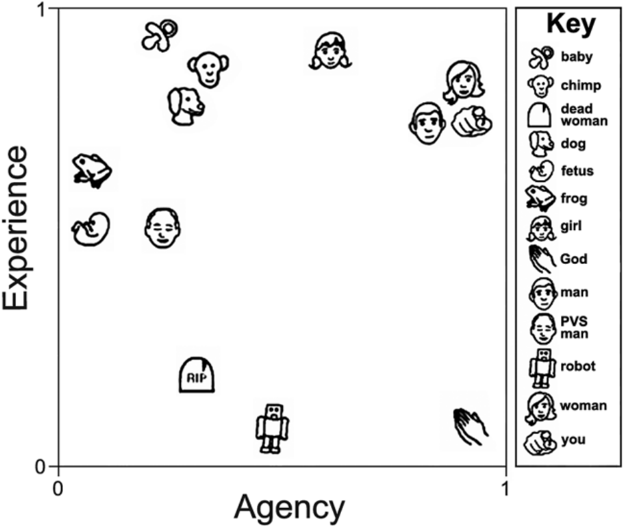
Participants compared the mental capacities of various human and nonhuman characters via online surveys. Factor analysis revealed two dimensions of mind perception, Experience (for example, capacity for hunger) and Agency (for example, capacity for self-control). The dimensions predicted different moral judgments but were both related to valuing of mind.
Overview
CoChat Summary
## TL;DR
This paper argues that mind perception is not a single continuum but instead has two dimensions: Experience and Agency. Using 2,399 completed web-based surveys, the authors found that these dimensions explain how people judge minds across 13 characters and are differentially related to moral judgments.
## Key findings
- A principal components factor analysis of correlations among 18 mental capacities yielded two factors with eigenvalues over 1.0: Experience (eigenvalue 15.85, explaining 88% of variance) and Agency (eigenvalue 1.46, explaining 8% of variance); the rotated solution explained 97% of rating variance.
- Experience loaded on 11 capacities: hunger, fear, pain, pleasure, rage, desire, personality, consciousness, pride, embarrassment, and joy; Agency loaded on 7 capacities: self-control, morality, memory, emotion recognition, planning, communication, and thought.
- Personal judgments tracked the dimensions differently: liking, saving from destruction, making happy, and perceiving a soul correlated with both dimensions, with r ranging from 0.38 to 0.72.
- Punishment judgments correlated more with Agency than Experience (r = 0.82 vs. r = 0.22, z = 2.86, P < 0.05), while avoidance of harm correlated more with Experience than Agency (r = 0.85 vs. r = 0.26, z = 2.10, P < 0.05).
## Methods
- Web-based Mind Survey design: respondents saw pairwise comparisons of 13 characters across 18 mental capacities or 6 personal judgments, using five-point scales for 78 comparisons per survey.
- Sample: about 3,400 survey launches, with 2,399 completed surveys analyzed; respondents ranged from 12 to 75 years old (mean 30.44, SD 12.27) and were 64% female.
- Main analysis: character means were computed, correlations across capacities were submitted to principal components factor analysis with varimax rotation, and factor scores were estimated via regression; additional analyses examined correlations with personal judgments and individual-difference variables using z-statistics.
## Limitations
- The paper states that the surveys were largely independent and that respondent data came from web recruitment through other psychology sites, which makes the sample a convenience sample rather than a random population sample.
- Evident from the text: the factor structure is based on self-selected web respondents and on pairwise judgments of preselected characters and capacities, so generalizability beyond the survey context is not directly tested.
- The paper notes that about 25% of launched surveys were not completed, indicating noncompletion/missing-data attrition.
Model-written summary. Check it against the paper before relying on it.
Integrity signals
Registry
Cites
Statistics
Figures
Verification
Claims the paper makes
0 Valid · 0 Not valid · 0 Not checked · 18 Own results and interpretations
A result the paper reports from its own data — it cites no other source for it, so there is none to check. The quote shows it is in the paper.
In the paper
“Characters ' factor scores on these dimensions (Fig. 1) reveal interesting features; for example, God was perceived as having much Agency but little Experience.”
- Also stated in: § Dimensions of Mind Perception · plain
“for example, God was perceived as having much Agency but little Experience.”
plain- Asserted: passes — The authors put it forward as true.
- Checkable: passes — It can be checked against evidence.
- Load-bearing: unclear — It is unclear whether the paper’s conclusions depend on it.
- Based: passes — The paper gives a reason why it holds.
- Also stated in: § Dimensions of Mind Perception · plain
A result the paper reports from its own data — it cites no other source for it, so there is none to check. The quote shows it is in the paper.
In the paper
“A factor we termed Experience (eigenvalue = 15.85) accounted for 88% of the variance and included 11 capacities (from highest loading): hunger, fear, pain, pleasure, rage, desire, personality, consciousness, pride, embarrassment, and joy.”
plain- Asserted: passes — The authors put it forward as true.
- Checkable: passes — It can be checked against evidence.
- Load-bearing: passes — The paper’s conclusions depend on it.
- Based: passes — The paper gives a reason why it holds.
A result the paper reports from its own data — it cites no other source for it, so there is none to check. The quote shows it is in the paper.
In the paper
“Of 234 z -statistics (13 characters × 9 individual difference variables × 2 factors), 23 were statistically significant.”
plain- Asserted: passes — The authors put it forward as true.
- Checkable: passes — It can be checked against evidence.
- Load-bearing: unclear — It is unclear whether the paper’s conclusions depend on it.
- Based: passes — The paper gives a reason why it holds.
A result the paper reports from its own data — it cites no other source for it, so there is none to check. The quote shows it is in the paper.
In the paper
“whereas desire to avoid harming ( ' If you were forced to harm one of these characters, which one would it be more painful for you to harm? ' ) correlated more with Experience ( r = 0.85) than Agency ( r = 0.26, z = 2.10, P < 0.05).”
plainstates an association- Asserted: passes — The authors put it forward as true.
- Checkable: passes — It can be checked against evidence.
- Load-bearing: passes — The paper’s conclusions depend on it.
- Based: passes — The paper gives a reason why it holds.
A result the paper reports from its own data — it cites no other source for it, so there is none to check. The quote shows it is in the paper.
In the paper
“The rotated solution accounted for all 18 capacities (extraction communalities ranged from 0.82 to 0.99), explained 97% of rating variance, and yielded two factors with eigenvalues over 1.0.”
plainstates an association- Asserted: passes — The authors put it forward as true.
- Checkable: passes — It can be checked against evidence.
- Load-bearing: passes — The paper’s conclusions depend on it.
- Based: passes — The paper gives a reason why it holds.
5 more claims
Create a free account to see all 18 claims and every source verdict.
- It may state two separate claims as one. 8
- Probably not a substantial claim. 1
Claims other papers make about this one
Each is checked against this paper’s own text: does it say what the citing paper says it does?
The source backs part of the claim, not all of it — or backs it for a different population, condition or comparison.
In the citing paper
“People also anthropomorphize a range of inanimate objects and animals (Kwan & Fiske, 2008; Gray, Gray, & Wegner, 2007).”
From Dehumanized Perception: A Psychological Means to Facilitate Atrocities, Torture, and Genocide? (2011) · cites this paper as Gray, Gray, & Wegner, 2007
Experimental — accuracy not yet measuredThe source backs part of the claim, not all of it — or backs it for a different population, condition or comparison.
In the citing paper
“work in social psychology has demonstrated that mental state attribution is not a unitary concept, but rather involves distinct and independent dimensions of ‘intelligence’ and ‘experience’.”
From The influence of mental state attributions on trust in large language models (2025) · cites this paper as [19]
Experimental — accuracy not yet measuredThe source backs part of the claim, not all of it — or backs it for a different population, condition or comparison.
In the citing paper
“Participants’ ratings for each of the 65 traits (Supplementary Fig. S1a) were reduced via a principal component analysis to two main dimensions, which together explained 58% of the variance (Supplementary Fig. S1b) and mapped onto previously identified dimensions of ‘experience’ (e.g. experiencing pleasure or feeling fearful) and ‘intelligence’ (e.g. knowing things or making choices; Gray et al. 2”
From Folk psychological attributions of consciousness to large language models (2024) · cites this paper as Gray et al. 2007
Experimental — accuracy not yet measuredThe cited source says what the claim attributes to it.
In the citing paper
“This dissociation is supported by factor analyses of ratings of a variety of mental states, which reveal two fundamental factors: agency, or the capacity for high-level reasoning and planning, and experience, or the capacity for sensations and emotions19”
From The influence of mental state attributions on trust in large language models (2025) · cites this paper as [19]
The cited source says what the claim attributes to it.
In the citing paper
“Other work has systematically explored the dimensions underlying mental state attributions to various agents, revealing a two-dimensional structure distinguishing between ‘Experience’ (i.e. the capacity to feel pain, fear, joy, or pride) and ‘Agency’ (i.e. the capacity to have self-control, morality, planning, or communication) that is reminiscent of the distinction between phenomenal and non-phen”
From Folk psychological attributions of consciousness to large language models (2024) · cites this paper as Gray et al. 2007
Statistics recomputed
Every reported test result, recomputed from its test statistic and degrees of freedom. A result shows as not adding up only once an independent check has confirmed it.
- Consistentz = 2.86reported p < .05 · recomputed p = .004
“z = 2.86, p < .05”
- Consistentz = 2.1reported p < .05 · recomputed p = .036
“z = 2.10, p < .05”
Self-check
Percentages, sums and reported differences re-computed from the paper’s own numbers.
Self-check results appear here once an independent check has confirmed them.
Citations
Cites
I.—COMPUTING MACHINERY AND INTELLIGENCE
TURING, A. M. (1950) · Mind · doi:10.1093/mind/lix.236.433 · Cited by 10,290
Does the chimpanzee have a theory of mind?
Premack, D., & Woodruff, G. (1978) · Behavioral and Brain Sciences · doi:10.1017/s0140525x00076512 · Cited by 8,743
Mindblindness: An Essay on Autism and Theory of Mind
Baron-Cohen, S. (1995) · doi:10.7551/mitpress/4635.001.0001 · Cited by 3,428
Dennett, D. C. (1996) · Medical Entomology and Zoology · Cited by 314
Research works printed but not linked: 1
- A. Turing, Mind59, 433 (1950).
Cited by
Items 1,901–2,000 of 2,340
The Flatland Fallacy: Moving Beyond Low Dimensional ThinkingPreprint
Jolly, E., & Chang, L. J. (2017) · OSF Preprints (OSF Preprints) · doi:10.31219/osf.io/h7pwt · Cited by 2
Hanson, R. (2016) · Oxford University Press eBooks · doi:10.1093/oso/9780198754626.003.0019
Hanson, R. (2016) · Oxford University Press eBooks · doi:10.1093/oso/9780198754626.003.0036
Hanson, R. (2016) · Oxford University Press eBooks · doi:10.1093/oso/9780198754626.003.0030
Hanson, R. (2016) · Oxford University Press eBooks · doi:10.1093/oso/9780198754626.003.0007
Bird, S. J. (2019) · Elsevier eBooks · doi:10.1016/b978-0-12-809324-5.23379-8
Religion: Her Ideas of His Ideas of Their Ideas …
Pyysiäinen, I. (2009) · Oxford University Press eBooks · doi:10.1093/acprof:oso/9780195380026.003.0001
Hanson, R. (2016) · Oxford University Press eBooks · doi:10.1093/oso/9780198754626.003.0038
Hanson, R. (2016) · Oxford University Press eBooks · doi:10.1093/oso/9780198754626.003.0027
Hanson, R. (2016) · Oxford University Press eBooks · doi:10.1093/oso/9780198754626.003.0039
Hanson, R. (2016) · Oxford University Press eBooks · doi:10.1093/oso/9780198754626.003.0004
Hanson, R. (2016) · Oxford University Press eBooks · doi:10.1093/oso/9780198754626.003.0012
Hanson, R. (2016) · Oxford University Press eBooks · doi:10.1093/oso/9780198754626.003.0040
Pain Perception and Empathy for Objectified Women
Purnell, S. E. (2021) · doi:10.46569/20.500.12680/sq87c1179
Smith, E. R., Šabanović, S., & Fraune, M. R. (2020) · Technology Mind and Behavior · doi:10.1037/tmb0000002.supp
Siri, G., Abubshait, A., Tommaso, D. D., Cardellicchio, P., D’Ausilio, A., & Wykowska, A. (2022) · doi:10.31219/osf.io/u3tkp
Kristiyono, J., Permatasari, D. B. A., Ekantoro, J., & Roosinda, F. W. (2022) · Masyarakat Kebudayaan dan Politik · doi:10.20473/mkp.v35i32022.380-395 · Cited by 2
“The data collection technique uses metadata documentation of @humasprovjatim IG feed content for two periods in 2020 (Gray et al. 2007, Suparno 2011).”
MethodThe role of causal representations in moral judgment
Engelmann, N. (2022) · eDiss (Georg-August-Universität Göttingen) · doi:10.53846/goediss-9433 · Cited by 3
A data-driven investigation of human action representationsPreprint
Dima, D. C., Hebart, M. N., & Işık, L. (2022) · bioRxiv (Cold Spring Harbor Laboratory) · doi:10.1101/2022.09.22.509054
Monism and pluralism in morality: Origins, connotations and debates
Haotian, Z., Feng, Y., Liying, X., & Zheli, X. (2022) · Advances in Psychological Science · doi:10.3724/sp.j.1042.2023.00301 · Cited by 2
Will the use of machines to identify negative activist investments backfire? Experimental evidencePreprint
Niszczota, P., & Kaszás, D. (2022) · PsyArXiv (OSF Preprints) · doi:10.31234/osf.io/f5dh6
(2009) · Oxford University Press eBooks · doi:10.1093/acprof:oso/9780195380026.002.0005
(2009) · Oxford University Press eBooks · doi:10.1093/acprof:oso/9780195380026.001.0001.002.002
Appendix: Cognitive Processes and Explaining Religion
(2009) · Oxford University Press eBooks · doi:10.1093/acprof:oso/9780195380026.005.0001
(2009) · Oxford University Press eBooks · doi:10.1093/acprof:oso/9780195380026.002.0006
(2009) · Oxford University Press eBooks · doi:10.1093/acprof:oso/9780195380026.001.0001.002.007
(2009) · Oxford University Press eBooks · doi:10.1093/acprof:oso/9780195380026.001.0001.002.006
(2009) · Oxford University Press eBooks · doi:10.1093/acprof:oso/9780195380026.001.0001.002.001
(2009) · Oxford University Press eBooks · doi:10.1093/acprof:oso/9780195380026.001.0001.002.003
(2009) · Oxford University Press eBooks · doi:10.1093/acprof:oso/9780195380026.001.0001.002.004
A kinematic study on social intention during a human-robot interaction
Bah, J.-M., Mostafaoui, G., & Cohen, L. (2022) · IEEE International Conference on Development and Learning (ICDL) · doi:10.1109/icdl53763.2022.9962213
“Furthermore, to evaluate if the obtained results are related to the way we perceive the robot, we propose to use a Mind Perception Questionnaire dedicated to the exploration of two dimensions, namely the agency and experience aspects of mind perception [13].”
Method(2009) · Oxford University Press eBooks · doi:10.1093/acprof:oso/9780195380026.002.0003
Computational Theory of Mind for Human-Agent Coordination
Erdogan, E., Dignum, F. P. M., Verbrugge, R., & Yolum, P. (2022) · Lecture notes in computer science · doi:10.1007/978-3-031-20845-4_6
“As we aim to design higher-order ToM agents that can also take into account how their own artificial minds are perceived by others, we plan to benefit from mind perception theory [19, 23] when investigating the roles of observation and communication in recursive ToM reasoning.”
Background(2009) · Oxford University Press eBooks · doi:10.1093/acprof:oso/9780195380026.001.0001.002.005
The Significance of a Second-Person Perspective for the Development of Humanoid AI
Ma, H. (2022) · Lecture notes in computer science · doi:10.1007/978-3-031-23470-5_5
Expectations of how machines use individuating information and base-rates
English, S. D., Denison, S., & Friedman, O. (2022) · Judgment and Decision Making · doi:10.1017/s1930297500003600
“Also, people often rate computers and robots as less able than humans to have many mental states, but especially desires and emotions (Bigman & Gray, 2018; Gray et al., 2007; Haslam et al., 2008; Weisman et al., 2017).”
BackgroundA Theory of a Human-Centered Social Cognitive Chain
Yu, F., Xu, L., & Kaiping, P. (2022) · 中国社会科学:英文版 · doi:10.1080/02529203.2022.2166297
“Table 3 Basic Dimensions of Social Cognition Gray et al., 2007 Haslam, 2006 Fiske et al., 2007 Alexander et al., 1999 Wiggins, 1991 Rosenberg et al., 1968 Frimer et al., 2011 Dimension 1 Experience Human nature Warmth Morality Nurturance Sociality Communion Dimension 2 Agency Human uniqueness Competence Competence Dom…”
BackgroundInfluentialLoneliness During COVID-19 Influences Mind and Likeability Ratings in the Uncanny Valley
Abubshait, A., Xie, Y., Lin, J.-K., Toma, M., & Wiese, E. (2022) · Lecture notes in computer science · doi:10.1007/978-3-031-24670-8_23 · Cited by 2
Marchesi, S., Kompatsiari, K., Tommaso, D. D., & Wykowska, A. (2023) · PsyArXiv (OSF Preprints) · doi:10.31234/osf.io/mz4rt
Siri, G., Abubshait, A., Tommaso, D. D., Cardellicchio, P., D’Ausilio, A., & Wykowska, A. (2023) · PsyArXiv (OSF Preprints) · doi:10.31234/osf.io/vdxh9
Organizational Management Variables Enhancing Organizational Citizenship Behaviors
Vargas-Hernández, J. G., & Vargas-González, O. C. (2023) · Advances in human resources management and organizational development book series · doi:10.4018/978-1-6684-7422-8.ch009
Children: dehumanized or not yet fully human?
Hagá, S. (2023) · Current Opinion in Behavioral Sciences · doi:10.1016/j.cobeha.2023.101276 · Cited by 3
Human and Non-Human Persons in not Inhuman Civilization
Łukaszewicz, A. (2023) · Integrated science · doi:10.1007/978-3-031-27945-4_7
Factor Analysis of Impression of Local “Moe” Character
Matsui, T. (2021) · The Journal of the Society for Art and Science · doi:10.3756/artsci.20.120
Matsui, T. (2023) · Research Square · doi:10.21203/rs.3.rs-3070299/v1
Engaging with Bot Narratives: The Audience Experience and Perceptions of Machine Script WritersPreprint
Son, R., Yang, Q., Vollmer, B. T., & Johnson, B. K. (2023) · doi:10.33767/osf.io/67ebm
Aesthetic Motivation Impacts Judgments of Others’ Prosociality and Mental LifePreprint
Agrawal, T., & Schachner, A. (2023) · doi:10.31234/osf.io/u5kq8
Matsui, T. (2023) · Research Square · doi:10.21203/rs.3.rs-3070299/v2
Oliveira, M., Brands, J., Mashudi, J., et al. (2023) · doi:10.31234/osf.io/vsxr4
Au, R. H. Y., Fraune, M. R., & Wullenkord, R. (2023) · International Journal of Social Robotics · doi:10.1007/s12369-023-01057-2 · Cited by 1
“Our findings were in line with past findings that humans were perceived as possessing higher capacity for both experience and agency than robots [13].”
BackgroundMethodResultInfluentialGuo, Y. (2023) · Lecture Notes in Education Psychology and Public Media · doi:10.54254/2753-7048/12/20230797 · Cited by 1
Divisive languagePreprint
Dillon, M. R. (2023) · doi:10.31234/osf.io/w8s9h
Rahmjoo, A., & Friedman, D. (2023) · Physics of Life Reviews · doi:10.1016/j.plrev.2023.11.001
Between the Authentic and Artificial: From the Perspective of Contingency
Sato, M. (2023) · IOP Conference Series Materials Science and Engineering · doi:10.1088/1757-899x/1292/1/012023
Assessing a Virtual Platform’s Effectiveness in Exploring Mental Models of Robot Design
Laity, W., Mamo, R., Dossett, B., Toczek, M., Sinclair, J., Train, N., Pittman, D. E., & Haring, K. S. (2023) · IEEE RO-MAN · doi:10.1109/ro-man57019.2023.10309465
“Before starting a new robot design, the user is presented with a challenge card that prompts the user to build a robot with a certain capability that corresponds mainly to two different dimensions of mind perception: agency and experience [34].”
BackgroundDistorted Extension of the “Just Deserts”: Permitting Immoral Behavior Suffered by PerpetratorsPreprint
Xu, K., Wang, M., Lin, J., Chen, J., Yan, Z., Zuo, S., Shuyue, Z., & Xue, H. (2023) · SSRN Electronic Journal · doi:10.2139/ssrn.4656710
Barone, A. M., & Stagno, E. (2023) · Springer eBooks · doi:10.1007/978-3-031-48792-7_1
Virtuelle Realität und sozial interaktive Agenten
Stein, J., & Lugrin, B. (2023) · Springer eBooks · doi:10.1007/978-3-662-66608-1_18
Gut, A., Wilczewski, M., Gorbaniuk, O., Kuts, O., Amangaldi, A., & Romanovska, L. (2024) · SSRN Electronic Journal · doi:10.2139/ssrn.4691486
Brinkmanship in algorithmic warfare
Johnson, J. S. (2024) · Oxford University Press eBooks · doi:10.1093/oso/9780198892182.003.0005
Thinking forward with counterfactuals
Johnson, J. S. (2024) · Oxford University Press eBooks · doi:10.1093/oso/9780198892182.003.0006
Johnson, J. S. (2024) · Oxford University Press eBooks · doi:10.1093/oso/9780198892182.005.0001
Johnson, J. S. (2024) · Oxford University Press eBooks · doi:10.1093/oso/9780198892182.003.0007
Sample of AI-enabled autonomous weapons used in human–machine teaming
Johnson, J. S. (2024) · Oxford University Press eBooks · doi:10.1093/oso/9780198892182.005.0002
Johnson, J. (2024) · Oxford University Press eBooks · doi:10.1093/oso/9780198892182.002.0006
Tactical generals and strategic corporals
Johnson, J. S. (2024) · Oxford University Press eBooks · doi:10.1093/oso/9780198892182.003.0004
Johnson, J. (2024) · Oxford University Press eBooks · doi:10.1093/oso/9780198892182.002.0003
Introduction: AI-enabled “centaur warfighting”
Johnson, J. S. (2024) · Oxford University Press eBooks · doi:10.1093/oso/9780198892182.003.0001
Johnson, J. S. (2024) · Oxford University Press eBooks · doi:10.1093/oso/9780198892182.003.0002
DAMPAK PERILAKU NORMA SOSIAL TIDAK BIASA TERHADAP KUALITAS LAYANAN SELAMA MASA PANDEMI COVID-19
Purwanto, P., & Fitriany, R. (2024) · MANAJEMEN DEWANTARA · doi:10.30738/md.v8i1.15617
Perceiving humanness across ages: neural correlates and behavioral patterns
Saito, T. I., Nouchi, R., Ishibashi, R., Motoki, K., Matsuzaki, Y., Kobayashi, A., Sugiura, M., & Kawashima, R. (2024) · Frontiers in Psychology · doi:10.3389/fpsyg.2024.1361588
“” The explanations for agency and experience were adapted from previous studies (Haslam, 2006; Gray et al., 2007).”
MethodA Humanizing Separation from Work: The Benefits of Rewarding People with Vacation Instead of MoneyPreprint
Lee-Yoon, A., & DeVoe, S. E. (2024) · SSRN Electronic Journal · doi:10.2139/ssrn.4811420
Jaeger, B., & Bosten, M. (2024) · PsyArXiv (OSF Preprints) · doi:10.31234/osf.io/p4hc3 · Cited by 3
Representation of others' beliefs
Qin, J., & Wu, H. (2024) · Elsevier eBooks · doi:10.1016/b978-0-12-820480-1.00159-5 · Cited by 1
Feng, Z., & Dang, J. (2024) · SSRN Electronic Journal · doi:10.2139/ssrn.4882878
Organizational Management Variables Enhancing the Organizational Citizenship Behaviors
Vargas-Hernández, J. G., González, F. J. J., Reyes-Sánchez, J. D. J., & Vargas-González, O. C. (2024) · Practice, progress, and proficiency in sustainability · doi:10.4018/979-8-3693-2699-2.ch009
Advancements in Machine Learning and Deep Learning
Darwish, D. A. M. (2024) · Advances in geospatial technologies book series · doi:10.4018/979-8-3693-2913-9.ch006 · Cited by 2
Factors Governing the Amount of Fan Fiction of Smartphone Game Apps
Matsui, T., & HURUKAWA, H. (2024) · Journal of Digital Games Research · doi:10.9762/digraj.17.1_33
Between desubjectivation and identification: medical practice with critically ill patients
Albarracín, D. (2024) · Mortality · doi:10.1080/13576275.2024.2386573
“Indeed, a person in such a condition is perceived as less human than a healthy woman or man (H. M. Gray et al., 2007), or even a dead person (K. Gray et al., 2011).”
Schroeder, J. (2024) · Oxford University Press eBooks · doi:10.1093/oxfordhb/9780197763414.013.30
Humanization promotes equality over efficiency preference in carbon allocation
Huang, L., Liu, L., Dang, J., Wei, C., Miao, X., & Liu, Z. (2024) · Journal of Environmental Psychology · doi:10.1016/j.jenvp.2024.102481
Theatrical Illusion and the Performance of Fictional Minds in Hag-Seed
Harrison, C. (2024) · Palgrave studies in language, literature and style · doi:10.1007/978-3-031-67640-6_5
Delineation and Operationalisation of the Concept of the Intentional Stance
Marchesi, S., Spatola, N., & Wykowska, A. (2024) · Springer eBooks · doi:10.1007/978-3-031-65483-1_2
Robot transparency and anthropomorphic attribute effects on human-robot interactions
Wang, J., Liu, Y., Yue, T., Wang, C., Mao, J., Wang, Y., & You, F. (2024) · Elsevier eBooks · doi:10.1016/b978-0-443-23606-8.00020-8 · Cited by 1
An Introduction to the Law, Policy, and Regulation for Human–Robot Interaction
Barfield, W., Weng, Y.-H., & Pagallo, U. (2024) · Cambridge University Press eBooks · doi:10.1017/9781009386708.003
Kardoš, P., Leidner, B., & Nawalkha, S. K. (2024) · The Journal of Psychology · doi:10.1080/00223980.2024.2437380 · Cited by 2
“Since prior research finds commonalities between these two interaction partners in terms of people’s perception of these as lacking important qualities of humanness (e.g., Gray et al., 2007; Loughnan & Haslam, 2007), we labeled this cluster infrahumanized (i.e., perceived as not fully human).”
Learning While Learning: Psychology Case Studies for Teaching Regression
Evans, C., Reinhart, A., Cooley, E., & Cipolli, W. (2025) · Journal of Statistics and Data Science Education · doi:10.1080/26939169.2024.2441706
Mind perception and fan fiction: a survey using the IDOLM@STER series
Matsui, T. (2025) · Cogent Social Sciences · doi:10.1080/23311886.2025.2453084
“‘agency’ and ‘experience’ are concepts originally proposed by Gray et al. (2007).”
Erweiterte Realitäten und virtuelle Welten
Lang, F. (2025) · Springer eBooks · doi:10.1007/978-3-658-46273-4_2
Jaeger, C. B., & Levin, D. T. (2025) · SSRN Electronic Journal · doi:10.2139/ssrn.5139267
The Impact of Service Robot Attributes and Task Types on Consumer Usage Intentions
张, 宁. (2025) · Modern Marketing · doi:10.12677/mom.2025.151005
Modern Moral Psychology: A Guide to the Terrain
Malle, B. F., & Robbins, P. (2025) · Cambridge University Press eBooks · doi:10.1017/9781108894357.002 · Cited by 1
Malle, B., & Robbins, P. (2025) · Cambridge University Press eBooks · doi:10.1017/9781108894357.009
Malle, B., & Robbins, P. (2025) · Cambridge University Press eBooks · doi:10.1017/9781108894357.015
Gündüz, T. (2025) · İnsan ve Toplum Bilimleri Araştırmaları Dergisi · doi:10.15869/itobiad.1573730
Mind and Body: Dimensions of Mind Perception Across Agent Types in Human-Agent Interaction
Haresamudram, K. (2025) · Lecture notes in computer science · doi:10.1007/978-981-96-3525-2_15
Apples and Oranges: Validity and Reliability of the Three Main Anthropomorphism Measures
Keijsers, M., Porzio, L., Tricarico, A., Rea, D. J., Seo, S. H., & Kanda, T. (2025) · Lecture notes in computer science · doi:10.1007/978-981-96-3519-1_39
Bruzzo, D., Matarese, M., Sciutti, A., & Rea, F. (2025) · Lecture notes in computer science · doi:10.1007/978-981-96-3522-1_40 · Cited by 2
Metadata
- Authors
- Gray, H. M., Gray, K., & Wegner, D. M.
- Affiliations
- Harvard University (US)
- Corresponding author
- Gray, Heather M.
- Venue
- Science
- Published
- 2007-02-02
- Volume
- 315
- Issue
- 5812
- Pages
- 619-619
- ISSN
- 0036-8075 (ISSN-L)
- 1095-9203
- OpenAlex
- W2131227926
- Cited by
- 2,342
- References
- 4
- Citations by year
- 2026: 359 · 2025: 326 · 2024: 249 · 2023: 220 · 2022: 198 · 2021: 156 · 2020: 157 · 2019: 107 · 2018: 91 · 2017: 86 · 2016: 96 · 2015: 66 · 2014: 52 · 2013: 44 · 2012: 45
- FWCI
- 10.81
- Type
- journal article
- Language
- en
- Open access
- closed
- Locations
- Science (publishedVersion)
- PubMed (publishedVersion)
- Funders
- National Institutes of Health (1f31mh071053-01)
- National Institute of Mental Health (MH-71053, MH 49127, R01MH049127)
- Topics
- Life Sciences › Neuroscience › Cognitive Neuroscience › Psychology of Moral and Emotional Judgment
- Social Sciences › Psychology › Social Psychology › Social Robot Interaction and HRI
- Social Sciences › Sociology and Political Science › Social and Intergroup Psychology
- Keywords
- mind perception, moral judgment, agency, experience, non-human animals, personification, moral status of animals, self-control, hunger
- MeSH terms
- Adolescent, Adult, Aged, Child, Emotions, Female, Humans, Male, Mental Processes, Middle Aged, Morals, Perception, Personality, Principal Component Analysis
About these checks
Registry, retraction, Cites and statistics results are computed, not judged, with one exception: a printed reference that no index lists is read once by a model before it counts as a citation error. Claims are extracted by a model and kept only when their quote appears verbatim in the text; each cited source is then checked, with a model’s help, for whether it says what the claim relies on. Those verdicts can be wrong — read the claim’s quote and the cited source before relying on one.
A language model drew the claims from the paper on 2026-09-28, under version 3 of the claim definition (model deepseek-v4.1-flash, prompt extract-v3).
A second model labelled each claim on 2026-09-28 (model jev-1.13-20260917, definition revision gold-guideline-v0.2).
Statistics and arithmetic are recomputed, not judged.
Confidence bands are shown only for fields calibrated on our annotated test set. None is calibrated yet, so no band is shown.
What counts as a claim ›How we measure confidence ›How we check this ›
Are you an author, or do you see a problem with this page? Request a review
Data sources
Bibliographic data: Semantic Scholar, OpenAlex, Crossref.
Contains information from the Semantic Scholar Academic Graph Datasets, made available under the ODC Attribution License (ODC-BY 1.0).
Semantic Scholar’s data is described in: Kinney, R., et al. (2023). The Semantic Scholar Open Data Platform. arXiv:2301.10140.
