

Dimensions of Mind Perception
The DOI matches its Crossref record; 4 of the 4 references it cites were found in a registry or an index.
Abstract
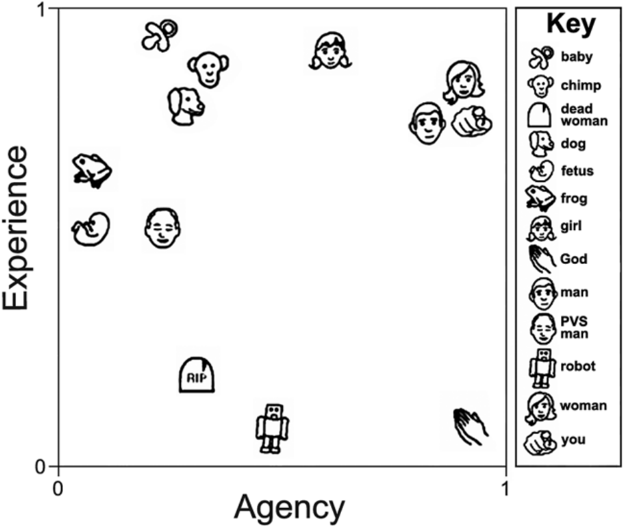
Participants compared the mental capacities of various human and nonhuman characters via online surveys. Factor analysis revealed two dimensions of mind perception, Experience (for example, capacity for hunger) and Agency (for example, capacity for self-control). The dimensions predicted different moral judgments but were both related to valuing of mind.
Overview
CoChat Summary
## TL;DR
This paper argues that mind perception is not a single continuum but instead has two dimensions: Experience and Agency. Using 2,399 completed web-based surveys, the authors found that these dimensions explain how people judge minds across 13 characters and are differentially related to moral judgments.
## Key findings
- A principal components factor analysis of correlations among 18 mental capacities yielded two factors with eigenvalues over 1.0: Experience (eigenvalue 15.85, explaining 88% of variance) and Agency (eigenvalue 1.46, explaining 8% of variance); the rotated solution explained 97% of rating variance.
- Experience loaded on 11 capacities: hunger, fear, pain, pleasure, rage, desire, personality, consciousness, pride, embarrassment, and joy; Agency loaded on 7 capacities: self-control, morality, memory, emotion recognition, planning, communication, and thought.
- Personal judgments tracked the dimensions differently: liking, saving from destruction, making happy, and perceiving a soul correlated with both dimensions, with r ranging from 0.38 to 0.72.
- Punishment judgments correlated more with Agency than Experience (r = 0.82 vs. r = 0.22, z = 2.86, P < 0.05), while avoidance of harm correlated more with Experience than Agency (r = 0.85 vs. r = 0.26, z = 2.10, P < 0.05).
## Methods
- Web-based Mind Survey design: respondents saw pairwise comparisons of 13 characters across 18 mental capacities or 6 personal judgments, using five-point scales for 78 comparisons per survey.
- Sample: about 3,400 survey launches, with 2,399 completed surveys analyzed; respondents ranged from 12 to 75 years old (mean 30.44, SD 12.27) and were 64% female.
- Main analysis: character means were computed, correlations across capacities were submitted to principal components factor analysis with varimax rotation, and factor scores were estimated via regression; additional analyses examined correlations with personal judgments and individual-difference variables using z-statistics.
## Limitations
- The paper states that the surveys were largely independent and that respondent data came from web recruitment through other psychology sites, which makes the sample a convenience sample rather than a random population sample.
- Evident from the text: the factor structure is based on self-selected web respondents and on pairwise judgments of preselected characters and capacities, so generalizability beyond the survey context is not directly tested.
- The paper notes that about 25% of launched surveys were not completed, indicating noncompletion/missing-data attrition.
Model-written summary. Check it against the paper before relying on it.
Integrity signals
Registry
Cites
Statistics
Figures
Verification
Claims the paper makes
0 Valid · 0 Not valid · 0 Not checked · 18 Own results and interpretations
A result the paper reports from its own data — it cites no other source for it, so there is none to check. The quote shows it is in the paper.
In the paper
“Characters ' factor scores on these dimensions (Fig. 1) reveal interesting features; for example, God was perceived as having much Agency but little Experience.”
- Also stated in: § Dimensions of Mind Perception · plain
“for example, God was perceived as having much Agency but little Experience.”
plain- Asserted: passes — The authors put it forward as true.
- Checkable: passes — It can be checked against evidence.
- Load-bearing: unclear — It is unclear whether the paper’s conclusions depend on it.
- Based: passes — The paper gives a reason why it holds.
- Also stated in: § Dimensions of Mind Perception · plain
A result the paper reports from its own data — it cites no other source for it, so there is none to check. The quote shows it is in the paper.
In the paper
“A factor we termed Experience (eigenvalue = 15.85) accounted for 88% of the variance and included 11 capacities (from highest loading): hunger, fear, pain, pleasure, rage, desire, personality, consciousness, pride, embarrassment, and joy.”
plain- Asserted: passes — The authors put it forward as true.
- Checkable: passes — It can be checked against evidence.
- Load-bearing: passes — The paper’s conclusions depend on it.
- Based: passes — The paper gives a reason why it holds.
A result the paper reports from its own data — it cites no other source for it, so there is none to check. The quote shows it is in the paper.
In the paper
“Of 234 z -statistics (13 characters × 9 individual difference variables × 2 factors), 23 were statistically significant.”
plain- Asserted: passes — The authors put it forward as true.
- Checkable: passes — It can be checked against evidence.
- Load-bearing: unclear — It is unclear whether the paper’s conclusions depend on it.
- Based: passes — The paper gives a reason why it holds.
A result the paper reports from its own data — it cites no other source for it, so there is none to check. The quote shows it is in the paper.
In the paper
“whereas desire to avoid harming ( ' If you were forced to harm one of these characters, which one would it be more painful for you to harm? ' ) correlated more with Experience ( r = 0.85) than Agency ( r = 0.26, z = 2.10, P < 0.05).”
plainstates an association- Asserted: passes — The authors put it forward as true.
- Checkable: passes — It can be checked against evidence.
- Load-bearing: passes — The paper’s conclusions depend on it.
- Based: passes — The paper gives a reason why it holds.
A result the paper reports from its own data — it cites no other source for it, so there is none to check. The quote shows it is in the paper.
In the paper
“The rotated solution accounted for all 18 capacities (extraction communalities ranged from 0.82 to 0.99), explained 97% of rating variance, and yielded two factors with eigenvalues over 1.0.”
plainstates an association- Asserted: passes — The authors put it forward as true.
- Checkable: passes — It can be checked against evidence.
- Load-bearing: passes — The paper’s conclusions depend on it.
- Based: passes — The paper gives a reason why it holds.
5 more claims
Create a free account to see all 18 claims and every source verdict.
- It may state two separate claims as one. 8
- Probably not a substantial claim. 1
Claims other papers make about this one
Each is checked against this paper’s own text: does it say what the citing paper says it does?
The source backs part of the claim, not all of it — or backs it for a different population, condition or comparison.
In the citing paper
“People also anthropomorphize a range of inanimate objects and animals (Kwan & Fiske, 2008; Gray, Gray, & Wegner, 2007).”
From Dehumanized Perception: A Psychological Means to Facilitate Atrocities, Torture, and Genocide? (2011) · cites this paper as Gray, Gray, & Wegner, 2007
Experimental — accuracy not yet measuredThe source backs part of the claim, not all of it — or backs it for a different population, condition or comparison.
In the citing paper
“work in social psychology has demonstrated that mental state attribution is not a unitary concept, but rather involves distinct and independent dimensions of ‘intelligence’ and ‘experience’.”
From The influence of mental state attributions on trust in large language models (2025) · cites this paper as [19]
Experimental — accuracy not yet measuredThe source backs part of the claim, not all of it — or backs it for a different population, condition or comparison.
In the citing paper
“Participants’ ratings for each of the 65 traits (Supplementary Fig. S1a) were reduced via a principal component analysis to two main dimensions, which together explained 58% of the variance (Supplementary Fig. S1b) and mapped onto previously identified dimensions of ‘experience’ (e.g. experiencing pleasure or feeling fearful) and ‘intelligence’ (e.g. knowing things or making choices; Gray et al. 2”
From Folk psychological attributions of consciousness to large language models (2024) · cites this paper as Gray et al. 2007
Experimental — accuracy not yet measuredThe cited source says what the claim attributes to it.
In the citing paper
“This dissociation is supported by factor analyses of ratings of a variety of mental states, which reveal two fundamental factors: agency, or the capacity for high-level reasoning and planning, and experience, or the capacity for sensations and emotions19”
From The influence of mental state attributions on trust in large language models (2025) · cites this paper as [19]
The cited source says what the claim attributes to it.
In the citing paper
“Other work has systematically explored the dimensions underlying mental state attributions to various agents, revealing a two-dimensional structure distinguishing between ‘Experience’ (i.e. the capacity to feel pain, fear, joy, or pride) and ‘Agency’ (i.e. the capacity to have self-control, morality, planning, or communication) that is reminiscent of the distinction between phenomenal and non-phen”
From Folk psychological attributions of consciousness to large language models (2024) · cites this paper as Gray et al. 2007
Statistics recomputed
Every reported test result, recomputed from its test statistic and degrees of freedom. A result shows as not adding up only once an independent check has confirmed it.
- Consistentz = 2.86reported p < .05 · recomputed p = .004
“z = 2.86, p < .05”
- Consistentz = 2.1reported p < .05 · recomputed p = .036
“z = 2.10, p < .05”
Self-check
Percentages, sums and reported differences re-computed from the paper’s own numbers.
Self-check results appear here once an independent check has confirmed them.
Citations
Cites
I.—COMPUTING MACHINERY AND INTELLIGENCE
TURING, A. M. (1950) · Mind · doi:10.1093/mind/lix.236.433 · Cited by 10,290
Does the chimpanzee have a theory of mind?
Premack, D., & Woodruff, G. (1978) · Behavioral and Brain Sciences · doi:10.1017/s0140525x00076512 · Cited by 8,743
Mindblindness: An Essay on Autism and Theory of Mind
Baron-Cohen, S. (1995) · doi:10.7551/mitpress/4635.001.0001 · Cited by 3,428
Dennett, D. C. (1996) · Medical Entomology and Zoology · Cited by 314
Research works printed but not linked: 1
- A. Turing, Mind59, 433 (1950).
Cited by
Items 1,401–1,500 of 2,340
Theory of Mind in Human-AI Interaction and AI
Walsh, S., Wang, Q., & Ying, L. (2025) · Springer eBooks · doi:10.1007/978-981-95-3658-0_6 · Cited by 7
How AI Alleviates Woes: The Impact of Chatbot Relational Cues on Emotional Interaction Experiences
Xiang, Y., Gu, R., Chen, Z., Gan, T., & Zheng, Y. (2025) · International Journal of Human-Computer Interaction · doi:10.1080/10447318.2025.2601286 · Cited by 9
“This double-edged sword effect shows the complex role of mind perception and broadens the application of the three-factor theory of anthropomorphism and mind perception theory in human-AI interaction (Epley et al., 2007; Gray et al., 2007).”
Robots with hearts: How in-store AI’s task types impact brand attitude and ethicality
Bhoumik, K., Fang, L., & Igarashi, R. (2025) · Journal of Business Research · doi:10.1016/j.jbusres.2025.115923 · Cited by 6
“To explain how consumers interpret these role assignments, we draw on mind perception theory (Gray et al., 2007), which posits that individuals evaluate social entities, including nonhuman ones, along two dimensions: agency (the ability to act intentionally) and experience (the ability to feel and…”
Sun, C., Meng, H., & Liu, Y. (2025) · International Journal of Human-Computer Interaction · doi:10.1080/10447318.2025.2607555 · Cited by 3
“As an artificial intelligence technology, virtual humans possess a high degree of agency (H. M. Gray et al., 2007).”
InfluentialWhen Personality Meets Platform: The Moderating Role of Human-Likeness in AI User Evaluations
Lee, S., & Choi, Y. K. (2025) · International Journal of Human-Computer Interaction · doi:10.1080/10447318.2025.2604629 · Cited by 4
“Thirdly, our study refines Mind Perception Theory by illustrating the multifaceted role of perceived intentionality and awareness (Gray et al., 2007) in different AI contexts.”
InfluentialEmotionally competent robots: acknowledging customer anger in service failure
Goyeneche, D., Arango, L., Septianto, F., Pontes, N., & Leszczyc, P. T. L. P. (2026) · Journal of Business Research · doi:10.1016/j.jbusres.2026.115971 · Cited by 3
Trusting machines with morality — Delegating moral decisions to AI
Hüholt, N., & Szech, N. (2026) · European Economic Review · doi:10.1016/j.euroecorev.2025.105255 · Cited by 8
Liu, H., Han, X., Li, S., Zhao, X., & Liu, H. (2026) · Electronic Commerce Research and Applications · doi:10.1016/j.elerap.2026.101572 · Cited by 4
Wang, H., Wang, N., Wang, H., & Wang, J. (2026) · Asia Pacific Journal of Marketing and Logistics · doi:10.1108/apjml-06-2025-1104 · Cited by 3
Zhang, X., & Su, L. (2026) · Journal of Retailing and Consumer Services · doi:10.1016/j.jretconser.2026.104767 · Cited by 3
The Emergence of Belief Attribution and Dehumanization Are Associated
Zhou, W., & Hare, B. A. (2026) · Developmental Science · doi:10.1111/desc.70165 · Cited by 3
Jaeger, B., & Bosten, M. (2026) · Psychological Science · doi:10.1177/09567976261425576 · Cited by 4
“One dimen-sion showed strong overlap with the experience dimen-sion found by H. M. Gray et al. (2007), including capacities for feelings of pleasure, pain, and other affective states.”
InfluentialYan, X., Tat, H. H., Sade, A. B., & Zhou, Y. (2026) · Journal of Consumer Behaviour · doi:10.1002/cb.70169 · Cited by 3
Growing up with Artificial Intelligence: Implications for Child Development
Xu, Y., & He, K. (2026) · Cambridge University Press eBooks · doi:10.1017/9781009503914 · Cited by 7
Speciesism and the psychology of animal exploitation
Dhont, K., & Hodson, G. (2026) · Nature Reviews Psychology · doi:10.1038/s44159-026-00585-8 · Cited by 3
The influence of robot salience on workplace objectification
Liying, X. U., Feng, Y. U., Kaiping, P. E. N. G., & Xuehui, W. A. N. G. (2022) · Advances in Psychological Science · doi:10.3724/sp.j.1042.2022.01905 · Cited by 5
Hiestand, K. M., McComb, K., & Banerjee, R. A. (2022) · Animals · doi:10.3390/ani12233434 · Cited by 3
“However, as the ascribing of internal states–particularly emotions–to animals has important implications for their moral status [31], gaining understanding and insight into how humans construct animal empathy may hold an applied value.”
BackgroundDelgado, N., Mattavelli, S., Brambilla, M., Rodríguez-Gómez, L., & Harris, L. T. (2023) · Journal of Experimental Social Psychology · doi:10.1016/j.jesp.2023.104455 · Cited by 5
Predicting other people shapes the social mind
Tamir, D., & Thornton, M. A. (2023) · Advances in experimental social psychology · doi:10.1016/bs.aesp.2023.11.003 · Cited by 6
Chen, W., Weicong, C., Liang, H., Suyu, H., & Yiwen, W. (2023) · Acta Psychologica Sinica · doi:10.3724/sp.j.1041.2024.00194 · Cited by 7
“…, 5= 非常同 意 ) 。然后要求被试填写人机投射问卷 , 问卷采用自编方式 , 包含 9 个项目 ( 如:“我认为这 个机器人和人类一样有智慧” , “我认为这个机器人可以理解人类的情感” , “我认为这个 机器人能做出符合人类期望的行为” , 其它项目详见附录 ), 测量个体感知机器人具备与人相 类似智能的程度 , 涵盖认知、情感和行动三个智能层面 (Gray et al., 2007; Gray & Wegner, 2012; Haslam, 2006) abided by ethical principles compared with those who violated.”
InfluentialBorges-Castells, N., Betancor, V., & Pérez, A. R. (2024) · Frontiers in Psychology · doi:10.3389/fpsyg.2024.1418404 · Cited by 4
“It entails denying individuals the capacity to feel, experience, or, in terms of agency, engage in rational activities (Gray et al., 2007).”
BackgroundMethodInfluentialCapozza, D., Colledani, D., & Falvo, R. (2024) · Journal of Applied Social Psychology · doi:10.1111/jasp.13060 · Cited by 6
Nijssen, S. R. R., Krainz, M., White, M. P., & Pahl, S. (2024) · Journal of Environmental Psychology · doi:10.1016/j.jenvp.2024.102411 · Cited by 3
A second life for second-hand products: the role of anthropomorphism and taboo trade-offs
Wan, J., & Aggarwal, P. (2024) · European Journal of Marketing · doi:10.1108/ejm-05-2023-0316 · Cited by 5
Anthropomorphism and Human–Robot Interaction
Wullenkord, R., Lacroix, D., & Eyssel, F. (2024) · Cambridge University Press eBooks · doi:10.1017/9781009386708.005 · Cited by 5
Determinants of consumers’ emotions and willingness to use artificial intelligence in Indonesia
Laksmidewi, D., Efendi, & Hoo, W. C. (2024) · Innovative Marketing · doi:10.21511/im.20(4).2024.22 · Cited by 3
Intergroup Conflict and Dehumanization
Haslam, N. (2025) · Cambridge University Press eBooks · doi:10.1017/9781108894357.018 · Cited by 14
Blame games: Who is to blame when things go wrong, human or AI?
Qin, Y., Zhou, W. A., & Zhong, B. (2025) · CHI Conference Extended Abstracts on Human Factors in Computing Systems (CHI EA) · doi:10.1145/3706599.3719949 · Cited by 3
“Participants’ perceptions of AI’s cognitive and emotional capabilities relative to humans were assessed through two constructs of mind perception [8]: perceived agency (PA) and perceived experience (PE), adapted from Yam et al. [34].”
InfluentialNardelli, A., Maccagni, G., Minutoli, F., Sgorbissa, A., & Recchiuto, C. T. (2025) · International Journal of Social Robotics · doi:10.1007/s12369-025-01260-3 · Cited by 8
“The second questionnaire administered measured the Agency and Experience[95] ( Hypothesis II ).”
Kim, E. J., Kim, E. L., & Kim, M. (2025) · Current Issues in Tourism · doi:10.1080/13683500.2025.2519661 · Cited by 4
“Prior research suggests that users may respond more positively to cognitive empathy when AI identity is disclosed, as it aligns with their expectations of machine capabilities and avoids uncanny emotional expressions that may feel inauthentic (Dwivedi et al., 2023; Gray et al., 2007).”
Tan, X., He, Y., Zhou, Y., Li, X., Ding, Q., Tang, Y., Luo, Y. L. L., & Gu, R. (2025) · Advanced Science · doi:10.1002/advs.202506262 · Cited by 4
Cha, Y., & Xiao, F. (2025) · Finance research letters · doi:10.1016/j.frl.2025.107908 · Cited by 3
Noh, H., & Lee, B. (2025) · Communication Quarterly · doi:10.1080/01463373.2025.2537027 · Cited by 4
“The mind-perception framework classifies these human-like qualities into two dimensions: experiential states, which include emotions and thoughts, and agency, which involves intentionality and purpose (Gray et al., 2007).”
The Boundaries of Trust in a New Era
Korsgaard, M. A., Cooper, C. D., Mayer, K. J., Poppo, L., & Zaheer, A. (2025) · Academy of Management Review · doi:10.5465/amr.2024.0605 · Cited by 8
Consumer responses to robot servers remotely controlled by employees with disabilities
Motoki, K., Matsushita, K., Saito, K., & Nakahara, T. (2025) · Asia Pacific Journal of Tourism Research · doi:10.1080/10941665.2025.2555213 · Cited by 3
“Although prior research suggests that humans and robots are typically perceived in fundamentally different ways (Gray et al., 2007), it remains unclear which perceptual dimensions are most central to consumer evaluations, particularly in shaping anticipated satisfaction.”
Hartmann, T. (2025) · De Gruyter eBooks · doi:10.1515/9783111292144-032 · Cited by 3
One Robot, Many Minds: Factors Shaping Visitors' Evaluation of an Autonomous Museum Robot Guide
Garello, L., Cocchella, F., Catalano, M. G., Sciutti, A., & Rea, F. (2025) · International Conference on Human-Agent Interaction (HAI) · doi:10.1145/3765766.3765777 · Cited by 3
“• Agency and Experience [22]: 8-item scale on how much they believed the robot was able to act and feel.”
The National Debt in the 2012 U.S. Presidential Election
Chin, A., & Cohen, T. (2014) · Analyses of Social Issues and Public Policy · doi:10.1111/asap.12046 · Cited by 3
Seeing Agents When we Need to, Attributing Experience When we Feel Like it
Hallgren, I. (2012) · Review of Philosophy and Psychology · doi:10.1007/s13164-012-0109-0 · Cited by 4
Strait, M. K., & Scheutz, M. J. (2014) · Brain-Computer Interfaces · doi:10.1080/2326263x.2014.912886 · Cited by 3
Is the moral domain unique? A social influence perspective for the study of moral cognition
Lees, J. M., & Gino, F. (2017) · Social and Personality Psychology Compass · doi:10.1111/spc3.12327 · Cited by 3
Technology as Teacher: How Children Learn from Social Robots
Brink, K. A., & Wellman, H. M. (2019) · Oxford University Press eBooks · doi:10.1093/oso/9780190860974.003.0008 · Cited by 5
The ‘me’ in meat: Does affirming the self make eating animals seem more morally wrong?
Leach, S., Sutton, R. M., Douglas, K. M., & Dhont, K. (2021) · Journal of Experimental Social Psychology · doi:10.1016/j.jesp.2021.104135 · Cited by 4
Experimental Disproof of a Manga Character Construction Model
Matsui, T., & Gunji, Y. (2021) · Symmetry · doi:10.3390/sym13050838 · Cited by 4
“proposed a two-dimensional model generated from applying factor analysis to the results of questionnaires for the image held by users about statements explaining humans, animals, and robots [13].”
MethodA new methodological tool for research on supernatural concepts
Sommer, J., Hemmer, P., Musolino, J., & Spencer, C. (2022) · Behavior Research Methods · doi:10.3758/s13428-022-01826-3 · Cited by 5
Mitsuno, S., Yoshikawa, Y., Ban, M., & Ishiguro, H. (2022) · Transactions of the Japanese Society for Artificial Intelligence · doi:10.1527/tjsai.37-3_ids-i · Cited by 7
Morally excused but socially excluded: Denying agency through the defense of mental impairment
de Vel‐Palumbo, M., Ferguson, R., Schein, C., Chang, M. X., & Bastian, B. B. (2022) · PLoS ONE · doi:10.1371/journal.pone.0272061 · Cited by 4
“Previous research has downplayed the impact of agency on rights, and instead focused on the link between agency and responsibility [20, 25].”
BackgroundLiu, H. (2022) · Inquiry · doi:10.1080/0020174x.2022.2161069 · Cited by 4
“Still others consider the psychological processes responsible for attributing consciousness to other entities (Fiala, Arico, and Nichols 2012; Gray, Gray, and Wegner 2007).”
Fortuna, P., Gut, A., & Wróblewski, Z. (2023) · Roczniki Psychologiczne · doi:10.18290/rpsych2023.0008 · Cited by 5
Perceptual discrimination in the face perception of robots is attenuated compared to humans
Abubshait, A., Weis, P. P., Momen, A., & Wiese, E. (2023) · Scientific Reports · doi:10.1038/s41598-023-42510-6 · Cited by 6
“Mind perception is the tendency to ascribe emotions, beliefs, and intentions to non-human agents 54–56 .”
BackgroundSpelke, E. (2023) · Mind & Language · doi:10.1111/mila.12490 · Cited by 2
The Drivers of Customer Satisfaction in Interactions with Virtual Agents: Evidence from South Africa
Dhavraj, K., & Ndoro, T. T. (2023) · Studies in Media and Communication · doi:10.11114/smc.v11i7.6365 · Cited by 5
Self-discrepancies in mind perception for actual, ideal, and ought selves and partners
Jacobs, O. L. E., Pazhoohi, F., & Kingstone, A. F. (2023) · PLoS ONE · doi:10.1371/journal.pone.0295515 · Cited by 4
Tian, L., Deska, J. C., & Rule, N. O. (2023) · Current Research in Ecological and Social Psychology · doi:10.1016/j.cresp.2023.100178 · Cited by 5
Moral dimensions of synthetic biological intelligence: Unravelling the ethics of neural integration
Kataoka, M., Gyngell, C., Savulescu, J., & Sawai, T. (2024) · Developments in neuroethics and bioethics · doi:10.1016/bs.dnb.2024.02.012 · Cited by 8
Crafting the modern Prometheus: navigating morality and identity in the age of cyborg enhancements
Zhang, H., Xuan, Z., Feng, Y., Ding, X., & Han, Y. (2024) · Philosophical Psychology · doi:10.1080/09515089.2024.2382297 · Cited by 5
“Although advanced artificial intelligence systems demonstrate considerable cognitive capabilities (Gray et al., 2007), emotions are integral to human nature and uniqueness.”
Kim, T., Song, Y., Kim, D., & Song, H. (2025) · International Journal of Human-Computer Interaction · doi:10.1080/10447318.2025.2477744 · Cited by 9
“People perceive an agentic mind in a machine when it is considered to have the ability to think and plan on its own (H. M. Gray et al., 2007).”
InfluentialChen, K. (2025) · International Journal of Social Robotics · doi:10.1007/s12369-025-01307-5 · Cited by 5
Crossmodal lifelong learning in hybrid neural embodied architectures
Wermter, S., Griffiths, S., & Heinrich, S. (2017) · Behavioral and Brain Sciences · doi:10.1017/s0140525x17000292 · Cited by 3
Do Personality Features Influence Our Intuitions of the Mind-Body Problem? A Pilot Study
Havlík, M., Mladá, K., Fajnerová, I., & Horáček, J. (2018) · Frontiers in Psychology · doi:10.3389/fpsyg.2018.01219 · Cited by 3
“, 2015), and intuitions about folk psychology and phenomenal consciousness (Robbins and Jack, 2006; Gray et al., 2007; Haslam et al., 2008; Knobe and Prinz, 2008; Huebner, 2010).”
BackgroundCues of Violent Intergroup Conflict Diminish Perceptions of Robotic Personhood
Holbrook, C. (2018) · ACM Transactions on Interactive Intelligent Systems · doi:10.1145/3181674 · Cited by 5
Urquiza-Haas, E. G., Martínez, R. I. O., & Kotrschal, K. M. (2020) · Ethnobiology · doi:10.1007/978-3-030-27504-4_2 · Cited by 3
Who Has a Mind?: Mind Perception and Moral Decision Toward Robots
Shin, H.-I. (2021) · Journal of Social Science · doi:10.16881/jss.2021.01.32.1.195 · Cited by 3
Studying the opposing effects of robot presence on human corruption
Roizman, M., Hoffman, G., Ayal, S., Hochman, G., Tagar, M. R., & Maaravi, Y. (2016) · ACM/IEEE International Conference on Human-Robot Interaction (HRI) · doi:10.1109/hri.2016.7451826 · Cited by 4
“Robots are often seen as entities with some elements of “theory of mind”, including morality [4]; however, people view robots differently than humans when it comes to moral decisions [5].”
BackgroundSiri, G., Abubshait, A., Tommaso, D. D., Cardellicchio, P., D’Ausilio, A., & Wykowska, A. (2022) · IEEE RO-MAN · doi:10.1109/ro-man53752.2022.9900514 · Cited by 4
“…intentionality is related to mind perception (i.e., the extent to which an agent is perceived to experience and have agency over the environment; [11], anthropomorphism (the extent to which an agent is animated; [12], [13], and mental life capacities (i.e., the extent to which an agent…”
BackgroundResultUwen, G. O., Ekpenyong, B. A., Onah, G. A., & Akpanika, E. N. (2023) · Environment and Social Psychology · doi:10.54517/esp.v8i3.1848 · Cited by 4
“Gray et al. [54] , and Pereira and van Prooijen [55] reveal that prior to revenge of this nature, there must be some emotional feelings of injustice arising from cheating experience that leads to emotionally associated anger that calls for retaliation.”
BackgroundThe Moral Cognition/Consciousness Connection
Phelan, M., & Waytz, A. G. (2012) · Review of Philosophy and Psychology · doi:10.1007/s13164-012-0110-7 · Cited by 4
“Some recent work has suggested that the recognition of others’ mental states is of central importance to morality (Gray et al. 2007; Gray et al. 2012).”
BackgroundJago, A. S., Fast, N. J., & Pfeffer, J. (2020) · Journal of Business Ethics · doi:10.1007/s10551-020-04645-8 · Cited by 3
Guidi, S., Marchigiani, E., Roncato, S., & Parlangeli, O. (2021) · European Conference on Cognitive Ergonomics · doi:10.1145/3452853.3452864 · Cited by 4
“[35] which identified two dimensions for mind perception: Agency, related to the perceived capacity to intend and to act, and Experience, related to the perceived capacity for sensation and feeling.”
BackgroundStandard Dialogue Structure and Frequent Patterns in the Agent Dialogue System
Tominaga, Y., Tanaka, H., Ishiguro, H., et al. (2021) · Lecture notes in computer science · doi:10.1007/978-3-030-77015-0_25 · Cited by 3
Malle, B. F. (2021) · Nature Human Behaviour · doi:10.1038/s41562-021-01183-9 · Cited by 4
Heyselaar, E., & Bosse, T. (2021) · ACM International Conference on Intelligent Virtual Agents (IVA) · doi:10.1145/3472306.3478343 · Cited by 3
Pazhoohi, F., Gojamgunde, S., & Kingstone, A. F. (2023) · Journal of Environmental Psychology · doi:10.1016/j.jenvp.2023.102088 · Cited by 5
“In the second study, we also measured observer ’ s perception of mind of the robot and human (Gray et al., 2007).”
BackgroundResultTatsukawa, K., Takahashi, H., Yoshikawa, Y., & Ishiguro, H. (2019) · Frontiers in Robotics and AI · doi:10.3389/frobt.2019.00088 · Cited by 3
“Gray et al. (2007) established the mind perception scale, which enables the perceived mind to be evaluated for two dimensions, namely, agency (capacity to plan and do), and experience (capacity to feel various emotions).”
BackgroundArnestad, M. N., Studzińska, A., Nordmo, M., et al. (2020) · doi:10.31234/osf.io/q2zhg · Cited by 3
Would I Lie to You? How Interaction with Chatbots Induces DishonestyPreprint
Biener, C., & Waeber, A. (2021) · SSRN Electronic Journal · doi:10.2139/ssrn.3881084 · Cited by 3
Thabethe, M. M. (2019) · DUT Open Scholar (Durban University of Technology) · doi:10.51415/10321/3302 · Cited by 5
Shank, D. B., North, M., Arnold, C., & Gamez, P. (2020) · Technology Mind and Behavior · doi:10.1037/tmb0000047.supp · Cited by 3
The principle of discrimination: Investigating perceptions of soldiersPreprint
Watkins, H. M., & Laham, S. M. (2018) · OSF Preprints (OSF Preprints) · doi:10.31219/osf.io/78w9a · Cited by 3
Sytsma, J. M. (2016) · Wiley eBooks · doi:10.1002/9781118661666.ch18 · Cited by 3
Wiese, E., Buzzell, G. A., Abubshait, A., & Beatty, P. (2018) · PsyArXiv (OSF Preprints) · doi:10.31234/osf.io/ac47k · Cited by 3
Imperfectly Human: The Humanizing Potential of (Corrected) Errors in Text-Based CommunicationPreprint
Bluvstein, S., Zhao, X., Barasch, A., & Schroeder, J. (2021) · SSRN Electronic Journal · doi:10.2139/ssrn.3901961 · Cited by 3
Taking algorithmic (vs. human) advice reveals different goals to othersPreprint
Efendić, E., de Calseyde, P. P. F. M. V., Bahník, Š., & Vranka, M. A. (2023) · doi:10.31234/osf.io/bp24r · Cited by 3
Victimhood: The Most Powerful Force in Morality and PoliticsPreprint
Gray, K. J., & Kubin, E. (2024) · doi:10.31234/osf.io/2n9m5 · Cited by 3
Self-citationWhen the new medium is a robot
Fortunati, L. (2019) · Springer eBooks · doi:10.1007/978-3-658-27902-8_5 · Cited by 2
The concept, manifestation and cause of naturalness preference
ZHANG, H., & Feng, Y. U. (2023) · Advances in Psychological Science · doi:10.3724/sp.j.1042.2023.02393 · Cited by 2
Rolison, J. J., Gooding, P., Russo, R., & Buchanan, K. E. (2024) · PLoS ONE · doi:10.1371/journal.pone.0292944 · Cited by 3
Lim, S., van Osselaer, S. M. J., Goodman, J. K., Fuchs, C., & Schreier, M. (2024) · Journal of Retailing · doi:10.1016/j.jretai.2024.04.002 · Cited by 5
“A robot is a non-social agent that lacks human mindedness ( Gray, Gray, & Wegner, 2007 ; Jin, Walker, & Reczek, 2024 ).”
BackgroundMentalistic attention orienting triggered by android eyes
Sato, W., Shimokawa, K., Uono, S., & Minato, T. (2024) · Scientific Reports · doi:10.1038/s41598-024-75063-3 · Cited by 3
“A previous study assessed participants’ mental state attributions to various agents and found that humanoid robots were considered to have no subjective experience, i.e., their subjective experience was rated below that of a deceased woman 41 .”
BackgroundCheek, N. N. (2024) · Journal of Experimental Social Psychology · doi:10.1016/j.jesp.2024.104687 · Cited by 2
Development and Validation of Moral Concern for Robot Scale (MCRS)
Yamada, S., Kanda, T., & Arimitsu, K. (2025) · ACM Transactions on Human-Robot Interaction · doi:10.1145/3724130 · Cited by 5
“People usually do not perceive a robot as a moral patient [19, 20]; however, some people do show moral concern for a robot [e.g., 7, 21].”
Schumacher, A., & Halabi, M. E. (2025) · Psychology and Marketing · doi:10.1002/mar.22237 · Cited by 2
“This measure draws on items from validated scales of agency (i.e., self ‐ control, memory, planning, thoughtfulness, intention, cognition; Gray et al. 2007; Kozak et al. 2006).”
Bernardo, G. A. D., Pecini, C., Tallone, B., Raguso, G., & Andrighetto, L. (2025) · Psychology of Women Quarterly · doi:10.1177/03616843251340962 · Cited by 4
“Conversely, theories of dehuman-ization explicitly highlight the denial of traits associated with humanity (Gray et al., 2007; Haslam, 2006; Leyens et al., 2007) or comparisons to nonhuman entities, such as animals or robots (Loughnan et al., 2009).”
Intranasal oxytocin increases cooperation of heterosexual men with women
Cosme, G., Patrocínio, M., Cogoni, C., Kosilo, M., & Prata, D. P. (2025) · Psychoneuroendocrinology · doi:10.1016/j.psyneuen.2025.107519 · Cited by 2
The Importance and Intended Use of the Mental State Domain in the Five Domains Model
Littlewood, K. E., Kells, N. J., Beausoleil, N. J., & Mellor, D. J. (2025) · CABI eBooks · doi:10.1079/9781800624313.0024 · Cited by 3
Wu, R., & Lu, X. (2025) · Kybernetes · doi:10.1108/k-11-2024-3098 · Cited by 6
Qian, P., Zhao, S. X., Jiang, W., Wang, W. H., Tang, S., & Xie, X.-Z. (2025) · International Journal of Human-Computer Interaction · doi:10.1080/10447318.2025.2542902 · Cited by 3
The Relationship Between Perceived Agency and Trust in Robots
Frazier, C. R., McCurry, J. M., Zish, K., & Trafton, J. G. (2025) · International Journal of Social Robotics · doi:10.1007/s12369-025-01285-8 · Cited by 3
A humanizing separation from work: the benefits of rewarding people with vacation instead of money
Lee-Yoon, A. J., & DeVoe, S. E. (2025) · Journal of Managerial Psychology · doi:10.1108/jmp-07-2024-0517 · Cited by 3
Liu, B., Gambino, A., & Wei, L. (2025) · Journal of Media Psychology Theories Methods and Applications · doi:10.1027/1864-1105/a000487 · Cited by 4
Metadata
- Authors
- Gray, H. M., Gray, K., & Wegner, D. M.
- Affiliations
- Harvard University (US)
- Corresponding author
- Gray, Heather M.
- Venue
- Science
- Published
- 2007-02-02
- Volume
- 315
- Issue
- 5812
- Pages
- 619-619
- ISSN
- 0036-8075 (ISSN-L)
- 1095-9203
- OpenAlex
- W2131227926
- Cited by
- 2,342
- References
- 4
- Citations by year
- 2026: 359 · 2025: 326 · 2024: 249 · 2023: 220 · 2022: 198 · 2021: 156 · 2020: 157 · 2019: 107 · 2018: 91 · 2017: 86 · 2016: 96 · 2015: 66 · 2014: 52 · 2013: 44 · 2012: 45
- FWCI
- 10.81
- Type
- journal article
- Language
- en
- Open access
- closed
- Locations
- Science (publishedVersion)
- PubMed (publishedVersion)
- Funders
- National Institutes of Health (1f31mh071053-01)
- National Institute of Mental Health (MH-71053, MH 49127, R01MH049127)
- Topics
- Life Sciences › Neuroscience › Cognitive Neuroscience › Psychology of Moral and Emotional Judgment
- Social Sciences › Psychology › Social Psychology › Social Robot Interaction and HRI
- Social Sciences › Sociology and Political Science › Social and Intergroup Psychology
- Keywords
- mind perception, moral judgment, agency, experience, non-human animals, personification, moral status of animals, self-control, hunger
- MeSH terms
- Adolescent, Adult, Aged, Child, Emotions, Female, Humans, Male, Mental Processes, Middle Aged, Morals, Perception, Personality, Principal Component Analysis
About these checks
Registry, retraction, Cites and statistics results are computed, not judged, with one exception: a printed reference that no index lists is read once by a model before it counts as a citation error. Claims are extracted by a model and kept only when their quote appears verbatim in the text; each cited source is then checked, with a model’s help, for whether it says what the claim relies on. Those verdicts can be wrong — read the claim’s quote and the cited source before relying on one.
A language model drew the claims from the paper on 2026-09-28, under version 3 of the claim definition (model deepseek-v4.1-flash, prompt extract-v3).
A second model labelled each claim on 2026-09-28 (model jev-1.13-20260917, definition revision gold-guideline-v0.2).
Statistics and arithmetic are recomputed, not judged.
Confidence bands are shown only for fields calibrated on our annotated test set. None is calibrated yet, so no band is shown.
What counts as a claim ›How we measure confidence ›How we check this ›
Are you an author, or do you see a problem with this page? Request a review
Data sources
Bibliographic data: Semantic Scholar, OpenAlex, Crossref.
Contains information from the Semantic Scholar Academic Graph Datasets, made available under the ODC Attribution License (ODC-BY 1.0).
Semantic Scholar’s data is described in: Kinney, R., et al. (2023). The Semantic Scholar Open Data Platform. arXiv:2301.10140.
