

Dimensions of Mind Perception
The DOI matches its Crossref record; 4 of the 4 references it cites were found in a registry or an index.
Abstract
Participants compared the mental capacities of various human and nonhuman characters via online surveys. Factor analysis revealed two dimensions of mind perception, Experience (for example, capacity for hunger) and Agency (for example, capacity for self-control). The dimensions predicted different moral judgments but were both related to valuing of mind.
Overview
CoChat Summary
## TL;DR
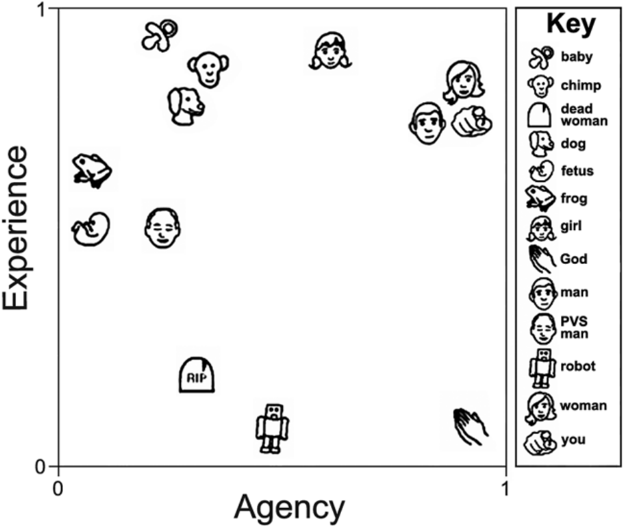
This paper argues that mind perception is not a single continuum but instead has two dimensions: Experience and Agency. Using 2,399 completed web-based surveys, the authors found that these dimensions explain how people judge minds across 13 characters and are differentially related to moral judgments.
## Key findings
- A principal components factor analysis of correlations among 18 mental capacities yielded two factors with eigenvalues over 1.0: Experience (eigenvalue 15.85, explaining 88% of variance) and Agency (eigenvalue 1.46, explaining 8% of variance); the rotated solution explained 97% of rating variance.
- Experience loaded on 11 capacities: hunger, fear, pain, pleasure, rage, desire, personality, consciousness, pride, embarrassment, and joy; Agency loaded on 7 capacities: self-control, morality, memory, emotion recognition, planning, communication, and thought.
- Personal judgments tracked the dimensions differently: liking, saving from destruction, making happy, and perceiving a soul correlated with both dimensions, with r ranging from 0.38 to 0.72.
- Punishment judgments correlated more with Agency than Experience (r = 0.82 vs. r = 0.22, z = 2.86, P < 0.05), while avoidance of harm correlated more with Experience than Agency (r = 0.85 vs. r = 0.26, z = 2.10, P < 0.05).
## Methods
- Web-based Mind Survey design: respondents saw pairwise comparisons of 13 characters across 18 mental capacities or 6 personal judgments, using five-point scales for 78 comparisons per survey.
- Sample: about 3,400 survey launches, with 2,399 completed surveys analyzed; respondents ranged from 12 to 75 years old (mean 30.44, SD 12.27) and were 64% female.
- Main analysis: character means were computed, correlations across capacities were submitted to principal components factor analysis with varimax rotation, and factor scores were estimated via regression; additional analyses examined correlations with personal judgments and individual-difference variables using z-statistics.
## Limitations
- The paper states that the surveys were largely independent and that respondent data came from web recruitment through other psychology sites, which makes the sample a convenience sample rather than a random population sample.
- Evident from the text: the factor structure is based on self-selected web respondents and on pairwise judgments of preselected characters and capacities, so generalizability beyond the survey context is not directly tested.
- The paper notes that about 25% of launched surveys were not completed, indicating noncompletion/missing-data attrition.
Model-written summary. Check it against the paper before relying on it.
Integrity signals
Registry
Cites
Statistics
Figures
Verification
Claims the paper makes
0 Valid · 0 Not valid · 0 Not checked · 18 Own results and interpretations
A result the paper reports from its own data — it cites no other source for it, so there is none to check. The quote shows it is in the paper.
In the paper
“Characters ' factor scores on these dimensions (Fig. 1) reveal interesting features; for example, God was perceived as having much Agency but little Experience.”
- Also stated in: § Dimensions of Mind Perception · plain
“for example, God was perceived as having much Agency but little Experience.”
plain- Asserted: passes — The authors put it forward as true.
- Checkable: passes — It can be checked against evidence.
- Load-bearing: unclear — It is unclear whether the paper’s conclusions depend on it.
- Based: passes — The paper gives a reason why it holds.
- Also stated in: § Dimensions of Mind Perception · plain
A result the paper reports from its own data — it cites no other source for it, so there is none to check. The quote shows it is in the paper.
In the paper
“A factor we termed Experience (eigenvalue = 15.85) accounted for 88% of the variance and included 11 capacities (from highest loading): hunger, fear, pain, pleasure, rage, desire, personality, consciousness, pride, embarrassment, and joy.”
plain- Asserted: passes — The authors put it forward as true.
- Checkable: passes — It can be checked against evidence.
- Load-bearing: passes — The paper’s conclusions depend on it.
- Based: passes — The paper gives a reason why it holds.
A result the paper reports from its own data — it cites no other source for it, so there is none to check. The quote shows it is in the paper.
In the paper
“Of 234 z -statistics (13 characters × 9 individual difference variables × 2 factors), 23 were statistically significant.”
plain- Asserted: passes — The authors put it forward as true.
- Checkable: passes — It can be checked against evidence.
- Load-bearing: unclear — It is unclear whether the paper’s conclusions depend on it.
- Based: passes — The paper gives a reason why it holds.
A result the paper reports from its own data — it cites no other source for it, so there is none to check. The quote shows it is in the paper.
In the paper
“whereas desire to avoid harming ( ' If you were forced to harm one of these characters, which one would it be more painful for you to harm? ' ) correlated more with Experience ( r = 0.85) than Agency ( r = 0.26, z = 2.10, P < 0.05).”
plainstates an association- Asserted: passes — The authors put it forward as true.
- Checkable: passes — It can be checked against evidence.
- Load-bearing: passes — The paper’s conclusions depend on it.
- Based: passes — The paper gives a reason why it holds.
A result the paper reports from its own data — it cites no other source for it, so there is none to check. The quote shows it is in the paper.
In the paper
“The rotated solution accounted for all 18 capacities (extraction communalities ranged from 0.82 to 0.99), explained 97% of rating variance, and yielded two factors with eigenvalues over 1.0.”
plainstates an association- Asserted: passes — The authors put it forward as true.
- Checkable: passes — It can be checked against evidence.
- Load-bearing: passes — The paper’s conclusions depend on it.
- Based: passes — The paper gives a reason why it holds.
5 more claims
Create a free account to see all 18 claims and every source verdict.
- It may state two separate claims as one. 8
- Probably not a substantial claim. 1
Claims other papers make about this one
Each is checked against this paper’s own text: does it say what the citing paper says it does?
The source backs part of the claim, not all of it — or backs it for a different population, condition or comparison.
In the citing paper
“People also anthropomorphize a range of inanimate objects and animals (Kwan & Fiske, 2008; Gray, Gray, & Wegner, 2007).”
From Dehumanized Perception: A Psychological Means to Facilitate Atrocities, Torture, and Genocide? (2011) · cites this paper as Gray, Gray, & Wegner, 2007
Experimental — accuracy not yet measuredThe source backs part of the claim, not all of it — or backs it for a different population, condition or comparison.
In the citing paper
“work in social psychology has demonstrated that mental state attribution is not a unitary concept, but rather involves distinct and independent dimensions of ‘intelligence’ and ‘experience’.”
From The influence of mental state attributions on trust in large language models (2025) · cites this paper as [19]
Experimental — accuracy not yet measuredThe source backs part of the claim, not all of it — or backs it for a different population, condition or comparison.
In the citing paper
“Participants’ ratings for each of the 65 traits (Supplementary Fig. S1a) were reduced via a principal component analysis to two main dimensions, which together explained 58% of the variance (Supplementary Fig. S1b) and mapped onto previously identified dimensions of ‘experience’ (e.g. experiencing pleasure or feeling fearful) and ‘intelligence’ (e.g. knowing things or making choices; Gray et al. 2”
From Folk psychological attributions of consciousness to large language models (2024) · cites this paper as Gray et al. 2007
Experimental — accuracy not yet measuredThe cited source says what the claim attributes to it.
In the citing paper
“This dissociation is supported by factor analyses of ratings of a variety of mental states, which reveal two fundamental factors: agency, or the capacity for high-level reasoning and planning, and experience, or the capacity for sensations and emotions19”
From The influence of mental state attributions on trust in large language models (2025) · cites this paper as [19]
The cited source says what the claim attributes to it.
In the citing paper
“Other work has systematically explored the dimensions underlying mental state attributions to various agents, revealing a two-dimensional structure distinguishing between ‘Experience’ (i.e. the capacity to feel pain, fear, joy, or pride) and ‘Agency’ (i.e. the capacity to have self-control, morality, planning, or communication) that is reminiscent of the distinction between phenomenal and non-phen”
From Folk psychological attributions of consciousness to large language models (2024) · cites this paper as Gray et al. 2007
Statistics recomputed
Every reported test result, recomputed from its test statistic and degrees of freedom. A result shows as not adding up only once an independent check has confirmed it.
- Consistentz = 2.86reported p < .05 · recomputed p = .004
“z = 2.86, p < .05”
- Consistentz = 2.1reported p < .05 · recomputed p = .036
“z = 2.10, p < .05”
Self-check
Percentages, sums and reported differences re-computed from the paper’s own numbers.
Self-check results appear here once an independent check has confirmed them.
Citations
Cites
I.—COMPUTING MACHINERY AND INTELLIGENCE
TURING, A. M. (1950) · Mind · doi:10.1093/mind/lix.236.433 · Cited by 10,290
Does the chimpanzee have a theory of mind?
Premack, D., & Woodruff, G. (1978) · Behavioral and Brain Sciences · doi:10.1017/s0140525x00076512 · Cited by 8,743
Mindblindness: An Essay on Autism and Theory of Mind
Baron-Cohen, S. (1995) · doi:10.7551/mitpress/4635.001.0001 · Cited by 3,428
Dennett, D. C. (1996) · Medical Entomology and Zoology · Cited by 314
Research works printed but not linked: 1
- A. Turing, Mind59, 433 (1950).
Cited by
Items 1,501–1,600 of 2,340
The Reasonable, the Rational, and the Good: On Folk Theories of Deliberative Judgment
Grossmann, I., Kachhiyapatel, N., Meyers, E. A., Zhang, H.-X., & Eibach, R. P. (2025) · Open Mind · doi:10.1162/opmi.a.24 · Cited by 2
“…’ for evaluation of a person showing sound judgment) based on a pilot test where participants described individuals demonstrating sound judgment, and prior research on person and mind perception (Abele et al., 2021; Gray et al., 2007; Wojciszke et al., 1998; see Table S1 in the online supplement).”
A Compassion Paradox: Can AI Truly Bridge the Empathy Gap in Human Relationships?
Liang, S., & Jin, S. Q. (2025) · Springer eBooks · doi:10.1007/978-981-96-7185-4_9 · Cited by 3
Engaging with Bot Narratives: The Audience Experience and Perceptions of Machine Script Writers
Son, R., Yang, Q., Vollmer, B. T., & Johnson, B. K. (2025) · Poetics · doi:10.1016/j.poetic.2025.102057 · Cited by 6
The Minds That Matter: How Robots’ Mental Capacities Shape Children’s Evaluations and Trust
Grigoreva, A. D., & Tasimi, A. (2025) · Open Mind · doi:10.1162/opmi.a.37 · Cited by 3
Zhao, L., Chen, Z., & Wang, Y. (2025) · Journal of Research in Interactive Marketing · doi:10.1108/jrim-06-2025-0306 · Cited by 5
Sogemeier, D., Naujoks, F., Forster, Y., Krems, J. F., & Keinath, A. (2025) · International Journal of Human-Computer Interaction · doi:10.1080/10447318.2025.2578394 · Cited by 5
“Waytz et al. (2014) stated that the process did not solely include attributing superficial human characteristics, e.g., a humanlike face or body, to the nonhuman, but rather essential human characteristics such as the capability to think and feel (Gray et al., 2007).”
Between Man and Machine: Unveiling the Incomplete Moral Agency of Virtual Digital Humans
Xin, J., Ding, X., Xie, C., & Yu, F. (2025) · Topoi · doi:10.1007/s11245-025-10309-x · Cited by 3
The impact of eyes on attributions of agency and experience in humanoid robots
Hietanen, J. K., Linnunsalo, S., & Küster, D. (2025) · Consciousness and Cognition · doi:10.1016/j.concog.2025.103963 · Cited by 4
Liao, W., Lee, Y.-C., Xue, H., & McKinley, E. K. (2025) · Human Communication Research · doi:10.1093/hcr/hqaf026 · Cited by 4
Visually detectable facial mimicry in response to android facial expressions
Yang, D., Sato, W., Hsu, C., Minato, T., & Nishida, S. (2025) · Scientific Reports · doi:10.1038/s41598-025-25394-6 · Cited by 5
“…that humanoid robots were considered not to have subjective experience, i.e., their subjective experience was rated below that of a deceased woman 29 These findings suggest that the explicit, rational evaluation of the subjective states of Nikola may deny the existence of its emotional…”
Kim, S., & Huang, L. (2025) · Journal of Global Marketing · doi:10.1080/08911762.2025.2580341 · Cited by 4
“In addition, according to a mind perception theory (Epley & Waytz, 2010; Gray et al., 2007), people attribute “mind” to agents (human and non-human agents such as robots) based on two dimensions: 1) experience (the capacity to sense and feel via sensory capacity) and 2) agency (the capacity to plan…”
InfluentialBai, Y. (2025) · Humanistic Management Journal · doi:10.1007/s41463-025-00215-0 · Cited by 4
“I argue that this bias arises from people’s overall perception of the differing moral capabilities of humans versus AI systems (Gray et al. 2007 ).”
InfluentialA systematic review of moral agency in artificial agents
Tok, A. Y. F., Powell, N. L., & Guellaï, B. (2025) · Discover Psychology · doi:10.1007/s44202-025-00537-y · Cited by 6
“Included surveys have explored public perceptions of robots’ rights and mental abilities [24, 25].”
InfluentialRuolin, F., Zheng, Y., Li, J., & Xu, G. (2025) · BMC Psychology · doi:10.1186/s40359-025-03655-3 · Cited by 6
“In mind perception, agency reflects an individual’s perception of others’ cognitive functions such as self-control and reasoning, while experience reflects the degree to which an individual perceives other as capable of emotion experiences [32, 33].”
InfluentialEffects of Creativity in AI Advertising: The Mediating Role of Perceived Uncanniness
Hwang, Y., & Jeong, S. (2025) · Cyberpsychology Behavior and Social Networking · doi:10.1177/21522715251410335 · Cited by 2
“On a related note, mind perceptions might be activated and perceived as more threatening when AI is used to aid advertising idea generation (vs. advertising production) and when experience (vs. agency) perceptions 16 are involved.”
Huang, J., & Liao, J. (2026) · Journal of Hospitality Marketing & Management · doi:10.1080/19368623.2026.2613799 · Cited by 2
“Such variety inherently changes the homogeneity of robot replicates, imbuing each robot with a greater sense of uniqueness and autonomy (Gray et al., 2007).”
Ji, A., Paltaratskaya, V., & Wise, K. R. (2026) · International Journal of Human-Computer Interaction · doi:10.1080/10447318.2026.2623229 · Cited by 3
“Consistent with previous research on mind perception and social inference (Gray et al., 2007; Waytz et al., 2010), we model these concepts as a directional perceptual sequence rather than simultaneous evaluations.”
InfluentialWang, X., Guo, L., Xu, L., Guan, L., Ge, P., & Gao, T. (2026) · Ergonomics · doi:10.1080/00140139.2026.2621032 · Cited by 2
Yin, J., Yi, C., & Gu, Q. (2026) · Journal Of Vacation Marketing · doi:10.1177/13567667261425037 · Cited by 4
When tech makes the team: Mind perception as a unifying framework for human and human-agent teams
Harris, A. M., & Larson, L. (2026) · Computers in Human Behavior · doi:10.1016/j.chb.2026.109000 · Cited by 6
Ibrahim, F., Telle, N.-T., Lauckner, M., Karl, J. A., & Daseking, M. (2026) · Computers in Human Behavior Reports · doi:10.1016/j.chbr.2026.101003 · Cited by 4
Ratajczyk, D., Żyła, M., Jaworski, P., & Łupkowski, P. (2026) · International Journal of Social Robotics · doi:10.1007/s12369-025-01352-0 · Cited by 3
Xu, S., & Liu, D. (2026) · Journal of Research in Interactive Marketing · doi:10.1108/jrim-10-2025-0624 · Cited by 3
Pal, O., Duddu, V., Goyal, A., Goel, D., & Saha, K. (2026) · CHI Conference Extended Abstracts on Human Factors in Computing Systems (CHI EA) · doi:10.1145/3772363.3799386 · Cited by 6
“Language models exhibiting human-like behavior elicit anthropomorphic interpretations, often leading users to overestimate their capacities [17, 37, 51].”
Mind perception of artificial intelligence: A systematic review
Li, Y., Qin, X., Yam, K. C., Gray, K. J., Cheng, X., Wen, J., & Lai, X. (2026) · Information Processing & Management · doi:10.1016/j.ipm.2026.104820 · Cited by 6
Self-citationZhang, L., & Zhao, M. Y. (2026) · Computers in Human Behavior · doi:10.1016/j.chb.2026.109039 · Cited by 2
Kumar, S., & Rani, M. (2026) · Business and Society Review · doi:10.1111/basr.70052 · Cited by 3
Balaban, D. C., & Phua, J. (2026) · Computers in Human Behavior · doi:10.1016/j.chb.2026.109047 · Cited by 17
Ghazvini, S. N., Ardabili, B. A., Arash, A. H., Hajmalek, S., Vafa, M. H., & Nosrati, H. (2026) · Computers in Human Behavior · doi:10.1016/j.chb.2026.109080 · Cited by 3
Considering Victims' Minds in the Evaluation of Harmful Agents' Moral Standing
Akechi, H., & Hietanen, J. K. (2021) · Social Cognition · doi:10.1521/soco.2021.39.4.489 · Cited by 2
Sah, Y. J. (2022) · Elsevier eBooks · doi:10.1016/b978-0-323-85648-5.00013-x · Cited by 5
Tepe, B., & Karakulak, A. (2022) · Social Cognition · doi:10.1521/soco.2022.40.4.336 · Cited by 3
Human–agent interaction as augmentation of social intelligence
Ōsawa, H. (2023) · Artificial Life and Robotics · doi:10.1007/s10015-023-00874-y · Cited by 3
“…not actually a single one, but consists of multiple independent factors and at different stages of development. using multiple illustrations, Gray et al. found that “intelligence” and “friendliness” are two of the most important aspects of human-like qualities perceived in artificial objects [28].”
BackgroundMind Attribution to Gods and Christians in the Chinese Cultural Context
Tian, Q., Becker, M., & Hilton, D. (2023) · Journal for the Scientific Study of Religion · doi:10.1111/jssr.12874 · Cited by 2
Fortuna, P., Wróblewski, Z., Gut, A., & Dutkowska, A. (2023) · Current Psychology · doi:10.1007/s12144-023-05313-6 · Cited by 7
“While the effect of soul attribution on MS was a new, if anticipated, result, the mind—MS relationship only confirmed the relationship noted in research on mind perception (see: Gray et al., 2007).”
Kettle, L., McCarty, M. M., Simpson, K. L., & Lee, Y. (2023) · Human Behavior and Emerging Technologies · doi:10.1155/2023/9009791 · Cited by 3
“Anthropo-morphism in this context relates to the attribution of human-like mental capacities of agency to nonhuman agents [36].”
BackgroundStein, J., Messingschlager, T. V., & Hutmacher, F. (2023) · Springer eBooks · doi:10.1007/978-3-662-66608-1_17 · Cited by 3
Humor and morality in organizations
Yam, K. C., & Ye, Y. M. (2024) · Current Opinion in Psychology · doi:10.1016/j.copsyc.2024.101799 · Cited by 2
Development of the Japanese version of the Individual Differences in Anthropomorphism Questionnaire
Nakamura, H., Matsuo, A., & Majima, Y. (2024) · The Japanese journal of psychology · doi:10.4992/jjpsy.95.22217 · Cited by 6
Contextual Effects on Attributing Minds to Older Adults
Cassidy, B., & Ojeda, J. T. (2024) · Current Research in Ecological and Social Psychology · doi:10.1016/j.cresp.2024.100195 · Cited by 1
The Use of AI in Personalized Marketing: Balancing Benefits and Privacy Concerns
Yadav, M., Kumar, A., & Jha, R. (2024) · International Journal of Advanced Research in Science Communication and Technology · doi:10.48175/ijarsct-17823 · Cited by 6
Incomplete Faces Do but Masked Faces Do Not Affect Mind Perception
Pazhoohi, F., Aoki, K., & Kingstone, A. F. (2024) · Psychological Reports · doi:10.1177/00332941241269547 · Cited by 1
“The current study aimed to test whether face masks affect mind perception (Gray et al., 2007).”
Female Sexual Objectification Among Gay Men: Neural and Cultural Insights
Ruzzante, D., Cogoni, C., & Vaes, J. (2024) · The Journal of Men s Studies · doi:10.1177/10608265241281721 · Cited by 2
“Then, they evaluated the mind of the person in the pictures using 6 items of the Mind attribution scale (Gray et al., 2007), such as the level of “ self-control ” , “ feeling pain ” , “ acting morally ” , “ feeling desire ” , “ planning ” and “ feeling fear ” on a 7-point scale (1 = Not at all to 7…”
Xia, L., Wang, J., & Gao, F. (2024) · European Journal of Marketing · doi:10.1108/ejm-02-2023-0074 · Cited by 6
Think Once, Think Again: Exploring the Harm-Made Mind Effect Through Dual-Process Theory
Koban, K., & Wieringa, M. S. (2024) · International Journal of Social Robotics · doi:10.1007/s12369-024-01179-1 · Cited by 8
“The harm-made mind phenomenon is typically explained by the theory of dyadic morality [27, 28], which assigns mind perception (i.e., the perception of diverse mental abilities in others) the central role in morality.”
InfluentialShank, D. B., Dew, M., & Sajjad, F. (2024) · Behaviour and Information Technology · doi:10.1080/0144929x.2024.2403651 · Cited by 4
“Humans are perceived as having more agency – the capacity to take action, make things happen, and effect change in the world – than AIs (Gray, Gray, and Wegner 2007; Wegner and Gray 2017) and therefore an agentic behaviour by AIs can reveal more and motivate impression changes than the equivalent…”
Ties That Bind: Group Effects in Human-Robot Team Interaction in Japan and the United States
Collins, S., Fraune, M. R., Amon, K. J., Smith, E. R., & Šabanović, S. (2024) · IEEE RO-MAN · doi:10.1109/ro-man60168.2024.10731311 · Cited by 2
“They also rated perceptions of the players’ experience, including positive traits (i.e., pleasure, desire, personality, consciousness, pride, joy; Cronbach α = .787) and negative (i.e., fear, pain, rage, embarrassment; Cronbach α = .755; Gray et al, 2007).”
BackgroundBiodiversity and cultural diversity are morally valued
Klebl, C., Jetten, J., Bastian, B. B., & Lee, J. (2024) · British Journal of Social Psychology · doi:10.1111/bjso.12818 · Cited by 3
Beauty Builds Cooperation by Increasing Moral Concern for the Environment
Kirkland, K., Lange, P. A. M. V., Charalambous, N., Strauss, C. R., & Bastian, B. B. (2024) · Environment and Behavior · doi:10.1177/00139165241291700 · Cited by 3
“To date, much of moral psychology and philosophy has underscored the pivotal role of sentience in the application of moral principles (Bentham, 1789; Gray et al., 2007; Kant, 1785; Mill, 1998; Schein & Gray, 2018; Sidgwick, 1907; Singer, 1995).”
Are humanoid robots perceived as mindless mannequins?
Tidoni, E., Cross, E. S., Ramsey, R., & Scandola, M. (2024) · Computers in Human Behavior Artificial Humans · doi:10.1016/j.chbah.2024.100105 · Cited by 4
“More studies are needed to assess how mind attribution to humans, monkeys, and robots (Gray et al., 2007; Leach et al., 2023) and their perceptual differences (e.g., fur, having the tail, different body ratios between humans, robots, and apes) may influence search asymmetries.”
Physical anthropomorphism (but not gender presentation) influences trust in household robots
Holbrook, C., Krishnamurthy, U., Maglio, P. P., & Wagner, A. R. (2024) · Computers in Human Behavior Artificial Humans · doi:10.1016/j.chbah.2024.100114 · Cited by 4
Diet predicts mind and moral concern towards a broad range of animal categories
Hankins, E., Jenkins, R., Bousfield, E., & Wilks, M. (2024) · Psychology of Human-Animal Intergroup Relations · doi:10.5964/phair.14597 · Cited by 2
Sun, Y., & Xiao, C. (2024) · International Journal of Human-Computer Interaction · doi:10.1080/10447318.2024.2443251 · Cited by 4
“During human-animal interaction, people would behave appropriately in accordance with the mind perception of others (Gray et al., 2007), like speaking simply and acting slowly when playing with a dog, similar to caring for babies (Prato-Previde et al., 2022).”
InfluentialMind Perception of Avatars: A Focus Group Study
Mazerant, K., Schouten, A. P., Smit, S. B. T., van Berlo, Z. M. C., & Willemsen, L. M. (2025) · Communications in computer and information science · doi:10.1007/978-3-031-80472-4_9 · Cited by 3
Milo, R., Cordasco, G., & Esposito, A. A. (2024) · IEEE International Conference on Cognitive Infocommunications · doi:10.1109/coginfocom63007.2024.10894710 · Cited by 2
Not Relying on Emotions: Organizations Using Algorithms are Considered Less Warm
Chen, Y., Fu, R., Zhou, X., & Lu, J. (2025) · Basic and Applied Social Psychology · doi:10.1080/01973533.2025.2474419 · Cited by 4
“Because algorithms are perceived as lacking emotions (Bigman & Gray, 2018; Gray et al., 2007; Haslam et al., 2008; Kahn et al., 2007), people believe that organizations that employ algorithms resist relying on emotions.”
NAO, I Can Read Your Mind: Preschool-Aged Children Construct Theory of Artificial Mind (ToAM)
Mao, K., Li, Z. Y., Lu, Z., Nishimura, Y., & Li, T. (2025) · International Journal of Human-Computer Interaction · doi:10.1080/10447318.2025.2474488 · Cited by 2
“About 15 years ago, Gray et al. (2007) and Bartneck et al. (2009) respectively developed distinct instruments for measuring mental state attribution, differentiating various dimensions such as experience, agency, and likability.”
AI Robots and Moral Dilemmas: The Role of AI Robots’ Gender and Dilemma Types
Zhu, C., Su, R., Wang, C., & Zuo, B. (2025) · International Journal of Human-Computer Interaction · doi:10.1080/10447318.2025.2480874 · Cited by 2
“A complete mind is typically regarded as a prerequisite for moral decision-making and encompasses two dimensions: agency and experience (Bigman & Gray, 2018; Gray et al., 2007).”
The Pinocchio effect: AI and the risk of diminished human-self perceptions of agency i
Puranam, P. (2025) · Journal of Risk Research · doi:10.1080/13669877.2025.2496229 · Cited by 2
“What matters for human-AI interaction is the presence of agency - the capacity to think, plan, and act (Gray, Gray, and Wegner 2007; Gray and Wegner 2012)—which humans undoubtedly possess, and some AI systems may genuinely have begun to display, which is why the problem of “alignment” has become so…”
Living with AI: Examining Older Adults’ Preferences for Task Assistance
Lei, W., & Chen, K. (2025) · Lecture notes in computer science · doi:10.1007/978-3-031-92712-6_25 · Cited by 2
What Makes People Use Social Robots? Integrating Trustworthiness Into the UTAUT Model
Fischer, K., Kim, D.-G., & Hong, J.-W. (2025) · Lecture notes in computer science · doi:10.1007/978-3-031-93412-4_4 · Cited by 3
Exploration of Mehrabian’s communication model with an android
Sato, W., Shimokawa, K., & Minato, T. (2025) · Scientific Reports · doi:10.1038/s41598-025-11745-w · Cited by 3
“However, as a previous study showed that people generally believe that humanoid robots have no subjective experience, akin to dead people 16 we asked participants to rate the “expressed emotion” at the behavioral level, without referring to subjective emotional states.”
Generative Artificial Intelligence as Creative Artificial Intelligence
Appel, M., Messingschlager, T. V., Raffloer, G., & Reed, P. A. (2025) · Oxford University Press eBooks · doi:10.1093/oxfordhb/9780197689875.013.0016 · Cited by 2
Sharan, N. N., Peter, J., & van Straten, C. L. (2025) · International Journal of Social Robotics · doi:10.1007/s12369-025-01293-8 · Cited by 3
“Second, people attribute mind to robots [52]: a characteristic that is usually considered fundamental to humans and lacking in robots [53].”
Tricking into Trusting? The Influence of Social Cues of a Generative AI on Perceived Trust
Krämer, N. C., Lamia, I., Siegert, H., Wenda, F., & Suchmann, L. B. (2025) · ACM Transactions on Interactive Intelligent Systems · doi:10.1145/3771844 · Cited by 11
“Thus, if an entity is said to have consciousness, it is treated morally as well as held responsible for its actions [Gray et al., 2007].”
Tavares, V., & Melo‐Pfeifer, S. (2025) · Oxford University Press eBooks · doi:10.1093/oxfordhb/9780192869203.013.41 · Cited by 7
Are We Automating the Joy Out of Work? Designing AI to Augment Work, Not Meaning
Ranjit, J., Zhou, K., Swayamdipta, S., & Quercia, D. (2026) · CHI Conference on Human Factors in Computing Systems · doi:10.1145/3772318.3791845 · Cited by 9
“When people further attribute a ‘mind’ to AI in such studies, they tend to collaborate with it more, and also blame it more when it makes errors, with these effects amplified by human-like cues [38, 90].”
Hernandez, I. A., Preston, J. L., & Hepler, J. (2014) · PLoS ONE · doi:10.1371/journal.pone.0083320 · Cited by 2
Studying the Opposing Effects of Robot Presence on Human Corruption
Roizman, M., Hoffman, G., Ayal, S., Hochman, G., Tagar, M. R., & Maaravi, Y. (2016) · ACM/IEEE International Conference on Human-Robot Interaction (HRI) · doi:10.5555/2906831.2906947 · Cited by 2
Giving Robots a Voice: Testimony, Intentionality, and the Law
Wheeler, B. (2017) · Advances in computational intelligence and robotics book series · doi:10.4018/978-1-5225-2973-6.ch001 · Cited by 2
Harmful Attributions: The Role of Mind Perception
Silva, C., & Tsay, C. (2019) · Journal of Social and Clinical Psychology · doi:10.1521/jscp.2019.38.9.788 · Cited by 2
Effect of Anthropomorphic Design on the Effectiveness of Motivational Messages
Sikorski, E. G., Mulvey, S., & Wiese, E. (2019) · Proceedings of the Human Factors and Ergonomics Society Annual Meeting · doi:10.1177/1071181319631349 · Cited by 2
“Since animal-like agents are usually ascribed less mind than human-like or human agents (Gray et al., 2007), our specific hypotheses are: H1 – Messages paired with a human image will be rated as more motivational than messages paired with an anthropomorphic or zoomorphic robot image.”
BackgroundDeciding Machines: Moral-Scene Assessment for Intelligent Systems
Greenberg, A. M. (2020) · Elsevier eBooks · doi:10.1016/b978-0-12-820543-3.00006-7 · Cited by 6
Why do ethicists eat their greens?
Sneddon, A. (2020) · Philosophical Psychology · doi:10.1080/09515089.2020.1787973 · Cited by 2
Relationship between autism and mind perception of selves, others, and toy objects
Au, R. H. Y. (2021) · International Journal of Personality Psychology · doi:10.21827/ijpp.7.37351 · Cited by 3
“Mind perception is important to morality, with experiential mental capacities predicting moral respect and agentic ones predicting moral responsibility (Gray et al., 2007; K. Gray et al., 2012; Waytz et al., 2010b).”
BackgroundResultInfluentialMental inference: Mind perception as Bayesian model selection.
Burger, L., & Jara‐Ettinger, J. (2020) · eScholarship (California Digital Library) · Cited by 6
Yang, J., Xu, T., Hou, Y., Monczynski, E. C., & Jiang, X. (2021) · Psychological Reports · doi:10.1177/00332941211007080 · Cited by 2
“According to mind perception theory (Gray et al., 2007), people who anthropomorphize money tend to temporarily think of money as a warm person rather than an object, and therefore they are more likely to donate money (X. Zhou et al., 2019).”
BackgroundModulating the Intentional Stance: Humanoid Robots, Narrative and Autistic Traits
O’Reilly, Z., Ghiglino, D., Spatola, N., & Wykowska, A. (2021) · Lecture notes in computer science · doi:10.1007/978-3-030-90525-5_61 · Cited by 4
Naryan, S., & Bykov, A. V. (2022) · Sociological Journal · doi:10.19181/socjour.2022.28.1.8835 · Cited by 4
Hostettler, D. (2022) · CHI Conference Extended Abstracts on Human Factors in Computing Systems (CHI EA) · doi:10.1145/3491101.3503812 · Cited by 2
“(De)Humanization [23] as well as mind perception [22][52][51][39] describe how humans perceive others”
BackgroundBai, H., Euh, H., Federico, C. M., & Borgida, E. (2021) · Social Cognition · doi:10.1521/soco.2021.39.6.657 · Cited by 5
Two Conceptions of Subjective Experience
Sytsma, J. M., & Machery, É. (2014) · Oxford University Press eBooks · doi:10.1093/acprof:osobl/9780199927418.003.0005 · Cited by 3
Exploring the Representational Structure of Trait Knowledge Using Perceived Similarity Judgments
Kim, M. J., Young, L., & Anzellotti, S. (2022) · Social Cognition · doi:10.1521/soco.2022.40.6.549 · Cited by 2
“…which consists of warmth and competence (Fiske et al., 2002); (3) the twofactor model of mind perception, which consists of agency and experience (Gray et al., 2007); and (4) the two-factor model of face perception, which consists of trustworthiness and dominance (Oosterhof & Todorov, 2008).”
BackgroundAshton, H., & Franklin, M. (2022) · Communications in computer and information science · doi:10.1007/978-3-031-19682-9_59 · Cited by 2
Personalized and Contextual Artificial Intelligence-Based Services Experience
Pitardi, V. (2023) · Springer eBooks · doi:10.1007/978-3-031-33898-4_5 · Cited by 6
Saito, T. I., Hugenberg, K., Motoki, K., & Nouchi, R. (2023) · Japanese Psychological Research · doi:10.1111/jpr.12472 · Cited by 2
The implicit perception of harm following moral violations in autism
Osler, G., Franchin, L., Guglielmetti, G., Calzolari, S., Micciolo, R., & Surian, L. (2023) · Thinking & Reasoning · doi:10.1080/13546783.2023.2259538 · Cited by 2
“Gray et al. (2007) suggested that the perception of another mind is the result of two independent mind perception dimensions: agency and experience. the agency dimension consists of cognitive mind perception, such as the ability to engage in reasoned action or goal directed behaviour, whereas the…”
BackgroundBorges-Castells, N., Betancor, V., & Pérez, A. R. (2024) · Current Psychology · doi:10.1007/s12144-024-06278-w · Cited by 2
“Dehumanization With this scale, we measure participants' tendency to attribute fewer mental and perceptual capabilities to the aggressors, which is related to considering them as less human (Gray et al., 2007).”
InfluentialThinking Socially About the Nonsocial World
Stroessner, S. J., & Koya, P. D. (2024) · Oxford University Press eBooks · doi:10.1093/oxfordhb/9780197763414.013.22 · Cited by 2
Lekka, D., Richardson, C., Madoglou, A., Orlandou, K., Arachoviti, V., Karamanoli, V. I., Roubi, A., Togas, C., Tsaraklis, A., & Stalikas, A. (2022) · Cureus · doi:10.7759/cureus.21445 · Cited by 2
Adults' Attributions of Psychological Agency, Credit, and Fairness to a Humanoid Social Robot
Gary, H. E. (2015) · ResearchWorks at the University of Washington (University of Washington) · Cited by 4
Exploring Human Nature: A reflexive mixed methods enquiry into Solo time in the wilderness
Lemke, J. (2018) · Natallia Sender (Europa-Universität Viadrina Frankfurt) · Cited by 3
An Affective Robot Companion for Assisting the Elderly in a Cognitive Game ScenarioPreprint
Churamani, N., Sutherland, A., & Barros, P. V. A. (2018) · arXiv (Cornell University) · doi:10.48550/arxiv.1807.09825 · Cited by 2
“[8], as well as objective performance evaluations based on emotion recognition and the improvement in the performance of the users, over time.”
BackgroundExceptionalist Naturalism: Human Agency and the Causal OrderPreprint
Turri, J. (2020) · doi:10.31219/osf.io/y8dg2 · Cited by 2
Speciesism in everyday languagePreprint
Leach, S., Kitchin, A. P., Sutton, R. M., et al. (2021) · doi:10.31234/osf.io/ktvgx · Cited by 2
The Psychology of Big Data: Developing a 'Theory of Machine' to Examine Perceptions of AlgorithmsPreprint
Logg, J. M. (2018) · SSRN Electronic Journal · doi:10.2139/ssrn.3878873 · Cited by 2
Dehumanization and mass violence: A study of mental state language in Nazi propaganda (1927-1945)Preprint
Landry, A., Mere, K., & Orr, R. I. (2021) · doi:10.31234/osf.io/7w2vk · Cited by 2
Innocence over utilitarianism - Heightened Moral Standards for Robots in Rescue Dilemmas PREPRINTPreprint
Sundvall, J. R. I., Drosinou, M., Hannikainen, I. R., Elovaara, K., Halonen, J., Herzon, V., Kopecký, R., Košová, M. J., Koverola, M., Kunnari, A., et al. (2021) · doi:10.31234/osf.io/2p3ke · Cited by 2
White, C., Norenzayan, A., & Schaller, M. (2019) · doi:10.31234/osf.io/ypj9v · Cited by 2
Hanson, R. (2016) · Oxford University Press eBooks · doi:10.1093/oso/9780198754626.003.0015 · Cited by 2
Metadata
- Authors
- Gray, H. M., Gray, K., & Wegner, D. M.
- Affiliations
- Harvard University (US)
- Corresponding author
- Gray, Heather M.
- Venue
- Science
- Published
- 2007-02-02
- Volume
- 315
- Issue
- 5812
- Pages
- 619-619
- ISSN
- 0036-8075 (ISSN-L)
- 1095-9203
- OpenAlex
- W2131227926
- Cited by
- 2,342
- References
- 4
- Citations by year
- 2026: 359 · 2025: 326 · 2024: 249 · 2023: 220 · 2022: 198 · 2021: 156 · 2020: 157 · 2019: 107 · 2018: 91 · 2017: 86 · 2016: 96 · 2015: 66 · 2014: 52 · 2013: 44 · 2012: 45
- FWCI
- 10.81
- Type
- journal article
- Language
- en
- Open access
- closed
- Locations
- Science (publishedVersion)
- PubMed (publishedVersion)
- Funders
- National Institutes of Health (1f31mh071053-01)
- National Institute of Mental Health (MH-71053, MH 49127, R01MH049127)
- Topics
- Life Sciences › Neuroscience › Cognitive Neuroscience › Psychology of Moral and Emotional Judgment
- Social Sciences › Psychology › Social Psychology › Social Robot Interaction and HRI
- Social Sciences › Sociology and Political Science › Social and Intergroup Psychology
- Keywords
- mind perception, moral judgment, agency, experience, non-human animals, personification, moral status of animals, self-control, hunger
- MeSH terms
- Adolescent, Adult, Aged, Child, Emotions, Female, Humans, Male, Mental Processes, Middle Aged, Morals, Perception, Personality, Principal Component Analysis
About these checks
Registry, retraction, Cites and statistics results are computed, not judged, with one exception: a printed reference that no index lists is read once by a model before it counts as a citation error. Claims are extracted by a model and kept only when their quote appears verbatim in the text; each cited source is then checked, with a model’s help, for whether it says what the claim relies on. Those verdicts can be wrong — read the claim’s quote and the cited source before relying on one.
A language model drew the claims from the paper on 2026-09-28, under version 3 of the claim definition (model deepseek-v4.1-flash, prompt extract-v3).
A second model labelled each claim on 2026-09-28 (model jev-1.13-20260917, definition revision gold-guideline-v0.2).
Statistics and arithmetic are recomputed, not judged.
Confidence bands are shown only for fields calibrated on our annotated test set. None is calibrated yet, so no band is shown.
What counts as a claim ›How we measure confidence ›How we check this ›
Are you an author, or do you see a problem with this page? Request a review
Data sources
Bibliographic data: Semantic Scholar, OpenAlex, Crossref.
Contains information from the Semantic Scholar Academic Graph Datasets, made available under the ODC Attribution License (ODC-BY 1.0).
Semantic Scholar’s data is described in: Kinney, R., et al. (2023). The Semantic Scholar Open Data Platform. arXiv:2301.10140.
