

Dimensions of Mind Perception
The DOI matches its Crossref record; 4 of the 4 references it cites were found in a registry or an index.
Abstract
Participants compared the mental capacities of various human and nonhuman characters via online surveys. Factor analysis revealed two dimensions of mind perception, Experience (for example, capacity for hunger) and Agency (for example, capacity for self-control). The dimensions predicted different moral judgments but were both related to valuing of mind.
Overview
CoChat Summary
## TL;DR
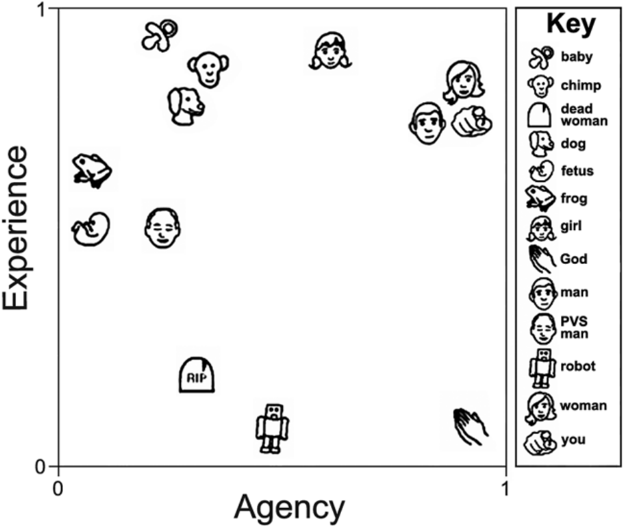
This paper argues that mind perception is not a single continuum but instead has two dimensions: Experience and Agency. Using 2,399 completed web-based surveys, the authors found that these dimensions explain how people judge minds across 13 characters and are differentially related to moral judgments.
## Key findings
- A principal components factor analysis of correlations among 18 mental capacities yielded two factors with eigenvalues over 1.0: Experience (eigenvalue 15.85, explaining 88% of variance) and Agency (eigenvalue 1.46, explaining 8% of variance); the rotated solution explained 97% of rating variance.
- Experience loaded on 11 capacities: hunger, fear, pain, pleasure, rage, desire, personality, consciousness, pride, embarrassment, and joy; Agency loaded on 7 capacities: self-control, morality, memory, emotion recognition, planning, communication, and thought.
- Personal judgments tracked the dimensions differently: liking, saving from destruction, making happy, and perceiving a soul correlated with both dimensions, with r ranging from 0.38 to 0.72.
- Punishment judgments correlated more with Agency than Experience (r = 0.82 vs. r = 0.22, z = 2.86, P < 0.05), while avoidance of harm correlated more with Experience than Agency (r = 0.85 vs. r = 0.26, z = 2.10, P < 0.05).
## Methods
- Web-based Mind Survey design: respondents saw pairwise comparisons of 13 characters across 18 mental capacities or 6 personal judgments, using five-point scales for 78 comparisons per survey.
- Sample: about 3,400 survey launches, with 2,399 completed surveys analyzed; respondents ranged from 12 to 75 years old (mean 30.44, SD 12.27) and were 64% female.
- Main analysis: character means were computed, correlations across capacities were submitted to principal components factor analysis with varimax rotation, and factor scores were estimated via regression; additional analyses examined correlations with personal judgments and individual-difference variables using z-statistics.
## Limitations
- The paper states that the surveys were largely independent and that respondent data came from web recruitment through other psychology sites, which makes the sample a convenience sample rather than a random population sample.
- Evident from the text: the factor structure is based on self-selected web respondents and on pairwise judgments of preselected characters and capacities, so generalizability beyond the survey context is not directly tested.
- The paper notes that about 25% of launched surveys were not completed, indicating noncompletion/missing-data attrition.
Model-written summary. Check it against the paper before relying on it.
Integrity signals
Registry
Cites
Statistics
Figures
Verification
Claims the paper makes
0 Valid · 0 Not valid · 0 Not checked · 18 Own results and interpretations
A result the paper reports from its own data — it cites no other source for it, so there is none to check. The quote shows it is in the paper.
In the paper
“Characters ' factor scores on these dimensions (Fig. 1) reveal interesting features; for example, God was perceived as having much Agency but little Experience.”
- Also stated in: § Dimensions of Mind Perception · plain
“for example, God was perceived as having much Agency but little Experience.”
plain- Asserted: passes — The authors put it forward as true.
- Checkable: passes — It can be checked against evidence.
- Load-bearing: unclear — It is unclear whether the paper’s conclusions depend on it.
- Based: passes — The paper gives a reason why it holds.
- Also stated in: § Dimensions of Mind Perception · plain
A result the paper reports from its own data — it cites no other source for it, so there is none to check. The quote shows it is in the paper.
In the paper
“A factor we termed Experience (eigenvalue = 15.85) accounted for 88% of the variance and included 11 capacities (from highest loading): hunger, fear, pain, pleasure, rage, desire, personality, consciousness, pride, embarrassment, and joy.”
plain- Asserted: passes — The authors put it forward as true.
- Checkable: passes — It can be checked against evidence.
- Load-bearing: passes — The paper’s conclusions depend on it.
- Based: passes — The paper gives a reason why it holds.
A result the paper reports from its own data — it cites no other source for it, so there is none to check. The quote shows it is in the paper.
In the paper
“Of 234 z -statistics (13 characters × 9 individual difference variables × 2 factors), 23 were statistically significant.”
plain- Asserted: passes — The authors put it forward as true.
- Checkable: passes — It can be checked against evidence.
- Load-bearing: unclear — It is unclear whether the paper’s conclusions depend on it.
- Based: passes — The paper gives a reason why it holds.
A result the paper reports from its own data — it cites no other source for it, so there is none to check. The quote shows it is in the paper.
In the paper
“whereas desire to avoid harming ( ' If you were forced to harm one of these characters, which one would it be more painful for you to harm? ' ) correlated more with Experience ( r = 0.85) than Agency ( r = 0.26, z = 2.10, P < 0.05).”
plainstates an association- Asserted: passes — The authors put it forward as true.
- Checkable: passes — It can be checked against evidence.
- Load-bearing: passes — The paper’s conclusions depend on it.
- Based: passes — The paper gives a reason why it holds.
A result the paper reports from its own data — it cites no other source for it, so there is none to check. The quote shows it is in the paper.
In the paper
“The rotated solution accounted for all 18 capacities (extraction communalities ranged from 0.82 to 0.99), explained 97% of rating variance, and yielded two factors with eigenvalues over 1.0.”
plainstates an association- Asserted: passes — The authors put it forward as true.
- Checkable: passes — It can be checked against evidence.
- Load-bearing: passes — The paper’s conclusions depend on it.
- Based: passes — The paper gives a reason why it holds.
5 more claims
Create a free account to see all 18 claims and every source verdict.
- It may state two separate claims as one. 8
- Probably not a substantial claim. 1
Claims other papers make about this one
Each is checked against this paper’s own text: does it say what the citing paper says it does?
The source backs part of the claim, not all of it — or backs it for a different population, condition or comparison.
In the citing paper
“People also anthropomorphize a range of inanimate objects and animals (Kwan & Fiske, 2008; Gray, Gray, & Wegner, 2007).”
From Dehumanized Perception: A Psychological Means to Facilitate Atrocities, Torture, and Genocide? (2011) · cites this paper as Gray, Gray, & Wegner, 2007
Experimental — accuracy not yet measuredThe source backs part of the claim, not all of it — or backs it for a different population, condition or comparison.
In the citing paper
“work in social psychology has demonstrated that mental state attribution is not a unitary concept, but rather involves distinct and independent dimensions of ‘intelligence’ and ‘experience’.”
From The influence of mental state attributions on trust in large language models (2025) · cites this paper as [19]
Experimental — accuracy not yet measuredThe source backs part of the claim, not all of it — or backs it for a different population, condition or comparison.
In the citing paper
“Participants’ ratings for each of the 65 traits (Supplementary Fig. S1a) were reduced via a principal component analysis to two main dimensions, which together explained 58% of the variance (Supplementary Fig. S1b) and mapped onto previously identified dimensions of ‘experience’ (e.g. experiencing pleasure or feeling fearful) and ‘intelligence’ (e.g. knowing things or making choices; Gray et al. 2”
From Folk psychological attributions of consciousness to large language models (2024) · cites this paper as Gray et al. 2007
Experimental — accuracy not yet measuredThe cited source says what the claim attributes to it.
In the citing paper
“This dissociation is supported by factor analyses of ratings of a variety of mental states, which reveal two fundamental factors: agency, or the capacity for high-level reasoning and planning, and experience, or the capacity for sensations and emotions19”
From The influence of mental state attributions on trust in large language models (2025) · cites this paper as [19]
The cited source says what the claim attributes to it.
In the citing paper
“Other work has systematically explored the dimensions underlying mental state attributions to various agents, revealing a two-dimensional structure distinguishing between ‘Experience’ (i.e. the capacity to feel pain, fear, joy, or pride) and ‘Agency’ (i.e. the capacity to have self-control, morality, planning, or communication) that is reminiscent of the distinction between phenomenal and non-phen”
From Folk psychological attributions of consciousness to large language models (2024) · cites this paper as Gray et al. 2007
Statistics recomputed
Every reported test result, recomputed from its test statistic and degrees of freedom. A result shows as not adding up only once an independent check has confirmed it.
- Consistentz = 2.86reported p < .05 · recomputed p = .004
“z = 2.86, p < .05”
- Consistentz = 2.1reported p < .05 · recomputed p = .036
“z = 2.10, p < .05”
Self-check
Percentages, sums and reported differences re-computed from the paper’s own numbers.
Self-check results appear here once an independent check has confirmed them.
Citations
Cites
I.—COMPUTING MACHINERY AND INTELLIGENCE
TURING, A. M. (1950) · Mind · doi:10.1093/mind/lix.236.433 · Cited by 10,290
Does the chimpanzee have a theory of mind?
Premack, D., & Woodruff, G. (1978) · Behavioral and Brain Sciences · doi:10.1017/s0140525x00076512 · Cited by 8,743
Mindblindness: An Essay on Autism and Theory of Mind
Baron-Cohen, S. (1995) · doi:10.7551/mitpress/4635.001.0001 · Cited by 3,428
Dennett, D. C. (1996) · Medical Entomology and Zoology · Cited by 314
Research works printed but not linked: 1
- A. Turing, Mind59, 433 (1950).
Cited by
On seeing human: A three-factor theory of anthropomorphism
Epley, N., Waytz, A., & Cacioppo, J. T. (2007) · Psychological Review · doi:10.1037/0033-295x.114.4.864 · Cited by 4,069
Algorithm appreciation: People prefer algorithmic to human judgment
Logg, J. M., Minson, J. A., & Moore, D. A. (2019) · Organizational Behavior and Human Decision Processes · doi:10.1016/j.obhdp.2018.12.005 · Cited by 2,061
The mind in the machine: Anthropomorphism increases trust in an autonomous vehicle
Waytz, A., Heafner, J., & Epley, N. (2014) · Journal of Experimental Social Psychology · doi:10.1016/j.jesp.2014.01.005 · Cited by 1,439
“Four items measured anthropomorphism, defined as attributing humanlike mental capacities of agency and experience to it (Epley, Waytz, & Cacioppo, 2007; Gray et al., 2007; Waytz et al., 2010).”
BackgroundFeuerriegel, S., Hartmann, J., Janiesch, C., & Zschech, P. (2024) · Business & Information Systems Engineering · doi:10.1007/s12599-023-00834-7 · Cited by 2,267
“…fuels another important observation: The theory of mind is an established theoretical lens in psychology to describe the cognitive ability of individuals to understand and predict the mental states, emotions, and intentions of others (Carlson et al. 2013; Baron-Cohen 1997; Gray et al. 2007).”
Lee, M. K. (2018) · Big Data & Society · doi:10.1177/2053951718756684 · Cited by 1,338
“On the other hand, research on bots and robot suggests that people may perceive computational systems as having less agency and emotional capability than humans (Gray et al., 2007; Gray and Wegner, 2012; Waytz and Norton, 2014).”
BackgroundWho Sees Human?: The Stability and Importance of Individual Differences in Anthropomorphism
Waytz, A., Cacioppo, J., & Epley, N. (2010) · Perspectives on Psychological Science · doi:10.1177/1745691610369336 · Cited by 1,228
“Existing research demonstrates that people more willingly punish an agent they consider mindful (Gray et al., 2007), and corporations represented as single, personified agents may be held more legally responsible for moral violations than corporations that are represented as collectives of…”
BackgroundDehumanization and Infrahumanization
Haslam, N., & Loughnan, S. (2014) · Annual Review of Psychology · doi:10.1146/annurev-psych-010213-115045 · Cited by 1,143
“A surprising finding of this research is that mind is ascribed along two separate dimensions (Gray et al. 2007).”
BackgroundMind Perception Is the Essence of Morality
Gray, K., Young, L., & Waytz, A. (2012) · Psychological Inquiry · doi:10.1080/1047840x.2012.651387 · Cited by 1,008
“Respondents evaluated both the mental capacities of diverse targets (e.g., adult humans, babies, animals, God) and their moral standing (Gray et al., 2007).”
BackgroundInfluentialSelf-citationThe Neural Bases of Social Cognition and Story Comprehension
Mar, R. A. (2011) · Annual Review of Psychology · doi:10.1146/annurev-psych-120709-145406 · Cited by 950
“The level of intentionality attributed to other minds appears to be determined by varying levels of two dimensions, labeled as either warmth and competence (Fiske et al. 2007) or experience and agency (Gray et al. 2007).”
BackgroundFeeling robots and human zombies: Mind perception and the uncanny valley
Gray, K., & Wegner, D. M. (2012) · Cognition · doi:10.1016/j.cognition.2012.06.007 · Cited by 941
“Adult humans do have significantly more agency than robots, but there is also a striking experience gap : humans are perceived to be significantly more capable of experiencing emotion and sensation than are robots and other machines (Gray et al., 2007; Huebner, 2009).”
BackgroundInfluentialSelf-citationZaki, J. (2014) · Psychological Bulletin · doi:10.1037/a0037679 · Cited by 821
When We Need A Human: Motivational Determinants of Anthropomorphism
Epley, N., Waytz, A., Akalis, S., & Cacioppo, J. T. (2008) · Social Cognition · doi:10.1521/soco.2008.26.2.143 · Cited by 626
“Leyens et al., 2003), or inner mental states and motivations ( Gray, Gray, & Wegner, 2007 ).”
BackgroundRationalizing meat consumption. The 4Ns
Piazza, J., Ruby, M. B., Loughnan, S., Luong, M., Kulik, J., Watkins, H. M., & Seigerman, M. (2015) · Appetite · doi:10.1016/j.appet.2015.04.011 · Cited by 768
Blame the Bot: Anthropomorphism and Anger in Customer–Chatbot Interactions
Crolic, C., Thomaz, F., Hadi, R., & Stephen, A. T. (2022) · Journal of Marketing · doi:10.1177/00222429211045687 · Cited by 764
“To account for the ordinal nature of our data and the sample selection, we used an extended ordinal probit model, which estimates the probit selection and the ordinal satisfaction ratings equations simultaneously and with correlated errors (Greene and Hensher 2010).”
MethodCauses and consequences of mind perception
Waytz, A., Gray, K., Epley, N., & Wegner, D. M. (2010) · Trends in Cognitive Sciences · doi:10.1016/j.tics.2010.05.006 · Cited by 759
Self-citationPeople are averse to machines making moral decisions.
Bigman, Y. E., & Gray, K. (2018) · Cognition · doi:10.1016/j.cognition.2018.08.003 · Cited by 738
Self-citationThe ascent of man: Theoretical and empirical evidence for blatant dehumanization.
Kteily, N., Bruneau, E., Waytz, A., & Cotterill, S. (2015) · Journal of Personality and Social Psychology · doi:10.1037/pspp0000048 · Cited by 711
Almost human: Anthropomorphism increases trust resilience in cognitive agents.
de Visser, E. J., Monfort, S. S., McKendrick, R., Smith, M. A. B., McKnight, P. E., Krueger, F., & Parasuraman, R. (2016) · Journal of Experimental Psychology: Applied · doi:10.1037/xap0000092 · Cited by 614
“org/10.1518/ 001872006777724408 Manzey, D., Reichenbach, J., & Onnasch, L. (2012). Human performance consequences of automated decision aids: The impact of degree of automation and system experience. Journal of Cognitive Engineering and Decision Making, 6, 57–87. http://dx.doi.org/10.1177/1555343411433844 Mayer, R., D…”
BackgroundInfluentialAnthropomorphism: Opportunities and Challenges in Human–Robot Interaction
Złotowski, J., Proudfoot, D., Yogeeswaran, K., & Bartneck, C. (2015) · International Journal of Social Robotics · doi:10.1007/s12369-014-0267-6 · Cited by 598
“These two dimensions map well onto the concept proposed for the dimensionality of mind-attribution that was found to involve agency and experience [72].”
BackgroundMaking sense by making sentient: Effectance motivation increases anthropomorphism.
Waytz, A., Morewedge, C. K., Epley, N., Monteleone, G., Gao, J.-H., & Cacioppo, J. T. (2010) · Journal of Personality and Social Psychology · doi:10.1037/a0020240 · Cited by 587
The Unconscious Will: How the Pursuit of Goals Operates Outside of Conscious Awareness
Custers, R., & Aarts, H. (2010) · Science · doi:10.1126/science.1188595 · Cited by 573
Chaves, A. P., & Gerosa, M. A. (2021) · International Journal of Human–Computer Interaction · doi:10.1080/10447318.2020.1841438 · Cited by 572
Divine intuition: Cognitive style influences belief in God.
Shenhav, A., Rand, D. G., & Greene, J. D. (2012) · Journal of Experimental Psychology: General · doi:10.1037/a0025391 · Cited by 557
Moral typecasting: Divergent perceptions of moral agents and moral patients.
Gray, K., & Wegner, D. M. (2009) · Journal of Personality and Social Psychology · doi:10.1037/a0013748 · Cited by 535
Self-citationInteractions with robots: the truths we reveal about ourselves
Broadbent, E. (2017) · Annual Review of Psychology · doi:10.1146/annurev-psych-010416-043958 · Cited by 547
“, hunger, fear, pain, pleasure, rage, desire, personality, consciousness, pride, embarrassment, and joy) (Gray et al. 2007).”
Concept Creep: Psychology's Expanding Concepts of Harm and Pathology
Haslam, N. (2016) · Psychological Inquiry · doi:10.1080/1047840x.2016.1082418 · Cited by 538
To Err Is Human(-oid): How Do Consumers React to Robot Service Failure and Recovery?
Choi, S., Mattila, A. S., & Bolton, L. E. (2021) · Journal of Service Research · doi:10.1177/1094670520978798 · Cited by 502
“The two dimensions of mind perception are closely associated with other important constructs in social cognition, most notably warmth and competence perceptions (Fiske, Cuddy, and Glick 2007; H. M. Gray, Gray, and Wegner 2007).”
BackgroundDon’t Mind Meat? The Denial of Mind to Animals Used for Human Consumption
Bastian, B., Loughnan, S., Haslam, N., & Radke, H. R. M. (2012) · Personality and Social Psychology Bulletin · doi:10.1177/0146167211424291 · Cited by 411
The role of meat consumption in the denial of moral status and mind to meat animals
Loughnan, S., Haslam, N., & Bastian, B. (2010) · Appetite · doi:10.1016/j.appet.2010.05.043 · Cited by 488
“Moreover, people generally believe that animals should be afforded moral consideration because they possess these mental capacities (Gray et al., 2007).”
BackgroundResultInfluentialShould Machines Express Sympathy and Empathy? Experiments with a Health Advice Chatbot
Liu, B., & Sundar, S. S. (2018) · Cyberpsychology, Behavior, and Social Networking · doi:10.1089/cyber.2018.0110 · Cited by 447
“27 Violation of this norm, such as machines showing the ability to feel/experience, is particularly disturbing compared with those with ability to think and act.”
Unreal influence: leveraging AI in influencer marketing
Sands, S., Campbell, C. L., Plangger, K., & Ferraro, C. (2022) · European Journal of Marketing · doi:10.1108/ejm-12-2019-0949 · Cited by 452
Dehumanization in Medicine: Causes, Solutions, and Functions
Haque, O. S., & Waytz, A. (2012) · Perspectives on Psychological Science · doi:10.1177/1745691611429706 · Cited by 411
Leveraging Artificial Intelligence in Marketing for Social Good—An Ethical Perspective
Hermann, E. (2022) · Journal of Business Ethics · doi:10.1007/s10551-021-04843-y · Cited by 403
Li, X., & Sung, Y. (2021) · Computers in Human Behavior · doi:10.1016/j.chb.2021.106680 · Cited by 402
Puzakova, M., Kwak, H., & Rocereto, J. F. (2013) · Journal of Marketing · doi:10.1509/jm.11.0510 · Cited by 388
“For example, Gray, Gray, and Wegner (2007) show that greater attributions of mindfulness to nonhuman entities correlate with liking for the entity and a desire to protect it and make it happy.”
BackgroundSocial cognition unbound: insights into anthropomorphism and dehumanization
Waytz, A., Epley, N., & Cacioppo, J. T. (2010) · Current Directions in Psychological Science · doi:10.1177/0963721409359302 · Cited by 273
Loughnan, S., Haslam, N., Murnane, T., Vaes, J., Reynolds, C., & Suitner, C. (2010) · European Journal of Social Psychology · doi:10.1002/ejsp.755 · Cited by 373
Saving Mr. Nature: Anthropomorphism enhances connectedness to and protectiveness toward nature
Tam, K.-P., Lee, S.-L., & Chao, M. M. (2013) · Journal of Experimental Social Psychology · doi:10.1016/j.jesp.2013.02.001 · Cited by 364
“However, these studies were concerned mostly about protective attitudes, with animals (e.g., Hills, 1995; Plous, 1993) or robots (e.g., Gray et al., 2007) as the attitudinal object.”
BackgroundAre sexualized women complete human beings? Why men and women dehumanize sexually objectified women
Vaes, J., Paladino, P., & Puvia, E. (2011) · European Journal of Social Psychology · doi:10.1002/ejsp.824 · Cited by 360
Bastian, B., & Loughnan, S. (2017) · Personality and Social Psychology Review · doi:10.1177/1088868316647562 · Cited by 353
Social categorization of social robots: Anthropomorphism as a function of robot group membership
Eyssel, F., & Kuchenbrandt, D. (2012) · British Journal of Social Psychology · doi:10.1111/j.2044-8309.2011.02082.x · Cited by 360
Kim, J., Giroux, M., & Lee, J. C. (2021) · Psychology & Marketing · doi:10.1002/mar.21498 · Cited by 353
The Uncanny Valley: Existence and Explanations
Wang, S., Lilienfeld, S. O., & Rochat, P. (2015) · Review of General Psychology · doi:10.1037/gpr0000056 · Cited by 344
Attributing and denying humanness to others
Haslam, N., Loughnan, S., Kashima, Y., & Bain, P. (2008) · European Review of Social Psychology · doi:10.1080/10463280801981645 · Cited by 333
“Gray, Gray, and Wegner ( 2007 ) found that humans were believed to differ from animals in capacities for self-control, morality, planning, and thought, which closely resemble those that define human uniqueness in our model, whereas humans were differentiated from robots primarily on wants, emotions, and individuality,…”
BackgroundThe fMRI signal, slow cortical potential and consciousness
He, B. J., & Raichle, M. E. (2009) · Trends in Cognitive Sciences · doi:10.1016/j.tics.2009.04.004 · Cited by 332
Yam, K. C., Tang, P. M., Jackson, J. C., Su, R., & Gray, K. (2023) · Journal of Applied Psychology · doi:10.1037/apl0001045 · Cited by 328
Self-citationWild justice: the moral lives of animals
(2009) · Choice Reviews Online · doi:10.5860/choice.47-1420 · Cited by 322
Moral expansiveness: Examining variability in the extension of the moral world.
Crimston, C. R., Bain, P. G., Hornsey, M. J., & Bastian, B. (2016) · Journal of Personality and Social Psychology · doi:10.1037/pspp0000086 · Cited by 305
Inclusive AI literacy for kids around the world
Druga, S., Vu, S. T., Likhith, E., & Qiu, T. (2019) · Proceedings of FabLearn 2019 · doi:10.1145/3311890.3311904 · Cited by 318
“A core challenge becomes then to make the agent reasoning more transparent, and allow the child to understand how the machine perceives and models the world [10].”
BackgroundThe myth of harmless wrongs in moral cognition: Automatic dyadic completion from sin to suffering.
Gray, K., Schein, C., & Ward, A. F. (2014) · Journal of Experimental Psychology: General · doi:10.1037/a0036149 · Cited by 309
Self-citationFerrari, F., Paladino, M. P., & Jetten, J. (2016) · International Journal of Social Robotics · doi:10.1007/s12369-016-0338-y · Cited by 314
“These capacities were chosen on the basis of a factor analysis by Gray, Gray and Wegner [29] confirm-ing these items capture the two types of minds.”
MethodInfluentialHu, Q., Lu, Y., Pan, Z., Gong, Y., & Yang, Z. (2021) · International Journal of Information Management · doi:10.1016/j.ijinfomgt.2020.102250 · Cited by 307
Eyssel, F., Kuchenbrandt, D., Bobinger, S., de Ruiter, L., & Hegel, F. (2012) · Proceedings of the seventh annual ACM/IEEE international conference on Human-Robot Interaction · doi:10.1145/2157689.2157717 · Cited by 307
Bad News? Send an AI. Good News? Send a Human
Garvey, A. M., Kim, T., & Duhachek, A. (2023) · Journal of Marketing · doi:10.1177/00222429211066972 · Cited by 305
“The benevolence of the action, if conducted by a human driver, would be praised, but the same action would receive less praise when conducted by an autonomous vehicle ’ s AI system (Awad et al. 2018; Gray, Gray, and Wegner 2007; Gray, Young, and Waytz 2012).”
BackgroundCognitive biases explain religious belief, paranormal belief, and belief in life’s purpose
Willard, A. K., & Norenzayan, A. (2013) · Cognition · doi:10.1016/j.cognition.2013.07.016 · Cited by 300
“He is a mega-mind without the frailty of a human body and without basic human needs, like hunger, or feelings (Gray et al., 2007).”
Stein, J.-P., & Ohler, P. (2017) · Cognition · doi:10.1016/j.cognition.2016.12.010 · Cited by 296
Modeling the Predictive Social Mind
Tamir, D. I., & Thornton, M. A. (2018) · Trends in Cognitive Sciences · doi:10.1016/j.tics.2017.12.005 · Cited by 282
Bots with Feelings: Should AI Agents Express Positive Emotion in Customer Service?
Han, E., Yin, D., & Zhang, H. (2023) · Information Systems Research · doi:10.1287/isre.2022.1179 · Cited by 307
“As explained in more depth later, an AI agent is less expected to express positive emotion than a human employee because machines are generally believed to lack consciousness or feelings (Gray et al. 2007, The Economist 2022).”
BackgroundThe Roles of Dehumanization and Moral Outrage in Retributive Justice
Bastian, B., Denson, T. F., & Haslam, N. (2013) · PLoS ONE · doi:10.1371/journal.pone.0061842 · Cited by 294
Heflick, N. A., Goldenberg, J. L., Cooper, D. P., & Puvia, E. (2011) · Journal of Experimental Social Psychology · doi:10.1016/j.jesp.2010.12.020 · Cited by 297
Feeling our way to machine minds: people's emotions when perceiving mind in artificial intelligence
Shank, D. B., Graves, C., Gott, A., Gamez, P., & Rodriguez, S. (2019) · Computers in Human Behavior · doi:10.1016/j.chb.2019.04.001 · Cited by 293
Simulating murder: The aversion to harmful action.
Cushman, F., Gray, K., Gaffey, A., & Mendes, W. B. (2012) · Emotion · doi:10.1037/a0025071 · Cited by 283
Self-citationMoral Character in Person Perception
Goodwin, G. P. (2015) · Current Directions in Psychological Science · doi:10.1177/0963721414550709 · Cited by 278
Robots As Intentional Agents: Using Neuroscientific Methods to Make Robots Appear More Social
Wiese, E., Metta, G., & Wykowska, A. (2017) · Frontiers in Psychology · doi:10.3389/fpsyg.2017.01663 · Cited by 286
“Luckily for human–robot interaction, perceiving mind is not exclusive to agents that actually have a mind, but can also be triggered by agents who are not believed to have a mind (i.e., robots, avatars, self-driving cars) or agents with ambiguous mind status (i.e., animals; Gray et al., 2007).”
BackgroundInfluentialAwe, Uncertainty, and Agency Detection
Valdesolo, P., & Graham, J. (2014) · Psychological Science · doi:10.1177/0956797613501884 · Cited by 277
Exaggerated meta-perceptions predict intergroup hostility between American political partisans
Moore-Berg, S. L., Ankori-Karlinsky, L.-O., Hameiri, B., & Bruneau, E. (2020) · Proceedings of the National Academy of Sciences · doi:10.1073/pnas.2001263117 · Cited by 281
More than a body: Mind perception and the nature of objectification.
Gray, K., Knobe, J., Sheskin, M., Bloom, P., & Barrett, L. F. (2011) · Journal of Personality and Social Psychology · doi:10.1037/a0025883 · Cited by 277
“Alternatively, ascriptions of moral rights are linked to perceptions of experience (H. M. Gray et al., 2007; Regan, 1985), so if a body focus increases perceived experience, it should also lead to a greater perceived entitlement to avoid harm.”
BackgroundInfluentialSelf-citationBrüns, J. D., & Meißner, M. (2024) · Journal of Retailing and Consumer Services · doi:10.1016/j.jretconser.2024.103790 · Cited by 278
The mind behind anthropomorphic thinking: attribution of mental states to other species
Urquiza-Haas, E. G., & Kotrschal, K. (2015) · Animal Behaviour · doi:10.1016/j.anbehav.2015.08.011 · Cited by 267
“Gray et al. (2007) found that living beings that are thought to experience emotions, including the capacity to feel pleasure and pain, are more likely to be attributed with moral rights.”
BackgroundInfluentialThe most human bot: Female gendering increases humanness perceptions of bots and acceptance of AI
Borau, S., Otterbring, T., Laporte, S., & Fosso Wamba, S. (2021) · Psychology & Marketing · doi:10.1002/mar.21480 · Cited by 272
Blaming God for our pain: Human suffering and the divine mind
Gray, K., & Wegner, D. M. (2010) · Personality and Social Psychology Review · doi:10.1177/1088868309350299 · Cited by 267
“Even people who hold no belief in the supernatural can sometimes puzzle over this question, wondering what could be going on in the mind of God.”
BackgroundInfluentialSelf-citationBroadbent, E., Kumar, V., Li, X., Sollers, J., Stafford, R. Q., MacDonald, B. A., & Wegner, D. M. (2013) · PLoS ONE · doi:10.1371/journal.pone.0072589 · Cited by 260
Self-citationCustomer-robot interactions: Understanding customer experience with service robots
Huang, D., Chen, Q., Huang, J., Kong, S., & Li, Z. (2021) · International Journal of Hospitality Management · doi:10.1016/j.ijhm.2021.103078 · Cited by 257
From Agents to Objects: Sexist Attitudes and Neural Responses to Sexualized Targets
Cikara, M., Eberhardt, J. L., & Fiske, S. T. (2011) · Journal of Cognitive Neuroscience · doi:10.1162/jocn.2010.21497 · Cited by 255
“This is important because agency is a fundamental predictor of mind perception (Gray, Gray, & Wegner, 2007 ).”
BackgroundMaking Sense? The Sensory-Specific Nature of Virtual Influencer Effectiveness
Zhou, X., Yan, X., & Jiang, Y. (2024) · Journal of Marketing · doi:10.1177/00222429231203699 · Cited by 249
“The growing perva-siveness of perceiving mental capacities in nonhuman agents has led to an abundant stream of literature examining how humans ascribe their unique mental capacities to other (i.e., non-human) entities (e.g., Gray, Gray, and Wegner 2007).”
BackgroundAI can help people feel heard, but an AI label diminishes this impact
Yin, Y., Jia, N., & Wakslak, C. J. (2024) · Proceedings of the National Academy of Sciences · doi:10.1073/pnas.2319112121 · Cited by 247
Subhuman, Inhuman, and Superhuman: Contrasting Humans with Nonhumans in Three Cultures
Haslam, N., Kashima, Y., Loughnan, S., Shi, J., & Suitner, C. (2008) · Social Cognition · doi:10.1521/soco.2008.26.2.248 · Cited by 247
The Tipping Point of Animacy: How, When, and Where We Perceive Life in a Face
Looser, C. E., & Wheatley, T. (2010) · Psychological Science · doi:10.1177/0956797610388044 · Cited by 232
“That is, images in different pairs that straddled the PSE not only were physically different but also appeared to belong to two separate, psychological categories (animate vs. inanimate).”
BackgroundMethodThe Moral Dyad: A Fundamental Template Unifying Moral Judgment
Gray, K., Waytz, A., & Young, L. (2012) · Psychological Inquiry · doi:10.1080/1047840x.2012.686247 · Cited by 225
“Nevertheless, we recognize that in many instances it does appear to be the self that is perceived as the key victim—in other words, the self is both the agent and the patient.”
BackgroundInfluentialSelf-citationThe effect of categorization as food on the perceived moral standing of animals
Bratanova, B., Loughnan, S., & Bastian, B. (2011) · Appetite · doi:10.1016/j.appet.2011.04.020 · Cited by 231
Value of social robots in services: social cognition perspective
Čaić, M., Mahr, D., & Oderkerken-Schröder, G. (2019) · Journal of Services Marketing · doi:10.1108/jsm-02-2018-0080 · Cited by 227
Classifying and measuring the service quality of AI chatbot in frontline service
Chen, Q., Gong, Y., Lu, Y., & Tang, J. (2022) · Journal of Business Research · doi:10.1016/j.jbusres.2022.02.088 · Cited by 230
Service robots, agency and embarrassing service encounters
Pitardi, V., Wirtz, J., Paluch, S., & Kunz, W. H. (2022) · Journal of Service Management · doi:10.1108/josm-12-2020-0435 · Cited by 228
Intuitions about consciousness: experimental studies
Knobe, J., & Prinz, J. (2008) · Phenomenology and the Cognitive Sciences · doi:10.1007/s11097-007-9066-y · Cited by 227
“This point comes out especially clearly in recent work by Gray et al. (2007 ) a nd”
ResultHu, B., Mao, Y., & Kim, K. J. (2023) · Computers in Human Behavior · doi:10.1016/j.chb.2023.107760 · Cited by 228
Human or virtual: How influencer type shapes brand attitudes
Ozdemir, O., Kolfal, B., Messinger, P. R., & Rizvi, S. (2023) · Computers in Human Behavior · doi:10.1016/j.chb.2023.107771 · Cited by 219
Stafford, R. Q., MacDonald, B. A., Jayawardena, C., Wegner, D. M., & Broadbent, E. (2014) · International Journal of Social Robotics · doi:10.1007/s12369-013-0186-y · Cited by 216
Self-citationTimescale bias in the attribution of mind.
Morewedge, C. K., Preston, J., & Wegner, D. M. (2007) · Journal of Personality and Social Psychology · doi:10.1037/0022-3514.93.1.1 · Cited by 214
Self-citationNummenmaa, L., Hari, R., Hietanen, J. K., & Glerean, E. (2018) · Proceedings of the National Academy of Sciences · doi:10.1073/pnas.1807390115 · Cited by 216
“When individuals evaluate the presence of mental functions in other agents, the presence of physiological, emotional, and cognitive– perceptual experiences, and the sense of agency, are the most important determinants guiding the decision (19, 20).”
BackgroundSexual Objectification Increases Rape Victim Blame and Decreases Perceived Suffering
Loughnan, S., Pina, A., Vasquez, E. A., & Puvia, E. (2013) · Psychology of Women Quarterly · doi:10.1177/0361684313485718 · Cited by 212
“People assign moral concern on the basis of an individual’s perceived capacity to suffer, but also believe that those people who elicit moral concern suffer more if harmed (H. Gray et al., 2007; K. Gray & Wegner, 2009).”
BackgroundTwo conceptions of subjective experience
Sytsma, J., & Machery, E. (2010) · Philosophical Studies · doi:10.1007/s11098-009-9439-x · Cited by 213
The uncanny of mind in a machine: Humanoid robots as tools, agents, and experiencers
Appel, M., Izydorczyk, D., Weber, S., Mara, M., & Lischetzke, T. (2020) · Computers in Human Behavior · doi:10.1016/j.chb.2019.07.031 · Cited by 209
The Amsterdam Resting-State Questionnaire reveals multiple phenotypes of resting-state cognition
Diaz, B. A., Van Der Sluis, S., Moens, S., Benjamins, J. S., Migliorati, F., Stoffers, D., Den Braber, A., Poil, S.-S., Hardstone, R., Van't Ent, D., et al. (2013) · Frontiers in Human Neuroscience · doi:10.3389/fnhum.2013.00446 · Cited by 194
“Although research into cognitive constructs and mind perception has yielded fascinating insights (Gray et al., 2007), psychometric instruments aimed at specifically exploring resting-state cognition in neuroimaging are virtually non-existent.”
BackgroundHuman-Robot Interaction: An Introduction
Bartneck, C., Belpaeme, T., Eyssel, F., Kanda, T., Keijsers, M., & Šabanović, S. (2020) · doi:10.1017/9781108676649 · Cited by 211
Social connection enables dehumanization
Waytz, A., & Epley, N. (2012) · Journal of Experimental Social Psychology · doi:10.1016/j.jesp.2011.07.012 · Cited by 207
Distortions of mind perception in psychopathology
Gray, K., Jenkins, A. C., Heberlein, A. S., & Wegner, D. M. (2011) · Proceedings of the National Academy of Sciences · doi:10.1073/pnas.1015493108 · Cited by 205
“, the capacity for self-control, planning, memory) (6).”
BackgroundSelf-citationTHE PAST AND FUTURE OF EXPERIMENTAL PHILOSOPHY
Nadelhoffer, T., & Nahmias, E. (2007) · Philosophical Explorations · doi:10.1080/13869790701305921 · Cited by 205
“coming), Greene and Haidt (2002), Greene et al.”
BackgroundDehumanization increases instrumental violence, but not moral violence
Rai, T. S., Valdesolo, P., & Graham, J. (2017) · Proceedings of the National Academy of Sciences · doi:10.1073/pnas.1705238114 · Cited by 195
A Superhumanization Bias in Whites’ Perceptions of Blacks
Waytz, A., Hoffman, K. M., & Trawalter, S. (2015) · Social Psychological and Personality Science · doi:10.1177/1948550614553642 · Cited by 201
“…also explain why people consider Black juveniles to be more ‘‘adult’’ than White juveniles when judging culpability (Rattan, Levine, Dweck, & Eberhardt, 2012); perhaps people attribute enhanced agency to Blacks thereby judging them more culpable than Whites for their actions (Gray et al., 2007).”
BackgroundThe Meta-Problem of Consciousness
Chalmers, D. J. (2018) · Journal of Consciousness Studies · Cited by 361
Metadata
- Authors
- Gray, H. M., Gray, K., & Wegner, D. M.
- Affiliations
- Harvard University (US)
- Corresponding author
- Gray, Heather M.
- Venue
- Science
- Published
- 2007-02-02
- Volume
- 315
- Issue
- 5812
- Pages
- 619-619
- ISSN
- 0036-8075 (ISSN-L)
- 1095-9203
- OpenAlex
- W2131227926
- Cited by
- 2,342
- References
- 4
- Citations by year
- 2026: 359 · 2025: 326 · 2024: 249 · 2023: 220 · 2022: 198 · 2021: 156 · 2020: 157 · 2019: 107 · 2018: 91 · 2017: 86 · 2016: 96 · 2015: 66 · 2014: 52 · 2013: 44 · 2012: 45
- FWCI
- 10.81
- Type
- journal article
- Language
- en
- Open access
- closed
- Locations
- Science (publishedVersion)
- PubMed (publishedVersion)
- Funders
- National Institutes of Health (1f31mh071053-01)
- National Institute of Mental Health (MH-71053, MH 49127, R01MH049127)
- Topics
- Life Sciences › Neuroscience › Cognitive Neuroscience › Psychology of Moral and Emotional Judgment
- Social Sciences › Psychology › Social Psychology › Social Robot Interaction and HRI
- Social Sciences › Sociology and Political Science › Social and Intergroup Psychology
- Keywords
- mind perception, moral judgment, agency, experience, non-human animals, personification, moral status of animals, self-control, hunger
- MeSH terms
- Adolescent, Adult, Aged, Child, Emotions, Female, Humans, Male, Mental Processes, Middle Aged, Morals, Perception, Personality, Principal Component Analysis
About these checks
Registry, retraction, Cites and statistics results are computed, not judged, with one exception: a printed reference that no index lists is read once by a model before it counts as a citation error. Claims are extracted by a model and kept only when their quote appears verbatim in the text; each cited source is then checked, with a model’s help, for whether it says what the claim relies on. Those verdicts can be wrong — read the claim’s quote and the cited source before relying on one.
A language model drew the claims from the paper on 2026-09-28, under version 3 of the claim definition (model deepseek-v4.1-flash, prompt extract-v3).
A second model labelled each claim on 2026-09-28 (model jev-1.13-20260917, definition revision gold-guideline-v0.2).
Statistics and arithmetic are recomputed, not judged.
Confidence bands are shown only for fields calibrated on our annotated test set. None is calibrated yet, so no band is shown.
What counts as a claim ›How we measure confidence ›How we check this ›
Are you an author, or do you see a problem with this page? Request a review
Data sources
Bibliographic data: Semantic Scholar, OpenAlex, Crossref.
Contains information from the Semantic Scholar Academic Graph Datasets, made available under the ODC Attribution License (ODC-BY 1.0).
Semantic Scholar’s data is described in: Kinney, R., et al. (2023). The Semantic Scholar Open Data Platform. arXiv:2301.10140.
