

Dimensions of Mind Perception
The DOI matches its Crossref record; 4 of the 4 references it cites were found in a registry or an index.
Abstract
Participants compared the mental capacities of various human and nonhuman characters via online surveys. Factor analysis revealed two dimensions of mind perception, Experience (for example, capacity for hunger) and Agency (for example, capacity for self-control). The dimensions predicted different moral judgments but were both related to valuing of mind.
Overview
CoChat Summary
## TL;DR
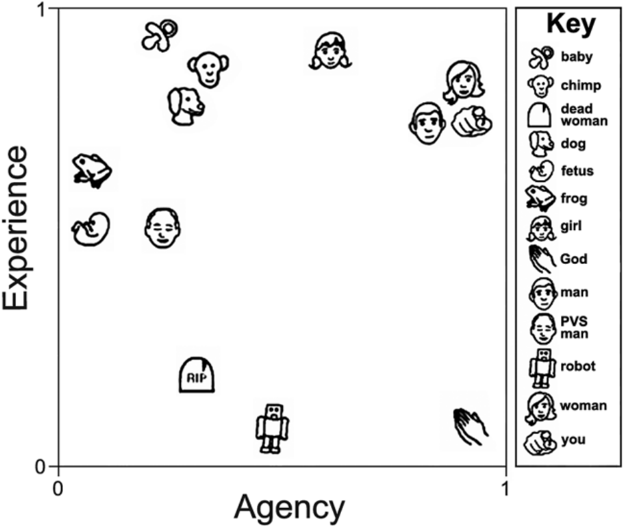
This paper argues that mind perception is not a single continuum but instead has two dimensions: Experience and Agency. Using 2,399 completed web-based surveys, the authors found that these dimensions explain how people judge minds across 13 characters and are differentially related to moral judgments.
## Key findings
- A principal components factor analysis of correlations among 18 mental capacities yielded two factors with eigenvalues over 1.0: Experience (eigenvalue 15.85, explaining 88% of variance) and Agency (eigenvalue 1.46, explaining 8% of variance); the rotated solution explained 97% of rating variance.
- Experience loaded on 11 capacities: hunger, fear, pain, pleasure, rage, desire, personality, consciousness, pride, embarrassment, and joy; Agency loaded on 7 capacities: self-control, morality, memory, emotion recognition, planning, communication, and thought.
- Personal judgments tracked the dimensions differently: liking, saving from destruction, making happy, and perceiving a soul correlated with both dimensions, with r ranging from 0.38 to 0.72.
- Punishment judgments correlated more with Agency than Experience (r = 0.82 vs. r = 0.22, z = 2.86, P < 0.05), while avoidance of harm correlated more with Experience than Agency (r = 0.85 vs. r = 0.26, z = 2.10, P < 0.05).
## Methods
- Web-based Mind Survey design: respondents saw pairwise comparisons of 13 characters across 18 mental capacities or 6 personal judgments, using five-point scales for 78 comparisons per survey.
- Sample: about 3,400 survey launches, with 2,399 completed surveys analyzed; respondents ranged from 12 to 75 years old (mean 30.44, SD 12.27) and were 64% female.
- Main analysis: character means were computed, correlations across capacities were submitted to principal components factor analysis with varimax rotation, and factor scores were estimated via regression; additional analyses examined correlations with personal judgments and individual-difference variables using z-statistics.
## Limitations
- The paper states that the surveys were largely independent and that respondent data came from web recruitment through other psychology sites, which makes the sample a convenience sample rather than a random population sample.
- Evident from the text: the factor structure is based on self-selected web respondents and on pairwise judgments of preselected characters and capacities, so generalizability beyond the survey context is not directly tested.
- The paper notes that about 25% of launched surveys were not completed, indicating noncompletion/missing-data attrition.
Model-written summary. Check it against the paper before relying on it.
Integrity signals
Registry
Cites
Statistics
Figures
Verification
Claims the paper makes
0 Valid · 0 Not valid · 0 Not checked · 18 Own results and interpretations
A result the paper reports from its own data — it cites no other source for it, so there is none to check. The quote shows it is in the paper.
In the paper
“Characters ' factor scores on these dimensions (Fig. 1) reveal interesting features; for example, God was perceived as having much Agency but little Experience.”
- Also stated in: § Dimensions of Mind Perception · plain
“for example, God was perceived as having much Agency but little Experience.”
plain- Asserted: passes — The authors put it forward as true.
- Checkable: passes — It can be checked against evidence.
- Load-bearing: unclear — It is unclear whether the paper’s conclusions depend on it.
- Based: passes — The paper gives a reason why it holds.
- Also stated in: § Dimensions of Mind Perception · plain
A result the paper reports from its own data — it cites no other source for it, so there is none to check. The quote shows it is in the paper.
In the paper
“A factor we termed Experience (eigenvalue = 15.85) accounted for 88% of the variance and included 11 capacities (from highest loading): hunger, fear, pain, pleasure, rage, desire, personality, consciousness, pride, embarrassment, and joy.”
plain- Asserted: passes — The authors put it forward as true.
- Checkable: passes — It can be checked against evidence.
- Load-bearing: passes — The paper’s conclusions depend on it.
- Based: passes — The paper gives a reason why it holds.
A result the paper reports from its own data — it cites no other source for it, so there is none to check. The quote shows it is in the paper.
In the paper
“Of 234 z -statistics (13 characters × 9 individual difference variables × 2 factors), 23 were statistically significant.”
plain- Asserted: passes — The authors put it forward as true.
- Checkable: passes — It can be checked against evidence.
- Load-bearing: unclear — It is unclear whether the paper’s conclusions depend on it.
- Based: passes — The paper gives a reason why it holds.
A result the paper reports from its own data — it cites no other source for it, so there is none to check. The quote shows it is in the paper.
In the paper
“whereas desire to avoid harming ( ' If you were forced to harm one of these characters, which one would it be more painful for you to harm? ' ) correlated more with Experience ( r = 0.85) than Agency ( r = 0.26, z = 2.10, P < 0.05).”
plainstates an association- Asserted: passes — The authors put it forward as true.
- Checkable: passes — It can be checked against evidence.
- Load-bearing: passes — The paper’s conclusions depend on it.
- Based: passes — The paper gives a reason why it holds.
A result the paper reports from its own data — it cites no other source for it, so there is none to check. The quote shows it is in the paper.
In the paper
“The rotated solution accounted for all 18 capacities (extraction communalities ranged from 0.82 to 0.99), explained 97% of rating variance, and yielded two factors with eigenvalues over 1.0.”
plainstates an association- Asserted: passes — The authors put it forward as true.
- Checkable: passes — It can be checked against evidence.
- Load-bearing: passes — The paper’s conclusions depend on it.
- Based: passes — The paper gives a reason why it holds.
5 more claims
Create a free account to see all 18 claims and every source verdict.
- It may state two separate claims as one. 8
- Probably not a substantial claim. 1
Claims other papers make about this one
Each is checked against this paper’s own text: does it say what the citing paper says it does?
The source backs part of the claim, not all of it — or backs it for a different population, condition or comparison.
In the citing paper
“People also anthropomorphize a range of inanimate objects and animals (Kwan & Fiske, 2008; Gray, Gray, & Wegner, 2007).”
From Dehumanized Perception: A Psychological Means to Facilitate Atrocities, Torture, and Genocide? (2011) · cites this paper as Gray, Gray, & Wegner, 2007
Experimental — accuracy not yet measuredThe source backs part of the claim, not all of it — or backs it for a different population, condition or comparison.
In the citing paper
“work in social psychology has demonstrated that mental state attribution is not a unitary concept, but rather involves distinct and independent dimensions of ‘intelligence’ and ‘experience’.”
From The influence of mental state attributions on trust in large language models (2025) · cites this paper as [19]
Experimental — accuracy not yet measuredThe source backs part of the claim, not all of it — or backs it for a different population, condition or comparison.
In the citing paper
“Participants’ ratings for each of the 65 traits (Supplementary Fig. S1a) were reduced via a principal component analysis to two main dimensions, which together explained 58% of the variance (Supplementary Fig. S1b) and mapped onto previously identified dimensions of ‘experience’ (e.g. experiencing pleasure or feeling fearful) and ‘intelligence’ (e.g. knowing things or making choices; Gray et al. 2”
From Folk psychological attributions of consciousness to large language models (2024) · cites this paper as Gray et al. 2007
Experimental — accuracy not yet measuredThe cited source says what the claim attributes to it.
In the citing paper
“This dissociation is supported by factor analyses of ratings of a variety of mental states, which reveal two fundamental factors: agency, or the capacity for high-level reasoning and planning, and experience, or the capacity for sensations and emotions19”
From The influence of mental state attributions on trust in large language models (2025) · cites this paper as [19]
The cited source says what the claim attributes to it.
In the citing paper
“Other work has systematically explored the dimensions underlying mental state attributions to various agents, revealing a two-dimensional structure distinguishing between ‘Experience’ (i.e. the capacity to feel pain, fear, joy, or pride) and ‘Agency’ (i.e. the capacity to have self-control, morality, planning, or communication) that is reminiscent of the distinction between phenomenal and non-phen”
From Folk psychological attributions of consciousness to large language models (2024) · cites this paper as Gray et al. 2007
Statistics recomputed
Every reported test result, recomputed from its test statistic and degrees of freedom. A result shows as not adding up only once an independent check has confirmed it.
- Consistentz = 2.86reported p < .05 · recomputed p = .004
“z = 2.86, p < .05”
- Consistentz = 2.1reported p < .05 · recomputed p = .036
“z = 2.10, p < .05”
Self-check
Percentages, sums and reported differences re-computed from the paper’s own numbers.
Self-check results appear here once an independent check has confirmed them.
Citations
Cites
I.—COMPUTING MACHINERY AND INTELLIGENCE
TURING, A. M. (1950) · Mind · doi:10.1093/mind/lix.236.433 · Cited by 10,290
Does the chimpanzee have a theory of mind?
Premack, D., & Woodruff, G. (1978) · Behavioral and Brain Sciences · doi:10.1017/s0140525x00076512 · Cited by 8,743
Mindblindness: An Essay on Autism and Theory of Mind
Baron-Cohen, S. (1995) · doi:10.7551/mitpress/4635.001.0001 · Cited by 3,428
Dennett, D. C. (1996) · Medical Entomology and Zoology · Cited by 314
Research works printed but not linked: 1
- A. Turing, Mind59, 433 (1950).
Cited by
Items 2,301–2,340 of 2,340
Ward, D. D. (2026) · Open Journal of Social Sciences · doi:10.4236/jss.2026.149011
Nakata, Y., Yamagata, M., & Takahashi, H. (2026) · Journal of the Robotics Society of Japan · doi:10.7210/jrsj.44.653
Zhu, X., Chen, L., & Yang, M. (2026) · Chinese Management Studies · doi:10.1108/cms-07-2025-0792 · Cited by 1
Mercer, E., & Bennett, O. (2026) · Digital Enterprise Studies · doi:10.68217/z02nrf73
“Gray et al. (2007) and Waytz et al. (2010) showed that lay perceivers attribute agency and experience as separate dimensions and grant machines the first while withholding the second.”
When AI Remembers: Investigating the Dual Role of Long‐Term Memory in Chatbots
Parvizian, M., Whittaker, L., Daronkola, H. K., Pallant, J. L., & Johnson, L. W. (2026) · Psychology and Marketing · doi:10.1002/mar.70267 · Cited by 1
Jiang, H., Liu, J., & Gong, H. (2026) · Asia Pacific Journal of Marketing and Logistics · doi:10.1108/apjml-04-2026-0860
Art as revelation: Why AI art moves us less
Depecik, B., Ozgen, E., Cosguner, K., & Inman, J. J. (2026) · International Journal of Research in Marketing · doi:10.1016/j.ijresmar.2026.09.002 · Cited by 1
Li, M., Bitterly, T. B., Nason, S. W., & Cheung, C. S. (2026) · Current Opinion in Psychology · doi:10.1016/j.copsyc.2026.102456
Misino, L., Guidi, S., Lusuardi, L. M., Innocenti, A., & Parlangeli, O. (2026) · European Conference on Cognitive Ergonomics · doi:10.1145/3822301.3822326
Akkuş, I. A., Crimston, C. R., Kirkland, K., Bastian, B. B., & Jaeger, B. (2026) · European Journal of Social Psychology · doi:10.1002/ejsp.70114
Zhou, D., & Gong, Z. (2026) · Computers in Human Behavior · doi:10.1016/j.chb.2026.109190
Huang, S., Qian, L., & Huang, L. (2026) · Procedia Computer Science · doi:10.1016/j.procs.2026.08.060
Liu, C.-J., Han, S., & Hao, F. (2026) · Basic and Applied Social Psychology · doi:10.1080/01973533.2026.2733007
Al-Mamari, M., & Al-Abri, A. (2026) · Education Sciences · doi:10.3390/educsci16091558
AI Agents in Human Social Decision-Making: A Framework from Social Inference to Social Action
Yin, Y.-L., Yu, G.-H., Pan, J.-Q., & Zhu, L.-S. (2026) · Cognitive Science Research · doi:10.1016/j.csres.2026.09.001
Mapping the Knowledge Structure of Physical Artificial Intelligence: A Data-Driven Systematic Review
Maeng, K., Jin, H., & Kim, S. (2026) · Applied Sciences · doi:10.3390/app16189306
Fortuna, P. (2026) · Wiley eBooks · doi:10.1002/9781394399680.refs
Cheng, J., & Zhou, S. (2026) · Journal of Retailing and Consumer Services · doi:10.1016/j.jretconser.2026.105124
Dono, M., & Pollmanns, C. (2026) · PsyEcology Bilingual Journal of Environmental Psychology · doi:10.1177/21711976261483937
Xu, H., Yang, Y., Liu, Y., & She, S. (2026) · Journal of Retailing and Consumer Services · doi:10.1016/j.jretconser.2026.105125
Stance-Prompting Frames and Tolerance of Service Robot Failures
Lv, D., Sun, R., Zhu, Q., Cheng, Y., & Qin, S. (2026) · International Journal of Social Robotics · doi:10.1007/s12369-026-01444-5
“Mind perception concerns whether users judge an entity to possess agency and experience and is a related but distinct psychological outcome [21].”
InfluentialMukherji, M., & Dillon, M. R. (2026) · Open Mind · doi:10.1162/opmi.a.386
Agency, Emotion, and Memory in Forgiving Collective Agents
Wu, S., Meyer, M. L., & Phillips, J. (2026) · Review of Philosophy and Psychology · doi:10.1007/s13164-026-00832-0
Koukopoulos, A. (2026) · Kybernetes · doi:10.1108/k-06-2026-1674
AI is not as conscious as humans: Essentialism in mental state attributions to artificial systems
Longin, L., Karpus, J., Meertens, N., Bahrami, B., & Deroy, O. D. (2026) · Cognition · doi:10.1016/j.cognition.2026.106733
Jang, J., Lee, J.-G., & Song, H. (2026) · Behavioral Sciences · doi:10.3390/bs16101794
Advertising with HAART: Introducing Human–AI Asymmetric Relationship Theory
Thomas, V. L., Shoenberger, H., Gvirtz, A., Sands, S., & Willemsen, L. M. (2026) · Journal of Advertising · doi:10.1080/00913367.2026.2735425
Kim, J., & Sung, Y. (2026) · Behaviour and Information Technology · doi:10.1080/0144929x.2026.2738811
Kondrashev, S. V., Rozhnov, A. А., Belova, T. B., Khairullina, E. R., Nikitina, S., & Александровна, Б. И. (2026) · Frontiers in Education · doi:10.3389/feduc.2026.1959997
McCrackin, S. D., & Ristic, J. (2026) · Visual Cognition · doi:10.1080/13506285.2026.2738475
Mızrak, F., Kırgız, A. C., & Demirel, H. G. (2026) · Journal of Intelligence · doi:10.3390/jintelligence14100248
Social Robotics and Human–Robot Communication
Laban, G., & Cross, E. S. (2026) · Springer tracts in advanced robotics · doi:10.1007/978-3-032-19374-2_8
Is There a Human Premium in Negotiations? A Relational-Economic Tradeoff in Human vs. AI Bargaining
Mislin, A. A., Druckman, D., & Serre, L. (2026) · Group Decision and Negotiation · doi:10.1007/s10726-026-10027-8
“…research showing that nego - tiators can construe the same interaction through different task, relational, and value frames (Pinkley 1990) and with mind-perception accounts in which social mean - ing changes how agents are categorized and evaluated (Gray et al. 2007; Waytz et al. 2010).”
InfluentialArico, A. J. (2013) · UA Campus Repository (The University of Arizona)
Power dichotomies : an exploratory comparison between online and offline spaces.
Coote, S. (2015) · UC Research Repository (University of Canterbury) · doi:10.26021/5192
From Choosing to Responsibility - The Impact of the Sense of Control on Memory
Chatman, L. (2014) · doi:10.7916/d83x858z · Cited by 1
Lane, J. D. (2011) · Deep Blue (University of Michigan)
Untitled work
Eom, D., Renner, J., & Chinn, S. (2026) · arXiv (preprint)
“…human-like intentions and inner states to non-human agents, especially when those agents behave contingently, and users are motivated by unmet social needs (Epley et al., 2007; Guingrich & Graziano, 2025), and they perceive entities along dimensions of agency and experience (Gray et al., 2007).”
Metadata
- Authors
- Gray, H. M., Gray, K., & Wegner, D. M.
- Affiliations
- Harvard University (US)
- Corresponding author
- Gray, Heather M.
- Venue
- Science
- Published
- 2007-02-02
- Volume
- 315
- Issue
- 5812
- Pages
- 619-619
- ISSN
- 0036-8075 (ISSN-L)
- 1095-9203
- OpenAlex
- W2131227926
- Cited by
- 2,342
- References
- 4
- Citations by year
- 2026: 359 · 2025: 326 · 2024: 249 · 2023: 220 · 2022: 198 · 2021: 156 · 2020: 157 · 2019: 107 · 2018: 91 · 2017: 86 · 2016: 96 · 2015: 66 · 2014: 52 · 2013: 44 · 2012: 45
- FWCI
- 10.81
- Type
- journal article
- Language
- en
- Open access
- closed
- Locations
- Science (publishedVersion)
- PubMed (publishedVersion)
- Funders
- National Institutes of Health (1f31mh071053-01)
- National Institute of Mental Health (MH-71053, MH 49127, R01MH049127)
- Topics
- Life Sciences › Neuroscience › Cognitive Neuroscience › Psychology of Moral and Emotional Judgment
- Social Sciences › Psychology › Social Psychology › Social Robot Interaction and HRI
- Social Sciences › Sociology and Political Science › Social and Intergroup Psychology
- Keywords
- mind perception, moral judgment, agency, experience, non-human animals, personification, moral status of animals, self-control, hunger
- MeSH terms
- Adolescent, Adult, Aged, Child, Emotions, Female, Humans, Male, Mental Processes, Middle Aged, Morals, Perception, Personality, Principal Component Analysis
About these checks
Registry, retraction, Cites and statistics results are computed, not judged, with one exception: a printed reference that no index lists is read once by a model before it counts as a citation error. Claims are extracted by a model and kept only when their quote appears verbatim in the text; each cited source is then checked, with a model’s help, for whether it says what the claim relies on. Those verdicts can be wrong — read the claim’s quote and the cited source before relying on one.
A language model drew the claims from the paper on 2026-09-28, under version 3 of the claim definition (model deepseek-v4.1-flash, prompt extract-v3).
A second model labelled each claim on 2026-09-28 (model jev-1.13-20260917, definition revision gold-guideline-v0.2).
Statistics and arithmetic are recomputed, not judged.
Confidence bands are shown only for fields calibrated on our annotated test set. None is calibrated yet, so no band is shown.
What counts as a claim ›How we measure confidence ›How we check this ›
Are you an author, or do you see a problem with this page? Request a review
Data sources
Bibliographic data: Semantic Scholar, OpenAlex, Crossref.
Contains information from the Semantic Scholar Academic Graph Datasets, made available under the ODC Attribution License (ODC-BY 1.0).
Semantic Scholar’s data is described in: Kinney, R., et al. (2023). The Semantic Scholar Open Data Platform. arXiv:2301.10140.
