

Dimensions of Mind Perception
The DOI matches its Crossref record; 4 of the 4 references it cites were found in a registry or an index.
Abstract
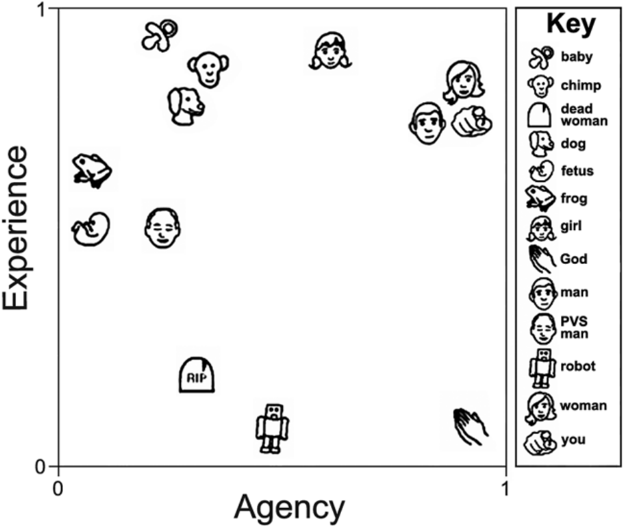
Participants compared the mental capacities of various human and nonhuman characters via online surveys. Factor analysis revealed two dimensions of mind perception, Experience (for example, capacity for hunger) and Agency (for example, capacity for self-control). The dimensions predicted different moral judgments but were both related to valuing of mind.
Overview
CoChat Summary
## TL;DR
This paper argues that mind perception is not a single continuum but instead has two dimensions: Experience and Agency. Using 2,399 completed web-based surveys, the authors found that these dimensions explain how people judge minds across 13 characters and are differentially related to moral judgments.
## Key findings
- A principal components factor analysis of correlations among 18 mental capacities yielded two factors with eigenvalues over 1.0: Experience (eigenvalue 15.85, explaining 88% of variance) and Agency (eigenvalue 1.46, explaining 8% of variance); the rotated solution explained 97% of rating variance.
- Experience loaded on 11 capacities: hunger, fear, pain, pleasure, rage, desire, personality, consciousness, pride, embarrassment, and joy; Agency loaded on 7 capacities: self-control, morality, memory, emotion recognition, planning, communication, and thought.
- Personal judgments tracked the dimensions differently: liking, saving from destruction, making happy, and perceiving a soul correlated with both dimensions, with r ranging from 0.38 to 0.72.
- Punishment judgments correlated more with Agency than Experience (r = 0.82 vs. r = 0.22, z = 2.86, P < 0.05), while avoidance of harm correlated more with Experience than Agency (r = 0.85 vs. r = 0.26, z = 2.10, P < 0.05).
## Methods
- Web-based Mind Survey design: respondents saw pairwise comparisons of 13 characters across 18 mental capacities or 6 personal judgments, using five-point scales for 78 comparisons per survey.
- Sample: about 3,400 survey launches, with 2,399 completed surveys analyzed; respondents ranged from 12 to 75 years old (mean 30.44, SD 12.27) and were 64% female.
- Main analysis: character means were computed, correlations across capacities were submitted to principal components factor analysis with varimax rotation, and factor scores were estimated via regression; additional analyses examined correlations with personal judgments and individual-difference variables using z-statistics.
## Limitations
- The paper states that the surveys were largely independent and that respondent data came from web recruitment through other psychology sites, which makes the sample a convenience sample rather than a random population sample.
- Evident from the text: the factor structure is based on self-selected web respondents and on pairwise judgments of preselected characters and capacities, so generalizability beyond the survey context is not directly tested.
- The paper notes that about 25% of launched surveys were not completed, indicating noncompletion/missing-data attrition.
Model-written summary. Check it against the paper before relying on it.
Integrity signals
Registry
Cites
Statistics
Figures
Verification
Claims the paper makes
0 Valid · 0 Not valid · 0 Not checked · 18 Own results and interpretations
A result the paper reports from its own data — it cites no other source for it, so there is none to check. The quote shows it is in the paper.
In the paper
“Characters ' factor scores on these dimensions (Fig. 1) reveal interesting features; for example, God was perceived as having much Agency but little Experience.”
- Also stated in: § Dimensions of Mind Perception · plain
“for example, God was perceived as having much Agency but little Experience.”
plain- Asserted: passes — The authors put it forward as true.
- Checkable: passes — It can be checked against evidence.
- Load-bearing: unclear — It is unclear whether the paper’s conclusions depend on it.
- Based: passes — The paper gives a reason why it holds.
- Also stated in: § Dimensions of Mind Perception · plain
A result the paper reports from its own data — it cites no other source for it, so there is none to check. The quote shows it is in the paper.
In the paper
“A factor we termed Experience (eigenvalue = 15.85) accounted for 88% of the variance and included 11 capacities (from highest loading): hunger, fear, pain, pleasure, rage, desire, personality, consciousness, pride, embarrassment, and joy.”
plain- Asserted: passes — The authors put it forward as true.
- Checkable: passes — It can be checked against evidence.
- Load-bearing: passes — The paper’s conclusions depend on it.
- Based: passes — The paper gives a reason why it holds.
A result the paper reports from its own data — it cites no other source for it, so there is none to check. The quote shows it is in the paper.
In the paper
“Of 234 z -statistics (13 characters × 9 individual difference variables × 2 factors), 23 were statistically significant.”
plain- Asserted: passes — The authors put it forward as true.
- Checkable: passes — It can be checked against evidence.
- Load-bearing: unclear — It is unclear whether the paper’s conclusions depend on it.
- Based: passes — The paper gives a reason why it holds.
A result the paper reports from its own data — it cites no other source for it, so there is none to check. The quote shows it is in the paper.
In the paper
“whereas desire to avoid harming ( ' If you were forced to harm one of these characters, which one would it be more painful for you to harm? ' ) correlated more with Experience ( r = 0.85) than Agency ( r = 0.26, z = 2.10, P < 0.05).”
plainstates an association- Asserted: passes — The authors put it forward as true.
- Checkable: passes — It can be checked against evidence.
- Load-bearing: passes — The paper’s conclusions depend on it.
- Based: passes — The paper gives a reason why it holds.
A result the paper reports from its own data — it cites no other source for it, so there is none to check. The quote shows it is in the paper.
In the paper
“The rotated solution accounted for all 18 capacities (extraction communalities ranged from 0.82 to 0.99), explained 97% of rating variance, and yielded two factors with eigenvalues over 1.0.”
plainstates an association- Asserted: passes — The authors put it forward as true.
- Checkable: passes — It can be checked against evidence.
- Load-bearing: passes — The paper’s conclusions depend on it.
- Based: passes — The paper gives a reason why it holds.
5 more claims
Create a free account to see all 18 claims and every source verdict.
- It may state two separate claims as one. 8
- Probably not a substantial claim. 1
Claims other papers make about this one
Each is checked against this paper’s own text: does it say what the citing paper says it does?
The source backs part of the claim, not all of it — or backs it for a different population, condition or comparison.
In the citing paper
“People also anthropomorphize a range of inanimate objects and animals (Kwan & Fiske, 2008; Gray, Gray, & Wegner, 2007).”
From Dehumanized Perception: A Psychological Means to Facilitate Atrocities, Torture, and Genocide? (2011) · cites this paper as Gray, Gray, & Wegner, 2007
Experimental — accuracy not yet measuredThe source backs part of the claim, not all of it — or backs it for a different population, condition or comparison.
In the citing paper
“work in social psychology has demonstrated that mental state attribution is not a unitary concept, but rather involves distinct and independent dimensions of ‘intelligence’ and ‘experience’.”
From The influence of mental state attributions on trust in large language models (2025) · cites this paper as [19]
Experimental — accuracy not yet measuredThe source backs part of the claim, not all of it — or backs it for a different population, condition or comparison.
In the citing paper
“Participants’ ratings for each of the 65 traits (Supplementary Fig. S1a) were reduced via a principal component analysis to two main dimensions, which together explained 58% of the variance (Supplementary Fig. S1b) and mapped onto previously identified dimensions of ‘experience’ (e.g. experiencing pleasure or feeling fearful) and ‘intelligence’ (e.g. knowing things or making choices; Gray et al. 2”
From Folk psychological attributions of consciousness to large language models (2024) · cites this paper as Gray et al. 2007
Experimental — accuracy not yet measuredThe cited source says what the claim attributes to it.
In the citing paper
“This dissociation is supported by factor analyses of ratings of a variety of mental states, which reveal two fundamental factors: agency, or the capacity for high-level reasoning and planning, and experience, or the capacity for sensations and emotions19”
From The influence of mental state attributions on trust in large language models (2025) · cites this paper as [19]
The cited source says what the claim attributes to it.
In the citing paper
“Other work has systematically explored the dimensions underlying mental state attributions to various agents, revealing a two-dimensional structure distinguishing between ‘Experience’ (i.e. the capacity to feel pain, fear, joy, or pride) and ‘Agency’ (i.e. the capacity to have self-control, morality, planning, or communication) that is reminiscent of the distinction between phenomenal and non-phen”
From Folk psychological attributions of consciousness to large language models (2024) · cites this paper as Gray et al. 2007
Statistics recomputed
Every reported test result, recomputed from its test statistic and degrees of freedom. A result shows as not adding up only once an independent check has confirmed it.
- Consistentz = 2.86reported p < .05 · recomputed p = .004
“z = 2.86, p < .05”
- Consistentz = 2.1reported p < .05 · recomputed p = .036
“z = 2.10, p < .05”
Self-check
Percentages, sums and reported differences re-computed from the paper’s own numbers.
Self-check results appear here once an independent check has confirmed them.
Citations
Cites
I.—COMPUTING MACHINERY AND INTELLIGENCE
TURING, A. M. (1950) · Mind · doi:10.1093/mind/lix.236.433 · Cited by 10,290
Does the chimpanzee have a theory of mind?
Premack, D., & Woodruff, G. (1978) · Behavioral and Brain Sciences · doi:10.1017/s0140525x00076512 · Cited by 8,743
Mindblindness: An Essay on Autism and Theory of Mind
Baron-Cohen, S. (1995) · doi:10.7551/mitpress/4635.001.0001 · Cited by 3,428
Dennett, D. C. (1996) · Medical Entomology and Zoology · Cited by 314
Research works printed but not linked: 1
- A. Turing, Mind59, 433 (1950).
Cited by
Items 1,801–1,900 of 2,340
Formal and Social Enforcement of Individual vs. Corporate TransgressionsPreprint
Haran, U., Feldman, Y., & Teichman, D. (2015) · SSRN Electronic Journal · doi:10.2139/ssrn.2628776
Renes, R. A. (2016) · Utrecht University Repository (Utrecht University)
O’Brien, E. (2014) · ACR North American Advances
Pyysiäinen, I. (2009) · Oxford University Press eBooks · doi:10.1093/acprof:oso/9780195380026.003.0003
Pyysiäinen, I. (2009) · Oxford University Press eBooks · doi:10.1093/acprof:oso/9780195380026.003.0002
Hoang‐Kim, A. (2015) · TSpace (University of Toronto)
Interconnections Between Perceptions of Blame, Mind, and Moral Abilities
Ropes, A., & Guglielmo, S. (2016) · DigitalCommons-Macalester (Macalester College)
The genitive ratio and its applications
Glover, K. A. (2016) · Open Access at Essex (University of Essex)
Design of a Product Recommendation Virtual Agent That Induces User’s Trust Operating User’s Trust
Matsui, T., & Yamada, S. (2017) · Transactions of the Japanese Society for Artificial Intelligence · doi:10.1527/tjsai.c-g92
Disgust and religious morality of mind
Ritter, R. S. (2014) · Illinois Digital Environment for Access to Learning and Scholarship (University of Illinois at Urbana-Champaign) · Cited by 2
A Kansei-evaluation Study on the Uncanny Valley of Real-world Robots
Tsukimoto, T. (2017) · Transactions of Japan Society of Kansei Engineering · doi:10.5057/jjske.tjske-d-16-00091
“Grayら[8] によると,Experienceで表される属性は,飢え,恐れ, 痛み,幸せ,怒り,欲望,個性,意識,プライド,困惑,”
InfluentialDecoding Partner Type in Human-Agent Negotiation using functional MRI.
Kim, E., Gilbert, J., Horowitz, C., et al. (2017) · eScholarship (California Digital Library)
Ng, B. K. L. (2017) · UKnowledge (University of Kentucky) · doi:10.13023/etd.2017.424
“Perception of agency was also found to be positively and highly correlated (r=.82) with deserving of punishment for wrongdoing (Gray et al, 2007).”
ResultHardin, A. E. (2017) · Deep Blue (University of Michigan)
Perspective Taking Failures in the Valuation of Mind and BodyPreprint
Jordan, M. R., Gebert, T., & Looser, C. E. (2017) · SSRN Electronic Journal · doi:10.2139/ssrn.3082952
Moral Action Changes Mind Perception for Human and Artificial Moral Agents.
Hristova, E., & Grinberg, M. (2017) · eScholarship (California Digital Library)
Mental Representations of the Homeless
McKee, S. E. (2018) · UKnowledge (University of Kentucky) · doi:10.13023/etd.2018.059
Do shamans violate notions of humanness?
Haslam, N. (2018) · Behavioral and Brain Sciences · doi:10.1017/s0140525x17002060
Stereotypes and Prototypes: The Causes and Consequences of Intersectional Invisibility
Williams, A. L. (2018) · University of Minnesota Digital Conservancy (University of Minnesota) · Cited by 1
Schroer, R., & Schroer, J. W. (2018) · Philosophical Psychology · doi:10.1080/09515089.2018.1555800 · Cited by 1
Sneddon, A. (2019) · Metaphilosophy · doi:10.1111/meta.12344 · Cited by 1
Differential effects of cognitive ability on mind agency and perceived innocence
Noguchi, K., & Mong, M. D. (2019) · Current Psychology · doi:10.1007/s12144-019-0152-4
The Effect of Perceived Harm on Moral Judgment
欧, 阳. (2019) · Advances in Psychology · doi:10.12677/ap.2019.93070
More People But Less Mind: How Number Affects Mind Perception and Decisions to Harm
Cooley, E. (2015) · Carolina Digital Repository (University of North Carolina at Chapel Hill) · doi:10.17615/ar1j-ye53 · Cited by 1
Turing Tests as Reflexive Experimental Apparatus
Redstone, J. (2019) · Carleton University's Institutional Repository (MacOdrum Library, Carleton University) · doi:10.22215/etd/2019-13655
“But Gray et al. (2007) suggest that mind perception occurs when we perceive entities to have the capacity for agency, and the capacity to have experiences, for these are two important capacities that beings with minds have.”
BackgroundInfluentialValuing humane lives in two-level utilitarianism
Delon, N. (2020) · Utilitas · doi:10.1017/s0953820819000542
“Attributions of moral standing track perceptions of “mindedness,” typically along two dimensions: Experience (e.g. suffering, feelings, emotions) and/or Agency (e.g. thinking, memory, planning, self-control) (Gray et al. 2007).”
BackgroundSome Neuro-Biologic Determinants of Intergroup Bias That Affect the Development of Anti-Semitism
Harford, M. W. (2020) · Springer eBooks · doi:10.1007/978-3-030-37745-8_4
Interactions Between Humans, Virtual Agent Characters and Virtual Avatars
Griffith, T. (2020) · STARS (University of Central Florida) · Cited by 1
The Neural Organization of Social Knowledge
Thornton, M. A. (2017) · Digital Access to Scholarship at Harvard (DASH) (Harvard University)
The Roles of Robots in our Future Society
Zuurbier, Q. L. (2020) · Utrecht University Repository (Utrecht University)
Integrating Risk Management Into Decision Making
Boghean, F. (2020) · doi:10.18662/lumproc/ncoe4.0.2019/10
Lages, Y., Mograbi, D. C., Krahe, T. E., & Landeira-Fernández, J. (2020) · Consciousness and Cognition · doi:10.1016/j.concog.2020.103003
An Experiencer, An Animal or An Object? Erection Salience Decreases Men’s Perceived Agency
Górska, P., Budziszewska, M., Marchlewska, M., Stefaniak, A., Malinowska, K., & Kuzawińska, O. (2020) · Archives of Sexual Behavior · doi:10.1007/s10508-020-01800-0
Twitchin, S. (2020) · Open Access Victoria University of Wellington | Te Herenga Waka (Figshare) · doi:10.26686/wgtn.17150846.v1
The Foundations of Shamanism and Witchcraft
Singh, M. (2020) · Digital Access to Scholarship at Harvard (DASH) (Harvard University) · Cited by 2
La percepción de daño intencional y su papel en los juicios morales condenatorios
Carrero, S., & Adolfo, G. (2020)
Naming And Morality: How Having A Name Influences Perceptions Of Mind And Moral Status
Wyngaarden, & James, B. M. (2020)
Supplemental Material for Of Like Mind: The (Mostly) Similar Mentalizing of Robots and Humans
(2020) · Technology Mind and Behavior · doi:10.1037/tmb0000025.supp
Reeves, B. B., Hancock, J. T., & Liu, X. (2020) · Technology Mind and Behavior · doi:10.1037/tmb0000018.supp
Trust Discounting in the Multi-Arm Trust Game
Collins, M. G. (2020) · Journal of Bioresource Management
Robot-Touch Promotes Memory Sensitization
Keshmiri, S. (2021) · Applied Sciences · doi:10.3390/app11052271
Lees, J. M., Tang, S., & Sidanius, J. (2021) · PsyArXiv (OSF Preprints) · doi:10.31234/osf.io/t4bgp
Bai, H., Euh, H., Federico, C. M., et al. (2021) · doi:10.31234/osf.io/fknrd
From Freud to Android: Constructing a scale of uncanny feelingsPreprint
Benjamin, R., & Heine, S. J. (2020) · doi:10.31234/osf.io/duvh8
Monroe, A. E., & Plant, E. A. (2018) · PsyArXiv (OSF Preprints) · doi:10.31234/osf.io/q8y45
Drivers of retail app continuance use intention among Malaysian millennials
Lim, X. (2020) · Universiti Putra Malaysia Institutional Repository (Universiti Putra Malaysia)
Bartneck, C., Belpaeme, T., Eyssel, F., Kanda, T., Keijsers, M., & Šabanović, S. (2020) · Cambridge University Press eBooks · doi:10.1017/9781108676649.003
Conceptual associations guide social inferencePreprint
Stolier, R. M. (2019) · PsyArXiv (OSF Preprints) · doi:10.31234/osf.io/57nwp
“Dimensional models of social perception are wide-spread, present in mental state inference (Gray et al., 2007), emotion (Russell, 1980), face impressions (Oosterhof & Todorov, 2008), person knowledge (Rosenberg et al., 1968), and stereotypes (Fiske et al., 2002).”
BackgroundKljajević, V. (2021) · Cognitive systems monographs · doi:10.1007/978-3-662-63742-5_3
Top-Down Effects on Anthropomorphism of a Robot
Scherer, H., & Phillips, J. (2020) · eScholarship (California Digital Library) · doi:10.7910/dvn/b1o1zq · Cited by 1
Tominaga, Y., Tanaka, H., Matsubara, H., et al. (2021) · Transactions of the Japanese Society for Artificial Intelligence · doi:10.1527/tjsai.36-5_ag21-f
Tanibe, T., & Karasawa, K. (2021) · THE JAPANESE JOURNAL OF EXPERIMENTAL SOCIAL PSYCHOLOGY · doi:10.2130/jjesp.2016
“…用が広がっている(松尾,2015;西垣・河島,2019)。 その中でも自動車の自動運転は実用化が既に進んでいる 分野の一つで,カメラやレーダーで得た情報から歩行者 や車両を認識するための画像認識や,他の主体(歩行者, 車両)の動きの予測,そしてそれらの情報を踏まえて適 切な経路を判断する行動計画といった作業に AI 技術が 活用されている(高度情報通信ネットワーク社会推進戦 略本部・官民データ活用推進戦略会議,2020)。 第 3 次 AI ブームを起こした中核的な技術は深層学習 というもので,第 2…”
An Exploratory Research on People’s Moral Decision-Making Expectation for Autonomous Machines
吴, 明. (2021) · Advances in Psychology · doi:10.12677/ap.2021.1111277
An Inquiry into the Nature and Causes of Choosing Treatment
Martinez, A. G. (2012) · eScholarship (California Digital Library)
Medical progress in a changing world.
JOHNSON, J. L. (1951) · PubMed Central
The Thought Experiments are Rigged: Mechanistic Understanding Inhibits Mentalistic Understanding
Adleberg, T. (2013) · Digital Archive @ GSU · doi:10.57709/4456726 · Cited by 1
Contrasting Living-Being and Machine Metaphors: Implications for Making Meaning of Human ExperiencesPreprint
Diekman, A. B., Williams, H. E., Vuletich, H. A., & Vuletich, J. S. (2021) · PsyArXiv (OSF Preprints) · doi:10.31234/osf.io/kv2dg · Cited by 1
Koban, K., Haggadone, B. A., & Banks, J. (2020) · Technology Mind and Behavior · doi:10.1037/tmb0000049.supp
Pyysiäinen, I. (2009) · Oxford University Press eBooks · doi:10.1093/acprof:oso/9780195380026.003.0006
[PREPRINT] Mind the Machines: Applying Implicit Measures of Mind Perception to Social RoboticsPreprint
Li, Z., Terfurth, L., Woller, J. P., & Wiese, E. (2022) · doi:10.31234/osf.io/2ezfj
Of Essence and Obsolescence: Priming Artificial Intelligence Changes Perceptions of Human NaturePreprint
Santoro, E., & Monin, B. (2021) · doi:10.31234/osf.io/uvchf
Bartneck, C., Belpaeme, T., Eyssel, F., Kanda, T., Keijsers, M., & Šabanović, S. (2020) · Cambridge University Press eBooks · doi:10.1017/9781108676649.004 · Cited by 1
Bartneck, C., Belpaeme, T., Eyssel, F., Kanda, T., Keijsers, M., & Šabanović, S. (2020) · Cambridge University Press eBooks · doi:10.1017/9781108676649.007
Bartneck, C., Belpaeme, T., Eyssel, F., Kanda, T., Keijsers, M., & Šabanović, S. (2020) · Cambridge University Press eBooks · doi:10.1017/9781108676649.001 · Cited by 3
Bartneck, C., Belpaeme, T., Eyssel, F., Kanda, T., Keijsers, M., & Šabanović, S. (2020) · Cambridge University Press eBooks · doi:10.1017/9781108676649.012
Bartneck, C., Belpaeme, T., Eyssel, F., Kanda, T., Keijsers, M., & Šabanović, S. (2020) · Cambridge University Press eBooks · doi:10.1017/9781108676649.005
Bartneck, C., Belpaeme, T., Eyssel, F., Kanda, T., Keijsers, M., & Šabanović, S. (2020) · Cambridge University Press eBooks · doi:10.1017/9781108676649.008
Wilson, A., Stefanik, C., & Shank, D. B. (2022) · doi:10.31234/osf.io/bmq7h
Is a good bot better than a mediocre human?: Chatbots as alternative sources of social connectionPreprint
Folk, D. P., Yu, S., & Dunn, E. W. (2022) · PsyArXiv (OSF Preprints) · doi:10.31234/osf.io/xunsy · Cited by 1
Corporate InsecthoodPreprint
Strohminger, N., & Jordan, M. (2022) · doi:10.31234/osf.io/rxkhe
Grundke, A., Stein, J., & Appel, M. (2022) · Technology Mind and Behavior · doi:10.1037/tmb0000053.supp
“As an underlying framework for this line of research, the mind perception dichotomy by Gray et al. (2007) has gained a lot of attention in recent years.”
BackgroundMethodInfluentialPotentials of Experimental Bioethics
Ota, K., & Tanibe, T. (2022) · Kagaku tetsugaku · doi:10.4216/jpssj.54.2_3
Ban, M., & Takahashi, H. (2022) · Early Child Development and Care · doi:10.1080/03004430.2022.2055006
“Taken together with the results of Gray et al. (2007), Arnott and Meins (2007), and Planalp et al. (2019), this finding suggests that mothers have an especial view of their children.”
BackgroundMethodResultInfluentialHuman or Bot? How (Corrected) Errors Humanize a CommunicatorPreprint
Netter, S. B., Zhao, X., Barasch, A., & Schroeder, J. (2019) · PsyArXiv (OSF Preprints) · doi:10.31234/osf.io/a92bv
Hanson, R. (2016) · Oxford University Press eBooks · doi:10.1093/oso/9780198754626.003.0024
Hanson, R. (2016) · Oxford University Press eBooks · doi:10.1093/oso/9780198754626.003.0034
Hanson, R. (2016) · Oxford University Press eBooks · doi:10.1093/oso/9780198754626.003.0028
Hanson, R. (2016) · Oxford University Press eBooks · doi:10.1093/oso/9780198754626.003.0029
Hanson, R. (2016) · Oxford University Press eBooks · doi:10.1093/oso/9780198754626.003.0023
Hanson, R. (2016) · Oxford University Press eBooks · doi:10.1093/oso/9780198754626.003.0006
Kellie, D. J., Blake, K. R., & Brooks, R. C. (2020) · doi:10.31234/osf.io/zu8q5
“Mental agency and mental experience of each fictional woman were assessed using the two items with the highest factor loadings from the shortened agency scale and the shortened experience scale, respectively (Blake et al., 2016; H. M. Gray et al., 2007).”
BackgroundMethodInfluentialHanson, R. (2016) · Oxford University Press eBooks · doi:10.1093/oso/9780198754626.003.0017
Hanson, R. (2016) · Oxford University Press eBooks · doi:10.1093/oso/9780198754626.003.0035
Chapter 9 - Theory of Mind and Joint AttentionPreprint
Pérez-Osorio, J., Wiese, E., & Wykowska, A. (2021) · PsyArXiv (OSF Preprints) · doi:10.31234/osf.io/az8qy
Hanson, R. (2016) · Oxford University Press eBooks · doi:10.1093/oso/9780198754626.003.0014
Hanson, R. (2016) · Oxford University Press eBooks · doi:10.1093/oso/9780198754626.003.0010
Hanson, R. (2016) · Oxford University Press eBooks · doi:10.1093/oso/9780198754626.003.0022
Hanson, R. (2016) · Oxford University Press eBooks · doi:10.1093/oso/9780198754626.003.0026
Valuation of Morality and Mind: Morality as a Metacognitive ByproductPreprint
Baxter, R. R. (2017) · PsyArXiv (OSF Preprints) · doi:10.31234/osf.io/w2b5y
Early Mapping of “Electronic Hive Minds” on the Web and Internet
(2019) · Advances in social networking and online communities book series · doi:10.4018/978-1-5225-9369-0.ch001
Hanson, R. (2016) · Oxford University Press eBooks · doi:10.1093/oso/9780198754626.003.0020
Hanson, R. (2016) · Oxford University Press eBooks · doi:10.1093/oso/9780198754626.003.0016
Hanson, R. (2016) · Oxford University Press eBooks · doi:10.1093/oso/9780198754626.003.0008
Hanson, R. (2016) · Oxford University Press eBooks · doi:10.1093/oso/9780198754626.003.0033
Bartneck, C., Belpaeme, T., Eyssel, F., Kanda, T., Keijsers, M., & Šabanović, S. (2020) · ACM/IEEE International Conference on Human-Robot Interaction (HRI) · doi:10.1017/9781108676649.014
Hanson, R. (2016) · Oxford University Press eBooks · doi:10.1093/oso/9780198754626.003.0032
Hanson, R. (2016) · Oxford University Press eBooks · doi:10.1093/oso/9780198754626.003.0009
Bartneck, C., Belpaeme, T., Eyssel, F., Kanda, T., Keijsers, M., & Šabanović, S. (2020) · Cambridge University Press eBooks · doi:10.1017/9781108676649.013
Hanson, R. (2016) · Oxford University Press eBooks · doi:10.1093/oso/9780198754626.003.0013
Metadata
- Authors
- Gray, H. M., Gray, K., & Wegner, D. M.
- Affiliations
- Harvard University (US)
- Corresponding author
- Gray, Heather M.
- Venue
- Science
- Published
- 2007-02-02
- Volume
- 315
- Issue
- 5812
- Pages
- 619-619
- ISSN
- 0036-8075 (ISSN-L)
- 1095-9203
- OpenAlex
- W2131227926
- Cited by
- 2,342
- References
- 4
- Citations by year
- 2026: 359 · 2025: 326 · 2024: 249 · 2023: 220 · 2022: 198 · 2021: 156 · 2020: 157 · 2019: 107 · 2018: 91 · 2017: 86 · 2016: 96 · 2015: 66 · 2014: 52 · 2013: 44 · 2012: 45
- FWCI
- 10.81
- Type
- journal article
- Language
- en
- Open access
- closed
- Locations
- Science (publishedVersion)
- PubMed (publishedVersion)
- Funders
- National Institutes of Health (1f31mh071053-01)
- National Institute of Mental Health (MH-71053, MH 49127, R01MH049127)
- Topics
- Life Sciences › Neuroscience › Cognitive Neuroscience › Psychology of Moral and Emotional Judgment
- Social Sciences › Psychology › Social Psychology › Social Robot Interaction and HRI
- Social Sciences › Sociology and Political Science › Social and Intergroup Psychology
- Keywords
- mind perception, moral judgment, agency, experience, non-human animals, personification, moral status of animals, self-control, hunger
- MeSH terms
- Adolescent, Adult, Aged, Child, Emotions, Female, Humans, Male, Mental Processes, Middle Aged, Morals, Perception, Personality, Principal Component Analysis
About these checks
Registry, retraction, Cites and statistics results are computed, not judged, with one exception: a printed reference that no index lists is read once by a model before it counts as a citation error. Claims are extracted by a model and kept only when their quote appears verbatim in the text; each cited source is then checked, with a model’s help, for whether it says what the claim relies on. Those verdicts can be wrong — read the claim’s quote and the cited source before relying on one.
A language model drew the claims from the paper on 2026-09-28, under version 3 of the claim definition (model deepseek-v4.1-flash, prompt extract-v3).
A second model labelled each claim on 2026-09-28 (model jev-1.13-20260917, definition revision gold-guideline-v0.2).
Statistics and arithmetic are recomputed, not judged.
Confidence bands are shown only for fields calibrated on our annotated test set. None is calibrated yet, so no band is shown.
What counts as a claim ›How we measure confidence ›How we check this ›
Are you an author, or do you see a problem with this page? Request a review
Data sources
Bibliographic data: Semantic Scholar, OpenAlex, Crossref.
Contains information from the Semantic Scholar Academic Graph Datasets, made available under the ODC Attribution License (ODC-BY 1.0).
Semantic Scholar’s data is described in: Kinney, R., et al. (2023). The Semantic Scholar Open Data Platform. arXiv:2301.10140.
