

Dimensions of Mind Perception
The DOI matches its Crossref record; 4 of the 4 references it cites were found in a registry or an index.
Abstract
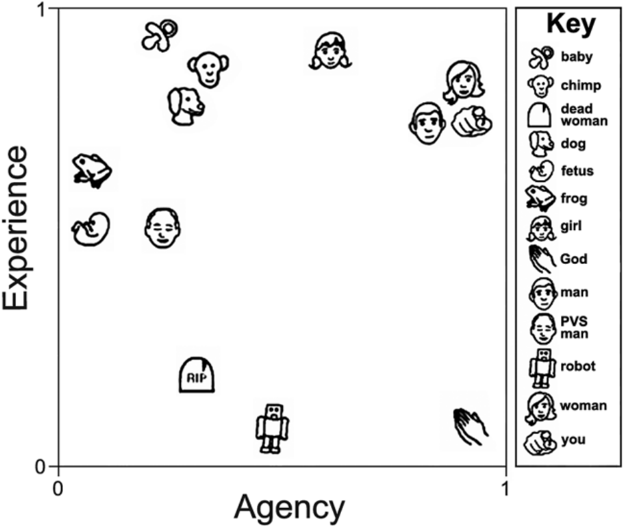
Participants compared the mental capacities of various human and nonhuman characters via online surveys. Factor analysis revealed two dimensions of mind perception, Experience (for example, capacity for hunger) and Agency (for example, capacity for self-control). The dimensions predicted different moral judgments but were both related to valuing of mind.
Overview
CoChat Summary
## TL;DR
This paper argues that mind perception is not a single continuum but instead has two dimensions: Experience and Agency. Using 2,399 completed web-based surveys, the authors found that these dimensions explain how people judge minds across 13 characters and are differentially related to moral judgments.
## Key findings
- A principal components factor analysis of correlations among 18 mental capacities yielded two factors with eigenvalues over 1.0: Experience (eigenvalue 15.85, explaining 88% of variance) and Agency (eigenvalue 1.46, explaining 8% of variance); the rotated solution explained 97% of rating variance.
- Experience loaded on 11 capacities: hunger, fear, pain, pleasure, rage, desire, personality, consciousness, pride, embarrassment, and joy; Agency loaded on 7 capacities: self-control, morality, memory, emotion recognition, planning, communication, and thought.
- Personal judgments tracked the dimensions differently: liking, saving from destruction, making happy, and perceiving a soul correlated with both dimensions, with r ranging from 0.38 to 0.72.
- Punishment judgments correlated more with Agency than Experience (r = 0.82 vs. r = 0.22, z = 2.86, P < 0.05), while avoidance of harm correlated more with Experience than Agency (r = 0.85 vs. r = 0.26, z = 2.10, P < 0.05).
## Methods
- Web-based Mind Survey design: respondents saw pairwise comparisons of 13 characters across 18 mental capacities or 6 personal judgments, using five-point scales for 78 comparisons per survey.
- Sample: about 3,400 survey launches, with 2,399 completed surveys analyzed; respondents ranged from 12 to 75 years old (mean 30.44, SD 12.27) and were 64% female.
- Main analysis: character means were computed, correlations across capacities were submitted to principal components factor analysis with varimax rotation, and factor scores were estimated via regression; additional analyses examined correlations with personal judgments and individual-difference variables using z-statistics.
## Limitations
- The paper states that the surveys were largely independent and that respondent data came from web recruitment through other psychology sites, which makes the sample a convenience sample rather than a random population sample.
- Evident from the text: the factor structure is based on self-selected web respondents and on pairwise judgments of preselected characters and capacities, so generalizability beyond the survey context is not directly tested.
- The paper notes that about 25% of launched surveys were not completed, indicating noncompletion/missing-data attrition.
Model-written summary. Check it against the paper before relying on it.
Integrity signals
Registry
Cites
Statistics
Figures
Verification
Claims the paper makes
0 Valid · 0 Not valid · 0 Not checked · 18 Own results and interpretations
A result the paper reports from its own data — it cites no other source for it, so there is none to check. The quote shows it is in the paper.
In the paper
“Characters ' factor scores on these dimensions (Fig. 1) reveal interesting features; for example, God was perceived as having much Agency but little Experience.”
- Also stated in: § Dimensions of Mind Perception · plain
“for example, God was perceived as having much Agency but little Experience.”
plain- Asserted: passes — The authors put it forward as true.
- Checkable: passes — It can be checked against evidence.
- Load-bearing: unclear — It is unclear whether the paper’s conclusions depend on it.
- Based: passes — The paper gives a reason why it holds.
- Also stated in: § Dimensions of Mind Perception · plain
A result the paper reports from its own data — it cites no other source for it, so there is none to check. The quote shows it is in the paper.
In the paper
“A factor we termed Experience (eigenvalue = 15.85) accounted for 88% of the variance and included 11 capacities (from highest loading): hunger, fear, pain, pleasure, rage, desire, personality, consciousness, pride, embarrassment, and joy.”
plain- Asserted: passes — The authors put it forward as true.
- Checkable: passes — It can be checked against evidence.
- Load-bearing: passes — The paper’s conclusions depend on it.
- Based: passes — The paper gives a reason why it holds.
A result the paper reports from its own data — it cites no other source for it, so there is none to check. The quote shows it is in the paper.
In the paper
“Of 234 z -statistics (13 characters × 9 individual difference variables × 2 factors), 23 were statistically significant.”
plain- Asserted: passes — The authors put it forward as true.
- Checkable: passes — It can be checked against evidence.
- Load-bearing: unclear — It is unclear whether the paper’s conclusions depend on it.
- Based: passes — The paper gives a reason why it holds.
A result the paper reports from its own data — it cites no other source for it, so there is none to check. The quote shows it is in the paper.
In the paper
“whereas desire to avoid harming ( ' If you were forced to harm one of these characters, which one would it be more painful for you to harm? ' ) correlated more with Experience ( r = 0.85) than Agency ( r = 0.26, z = 2.10, P < 0.05).”
plainstates an association- Asserted: passes — The authors put it forward as true.
- Checkable: passes — It can be checked against evidence.
- Load-bearing: passes — The paper’s conclusions depend on it.
- Based: passes — The paper gives a reason why it holds.
A result the paper reports from its own data — it cites no other source for it, so there is none to check. The quote shows it is in the paper.
In the paper
“The rotated solution accounted for all 18 capacities (extraction communalities ranged from 0.82 to 0.99), explained 97% of rating variance, and yielded two factors with eigenvalues over 1.0.”
plainstates an association- Asserted: passes — The authors put it forward as true.
- Checkable: passes — It can be checked against evidence.
- Load-bearing: passes — The paper’s conclusions depend on it.
- Based: passes — The paper gives a reason why it holds.
5 more claims
Create a free account to see all 18 claims and every source verdict.
- It may state two separate claims as one. 8
- Probably not a substantial claim. 1
Claims other papers make about this one
Each is checked against this paper’s own text: does it say what the citing paper says it does?
The source backs part of the claim, not all of it — or backs it for a different population, condition or comparison.
In the citing paper
“People also anthropomorphize a range of inanimate objects and animals (Kwan & Fiske, 2008; Gray, Gray, & Wegner, 2007).”
From Dehumanized Perception: A Psychological Means to Facilitate Atrocities, Torture, and Genocide? (2011) · cites this paper as Gray, Gray, & Wegner, 2007
Experimental — accuracy not yet measuredThe source backs part of the claim, not all of it — or backs it for a different population, condition or comparison.
In the citing paper
“work in social psychology has demonstrated that mental state attribution is not a unitary concept, but rather involves distinct and independent dimensions of ‘intelligence’ and ‘experience’.”
From The influence of mental state attributions on trust in large language models (2025) · cites this paper as [19]
Experimental — accuracy not yet measuredThe source backs part of the claim, not all of it — or backs it for a different population, condition or comparison.
In the citing paper
“Participants’ ratings for each of the 65 traits (Supplementary Fig. S1a) were reduced via a principal component analysis to two main dimensions, which together explained 58% of the variance (Supplementary Fig. S1b) and mapped onto previously identified dimensions of ‘experience’ (e.g. experiencing pleasure or feeling fearful) and ‘intelligence’ (e.g. knowing things or making choices; Gray et al. 2”
From Folk psychological attributions of consciousness to large language models (2024) · cites this paper as Gray et al. 2007
Experimental — accuracy not yet measuredThe cited source says what the claim attributes to it.
In the citing paper
“This dissociation is supported by factor analyses of ratings of a variety of mental states, which reveal two fundamental factors: agency, or the capacity for high-level reasoning and planning, and experience, or the capacity for sensations and emotions19”
From The influence of mental state attributions on trust in large language models (2025) · cites this paper as [19]
The cited source says what the claim attributes to it.
In the citing paper
“Other work has systematically explored the dimensions underlying mental state attributions to various agents, revealing a two-dimensional structure distinguishing between ‘Experience’ (i.e. the capacity to feel pain, fear, joy, or pride) and ‘Agency’ (i.e. the capacity to have self-control, morality, planning, or communication) that is reminiscent of the distinction between phenomenal and non-phen”
From Folk psychological attributions of consciousness to large language models (2024) · cites this paper as Gray et al. 2007
Statistics recomputed
Every reported test result, recomputed from its test statistic and degrees of freedom. A result shows as not adding up only once an independent check has confirmed it.
- Consistentz = 2.86reported p < .05 · recomputed p = .004
“z = 2.86, p < .05”
- Consistentz = 2.1reported p < .05 · recomputed p = .036
“z = 2.10, p < .05”
Self-check
Percentages, sums and reported differences re-computed from the paper’s own numbers.
Self-check results appear here once an independent check has confirmed them.
Citations
Cites
I.—COMPUTING MACHINERY AND INTELLIGENCE
TURING, A. M. (1950) · Mind · doi:10.1093/mind/lix.236.433 · Cited by 10,290
Does the chimpanzee have a theory of mind?
Premack, D., & Woodruff, G. (1978) · Behavioral and Brain Sciences · doi:10.1017/s0140525x00076512 · Cited by 8,743
Mindblindness: An Essay on Autism and Theory of Mind
Baron-Cohen, S. (1995) · doi:10.7551/mitpress/4635.001.0001 · Cited by 3,428
Dennett, D. C. (1996) · Medical Entomology and Zoology · Cited by 314
Research works printed but not linked: 1
- A. Turing, Mind59, 433 (1950).
Cited by
Items 2,101–2,200 of 2,340
AI Anthropomorphism and Athlete Engagement: The Critical Role of Human Coach AI Endorsement
Mingxiu, Y., & Jingwen, Y. (2025) · International Computer Conference on Wavelet Active Media Technology and Information Processing (ICCWAMTIP) · doi:10.1109/iccwamtip68645.2025.11352684
“…visual anthropomorphism (human-like avatars, facial features, gestures), auditory anthropomorphism (natural speech patterns, emotional intonation, conversational language), and behavioral anthropomorphism (responsive feedback, adaptive coaching strategies, apparent emotional reactions) [18], [19].”
Attributing Mind to Large Language Models: The Effect of Exposure and Individual Differences
Jacobs, O. L. E., Pazhoohi, F., & Kingstone, A. F. (2026) · International Journal of Social Robotics · doi:10.1007/s12369-025-01337-z
From Social Encounters to Sociotechnical Creative Collaboration: Perceiving and Engaging with Robots
Bonnardel, N., Marcon, M., Moták, L., & Belletier, C. (2026) · Springer eBooks · doi:10.1007/978-3-032-07753-0_9
Mays, K. K., & Novozhilova, E. (2026) · Human-Machine Communication · doi:10.30658/hmc.12.6 · Cited by 1
“Further work on mind perceptions showed that the Gray et al.’s ( 2007 ) two-dimensional structure might not fully capture people’s ontology of mental life.”
The Antecedents and Consequences of Interpersonal Objectification
任, 梓. (2026) · Advances in Psychology · doi:10.12677/ap.2026.162072
Daley, J. S., & Bodenhausen, G. V. (2026) · Social Cognition · doi:10.1521/soco.2026.44.1.19 · Cited by 1
Evaluating Biases for Robots Presenting with Perceived National Identities
Barfield, J. K. (2026) · International Journal of Human-Computer Interaction · doi:10.1080/10447318.2026.2617904 · Cited by 2
“…in HRI and using Caucasian Americans as participants, Eyssel and Loughnan (2013) asked participants to rate a robot that either resembled the participants’ in-group or resembled a social out-group on the decision of whether the robot had a mind (see also Gray et al., 2007; Kang & Park, 2021).”
How Dare You, iCub? Robots Face Harsher Judgments than Humans in Social Exclusion
Cocchella, F., Mongile, S., Pusceddu, G., Lastrico, L., Belgiovine, G., Tanevska, A., Andrighetto, L., Rea, F., & Sciutti, A. (2026) · International Journal of Social Robotics · doi:10.1007/s12369-025-01347-x
“● Agency and Experience of the robot [ 49 ]: 8-item scale on how much they believed the robot was able to plan and feel.”
Meyer, S., Müller, M. R., Sonnenmoser, A., Mandl, S., Strobel, A., & Gesmann-Nuissl, D. (2026) · Advances in Science, Technology & Innovation/Advances in science, technology & innovation · doi:10.1007/978-3-032-03488-5_22 · Cited by 1
Task context matters: Gender dynamics and robot abuse in task-based interactions
Bagchi, C., & de Graaf, M. M. A. (2026) · Computers in Human Behavior Artificial Humans · doi:10.1016/j.chbah.2026.100267
Hussain, A., & Singh, A. G. (2026) · EDPACS · doi:10.1080/07366981.2026.2638524 · Cited by 1
Not All Authors Are Equal: Moral Judgments of Plagiarism From AI and Human Sources
Brake, C., Lee, K., & Friedman, O. (2026) · Open Mind · doi:10.1162/opmi.a.336
“Theories of moral standing distinguish between agency (the ability to make decisions or grant consent) and experience (the capacity to feel pain or be harmed) (Gray et al., 2007).”
Xie, C., Ding, X., Xu, M., Jiao, C., Fu, S., Xin, J., & Feng, Y. U. (2026) · Topoi · doi:10.1007/s11245-026-10393-7 · Cited by 2
Robot Fashion: The Social Psychology of Robot Clothing
Cardenas, I. S., Kim, J.-H., Ohrn-McDaniel, L., Stevenson, K. R., Campbell, J. R., & Yeo, N. C. (2026) · ACM/IEEE International Conference on Human-Robot Interaction (HRI) · doi:10.1145/3757279.3788821 · Cited by 1
“[22, 24, 29–32 Trust-washing in high-stakes domains; sensory overload; unwanted touch.”
The Role of Agent’s Anthropomorphism in Shaping Phantom Costs
Lebrun, B., Bartneck, C., & Vonasch, A. J. (2026) · ACM/IEEE International Conference on Human-Robot Interaction (HRI) · doi:10.1145/3757279.3788659
“Finally, our findings may be confounded by participants’ perceptions of agent experience and agency [7], due to their role in mind attribution, anthropomorphism, and responsibility.”
Risk-Taking Behavior in Human-Robot Teams: Collaboration vs. Competition
Wille, K., Wiese, E., & Pérez-Osorio, J. (2026) · ACM/IEEE International Conference on Human-Robot Interaction (HRI) · doi:10.1145/3757279.3785562
“…setting of collaboration or competition and the outcome of the task also affect mind perception (i.e., degree to which internal states are being perceived in others), [13]; with different levels of mind perception in competitive and collaborative settings depending on the outcomes of a task [25].”
Children’s communication repairs with AI versus human partners
Li, Z., Thomas, T., Yu, C., & Xu, Y. (2026) · International Journal of Human-Computer Studies · doi:10.1016/j.ijhcs.2026.103800
Dictator Game Decisions with Robot Recipients
Dev, A., de Kleijn, R., & Mukherjee, S. (2026) · International Journal of Social Robotics · doi:10.1007/s12369-026-01385-z
Komatsu, T. (2026) · ACM/IEEE International Conference on Human-Robot Interaction (HRI) · doi:10.1145/3776734.3794351
Do We Really Need a Robot Here? Exploring Stakeholders’ Voices in Human-Robot Interaction
Cocchella, F. (2026) · ACM/IEEE International Conference on Human-Robot Interaction (HRI) · doi:10.1145/3776734.3794620
The Perception of Phantom Costs in HRI
Lebrun, B. (2026) · ACM/IEEE International Conference on Human-Robot Interaction (HRI) · doi:10.1145/3776734.3794621
The Awareness Attribution Scale: An Italian Validation Study
Gou, M. S., Marchesi, S., Wykowska, A., & Prescott, T. J. (2026) · ACM/IEEE International Conference on Human-Robot Interaction (HRI) · doi:10.1145/3776734.3794417
Kraus, J., Grünewald, N., Kapell, C., & Wessels, M. (2026) · ACM/IEEE International Conference on Human-Robot Interaction (HRI) · doi:10.1145/3776734.3794568
Álvarez, M. Á. R., Mara, M., & Siedl, S. M. (2026) · ACM/IEEE International Conference on Human-Robot Interaction (HRI) · doi:10.1145/3776734.3794442
The perception of phantom costs and personalized HRI
Lebrun, B., & Vonasch, A. J. (2026) · Elsevier eBooks · doi:10.1016/b978-0-443-29266-8.00003-7
AI social connectedness increases sensitivity to moral norms and tolerance of norm violationsPreprint
Ayad, R., & Plaks, J. E. (2026) · SSRN Electronic Journal · doi:10.2139/ssrn.6428318
Mitsuno, S., Ban, M., Ishiguro, H., & Yoshikawa, Y. (2026) · Computers in Human Behavior Artificial Humans · doi:10.1016/j.chbah.2026.100292 · Cited by 2
Vaes, J., & Paladino, M. P. (2026) · Springer eBooks · doi:10.1007/978-3-031-70581-6_210-1
Reappraising intuitions about consciousness
Kim, C., & Chong, S. C. (2026) · Frontiers in Psychology · doi:10.3389/fpsyg.2026.1747924
“…intelligences, and even objects— a phenomenon commonly referred to as theory of mind, mind perception, or anthropomor-phism (Colombatto and Fleming, 2024; Epley et al., 2007; Frith and Frith, 2005; Goldman, 2006; Gray et al., 2007; Knobe and Prinz, 2008; Leslie et al., 2004; Waytz et al., 2010).”
Jaeger, C. B., & Levin, D. T. (2026) · Consciousness and Cognition · doi:10.1016/j.concog.2026.104044
The philosophy of human-agent interaction
Matsui, T. (2026) · Digital Twin · doi:10.1080/27525783.2026.2646360
Chuan, S., Hu, Y., Chen, F., Lenz, S., Li, J., Feng, Y., Zeng, X., & Wu, M. (2026) · Journal of Social Cognition and Communication · doi:10.63802/jscc.v1.i1.291 · Cited by 3
From place to soul: The restorative function of place attachment on self-humanity
Wang, M., Liu, L., & Dang, J. (2026) · Journal of Environmental Psychology · doi:10.1016/j.jenvp.2026.103017
Deconstructing the moral circle: Obligations as the driver of moral expansion
Crimston, C. R., Rottman, J., Neldner, K., Wilks, M., & Young, T. (2026) · British Journal of Social Psychology · doi:10.1111/bjso.70073
“…plays a crucial role in determining moral status (Gray et al., 2012; Rottman et al., 2021; Waytz et al., 2010), future research could examine the relationships between dimensions of mind perception (e.g. agency and patiency; Gray et al., 2007) and various forms of moral worth (Piazza et al., 2014).”
Pham, P. N. N., Ha, Q.-A., & Bui, T. T. (2026) · The Journal of Marketing Theory and Practice · doi:10.1080/10696679.2026.2647075
Mind perception in two different cultural contexts : religious targets and food animals as examples
Tian, Q. (2014) · theses.fr (ABES) · doi:10.70675/a823bfcazb73dz4e53z9db2z01354d30238f
Gender differences in perception of sexual harassment
Studzińska, A. (2015) · theses.fr (ABES) · doi:10.70675/d90c56b6z5e17z40f8zafb5zf7812cc5ec6b · Cited by 10
Qiu, L., & Han, C.-W. (2026) · Journal of Digital Contents Society · doi:10.9728/dcs.2026.27.3.621 · Cited by 1
Hao, R., & Li, C. (2026) · International Journal of Hospitality Management · doi:10.1016/j.ijhm.2026.104700
Les causes et conséquences de la perception d’objectification au travail : Le cas du télétravail
Crône, L. (2022) · theses.fr (ABES) · doi:10.70675/0803ae87z1883z4464z9391ze4fd6d569238
Marchais, D. (2023) · theses.fr (ABES) · doi:10.70675/b7ec01fdzcf6dz45d4zb6bez5efd19f2220f · Cited by 5
“Matilda is Lazy Today”: How Mind Perceptions Trigger Relational Job Crafting With Industrial Robots
Goštautaitė, B., Liubertė, I., Reay, T., Bučiūnienė, I., Blaževičius, M. D., & Moniz, A. B. (2026) · Group & Organization Management · doi:10.1177/10596011261428932 · Cited by 1
“…may still perceive objects as having varying levels of agency and experience irrespective of their inherent characteristics (Epley et al., 2007; Gray et al., 2007), so that even objects without any human-like qualities — such as industrial robots — can be seen as having the ability to think or…”
InfluentialHamel, J. (2023) · theses.fr (ABES) · doi:10.70675/3e088396z8292z4f11z8e22z9bcf82e0981f · Cited by 1
Wang, B., Wu, Y., Li, R., Zeng, W., & Zhao, D. (2026) · Applied Sciences · doi:10.3390/app16083633 · Cited by 1
Rérolle, O., & Selimbegović, L. (2026) · Cognition · doi:10.1016/j.cognition.2026.106539
Durand, A., & Bègue, L. (2026) · Journal of Research in Personality · doi:10.1016/j.jrp.2026.104725
Park, Y., Song, H., & Kim, D. (2026) · CHI Conference Extended Abstracts on Human Factors in Computing Systems (CHI EA) · doi:10.1145/3772363.3799087
“82) [13], perceived argument strength (six items, 𝛼 = .”
Wischnewski, M., & Nguyen, D. (2026) · CHI Conference Extended Abstracts on Human Factors in Computing Systems (CHI EA) · doi:10.1145/3772363.3798547 · Cited by 2
“To that end, the scale by Gray et al. [12] captures mental state attribution via the two dimensions agency (seven items, e.g., "To what degree is ChatGPT capable of making plans and working toward goals?") and experience (eleven items, e.g., "To what degree is ChatGPT capable of feeling afraid or…”
Mind over matter: how anthropomorphism of virtual influencers affects online user engagement
Zhu, H., Liu, D., & Shen, R. (2026) · Behaviour and Information Technology · doi:10.1080/0144929x.2026.2657450
Kou, Y., Zhou, Q., Wang, J., & Yu, N. X. (2026) · CHI Conference on Human Factors in Computing Systems · doi:10.1145/3772318.3791151 · Cited by 1
“The visibility of human occupants can render the AV a more “moralized" entity, who deserves protection from harm [35, 36].”
Zhuo, S. (2026) · Behaviour and Information Technology · doi:10.1080/0144929x.2026.2657458
Do We Like AI to Show “Thinking”? Revealing the Effect of Chain-of-Thought on Human Perceptions
Gao, Z., & Sang, Y. (2026) · International Journal of Human-Computer Interaction · doi:10.1080/10447318.2026.2655929
侯, 佳. (2026) · Advances in Psychology · doi:10.12677/ap.2026.164196
Feeling powerful and less emotional: how sense of power reduces aversion to AI services
Ren, S., & Hu, Y. (2026) · Frontiers in Psychology · doi:10.3389/fpsyg.2026.1760538
Hard to Resist Quicker Decisions: How Response Time Shapes Conformity in Human–Robot Hybrid Groups
Lei, C., Pan, J., Gregory, L., Hasford, J., Zhang, P., & Tao, H. (2026) · Journal of Behavioral Decision Making · doi:10.1002/bdm.70082
Gu, Y., & Zhou, Y. (2026) · Journal of Advertising Research · doi:10.1080/00218499.2026.2651999
Huang, J., Zhu, G., Luo, Y., Lü, J., & Wang, Q. (2026) · Information Technology and People · doi:10.1108/itp-08-2024-0978 · Cited by 1
Alkhayat, A. (2026) · Language and Semiotic Studies · doi:10.1515/lass-2026-0021 · Cited by 1
“Gray et al. (2007) argue that social engagement depends on whether users perceive the AI as possessing agency or experience.”
Mao, K., Li, Z. Y., Xu, F., Yang, Y., Li, T., Li, J., & Zhu, L. (2026) · ACM Transactions on Human-Robot Interaction · doi:10.1145/3813111 · Cited by 1
“Further exploration could center on the mental states which mainly represented humanity, differed from those of fauna and flora, delving into matters of cognition, sociability, morality, personality, and agency [65].”
InfluentialChen, J., Luo, D., Wang, M., & Xu, K. (2026) · Current Psychology · doi:10.1007/s12144-026-09462-2
“Moral agents are associated with greater agency, whereas moral patients are associated with moral experience, including sensations of pain and pleasure related to moral rights (Gray et al., 2007; Gray, Young et al., 2012b; Tok et al., 2025).”
Zhao, R., Chen, Z., & Zhao, J. (2026) · Human Factors and Ergonomics in Manufacturing & Service Industries · doi:10.1002/hfm.70046 · Cited by 1
“Gray and Wegner used principal component analysis (PCA) to classify 18 cognitive abilities and proposed that mind perception should be divided into the dimensions of perceived agency and perceived experience (Gray et al. 2007).”
InfluentialHe, Y., Su, Y., Yang, Z., Tang, Y., Luo, Y., & Gu, R. (2026) · Journal of Advanced Research · doi:10.1016/j.jare.2026.05.010
Dehumanizing Prisoners: Remaining Sentence Duration Predicts the Ascription of Mind to PrisonersPreprint
Almaraz, S. M., Hugenberg, K., & Deska, J. C. (2020) · OSF Preprints (OSF Preprints)
Taking algorithmic (vs. human) advice reveals different goals to othersPreprint
Bahník, Š., Vranka, M. A., Efendić, E., & de Calseyde, P. P. F. M. V. (2024) · OSF Preprints (OSF Preprints)
The Shifting Sands of Context: AI-Supported Storytelling and Digital Content Creation
Jha, A. K., & Jha, S. (2026) · Advances in computational intelligence and robotics book series · doi:10.4018/979-8-3373-7021-7.ch011
Generative AI, large language models, and their agentic framing in news media
Nguyen, D., & Wischnewski, M. (2026) · AI & Society · doi:10.1007/s00146-026-03070-1 · Cited by 3
“As such, mental state attribution is based on the assumptions that the entity in focus can act (has agency) and has experiences (thoughts and feelings) (Gray et al. 2007).”
Expected cooperation in algorithms: evidence from the Stag Hunt game
Zhang, Y., Mulder, M., Kenemans, J. L., Aarts, H., & Liefooghe, B. (2026) · Journal of Psychology and AI · doi:10.1080/29974100.2026.2666266
Zhenyan, L., Li, H., & 袁勤俭 (2026) · Telematics and Informatics · doi:10.1016/j.tele.2026.102404 · Cited by 1
Bie, Y., Yao, Y., Yang, M., Feng, C., & Jiang, Y. (2026) · Journal of Research in Interactive Marketing · doi:10.1108/jrim-07-2025-0378
Deb, M., Mishra, S., & Jain, S. (2026) · Journal of Advertising Research · doi:10.1080/00218499.2026.2631892
Chen, Q., Chen, Y., Tu, Y., & Zhong, Z. (2026) · Accounting and Finance · doi:10.1111/acfi.70228
Xu, C., Niu, G., & Sun, X. (2026) · International Journal of Educational Technology in Higher Education · doi:10.1186/s41239-026-00594-w · Cited by 2
“This theory plays a crucial role in understanding and predicting individuals’ intentions and behavioral ten-dencies, significantly influencing how individuals perceive and interact with non-human entities (Gray et al., 2007).”
Comfort in the Digital Age: The Mechanism of AI Emotional Support
张, 熙. (2026) · Advances in Psychology · doi:10.12677/ap.2026.165252
Lee, H. (2026) · Journal of Digital Contents Society · doi:10.9728/dcs.2026.27.4.1093
Wow! you’re so cool! Does anthropomorphism affect brand coolness perceptions?
Tiwari, A. A., Kumar, R., & Singh, B. (2026) · Spanish Journal of Marketing - ESIC · doi:10.1108/sjme-09-2024-0262
The United States and Canada: The Psychology of Religion up to 2020
Jackson, J. C., Dillion, D., & Gray, K. J. (2026) · Cambridge University Press eBooks · doi:10.1017/9781108771122.032
Self-citationLei, Y., Shen, F., & Liu, Z. (2026) · Asia Pacific Journal of Marketing and Logistics · doi:10.1108/apjml-11-2025-2494
Human minds over AI: creative and retrospective strength in fashion
Min, Y., Baek, E., & Jin, B. E. (2026) · International Journal of Retail & Distribution Management · doi:10.1108/ijrdm-08-2025-0633
The Singular Effect of Expert Short Recommendation Lists
Mejía, V. D., & Guesmi, S. (2026) · Psychology and Marketing · doi:10.1002/mar.70173
“Unlike human recommendations, recommendations generated by algorithms or aggregators are more difficult to understand because algorithms and aggregators do not “think” (Gray et al. 2007) and are mindless (Kim and Duhachek 2020).”
Mi, Y., Wu, B., Wang, Y., & Du, Y. (2026) · Journal of theoretical and applied electronic commerce research · doi:10.3390/jtaer21060172
“The consumer’s lay mental model holds that AI cannot have emotion [8,17].”
InfluentialAugustine, A. A., & Eyssel, F. (2026) · International Journal of Social Robotics · doi:10.1007/s12369-026-01405-y · Cited by 1
“Previous studies suggest that robots are perceived as mindful regarding agency, but lesser so than humans [26 ].”
InfluentialLiu, M., Zhou, J., Nian, P., & Liu, S. (2026) · Human Resource Management · doi:10.1002/hrm.70082
Unpacking mentalising through its denial: Integrating the roles of perceptual and contextual cues
Vaes, J., Ruzzante, D., & Biasiotti, C. (2026) · European Review of Social Psychology · doi:10.1080/10463283.2026.2681343
A Process Account of Dehumanization: Extending the Framework with a Developmental Research Agenda
Vaes, J., Dapor, C., Meconi, F., Quadrelli, E., Roberti, E., Ruzzante, D., & Testa, A. (2026) · Behavioral Sciences · doi:10.3390/bs16060867 · Cited by 1
“…of what it means to be human, e.g., secondary emotions (J. Leyens et al., 2001), human nature or uniquely human characteristics (Haslam, 2006), and agency or experience traits (H. M. Gray et al., 2007) and gauge the extent to which these characteristics are denied or granted to some social targets.”
'Can AI Care?': Emotional Tone Analysis and Perceived Empathy in AI-Generated Health Advice
Irfan, M., Kärkkäinen, T., & Correia, A. (2026) · International Congress on Human-Computer Interaction, Optimization and Robotic Applications (ICHORA) · doi:10.1109/ichora69329.2026.11537121
“Building on the dimensions of mind perception [19], Liu and Sundar [20] claimed that while machines may be comfortably attributed agency (the capacity to think), attributing experiential capacity (i.e., the ability to feel) risks perceptions of inauthenticity.”
Alim, M. A., Quach, S., Thaichon, P., Weaven, S. K., & Nguyen, M. (2026) · Journal of Global Scholars of Marketing Science · doi:10.1080/21639159.2026.2667771
“By integrating Congruity Theory (Osgood & Tannenbaum, 1955) with Mind Perception Theory (Gray et al., 2007), we examined not only whether congruence enhances consumer engagement, but also whether this effect depends on the influencer’s ontological status (human vs. virtual).”
InfluentialThe Medusa Effect RevisitedPreprint
Takashima, K., & Kawabe, T. (2026) · SSRN Electronic Journal · doi:10.2139/ssrn.6900308
When AI Becomes ”You”: How Personalized AI Influences Mind Perception and Moral StandingPreprint
Li, C., Pretty, E. J., Hamari, J., Holopainen, J., & Xi, N. (2026) · SSRN Electronic Journal · doi:10.2139/ssrn.6910511
Alavijeh, M. R. K. (2026) · SSRN Electronic Journal · doi:10.2139/ssrn.6919240
What’s in a Name? Implications of AI Roles and Mind Perception for Human-AI Teams
Harris, A. M., Byun, C., & Larson, L. (2026) · Human Factors The Journal of the Human Factors and Ergonomics Society · doi:10.1177/00187208261457702
“…sub-dimensions: (1) agency, which encompasses abilities such as strategic thinking, reasoned action, and goal-setting and (2) conscious experience, which involves capacities for emotionality, feelings, and sensory experiences (H. M. Gray et al., 2007; K. Gray & Wegner, 2012; Waytz et al., 2014).”
Neural and behavioral dissociations of self-focused and other-focused incentives in trust
Salimi, Z., Bayat, D., Motamedi, H., Pour, F. Z. S., Vahabie, A., & Krüeger, F. (2026) · Cortex · doi:10.1016/j.cortex.2026.06.004 · Cited by 2
Developmental Trajectories in Children’s Anthropomorphism of Robotic, Living and Non-Living Agents
Sommer, K., Sweezy, S. E., & Wilks, M. (2026) · International Journal of Social Robotics · doi:10.1007/s12369-026-01404-z
“Other research has suggested using multiple dimensions to evaluate the mental lives of others, such as agency and experience [ 22 ] or mind-body-heart [ 23 ].”
Qi, Z., Yan, Y., & Ren, P. (2026) · Frontiers in Psychology · doi:10.3389/fpsyg.2026.1804847
Forstmann, M., & Sonder, I. (2026) · The Journal of Social Psychology · doi:10.1080/00224545.2026.2688327
Jump Into Comics: Can Reader-AI Interaction Boost Willingness to Pay
Yin, M. (2026) · International Journal of Human-Computer Interaction · doi:10.1080/10447318.2026.2688496
Interactions with artificial agents in virtual reality: A study of behaviors in game-based tasks
Ratajczyk, D., Kurowska, Z., Wasielewska, A., & Łupkowski, P. (2026) · International Journal of Human-Computer Studies · doi:10.1016/j.ijhcs.2026.103882
Grosswieser, H., Seeber, I., & Mara, M. (2026) · Annual Symposium on Human-Computer Interaction for Work (CHIWORK) · doi:10.1145/3808045.3808073
“…recent empirical evidence suggests that in actual interactions with AI systems, this distinction might blur as users intuitively make holistic attributions of mind, thereby interpreting it as a unidimensional construct [7, 121] rather than the two-dimensional structure proposed by Gray et al. [39].”
InfluentialMcLeod, L. J., Bhattacharya, O., Chen, X., & Hine, D. W. (2026) · Anthrozoös · doi:10.1080/08927936.2026.2683216
“intentionally and make decisions) (Callahan et al., 2021; Gray et al., 2007).”
Metadata
- Authors
- Gray, H. M., Gray, K., & Wegner, D. M.
- Affiliations
- Harvard University (US)
- Corresponding author
- Gray, Heather M.
- Venue
- Science
- Published
- 2007-02-02
- Volume
- 315
- Issue
- 5812
- Pages
- 619-619
- ISSN
- 0036-8075 (ISSN-L)
- 1095-9203
- OpenAlex
- W2131227926
- Cited by
- 2,342
- References
- 4
- Citations by year
- 2026: 359 · 2025: 326 · 2024: 249 · 2023: 220 · 2022: 198 · 2021: 156 · 2020: 157 · 2019: 107 · 2018: 91 · 2017: 86 · 2016: 96 · 2015: 66 · 2014: 52 · 2013: 44 · 2012: 45
- FWCI
- 10.81
- Type
- journal article
- Language
- en
- Open access
- closed
- Locations
- Science (publishedVersion)
- PubMed (publishedVersion)
- Funders
- National Institutes of Health (1f31mh071053-01)
- National Institute of Mental Health (MH-71053, MH 49127, R01MH049127)
- Topics
- Life Sciences › Neuroscience › Cognitive Neuroscience › Psychology of Moral and Emotional Judgment
- Social Sciences › Psychology › Social Psychology › Social Robot Interaction and HRI
- Social Sciences › Sociology and Political Science › Social and Intergroup Psychology
- Keywords
- mind perception, moral judgment, agency, experience, non-human animals, personification, moral status of animals, self-control, hunger
- MeSH terms
- Adolescent, Adult, Aged, Child, Emotions, Female, Humans, Male, Mental Processes, Middle Aged, Morals, Perception, Personality, Principal Component Analysis
About these checks
Registry, retraction, Cites and statistics results are computed, not judged, with one exception: a printed reference that no index lists is read once by a model before it counts as a citation error. Claims are extracted by a model and kept only when their quote appears verbatim in the text; each cited source is then checked, with a model’s help, for whether it says what the claim relies on. Those verdicts can be wrong — read the claim’s quote and the cited source before relying on one.
A language model drew the claims from the paper on 2026-09-28, under version 3 of the claim definition (model deepseek-v4.1-flash, prompt extract-v3).
A second model labelled each claim on 2026-09-28 (model jev-1.13-20260917, definition revision gold-guideline-v0.2).
Statistics and arithmetic are recomputed, not judged.
Confidence bands are shown only for fields calibrated on our annotated test set. None is calibrated yet, so no band is shown.
What counts as a claim ›How we measure confidence ›How we check this ›
Are you an author, or do you see a problem with this page? Request a review
Data sources
Bibliographic data: Semantic Scholar, OpenAlex, Crossref.
Contains information from the Semantic Scholar Academic Graph Datasets, made available under the ODC Attribution License (ODC-BY 1.0).
Semantic Scholar’s data is described in: Kinney, R., et al. (2023). The Semantic Scholar Open Data Platform. arXiv:2301.10140.
