

Dimensions of Mind Perception
The DOI matches its Crossref record; 4 of the 4 references it cites were found in a registry or an index.
Abstract
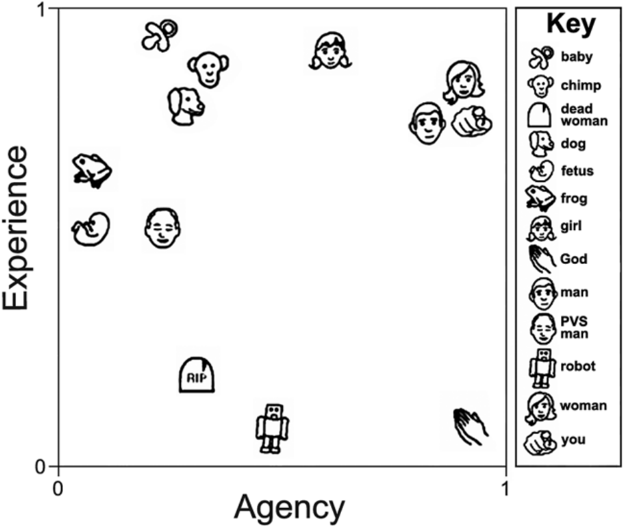
Participants compared the mental capacities of various human and nonhuman characters via online surveys. Factor analysis revealed two dimensions of mind perception, Experience (for example, capacity for hunger) and Agency (for example, capacity for self-control). The dimensions predicted different moral judgments but were both related to valuing of mind.
Overview
CoChat Summary
## TL;DR
This paper argues that mind perception is not a single continuum but instead has two dimensions: Experience and Agency. Using 2,399 completed web-based surveys, the authors found that these dimensions explain how people judge minds across 13 characters and are differentially related to moral judgments.
## Key findings
- A principal components factor analysis of correlations among 18 mental capacities yielded two factors with eigenvalues over 1.0: Experience (eigenvalue 15.85, explaining 88% of variance) and Agency (eigenvalue 1.46, explaining 8% of variance); the rotated solution explained 97% of rating variance.
- Experience loaded on 11 capacities: hunger, fear, pain, pleasure, rage, desire, personality, consciousness, pride, embarrassment, and joy; Agency loaded on 7 capacities: self-control, morality, memory, emotion recognition, planning, communication, and thought.
- Personal judgments tracked the dimensions differently: liking, saving from destruction, making happy, and perceiving a soul correlated with both dimensions, with r ranging from 0.38 to 0.72.
- Punishment judgments correlated more with Agency than Experience (r = 0.82 vs. r = 0.22, z = 2.86, P < 0.05), while avoidance of harm correlated more with Experience than Agency (r = 0.85 vs. r = 0.26, z = 2.10, P < 0.05).
## Methods
- Web-based Mind Survey design: respondents saw pairwise comparisons of 13 characters across 18 mental capacities or 6 personal judgments, using five-point scales for 78 comparisons per survey.
- Sample: about 3,400 survey launches, with 2,399 completed surveys analyzed; respondents ranged from 12 to 75 years old (mean 30.44, SD 12.27) and were 64% female.
- Main analysis: character means were computed, correlations across capacities were submitted to principal components factor analysis with varimax rotation, and factor scores were estimated via regression; additional analyses examined correlations with personal judgments and individual-difference variables using z-statistics.
## Limitations
- The paper states that the surveys were largely independent and that respondent data came from web recruitment through other psychology sites, which makes the sample a convenience sample rather than a random population sample.
- Evident from the text: the factor structure is based on self-selected web respondents and on pairwise judgments of preselected characters and capacities, so generalizability beyond the survey context is not directly tested.
- The paper notes that about 25% of launched surveys were not completed, indicating noncompletion/missing-data attrition.
Model-written summary. Check it against the paper before relying on it.
Integrity signals
Registry
Cites
Statistics
Figures
Verification
Claims the paper makes
0 Valid · 0 Not valid · 0 Not checked · 18 Own results and interpretations
A result the paper reports from its own data — it cites no other source for it, so there is none to check. The quote shows it is in the paper.
In the paper
“Characters ' factor scores on these dimensions (Fig. 1) reveal interesting features; for example, God was perceived as having much Agency but little Experience.”
- Also stated in: § Dimensions of Mind Perception · plain
“for example, God was perceived as having much Agency but little Experience.”
plain- Asserted: passes — The authors put it forward as true.
- Checkable: passes — It can be checked against evidence.
- Load-bearing: unclear — It is unclear whether the paper’s conclusions depend on it.
- Based: passes — The paper gives a reason why it holds.
- Also stated in: § Dimensions of Mind Perception · plain
A result the paper reports from its own data — it cites no other source for it, so there is none to check. The quote shows it is in the paper.
In the paper
“A factor we termed Experience (eigenvalue = 15.85) accounted for 88% of the variance and included 11 capacities (from highest loading): hunger, fear, pain, pleasure, rage, desire, personality, consciousness, pride, embarrassment, and joy.”
plain- Asserted: passes — The authors put it forward as true.
- Checkable: passes — It can be checked against evidence.
- Load-bearing: passes — The paper’s conclusions depend on it.
- Based: passes — The paper gives a reason why it holds.
A result the paper reports from its own data — it cites no other source for it, so there is none to check. The quote shows it is in the paper.
In the paper
“Of 234 z -statistics (13 characters × 9 individual difference variables × 2 factors), 23 were statistically significant.”
plain- Asserted: passes — The authors put it forward as true.
- Checkable: passes — It can be checked against evidence.
- Load-bearing: unclear — It is unclear whether the paper’s conclusions depend on it.
- Based: passes — The paper gives a reason why it holds.
A result the paper reports from its own data — it cites no other source for it, so there is none to check. The quote shows it is in the paper.
In the paper
“whereas desire to avoid harming ( ' If you were forced to harm one of these characters, which one would it be more painful for you to harm? ' ) correlated more with Experience ( r = 0.85) than Agency ( r = 0.26, z = 2.10, P < 0.05).”
plainstates an association- Asserted: passes — The authors put it forward as true.
- Checkable: passes — It can be checked against evidence.
- Load-bearing: passes — The paper’s conclusions depend on it.
- Based: passes — The paper gives a reason why it holds.
A result the paper reports from its own data — it cites no other source for it, so there is none to check. The quote shows it is in the paper.
In the paper
“The rotated solution accounted for all 18 capacities (extraction communalities ranged from 0.82 to 0.99), explained 97% of rating variance, and yielded two factors with eigenvalues over 1.0.”
plainstates an association- Asserted: passes — The authors put it forward as true.
- Checkable: passes — It can be checked against evidence.
- Load-bearing: passes — The paper’s conclusions depend on it.
- Based: passes — The paper gives a reason why it holds.
5 more claims
Create a free account to see all 18 claims and every source verdict.
- It may state two separate claims as one. 8
- Probably not a substantial claim. 1
Claims other papers make about this one
Each is checked against this paper’s own text: does it say what the citing paper says it does?
The source backs part of the claim, not all of it — or backs it for a different population, condition or comparison.
In the citing paper
“People also anthropomorphize a range of inanimate objects and animals (Kwan & Fiske, 2008; Gray, Gray, & Wegner, 2007).”
From Dehumanized Perception: A Psychological Means to Facilitate Atrocities, Torture, and Genocide? (2011) · cites this paper as Gray, Gray, & Wegner, 2007
Experimental — accuracy not yet measuredThe source backs part of the claim, not all of it — or backs it for a different population, condition or comparison.
In the citing paper
“work in social psychology has demonstrated that mental state attribution is not a unitary concept, but rather involves distinct and independent dimensions of ‘intelligence’ and ‘experience’.”
From The influence of mental state attributions on trust in large language models (2025) · cites this paper as [19]
Experimental — accuracy not yet measuredThe source backs part of the claim, not all of it — or backs it for a different population, condition or comparison.
In the citing paper
“Participants’ ratings for each of the 65 traits (Supplementary Fig. S1a) were reduced via a principal component analysis to two main dimensions, which together explained 58% of the variance (Supplementary Fig. S1b) and mapped onto previously identified dimensions of ‘experience’ (e.g. experiencing pleasure or feeling fearful) and ‘intelligence’ (e.g. knowing things or making choices; Gray et al. 2”
From Folk psychological attributions of consciousness to large language models (2024) · cites this paper as Gray et al. 2007
Experimental — accuracy not yet measuredThe cited source says what the claim attributes to it.
In the citing paper
“This dissociation is supported by factor analyses of ratings of a variety of mental states, which reveal two fundamental factors: agency, or the capacity for high-level reasoning and planning, and experience, or the capacity for sensations and emotions19”
From The influence of mental state attributions on trust in large language models (2025) · cites this paper as [19]
The cited source says what the claim attributes to it.
In the citing paper
“Other work has systematically explored the dimensions underlying mental state attributions to various agents, revealing a two-dimensional structure distinguishing between ‘Experience’ (i.e. the capacity to feel pain, fear, joy, or pride) and ‘Agency’ (i.e. the capacity to have self-control, morality, planning, or communication) that is reminiscent of the distinction between phenomenal and non-phen”
From Folk psychological attributions of consciousness to large language models (2024) · cites this paper as Gray et al. 2007
Statistics recomputed
Every reported test result, recomputed from its test statistic and degrees of freedom. A result shows as not adding up only once an independent check has confirmed it.
- Consistentz = 2.86reported p < .05 · recomputed p = .004
“z = 2.86, p < .05”
- Consistentz = 2.1reported p < .05 · recomputed p = .036
“z = 2.10, p < .05”
Self-check
Percentages, sums and reported differences re-computed from the paper’s own numbers.
Self-check results appear here once an independent check has confirmed them.
Citations
Cites
I.—COMPUTING MACHINERY AND INTELLIGENCE
TURING, A. M. (1950) · Mind · doi:10.1093/mind/lix.236.433 · Cited by 10,290
Does the chimpanzee have a theory of mind?
Premack, D., & Woodruff, G. (1978) · Behavioral and Brain Sciences · doi:10.1017/s0140525x00076512 · Cited by 8,743
Mindblindness: An Essay on Autism and Theory of Mind
Baron-Cohen, S. (1995) · doi:10.7551/mitpress/4635.001.0001 · Cited by 3,428
Dennett, D. C. (1996) · Medical Entomology and Zoology · Cited by 314
Research works printed but not linked: 1
- A. Turing, Mind59, 433 (1950).
Cited by
Items 2,201–2,300 of 2,340
Effects of skin tone on mind perception and occupational suitedness judgments
Ha, C., & Park, S. H. (2026) · Current Psychology · doi:10.1007/s12144-026-09639-9
“SES may also impact perceptions of individuals’ experience (Gray et al., 2007).”
Competence and Warmth in Robots: Exploring their Relationship and the Primacy Role
Zhu, C., Su, R., & Zuo, B. (2026) · International Journal of Social Robotics · doi:10.1007/s12369-026-01414-x · Cited by 1
“According to mind perception theory, robots are typically attributed with a degree of agency but are perceived as lacking experience [47, 48].”
Shimoyama, T., Kume, Y., Yamagata, M., Takahashi, H., & Nakata, Y. (2026) · PLoS ONE · doi:10.1371/journal.pone.0350612
“They are rated lower than adult humans in terms of Agency and Experience, with a particularly pronounced deficit in Experience [8].”
InfluentialKim, T., Lee, C. H., Wu, Y., Jang, J., Kwon, H., Song, H., Lee, J.-G., Park, N., & Lee, K. M. (2026) · Media Psychology · doi:10.1080/15213269.2026.2679123
How Probing for Problems and Bias Affects Perceptions of AI Chatbot Trustworthiness
Tolsdorf, J., Luo, A. F., Kodwani, M., Eum, J., Sharif, M., Mazurek, M. L., & Aviv, A. J. (2026) · ACM Conference on Fairness, Accountability, and Transparency (FAccT) · doi:10.1145/3805689.3806751 · Cited by 1
“These attributions of mind divide into agency —i.e., capacities for reasoning and planning (e.g., self-control, morality, memory, communication, thought)—and experience —sensations and emotions (e.g., hunger, fear, pain, pleasure, consciousness) [31].”
Uğur, N. G., & Bayram, İ. (2026) · Frontiers in Psychiatry · doi:10.3389/fpsyt.2026.1839044
“Affective responses to AI are often shaped by perceived agency, humanness, authenticity, and control (6, 13, 25).”
The genuine problem of consciousness
Jack, A. I., Robbins, P., Friedman, J. P., & Roepstorff, A. (2026) · Elsevier eBooks · doi:10.1016/b978-0-443-29258-3.00037-9 · Cited by 1
Sedefoglu, D., Ohly, S., & Schmelz, J. (2026) · Computers in Human Behavior · doi:10.1016/j.chb.2026.109096 · Cited by 1
Wei, S., Chen, D., Yu, S., Ren, Z., An, W., Liu, Z., & Pusetso, T. J. (2026) · International Journal of Human-Computer Interaction · doi:10.1080/10447318.2026.2693617
Katz, J. E. (2026) · Frontiers in Communication · doi:10.3389/fcomm.2026.1895848 · Cited by 1
The Relationship Between Personal Pronouns Used by AI and AI Trust of Users
Wang, D., Fu, Y., Li, L., & Song, J. (2026) · International Journal of Human-Computer Interaction · doi:10.1080/10447318.2026.2694630
Designing for Label-Bias Mitigation in AI-Generated Art: Synart’s Audience-to-Creator Feedback Loop
Xiao, L., Duan, Y., Chen, X., & Zhang, Y. (2026) · Lecture notes in computer science · doi:10.1007/978-3-032-30846-7_13
Humanizing the frontlines: individuating connections reduce customer mistreatment
Trinh, E. N., & Cunningham, J. L. (2026) · Organizational Behavior and Human Decision Processes · doi:10.1016/j.obhdp.2026.104510
Peng, R. X. (2026) · Computers in Human Behavior · doi:10.1016/j.chb.2026.109119
Şahin, M., Gültekin, M. H., Erdoğdu, F., & Cesur, S. (2026) · International Journal of Human-Computer Interaction · doi:10.1080/10447318.2026.2719186
Wang, P., Xie, Q., Li, H., et al. (2026) · Information Communication & Society · doi:10.1080/1369118x.2026.2699262
Transdiagnostic Assessment of Mental Health and Sleep Registry: Protocol for a Cross-Sectional Study
Ishii, A., Muroi, K., Noma, H., Nishimura, M., Maeda, S., Furutani, K., Machida, M., Lee, S., Oi, H., Koike, M., et al. (2026) · ALPHA PSYCHIATRY · doi:10.31083/ap51115
“…toward Safety, Support, Understanding, and Risk for Human-AI therapists (ASSURE; two parallel scales: ASSURE-HT and ASSURE-AI), AI romance ethics, Anthropomorphism [83], Fulfilling emotional needs [84,85], Relationship Au-thenticity (RA) [ 86], and Desire for Real-World Relation-ships (DRR) [ 86].”
Substratism: Conceptualizing and measuring moral bias against AI
Ladak, A., Pauketat, J. V. T., Anthis, J. R., Loughnan, S., & Wilks, M. (2026) · Computers in Human Behavior · doi:10.1016/j.chb.2026.109120 · Cited by 3
Shen, W., & Liu, Y. (2026) · Lecture notes in computer science · doi:10.1007/978-3-032-29903-1_28
Sun, C., Li, X. D., & Meng, X. (2026) · Journal of theoretical and applied electronic commerce research · doi:10.3390/jtaer21070215 · Cited by 1
“Theoretically, anthropomorphism involves per-ceiving humanlike qualities or mind in nonhuman agents [52,53].”
Diversity Ideologies and the Subtle Dehumanization of Indigenous Peoples in the Philippines
Bernardo, A. B. I. (2026) · Behavioral Sciences · doi:10.3390/bs16071142
“…even be more pervasive yet subtle forms of dehuman-ization, such as the tendency to downplay the capacity of an outgroup to feel, think and plan (Gray et al., 2007) or demeaning outgroup members’ drive to meet more complex psychological needs (Schroeder & Epley, 2020); in both cases,…”
Song, W., Wei, S., Li, Z., Deng, S., & Du, Y. (2026) · Journal of theoretical and applied electronic commerce research · doi:10.3390/jtaer21070219
“Mind perception, also known as human-izing or mentalizing, is a cognitive process that helps individuals infer others’ motives, beliefs, and intentions [48,49].”
Service robot led by Mr. John: the mere disclosure human leader effect
Zhu, D., & Zhang, W. Q. (2026) · European Journal of Marketing · doi:10.1108/ejm-10-2024-0844
When AI designs look simple: Perceived luxuriousness as a driver of consumers’ willingness to pay
Xu, T., Zhou, X., & Sheng, X. (2026) · Journal of Retailing and Consumer Services · doi:10.1016/j.jretconser.2026.104975
Bodily Data Control, Human Agency Threats, and Job Insecurity
Killoran, J., Park, A., Manseau, J., & Kietzmann, J. (2026) · Journal of Management · doi:10.1177/01492063261457329
Xie, Z., Wen, F., Lujun, S., Liu, C., & Yang, L. (2026) · Personality and Social Psychology Bulletin · doi:10.1177/01461672261464676
Exploring the Attribution of Essentially Human Traits Across Elements of Nature
Moreno-Gata, S., García, J. A., & Aragonés, J. I. (2025) · Social Psychology · doi:10.1027/1864-9335/a000594
Liu, F. (2026) · Asia Pacific Journal of Marketing and Logistics · doi:10.1108/apjml-12-2025-2605
Tanaka, K., Iio, T., & Shiomi, M. (2026) · Computers in Human Behavior Artificial Humans · doi:10.1016/j.chbah.2026.100361
Imaginary companions: A meta-analytic investigation on anthropomorphism and chronic loneliness
Durand, A., & Bègue, L. (2026) · Acta Psychologica · doi:10.1016/j.actpsy.2026.107436
The Psychology of Artistic Authenticity
Dillion, D., Hester, N., Bigman, Y., Smith, M. M., Court, J., Sarkar, A., & Gray, K. J. (2026) · Empirical Studies of the Arts · doi:10.1177/02762374261463519
Self-citationOhira, H. (2026) · Journal of the Robotics Society of Japan · doi:10.7210/jrsj.44.577
Kurniawan, N. A., Hanafi, H., Sona, D., Fitriyah, F. K., Ralianti, D. D., Syarifudin, S., & Abdillah, M. (2026) · Journal of Environmental Psychology · doi:10.1016/j.jenvp.2026.103136
Chen, L., Jin, C., & Wang, L. (2026) · Transportation Research Part F Traffic Psychology and Behaviour · doi:10.1016/j.trf.2026.103737
Liu, H., Dong, E., & Li, J.-Y. (2026) · International Journal of Business Communication · doi:10.1177/23294884261462485
Johnson, D. S., Chun, S. Y., Pandey, S., & Ahmed, G. (2026) · Informatics · doi:10.3390/informatics13070116
“Additionally, studies on perceptions of bots and computational systems suggest that AI is perceived as having limited emotional capacity, including reduced ability to feel, sense, or exercise self-control [50,53,54].”
Hu, Q., & Pan, Z. (2026) · Journal of theoretical and applied electronic commerce research · doi:10.3390/jtaer21070234
“Second, following Gray et al. [17], this study examined the underlying mechanisms of how machine minds lead to the quadratic effect on user engagement by categorizing machine minds into agentic and experiential minds.”
InfluentialTell me the truth: Consumer responses to feedback solicitation with robots versus humans
Choi, S., Wan, L. C., & Mattila, A. S. (2026) · Tourism Management · doi:10.1016/j.tourman.2026.105501
Mo, L., Zhu, N., Wu, Y., & Deng, F. (2026) · Journal of Retailing and Consumer Services · doi:10.1016/j.jretconser.2026.104994
Rabinovitch, A., Meler, K., & Tołopiło, A. (2026) · SSRN Electronic Journal · doi:10.2139/ssrn.7156838 · Cited by 1
Kim, M., Kim, M., & Song, H. (2026) · ACM Conference on Conversational User Interfaces (CUI) · doi:10.1145/3816046.3816291
Bieberstein, A., Schnitzer, B. L., Gampe, S., & Korn, O. (2026) · ACM Conference on Conversational User Interfaces (CUI) · doi:10.1145/3816046.3816221 · Cited by 1
“Psychological perspectives on social perception further suggest that judgments of responsiveness and support depend on broader attributions of intentionality and relational sensitivity [17, 33].”
Miederer, S., Gelbrich, K., Roschk, H., & Hosseinpour, M. (2026) · Psychology and Marketing · doi:10.1002/mar.70216 · Cited by 2
Wang, S., Sun, X., Ni, S., Wu, M., & Hu, K. (2026) · Scientific Reports · doi:10.1038/s41598-026-61031-6 · Cited by 3
Moral judgments toward robots in Japanese preschool children
Ikeda, S. (2026) · Cognitive Development · doi:10.1016/j.cogdev.2026.101755
Feeling Vulnerable With My AI Companion: Examining Well‐Being in Human‐AI Relationships
Abboud, L., Pitardi, V., & Marriott, H. R. (2026) · Psychology and Marketing · doi:10.1002/mar.70230 · Cited by 5
Juquelier, A., Hazée, S., Vaerenbergh, Y. V., & Poncin, I. (2026) · Journal of the Academy of Marketing Science · doi:10.1007/s11747-026-01177-x · Cited by 1
Gong, T., & Huang, Y. (2026) · Journal of Retailing and Consumer Services · doi:10.1016/j.jretconser.2026.104998
Liu, F., Chen, X., & Xu, K. (2026) · Annals of the International Communication Association · doi:10.1093/anncom/wlag033 · Cited by 1
Karimkhan, F., Feng, Y., & Ham, J. (2026) · International Journal of Human-Computer Interaction · doi:10.1080/10447318.2026.2702718
From anthropomorphism to prosocial intention: a PLS-SEM and fsQCA study of virtual influencers
Su, L., Pan, X.-L., & Duan, X. (2026) · Frontiers in Psychology · doi:10.3389/fpsyg.2026.1899105
“FrontiersinPsychology 03 frontiersin.org experience and by demonstrating that these dimensions shape moral judgments and social responses (Gray et al., 2007; Haggard and Tsakiris, 2009; Geiselmann et al., 2023).”
The human-robot interaction scale database
Saad, L., Roesler, E., Phillips, E., & Trafton, J. G. (2026) · Frontiers in Robotics and AI · doi:10.3389/frobt.2026.1846413
Is a robot a tool or an agent?
Murphy, R. R. (2026) · Science Robotics · doi:10.1126/scirobotics.aej9331
Making emotional transparency transparent
Facchin, M., & Zanotti, G. (2026) · Phenomenology and the Cognitive Sciences · doi:10.1007/s11097-026-10188-6
Salam, M. A., Leong, V. S., Muhamad, N., & Rayun, S. M. N. (2026) · Advances in computational intelligence and robotics book series · doi:10.4018/979-8-2600-2977-0.ch008
Attribution of consciousness: Infants, animals, and artificial intelligence
Chiarella, S. G., Gallagher, S., & Raffone, A. (2026) · Elsevier eBooks · doi:10.1016/b978-0-443-29258-3.00086-0
Luo, Y., Liu, Y., Zhang, J., & Wang, X. (2026) · Journal of Applied Social Psychology · doi:10.1111/jasp.70080
Qi, X., Huang, Z., & Chang, W. (2026) · Tourism Management · doi:10.1016/j.tourman.2026.105509
Chen, S., Meng, L. Y. C., Tu, T., Wang, Y., & Huhmann, B. A. (2026) · Research Square · doi:10.21203/rs.3.rs-10562955/v1
Why Does AI Dance “Featuring” Audrey Hepburn Not Feel “Authentic”?
Kim, J., Jung, S., & Choi, H. (2026) · The Journal of Dance Society for Documentation & History · doi:10.26861/sddh.2026.81.97
Ramadhan, R., & Purwanegara, M. S. (2026) · Cogent Business & Management · doi:10.1080/23311975.2026.2710503
Park, H., & Lee, K. (2026) · Journal of Business Research · doi:10.1016/j.jbusres.2026.116453 · Cited by 1
How users interpret AI-assisted reviews: Disclosure design and authenticity perceptions
Kim, H., & Lee, S. W. (2026) · Computers in Human Behavior · doi:10.1016/j.chb.2026.109148 · Cited by 2
The Embodied Hijack: when Pleistocene minds meet disembodied artificial intelligence
Macrine, S. L. (2026) · Frontiers in Psychology · doi:10.3389/fpsyg.2026.1889386
Wang, E. J., Berthon, P. R., & John, J. (2026) · Journal of Services Marketing · doi:10.1108/jsm-12-2025-0888 · Cited by 1
Altered neural processing of evaluative feedback from presumed conscious AI
Peters, A., Ohlsen, M., Bölte, J., Arkun, S., Brockhoff, L., Straube, T., & Schindler, S. (2026) · iScience · doi:10.1016/j.isci.2026.117175 · Cited by 1
Is “Consciousness” a folk psychological concept?
Barcellos, V. M. (2026) · Phenomenology and the Cognitive Sciences · doi:10.1007/s11097-026-10197-5
The Physical, Emotional, and Autonomous Anthropomorphism of Service Chatbots
Hu, Y., Açikgöz, F., & Yu, S. (2026) · Psychology and Marketing · doi:10.1002/mar.70255 · Cited by 2
Patient Objectification in Psychiatry
Sakakibara, E. (2026) · Journal of Bioethical Inquiry · doi:10.1007/s11673-026-10600-5
Pontes, V., Goyeneche, D., Pontes, N., & Leszczyc, P. T. L. P. (2026) · European Journal of Marketing · doi:10.1108/ejm-03-2025-0198
A recognition-based framework for human–robot relationships
Hoshino, J. (2026) · Computers in Human Behavior Artificial Humans · doi:10.1016/j.chbah.2026.100382
Zhang, L., Fang, C., Wu, Y., Yuan, Y., Wang, S. J., Luo, S., & Yoon, S. (2026) · Computers in Human Behavior · doi:10.1016/j.chb.2026.109153
Niszczota, P., & Antoniou, E. (2026) · Journal of Experimental Social Psychology · doi:10.1016/j.jesp.2026.104991 · Cited by 1
Compensating the body with biographies: The persuasion code of destination virtual influencers
Xue, J., & Han, W. (2026) · Journal Of Vacation Marketing · doi:10.1177/13567667261478321
Ginguené, S., Bourguignon, D., & Préau, M. (2026) · Journal of Police and Criminal Psychology · doi:10.1007/s11896-026-09841-2
Wang, X., & Zhang, Y. (2026) · European Journal of Marketing · doi:10.1108/ejm-01-2025-0039
How chatbot eating-action language shapes food purchase responses?
Chen, J., Li, G., Chen, J., Wang, S., & Ke, W. (2026) · Journal of Retailing and Consumer Services · doi:10.1016/j.jretconser.2026.105056
The impact of generative AI on news believability: A mind perception perspective
Liu, Y., Zeng, J., Liu, S., & 卢, 晗. (2026) · Information & Management · doi:10.1016/j.im.2026.104418
Ischen, C., Wang, E., & Smit, E. G. (2026) · Human-Machine Communication · doi:10.30658/hmc.13.2 · Cited by 1
The Passenger’s Dilemma: Rethinking Consumer Responsibility for Autonomous Machine Behavior
Teychenié, T., Cloarec, J., Kuhn, M. M., & Meyer‐Waarden, L. (2026) · Journal of Business Ethics · doi:10.1007/s10551-026-06432-3
Can bad guys count as happy? The graded moralization of happiness across general and episodic levels
Li, J., Qi, H., Long, J., & Luo, Y. (2026) · Journal of Experimental Social Psychology · doi:10.1016/j.jesp.2026.104996
AI models as consciousness attributors: how LLMs ascribe consciousness to other agents
Kang, B., & Kim, C.-E. (2026) · Frontiers in Psychology · doi:10.3389/fpsyg.2026.1926286
Seeing humans in technology: The antecedents, boundaries and consequences of AI anthropomorphism
Kim, S., & Liu, J. (2026) · Current Opinion in Psychology · doi:10.1016/j.copsyc.2026.102397 · Cited by 1
Zeng, R. (2026) · Social Sciences and Humanities · doi:10.63313/ssh.9129
Yao, Q., Tang, M., Zeng, K. J., Yang, M. X., & Wang, C. L. (2026) · Asia Pacific Journal of Marketing and Logistics · doi:10.1108/apjml-12-2025-2751
Kong, S. (2026) · International Journal of Business Communication · doi:10.1177/23294884261478255
Park, K., Xu, D.-Q., & Xie, J.-M. (2026) · Journal of Public Relations Research · doi:10.1080/1062726x.2026.2722941
Hoang, L. C., Uyen, N. T. M., Nguyen, M. T., & Pham, H. M. L. (2026) · Journal of Promotion Management · doi:10.1080/10496491.2026.2724938
“Analyzed through Mind Perception Theory (Gray et al., 2007), this indicates that the agency-experience asymmetry long attributed to AI, judged as highly capable but not genuinely experiencing, is a comparatively fixed feature of how consumers categorize AI-generated content (Epley & Waytz, 2010;…”
InfluentialZheng, X., Li, Y., & Liu, Q. (2026) · Human Resource Management · doi:10.1002/hrm.70091
Anthropomorphic cueing, social evaluation, and threat in stated willingness to collaborate with AI
Yan, D. (2026) · Frontiers in Psychology · doi:10.3389/fpsyg.2026.1896807
“Observers commonly distinguish experience, which concerns a capacity to feel, from agency, which concerns a capacity to plan and act (Gray et al., 2007; Waytz et al., 2010).”
Chen, L., Li, X., Zhang, J., Zhang, M., & Liu, S. (2026) · Journal of Hospitality and Tourism Management · doi:10.1016/j.jhtm.2026.101545 · Cited by 1
A series of replication attempts of experimental awe-induction effects
Graziosi, M., Chirico, A., Clifton, J. D. W., Rohde, J. S., Chhabra, R., & Yaden, D. B. (2026) · PLoS ONE · doi:10.1371/journal.pone.0356728
“Gray et al.‘s (2007) Mind Perception Scale [40] was used to measure mind perception in this study.”
Toudjui, S., Tang, J., Akhter, H., Cho, E., Côté, É., & Plaks, J. E. (2026) · Discover Artificial Intelligence · doi:10.1007/s44163-026-02150-x · Cited by 1
“Trust has traditionally been studied in interpersonal relationships, whereby the trustee is assumed to possess agency and intentionality [25], as well as characteristics such as moral responsibility [26] and the capacity to reciprocate trust [27].”
How they collaborate matters: collaboration modes and task fit in human-AI recommendations
Shao, B., Chen, Y., Teng, H., & He, X. (2026) · Journal of Retailing and Consumer Services · doi:10.1016/j.jretconser.2026.105090
Zeng, X., Wu, Z., Feng, J., et al. (2026) · PsyCh Journal · doi:10.1002/pchj.70122
“Moral judgments are more closely tied to welfare, harm, vulnerability, and perceived sentience (Caviola et al. 2022; Cushman 2015; Gray et al. 2007).”
Beyond Text: Embodiment and Robots
Perry, A., & Cameron, C. D. (2026) · Cambridge University Press eBooks · doi:10.1017/9781009639057.016
Yan, D. (2026) · Frontiers in Psychology · doi:10.3389/fpsyg.2026.1827795
“Anthropomorphic inference is shaped by agent knowledge, effectance, and sociality motives (Epley et al., 2007), while mind perception differentiates attributed agency from attributed experience (Gray et al., 2007).”
Anticipating Children’s Beliefs about Artificial Empathy
Reinecke, M. G. (2026) · Cambridge University Press eBooks · doi:10.1017/9781009639057.022
Metadata
- Authors
- Gray, H. M., Gray, K., & Wegner, D. M.
- Affiliations
- Harvard University (US)
- Corresponding author
- Gray, Heather M.
- Venue
- Science
- Published
- 2007-02-02
- Volume
- 315
- Issue
- 5812
- Pages
- 619-619
- ISSN
- 0036-8075 (ISSN-L)
- 1095-9203
- OpenAlex
- W2131227926
- Cited by
- 2,342
- References
- 4
- Citations by year
- 2026: 359 · 2025: 326 · 2024: 249 · 2023: 220 · 2022: 198 · 2021: 156 · 2020: 157 · 2019: 107 · 2018: 91 · 2017: 86 · 2016: 96 · 2015: 66 · 2014: 52 · 2013: 44 · 2012: 45
- FWCI
- 10.81
- Type
- journal article
- Language
- en
- Open access
- closed
- Locations
- Science (publishedVersion)
- PubMed (publishedVersion)
- Funders
- National Institutes of Health (1f31mh071053-01)
- National Institute of Mental Health (MH-71053, MH 49127, R01MH049127)
- Topics
- Life Sciences › Neuroscience › Cognitive Neuroscience › Psychology of Moral and Emotional Judgment
- Social Sciences › Psychology › Social Psychology › Social Robot Interaction and HRI
- Social Sciences › Sociology and Political Science › Social and Intergroup Psychology
- Keywords
- mind perception, moral judgment, agency, experience, non-human animals, personification, moral status of animals, self-control, hunger
- MeSH terms
- Adolescent, Adult, Aged, Child, Emotions, Female, Humans, Male, Mental Processes, Middle Aged, Morals, Perception, Personality, Principal Component Analysis
About these checks
Registry, retraction, Cites and statistics results are computed, not judged, with one exception: a printed reference that no index lists is read once by a model before it counts as a citation error. Claims are extracted by a model and kept only when their quote appears verbatim in the text; each cited source is then checked, with a model’s help, for whether it says what the claim relies on. Those verdicts can be wrong — read the claim’s quote and the cited source before relying on one.
A language model drew the claims from the paper on 2026-09-28, under version 3 of the claim definition (model deepseek-v4.1-flash, prompt extract-v3).
A second model labelled each claim on 2026-09-28 (model jev-1.13-20260917, definition revision gold-guideline-v0.2).
Statistics and arithmetic are recomputed, not judged.
Confidence bands are shown only for fields calibrated on our annotated test set. None is calibrated yet, so no band is shown.
What counts as a claim ›How we measure confidence ›How we check this ›
Are you an author, or do you see a problem with this page? Request a review
Data sources
Bibliographic data: Semantic Scholar, OpenAlex, Crossref.
Contains information from the Semantic Scholar Academic Graph Datasets, made available under the ODC Attribution License (ODC-BY 1.0).
Semantic Scholar’s data is described in: Kinney, R., et al. (2023). The Semantic Scholar Open Data Platform. arXiv:2301.10140.
